IBS
Department of Human Resources and Organisational Behaviour
Human Resources Management Practices in Micro-firms
in the Enterprise Resource Planning Selling and Consulting Sector
Ana Cláudia Moreira Rodrigues
Thesis specially presented for the fulfilment of the degree of Doctor in Human Resources Management and Development
Supervisor: António Caetano, Full Professor
Instituto Universitário de Lisboa, ISCTE-IUL
Human Resources Management Practices in Micro-firms
in the Enterprise Resource Planning Selling and Consulting Sector
Ana Cláudia Moreira Rodrigues
Tese Especialmente elaborada para obtenção do grau de Doutor em Gestão e Desenvolvimento de Recursos Humanos
Composição do Júri
Presidente do Júri
Doutora Ana Margarida Soares Lopes Passos, Professora Associada do ISCTE-IUL
Vogais
Doutora Maria Teresa Pereira, Responsável do Centro de Estudos de Comportamento Organizacional do Instituto Superior de Gestão Bancária
Doutor Francisco José Santos Cesário, Professor Auxiliar do ISPA – Instituto Universitário de Ciências Psicológicas, Sociais e da Vida
Doutora Maria de Lurdes Cardina Pedro, Professora Adjunta Convidada do Instituto Politécnico de Setúbal
Doutor José Gonçalves das Neves, Professor Associado c/Agregação do
Departamento de Recursos Humanos e Comportamento Organizacional do ISCTE-IUL
Doutor António Caetano, Professor Catedrático do Departamento de Recursos Humanos e Comportamento Organizacional do ISCTE-IUL (Orientador)
Instituto Universitário de Lisboa, ISCTE-IUL
December 2017Ao meu pai, que partiu durante este processo Ao meu tio, o maior entusiasta de todos Aos donos das micro-empresas, que me fascinam e inspiram
Agradecimentos
Este foi um longo caminho. Apesar de dizerem que o doutoramento é um trabalho solitário é também de solidariedade e amizade.
Começo por agradecer ao meu orientador Professor António Caetano que sabe sempre como resolver os problemas difíceis e é capaz de tornar uma situação aparentemente impossível numa solução clara e óbvia, como se não houvesse dúvidas. Foi um privilégio conhecê-lo mais de perto e conviver com a sua humanidade e elegância.
À minha colega e amiga Helena Martins e à professora Helena Carvalho pelo apoio na análise estatística.
Aos empresários que participaram deste projeto, nomeadamente, aos que participaram dos estudos qualitativos, pela sua disponibilidade e generosidade na partilha de informação. Às
software houses PHC, SAGE e Primavera pela facilitação das bases de dados de parceiros. Ao
Dr. Nelson Lopes da Assoft (Associação Portuguesa de Software) pelas suas orientações na pesquisa para a caracterização do setor. Às pessoas que me ajudaram a recolher dados. No P.Porto, na ESEIG, ao Flávio e Lino pela compreensão em tantos momentos, aos meus colegas de departamento que comigo transitaram e trabalham no ISCAP: Viviana, Dora, Salvador, Ana Luisa, Ana Isabel, Marlene, Eva e Rui, por serem quem são, por gostarem tanto de RH como eu e por todo o apoio.
Aos meus amigos da ESTG: Marisa, Catarina, Vitor, Amélia, Vanda e Alexandra, por todos os momentos de diversão e de trabalho que partilhámos ao longo destes anos.
Aos meus amigos de sempre Coca, Nini, Sarú, Carminho, Fizz, Bels, Lic, Vi e aos mais recentes, Martinha, e todo o nosso grupo de 30 amigos por me ajudarem a edificar como pessoa e por estarem sempre aí. Ainda a Coca, que tem um papel e um lugar especiais... À Helena Braz, por ser um exemplo de como eu gostaria de ser quando for grande, e pela disponibilidade em todos os momentos, o tempo que for necessário.
Às minhas tias Rosa, Teté, Ilda e Zélia, ao meu tio, sempre incentivadores e compreensivos nos momentos mais ausentes.
À minha Mãe, ao Ricas, Maricota e Tomazinho pelo incentivo e ligação incondicional. E à Teresa por ajudar a tomar conta desta gente toda.
Ao Marcos, pelo apoio, pelo incentivo e compreensão nas ausências… e pelo amor, o alicerce disto tudo.
Abstract
This thesis studies the association between human resources management (HRM) practices and performance of micro-firms in the Enterprise Resource Planning (ERP) Selling and Consulting sector. Study 1 includes owners' characteristics, and analyses two case studies. Findings show that the owner with a lower level of entrepreneurial skills and entrepreneurial orientation (EO), uses less relational HRM practices, hires already qualified people, and promotes an autonomous way of working, had better performance. The owner with a higher EO is associated with bigger investment in employee management. Study 2 analyses four micro-firms relating HRM practices to corporate culture (Competing Values Framework)and performance. Results suggest that: clan culture has a positive impact on performance regardless of the HRM practices; any kind of incentive pay has a positive impact on performance, as long as the associated culture types are not only on the control axis; and, employees' perception of market culture has a negative impact on job satisfaction. Study 3, based on a national sample, identifies two types of HRM practices patterns: transactional and developmental, and shows that transactional practices relate to firm performance. Three types of firms regarding HRM practices number and intensity were identified: low, intermediate and high-involvement work practices, which relate to performance the same way. Owners who use more HRM practices also have higher entrepreneurial skills, emotional link to their business, and promote clan culture. This thesis is a rare study of HRM practices in micro-firms, contributing to the literature, to knowing better the ERP sector, and to micro-firms business owners.
Keywords: Configurations, Human Resources Management Practices, Micro-firms, Organizational Performance
JEL Classification System: L2 - Firm Objectives, Organization, and Behaviour; M12 – Personnel Management
Resumo
Esta tese estuda a associação entre as práticas de gestão de recursos humanos (GRH) e o desempenho de micro-empresas do setor das empresas que vende e faz consultoria em Entreprise Resource Planning (ERP). O estudo 1 inclui as características dos empresários e analisa dois estudos de caso. Os resultados mostram que o empresário com um nível mais baixo de competências empreendedoras e orientação empreendedora (EO), usa práticas de GRH menos relacionais, contrata pessoas já qualificadas e que promove uma forma de trabalhar mais autónoma, teve melhor desempenho. O empresário com maior EO investe mais na gestão dos colaboradores. O estudo 2 analisa quatro micro-empresas que relacionam as práticas de GRH com a cultura organizacional (Modelo dos Valores Contrastantes) e o desempenho. Os resultados sugerem que: a cultura de clã tem um impacto positivo no desempenho, independentemente das práticas de GRH; qualquer tipo de pagamento de incentivos tem um impacto positivo no desempenho, desde que os tipos de cultura associados não sejam apenas no eixo de controle; a percepção dos colaboradores sobre a cultura de mercado tem um impacto negativo na satisfação no trabalho. O Estudo 3, baseado numa amostra nacional, identifica 2 padrões de práticas de GRH: transacional e de desenvolvimental e mostra que as práticas transacionais estão associadas ao desempenho. Foram identificados três tipos de empresas relativamente ao uso de práticas de GRH: práticas de trabalho de baixo, intermédio e alto-envolvimento, que se relacionam com o desempenho da mesma maneira. Os empresários que usam mais práticas de GRH têm também mais competências empreendedoras, maior ligação emocional ao negócio e promovem a cultura de clã. Esta tese é um estudo raro de práticas de GRH em microempresas, contribuindo para a literatura, para o setor de ERP de forma mais direta e para os empresários de micro-empresas.
Palavras-chave: Configurações, Desempenho Organizacional, Práticas de Gestão de Recursos Humanos, Micro-empresas
I Indexes
III GENERAL INDEX
GENERAL INTRODUCTION ... 1
CHAPTER 1. Human Resources Management Practices and Other Organisational Factors Affecting Firm Performance ... 9
1.1. Human Resources Management Practices and Performance ... 11
1.1.1. The Pertinence of the Configurational Perspective on Studying HRM-Performance Link ... 16
1.1.2. Human Resources Management Practices in Small Firms ... 21
1.1.3. Human Resources Management Practices in the Portuguese context and in its SMEs ... 27
1.2. Organisational Factors and Resources ... 32
1.2.1. Firm Owner Characteristics ... 33
1.2.2. Managerial Strategy: Entrepreneurial Orientation and Small Business Orientation... 36
1.2.3. Corporate Culture ... 39
1.3. Organisational Performance Measures ... 44
1.4. Conclusions ... 46
CHAPTER 2. The context: The Enterprise Resource Planning Selling and Consulting Sector ... 51
2.1. Introduction ... 53
2.2. The position of Portugal in the international context ... 56
2.3. Characterisation of the ERP Selling and Consulting Sector in Portugal ... 59
2.4. Major software houses operating in Portugal with micro firms’ partners ... 61
2.4.1. PHC ... 64
2.4.2. Primavera ... 64
2.4.3. SAGE ... 65
CHAPTER 3. The Human Resource Management Practices-Performance Link Incorporating
the Firm Owner: Case-studies in Micro-firms (study 1) ... 67
3.1. Introduction ... 69
3.2. Method ... 71
3.2.1. Case study: the methodological approach ... 71
3.2.2. The case studies ... 72
3.2.3. Data collection ... 73
3.2.4. Measures ... 74
3.3. Results ... 77
3.4. Discussion ... 89
3.5. Limitations and Future Research Directions ... 93
3.6. Conclusions ... 95
CHAPTER 4. The Relation of Human Resources Management Practices, Culture and Micro-firm Performance: a Multi Case-study Approach (Study 2) ... 97
4.1. Introduction ... 99
4.2. Methodology ... 100
4.2.1. Case Study: The Methodological Approach... 100
4.2.2. Case studies selection and data collection ... 101
4.2.3. Measures ... 102
4.3. Results ... 105
4.4. Discussion ... 116
4.5. Conclusions ... 121
CHAPTER 5. A Configurational Approach to Human Resources Management Practices in Micro-firms (Study 3) ... 125
5.1. Introduction ... 127
5.2. Methodology ... 128
5.2.1. Data Collection and Sample ... 128
5.2.2. Measures ... 130
V
5.3. Results and Discussion ... 133
5.3.1. Human Resources Management Practices Bundles in Micro-Firms and Performance ... 134
5.3.2. Human Resources Management Practices Taxonomy in Micro-firms ... 140
5.4. Limitations and Future Research ... 146
5.5. Conclusions ... 146
GENERAL CONCLUSIONS ... 149
Main theoretical contributions ... 152
Main Empirical Contributions ... 158
Suggestions for future research ... 159
REFERENCES ... 161
APPENDIXES ... 177
Appendix A - Examples of studies of HRM practices in SME ... 179
Appendix B – Pfeffer’s (2005) Thirteen HRM Practices Description ... 183
Appendix C – Study 1 - Dimensions, related items, and data collection techniques . 187 Appendix D – Study 2 – Detailed case-studies description ... 193
Figure Index
Figure 1 - Competing Values Framework (CVF; based on Cameron & Quinn, 2011) ... 42 Figure 2 - Businesses using ERP (Enterprise Resource Planning) software, with 10 persons
employed or more (percent) ... 56 Figure 3 - Use of ERP software, by size, 2010 and 2014 (as a percentage of enterprises in
each employment size class) ... 58 Figure 4 - ICT employment (percentage of business sector employment) ... 58 Figure 5 - Enterprises of the ICT sector (10 persons employed or more) recruited/tried to
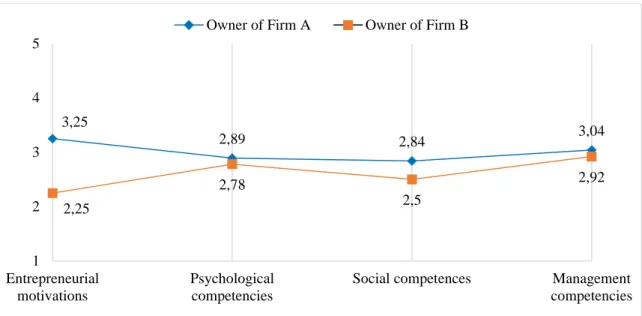
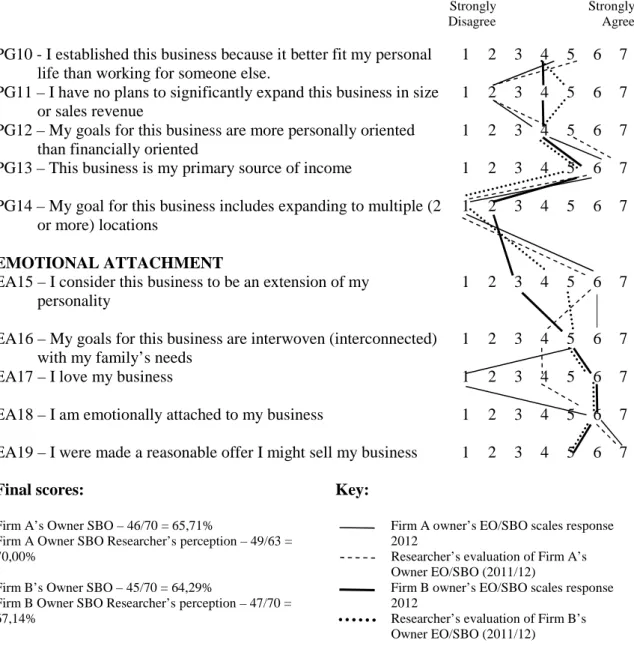
recruit personnel for jobs requiring ICT specialist skills (percent) ... 59 Figure 6 - Owners Entrepreneurial Potential Profile ... 79 Figure 7 - Entrepreneurial Orientation Assessment Results ... 80 Figure 8 - Small Business Orientation Assessment Results ... 81 Figure 9 - Net income per employee (1000 euros) and average number of employee paths
over the years 2012-2015 ... 130 Figure 10 - Discrimination of the active variables in each dimension ... 135 Figure 11 - Topological configuration of the HRM practices and micro-firms’ clusters .... 141
VII Table Index
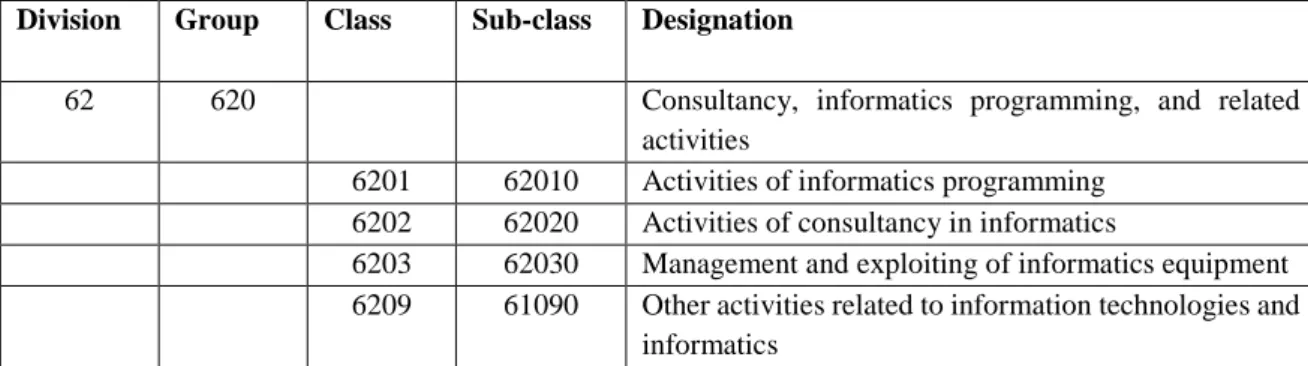
Table 1- Summary of empirical studies ... 8 Table 2- Economic activities codes, according to CAE-Rev.3 (2007) for the firms of this
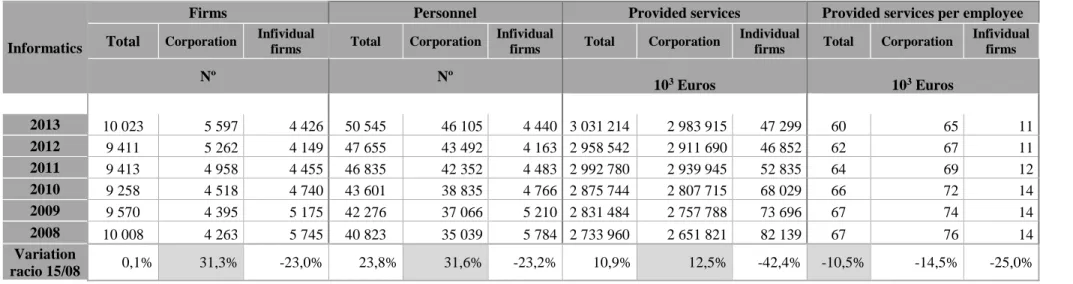
project ... 60 Table 3 - Allocation of the provided services, by type of service - Informatics ... 62 Table 4 - Main economic indicators, according to the legal business type ... 63 Table 5 - Characteristics of the case studies ... 73 Table 6 - HRM practices’ comparison between cases: Owners (2010, 2012), Employees
perspectives (2010), and researcher evaluation ... 83 Table 7 - Organizational performance indicators of Firm A and B 2008-2011 ... 88 Table 8 - Data collection structure ... 104 Table 9 - HRM practices comparison between the four micro-firms (1/4) ... 106 Table 10 - Case studies’ organisational culture scoring by owners and employees ... 112 Table 11 - HRM practices, Organisational Culture types (firm owners and employees),
performance and growth indicators ... 115 Table 12 - Contribution of the active variables ... 134 Table 13 – Categorical regression coefficients: Dependent variable employee growth
between 2012 and 2015 ... 136 Table 14 – Correlations and tolerance: Dependent variable employee growth between 2012
and 2015 ... 136 Table 15 – Categorical regression coefficients: Dependent variable owner's subjective
performance evaluation ... 136 Table 16 – Correlations and tolerance: Dependent variable owner's subjective performance
evaluation ... 137 Table 17- Clusters’ characterisation ... 143 Table 18 - Summary of empirical studies and results ... 157
List of Abbreviations
AMO – Ability, Motivation and Opportunity EO – Entrepreneurial Orientation
ERP – Enterprise Resource Planning EU – European Union
HR – Human Resources
HRM – Human Resources Management
ICT - Information and Communication Technology
OECD – Organisation for Economic Co-operation and Development SBO – Small Business Orientation
1 GENERAL INTRODUCTION
3 General Introduction
Scholars have been arguing that people, specifically employees, can represent an exclusive source of competitive advantage for their firms, one that is difficult to imitate by competitors (e.g., Barney, 1991; Huselid, 1995). As a result, suitable management of these special resources can have a large impact on firm competitiveness and performance.
Most of the literature on human resources management (HRM) practices and their impact on firm performance were carried out in large firms. Heneman, Tansky, and Camp's (2000) paper on unanswered questions regarding HRM practices in small and medium-sized enterprises (SMEs), and Cardon and Stevens's (2004) reflection on HRM in small firms, confirm this. The authors of a recent meta-analysis regarding HRM practices in SME (Rauch & Hatak, 2016) also acknowledge that the majority of studies in the HRM field were carried out in large firms.
We witness in the literature an increasing body of research on SMEs regarding HRM practices, namely relating them to firm performance. The recent meta-analysis performed by Rauch and Hatak (2016) examined 56 studies since 2000 that relate HRM practices to performance in the SMEs context. Rauch and Hatak’s (2016) literature review items’ list is longer, compared to the 17 studies reviewed by Heneman et al. (2000). The larger number of studies in these reviews suggests an increasing interest in this field of research.
In the entrepreneurship literature, the relationship of human resources (HR) to growth has increasingly become a topic of interest. Here, both HRM practices (e.g., Mayson & Barrett, 2006), and human capital, namely that of the business owner (e.g., Rauch, Frese, & Utsch, 2005) have been considered. Small firms struggle with scarce resources, which include people, causing each employee and their intellectual capital to have a greater impact on the firm’s performance than each employee has in larger firms. Previous empirical evidence makes us expect that HRM practices, which influence employees’ human capital and performance, have a positive impact on the firm’s results and the perceived success of the firm, even if those practices are informal (Hayton, 2006; Mayson & Barrett, 2006).
Some researchers state that small firms manage people in different ways than do larger firms in areas such as HRM policies and system development processes, the manner of introducing HRM practices, making employee management decisions, and formalisation levels (Cardon & Stevens, 2004; Veloso & Keating, 2008).
The growth of small and medium-sized firms is increasingly researched as a source of interest for both literature and economic policy. An interesting sub-group of this kind of firm
4
involves micro-firms, which employ fewer than 10 workers1 (Saarakkala, Tornikoski, Varamäki, & Kohtamäki, 2007). Micro-firms are the category of business that represents the most abundant proportion of firms worldwide (90%), in the European Union (EU) (93.1%), as well as in Portugal (95.4%) (Organisation for Economic Co-operation and Development [OECD], 2017a). The average employment proportion is different: in the OECD countries it is 22%, in the EU countries it is 30%. Portugal is among the five countries in the EU2 in which the proportion of employment in micro-firms is over 40% (OECD, 2017a). In Portugal, in 2015 micro-firms employed 46.4% of the active population and were responsible for 19.3% of turnover, about the same as small and medium-sized firms, which suggests that one-third of the turnover in SME is due to micro-firms (INE, 2017). While data show that most firms in the world are micro-firms, the countries that have bigger sized companies (i.e., fewer people employed in micro-firms) have better overall economic results. This means it is important to help micro-firms expand in terms of employment (thus enabling them to grow out of the micro-firm category).
Micro-firms are a very pertinent type of firm to study theoretically as well as empirically. Their examination can bring important knowledge both to the academic community and society, particularly with respect to business competitiveness and employment. The current project root is the resource-based view of the firm (Barney, 1991). Its main objective is to better understand the relationship between HRM practices and business performance and growth in micro-firms.
Researchers agree that firm growth and competitiveness is due to three main groups of factors: the country’s macroeconomic setting, specific characteristics of the industry in which it operates, and the firm itself (characteristics of the entrepreneur, internal variables, management strategies) (Baum, Locke, & Smith, 2001; Dobbs & Hamilton, 2007; Wiklund, Patzelt, & Shepherd, 2009). There are many studies which try to categorise the importance of these factors, and several empirical studies point to the characteristics of the firm as the ones that better explain business performance and growth (Baum et al., 2001; Davidsson, Achtenhagen, & Naldi, 2005; Dobbs & Hamilton, 2007). There are two types of organisational characteristics: tangible and intangible (Zahra, 1991). In this thesis, we control the tangible
1 The Portuguese Ministry of Economy and Employment applies the European Commission Recommendation
2003/361/CE, of 6 May 2003, regarding the definition of micro, small and medium enterprises, considering both number of employees and business sales (Ministério da Economia e do Emprego, 2007) – therefore, micro-firms have fewer than 10 workers and up to two million Euros in sales.
5 and study the intangible organisational factors that relate HRM practices to performance: firm-owner characteristics, entrepreneurial and small business orientation, and culture.
Even though internal variables of the firm are considered the most determinant in differentiating firm performance, external variables such as macroeconomic conditions and industry also impact its role as facilitator or obstacle to progress. They therefore cannot be disregarded (Baum et al., 2001; Datta, Guthrie, & Wright, 2005; Davidsson et al., 2005).
Since the industry has a direct effect on firm performance (Wiklund et al., 2009), it is important to identify the differences between firms within the same sector, to analyse which are the firms’ internal resources and capabilities that deliver the best performance (Rodríguez-Gutiérrez, Moreno, & Tejada, 2015). The manufactured goods sector is the most studied sector. It is therefore important to deepen knowledge on the services sector, considering their share of business in European countries’ economies (Rodríguez-Gutiérrez et al., 2015). Following the literature’s methodological recommendation (Short, Payne, & Ketchen Jr., 2008; Wiklund et al., 2009), we focus on one business field from the services sector: the Enterprise Resource Planning (ERP) selling and consulting sector, which is part of the larger Information and Communication Technologies sector.
The current thesis approaches the HRM practices-performance link initially with a broad, in-depth qualitative methodology, and then proceeds with general data collection. This enabled definition of the HRM bundles in micro-firms, as well as characterisation of the micro-firms and their firm owners regarding HRM practices and organisational performance. Considering the limited knowledge about the micro-firm type of management, in the first study, we asked an overarching, exploratory question: is there an association between
HRM practices and performance in micro-firms? We selected two firms that sold the same
brand of ERP. To collect data from the owners and each of the employees we used semi-structured interviews, unsemi-structured observation at the firm's facilities, a survey to define the owner profile, and secondary data regarding firm performance indicators. The information was collected in two different stages, two years apart. This allowed for wide and in-depth knowledge of the firms and their management dynamics. The results revealed two very different and even contradictory ways to manage people and the firm in general, yet both firms were evaluated as “TOP partners” by their software house brand. Our findings pointed to a contingency approach to the management styles (entrepreneurial and small business orientation), and led us to discriminate these constructs’ dimensions when considering performance and crisis periods.
6
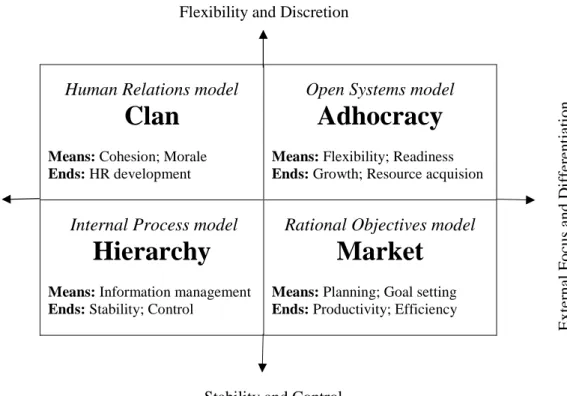
In the second study we wanted to understand the relation of HRM practices with the corporate culture and performance. We used the case study methodology with four micro-firms. Data were collected in two different phases. In the first phase we conducted semi-structured interviews with both owners and each of the employees, as well as observation at the firm's offices. In the second phase, we used the Competing Values Framework (CVF) model instrument to define the owner’s and employees’ culture perceptions. At this point we also used surveys to assess employees’ satisfaction and affective commitment. To measure firm performance indicators we collected secondary data. The analysis of the broad and detailed information collected about these four micro-firms enabled the development of some propositions. The feeling of clan culture in both owners and employees seems to be related to good firm performance, regardless of which HRM practices were used or the amount thereof. Incentive pay may be considered a very important practice to be included in any HRM practices bundle. This HRM practice happens when a market type of culture is present. Yet sometimes this can even occur in an ad hoc way, with no structure. It still has good performance results. It seems that it is important to have a combination of culture types, maintaining the precaution to avoid focussing only on the control type of culture. Two features of micro-firms emerged in our findings. To measure HRM practices in micro-firms it appears to be better to do so in a qualitative (configurations), as opposed to a quantitative (intensity), manner. It is time in business, and not size, that seems to motivate micro-firms to try to standardise and control their processes.
In the third study, we collected data from a national sample of business owners of ERP selling and consulting micro-firms of several brands. We conducted structured interviews to firm owners using a questionnaire. Data gathering was completed with secondary information about the performance indicators. We found two bundles of HRM practices in these micro-firms: transactional and developmental practices. Only the transactional practices related to firm performance indicators growth from 2012 to 2015. There were three hybrid micro-firms clusters based on these two dimensions, with an increasing level of HRM practices utilisation and intensity sophistication: low-involvement work practices, intermediate-involvement work practices, and high-involvement work practices. There was a difference found between firm owners’ characteristics associated with the HRM practices: the more entrepreneurial potential abilities they possess, the more HRM practices and in higher intensity they use them. Most firms are either characterised by low-involvement or high-involvement work practices. There were no significant differences regarding performance growth in any of the considered indicators, which reinforces the configurational approach assumption of equifinality.
7 Several innovation issues set the value of this thesis. There is a new path to follow regarding the HRM literature in a very important and understudied type of firm, the micro-firms. Even though there is increasing interest in smaller sized firms (e.g., Innes & Wiesner, 2012; Jaouen & Tessier, 2009), they are not necessarily micro-firms. Another valuable issue of this project is the use of empirical data to define HRM practices patterns, rather than a conceptual framework (e.g., Subramony, 2009). Our results enable entering the theoretical discussion of HRM bundles and the differences between micro-, small and medium-sized firms (e.g., Pearson, Stringer, Mills, & Summers, 2006). Studying HRM practices with other internal organisational variables such as owner’s characteristics and management styles and corporate culture deepens the understanding of the HRM-performance link. The use of time-lagged performance indicators to understand better the effect of HRM practices can be a very useful strategy, rather than the cross-sectional approach (Saridakis, Lai, & Cooper, 2017). The results reliability of this thesis, in its basis, is due to a methodological decision to focus on just one business sector (leveraging all participants with the same macroeconomic and legal context). The project participants are competitors among themselves, which enabled comparison regarding the research variables.
This thesis begins with a general literature review that frames the conceptual basis of the project (Chapter 1). We then present the business sector in which we develop this research project (Chapter 2). The next three chapters (3, 4, and 5) present and discuss empirical studies relating HRM practices to performance of micro-firms involved in ERP selling and consulting sector. Finally, we report the final and general conclusions of this research.
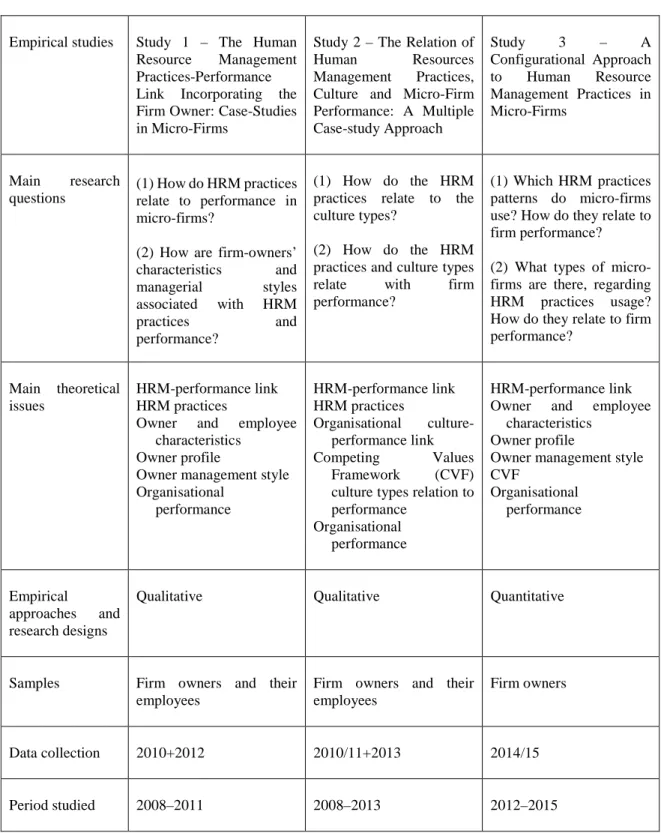
In Table 1 there is a general outline of the entire research project, describing the main characteristics of the three empirical studies: the main research questions, the general theoretical topics covered, empirical approaches, samples, data collection dates, and periods studied.
8
Table 1- Summary of empirical studies
Empirical studies Study 1 – The Human Resource Management Practices-Performance Link Incorporating the Firm Owner: Case-Studies in Micro-Firms
Study 2 – The Relation of Human Resources Management Practices, Culture and Micro-Firm Performance: A Multiple Case-study Approach Study 3 – A Configurational Approach to Human Resource Management Practices in Micro-Firms Main research questions (1) How do HRM practices relate to performance in micro-firms?
(2) How are firm-owners’ characteristics and managerial styles associated with HRM practices and performance? (1) How do the HRM practices relate to the culture types?
(2) How do the HRM practices and culture types relate with firm performance?
(1) Which HRM practices patterns do micro-firms use? How do they relate to firm performance? (2) What types of micro-firms are there, regarding HRM practices usage? How do they relate to firm performance?
Main theoretical issues
HRM-performance link HRM practices
Owner and employee characteristics
Owner profile
Owner management style Organisational performance HRM-performance link HRM practices Organisational culture-performance link Competing Values Framework (CVF) culture types relation to performance
Organisational performance
HRM-performance link Owner and employee
characteristics Owner profile
Owner management style CVF Organisational performance Empirical approaches and research designs
Qualitative Qualitative Quantitative
Samples Firm owners and their employees
Firm owners and their employees
Firm owners
Data collection 2010+2012 2010/11+2013 2014/15
9 CHAPTER 1. Human Resources Management Practices and Other Organisational Factors Affecting Firm Performance
11 1.1. Human Resources Management Practices and Performance
There is a research domain that produced a solid body of knowledge regarding HRM practices’ impact on firm performance, and which has been receiving much theoretical support throughout the years: the strategic human resources management field (e.g., Combs, Liu, Hall, & Ketchen, 2006; Huselid, 1995; Pfeffer, 2005; Wright, Gardner, Moynihan, & Allen, 2005). Literature regarding strategic HRM states that, in order to gain a competitive advantage through people, firms need to have an HR system (Delery & Doty, 1996). These HR systems, when implemented with the intention to help accomplish the firm’s goals, are regarded as strategic (Wright & McMahan, 1992).
Wright and McMahan (1992) identified in the strategic HRM literature micro and macro approaches to HR systems. They considered as micro approaches policies and practices referred to by the study as “individual,” while macro approaches emphasised a set of interconnected HRM practices. These authors found that HRM practices have a stronger effect when they take place together, in bundles, rather than individually, because the effects of the different practices are additive (e.g., Combs et al., 2006; Huselid, 1995). MacDuffie (1995) states that these HRM practices bundles are the best unit to study the HRM impact on firm performance because, as are coherent and firm specific, can act as a strategic competitive asset to firms, hard to imitate.
The sets of HRM practices that are designed to improve employee involvement and participation in the workplace, namely through communication between management and employees, and have a positive impact on organisational performance have been termed
high-performance management practices (Gollan, 2005; Wiesner, McDonald, & Banham, 2007).
Most literature, when explaining the relationship between HRM practices and organisational performance, adopts the behavioural perspective, stating that those high-performance [HR]
management practices act on firm performance by developing higher levels of employee
knowledge, skills and abilities (KSAs), and motivating workers to use these KSAs when participating in organisational processes that are beneficial (e.g., Combs et al., 2006; Huselid, 1995; MacDuffie, 1995).
On the same behavioural path, but with some nuances, we present some other authors’ models (e.g., Delery & Shaw, 2001; Guest, 1997; Ostroff & Bowen, 2000). Delery and Shaw (2001) present a model in which they say that each HRM practice may affect several employee’s characteristics, for example, training can affect both knowledge and skills, as well
12
as motivation. Practices can also combine in different ways to achieve the organisational goals. These complementary effect of the practices, make the equifinality of the HR system possible.
Guest (1997), relates the HRM practices with strategy, referring the importance of the coherent contingency. The HRM practices should be conceived intentionally to obtain three main HRM outcomes: commitment, quality and flexibility. Only after these HRM results are attained the rest of the outcomes are accomplished: the behavioural outcomes (motivation, cooperation, involvement, citizenship behaviours), organisational performance (high productivity, quality and innovation, and low absence, turnover, conflict, and customer complaints), and financial outcomes (profits and return on investment). Guest's (1997) analysis implies that more distant results (behavioural, performance and financial) won’t be as strong as the HRM outcomes, due to other organisational factors that also intervene.
Ostroff & Bowen (2000) suggest a multilevel framework, integrating individual-level, organization-level, and multilevel approaches. They believe that HRM practices can influence directly the firm performance, unlike Guest (1997) that only previewed indirect influence. This direct influence occurs through operational processes and job design, and through human capital development. The indirect effect on the organisational various dimensions effectiveness is through the impact that HRM practices have on organisational climate and contracts, which shape collective attitudes (as satisfaction and involvement), and behaviours (as citizenship, and attendance).
The literature shows an evolution in the utilisation of the concept. Walton (1985) proposed the high-commitment model, stating that organisations consist of parties (management and employees) with shared interests, both of which benefit from their interdependence. Organisations leave their traditional focus on control and replace it with a commitment strategy, giving employees more responsibilities and stimulating them to add value to the organisation as well as obtain satisfaction from their work. Lawler (1992) advocated for the high-involvement model, which aims to give employees the opportunity to acquire competencies and knowledge necessary to assure they can work in an engaged manner. This model involves practices such as training to work as teams, functional flexibility and information sharing.
Scholars (e.g., Guthrie, 2001) have been using the labels commitment and
high-involvement to refer to the HR strategies that aim to develop employees abilities, skills,
motivation, and information regarding their work, enabling them to perform better, in an interchangeably way.
13
High-performance work practices is another label referring to studies of HRM in
organisations, relating these practices to performance (Huselid, 1995). Combs et al. (2006) and Posthuma, Campion, Masimova, and Campion (2013), in both their meta-analyses, also refer to HRM practices that are positivly related to organisational performance as
high-performance work practices. Wood (1999) refers to the concept high-high-performance management systems as a way of extending the model to include operational practices that
enhance performance by skills training and acquisition, work redesign and performance management (as opposed to solely focusing on involvement and commitment attitudes). Zacharatos, Barling, and Iverson (2005) regard the high-performance work practices as including the high-commitment and high-involvement systems features, and expanding them because high-performance work practices refer in a more specific way the enhancement of competitive advantage using these HR practices. Wood, De Menezes, and Lasaosa (2003) indicate that in the literature high-commitment, high-involvement, and high-performance work
practices appear as corresponding concepts. Authors reviewing literature analysing the high-performance work practices concept acknowledge, as us, that scholars have been studying the
HR systems relation to performance and continuously reporting a positive relation to firm performance, even though using different labels to refer them (Esteves & Caetano, 2010; Esteves, 2008; Veloso, 2008). There seem to be general agreement on the fact that the HRM practices that regard high-performance work practices have a strategic approach, include good practices, and aim to develop competencies and organisational commitment (Esteves & Caetano, 2010).
In this research project we use the HRM broad concept of Boxall & Purcell (2000, p. 184) “HRM includes anything and everything associated with the management of employment relations in the firm”. These authors do not associate HRM with only one model or management style (high-performance, high-commitment, or high-involvment). They suggest the HRM discipline should acknowledge the diversity of models and management styles to develop better conceptualisation and deliver superior practice. Following this concept, in this project, we use the term HRM practices as a synonym of the high-performance
management practices and work practices, which in turn already include high-commitment
and high-involvement, as well as quality practices.
In the strategic HRM literature, the HRM practices associated with performance comprise a group of recurring types of practice (Pfeffer, 2005). We present some examples. Huselid (1995) based his study on the 10 practices previously identified by Delaney, Lewin,
14
and Ichniowski (1989), complemented by three others.3 Datta, Guthrie, and Wright (2005), basing their work on that of Huselid (1995) and Guthrie (2001), studied 18 practices.4 Pfeffer (1998) presented a simplified version of the successful organisation's practices in a set of seven practices,5 and later proposed an augmented version of 13 practices (Pfeffer, 2005).6 Esteves (2008) based on an extensive literature review proposed seven high-performance HRM practices.7
Theoretical and methodological controversies characterise research and practice in the strategic HRM field (Esteves & Caetano, 2010). Initially, Delery and Doty (1996) and Martín-Alcázar, Romero-Fernández, and Sánchez-Gardey (2005) present and characterise the perspectives used to study strategic HRM: universalistic, contingency, configurational and
contextual. The universalistic perspective argues for a “best practices” approach. This
perspective proposes that some practices are better than others and thus should be adopted in all circumstances (Delery & Doty, 1996). The universalistic approach analyses the impact of best practices on performance from a cumulative perspective, not considering the synergies or interelations between practices (Martín-Alcázar et al., 2005). According to these authors, the universalistic perspective is built upon empirical statistically proven relationships, not on strong theoretical grounds.
The researchers who support the contingency perspective suggest that HRM practices and policies should be consistent with other organisational dynamic aspects such as overall strategy and strategic options (Delery & Doty, 1996). That congruence is called the “vertical fit” (Huselid, 1995). Researchers look for causal linear relations between internal system characteristics and external contexts and situations to explain the results (Meyer, Tsui, & Hinings, 1993). Although this perspective has better theoretical grounds than the universalistic
3 These involved: incentive compensation; labour-management participation; performance appraisal; grievance
procedures; information-sharing; personnel selection; attitude assessment and job design. He also included promotion based on seniority versus merit; recruiting efforts and training hours per employee.
4 These included: effort on recruiting; hire based on tests; internal promotions; much training in firm-specific and generic skills; cross-training; performance-based promotions; frequent performance-feedback; other performance-feedback; pay based on skills; group-based pay; employee participation programs; performance, financial, and strategic plans information sharing; attitude surveys; team organized work and grievance system.
5 These include: employment security; self-managed teams and decentralisation of decision making; selective hiring; high compensation and contingent on performance; training; symbolic igualitarism; performance and other information sharing.
6 These include: employment security; recruitment selectivity; high compensation; incentive pay; employee ownership; information sharing; participation and empowerment; self-managed team;, training and development; cross-utilisation and training; symbolic egalitarianism; wage compression; and promotions. 7 These include: employment security; performance evaluation; compensation practices; career; training;
15 approach, it does not show the same strong, statistical relationships as the latter (Martín-Alcázar et al., 2005).
The third strategic HRM perspective, configurational, pursues a more holistic view of organisational phenomena. Research projects that use this approach identify patterns of variables that are related to an effect, rather than the relation of single variables to each other (Delery & Doty, 1996). We can describe the relation between HRM practices and organisational outcomes as a link between interrelated sets of HRM practices, organised in patterns and organisational performance (as an outcome example), instead of a relation between independent HRM practices and performance (Clark & Lengnick-Hall, 2012). The configurational approach highlights that the impact on organisational outcomes results from complex interactions between practices, which cannot be accounted for by linear relations. The synergetic effect of HRM practices among themselves explains the organisational performance (Delery & Doty, 1996). This approach embodies a shift in strategic HRM studies since the “‘black box’ of the universalistic and contingency models is opened so that the HR function can be analysed as a complex and interactive system” (Martín-Alcázar et al., 2005, p. 637).
The configurational approach also inherits the characteristics of the Katz and Kahn systems theory “equifinality” (Katz & Kahn, 1978) postulating that different arrangements of internal organisational and contextual patterns can be equally effective (Doty, Glick, & Huber, 1993; Martín-Alcázar et al., 2005). That is to say, organisations should plan and implement HR policies and practices that lead to the defined organisational goals. Thus, besides the vertical fit with organisational goals, organisations should pursue a horizontal fit, which involves internal consistency within the HR system practices and policies (Delery & Doty, 1996). The statistical techniques used to define HRM practices configurations are cluster analysis, factor analysis and neural network techniques(Delery & Doty, 1996; Martín-Alcázar et al., 2005).
The contextual perspective of researching strategic HRM offers a major change: the level of analysis it comprises, exceeding the organisational level, considering that the HRM role goes beyond the organisational borders, influecing and being influenced by the social context within which it operates (Brewster, 1999; Martín-Alcázar et al., 2005). This perspective includes often non accounted influencing social actors such as unions, the influence of the State and other institutional stakeholders. Studies that use the contextual approach deal with the continental level, concentrate on European countries, often comparing them (e.g. Brewster, 1995; Claus, 2003; Nikandrou, Apospori, & Papalexandris, 2005).
16
The methodological approach in the contextual perspective is descriptive, performing mainly simple statistics analysis (means, standard derivations) (Martín-Alcázar et al., 2005). There are some longitudinal studies regarding the evolution of the HRM practices usage among the European countries, and their classification into similar groups (Nikandrou et al., 2005), but still scholars advocate for more sophisticated quantitative and qualitative analysis to understand better the HRM relation with it’s context (Martín-Alcázar et al., 2005).8
1.1.1. The Pertinence of the Configurational Perspective on Studying HRM-Performance Link
Configurations research is said to have great potential and to contribute to an increased understanding of people, groups and organisational dynamics. However, it is still underused and should be explored further (Meyer & Allen, 1997; Short, Payne, & Ketchen Jr., 2008). Configurational research meets the objectives of research in organisations by describing, explaining and predicting organisational effects and dynamics (Short et al., 2008).
Studies on the contribution of HRM to a firm’s performance and the gaining of competitive advantage has seen an increase since the 1990’s (e.g., Becker & Huselid, 1999; Delaney & Huselid, 1996; Huselid, 1995). These HRM practices influence organisational performance, increasing employees’ KSAs and motivation to apply them to benefit the organisation, bringing sustainable advantage and better organisational results (Combs et al., 2006). HRM practices are organised internally in a unique way, and the individual way employees apprehend and apply the KSAs, enabled by those HRM practices, makes them impossible to copy. This therefore constitutes a competitive advantage to firms. Thus, the resource-based view of the firm is the foundation for the strategic HRM literature development (Barney, 1991).
The combinations of several HRM practices performed in firms are frequently called bundles (e.g., Bello-Pintado, 2015; Gerhart, 2007; MacDuffie, 1995; Meuer, 2017). Different HRM perspectives value these sets of HRM practices in different ways. The universalist perspective claims that each of those HRM practices has a positive impact on performance. In the contingent perspective, the HRM practices bundles are effective if they are adequate to internal factors such as strategy, and/or external factors such as the industry. Both
8 For other literature reviews on the HRM practices relation to performance, see Esteves (2008) and Marques
17 perspectives, universalistic and contingency, regard HRM practices from an addictive standpoint (Martín-Alcázar et al., 2005).
In the configurational perspective, the HR practices that constitute the bundles are complementary and interact in a complex and not linear way (Delery & Doty, 1996; Gerhart, 2007; Martín-Alcázar et al., 2005). From this perspective, employers should experiment with several complementary HRM practices: the result of the whole HRM practices bundle is more beneficial than the effect of each practice itself, or even the sum of the effects of each practice individually (Bello-Pintado, 2015; Combs et al., 2006; Huselid, 1995). As an illustration of how HRM practices configurations work if we want to enhance employees’ skill levels, we can achieve a better result if we accumulate intentionally various practices in that way, for example, selection and training, instead of only one practice. A workforce’s KSAs will improve if we define and use appropriate staffing techniques and provide training suitable for the KSAs intended. This means that HRM bundles, i.e., sets of HRM practices working together toward the same objective, will have a positive impact on workers’ KSAs, and thus, on organisational performance (Subramony, 2009). Cesário (2015), who studied the employees perceptions on HRM practices, concludes that from their point of view, the experience is a simultaneus and combined perception of the HR systems. Therefore, as the HRM practices are performed to have an impact on employees, it is probably more interesting to the analyse the HRM practices together, because that is the way employees perceive them (Cesário, 2015). This perspective allows opening the “black box” of the universalistic and contingency models, in which there are only inputs and outputs, without revealing the processes of the phenomena involved (Martín-Alcázar et al., 2005).
With all the promising features of configurational research, it still is not much developed. One reason for this, as pointed by Short et al (2008), concerns an inconsistent use of terminology and labelling: typologies, gestalts, generic strategies, modes, archetypes, strategic groups, strategic scope groups, competitive groups and taxonomies have all been used to denote such practices. Based on a thorough literature review since 1993, using the same strategy that a previous literature review (Dess, Newport, & Rasheed, 1993) employed, Short et al (2008) make a terminology proposal. They suggest categorising the configurational studies based on the system of identifying organisational configurations (competitive strategies/organisational features) and their applicability (context specific/generalisable).9
9 Strategic groups are context-specific configurations that have an underlying competitive strategy, and Generic strategies are configurations that are identified based on the competitive strategy and are applicable
18
Since these authors’ proposal in 2008, and up to 2017 in the configurational literature we reviewed, we did not find those proposed terms or concepts applied.
There are two other important concepts related to the configurational research: typology and taxonomy. Short et al. (2008) state that these terms go beyond the configurational literature because they are commonly used in several contexts many times, describing basic and unsophisticated categories. There is already a consensual definition regarding typologies and taxonomies concepts, based on the source of information used to define them, even if not used correctly in all circumstances (e.g., Jaouen & Lasch, 2015). A
typology derives from a conceptual organisation of ideas, that is, deductive thinking. A
categorisation based on empirical data, the inductive way of generating knowledge, is called a taxonomy (Meyer & Allen, 1997; Short et al., 2008). Nevertheless, conceptual information used to conceive typologies is usually grounded in empirical research, and taxonomies also need to have conceptual logic and a theoretical basis to be acknowledged by academic peers. Researchers should therefore present the sequence of thought and the inductive and deductive reasoning that undergird the typologies and taxonomies they present (Short et al., 2008).
Despite the identified potential of the configurational approach, between 2007 and 2017, we found only 15 published papers in the HRM field using this perspective. We conducted a literature review on 22 top academic journals regarding HRM, strategy, management, entrepreneurship and small business.10 We used “typology”, “taxonomy” and “configuration” expressions to search in each of the mentioned journals, within the defined time period. We analysed a total of 340 papers to define inclusion in our analysis (title, abstract, and paper content when needed). The criteria for inclusion were: verifying the configurational approach, being in the HRM field, and being firm-level studies. Each paper was counted only once. A final number of 17 papers were deeply analysed. From those, 13 are empirical papers proposing taxonomies, and four are theoretical papers.
forms focus on the features of organizations, but the first are context-specific and the latest are groups of
similar firms that can be found across industries (Short, et al., 2008).
10 HRM: Human Resource Management Review, Personnel Psychology, Journal of Human Resources, Human
Relations, Human Resource Management, Industrial and Labour Relations Review, European Journal of Industrial Relations, Human Resource Management Journal, and International Journal of Human Resource Management.
STRATEGIC MANAGEMENT: Academy of Management Annals, Academy of Management Journal, Academy of Management Review, Strategic Management Journal, Journal of Management, Journal of Management Studies, Journal of International Business Studies.
ENTREPRENEURSHIP & SMALL FIRMS: Journal of Business Venturing, Entrepreneurship: Theory and Practice, Small Business Economics, International Small Business Journal, Journal of Small Business Management, Entrepreneurship and Regional Development.
19 There are some interesting general features to notice. The theoretical papers define HRM practices typologies for the different issues of their respective objectives.11 Regarding empirical studies, they occur in large firms,12 and all deal with different issues in the HRM practices relating to different performance outcomes. From those studies, only two Bello-Pintado (2015) and Meuer (2017) explore objectives similar to those of our project: start from a list of HRM practices to define HRM practices bundles and relate them to performance. Of those, only Bello-Pintado (2015) and Meuer (2017) studied SME.13 Another interesting feature of these two papers is that they not only depart from a list of HRM practices, they also organise those practices initially based on the AMO framework, which we will explore in the next few paragraphs.
Appelbaum, Bailey, and Berg (2000) analysed the large listing of HRM practices and categorised them into three bundles, whose first letters provide the acronym: abilities, motivation, and opportunity: the AMO framework. This model advocates that to engage employees in their work to the fullest, HR systems should: provide them with the abilities they need, motivate them to fulfill their needs, and enable them with the opportunity to do their job in engaging ways (e.g., Boselie, Dietz, & Boon, 2005).
The HRM practices associated with enhancing employee skills and knowledge (ability) are recruitment, selection, training and development. The practices associated with motivation are incentives, recognition, pay-for-performance, group bonuses and job security. Information-sharing, job participation, self-directed work teams and other employee involvement activities are opportunity-enhancing HR practices. The AMO framework enables a better understanding of HR systems, enlightening the way HRM practices “fit” with each other (Meuer, 2017). At the same time they help clarify HRM practices in organisations, categorising the long HRM practices list available in the literature.
The AMO framework seems to be the HRM practices configuration more used in the literature. Two recent meta-analyses of the HRM practices-performance link in large firms
11 Topics studied in the theoretical papers were: (1) HRM practices transfer model in multinationals corporations
for their subsidiaries (Clark & Lengnick-Hall, 2012); (2) model proposal that explains organisational politics in the HRM context and that takes in constructive, destructive, ineffective and virtual HRM practices (Drory & Vigoda-Gadot, 2010); (3) based on the exploration versus exploitation paradigm, they define an HR architecture configuration fostering organisational learning and value creation (Kang, Morris, & Snell, 2007) and (4) authors propose how HRM practices bundles relate to performance evaluation and compensation may induce more or less employee misconduct (Werbel & Balkin, 2010).
12 Only one refers that the sample has firms with more than 20 employees, not mentioning the maximum or
average number of employees (Bello-Pintado, 2015). Another refers to using 15 participants in each organisation, not mentioning the total number of employees in each organisation.
13 After this systematic literature review, we used a snowball technique to find other configurational studies that
20
and SMEs apply it not only to organise the HRM practices considered in the analysed studies, but also to present and discuss results (Jiang, Lepak, Jia, & Baer, 2012; Rauch & Hatak, 2016). The use of this formula, namely, when a large number of HRM practices are available in the literature and, knowing that firms use bundles of practices, reinforces the pertinence of the configurational approach to the study of the HRM practices-performance link.
The literature also provides another interesting argument that favours the configurational approach usage: the distinction between core and peripherical HRM practices concurring with organisational performance (Meuer, 2017; Posthuma et al., 2013). Opening the “black box” in the HRM practices-performance link means to understand the synergetic effects of the practices when applied together.
Posthuma et al. (2013) performed a literature review of empirical studies on HRM practices conducted in the past 20 years. They identified 61 practices and developed a nine-category taxonomy. They also analysed the frequency defining which are the core, the peripherical and the least-used practices. Their analyses also covered HRM practices usage over time, namely identifying the growing, the stable and the declining ones, as well as the regional usage of the practices.
Meuer (2017) performed an empirical study seeking to understand the complementarities within HRM practices bundles. He found that within all bundles there are combinations of core and peripherical HRM practices which, when overlapping, have a positive impact on performance. He also emphasises that some of the practices are not essential or may even have negative impacts. Therefore the virtuous overlaps of HRM practices bundles should embrace the fact that not all HRM practices should be implemented when aiming for the best organisational result. For exemple, in the bundle, Meuer (2017) named “low investment” it is clear the emphasis is on recruitment and selection and the absence of expensive training programmes. The firms that use these strategies compensate for the lack of internal training with concern in the staffing activities, so they do not have to fulfill that gap internally. Therefore, one of the challenges he identifies for firms is that they should try to distinguish and emphasise core and peripherical HRM practices differently, to enable firm’s the best performance.
There are several arguments that support the use of the configurational approach to study HRM: (a) it has a big potential to capture the complex dynamics of the organisational setting, (b) there are few studies in the literature, and scholars have called for more research using this approach; (c) intentionally defined HRM practices bundles have a higher impact on
21 employees’ KSAs than the individual or random practices; and (d) the existence of core and peripheriral practices define the importance of identifying the right ones to use.
1.1.2. Human Resources Management Practices in Small Firms
Micro-firms comprise a substantial portion of the business environment in Portugal (INE, 2017), as is the case in other European countries (Goswami, McMahan, & Wright, 2006; OECD, 2017a). Many of those small and micro-firms were created in an entrepreneurial process. There is no consensus among researchers about the “entrepreneurial firms” concept (Goswami et al., 2006, p. 17). There are several ways of defining them: high growth firm, firm managed by the owner, or business managed by its founder (Goswami et al., 2006; Stewart & Roth, 2001; Unger, Rauch, Frese, & Rosenbusch, 2011). Research in the HRM field is carried out relative to either entrepreneurial entities (Dabic, Ortiz-De-Urbina-Criado, & Romero-Martínez, 2011), SME or small firms (Pearson et al., 2006; Sheehan, 2013).
In this project, we focus on independent firms managed by their owners, which is also the minimum criterion accepted for the entrepreneur’s definition (Stewart & Roth, 2001). We started by referring to the resource-based view of the firm perspective, which identifies employees as one of the most important firm resources because they are exclusive of the firm in which they work, and competitors cannot imitate them (Barney, 1991; Huselid, 1995). In small and micro-firms each employee has a higher influence on the firm’s performance than in larger firms. Moreover, small firms with scarce and at times unstable resources and environmental conditions may be reinforced and maintained when using certain HRM practices (Vogus & Welbourne, 2003).
Although there are many conceptual and empirical studies on entrepreneurship processes and results (Goswami et al., 2006), according to literature reviews by Cardon and Stevens (2004) and Heneman et al. (2000), the HRM field has not attracted much attention. The interest in the human factor in the entrepreneurial and small firms drew the attention of researchers mostly in the first decade of this century (Unger et al., 2011). Goswami et al. (2006) tried to meet that conceptual gap by proposing a human resources strategic management model in entrepreneurial firms. This conceptual model attempts to clarify the mechanism through which management practices can develop critical behaviours in employees that, in turn, facilitate the emergence of a knowledge environment that is positive to a firm’s performance. What it does, in fact, is replicate what occurs in larger companies,
22
adding the constructs of entrepreneurial sophistication and a knowledge environment. As far as we were able to verify, this model has never been tested.
Even though there is a traditional view “that smaller firms ‘do not need human resources’” (Sheehan, 2013, p. 546), that perspective is no longer appropriate. These firms manage people, their special resources, expecting to have a positive influence on the firm’s results, even if such HRM practices are informal (Hayton, 2006; Mayson & Barrett, 2006). In small-scale firms the adoption of such practices is not necessarily formal, since the costs in both money and time to create, implement and maintain it may not pay off (Patel & Cardon, 2010). In addition to the economic balance regarding cost-benefit, small firms may also lack the technical capability to implement such measures. Accordingly, small firms’ engagement in HRM practices, namely formal, are carefully considered (Patel & Cardon, 2010). Way (2002) presented empirical evidence that the use of HRM practices in the US small business sector may not enhance costs related to the execution of these practices. Sels et al. (2006), however, reported the contrary: increased labour costs came with HRM practise implementation. Other scholars (e.g., Innes & Wiesner, 2012; Melo & Machado, 2015) stress that HRM practices formalisation does not necessarily mean effective employment of those practices in organisations, because they should be performed on an as-needed basis. An incremental way of introducing HRM practices has a higher impact because it allows the progressive involvement of the employees in those practices, and it is also characterised by its unique structure, which isn’t possible to replicate, thus being a factor of competitive advantage (Veloso, 2008).
An escalating literature production in this field in SME occurred in recent years (e.g. Aït Razouk, 2011; Datta et al., 2005; Guest & Conway, 2011; Messersmith & Wales, 2013; Patel & Cardon, 2010; Sheehan, 2013; Way, 2002). This line of research identified HRM practices that occur in SME, relating them to firm performance. Authors study somewhat similar HRM practices lists (firms that have the same core practices). They mainly depart from HRM practices defined as high performance work practices of large firms (see Appendix A: Examples of studies of HRM practices in SME). They are different in the sense that they contemplate a different number of practices (from six to 18 HRM practices), but all report a positive effect of HRM practices on several measures of performance. Another common feature is that these studies use an additive means of measuring and analysing the HRM practices’ impact on firm performance, following the literature tradition of defining a single index (e.g., Becker & Huselid, 1999; Sels et al., 2006). This method is consistent with the
23 universalistic and contingency approaches to strategic HRM (Delery & Doty, 1996; Martín-Alcázar et al., 2005).
Rauch and Hatak (2016) organised the limited and scattered knowledge (when compared to large firms) on HR-enhancing practices in SME that impact these firms’ performance. Specifically, they studied the effect of those practices on performance and what kind of contingencies they involve, to report on the relation between HRM practices and performance. They conducted a meta-analytic study (including 56 independent samples, representing 18.521 firms) that analyses the associations between HR-enhancing practices and SME performance. The samples they reviewed had fewer than 500 employees, following the framework of Subramony (2009), itself based on other models, namely the AMO framework initiated by Appelbaum et al. (2000). Rauch and Hatak (2016) classified the HR-enhancing practices into three groups: practices that aim to enhance skills, motivation, and empowerment.14 The meta-analysis performed found that HR-enhancing practices are
important to SME performance. Their results point to empowerment-enhancing HR practices (e.g., employee participation and involvement in decision-making regarding several aspects, including work process and outcomes) being especially important in SME. They also identified several moderators that lead to considering a contingency approach as adequate for SME. As examples, these authors found that enhancing motivation practices, such as incentive and reward, are suitable for young firms (as a means of attracting employees). Firm size is also a moderator indicating that, in small firms, the skill-enhancing HRM practices have a larger impact than in medium-sized firms. They also mention that HRM practices are especially useful in countries with rigid retention legislation since, with these practices, they can develop their employees, if it is too hard to dismiss them.
Firm size in general is an important variable when it comes to studying HRM practices and performance. Size defines work settings that challenge SME (Cardon & Stevens, 2004). Due to time compression, smaller firms with fewer resources require a more intensive workload than do large firms (Jaouen & Tessier, 2009; Patel & Cardon, 2010). Employees need to be more polyvalent, dealing with different tasks and roles, as this kind of firm often has difficulty attracting and retaining talented employees (Rauch & Hatak, 2016), a problem that hinders productivity (Way, 2002).
14 The titles Subramony (2009) gave to the three groups and the HRM practices they represent are the same as
the original, in which the acronym “AMO” in the framework stands for ability, motivation and opportunity (Appelbaum et al., 2000; Boxall & Purcell, 2000; Gerhart, 2007; Jiang et al., 2012). These are three bundles of HRM practices that enable employee to have their best performance (Meuer, 2017).