UNIVERSITY OF THE ALGARVE
THE IMPACT OF INTERNAL MARKETING AND SERVICE QUALITY
ON CUSTOMERS’ SATISFACTION IN MOLDOVAN HIGHER
EDUCATION INSTITUTION: THE CASE STUDY OF CAHUL STATE
UNIVERSITY “BOGDAN PETRICEICU HASDEU”.
Liudmila Raru
Dissertation
Master integrated in Human Resources Management
Research paper elaborated under the guidance of
PhD Professor Ronaldo Schutz and PhD Professor Rosária Pereira
UNIVERSITY OF THE ALGARVE
THE IMPACT OF INTERNAL MARKETING AND SERVICE QUALITY
ON CUSTOMERS’ SATISFACTION IN MOLDOVAN HIGHER
EDUCATION INSTITUTION: THE CASE STUDY OF CAHUL STATE
UNIVERSITY “BOGDAN PETRICEICU HASDEU”.
Liudmila Raru
Dissertation
Master integrated in Human Resources Management
Research paper elaborated under the guidance of
PhD Professor Ronaldo Schutz and PhD Professor Rosária Pereira
I THE IMPACT OF INTERNAL MARKETING AND SERVICE QUALITY ON
CUSTOMERS’ SATISFACTION IN MOLDOVAN HIGHER EDUCATION INSTITUTION: THE CASE STUDY OF CAHUL STATE UNIVERSITY “BOGDAN
PETRICEICU HASDEU”
DECLARATION OF AUTHORSHIP WORK
I hereby declare that the dissertation submitted for Master Degree of Human Resources Management at the University of the Algarve is my own original work and has not been submitted or published to any other institution of higher education. I further declare that all authors and sources are properly cited and indicated in the text by means of a comprehensive list of references.
Signature __________________
© Copyright: Liudmila Raru
“A Universidade do Algarve tem o direito, perpétuo e sem limites geográficos, de arquivar e publicitar este trabalho através de exemplares impressos reproduzidos em papel ou de forma digital, ou por qualquer outro meio conhecido ou que venha a ser inventado, de o divulgar através de repositórios científicos e de admitir a sua cópia e distribuição com objetivos educacionais ou de investigação, não comerciais, desde que seja dado crédito ao autor e editor.”
II ACKNOWLEDGEMENTS AND DEDICATION
During the winter 2013 and autumn 2014, I have studied the implications of seeing the academic staff and students of Moldovan State University “Bogdan Petriceicu Hasdeu” from Cahul as internal and external customers and identifying their level of satisfaction towards university’ s quality of services provided. I was capable to do this due to the biggest help and guidance of several persons.
For all that, I would like to express my deepest gratitude to the senior lecturer in marketing Ronaldo Schutz who being my professor of the course “internal marketing” has motivated me to choose this theme of my thesis. As a supervisor, I’m indebted to him for his pieces of advice to develop the very idea of this paper.
I’m also grateful to my supervisor Rosária Pereira for her guidance and advice, for her valuable ideas and information that really helped me to produce a better finished result.
Also, I wish to thank the professor Margarida Jésus for her truly help in terms of statistical issues. Thank to her, I was able to correctly identify and deeply analyze the data that helped me to face methodological challenges.
I would also like to offer my thanks to the Master Course Director Ileana Monteiro for her continuous support and guidance, for her time to answer my undetermined questions related to the format, procedures and development of master dissertation.
My special thanks also go to all teachers and undergraduate students of Cahul State University “B.P.Hasdeu” who were involved in the completion of the questionnaires, for their time, understanding, cooperation and responsiveness.
The last but not the least, my deepest gratitude goes to God, my Lord who gave me the strength and patience to overcome the difficulties and weaknesses in completing this study.
I dedicate this dissertation to my family: my parents, sister, brother-in-low and my sweetheart niece who always encouraged me and supported morally from home. Thanks for their love, friendship, moral support and continuous guidance and encouragement.
Without you all, this dissertation could not be possible to complete!
Thank You, Yours, Liudmila Raru Faro, Portugal 2015
III ABSTRACT
Nowadays, many organizations, companies or institutions, especially those whose product are services such as higher educational institutions (HEIs) are trying to cope with various competitive challenges regardless their brand image and organizational process of delivering high quality of services. As a result of strong competitiveness in the market area, the requests for quality standards are merely increasing. One of the most important and successful standards is to be customer focused or to continuously meet or exceed customers’ service expectations and satisfactions. Therefore, in the field of HEIs, internal marketing approach implies the orientation to internal and external customers’ needs, expectations and satisfaction. As a result, providing a high service quality in Universities will positively affect teachers and students’ satisfaction. The main purpose of this study is to examine, explore, analyze and evaluate academic customers’ level of satisfaction at Cahul State University “B.P.Hasdeu” when applying and adopting internal marketing approach and service quality. The study was conducted within all faculties of the selected University. The sample consisted of a considerable number of teachers (N =90) and students (N=110). The respondents were required to complete 2 structured questionnaires by responding to the 33-items based on a 4-point Likert scale. Data analysis was conducted through SPSS software program version 17.0. Frequencies and descriptive statistics were used to answer the research questions. From the analysis carried out it was found that teachers and students provide a moderate level of satisfaction. The extrinsic factors teachers and students are satisfied with are: teachers’ status within University, benefits, university’s curriculum, students’ punctuality, skills and students’ attitudes towards them and their subjects, University’s web page, students’ involvement into conferences and students’ union, teachers’ punctuality, professional competences and skills, teachers’ methods and techniques used in the class and feedback. In terms of dissatisfaction, they are somewhat dissatisfied with: salary, university’s not sufficient support for Master and PhD’ career development, promotion and advancement, teachers’ freedom to take new challenges and be creative. In almost all the situations, teachers and students of Philology and History Faculty are more satisfied than those of Law and Economy Faculties. The study is limited from methodological and generalization’ point of view. Further researches are needed to be carried out in order to figure out whether other factors than service quality and internal marketing can impact teachers and students’ satisfaction.
Keywords: Higher education institutions, service quality, internal marketing, internal and external customers, customers’ satisfaction, Cahul State University.
IV RESUMO
Atualmente, muitas organizações, empresas ou instituições, especialmente aquelas que são fornecedoras de serviços tais como as instituições de ensino superior (IES) enfrentam vários desafios competitivos, independentemente sua imagem de marca e processo organizacional, como seja fornecer serviços de alta qualidade. Como resultado da forte competitividade nesta área de mercado, os requisitos para atingir padrões de qualidade são cada vez mais exigentes. Um dos pressupostos para um melhor desempenho e qualidade das Universidades, bem como da qualidade do serviço educacional são a gestão e a liderança por forma a repensar as suas estratégias. Uma das estratégias mais importantes e bem- sucedidas é estar focado no cliente ou seja, continuamente atender ou exceder as suas expectativas em termos de serviço e de satisfação. Portanto, no campo das IES, uma abordagem de marketing interno implica uma orientação para as necessidades, expectativas e satisfação não só dos clientes internos mas também dos clientes externos. Consequentemente, proporcionar uma qualidade de serviço elevada nas Universidades vai afetar positivamente os professores e a satisfação dos alunos. O principal objetivo deste estudo é analisar, explorar e avaliar o nível da satisfação dos clientes através da qualidade do serviço na Cahul State University "B.P.Hasdeu" quando adotando uma abordagem de marketing interno. O estudo foca-se na perceção da qualidade do serviço por parte da Administração da Universidade e do pessoal docente (professores) e considera igualmente a perspetiva dos alunos. Esta tese começa com uma revisão da literatura em marketing interno e nas abordagens de qualidade do serviço. O estudo revê ainda como esses conceitos podem ser refletidos e utilizados no contexto do ensino superior. O estudo foi realizado na Universidade Pública de Cahul "B.P.Hasdeu", abrangendo todas as suas faculdades (Faculdade de Filologia e História- estudo 1 e Faculdade de Direito e Administração Pública e Faculdade de Economia – estudo 2), tendo o inquérito decorrido em dois momentos diferentes. A amostra deste estudo consistiu num número considerável de professores (N = 90) e de estudantes (N = 110) inquiridos durante os anos letivos de 2013-2014 e 2014-2015. O estudo tem como objetivo descobrir se professores e estudantes estão satisfeitos com a qualidade do serviço fornecida pela Administração da Universidade, se os professores estão satisfeitos com a qualidade do desempenho dos alunos e se os alunos estão satisfeitos com a qualidade do serviço prestado pelos professores. O estudo também pretende identificar se na Universidade em estudo as estratégias de marketing interno e as abordagens de qualidade do serviço aplicadas têm impacto na satisfação dos clientes. A recolha de dados foi realizada através da aplicação de um questionário incluindo 33 itens. Os
V
itens foram adaptados dos estudos de Barmby (2006), Day, Stobart, Sammon & Kington (2006), Moran, Kilpatrick, Abbott, Dallat & McClune, (2001) e outros. Os inquiridos foram convidados a completar os respetivos questionários (professor ou aluno), avaliando os vários itens com base numa escala de Likert de 4 pontos (1= muito insatisfeito, 4= muito satisfeito, sendo que o 2 e o 3 correspondem ao nível de médio, tais como um tanto insatisfeito e um tanto satisfeito). A análise dos dados foi realizada através do programa estatístico para ciências sociais (SPSS), versão 17,0. Frequências e estatística descritiva foram utilizada para responder às questões de investigação. A partir da análise realizada verificou-se que professores e alunos demonstraram um nível moderado de satisfação. Eles não estão altamente satisfeitos como era de se esperar, mas também não estão insatisfeitos. Os fatores extrínsecos que foram avaliados positivamente por um maior percentual de professores foram:
status dentro da Universidade (27,78% vs. % 12,22%), cuidados de saúde e benefícios na
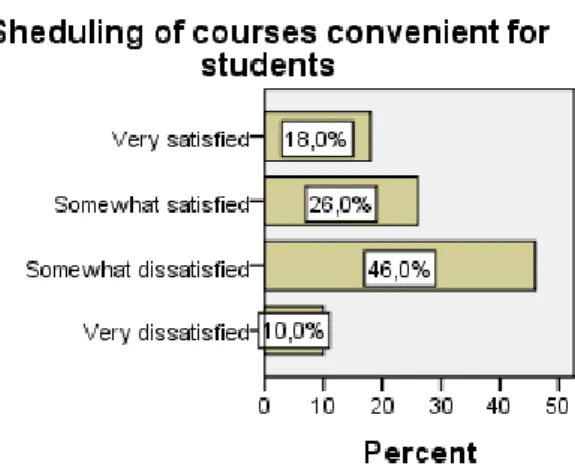
reforma (33,33% vs. 16,67%), currículo da Universidade (28,89% vs. 22,22%), atitude dos estudantes em relação aos professores e às suas unidades curriculares (37,78% vs. 16,67%), pontualidade dos estudantes (37,78% vs. 16,67%) e capacidades e aptidões dos alunos (30% vs. 22,22%). Em termos de insatisfação, os professores revelam-se um pouco insatisfeitos com o seu salário, bónus financeiros e recompensas (38,89% vs. 15,56%), apoio do governo para formação ao nível de mestrado e doutoramento, promoção e progressão na carreira (26,67% vs. 11,11%) e ainda em relação à liberdade dos professores para assumir novos desafios e serem criativos no trabalho (26,67% vs. 10%). Tal como a dos professores, a satisfação dos alunos é também moderada. Os estudantes revelam-se satisfeitos com: página de web da Universidade como fonte de informação (22,73% para estudantes de Direito e de Economia vs. 18,18% para alunos da Faculdade de Filologia e História e), participação em conferências (29,09% para estudantes de Direito e de Economia vs. 27,27% para os estudantes de Filologia e História) possibilidade de fazer parte da Associação de Estudantes (25,25% para os estudantes de Filologia e História vs. 23,64% para estudantes das Faculdades de Direito e de Economia), pontualidade dos professores (26,18% vs. 21,82%), competências profissionais e aptidões dos professores (30,91% vs. 22,73%), métodos e técnicas de ensino utilizadas em aula pelos professores (22,73% vs. 16,36%) e feedback dos professores (40% vs. 15,45%). A qualidade do serviço afetou a satisfação dos alunos em pequeno grau nomeadamente no que diz respeito a: horários (convenientes para estudantes) (20,91% vs.18,18%), bolsas de estudo para os alunos (12,73% vs. 10,91%) currículo dos professores (11,82% vs. 9,09%). Em quase todas as situações, os professores e alunos da Faculdade de Filologia e História estão mais satisfeitos do que os da Faculdade de Direito e Administração
VI
Pública e da Faculdade de Economia. Este estudo pode ser uma ferramenta eficiente para outras universidades em todo o mundo, onde professores e alunos enfrentam questões semelhantes. O estudo é limitado em termos de metodologia e possibilidade de generalização dos resultados. Mais pesquisas são necessárias a fim de descobrir se outros fatores da qualidade dos serviços e do marketing interno podem afetar a satisfação dos alunos e professores.
Palavras-chave: Instituições de ensino superior, qualidade do serviço, sarketing interno, clientes internos e clientes externos, satisfação dos clientes, Cahul State University.
VII TABLE OF CONTENTS
LIST OF TABLES ... X LIST OF FIGURES ... XI LIST OF ABBREVIATIONS ... XIII LIST OF APPENDIXES ... XIV
CHAPTER I:INTRODUCTION ... 1
1.1 Introduction ... 1
1.2 Problem statement ... 3
1.3 Objectives of the study ... 4
1.5 Purpose of the study ... 4
1.6 Importance of the study ... 4
CHAPTER II:LITERATURE REVIEW ... 6
2.1 Marketing approaches in Higher Education ... 6
2.2 The service marketing-mix strategies of Higher Education ... 8
2.2.1 Educational service product strategy ... 8
2.2.2 Educational service price strategy ... 9
2.2.3 Educational communication/promotion service strategy………... 9
2.2.4 Educational distribution service strategy ... 11
2.2.5 Educational service people strategy………....11
2.2.6 Educational service process strategy ... 12
2.2.7 Educational service physical evidence strategy ... 13
2.3 Internal Marketing Concept in Higher Education ... 14
2.3.1 Introduction to Internal Marketing Concept ... 14
2.3.2 Internal marketing significance or definitions ... 15
2.4 Service Quality concept in Higher Education ... 17
2.4.1 Introduction to Service Quality ... 17
2.4.2 Services and quality concepts in Higher Education ... 17
2.4.3 Service Quality issues and role in Higher Education ... 18
2.5 Teachers’ Job Satisfaction and Students’ Satisfaction in Higher Education ... 20
2.5.1 Job satisfaction’s general aspects in higher educational context ... 20
2.5.2 Factors that influence teachers’ job satisfaction in Higher Education………22
2.5.2.1 Factors intrinsic to teaching………22
VIII
2.5.2.3 Factors operating at the system level………. 22
2.6 Students’ satisfaction ... 24
CHAPTER III:RESEARCH METHODOLOGY ... 27
3.1 Design of the study ... 27
3.2 Choice of quantitative research ... 28
3.3 Research sources of data... 29
3.4 Surveys design ... 30
3.4.1 Questionnaires’ type and purpose ... 30
3.4.2 Structure of the questionnaires ... 31
3.5 Sampling size and method, data collection and data analysis ... 33
CHAPTER IV:DATA ANALYSIS RESULTS ... 36
4.1 Study I: Teachers and students’ satisfaction of Philology and History Faculty ... 36
4.1.1 Demographic characteristics ... 36
4.1.2 Teaching staff’s level of satisfaction (Faculty of Philology and History) ... 37
4.1.3 Students’ level of satisfaction (Faculty of Philology and History) ... 42
4.2 Study II: Teachers and students’ satisfaction of Law, Public Administration and Economics Faculties ... 49
4.2.1 Demographic characteristics ... 49
4.2.2 Academics staff (teachers)’ level of satisfaction (Law and Economics Faculties).. 51
4.2.3 Students’ level of satisfaction (Law and Economics Faculties) ... 55
4.3 Teachers’ satisfaction of Cahul State University (all faculties) ... 64
4.3.1 Teachers’ informational background ... 64
4.3.2 Teachers’ level of satisfaction towards university’s administration service quality 65 4.3.3 Teachers’ level of satisfaction towards students’ quality of performance (the way of learning and behaving) ... 69
4.4 Students’ satisfaction of Cahul State University (all faculties) ... 70
4.4.1 Students’ informational background ... 70
4.4.2 Students’ level of satisfaction towards university’s administration quality of services ... 71
4.4.3 Students’ level of satisfaction towards teachers’ quality of services (the way of teaching and behaving) ... 75
CHAPTER V:DISCUSSION AND CONCLUSION ... 79
5.1 Introduction to Discussion and Conclusion ... 79
IX
5.2.1 Discussion 1: Are teachers highly satisfied with the quality of services
provided by the university’s administration? ... 81
5.2.2 Discussion 2: Are students highly satisfied with the quality of services provided by the university’s administration? ... 82
5.2.3 Discussion 3: Are teachers highly satisfied with the quality of student performances (the way of learning, behaving)? ... 84
5.2.4 Discussion 4: Are students highly satisfied with the quality of services provided by teachers (the way of teaching, behaving)? ... 84
5.2.5 Discussion 5: Is Cahul State University applying an internal marketing approach and service quality assessment? Is there any impact on customers’satisfaction?.... 85
5.3 Managerial Implications or future guidelines for Cahul State University’s improvement ... 87
5.4 Limitations and further research ... 91
References ... 93
X LIST OF TABLES
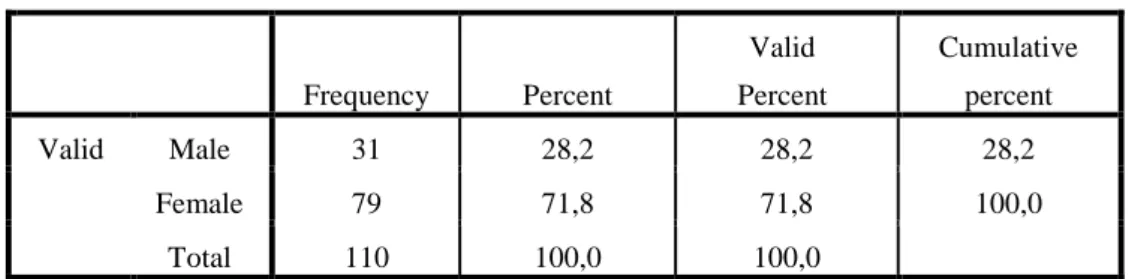
Table 4.1 Participants' gender ... 36
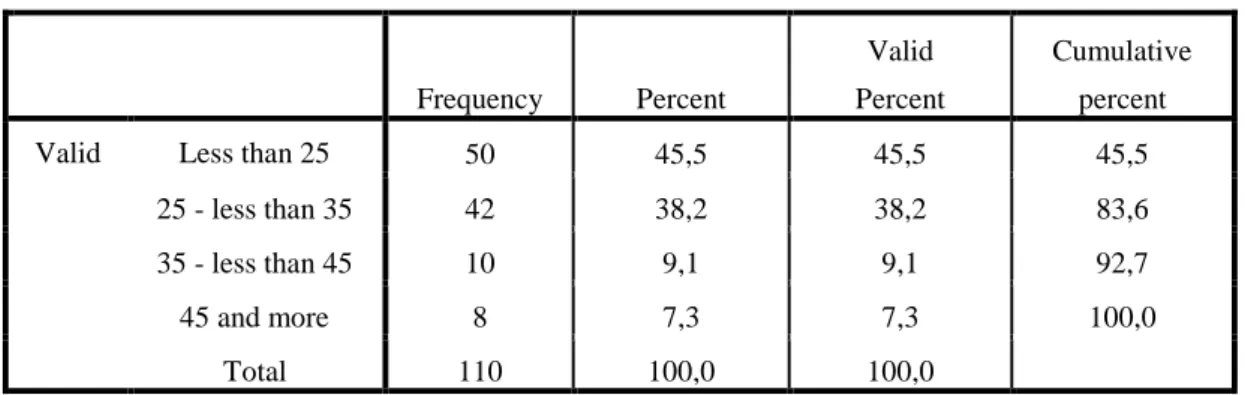
Table 4.2 Participants' age ... 37
Table 4.3 Participants' academic qualification (education) ... 37
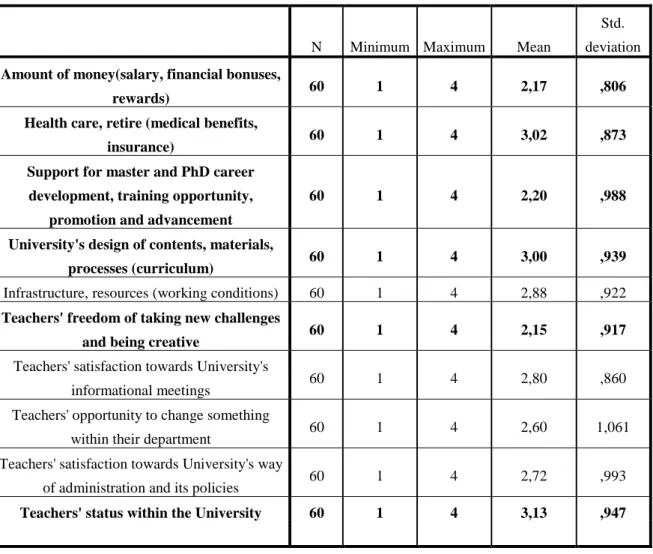
Table 4.4 Descriptive statistics of the items related to teachers’ level of satisfaction concerning administration’s quality of services ... 38
Table 4.5 Descriptive statistics of the items related to teachers’ level of satisfaction concerning students’ quality of performances (the way of learning, behaving) ... 40
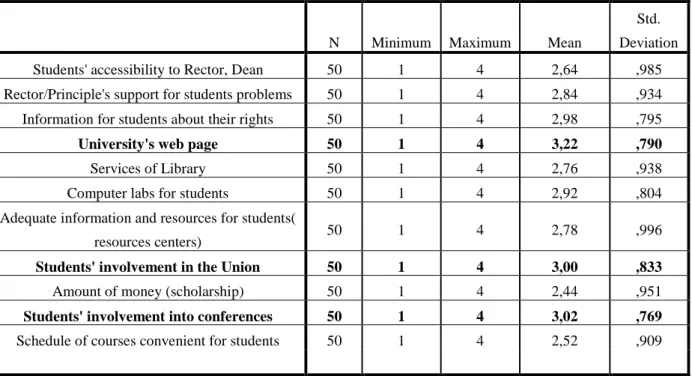
Table 4.6 Descriptive statistics of the items related to students’ level of satisfaction concerning administration’s quality of services ... 42
Table 4.7 Descriptive statistics of the items related to students’ level of satisfaction concerning teachers’ quality of services (the way of teaching, behaving) ... 44
Table 4.8 Descriptive statistics of the items related to general level of satisfaction of teachers and students ... 47
Table 4.9 Participants' gender ... 49
Table 4.10 Participants' age………...49
Table 4.11 Participants' academic qualification………...49
Table 4.12 Descriptive statistics of the items related to teachers’ level of satisfaction concerning administration’s quality of services ... 51
Table 4.13 Descriptive statistics of the items related to teachers’ level of satisfaction concerning students’ quality of performances (the way of learning, behaving) ... 53
Table 4.14 Descriptive statistics of the items related to students’ level of satisfaction concerning administration’s quality of services ... 55
Table 4.15 Descriptive statistics of the items related to students’ level of satisfaction concerning teachers’ quality of services (the way of teaching, behaving) ... 58
Table 4.16 Descriptive statistics of the items related to general level of satisfaction of teachers and students ... 60
Table 4.17 Teachers’ gender ... 64
Table 4.18 Teachers’ age ... 64
Table 4.19 Teachers' academic qualification ... 64
Table 4.20 Descriptive statistics of the items related to teachers’ level of satisfaction concerning administration’s quality of services ... 65
Table 4.21 Descriptive statistics of the items related to teachers’ level of satisfaction concerning students’ quality of performances (the way of learning, behaving) ... 69
XI Table 4.22 Students' gender ... 71 Table 4.23 Students’ age ... 71 Table 4.24 Students’ academic qualification ... 71 Table 4.25 Descriptive statistics of the items related to students’ level of satisfaction concerning administration’s quality of services ... 72 Table 4.26 Descriptive statistics of the items related to students’ level of satisfaction concerning teachers’ quality of services (the way of teacjhing, behaving) ... 75
XII LIST OF FIGURES
Figure 2.1 Marketing approaches in Higher Education ... 6
Figure 2.2 Service marketing mix elements ... 8
Figure 2.3 Communication and service marketing triangle ... 10
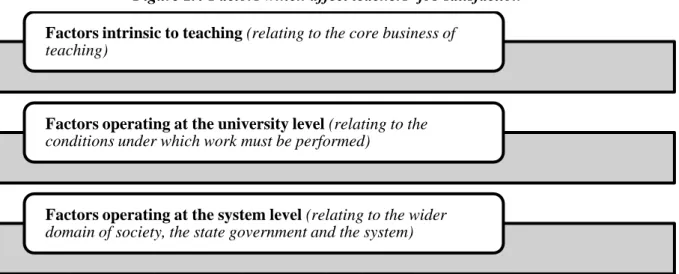
Figure 2.4 Factors which affect teachers’ job satisfaction ... 22
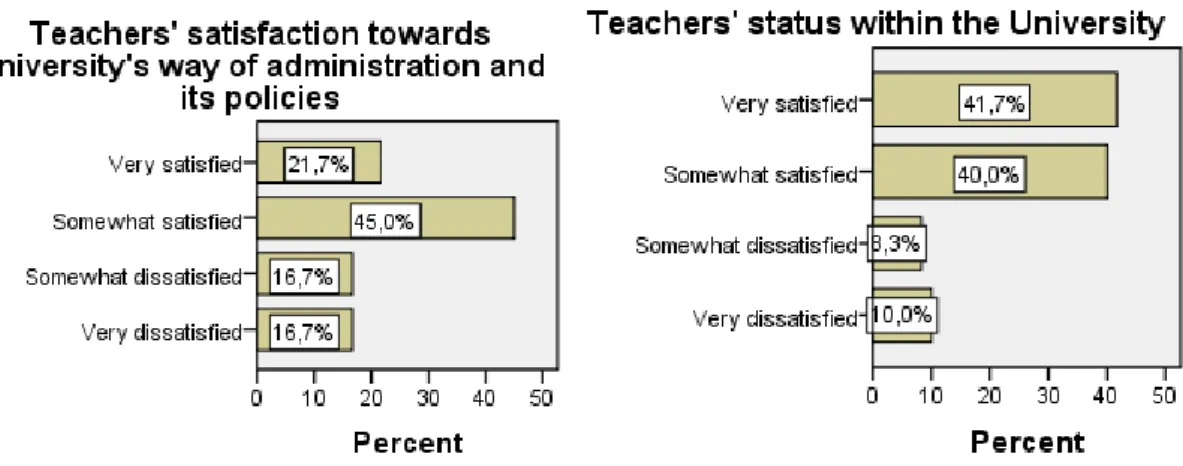
Figures 4.1-4.10 Teachers’ level of satisfaction concerning administration’s quality of services ... 38
Figures 4.11-4.15 Teachers’ level of satisfaction concerning students’ quality of performances (the way of learning, behaving) ... 41
Figures 4.16-4.26 Students’ level of satisfaction concerning administration’s quality of services ... 42
Figures 4.27-4.35 Students’ level of satisfaction concerning teachers’ quality of services (the way of teaching, behaving) ... 45
Figure 4.36 Teachers’ general level of satisfaction towards the university’s administration’service quality and students’ performance quality………...47
Figure 4.37 Students' general level of satisfaction towards the university's administration and teachers' service quality ………...47
Figures 4.38-4.47 Teachers’ level of satisfaction concerning administration’s quality of services ... 52
Figures 4.48-4.52 Teachers’ level of satisfaction concerning students’ quality of performances (the way of learning, behaving) ... 54
Figures 4.53-4.63 Students’ level of satisfaction concerning administration’s quality of services ... 56
Figures 4.64-4.72 Students’ level of satisfaction concerning teachers’ quality of services (the way of teaching, behaving) ... 59
Figure 4.73 Teachers’ general level of satisfaction towards university’s administration’ service quality and students’ performance quality. ... 61
Figure 4.74 Students' general level of satisfaction towards university's administration and teachers' service quality………61
Figures 4.75-4.84 Teachers’ level of satisfaction concerning administration’s quality of services ... 67
XIII Figures 4.85-4.89 Teachers’ level of satisfaction concerning students’ quality of performances (the way of learning, behaving) ... 70 Figures 4.90-4.100 Students’ level of satisfaction concerning administration’s quality of services ... 73 Figures 4.101-4.109 Descriptive statistics related to students’ level of satisfaction concerning teachers’ quality of services (the way of teaching, behaving) ... 76 Figure 4.110 Teachers’ general level of satisfaction towards university’s administration’ service quality and students’ performance quality……….. ... 78 Figure 4.111 Students' general level of satisfaction towards university's administration and teachers' quality of services………...78
XIV LIST OF ABBREVIATIONS
USC - Cahul State University (Universitatea de Stat din Cahul) HEIs- Higher Education Institutions
HE- Higher Education IM- Internal Marketing SERVQUAL- Service Quality
SPSS- Statistical Package for Social Science VS. - Versus
XV LIST OF APPENDIXES
Appendix 1: Questionnaire 1: Teachers’ level of satisfaction regarding Cahul State University’s administration’ service quality and students’ performance quality………..102 Appendix 1: Questionnaire 2: Students’ level of satisfaction regarding Cahul State University’s administration’ and teachers’ service quality……….104 Appendix 2: Article on Internal marketing and service quality’ effect on customers’ satisfaction in Cahul State University “Bogdan Petriceicu Hasdeu”………..107
1 CHAPTER I
INTRODUCTION 1.1 Introduction
The 21st century as a modern or contemporary era, as a century of dynamism, movements and events, embraces a lot of changes. Those changes have modified the course of worldwide history. Today’s changes in politics, economics, culture and civilization, technology and social environment have risen the sense of people of striving, of finding best options to survive. One of the most important variants was to invest in human capital by involving it into the process of competitiveness areas emphasizing the industry market.
Modern market units require all organizations, companies and institutions to manifest and extend their competitive abilities and to be flexible to adapt to the challenges in the markets they serve. The issue of competitiveness in the market industry is evident in every type of organization, whether for profit or not for profit, whether public or private, because each company is trying to provide the best products or deliver the best service quality. One of the nonprofit yet still competitive institutions increasingly involved in the service market is higher education.
Over the last two decades, Higher Education Institutions’ importance has increased due to its never-ever life-long process of teaching and learning. The managers’ major purpose, providing top quality, created an urgent need services to maintain the best possible position in worldwide markets by spreading up the process of competitiveness. In such competitive circumstances, in order to establish a competitive market position, higher education institutions need to adopt internal marketing practices, strategies and activities.
To be competitive and improve performance in internal marketing, it is very important to satisfy the employees as well as the customers. Therefore, strategically, every organization’s success which hangs on the service suppliers’ capacity to increase their popularity by continuously satisfying customers’ service assumptions (Berry & Parasuraman, 2004). The statements of Rhoades A. & Marriot B., (2013: p.1) are provide reasoning for same concept. According to them “The unique reason which makes a business productive is due to the every
positive cooperation between employees and customers. This is usually happening when employees are treated or served very well”. It is merely important to “ Keep in mind your employees and they will keep an eye on your customers”. This strong connection between
employees and customers rests on the basis of internal marketing. The essence of internal marketing is satisfying and motivating the employees by strengthening them to provide very
2
good services for customer’ satisfaction which will therefore contribute to the improvement of any service organization (Goldsmith & Clark, 2005).
Due to economic and cultural globalization, there have appeared challenges for higher education systems. As a result, the majority of companies have been increasingly focusing on customers and their satisfaction. Satisfying customers only occurs when the best quality services are delivered, and is strengthened by solid internal marketing. In educational setting, service quality is the above mentioned educational process assessment presented through the process of enhancing beneficiaries’ educational progress in order to achieve the set aims (Barnett, Parry & Coate, 2001). In other words, the beneficiaries or customers are improving, developing and satisfying their wants and needs through the process of service quality. This process is really important to evaluate the customers’ educational improvements. Therefore, as it was mentioned above, in the field of higher education, the concepts of internal marketing and service quality are especially important, as they influence internal and external customers’ satisfaction. Cahul State University “Bogdan Petriceicu Hasdeu” was purposely selected for this research - in order to identify whether internal marketing and service quality are truly influencing and impacting customer’ satisfaction. Additionally, this research examines whether there is a need to implement and develop these concepts for further improvements within the university, which is located in the southern part of Republic of Moldova.
In order to figure out as well as clear up and clarify the real situation of the above- mentioned university, this dissertation will be structured according to several chapters. The following chapters provide evidence for the research questions that will be stated below, using existing literature and, results of researcher’s opinions based on the case study. Hence, Chapter I identifies the background and a general introduction to internal marketing, service
quality and customer’ satisfaction’s concepts, Cahul State University’s problem or situation,
the objectives and research questions stated by the researcher and the importance of the study. Chapter II outlines a brief literature review about marketing and internal marketing approaches, service quality as well as internal and external customer’ satisfaction in the context of higher education. Chapter III explains how these concepts are practiced in Cahul State University making use of some methodological issues and instrumentations. Chapter IV considers Cahul State University, showing that customer’ satisfaction (teachers’ and students’) is positive and moderate rather than very high or very low. Chapter V shows the analogy between all three faculties. The teachers and students of the Philology and History Faculty are more satisfied with university’s quality of services than those of the Law, Public
3
Administration and Economics Faculties. It also presents some logical explanations for these references. Consequently, the dissertation concludes with the fact that Cahul State University is applying internal marketing and services quality concepts but it still needs further improvements. Teachers’ and students’ satisfaction appear to be the key indicators of this need for improvement.
1.2 Problem statement
Cahul State University (USC) is a public institution in the field of higher education which is situated in the southern region of the Republic of Moldova. The main goal of this university is to train and provide the southern region of the Republic of Moldova with highly qualified professionals or specialists in different fields. Though the institution has a short history (founded in 1999), USC provides excellent results both in terms of scientific research and the involvement of teachers in the participation of different extra - curricular activities, programs and projects. Despite this wide range of experience, internal marketing is still new for USC. However, in recent year, the university started to apply this concept to its marketing practices due to the competitive advantage. Hence, service organizations are becoming competitors and due to this the higher education sector must deal with the marketing idea (Maringe, 2006). In addition, it was noticed that if higher education institutions do not rethink and refine their marketing, they could be accused of not performing the duties what they are supposed to perform (Nicholls, Harris, Morgan, Clarke & Sims, 1995). Taking into account that universities provide education as a service, the quality of it should be excellent according to customers’ standards of satisfaction. Particularly in formerly communist countries, academic customer satisfaction was largely undervalued until recent years and there was not a special area of study, dedicated to assessing academic customer’ satisfaction and in general, research on this topic is limited. The study of Siddiqui & Sahaf, (2007) emphasized and identified some elements of internal marketing stressing the points of training and development, organizational commitment, and employee motivation. Schuller & Chalupsky (2011) have studied internal marketing communication activities at public universities in Czech Republic. Additionally, such research is further limited, especially in Moldovan higher education sector. It is time to identify, analyze and explore the impact of internal marketing and service quality on customer’ satisfaction in higher education. For this purpose, this study focuses on Cahul State University. Taking into account all it was mentioned above, the following objectives were carried out. Also, questions regarding the application of internal marketing approaches and, the delivery and performance of service quality and customers’ satisfaction should be answered.
4 1.3 Objectives of the study
a) To examine whether teachers and students are satisfied with service quality provided by the university’s administration;
b) To analyze whether teachers are satisfied with the quality of student performance; c) To analyze whether students are satisfied with service quality provided by teachers; d) To identify whether Cahul State University applies an internal marketing approach
and service quality assessment and whether there is any impact on customer’ satisfaction.
1.4 Research Questions
a) Are teachers highly satisfied with the quality of services provided by the university’s administration?
b) Are students highly satisfied with the quality of services provided by the university’s administration?
c) Are teachers highly satisfied with the quality of student performance (the way of learning and behaving)?
d) Are students highly satisfied with the quality of services provided by teachers (the way of teaching and behaving)?
e) Is Cahul State University applying an internal marketing approach and service quality assessment? Is there any impact on customers’ satisfaction?
1.5 Purpose of the study
The purpose of this study is to examine, explore, analyze and evaluate academic customers’ level of satisfaction at Cahul State University “B.P.Hasdeu” when examining customer’ satisfaction through the concepts of internal marketing. It is focused on attitudes and perceptions about service quality from the perspectives of teachers and students, specifically in the context of three faculties. The study was conducted at the Faculty of Philology and History, Law and Public Administration and the Faculty of Economics at the above- mentioned university. The sample of this study consisted of a considerable number of teachers (N=90) and students (N=110) during academic sessions of 2013-2014 and 2014-2015 respectively.
1.6 Importance of the study
In terms of global importance, this study will be useful by representing the necessity for further studies on internal marketing, service quality and customer satisfaction in university settings. It will also help to validate the results of empirical study and apply them in other service settings. In terms of local importance, this study will be useful for policy makers and
5
university management to understand the significance of applying internal marketing concepts as a key-factor of improving the service quality of education. The results of the improvement effort will benefit all stakeholders of Cahul State University’s service setting, the most important being the students.
6 CHAPTER II
LITERATURE REVIEW 2.1 Marketing approaches in Higher Education
The influence of globalization has changed the environment in which people live and activate as an employee or as a student. Due to this essential change, every organization including higher education focuses on the process of providing best quality of services. In order to gain competitiveness and provide a good service quality, it’s important to stress the point on applying marketing approaches or concepts within the organizations or institutions. The concept of marketing has known different evolutionary stages. The marketing approaches matched with the history of businesses by representing the levels of organization’s development in time: the production era, the sales era, the marketing concept era and the societal marketing era (Berkovitz, Kerin & Rudelius, 2005). On the other hand, it was claimed that there are five concepts of marketing activity: production, product, selling, marketing and societal marketing (Kotler, 2006). He emphasized that the last two levels are mostly used by today’s organizations due to their significance as the core of the marketing concept. The marketing concept is the key-factor for reaching organizational objectives which usually depend on determining the target market’s expectations and providing the desired satisfaction more efficiently than opponents (Kotler 2006). In other words, the marketing approach focuses its attention on customer’s needs with the goal of satisfying him/her and gain competition. Consequently, marketing concepts, which have been successful in past business organizations, are starting now to be applied by many service organizations such as universities (Hemsley-Brown & Oplatka, 2006, Temple & Shattock, 2007). Based on the customer’s philosophy mentioned above, the service organizations, including higher education are now using different marketing approaches, such as market segmentation, consumer behavior, positioning and the marketing of mixed activities or strategies. (See figure 2.1)
Figure 2.1 Marketing approaches in Higher Education
Source: author’s elaboration
Market segmentation Consumer behavior
7 Market segmentation is an abstract idea of identifying the “who” of target markets (Maringe,
2006). In every organization the target markets are those who stand in good stead with quality service and products. These are the customers. The higher education institution has multi-clients or stakeholders. Maringe (2006) also made a classification of target market. According to Maringe (2006), the students, employers and society are seen to be the main beneficiaries. However, along with students, employers and society, there are other stakeholders who have an interest in higher education and who can be seen as customers (Chapleo, 2004; Voss, Gruber, & Szmigin, 2007 & Kantanen, 2007). According to Chapleo et al., (2004/ 2007) these are: parents, the government, quality assurance agencies, professional bodies and others. In a study of UK University, it was noticed that there are two types of customers: internal and external (Kanji & Tambi, 1999). Internal customers include employees, while external customers are students, the government, industry, and parents (Kanji & Tambi, 1999). For the present research study’s purpose, the theory of Kanji & Tambi (1999) will be considered as the best classification or customers’ segmentation.
Consumer behavior is another concept of marketing approach that helps the organization to identify what customers need and want. In the case of this research, this concept refers to student behavior as a primary client and customer of higher education and to teachers as secondary customers. Regarding students and teachers’ behavior, there are some aspects that identified their satisfaction, such as student/teachers’ expectations and student/teachers’ choice. Student choices range from the option of higher education institutions or courses that will determine their expectations and actual performance. Teacher’s have the option of selecting an institution with the level of services that meet their expectations (Baldwin & James, 2000).
After identifying the customers and what they want and need, higher education institutions (HEIs) should differentiate themselves from competitors by using positioning concept. In the field of higher education it is quite difficult to identify this concept because all within academic are similar. In his study, Chapleo (2004)uses a series of key-factors to take positions of differentiation: teaching versus research, science-based versus arts based, basic teaching versus higher level teaching (Chapleo, 2004). However, these cannot assure totally differentiated positions in universities. Therefore, positioning concept is limited in higher education sector. In higher education institutions, positioning is more about the branding image of the school than distinctiveness whose upsurge and position should be kept in the minds of the public (Hemsley-Brown et al., 2006).
8
After having identified and generalized the customers and their wants, the service organization such as higher education has to meet the demands of the customers. These products which will satisfy the customers’ needs, have to be marketed using service
marketing-mix strategies (product, price, promotion, distribution, people, process and
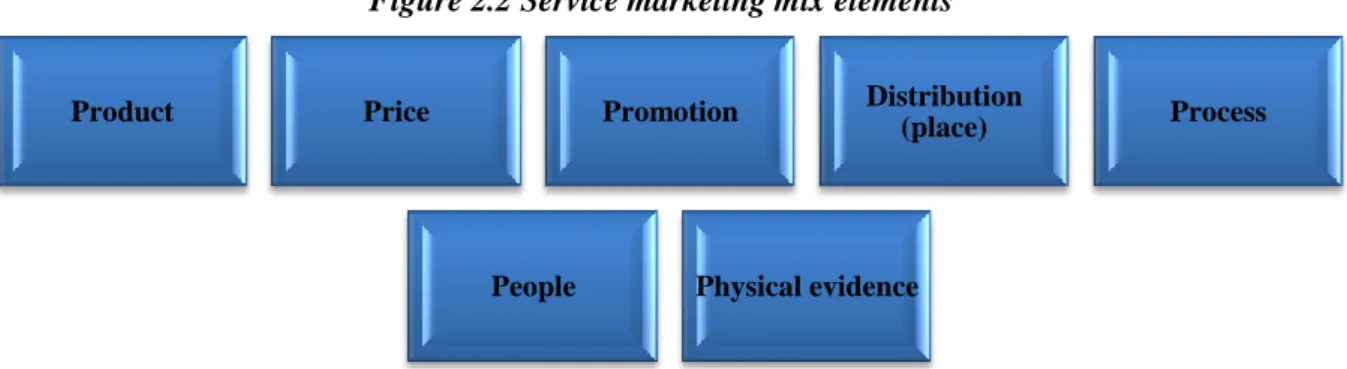
physical evidence) that have a special impact and importance on customers’ satisfaction. The main aspects of service marketing-mix strategies will be analyzed in the following sections. 2.2 The service marketing-mix strategies of Higher Education
Higher education institutions as well as any type of service organization need a fully-developed and extensive marketing strategy that is especially communicated throughout the organization (Brooker & Noble, 1985). The upsurge of a marketing strategy implies the coordination and apposition of the marketing mix elements (Mowen, Brown & Donovan, 2002, & Hawkins, Best, & Coney, 2001). Consequently, it is the coordination and combination of these marketing mix elements that help the service organizations to meet customers’ expectations or satisfactions. In the field of educational sector, the marketing of mixed strategies are the sole most significant factors of marketing success (Kraft, 2006). Actually, a traditional marketing mix strategies include four elements: service product, price,
promotion and distribution (place) but due to the great importance and untouchable,
inseparable, heterogeneous and inconstant nature of services, the traditional marketing mix was expanded and now includes: the process, people and physical evidence (Goldsmith & Clark 2005). (See figure 2.2)
Figure 2.2 Service marketing mix elements
Source: author’s elaboration (adapted from Goldsmith & Clark, 2005)
2.2.1 Educational service product strategy
The most important decision a higher education institution has to make is the types of programs and services they will offer to their internal and external customers. Developing service products that satisfy customers’ expectations is a crucial marketing function for companies or organizations (Hoyer & MacInnins, 2001). In the educational sector, service
Product Price Promotion Distribution (place) Process
9
product is a process of “removing” the knowledge, attitudes and behaviors from one person to another that aids them to acquire new capabilities (Alves, 2010). Most educational services are a mixture of tangible (textbooks, chairs, notes) and intangible (teaching process, contact with students) elements (Kotler, Armstrong, Cunningham & Mitchell, 2004). It was claimed that there are two types of services provided by the universities as a global product. These are: educational services (university mission, students’ opportunity of choosing a particular university) and extra services (teaching, research services) designed to match customers’ satisfaction (Bratianu, 2008, & Kantanen, 2007). Generally speaking about educational services, it’s crucial to emphasize external and internal marketing’s impact on customers due to the interpersonal relationships between students and teachers, which heavily influences overall satisfaction (Voss et al., 2007).
2.2.2 Educational service price strategy
Price is the amount of money used by customers in exchange for a service product provided by the seller. In the field of higher education, price is the amount that a customer (student, employer, parents) must pay to be educated. Therefore, the price of a service has a very particular and important position. On one hand, price influences the amount of the service product the customer will purchase and on the other hand it influences whether selling of the service will be advantageous for the company or not (Machado & Cassim, 2002). Price is used as a tool for measuring the service quality that student will achieve and the single clear information determinant that bears before consumption. The price of educational service includes any subsidies from the government in the form of scholarships as well as the taxes or tuition fees. Regarding students’ service price, it is important to notice that it consists not only on monetary costs, but non-monetary costs as well (Eiglier & Langeard, 1991). In a study by Kotler & Armstrong (2003), it was expressed the fact that students’ non-monetary costs consist of psychological costs (students’ stress of enrolling in an institution far from home), effort costs (number of years of study), and time costs (visiting or attending days at different institutions). Price as a part of marketing mix should be considered an important element by educational service organizations because it will help the managers attract more customers. HEIs will provide a good quality of educational service if they clear with customers on their price and services. It is important to communicate with its customers in order to promote what the institution has. The next section will focus on promotional or communication strategies. 2.2.3 Educational communication/promotion service strategy
Educational institutions, as well as other types of service organizations, need to communicate with their internal and external customers in order to emphasize the
10
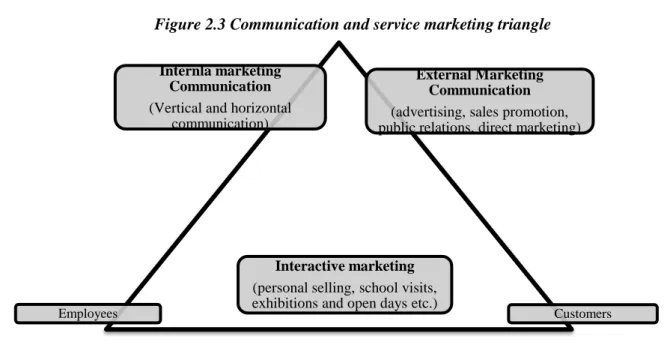
effectiveness of marketing approach. It’s necessary for them to promote what they are aware to have for competitive advantage. The process of communication and the elements of promotional marketing mix (advertising, public relations, personal selling and sales promotions) are generally used by the institutions to communicate to their prospective students. In the higher education sector, communication or promotion can take place in different ways. However, the best way of communication should integrate a complex form. As for this, Zeithaml & Bitner (2000) suggested a fully communicative strategy which implies the involvement of teachers and students. They have suggested a service marketing triangle which includes three types of marketing communications: internal, external, and interactive. (See figure 2.3)
Figure 2.3 Communication and service marketing triangle
Source: Adapted from Zeithalm & Bitner (2000)
Internal marketing communication includes both vertical communication, which takes place
within the departments from the university and horizontal communication, which takes place across departments. External marketing communication includes elements such as
advertising, sales promotions, public relations and direct marketing). Advertising is defined
as detached, paid, one-way mass communication about the service product of an institution used to achieve internal and external customers’ needs and fulfill the institutions’ overall aims (Lamb, Hair, McDaniel, Boshoff & Terblanche, 2004). The tools used by higher education institutions relating this element of external marketing communication are: print, radio, cinema, television, internet, intranet etc. Sales promotions are described as all activities, methods and incentives designed to accelerate a customers’ response (Strydom, Jooste, & Cant, 2000). Sales promotion examples can include: displays, contests, demonstrations,
Internla marketing Communication
(Vertical and horizontal communication)
External Marketing Communication
(advertising, sales promotion, public relations, direct marketing)
Interactive marketing
(personal selling, school visits, exhibitions and open days etc.)
11
special events etc. Higher education’ sales promotion could take the form of special events with the purpose to encourage students to enroll for particular courses (Kotler & Armstrong, 2003). Public relations involves the quality of communicate with the public such as customers, employers, government officials. A good way of disseminate the information to the public higher education institutions is using the intranet, web pages and brochures. HEIs often use direct marketing with the purpose of communicating with the public through mail, telephone, fax, e-mail and other non-personal instruments (Kotler & Armstrong, 2003).
Personal selling as an important element of interactive marketing is a form of paid
communication, which usually seeks a personal and often one-to-one contact between the institution and its customers (Machado & Cassim, 2002). This often requires a demonstration, and an explanation. In educational setting, face-to-face interactions are by far one of the best ways to sell an educational service product. School visits represent the visits of some delegated persons with the purpose to persuade customers to enroll to HEIs. For the same purpose, HEIs are organizing exhibitions and open days. The communication or promotional strategy is very important for contacting customers and future customers, but it will be great if part of this strategy services will be distributed to convenient locations. The distribution service strategy will be discussed in next section.
2.2.4 Educational distribution service strategy
Distribution is the making the products and services of an institution accessible or suitable to the customer. In educational setting, distribution is the process of making education or programs available to potential students and teachers in the most convenient and accessible way (Strydom et al., 2000). HEIs’ delivery service system is divided into three main components: location, scheduling and technology. The first one is the location of institution which includes the overall atmosphere as well as the accessibility and the quality of facilities. The second is the type of schedule provided to the students. The third major component is the technology used by the teachers (Kotler et al., 2004). Therefore, the distribution strategy is limited in HEIs because they are not totally free in delivering their decisions because of the restrictions set by the Department of Education. However, HEIs usually produce and deliver their services with the help of people such as lecturers, administrative personnel. The next section will focus on the use of people as a strategy for promoting higher education.
2.2.5 Educational service people strategy
The term, “people” is defined as all human actors who play a major role in the service delivering process that provide a special direction to customers regarding the nature of
12
service. The people strategy plays a big role in every organization because it aims to satisfy all customers’ needs and wants. When planning the people strategy, every organization should take into consideration three important elements: managing employees, managing customers
and balancing employees and customer issues (Jordaan & Prinsloo, 2004). In HEIs, managing employees refers to teachers and administrative personnel. HEIs should manage
them in the very best way in order to provide best service quality and deliver customer satisfaction. Management should create a job design, reward and recognition program. All service organizations should emphasize the processes of hiring, training, supporting, evaluating and rewarding service staff (Goldsmith & Clark, 2005). In their article, Goldsmith & Clark (2005) note that there are three types of sales people: teachers (who deliver educational service product), administrators and public relations officers (who build good will with customers) and technical sales people (who provide support and advice the customers on best buying their needs). Managing customers mean managing students because the process of delivering service influences students as well whether indirectly but it still has an influence such as participating in research or exercising a choice. The managers of HEIs should provide a balance of teachers-students interaction because they are each important to the overall quality of the institution. Various control strategies such as physical (students must sit on chairs provided in class, no smoking in classrooms), leadership (teacher using authority to give a lecture or a class), and rewards (students earning extra credits for class participation) can be implemented. In order to be effective emphasis cannot be placed solely on people, but on the process as well.
2.2.6 Educational service process strategy
The term, “process’ is defined as the methods by which the buyers acquire and use the product, thus all the operations involve in generating and delivering the service (Goldsmith & Clark, 2005). In their 2000 study, Rafiq & Ahmed (2000) supported the same idea. According Rafiq & Ahmed (2000), all policies, methods, mechanisms, employee caution, customer implication, customer guidance and flow of operations are part of the educational process. All these activities represented in a form of processes help teachers to deliver the best educational product. In HEIs, teachers provide the educational product in two ways, usually representing through two types of activities. Some activities which are seen or perceived by students and are referred to as front stage activities (teacher in class) and some activities which are not seen or perceived by students (teachers preparing at home) which are classified as backstage activities (Jones, 2002). Actually, process decisions affect the service which is delivered to students, that’s why, with the first contact with them, administrative procedures,
13
delivery and evaluation of the course should be managed as a process or helpful system. However, not only the process strategy should be managed, the physical evidence should be undertaken as well. In next section the physical evidence strategy will be discussed.
2.2.7 Educational service physical evidence strategy
Even if HEIs are non-profit organizations and provide intangible service and not tangible goods as in the case of business organizations, there is a strong necessity to transpose the intangible educational service into a tangible one. This becomes possible with the help of physical evidence issue. Physical evidence is defined as the physical resources which support and encompass the service. Among these physical resources can be mentioned: reports, signage, music, smells, uniforms, store décor and equipment (Goldsmith et al. 2005). According to them, there are three features of physical evidence which affect service environment. These are: ambience, design and social communication factors. The effect of ambience has a psychological impact on teachers as well as students and this refers to noise, lighting, music, sounds and air quality. The design factors consist of exterior appearance and architectural appearance and the interior aspect such as furniture, equipment. The third feature as a number of people presented in the class consists of their moods and behaviors (teachers and students’ moods and behaviors). Therefore, physical evidence is important because customers use tangible indications or directions to evaluate the product’s quality of the service (Rafiq & Ahmed 1995).
Generally speaking, due to the chances and threats in the educational sector that are taken place from a global and even particular point of view, HEIs need to adopt marketing approaches, concepts or ideas in order to survive, grow, develop and gain competitive advantage. HEIs as service organizations should deliver customer satisfaction by adding value and integrating marketing concepts. It should segment who are the potential customers, what they need and want. In order to do that, it also has to position on the market by providing different educational products and delivering good services for customer satisfaction. Marketing mix strategies will be a successful and effective way of reaching HEIs’ purpose and mission, meeting customers’ satisfaction and providing and delivering best service quality. Therefore, the ultimate goal of HEIs should be the internal customers (teaching and non-teaching staff) as well as external customers (students, employers, society) in order to guarantee a best market institution. The determination of their needs, interests, wants matched with the adaptation of educational marketing lead on internal marketing use and practices that will improve their long-term satisfaction. In next section, internal marketing practices, impact and activities will be discussed.
14 2.3 Internal Marketing Concept in Higher Education
2.3.1 Introduction to Internal Marketing Concept
Due to the process of globalization and advancements in technology in the 21st century, all organizations whether small or large, profit or not profit, business or service ones could not ignore the importance of marketing. By contrast, they started to implement marketing activities because of the high competitiveness which explored many companies by the passage of time. To win competition, the companies have to satisfy their customers. Customers’ satisfaction can be reached through the employees’ satisfaction (Schultz, 2004). Customers’ satisfaction can be easily acquired through internal marketing process (Pitt, Bruwer, Nel & Berthon, 1999).
Over the last two decades, the term internal marketing has been used by HEIs with the purpose of emphasizing employees as partners of an organization, for reaching organizational success, effectiveness and performance. The point was that by viewing employees as a valuable asset and treating them as internal customers will help the companies to gain competitive advantage and achieve their goals. In other words, the heart of organizational success are the internal customers who have to be informed, skill-educated, motivated and satisfied in order to achieve organizational objectives. Effective internal customers such as employees will contribute to the clients’ development and education, in this case (teachers will contribute to students’ satisfaction and development).
The concept of internal marketing was has taken into discussion for almost four decades ago. The term was invented by Berry (2002) who firstly stated that the success of any organization depends on employees’ fulfillment of needs and wants. Taking into consideration the opinion of Berry (2002) it’s important to highlight that the concept of internal marketing has evolved from the original conceptualization of employees’ satisfaction and motivation by treating them as customers and their jobs as products for continuous improvements of service quality.
Internal marketing in HE started to flourish in the late 1985. Kotler et al., (2005)’ studies being the first that have been focusing on marketing educational institutions, mostly on higher education and have been removing the business applications and concepts of marketing into education. Since 1985 till nowadays, internal marketing is mostly discussed in service organizations, for instance, higher education that is viewing it as a philosophy. By emphasizing the same idea, it can be notice that the linkage between internal marketing and service marketing goes forward the long-established objective of improving service quality to external customers. In other words, in the educational sector, teachers’ job experience is a
15
service delivered to external customers and due to the fact that they are treated as internal customers, this kind of service is on the base on internal marketing efforts necessary to satisfy external customers. Or, teachers’ needs, interests, expectations and satisfaction focus on external customers (students) to achieve organizational goals. It is already clear the way internal marketing evolved all over the years. Next section will focus on internal marketing meaning or definitions.
2.3.2 Internal marketing significance or definitions
External marketing represents the process by which are identified customers’ needs and wants and whose satisfaction is achieved. If we do the same thing within the organization, meanly, satisfying employees’ needs, then this process will be seen as internal marketing. Taking into consideration that HE is a service organization and doesn’t provide physical goods, it’s merely important to emphasize internal marketing process as an aid of organizational success through customers’ satisfaction. In service organization, internal marketing concept helps all employees understand the organization’s mission and goals. It is usually referring to education or instruction and to motivation and adequate assessment of employees to excellently accomplish organizational goals (Johnson, Scheuing and Gaida, 1986). The concept of Internal Marketing (IM) was studied from three different points of view or aspects. Some researchers (Berry & Parasuraman, 2004) emphasized the employees as internal customers whose satisfaction should be reached. Others, such as Woodruff, (1997), studied IM concept by emphasizing both types of customers like internal as well as external one. Some researchers (Lings & Greenley, 2005) studied IM concept by viewing it as a process of employees’ happiness. Therefore, taking into account the first aspect of IM as a
process of satisfying employees, IM was described as a process of attracting, developing,
motivating and retaining skilled employees through their jobs seen as products that satisfy their expectations (Berry et al., 2004). According to them, IM is the philosophy of treating employees as customers and it is the strategy of defining job products to meet human needs. Also, in another study, it was supported the same idea and it has stated that the concept of IM is viewing employees as customers, so internal customers need to have their necessities satisfied (Berry, 2002). The term IM was defined as the retort to getting employee (Hogg, 1998), while Schultz (2004) mentioned that IM is a premise for employee satisfaction.
As it has mentioned above, there are some researchers that studied IM by emphasizing
both customers as having an important role in developing the concept. For example, IM was
defined as an equal treatment of both employees and customers with the aid of dynamic policies to achieve organizational objectives (Woodruff, 1997). Some of the researchers
16
(stated below) have highlighted that IM should provide a relationship between employees and customers’ management and satisfaction. For example, IM’s aim is to employ, educate and motivate internal employees by encouraging them to be aware of the concepts and importance of customer’s management as strategically support and serve with the marketing unit to furnish excellent customer service (Huang, 2003). On the other hand, IM is creating an internal environment with customer orientation for service realization within the institution (Conduit & Mavondo, 2001; Johnson et al., 1986). The most complex definition that enhances all IM activities ensuring its influence on both types of customers is that of Rafiq & Ahmed’s (2000). According to them IM is an aforethought effort based on marketing practices to face organizational opposition to modify and motivate, inter-functionally coordinate and implicate employees towards the efficient application of corporate and functional strategies in order to supply customer satisfaction through the process of motivated and customer oriented employees.
IM is also seen as a process of employees’ happiness because it is used to reach the higher level of job satisfaction. Due to their work experience and the level of satisfaction they can feel the sense of happiness. As regards, the process of happiness, IM must establish a mere situation in an institution which makes the employees happy (Lings et al., 2005). Also, the same idea was supported by Broom, Jooste & Cant, (2000). They have claimed that the main profit of IM’s programs is got through the employees’ happy surroundings and any type of institution has the ability to create it. Therefore, despite the fact that internal marketing has been studied from different perspectives, it has a tremendous role in service organizations having higher education as an example. Internal marketing’s major role is to increase the satisfaction of teachers as internal customers in order to improve continuously the offering of services and products to students. The goal of internal marketing as was stated by many researchers is to satisfy and develop both types of customers’ expectations. The statement of Payne (2000) represents the same idea. He argued that the main aims of IM are the upsurge of internal and external customer’s consciousness as well as the dismissal of functional obstructions to reach organizational productiveness. The purpose of IM is to set out a situation in which the consciousness of the employees gets bigger (Caruana & Calleya, 1998). Consequently, if teachers continue to improve from educational point of view, their needs could be satisfied, so their satisfaction will lead to students’ satisfaction and improvements (Chang & Kelly, 1999). However, their satisfaction depends on how qualitative university’s administration and management provide the services towards them. In next section, service quality in HE will be merely discussed.