This article was published in Environment International, 75, 33-51, 2015 http://dx.doi.org/10.1016/j.envint.2014.10.027
An overview on the advanced oxidation processes applied for the
treatment of water pollutants defined in the recently launched
Directive 2013/39/EU
Ana R. Ribeiro a,⁎, Olga C. Nunes b, Manuel F.R. Pereira a, Adrián M.T. Silva a,⁎ a LCM – Laboratory of Catalysis and Materials – Associate Laboratory LSRE-LCM,
Faculdade de Engenharia, Universidade do Porto, Rua Dr. Roberto Frias, 4200-465 Porto, Portugal
b LEPABE – Laboratory for Process Engineering, Environment, Biotechnology and
Energy, Faculdade de Engenharia, Universidade do Porto, Rua Dr. Roberto Frias, 4200-465 Porto, Portugal
Abstract
Environmental pollution is a recognized issue of major concern since a wide range of contaminants has been found in aquatic environment at ng L−1 to μg L−1 levels. In the year 2000, a strategy was defined to identify the priority substances concerning aquatic ecosystems, followed by the definition of environmental quality standards (EQS) in 2008. Recently it was launched the Directive 2013/39/EU that updates the water framework policy highlighting the need to develop new water treatment technologies to deal with such problem. This review summarizes the data published in the last decade regarding the application of advanced oxidation processes (AOPs) to treat priority compounds and certain other pollutants defined in this Directive, excluding the inorganic species (cadmium, lead, mercury, nickel and their derivatives).
The Directive 2013/39/EU includes several pesticides (aldrin, dichlorodiphenyltrichloroethane, dicofol, dieldrin, endrin, endosulfan, isodrin, heptachlor, lindane, pentachlorophenol, chlorpyrifos, chlorfenvinphos, dichlorvos, atrazine, simazine, terbutryn, diuron, isoproturon, trifluralin, cypermethrin, alachlor), solvents (dichloromethane, dichloroethane, trichloromethane and carbon tetrachloride), perfluorooctane sulfonic acid and its derivatives (PFOS), polychlorinated biphenyls (PCBs), polycyclic aromatic hydrocarbons (PAHs), nonylphenol and octylphenol, as well as the three compounds included in the recommendation for the first watch list of sub- stances (diclofenac, 17-alpha-ethinylestradiol (EE2) and 17-beta-estradiol (E2)). Some particular pesticides (aclonifen, bifenox, cybutryne, quinoxyfen), organotin compounds (tributyltin), dioxins and dioxin-like compounds, brominated diphenylethers, hexabromocyclododecanes and di(2-ethylhexyl)phthalate are also defined in this Directive, but studies dealing with AOPs are missing.
AOPs are recognized tools to destroy recalcitrant compounds or, at least, to transform them into biodegradable species. Diuron (a phenylurea herbicide) and atrazine (from the triazine chemical class) are the most studied pesticides from Directive 2013/39/EU. Fenton-based processes are the most frequently applied to treat priority compounds in water and their efficiency typically increases with the operating temperature as well as under UV or solar light. Heterogeneous photocatalysis is the second most used treatment to destroy pollutants defined in the Directive. Ozone alone promotes the partial oxidation of pollutants, and an increase in the effluent biodegradability, but complete mineralization of pollutants is difficult. To overcome this drawback, ozonation has been combined with heterogeneous catalysts, addition of H2O2, other AOPs (such as photocatalysis) or membrane technologies.
1.
Environmental pollution: Directive 2013/39/EU
The occurrence of micropollutants has been highlighted in thousands of publications during the last decades, which have pointed out a growing concern about them. These emerging pollutants can be natu- ral or anthropogenic substances found at ng L−1 to μg L−1 levels and include pesticides, industrial compounds, pharmaceuticals, personal care products, steroid hormones, drugs of abuse and others (Jurado et al., 2012). They are sourced by industrial and domestic wastewaters, hospi- tal effluents, landfill leachates, runoff from agriculture, livestock and aquaculture (Luo et al., 2014). Some of them persist in the environment but others are so-called pseudo-persistent due to the continuous introduction at low levels into the environment that overcomes the transfor- mation or removal rates. The water and wastewater treatment processes are hampered since wastewater treatment plants (WWTPs) using conventional physicochemical and biological treatments are not specifically designed to eliminate such compounds. The potential contamination of the main environmental compartments, such as surface water, groundwater and soils, which are constantly interconnected, may cause cumulative negative effects along multigenerational expo- sure in aquatic organisms and micropollutants can even end up in drinking water.
Although there are no discharge limits for most micropollutants, some regulations have been published. Considering that chemical pollution of surface water affects the environment, several effects are described as acute and chronic toxicity on aquatic organisms, accumulation in the ecosystem, loss of habitats and biodiversity, as well as inju- ries to human health. Early in 2000, a strategy was defined by the Directive 2000/60/EC with the aim of identifying priority substances with high risk to the aquatic ecosystems (Directive, 2000). In 2008, a list of 33 priority substances/groups of substances was established at Union level by the Directive 2008/105/EC, in the field of water policy. Environmental quality standards (EQS) were defined for these 33 priority substances/groups of substances and for other eight pollutants, based on
available data of acute and chronic effects to aquatic en- vironment and human health, being expressed as an annual average value (level providing protection against long-term exposure) and/or maximum allowable concentrations (level providing protection against short-term exposure) (Directive, 2008).
The recent Directive 2013/39/EU of the European Parliament and of the Council of 12 August 2013 amending the Directives 2000/60/EC and 2008/105/EC, updated the water framework policy (Directive, 2013). The Directive 2013/39/EU promotes the preventive action and the pol- luter pays principle, the identification of pollution causes, dealing with emissions of pollutants at the source, and finally the development of in- novative water/wastewater treatment technologies, avoiding expensive solutions. In particular, a significant improvement in the water framework policy was achieved by amending the list of priority substances previously defined in 2008/105/EC, namely:
(a) new priority substances were identified;
(b) EQS for newly identified substances were defined, which should be met by the end
of 2027;
(c) EQS for substances already identified were revised, which should be met by the end
of 2021;
(d) biota EQS were defined for some existing and newly identified priority substances.
The recent Directive 2013/39/EU includes 45 substances/groups of substances and also certain other pollutants with defined EQS to be considered, which are listed in this review according to their classes (Table 1), except the inorganic substances (cadmium, lead, mercury, nickel and their compounds) that are not the aim of this paper.
Since numerous publications have stressed the concerns on the contamination of environmental compartments by other pollutants, such as pharmaceutical contamination of water and soil, the European Commis- sion intends to reinforce the risk assessment of medicinal products to the aquatic environment, as well as to revise the current legislative framework, in order to protect the aquatic compartments and the human health. For instance, a watch list of substances will be established by the Commission in order to be monitored within the European Union. This list shall comprise a maximum of 10 substances/ groups of substances, and will be elaborated accordingly with the information about matrices that should be investigated and the respective methods of analysis. The information on substances included shall indicate risk at Union level to, or via, the aquatic environment. There is already a recommendation to include in the first watch list two pharmaceuticals, namely diclofenac and the synthetic hormone 17- alpha-ethinylestradiol (EE2), as well as the natural hormone 17-beta- estradiol (E2). The Commission shall have a well established strategic approach to mitigate water pollution due to pharmaceutical substances by September 2015.
The fate and effects of pollutants are known through thousands of papers published in the last two decades. The EQS for biota are set for highly hydrophobic substances
that bioaccumulate since they are very difficult to detect in water bodies. Avoidance of discharges, emissions and losses of priority hazardous substances should be priori- tized. Nonetheless, there are substances so-called PBTs (persistent, bioaccumulative and toxic substances) that can persist for long time in the aquatic environment, even after taking measures to reduce or eliminate their emissions, being also ubiquitous for long-term due to the easy transportation in the environment. Some of them are already iden- tified in the list of priority hazardous substances and it is very important to take them into consideration.
Directive 2013/39/EU calls the attention to the important role of monitoring emerging pollutants that are not regularly considered in monitoring programs but that can have ecotoxicological and toxicological effects. In this context, we have reviewed the literature focused on the application of advanced oxidation processes (AOPs) to treat the water priority compounds (Table 2), including details on the degradation of such pollutants and the operating conditions employed.
2.
Advanced oxidation processes (AOPs): concept and
fundamentals
The treatment of effluents generated by WWTPs might minimize the discharge of micropollutants into the receiving waters, and can even im- prove the overall secondary effluent quality status for possible reuse (Comninellis et al., 2008; De Luca et al., 2013). The upgrading of WWTPs by the implementation of additional advanced or tertiary treatment technologies, prior to discharge into the environment, has arisen as practice for the total mineralization of micropollutants, or by converting them into less harmful compounds.
Chemical oxidation processes can destroy organic pollutants into less complex compounds, their complete mineralization being the ideal scenario. AOPs are considered clean technologies for the treatment of polluted waters that apply the concept of producing hydroxyl radicals (HO•), which will attack the organic pollutants. The efficiency of AOPs is based on the generation of these highly reactive radicals that are unse- lective and powerful oxidizing species (E0 = 2.80 V), which can degrade indiscriminately micropollutants with reaction rate constants usually around 109 L mol−1 s−1 (Hoigné, 1997), yielding CO2, H2O and, eventu- ally, inorganic ions as final products. After fluorine, hydroxyl radical is the strongest oxidant (Pera-Titus et al., 2004) and its production can be achieved by many pathways (i.e., by different AOPs based on differ- ent fundamentals), which allows one to choose the appropriate AOP ac- cording to the specific characteristics of the target water/wastewater and treatment requirements.
When the contaminants and their reaction intermediate products are completely destroyed by the chemical process (mineralization), critical secondary wastes are not generated and, thus, post-treatment or final disposal is not required (Andreozzi et al., 1999). However, when complete mineralization is not achieved or requires too long
reac- tion periods, a post-treatment may be necessary before final disposal. A higher biodegradability and/or lower toxicity of the reaction by- products, in comparison with the parent compounds, are desirable benefits of applying AOPs to treat wastewaters; but in some cases these by- products can be less biodegradable and/or more toxic than the parent pollutants. AOPs can be applied as post-treatment or pre-treatment of biological processes. The integration of different AOPs in a sequence of complementary processes is also a common approach to achieve a bio- degradable effluent that can be further treated by a cheaper and con- ventional biological process, reducing the residence time and reagent consumption in comparison with AOPs alone. However, it is important to completely eliminate the oxidizing agents before any biological treat- ment, since they can inhibit the growth of microorganisms (Gernjak et al., 2006; Mantzavinos and Kalogerakis, 2005; Oller et al., 2011).
One shortcoming of these processes is the presence of scavengers in many wastewaters. These species consume hydroxyl radicals, competing with organic contaminants for hydroxyl radical reactions. They can be organic matter (e.g., humic and/or fulvic acids, proteins, amino acids and carbohydrates) or inorganic ions (like dissolved sulfide, car- bonate and bicarbonate, or even bromide and nitrate in some particular cases). Since most waters naturally contain these scavengers, optimiza- tion of AOPs must be performed taking these species into account. The prediction of the effect of all these scavengers on the process efficiency is difficult due to their different reactivity, as well as due to the constant variations in the liquid phase when the parent pollutants are continuously transformed into many different by-products (Pera-Titus et al., 2004; Song et al., 2008).
AOPs include a series of powerful technologies to treat water, and they can implement ultraviolet (UV) radiation, ozone (O3), hydrogen peroxide (H2O2), and oxygen (O2), among others. Some of the most typ- ical AOPs are the Fenton process, ozonation, catalytic wet peroxide oxi- dation, heterogeneous photocatalysis, catalytic wet air oxidation, electrochemical oxidation or even the combination of some of them (e.g., photo-Fenton and electro-Fenton processes). Supercritical water oxidation, sonolysis, γ-ray irradiation, microwaves and pulsed electron beam are also alternative AOPs. Several reports including many review papers have been published in this field (Feng et al., 2013; Gogate and Pandit, 2004a; Hoffmann et al., 1995; Ikehata and El-Din, 2005; Joseph et al., 2009; Levec and Pintar, 2007; Mishra et al., 1995; Nidheesh and Gandhimathi, 2012; Pera-Titus et al., 2004; Serpone et al., 2010).
Regarding the methodology to generate hydroxyl radicals, AOPs can be divided into chemical, electrochemical, sono-chemical and photochemical processes (Babuponnusami and Muthukumar, 2014). Conven- tional AOPs can be also classified as homogeneous and heterogeneous processes, depending on whether they occur in a single phase or they make use of a heterogeneous catalyst like metal supported catalysts, carbon materials or semiconductors such as TiO2, ZnO, and WO3 (Oliveira et al., 2014). While homogeneous processes are characterized by chemical changes depending on the interactions between the chemical reagents and target compounds only, heterogeneous processes also depend on the adsorption of reactants and desorption of products that occur at the active sites of the catalyst surface. As the
reaction occurs, the products are desorbed and new species can adsorb on the active sites, so the surface characteristics and the pore structure of the catalyst will strongly affect its efficiency and stability (Soon and Hameed, 2011).
Some examples of homogeneous processes are: (i) O3 based pro- cesses, which include O3, O3 + UV, O3 + H2O2, O3 + UV + H2O2; (ii) wet peroxide oxidation, which implements H2O2 as oxidizing agent and usually operates at temperatures lower than 373 K; (iii) Fenton- based processes, such as the classical Fenton (H2O2 + Fe2+) as well as Fenton-like (H2O2 + Fe3+), photo-Fenton (UV + H2O2 + Fe2+), sono-Fenton (ultrasound + H2O2 + Fe2+), electro-Fenton, sono- electro-Fenton, photo-electro-Fenton and sono-photo-Fenton process- es; (iv) wet oxidation, operating at high temperature (470–600 K) and pressure (20–200 bar) and where dissolved oxygen is used as oxidizing agent.
Among the heterogeneous AOPs, the most commonly employed are: (i) heterogeneous photocatalysis, where a semiconductor photocatalyst is irradiated with UV and/or Vis-light; (ii) catalytic wet peroxide oxida- tion (CWPO), implementing heterogeneous catalysts at temperatures between 323–353 K; (iii) catalytic ozonation (COz), where a heteroge- neous catalyst increases the production of highly reactive species, lead- ing to higher mineralization rates; (iv) heterogeneous Fenton-like processes (e.g., H2O2 + (Fe2+/Fe3+/mn+)-solid; H2O2 + immobilized zero valent iron) which is a particular case of the CWPO process; and (v) catalytic wet oxidation where the catalyst allows less severe operat- ing temperatures (400–520 K) and pressures (5–50 bar) in comparison with the non-catalytic wet oxidation route.
In the abovementioned AOPs, supported or unsupported heteroge- neous metal oxides (e.g., Cu, Zn, Mn, Fe, Co and Bi) and noble metals (e.g., Ru, Pt, Pd, Ir and Rh), carbon materials as well as different photocatalysts (e.g., TiO2, ZnO, WO3, pure or modified by metal deposi- tion, coupling with other materials, or by doping with metals/non-metal ions) have been widely employed (Bhargava et al., 2006; Cybulski, 2007; Herney-Ramirez et al., 2010; Liotta et al., 2009; Stüber et al., 2005). More recently, metal-free carbon materials as catalysts on their own have gained increasing attention due to actual concerns with metal scarcity and catalyst deactivation by metal leaching. Some exam- ples are activated carbons (Morales-Torres et al., 2010), carbon xerogels (Apolinário et al., 2008; Gomes et al., 2008), carbon nanotubes (Restivo et al., 2014; Rocha et al., 2011, 2014), carbon foams and fibers (Sousa et al., 2010) and graphite (Domínguez et al., 2014).
Fig. 1 shows the relative frequency of studies dealing with different types of AOPs addressed in this review to treat priority substances/ group of substances defined in Directive 2013/39/EU, considering only the works published in the last decade (i.e., since 2004) and ex- cluding the works performed with some particular pollutants (PAHs, nonylphenol, octylphenol, diclofenac, 17-beta-estradiol and 17-alpha- ethinylestradiol) that have been reviewed elsewhere (Fatta-Kassinos et al., 2011; Feng et al., 2013; Kanakaraju et al., 2014; Klavarioti et al., 2009; Liu et al., 2009; Luo
et al., 2014; Rivera-Utrilla et al., 2013; Rubio-Clemente et al., 2014; Silva et al., 2012; Sires and Brillas, 2012). Therefore, Fig. 1 shows that Fenton-based processes are the most ap- plied AOPs (31%) in the field of compounds defined in the Directive 2013/39/EU, followed by heterogeneous photocatalysis (20%), while an important fraction is related to the comparison of different AOPs (18%). Fenton-based processes together with heterogeneous photocatalysis represent more than half of the reports discussed in this paper. The next section will further describe the most used AOPs to treat wastewaters contaminated with priority substances defined in the Directive 2013/39/EU, and details on the treatment conditions are also given.
2.1. Photolysis and H2O2-assisted processes
Table S1 (Supplementary information) refers to photolysis (mainly UV) and/or H2O2-assisted processes for the degradation of pesticides, the solvents 1,2-dichloroethane, trichloromethane and carbon tetra- chloride, PAHs, diclofenac, 17-beta-estradiol, 17-alpha-ethinylestradiol and octylphenol, all of them included in the Directive 2013/39/EU. The majority of the studies reviewed herein regards to pesticides, namely organochlorine (endosulfan), organophosphorus (chlorpyrifos), triazine (atrazine and terbutryn), phenylurea (diuron and isoproturon) and dinitroaniline (trifluralin) chemical classes. The range of concentra- tions of pesticides treated by these AOPs is wide and can be from a few mg L−1 to thousands of mg L−1; three different orders of magnitude of H2O2 concentration can be found in the different reports (James et al., 2014; De Oliveira et al., 2014).
For instance, atrazine (Khan et al., 2014) and endosulfan (Shah et al., 2013) at initial concentrations of 1 mg L− 1 and 350–1500 mg L− 1, respectively, were degraded by direct photolysis at 254 nm and the removal efficiency was enhanced using different peroxides, being persulfate the most efficient peroxide in both cases. Atrazine spiked at 1 mg L− 1 in effluent samples of a WWTP was efficiently removed using UV light and H2O2; however, a matrix effect was observed (Souza et al., 2014). Degradation of atrazine was also studied by UV/H2O2 in pre-treated surface waters, together with diuron, isoproturon and the pharmaceutical diclofenac, with remov- al rates between 30 and 90% depending on the compound (Lekkerkerker-Teunissen et al., 2013). A post-membrane AOP ap- proach was also studied with UV/H2O2, and a high removal for the compounds included in the Directive 2013/39/EU was shown (James et al., 2014).
Concerning the other classes of compounds described in Table S1, the concentrations are between μg L− 1 and mg L− 1, depending on the pollutant. As example, 4-tert-octylphenol was completely de- graded in the presence of Fe3+ (1.2 × 10− 3 M) under UV irradiation after 45 min and 70% of mineralization was obtained after 50 h of re- action (Wu et al., 2013). Its efficient degradation also occurred using UV/H2O2 (0.01 M), but with a low extent of mineralization (Błędzka
et al., 2010a, 2010b). The solvents trichloromethane and carbon tetrachloride were tested at μg L− 1 levels applying UV/H2O2, the degra- dation of CCl4 being higher than that of CHCl3 (Jo et al., 2011). Dichloroethane was efficiently removed by UV/H2O2 (Vilhunen et al., 2010).
2.2. Fenton-based processes
This section presents the general principles and fundamentals of Fenton-based processes, and in particular classical Fenton, photo- Fenton and electro-Fenton processes are focused.
2.2.1. Classical Fenton process
Table S2 (Supplementary information) provides a brief survey of Fenton-based processes applied to the degradation of several com- pounds included in the list of priority substances of Directive 2013/39/ EU. In the particular case of the classical Fenton process, these compounds comprise pesticides, PFOS and the solvent 1,2-dichloroethane. The pesticides were studied at mg L− 1 levels (27–180 mg L−1) and the following classes were represented: organochlorine (pentachloro- phenol), organophosphorus (chlorfenvinphos), triazine (atrazine), phenylurea (diuron) and chloroacetanilide (alachlor). Iron and H2O2 concentrations varied between different works, both ranging from mg L− 1 to g L− 1(Kusvuran and Erbatur, 2004; Djebbar et al., 2008; Grčić et al., 2009a; Grčić et al., 2009b).
The classical Fenton process (named after the Fenton's reaction fol- lowing the 1894 studies of Henry Fenton (Fenton, 1894)) employs envi- ronmental friendly reactants (namely H2O2 decomposing only in O2 and H2O, and low amounts of iron species) at room temperature and pres- sure and does not require special equipment (Andreozzi et al., 1999). Some authors have also investigated the positive effect of increasing the process temperature (Zazo et al., 2010). The mixture of H2O2 and Fe2+ is the so-called “Fenton's reagent”, the iron catalyst breaking down the H2O2 molecules into hydroxyl radicals, as shown in Eq. (1). The optimal efficiency of this process is typically achieved at pH around 2.5–3.0, which has to be optimized beyond the H2O2 and Fe2+ concentrations.
The terminology “Fenton-like” process often intends to identify the reduction of Fe3+ to Fe2+ (Andreozzi et al., 1999):
but this concept has been also widely employed to refer to variants of the Fenton process. For instance, the Fe°/H2O2/H2SO4 Fenton-like sys- tem uses zero-valent iron (Fe°) directly, and its efficiency depends on the gradual generation of Fe2+ from Fe°, Eq. (4), followed by Fenton re- action, Eq. (1) (Mackul'ak et al., 2011).
In fact, Fenton and Fenton-like reactions involve complex mechanisms and several important factors influencing these reactions (Pignatello et al., 2006). The main advantages associated to the classical Fenton process are the easy implementation and operation, efficiency, relatively low cost reagents, and the fact that energy is not needed for H2O2 activation. The main drawbacks of this process are the fast con- sumption of Fe2+ in comparison with its regeneration rate, the production of a sludge that needs post-processing/treatment, the limited pH range to operate (pH 2.5–3), the complexation of some iron species and the possible waste of oxidants (e.g., due to H2O2 scavenging effect or self-decomposition) (Nidheesh and Gandhimathi, 2012). Regarding the latter, the cost reduction of the process by saving oxidants (i.e., using substoichiometric concentrations of H2O2) should be avoided due to the possible formation of highly toxic by-products. For instance, in a study on homogeneous Fenton-like (H2O2/Fe3+) oxidation of monochlorophenols, an efficient degradation was obtained with com- plete breakdown of 4-chlorophenol into CO2 and short-chain acids (Munoz et al., 2011); however, when H2O2 was under their stoichiometric amounts, condensation by-products like PCBs, dioxins and dichlorodiphenyl ethers were formed by oxidative coupling reactions. Another report (Poerschmann and Trommler, 2009) also highlighted this issue in the treatment of phenol by the classical Fenton process. In this case, hydroxylated dibenzofurans (DBFs), p,p′-dioxins, as well as highly condensed aromatic intermediates, including polyols of PAHs, were identified besides the most abundant benzenediols hydroxylated biphenyls and diphenyl ethers, when using substoichiometric concen- trations of H2O2.
Table S2 shows that the removal of alachlor (180 mg L−1), atrazine and diuron (27 mg L−1 each) could be achieved by the Fenton process, with complete herbicide conversion and 50% of total organic carbon (TOC) reduction (Sanchis et al., 2014). Fenton parameters were assessed for chlorfenvinphos (50 and 100 mg L−1) degradation, the in- crease of the temperature being an important parameter to reduce the time required for its complete degradation and enhanced mineralization (Oliveira et al., 2014). Optimal H2O2/Fe2+/diuron ratio during the Fenton process was assessed to remove diuron at mg L−1 and an efficiency of 98.5% was achieved (Catalkaya and Kargi, 2007). The kinetic rate constants and extent of chloride generation resulting from penta- chlorophenol (50 mg L−1) degradation by
heterogeneous Fenton were determined in the presence of different chelating agents, following an order that did not correlate with the Fe-chelating ability: oxalate N EDTA N CMCD N citrate N tartrate N succinate N without chelating agent (Xue et al., 2009). The classical Fenton process of the solvent 1,2-dichloroethane at an initial concentration of 20 mg L− 1 showed potentialities for industrial application as a pre-treatment stage since TOC reductions up to 94% after 120 min were achieved, with a superior mineralization obtained with ferrous sulfate compared with ferric chloride (Grčić et al., 2009b).
The stepwise addition of H2O2 was tested for atrazine (2.16 mg L−1) removal, and it was shown that the process efficiency was enhanced (Chu et al., 2007). Atrazine removal by Fenton and photo-Fenton processes was already tested as single compound, in a mixture with fenitro- thion (Rizzo et al., 2009), and spiked in a synthetic effluent (Benzaquen et al., 2013). In these reports atrazine degradation was effective with UV radiation enhancing the performance of the Fenton process. In opposi- tion, Fenton and zero-valent iron (ZVI) processes were applied to PFOS and both were ineffective in its degradation (Sun et al., 2013).
2.2.2. Photo-Fenton and photo-Fenton like processes
Photo-Fenton-based processes have been used to degrade some pesticides of the Directive 2013/39/EU list of priority substances as well as the pharmaceutical diclofenac included in the watch list. The pesticide chemical classes treated by photo-Fenton processes (Table S2) belong to the classes of organochlorine (aldrin, endosulfan, lindane and pentachlorophenol), organophosphorus (chlorfenvinphos), triazine (atrazine), phenylurea (diuron, isoproturon) and chloroacetanilide (alachlor) and their initial concentrations ranged from 150 ng L−1 using effluents from WWTPs to almost 150 mg L−1 in the case of endo- sulfan treated in a pilot solar plant. It is well accepted that in the photo-Fenton process the irradiation with UV–vis light accelerates the regeneration rate of Fe2+ from Fe3+ complexes (Eq. (5)), and also the photo-decarboxylation of ferric carboxylates (Umar et al., 2010). As alternative, the Fe3+ oxalate complexes are used (Fe3+-oxalate-induced photolysis or photo-Fenton- like oxidation), which have an extended absorption range (up to 570 nm) and give a higher quantum yield of Fe2+ as compared to the Fe2+ hydroxyl complexes (Eqs. (6) and (7)) (Gogate and Pandit, 2004b).
The photo-Fenton process is more efficient in the generation of hydroxyl radicals when compared to the conventional Fenton process or to photolysis alone, so the degradation rate of organic compounds is ex- pected to be higher (Valcarcel et al., 2012). The great advantage of low- ering the amount of catalyst needed leads to a compensation in the higher costs of UV as well as to a decrease of the final sludge volume, making the photo-Fenton process competitive with the classical Fenton process regarding the overall treatment costs (Umar et al., 2010).
As shown in Table S2, diuron (1, 13, 25 mg L−1) removal by photo-Fenton was enhanced by the increase of H2O2 and Fe2+ concentrations, with the optimal H2O2/Fe2+/diuron ratio leading to its total removal and 85% of mineralization (Catalkaya and Kargi, 2008). The same pro- cess using blacklight irradiation and ferrioxalate complex led to 90% of diuron mineralization, being the ferrioxalate complex more determinant in the treatment process than the H2O2 dosage (Paterlini and Nogueira, 2005). Isoproturon (25 mg L−1) was degraded by homogeneous and heterogeneous photo-Fenton and it was found that iron pillared laponide-RD used as catalyst favored the mineralization by 10% (Bobu et al., 2007). Combining a biological system with solar photo-Fenton in a pilot scale compound parabolic collector (CPC) plant, diuron was successfully removed with a mineralization of approximately 80% in both simulated and real industrial wastewaters, using 9.4 mg L− 1 of Fe2+ and 72 mg L− 1 of H2O2 (Mendoza-Marin et al., 2010). Effluents of the secondary treatment from a municipal WWTP contaminated with diuron and diclofenac at ng L− 1 levels were treated by photo-Fenton in a pilot CPC plant, using 5 mg L−1 of Fe2+ and 50 mg L−1 of H2O2, and an overall contamination reduction of 97% was obtained in 50 min (Klamerth et al., 2013). The photo- Fenton treatment of endosulfan in a pilot solar plant, using 8 mM of H2O2 and 0.18 mM of Fe2+, increased the biodegradability of the endosulfan-contaminated effluent by 50% after 90 min (Kenfack et al., 2009). The photo-Fenton process of lindane using UV–vis radiation led to a 95% TOC reduction in 2 h (Nitoi et al., 2013). Photo-Fenton was ef- fective in the degradation and mineralization of alachlor, atrazine, chlorfenvinphos, diuron, isoproturon and pentachlorophenol in a solar pilot-plant with three CPCs under natural sunlight (Rubio et al., 2006). Also Gernjak et al. (2006) reported the
complete removal of alachlor (100 mg L−1) and 85–95% mineralization of dissolved organic carbon (DOC) at a solar pilot-plant scale; efficiency was enhanced with the in- crease of temperature, iron concentration and illuminated volume. At- razine removal was approximately 20% for Fenton, 60% for UV-A and 70% for UV-C Fenton treatments (De Luca et al., 2013). A Fenton-like system using cobalt-peroximonosulfate was effective to remove atra- zine under solar irradiation (Bandala et al., 2007). Fenton and the Fenton-like system Fe0/H2O2/H2SO4 were also effective on the removal of this herbicide, leading to toxicologically inactive small organic mole- cules or even to mineralization (Mackul'ak et al., 2011).
2.2.3. Electro-Fenton process
Table S2 describes some electro-Fenton-based processes applied to the degradation of PFOS and some pesticides listed in the priority sub- stances of the Directive 2013/39/EU, namely the triazine pesticide atra- zine, the phenylurea pesticide diuron and the organophosphorus pentachlorophenol, all of them tested at mg L−1 levels.
Electro-Fenton is among the most eco-friendly electrochemical AOPs and basically consists of an electrically assisted Fenton process. The Fenton reagents can be added to the reactor and the anode material is an inert electrode or, alternatively, only H2O2 is added and Fe2+ is provided from sacrificial cast iron anodes (Nidheesh and Gandhimathi, 2012). It is possible to avoid the storing and transport of H2O2 if it is con- tinuously supplied to the polluted solution by a two-electron oxygen re- duction in an acidic medium:
O2 + 2H+ + 2e−→H2O2. (8)
Thus, the electro-Fenton process emerges as an advantageous option compared to the conventional Fenton process. The sludge produced and safety hazards associated with acids needed are disadvantages that should be mitigated by optimizing the amounts of Fenton reagents and through the implementation of safety measures. There are several pa- rameters to be optimized such as pH, oxygen sparging rate, temperature, applied current density, Fe2+ concentration when needed, H2O2 concen- tration and feeding mode (i.e., single/multiple step or continuous mode), distance between the electrodes and nature of the supporting electrolyte (Nidheesh and Gandhimathi, 2012). The lower Fe2+ concentration re- quired when compared with the Fenton process is related to the electro-regenerated Fe2+. The distance between the electrodes has to be optimized to be large enough to avoid Fe2+ oxidation to Fe3+ at the anode, but not too large due to the limiting mass transfer of Fe3+ to the cathode surface where Fe2+ regeneration takes place (Nidheesh and Gandhimathi, 2012). As in the case of the photo-Fenton process, the lower amount of catalyst leads to a compensation for the higher costs of electricity and to a reduction of the final sludge volume.
Electro-• þ
2 2
Fenton efficiency can be increased applying UV radiation and this particular process is called photo-electro-Fenton (Umar et al., 2010). Table S2 shows that atrazine, diuron and pentachlorophenol removal was tested by electro-Fenton using Pt or boron-doped diamond (BDD) anodes and carbon-felt, graphite or carbon poly- tetrafluoroethylene cathodes. When using a carbon-felt cathode (Balci et al., 2009; N. Oturan et al., 2011) atrazine degradation followed the decreasing order: electro-Fenton-BDD N electro-Fenton-Pt N anodic oxidation-BDD (N. Oturan et al., 2011). The degradation of atrazine was faster with Fe3+ than with Cu2+, although a synergetic effect of Fe3+ and Cu2+ was observed, removing atrazine in 22 min (Balci et al., 2009). Photo-Fenton was found to be more effective than electro-Fenton using a carbon polytetrafluoroethylene cathode (Borrás et al., 2010). Pentachlorophenol (together with other chlorophenols not included in the Directive 2013/39/EU was subjected to electro -Fenton using a Pt anode and a carbon felt cathode (Oturan et al., 2009) with oxidation through attack of HO• on ortho and para chlorine positions and subsequent mineralization. When using a graphite cathode (Song-hu and Xiao-hua, 2005) the pentachlorophenol removal was lower than that observed in other studies involving AOPs. Regarding diuron, its degradation was fast even when using relatively weak currents with a Pt anode and a carbon-felt cathode (Oturan et al., 2008). Photo-electro-Fenton and solar photo-electro-Fenton were more efficient than electro-Fenton, with a BDD-anode resulting in higher efficiencies of removal than with a Pt-anode (Pipi et al., 2014). The complete disappearance of diuron in less than 6 min by an electro-electro-Fenton treatment (Oturan et al., 2011) seems to be the most efficient approach concerning cost effectiveness and overall pro- cess efficiency.
2.3. Heterogeneous photocatalysis
Table S3 (Supplementary information) includes several reports on the degradation of compounds referred to in the list of priority sub- stances of the Directive 2013/39/EU, using heterogeneous photo- catalysis. Pesticides are the most studied compounds, comprising organochlorine (aldrin and pentachlorophenol), organophosphorus (chlorpyrifos), triazine (atrazine, simazine, terbutryn), phenylurea (diuron, isoproturon), pyrethroid (cypermethrin) and chloroacetanilide (alachlor) chemical classes.
Fujishima and Honda described for the first time the photo- electrochemical decomposition of water under light radiation and with- out any applied electric current using TiO2 (Fujishima and Honda, 1972), but the particular interest of photocatalytic processes on environmental applications only escalated when TiO2 was used for oxidation of cyanide ion in aqueous solutions (Frank and Bard, 1977). Since then, an enor- mous number of works related with heterogeneous photocatalysis have been published for water/wastewater treatment applications and also in the fields of energy conversion and air purification.
When these materials are illuminated with photons of energy hν higher than (or equal to) their band-gap EG (hν ≥ EG), elec- trons and holes are generated as well as several subsequent reactions. An ideal catalyst should present chemical- and photo-stability, ability to adsorb reactants under efficient photonic activation, and preferen- tially should have a low cost and be easily available. TiO2 has been the reference commercially available photocatalyst due to its relatively low toxicity, high photochemical stability, excellent activity, acceptable band gap energy and low cost (Hoffmann et al., 1995; Kabra et al., 2004).
The first steps in this process are the absorption of the radiation and the photo-excitement of valence band electrons, resulting in electron– hole pairs (Eq. (9)). Then, electrons and holes dissociate and migrate to the semiconductor surface. Holes generate reactive hydroxyl radicals (Eq. (10)), or can also react directly with adsorbed species (Eq. (11)), while electrons reduce dissolved oxygen leading to the production of superoxide radicals (Eq. (12)) and later to hydroxyl radicals. All these radicals initiate multiple sequentially reactions.
ZnO is another semiconductor gaining major attention in photocatalysis. It is reported to be similar to TiO2 under sunlight, due to their near band gap energy and to the similar photooxidation induced pathway, including the formation of hydroxyl radicals and the direct oxidation by photogenerated holes. The main difference between these materials is the high electronic conductivity of ZnO, comparatively with TiO2, with the electron mobility of ZnO at least two orders of magnitude higher than TiO2 (Fenoll et al., 2013). However, it is also reported that ZnO can suffer photo-corrosion in certain conditions and, thus, TiO2 is still the preferred photocatalyst in literature.
Some shortcomings of heterogeneous photocatalysis are the recom- bination of electron–hole pairs and that solar applications are frequently aimed but the overlapping between the absorption spectrum of TiO2 and that of the solar irradiation reaching the Earth's surface only occurs in a small fraction of the UV range (Andreozzi et al., 1999). In fact, one of the main advantages of this process is the possibility to use
the sunlight renewable energy to produce hydroxyl radicals (Gernjak et al., 2006). This approach has economic and sustainability advantages in comparison with processes involving ozone generation, lamps or electrodes, which require high energy costs (Marin et al., 2011). Another advantage is the possible disinfection of water contaminated with pathogenic microorganisms (McCullagh et al., 2007; Rincón and Pulgarin, 2004).
Therefore, suppressing the recombination of photo-generated charge carriers, as well as the efficient utilization of visible light, are some of the main challenges to develop economically feasible photocatalytic processes. In order to overcome these shortcomings, various strat- egies have been developed to improve the photocatalytic performance of semiconductor materials, such as the addition of electron donors, metal ion or anion doping, noble metal loading, dye sensitization and fabrication of composite semiconductors (Linsebigler et al., 1995; Morales-Torres et al., 2012).
The photocatalytic degradation process depends on several factors, such as the loading and composition/type of photocatalyst, nature and concentration of target pollutants, irradiance, interfering species in the liquid media, and solution pH, among others (Herrmann, 1999, 2005). For instance, the apparent reaction rate constants increase with the cat- alyst loading until a certain value where a plateau is reached. This plateau value corresponds to the maximum quantity of catalyst at which all particles are totally irradiated. It is also possible that an excess of suspended particles may block the passage of light, increasing light scattering. This depends on the geometry and the working conditions of the photoreactor, and thus the catalyst loading should be optimized. Addi- tion of oxidizing agents/electron acceptors (e.g., inorganic peroxides (S2O82 −), Fe3+, H2O2, BrO3−, and Ag+) that can capture the
photogenerated electrons more efficiently than dissolved oxygen, low- ering the electron–hole recombination and increasing the photooxida- tion process, can also have a positive influence on the process efficiency (Fenoll et al., 2013).
Few studies reported diclofenac, 17-alpha-ethinylestradiol and 4- tert-octylphenol degradation by heterogeneous photocatalysis, as shown in Table S3. Pesticides were frequently treated at initial concentrations of mg L− 1. However, atrazine, chlorfenvinphos, diuron, isoproturon and simazine, as well as the pharmaceutical diclofenac were already tested at ng L− 1 levels (Prieto-Rodriguez et al., 2012) using un-spiked real effluents collected from a secondary biological treatment tank. This report shows that increasing the reactor diameter is crucial in order to enhance the photocatalytic treatment under natural solar irradiation in a CPC pilot scale plant when using low TiO2 catalyst loads (such as 20 mg L− 1). The phenylurea pesticides diuron and isoproturon were also treated (at 0.1 mg L− 1 each), using different photocatalysts, and their catalytic activity decreased as follows: ZnO N TiO2 ≫ SnO2 ≈ WO3 N ZnS (Fenoll et al., 2013). A report comprising the degradation of alachlor, atrazine, simazine and terbutryn confirmed that ZnO was a more efficient photocatalyst than TiO2 (Fenoll et al., 2012), and the same group of researchers found
that the addition of Na2S2O8 significantly increased the degradation rate of diuron and isoproturon (Fenoll et al., 2013).
High diuron concentrations (1–40 mg L−1) were applied in many other works, being its removal using TiO2 and UV radiation with a 340 nm cut-off filter complete in 90 min, and negligible under UV radia- tion only (Carrier et al., 2009b). Under quite similar conditions, i.e. λ N 340 nm and λmax = 365 nm (Madani et al., 2006), and with a solar simulator (Bamba et al., 2007), P25 was more active than a PC500 TiO2 photocatalyst. Platinization of TiO2 increased the degradation rate of diuron under both UV and visible light illumination (Katsumata et al., 2009). An anatase TiO2 photocatalyst synthesized by thermal decomposi- tion of a titanium alkoxide precursor showed superior diuron removal than a reference catalyst (JRC-TIO-1) under UV or solar irradiation (Klongdee et al., 2005). Degradation of pentachlorophenol (15– 100 mg L−1), together with other chlorophenols not included in the Directive 2013/39/EU, was also studied by heterogeneous photocatalysis (Essam et al., 2007; Gonzalez et al., 2010), being penta- chlorophenol more easily removed than the other chlorophenols with four UV lamps at λmax = 365 nm (Gonzalez et al., 2010). A report compar- ing AOPs as pre-treatment processes of pentachlorophenol showed that UV/TiO2/H2O2 was able to release only biodegradable photoproducts (Essam et al., 2007).
Isoproturon, diuron, and 17-alpha-ethinylestradiol were totally converted after 3–5 h using three UV lamps and combining a cellulose fiber, TiO2 and SiO2 (Fourcade et al., 2012). Alachlor removal depended on both the irradiation time and the H2O2 concentration in a batch photocatalytic reactor where TiO2 nanoparticles were immobilized (Mahmoodi and Arami, 2010), while its poor degradation was obtained with an organic 2,4,6-triphenylthiapyrylium photocatalyst in a solar simulator (Gomis et al., 2012). 4-tert-octylphenol degradation was tested using a TiO2 precursor sol coated on the inner wall of a photoreactor at λ = 254 nm (Wu et al., 2012) as well as a NaBiO3 photocatalyst under visible radiation (Chang et al., 2010), in both cases up to 90% of the pol- lutant removal being obtained. Chlorpyrifos, cypermethrin and chlorothalonil were removed after 30 min in an experiment using TiO2, UV radiation (λ = 365 nm) and H2O2 (Affam and Chaudhuri, 2013). Different pesticides (individually and as mixture) were studied in various matrices including laboratory grade water, surface water and groundwater, the decreasing order of degradation being observed: diuron and chlorfenvinphos N alachlor, pentachlorophenol and atrazine ≫ isoproturon (Sanches et al., 2010). The pharmaceuticals diclofenac and 17-alpha-ethinylestradiol and the industrial compound octylphenol were also addressed in some publications, the catalyst dos- age varying from few mg L−1 to few g L−1.
Table S4 (Supplementary information) describes some reports on the degradation of pesticides included in the list of priority substances of Directive 2013/39/EU by ozonation. The pesticide classes organochlorine (aldrin, DDT, dieldrin, endrin, isodrin, dicofol, hexachlorocyclohexane including lindane, heptachlor), organophosphorus (chlorpyrifos and chlorfenvinphos), triazine (atrazine, simazine, terbutryn), phenylurea (diuron, isoproturon), dinitroaniline (trifluralin) and chloroacetanilide (alachlor) were investigated typically at mg L−1 levels.
During ozonation, the pollutants can be degraded by two different pathways: direct reactions with O3 and indirect reactions with hydroxyl radicals. At high pH values, there is a higher concentration of hydroxyl ions that enhances the decomposition of O3 by a complex chain mecha- nism into hydroxyl radicals that can react faster and less selectively than O3 (Ikehata and El-Din, 2004). In fact, hydroxyl radicals can react 106–1012 times faster than ozone, since the latter is a selective oxidant that preferentially attacks electron-rich organic moieties (Munter, 2001). Thus, the oxidation of organic compounds by hydroxyl radicals at high pH is often more efficient than at low pH where the amount of hydroxyl radicals is lower and not enough to cause the decomposition of dissolved ozone (Luis et al., 2011).
Surface and groundwater contain natural organic matter (NOM) and carbonate ions, and depending on their concentrations and pH, they can affect the ozone decomposition rate and consequently the production rate of hydroxyl radicals (Saquib et al., 2010). The main shortcoming in ozonation is the difficult mineralization of pollutants. Heterogeneous catalysts have been found as solution in ozonation, as well as heterogeneous photocatalysts and, thus, ozonation has been also combined with photocatalysis, the electron–hole recombination decreasing and the production of hydroxyl radicals increasing (Agustina et al., 2005; Farré et al., 2005). The addition of H2O2 during ozonation is also a common practice (Andreozzi et al., 1999; Pera-Titus et al., 2004). Furthermore, membrane technologies have been integrated with ozonation, for instance in the removal of atrazine and NOM through ozonation preceded by three pressure-driven membrane filtration methods, namely ultrafiltration (UF), nanofiltration (NF) or reverse osmosis (RO) (Luis et al., 2011). Ozonation has been proven to be useful for drinking water treatment and also to achieve a partial oxidation of pollutants in wastewaters, as well as to increase the biodegradability, allowing the application of bio- logical treatments after the ozonation process (Maldonado et al., 2006). Table S4 shows that ozonation of atrazine and nonylphenol was assessed in a pilot unit using ceramic honeycomb monoliths coated with carbon nanofiber as catalyst, the process removing both compounds and improving the mineralization of atrazine (Derrouiche et al., 2013). A higher mineralization of atrazine was also verified when using multi- walled carbon nanotubes (Fan et al., 2014). O3/H2O2 and O3/H2O2/UV were applied to a pre-treated surface water spiked with a mixture of 14 compounds, including atrazine and isoproturon at μg L−1 levels, and it was observed that isoproturon was converted above 90% by the O3/ H2O2 process and 70% of atrazine removal was achieved by O3/H2O2/ UV (Lekkerkerker-Teunissen
et al., 2012). Ozonation and catalytic ozonation processes were assessed to remove alachlor at ppm (i.e. 10 and 100 mg L−1) using Cu/Al2O3 as catalyst. Although alachlor removal was similar in both non-catalytic and catalytic ozonations, the catalyst significantly enhanced its mineralization (Sanches et al., 2013). When using the O3 and O3/H2O2 treatment of alachlor in other study, both processes led to the formation of high and low molecular weight by-products and the toxicity decreased slightly (Qiang et al., 2010).
Mixtures of pesticides at ppm levels were treated by ozonation and the degradation decreased as follows: isoproturon N diuron N atrazine N chlorfenvinphos N alachlor (Maldonado et al., 2006). A more complex mixture comprising alachlor, aldrin, atrazine, chlorfenvinphos, chlorpyrifos, pp′-DDD, op′-DDE, op′-DDT, pp′-DDT, dicofol, dieldrin, diuron, endrin, α-HCH, β-HCH, lindane (γ-HCH), δ- HCH, heptachlor, dieldrin, isoproturon, simazine, terbutryn, trifluralin (at 500 ng L−1), and other pesticides not included in the 2013/39/EU Di- rective, was effectively removed (90%) combining ozonation and activated-carbon adsorption processes (Ormad et al., 2008). In a work developed by the same group of researchers, testing the same mixture of compounds spiked in natural waters collected from the River Ebro (Spain), O3/H2O2 and O3/TiO2 led to a lower removal than ozonation, but O3/H2O2/TiO2 was the most efficient process (Ormad et al., 2010). O3/H2O2 was tested for simazine removal and the direct ozone reaction was found as the main pathway for simazine removal at pH b 7, requiring low H2O2 doses, while at pH N 9 the indirect ozone oxidation was predominant due to the low solubility of ozone (Catalkaya and Kargi, 2009). Diuron was poorly degraded at low pH (Chen et al., 2008). PFOS was studied in two water reclamation plants located in Australia, differing in the effluent load and in the process applied, UV/H2O2 and membrane processes leading to removals below detection limit (Thompson et al., 2011), while alkaline ozonation was unsuccess- fully tested for the PFOS removal (Yang et al., 2014).
2.5. Miscellaneous
Table S5 (Supplementary information) refers to the miscellaneous processes that comprise γ-irradiation with a 60Co source, non-thermal plasma (NTP), electrochemical oxidation, sulfate radical-based AOPs and electron beam irradiation, among others. The compounds studied under these processes comprise pesticides including the triazine atra- zine, organochlorine (endosulfan and pentachlorophenol) and organo- phosphorus (chlorpyrifos, chlorfenvinphos and dichlorvos), as well as other compounds such as polychlorinated biphenyls (PCBs), dioxins and dioxin-like compounds, and the industrial compounds PFOS, perfluorooctanoic acid (PFOA), and nonylphenol and octylphenol. Ionizing radiation (such as gamma radiation) produces three primary transient species: the hydroxyl radicals, hydrated electrons (e−aq) and hydrogen atoms (H•), which may simultaneously destroy the pollutants (Ismail
et al., 2013). This process was applied to degrade chlorfenvinphos (50 mg L− 1) and chlorpyrifos (0.2–1 mg L− 1). It was found that the irradiation dose affected the degradation rate of chlorfenvinphos and the production of ionic products (Bojanowska-Czajka et al., 2010a, 2010b). Degradation of chlorpyrifos was more efficient at lower concentrations and when using solutions saturated with N2O instead of N2 or air (Ismail et al., 2013). Electron beam irradiation was applied to remove 4-tert-octylphenol (1.81 μg L− 1) and 4-nonylphenol (3.95 μg L−1) in a effluent from a WWTP, the degradation being dependent on the ionizing radiation dose (Petrovic et al., 2007).
NTP is an emerging technology in this field consisting on corona dis- charge through high-voltage electrical pulses across fiber-like elec- trodes (Gerrity et al., 2010). The electrical pulses have a great ionizing capability, originating singlet oxygen atoms, which in turn form ozone and hydroxyl radicals. NTP has the advantage of combining multiple generations of short-lived oxidants and shock waves that can mineral- ize the pollutants. In addition, several catalysts can be combined with plasma for effective utilization of the produced ozone as oxidant. Even so, only a few reports were found dealing with these processes in the degradation of the compounds defined in the Directive 2013/39/EU.
For instance, NTP-dielectric barrier discharge was applied to the degradation of endosulfan (5, 10 and 15 mg L−1) at different voltages and the pollutant removal was favored by higher applied voltages and lower initial concentrations, and the addition of a CeO2 catalyst had a positive effect on the process efficiency (Reddy et al., 2014). Fenton re- action with pulsed electrical discharge was also tested for atrazine (5 mg L−1) degradation (Mededovic and Locke, 2007). Concerning electrochemical oxidation, a system based on SnO2-Sb2O5 anodes was used to remove dichlorvos (4–87 mg L−1) and it was observed a higher degradation at higher potential and lower initial concentration of the pollutant (Vargas et al., 2014). Polychlorinated dibenzo-p-dioxins and dibenzofurans (PCDD/Fs) were also degraded by electrochemical oxida- tion using BDD on silicon anode and a stainless steel cathode, leading to the concentration reduction of most PCDD/Fs after 180 min (Vallejo et al., 2013). Sulfate radical-based AOPs were also applied to remove a model polychlorinated biphenyl (PCB), i.e. 2-chlorobiphenyl (2-CB), by coupling Fe2+/Fe3+ with peroxymonosulfate (PMS) (Rastogi et al., 2009). Sulfate radical-based AOPs were also tested for PCB removal and the presence of chloride ion inhibited their transformation (Fang et al., 2012). Persulfate oxidation processes were applied to PFOA using UV–visible light (Hori et al., 2005, 2008) and PFOS using an UV lamp (Yang et al., 2013). Persulfate produced a highly oxidative sulfate radical anion and PFOA (1.35 mM) was efficiently removed in 4 h (Hori et al., 2005). Also a heat activated persulfate process removed PFOA (374 μM) after 6 h (Hori et al., 2008). Different activated persulfate ox- idation technologies were applied to PFOS at ppm levels in other studies where the main mechanisms involved in defluorination of PFOS were sulfate radical oxidation and
hydrolysis, with the efficiency of PFOS defluorination decreasing as follows: (hydrothermal)/S2O2 − > UV/S2O82− > Fe2+/S2O82− > ultrasound/S2O82− (Yang et al., 2013).
A microwave-hydrothermal treatment using zero-valent iron and persulfate to remove PFOA showed their synergetic effect on the PFOA removal rate (Lee et al., 2010). Ultrasonic cavitation was applied to PFOS and PFOA, with both pollutants having a half-life of 30 min or less and achieving complete mineralization immediately after the deg- radation of the pollutant (Vecitis et al., 2008). Wet air oxidation and catalytic wet air oxidation using Ru/TiO2 as catalyst showed a complete removal of diuron (40 mg L−1) after 2 h (Carrier et al., 2009a). Recently, pentachlorophenol was removed within 2 min by a peroxyacetic acid mediated UV process (Sharma et al., 2014).
3.
Overlooking priority substances in the field of water policy
studied by using AOPs
As shown above, different AOPs were already tested for a variety of compounds focused on the Directive 2013/39/EU. The next sections summarize all the data reviewed in the literature from the last ten years, by considering each substance/class of substances, and details are described in Tables S1–S6 (Supplementary information). The pollut- ants studied in the reviewed literature that are out of the scope of the Directive 2013/39/EU are not included in this review.
3.1. Pesticides
A great number of publications have arisen in the last decade regard- ing the degradation pattern of pesticides, listed as priority substances in the field of water policy or as part of the watch list in the Directive 2013/ 39/EU. This class of compounds is the unique that has been transversely addressed on different AOPs by researchers, including photolysis and H2O2-assisted processes (Table S1), Fenton-based processes (Table S2), heterogeneous photocatalysis (Table S3), ozonation-based processes (Table S4), miscellaneous (Table S5) and comparative studies of many AOPs (Table S6). UV, UV/H2O2, microwave (MW), MW/H2O2, MW/UV and MW/UV/H2O2 processes were applied to remove penta- chlorophenol and it was found that UV and MW together led to a supe- rior removal (Klán and Vavrik, 2006). UV, sonolysis and sono-photolysis were compared concerning atrazine degradation and sono-photolysis achieved the higher mineralization rate (Xu et al., 2014). Photo-Fenton and heterogeneous photocatalysis using TiO2 were compared in some studies that included many pesticides, such as alachlor, atrazine, chlorfenvinphos, diuron, isoproturon and pentachlorophenol. In these reports photo-Fenton was more efficient than heterogeneous photocatalysis, both for pesticide degradation and mineralization (Klamerth et al., 2009; Maldonado et al., 2007; Pérez et al., 2006), and the same was observed in one study dealing with diclofenac (Klamerth et al., 2009). Regarding the same pesticides, photolysis and heterogeneous photocatalysis (prior to
nanofiltration) were tested and photolysis and nanofiltration alone were efficient to remove the target pesticides spiked in a real surface water (Sanches et al., 2013). Ozonation, photolysis and visible light photocatalysis were applied to atrazine, chlorpyrifos-ethyl, terbutryn and pyrene (PAH) at ng L−1 level in wastewater samples and the performance decreased in the following order: O3 > UV > Xe–Ce–TiO2 > Xe (Santiago-Morales et al., 2013). High removal of alachlor, atrazine, diuron, isoproturon, simazine as well as high mineralization were reached using TiO2/ H2O2/UV (Moreira et al., 2012). Nano photo-Fenton like (Fe2O3(nano)/ H2O2/UV), nano photo zinc oxide combined with H2O2 (ZnO(nano)/H2O2/UV), photo-Fenton (Fe2+/H2O2/UV) and ZnO/H2O2/UV processes were compared to destroy chlorpyrifos and the most effective treat- ment for its removal in drinking water was the nano photo-Fenton like process (Fe2O3(nano)/H2O2/UV) (Derbalah et al., 2013). The ozonation process was more efficient when HO• production was enhanced while oxidation with UV irradiation was promoted by the temperature and pH increase (Acero et al., 2008). Different treatments were applied to trifluralin and it was observed the following decreasing order of re- moval efficiency: O3/H2O2UV/H2O2 N O3 N UV/H2O2 N UV (Chelme- Ayala et al., 2010).
Fig. 2 shows that most of the published reports on AOPs deal with the phenylurea (29%), triazine (25%), organochlorine (21%) and organophosphorus (12%) classes of pesticides, accounting for 87% of the publications, while only a few reports were found regarding chloroacetanilide (10%, all of them related with alachlor) and dinitroaniline (3% considering trifluralin).
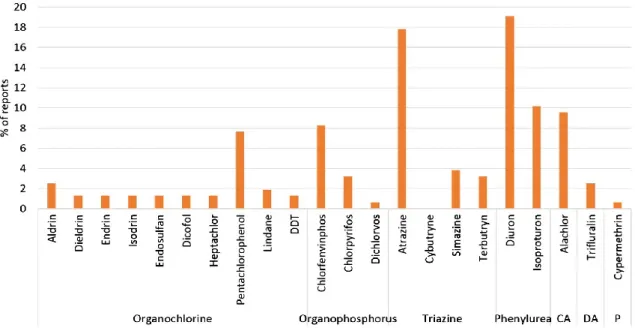
Fig. 3 shows the relative frequency of studies dealing with different pesticide classes defined in Directive 2013/39/EU treated by AOPs. Phenylurea herbicides, represented in the Directive 2013/39/EU by diuron and isoproturon, account for more than a quarter of the reports (19% and 10%, respectively). Thus, diuron can be considered the most studied pesticide. Triazine pesticides included in the Directive 2013/39/EU, representing approximately a quarter of the reports on AOPs for pesticides here reviewed (Fig. 2), comprise atrazine (17.8%), simazine (3.8%) and terbutryn (3.2%), as shown in Fig. 3. Therefore, overall, atra- zine is the second most studied pesticide using AOPs. Although cybutryne is a triazine pesticide, which is also priority in the Directive 2013/39/EU, no reports for this pesticide implementing AOPs were found.
Regarding the organochlorine pesticides of the Directive 2013/39/ EU (21% of reports on AOPs, Fig. 2), the studies comprise aldrin, dieldrin, endrin, isodrin, endosulfan, dicofol, heptachlor and its epoxide, lindane (HCH) and DDT, each one representing less than 3.0% of the reports here presented, as shown in Fig. 3. Pentachlorophenol is the most represented pesticide of this class with 7.6% of the total reports.
Concerning the organophosphorus class of pesticides (12% of reports on AOPs), the decreasing order of frequency is: chlorfenvinphos (8.3%), chlorpyrifos (3.2%) and dichlorvos (0.6%).
Alachlor (chloroacetanilide class, CA), trifluralin (dinitroaniline class, DA) and cypermethrin (pyrethroid class, P) represent 9.6%, 2.6% and 0.6% of the studies,
respectively. Alachlor is often used as a model compound in studies dealing with AOPs due to its trend to form complexes with organic matter and its classification as an endocrine disrupting compound, EDC (Song et al., 2008).
Overall, the phenylurea pesticide diuron and the triazine pesticide at- razine are the most studied compounds using AOPs, accounting together for more than 36% of the reports (Fig. 3). Although atrazine has been banned in the European Union due to the widespread contamination of drinking water supplies, this pesticide considered an EDC, is still used in other regions of the world and for this reason is widely studied (Mackul'ak et al., 2011). Table S1 shows that atrazine was poorly degraded with UV/H2O2 using pre-treated water spiked with a set of 15 compounds at 10 μg L−1 each, while the conversion of all other tested compounds was higher (Lekkerkerker-Teunissen et al., 2013). This work reinforces the idea that this pesticide is a good indicator for the overall performance of an AOP when the aim is to treat waters contam- inated with pesticides. Atrazine is an herbicide known to induce the inhibition of the biological activity of the aerobic biomass normally found in the activated sludge of WWTPs. Thus, it is also important to assess the feasibility of its degradation by AOPs to remove it before entering into biological treatment processes or even into the environment (Benzaquen et al., 2013). Table S2 shows that atrazine is easily degraded by using Fenton-based processes, typically studied at concentrations of 0.1–100 mg L−1, with H2O2 and iron concentrations of 5–50 mg L−1 and 1–55 mg L−1, respectively. Diuron is frequently treated at concentra- tions between 1 and 50 mg L−1, Fenton-based processes presenting high efficiency for its removal and mineralization (H2O2 and iron concentrations employed of 1.5–340 mg L−1 and 0.25–56 mg L−1, respectively).
Heterogeneous photocatalysis has shown to be more effective to treat diuron than atrazine (Table S3). Ozonation is poorly effective in the treatment of both compounds, although more research is needed re- garding catalytic ozonation (Table S4). The phenylurea herbicide isoproturon is also a well-known and documented compound. Concentrations of 25–50 mg L− 1 of isoproturon, which belongs to the same chemical class of diuron, can be also efficiently removed by Fenton-based processes, mainly by photo-Fenton and electro-Fenton (Table S2). Isoproturon was more reactive towards ozone than the other pesticides treated.
After diuron, atrazine and isoproturon, the most studied compounds are the organophosphorus chlorfenvinphos and the organochlorine pentachlorophenol and the chloroacetanilide alachlor. Pentachlorophe- nol at 15–100 mg L− 1 is well removed by Fenton-based processes (Table S2) and also heterogeneous photocatalysis (Table S3) using TiO2 loads between 0.5 and 20 mg L−1. Alachlor can be completely removed by Fenton-based processes at concentrations between 50 and 180 mg L−1. However, heterogeneous photocatalysis and ozonation did not present the same efficiency. Although the main chemical classes of pesticides are well represented by at least one pesticide per class, there are differences in the degradation process between
compounds belonging to the same class of pesticides that justify more research in this area. On the other hand there are compounds included in the Directive like diphenyl ethers (aclonifen and bifenox), quinolone (quinoxyfen) and organotin compounds (tributyltin) that were not yet studied as model pollutants for water treatment by AOPs.
3.2. Polychlorinated biphenyls (PCBs), dioxins and dioxin-like compounds
Polychlorinated biphenyl (PCB) compounds comprise 209 congeners that were extensively used in industry due to their low flammability and electrical insulation characteristics until the 1970s. They are a recognized class of aquatic pollutants with associated long-term risks both to humans and animals (Fang et al., 2012; Rastogi et al., 2009). Dioxins and dioxin-like compounds include three main classes of compounds, namely polychlorinated dibenzo-p-dioxins (PCDDs), polychlorinated dibenzofurans (PCDFs) and dioxin-like polychlorinated biphenyls (PCB-DL). PCDDs and PCDFs are by-products from waste incinerators, chemical and metal industry and landfill leaching. These compounds are released into the environment, being present in all types of environmental media. Additionally, they are recalcitrant to both abiotic and biotic degradation and can lead to long-term risks (Lee et al., 2009). There is a lack of publications concerning the effective- ness of AOPs in degrading dioxins and dioxin-like compounds as well as PCBs. Briefly, PCDDs and PCDFs were treated by Fenton-like oxidation (Lee et al., 2009; Vallejo et al., 2013) (Table S2) and electrochemical ox- idation (Vallejo et al., 2013) was specifically tested for PCDDs (Table S5). PCDDs were efficiently degraded using a catalyst coupled to H2O2 (Lee et al., 2009). While electrochemical oxidation led to the reduction of concentration and toxicity, Fenton oxidation increased the toxicity (Vallejo et al., 2013). Sulfate radical-based AOPs were studied for the degradation of PCBs (Fang et al., 2012; Rastogi et al., 2009) (Table S5).
3.3. Perfluorooctane sulfonic acid and its derivatives (PFOS)
Perfluorooctane sulfonic acid and its derivatives (PFOS) are used in several industrial and household products, mainly as surfactants. In 2009, they were included in the Persistent Organic Pollutant (POP) rec- ommendation list of the Stockholm Convention (Thompson et al., 2011). Although PFOS have been banned in the USA and Europe in the beginning of the 21st century, they are still used and consequently de- tected in the environment. Studies dealing with this class of persistent compounds are still limited regarding AOPs (Tables S4 and S6), only a few studies addressing ozonation (Thompson et al., 2011) and ozona- tion compared with other AOPs (Schroder et al., 2010; Schröder and Meesters, 2005). Two reports compared different AOPs to remove PFOS at different concentrations. PFOS at an initial concentration of 20 ppm was recalcitrant towards O3, O3/UV, O3/H2O2 and Fenton processes (Schröder and Meesters, 2005). In other study including these AOPs and also UV/H2O2, photo-Fenton, O3/catalyst, H2O2/catalyst, O3/catalyst/UV,
and UV/catalyst/H2O2, PFOS at an initial concentration of 0.1 mg L− 1 was degraded between 10% (UV/H2O2) and 50% (O3/UV) (Schroder et al., 2010).
3.4. Polycyclic aromatic hydrocarbons (PAHs)
Polycyclic aromatic hydrocarbons (PAHs) refer to a great class of substances of environmental concern that are ubiquitous in the aquatic environment. They are derived from incomplete combustion of fossil fuels, entering into groundwater and surface waters through direct discharges into the environment from point sources, such as WWTPs or industrial effluents (Dailianis et al., 2014; Sponza and Oztekin, 2010). Besides their carcinogenicity, PAHs are toxic for aquatic ecosystems even at low concentrations, mainly due to their hydrophobicity that turns them easy to bioaccumulate (Dailianis et al., 2014). Reports com- prising AOPs were recently well discussed in a review (Rubio-Clemente et al., 2014), where specific information regarding this topic can be consulted.
3.5. Solvents
Few studies have been performed to assess the effect of AOPs on the removal of solvents, but some of them addressed solvents included in Directive 2013/39/EU. These reports deal with dichloromethane, dichloroethane, trichloromethane and carbon tetrachloride, assessing their re- moval by UV, UV/H2O2, Fenton, photo-Fenton and heterogeneous photocatalysis (Tables S1, S2 and S6). Heterogeneous photocatalysis and photo-Fenton were efficient to treat a wastewater containing three chlorinated solvents (dichloroethane, dichloromethane and trichloromethane) at ppm levels (Rodriguez et al., 2005).
3.6. Nonylphenol and octylphenol
The alkylphenols nonylphenol and octylphenol are included in the priority list in the field of water policy (Directive, 2013) due to their high frequency in the environment at concentrations up to μg L− 1 (Luo et al., 2014). Although there are few reports of AOPs concerning this kind of contaminants, AOPs applied to micropollutants including alkylphenols were compared recently in terms of performance (Jiang et al., 2013). AOPs applied to nonylphenol comprise ozonation (Table S4), electron beam irradiation (Table S5) and comparative stud- ies of different AOPs such as Fenton-based, photocatalysis and ozonation (Table S6). Photo-Fenton and ozonation were compared regarding nonylphenol removal in two reports (Balabanič et al., 2012; Bertanza et al., 2010), one of them comparing also Fenton and heteroge- neous photocatalysis. Using wastewater as matrix, photo-Fenton was the most efficient AOP (Balabanič et al., 2012). Some publications also deal with octylphenol, using photolysis and H2O2-assisted AOPs (Table S1), heterogeneous photocatalysis (Table S3) and electron beam irradiation (Table S5).