School of Economics and Management
TECHNICAL UNIVERSITY OF USBON
MANAGING A PLURALITY OF INTERESTS AND COLLECTIVE VALUES
Chantale Mailhot
HEC Montreal- Canada.
Stephanie Gagnon
Ecole Nationale d'Administration Publique- Canada.
Franc;ois Normandin
HEC Montreal -Canada.
Abstract
We studied a collaborative research project and asked ourselves how actors can coordinate them-selves without having the same interests and values regarding the project. This paper is based on an in-depth case study of a research partnership involving numerous and diverse actors. We found that many features of the governance apparatus of the project allowed coordination of the actors, but the research design in itself constitutes the most powerful device.
Index Terms: project governance, research partnerships, collaborative research project.
1. INTRODUCTION
Our aim is to contribute to research on collaborative research projects. Most of the analysis of these new forms of collaborations is made at the macro level. The management of the boundary-spanning research projects has been the sub-ject of very few works (Adler et a/., 2009). Nevertheless, boundary-spanning research projects take place outside the shared logics, values, cultures and meth-odologies found in each of the organizations that participate in cooperation. New rules need to be constructed by the actors and attention must be paid to the
politi-Correspondence Address: Chantale Mailhot- HEC Montreal, 3000, ch. de Ia Cote-Sainte-Catherine, Montreal (QC), Canada, H3T 1A7. E-mail: [email protected]
PORTUGUESE JOURNAL OF MANAGEMENT STUDIES, VOL. XV, NO.3, 2010
cal dimension, i.e. to what makes a participant in those partnerships work within a common project in spite of different, and sometimes divergent, interests.
We studied a large networking project of schools located in remote regions in Quebec (Canada). The project, guided by a "liaison and transfer center" (LTC), sought to improve the educational environment in these schools and prevent their closing. This large-scale project, which lasted six years and is now in the insti-tutionalization phase, involved many actors from different milieus. Initially, the project included only three primary schools and a handful of students and teach-ers. At its conclusion, it encompassed over a hundred primary and secondary schools, 200 teachers and 2500 students distributed among 22 school boards. At the outset, the Quebec government commissioned the project, involving two agencies and elaborated by a team of researchers from two Quebec universities. A "liaison and transfer centre," a typically Quebec institution set up to facilitate relations established between universities and other socioeconomic organizations, was asked to manage the project. This project is noteworthy in that it involves numerous actors and stakeholders (teachers, students, school principals, school boards and teachers unions). Thus, a variety of actors with different values, inter-ests and objectives interacted on the same project. We asked ourselves how the participants and stakeholder in such a large project could coordinate despite their differing interests and objectives.
2. LITERATURE REVIEW
Collaboration between multiple social entities has become a major trend in the last two decades, giving rise to what Googins and Rochlin (2000) call the "partnership society." These new forms of collaboration can be found in many spheres and include multiple actors. Collaborations between firms are certainly the most apparent and scholars have identified a variety of forms that such col-laborations can take (Vyas eta/., 1995; Varadarajan and Cunningham, 1995; Todeva and Knoke, 2005), such as joint ventures, cartels, formal alliances, franchises and licensing agreements, to name but a few. Given that technol-ogy strongly contributes to the construction of a competitive advantage for firms, scholars have also closely examined technological and R&D collaborations be-tween firms (Chiesa and Manzini, 1998; Hagedoorn eta/., 2000; Hagedoorn, 2002). Invoking the imperative need for greater innovation and national competi-tiveness in a globalized world, governments, along with universities, have forged strong collaborative links with firms to form a dynamic configuration compared by Etzkowitz and Leydesdorff (2000) to a "triple helix." Nevertheless, this relatively recent phenomenon of collaborations is not only limited to economic, political and academic actors. The increasing blur between the economic and social spheres
PORTUGUESE JOURNAL OF MANAGEMENT STUDIES, VOL. XV, NO.3, 2010
has spawned extensive collaborations between firms and non-profits in a variety of configurations (Wad dock, 1991; Wymer and Samu, 2003; Seitanidi and Ryan, 2007).
Academics have explored a variety of perspectives in respect of such collabo-rations to explain and interpret this new social and economic reality. Macroeco-nomics has provided an initial way of looking at partnerships, whereas transaction cost theory considers alliances and collaboration as a way of coping with market failures and/or avoiding opportunistic behaviours from partners. This perspective is characterized by extensive reliance on economic concepts (transaction costs, procurement costs, opportunism, and so on) and a strong emphasis on the firm as the main dynamic element of collaborations (Dyer, 1997).
Strategic management offers another perspective on partnerships and mul-tiple vantage points. Resource dependence theory views collaboration as a mean for organizations to access lacking, needed or complementing resources. The fo-cus here largely relies on the firm and its behaviour (Dyer and Singh, 1998: 660). Many scholars have adopted the strategic choice perspective to explain collabora-tions, putting their efforts into exposing the multiple motives to collaborate, such as the desire for an organization to rapidly access a new market, increase its com-petitiveness or counteract a move taken by a competitor on a given market. In the stakeholder theory's perspective, organizations are perceived as a way and place for coordinating the stakeholders' interests. Collaboration is, therefore, considered to be a means to align the stakeholders' various interests and, consequently, to reduce uncertainty. Strategic management perspective can also include contribu-tions from learning theory, where partnerships are established and pursued in order to acquire technical skills or technological knowledge.
Institutional theory (DiMaggio and Powell, 1983) offers another perspective on collaborations. According to this perspective, organizations engage in partner-ships in order to enhance their legitimacy and to conform to the existing norms and rules of their business environment. Collaboration can eventually lead to the creation of a new institution, thus affording the organizations involved a competi-tive advantage over other organizations (Lawrence eta/., 2002). However, this theoretical view still considers the firm as the primordial actor in collaborations, as the macroeconomic and strategic management perspectives do, but begins to more closely examine managerial behaviour through agency theory (Han eta/., 1993) and stewardship theory in collaborative situations.
(Oii-PORTUGUESE JOURNAL OF MANAGEMENT STUDIES, VOL. XV, NO.3, 2010
ver, 1990), characteristics (Shaw, 2003), drivers and enablers (Austin, 2000), advantages and disadvantages of collaboration (Barringer and Harrison, 2000). Regarding implementation, scholars have mainly put their efforts into elaborat-ing stage models of evolution (Gray and Wood, 1989; Austin, 2000; Kaplan and Hurd, 2002), in enumerating sensible themes inherent in collaborations, such as management of objectives, compromise, communication, democracy and equality, power and trust, determination, commitment and stamina (Huxham and Vangen, 1996), and in identifying key success factors (Pietras and Stormer, 2001) for col-laborations. On the subject of collaborative outcomes, links have been established between key factors of success and predefined outcomes (Dorado eta/., 2009), while other academics (Kiitgaard and Treverton, 2004) have elaborated assess-ment tools and methods (2004) to measure results generated by collaborations. Partnerships and collaborations have, until now, been studied essentially at the level of firms and organizations. Duysters et a/. (2004) note that extensive scientific contributions in the field of collaborations relate to "immaterial" actors such as the alliance, the firm and the network, thus obscuring individual actors such as managers. Embedded relationships, trust, value differences, divergent goals, and domain consensus (Tsasis, 2009: 16-17) are beginning to be inves-tigated in strategic partnerships, but the processes of adjustments between the partners of collaborations have not been explored in depth. Adler eta/. (2009: 1137) speak of strong emphasis placed on the "macro perspective" of collabo-rations and note that the management of collaborative research programs and projects has not been studied despite the proliferation of these kinds of projects (Gibbons eta/., 1994, Etzkowitz and Leydesdorff, 2000).
3.CONCEPTUALBACKGROUND
We have adopted a pluralistic research approach, i.e. an approach that ac-knowledges the existence of multiple value systems, logics and frameworks of action, a multiplicity that can produce tensions. We focus on research trends that analyze the local dynamics of the association between actors, and by tak-ing into account apparatuses upon which these associations are based (Eymard-Duvarnay, 1999). Our theoretical analytical framework is the Economy of Worth, elaborated by French sociologists Boltanski and Thevenot (1991) and Boltanski and Chiapello (1999). This analytical framework has, until now, been used pri-marily in political sociology.
PORTUGUESE JOURNAL OF MANAGEMENT STUDIES, VOL. XV, NO.3, 2010
when they want to coordinate. These authors and Boltanski and Chiapello (1999) have identified seven (Mesny and Mailhot, 2007) major principles of action, or worlds, to assess individuals or situations as good or bad, i.e. the inspired world, the domestic world, the civic world, the opinion world, the industrial world, the merchant world and the project world.
In the first world (the inspired world), what is good sparks inspiration and what is bad hinders it. In the domestic world, it is respect for tradition and author-ity that matters. Any friendly authorauthor-ity that allows the preservation of traditional ways of doing things is good. In the civic world, it is collective welfare that mat-ters, while in the opinion world, only the opinion of others counts for a celeb-rity. Efficiency is important in the industrial world, while return on investment is predominant in the merchant world. Lastly, networking is the main objective in the project world. In each world, subjects, objects and mechanisms of all sorts embody the values of the world. The artist and his vision are important figures of the inspired world, like the family and the title in the domestic world, the opinion leader and the message in the world of fame, collectivities and their rights in the
Higher Common Principle
State of Worthiness
Subjects
Objects
Relationships
TABLE 1
The Seven Worlds (summary)
PORTUGUESE JOUR"fAL OF MANAGEMENT STUDIES, VOL. XV, NO.3, 2010
civic world, the client and the objects of luxury in the market world, the expert and his methods in the industrial world, and the mediator and the agreement in the project world. When actors try to coordinate, they rely on principles but also on these subjects or objects, methodologies, techniques, roles, legislation, plans, resources, technologies, and so on. In this perspective, agreement is not only intersubjective but is also anchored in concrete mechanisms.
In a situation where several worlds are present, tensions or even conflict can arise from disagreement on principles or the logic to adopt. People can reach agreement by referring to the founding principle of the same world, by means of the juxtaposition of different worlds through nonconflicting objects or subjects, or by constructing a compromise between the worlds present through the elabora-tion of new principles and operating rules.
Our research question is: How do actors coordinate themselves despite their different values and interests? People involved in the partnership have economic, political and social concerns that appear during the debates. We ask the general question of the mechanism that allows the actors to participate in a common project despite their divergent logics. The framework of the Economy of Worth will allow us to produce a "case of applied sociopolitics" in the field of management of collaboration research projects.
4. METHODOLOGY
Our methodological approach is based on an in-depth case study. We want-ed to understand the process of coordination between actors having different in-terests in a project. The case study is a research strategy that is most appropriate for process-oriented research. The idea was to choose a case "where the progress is transparently observable" (Pettigrew, 1995: 102). In other words, the project chosen was a successful one and was institutionalized.
We combined two methods of data collection:1 (1) 13 semi-directed
inter-views with representatives of key groups of actors involved in the project and (2) document analysis. One hundred documents were produced under the project, including a literature review at the start of the project, environment descriptions written by the actors involved, scientific or vulgarization papers written by uni-versity researchers in education studies, various analyses (social impact, public policy implications), stage synthesis from experts, and so on.
Our analysis was conducted in two phases. First, we looked at individuals involved in the partnership and their economic, political and social concerns ap-parent during the project. The concepts of the framework were used to guide this
PORTUGUESE JOURNAL OF MANAGEMENT STUDIES, VOL. XV, NO.3, 2010
initial categorization. In this way, we realized that the project set in motion a plu-rality of logics or collective values and noted that widespread tension character-ized the project. Second, we looked at the solutions that the actors implemented to resolve conflicts or friction and examined the elaboration of the functioning rules of the collective.
In the next section of the paper, we will present the case of the project, the Remote Networked Schools Initiative, managed by CEFRIO, an LTC.2 We will
describe the organizational apparatus of the project, the actors and stakeholders, their concerns and their objectives regarding the project and, lastly, the various moments of tension that the actors identified. Next, our analysis will look more precisely at the actors' acts of production of judgment, the references made to politics in individual discourse at times of reflexivity or, in other words, when the actors engaged in political sociology. According to Boltanski and Thevenot, it is the presence of multiple logics that can provoke tensions but also allow the elaboration of innovative agreements. We will endeavour to reveal the solutions elaborated by the actors to reconcile principles of actions or rival value systems.
5. THE REMOTE NETWORKED SCHOOLS INITIATIVE (RNSI)
5.1. Description of the project
RNSI, which started in 2003, arose from the government's determination to revitalize rural regions contending with problems related to depopulation and economic development. It sought to keep rural schools open, thus helping to maintain the integrity and vitality of the local communities. The idea was to trans-form usual educational practices by integrating the use of intrans-formation and com-munications technologies OCT) and to network small schools in order to improve the quality of education.
A deputy minister in the ministere de !'Education du Loisir et du Sport (MELS) (the Quebec department of education) gave CEFRIO the mandate to examine the role that ICT could play in the preservation and the development of these remote schools. The initial idea was to have classes in three different schools work together during an entire academic year, link two teachers and two groups of students from different schools in order to work together on learning activities through the Internet, collect data, and document these educational practices. Technological tools were given to teachers. An Internet link with high bandwidth was set up in each class, videoconferencing software (iVisit) and newsgroup
soft-2 CEFRIO stands for Centre francophone d'informatisation des organisations: Francophone center for the
PORTUGUESE JOURNAL OF MANAGEMENT STUDIES, VOL. XV, NO.3, 2010
ware (Knowledge Forum) were installed on computers to allow communication and exchanges between teachers and students.
The project, proposed by CEFRIO and the researchers in education sciences from Universite Laval (Quebec City) and McGill University (Montreal), sought to connect students from schools located in remote areas with other schools using optical fibre. By doing so, these remote schools became places of experimentation for remote collaboration and new pedagogical experiences.
It was the researchers who first had the theoretical idea to put classes into a network, without knowing how the actors were going to respond to the idea and adopt it.
The research was based on an action-research design or, more precisely, a "design experiment." This research design implied iterations according to the progress of the research, i.e. data was quickly presented to people in the field, in a logic of reflexive practice. The project was divided into three phases, each of which contained iteration moments. These moments served, at the end of every academic semester, to give the participants the results of the practices developed in their school.
It took approximately two years before formalizing the concept of RNSI, in the course of the interactions between researchers, teachers, educational advis-ers, school principals and school boards, since the initiative of the innovation and the operationalization of the idea was, from the start, an initiative of those working in the field. In fact, every school had to plan the specific deployment of the project in its classrooms (choice of the activities and the training aids, type of supervision to display in class, and parents' involvement). A budget was then given to every school to make sure that it was connected to the Internet, that it had technical support and that teachers received pedagogical leave in order to plan and evaluate. According to the experiment design, the iteration moments al-lowed rapid feedback to each school.
Every year, transfer sessions were organized. These sessions assembled all participants in the project (in every school) in order to share educational activities realized under the project. The objective of these sessions was to allow prompt circulation of innovative practices to other school boards and to present results to decision-makers. Transfer sessions were promptly followed by the communication of case reviews and research papers produced by the research team and reports pro-duced by the experts and advisers from the CEFRIO for users and decision-makers.
5.2. The actors and their interests
The research team comprised three researchers from both participating uni-versities (Laval and McGill), as well as of graduate students (seven
PORTUGUESE JOURNAL OF MANAGEMENT STUDIES, VOL. XV, NO.3, 2010
als). The research team also included the project manager from CEFRIO and a consultant. In the field, follow-up committees were set up at each of the cho-sen sites. These committees included school principals, educational advisers, administrative managers from the school boards involved in the project (the chief educational officer, the chief technological officer), as well as the CEFRIO project manager. At the head of this local organization was an executive committee set up by the provincial and regional representatives from MELS, the CEFRIO project manager, a representative from the ministere des Affaires municipales et des Re-gions (MAMR)3 and, lastly, a representative from the Centrale des syndicats du Quebec (CSQ), the biggest teachers' union in Quebec.
Even though the goals were modest at the beginning of the project (es-sentially testing with three experimental schools), the project gathered multiple actors (researchers, CEFRIO staff, a deputy minister, teachers and students) and numerous stakeholders (civil servants at MELS, school principals, school boards, labour unions, and so on). Each actor perceived the project very differently.
The deputy minister saw in this initiative an opportunity to satisfy by means of ICT the needs of students in remote areas, which are rapidly depopulating. For researchers, these schools were interesting fields of experimentation from the standpoint of networking classrooms, the concept of the learning commu-nity and the concept of knowledge co-elaboration (rather than that of distance teaching). Thus, the deputy minister was interested in preserving schools, while the researchers' interest was educational. Teachers saw in this project a way of protecting their jobs and school principals, beyond the evident interest of avoiding school closures, found a way to enter into classrooms and to know more about what takes place at the educational level. Finally, CEFRIO played its role as an indispensable integrator in projects of this nature. That being said, all of the ac-tors acknowledged that this project was in the public interest and that each one of them had to work in the name of a certain social responsibility.
5.3. Multiple stakes for multiple actors
"This type of project is a fragile system in which each of the actors has a status, a role and in which the object at the same time interests him and upsets him." (a CEFRIO
consultant).
For the teachers, this project included numerous challenges, including lon-ger hours of work, especially during the project's implementation phase. The project implied a major shake-up of teaching methods and a questioning of the
PORTUGUESE JOURNAL OF MANAGEMENT STUDIES, VOL. XV, NO.3, 2010
existing school organization. Teachers also felt pressure from researchers to pro-duce results in a rather short lapse of time. But teachers were especially afraid of being evaluated on their own educational practices and of being considered "guinea pigs" in the project, because researchers were having an ethnographical look at their daily practices.
Furthermore, change disrupts the usual way of working. "Some teachers were destabilized, because whether you want it or not, working in network, we go into the classroom as such. Often what we saw was two, three or four comput-ers per class, which drew the teacher into multitasking. Not everyone was used to doing so. People have a tendency to make students do the same thing at the same time. I remember that, at first, it was not easy." (a researcher) For a school board officer involved in the project, the academic environment is tied to almost secular ways of doing.
For university researchers, the design of the project was also very demand-ing. This design forced researchers from various universities to work together, produce popularization texts, and modify their design according to the evolution of the research while making sure of the validity of their method. For researchers who partly relinquished the initiative of the innovation to the people in the field within the framework of this design, the research protocol contained an important element of uncertainty. For example, they had to change their vocabulary to make sure that the teachers understood what was needed: "We pretty much believed in principles inherent in the co-construction of knowledge and soon enough, we said to ourselves: 'Let's set aside these principles. Let's keep them in mind, but let's not name them specifically."' (a researcher).
School boards also felt the presence of MELS and CEFRIO as an intrusion "in their backyard" because CEFRIO and MELS were present in their everyday lives. The introduction of the RNSI project required a willingness to open up and share characteristics of the environments. It also required sharing the results obtained under the project. School boards regard their schools as their territory and responsibility, as is true of the schools and their teachers. The presence of an organization such as CEFRIO, imposed by the government, to interact with school principals and school boards was an important source of friction. Intervention by the organization, which occurred at different decision-making levels, broke or violated the traditional hierarchical order which exists between school boards, schools and classrooms. People from CEFRIO or researchers entered classrooms with a research protocol that implied a precise course of action. People from the school boards or school principals did not always appreciate that "their teachers" were told what to do.
PORTUGUESE JOURNAL OF MANAGEMENT STUDIES, VOL. XV, NO.3, 2010
facing this organization was, in particular, to ensure that researchers and actors in the field fulfilled their commitments to MELS and that essential and reliable links were gradually forged to ensure the proper functioning of this project. This was particularly important, given its mandate centred on the social transformation of organizations. All this generated widespread tension "[ ... ] and without an organi-zation with the mandate to intervene there, the project would have failed." (a CE-FRIO consultant). CECE-FRIO had the official task of managing relations with school boards and Quebec government agencies. CEFRIO staff frequently intervened dur-ing conflicts at every level, includdur-ing between researchers and teachers in the field, even when researchers did not clearly see, at first, why this organization was involved in the research, and that its presence was even questioned by other actors such as school boards. CEFRIO was involved in "several lengthy, pointed explanations" with researchers. The CEFRIO project manager found it harder to manage this type of research design than to manage a research team that is going to collect data in the field and leave afterward to produce its report: "Under this research protocol, the researcher collected data but also helped actors in the field to advance, to improve certain practices, and that is where management becomes complex, because this collaboration also generates tension, people experience things." (a CEFRIO project manager).
5.4. Tensions and conflicts
Two types of activities were particularly difficult during the project. One was the first iteration session, which for several actors was very problematical as re-gards the relationship between researchers and teachers. The second activity was a transfer session, where the importance and aims of the session varied from one actor to another.
At the iteration session, teachers had not fully grasped the intention conveyed through the research protocol, all the more so as they did not even understand the language used by the researchers. "A researcher made a half-day presentation on the software when teachers were granted pedagogical leaves. And then, it was a to-tal shock. Teachers understood nothing. It was really an academic language, it was not concrete at all. They left the room discouraged and all wanted to give it up."(an educational adviser) Furthermore, " ... phases of iteration come from a model where we give back precise data on what people do privately, on things that are at the heart of their profession and their responsibility." (a CEFRIO project manager).
Through the transfer session, the schools involved in the project presented to other school principals, school boards and MELS staff the results of their ef-forts throughout the year. The teachers perceived the transfer sessions as dead-lines and as another obligation. The researchers, who wanted to force innovation,
PORTUGUESE JOURNAL OF MANAGEMENT STUDIES, VOL. XV, NO. 3, 2010
regarded such sessions as a form of pressure. Other actors in the field deemed the transfer sessions to be indispensable in order to " ... get their own reading [the researchers' reading] regarding the objectification of the fallout from our activities or especially with the speed at which things progressed. Because of the models of development on which the teams of researchers had agreed, staff in the schools regarded them as one model among others. Thus, we were not necessarily aware of specific aspects, scales or grids that researchers used to examine the progress of such an innovative dynamic."(a school board). For the LCT, these sessions were a means to present results to stakeholders and "to hang on" or interest other actors in the project. A big difficulty at first was to convince people to attend these meetings (messages still failed to pass between school boards, school principals and teach-ers), in particular MELS staff, who failed to see the interest in participating in these sessions.
5.5. A plurality of logics at play
"NSR concerns a lot of people. It is rich, complex, yet also full of difficulties." (the head of research).
The analysis of actors' comments during interviews revealed that school staff evolved according to a domestic logic, the researchers according to an industrial logic, and CEFRIO according to a project logic. Accordingly, our results show that besides the different interests, a multiplicity of logics, action principles and ways of seeing the world was present. The project implied the coordination of various actors who adopted rules and common ways of functioning to realize a project of public interest.
The clear presence of the domestic world for school staff can be seen in Table 2.
Educate, give, respect
Tradition
Benevolent
292
TABLE 2
The domestic world
"If teachers had ideas or projects, I managed to guide and support them and make their project simpler." (a manager of educational ser-vices)
"We required them to devoted 25% of their work time to the network when they were accustomed to working alone, without criticism. Teamwork has been an issue." (the CEFRIO project manager)
PORTUGUESE JOURNAL OF MANAGEMENT STUDIES, VOL. XV. NO. 3, 2010
In contrast, the work done by the team of researchers was inspired by the industrial world (see Table 3)
Expert
Method
Efficiency
TABLE 3
The industrial world
"We believed in these co-development principles but we quickly real-ized that we couldn't talk about them explicitly. It was an academic language ... Nobody understands anything." (a researcher)
"I had never seen data collection that complex ... It was created for this project in particular." (the CEFRIO project manager)
"A problem arose concerning a particular researcher. The teachers didn't want to work with him anymore because he was too demand-ing about results." (an educational adviser)
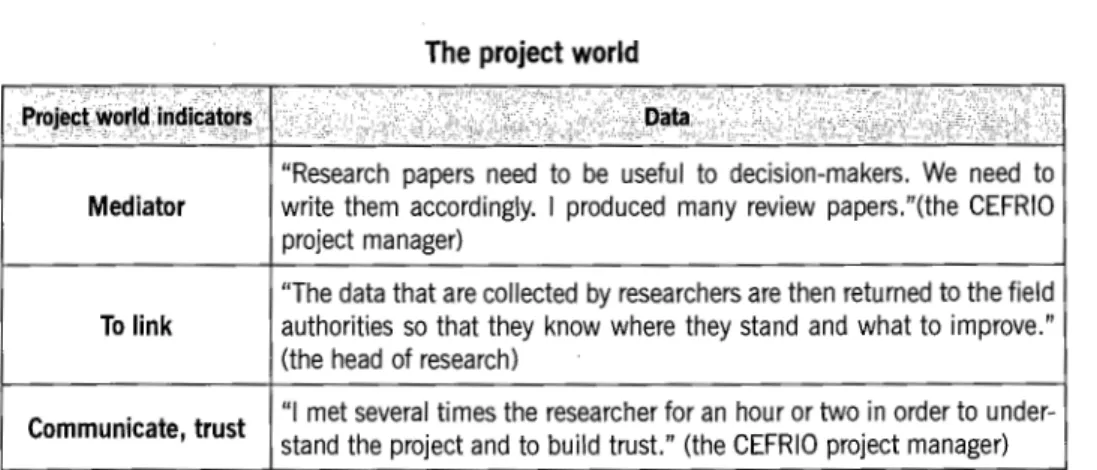
The CEFRIO project manager's perspective centres heavily on the project world.
Mediator
To link
Communicate, trust
TABLE 4
The project world
"Research papers need to be useful to decision-makers. We need to write them accordingly. I produced many review papers."(the CEFRIO project manager)
"The data that are collected by researchers are then returned to the field authorities so that they know where they stand and what to improve." (the head of research)
"I met several times the researcher for an hour or two in order to under-stand the project and to build trust." (the CEFRIO project manager)
All of these actors collaborated on a project in which a general problem stemmed from a civic logic, i.e. "to maintain and to develop schools in remote regions, "which emanated from MELS. The project was first formulated in the perspective of a civic logic at the departmental level: "It was not the teaching dimension that interested us but rather the preservation of schools. The academic question was not our cup of tea. The school is important to the community and what interested us was ways of maintaining it." (MAMR).
In light of these observations, it becomes obvious that activities that are unquestionably difficult encompass different logics. The research project implied
PORTUGUESE JOURNAL OF MANAGEMENT STUDIES, VOL. XV, NO.3, 2010
opening the classroom to researchers by means of data collection. "It was literally a question of using ultrasound to examine the classroom" (a researcher), and of several classrooms in various schools. The project involved extraordinary obser-vation, the observation of the teachers' practices in their classrooms, but also generated quantitative data that allows the comparison of classes and schools and reveals the practices of the educational advisers, for example. "The project upset several people. It revealed things that people would have preferred not to see revealed, really disturbing things." (the CEFRIO project manager).
According to the actors, the research design generated widespread insecurity that provoked the project's initial crises. Teachers did not readily agree to have researchers in the classroom commenting, sometimes awkwardly, on their work for example, by comparing their performance with that of the others. Researchers were often perceived as cold individuals, asked to apply a method without taking into account small details in the field. Teachers greatly feared that their ability to innovate would be inaccurately assessed by the "researchers' "knowledge author-ity.". They were also afraid of not meeting these high and impersonal standards.
5.6. The resolution of difficult situations
The evolution of the project showed that phases of iteration that went well depended on exchanges marked by subtlety and tact and a good understanding of how the research protocol was experienced in the field. That being said, for the first session that appeared to be problematical, three solutions proved to be successful over time. The first factor was the educational adviser's attitude. She thoroughly understood the teachers' situation, which helped. She put things into perspective regarding the incident of the academic vocabulary mentioned earlier: Because I was the guide in this project, I said: 'Is it OK to use videoconferenc-ing?' They said 'Yes.' Then I said: 'We are going to put that aside, we are going to only use videoconferencing We'll get back to Knowledge Forum later. But at some point, it was necessary to return to Knowledge Forum. I met with the teach-ers during a day of planning and said 'Ready or not, here we go!' Why don't we try something? Maybe we'll fail. Maybe we'll also be able to reach students and obtain positive results. I simply asked them if they were ready. And then they said 'Yes.' They felt that I had lifted a burden from their shoulders."
Next, the researcher managed to interact with the teachers, such that the latter felt at ease and did not perceive researchers as individuals in an ivory tower. In fact, the research method that was applied facilitated this attitude. It is "a method of experiment design, essentially we work by iteration. Then, yes we go and get data, we analyze the data and send it back in the field. But at the same time the results we acknowledge ... inevitably provide an image of our own
PORTUGUESE JOURNAL OF MANAGEMENT STUDIES, VOL. XV, NO.3, 2010
support. This clearly encouraged us to make certain adjustments" (a researcher), namely the adjustment of the vocabulary in use.
What stands out in the discussion about key factors in the project's success in the classroom is that researchers had to re-create a familiar face so that the participants would agree to open up and collaborate on the research. The decisive factor was the ongoing but discreet presence of researchers to answer questions from teachers. This support given to the teachers was extremely important and the teachers relied extensively on it. In fact, the researchers and teachers com-municated daily by videoconference, depending on the needs felt at that time. Teachers received support from the researcher concerning the technical tools and, ultimately, pedagogical questions.
For the transfer sessions, the differences between the actors were resolved by the presentation of the results. In fact, the session allowed teachers and schools to see their contribution to the learning process of the students and to a research project. Having experienced these transfer sessions, the participants were pleased and confident of the conclusion. Teachers, for example, observed their progress and could borrow ideas from the other schools involved in the project.
6. DISCUSSION
"The RNSI project is a social economy project because it is basically a question of education but also focuses extensively on governance and decision-making among administrators in the education sector." (the CEFRIO project manager).
What stands out in our results (see Table 5) is firstly the fact that encounters proved to be difficult at the beginning of the project. Paradoxically, it was the creation of sound relations through recurrent relationships (through the observa-tion apparatus) that the relaobserva-tionship of donaobserva-tion, support, training and educaobserva-tion emerged. This seemed to have strengthened the links between researchers and teachers. Moreover, once the teachers clearly understood that the project did not imply a loss of employment (the fear of being replaced by technology) but, to the contrary, the preservation of their jobs and their school and the retention of young people in remote areas who receive a better education through teaching methods centred on new technologie), they got involved in the project. "Honestly, what we told ourselves is that people have nothing to lose, because now the model on which the school relies is not producing results. Success at school was simply not there."(a school board).
PORTUGUESE JOURNAL OF MANAGEMENT STUDIES, VOL. XV, NO.3, 2010
project world. However, the reasoning which characterizes the project world could not, in itself, ensure the commitment of people in the field and its success. The apparatus of research-action, the 'experiment design," is an extraordinary com-promise between the domestic world of the small school and the industrial world of the researchers, because it allows the recognition of the teachers' competence (their role as teachers is not questioned, the preservation of their traditional im-portance in school) and the efficiency of their practices: "The research goes be-yond simply saying to practitioners what to do. It respects their knowledge and their knowledge of experiment." (a researcher). "The theory and the conceptual models feed the practice and the practice feeds these models. Thus, we are in a dialogue. It is oddly interesting but at the same time obvious that it is an unusual challenge , because the research's frames of reference are not always the same as those of the practice's frames of reference. Then, there are adjustments that have to be made. "It is difficult but what is striking is that we have no choice but to dialogue. And for me, the dialogue, combined with good listening, helps to bring people together." (a researcher).
Communication, adjustment and trust are relationship markers in the project world. But this trust could not have grown without the assurance of job security, at first, then without the offer of constant support from friendly researchers. It is also noteworthy that the technological tool facilitated the establishment of this compromise with the domestic world of the small school. The domestic world is generally ill-equipped for distant action, being an eminently local world (Boltanski and Thevenot, 1991: 206). The idea of networking schools aroused resistance in this world, which the notion of creating a school community probably appeased. But it is precisely through the networking tool that teachers have been able to establish domestic links with researchers who could be present with them any time to help them, answer their questions and reassure them. By doing so, they were able to consider networking as a means of re-creating a community. How-ever, this protocol is more dangerous for the researchers who put themselves in a permanent situation of service: "We must strike a balance. It is necessary for researchers to continue to do research and not only put ourselves in situation of service."(the head of research).
We see that the main argument for the implementation of the RNSI project and the need to sustain it, i.e. "to preserve schools in remote regions," represents an objective or a justification for certain individuals only, usually staff from MELS. Participants in the project have numerous other justifications for participating in and supporting this project, which does not really find a collective objective. Ap-paratuses set up to ensure the smooth running of the project depend much more on the industrial and domestic worlds rather than the civic or project worlds.
TEACHERS AND SCHOOLS
• Traditional methods of teaching
• Teacher-pupils relations • Bureaucracy
PORTUGUESE JOURNAL OF MANAGEMENT STUDIES, VOL. XV, NO. 3, 2010
TABLE 5
Resolution of critical moments
. ·' :>:~ .
c: :~ -., \}-.•
Observation apparatus (formal):
I) Allows to overcome the classroom secrecy and to get a picture of the classroom
2) Ensure a presence and a constant support from researchers 3) Recreate a virtual community
• Inner circle Phases of iteration
Domestic world
RESEARCHERS
• Improvement of pedagogical methods' efficiency • Progress of science
Industrial world CEFRIO
• Linkage of actors from
Research-action design (formal):
I) Researchers out of their "ivory tower" understand the field's context 2) Adjustments of researchers to people's reactions in the field 3) Acknowledgement of practioners' competency and expertise
Actors with special profiles (informal):
I) Actors sensitive to people's concerns in the field
2) Actors who know different environments and mediate between people 3) Allow to not impose a unique objective and to preserve the multiplicity of
points of view and goals
Transfer sessions Committees, documents, apparatuses and presentations (formal):
different circles I) Allow the creation of a network of multipe actors in order to make the project evolve
Project world 2) Supply practioners for transformation of practices and decision-making 3) Allow to sustain the interest of multiple actors supporting the project
meetings, and regulating conflicts that the principles of the project world emerged. The enthusiasm and commitment of the actors in the project was largely the fruit of this constant, laborious, but not always easy, work. The communication and adjustment between individuals, which seems natural in the project world, was difficult, as the project was marked to a greater degree by a succession of crises. The challenge is then to see if, without the constant work of intermediaries, the project can be institutionalized.
7. CONCLUSION
PORTUGUESE JOURNAL OF MANAGEMENT STUDIES, VOL. XV, NO. 3, 2010
value in their profession. The latitude generated from the experiment design also made possible the integration of new practices and the subsequent adjustment for each of the groups of involved actors. Finally, the plurality of established com-mittees reconciled divergent interests when they appeared, but also demonstrated successes as they arose in order to build on each one of them. Transfer sessions, in particular, had the effect of fully revealing progress and the scope of the work accomplished.
In addition to these formal mechanisms, we found an informal characteristic that made possible the RNSI project's success. At first, several actors acted, each with a specific profile and/or a diversified background, which made them sensitive to other protagonists' fears, concerns and interests .. For instance, the individual who demystified Knowledge Forum had extensive experience as a teacher and an educational adviser. Several other actors were able to navigate between the worlds of researchers, governmental agencies, teachers, school boards and school managers. Then, beyond the capacity to establish links between the worlds in question, the actors were smart enough to understand others and to be sensitive to them. The attitude of respect and the openness to differences turned out to be essential.
PORTUGUESE JOURNAL OF MANAGEMENT STUDIES, VOL. XV, NO. 3, 2010
References
Adler, N., Elmquist, M. and Norrgren, F. (2009). "The challenge of managing boundary-spanning research activities: Experiences from the Swedish context", Research Policy, 38 (7), pp. 1136-1149.
Ahuja, G. (2000). "Collaboration Networks, Structural Holes and Innovation: A Longitudinal Study",
Administrative Science Quarterly, 45 (3), pp. 425-455.
Andrews, R. and Entwistle, T. (2010). "Does Cross-Sectoral Partnership Deliver? An Empirical Exploration of Public Service Effectiveness, Efficiency, and Equity", Journal of Public
Admin-istration Research and Theory, 20 (3), pp. 679-701.
Austin, J. E. (2000). "Strategic Collaboration Between Nonprofits and Business", Nonprofit and
Voluntary Sector Quarterly, 29 (1), pp. 69-97.
Barringer, B. R. and Harrison, J. S. (2000). "Walking a Tightrope: Creating Value Through lnteror-ganizational Relationships", Journal of Management, 26 (3), pp. 367-403.
Boltanski, L. and Chiapello, L. (1999). Le nouvel esprit du capitalisme. Paris: Editions Gallimard, 843 p.
Boltanski, L. and Thevenot, L. (2006). On justification: Economies of worth. Princeton (NJ): Prin-ceton University Press, 390 p.
Boltanski L. and Thevenot, L. (1991). De Ia justification. Les economies de Ia grandeur. Paris: Editions Gallimard, 485 p.
Chiesa, V. and Manzini, R. (1998). "Organizing for Technological Collaborations: A Managerial Perspective", R&D Management, 28 (3), pp. 199-212.
DiMaggio, P. J. and Powell, W. W. (1983). "The Iron Cage Revisited: Institutional Isomorphism and Collective Rationality in Organizational Fields", American Sociological Review, 48 (2), pp. 147-160.
Dorado, S., Giles, D. E. Jr. and Welch, T. C. (2009). "Delegation of Coordination and Outcomes in Cross-Sector Partnerships: The Case of Service Learning Partnerships", Nonprofit and
Volun-tary Sector, 38 (3), pp. 368-391.
Duysters G., Heimeriks, K. H. and Jurriens, J. A. (2004). "An Integrated Perspective on Alliance Management", Journal on Chain and Network Science, 4 (2), pp. 83-94.
Dyer J. H. (1997). "Effective Interfirm Collaboration: How Firms Minimize Transaction Costs and Maximize Transaction Value", Strategic Management Journal, 18 (7), pp. 535-556. Dyer J. H. and Singh, H. (1998). "The Relational View: Cooperative Strategy and Sources of
ln-terorganizational Competitive Advantage", Academy of Management Review, 23 (4), pp. 660-679.
Etzkowitz, H., Leydesdorff, L. (2000). "The Dynamics of Innovation: From National Systems and "Mode 2" to a Triple Helix of University-Industry-Government Relations", Research Policy,
29 (2), pp. 109-123.
Eymard-Duvernay, F. (1999). "Les competences des acteurs dans les reseaux". In Calion, M., Co-hendet, P., Curien, N., Daile, J.-M., Eymard-Duvernay, F., Foray D. and Schenk, E., Reseau
et coordination. Paris: Economica, 194 p.
Gibbons, M., Limoges, C., Nowotny, H., Schwartzman, S., Scott, P. and Trow, M. (1994). The New Production of Knowledge: The Dynamics of Science and Research in Contemporary
Societ-ies. London: Sage Publications, 179 p.
Googins, B. K. and Rochlin, S. A. (2000). "Creating the Partnership Society: Understanding the Rhetoric and Reality of Cross-Sectoral Partnerships", Business and Society Review, 105 (1), pp. 127-144.
Gray, B. and Wood, D. (1991). "Collaborative Alliances: Moving from Practice to Theory", Journal
of Applied Behavioral Science, 27 (3), pp. 3-22.
PORTUGUESE JOURNAL OF MANAGEMENT STUDIES, VOL. XV, NO.3, 2010
Hagedoorn, J., Link, A. N. and Vonortas, N. S. (2000). "Research Partnerships", Research Policy,
29 (4-5), pp. 567-586.
Han, S. L., Wilson, D. T. and Dant, S. (1993). "Buyer-supplier relationships today", Industrial
Mar-keting Management, 22 (4), pp. 331-338.
Herreros, G. and Livian Y. F. (1994). "La sociologie des conventions: une nouvelle grille d'analyse des organisations?", Revue franr;aise de gestion, 101, pp. 43-59.
Huxham, C. and Vangen, S. (1996). "Working together: Key themes in the management of relation-ships between public and non-profit organizations", International Journal of Public Sector
Management, 9 (7), pp. 5-17.
Kaplan, N. J. and Hurd, J. (2002). "Realizing the Promises of Partnerships", Journal of Business
Strategy, 23 (3), pp. 38-42.
Klitgaard, R. and Treverton, G. F. (2004). "Assessing Partnerships: New Forms of Collaboration".
In Kamensky, J. M. and Burl in, T. J. eds. (2004). Collaboration Using Network and
Partner-ships. Lanham (MAl: Rowman and Littlefield Publishers, 393 p.
Lawrence, T. B., Hardy, C. and Phillips, N. (2000). "Institutional Effects of lnterorganizational Col-laboration: The Emergence of Proto-Institutions", The Academy of Management Journal, 45 (1), pp. 281-290.
Mesny, A. and Mailhot, C. (2007). "The Difficult Search for Compromises in a Canadian Industry/ /University Research Partnership", Canadian Journal of Sociology, 32 (2), pp. 203-227.
Oliver, C. (1990). "Determinants of lnterorganizational Relationships: lntergration and Future Direc-tions", Academy of Management Review, 15 (2), pp. 241-265.
Pettigrew, A.M. (1995). "Longitudinal Field Research on Change: Theory and Practice". In Huber, G. P. and Van de Ven, A. H., Longitudinal Field Research Methods: Studying Processes of
Organizational Change. Thousand Oaks (CAl: Sage Publications, 373 p.
Pietras, T. and Stormer, C. (2001). "Managing Strategic Alliances Work", Business and Economic
Review, 47 (4), pp. 9-12.
Santoro, M. D. and Chakrabarti, A. K. (2002). "Firm Size and Technology Centrality in Industry-University Interactions", Research Policy, 31 (7), pp. 1163-1180.
Selsky, J. W. and Parker, B. (2005). "Cross-Sector Partnerships to Address Social Issues: Challenges to Theory and Practice", Journal of Management, 31 (6), pp. 849-873.
Sengir, G. H., Trotter, R. T., Robert, T., Briody, E. K., Kulkarni, D. M., Catlin, L. B., and Meerwarth, T. L. (2004). "Modeling relationship dynamics in GM's research-institution partnerships",
Journal of Manufacturing Technology Management, 15 (7), pp. 541-559.
Seitanidi, M. M. and Ryan, A. (2007). "A critical review of forms of corporate community involve-ment: from philanthropy to partnerships", International Journal of Nonprofit and Voluntary
Sector Marketing, 12 (3), pp. 247-266.
Shaw, M. (2003). "Successful Collaboration Between the Nonprofit and Public Sectors", Nonprofit
Management and Leadership, 14 (1), pp. 107-120.
Slaughter, S. and Leslie, L. L. (1997). Academic Capitalism. Politics, Policies and the
Entrepre-neurial University. Baltimore (MD): Johns Hopkins University Press, 276 p.
Todeva, E. and Knoke, D. (2005). "Strategic alliances and models of collaboration", Management
Decision, 43 (1), pp. 123-148.
Tsasis, P. (2009). "The social processes of interorganizational collaboration and conflict in nonprofit organizations", Nonprofit Management and Leadership, 20 (1), pp. 5-21.
Varadarajan, P. R. and Cunningham, M. H. (1995). "Strategic Alliances: A Synthesis of Conceptual Foundations", Journal of the Academy of Marketing Science, 23 (4), pp. 282-296. Vyas, N. M., Shelburn, W. L. and Rogers, D. C. (1995). "An Analysis of Strategic Alliances: Forms,
Functions and Framework", The Journal of Business & Industrial Marketing, 10 (3), pp. 47-60
Waddock, S. A. (1991). "A Typology of Social Partnership Organizations", Administration and
PORTUGUESE JOURNAL OF MANAGEMENT STUDIES, VOL. XV, NO.3, 2010
Wymer, W. W. Jr. and Samu, S. (2003). "Dimensions of Business and Nonprofit Collaborative Rela-tionships", Journal of Nonprofit & Public Sector Marketing, 11 (1), pp. 3-22.
Zhang, J., Baden-Fuller, C. and Mangematin, V. (2007). "Technological knowledge base, R&D or-ganization structure and alliance formation: Evidence from the biopharmaceutical industry",
Research Policy, 36 (4), pp. 515-552.