An Analysis of the
Customer Perception and Usage Preferences
of Reusable Water Bottles
in the German Market
Fiona Leonie Mauroner
Dissertation written under the supervision of
Miguel Fontes Rita
Dissertation submitted in partial fulfilment of requirements
for the MSc in Management, at the Universidade Católica
2
Abstract
Title:
An Analysis of the Customer Perception and Usage Preferences of Reusable
Water Bottles in the German Market
Author:
Fiona Leonie Mauroner
Purpose:
The purpose of this thesis is the academic study of customer perception and behavior of reusable water bottles in the German Market. Against the background of being possibly used to reduce single use plastic bottles. Therefore, knowledge about reusable containers and consumers’ values, perceptions, drinking behaviors and socio-demographics from existing literature was compared with data from interviews and a survey specifically about reusable water bottles. Major overlaps as well as differences between the sources could be find and the results give insights into consumer motivations, barriers, preferences and socio-demographic characteristics for the reusable water bottle’s market.
Keywords:
Reusable water bottles, Customer Perception, Preferences, Water Consumption, German Market, Green Consumer
3
Abstrato
Título:
Uma Análise da Percepção do Consumidor e suas Preferências na Utilização
de Garrafas de Água Reutilizáveis no Mercado Alemão
Autor:
Fiona Leonie Mauroner
Objetivo:
O objetivo desta tese é o estudo acadêmico da percepção dos consumidores e seus comportamentos frente ao uso de garrafas de água reutilizáveis no mercado alemão, no que se refere á possibilidade de reduzir o consumo de garrafas descartáveis. Portanto, o conhecimento sobre os recipientes reutilizáveis, assim como os valores, percepções e características socio-demográficas dos consumidores, obtido na literatura existente foi comparado com os dados recolhidos em entrevistas e pesquisas, especificamente sobre garrafas de água reutilizáveis. O estudo apresentou alguma concordância assim como diferenças entre as fontes que foram encontradas na literatura, entrevistas e pesquisas. Os resultados mostraram discernimentos em relação á motivacão, barreiras, preferências e características sócio-demográficas dos consumidores para o mercado de garrafas de água reutilizáveis.
Palavras –chaves:
Garrafas de Água Reutilizáveis, Percepção do Consumidor, Preferências, Consumo de Água, Mercado Alemão, Consumidor Ecológico
4
Acknowledgments
First, I would like to thank Professor Miguel Fontes Rita. Not only for his continuous support, productive and helpful feedback and advice whenever needed, but also for his flexibility and making it possible for me to write from abroad Portugal and being able to already start my professional career.
Second, a big thank you to everyone who participated in the interviews and survey, who helped spreading it around and gave me feedback and new ideas.
Next, I must especially thank my parents and grand-parents for their unfailing support and encouragement throughout my years of study and during the process to write this thesis. I wouldn’t have come to this accomplishment without them.
Finally, I thank my friends and family, especially Dafne and David for their amazing help and care during the last months, as well as Max, Amelie, Dominik, Elisabeth, Alina and Sabine for all their support, feedback and encouragements.
5
Table of Contents
Abstract ... 2 Abstrato ... 3 Acknowledgments ... 4 Table of Contents... 5 Figures Index ... 6 1. Introduction ... 7 2. Literature Review ... 82.1 “Re-use” as green consumer trend ... 8
2.2 Analysis of the Reusable Bottle Market ... 11
2.3 Consumer Analysis: Water Consumption ... 14
3. Methodology and Data ... 16
4. Results’ Analysis ... 18
4.1 Qualitative Data Results ... 18
4.2 Quantitative Data Results ... 21
5. Conclusions, limitations, future research, recommendations and managerial implications ... 29
5.1 Conclusions and managerial implications... 29
5.2 Limitations and future research ... 30
6. References ... 32
7. Appendices ... 36
Appendix 1: Interview Guideline ... 36
Appendix 2: Interview Results (translated from German to English)... 37
6
Figures Index
Figure 1: Market Overview ... 13 Figure 2: Influence of Gender differences ... 25 Figure 3: Influence of income differences ... 26
7
1. Introduction
The plastic pollution on our globe gained high attention during recent months. It is estimated that 8300 million metric tons of plastic were produced since the 1950th worldwide, out the
majority was put into landfills or the natural environment, cumulating to about 6300 metric tons (Geyer et al., 2017). One of the main plastic products are water and soft drink bottles, being a daily consumed good for millions of people around the world (World Economic Forum, 2016). Only recently consumers, politics and companies started to rethink the worldwide plastic consumption. The European Union passed a law to ban some single-use plastic products, like straws and cutlery from 2021 on and some big companies, like LIDL are following the movement by cutting plastic waste (European Parliament, 2018; LIDL, 2018). But so far, non-of those are affecting plastic bottles. Are consumers nevertheless starting to look for alternatives to single use plastic bottles?
This thesis aims to examine reusable containers as possible alternative to single use plastic on the example of reusable water bottles in the German market. This includes the current state of research in the field and the existing market, but especially focuses on consumer perception and preferences, as well as usage behavior and motivation of reusable water bottles, deducting implications for the market players.
Therefore, existing research will be discussed and compared with collected data from interviews and an online survey. The intention is to approach the topic from the consumer perspective and allow the market to better understand the needs of consumers, as well as giving input for future research. The literature review hereby helps to get an understanding of the research area and serves as base for the structure and discussion of the conducted primary data.
8
2. Literature Review
2.1 “Re-use” as green consumer trend
Consumer perception of reusable containers
Reusable products in contrast to disposable ones are made to be reused over time and are not at the end of their lifecycle right after purchasing but at the beginning (Numata & Managi, 2012). This makes them a critical strategy for “waste reduction, resource conservation and sustaining quality of life”, being even more effective as recycling (Erzt et al., 2017, p.1). As environmental awareness increased over the last decades, research increasingly turned its focus on the re-use phenomena, as socially desirable product feature. While extensive literature can be found about green consumerism, research about re-use is still young and limited, especially literature on getting a comprehensive view on single reusable products from different perspectives.
The following study has as aim to expand research on specific reusable products by focusing on reusable bottles, often described as new consumer trend in the media (Cochrane, 2017; Slavik, 2017; Mosendz, 2018), analyzing their consumers’ characteristics and usage.
Earlier studies show that consumers’ perception and motives of use of reusable containers can vary a lot. They range from saving money, being practical for sports and travelling, being a fashion or lifestyle statement, to be a personal challenge to care more about the environment around (Erzt et al., 2017; Transparency Market Research, 2017). Research by Auger et al. (2008) supports that being environmentally friendly is not enough for a product to be bought, as consumers will not sacrifice ethically feature for product functionality. Nevertheless, according to this study consumers are willing to pay a premium for socially desirable product attributes if functionality is fully given (Auger et al., 2008).
Apart from direct product attributes, Erzt et al. (2007) found a high importance of consumers’ perception of environmental elements as driving people to use reusable containers. Thus, in the following, a closer look at green consumerism will be taken to be able to distinguish this consumer group from others and being able to analyze their importance for the reusable water bottle market.
9 The Green Consumer
There is extensive literature about the green consumer (Straughan & Roberts, 1999; Gilg et al., 2005) and the consumption and usage of green products (Lin, Y.-C., & Chang, C.-c. A., 2012). Hereby “green” is a vague term. It can be used as synonym of “pro-environmental” and a green consumer can be any person “whose purchase behavior is influenced by environmental concerns” (Shrum et al., 1995, p.2). Another approach summarizes the expanding number of products and activities described as “green” under the definition of being sustainable in general (Gilg et al., 2005).
To understand to which degree a buying or consumer behavior is influenced by environmental concerns it is necessary to classify consumers. Hereby earlier researchers distinguish in three sets of variables: environmental and social values, socio-demographics and psychological factors (Gilg et al., 2015).
Environmental values and concern
Existing literature about green consumers identified four values making a consumer more likely to engage in environmentally friendly buying behavior: being non-materialistic, being open to change, being ecocentric and being biospheric. (Roberts, 1996; Gilg et al., 2005) Socio-demographic variables
According to studies there are some typical socio-demographic variables for environmentally friendly consumers. They describe females, with high education and income, matured age and liberal political view as especially likely to be a green consumer (Olli et al. 2001; Gilg et al., 2005). Contradicting for reusable products there is evidence of consumers with higher income replacing those by disposable products (McCollough, 2006). Further researchers found cultural differences in the perception of sustainable products (Erzt et al., 2007) which will not be further explored as this study focuses on a single country market only.
At the same time there are doubts about the relation of socio-demographics and green attitudes of consumers and many studies are not supporting such correlation (Shrum & McCarty, 1995; Gilg et al. 2005). Thus, earlier research gives more explanatory power on the psychographic variables (Shrum & McCarty 1995).
Psychological factors
Psychological factors to describe green consumerism include (1) the perception how much one’s own actions can influence the environment, (2) the self efficacy of participating in
10
sustainable purchase behavior, (3) the felt responsibility in taking actions and (4) the importance given to green features over price, quality and brand loyalty (Roberts, 1996; Gilg et al., 2005).
Based on these attributes Gilg et al. (2005) identified four groups of green consumers, with committed environmentalists being most involved in green consumption and non-environmentalists least, stating committed environmentalist being least concerned of price for environmentally friendly products.
Green as Fashion (Green to be seen)
A phenomenon of reusable bottles highly discussed in the media but not yet academically researched, is their usage as lifestyle statement of being healthy, sporty and environmental conscious as well as fashion item and accessory (Cochrane, 2017; Slavik, 2017; Mosendz, 2018).
Studies about the “green to be seen” phenomenon show green products as status symbol, especially when they are higher priced than non-environmental products but also to promote a pro social behavior to peers (Griskevicius et al., 2010; Van der Wal et al., 2015). Thus, using products with socially desirable features turned into a mean to show status. This, as usually the case for status symbols, is especially likely for publicly disposable items (Van der Wal et al., 2015).
As reusable water bottles are a product used in public, the importance of “green to be seen” in their purchase decision will be further analyzed. This extends the regarded product attributes of functionality and environmental friendliness, to a third one, being design. To analyze the importance of the identified attributes of currently available reusable bottles in Germany a market analysis is necessary.
11
2.2 Analysis of the Reusable Bottle Market
In the following the German market for reusable water bottles is analysed.
These include all kinds of bottles which can be refilled and reused over a long period. The bottles come in a variety of materials, sizes and specific product characteristics. Sizes vary largely but the clear majority of bottles fall in between 350ml and 1500ml. The materials of drinking bottles can be categorized into four material groups: Metal, polymer, glass and silicone (Transparency Market Research, 2017). Metal bottles usually consist of stainless steel, while polymer, better known as plastics, can further be divided into tritan (hard plastics) and non-tritan (softer kinds off plastic).
Further the producers try to differentiate with special products characteristics. These include but are not limited to: being leak proof, BPA free, dishwasher safe, vacuum isolated, LFGB certified (Food and Commodities Act - Lebensmittel- und Futtermittelgesetzbuch), including infuser for fruits or herbs and special water flow rates. BPA, also called Bisphenol A, is a chemical used in a great variety of consumer goods packages, having harmful effects on the hormone system and development of humans. A study by Cooper et al. (2011) found that BPA is released into drinking water from aluminium bottles with epoxy-based liner and BPA containing polymer. The materials stainless steal, copolyester tritan and copolyester lined aluminium are found to not migrate any BPA into the water and can thus be called BPA free (Cooper et al., 2011).
The water flow rate links to the characteristics of the bottle cap, often deviating from the material of the body of the bottle. Here the market knows a variety of different closing systems. The main ones on the market are the screw cap, hinged lid, cap locking, loop cap, flip top lid and straw lid. Further the cap can be attached to the bottle or unattached. For the following research the different lids will be simplified into screw lids and sports lids. The first group include attached and unattached screw caps and loop caps, which have in common that the consumer drinks directly from the bottle neck. The second includes all kinds of push and bottom lid techniques, where the lid stays attached to the bottle while drinking.
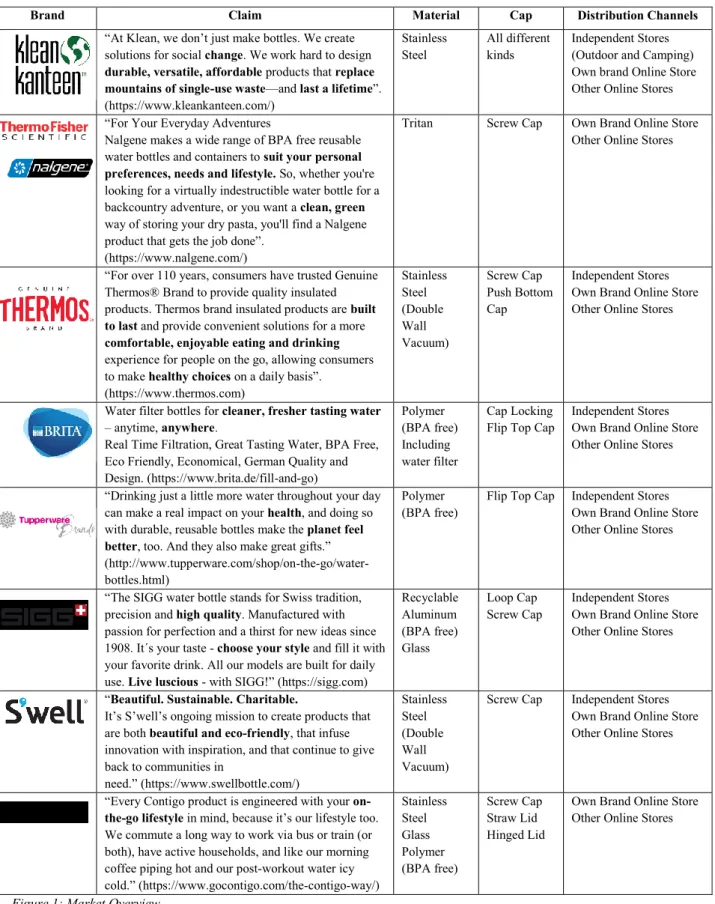
Regarding the market players, Transparency Market Research (2017) identified eleven key brands on the world-wide reusable bottle market. Out of these, three players are not present on the German market and are thus not further regarded. This leaves Klean Kanteen, Thermo Fisher Scientific Inc., Thermos L.L.C (owning Alfi GmbH in Germany/Austria/Switzerland),
12
Brita GmbH, Tupperware Brand Cooperation, Sigg Switzerland AG, S’Well and Contigo as main competitive landscape in the regarded market. There are many more small providers on the market which can not all be listed here.
On the German market durable drinking bottles are sold in a variety of stores, including supermarkets, department stores, household goods shops and online stores. To facilitate the look on the different distribution channels they can be grouped in (1) Hyper/Supermarket, (2) Independent Stores, (3) Online Sales and (4) Others (Transparency Market Research 2017). While there are no specific numbers available for the market development of reusable bottles in Germany, sales over Europe increased in the last years and the market is expected to further grow in the next years (Transparency Market Research, 2017). Figure 1 provides an overview of the mentioned brands and their products and features.
13
Brand Claim Material Cap Distribution Channels
“At Klean, we don’t just make bottles. We create solutions for social change. We work hard to design
durable, versatile, affordable products that replace mountains of single-use waste—and last a lifetime”.
(https://www.kleankanteen.com/) Stainless Steel All different kinds Independent Stores (Outdoor and Camping) Own brand Online Store Other Online Stores “For Your Everyday Adventures
Nalgene makes a wide range of BPA free reusable water bottles and containers to suit your personal
preferences, needs and lifestyle. So, whether you're
looking for a virtually indestructible water bottle for a backcountry adventure, or you want a clean, green way of storing your dry pasta, you'll find a Nalgene product that gets the job done”.
(https://www.nalgene.com/)
Tritan Screw Cap Own Brand Online Store Other Online Stores
“For over 110 years, consumers have trusted Genuine Thermos® Brand to provide quality insulated products. Thermos brand insulated products are built
to last and provide convenient solutions for a more comfortable, enjoyable eating and drinking
experience for people on the go, allowing consumers to make healthy choices on a daily basis”.
(https://www.thermos.com) Stainless Steel (Double Wall Vacuum) Screw Cap Push Bottom Cap Independent Stores Own Brand Online Store Other Online Stores
Water filter bottles for cleaner, fresher tasting water – anytime, anywhere.
Real Time Filtration, Great Tasting Water, BPA Free, Eco Friendly, Economical, German Quality and Design. (https://www.brita.de/fill-and-go) Polymer (BPA free) Including water filter Cap Locking Flip Top Cap
Independent Stores Own Brand Online Store Other Online Stores “Drinking just a little more water throughout your day
can make a real impact on your health, and doing so with durable, reusable bottles make the planet feel
better, too. And they also make great gifts.”
(http://www.tupperware.com/shop/on-the-go/water-bottles.html)
Polymer (BPA free)
Flip Top Cap Independent Stores Own Brand Online Store Other Online Stores
“The SIGG water bottle stands for Swiss tradition, precision and high quality. Manufactured with passion for perfection and a thirst for new ideas since 1908. It´s your taste - choose your style and fill it with your favorite drink. All our models are built for daily use. Live luscious - with SIGG!” (https://sigg.com)
Recyclable Aluminum (BPA free) Glass Loop Cap Screw Cap Independent Stores Own Brand Online Store Other Online Stores
“Beautiful. Sustainable. Charitable.
It’s S’well’s ongoing mission to create products that are both beautiful and eco-friendly, that infuse innovation with inspiration, and that continue to give back to communities in need.” (https://www.swellbottle.com/) Stainless Steel (Double Wall Vacuum)
Screw Cap Independent Stores Own Brand Online Store Other Online Stores
“Every Contigo product is engineered with your
on-the-go lifestyle in mind, because it’s our lifestyle too.
We commute a long way to work via bus or train (or both), have active households, and like our morning coffee piping hot and our post-workout water icy cold.” (https://www.gocontigo.com/the-contigo-way/) Stainless Steel Glass Polymer (BPA free) Screw Cap Straw Lid Hinged Lid
Own Brand Online Store Other Online Stores
14
2.3 Consumer Analysis: Water Consumption
The bottled water market, including all kinds of water sold in bottles and not coming out of pipes, is a dynamic market with a turnover of € 12.4 billion in Europe 2017 (Ferrier 2001, European Federation of Bottled Waters AISBL 2017). It particularly started growing in the 1990s and has now an annually worldwide growth rate of about 7%, with Europeans having the highest bottled water consumption of 109.9 liter per capita (Ferrier, 2001; Doria, 2006; European Federation of Bottled Waters AISBL, 2017). The question why people spend 500 to 1000 times more for bottled water instead of consuming tap water was covered in several studies during recent years (Ferrier, 2001; Doria, 2006; Teillert et al., 2010; Saylor et al., 2011).
The first reason identified was dissatisfaction with the taste odour and sight of tap water, being perceived less tasty than bottled water (Doria, 2006; Saylor et al., 2011). Nevertheless, a study conducted among 389 French consumers by Teillert et al. (2010) found that tap water, after passively being dechlorinated, was not perceived inferior during blind tastings.
Another major concern of people preferring bottled over tap water are health factors and risk avoidance, as bottled water is perceived safer and healthier (Ferrier, 2001) A study by Saylor et al. (2011) among 2045 students and staff members at Purdue University found that this is especially the case for women, being more risk averse than men and thus drinking disproportionally more bottled water. The perception of bottled water being cleaner is even the case in developed countries where tap water is highly controlled and of excellent quality, including Germany (Doria, 2006; Bundesministerium für Gesundheit & Umwelt Bundesamt, 2018) and there is no evidence of bottled water being safer than water from the tap (Saylor et al., 2011). Here the marketing of bottled water plays a major role as it is promoted as “healthy” and “pure” and often also as a status symbol, thus being a sign of high social standard (Ferrier, 2001; Doria, 2006).
Moreover, changes in consumer lifestyle since the 1990s contribute to the boom of bottled water. For example, the increased use of cars making transportation easy as well as increasing demand of convenience goods, as water already being bottled and easy to take away (Ferrier, 2001). Concerning convenience, consumer preferences of water can change depending on location and use, for example at home or at work or to make tea or drink pure (Doria, 2006). These findings match with the study by Cohen (2000), finding that the main reasons people
15
prefer disposable goods, like the bottled water, are convenience, and perceived higher hygiene and quality.
While these studies analyze the preference between already bottled water and tap water, there is little literature linking the results with the consumption of reusable bottles and environmental concerns. Only the study by Saylor et al. (2011) analyzed the perception of bottled water on the environment and found that many participants were not aware of environmental impacts of disposable plastic bottled water or were aware and even having a bad conscious but still used the one-way bottled water. Concerning the use of reusable bottles to fill with tap waters they found ‘getting sick from germs in reusable bottles not being kept clean’, the ‘ease of forgetting or loosing reusable bottles’ and the ‘better availability of bottled water on campus’ as main barriers of using reusable water bottles. While these are important insights, the study does not consider the role of different reusable bottle materials and features as well as consumer characteristics and values in the consumption of bottled water versus reusable bottles.
The following study will thus focus on the interplay of consumer characteristics: socio-demographics, values and psychological factors, as well as preferences in bottle materials, features and designs and their influence on the consumption and use of reusable bottle in contrast to disposable ones. Therefore, six research questions were formulated.
16
3. Methodology and Data
To expand the limited data and literature available about the consumer perception of reusable containers, in this specific case reusable water bottles, a study as well as interviews were conducted. This mixed multi-method approach is used to complement qualitative and quantitate data for a more detailed understanding of consumer perceptions, behaviors and preferences regarding reusable bottles.
During a ten-days period in the beginning of November 2018 nine semi-structured, personal interviews were conducted. Their aim was to get first insights from the field about the drivers and barriers of using reusable bottles, as well as critical product features and preferences about the analyzed product group. Further, the water consumption of participants and its influence on the usage behavior of reusable bottles were of interest. Therefore, a semi-structured interview, including open and closed questions was used. Except of two face-to-face interviews, all others were conducted on the phone and had a duration of 25-30 minutes. The nine participants represent different age groups, occupations and gender, and were selected as being people who drink water every day. An interview guideline was used for an easier comparison of interview results and to allow a better flow of questions during the interviewing process (Appendix 1). As all interviews were conducted for the German market, they were originally in German language and results were later translated into English and summarized into categories (Appendix 2). These results were used within the methodology of grounded theory to find new factors of relevance within the topics as well as looking for patterns in participants’ answers (White & Rayner, 2011). These new factors and patterns were then adopted and tested in further quantitative research. Moreover, the grounded theory was used as it is especially useful for small-scale qualitative data, which is the case for the conducted interviews (Denscombe 2010). As important for the grounded theory, there were no existing theories tested but the retrieved primary data was used to find theories and further test and adopt them (Denscombe 2010). This was especially useful, as there was no existing secondary data and theories about reusable water bottle consumer behavior and perception on the German market.
In a second step, after concluding and analyzing the interviews, a qualitative study was conducted. This study was created with Qualtrics software and contained 23 questions divided in four blocs (Appendix 3). Those were constructed based on knowledge from existing literature, as well as first insights and theories from the qualitative interviews. The survey
17
started with three easy to answer questions about water consumption followed by the second part about environmental values and psychological factors. The 15 statements in this second part, for participants to state their degree of agreement or disagreement, were based on the findings of Roberts (1996) and Gilg et al. (2005) on how to classify green consumers. The topic of research was only revealed to participants in the third part of the survey, to avoid being biased. This block contained 14 specific questions about reusable water bottles. Out of these, five were asked only to reusable bottles owners and one only to participants not owning such a bottle or using theirs less than once per week. The fourth and last part contained five socio demographic questions.
The survey was sent out online over social media and e-mail between November 18th and
November 27th, 2018. 163 complete surveys were returned during this period. 11 of those had
to be excluded, as participants stated not to live in Germany, and thus were not being part of the analyzed German market. This resulted in an analyzed sample size of 152 people. The data was coded and analyzed with IBM SPSS Statistics 25.
18
4. Results’ Analysis
4.1 Qualitative Data Results
From the nine participants interviewed three were males and six females with an age range between 19 to 54. Two of the participants did not own a reusable one bottle and one participant was using its bottle less than once per week. All other six participants were indicating to use a reusable water bottle on five to seven days per week and thus are regular users.
How is the water consumption leading to usage behaviors of reusable water bottles? Regarding their water consumption, all participants state that they are drinking tap water, three of them exclusively. The good quality of tap water in Germany was mentioned several times and only one participant expressed not liking the taste of tap water and smelling chlorine. This led to the theory of an overall high adaptation and satisfaction of tap water for German consumers, which was later tested on a larger sample.
The high preferences of bottled water of Europeans often because of a dislike of odour and taste of tap water (Doria, 2006; Saylor et al., 2011), wasn’t confirmed during the interviews. A clear pattern amongst participants was the use of glasses at home and reusable bottles out of home. So, there can be a theory derived that reusable bottles are only for the use out of home.
As tap water being widely accepted among the participants, this was also the main kind of water stated to be filled in the reusable bottle. Several participants also said to find it important to be able to fill hot tea in their bottle or juice mixed with water. Only one participant mentioned to fill coffee in his reusable bottle. It might be a competitive advantage for a reusable bottle brand to make the bottle usable for hot drinks and market it as such. This theory was also included and tested in the online survey.
The majority also agreed to drink different kinds of water at home and at work and thus confirm the finding of people having changing preferences depending on location (Doria, 2006). There could be no clear pattern identified which water is preferred at which location. Nevertheless, there is the indication of tap water being preferred for taking out of home.
19
What are the drivers of reusable bottle consumption of people?
Drivers of consumption varied a lot between participants. The purchase motivation most often named was saving money, followed by the practical reasons of always having a bottle with one, no need to carry water boxes and being useful for doing sports (bike) and the environmental reason of avoiding or using less single-use plastic bottles. The interviews showed that practical reasons were top of mind among participants as motivation to use a reusable bottle. Environmental reasons were subordinate and only one participant stated design and fashion as driver of consumption.
This shows a first link to Auger et al. (2008) who stated that being environmentally friendly is not enough for a product to be bought. The pattern of practicality over environmental thoughts and design was henceforth analyzed in the online survey.
What are the barriers preventing people of buying or using reusable water bottles? Are reusable water bottles replacing single-use plastic water bottles or are they used parallel? What might be the source of growth in the market?
A crucial insight during the nine interviews was the role of sparkling water towards the use of reusable bottles. The three participants saying to go without single-use water bottles, where those only drinking tap water and no sparkling water. All other 6 participants, who like to drink sparkling water, buy this one bottled in the supermarket. These bottles are then used parallel to the reusable bottle. Filling bottled sparkling water in the reusable bottle was not a common behavior among participants. This results in the theory of drinking sparkling water being the main usage barrier for reusable bottles, as well as reason to continue using single-use bottles. At the same time, it is not a barrier to buy a reusable bottle as those are preferable used for tap water, which is parallel or exclusively consumed by all participants. The role of drinking sparkling water as usage barrier and the influences on the usage of reusable bottles was also from further interest during the quantitative research.
Purchase barriers mentioned by the two participants not owning a reusable bottle were doubts about the hygiene of such bottles connected with being hard to clean and being expensive and not convenient. Concerning convenience, the participant explained that disposable bottles can be thrown away everywhere and do not need to be carried around when not needed.
This matches the findings of Cohen (2000) and Saylor at al. (2011), that hygiene and convenience are main arguments to use disposable bottles and are also of concern for German
20
consumers during the interviews. Additional to existing findings sparkling water was found to be a barrier for the adaptation of reusable bottles and main reason for disposable bottles being used parallel to reusable ones. This theory will further be tested in the quantitative study. What is the consumer profile of reusable bottle users?
The small sample size of the interviews did not allow to extract a consumer profile. This information was extracted in the following from the quantitative survey results.
Which product features play a critical role in the adaptation of reusable bottles?
Hard plastic was the most preferred material during the interviews, with the reasons given of being light, not breakable and cheap. Three participants stated stainless steal as preferred material. Here a pattern between stainless steal and the importance of design was shown in the interviews. The participant seeing fashion as main purchase motivation, bought stainless steal bottles and payed a premium for those. In another interview the person stated hard plastic as looking cheap and thus preferring stainless steel. A third person having a bottle out of stainless steal was referring to it as “the perfect bottle”. These observations lead to the theory of stainless steal being seen as premium material. A critique of stainless steal expressed twice was that it easily takes odours. Participants commonly perceived glass bottles as being heavy and breakable, and no one considered using such a bottle.
Preferred capacity differed widely between 500ml and 1000ml. While some see a capacity of one liter as best for practical reasons of having enough water during the day. The advantage of smaller bottles is seen in being easier to carry around. The two participants using two reusable bottles regularly do have them in different sizes, 500ml and 1000ml, but from the same brand. This is an indication for strong brand loyalty and a potential source of growth, that needed to be further regarded during quantitative research.
In connection with the capacity, the shape of the bottle was an important characteristic of a bottle for several participants. Twice the problem of a bottle being to big to fit into a bike holder outside or in the fitness studio was recalled. A further insight from a participant, was the importance of the bottle being easy to hold, for example with a grid in the middle. Furthermore, preferences and perception of lids varied a lot among participants. While screw lids were mostly used, this lid form was several times criticized as being hard do drink from, especially if the bottleneck is big. Both participants using a reusable water bottle with sports
21
cap were very satisfied with the drinking experience. Concerning the sports caps one participant cited to not find this kind of lid hygienic as it is hard to clean.
Regarding other product characteristics, being leakproof was mentioned most often during the nine interviews. This makes sense as reusable bottles are used out of home and carried around in bags and backpacks by participants. Further the need to be easy to clean was mentioned several times. Not being a main purchase motivation did not mean design is an unimportant product feature, as during five interviews the design of the bottle was mentioned as being important. In one interview being BPA free came out as most important feature when buying the bottle, while all other participants did not have BPA on the top of mind when thinking about reusable bottles. Another participant especially liked the fact of his bottle having a water filter to improve tap water quality. This feature was also only stated once. Three of the reusable bottle owners bought the product in an independent online store (Amazon.de was mentioned several times) due to convenience. There were also two participants who got the bottle as advertisement present, which will not be relevant for further research. Only one participant bought the bottle in a speciality store, after seeing online advertisement on social media.
The interviews indicated a reusable bottle made of hard plastic, with a capacity of 500-1000ml, a screw lid and especially being leakproof and easy to clean as the preferred product on the German market. When people are searching less for practicality and more for premium and design stainless steal is preferred. Independent online stores are the most convenient place of purchase.
These interview results gave a further understanding of the topic of reusable bottles on the German market and insights and theories going beyond existing literature. Qualitative research nonetheless can not confirm trends, for which a bigger sample size is needed. Quantitative data was thus produced for confirmation or rejection of trends and have a more representative look on the reusable water bottle user.
4.2 Quantitative Data Results
How is the water consumption leading to usage behaviors of reusable water bottles? A clear majority of participants is drinking water every day (95.4%) which shows a huge potential market for reusable water bottles. Hereby, the most spread kind of drinking water of
22
the Germany based participants in the study was unfiltered tap water, which is consumed by 76,3% of participants at least once per week. It is followed by bottled mineral water (47.4%). Further 9,9% said to drink filtered tap water once per week. Drinking a lot of tap water nevertheless does not mean that Germans do not drink bottled still water, as 30.9% drink it at least once per week.
According to tap water being the preferred kind of water, 80.3% of participants are very satisfied or satisfied with the taste of tap water at their home.
These results confirm the interview insights of tap water being perceived as very good and widely consumed on the German market. This can be linked to it being highly controlled and from excellent quality (Bundesministerium für Gesundheit & Umwelt Bundesamt, 2018). Although tap water is good and accepted in Germany nearly half of participants also consume bottled mineral water and about one third bottled still water. This underlines the findings by Cohen (2000) and Doria (2006), of the wide use of the convenient good “disposable water bottle” independent from the tap water quality.
It was not the aim of the study tofurther analyze the perception of bottled and tap water in Germany, but of reusable water bottles. Nevertheless, further research in this area can also give better understanding of the consumption of disposable goods in Germany.
Underlining the high acceptance of tap water in Germany, this was the drink filled in the bottle by most participants (76.7%). After tap water participants like to fill water mixed with juice and hot tea in their reusable bottle (each 17.8%). Bottled water is less frequently filled in reusable water bottle. 8.5% indicated to fill bottled mineral water and 12.4% bottled still water in their reusable bottle. 10.9% of participants also like to drink hot coffee from their reusable bottle.
Interview and survey results confirm that tap water is filled most into reusable water bottles and that it is not common to fill hot coffee and bottled water in those bottles. Nearly every fifth participant also likes to fill hot tea and juice and water mixtures in reusable water bottles. This requires a bottle which is easy to clean as well as a material that does not easily take odours for juice and heat proof material for tea, which can be used as features for a competitive advantage of companies on the market.
What are the drivers of reusable bottle consumption of people?
84.9% of participants stated to own a reusable bottle. Thus, this product is already widely spread in the market. Out of these more than one third (36.7%) uses it every day and are heavy
23
users. Another 35.2% use their bottle at least once per week. 10,9% have a reusable water bottle but use it less than once per week or even less than once per month (17.2%). The later two groups were identified as light users in the following.
Asked about their purchase motivation “They help me reduce plastic bottles” was indicated as first motivation with a mean of 1.86 on a scale from 1 as most important to 7 of being least important. Being “practical, as I can carry them with me everywhere (sports, university, work, …)” (2.4) and “I don’t need to carry boxes with bottled water any more” (3.76), were the other most important drivers of to use reusable bottles. Least important were “They show that I care for the environment and I can influence others to do the same” and “They look good and are trendy”.
These results show an environmental reason as main driver to use reusable bottle, followed by practical motivations, of transportability, less carrying of heavy boxes and economical advantages. These results vary slightly from qualitative data results, were practical reasons were top of mind for participants, followed by reducing plastic consumption. Out of this can be extrapolated that first consumers on the German market are already aware of environmental harm of disposable products and second do perceive reusable water bottles as convenient. This opposes earlier studies done on the US American market by Cohen (2000), discovering convenience as main driver for using disposable products and Saylor et al. (2011) finding a lack of awareness of environmental impacts among participants. A third indication from the survey results, matching with the interview output, is that a “green to be seen” attitude and the reusable water bottle used as fashion statement are not prevalent among German consumers. Thus, studies by Van der Wal et al., (2015), Griskevicius et al., (2010) and several medias can’t be confirmed with these survey results.
What are the barriers preventing people of buying or using reusable water bottles? All participants not owning a water bottle or using theirs less than once per week, were asked of their usage barriers. Hereby being not leak-proof (20.9%), hard to clean (20.9%), being unhygienic (18.6%) and the ease of forgetting them at home were the most common barriers of using a reusable water bottle. Being too big and heavy and being hard to drink out (both 11.1%) were from less importance.
This shows that reusable water bottles are often perceived as not being leak proof. As shown in the interviews people mostly use reusable water bottles out of home, which makes being leakproof the most important product feature for them and the most crucial product feature
24
companies on the market should guarantee and communicate. The second most common barriers are the linked perceptions of reusable bottles being hard to clean and unhygienic. This matches with findings of Cohen (2000), that disposable products are perceived of better hygiene, which is often intensified by the marketing messages of bottled water being healthy and pure.
The interview results indicated that drinking bottled sparkling water might be a further barrier preventing people from using reusable bottles. Therefore, those who indicated drinking bottled mineral water at least once per week were analyzed separately. Out of this group 79.2% owned a reusable water bottle, which is less than the overall average of 84.9%. From those who do not drink sparkling mineral water regularly 90% owned a reusable water bottle. This supports the theory from the interview results that drinking sparkling water on a regular base is a usage barrier for reusable water bottles.
Are reusable water bottles replacing single-use plastic water bottles or are they used parallel? What might be the source of growth in the market?
The survey results show a dependency between the consumption of disposable plastic bottles and being a frequent user of reusable bottles (at least once per week) or an infrequent user (less than once per week but at least once per month) or very infrequent user (less than once per month). While in the first group 92.3% indicated that their consumption of single-use bottles decreased since having a reusable alternative, in the second group 50% said so and from the very infrequent users just 31.8% could reduce their single-use plastic bottles. None of the participants owning a reusable water bottles said, that their consumption of single-use bottles increased.
This indicates that using a reusable bottle frequently is reducing the use of single plastic bottles and further supports the interview results. Even if disposable bottles are used parallel to reusable bottles, especially to have easy access to sparkling water, their consumption is minimized.
What is the consumer profile of reusable bottle users?
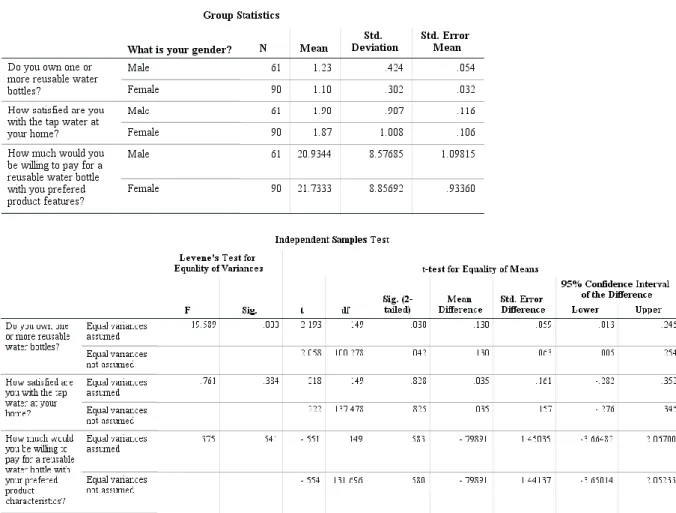
Further the aim of the study was to identify a consumer profile of reusable bottle owners, in contrast to those not owning this product. Several statistical tests were used to compare these two groups. First an independent samples t-Test showed that women are significantly more likely to have a reusable water bottle than men, assuming an alpha of 5%.
25 Figure 2: Influence of Gender differences
Apart from the likelihood to own a reusable water bottle, there is no significant differences in willingness to pay and in how much one likes tap water, between the genders.
Second, a Chi Square test was done to compare the likelihood of having a reusable water bottle between the different generations. The results showed no association between age and owning reusable bottle and no association between age and “liking tap water”.
The differences between age groups are not significant in this study. Nevertheless, the frequencies show that Millennials, being between 24-38 years old (87.8%) and Generation Z, being younger than 24 years old (87.2%) were most likely to own a reusable water bottle, while in older generations less people owned the product.
A third test, also Chi Square, was done to test an association between level of education and owning a reusable water bottle. Here again no significant differences between different levels of education and owning a reusable water bottle among study participants was shown. Fourth, an independent samples t-Test to compare participants with a high net income above 2600€ with those with an net income below 2600€ shows that those with higher income are significantly less likely to own a reusable water bottle, with an alpha given 5%.
26 Figure 3: Influence of income differences
Apart from this there is no significant difference in the willingness to pay for a reusable water bottle and in the satisfaction with tap water between participants with higher and lower income.
That women are significantly more likely to use reusable water bottles shows a parallel to the sociographic characteristics of a green consumer described by Olli et al. (2001) and Gilg et al., (2005). Nevertheless, their characteristics of high education and income could not be confirmed by the data. Concerning income, the study results support the contradicting findings of McCollough (2006) that people with higher income are more tempted to use disposable products.
Moreover, environmental values and psychological factors based on the findings about green consumers (Roberts, 1996; Gilg et al., 2005) were tested on the survey participants. An independent samples t-test was done to analyze if there are significant differences between people owning a reusable water bottle and those who don’t. In only one of those values a significant difference between the groups could be observed. This was the case for “I feel my own actions have no influence on the environment”. Here, reusable bottle owners disagreed more strongly than those using only disposable bottles and so strongly showed the green consumer factor the perception how much one’s owns actions can influence the environment
27
(Gilg et al., 2005). Nevertheless, as for all other factors of green consumerism there is no significant difference between the two groups, we can not say that in this study reusable water bottle owners were more likely to show green consumer attitudes than those who do not own such a bottle. This also included “green to be seen” factors. Thus, there is no evidence that reusable water bottle users see the product as a fashionable way to show green consumerism or as a status symbol. This is supported by the findings about purchase motivations, where reusable water bottles were not purchased to deal as a “fashion statement”.
Which product features play a critical role in the adaptation of reusable bottles? Furthermore, participants were asked about their preferred product features and brands. The brands most used among participants were Sigg (28,4%), Thermo Fischer/Nalgene 10,5% and Tupperware (8,6%). Also, the real figures might be higher, because a third answered to not know the brand of their bottle.
Similar to the interview results hard plastic/tritan was the preferred material for reusable water bottles (38,8%). Nevertheless, the results do not show a clear preference. Different to the non-representative qualitative data, the survey results show and equal preference between glass and stainless steel (each 30,9%). Asked about their preferred capacity of a reusable water bottle, participants showed a clear favour towards 750ml (48%). Also, 1l (26,3%) and 500ml (24,3%), found high acceptance. Sizes smaller than 500ml were not preferred. For the lid, participants especially liked screw lids: 38,8% attached and 27% unattached. Another popular lid is the sports cap (24,3%), All other kinds of lids were not liked by participants.
Furthermore, participants were asked to rate a list of products features from 1 (very important) to 3 (not important).
Matching with the interview results as well as purchase/usage barriers the feature ranked most important was “leakproof” (1,05). Interview insights show that this is especially important as people usually use reusable water bottles out of home.
The second most important product features were good quality (1,17) followed by easy to clean (1,26). Further being BPA free (1,53) and dishwasher safe (1,77) was important, as well as the design of the bottle.
The brand was seen as unimportant (2,88), corresponding with the findings that most participants did not even know the name of their bottle’s brand. Having an integrated fruit
28
filter (2,86), water filter or measurement scale (2,81) were also from low importance for participants.
Another insight from the survey results was that participants were not very price sensitive regarding reusable water bottles. “Affordable price” was not under the most important criteria for such a bottle (2,14) and participants showed a high willingness to pay. 19,9% were willing to pay up to 30€ for one reusable bottle with their personal preferred product features. 42,1% were willing to pay up to 20€ and 69,1% up to 15€. Only 9,2% do not want to pay more than 10€ for a reusable water bottle of their choice.
The preferred channels to buy a reusable water bottle among participants were specialist shops (e.g. outdoor or household goods) (38,8%) and independent online shops (30,3%). A few participants also preferred department stores (15,8%) and supermarkets (11,2%), while brand owned only stores were an unpopular channel (3,9%).
Consumer preferences shown in the survey result are similar in those to the interview results in most points. Hard plastic again was the favorite material, but the dislike of glass during the interviews was refuted by survey results. A preference for screw lids can be observed over all results and again being leak-proof is the most essential buying criteria for consumers. Matching with earlier findings about hygiene concerns for reusable containers (Cohen 2000), being from good quality, easy to clean and dishwasher safe are from high importance for consumers. Further people were aware of the harmful effect of BPA and want BPA free reusable water bottles. The observation that about a third of people in both, survey and interviews do not know the brand of their reusable bottle and most people agree to not find “brand” an important criterion indicates a low brand loyalty. This could partly be explained by findings from the consumer profile, as “green to be seen” and thus using the reusable water bottle and its brand as symbol is not distinctive among survey and interview participants. The interview insight of independent online stores being the preferred place to buy reusable water bottles couldn’t be confirmed in the survey as people in this larger sample favored specialist store. Still, being on second place shows a high acceptance of purchasing reusable water bottles online.
29
5. Conclusions, limitations, future research, recommendations and
managerial implications
5.1 Conclusions and managerial implications
The results show that reusable water bottles are already widely spread on the German market and are reducing the single-use plastic bottle consumption if used frequently.
Reusable water bottles are used by a wide range of consumers in Germany, including different generations, genders and income groups. Nevertheless, companies should be aware that women, people with lower income and people who believe that their own small actions can have a positive impact on the environment are the most likely to use reusable water bottles. Seeing a reusable water bottle as fashion product or status symbol doesn’t apply for German consumers.
The usage of reusable bottles is motivated by environmental reasons of limiting single-use plastic as well as practicality for daily life and saving money. As environmentally friendly products are only adopted if they also fulfill practical requirements, these two benefits should be communicated together by companies to reach a maximum target market. Further, providers need to focus their bottles on being 100% leakproof and easy to clean to be hygienic, as these are the main usage and purchase barriers. As hard plastic, aluminium and glass as materials and capacities between 500ml and 1000ml are all liked by consumers, it is of advantage for companies to offer bottles in different sizes and materials. This is also a source of growth for consumers owning different kinds of bottles for different usage situations. As consumers clearly prefer screw lids, but opinions differ if attached or unattached ones are better, companies can profit from developing and offering screw lids that can be used attached, as well as unattached. Another competitive advantage are reusable bottles from materials that allow filling hot beverages, as about every third user likes filling those in the reusable water bottle. People on the German marked care about good quality of their reusable water bottles and thus are also willing to pay a premium price of more than 15€ for the majority and up to 30€ for every fifth user.
Regarding political implications, the satisfaction of tap water was, opposing to existing studies from France and the US, no usage barrier for reusable water bottles. Quite contrary is the case, as people were highly satisfied with tap water in Germany and mainly fill their reusable bottles with it. Mineral water however is a motivation of people using single-use plastic bottles instead
30
of reusable ones. Even as there are alternatives to single-use bottles in form of in-home solutions to put carbonic acid into tap water, this entails cost and time investments tap water hasn’t. This could be solved by supermarkets and companies installing water dispensers with still and carbonated water and taking a price below bottled water for it.
Overall, people on the German market already show motivation to limit single-use plastics by using reusable water bottles, paired with companies offering the products consumer ask for and better alternatives to bottled mineral water, the purchase of single-use plastics for water consumption can be reduced during coming years. Thus, consumer analysis shows that reusable water bottles are an alternative to single use plastic and have a positive contribution to reduce plastics in Germany.
5.2 Limitations and future research
When looking at the results of this thesis one must keep the small sample size in mind and thus limited representability. As research in this topic is still new, the aim was to give first basic insights of consumer behavior towards reusable water bottles. There was data collected and analysed from all age groups, but the sample’s age distribution is younger than the one of the whole country. There is further a geographic imbalance, as more than 90% of participants come from three (Bavaria, Hesse and Baden-Württemberg) out of the 16 German provinces. As 84,9% of the sample were already owning at least one reusable water bottle this supported the research on purchase motivations and consumer characteristics but limited the research on purchase barriers due to small cases.
The insight of carbonated water as barrier was briefly analysed, but as there was no split into heavy and light users from mineral water no further in-depth research on this point could be done in the context of this thesis. This could be from interest for further research, as well as analysing the consumer perception of new alternatives to bottled sparkling water, like for example water dispensers.
Moreover, this study’s finding that the use of reusable water bottles is decreasing the consume of single-use plastic bottles should be further tested, as the results are based on consumer perception, which can be biased. Thus, this theory should be further backed-up with consumer observations in the field and additional quantitative data.
31
This thesis could hopefully help market players to improve their offer towards consumers preferences and increase the awareness of reusable water bottles for future research to avoid single-use plastics.
32
6. References
Auger, P., Devinney, T. M., Louviere, J. J., & Burke, P. F. (2008). Do social product features have value to consumers? International Journal of Research in Marketing, 25(3), 183–191.
Bundesministerium für Gesundheit, & Umwelt Bundesamt. (2018). Bericht des
Bundesministeriums für Gesundheit und des Umweltbundesamtes an die Verbraucherinnen und Verbraucher über die Qualität von Wasser für den menschlichen Gebrauch
(Trinkwasser) in Deutschland 2014 – 2016. Retrieved from
https://www.umweltbundesamt.de/sites/default/files/medien/374/publikationen/2018-05-22_uug_02-2018_trinkwasserqualitaet_2014-2016.pdf
Cochrane Lauren (2017, August 15). How reusable water bottles became the new tote bag.
The Guardian. Retrieved from
https://www.theguardian.com/fashion/2017/aug/15/how-reusable-water-bottles-became-the-new-tote-bag
Cooper, J. E., Kendig, E. L., & Belcher, S. M. (2011). Assessment of bisphenol A released from reusable plastic, aluminium and stainless steel water bottles. Chemosphere, 85(6), 943– 947.
Doria, M. F. (2006). Bottled water versus tap water: understanding consumers' preferences.
Journal of Water and Health, 4(2), 271–276.
Ertz, M., Huang, R., Jo, M.-S., Karakas, F., & Sarigöllü, E. (2017). From single-use to multi-use: Study of consumers' behavior toward consumption of reusable containers. Journal of
Environmental Management, 193, 334–344.
European Parliament. (2018). Plastic Oceans: MEPs back EU ban on throwaway plastics by
2021. Retrieved from
http://www.europarl.europa.eu/news/en/press-room/20181018IPR16524/plastic-oceans-meps-back-eu-ban-on-throwaway-plastics-by-2021 European Federation of Bottled Waters AISBL. (2017). EFBW Industry Report: Natural
Mineral & Spring Waters: The Natural Choice For Hydration. Retrieved from
https://www.efbw.org/fileadmin/user_upload/documents/Publications/EFBW_Industry_Rep ort_interactive_web_PDF_version_final.pdf
33
Ferrier, C. (2001). Bottled Water: Understanding a Social Phenomenon. AMBIO: a Journal
of the Human Environment, 30(2), 118–119.
Gilg, A., Barr, S., & Ford, N. (2005). Green consumption or sustainable lifestyles? Identifying the sustainable consumer. Futures, 37(6), 481–504.
Godbey, G., Lifset, R. & Robinson, J. (1998). No time to waste: an exploration of time use, attitudes towards time use and the generation of municipal solid waste, 65, 101–140. Social
Research, 65(1), 101–140.
Griskevicius, V., Tybur, J. M., & van den Bergh, B. (2010). Going green to be seen: status, reputation, and conspicuous conservation. Journal of Personality and Social Psychology,
98(3), 392–404.
Karmarkar, U. R., & Bollinger, B. (2015). BYOB: How Bringing Your Own Shopping Bags Leads to Treating Yourself and the Environment. Journal of Marketing, 79(4), 1–15.
LIDL. (2018). Positionspapier für Reduzierung von Verpackungsmaterialien und
Lebensmittelverlusten. Retrieved from
https://www.lidl.de/de/asset/other/180409_Positionspapier_Lebensmittelverluste_A4_online. pdf
Lin, Y.-C., & Chang, C.-c. A. (2012). Double Standard: The Role of Environmental Consciousness in Green Product Usage. Journal of Marketing, 76(5), 125–134. McCollough, J. (2007). The effect of income growth on the mix of purchases between disposable goods and reusable goods. International Journal of Consumer Studies, 31(3), 213–219.
Mosendz, P. (2018, March 5). Water in a Fancy Outfit. Bloomberg Businessweek,, p. 77–78. Numata, D., & Managi, S. (2012). Demand for refilled reusable products. Environmental
Economics and Policy Studies, 14(4), 421–436.
Olli, E., Grendstad, G., & Wollebaek, D. (2001). Correlates of Environmental Behaviors.
34
Roberts, J. A. (1996). Green consumers in the 1990s: Profile and implications for advertising. Journal of Business Research, 36(3), 217–231.
Saylor, A., Prokopy, L. S., & Amberg, S. (2011). What's wrong with the tap? Examining perceptions of tap water and bottled water at Purdue University. Environmental
Management, 48(3), 588–601.
Schlegelmilch, B. B., Bohlen, G. M., & Diamantopoulos, A. (1996). The link between green purchasing decisions and measures of environmental consciousness. European Journal of
Marketing, 30(5), 35–55.
Shrum, L. J., McCarty, J. A., & Lowrey, T. M. (1995). Buyer Characteristics of the Green Consumer and Their Implications for Advertising Strategy. Journal of Advertising, 24(2), 71–82.
Slavik, A. (2017, July 2). Die Trinkflasche ist die neue It-Bag. Süddeutsche Zeitung. Retrieved from https://www.sueddeutsche.de/stil/lifestyle-die-trinkflasche-ist-die-neue-it-bag-1.3564931
Sriram, V., & Forman, A. M. (1993). The Relative Importance of Products′ Environmental Attributes: A Cross‐cultural Comparison. International Marketing Review, 10(3), 80. Straughan, R. D., & Roberts, J. A. (1999). Environmental segmentation alternatives: a look at green consumer behavior in the new millennium. Journal of Consumer Marketing, 16(6), 558–575.
Teillet, E., Urbano, C., Cordelle, S., & Schlich, P. (2010). Consumer perception and preference of bottled and tap water. Journal of Sensory Studies, 25(3), 463–480.
Transparency Market Research. (2017). Reusable Water Bottles Market: Global Industry
Analysis, Size, Share, Growth, Trends and Forecast, 2017–2025. Retrieved from
https://www.transparencymarketresearch.com/pressrelease/reusable-water-bottles-market.htm
Van der Wal, A. J., van Horen, F., & Grinstein, A. (2016). The paradox of ‘green to be seen’: Green high-status shoppers excessively use (branded) shopping bags. International
35
World Economic Forum. (2016). The New Plastics Economy: Rethinking the future of
plastics. Retrieved from
36
7. Appendices
Appendix 1: Interview Guideline
i. Introduction (2min) Vielen Dank für deine Zeit
Das Interview ist für meine Master Thesis über das Konsumverhalten eines bestimmten Produktes. Nach dem Interview erzähle ich dir gerne mehr.
(Explanation that the interview is for Master Thesis and research on a product and its consumer behavior (as less info as possible to not bias participant)
ii. Water Consumption (5min)
a) Welches Wasser drinkst du? (What kind of water do you drink?) Warum? (Why?) b) Aus welchen Behältnissen drinkst du Wasser? (Which containers do you use to drink
water from?)
c) Unterscheiden sich die Behältnisse während des Tages oder je nach bestimmten Situationen? (Do they differ during the day or depending on special situations?)
iii. Reusable Water Bottles (10-15min)
a) Nutzt du wiederverwendbare Wasserflaschen? (Do you use reusable bottles?) Yes
b) Warum hast du dir diese Flasche gekauft (What was your motivation to buy that bottle?)
c) Wie oft nutzt du die wiederverwendbare Flasche? (How often are you using your reusable bottle(s)?)
d) In welchen Situationen nutzt du deine Flasche? (In which situation are you using your bottle?)
e) Beschreibe deine Flasche (Marke, Material, Deckel, Füllmenge, …) (Describe your reusable bottle: Brand, material, lid, capacity, …)
f) Was gefällt dir besonders an der Flasche? (What do you especially like about the bottle?
g) Was gefällt dir weniger an der Flasche? Gibt es eine andere, die du gerne hättest? (What do you don’t like and would you like to have a different one?)
37
i) Nutzt du Einweg-Flaschen? Wenn ja in welchen Situationen? (Are you using single use bottles? If so, on which occasions?)
No
a) Was hält dich davon ab wiederverwendbare Flaschen zu nutzen? (What is stopping you from using reusable bottles?)
b) Kannst du dir vorstellen eine wiederverwendbare Wasserflasche zu kaufen? Wenn ja, was wäre deine Motivation dazu? (Could you imagine buying a reusable bottle? If so, what would be your motivation?)
c) Wenn du solch eine Flasche kaufen müsstest, auf was würdest du achten? (If you would need to buy such a bottle, what would you care for: Brand, material, lid, capacity?)
iv. Summary (3min)
a) I will give a short summary of the main answers of participant and ask if I got everything right
b) I will ask if participant has anything he/she wants to add about the topic c) Thank you and further explanation about research if participant is interested
Appendix 2: Interview Results (translated from German to English)
Interview 1: 8th of November 2018
General Information Clara P. (19), apprenticeship + school Face to Face Interview
Water Consumption Drinks tap water and bottles sparkling water from single-use bottles
She uses a single use bottle for several days before throwing them away
Reusable water bottle owner:
No
Purchase Barriers No need for a reusable water bottle.
Single-use bottles are more practical as they can be thrown away and don’t need to be carried around all time
Reusable bottles are expensive Possible Purchase
Motivation
If finding a beautiful bottle or getting one as promotional gift
Preferred Bottle Hard Plastic, 700ml, attached screw lid, leak proof, design is important,