E-BANKING: CURRENT USE AND FACTORS
AFFECTING ITS ADOPTION IN PORTUGAL
Beatriz Isabel de Almeida Rodrigues
Dissertation submitted as a partial requirement for the conferral of
MSc in Management of Services and Technology
Supervisor:
Professor Marjan Sara Fonseca Jalali, ISCTE Business School, Marketing,
Operations and Management Department
ii
iii RESUMO
A internet e os Sistemas de Informação são fenómenos mundiais que originaram novas soluções e modelos de negócio, que podem ser aplicados a diversos setores de atividade. Paralelamente foram desenvolvidos vários modelos e teorias para explicar as reações e os comportamentos de adoção de novas tecnologias. Tal inclui estruturas modelos como Teoria do Comportamento Planeado e Modelo de Adoção da Tecnologia.
A Banca online, também muito conhecida como e-banking, é um termo genérico usado para definir o conjunto de atividade de podem ser feitas com recurso à internet, em vez de ser necessário ir fisicamente a uma agência bancária. Este não é um tópico recente, tendo mesmo sido introduzido em Portugal em 1994. No entanto, a taxa de adoção em Portugal é bastante inferior comparada à dos principais países europeus.
O presente trabalho tem como objetivo dar um contributo no que toca a entender o que influenciam os consumidores portugueses a adotar o e-banking.
Como forma de atingir o objetivo proposto, foi construído um modelo de investigação com base nas teorias atualmente presente na literatura. Para tal, foi utilizado um método quantitativo associado a um questionário, como forma de recolher as opiniões dos consumidores.
Pela análise dos resultados é possível apurar que o nível de utilização da banca online é superior à anteriormente estimada. Adicionalmente, de acordo com a análise do modelo proposto foi possível concluir que a falta de confiança e a falta de contacto pessoal são os principais fatores que impedem o uso da banca online em Portugal.
Palavras-chave: Banca online; Teoria de Aceitação da Tecnologia; Sistemas de Informação; Aceitação dos consumidores
Classificação JEL: M10 – Gestão: Geral
v ABSTRACT
The internet and Information Systems are a worldwide phenomenon that originated new solutions and business models, which can be used in innumerous activity sectors. In parallel several theories and models were developed to better understand consumers’ reactions and new technologies adoption behavior, including frameworks like Theory of Planned Behavior and Technology Acceptance Model.
Internet banking, mostly known as e-banking, is a general term to refer to the set of activities that can be perform electronically, without fiscally visit any bricks-and-mortar institution. E-banking is not a brand new topic starting in Portugal in 1994. Although, e-banking adoption in Portugal is by far lower than compared with the leading European countries.
The present work aims to contribute to the investigation to which factors influence Portuguese customers’ e-banking adoption.
In order to accomplish this goal, a research model was built up, following current tested theories present in the literature. For that, was used a quantitative method associated to an online survey to collect customers’ opinions.
The results show that e-banking adoption in the sample is higher than the current estimations. Additionally, according to the analysis of the proposed model was possible to conclude that the lack trust and the lack of personal contact are the two main factors preventing consumers from using e-banking services.
Key-words: E-banking adoption; Technology Acceptance Model; Information Systems; Consumers’ acceptance
JEL Classification System:
M10 – Business Administration: General M15 – IT Management
vii ACKNOWDELGEMENTS
During the Master I met wonderful people that had a huge impact on my academic path and personal life, to whom I should thanks for the time, patience and kind words.
To Professor João Vilas-Boas, I have to congratulate for the entire dedication to the Master, in particular the constant will to develop it and design it to follow higher standards.
I should specially thank to my supervisor, Professor Marjan Jalali, for all the support and dedication. All her availability, quick response and encouraging words, were unconditional and decisive during the entire process.
Finally, a huge thanking to my family and friends, without who I could not have overcome all the obstacles and barriers.
ix TABLE OF CONTENTS
INTRODUCTION 1
1. LITERATURE REVIEW ... 4
1.1. Internet and the business world ... 4
1.1.1. E-business ... 4
1.1.2. E-supply chain and value creation ... 6
1.2. Banks’ distribution channels and e-banking in Portugal ... 10
1.2.1. Banks multi-channel distribution ... 10
1.2.2. E-banking ... 12
1.3. Consumers’ technology acceptance ... 16
1.3.1. Trust, security and Privacy ... 16
1.3.2. Personal contact ... 17
1.3.3. Theory of Reasoned Action (TRA) ... 18
1.3.4. Theory of Planned Behavior (TPB) ... 19
1.3.5. Technology Acceptance Model (TAM) ... 19
2. RESEARCH MODEL ... 26
2.1. Hypothesis ... 28
3. METHODOLOGY... 30
3.1. Data collection ... 30
3.2. Survey ... 31
3.3. Data analysis procedure ... 32
4. DATA ANALYSIS ... 34
4.1. Sample characterization ... 34
4.1.1. Non-users characterization ... 35
4.2. Current use ... 36
x
4.4. Correlations ... 38
4.5. Multiple regression analysis ... 39
4.6. Impact of the perceived benefits ... 41
4.6. E-banking future use ... 42
5. DISCUSSION ... 44 6. CONCLUSION ... 46 6.1. Limitations ... 47 6.2. Future research ... 48 BIBLIOGRAPHY ... 49 Appendix ... 57 1. Survey ... 57 2. Cronbach Alfa ... 64
3. Results of the first analysis ... 64
xi LIST OF FIGURES
Figure 1 - Highly integrated supply chain ... 7
Figure 2 - Sources of value creation in e-business ... 9
Figure 3- E-banking penetration rate in Portugal ... 14
Figure 4 - TRA Model ... 18
Figure 5 - TPB Model ... 19
Figure 6 - Technology Acceptance Model ... 20
Figure 7 - TAM2 Framework ... 21
Figure 8 - TAM3 Framework ... 22
Figure 9 - CIBM Framework ... 23
Figure 10 - EBTAM Framework ... 24
Figure 11 - Research model framework ... 27
Figure 12 - Branch use and e-banking importance ... 35
Figure 13 - Non-users characterization ... 36
Figure 14 - E-banking use ... 37
Figure 15 - Services used ... 37
Figure 16 – Perceived impact of e-banking benefits ... 42
xii LIST OF TABLES
Table 1 - E-banking penetration in European markets ... 14
Table 2 - Summary of the Models ... 24
Table 3 - Constructs used in the Framework ... 27
Table 4 - Survey questions ... 31
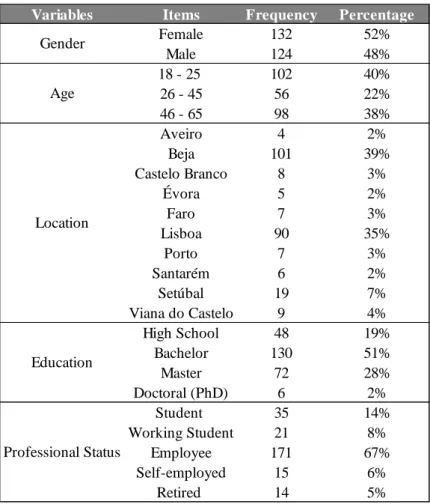
Table 5 - Users demographic characterization ... 34
Table 6 - Correlation matrix ... 38
Table 7 - Third analysis output ... 40
xiii LIST OF ABREVIATIONS
APS – Advanced Planning and Optimization Solutions ATM – Automated Teller Machine
BES – Banco Espírito Santo BI – Behavioural Intentions CGD – Caixa Geral de Depósitos
CIBM – Consumer Internet Banking Model
EBTAM – E-business Technology Acceptance Model EU – European Union
ERP – Enterprise Resource Planning
ICT – Information and Communication Technology IS – Information System
IT – Information Technology IU – Intention to Use
PB – Perceived Benefits
PBC – Perceived Behavioral Control PEOU – Perceived Ease of Use PI – Perceived Impediments PC – Personal Contact PP – Perceived Privacy PS – Perceived Security PU – Perceived Usefulness
SCM – Supply Chain Management SFCU – Stanford Federal Credit Union SI – Social Influence
SN – Subjective Norm
TAM – Technology Acceptance Model TPB – Theory of Planned Behavior TRA – Theory of Reasoned Action
1 INTRODUCTION
The internet and companies were not always an interconnected reality. Over time this channel has shown its potential to companies, as long as companies and consumers were using computers and internet to communicate (Silva, 2008). Moreover, internet has been widely used, and in the last 10 years the number of internet users worldwide has tripled, and now stands at almost 3.5 billion (Statista, 2017) with a world penetration of 49.2% (Internet World Stat, 201). In Europe the estimated internet penetration for 2016 is about 73.9% (Internet World Stat, 2016), and the estimated value for Portugal around 67.3% (Internet Live Stat, 2016).
The internet appears to be a constant in each and every sector. It has restructured the whole business world, changing almost every business process and leading a new business model to emerge, e-business (Basu and Muylle, 2007). According to Kumar and Kumar (2014) e-business refers to doing business on the internet and this process includes: buying and selling products, supplies and services; servicing customers; processing payments; managing production control; collaborating with business partners; sharing information; recruiting. Additionally, e-business even is considered a major force in the marketplace and a key tool to succeed over the competition (Mudholkar et al, 2013). The use of e-business has reshaped organizations’ supply chain structure (Weingarten et al, 2015) and changed the way value is created throughout the entire supply chain (Amit and Zott, 2001).
Banks are no exception and are also following the increasing trend of using the internet in their everyday business activities. As a result, multi-channel distribution is being more widely used in banking in order to better meet market needs. Using such a distribution strategy implies managing and optimizing the mix of channels, integrating and coordinating them to prevent conflicts among the different distribution channels (Rosenbloom, 2007). In the banking context, the distribution channel based on internet is generically named e-banking. It started not only as an innovative payment method and a way to increase customers’ convenience, but also as a tool to reduce costs and increase profits (Arnaboldi and Claeys, 2008). Electronic banking allows consumers to make a set of operations without physically going to a bricks-and-mortar institution (Haque et al 2009). E-banking is a convenient and time saving tool for customers (Salehi and Alipou,
2
2010), that is seen as a key component of banks’ corporate strategies (Arnaboldi and Claeys, 2008).
On average, e-banking penetration rate in Europe, in 2016, was of 49% (Statista, 2017), with Norway in the lead with an e-banking penetration rate of 91% (Statista, 2017). Despite the potential benefits of e-banking for customers, such as significant time savings (Salehi and Alipou, 2010) and quick and continuous access to information (Gurau, 2002) the penetration rate in Portugal is still one of the lowest in Europe. Portugal, in 2016, was in the bottom seven countries of e-banking adoption, with a 29% penetration rate (Statista, 2017).
This issue of low adoption rates, in Portugal or elsewhere, does not only concern electronic banking, however, but also pertains to many other types of technologies, and over the year many theories have emerged to try determine the factors affecting the adoption of Information Systems (IS). The Technology Acceptance Model (TAM) developed by Davis (1989), proposes an explanation of consumers’ acceptance and adoption behavior of technology based on perceived usefulness and perceived ease of use, and was the first theory used to describe the adoption of IS. Later, new models appeared in the literature using TAM fundamentals, and more recently, this research field has been introducing new theoretical frameworks directly related to e-banking adoption.
It is now known, for instance, that lack of trust in e-banking influences consumers’ adoption of it (Gabner-Krauter and Faullant, 2008), and according to some authors constitutes the main reason preventing consumers from using those kinds of services (Flavian et al, 2006).
With studies showing that the e-banking adoption rate in Portugal is one of the lowest in Europe, the main goal of this dissertation is to understand the main factors affecting e-banking adoption in Portugal and the future perspectives of e-e-banking, from consumers’ point of view. More specifically to: i) assess the current use of e-banking in Portugal; ii) determine the factors which according to consumers influence their adoption of e-banking; iii) analyze consumers’ perspectives on the future of e-banking.
The topic under discussion is important for bank managers because it can provide relevant information to drive strategic decisions. The results should provide key drivers for banks to match their offer with what customers really want and need. Furthermore, the study
3
should help Portuguese Banks to better understand their customers’ fears and motivations with respect to e-banking.
The present work will start with a literature review on the topics mentioned before, followed by the determination of the investigation framework and the methodology used will end with the data analysis, discussion and conclusion.
4 1. LITERATURE REVIEW
The fundamentals for the present study are presented in the present section. The literature review portrays the overall scenario of e-business and e-banking. It starts with the explanation of what is e-business and the transformations that it causes to supply chain, followed by the description of the banking sector, with special attention to multi-channel distribution and banking definition. Finally it describes the role of customers in e-banking and their process on adopting new technologies.
The literature review has three main sections. The first one “Internet and the business world”, is an initial insight into the topic, explaining the overall context of e-business and some general specifications of its supply chain. The second sections is an overview of the banking sector with particular emphasis on the definition of e-banking and its current distributions model. The last section aims to describe the main models used to explain consumers’ new technology adoption behavior and the recent frameworks directly related to e-banking adoption.
1.1. Internet and the business world
Technological changes require constant adaptations in the economic, social and cultural field (Angeloska-Dichovska and Mirchevska, 2017). According to Angeloska-Dichovska and Mirchevska (2017) these changes influence the environment where information is created and increase competition among companies, by creating the need to continuously adapt to a more and more complex marketplace.
Together with globalization, technological evolution is one of the main factors stimulating competition among companies and boosting development (Sceulovs and Gaile-Sarkane, 2014). This shift toward the exploitation of the Internet and the electronic environment is a mainstream trend in today’s business world and a trigger for new ways of doing business (Sceulovs and Gaile-Sarkane, 2014).
1.1.1. E-business
Electronic business, defined as doing business using the internet (Kumar and Kumar, 2014) and commonly named e-business, as mentioned before has drastically changed how companies do business. Over the past decades, the Internet restructured and reconfigured the entire business world, changing industry structures and shifting the balance of power between suppliers and customers (Basu and Muylle, 2007). E-business is also considered a major force in the global economy and a way to stay competitive (Mudholkar et al,
5
2013). It provides new opportunities for companies to compete on a global scale and plays an important role in the world’s economy (Ciarniene and Stankeviciute, 2015).
According to Kumar and Kumar (2014) e-business refers to doing business on the internet and this process includes: buying and selling products, supplies and services; servicing customers; processing payments; managing production control; collaborating with business partners; sharing information; recruiting. Swaminathan and Tayur (2003, p.1389) have a similar definition, for them e-business “is a process that uses internet or other electronic medium as a channel to complete business transactions”. Melão (2008), for instance, refers to e-business as the use of ICT (Information and Communication Technology) as a way to (re)design, manage, execute, improve and control business processes, both within and between organizations. Ciarniene and Stankeviciute (2015, p.735) sum up the definition of e-business as: “an internal and external business processes automation within computer’s network; an innovative IT application in the enterprise and beyond, in order to increase the competitiveness; an additional customer value through a computer-mediated network; a critical competitive strategy.”
Information Technology (IT) is a set of information systems for the use of administrators and managers that includes database hardware, information network software, among other tools (Rahmanseresht et al, 2016). IT allows organizations to take their operations to a worldwide scale, thanks to applications and software accessible from any part of the world and with a wide capacity for data collection and analysis. According to Rahmanseresht et al (2016), it has even become a key component for organizations to gain competitive advantage. Furthermore, is has been developing rapidly in the past decade, allowing e-business to become a global phenomenon, exponentially growing and expanding in different contexts (Zabukovšek et al, 2015).
The definition of e-business has never been completely clear, and it is sometimes equated with commerce and service. Nonetheless, in accordance with the definitions of e-business given before, e-commerce can be seen as a part of the e-e-business (Magutu et al, 2011). According to this view, e-commerce is seen as a mere transaction activity, where goods and services are bought and sold (Magutu et al, 2011), while e-business is more than just buying and selling goods and services, (Turban et al, 2006) it also includes servicing customers, collaborating with business partners and all the electronic transactions conducted within an organization (Turban et al, 2006). Electronic service
(e-6
service) in turn, is a term to define all sorts of ICT services. E-services can be defined as “activities provided by provider to a recipient; these services are non-material; they are provided by means of information and communication devices and the result of their consumption can be a benefit, service or acquisition of property” (Kvasnicova et al, 2015, p.193).
The electronic business has caused changes in many companies, in particular, in their operational scenario (Swaminathan and Tayur, 2003). The referred change have a practical impact on the supply and value chain (Wiengarten et al, 2015), which deserves to be analyzed in more detail in the next section.
1.1.2. E-supply chain and value creation
The adoption of the internet has had a huge impact in all aspects of business, from marketing and finance to information systems (IS) and operations (Swaminathan and Tayur, 2003). In fact, the arrival of ICT to the organizational environment has changed the traditional approach to business and markets (Hamidianpour et al, 2016).
A supply chain is a network of organizations and a set of activities that work together to produce value for the customers (Wang et al, 2008). Supply chain management (SCM) is the integration and organization of all activities involved in the production of products and services, from suppliers to the end user (Hamidianpour et al, 2016). SCM is considered a critical competency in today’s global market (Wang et al, 2008).
The use of e-business has reshaped organizations’ supply chain structure (Weingarten et al, 2015). E-business influence the changing of focus of SCM from production efficiency to being customer-driven (Wang et al, 2008). Additionally, with the adoption of e-business, the supply chain can benefit from cost reductions, more flexibility and faster response times (Wang et al, 2008). According to Sanders (2007), the use of IT has made it possible to share a huge amount of information along the entire supply chain. IT enables real-time access to information and integration between supply chain partners (Sanders, 2007). Before the internet it was impossible to have access to real-time demand and inventory information, among others (Sanders, 2007).
E-business strategy boosts the role of the internet in the competitive advantage of companies (Cagliano et al, 2009) and “in the context of supply chain, e-business integration refers to the assimilation and adaptation of internet-based e-business
7
operations, which enables firms to exchange information , share resources , and undertake continuous and collaborative activities” (Shi and Liao, 2015, p.943).
Swaminathan and Tayur (2003) state that the internet has influenced supply chain models in three ways: i) it has facilitated use of enterprise resource planning (ERP) and advanced planning and optimization solutions (APS); ii) it has created the ability to obtain real time information and access to large computer systems, enabling firms to develop detailed supply chain models that can be utilized to make real-time decisions; iii) it has facilitated the creation of opportunities to integrate information and decision making across different functional units, thus creating a need for supply chain models that go beyond a business unit to study the extended enterprise.
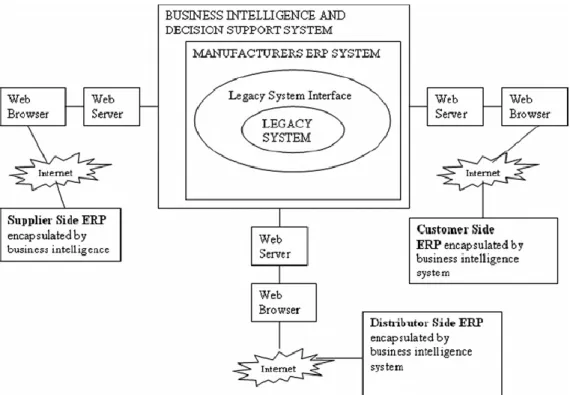
Information systems and technology have the potential to coordinate the different functions of a business, allowing the virtual integration of the entire supply chain, from suppliers to customers (Akyuz and Rehan, 2007). According to Akyuz and Rehan (2007) this integration merges SCM with the internet and they referred to it as e-supply chain management (e-SCM). In practice e-SCM is the use of internet technologies in the management of supply chain interactions and integration is key to efficiency (Akyuz and Rehan, 2007). Figure 1 presents a schematic representation of an integrated supply chain.
Figure 1 - Highly integrated supply chain
8
In short, e-SCM is “the impact that the internet has on the integration of key business processes from the end user through original suppliers that provides products, services, and information that add value for customers and other stakeholders” (Dey, 2015). The integration of the e-supply chain described above, has many benefits, including: creating a more cooperative business environment; a more interactive approach to supply chain; demand data and supply capacity data visibility; increased ability to anticipate and respond to demand fluctuations; tools to coordinate relationships across the entire supply chain; creation of operational linkages; creation of strategic partnerships; breaking down some organizational and functional boundaries; enhancing the flow of information (Akyuz and Rehan, 2007).
According to Porter (1985:38) “value is the amount buyers are willing to pay for what a firm provides them”. According to the same author the ultimate goal of companies is the creation of value for customers. In the scope of the present analysis the expression “source of value creation” is used to describe any factor that may influence the value created by e-business (Amit and Zott, 2001).
Along with the transformation of the supply chain, and as a consequence of that, e-business also changed the process of value creation, which cannot be described using traditional theories (Amit and Zott, 2001). Having that in mind, Amit and Zott (2001), conducted their own investigation to develop the definition of value creation and adopt it to broad applications, such as e-business, basing their research on Schumpeterian innovation, the resource-based view of the firm, strategic networks and transaction cost economics.
With their investigation, the authors, concluded that value creation opportunities in virtual markets are originated in the combination, reconfiguration and integration of different drivers (Amit and Zott, 2001). They also stated that value creation in virtual markets may be based on “new combination of information, physical products and services, innovative configurations of transactions, and the reconfiguration and integration of resources, capabilities, roles and relationships among suppliers, partners and customers” (Amit and Zott, 2001:496). At the end, Amit and Zott (2001), proposed their own definition of value stating that the “total value is created as the sum of the values appropriated by each party involved in the transaction”. Moreover, they state that value is created regardless of who appropriates it. The model proposed by them describes the potential sources of value
9
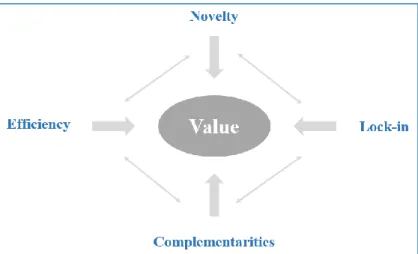
creation in e- business. This model consists of four dimensions, or four potential sources of value creation, that are also interrelated (Figure 2). The authors identified efficiency, complementarities, lock-in and novelty as the four main potential sources of value creation.
Figure 2 - Sources of value creation in e-business
Source: Amit and Zott, 2001
Efficiency is pointed out by Amit and Zott as the primary value driver for e-business. The authors adopt a vision of efficiency consistent with the transaction cost theory that suggests that transaction efficiency increases when transaction costs decrease. “Therefore, the greater the transaction efficiency gains that are enabled by a particular e-business, the lower the costs and hence the more valuable it will be”. Moreover, by leveraging cheap interconnectivity of virtual markets, e-business increases transactional efficiency by enabling faster and more informed decision making.
Another proposed source of value creation in e-business are complementarities. These are present whenever having a bundle of goods together provides more value than each one of the goods separately. E-business leverages this potential by offering bundles of both complementary goods and services, and the exploitation of complementarities is boosted by efficiency gains. The value creation of e-business can also be achieved through lock-in. Lock-in represents the extent to which customers are willing to repeat transactions and the extent to which business associates have incentives to maintain and improve their relationships. Furthermore, lock-in prevents strategic partners from migrating to
10
competitors. The fourth and last dimension is novelty. E-business also innovates in the way it structures the transactions, and consequently in the business structure.
1.2. Banks’ distribution channels and e-banking in Portugal
In general, the banking sector has two types of markets, retail and corporate (Berg and Kim, 1998). Usually banks that are retail oriented rely more on branch networks to develop their activities, and their operational activities are based on deposits. On the other hand, banks that have corporate customers as their main target tend to base their operation on the purchase of funds rather than on produced deposits (Berg and Kim, 1998).
Nowadays, due to a series of mergers and acquisitions in the past few years, throughout Europe, the banking sector has less institutions and each individual institution is bigger (Powlowska, 2015). According to Powlowska (2015), this is a common practice in all EU-27 countries that leads to a more concentrated sector. The banking sector is also heterogeneous, banks have clear differences in the value of their assets (Powlowska, 2015).
The global banking system is not mechanic and static, as it was once thought to be (Pop, 2015). Quite the opposite, it is dynamic and innovative, and traditional activities such as deposits, repayable funds and the granting of credits represent only a small part of the actual business (Pop, 2015). In fact, the technological developments of the past decades were a turning point in the banking sector, introducing new distribution channels (Silva, 2008).
Moreover, the introduction of new technologies into banking was a necessity for banks to stay competitive in high globalized markets (Silva, 2008). According to Silva (2008) banks focus their attention on clients and develop new marketing strategies and product/services based on new distribution channels, for example, e-banking (Silva, 2008).
1.2.1. Banks multi-channel distribution
The technological changes and globalization of markets in the past decades increased the competition among the financial institutions and led to a homogeneity of prices on deposits and loans (Akinci et al, 2004). To gain competitive advantage banks had to explore non-financial factors and new distribution trends emerged. Banks diversified their
11
traditional delivery channels, introducing virtual channels, and adopted a multi-channel distribution system (Akinci et al, 2004).
Multi-channel distribution is a service that adds value through the complementarity between physical and virtual components (Sousa and Voss, 2004). Distribution channels can be one of two types: virtual or physical. Sousa and Voss (2004) define physical channels as “means of communication with the customer employing a physical (bricks-and-mortar) infrastructure”. The same authors define the virtual channel as “means of communication using advanced telecommunications, information, and multimedia technologies”. With virtual channels the different services are available at any time and place (Seck and Philippe, 2013).
The vast opportunities offered by the internet changed the paradigm of services companies and led to the adoption of multi-channel distribution systems, using both traditional physical and virtual channels (Seck and Philippe, 2013). The banking sector is a good example of this new distribution approach. Banks use a mix of channels composed by “offices, retail outlets, telephone, call centers, ATMs and websites” as a way to better connect with consumers (Seck and Philippe, 2013).
A multi-channel strategy should not be seen as a mere addition of successive channels, but as a cohesive combination of the two types of channels that should be integrated and in complete harmony (Rosenbloom, 2007). Integration is now a key component through which companies attempt to reach an efficient multi-channel management (Seck and Philippe, 2013). It is necessary to create multi-channel strategies to “increase presence, awareness, trial and sales” (Sharma and Mehrotra, 2007).
In a multi-channel context, the customer experience is formed throughout all the moments of the interaction (Sousa and Voss, 2006). Customers base their service quality perception and satisfaction on all the channels they interact with (Sousa and Voss, 2006) and expect consistent and uniform quality across the multiple channels (Seck and Phillipe, 2013). Moreover, customer satisfaction has been a focus of managers’ attention worldwide (Welch et al, 2005) because it has been proven to increase customer retention, market share, loyalty, and company profits (Szymankski and Henard, 2001). In addition, according to Seck and Phillipe (2013), multi-channel consumers are more profitable than single channel consumers. The same authors state that increased contact through several
12
channels can increase shopping opportunities and allow a better communication with the customers.
1.2.2. E-banking
Like many other sectors, banking has been suffering changes due to development and improvements in ICT (Chavan, 2013), which has been a useful tool to follow market demands and practices. This development of new technologies has been causing a huge impact on organizations in terms of management and control, marketing and research, operations and decision making (Chavan, 2013).
Banking technology is not a new topic. It has been a constant presence in the literature since the late 1980s and early 1990s (Hernandez and Mazzon, 2007). According to Hernandez and Mazzon (2007) deregulation and globalization have been the main reasons behind the biggest technological changes in banking industry, together with the necessity to cut costs and increase profitability.
Electronic banking (e-banking) is the specific case of e-business in the banking sector (Hamidianpour et al, 2016). It is a set of services including automatic teller machines (ATM), point of sales, internet banking, telephone-banking and mobile banking (Hamidianpour et al, 2016)
E-banking can be defined as a set of activities conducted from home instead of a physical bank location (Kaur et al, 2015). It is an “umbrella term for the process by which a customer may perform banking transactions electronically without visiting a bricks-and-mortar institution” (Haque et al, 2009). E-banking can be also referred to as online banking, cyber banking, virtual banking and net banking (Kaur et al, 2015). Moreover, Angelakopoulos e Mihiotis (2011) state that there are three types of e-banking: internet banking, phone banking and mobile banking, that differ in terms of distribution channel, internet, phone and mobile phone, respectively.
According to Chavan (2013), e-banking is not something totally new. It started some time ago in the form of ATMs and telephone transactions. This first generation of solutions typically only allowed customers to view their statements online, conduct transfers between accounts and pay bills (Kaur et al, 2015). Nowadays, the amount of operations that can be carried out using banking services is far greater. Customers can use e-banking to: pay utility bills and insurance premiums; fund transferences; consult current account and savings balances; carryout mortgage payments; options subscriptions; book
13
orders online; book flights and railway tickets; and, purchase products online (Mudholkar et al,2013; )
The majority of banks recognize the need to change their business processes and follow the latest trends, in order to stay competitive (Mudholkar et al, 2013). Having that in mind, financial organizations aim to take the most benefits possible from technology, mostly to increase efficiency and have the end result of reducing costs (Chavan, 2013). In the last two decades, banks have focused on computerizing and electronizing each and every aspect of their processes (Masocha et al, 2011). With that mission arose e-banking, that allows banks to deliver products in a more customer oriented way (Masocha et al, 2011). This distribution channel is a consumer relationship management facilitator, which helps banks to better meet customers’ expectations and tighten their relationships with customers (Kumar and Kumar, 2015).
Since the first e-banking services were provided, in October 1994 and supplied by Stanford Federal Credit Union (SFCU), e-banking rapidly spread all over the world (Yoon, 2010). In Portugal, the first e-banking service arose in 1998, implemented by Banco Espirito Santo (BES). BES was followed by Banco Português de Investimentos (BPI) and Caixa Geral de Depósitos (CGD) that introduced e-banking in 2000 and 2003, respectively (Cândido, 2010).
The overall e-banking penetration rate in Europe has increased in the last decade, and according to available data, the penetration rate of e-banking in 2016 in Europe was 49% (Statista 06.10.2017). Portugal was positioned among the European countries with the lowest penetration rates in 2016, 29% (Statista 06.10.2017), as shown in table 1, right after Hungary and Slovenia. Denmark is the EU country with the highest penetration rate, 88%; however, Norway is the Schengen area country with the highest rate, 91%.
14
Table 1 - E-banking penetration in European markets
Source: Statista 06.10.2017
According to a Marktest study (21.02.2017) e-banking penetration tripled in Portugal in the last decade, as shown in figure 3. Nonetheless, the study pointed out a higher penetration rate than Statista, of 35%, which is still small compared with the leading countries as Finland, for example. This penetration rate represents around 2.5 million of Portuguese and has been stable since 2014, despite the decrease of open bricks-and-mortar (Exresso 04.07.2015). It should also be underlined that the penetration rate is strongly influenced by age (Marktest, 2017). In the population group with more than 64 years, in Portugal, the e-banking penetration rate is around 6,2%, compared with the 59, 7% of people between 25 and 34 years old (Marktest, 2017). In the same study, was stated that men use banking more than women and that the social condition also influences e-banking use, where people with higher wages and education use more internet e-banking.
Figure 3- E-banking penetration rate in Portugal
Source: Marktest, 2017
Country Penetration rate (%) Country Penetration rate (%)
Norway 91 EU (27 countries) 49 Denmark 88 Malta 46 Finland 86 Slovakia 45 Netherlands 85 Spain 43 Sweden 83 Poland 39 Estonia 79 Croatia 38 Luxembourg 71 Hungary 35 Belgium 64 Slovenia 35 Latvia 62 Italy 29 France 59 Portugal 29 Lithuania 54 Cyprus 28 Austria 53 Greece 19 Germany 53 Romania 5 Ireland 52 Bulgaria 4 Czech Republic 51
15 1.2.2.1. Advantages and disadvantages of e-banking
E-banking opened up a totally new world of possibilities and opportunities for financial institutions and changed their strategic behavior. “Online banking has a lot of benefits which add value to customers’ satisfaction in terms of better quality of service offerings and at the same time enable the banks gain more competitive advantage over other competitors” (Chavan, 2013, p.19).
Customers’ satisfaction and banks’ competitive advantage are just two of the long list of e-banking benefits proposed by Salehi and Alipou (2010). According to these authors, online banking benefits can be classified according to three points of view: the banks’ point of view, the customers’ point of view and economic benefits. From the banks’ point of view, the overall benefits are better branding and better responsiveness to the market, better brand image and profit maximization. The economic benefits pertain to lower operational costs of banks, potentially lowering margins and expanding reach through self-service (Salehi and Alipou 2010). Finally, the main benefit for customers pointed out by Salehi and Alipou (2010) are the significant time savings. Additional benefits for customers, include increased comfort compared to traditional services, quick and continuous access to information, better cash management, and faster, easier and more reliable services (Gurau, 2002). Moreover, with e-banking, customers can take as much time as they want to perform tasks wherever they want to and the service itself is simple, convenient and available 24 hours a day (Angelakopoulos and Mihiotis, 2011).
E-banking is not the solution for all banks’ problems, and there are even some problems/challenges pointed out in the current literature, both for banks and customers. On one hand, intense competition is one of the main problems for banks arising from facilitated access to information, as customers can easily and effortlessly access banks’ websites (Angelakopoulos and Mihiotis, 2011). Additional disadvantages pointed out by the authors are the amount of time and money required for establishing, maintaining and replacing the technological infrastructures.
On the other hand, for customers, the main disadvantages are security and the safety of their personal data, which originates a lack of trust in e-baking services (Angelakopoulos and Mihiotis, 2011; Silva, 2008). Other disadvantages mentioned include the lack of required technological skills by the users, lack of specialized equipment and/or infrastructures, and necessity of customers’ personal contact during service supply (Gabadeyan and Akinyoso, 2011; Curran and Meuter, 2005).
16 1.3. Consumers’ technology acceptance
Online banking services, as referred in the previous section, have several benefits for customers, and banks are still developing this services to better meet customers’ constant demands of quick answers, superior usability, personal attention and highly customized products and services (Mudholkar et al, 2013)
Despite the increasing number of internet users and the well-known advantages of internet banking for customers, the adoption rates of e-banking are not growing as expected (White and Nteli, 2004). As referred in the previous section, there are differences in e-banking adoption rates across Europe, a fact that raise questions regarding the factors which influence internet banking adoption by customers.
Early researches studied the factors behind human behavior and the motivations to perform a specific action (see Madden et al, 1992; Ajzen, 1991) where theories like Theory of Reasoned Action (TRA) and the Theory of Planned Behavior (TPB) appeared. Afterwards, using different methods and approaches, several researchers have studied the different factors influencing customers’ technology adoption (see Davis, 1989; Venkatesh and Davis, 2000; Venkatesh and Bala, 2008) where the main models is the Technology Acceptance Model (TAM). Additionally, regarding the specific case of e-banking and using the previous theories as fundamentals, recently some authors developed conceptual frameworks to explain e-banking adoption, such as, Safeena et al. (2014) and Ezzi (2014). The referred models will be detailed further on this work.
Adding to the theories used to describe technology adoption by consumers, there are some more interesting findings concerning to what influences technology adoption. For example, Gabner-Krauter and Faullant (2008) discovered that trust is a focal point in any type of transaction, being especially relevant in online transactions mostly because the lack of trust is one of the main reasons for the reluctance of customers to conduct financial transactions online (Flavian et al, 2006). Another factor described in the literature as influencing e-banking adoption is previous experiences, which can both have a positive or a negative influence in consumers’ attitudes towards e-banking (Laforet and Li, 2005).
1.3.1. Trust, security and Privacy
Trust is an important factor in social interactions, involving uncertainty and dependency (Gabner-Krauter and Faullant, 2008). In virtual environments the uncertainty level is higher than in a traditional setting, thus trust become an important factor (Gabner-Krauter
17
and Faullant, 2008). Grabner-kräuter and Faullant (2008) define technology trust as a belief combined with a willingness to rely on the internet as a medium for economic transactions, and state that it is particularly important when it comes to e-business, because in a virtual environment the level of uncertainty is higher than in traditional means in what refers to economic transactions. It has been proven in several studies that the ability to trust is a key enabler of information systems adoption (Flavian and Guinalıu, 2006) and the lack of trust the main reason stopping consumers from using e-banking (Flavian et al, 2006)
Personal and financial information can be used for fraudulent purposes and online transactions involve higher security concerns than traditional ones (Lee and Turban, 2002). Perceived security was previously defined as “threat that creates a circumstance, condition, or event with the potential to cause economic hardship to data or network resources in the form of destruction, disclosures, modification of data, denial of service, and/or fraud, waste and abuse” (Kalakota and Whinston, 1997). Users have the need to feel secure when they conduct online transactions and the lack of protection is even pointed out as one of the major disadvantages of information systems (Lee and Turban, 2002).
According to Grabner-kräuter and Faullant (2008), there is a growing concern related to the information given online. The interception and misuse of that information is a growing concern among consumers in terms of privacy. Thus, online consumers hesitate to make available their personal information and because of that do not use some information systems (Lim, 2003).
As mentioned before, trust can influence consumers’ behavior, in a positive or a negative way; therefore, when security and privacy are clearly disclosed, consumers increase their trust in online operations and are consequently more willing to perform online transactions (Chellappa and Pavlou, 2002).
1.3.2. Personal contact
As mentioned in the definitions of banking and in the description of its benefits, e-banking allows customers to perform the necessary tasks without visiting a bricks-and-mortar institution (Haque et al, 2009). Nonetheless, there are people that continue to perform the tasks in the traditional way for numerous reasons. Some customers do not
18
use e-banking because they enjoy the social experience of going to a bricks-and-mortar institution and prefer to deal with people (Zeithaml and Gilly, 1987).
Recent studies used personal contact as a construct of conceptual frameworks to study factors influencing IS adoption and concluded that the lack of personal contact can be even considered a factor that discourages IS adoption (Curran and Meuter, 2005; Hanafizadeh et al, 2014).
1.3.3. Theory of Reasoned Action (TRA)
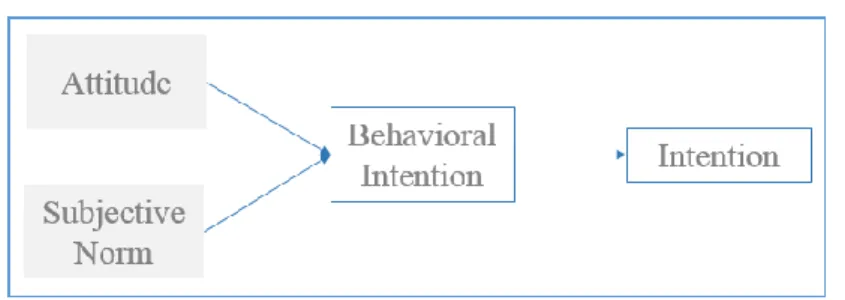
The Theory of Reasoned Action (TRA) was initially developed by Fishbein and Ajzen in 1975 and focused on individual motivations as constructs to determine the likelihood to perform a specific behavior (Montaño and Kasprzyk, 2008). In particular TRA led to the study of attitude and behavior, where it is stated that individuals’ behavior (B) is determined by the intention to perform that same behavior (Moore and Benbasat, 1996). TRA is based on three main constructs: behavioral intention (BI), attitude (A) and subjective norm (SN) with the configuration shown in figure 4.
Figure 4 - TRA Model
Source: Madden et al, 1992
According to the TRA, behavioral intention is determined by personal beliefs and social influence. Personal beliefs, named attitude (A) in the model, “is the individual’s positive or negative evaluation of performing the behavior”, while the social influence, called subjective norm (SN) in the model, represents the social pressure “to perform or not to perform the behavior in question” (Safeena et al, 2014, p.837).
The model suggests that the behavioral intention depends on person’s attitude towards the behavior and subjective norm; this means that behavioral intention is positively influenced by individuals’ attitudes and subjective norms (Safeena et al, 2014). Additionally, behavioral intention is what influences the actual behavior of individuals.
19
TRA itself is not widely used to study internet banking adoption. However, it is a starting point or a component of several models as exemplified bellow.
1.3.4. Theory of Planned Behavior (TPB)
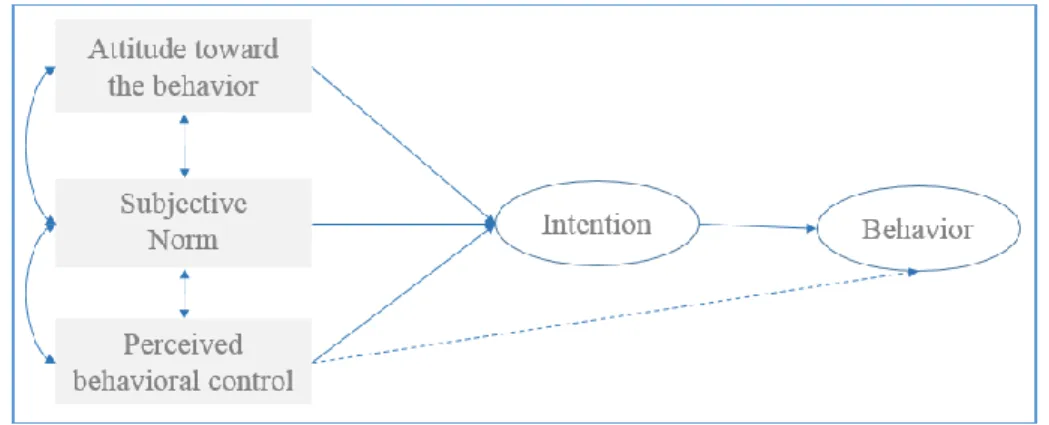
The Theory of Planned Behavior (TPB) is an extension of the TRA model and was proposed by Ajzen in 1985. TPB aims to overcome the limitations of TRA, by including a new construct, perceived behavioral control (PBC), which refers to the availability of resources and control an individual has to carry out a behavior freely and without any external conditioning. Even so the main goal of the theory is the same of TRA: explain the individuals’ behavior (Safeena et al, 2014).
According to Ajzen (1991), TPB assumes that human behavior is explain by behavioral intention and behavioral control, as represented in figure 5. Similarly to TRA, in the present theory, behavioral intention is also determined by attitude and subjective norm, and are assumed to capture the motivational factors that influence the actual behavior (Ajzen, 1991).
Figure 5 - TPB Model
Source: Ajzen, 1991
Additionally, Ajzen (1991) states that the “stronger the intention to engage in a behavior, the more likely should be is performance”. However, he makes clear that behavioral intention only takes expression when a person has the required opportunities and resources to perform a certain behavior, and can decide to perform it or not.
1.3.5. Technology Acceptance Model (TAM)
The Technology Acceptance Model (TAM) has its roots in TRA and TPB, aiming to express the way customers accept new technologies. TAM was proposed by Davis (1989)
20
and underlies almost every recent study in the information systems (IS) field. The model suggests that when users are presented with a new technology, their decision to use it is based on a multiplicity of factors (Safeena et al, 2014).
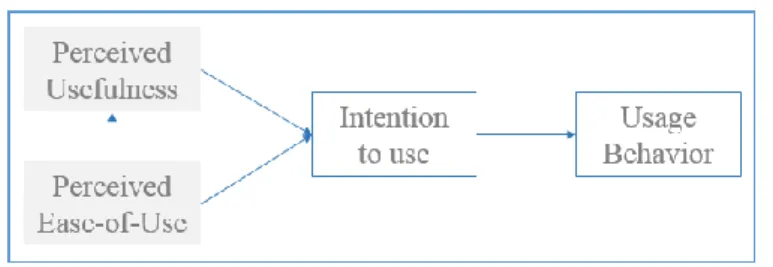
According to Davis (1989), as portrayed in figure 6, TAM assumes that users’ acceptance of a new information system is determined by their intention to use the system. In constructing one’s use intention towards an IS both perceived usefulness (PU) and perceived ease of use (PEOU) are deemed relevant. The variables are the main constructs of TAM and are used as determinants of users’ intentions to use a specific IS. As defined by Davis (1989) PU is the possible impact on performance that a person thinks the use of a specific system can have and PEOU represents how easy and effortless a person thinks that using a specific system will be. Although both PU and PEOU influence the intention to use a sort of technology, the usefulness/usage relationship is stronger than the ease-of-use/usage relationship (Davis, 1989). This means that consumers are more willing to use a technology because of the functionalities it has for them, than because it is easy to use (Davis, 1989). Additionally, PEOU, also has a positive influence on PU, which means that when someone thinks that a system is easy and effortless to use he/she will also think that it has a positive impact on the task performance.
Figure 6 - Technology Acceptance Model
Source: Davis, 1989
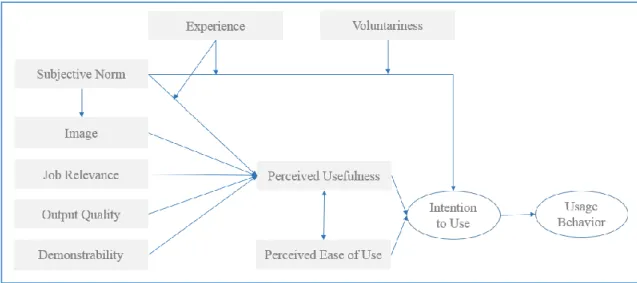
TAM is a proved theory in the literature, serving even as a tool to plan the introduction of new IS, more than just an evaluation system (Taylor and Todd, 1995). The model is the foundation of several new models, rather directly related to e-banking or not. For instance, TAM2 developed by Venkatesh and Davis (2000), incorporates social influence processes and cognitive instrumental processes, related to the initial constructs of TAM, as presented in figure 7. TAM2 adds the following constructs to the model: subjective norm, voluntariness, image, experience, job relevance, output quality and result demonstrability. As previously mentioned, subjective norm represents the perceived
21
social pressure to use an IS. Voluntariness represents the perception of an IS as not-mandatory. In its turn, image represents the impact people think the adoption of an IT solution will have on their social status. Experience is the user capability to use the system. Job relevance is the perception of impact on the persons’ job. The output qualit y is the perception someone has of how well the task went. Finally result, demonstrability is the tangibility of the results.
Figure 7 - TAM2 Framework
Source: Venkatesh and Davis, 2000
TAM3 is another model with foundation in TAM constructs, more specifically it is a development of TAM2. This model was developed by Venkatesh and Bala (2008) and keeps the variables determined in TAM2, affecting PU, and adds six new determinants affecting PEOU: computer anxiety, playfulness, self-efficacy, perceived enjoyment, objective usability and perception of external control, as shown in figure 8. Anxiety represents the degree of apprehension of using an IT solution. Playfulness represents the cognitive spontaneous level in computer interaction, this means, using computers because it is fun rather for a specific purpose. Another variable added to TAM3, self-efficacy, represents the skills the individual thinks to have when using an IT solution. The perceived enjoyment represents how enjoyable is to use the IS. The objective usability compares the effort necessary to complete the task, with and without the IT solution. Finally, perception of external control, is based on the perception of existing an organizational and technical use support system.
22
Figure 8 - TAM3 Framework
Source: Venkatesh and Bala, 2008
As mentioned before, TAM fundamentals have been used to build theoretical frameworks specifically applied to the e-banking case. Two study models were proposed by Ezzi, S. (2014) and Safeena et al (2014).
The e-business TAM (EBTAM) theory developed by Ezzi (2014) is known as the Consumer Internet Banking Model (CIBM) and introduces some new constructs, such as trust, perceived privacy, perceived security, responsiveness and demographics. In line with the previous investigators, Ezzi (2014) tried to describe consumers’ attitudes towards e-banking and their intentions to use it. As a result of the investigation, the author ended up with the model in figure 9 and new constructs: perceived privacy and security – individuals fear to provide sensitive information online; trust – confidence in the quality and reliability of services; computer self-efficacy – confidence in the ability to perform a task; responsiveness – feedback time and accuracy; demographics – age, education, gender and income level. Additionally, by testing the model, Ezzi (2014) proved that the referred customers’ attitudes positively influence their intention to use e-banking services.
23
Figure 9 - CIBM Framework
Source: Ezzi, 2014
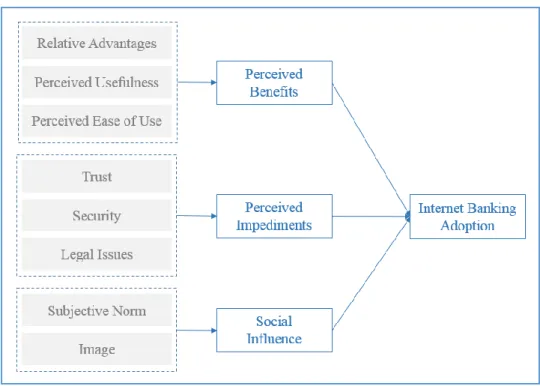
A parallel research and consequent development of an EBTAM framework (figure 10) was carried out by Safeena et al (2014). The authors determined that internet banking adoption is influenced by perceived benefits (PB), perceived impediments (PI) and social influence (SI). From the model analysis, it was proven that perceived benefits (relative advantages, perceived usefulness and perceived ease of use) and social influence (subjective norm and image) have a positive impact on internet banking adoption. Perceived impediments (trust, security and legal issues) have a negative impact on internet banking adoption and gender and age have an even bigger impact on internet adoption (Safeena et al, 2014).
24
Figure 10 - EBTAM Framework
Safeena et al, 2014
Summing up the main models referred in the present literature review, is presented in table 2. It aims not only to summarize the most important topics approached in the current section, but also serves as a support for the chosen research model.
Table 2 - Summary of the Models
Model Author Constructs Impact on IS/e-banking use
Attitude (A) May have a positive or a negative impact depending on the personal belifs; Subjective Norm (SN) Have a positive or a negative impact
depending on the social pressure to perform or not the task;
Behavioral Intention (BI) Depends on the previous constructs; Attitude (A) May have a positive or a negative impact
depending on the personal belifs; Subjective Norm (SN) Have a positive or a negative impact
depending on the social pressure to perform or not the task;
Perceived Behavioral Control (PBC)
Positive influence if the individual has the necessary control and resources to perform the task;
Behavioral Intention (BI) Depends on the previous constructs; Perceived Usefulness (PU) Positive influence;
Perceived Ease of Use (PEOU) Positive influence; Intention to Use (IU) Positive influence; Theory of Reasoned Action (TRA) Fishbein and Ajzen, 1975 Theory of Planned Behavior (TPB) Ajzen, 1985 Technology Acceptance Model (TAM) Davis, 1989
25
Source: Author
Perceived Usefulness (PU) Positive influence; Perceived Ease of Use (PEOU) Positive influence; Intention to Use (IU) Positive influence;
Subjective Norm (SN) Have a positive or a negative impact depending on the social pressure to perform or not the task;
Image (I) Positive influence;
Experience May have a positive or a negative impact depending if the individual has the necessary skills or not;
Voluntariness Moderating variable; Job Relevance (JR) Positive influence; Output Quality (OQ) Positive influence; Result Demonstrability (RD) Positive influence; Perceived Usefulness (PU) Positive influence; Perceived Ease of Use (PEOU) Positive influence; Intention to Use (IU) Positive influence;
Subjective Norm (SN) Have a positive or a negative impact depending on the social pressure to perform or not the task;
Image (I) Positive influence;
Experience May have a positive or a negative impact depending if the individual has the necessary skills or not;
Voluntariness (V) Moderating variable; Job Relevance (JR) Positive influence; Output Quality (OQ) Positive influence; Result Demonstrability (RD) Positive influence; Computer Anxiety (CA) Negative Influence;
Playfulness (P) Positive and negative influence; Self-efficacy (SE) Positive and negative influence; Perceived Enjoyment (PE) Positive influence;
Objective Usability (OU) Positive influence;
Perception of External Control (PEC)Positive and negative influence; Perceived Usefulness (PU) Positive influence;
Perceived Ease of Use (PEOU) Positive influence; Intention to Use (IU) Positive influence;
Trust (T) Negative Influence;
Perceived Privacy (PP) Negative Influence; Perceived Security (PS) Negative Influence; Responsiveness Positive influence;
Self-efficacy (SE) Positive and negative influence; Demografics Not analised in detail;
Perceived Benefits (PB) Positive influence; Perceived Impediments (PI) Negative Influence; Social Influence (SI) Positive influence; Safeena et al., 2014 EBTAM TAM 2 Venkatesh and Davis, 2000 TAM 3 Venkatesh and Bala, 2008 Ezzi, 2014 Consumer Internet Banking Model (CIBM)
26 2. RESEARCH MODEL
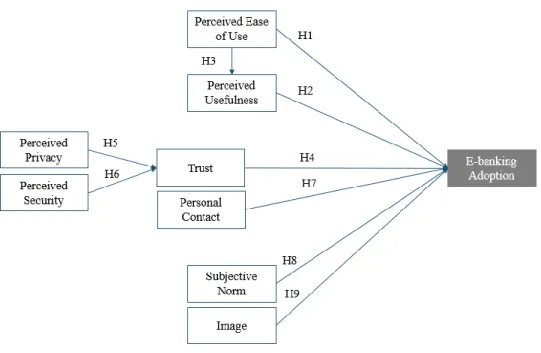
Considering the literature review section it is possible to conclude that consumers sometimes have reservations in what concerns e-banking adoption, which is reflected in different e-banking penetration rates among countries. Moreover, in the specific case of Portugal, the use of internet banking services has been stable since 2014 and one of the lowest in Europe (Statista, 2017). Thus, the present work aims to give an insight into the topic by examining consumer’s perceptions of what influences their use of e-banking. For that, the proposed model bases its constructs in the literature and correspondent models. The proposed research framework, similar to that of Safeena et al (2014) model, has three main groups of constructs. The first one includes perceived usefulness and perceived ease of use, which corresponds to the TAM model, and aims to validate if these perceived benefits positively influence Portuguese customers to adopt e-banking. The second group is formed by trust and personal contact. Trust, as previously mentioned, has been identified in the literature as one of the main reasons stopping consumers from using information systems. Thus, this construct aims to confirm whether this also applies to e-banking adoption in Portugal. Perceived privacy and perceived security, in turn, and as described in the literature review, are the main components of trust, and were necessary to assess its real impact on Portuguese customers’ trust, to better understand what influences people trust. The second construct of this group, personal contact, was introduced in the framework because the lack of personal contact is one of the main differences between e-banking and traditional banking. This inclusion of this variable is one of the main differences relative to previous models, but was considered necessary to assess to what extent the lack of personal contact impacts e-banking adoption. The final group was composed of subjective norm and image, and aimed to test the impact of social influence on e-banking use.
Additionally, the constructs are directly linked to e-banking adoption and not to the behavioral intention because the author aims to assess the direct impact of the constructs in consumers’ e-banking adoption and not in their intention to use it.
27
Figure 11 - Research model framework
Source: Author
The table below lists the constructs used in the framework and the definitions considered for the study.
Table 3 - Constructs used in the Framework
Source: Author
Construct Definition
Perceived Ease of Use (PEOU)
Belief that there is no need of effort when using e-banking. Ease of use also influences customers' perceived usefulness of e-banking. Perceived Usefulness (PU) Belief that the use of e-banking will help the individuals' bank
tasks performance.
Trust Belief that e-banking will follow a safe conduct. Confidence in quality and reliability of services. Trust is also influenced by perceived privacy and perceived security.
Perceived Privacy (PP) Perceived privacy is the belief that the personal data used to access e-banking and the tasks performed are not revealed to other Perceived Security (PS) Perceived security is the degree to which individuals feel protected
against any threat resulting from the use of e-banking. Personal Contact (PC) Refers to the necessity to stablish personal contact during the
service supply.
Subjective Norm (SN) The perceived social pressure one think to have to use e-banking. Image The impact people think the adoption of e-banking has in his/hers
28 2.1. Hypothesis
Broadly speaking, in the main theories described in the literature review, usually the constructs influence behavioural intention, and behavioural intention then translates into the effective use of IS or banking. In the proposed model, as mentioned before, e-banking use is directly linked to the proposed constructs, thus, the hypotheses will test the direct impact of the constructs on e-banking’s effective use.
The first constructs and consequent hypotheses are based on TAM assumptions, developed by Davis in 1989. Perceived ease of use represents the necessary effort to perform a task using e-banking, and not only influences e-banking adoption directly, but also influences its perceived utility. So, the first hypothesis proposes that perceived ease of use influences e-banking adoption.
H1: Perceived ease of use has a positive influence in e-banking adoption.
Another fundamental construct of TAM (Davis, 1989) is perceived usefulness. According to the author, it refers to the possible impact on performance that a person thinks the use of a specific system can have. Perceived usefulness is also one of the main factors influencing IS adoption, compared with ease of use. This means that consumers are more willing to use a technology because of the functionalities it has for them, than because it is easy to use (Davis, 1989). Perceived usefulness is a constant presence in the models used to describe IS adoption, including the resent research on e-banking adoption (Venkatesh and Davis, 2000; Venkatesh and Bala, 2008; Ezzi, 2014; Safeena et al, 2014).
H2: Perceived usefulness has a positive impact on e-banking adoption.
According to the original model of Davis (1989) perceived ease of use also influences the perceived usefulness. Thus it is hypothesed that:
H3: Perceived ease of use has a positive impact on perceived usefulness.
Trust is a feature present in every social and economic interaction. Moreover, online interactions have a high level of uncertainty associated to them compared with physical interactions; thus it is necessary to forge stronger bonds of trust with the consumers (Gabner-Krauter and Faullant, 2008). Additionally, some studies report that lack of trust is the main reason stopping consumers from using e-banking (Flavian et al, 2006). Grabner-kräuter and Faullant (2008) state that there is a high concern related to the information given online, concerning to the interception and misuse of that information,
29
in terms of privacy. Thus, online consumers often hesitate to make available their personal information and because of that do not use certain information systems (Lim, 2003). Additionally, users have the need to feel secure when conducting online transactions and the lack of protection is even pointed out as one of the major barriers to the adoption of information systems (Lee and Turban, 2002).
H4: The lack of trust in e-banking reduces its adoption. H5: Perceived privacy has a positive impact in e-banking trust. H6: Perceived security has a positive impact in e-banking trust.
Performing a task using e-banking hinges on the idea of no need for personal interaction. However, some people continue to use traditional distribution systems because they enjoy the social experience of going to a bricks-and-mortar institution and prefer to deal with people (Zeithaml and Gilly, 1987). The lack of personal contact is pointed out in some studies as negatively influencing e-banking adoption (Hanafizadeh et al, 2014). Thus, it is proposed that:
H7: Lack of personal contact has a negative impact on e-banking adoption. Also related to social interactions we have the subjective norm. This construct represents the social pressure to perform or not the behavior in question (Safeena et al, 2014) and it has been shown that it can have both a positive and a negative impact on the perceived usefulness (Venkatesh and Davis, 2000; Venkatesh and Bala, 2008). The referred impact depends on the direction of the social pressure, and whether it reinforces the intention to use it or not to use it. Furthermore, subjective norm has also been shown to have a positive impact on social influence, which in turn has a positive influence on e-banking adoption (Safeena et al, 2014).
H8: Subjective norm has a positive impact on e-banking adoption.
In its turn, image is related to personal beliefs and social interaction. It represents the impact people think the adoption of an IT solution will have on their social status (Venkatesh and Davis, 2000; Venkatesh and Bala, 2008).
30 3. METHODOLOGY
As previously mentioned, the main purpose of the present investigation is to understand what influences customers to adopt, e-banking in Portugal. In this sense, three key aims were defined, namely: i) to assess the overall use of e-banking in Portugal as well as the most used services; ii) to understand the factors influencing e-banking adoption from customers’ point of view; and, iii) to understand customers’ expectations for the future of e-banking.
Having the research goals in mind, a research model was developed, that started with a conceptual approach showing what is in the literature so far. In this section the research framework is presented, using the previous topics discussed in the literature review. Afterwards, the data collection methods, survey organization, data analysis procedure and measuring instruments are also presented in detail.
3.1. Data collection
Taking into consideration the nature of the research framework (see figure 11) was necessary to follow a quantitative method where, through statistical procedures, the hypotheses could be tested with the intention to identify the factors influencing e-banking adoption (Creswell, 2008, Walliman 2011). Quantitative research is a research methodology to quantify data, and applied for statistical analysis (Malhotra, 2007) and may be applied to test pre-determined hypotheses and produce generalizable results. The primary data was collected based on an online survey between 20th Abril 2017 and 20th June 2017, that was made available using Google Forms and diffused using social networks and via email. Surveys are a suitable tool to collect quantitative data, which as a method of collecting data is a simple and flexible tool (Walliman 2011). Walliman (2011) refers to surveys as structured formats that are easy and convenient for respondents, and cheap and quick to collect large amount of data. The questionnaire was made available online because it is a convenient distribution method. It does not have financial costs associated and is the least time consuming method compared with the traditional ones, personally and by post (Walliman 2011).