Department of Information Science and Technology
Detecting Violent Excerpts in Movies using Audio
and Video Features
Luis Jorge Gregório Dias
A dissertation submitted in partial fulfillment of the requirements for the degree of
Master in Computer Engineering
Supervisor:
PhD Tomás Gomes Silva Serpa Brandão, Assistant Professor, ISCTE-IUL – Instituto Universitário de Lisboa
Co-Supervisor:
PhD Fernando Manuel Marques Batista, Assistant Professor, ISCTE-IUL – Instituto Universitário de Lisboa
Resumo
Esta tese aborda o problema da deteção de violência em excertos de filmes, com base em características extraídas do audio e do video. A resolução deste problema é relevante para um vasto leque de aplicações, incluindo evitar ou monitorizar a exposição de crianças à violência que existe nos vários tipos de média, o que pode evitar que estas desenvolvam comportamentos violentos. Analisámos e extraímos características áudio e vídeo direta-mente do excerto de filme e usámo-las para classificar excertos de filme como violentos ou não violentos. De forma a encontrar o melhor conjunto de caracteristicas e atingir a melhor performance, as nossas experiências utilizam dois classificadores, nomeadamente: Support Vector Machines (SVM) e Redes Neuronais(NN). Foi usado um conjunto balanceado de ex-certos de filmes, retirado da base de dados ACCEDE, conjunto esse, que contém 880 excer-tos de filme, anotados manualmente como violenexcer-tos ou não violenexcer-tos. Durante as primeiras experiências, usando características incluídas na base de dados ACCEDE, testámos carac-teristicas áudio e características vídeo, individualmente, e combinações de características áudio e vídeo. Estes resultados estabeleceram o ponto de partida para as experiências que os seguiram, usando outras características áudio, extraídas através de ferramentas disponíveis, e outras características vídeo, extraídas através dos nossos próprios méto-dos. As conclusões mais relevantes a que chegámos são as seguintes: 1) características áudio podem ser facilmente extraídas usando ferramentas já existentes e têm grande im-pacto na performance do sistema; 2) em termos de características vídeo, caracteristicas relacionadas com o movimentos e transições entre planos numa cena, parecem ter mais im-pacto do que características relacionadas com cor e luminância; 3) Os melhores resultados ocorrem quando se combinam características áudio e vídeo, sendo que, em geral, o classi-ficador SVM parece ser mais adequado para o problema, apesar da performance dos dois classificadores ser semelhante para o melhor conjunto de características a que chegámos.
Abstract
This thesis addresses the problem of automatically detecting violence in movie ex-cerpts, based on audio and video features. A solution to this problem is relevant for a number of applications, including preventing children from being exposed to violence in the existing media, which may avoid the development of violent behavior. We analyzed and extracted audio and video features directly from the movie excerpt and used them to clas-sify the movie excerpt as violent or non-violent. In order to find the best feature set and to achieve the best performance, our experiments use two different machine learning clas-sifiers: Support Vector Machines (SVM) and Neural Networks (NN). We used a balanced subset of the existing ACCEDE database of movie excerpts containing 880 movie excerpts manually tagged as violent or non-violent. During an early experimental stage, using the features originally included in the ACCEDE database, we tested the use of audio features alone, video features alone and combinations of audio and video features. These results provided our baseline for further experiments using alternate audio features, extracted us-ing available toolkits, and alternate video features, extracted usus-ing our own methods. Our most relevant conclusions are as follows: 1) audio features can be easily extracted using existing tools and have a strong impact in the system performance; 2) in terms of video fea-tures, features related with motion and shot transitions on a scene seem to have a better impact when compared with features related with color or luminance; 3) the best results are achieved by combining audio and video features. In general, the SVM classifier seems to work better for this problem, despite the performance of both classifiers being similar for the best feature sets.
Palavras Chave
Keywords
Palavras chave
Deteção de Violência
Aprendizagem Automática
Características de Áudio e Vídeo
Classificação de Excertos de Filme
Rede Neuronal
Support Vector Machine
Keywords
Violence Detection
Machine Learning
Audio and Video Features
Classification of Movie Excerpts
Neural Network
Agradecimentos
Acknowledgements
Esta tese não teria sido possível sem o contributo de muitas pessoas que, cada um à sua maneira, tornaram tudo isto realidade, e aos quais estarei eternamente grato.
Aos meus orientadores, que sempre estiveram disponíveis para me ajudar, e que me acompanharam durante todo o meu percurso, dando-me todo o apoio que necessitei, e mais algum.
À minha namorada, que durante este meu percurso, sempre esteve ao meu lado e apoiou-me, encorajou-me e sempre me fez acreditar que seria possível, sendo que teve uma paciência e força inesgotável para me aturar.
Aos meus amigos e colegas, quer dentro da faculdade, com quem partilhei experiên-cias fantásticas, quer fora da faculdade, que sempre estiveram lá para mim e, sempre se mostraram disponíveis para me ouvir, ajudar-me nos meus problemas do dia-a-dia ou, sim-plesmente acompanharem-me nas noites de copos.
A toda minha família, em especial, o meu irmão que sempre foi o meu melhor amigo e com quem sempre pude contar em todo o tipo de momentos, e, acima de tudo, os meus pais, que não só me proporcionaram tudo isto, como também, sempre se sacrificaram por mim e fizeram tudo para que eu pudesse estudar, mesmo em tempos muito difíceis, e que, mais importante ainda, tiveram paciência para aturar o meu mau feitio, e com quem sempre pude contar nos melhores e nos piores momentos. A todos, muito obrigado.
Lisboa, 31 de Outubro de 2016 Luís Dias
Contents
1 Introduction 1 1.1 Motivation . . . 1 1.2 Objectives . . . 2 1.3 Research Questions . . . 4 1.4 Document Structure . . . 5 2 Related Work 7 3 The Classification System 15 3.1 Architecture . . . 153.1.1 Signal separation and processing . . . 16
3.1.2 Features extraction . . . 18 3.1.3 Classification . . . 19 3.2 Database . . . 20 3.3 Conclusion . . . 23 4 Features 25 4.1 ACCEDE features . . . 25
4.1.1 ACCEDE audio features . . . 26
4.1.2 ACCEDE Video Features . . . 27
4.2 Additional Features Implemented . . . 28
4.2.1 Audio Features . . . 30 i
4.2.2 Video Features . . . 31
4.3 Conclusion . . . 35
5 Experimental Results 37 5.1 First phase of experiments . . . 37
5.1.1 ACCEDE Features Testing . . . 38
5.1.2 Audio Features Testing . . . 39
5.1.3 Video Features Testing . . . 40
5.1.4 Multi-modal Feature Set Testing . . . 42
5.2 Second phase of Experiments . . . 43
5.2.1 Second phase Video Features Testing . . . 44
5.2.2 Final Multi-modal Features Testing . . . 49
5.3 Conclusion . . . 51
6 Conclusions and future work 53
List of Figures
2.1 Sequence of frames not detected as blood due to lack of quick movement . . . 8
2.2 Overview of the system reported by Giannakopoulos et al. (2010) . . . 11
2.3 Overview of Dai et al. (2014) system . . . 13
3.1 Representation of the system used and its major components . . . 16
3.2 Sample of the Weka Interface . . . 20
3.3 Sample of a scene considered violent . . . 21
3.4 Sample of a scene classified as non-violent . . . 22
List of Tables
3.1 Comparison between the original files and the raw files . . . 17
3.2 Details about ACCEDE database content . . . 21
4.1 Possible reasons for violent classification within the 35 violent excerpts out of the first 1000 excerpts. . . 29
4.2 Shot transitions used and how were they extracted . . . 33
5.1 System performance using ACCEDE features . . . 38
5.2 System performance using Audio features . . . 40
5.3 System performance using Color and Luminance related features . . . 40
5.4 System performance using motion intensity and motion orientation features . . 41
5.5 System performance after combining different of video features types . . . 42
5.6 System performance using different combinations of feature sets . . . 43
5.7 System performance using different statistic methods without frame removal, for motion intensity characterization . . . 44
5.8 System performance using different statistic methods with removal of frames where existed shot transictions, for motion intensity characterization . . . 44
5.9 System performance using Standard deviation based features . . . 45
5.10System performance when testing shot transitions related features . . . 46
5.11System Performance after combinations between NumCuts, TypeCuts and STD1 features . . . 47
5.12System performance using combinations of different types of motion intensity related features . . . 48 5.13Combination of TypeCuts and CombRemCuts features . . . 48 5.14System performance when swapping the former motion features for new ones . 49 5.15System performance obtained by mixing the best performance features of both
1
Introduction
This chapter introduces the work conducted on this thesis by presenting the motivation, the goals, and the corresponding research questions. Section 1.1 introduces the starting point of this work and addresses the main motivations. Section 1.2 describes the main goals, other objectives, and the expected outcome of interest to the scientific community. Section 1.3 presents the questions addressed on this work and intended to be answers, and the corresponding research addressed in the scope of this thesis. Finally, Section 1.4 provides a description of how the document is organized and structured.
1.1
Motivation
Violence among children and their relationship with existing violence on the many kinds of media (such as movies or video games), that they are exposed to, is a subject studied for quite some time, and continues to be a very current problem. Both in the twentieth century as in the present century, many studies on the subject matter have been conducted. studies which aimed at understanding the relationship between the existing violence in various types of media and violent behavior that people, including children, who had access to these types of media, developed.
In a study that followed the growth of several children to their entry into adulthood (between 1977 and 1992), Huesmann et al. (2003) were able to conclude that children’s exposure to violence on television assisted, influenced and increased the possibility that these come to develop behavior and violent attitudes during their adulthood, regardless of the context in which they lived on. This study also found that these conclusions are checked regardless of the sex of the child.
games and movies is reflected in an increase in feelings indicative of lack of empathy and attitudes said as demonstrative of violence, in people exposed to violent situations within these two types of media. Despite this conclusions, the study’s conclusions did not reveal this very same link between violent behavior and violence to which people watch, for other types of media.
Bushman and Huesmann (2006) conducted a study that compared the effect of violence in various types of media on children and people in adulthood, coming to the conclusion that the violent content that they were exposed to had a greater short-term impact, in terms of changes on behaviors and attitudes, on adults and greater impact in the long term in children. This study also revealed that, those changes on the way of being of the targeted people, were clear and there was an evident appearance of attitudes, thoughts and aggressive feelings, both on the children and on the people that already reached the adulthood.
The aforementioned studies reinforce the need for parents and early childhood educa-tors have some control over the content that their children watch or play, which, today, is increasingly complicated. As parents or guardians spend little time with their children, due to their professional lives and their lives outside the home environment, they tend to have difficulty on reducing their children exposure to acts of violence and other acts that are revealing of aggressive attitudes, for example, the use of inappropriate language. The development of tools and policies that assist children’s parents and tutors on this task is thus imperative, as pointed out by Sheehan in the study reported in Sheehan (1997).
1.2
Objectives
It is within this context or motivation, and this need of parents and guardians to monitor and assess whether what their children watch or not violent and harmful to even arises the work described in this thesis. One of the goals of this dissertation is to provide a baseline for the development of an automatic system that helps the parents or tutor on this task of having more control on its children exposure to certain contents, by classifying movie scenes or excerpts as violent or non-violent based on its characteristics. The task address focus on, not only research and discover a set of features that are strongly correlated to
violence that will be used by the system for its classification, but also build each phase of the system by describing the classifier and the techniques used for preparation and processing of the features to be used on the system. Thus, the aim of this work is to offer a contribution to help the parents of a child on the process of their decision of letting or not the children see a given movie.
The work presented on this dissertation, not only will, as stated, contribute as baseline for a tool that can be used in a future for helping parents and tutors on the task, already mentioned before, but also can be used and taken into consideration for similar tasks and other related works that can be done in a future. The use of this system or its components will be completely available so it can be considered by other projects if given the credit to the author. It can also be used as a tool for developing a complex system that, not only classify excerpts of movies (which is our contribution,) but also combined that information in order to classify the whole movie, or to give a concrete output in terms of which length of the movie is violent, and the exact temporal points where violence (detected by the system) occur, so a parent, can see that specific excerpt and decide by himself if its children can watch it.
On the task of detecting violence, an extensive research and testing of many different features is performed. those features are originated from both audio and visual domain, with different characteristics, some of them used in other tasks, like paralinguistics, or cre-ated, using Matlab development tool. A combination between features will be performed, with the intent of reaching a better system performance. A intent of this work is to un-derstand which of the two domains performed better on the system and, which of them has an easier feature extraction step. the last point is something to be considered if there is a desire to built a real-time system. Also, there is an intent to reach a conclusion on which of the tested classifiers performed better along the experiments. This research and its conclusions, are this work’s biggest contribution for the scientific community.
With this work, it is intended to enhance other works on the field of detecting violence, that were taken into consideration for developing the research step.
Having all this goals and considerations in mind, the system will have three phases:
• Separation of the audio and video signals from the movie excerpt in order to process 3
them separately.
• Extraction of features for each signal. At this step different groups of features will be tested and extracted.
• Classification of the movie excerpt as violent or non-violent, based on the features that fed the tested classifier (SVM or Neural Network).
1.3
Research Questions
In order to fulfill the goals and objectives of this work, as well as to build the intended system, there is a focus on have the following research questions answered:
• What are the main components that a system for detecting violence in movie excerpts need to have?
• Which machine learning algorithms should be used and tested on this task?
• Are there any projects on the very same task that can be fairly compared to our work, not only in terms of the process followed, but also in terms of results?
• Are there any projects in similar tasks that show different approaches in terms of features and classifiers used?
• Which audio or video features are usually used on the task of detecting violence in excepts or other similar tasks within the field of violence detection?
• Is there any set of movies (or movie excerpts) that can be used on this task?
• Are there any already extracted features that can be used as baseline for our work?
• Are there any toolkits available for extracting audio or video features?
• Which of the two modalities of features usually have a better performance on similar tasks?
1.4
Document Structure
This dissertation is structured as follows: On Chapter 2, a presentation of a series of projects, researches and other works produced on the field of violence detection is con-ducted. This group is, not only composed of works with the exact same task of our work, but also with other related tasks. On Chapter 3 it is presented a view of the system ar-chitecture, its components and the process that was followed when deciding which of the available options would be better to use on each of the steps of creating the system. Still in this chapter, a description of the database used to feed the system, which made part of the work, during all process of building the system and feature extraction and testing, was performed. On Chapter 4, it is performed an overview of all the sets of features that were extracted, both of audio and video domain, and, not only extracted using programmaticly developed programs, but also using other available software and other already extracted features. On Chapter 5, there is a focus on all of the experiments conducted during this work life-time, while trying to find the best performing features and the best performing classifier for the already explained problem, dividing the experiments in two phases. Fi-nally, Chapter 6 presents the conclusions reached out during this work, which answer the questions pledged to be answered, and the next step of this work in terms of what can be done after and based on this thesis.
2
Related Work
The main goal of the work described on this dissertation is to build a system able to clas-sify a movie excerpt as violent or non-violent, based on an mix of selected audio and video features. In order to fulfill this goal, a research was conducted, as a way of finding different approaches and kind of works that could function as a base, or at least as something where ideas to develop this work could be found, especially on the subject of selecting features to feed the system. On the particular task of classifying violence on movie excerpts, not many bibliography was found, except the works conducted by Lin and Wang (2009), Chen et al. (2011) and Giannakopoulos et al. (2010).
Starting by the work conducted and described in Lin and Wang (2009), it is proposed a mechanism for identifying violent movies using audio and visual features. In the case of audio features, a method monitored weekly is on a set of previously extracted audio features, such as bandwidth high or zero cross rate ratio. Those features are known to have good results in the field of audio classification and, in this work, their representations are grouped together, creating an audio vocabulary. In the case of video features a classifier is used to detect violence on images. In this case, are considered relevant in the context of detection of violent scenes, the rapid movement between images, the detection of an explosion or fire in the extracts and the presence of blood. All these considered relevant information is obtained through image processing techniques somewhat complex:
• In the case of fast movement between frames, a motion vector is calculated for a frame macro-block, having the motion intensity calculated from this very same motion vector. In order to calculate the intensity associated to the frame by itself, a sum of the motion intensities of all the macro-blocks that compose a frame is calculated. • For the case of fire and explosions, the frame is divided in areas that contain yellow
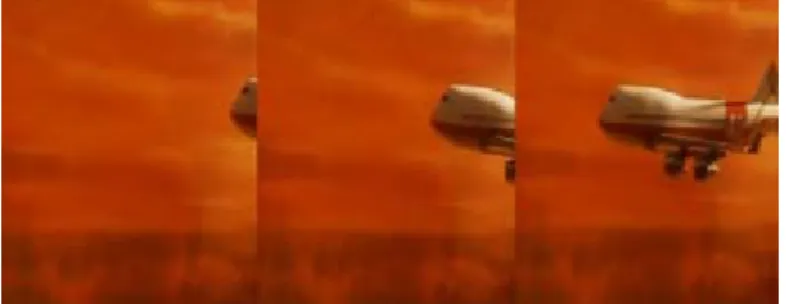
Figure 2.1: Sequence of frames not detected as blood due to lack of quick movement tones and areas that does not contain yellow tones. Afterwards, the adjacent areas are grouped and it is studied the existence of motion within those areas to see if they can be connected to any of those phenomenon.
• In the case of blood detection, it is used a method similar to the above, but this time the division of the image is performed according to red tones. In addition, it is assumed that the appearance of blood in a violent scene is highly connected to quick movement on the scene. Figure 2.1 shows a situation where the frames that compose the excerpt are, by themselves, composed of a majority of red tones, but it is not detected blood due to lack of quick movement in the scene.
Obtained results of the two fields of information, these are combined using a machine learning method called co-training, which combines two sets of data, which typically do not have dependencies on each other. The results obtained following this approach were compared with a system using Support Vector Machines and was denoted increased per-formance, from one system to the other, of about 20% for the test that was made.
The work conducted and described in Chen et al. (2011) proposes an approach that not only extracts features on a frame level, but also uses the movie on its all length and extracts features related to a set of continuous frames. This work used only visual based features, as a way of being more effective. Those visual features are related to the existence of motion on a movie excerpt and the existence of blood within a frame. Their work process can be summarized in four major steps:
1. As the first step on their approach, they start by segmenting a whole movie in different shots.
3. Thirdly, they use an SVM based classifier to detect action scenes. 4. Last, but not least, they proceed on detecting blood on the scenes.
Although their work flow is as it’s described above, the referred paper has more focus on detecting action scenes and blood frames. On the first case, four different features are extracted and, intend to describe the motion within a scene:
• Average motion intensity, which is calculated by computing a motion vector for every 16x16 pixels of a frame. After that, it is computed an average of all motion vectors, which is the Average motion intensity.
• Camera motion ratio. In this case, it is verified if a frame has less than 10% of null mo-tion vectors. If they have, that frame is considered to have camera momo-tion. Therefore, the camera motion ratio is calculated by dividing the number of frames with motion in a scene by the number of frames that compose a scene.
• Average shot length, which is calculated by, for a scene, by averaging the shot length of each of the shots that compose a scene.
• Shot cut frequency. This feature is obtained dividing one by the number of shots in a scene.
Those features are mixed in a SVM classifier, which will return, as output, a binary decision of classifying the scene as an action scene or as a non-action scene.
For detecting the blood frames on a scene, only the frames contained on a previously classified action scene are considered. On those scenes, they select a keyframe that will represent each shot that is contained on the action scene. Then, they used the keyframe for, not only trying to detect blood on the frame, but also, trying to identify human presence on that frame, by detecting faces. While on the face detection case, they used an existing face detection algorithm, on the blood detection case, they check, on the keyframe, for aggregations of pixels with their color present on a limit of RGB indexes.
Finally, they tested their system on four known Hollywood movies, and compared their approach with the one developed by Lin and Wang (2009), previously mentioned, obtaining a better performance, especially in terms of recall.
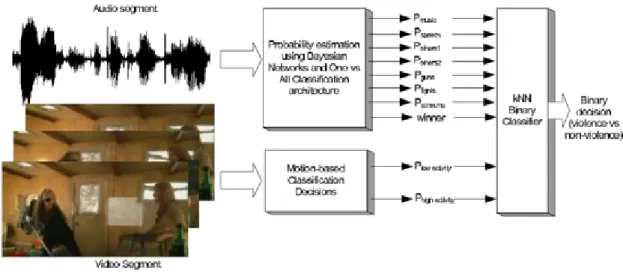
Last, the work conducted by Giannakopoulos et al., described on Giannakopoulos et al. (2010), was performed, in order to address the referred task, proposing an audio and visual features fusion classified using Bayesian networks and k-nearest neighbor algorithms. The group of researchers created different classifiers for audio and video, to recognize distinc-tive characteristics in each. In the case of audio, they used a classifier, based on Bayesian Network and an One vs All classification architecture, with seven classes, four of which are considered non-violent and claimed to represent audio relating to music, normal characters speech or other audio types pertain to the normal environment in the movies. In the case of violent classes, these were meant to represent situations of shooting, fighting or shouting. For each movie excerpt, it was calculated its probability of being within each of the re-ferred classes. In the case of image or video they were created three classes representing the interaction of existing people in the scene, based on the motion within the excerpt. The first class represented situations where there weren’t people on the scene or they appeared to be immovable. The second class was used to represent situations where there was in-teraction of people in a natural way scene. Finally, the third class represented situations where the sudden movements, by the characters, occurred, such as falls or fights. The combination of the various classes for each film, and the consequent decision of the system was achieved using an algorithm called k-Nearest Neighbor (kNN). that returned a binary response, indicating that the film was violent or not. The system was evaluated based on a comparison of its results and the opinion of three people, for fifty movie excerpts. Figure 2.2 shows a representation of the system used by this group of researchers.
All this three works intended to address the same task as this work. Although, it isn’t possible to compare the results between each work and this one, since, not only, the datasets used to build the system aren’t the same, but also, the dataset of the work described on this original thesis is balanced, situation that doesn’t occur on Lin and Wang (2009), Chen et al. (2011) and Giannakopoulos et al. (2010).
These three works were the only found with the exact same task as the work presented on this dissertation. However, much more studies were conducted on similar areas of vi-olence detection. On this other works, not only the task by itself changes, but also the methodologies and features used, considering they’re still within the violence in movies field.
Figure 2.2: Overview of the system reported by Giannakopoulos et al. (2010)
Acar et al. (2013) work consisted on developing two systems that used a SVM classifier for fulfilling the task of detecting the most violent scenes in Hollywood movies. Each sys-tem was fed with different groups of features: the first one contained only audio features, such as Mel-Frequency Cepstral Coefficients (MFCCs), building a bag of audio words; the second one used a mix audio and visual approach, using the features of the first system as audio features, and features from the video domain, which were motion related features, that consisted on computing the average motion between different key frames, as visual features. The results showed that the second system developed had a better performance on the task addressed, when comparing to the first one.
The MediaEval conference is a conference that since 2011 has addressed the issue of evaluating affective content in movies, including violence. One of the tasks or challenges proposed by this conference is to find the most violent excerpts among a dataset, somehow similar to the task addressed in this work. Although it is, still important to reinforce that the task that is approached on this MediaEval conference, it is different than the one ap-proached on this work. For instance, instead on trying to evaluate which excerpts, out of a previously selected set of excerpts, are the most violent, which is the task addressed in MediaEval conference, the task addressed on this is to determine and classify if a movie excerpt is violent or not. This conference originated many different works, results and ap-proaches, not only on the subject of the classifiers used, but also on the subject of selection of features, worth considering for the referred task, and, although the task isn’t the same
as the one addressed on this thesis, as the domain of the problem is the same, this work’s and approaches can give a really important value to the project developed on this thesis.
In terms of the many different works conducted on this conference and task, Jiang et al. (2012) used features from both audio and video domain. For the video case, they extracted features related to the trajectory and motion in the movies, spacial and temporal points of interest, to check situations where pixels presented big variations on both spacial and tem-poral domains, converting this feature into a bag of words with 4000 code words and SIFT descriptors, used to locate local invariant pieces of images in a movie frame. For the audio case, the usual MFCC coefficients as a way to represent the audio signal that composes the movie. These two groups of features are subject of a process of soothing, where each frame is represented by an average frame between itself, and the frames directly before and after it, and merged in a SVM classifier with a polynomial function based kernel to fulfill the task. Penet et al. (2012) created five different systems based on different techniques and algorithms. First, they try to avoid using machine learning algorithms and try to fulfill the task using, only, a similarity measure between the data that is contained on the training set and the data that is contained on the testing set. So for each movie, the system classify them by only compare it to violent movies and non-violent movies within the training set, using a K-Nearest Neighbor algorithm to give the final decision. The second system, used a bag of audio words as features, and a sigmoid function to give the final mean average precision, which is used to measure the system performance. The third system, added a set of 6 color related features to the audio features used, and Bayesian Networks machine learning algorithm to achieve the system decision. The fourth system, the group of researchers reimplemented a previous built system which used audio, video and text related features, and they removed the text related features, due to lack of performance. Last, they mixed all the approaches but the first one in a single system to address their problem.
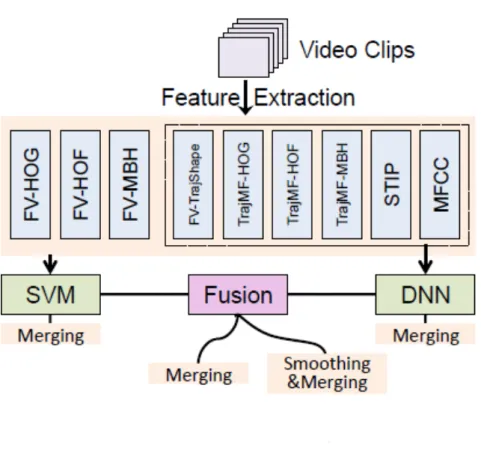
Also, Dai et al. (2014) used both audio and visual domain features to address the task. They used trajectory based features, spacial and temporal points of interest and MFCC coefficient as features, in an approach that is similar to the one taken by Jiang et al. (2012) on their previously mentioned work. As classifiers, they used both SVM and deep neural networks and fused their results which were target of a score smoothing. an overview of the system can be seen on 2.3.
Figure 2.3: Overview of Dai et al. (2014) system
Despite many of the presented approaches use features from both audio and video domain, Lam et al. (2012) used features from, only, the video domain. This group of re-searchers used many global features related to color, with different configurations on the subjects of granularity, color space chosen and quantization: color moments, color his-togram, edge orientation hishis-togram, and local binary patterns, with the intent of describing the color and texture distribution of the movie frames. This features were extracted from 5 keyframes that were used to represent a shot of movie. As for the classifier used to mix this set of features, the SVM classifier was the one chosen, having a Radial Basis Function kernel. The training was performed using cross-validation with five folds.
Martin et al. (2012) used only video/visual related features on their work. They used a simple module that uses multi-scale local binary pattern histogram features mixed in a Support Vector Machine classifier with a linear kernel.
Derbas et al. (2012) developed four different runs in order to address the MediaEval conference task. On their task they used descriptors from both audio and video domain:
color histograms to describe the color distribution on each movie frames; texture descrip-tors; SIFT descriptors and MFCC coefficients. To these descriptors, an optimization process was applied. First, a normalization process with this descriptors as targets occurred, and then a PCA reduction with the intent of reduce the number of dimensions of the descrip-tors was conducted. For their work, two different classifiers were used - SVM classifier and one based on the k-nearest neighbor algorithm - and their results were mixed. Other similar works conducted on this conference with the goal of addressing the referred task are describe on the work conducted by Acar and Albayrak (2012) and Eyben et al. (2012).
In this section it is presented a set of different works produced on the area of violence detection. The works on this domain, that had the exact same task as the work conducted on this dissertation aren’t much, in terms of quantity, as this is a fairly new and specific topic of the field. Nevertheless, with these related works, a series of different approaches were found, in terms of system architecture, features used and system evaluation. Although the task is the exact same on as the one addressed on this thesis, the results obtained from these works are not fairly comparable to the ones obtained during this dissertation, since they use different datasets. On a different subject, a set of different works were obtained with tasks similar to the one addressed on this work. These projects and researches re-sulted on many different approaches that were taken in consideration for our own work. Many different groups of features were extracted (and from different domains) and com-bined in many different forms using different classifiers and machine learning algorithms and techniques. This provided a starting background for the research conducted during this dissertation and highly inspired work conducted.
3
The Classification System
As stated before, the goal of this original master thesis is to develop a system that is able to correctly classify a movie excerpt as violent or non-violent, by analyzing a set of researched features, that can be from both audio or video domain, with the maximum performance possible. Having that in mind, the first step followed, before advancing to the concrete implementation, training and testing phase is to think about what are the main components of the system. This focus on addressing the system architecture and what techniques or options are going to be taken during each major component implementation, as well as what set or database of movies are going to be used as target of the experiments conducted on the scope of this work. In this last scenario, a research was conducted in order to look for an already built and available set of movie/movie excerpt data, that had the best characteristics, in order to be used on this work. Therefore, this Chapter is divided in two sections, each of them with their own self organization: On Section 3.1, it is addressed the system architecture, each of the main components of the developed system to address the problem that this original thesis is trying to solve, and the choices that were taken in each decision point of the development, in terms of system architecture. On Section 3.2, it is described the movie database that was found and adopted on this work, evaluating why that database was helpful, why it was chosen and what are its major characteristics.
3.1
Architecture
The system used to address the problem and fulfill the goal of detecting violent excerpts can be divided on three major components, with very specific functions related to them:
Audio and video
signals separation extractionFeatures Classifier
Movie
excerpt Violent / Non-violent
Figure 3.1: Representation of the system used and its major components • Features extraction component;
• Classification component.
The intent of building this system is to be able to, by receiving a movie excerpt, already extracted from a whole movie (something that is not the target of this work), have the ability to classify it as a violent or non-violent excerpts, as a way of fulfilling the task addressed on this dissertation. To do that, the movie excerpt needs to go through a previous processing phase, where not only, the signal of the movie excerpt is separated on audio signal and video signal, but also, these signals are outputted in a raw format that allows them to be treated. This signal processing and separation is described on Section 3.1.1. After that, and having the audio and video signals of the movie excerpt in their raw format, it is possible to extract features from both domains from them, in order to get a set of “indicators” that will impact the final decision of the system. The process of extracting those features, the techniques used and other toolkits or software used, are described on Section 3.1.2. Having the set of wanted features or movie excerpt characteristics extracted, the system needs to evaluate them and classify the movie excerpt according to the violence within it. This is done by using a classifier to reach the system decision. The details on what classifiers were tested and how the training and system performance analysis was conducted, is addressed on Section 3.1.3. A more visual representation of the system architecture is provided on Figure 3.1.
3.1.1
Signal separation and processing
The component of signal separation and processing had a very specific and simple task: To not only separate the audio and video signal from the video excerpt, but also to make sure that the outputted format of both signal was a raw one. The reason this processing step was done, in the first place, was to make possible the extraction of independent audio and video features directly from the signal, using their raw format.
Format Global Size (MB) Average Size per excerpt (MB)
mp4 999.2 1.14
wav 1586.8 1.80
yuv ~74800 ~85
Table 3.1: Comparison between the original files and the raw files
To complete the task explained, a tool known as FFMPEG was used. This is an open source tool to process multimedia data that allows the extraction of audio and video signals from the whole movie excerpt, with possibility of choosing the type of files the user wants to output the signals on, using the command prompt. This tool also allows the user to choose many other configurations for the output system, for example, the number of channels chosen for the audio signal. This processing was applied to the dataset used on this work, that was composed by 880 movie excerpts.
To separate the audio signal, the FFMPEG tool was used to output the .wav (raw format) from the original .mp4 files. The reason behind why that format was chosen was the fact that, not only it is a raw format, but also, it is compatible with OpenSmile toolkit, that was used to extract audio features, as it will be described further. To separated the video signal, the FFMPEG tool had the files outputted on .yuv files as it is a format that is very commonly used on video processing. It is worth mentioning that, for the video case, another phase of processing was conducted, to separated the .yuv files that contain the information of the visual signal of the whole movie excerpt in frame related informations, in order to be possible to extract features from the frame level. The table 3.1 shows a size comparison between the original .mp4 files and the raw formats from both signals: .wav files for the audio case and .yuv files for the video case.
As it can seen by analyzing the table 3.1,both raw formats had bigger size than the original format, as excepted. As the .mp4 is an encoded format and the raw files do aren’t target of any type of encoding process, the raw files tend to be bigger. It is also quite visible that the .yuv files are much bigger than the .wav files, which indicated that they will take longer to process.
After this step is concluded, it is possible to extract features from the both separated signals.
3.1.2
Features extraction
After having the raw formats for the target movie excerpts, it is, now, possible to extract features, of both audio and video domain, from them. The description of each individual set of features extracted can be seen on Chapter 4.
The two big groups of features: audio features and video features, where extracted from very different ways, as they belong to different domains.
The audio related features were extracted using the OpenSmile (Eyben et al. (2010)), a toolkit that allows a transparent extraction of audio features based on different configura-tions of the extraction. This makes possible the extraction of many groups of features with different complexity levels and different number of features. This toolkit was, then, used to extract three different groups of features as described on 4. As it works, the OpenSmile is given a configuration and the .wav file (raw audio format) and outputs a file describing each feature value for the audio file, in arff format.
For the task of extracting video features, it wasn’t found any toolkit, similar to the OpenSmile toolkit, but for video features processing. Therefore, the features had to be extracted recurring to scripts developed by us, using Matlab software. The software is commonly used for video processing and therefore was chosen to be the developing en-vironment of this dissertation. For this particular domain, two subtypes of features were extracted, within the video features context:
• Motion related features;
• Color and luminance related features.
After the features were extracted they were outputted in .csv files, used to store the in-formation of each individual feature, for each movie excerpt that was target of this work. More information on the features extracted is described on 4.
This component received the two types of signals as input, and outputted the .arff files containing the audio features information and the .csv files with the information about the video features.
3.1.3
Classification
After having the complete sets of features extracted, from both audio and video domain, using OpenSmile and Matlab, respectively, the next step was to use their information and combine it using a classifier, in order to be able to obtain the system response. On this particular task, the classifier is used to process the input features and output a binary decision in terms of classifying the movie excerpt as violent or non-violent. Thus, two classifiers were chosen: Support Vector Machines(SVM) and Neural Network. The SVM classifier was chosen due to its good results in similar tasks as shown on many works already described on Chapter 2, while the Neural Network was chosen, as this machine learning algorithm was used, with good performance, in many different fields of knowledge, for example in DeGroff et al. (2001), Figueiredo et al. (2014) or Prasad et al. (2013), and, therefore, was tested on this task, as well, with the hope of also have a good impact.
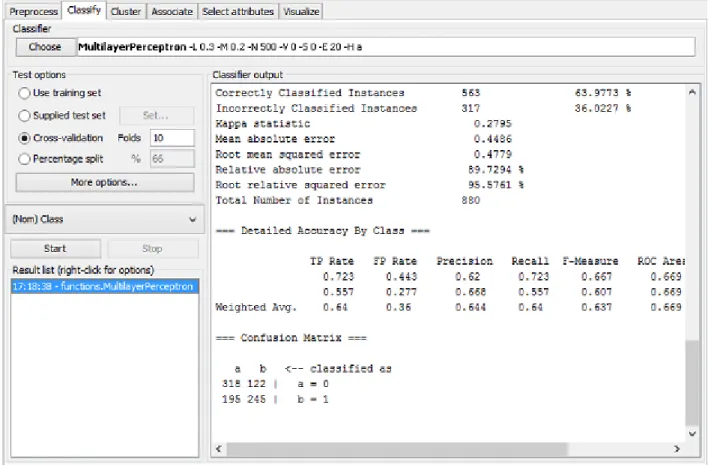
For this phase of the system a cross-validation technique with ten folds was used, train and evaluate the system according to its performance, based on the number of cases the system evaluated correctly divided by the number of classifications the system made. To implement both systems, Weka software was used. Weka is a toolbox to implement machine learning algorithms to a given problem. It allows a user to choose the classifier he wants to use on its problem, change its configurations, like the kernel used for the SVM classifier or the neurons architecture for the Neural Network classifier, choose the way the system will be evaluated, by choosing cross-validation or by dividing the set of features he’s working with in training and testing sets, and to apply operations, such as data set standardization or normalization, on the set of features in order to try to enhance the system performance. Figure 3.2 shows a sample of the interface of Weka for implementation of machine learning algorithms.
By analyzing the Figure 3.2 , it can seen that, not only this tool contains the features described before, but also outputs a series of statistical information about the training and the system, such as the precision, recall and f-measure, and the number of correctly and incorrectly classified instances, used for the system performance checking.
Both classifiers were tested on all the sets of features that were extracted and the system performance using each classifier on each set of features, individually or mixed
Figure 3.2: Sample of the Weka Interface
with other sets of features can be seen on Chapter 5.
3.2
Database
Having the system architecture selected on each of its own components level, as de-scribed on the previous Section, a set of movie excerpts data to be processed, have its features extracted, and classified as violent or non-violent, was needed. On the research for this type of data set, the main goal was to find a dataset that already had its movies separated in small excerpts, which was intended to be the input of the system described on this dissertation. The data set chosen was provided by ACCEDE movies database (Baveye et al. (2015)).
The ACCEDE movies database is a set that contains 9800 movie scenes/excerpts on .mp4 format, with about 10 seconds of duration and approximately 1 MB of file size. This movie excerpts are, individually, annotated as violent or non-violent, in a binary
classifica-Average length per excerpt (s) 9.901 Total length (s) 97033.6 Average size per excerpt (MB) 1.0492
Total size (MB) 10281.9 # of Violent excerpts 440 # of Non-Violent excerpts 9360 Table 3.2: Details about ACCEDE database content
Figure 3.3: Sample of a scene considered violent
tion based on subjective opinions provided on a crowdsourcing experiment by a big number of participants.
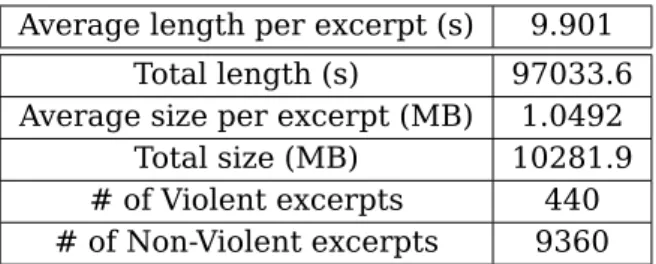
From the 9800 movie excerpts existent on the database, most of them were considered non-violent by the crowdsourcing method: from the whole set, only 440 of the 9800 movie excerpts were actually classified as violent by the participants, having the remaining 9360 and majority of the set classified as non-violent. Some more details about the content of the ACCEDE database can be seen on Table 3.2.
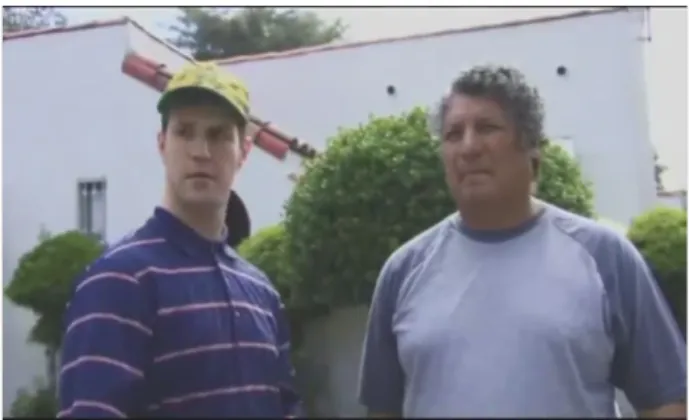
A sample of an image that belong on a movie excerpt considered violent can be seen on Figure 3.3, while, an image of a scene that is not considered violent can be seen on Figure 3.4. If this two excerpts are studied, it can be seen that in the first one a man is a attacking a women, and the scene is in general composed b darker colors, lots of movement and specific sound of screaming, while the other one as a more calm atmosphere where three friends are talking to each other. This kind of observations were taken into consideration while searching for indicatives and features that represent violence.
The fact that the dataset has such a majority of data referred to the non-violent content is a big issue, since it shows that it’s quite unbalanced and that threatens the training of
Figure 3.4: Sample of a scene classified as non-violent
the classifiers, especially the Neural Network based one, as there is a big possibility of the classifier only classify all the movie excerpts as non-violent, as it works for most of the cases, which is unwanted. This way of working may provide a big accuracy of the system, however, it’s completely undesirable to solve the problem addressed on this dissertation. Therefore, the first step to use this database correctly was to form a balanced dataset. Since there were only 440 movie excerpts classified as violent, they were all used on this new balanced dataset, and, additionally, 440 movie excerpts classified as non-violent were randomly selected from the 9360 non-violent movie excerpts available. Doing so, after all this processment, a balanced and smaller dataset, was reached, with a proportion of 1/1 of movie excerpts classified as violent and movie excerpts classified as non-violent, that was about 1/21 on the original set.
Although this section only focused on the movie excepts contained on the database, so far, some other content was available on this dataset: A set of 41 previously extracted features from both audio and video domain were made available for each of the movie excerpt presented on the dataset. From the whole 41 features, 21 were related to video and extracted from the video signal of the movie excerpt, while the remaining 20 were related to audio and extracted form the audio signal. It’s worth mentioning that some of this features represent coefficients, such as MFCC, so some of the features only have meaning together. This set of features was used as a starting point for the testing work developed on this project. More information about these features are addressed on Chapter4.
3.3
Conclusion
On this section a summary of the system that was developed is done. This system is composed by three major components in order to fulfill its intent of classifying a movie ex-cerpt according to the violence within it. First there is a separation of the signals, followed by the extraction of features and last, the classification of the movie. Also, on this section, an overview of the ACCEDE database is conducted, regarding its content, focusing, not only on the movie excerpts that it contains, but also their characteristics and previously extracted features that were also made available on this dataset.
4
Features
During the process of building, training and testing the system, several groups of fea-tures from different domains were used in order to determine which of them have a stronger impact on the detection of violence in movie excerpts. These groups of features can be di-vided according to three categories: ACCEDE features – features already extracted that are contained on the ACCEDE database, from both audio and video domains; Audio Features – features extracted on the scope of this thesis in order to improve the system, using a tool known as OpenSmile Eyben et al. (2010), that enables the extraction of numerous audio features based on a configuration; and Video features – features also extracted on the con-text of this thesis, based on the implementation of programs developed for that objective, using the Matlab development tool. These features were computed with the intent to dis-criminate the behavior of visual features like the color distribution and motion. On the next sections, a deeper description of these different groups of features is performed.
4.1
ACCEDE features
As stated before, the ACCEDE database includes 41 audiovisual features previously ex-tracted in the context of the Liris-ACCEDE project Baveye et al. (2015): 21 video features and 20 audio features. Those features were extracted in the scope of emotion recognition and affective video content analysis, a field that is highly related to the one explored on this thesis. In the context of this thesis, the ACCEDE features were used to setup a starting point, being used as a baseline that is compared throughout the different phases of testing and experimenting, in order to check how the work developed and evolved. These features were extracted and made available in a raw format, meaning they are present on the dataset without any kind of processing other than the one used to extract them. The database fields
(feature values) were not normalized, therefore high differences in the range of feature val-ues are observed from field to field. The features were separated into two groups, based on the domain they belong to (audio or video) in order to study them separately and together, as it will be shown in the next chapter that summarizes the experiments. A description of the features representative of the audio signal is performed on Section 4.1.1, while the description of the features representative of the video signal is performed on Section 4.1.2. More details on the ACCEDE features can be found in Baveye et al. (2015) and Baveye et al. (2013a).
4.1.1
ACCEDE audio features
As stated, there is a total of 20 audio related features contained on the ACCEDE database. This set of audio features aims to describe the audio signal using coefficients, volume measures and other kind of techniques.The features included on this set are as follows:
• Mel-frequency cepstral coefficients (MFCCs), which is a group of coefficients that represents the power spectrum of the sound. These coefficients are described by 12 different audio features on the ACCEDE database.
• Centroid, which measures the balance of the sound spectrum and tries to estimate the tone.
• Asymmetry and asymmetry enveloped, two features that measure the behavior of the symmetry of the sound spectrum around its centroid.
• Energy, feature that measures the power of the audio signal.
• Roll-off, which is usually described as the Nth percentile of the power spectral distri-bution, where the N is commonly about 85% or 95%.
• Zero-crossing Rate (ZCR), which is a rate that evaluates the signal changes along the very same signal.
4.1.2
ACCEDE Video Features
The ACCEDE database includes a total of 21 video related features. These video fea-tures can be divided according to two groups: feafea-tures that intended to represent the static part of the video (still images) and features that represent the dynamic part of the video (e.g., motion). The former group contains features related to color and light distribution and were extracted on a single key frame that represents the whole video sequence. This single key frame was selected based on the color histogram: the frame with the RGB his-togram that is closer to the average RGB hishis-togram of the whole video excerpt. The latter group of video features contains features related to the motion and shot transitions (cuts) between consecutive frames, aiming to describe the video based on its flow and not only on a representative frame. The video features existent on the ACCEDE database are the following:
• Alpha, which is the orientation of the color harmonious template, as described on Baveye et al. (2013b).
• Colorfulness, which evaluates the intensity of a specific color. It is calculated as shown in Hasler and Suesstrunk (2003).
• Color Raw Energy and Strength, as well as Min Energy, three features that evaluates the energy and intensity of the color as described in Wang and Cheong (2006). • Compositional Balance, which measures the organization of the elements in a frame,
as described in Luo and Tang (2008).
• Cut length that measures the total length of the cuts on a movie excerpt.
• Depth of field, a features that measures the depth of field using a blur map based method described in Baveye et al. (2012).
• Entropy Complexity, which is used to characterize the scene/excerpt complexity based on the sum of the wavelet sub-bands, as it is calculated in Le Meur et al. (2011). • Global Activity, the average size of the motion vectors between frames.
• Hue Count, a feature that measures the “simplicity” of a frame as stated in Ke et al. (2006).
• Lighting and Median Lightness, features that evaluates the lighting property in a frame that is used, for example to enhance the 3D visual effect. Luo and Tang (2008). • Max Saliency Count and Saliency Disparity that counts the number of pixels with highest values in a saliency map and evaluates the differences between the pixels in a saliency map.
• NbFades, NbWhiteFrames, NbCutScenes that count the numbers of fades, white frames and cut scenes in a video.
• Spatial Edge Distribution Area that evaluates the numbers of edges in a video.
• Standard Deviation Local Max that calculates the standard deviation of the Euclidean distance between the local maxima coordinates and the centroid of the local maxima.
4.2
Additional Features Implemented
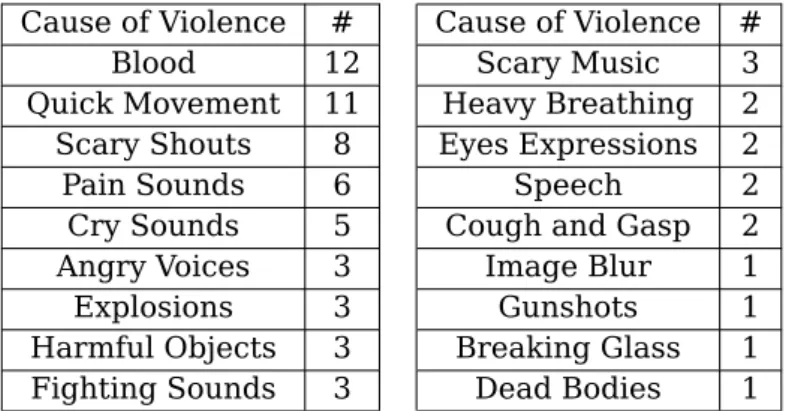
The ACCEDE related features presented on Section 4.1 consist on previously extracted features that function as the baseline for the work of this thesis. Besides that, one of the thesis goals is to test new features from both the audio and visual (video) domains, that will be used with the intent of enhancing the system’s performance. Therefore, and similarly to the ACCEDE feature set, these new features can be divided into two groups according to their respective domains: audio features and video features. Before advancing to the step of extracting new audio and video features, a preliminary study was conducted in order to find possible reasons that explain why a movie excerpt is violent and which visual and audio characteristics in an excerpt are more indicative of violence. Such preliminary study was performed using movie excerpts classified as violent within the first 1000 movie excerpts that are available on the ACCEDE database. Thus, for each movie excerpt classified as violent, a list of possible reasons for the presence of violence was synthesized. Based on the list of possible reasons that lead to the classification of an excerpt as violent, an insight can be provided for the derivation of new features that may enhance the system’s accuracy. Additionally, the global reasons for a movie excerpt to be classified as violent can be determined and see if those global reasons can be characterized by audio or video features. Within the first 1000 movies excerpts in the ACCEDE database, 35 were classified
Cause of Violence # Cause of Violence #
Blood 12 Scary Music 3
Quick Movement 11 Heavy Breathing 2 Scary Shouts 8 Eyes Expressions 2
Pain Sounds 6 Speech 2
Cry Sounds 5 Cough and Gasp 2 Angry Voices 3 Image Blur 1
Explosions 3 Gunshots 1
Harmful Objects 3 Breaking Glass 1 Fighting Sounds 3 Dead Bodies 1
Table 4.1: Possible reasons for violent classification within the 35 violent excerpts out of the first 1000 excerpts.
s violent and those were the ones targeted by this preliminary study. A list with the main reasons and the number of times they occurred is synthesized on Table 4.1.
After this study was conducted, some interesting conclusions were reached out. The existence of blood in a scene and the quick movement are the most common occurrences and seem to have a stronger link to the existence of violence. However, while a measure-ment for the amount of movemeasure-ment present in a scene is easily obtained, the existence of blood is hard to quantify. The existence of blood is related to the presence of regions with reddish colors on the frame. However, looking for reddish colors can lead to many mistakes if red objects, like a red shirt, existed on the scene. Furthermore, since the presence red-dish objects are more common than the presence of real blood, a feature that measures the presence of red color will most likely have a bad impact on the system.
Rapid movement in a scene is something considered to be potentially indicative of vi-olence and worth of deriving features about. By observing the videos that were subject to this preliminary study, it can seen that most of the excerpts classified as violent that con-tain a form of physical violence are characterized by the presence of intense motion across the video sequence. Sometimes this observation fails, for instance, when there is a danc-ing scene or a sports game, which are situations where the video is constantly changdanc-ing. Nevertheless, motion based features may have some potential on the system and are worth testing.
From Table 4.1, it can also be observed that, from the occurrences of violence indi-cators in the excerpt, 33 of them are related to video and 38 of them to audio. This fact, together with the fact that many occurrences related to video are harder to be quantified by
feature values (i.e., eyes expressions, harmful objects, blood, dead bodies), may lead to the conclusion that the audio features in a movie excerpt may be a little bit more meaningful to the problem of violence classification, despite the video features also playing a big part on the matter.
With this study it was found evidence that extracting video features related to move-ment and color and, as well as audio features that could represent the audio behavior in a scene should be the path to follow. Therefore, new audio and video features were derived based on the results of this study and other similar analysis of the movie excerpts that oc-curred during the experimental work performed on the scope of this thesis, both from the ones classified as violent and from the ones classified as non-violent. New audio features that were extracted during this work are addressed on Section 4.2.1, while the new video features are presented in Section 4.2.2.
4.2.1
Audio Features
The OpenSmile Eyben et al. (2010) toolkit was used for the extraction of new features from the audio signal of the movie excerpts. This toolkit works by receiving both the .wav file that corresponds to the audio file extracted from the movie excerpt and a configuration that describes the type of features to extract from the audio file. This toolkit allows the extraction of many groups of features that can be specified through the configuration files. This software contains many configurations available varying on the number of features they intent to extract and, therefore, the level of detail to be worked with. On the experi-ments conducted, three different configurations were tested: IS13, GeMAPS and eGeMAPS - an extended version of GeMAPS Eyben et al. (2016). The IS13 configuration and feature set was created in the scope of the Interspeech Computational Paralinguistics Challenge 2013 (ComParE), and consists on the use of 6125 features to describe the audio signal. The GeMAPS and eGeMAPS are minimalist sets of acoustic features, proposed for several ar-eas of automatic voice analysis, as a way of reducing the large number of existing features that are usually used to discriminate the audio signals into a much smaller set of features representative of a large percentage of the audio signal. The GeMAPS set of features con-tained 62 features which used, among other, frequency related features, amplitude related features and spectral related features with the advantage of having a small set, easy to
process, containing, altogether, 18 low level descriptors to represent the audio signal. As for the eGeMAPS set, it contains 88 features that can be viewed as an extended version of the original GeMAPS with the addition of 7 low-level descriptors. These three groups of features were used and tested in order to see which of them had a better impact on the problem. It is worth mentioning that after the OpenSmile toolkit outputs the groups of extracted features, they still need some processing, such as the normalization of the group, in order to be served as input of the system.
4.2.2
Video Features
Similarly to the audio features, new video related features were extracted. However, for this task there is the downside of not having a proper toolkit for feature extraction such as the one used for the audio signal, which allowed a transparent extraction of features without the need of programming. Thus, for the case of video features extraction, several scripts were programmed using the Matlab tool . The extracted features were related to the color and luminance distribution on the movie excerpt and features that discriminate the motion between consecutive frames, using low complexity computations. These features values result from globally combining several measurements performed in a frame-by-frame basis.
For the color characterization the first step was to extract the first four color moments from each movie excerpt, with the intent of discriminate the color distribution and behav-ior in an excerpt. For this procedure, a global histogram with the representation of the color distribution for the whole movie excerpt was computed and afterwards the four color moments were extracted from the histogram:
• Average;
• Standard Deviation; • Skewness;
• Kurtosis.
In order to characterize luminance distribution, a global histogram of the luminance was computed for the whole video sequence. Then, five features were extracted from the histogram:
• Most common luminance value (the distribution mode); • Frequency of the most common luminance value;
• Distance (measured in histogram bins) from the mode to the second most common luminance value that is distanced by at least three histogram bins from the mode;
• Frequency of the second most common luminance value; • Standard deviation of the histogram bins.
As for the motion characterization, the feature extraction process can be split according to two phases. On the first phase, in order to characterize the motion intensity within a movie excerpt, each video frame was split into non-overlapping blocks with dimension of 15x15 pixels. Then, the Mean Squared Error (MSE) values between pairs of blocks located in the same spatial positions of two consecutive frames were computed. After computing all block-wise MSE values along the video sequence, for all consecutive frame pairs, the resulting MSE values below a given threshold were set to 0 in order to suppress noise. Finally, three global features were extracted:
• Average of the frame-by-frame average value of the block-wise MSE values;
• Average of the frame-by-frame average value of the non-null block-wise MSE values; • Ratio between the number of non-null block-wise MSE values and the total number of block-wise MSE values.
Still on the first phase and related to motion, a set of features was extracted in order to characterize the behavior of the motion vectors orientation, and, to characterize the direction of the movement that exists on the excerpt. Thus, using the same block-wise structure mentioned above, additional measurements were performed in a frame-by-frame basis with the intent of characterizing the distribution motion vectors orientations:
• Average of the angles amplitude for the non-null motion vectors.
• Standard Deviation of the angles amplitude of the non-null motion vectors. • Skewness of the angles amplitude for the non-null motion vectors.
Name Description Detection methods Hard cut An abrupt transition
where a frame is contained on the first shot and the exact next
one is part of the second.
Comparing the color histograms of both shots and having the first one much different
from the second Black frame When the shot
transition is made using a dark frame
When the luminance of the whole frame is
above a threshold Fade in When a shot starts with
a black frame and gradual transitions into
the shot
Finding a black frame followed by a gradual brightness increase, in
terms of luminance Fade out When a shot gradually
derives into a black frame
Finding a black frame that is preceded by a gradual transition from
a lighter frame into a dark frame Others When there are
detected many successive hard cuts
Using the same method as hard cuts but with a
bigger set of consecutive frames Table 4.2: Shot transitions used and how were they extracted
Since the features must be representative of the whole movie excerpt and not of for individual frames, a combination of these measurements was performed and it resulted on 8 features: These 8 features result from computing the average and the standard deviation of each measures along the whole video sequence.
On the second phase, a series of features were extracted based on the very same method as the one used on the first phase, in a deeper way and with the inclusion of an-other paradigm: the existence of shot transitions on the movie excerpt. Using the Matlab software, a program was developed for detecting shot transitions in a movie and identify them as one of the following five categories: hard cut, black frame, fade in, fade out or others. Table 4.2 shows some more information about this shot transitions and how were they detected.
With the identification of the video shot boundaries, it is possible not only extract fea-tures related with the amount of shot transitions in a movie excerpt and their type, but also to split a movie excerpt according to smaller segments delimited by the identified shot