1. Serviço de Reumatologia e Doenças Ósseas Metabólicas, Hospital de Santa Maria, CHULN;
2. Unidade de Investigação em Reumatologia, Instituto de Medicina Molecular, Faculdade de Medicina, Universidade de Lisboa;
3. Faculdade de Farmácia da Universidade de Lisboa; Portugal; 4. iMed - Research Institute for Medicines - Faculdade de Farmácia da Universidade de Lisboa; Portugal;
5. Serviço Farmacêutico do Centro Hospitalar Universitário Lisboa Norte.
blood samples collected before and after switch. A to-tal of 27 patients had unaltered sIFX levels and ADA status during follow up. Three patients had detectable ADA at baseline, with low sIFX levels. After switch, ADAs became negative in 2 of those patients, and the other patient kept detectable ADA levels. ADAs became positive in 5 patients after switch. The switch to CT-P13 represented a 26.4 % reduction of costs in the use of IFX therapy in these patients.
The switch in routine care of a group of RA, SpA and PsA patients from IFXor to CT-P13 did not affect effi-cacy, safety, immunogenicity and reduced costs in 26.4%. The observed changes in blood samples were not associated with higher disease activity and did not lead to stopping IFX therapy.
IntroductIon
Biotechnological drugs are a fundamental resource for the treatment of rheumatic patients. TNF inhibitors have demonstrated value in the treatment of rheuma-toid arthritis (RA), spondyloarthritis (SpA), psoriatic arthritis (PsA) and are widely used1.
Patent expiry for biologicals created the opportuni-ty for biopharmaceutical manufacturers to develop biosimilar drugs intended to be as effective as the origi -nator product but with a lower cost to healthcare sys-tems1–3. Such is the case of the infliximab biosimilar
CT-P13 approved by the European Medicines Agency in 20134,5.
TNF inhibitors have different degrees of inherent im-munogenicity and their recurrent administration can cause patients to develop anti-drug antibodies (ADA)6,7.
ADA are drug reactive antibodies which can be neu-tralizing (nAb) and cause a decrease of serum drug con-centration to sub-therapeutic levels, resulting in loss of clinical response. Occasionally, ADA bind to the drug but do not inhibit its pharmacologic activity, in which
Efficacy, immunogenicity and cost analysis of a systematic
switch from originator infliximab to biosimilar CT-P13 of all
patients with inflammatory arthritis from a single center
Valido A1, 2, Silva-Dinis J1, 2, Saavedra MJ1, Iria I3,4, Gonçalves J3,4, Lopes JP4,5, Fonseca JE1, 2
ACTA REUMATOL PORT. 2019;44:303-311
AbstrAct
Biosimilar drugs are intended to be as effective as the originator product but with a lower cost to healthcare systems. In our center we promoted a switch from ori -ginator infliximab (IFXor) to biosimilar infliximab (CT-P13). We analyzed efficacy, safety, immunogenici-ty and cost savings of switching. Eligible patients were adults with the diagnosis of rheumatoid arthritis (RA), spondyloarthritis (SpA) and psoriatic arthritis (PsA) on therapy with IFXor for at least 6 months and with sta-ble disease activity. Efficacy was measured considering change from baseline in Disease Activity Score in 28 joints (DAS28) for RA and PsA and in Ankylosing Spondylitis Disease Activity Score (ASDAS) for SpA. Disease worsening was considered when an increase of 1.2 from baseline in DAS28 or an increase of 1.1 in AS-DAS occurred. Serum IFX levels (sIFX) were di-chotomized as therapeutic (between 3-6 µg/mL), low (< 3 µg/mL), and high (> 6 µg/mL). Anti-drug antibody (ADA) levels were dichotomized into detectable (> 10 ng/ml) or non-detectable (< 10 ng/ml). A cost analysis was done based on the purchasing prices of the 2 drugs at our center.
During a period of 1 year switch to CT-P13 was per-formed in 60 patients for non-medical reasons. We had a total of 36 patients with SpA, 16 with RA and 8 with PsA. Disease activity was stable over the observation period and similar to the values observed with IFXor. Median follow-up time was 15 months during which 5 patients stopped CT-P13. Forty-two switchers had
case, they are called non-neutralizing (non-nAb)6,7.
ADAs also raise safety concerns since they can be as-sociated with infusion and injection site reactions, thromboembolic events and serum sickness7,8.
The clinical impact of immunogenicity is observed predominantly between 6 months and 1 year after treatment start. ADA are normally sustained but they can also be classified as transient, when they are de-tected at only one sampling time point during the treat-ment or when ADA are detected at two or more time points over a limited period (< 16 weeks) and the last sampling time point is ADA-negative7.
Although biosimilars have a stringent and highly demanding process of quality characterization, assess-ing long-term clinical stability and safety in real-life is a reassuring evidence of the biosimilarity exercise9.
In our center, in November 2016, we promoted a non-medical switch from originator infliximab (IFXor) to biosimilar infliximab (CT-P13) in all patients with inflammatory arthritis treated in routine care. This study aims to do a descriptive analysis of efficacy, safe-ty and cost savings of switching from IFXor to CT-P13 in a single center. We also investigated the fraction of switchers who altered serum IFX concentrations (sIFX) status (i.e. high to low or vice versa) or changed ADA status (i.e. negative to positive or vice versa) during follow-up. Moreover, we assessed if these changes were associated with higher disease activity scores and IFX withdrawal.
mEthods
InclusIon crItErIA
Adult patients with the diagnosis of RA, SpA, and PsA on treatment with IFXor and with stable disease activ-ity, defined as a variation of Disease Activity Score 28 joints (DAS28) for RA and PsA of less than 1.2 and in Ankylosing Spondylitis Disease Activity Score (AS-DAS) for SpA of less than 1.1 over the previous 6 months. In November 2016, all eligible patients were proposed to switch to CT-P13. In the day of the last treatment with IFXor, written informed consent, clini -cal data and blood samples were collected, and the switching process was explained. In the following treatment day, CT-P13 was administered. Patients’ vis-its were scheduled according to the periodicity of drug administration over a total period of 12 months after switch.
Information was also collected regarding the 12
months that preceded the switch, regarding disease ac-tivity and persistence on drug for the same patients when they were on IFXor. The study was approved by the institutional ethics committee (Comissão de ética do Centro Académico de Medicina de Lisboa).
EffIcAcy And sAfEty outcomEs
Efficacy was measured considering the change from baseline in DAS28 for RA and PsA and in ASDAS for SpA. Patients were classified as having disease wors-ening if there was an increase of 1.2 from baseline in DAS28 or an increase of 1.1 in ASDAS, respectively. We analyzed disease activity 12 months after switch and the observed changes over time were calculated for each patient. Safety surveillance was performed on ev-ery visit, and consisted on the report of clinical or lab-oratory events that motivated drug withdrawal. Clin-ical data were collected from the Rheumatic Diseases Portuguese Register (Reuma.pt)10.
cost AnAlysIs
A cost analysis was done based on the purchasing prices of the 2 drugs in our center.
AntI-drug AntIbodIEs And InflIxImAb sErum lEvEls
A subgroup of patients (n=42) had blood samples available before and after the switch. Blood samples were collected at baseline, immediately before the first perfusion of CT-P13, and during follow-up (also im-mediately prior to each perfusion). ADA were analyzed using state-of-the-art bridging ELISA and concentra-tion of IFXor and CT-P13 were measured using Direct ELISA. Firstly, to minimize the high concentration in-terference of the drug in the bridging ELISA, sIFX-ADA immune complexes in serum samples were dissocia ted by acid treatment. The sIFX levels were considered therapeutic (i.e. the target though concentration, when in between 3 and 6 µg/mL, with a sensitivity of 1 µg/mL), low or suboptimal concentration (when <3 µg/mL) and high (>6 µg/mL, with a sensitivity of 1 µg/mL) when they had a supra-optimal concentration. The ADA levels were dichotomized into detectable (>10 ng/ml, positive) or non-detectable (<10 ng/ml, negative), with a sensitivity of 10 ng/ml. The neutral-ization activity of ADA (nAb) was measured by as-sessing the interference with TNF-alpha binding to TNF receptor 1 (TNFR1). The percentage of inhibition of sIFX was measured as the recovery effect of li -gand-receptor interaction. CT-P13 treatment
with-tients who stopped IFXor. One of them was due to pri-mary failure, the other 3 had an adverse event (one mi-nor adverse event, tremors after infusion, and two ma-jor adverse event, anaphylactic reaction and drug-induced hepatitis).
During follow-up, after switching, 5 patients (8.3%) stopped therapy with CT-P13. Three patients (5%) stopped duo to disease worsening. Regarding adverse events leading to drug withdrawal, one patient (1.7%) had lip edema. No other adverse events were reported. One of the patients returned to IFXor and the others switched to a drug with a different mechanism of ac-tion. One of the patients (1.7%) moved to another country and we lost follow up.
One of the patients with disease worsening was a 48-year-old male patient with PsA for 18 years. He had no concomitant therapy with DMARDs and was on IFXor therapy for 14 years. He switched to CT-P13 but one month after the switch psoriasis flared and he was switched to ustekinumab. The other one was a 59-year-old male patient, with SpA for 12 years, treated with IFXor for 11 years with concomitant MTX therapy. Since the first administration of the biosimilar the pa-tient reported no treatment effect. He had ASDAS wors-ening only caused by patient global assessment (PtGA) elevation. He stopped CT-P13 and switched to adali-mumab. The last patient was a 57-year-old women with RA for 24 years. She had no concomitant therapy with DMARDs and was under IFXor therapy for 18 years. She switched to CT-P13 and likewise reported no treat-ment effect since the first administration. This patient had a DAS28 4V and 3V worsening superior to 0.5 but below 1.2 (DAS28 4V baseline/9 months after switch: drawal and drug persistence were used as effectiveness
outcomes.
stAtIstIcAl AnAlysIs
Non-normal variables are presented as median and in-terquartile range. All the analyses were performed using STATA 14.2.
rEsults
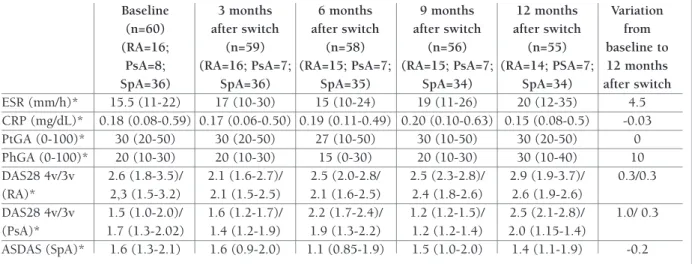
During the 12-month period, switch to CT-P13 was performed in 60 patients for non-medical reasons. We had a total of 36 patients with SpA, 16 with RA and 8 with PsA (Table I). Sixty-five percent (n=39) were male with a median age of 53 years (IQ: 48-64). Sixty-eight percent of the patients were also being treated with methotrexate (MTX). The median disease duration pre-viously to switch was 17 years (IQ: 10-23). The medi-an time on IFXor treatment before the switch was 9 years (IQ: 6.5-11.9) and the median time of follow-up after transition to CT-P13 was 15 months. The spec fic characteristics for each group are shown in Table I.
The assessment of disease activity was made com-paring the value of Erythrocyte Sediment Rate, (ESR), C-Reactive protein (CRP), Patient Global assessment (PtGA) and Physician global assessment (PhGA) dur-ing the year preceddur-ing the switch (table II) and durdur-ing the year after switching to CT-P13 (Table III). Tables II and III also show how the Disease Activity Scores (DAS28 for RA and PsA, and ASDAS for SpA) changed during the follow up period.
In the 12 months prior to switch there were 4
pa-tAblE I. bAsElInE chArActErIstIcs of pAtIEnts swItchEd to bIosImIlAr InflIxImAb (ct-p13)
SpA RA PsA Total
n=36 (60%) n=16 (27%) n=8 (13%) (n=60)
Age (years)* 50 (41-59) 59 (52-70) 56 (48-64) 53 (48-64)
Male gender, n (%) 30 (83%) 2 (13%) 7 (88%) 39 (65%)
Disease duration (years)* 16 (10-22) 18 (13-24) 16 (10-22) 17 (10-23)
Patients on methotrexate, n (%) 20 (55.6%) 15 (93.8%) 6 (75%) 41 (68%)
Patients with previous biologic therapy, n (%) 1 (2.8%) 3 (18.8%) 0 (0%) 4 (6.7%)
Duration of IFX originator treatment before
switch (years) *# 8.8 (0.2-15.5) 8.0 (4.8-16.6) 9.6 (4.8-16.6) 8.9 (0.2-16.6)
Duration of CT-P13 treatment after switch (months)*# 14.8 (12-27) 15.5 (12-25) 12.4 (12-13) 14.8 (12-27)
IFX: Infliximab; PsA: Psoriatic Arthritis; RA: Rheumatoid Arthritis; SpA: Spondyloarthritis. *Median values (IQ); *#Mean values (min-max).
1.77/ 2.561 [Δ 0.799], DAS28 3V baseline/9 months af-ter switch: 1.424/ 2.296 [Δ0.87]). Inaf-terestingly this same patient during the 9 months preceding the switch also had a fluctuation of disease activity superior to 0.5
but below 1.2 (DAS28 4V 9 months/baseline before switch: 2.33/1.77 [Δ- 0.56], DAS28 3V 9 months/base-line before switch: 2.04/1.424 [Δ-0.62]). We accepted the patient expressed will of switching back to IFXor. tAblE II. vArIAtIon of dIsEAsE ActIvIty mEAsurEmEnts thAt ArE common to rA, psA And spA
pAtIEnts. vAluEs shown for 12, 9, 6 And 3 months And bAsElInE bEforE swItch to bIosImIlAr InflIxImAb (ct-p13)
12 months 9 months 6 months 3 months Baseline
before switch before switch before before switch (n=60) Variation from
(n=64) (n=63) switch (n=61) (n=60) (RA=16; 12 months
(RA=18; PsA=8; (RA=18; PsA=8; (RA=17; PsA=8; (RA=16; PsA=8; PsA=8; before switch
SpA=38) SpA=37) SpA=36) SpA=36) SpA=36) to baseline
ESR (mm/h)* 16 (9-24) 12 (8-24) 17 (10-24) 15 (10-26) 17 (11-23) 1.0 CRP (mg/dL)* 0.28 (0.1-0.6) 0.3 (0.10-0.50) 0.19 (0.11-0.56) 0.3 (0.13-0.66) 0.23 (0.1-0.675) -0.05 PtGA (0-100)* 20 (0-40) 30 (0-50) 30 (10-50) 35 (10-50) 40 (10-50) 20 PhGA (0-100)* 20 (10-30) 20 (0-30) 15 (0-30) 20 (10-40) 20 (10-30) 0.0 DAS28 (RA)* 2.8 (2.0-3.0) 3.0 (2.0-3.2) 2.7 (1.6-2.9) 2.3 (1.8-2.9) 2.6 (2.4-3.5) -0.2 DAS28 (PsA)* 0.96 (0.96-0.96) 1.5 (1.0-2.0) 1.2 (1.1-1.4) 1.9 (1.1-3,2) 2.2 (1.0-2,0) 1.4 ASDAS (SpA)* 1.6 (1.1-2.3) 1.6 (1.1-2.3) 1.8 (1.18-2.3) 1.8 (1.25-2.25) 1.7 (1.2-2.5) 0.1
ASDAD: Ankylosing Spondylitis Disease Activity Score; DAS28 (CRP): Disease Activity Score in 28 joints (DAS28 4V[CRP]/3V[CRP]); CRP: C-Reactive protein; ESR: Erythrocyte sediment rate; PhGA: Physician global assessment; PsA: Psoriatic Arthritis; PtGA: Patient Global assessment; RA: Rheumatoid Arthritis; SpA: Spondyloarthritis. *Median values (IQ)
tAblE III. vArIAtIon of dIsEAsE ActIvIty mEAsurEmEnts thAt ArE common to rA, psA And spA pAtIEnts. vAluEs shown for bAsElInE And 3, 6, 9- And 12-months post swItch to bIosImIlAr InflIxImAb (ct-p13)
Baseline 3 months 6 months 9 months 12 months Variation
(n=60) after switch after switch after switch after switch from
(RA=16; (n=59) (n=58) (n=56) (n=55) baseline to
PsA=8; (RA=16; PsA=7; (RA=15; PsA=7; (RA=15; PsA=7; (RA=14; PSA=7; 12 months
SpA=36) SpA=36) SpA=35) SpA=34) SpA=34) after switch
ESR (mm/h)* 15.5 (11-22) 17 (10-30) 15 (10-24) 19 (11-26) 20 (12-35) 4.5 CRP (mg/dL)* 0.18 (0.08-0.59) 0.17 (0.06-0.50) 0.19 (0.11-0.49) 0.20 (0.10-0.63) 0.15 (0.08-0.5) -0.03 PtGA (0-100)* 30 (20-50) 30 (20-50) 27 (10-50) 30 (10-50) 30 (20-50) 0 PhGA (0-100)* 20 (10-30) 20 (10-30) 15 (0-30) 20 (10-30) 30 (10-40) 10 DAS28 4v/3v 2.6 (1.8-3.5)/ 2.1 (1.6-2.7)/ 2.5 (2.0-2.8/ 2.5 (2.3-2.8)/ 2.9 (1.9-3.7)/ 0.3/0.3 (RA)* 2,3 (1.5-3.2) 2.1 (1.5-2.5) 2.1 (1.6-2.5) 2.4 (1.8-2.6) 2.6 (1.9-2.6) DAS28 4v/3v 1.5 (1.0-2.0)/ 1.6 (1.2-1.7)/ 2.2 (1.7-2.4)/ 1.2 (1.2-1.5)/ 2.5 (2.1-2.8)/ 1.0/ 0.3 (PsA)* 1.7 (1.3-2.02) 1.4 (1.2-1.9) 1.9 (1.3-2.2) 1.2 (1.2-1.4) 2.0 (1.15-1.4) ASDAS (SpA)* 1.6 (1.3-2.1) 1.6 (0.9-2.0) 1.1 (0.85-1.9) 1.5 (1.0-2.0) 1.4 (1.1-1.9) -0.2
ASDAD: Ankylosing Spondylitis Disease Activity Score; DAS28 (CRP): Disease Activity Score in 28 joints (DAS28 4V[CRP]/3V [CRP]); CRP: C-Reactive protein; ESR: Erythrocyte sediment rate; PhGA: Physician global assessment; PsA: Psoriatic Arthritis; PtGA: Patient Global assessment; RA: Rheumatoid Arthritis; SpA: Spondyloarthritis. *Median values (IQ)
After switching back to IFX originator, the patient kept an oscillation of disease activity around 0.5 (DAS28 4V baseline/9 months after switch back to IFXor: 1.636/ 2.311 [Δ 0.68], DAS28 3V baseline/9 months after switch back to IFXor: 1.585/ 2.02 [Δ0.44]).
ImmunogEnIcIty And drug concEntrAtIon
In total, 42 switchers (70.0%) had blood samples col-lected before and after switch (27 patients with SpA, 13 with RA and 2 with PsA). Fifty-nine percent were male with a median age of 53.4 years. Seventy-six percent of patients were under concomitant MTX therapy. The median disease duration previously to switch was 18 years and the median time on IFXor treatment before switch was 8 years. The median dose for each perfusion was 264 mg and the median treatment interval was 8 weeks. At baseline, the median DAS28 for RA was 2.63 (IQ: 1.66-3.48) and for PsA was 1.73 (IQ: 1.095--1.252) and ASDAS for SpA was 1.5 (IQ: 1.1-2.1) (Table IV).
There were no major changes in ADA and sIFX va -lues before and after the switch (Table V).
A total of 27 (64.3%) patients showed unaltered sIFX levels and ADA status during the follow up pe riod.
At baseline, 5 patients showed low sIFX (<3 µg/mL), with no detectable ADAs (<10ng/mL), that reverted
after the switch to high sIFX (sIFX >3 µg/mL) keeping no detectable ADAs. These patients exhibited no vari-ation in disease activity (ASDAS) before and after switch.
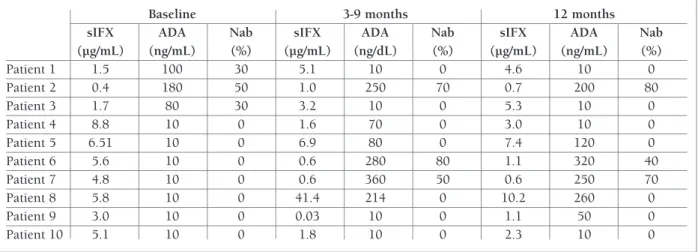
Ten patients changed the ADA status (i.e. negative to positive or vice versa) during follow-up (Table VI). Of them, 3 patients (14.3%) (patient 1, 2 and 3) had de-tectable ADA at baseline with low sIFX levels. After switching, ADA became negative in two of those pa-tients (patient 1 and 3) with normalization of sIFX and no variation in disease activity was observed. Patient 2 maintained detectable ADA levels after switch with per-sistently low sIFX. This patient showed ≥50% of neu-tralizing activity in all ADA measurements and had an elevation of DAS28 (Δ 1.63), based only in PtGA. We have not observed differences in ADA relative to total IgG1, IgG1-lambda and IgG4 in patient 2.
Three-to-nine months after switch, ADAs became detectable in 5 patients (11.9%) (Patient 4, 5, 6, 7 and 8), and 2 of them tested positive for nAb (patient 6 and 7). At the 12 months’ evaluation, 4 of these 5 patients maintained detectable ADA levels (patient 5, 6, 7 and 8), and nAb remains positive in the same two patients. We have not observed differences in ADA relative to total IgG1, IgG1-lambda and IgG4 in these 4 patients with persistent immunogenic response. Of these 5 pa-tAblE Iv. bAsElInE chArActErIstIcs of pAtIEnts swItchEd to bIosImIlAr InflIxImAb (ct-p13) who hAd blood sAmplEs AvAIlAblE bEforE And AftEr swItch
RA (n=13) PsA (n=2) SpA (n=27) Total (n=42)
Age, years* 57.6 52.4 52.8 53.4
(51.07-65.44) (49.56 - 55.29) (43.38-58.18) (44.9-60.83)
Male gender, n (%) 2 (15.4%) 2 (100%) 21 (77.8%) 25 (59.5%)
Concomitant methotrexate therapy, n (%) 12 (92.3%) 2 (100%) 18 (66.6%) 32 (76.2%)
Disease duration, years* 17.7 21.9 17.9 18
(13.4-23.4) (21.7 - 22.2) (11- 22.4) (11.7-22.5)
Duration of IFX originator treatment before 8.0 9.1 8.1 8.1
switch (years)*# (5.8 - 16.6) (7.8-10.3) (0.2-15.5) (0.2 - 16.6)
IFX dose/infusion, mg*# 243 340 325 264
(189-282) (297-383) (252-395) (189-395)
IFX treatment interval, weeks*# 7 (6-8) 8 (8-8) 8 (7 -10) 8 (6 - 10)
DAS 28 baseline * 2.63 1.173 – –
(1.66-3.48) (1.095-1.252)
ASDAS baseline * – – 1.5 –
(1.1-2.1)
ASDAS: Ankylosing Spondylitis Disease Activity Score; DAS28: Disease Activity Score in 28 joints (DAS28 4V[CRP]); IFX: Infliximab; PsA: Psoriatic Arthritis; RA: Rheumatoid Arthritis; SpA: Spondyloarthritis;
tients, sIFX changed from high to low concentration accompanied by an elevation of ASDAS (Δ 0.6, Δ 1.9 and Δ 0.6) in 3 patients at the 3-9 months’ evaluation period (patient 4, 6 and 7). Two of these patients (pa-tient 6 and 7) presented low sIFX at the 12 months’ evaluation. The other 2 patients (patient 5 and 8) main-tained ADA levels detectable with high sIFX during the evaluation period. These patients had no detectable neutralizing ADA.
Two patients (patient 9 and 10) had normal sIFX and no detectable ADA at baseline. The sIFX levels changed from high to low concentration after switch, with no detectable ADA in patient 10 and detectable ADA in patient 9 at the 12 months’ evaluation.
Apart from patients that developed ADAs, no other patients changed from high to low concentration of sIFX.
Patients 2, 6 and 7 who showed detectable ADA le -vels with low sIFX had to postpone treatment with CT-P13 due to infection (second infusion after switch, conditioning the 3-9 month evaluation) and were maintained without concomitant MTX therapy. No nAb were detected in the two patients (patient 5 and 8) who had detectable ADA levels and high sIFX levels.
The switch to CT-P13 represented a 26.4% reduc-tion of the IFX therapy costs in these patients. Figure 1 depicts the progressive switch to CT-P13 and the de-crease in cost over the period of the study considering a similar number of treated patients and of the doses used. After the switch to CT-P13, there was a reduction of vial costs of infliximab (342€ to 252€). Additional-ly, the total number of vials used per treatment was slightly reduced from the third trimester of 2016 until the fourth trimester of 2017. This was due to the cen-tralized preparation of the biosimilar of infliximab (at Hospital Pharmacy). Overall there was a cost reduction of 79 765€ (193 749€ to 113 984€) over a period of one year, from the 3rdtrimester of 2016 to the fourth
trimester of 2017.
dIscussIon
The experience with the non-medical switch of CT-P13 has been documented in several clinical studies, such as NOR-SWITCH, PLANETRA (Program evaLuating the Autoimmune Dosease iNvEstigational Drug cT-p13 in RA patients), PLANETAS (Program evaLuating the Autoimmuct-ne Disease iNvEstigational Drug in AS pa-tients) and DANBIO registry11–14. NOR-SWITCH was
tA b lE v . A d A A n d s If x c o n cE n tr A tI o n A t b A sE lI n E A n d A ft Er s w It ch R A ( n = 1 3 ) P sA ( n = 2 ) S p A ( n = 2 7 ) T o ta l (n = 4 2 ) A ft er A ft er A ft er A ft er A ft er A ft er A ft er A ft er sw it ch sw it ch sw it ch sw it ch sw it ch sw it ch sw it ch sw it ch B as el in e (3 -9 m ) (≥ 1 2 m ) B as el in e (3 -9 m ) (≥ 1 2 m ) B as el in e (3 -9 m ) (≥ 1 2 m ) B as el in e (3 -9 m ) (≥ 1 2 m ) IF X s er u m 1 1 .5 ( 9 .7 ) 9 .6 ( 8 .9 ) 7 .4 ( 4 .2 ) 6 .9 ( 2 .3 ) 6 .7 ( 2 .3 ) 6 .7 ( 1 .8 ) 6 .1 ( 3 .9 ) 6 .2 ( 8 .1 ) 5 .4 ( 3 .7 ) 7 .6 ( 6 .8 ) 7 .9 ( 8 .9 ) 6 .1 ( 3 .9 ) co n ce n tr at io n * (µ g /m L ) P o si ti v e A D A , 2 /1 3 1 /1 3 1 /1 3 0 /2 0 /2 0 /2 1 /2 7 5 /2 7 5 /2 7 3 /4 2 6 /4 2 6 /4 2 n /t o ta l A D A : A n ti -d ru g a n ti b o d y ; IF X : In fl ix im ab ; P sA : P so ri at ic A rt h ri ti s; R A : R h eu m at o id A rt h ri ti s; S p A : S p o n d y lo ar th ri ti s; m : m o n th s. * m ea n v al u es ( S D )
the first randomized trial to show non-inferiority of switching to CT-P13 compared to continued treatment with the originator drug. The trial included 481 pa-tients with different conditions of whom 198 papa-tients had rheumatic diseases11.
In our study, during the 12 months after the switch there were no significant variations in disease activity scores. This was similar to the non-significant va riations observed during the first 12 months before switch. These results are in accordance with the results of these
previous publications showing that mean DAS28 and ASDAS remained stable during follow-up and no ma-jor concerns were raised about CT-P13 safety.
The 2 patients who stopped CT-P13 due to joint symptoms showed minor variations in disease activity scores, suggesting a ‘nocebo-effect’ to the switch, which represents a negative outcome due to negative expec-tations towards the drug. This observation was also demonstrated in other studies, like the one reported by the DANBIO registry. In this latter study the
reten-Trimester 3, reten-Trimester 4, reten-Trimester 1, reten-Trimester 2, reten-Trimester 3, reten-Trimester 4, 2016 2016 2017 2017 2017 2017
Biosimilar
Reference product Price/Vale 100mgConsume
100% 90% 80% 70% 60% 50% DD D% 40% 30% 20% 10% 0% M ed ia n HS P Trimester 3, 2016 Trimester 2, 2017 Trimester 3, 2017 Trimester 4, 2017 Trimester 4, 2016 Trimester 1, 2017 €250,000 €200,000 €150,000 €100,000 €50,000 €400 €350 €300 €250 €200 €150 €100 €50
fIgurE 1. Increase use of CT-P13 during 3rdtrimester of 2016 and 4thtrimester of 2017, and the respective reduction of costs.
tAblE vI. pAtIEnts showIng vArIAtIon In AdA And sIfx concEntrAtIon At bAsElInE And AftEr swItch
Baseline 3-9 months 12 months
sIFX ADA Nab sIFX ADA Nab sIFX ADA Nab
(µg/mL) (ng/mL) (%) (µg/mL) (ng/dL) (%) (µg/mL) (ng/mL) (%) Patient 1 1.5 100 30 5.1 10 0 4.6 10 0 Patient 2 0.4 180 50 1.0 250 70 0.7 200 80 Patient 3 1.7 80 30 3.2 10 0 5.3 10 0 Patient 4 8.8 10 0 1.6 70 0 3.0 10 0 Patient 5 6.51 10 0 6.9 80 0 7.4 120 0 Patient 6 5.6 10 0 0.6 280 80 1.1 320 40 Patient 7 4.8 10 0 0.6 360 50 0.6 250 70 Patient 8 5.8 10 0 41.4 214 0 10.2 260 0 Patient 9 3.0 10 0 0.03 10 0 1.1 50 0 Patient 10 5.1 10 0 1.8 10 0 2.3 10 0
patients may inhibit or reduce the pharmacological ac-tivity of sIFX, and consistent with that these patients presented elevation of DAS28 and ASDAS. The patient who maintained detectable ADA levels, with sIFX >3 µg/mL before and after switch, did not show the pres-ence of nAb and consequently had no alteration in pharmacological activity of sIFX. Moreover, patients who maintained ADA after switch did not show diffe -rences in the amount of IgG1-lambda or IgG4, which may indicate that the transition from IFXor to CT-P13 did not alter the immunogenic status of the patients.
The interpretation of these results have some limi-tations, including missing data due to the observational study design. In addition, the study has a relatively short follow up duration and has a small sample size. The unblinded observational nature of the study and the absence of a non-switch control arm created diffi-culties in the interpretation of the reasons for patients withdrawal. This was partially compensated by the ob-servation of the same cohort during the preceding year, which showed equivalent disease activity fluctuation and also the same number of withdrawals. Finally, as already mentioned, some characteristics of the patients who withdrawal after switch suggest a nocebo effect, which is clearly difficult to prove and related to the in-herent subjective margin existing in this type of stu dies.
conclusIon
In conclusion, this study reinforces that the real-life switch from IFXor to CT-P13 does not affect efficacy, safety or immunogenicity1,2,4. The switch from IFXor
to CT-P13 promoted a cost reduction of 26.4%. corrEspondEncE to
Ana Antunes Valido
Serviço de Reumatologia e Doenças Ósseas Metabólicas Hospital de Santa Maria, CHLN
Lisboa, Portugal
E-mail: [email protected] rEfErEncEs
1. Araújo FC, Cordeiro I, Teixeira F, Gonçalves J, Fonseca JE. Phar-macology of biosimilar candidate drugs in rheumatology: a lit-erature review. [Internet]. [cited 2019 Jun 4]. Available from: https://www.ncbi.nlm.nih.gov/pubmed/24811458
2. Araújo FC, Gonçalves J, Fonseca JE. Biosimilar DMARDs: What Does the Future Hold? Drugs. 2016 Apr;76(6):629–637. 3. Araújo FC, Gonçalves J, Fonseca JE. Pharmacoeconomics of
Biosimilars: What Is There to Gain from Them? - [Internet]. [cited 2019 Jun 4]. Available from: https://www.ncbi.nlm. nih.gov/pubmed/27402107
tion rate was slightly lower in the CT-P13 cohort ver-sus the historic IFXor cohort. The authors considered that this difference was probably related to a ‘nocebo-effect’12,15.
Only one patient developed an adverse event lead-ing to treatment withdrawal and no other adverse events were reported. These results are in line with those from earlier observational studies and reinforces that switching to CT-P13 is not associated with any safety concerns.
In our study the switch to a biosimilar drug reduced the financial burden of treating patients with inflam-matory arthritis (cost saving of 26.4%), similarly to what has been reported in previous studies such as the NOR-SWITCH (cost saving of 39%)11.
Some patients refused to collect blood samples for the study, so we had only paired samples from 42 pa-tients, representing 70% of switchers. Patients who had received originator IFXor and switched to CT-P13 had only minor and non-significant changes in sIFX and ADA levels after switch. The observed changes were not associated with higher disease activity and did not lead to withdrawal of IFX therapy. Only one patient withdrew from IFX treatment without showing varia-tions in sIFX or ADA levels. These results are in agree-ment with findings from the NOR-SWITCH trial and with the 2-year extension phases of the PLANETRA and PLANETAS trials, which exhibited similar sIFX and ADA levels in the maintenance and switch groups13,14,16.
These observations were reproduced in other studies assessing inflammatory bowel disease patients17–19.
Patients with detectable ADA and low sIFX levels who changed to non-detectable ADA, with normaliza-tion of sIFX (CT-P13), had no varianormaliza-tion in disease ac-tivity. These patients probably developed low affinity transient ADA, which justifies a subsequent normal-ization of the serum drug concentration values. The in-verse correlation between ADA levels and sIFX has been previously shown in many studies and has been associated with decreased clinical efficacy when nAb are present6.
Patients who maintained detectable ADA levels (with nAb ≥50%) in all measurements before and after switch with persistent low sIFX, were patients who postponed treatment with CT-P13 due to infection. In addition, these patients were not on concomitant MTX therapy, which has been described to prevent ADA for-mation. The need to postpone treatment is a favorable condition to develop immunogenicity, which probably occurred in these patients. The presence of nAb in these
4. Araújo FC, Sepriano A, Teixeira F, Jesus D, Rocha TM, Fonseca JE. The Portuguese Society of Rheumatology position paper on the use of biosimilars - 2017 update. Acta Reumatol Port. 2017 Sep;42(3):219–228.
5. Fonseca JE, Gonçalves J, Araújo FC, Cordeiro I, Teixeira F, Can-hão H. The Portuguese Society of Rheumatology position paper on the use of biosimilars. Acta Reumatol Port. 2014 Mar;39(1):60–71.
6. Pratt KP. Anti-Drug Antibodies: Emerging Approaches to Pre-dict, Reduce or Reverse Biotherapeutic Immunogenicity. Anti-bodies. 2018 Jun;7(2):19.
7. Shankar G, Arkin S, Cocea L, Devanarayan V, Kirshner S, Krom-minga A. Assessment and reporting of the clinical immuno-genicity of therapeutic proteins and peptides-harmonized ter-minology and tactical recommendations. AAPS J. 2014 Jul;16(4):658–673.
8. Moots RJ, Xavier RM, Mok CC, Rahman MU, Tsai W-C, Al-Mai-ni MH, et al. The impact of anti-drug antibodies on drug con-centrations and clinical outcomes in rheumatoid arthritis pa-tients treated with adalimumab, etanercept, or infliximab: Results from a multinational, real-world clinical practice, non-interventional study. PLoS ONE. 2017;12(4):e0175207. 9. Gonçalves J, Araújo FC, Cutolo M, Fonseca JE. Biosimilar
mon-oclonal antibodies: preclinical and clinical development aspects [Internet]. Clin Exp Rheumatol. [cited 2019 Jun 5]. Available from: https://www.clinexprheumatol.org/abstract.asp?a=10305 10. Canhão H, Faustino A, Martins F, Fonseca JE, Rheumatic Dis-eases Portuguese Register Board Coordination, Portuguese So-ciety of Rheumatology. Reuma.pt - the rheumatic diseases por-tuguese register. Acta Reumatol Port. 2011 Mar;36(1):45–56. 11. Jørgensen KK, Olsen IC, Goll GL, Lorentzen M, Bolstad N, Haavardsholm EA, et al. Switching from originator infliximab to biosimilar CT-P13 compared with maintained treatment with originator infliximab (NOR-SWITCH): a 52-week, randomised, double-blind, non-inferiority trial. Lancet. 2017 10;389 (10086):2304–2316.
12. Glintborg B, Sørensen IJ, Loft AG, Lindegaard H, Linauskas A, Hendricks O. A nationwide non-medical switch from origina-tor infliximab to biosimilar CT-P13 in 802 patients with
in-flammatory arthritis: 1-year clinical outcomes from the DAN-BIO registry. Ann Rheum Dis. 2017 Aug;76(8):1426–1431. 13. Park W, Yoo DH, Miranda P, Brzosko M, Wiland P,
Gutierrez--Ureña S, et al. Efficacy and safety of switching from reference infliximab to CT-P13 compared with maintenance of CT-P13 in ankylosing spondylitis: 102-week data from the PLANETAS extension study. Ann Rheum Dis. 2017 Feb;76(2):346–354. 14. Yoo DH, Prodanovic N, Jaworski J, Miranda P, Ramiterre E,
Lan-zon A. Efficacy and safety of CT-P13 (biosimilar infliximab) in patients with rheumatoid arthritis: comparison between switch-ing from reference infliximab to CT-P13 and continuswitch-ing CT-P13 in the PLANETRA extension study. Ann Rheum Dis. 2017 Feb;76(2):355–363.
15. Nikiphorou E, Kautiainen H, Hannonen P, Asikainen J, Kokko A, Rannio T, et al. Clinical effectiveness of CT-P13 (Infliximab biosimilar) used as a switch from Remicade (infliximab) in pa-tients with established rheumatic disease. Report of clinical ex-perience based on prospective observational data. Expert Opin Biol Ther. 2015;15(12):1677–1683.
16. Reinisch W, Jahnsen J, Schreiber S, Danese S, Panés J, Balsa A, et al. Evaluation of the Cross-reactivity of Antidrug Antibodies to CT-P13 and Infliximab Reference Product (Remicade): An Analysis Using Immunoassays Tagged with Both Agents. Bio-Drugs. 2017 Jun;31(3):223–237.
17. Bronswijk M, Moens A, Lenfant M, Tops S, Compernolle G, Van Assche G, et al. Evaluating Efficacy, Safety, and Pharmacokine -tics After Switching From Infliximab Originator to Biosimilar CT-P13: Experience From a Large Tertiary Referral Center. In-flamm Bowel Dis. 2019 Aug 10;
18. Chaparro M, Garre A, Guerra Veloz MF, Vázquez Morón JM, De Castro ML, Leo E, et al. Effectiveness and Safety of the Switch from Remicade® to CT-P13 in Patients with Inflammatory Bow-el Disease. J Crohns Colitis. 2019 Oct 28;13(11):1380–1386. 19. Smits LJT, van Esch AAJ, Derikx LAAP, Boshuizen R, de Jong DJ, Drenth JPH, et al. Drug Survival and Immunogenicity After Switching From Remicade to Biosimilar CT-P13 in Inflamma-tory Bowel Disease Patients: Two-year Follow-up of a Prospec-tive Observational Cohort Study. Inflamm Bowel Dis. 2019 01;25(1):172–179.