ARTIGO DE REVISÃO
AbstrAct
Introduction: The present article reviews findings from empirical evaluations of integrated disease management programmes. The objective is to provide insights on integration levels, priority interventions and their effect on patient outcomes.
Material and Methods: The literature review identified 1 251 articles, published from 2006 to 2011. Upon a detailed screening 61 articles were selected for bibliometric analysis and critical discussion.
results: Among several findings, it can be noted that United States of America is the country with the highest amount of published evidence on the subject under study. The most frequently referred disease is diabetes mellitus and the main reported issue of integrated disease management is self-management support. The majority of the studies were developed and exclusively managed by managed care organizations, organized family doctors or hospitals. From a total of 360 interventions reported in studies, patient interventions are the most frequently used across all disease groups, followed by professional interventions. To monitor the effectiveness of the disease programmes, the most frequently used outcomes are patient physiological measures, service use and patient health status.
Discussion: Every country has its own way to implement the integrated disease management strategy. The focus of practice lies on patient empowerment, particularly through self-management. Physiological measures and service use are the outcomes with the high-est rate of assessment, which are also the indicators that show higher impact among all integrated disease management programmes. conclusion: The Portuguese health care system still faces challenges in the coordination and integration of care for patients with chronic disease thus improvements at integrated disease management programmes should be incorporate.
Keywords: Case Management; Chronic disease; Delivery of Health Care, Integrated; Disease Management; Portugal.
Integrated Disease Management: A critical
review of Foreign and Portuguese
Experience
Gestão Integrada da Doença: revisão crítica das Experiências
Estrangeiras e Portuguesa
1. Division of Health Quality Management. Department of Quality in Health. Directorate-General of Health. Minister of Health. Lisbon. Portugal. 2. Centre for Malaria and other Tropical Diseases. Instituto de Higiene e Medicina Tropical. Universidade Nova de Lisboa. Lisbon. Portugal. 3. Central Administration of the Health System. Lisbon. Portugal.
4. National School of Public Health.Universidade Nova de Lisboa. Lisbon. Portugal.
Recebido: 19 de Agosto de 2013 - Aceite: 06 de Fevereiro de 2014 | Copyright © Ordem dos Médicos 2014
Anabela COELHO1, Cláudia LEONE2, Vanessa RIBEIRO3, Pedro SÁ MOREIRA4, Gilles DUSSAULT2
Acta Med Port 2014 Jan-Feb;27(1):116-125
rEsUMO
Introdução: O artigo faz uma revisão de literatura sobre os programas de gestão integrada da doença, apresentando resultados sobre o nível de integração dos cuidados, as intervenções prioritárias utilizadas nos programas e o seu efeito, nomeadamente, nos doentes. Material e Métodos: A revisão de literatura identificou 1 251 artigos, publicados entre 2006 e 2011. Depois de uma criteriosa seleção identificaram-se para a análise bibliométrica e discussão crítica, 61 artigos.
resultados: Realçamos o facto de serem os Estados Unidos da América o país que mais publica sobre esta matéria; A doença mais reportada é a diabetes mellitus e o domínio de intervenção da gestão integrada da doença, predominante, é o ‘apoio ao auto-cuidado’. A maioria dos estudos foram implementados por managed care organizations, médicos de medicina geral e familiar organizados para o efeito ou hospitais. Das 360 intervenções reportadas, as mais utilizadas são as dirigidas aos doentes e aos profissionais. Os resul-tados mais observados nos doentes, aquando da monitorização dos programas, são: resposta clínica, utilização de serviços e estado de saúde.
Discussão: Cada país tem a sua própria forma de implementar a estratégia de gestão integrada da doença. O foco de atenção da prática clínica é o empoderamento dos doentes, particularmente através da promoção da auto-gestão. Os resultados clínicos e os de utilização dos serviços para além de serem os mais utilizados, são também, aqueles com maior impacto nos programas de gestão integrada da doença.
conclusão: O sistema de saúde Português ainda enfrenta sérios desafios no tocante à coordenação e integração de cuidados dirigi-dos à pessoa com doença crónica pelo que se sugere a atualização do programa.
Palavras-chave: Doença Crónica; Gestão de Caso; Gestão da Doença; Portugal; Prestação Integrada de Cuidados de Saúde.
INtrODUctION
This article reviews findings from empirical evaluations of integrated disease management (IDM) programmes. The aim was to describe the integration levels, identify the most frequent interventions and outcomes and to synthesise knowledge about their implementation and performance. The article focuses on discussing the documented good practices in the international literature that could improve the IDM Portuguese model implemented in 2008.
The article starts with a brief description of the most
re-cent developments and the context of IDM programmes; then the results of the literature search conducted in 2011 are presented; and finally, the evidence is synthesised in or-der to identify lessons that can be learned from international experiences.
context
Chronic Disease Management (CDM) initiatives were originally developed in the United States (USA) in line with
35
35 ano s a p rom ov er as ciê CA P ORT UGUE SA 1979 - 2014ARTIGO DE REVISÃO
Revista Científica da Ordem dos Médicos www.actamedicaportuguesa.com 117 anos
35
35 ano s a p rom ov er as ciê ncia s bio méd ica s A CT A MÉ DI CA P ORT UGUE SA 1979 - 2014the recommendation of Centers for Disease Control and Prevention, which state that the health care system should target diseases where effective public health preventive strategies exist, or are the subject of promising research.1
CDM programmes aim to enable health care systems to be more supportive to patient-provider interactions,2 to improve
overall health status and to reduce healthcare costs gene-rated by chronic conditions.
In 2012, the European Commission encouraged the replication of CDM models through an integrated care methodology known to improve the quality and accessibility of care to patients with a chronic condition (Opening speech on the European Year for Active Ageing and Solidarity be-tween Generations, January 18, 2012 by Dalli J). In order to reduce deficiencies such as inadequate care transitions, inefficient information flow between different levels of care and low patient engagement,3 several European countries
have, also, moved in that direction.4 In the case of Portugal,
a national CDM project named Integrated Disease Manage-ment (IDM) was launched in 2008, endorsed by the Ministry of Health. The introduction of the concept of integration was proposed as an alternative to fragmentation, duplication and inefficient use of resources in chronic disease manage-ment.5
The development of an IDM model became the main chronic disease strategy and decision-making tool in clinical management. It was perceived as a quality-driven approach to lead the reorganization of the Portuguese healthcare de-livery structure6 and to rationalize service provision to
im-prove productivity, quality and price control.7,8
In the context of great economic restraint this initiative increased the responsibility of patients (as self managers), providers (as clinical managers) and policy makers (as regulatory managers) involved in all phases of chronic di-seases.6
The Ministry of Health regulates health care delivery through a national online data base of patient’s records, in-cluded in all IMD programmes, together with a set of clinical guidelines and auditing practices. This online system is an important tool for the follow-up of patients, the monitoring of quality of care, as well as the motoring of the epidemiologi-cal evolution of the disease.6
One of the key and most innovative components of this program was the introduction of a funding model, similar to ‘pay for performance’, in which providers receive a lump sum per patient if they achieve some performance targets. Expected results are risk sharing with providers, patient-centred care practices, coordination of care, population risk stratification and the implementation of a direct relationship between funding and quality and safety clinical parameters.6
Analytical Framework
In many countries the coordination and integration of care remains a major challenges.3 In the literature there is
no formal or consensual definition of integration of care. In non English-speaking countries the different concepts to describe integrated care are even more diverse.9 For the
purpose of this review, Curry and Ham´s5 definition and
classification was used: “integration is concerned with the processes of bringing organizations and professionals to-gether, with the aim of improving outcomes for patients and service users through the delivery of integrated care”. Several countries have adapted IDM programmes to their own health care systems.4 However, for the purpose of
the present study, programmes were classified through the Chronic Care Model (CCM) conceptual framework. The six essential and interrelated elements of the CCM2 are:
− Delivery System Design - A clear division of multi-professional labour, separating the acute from the programmed care, in order to support process and structures through an effective patient care.
− Self-management Support - Collaborative strategies from education to support services based on self- -management principles, in a variety of formats that help patients and their families to acquire the skills to ma-nage their condition.
− Decision Support - Integration of evidence based clinical guidelines into practice, reminder systems, continuing medical education and inter-provider communications. − Clinical Information Systems - Availability and
comphensiveness of clinical data during patient visits with re-minder system to improve compliance with guidelines, performance measures and planning of care.
− Community Resources - Link with community based resources (hospitals, home care agencies, self help groups and senior homes).
− Health Care Organization - changes at the larger organi-zational level, from structure, goals to values improved by a strong leadership.
Interventions described in the reviewed articles were also classified according to the Cochrane Effective Practice and Organization of Care (EPOC) taxonomy10 (Appendix 1),
considering whether they were organizational, professional, regulatory or financial interventions. The item ‘patient inter-ventions’ was also included in the present study to encom-pass interventions related with the following: distribution of educational materials, education sessions, reminders, etc. Patient outcomes and other results were classified using the approach proposed by Zwar et al11: professional
adherence to guidelines; patient adherence to treatment; patient health service use; patient physiological measure of disease; patient risk behavior; patient quality of life; patient health status; patient functional status; patient satisfaction. Two additional itens were added: ‘patient education’ and ‘costs’.
MAtErIAL AND MEtHODs
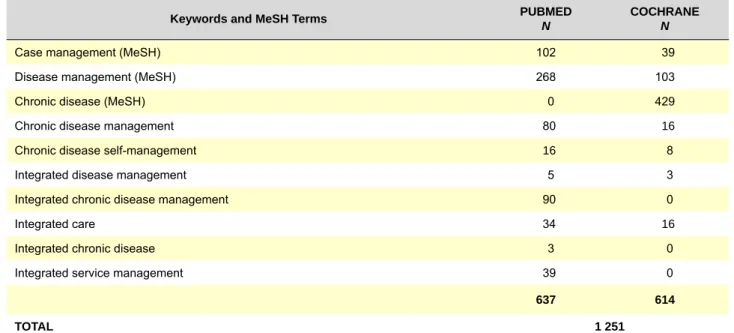
In 2011, a literature search in both Medline and Cochrane databases was undertaken to identify documents published on IDM, between January 2006 to end of June 2011. We used keywords and Medical Subject Headings (MeSH) descriptors (Table 1) associated them with the following diseases: ‘chronic kidney failure, multiple sclerosis, obesity, pulmonary hypertension, diabetes
ARTIGO DE REVISÃO
1 251 papers
23 707 papers were automaticly excluded when we cross search with chronic diseases 24 958 papers were identified by searching Pubmed in
MEDLINE and Cochrane , using textual terms and MeSH headings from 2006 to 2011.
523 papers were duplicated 502 papers
337 papers included in this review
119 papers reviewed and classified into a single
descriptor
Exclusion Criteria
621 papers
88 papers with Macro interventions 145 papers with Meso
interventions 104 papers with Micro
interventions
284 papers were excluded because full-text was not available (to clarify any doubts) or were not in the selected language or not pertaining to disease
management.
404 papers were excluded because
they were in both research database
27 papers did not report interventions, did not meet inclusion criteria or wasn't
collect
61 papers were included for detailed analysis
1 025 papers were selected
226 papers were excluded because title doesn’t pertain the study issue or abstracts
were not available
ARTIGO DE REVISÃO
Revista Científica da Ordem dos Médicos www.actamedicaportuguesa.com 119
mellitus, asthma, chronic obstructive pulmonary disease, heart failure, coronary disease and arterial hypertension’. This selection corresponded to the health profile of Portugal at the time the IDM programme was developed in 2008 and to the results of a Delphi survey, conducted in 2009 by the Diretorate-General of Health to identify diseases which had a stronger impact in the health care system.12
Inclusion criteria were: 1) publications in English, French, Spanish or Portuguese; 2) about diseases in hu-man beings; 3) covering populations aged over 19 with one or more of the above-mentioned diseases.
Articles were classified according to the three areas of coverage considered in the integration level category: ‘macro’, ‘meso’ or ‘micro’. The review focused on evidence of lessons useful to informing policy at national level, and therefore, only the full text studies under the ‘macro’
dimen-sion were included in the analysis.
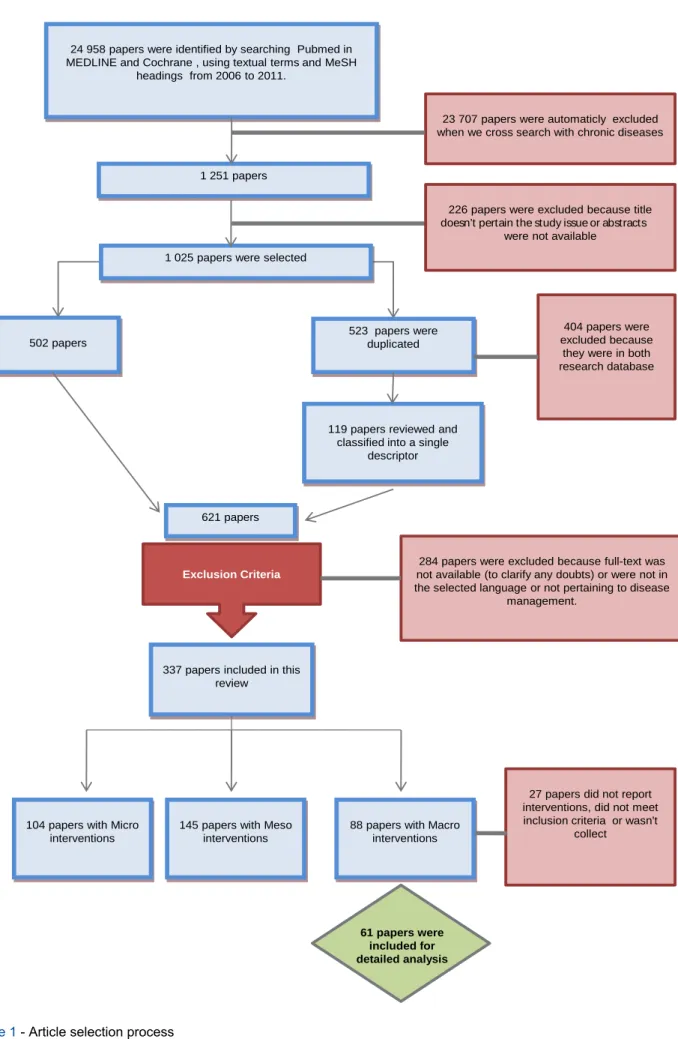
We excluded documents consisting a study of one or two patients or which did not describe specific interventions. Fig.1 details the steps in the identification of the articles and the number excluded at each stage.
Data was extracted and introduced directly into an ‘Excel’ database by a researcher and reviewed by a second one. All disagreements were resolved through discussion and consensus within the research team.
All articles retrieved (N = 61) were grouped according to the CCM main focus using Wagner et al’s definition.2
Inter-ventions were classified according to the EPOC taxonomy10
and results were classified using the approach proposed by Zwar et al.11
Overall results were discussed considering the Portu-guese experience as a benchmark.
Table 2 - Number of studies per disease and percent with statistically significant improvements
Diseases N * studies with documented outcomes‡ studies with statistically significant improvements§ % of Effective studies Diabetes Mellitus 31 29 26 90% Multiple Diseases 16 15 12 80% Asthma 4 4 4 100% Coronary disease 4 3 3 100%
Chronic obstructive pulmonary disease 3 3 2 67%
Heart failure 2 2 1 50%
Chronic kidney failure 1 1 1 100%
total 61 58 49 84%
*Number of studies included in the review per disease;‡ Number of studies with documented outcomes per disease; §Number of studies with statistically significant improvements per disease.
Table 1 - Keywords and MeSH Terms used in the review
Keywords and MesH terms PUbMEDN cOcHrANEN
Case management (MeSH) 102 39
Disease management (MeSH) 268 103
Chronic disease (MeSH) 0 429
Chronic disease management 80 16
Chronic disease self-management 16 8
Integrated disease management 5 3
Integrated chronic disease management 90 0
Integrated care 34 16
Integrated chronic disease 3 0
Integrated service management 39 0
637 614
ARTIGO DE REVISÃO rEsULts
The initial search identified 1 251 articles, of which 621 were retained after an initial screening. After the exclusion of duplicates, this number fell to 337 articles. Articles on the ‘Macro’ dimension (N = 88) were extracted by one investiga-tor and checked by a second one. Only the 61 full text stu- dies under the ‘macro’ dimension were selected for analysis. Data was first characterized according to the main bibli-ometric components. Programmes were then characterized according to their integration level, CCM elements, IDM in-tervention using the EPOC taxonomy and finally according to their outcomes and effectiveness.
Supplementary material is available for more detailed information about the results (Synthesis of Results in Appendix 2).
bibliometric approach
72% of total articles (n = 44) were identified in Med-line (PubMed), 10% (n = 6) in Cochrane Database of Sys-tematic Reviews and 18% (n = 11) were found in both of databases. All articles were in English; 51% had diabetes mellitus as the key disease-focus, followed by asthma and coronary disease (Table 2). 52% of the articles (n = 32) pre-sented studies were conducted in the USA; other studies were from the Netherlands, the United Kingdom, Germany and Australia; none referred Portugal.
Classification identified 15 studies as ‘research support’, 12 as ‘randomized controlled trials’, nine as ‘evaluation stu-dies’, eight as comparative studies and 17 were classified in ca-tegories such as ‘review’ (n = 3), ‘controlled clinical trial’ (n = 3), ‘cohort study’ (n = 3), ‘quasi-experimental design’ (n = 2), ‘case study’ (n = 2), ‘multicenter study’ (n = 1) and ‘meta-analysis’ (n = 1).
‘Population Health Management’ published six articles, ‘The American Journal of Managed Care’ four, ‘BMC Health Services Research’, ‘Diabetes care’ and ‘Medical Care’ three each.
Integration Level
Of the 61 articles classified as ‘macro’ interventions, 25 were implemented by managed care organizations (19 in USA and 2 in Germany), 22 by organized groups of fa- mily doctors, e.g. GP’s (6 in USA, 4 in the Netherlands and 3 in UK and 3 in Australia); and the other 10 by hospitals specifically organized to respond to disease management challenges.
Four articles described IDM programmes developed in the context of primary health care settings in collaboration with hospitals or managed care organizations; two in USA and one in the Netherlands and the United Kingdom.
ccM Elements
At least two or more CCM elements were described in 56% of the studies (n = 34), with multiple combinations be-tween them. In order to facilitate the analysis, the predomi-nant CCM element was identified and articles were classi-fied accordingly. Further categorization allowed to identify 19 studies as self-management support, 15 as health care organization, 11 as delivery system design, 11 as decision support and 4 as clinical information system.
As regards programme effectiveness, 58 studies pre-sented improvements and in 49 of them these were con-sidered statistically significant (Table 3). ‘Self-management support’ and ‘health care organizations’ were the two CCM elements with a higher number of IDM interventions and a higher number of studies reporting statistically significant improvements (16 of a total of 19 and 13 of a total of 14 articles respectively).
As far as IDM programmes are concerned, 29 of them focused on Diabetes Mellitus, with 26 reporting statistically significant improvements (Table 2). There was only one study about obesity and it didn´t report any improvements.
IDM Interventions
From a total of 360 IDM interventions, the most frequent Table 3 - Number of EPOC interventions per CCM elements and percent with statistically significant improvements per disease
ccM Elements Interventions (N)EPOc * documented studieswith outcomes (N)‡ studies with statistically significant improvements§ % of Effective studies
Clinical information system 10 4 4 100%
Decision support 39 10 8 80%
Delivery system design 93 10 7 70%
Health care organisation 86 14 13 93%
Self management support 128 19 16 84%
Community Resources 0 0 0 0
Not applicable 4 1 1 100%
total 360 58 49 84%
*Number of EPOC interventions identidied per CCM elementes; ‡ Number of studies with documented outcomes per CCM elementes; § Number of studies with statistically significant
ARTIGO DE REVISÃO
Revista Científica da Ordem dos Médicos www.actamedicaportuguesa.com 121
Table 4 - IDM Interventions classified according to the EPOC Taxonomy (N)
IDM Interventions by EPOc taxonomy N
Patient interventions (N = 110)
Self management 26
Education sessions 25
Distribution of educational materials 23
Call back reminder notice 17
Motivational counselling 12
Brief intervention 7
Community programmes 3
Professional interventions (N = 105)
Audit and feedback 25
Distribution of educational materials 24
Educational meetings 21
Educational outreach visits 10
Reminders 10
Patient mediated interventions 9
Local consensus processes 3
Local opinion leaders 3
Other 1
Organisational interventions (N = 63)
Revision of professional roles 7
Clinical multidisciplinary teams 21
Formal integration of services 1
Skill mix changes 3
Continuity of care 16
Communication and case discussion between distant health professionals 5
Other proveder oriented intervention 2
Presence and functioning of adequate mechanisms for dealing with patients’
suggestions and complaints 2
Other patient oriented intervention 6
Structural interventions (N = 58)
Changes to the setting/site of service delivery 13
Changes in physical structure, facilities and equipment 6
Changes in medical records systems 11
Changes in scope and nature of benefits and services 11
Presence and organisation of quality monitoring mechanisms 11
Ownership, accreditation, and affiliation status of hospitals and other facilities 1
Staff organization 5
Financial interventions (N = 19)
Fee-for-service 2
Capitation 2
Provider salaried service 1
Provider incentives 6
Institution incentives 1
Institution grant/allowance 1
Other (p4p) 4
Other Patient financial interventions 2
Regulatory interventions (N = 5)
Changes in medical liability 3
Management of patient complaints 2
ARTIGO DE REVISÃO
across all the disease groups were ‘patient interventions’ and ‘professional interventions’ (Table 4).
Among the former, the most frequent were:
- Self management (Supermarket tours and cooking
classes, Training with life coach; Self-management
group training program; Self-care initiatives led by care managers);
- Education sessions (Informal and formal education ses-sions; Periodic educational mailings);
- Distribution of educational materials (Educational book/ manual or booklet; Videocassette; Training devices, ie blood pressure and glucose monitoring tools; Self-ma-nagement guidelines; Action plan);
- Reminder notice (Reminders for medication compliance
and vaccination; Reminder calls and text message; Telephone appointment reminders).
Among the latter, the most frequent interventions were: - Audit and feedback (Monitorization of indicators/stan-dards of process and outcomes; Quality audit; Moni-torization of guidelines accomplishment; Computerized/ Web based decision support system, Notification of gaps between patient-reported practice and guideline recommendations);
- Distribution of educational materials (Therapeutic pro-tocols; Clinical management guidelines; Guidance on implementing standards of care);
- Educational meetings (Periodic fora, courses, work-shops; Training for nurses and GP’s about chronic diseases and lifestyles; Conference calls with collabora-tive leaders).
Measuring intervention Outcomes
The most common health outcomes used to monitor the IDM programmes were (Table 5):
- Physiological measures such as blood tests (HbA1c, cholesterol and triglyceride, micro-albuminuria,
creati-nine, proteinuria), blood pressure, nephropathy scree-ning, eye and foot examination, immunizations; - Service use, evaluated through some organizational
outcomes such as: length of stay, hospitalization rates, readmissions, visits to health offices or emergency de-partment; and
- Patient health status, monitored by rates, scores and scales such as: anxiety level, depression score, vacci-nation rate, the 10-year coronary heart disease risk and self-rated health self-care behaviour.
DIscUssION
The principal aim of this study was to identify documen-ted good practices in the international literature which could inspire lessons to improve the Portuguese IDM model. Since the end of our literature search no new systematic reviews has been published which suggest some level of consensus about the effectiveness of disease management programmes.13,14
The chronic diseases, which were included in this search (diabetes mellitus, asthma, coronary disease, etc.) reflect the ‘burden of disease’ of countries with the highest income and the most commonly managed at primary health care level.15
We were able to identify several types of studies, using different methods and levels of rigour. The three most com-mon types of evaluation designs applied to IDM program evaluation: were experimental designs, quasi-experimental designs, e.g. pre-post intervention studies with comparison group, and pre-experimental designs, e.g. pre-post studies without comparison group.16
Integration Level
In general, findings show that countries developed their IDM strategies as part of a national or regional policy17 in
or-der to improve patient outcomes and reduce wastefulness.5
A collaborative intervention between primary and se-condary care was found only in four articles, which eviden-ces that the interface between primary and secondary care still presents challenges in most countries.17 It also shows
that IDM programmes, as discussed by other authors,15
have their main focus on primary health care rather than on secondary health care as IDM programmes were mainly found to be developed within the context of managed care organizations or organized general or family practices.17
The highest number of IDM programmes was reported in the USA.15 In 2005 UK established the National Health
Service and Social Care Model, which based on the ‘pyra-mid of care’ adapted from Kaiser Permanente, helped in-troducing teams in primary care and creating a network of community providers.17 Other European countries such as
Spain, Italy, Ireland and Portugal, progressively moved to-wards the same approach.18
ccM Elements and IDM Interventions
More than half of studies reported two or more compo-nents from CCM and no country had all six compocompo-nents Table 5 - Analysis of the total number of outcomes reported in articles (N)
Outcomes N
Patient physiological measure of disease 38
Patient service use 22
Patient health status 21
Patient risk behaviour 18
Costs 14
Patient education 8
Patient quality of life 8
Patient adherence to treatment 7
Professional adherence to guideline 4
Patient functional status 2
ARTIGO DE REVISÃO
Revista Científica da Ordem dos Médicos www.actamedicaportuguesa.com 123
been implemented.19
Better outcomes are associated with the presence and implementation of multiple CCM elements.20 Portugal is one
of the few countries where the IDM program includes all six components at different levels of development.6 ‘Delivery
System Design’ separates the acute from the programmed care by offering an effective patient care through treatment units and reference centres; ‘Decision Support’ and ‘Self-management Support’ it integrate evidence-based clinical guidelines into professional practice and patients day life through a web base decision support system namely plat-form ‘Dados de Saúde’.
Programmes with ‘self-management support’, ‘clinical information system’, ‘delivery system design’ and ‘decision support’21 as predominant CCM elements, were considered
effective. The Portuguese IDM program for the End Stage Renal Disease was evaluated as an efficient initiative of coordination22-24 in which the empowerment of patients, the
use of evidence-based clinical practices, the prospective payment and the involvement of all the stakeholders con-tributed to control health spending without compromising quality of care.7
In general, the methodology for implementing disease management and for measuring its effects, in the perspec-tive of the CDM, is still in its infancy.16,25 The lack of quality
data represents a major challenge for informed planning, health policies development, implementation and evalua-tion, and programmes and community-based intervention oriented to patients with chronic diseases.1,21 The difficulty
in assessing the effect of this model through experimental studies probably explains why such studies are rare21 and
that no stronger evidence is available.
Even though most of studies reported improvements with statistical significance, evidence on the cost-effec-tiveness of the CCM is still scarce, and more research is needed to understand the implications for practices, pay-ers, and patients.20 There is also little quantitative evidence
documenting the relative importance1 and effectiveness25
of each component separately. Further research is also re-quired to explore the most effective combinations of CCM elements and the different implementation processes in or-der to increase the likelihood of improvements.20,26
Despite the scarcity of evidence regarding the effec-tiveness of IDM intervention in general, there is a growing body of studies showing that when compared to standard health care, self-management approaches provide benefits to participants, particularly in terms of knowledge, impact of self-management behaviours and health status.27 The
Care Continuum Alliance defends that the successful self-management of a chronic disease can slow down disease progression, improve quality of life and save money.16
Other authors4 conclude that most disease
manage-ment programmes give more emphasis to the compliance with medical prescriptions than to other self-management components, such as the involvement of the family and community, limiting self-management interventions in fa-vour of self-monitoring of some clinical parameters and
life-style changes.
Educational sessions and distribution of educational material seem to be highly valued interventions by patients and professionals. The empowerment of patients and the increase of their knowledge are sine qua non conditions in all disease management programmes; but to have patients better informed, proactive and more involved in decision-making processes, the personalization of education ses-sions and materials is needed, as well as continuing access to relevant information.4
In Portugal as in other European countries, the develop-ment of a patient portal is under impledevelop-mentation and some services that improved CDM and continuity of care, are al-ready offered.28
IDM programmes that incorporate provider education, feedback and reminders, are associated with improvements in disease control.5 The production, distribution and impact
of guidelines vary among countries, for instance, in Eng-land, for instance, the Health Department NICE produces evidence-based guidelines and tools,25 and in the USA,
most activities in CDM are found in health plans, such as those implemented by the National Committee for Quality Assurance, Kaiser Permanente and similar organizations.25
Portugal, like other European countries, has a tradition of regulating health care at central level, through guidelines, clinical auditing and inspections and believe that under the IDM model, health professionals become more involved in cost-effective guidance and in clinical governance.6
The CCM provides a useful conceptual framework for understanding some of the elements considered essential for the management of chronic disease and the interplay between its elements.11 But when it comes to their
effec-tiveness show that interventions applied to diabetes and coronary disease tend to concentrate the highest number of statistically significant improvements.21
While the literature and the findings of the present study identified some evidence of improvements in patient out-comes, an objective evaluation requires to consider the health care context, whether it is of public or private provi-sion, and the beliefs and attitudes of the patients.26
Measuring Intervention Outcomes
Quantitative data about ‘physiological measure of di-sease’, ‘service use’, ‘health status’ and ‘risk behavior’, were more frequently used than qualitative outcomes like ‘satisfaction’, ‘adherence to treatment’ and ‘quality of life’. There is evidence that clinical outcomes are easier to measure through standard tests and procedures, e.g. annu-al retinannu-al examination or screening of diabetic nephropathy, which explains their frequent use.16,21,29 Service utilization
is commonly measured by calculating inpatient admission rate and emergency room attendance.16,21,29 A review of
li-terature in 2006 concluded that there is some evidence that disease management programmes can reduce unplanned admissions.5
A survey conducted in ten European countries in 2010 shows that clinical parameters, hospital admissions and
life-ARTIGO DE REVISÃO style changes are the most commonly used progress
indi-cators in terms of implementation of disease programmes.4
We identified only one programme, the Netherlands, that monitors changes on patient satisfaction, even though, this is widely recognized, as an important dimension of health care.4,9 In Portugal all patients included in the national IDM
programme periodically report their satisfaction level.6
Different countries are at different stages in the imple-mentation and development IDM programmes. Countries also use different types of intervention, monitor results with different follow up periods and even use diverse concepts and models to refer to their approach to manage chronic diseases.5 As a result, good practices are not easily
repli-cated and different measures of performance and impact evaluation are not standardized.11,16
cONcLUsION
The present article provides insights on the response of different countries’ to the challenges of CDM, by analyzing different interventions of IDM programmes implemented at the political, management and health care levels.
In the case of Portugal, IDM programmes incorporate all the CCM elements, each at different stages of develop-ment. Like other European countries,8 Portugal also develo-
ped incentives to manage chronic diseases and hence reduce the fragmentation of care and improve cost control and quality.6,7
This review highlights the CCM elements and EPOC interventions related with self-management support and patient interventions, which are the less developed compo-nents in Portugal. The Portuguese experience is more fo-cused in professional interventions, such as monitorization of standards, guidelines adoption, quality audit, financial interventions (payment for performance) and organisational interventions (formal integration of services with the identifi-cation of a chronic disease reference network). In the near future more attention should be given to the patient/com-munity empowerment.
There is little robust evidence of what works or not at IDM, particularly in the CCM,20 and how health care
sys-tems should be organized. This appears to be country and context specific: countries have their own institutional arrangements, economic conditions, level of political commitment, planning tradition, as well as capacity and dynamics in the relationship among the numerous stake-holders,1,19,21 no standard indicators are used to measure
outcomes,5,11,16 and there is no monitoring culture.30,31
In Portugal the most frequently used mechanisms to measure outcomes are ‘physiological measures’ and ‘ser-vice use’. The Portuguese programme is one of the few that’s applies initiatives to measure ‘patient satisfaction’ systematically but others parameters could also be incorpo-rated such as ‘health status’ and ‘risk behaviour’.
It remains a challenge to draw overall conclusions, be-cause of the heterogeneity of disease management inter-ventions29 and of the population selection criteria to
evalu-ate chronic care management programmes.16 Conclusions
of the present literature search must be treated with cau-tion, avoiding generalizations and judgements based on the analysis of interventions in a single field or in a single country.19 To better understand whether policy reforms in
the management of chronic diseases deliver the promi-sing results, more attention should be paid to monitoring the design, implementation and outcomes of each interven-tion.30-32
cONFLIcts OF INtErEst
Anabela Coelho is employed by the Directorate-General of Health and was involved in the implementation of the IDM Project. There were no conflicts of interest declared by the authors.
FUNDING sOUrcEs
Involvement of Anabela Coelho in the implementation of the IDM Project was free of financial incentives. No funding sources were declared by the remaining authors.
rEFErENcEs
1. National Research Council. Living well with chronic illness: a call for public health action. Washington: The National Academies Press; 2012. 2. Wagner EH, Austin BT, Davis C, Hindmarsh M, Schaefer J, Bonomi A.
Improving chronic illness care: translating evidence into action. Health Aff. 2001;20:64-78.
3. Alexander JA, Bae D. Does the patient-centred medical home work? A critical synthesis of research on patient-centred medical homes and patient-related outcomes. Health Serv Manage Res. 2012;25:51–9. 4. Rijken M, Bekkema N, Boeckxstaens P, Schellevis F, Maeseneer J,
Groenewegen P. Chronic Disease Management Programs: an adequate response to patient’s needs? Health Expect. 2012 (in press).
5. Curry N, Ham C. Clinical and service integration: the route to improved outcomes. London: The King’s Fund; 2010.
6. Escoval A, Coelho A, Diniz J, Rodrigues M, Moreira F, Espiga, P. Gestão integrada da doença: uma abordagem experimental de gestão em saú-de. Rev Port Saúde Púb. 2010;9:105-15.
7. Coelho A, Sá H, Diniz J, Dussault G. The integrated management for renal replacement therapy in Portugal. Hemodial Int. 2014;18:175-84. 8. Joumard I, André C, Nicq, C. Health care systems: efficiency and
institu-tions. Paris: OECD; 2010.
9. Peytremann-Bridevaux I, Burnand B. Disease management: a proposal
for a new definition. Int J Integr Care. 2009;9:e16.
10. Cochrane Effective Practice and Organisation of Care Review Group. Cochrane Effective Practice and Organisation of Care Review Group - Data collection checklist; 2002. [consulted 2012 Mar 17]. Available at: http://epoc.cochrane.org/sites/epoc.cochrane.org/files/uploads/datacol-lectionchecklist.pdf.
11. Zwar N, Haris M, Griffiths R, Roland M, Dennis S, Powell Davies G, et al. A systematic review of chronic disease management. The University of New South Wales; 2006.
12. Direção-Geral da Saúde. Patologias a integrar, prioritariamente, em pro-jectos da gestão integrada da doença. Lisboa: DGS; 2008.
13. Egginton JS, Ridgeway JL, Shah ND, Balasubramaniam S, Emmanuel JR, Prokop LJ, et al. Care management for type 2 diabetes in the United States: a systematic review and meta-analysis. BMC Health Serv Res. 2012;12:72.
14. Tshiananga JK, Kocher S, Weber C, Erny-Albrecht K, Berndt K, Neeser K. The effect of nurse-led diabetes self-management education on gly-cosylated hemoglobin and cardiovascular risk factors: a Meta-analysis. Diabetes Educ. 2012;38:108-23.
15. World Health Organization. Global status report on noncommunicable diseases 2010. Geneva: WHO; 2011.
ARTIGO DE REVISÃO
Revista Científica da Ordem dos Médicos www.actamedicaportuguesa.com 125
16. Care Continuum Alliance. Outcomes Guidelines Report. Vol. 5. Wa-shington: CCA; 2010.
17. Bellew B, Brauman A, Zwar N. What is the evidence for the effective-ness of chronic disease prevention and management in Europe, and what are best options for investment within an innovative and strategic approach? Copenhagen: WHO Regional Office for Europe; 2010. 18. McKee M, Nolte E. Responding to the challenge of chronic diseases:
ideas from Europe. Clin Med. 2004;4:336-42.
19. Mullahy CM. The case manager’s - handbook. London: Jones & Bartlett Publishers; 2011.
20. Coleman K, Austin B, Brach C, Wagner E. Evidence on the chronic care model in the new millennium. Health Aff. 2009;28:75-85.
21. Busse R, Blümel M, Scheller-Kreinsen D, Zentner A. Tackling chronic disease in Europe: strategies, interventions and challenges. Copenha-gen: European Observatory on Health Systems and Policies; 2010. 22. Chartier K. Bundling, Euro style. Renal business today. 29 jan. 2008;
[consulted 2013 Apr 3]. Available at: http://www.renalbusiness.com/ar-ticles/2008/02/bundling-euro-style.aspx.
23. Fresenius Medical Care. Portugal introduce a bundled rate for hemodi-alysis treatment Fresenius Medical Care. 29 jan. 2008; [consulted 2013 Apr 3]. Available at: http://www.fmc-ag.de/523.htm.
24. Fresenius Medical Care. Fresenius Medical Care awarded first contract for comprehensive dialysis care and performance-oriented reimburse-ment in Spain. Fresenius Medical Care. 19 jan. 2011; [consulted 2013
Apr 3]. Available at: http://newsroom.fmcna.com/press-release/frese- nius-medical-care-awarded-first-contract-comprehensive-dialysis-care-and-performa.
25. Shojania KG, Ranji SR, McDonald KM, Grimshaw JM, Sundaram V, Rushakoff RJ, et al. Effects of quality improvement strategies for type 2 diabetes on glycemic control: a meta-regression analysis. JAMA. 2006;296:427-40.
26. Conklin A, Nolte E. Disease management evaluation - a comprehensive review of current state of the art. Cambridge: RAND Corporation; 2010. 27. Weingarten SR, Henning JM, Badamgarav E, Knight K, Hasselblad V,
Gano A Jr, et al. Interventions used in disease management programs for patients with chronic illness: which ones work? BMJ. 2002;325:925. 28. European Commission. eGovernment in Portugal. Lisbon:
eGovern-ment Practice Editorial Team, European Dynamics; 2011.
29. Organisation for Economic Co-operation and Development/ World Health Organization. OECD Reviews of Health Systems. Geneve: OECD Publishing; 2011.
30. Walt G, Shiffman J, Schneider H, Murray SF, Brugha R, Gilson L. ‘Doing’ health policy analysis: methodological and conceptual reflections and challenges. Health Policy Plan. 2008;23:308-17.
31. Marmor T, Wendt C. Conceptual frameworks for comparing healthcare politics and policy. Health Policy. 2012;107:11-20.
32. Van de Ven W, Schut F. Universal mandatory health insurance in the Netherlands: a model for the United States? Health Aff. 2008;27:771-81.