THE INFLUENCE OF NETWORK RELATIONSHIPS IN
THE INTERNATIONALIZATION OF STARTUPS
CASE STUDY - DREAMSHAPER
João Tiago Macias de Castro
Projectsubmitted as partial requirement for the conferral of Master in Management
Supervisor:
Prof. Luís Miguel da Silva Laureano, Prof. Auxiliar, ISCTE Business School, Departamento de Finanças
September 2017
“You can not connect the dots looking forward, you can only connect them looking backwards.” Steve Jobs, 2005
Acknowledgements Thank you professor Luís Laureano for the availability and support that helped me in the completion of this thesis.
Thank you André, Fernando, João, Leandro, Miguel and Pedro for the friendship, inspiration, knowledge and support you gave me along this journey, since the beginning. All the luck for Dreamshaper.
Index Index of figures... IV Index of tables... IV List of abbreviations... IV 1. Resumo...V 2. Abstract... VI 3. Introduction ...1 4. Literature Review...4 4.1. Internationalization theories...4 4.1.1. Uppsala Model...4
4.1.2. The network model...5
4.1.3. The concept of social capital...7
4.2. Structure of network relationships...9
4.2.1. Position of the small firm in the network context... 10
4.2.2. Formality of relationships... 10
4.2.3. Strength of Networks... 12
4.3. Influence of networks... 14
4.3.1. The role of founders... 14
4.3.2. Market entry... 16 4.3.3. Positive role... 18 4.3.4. Negative role... 19 4.3.5. Serendipity effect... 20 5. Methodology... 23 6. Case study... 25 6.1. The founders... 25
6.2. The origin of Dreamshaper... 25
6.3. Going international... 26 6.3.1. Motivations... 26 6.3.2. Product Development... 27 6.4. International Pathways... 29 6.4.1. Brazil... 29 6.4.2. Colombia... 32 6.4.3. Mexico... 33 7. Analysis... 34
7.1. Cooperative arrangements overview... 34
7.2. Selection criteria and strategy for establishing partnerships... 35
7.3. Mentors... 36
7.4. Partnership formation patterns... 37
7.5. Marketing and Distribution... 41
8. Discussion... 42
9. Limitations and Further Research... 50
10. Conclusion... 52
11. References... 55
Index of figures
Figure 1 - Types of network relationship categories... 10
Figure 2 - Horizontal and vertical network relationships... 10
Figure 3 - The structure of networks... 14
Figure 4 - Network ties of decision-makers... 15
Figure 5 - Serendipity Effect... 21
Index of tables Table 1 - Partnerships Overview... 37
List of abbreviations
B2B – Business to Business CEO – Chief Executive Officer FDI – Foreign Direct Investment
MBA – Master of Business Administration NGO – Non-profit organization
SaaS – Software as a Service
1. Resumo
O capital social incorporado no âmbito de empresas aponta as redes de relações como preponderantes para que as startups possam ter sucesso em geografias internacionais. A perspetiva estrutural e relacional das redes de relações é complexa e o papel desempenhado por diferentes tipos de relações de rede em ajudar as startups a ultrapassar as dificuldades de custos em operar internacionalmente e da falta de recursos não é totalmente compreendido pela literatura existente. O propósito desta tese é investigar como um determinado tipo de relação de rede influencia o processo de internacionalização de uma startup numa tentativa de reduzir o grau de incerteza próprio de tais cenários. Um caso de estudo único foi o método utilizado para a exploração do tema de uma forma qualitativa, sendo que os dados foram maioritariamente recolhidos através de entrevistas semiestruturadas com os fundadores da startup escolhida.
Os resultados encontrados demonstraram que o ambiente a respeito do âmbito das relações de rede é altamente dinâmico já que a morfologia de tais laços de ligação modifica-se com o decorrer do processo de internacionalização. Para além disso, as características dos fundadores revelaram-se também determinantes para a expansão de pequenas empresas que ambicionam internacionalizar-se.
Palavras-chave: Internacionalização, Rede de relações, Startup, Capital Social Sistema de Classificação JEL: F20, M13
2. Abstract
Social capital embedded in the firms’ scope points out networks as preponderant in order startups may succeed within international geographies. The structural and relational outlook of networks is complex and the role played by different types of network relationships on helping startups overcoming liabilities of foreignness and lack of resources is not fully understood by the existent literature. The purpose of this thesis is to investigate how a determined type of network relationship influences the internationalization of a startup in international markets in an attempt to reduce the degree of uncertainty proper of such scenarios. A single case study under a chosen software startup was the used method to conduct the exploration of the subject in a qualitative manner, being that the data was mainly collected through semi-structured interviews with the founders of the selected startup.
The encountered findings demonstrated that the environment regarding the scope of networks is highly dynamic as the morphology of such connection ties changes with the course of the process of internationalization. Furthermore, the characteristics of the founders have also been revealed to be determinant for the foreign expansion of a small firm aiming to internationalize.
Key words: Internationalization, Network, Startup, Social Capital JEL Classification System: F20, M13
3. Introduction
The phenomenon of globalization has been accompanied by an increasing amount of companies that choose to enter into international markets. Small firms often face more issues along the process in comparison to large organizations since their resources are scarce. Indeed, networks arise as the evolvement of traditional literature regarding internationalization patterns and its influence on such process has been motive of attention from several authors.
The software industry has engendered special care in the international business literature as the software market has been globalized over the last years and it is also noticeable that the center of attention of such studies has practically been on large firms. It has arisen an opportunity to develop a case study about Dreamshaper which is a startup acting in the SaaS industry and under a B2B model and so there was a match with the topic of interest referred before. The facility in the access to the firm, the fact that its founders were personally known and the fact they have been in a geographic expansion project were the reasons behind the choice of this startup to develop this thesis.
There has been a trend over the past decade on studying network relationships in the context of the international entrepreneurship theory and the findings suggest that they represent a crucial support for an entrepreneurial company and respective international activities. In fact, the implementation of cooperatives strategies is an urgent focus for startups aiming to internationalize. The role of social capital linked to networks on the facilitation of startups internationalization has been more and more evident and so, network relationships are seen as a tool the small firms use in order to overcome their resource and competency accessibility issues. It is common to attribute a high significance to network ties in the success of young firms when entering into new foreign markets and contrary to what is often thought, the establishment of new relations may be as much or more important than pre-existing ties.
The purpose of this study is to analyze the internationalization process of a startup by focusing on the influence networks have on their first years of international activities. Despite social capital at a company level has been more and more studied in a domestic context, recent studies claim the need of further application of the concept in international scenarios.
2 Network approaches within the matter in question do not display obvious structures and patterns regarding the internationalization process of a startup since the way they are constructed is not seen as a straightforward path. One possible reason for this is that there are still not enough findings among the literature about if and how the impact of a determined network relationship on the overcoming the obstacles inherent to international activities of a startup may be explained or related by the features of the respective network relationship. The added value that this thesis brings to the theoretical panorama is given through the attempt of to explore and fulfil this gap in the literature by studying a real case of a startup and answering to some fundamental questions. On this reasoning, the broader question of this subject shall be to find out how startups can establish and use networks either by pre-existent ties or by the development of new relationships during their internationalization processes to face the scarcity of resources. Inherent to this, it is important to demystify the complex system where the network scope is embedded in and so the understanding of how the different types of network relationships affect the startups on their foreign market entries is of vital significance. Taking into account the high degree of dynamism within the subject, one of the main interests of this study is to conclude in more detail to what extent the impact of networks have within the market selection and entry mode in the referred pathway. Another imminent issue comes from the neglection of the strategic positioning of the entrepreneurs on such process. Thus, there is a need of perceiving the role of the founders within the building of network ties and so the arising question is what are the ways through which they establish partnerships including the process of choice of partners.
The strategic orientation of a startup is often not linear thanks to the uncertainty of business environments. Unexpected events may occur, which make predictions difficult to be made. This implies that the effect of serendipities on the development of network ties should be motive of study as well to better understand the general topic in discussion.
Firstly, and regarding the structure of this thesis, it is presented a theoretical revision in the sense of framing up the concept of social capital within the theme of internationalization as well as the network theory embedded in it and which appears as an evolution of the Uppsala model school. The considered topics were the following: the possible applicable types of approaches in such international activities, to understand what is the role both of the founders and cooperative strategies in this process, signaling the complex and sometimes confusing networking structure of relations by categorizing its elements,
namely the formal position of the company compared to the context of network; the outline of the network types of relationships that exist; the strength of those ties; and finally the phenomenon of relationships multiplication, known as the effect of serendipity.
After the theoretical framework, a qualitative analysis under the selected startup was made and consubstantiated with the parse of the established partnerships that were regarded as pillars in the respective process of internationalization. For that, it was developed a descriptive account of the circumstances in which the partnerships were created and maintained over time, on what they have been contributing to the success of the company up to now in terms of availability of resources and what were the contacts that triggered them. Furthermore, it involves the motivations and criteria that determined the strategic selection of partnerships and a reference is made to the background and profile of the founders as well. It was also performed an analysis based on numeric data in order to find strategic patterns involving the relative importance of the formation of different types of partnerships within the course of the activities of the company. In turn, the collection of data involved internal sources of the company however it was mainly made through the conduction of semi-structured interviews with the founders of the company. Then it was drawn a discussion where the literature review was articulated with the results obtained from the analysis.
The findings give evidence that there are not specific series of stages to be followed during an internationalization process. Moreover, the study confirms the existence of a dynamic mechanism within the nature of network relationships, which is aggregated to the changing influence they play over international activities. For example, informal inter-personal relations act as triggers for internationalization as they allow the firm to establish intermediary ties and actually business ties are not so salient as the last two in the very beginning of the process. Still on the above-mentioned reasoning, there is also evidence of the need a startup has onto be strategically flexible in order to adapt and face barriers such as uncertainty and unpredictability when going into unknown foreign markets. A proactive approach was taken by the founders to develop new relationships and establish new partnerships and furthermore it was verified the multiplication factor, better known as serendipity effect, implying an increasing broadness on the scope of network ties with the course.
4
4. Literature Review
4.1. Internationalization theories 4.1.1. Uppsala Model
Internationalization theories are traditionally described as a step-wise mechanism (Bilkey and Tesar, 1977; Cavusgil, 1980; Johanson and Vahlne, 1977; Johanson and Wiedersheim-Paul, 1975). Developed by Johanson and Wiedersheim-Paul (1975) and Johanson and Vahlne (1977), the Uppsala model was the first to appear in the international business literature and it has been one of the most cited so far (Blomstermo and Sharma, 2003). An assumption of the model is that the lack of market knowledge is a relevant barrier to succeed on internationalizing a small firm and that the necessary knowledge can be mostly obtained through operations abroad (Johanson and Vahlne, 1977). Actually, the mentioned market knowledge is related to the process of increasing the international involvement of the organization derived from different types of learning (Ruzzler et al., 2006) and so, according to Johanson and Vahlne (1977), knowledge and learning of the foreign markets plays a crucial role concerning internationalization. The model divides knowledge into market-specific knowledge and general knowledge and there is a conceptualization behind each type. The market-specific knowledge is conceptualized as experiential in nature and it is principally acquired through the process of operating in the referenced foreign country, having its bases on earlier experiences about the target country environment which includes its market structure, customers in the market and culture. On the other hand, general knowledge is concrete and it concerns general issues from operation conducts to marketing methodologies and representative customers in a global scale. (Johanson and Vahlne, 1977).
Regarding the selection of markets to operate, firms should enter into markets close to their ome market in the first stage and then to expand gradually to more psychically distant markets (Johanson and Vahlne, 1977; Johanson and Wiedersheim-Paul, 1975).
Despite the general acceptance of the Uppsala Model in the international literature studies (Coviello and McAuley, 1999), nowadays it is noticeable that internationalization cannot be taken as an incremental process (Oviatt and McDougall, 1994). Furthermore, the deterministic character of the model has been critized (Reid, 1981).
4.1.2. The network model
In later studies and supported by the Uppsala model, Johanson and Vahlne (1990, 2003, 2006) proceeded with the examination of the internationalization process, applying a network perspective by considering the role of interactions of networks as responsible for new opportunities in international markets and for the learning and knowledge creation for the firm. Besides that, the internationalization pathway of small firms is driven by the deployment of networks (Coviello and Munro, 1995, 1997; Moen and Servais, 2002; Blomstermo et al., 2004a, b). Contrary to what one might think, it is argued that the existence of an already established network when the firm is founded is of smaller relevance than expected. Actually, there is evidence that the foundation of many firms may succeed without any pre-existent network of the founder being involved (Rasmussan, Madsen and Evangelista, 2001), which supports the theory that it is feasible to go into foreign markets from the ground.
The greatest differentiator factor between the Uppsala model (Johanson and Wiedersheim-Paul, 1975) and the network model is that the network model is not based in a gradual and sequential advancement in nature (Johanson and Vahlne, 2003). In addition, networks provide an access to resources controlled by other actors in the market (Johanson and Mattsson, 1988; Håkansson and Snehota, 1995) and it does not say anything about in respect to psychic distance (Johanson and Mattsson, 1988). The reliance firms have under the assistance given by networks helps to revoke the effects of distance. Thus, one of the changes in terms of theory perspective is the consideration that, in opposition to the traditional model, the possibility to identify and exploit new chances derived from the existence of business relationships makes the overcoming of country barriers less heavy in the current society. The network model conceptualizes network relationships as determinants for market selection where a firm follows network relationships to foreign markets (Håkansson and Snehota, 1995; Johanson and Mattsson, 1988). This was reinforced on subsequent research by Awuah (2009) and Johanson and Vahlne (2009) who provided evidence that there is a considerable impact of the network of a firm not only in the market selection of the foreign country but also on the type of entry mode that should be chosen by the firm. Nonetheless, the influence of network relationships on the market entry in these studies has been viewed from the scope of the internationalization operations of a firm into various countries. Thereby, in a scenario where a firm is entering a certain
6 individual country, it remains unclear the influence exercised by networking on the entry of a foreign market. From this sphere, it is understandable that there is a reciprocal action between the internationalization of the market and the degree of internationalization of the firm in the network approach (Jansson, 2007; Johanson and Vahlne, 2009).
In these networks, the firms share common interests, which motivate them in developing and maintaining relationships with each other in a way that provides them mutual benefits (Johanson and Mattsson, 1988, Johanson and Vahlne, 2003). This is reinforced by Blomstermo and Sharma (2003), who refer that establishing, developing and maintaining longstanding business ties, within the network, is crucial for the process of internationalization. Johanson and Vahlne (1990) go further and complement this vision by stating that relationships between the firms located in distinct countries function as bridges to new markets for the internationalizing firm. The nature of these relationships seems to be spread away and their influence not to be regular. However, a tightly interwoven network has the ability to provide international opportunities (Coviello and Munro, 1995). The use of networks has multiple applications as network partners can be utilized for consulting and discussing ideas and to share knowledge (Harris and Wheeler, 2005) and certain costs, to set up new business activities, resources and to build new partnerships via these relationships (Schulz et al., 2009).
In summary, the mentioned gain of knowledge comes from this reasoning and its components are the exchange of experience, market knowledge and mutual help overbuilding geographical distances. Hilmersson and Jansson (2012) argue that inherently to the increase of knowledge is attached the experiential knowledge which is crucial for building strong relationships in the foreign network and thus it is a key factor in the internationalization process.
From these insights, it is noticeable that it is necessary to realize the context in which an organization operates, namely its surrounding environment (Johanson and Mattson, 1993). This leads to the matter that despite a firm being dependent on resources owned by other organizations, it can access them by incrementing its status in the existing network through the development of relationships (Johanson and Mattsson, 1988). Like this, strengths and weaknesses of a firm become visible and so do strategic alignments and thus, the small firm increases the odds to succeed in its internationalization journey (Johanson and Mattsson, 1988).
4.1.3. The concept of social capital
4.1.3.1. Embeddedness in the business context
Social capital and its attached role to the foundation of new ventures has been considerably studied (Ferrary and Granovetter, 2009; Johanson and Vahlne, 2003; Oviatt and McDougall, 2005) leading to conclusions as its impact on the connectivity expansion of a firm, measured over the number of ties and its scope, being essential mainly for small firms searching for entering into foreign markets and for the inherent process of operationalization (Baker, 1990).
Social capital definition has been evolving through the years and broadly speaking, while for one side there is the view of the concept as the set of unique features that define vaguely structures connected among themselves (Bourdieu, 1980; Coleman, 1988; Putnam, 1993), on the other there is the perspective of social capital as a resource translated into the participation of firms in networks (Coleman, 1988; Nahapiet and Goshal, 1998). According to Coleman (1988), organizational actors would play a preponderant role in terms of accessibility of valuable resources to the firm through the intentional mobilization of relationships on the behalf of their interests and thus representing the expectations regarding the achievement of knowledge, information, financial resources or political contacts. In turn, Nahapiet and Ghoshal (1998) considers social capital as a cluster of a bundle of resources that are embedded within network of relationships and describes its typologies in the form of structural, relational and cognitive capital. However, only the relational and structural typologies will be specified, as they are the most relevant for the purpose of this thesis. The structural capital is related to the range of the network, which is the sole number of network ties with whom the manager straightly binds (Collins and Clark, 2003; Reagans and McEvily, 2003). They cover various and diverse actors who allow access to several kinds of information and thus, the larger the range is the bigger the set of knowledge will be accessible for managers (Burt, 1992; Hansen, Podolny, and Pfeffer, 2001). On the other hand, the relational outlook presents a better understanding of the behaviors of a firm in the strategic scope of seeking international resources suggesting that trust, behavioral norms, commitment, trust, reciprocity, reputation, shared values and mutual recognition regulate the mechanism of social capital (Bourdieu, 1986; Coleman, 1991; Putnam, 1993) and consequently there is the interpretation of this features as an
8 Power and Reagan (2007) have been widely studying the reasons behind successful B2B relationships, which straightly bind to the generation and accumulation of social capital. Moreover, they signalize the importance of to reach such success for the reputation, achievement of goals, positive performance, structural limits and adaptation of a firm. In turn, Lehtonen (2004) adds that the constitution and execution of well-defined objectives are a requirement for the success of B2B relationships.
4.1.3.2. Social capital as enabler for internationalization
Since an early life stage that young small firms reach reasonable success on foreign markets despite their scarce resources (e.g., Knight and Cavusgil, 2004; Oviatt and McDougall, 2005; Zhou et al., 2007). The strategy of the firm concerning internationalization is considered as having impact in the achieved level of success. Ball et
al. (2008) support this theory by referring that the elements that the company takes into
account when deciding about to get and use scarce resources in order to accomplish their internationalization goals are expressed in its strategy.
To succeed internationally, firms have to learn about their foreign markets, for example, the cultures and institutions of those markets (Hofstede, 1980; Majkgard and Sharma, 1998; Wilson et al., 2004). Knight and Cavusgil (2004) reinforce this view by referring that notwithstanding the difficulty new firms face to acquire and locate specific knowledge about foreign markets, there is a required process along international activities and that constitutes a crucial issue in the evolution of technological startups for instance. In spite of the assumption that startups internally have the proper ability to enable them to expand in foreign markets is not reasonable (Coviello and Munro, 1997), namely by the fact that their scarce resources may negatively influence their capacity to enter foreign markets as well as to constrain the evolvement to go forward to more advanced stages of internationalization (Westhead et al., 2001), one pertinent explanation for how they surmount those barriers is through the use of their relationships with other firms (Chetty and Wilson, 2003; Wilson, Chetty, and Shergill, 2004). Indeed, small firms may be forced to resort to external parties so they can reduce uncertainty about international markets by obtaining the needed information (Reid, 1984). Actually, those agents may represent a bridge (Adler and Kwon, 2002; Ellis and Pecotich, 2001) between the international market and the firm as the relationships with its customers, suppliers and distributors can incite its entry into new markets (Chetty and Blankenburg Holm, 2000; Johanson and Mattsson, 1988; Majkgard
and Sharma, 1998) and can also weighted in mode pattern changes (Petersen et al., 2000; Petersen and Welch, 2002). Like that, the mechanism of leveraging the social capital of founder-managers through these kinds of relationships has been manifested to be a practicable strategy for young and small firms to cope with liabilities of newness such as credibility, experience and initial resource constraints. McDougall, Shane, and Oviatt (1994) complement this broad view by arguing that direct personal contacts coming from key individuals can be useful for identifying new opportunities, assistance in foreign negotiations, obtaining business advice and opening doors in markets where the internationalizing firm is still not present. (Yli-renko, 1999). Thus, the solution usually comes through experience coming from direct activities in foreign markets (Bell, McNaughton, Young, and Crick, 2003) and in effect the more a technological startup builds business relationships based on the advance of its social capital, the more probable it is to strengthen its foreign growth derived from new knowledge exploitation and acquirement (Doz, Santos, and Williamson, 2001; Yli-Renko et al., 2001).
4.2. Structure of network relationships
Networks have been motive of more and more attention in the scope of business studies (Carson, Gilmore and Rocks, 2004; Håkans-son and Snehota, 2006; e.g. Möller and Halinen, 1999), which is justified by the fact that they furnish a close sight to the perceived real world by observers (Axelsson, 1992). Notwithstanding the interest in networking activities, it exists some clutter on what networks are and how they operate (Carson et al., 2004; Charan, 1991). Ojala (2009: 52) reinforces this statement by referring: “The
literature related to types of network relationships is somewhat confusing.” According to
Zain and Ng (2006: 184) a network is “the relationships between a firm’s management
team and employees with customers, suppliers, competitors, government, distributors, bankers, families, friends, or any other party that enables it to internationalize its business activities”.
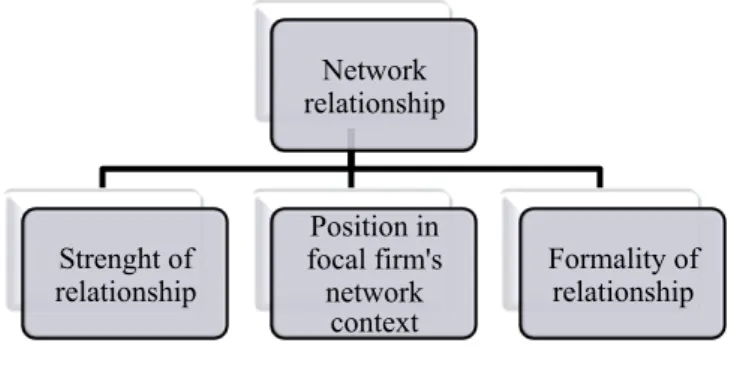
Network relationships can be presented under a perspective of three distinct categories: Formality of the relationships; strength of the relationship; and position of a firm in the network context.
10
Figure 1 - Types of network relationship categories
Source: Arvid and Helander (2009) 4.2.1. Position of the small firm in the network context
Möller and Halinen (1999) presented a model showing the distinct business relationships creating the network context of a firm being that a way to categorize them it is in vertical and horizontal relationships. Vertical relations encompass customers, customer partners, suppliers and supplier partners. On the other hand, horizontal ones encompass NGOs, universities and research institutions, competitors, competitor alliances and governmental organizations. However, and despite this categorization, it is not unusual these two types of relationships to be interrelated and hence to form complex networks.
Figure 2 - Horizontal and vertical network relationships
Source: Adapted from Möller and Halinen (1999) 4.2.2. Formality of relationships
Many authors have been claiming that the entrance into foreign markets is regulated through distinct types of network relationships referred as informal and formal. While informal relationships are associated to personal relationships such as friends and family for example, formal relationships are associated to business activities (Coviello and Martin,
Network relationship Strenght of relationship Position in focal firm's network context Formality of relationship Focal firm Suppliers Partners Universities NGOs Partners Customers Alliances Competitors
1999; Coviello and Munro, 1995, 1997; Ojala, 2009). Apart from this, intermediary relationships have also been referred as important (e.g. Ellis and Pecotich, 2001).
Within the formality of network relationships, they can be categorized into three types depending on their source: firm networks, also known as business networks, inter-personal networks (O’Donnell, Gilmore, Cummins, and Carson, 2001) and intermediary networks (Chetty and Blankenburg Holm, 2000; Ellis and Pecotich, 2001; Havila, Johanson, and Thilenius, 2004; Oviatt and McDougall, 2005). Briefly, the business type concerns to the set of relationships bonding one firm to other firms (Johanson and Mattson, 1988), the inter-personal one concerns to the sum of relationships bonding one person with other people (Burt, 1992) and the intermediary ones, being that all of these types allow for the facilitation market entry to foreign markets.
4.2.2.1. Business Networks
Business networks are conceived as inter-organizational cooperation shaped by an integrative form (Das andTeng, 1996; Golden and Dollinger, 1993) and furnish access to a diversified portfolio of important resources and complementary skills to firms (Chetty and Wilson, 2003). This leads to the enlargement of the knowledge of the company derived from the multidimensionality feature that this type of network possesses and actually it has the capacitance to imbibe new information in a fast pace (Lynn et al., 1996). In fact, its salient influence on organizational knowledge and learning exchange within the inter-firm networks (Huang, 2012) makes it where the researchers focus and concentrate the most when they employ the traditional network model of internationalization (Johanson and Mattson, 1988).
4.2.2.2. Inter-Personal Networks
All the people with whom managers have direct relations and get advice, services and moral support are included in inter-personal networks (Dubini and Aldrich, 1991) and it is not unusual for managers to consider the notion brought by this type of networks of “business know-who” as important as “business know-how” (Peterson and Rondstadt, 1986). On its turn, Kock (1995) visualizes this concept as networks among persons who are mostly connected through interactions within a social context and nevertheless, business and information exchanges may also happen in these kinds of situations. Like this, these
12 authors embody both professionals and family and friends in relation to this type of networks.
Inter-personal networks can be labeled as formal and informal depending on from where their sources come (Birley, 1985; Coviello and Munro, 1995; Ibarra, 1993; Johannsson, 1987). Formal inter-personal networks are “composed of a set of formally specified
relationships [...] among representatives of functionally differentiated groups who must interact to accomplish an organizationally defined task” (Ibarra, 1993: 58). That is, they
are attached to business activities constituted by two or more actors to the belonging network and usually translated into contracts and arrangements regulated by rights and duties for both parts (Das and Teng, 1997). In turn, informal inter-personal networks
“involve more discretionary patterns of interaction, where the content of relationships may be work related, social, or a combination of both.” (Ibarra, 1993: 58), including
interactions with other business actors, friends and family (Birley, 1985; Das and Teng, 1997).
4.2.2.3. Intermediary Ties
Instead of creating a direct contact relationship involving the seller and the buyer directly, there is a mediator, that is a third party, who makes it easier to establish a network relationship between the seller and the buyer (Ellis and Pecotich, 2001; Havila et al., 2004; Oviatt and McDougall, 2005). These mediated relationships proved to play a critical role for those who were establishing on new markets, as they did not have any existing formal or informal relationships that they could use for market entry themselves (Gabrielsson et
al., 2008).
4.2.3. Strength of Networks
4.2.3.1 Trust and Commitment
The strength of ties is a belonging feature to the structure of networks (Anderson, 2008; Ibarra, 1993; Kreiser, 2011; Zhao and Aram, 1995) and it is linked to the relational outlook of social capital.
The relation between actors can go from simple contacts to trustful relationships (Harris and Wheeler, 2005) being that this scope belongs to relational social capital. From a network model perspective, markets are viewed as networks of relationships holding trust
and commitment as pre-requirements for those network connections (Johanson and Vahlne, 2009). Trust is defined as ‘a willingness to rely on an exchange partner in whom one has
confidence’ (Moorman et al., 1993: 82) which means that there may be a reliable
cooperation within international network ties with the collaborating partners (Madhok, 2006). Furthermore, this is particularly critical in technology collaborations (Williamson, 1991) as it boosts the information sharing goodwill, open communication, (Currall and Judge, 1995) and it reduces both the necessity to monitor and the use of other control procedures (Inkpen and Li, 1999) and the fear of opportunism by partners (Williamson, 1991). Thus, firms should not concern too much on protecting themselves from the most trusted partners. Commitment is also attached to the strength of ties and it is defined as the efforts and time used to maintain the network linkages. Moreover, it is dimensioned under a frequency of communication basis (Carson et al., 2004). When both trust and commitment are simultaneously present, they yield outcomes that foment effectiveness, efficiency and productivity (Morgan and Hunt, 1994).
4.2.3.2. Weak and Strong Ties
Weak and strong ties are the classification for the strength of the network. While weak ties are responsible for making the connection to distant and disconnected firms and thus being related with lower levels of dependence and interaction, in the strong ones it is expected a high level of engagement and commitment within the relationship, a higher frequency of interaction and an emotionally closer relationship. Therefore, a firm is capable to gain more knowledge through the heterogeneous capabilities and resources of its partners (Johanson and Vahlne, 2009). For one side and because of the minimization and efficiency of costs, firms with a high number of weak ties have a more beneficial stance when compared to a firm engaged within a high number of strong ties since the last referee often take extra costs (Boorman, 1975; Hansen, 1999) and furthermore they are able to be more flexible and autonomous. Moreover, and according to Sharma and Blomstermo (2003), firms looking for new ties and channels beyond the existing ones find a positive correlation between the easiness of pursuing new partnerships and the lowness of dependency on the established ones. On the other side, according to Granovetter (1985) and despite the fact strong ties conduct to less miscellaneous information and need more maintenance, information coming from them is more accurate, detailed and credible when compared to
14 tendency assumes that individuals having strong ties with each other own alike information, which in turn leads to more redundancy (Burt, 1992; Burt, 1997).
Balancing the last mentioned structural features of network ties, Reagans and McEvily (2003) refer that the network range may assume a higher significance than weak ties when the firm makes the access to non-redundant information. Whereas network range accounts the extension to which the gathering of networks by the manager covers different bases of knowledge, weak ties just consider the strength of the relationship and thus, network range is more important in the moment to obtain non-redundant information.
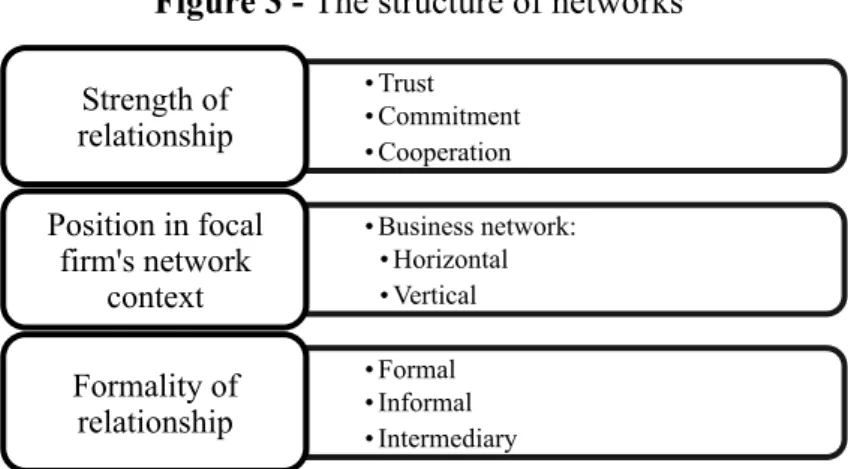
Figure 3 - The structure of networks
Source: Author Elaboration 4.3. Influence of networks
4.3.1. The role of founders
McDougall and Oviatt (2000) look to the entrepreneur as the major driver for value creation and internationalization of the firm. The attitudes and characteristics of the founder influence how the organization is going to respond to initiatives originals of its network connections. Beyond that it is pointed that managers play a fundamental role notedly in small firms when it comes the moment to identify opportunities for internationalization (Chetty and Holm, 2000). Actually, recent studies have given evidence of a positive correlation between the international experience, orientation, attitude and networks of the entrepreneur and the international development (Andersson and Florén, 2008; Andersson and Svensson, 2009b; Andersson and Wictor, 2003; Denicolai and Palamara, 2007; Knight and Cavusgil, 1996).
• Trust • Commitment • Cooperation Strength of relationship • Business network: • Horizontal • Vertical Position in focal firm's network context • Formal • Informal • Intermediary Formality of relationship
The set of attributes of the founder can be analyzed through three dimensions: managerial vision, prior international experience and use of networks. According to Reid (1981), managerial vision is crucial in the decision of a firm to go international. The vision differs from entrepreneur to entrepreneur and it depends on the age, foreign nationality, level and type of education, extent of foreign travel and the ability to speak other languages among other factors and thus, it shapes the perception and preferences of the entrepreneur on strategic choice matters. Rialp et al. (2005) defends these founders envision the world as one and so as not adopting a strong domestic focus and Oviatt and McDougall (1995) suggest that global thinking of founders or managers might be the most valuable characteristic for a startup company to expand internationally.
Prior international experience of the founder is probable to be influential on the way the firm behaves and consequently it affects its performance. Firms going international since the very beginning are usually founded by a group of individuals with international experience (Oviatt and McDougall, 1994). In fact, the mindset of an entrepreneur as a factor facilitating internationalization is tightly linked to the experience obtained by working abroad by the majority of the founders before committing in an own startup business (Schulz et al., 1990). The value of the decision-makers is highlighted several times within the context of the network of the firm (e.g. Carson et al., 2004), namely the use they make of their own personal relationships, including family and friends, so do its influence either in the choice the foreign markets where to enter and in the entry mode (e.g. Coviello and Munro, 1997; Zain and Ng, 2006). Thus, the networking of managers can signify using manifold networks (Gilmore et al., 2001), being that the founder must take a proactive approach in order the firm actively develops its network (Slotte-Kock and Coviello, 2010).
Figure 4 - Network ties of decision-makers
Decision-maker Friends Other Family members
16
4.3.2. Market entry
The set of steps that a startup has to take to pursue an effective market selection and entry in foreign geographies is not consensual among the existing literature and Koch (2001a) suggests that both aspects should be viewed as belonging to the same decision process. Johansson and Vahlne (1992: 9) states that the process of to enter in a foreign market is more and more acknowledged as to be: "unclear, complex, continuously changing [...]
strategy emerges out of interplay between actors in the foreign market and the firm". Koch
(2001a) highlights the huge importance the market entry strategy has for the international strategy of any company and according to Root (1998) the same is decomposed in the choice of the target market and the entry mode in order to penetrate the targeted market. According to Coviello and Munro (1997), formal and informal network relationships affect the foreign market selection and choice of entry mode of small software companies as well as its rapid internationalization process. Actually, opportunities for smaller and young firms for the entry into foreign markets are rather dependent on network ties than on traditional planning as in large firms for instance (Coviello and Munro, 1995). Ojala (2009) found evidence that formal relationships have had influence on the market entry in the cases of firms he studied, by using distributors acting in markets abroad. In turn, friends known coming from the experience in previous jobs of the managers also influenced the foreign market entry and thus, it was proved the use of informal relationships along the international expansion of the firm. Gupta and Govindarajan (2000: 46) states that there is no such thing as universal solutions for all scenarios and adds: “Unlike the complete
ownership, alliance-based entry modes have the advantages of permitting the firm to share the costs and risks associated with market entry, allowing rapid access to local know-how”. Actually, foreign market decisions are based on social ties and they are not all times
a straightforward process, being that there are situations where they are ad hoc.
4.3.2.1. Foreign Market Selection
It is believed that foreign market entry decisions are based on the systematization of collected objective information (Root, 1998). However, Ellis (2000) stresses that it exists evidence countering the vindication that the most communal approach to market selection is the traditional one.
Discussing foreign market selection implies to identify what approach the firm applies in such a process – a proactive or reactive one (Albaum et al., 2005). According to Album et
al. (2005), the proactive approach is traditionally characterized by a formalized and
systematic foreign market selection and it is determined for active initiatives taken by the company. In the reactive approach, the firm chooses markets in a passive way being that the initiative relies on external parties being that the firm fulfils awaiting initiatives or unsolicited orders coming from foreign buyers or representatives and thereby it is a non-systematic process. Other than these, there is a more or less institutionalized approach in order to find new international markets, an ad hoc and opportunistic approach where the decision maker bases its choice either on presented opportunities while travelling or from business acquaintances (Album et al., 2005), which can also be named as an intuitive market selection approach. Johanson and Vahlne’s (2006) reinforce this vision referring that relationships of a firm can open up new and unexpected opportunities, which in turn can engender changes in strategy.
4.3.2.2. Entry Mode
The mode of entry is what the firm uses in order to penetrate the targeted international market and it is important in the sense that it determines the degree of control of the company under then marketing mix and the degree of commitment in the target market (Albaum et al., 2005).
Firms operating in international markets generally can opt between either low and high commitment entry modes, going from exporting to licensing, joint ventures and FDI. When firms are small and young, do not possess wide international experience, have high risk of investment and great ability to develop differentiated products, they tend to choose low commitment modes (Agarwal and Ramaswami, 1991). Majkgard and Sharma (1998) state that the mostly used entry mode among entrepreneurs is alliances. In fact, strategic alliances give startups accessibility to resources, markets and knowledge (Lu and Beamish, 2001). According to Oviatt and McDougall (2005), small firms prefer network structures for internationalization which often are non-contractual relationships involving informal social contacts. Furthermore, small firms have also been engaging in hybrid structures like licensing and franchising (Oviatt and McDougall, 2005) or indirect exporting via agents (Erramilli and D’Souza, 1993). Direct exporting is also used via own channels like Internet
18 a difficult return on investment under the commitment of their own resources (Lu and Beamish, 2001).
4.3.3. Positive role
The process of internationalization is triggered through the acknowledgment of opportunities in international fields, also recognized as its crucial antecedent (Oviatt and McDougall, 2005) and that recognition relies on asymmetrical information among resource owners and individuals (Shane and Venkataraman, 2000). Thus, the awareness of foreign market opportunities can be promoted through inter-personal networks (Chandra et al., 2009; Ellis, 2000) and that promotion is strongly influenced by the managers (Ellis and Pecotich, 2001).
The utmost value to the firm of perceiving their own motivations is highlighted by the literature concerning the formation of cooperative arrangements. It is fundamental that a firm stipulates and understands the motives behind its consideration on the involvement incooperative strategic activities as they will significantly influence the choice of partners, the form of the relations and which activities to integrate (Badaracco, 1991a). The process of to screen and evaluate potential exchange partners is benefited by networks (Ellis, 2000). In that sense, and in a scenario of uncertainty about foreign markets, maintaining and developing new relationships is an important component in order to screen and assess eventual partners (Ellis, 2000) and obviously evaluating reliability before to start commercial transactions makes social engagement crucial (Al-Laham and Souitaris, 2008; Björkman and Kock, 1995; Ellis and Pecotich, 2001). The reason why managers use personal contacts for that cause is the fact they attribute greater honesty to that kind of ties (Musteen et al., 2010). Hence, and according to McGrath, Vance, and Gray (2003), the foundation of personal contacts usually comes from mutual trust and past experiences and so it serves as a reference for the guarantee the integrity of the personal of the manager (Burt, 1997; Stuart, Hoang, and Hybels, 1999). Moreover, this reference can be justified by the steady social norms and beliefs within inter-personal networks, emboldening allegiance to business practices related with ethics and consequently leading to diminish the requirement of formal manners (Adler and Kwon, 2002). Therefore, the managers of small firms make use of personal contacts as they affiliate those relationships to sincerity (Musteen et al., 2010).
Legitimacy, credibility and reputation promoted by alliances are particularly important elements for firms and their managers in foreign markets (Coviello and Munro, 1995; Loane and Bell, 2006; Oviatt and McDougall, 2005a) as in an initial phase they experience a shortfall of legitimacy and credibility in relation to their products and services which is defined as a lack of reputational capital (Aldrich and Fiol, 1994; Stuart et al., 1999) and furthermore they suffer from the lack of attractiveness (Anderson, Håkansson, and Johanson, 1994). This may be explained by the fact that even if the offered product possesses outstanding features, the market has still to find out its benefits. Striving to develop strong informal relations with partners with a considerable external reconnaissance help firms and managers to reach the needed reputation (Hoang and Antoncic, 2003; Zhao and Aram, 1995) which is effectual on the process to obtain legitimacy and it also diminishes the realized risk associated to third parties within the new market (Gulati and Higgins, 2003; Roberts and Dowling, 2002).
Networks also help on the accessibility of additional relationships and established channels (Zain and Ng, 2006) allowing the procurement of knowledge, which is especially imperative on the internationalization of resource, constrained small firms (Liesch and Knight, 1999). In fact, market knowledge about foreign countries can be achieved through relationships next to individuals either who possess this knowledge (Zhao and Aram, 1995) or by referring the small firm manager to a third party with the needed knowledge (Zain and Ng, 2006). Otherwise, an absence of local market knowledge may provoke difficulties for a firm when trying to realize business practices, norms or laws for example (Eriksson, Johanson, Majkgard, and Sharma, 1997).
4.3.4. Negative role
It is evident that networks are involved in the facilitation of the internationalization of a firm, however many authors argue there is also the negative side of it, regarding to time expend, limited strategic options and incurred costs that may sometimes outbalance its benefits (e.g., Coviello and Munro, 1995; Ellis, 2011; Mort and Weerawardena, 2006). Engagement within networks may restrict strategic options, phenomena also known as “lock-in effect” (Gulati and Gargiulo, 1999; Nahapiet and Ghoshal, 1998; Uzzi, 1997). This is in the sense its boundaries can bypass the opportunity limits and it is usually associated to the failure of firms on identifying new business opportunities further their
20 partners (Adler and Kwon, 2002; Gadde, Huemer, and Håkansson, 2003; Gulati, Nohria, and Zaheer, 2000). This signifies that opportunity costs arise as well as dependency and loss of control may occur. In such situations, firms end up by being able only to obtain information allowed by network ties (Hitt, Lee, and Yucel, 2002).
Another bad consequence is the denotative time managers need to invest on establishing and maintaining these relationships before they can benefit from network ties (Jack, 2005; Jack, Dodd, and Anderson, 2008). Thus, is precisely that what defines the opportunity cost of time emerged from the network and so the costs increase with the time spent by partnership and with the dimension of the network (Semrau and Werner, 2012), which sometimes leads to unbalanced cost-efficiency scenarios (Adler and Kwon, 2002).
Coviello and Munro (1997) verify this by giving evidence that the discussion of opportunistic behavior is surpassed by relationships based on trust within network ties. Issues regarding opportunistic behavior from partners can be avoided through the redundant use of networks in the case of formal ties (Etemad, 2004). However, this mechanism may fail, as they are not based on a deep personal trust like the informal ties are. Different but interrelated agglomerates of ties may also be a problem since they can lead to competition (Etemad, 2004).
4.3.5. Serendipity effect
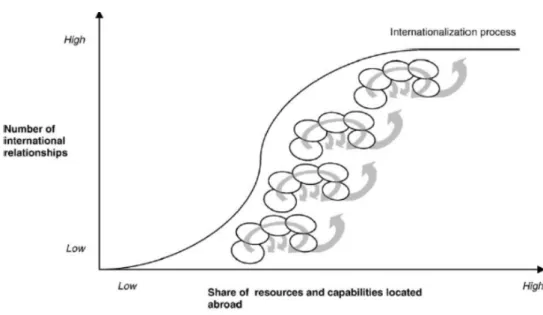
While some authors focus on resources that come from pre-planned or created network relationships on purpose (Boojihawon 2007; Chetty and Agndal 2007; Coviello 2006; Farooqi and Miog 2012), others emphasize both effectual and actual networks (Chetty and Agndal 2007; Galkina and Chetty 2015; Kalinic et al 2013), being the later maybe unknown however they shape relevant relationships which in turn triggers internationalization. According to Kalinic’s et al. (2013), network serendipities are any form of relationships that are not started by the firm or where the firm possesses a minimum control over their occurrences and so they are “co-created” instead of being created. There is literature showing that firms take more advantage of network relationships from family and friends rather than inter-firm networks at early stages of internationalization (Boojihawon 2007; Farooqi and Miog 2012; Rutashobya and Jaesson 2004). Along with the internationalization process, firms interact with more actors and business organizations which further permit the co-creation of more network relationships
to add serendipities which in turn power up internationalization (Johanson and Vahlne 2009). Indeed, this theory is confirmed by Granovetter (1973) who argues that third parties can serve more and more as linkages to other networks as either the interactions of firms and serendipitous networking opportunities increase. From a strategic opportunity point of view, such opportunities are susceptible to be resultant from a serendipitous strategy process determined by alertness and flexibility together with effort and luck (Denrell, Fang and Winther, 2003). According to Agndal et al. (2008), the symbiosis between nature and forms of network relationships is dynamic and therefore he affirms that the structure of networks resides in either direct or indirect relationships. Direct relationships are when firms interact directly with distributors, customers and suppliers for instance (Chetty and Agndal, 2007) and indirect ones are when firms establish relationships with customers’ customers and suppliers’ suppliers (Agndal et al 2008), that is, they are ties a firm has through another firm. Direct network relationships are bonded to earlier phases of internationalization while indirect relationships are bonded to later phases of the process Agndal et al. (2008). Notwithstanding, both direct and indirect relationships serve as a platform to allow network serendipities to happen since they can be co-created and searched for (Merrilees et al., 2015).
Figure 5 - Serendipity Effect
22 Network serendipities increase as the amount of direct and indirect network relationships rises (Agndal and Axelsson, 2002), the firms become better known within the network and consequently they get better connected and learn more about it (Hakansson and Snehota, 1995).
5. Methodology
This master thesis intends to acknowledge the internationalization process pursued by Dreamshaper through the analysis of influential factors as network relationships and the characteristics of the founders. The basis of this study will be under the findings from a single firm and so the assumed strategy to address the above-mentioned question is the conduction of a case study.
The utilized approach for the research of this thesis is a combination of a deductive and inductive approach. The deductive section concerns to research that has been previously conducted about the impact of network relationships on internationalization, having had the theoretical part of thesis been based on the extensive constructs from several authors in earlier studies. Despite that, a considerable amount of literature on the specified field of research is many times not straightforward and so an inductive approach was followed as well. This kind of approach should not be considered as to make ample generalizations from the findings in this case. Instead of it, it was used in a perspective of deepening both the interpretation and understanding of the studied issues and moreover they were used in an attempt of to give an exploratory character to the research by exploring the theoretical framework in more detail using empirical data. Thus, it was required the research design of the proposed study to be partially descriptive and it can be concluded that both deductive and inductive approach for the research are suitable for this case study. In consequence of all this, the thesis presents a qualitative analysis of the case study since one of the main objectives is to take in-depth insights related with the partnerships created by the startup, namely the importance of each specific type of network relationships in distinct moments of the internationalization process of the selected case study as well as to what point the profile of the founders determines the strategy of that process. The referred exploratory character of the research mainly concerns to the attempt of finding strategic patterns of internationalization within the context of this thesis.
The collection of data is conceptualized in two categories with different importance. Primary data contains an empirical data collection obtained from the sole selected case study and it is fundamental for the development of this thesis. It was principally collected through semi-structured interviews with the founders that have been influent in decision-making processes of the startup since the beginning of the internationalization pathway, allowing that way to study the data in a qualitative manner. The questions are open-ended
24 and they were thought considering the various extents of the reviewed literature. The structure of the interviews was made by accounting the possibility to ask more questions than the pre-established ones and always giving freedom to the interviewees to transmit any additional information they considered relevant to the research. In turn, this sometimes led to the appearance of other themes and issues which most of the times were worth to discuss due to the exploratory nature of the research. Despite that, there was an effort to keep the interviews the more structured possible in order to avoid bias. The obtainment of this type of data was divided along several interviews varying between one and two hours in their duration. It is also worth to mention that, except the founders, all the designations of network persons and companies along the case study are anonymous for motives of confidentiality. Finally, the outcomes of the interviews were carefully transcripted, interpreted and analyzed, being that the parts with more significance were summarized and used in for descriptive purposes of the case study.
Secondary data enfolds a desk research including the analysis of internal documentation provided by the startup as marketing and written documents, being that this category did not have a so predominant role on this matter as the above mentioned one.
In the next section, the findings will be shown regarding the explored themes as well as the encountered patterns of internationalization, ending up in a cross-analysis between the reviewed theoretical framework and the findings of the case, followed by the limitations of the case study, suggestions for further research and finally the respective conclusions were drawn.
6. Case study
6.1. The founders
José Miguel Queimado took a course in Science and Political Economy, having studied in universities like Georgetown, Stanford and Harvard Business School. He worked in investment banking, he was co-founder of Gongua Group of China, he did consulting at McKinsey and he was CEO of Groupon in Brazil. Nowadays he is the CEO and one of the founders of the Dreamshaper and the president of Acredita Portugal NGO.
Pedro Queiró holds a course of Physics at Instituto Superior Técnico and he has worked as a consultant at McKinsey having even passed through Brazil where he lived for a season. Furthermore, he is a founding partner and Head of Product Development at Dreamshaper and CEO in Acredita Portugal NGO.
João Borges studied Physical Sciences at Universidade Lusófona and he has a postgraduate degree in Leadership and Management by the Technical University of Lisbon. Today he is a founding partner and Head of Sales at Dreamshaper. He founded the startup WorkWell together with friends, which consists on services of health and well being for business. This constituted his first experience in entrepreneurship. Later, in 2011, João Borges went to Brazil to take an MBA at Getúlio Vargas Foundation and then he has worked as a commercial director in STATS.
6.2. The origin of Dreamshaper
José Miguel Queimado is an individual that is resilient, passionate and he possesses an unusual vision of the world. In 2008 he traveled Portugal from north to south in a marathon of nearly 800 kilometers in an attempt to realize which were the dreams and levels of creativity of the Portuguese population, having come to the conclusion that people, in addition to seeing their ideas devalued by society, did not have the resources to achieve them. It was in that same year that together with friends he founded Acredita Portugal Association, an NGO that is currently the biggest contest of entrepreneurship in Portugal. In 2011 it was designed a platform called Dreamfactory along with the creation of the competition, in order to give the necessary tools to participants so that they could be
26 In parallel with the emergence of Dreamfactory and over the course of the year 2012 the first discussions were initiated with multinational companies such as Coca-Cola Institute, José de Mello Saúde and Qatar Development in order to receive insights on if taking the technological tool for international lands would be viable. It was then that in 2013 and resulting from Dreamfactory, Dreamshaper was officially launched, being a spin-off of Acredita Portugal NGO. In addition to continue to support the tender since then, it provides educational products and services to public and private sectors in Portugal, Brazil, Colombia and Mexico, being colleges and universities their main clients. Dreamshaper is an online platform that integrates business-modelling tools with a solid pedagogical curriculum in order to help teachers to embed projects and entrepreneurship in the classroom according to the studying area. Students work on projects in a more practical and motivating way as well as they develop social-emotional skills, which are essential for their academic success.
The mission is to impact socially on a large scale in the area of education by giving all the people the opportunity to pursue their entrepreneurial dreams regardless of their background and culture.
6.3. Going international 6.3.1. Motivations
Dreamshaper project was born from the realization that the Portuguese domestic market did not have the proper dimension for those that were the ambitions of the startup. This has been a decisive reason in the decision on acting in international markets for almost since its inception. It was what happened a few months after its official establishment in 2013. In the words of one of the founding members:
"It is insufficient to start a technological startup bound to one market that is limited. Even being successful at 100% in Portugal, the level of revenue would not correspond to the true potential of the technological solution we offer".
The perception of the founders that the natural and expected scarce resources at hand would be insufficient to successfully establish themselves in a foreign country led to the conclusion that they could not compete alone and so they needed to create, develop and
maintain new relationships. The strategic model to start with the internationalization has essentially been to leverage social capital attached to relations with external parties through strong strategic alliances as a mean of combating the dual liability of foreignness and newness. The goal was mainly to gain access to skills such as knowledge of foreign markets, to identify key players in the education industry and also major client actors, distribution channels and networks, access funding streams as venture capital and gain confidence and credibility in the Brazilian market. Still in this line of reasoning, it is factual that companies are able to obtain objective knowledge via the Internet, however the experiential knowledge is much more difficult to obtain and it is precisely through relationships with network partners that this difficulty is overcome. As one of the founding members said:
“The best way to internationalize a company is through partnerships."
6.3.2. Product Development
A partnership relation for product development was essential for the healthy growth of Dreamshaper. After conversations between the founding partners of the startup on if it would make sense to launch Dreamshaper, the need for product development was visible and different possible options appeared on the horizon. There was the possibility of hiring engineers, however this option was financially risky. One of the partners holding the needed technical skills to accomplish such task was able to do it, however the biggest disadvantages in this scenario were the fact that a complex software tool like this one would simultaneously imply more time consumed by only one person and an increase in production time, probably leading to a delayed launch of the product on the market. Thus, the choice fell down on doing outsourcing of product development in order to ensure efficiency and effectiveness of results and time. It was then in the middle of the year 2013 that a company selection process began and turned out to be through a personal contact that Dreamshaper reached Sofdev, one of the best software development offices in Portugal. Money was required in exchange for their services. The minimum viable product was awarded in September 2013 and the product was ready to be released in January 2014, making the run time fast and proving the efficiency of time provided which in turn accelerated the process a lot. Here it shall be noted the active role of network, since the