WOMEN UNDERREPRESENTATION AT THE
WORKPLACE: A CASE STUDY IN THE CHINESE
PHARMACEUTICAL INDUSTRY
Fei Zhao
Project submitted as partial requirement for the conferral of
Master in Human Resource Management and Organizational Consultancy
Supervisor:
Prof. Maria Gabriela Silva, ISCTE Business School, Department of Human Resource Management
Spine
-WO M E N U N D ER R EP R E S EN T A TI O N A T T H E W O R K P LA C E: A C A S E S T UDY IN T HE C HI NE SE PHA R MA C E UT IC AL I NDU S T R YF
ei
Zha
o
Abstract
This thesis examines how the phenomenon of women’s numerical underrepresentation is perceived in the pharmaceutical sales industry in China. Previous studies have suggested that sex-differentiated perceptions and organizational factors may contribute to gender underrepresentation. Yet it is not well understood how these elements connect to foster women underrepresentation in everyday workplaces in the Chinese context. Through interviewing 18 Chinese employees at a joint-venture pharmaceutical sales company, the analysis sheds light on the job characteristics and people attitudes at the workplace. The analysis reveal that job requirements of pharmaceutical sales bring pressure of work-family balance, while male colleagues and even female salespeople themselves are (un)consciously reproducing sales occupation’s masculine cultures. The findings suggest that initiatives sponsored at different organizational ladders have reinforced the “status quo” – in few words, have helped to maintain existing systems of gender differences.
JEL Classification: J42, J71
Key Words: Gender segregation, Women underrepresentation, Pharmaceutical sales, China
Resumo
Esta tese estuda como o fenómeno da sub-representação numérica das mulheres é percebido na indústria farmacêutica na China. Os estudos anteriores têm sugerido que as perceções diferenciadas quanto ao sexo e os fatores organizacionais podem contribuir para a sub-representação de género. Contudo, ainda não se compreende bem como estes elementos se ligam para fomentar a sub-representação das mulheres no dia-a-dia no local de trabalho no contexto chinês. Com base em 18 entrevistas a trabalhadores chineses num consórcio internacional na área da indústria farmacêutica, a análise destaca as características do posto de trabalho e as atitudes individuais. As análises revelam que as exigências profissionais do delegado de informação médica não promovem o equilíbrio entre trabalho e família, enquanto os colegas do sexo masculino e até mesmo os delegados de sexo feminino (in)conscientemente reproduzem a cultura da profissão masculina de vendedor. Os resultados sugerem que as iniciativas promovidas em diferentes níveis hierárquicos têm reforçado o “status quo” – em poucas palavras, líderes e colaboradores têm ajudado a manter o sistema atual de diferenças de género.
Acknowledgements
The two years’ study in ISCTE develops me a broader mind to observe this world, and it would be a memorable experience in my life. As the final challenge in my master program, I tried my best and took hard works to accomplish this thesis. Also, this thesis is finished under lots of friends, colleagues and professors’ help. I would like to take this opportunity to express my appreciation to those who offered me enthusiastic support.
My special gratitude will go to my dear supervisor Professor Maria Gabriela Silva. Her kindness, rigorous academic attitude and attentive guidance inspired me not only during the elaboration of the thesis but also in my future life. From the starting of this thesis to its final edition, she is generous in sharing her profound knowledge and provided me helpful advice. Here, I want to show my sincerely thanks to her.
Additionally, I would like to say thank you to my family. They are my strongest backing that always encourage and support me to walk further. And, the special thanks also go to my friends and colleagues in ISCTE. The friendships with them give me great comfort during this far away from home's period.
i CONTENT CHAPTER 1: INTRODUCTION ... II 1.1 BACKGROUND ... II 1.2. RESEARCH PURPOSE ... IV 1.3. RESEARCH QUESTIONS ... V
CHAPTER 2: LITERATURE REVIEW ... 1
2.1. GENDERED OCCUPATIONAL SEGREGATION AND GENDER DOMINATED OCCUPATION .. 1
2.2. EXPLANATIONS FOR GENDERED OCCUPATIONAL SEGREGATION ... 4
2.2.1. Neoclassical model ... 4
2.2.2. Discrimination theory ... 5
2.2.3. Feminist theory ... 5
2.3 A CLOSER LOOK AT GENDER IN THE SALESFORCE ... 9
2.3.1. Individual level ... 9 2.3.2. Organizational level ... 11 CHAPTER 3: METHODOLOGY ... 15 3.1. RESEARCH STRATEGY ... 15 3.2 SETTING ... 16 3.3. DATA GENERATION ... 17 3.4. INTERVIEW PARTICIPANT ... 17
3.5. THE NATURE OF THE INTERVIEWS ... 18
Interview Guideline ... 19
3.6. INTERPRETATION OF THE EMPIRICAL MATERIAL ... 21
Discourse analysis ... 22
CHAPTER 4 FINDING ... 25
4.1 JOB REQUIREMENTS ... 25
4.1.1. Perceptions of Team Members ... 25
4.1.2. Perceptions of Middle Management ... 27
4.1.3. The Reality: Work, Family and Private life balance ... 28
4.2 CULTURAL INFLUENCE VS. GENDER DIFFERENCES ... 29
4.2.1. Stereotypes of Women ... 30
4.2.2. Gender difference in selling styles ... 32
4.3 ACTUAL ATTEMPTS TO (RE)CONSTRUCT THE MASCULINE CULTURE ... 34
4.3.1. Women’s Strategy: Proving yourselves ... 34
4.3.2. Peer integration ... 35
4.3.3. Co-workers’ Resistance ... 36
CHAPTER 5 DISCUSSION ... 39
CHAPTER 6 CONCLUSION ... 47
LIMITATION AND FUTURE DIRECTION ... 47
ii
Chapter 1: Introduction 1.1 Background
Women workforce has been discussed in extensive literatures. At global level, the female labor force participation rate was 49.6% while the corresponding figures for men was 76.1% in 2015 (International Labor Organization, 2016). But women’s share of the world’s board seats only account for 12% (Deloitte, 2016). Apart from the top position, women in military, sports, manufacturing, medicine and management areas are also in an underrepresented situation (Bureau of Labor, 2012). For example, in the United State, female represents one-third or less of those STEM occupations (Science, Technology, Engineer, Mathematics). Moreover, only 11.3% aerospace engineers, 17.9% software developers and 21% computer programmers are female (BLS, 2016). In China, women have a high labor force participation (64%)1 as well as an improved representation of tertiary education (50.7%)1, but they still have low representation in political offices and legal profession which is 23.6%2 and 17%3 respectively. Despite increased opportunities and participation for women in education and employment today, they are still underrepresented in some areas in today’s society.
Since 1960s women's liberation movement, female’s rights have developed over the years. However, gendered disparity and inequality is still a ubiquitous phenomenon in the workplace (Mulinge and Glass, 2002). The boosting technology and productivity have weakened the gendered divisions in labor market, but even today we still could hear the voice that these jobs “prefer” men applicants and those jobs are “appropriate” for women, which means some jobs are still gendered in organizations’ perspective (Acker, 1990). This phenomenon, men and women tend to work in different occupations and industries, further manifest as sex-typed underrepresentation and job sorting, is defined as occupational segregation by gender (Levanon et al., 2009).
1 The World Bank, “Percentage of Students in Tertiary Education Who Are Female, China, 2013,” The World Bank Databank (2016)
2 Inter-Parliamentary Union, “World Classification, China," Women in National Parliaments (April 1, 2016)
iii This study will focus on gender segregation in medicine industry in China, where female salespeople are facing the same underrepresentation problem. Industrial salesforce is regarded to be a male-centered domain and professional selling jobs have been labeled as intrinsically masculine (Comer and Jolson, 1991). In recent decades, both the United States and the United Kingdom’s labor market had a trend that increasing female is entering into areas traditionally considered as male’s domains (Jolson et al., 1997). In pharmaceutical industry, the business is largely dependent on the sales and marketing of each drug, its sales job is competitive. According to a report from Cegedim Strategic Data, pharmaceutical sales force levels in China increased more than 17%, with 80,000 sales reps’ equivalents at year 2011- situation that exceeded the U.S. reality for the first time. More than 17,000 sales jobs were newly added into Chinese market during the past five years by world-renowned pharmaceutical multinationals. In Pfizer, the top leading company, the sales force is now over 4,000. Bayer, MSD, AstraZeneca and other direct competitors almost keep the same pace (McKinsey, 2012). However, women in pharmaceutical sales industry still keeps a low representation in China. Among these soared salespeople, women’s proportion occupied approximately one fifths (McKinsey, 2012).
In the Asian region, men are deemed to be more suitable for many jobs than women (Honig and Hershatter 1988).It is also the Chinese case; female is a vulnerable group in labor market due to both objective inequality facts and subjective cultural perceptions. For thousands of years, the idea of female’s subordination rooted in every corner of Chinese society. Even today the feudal system was abandoned and the dross of traditional concepts were rejected by majority, the influence of this idea still remains. Women themselves, as a member in this patriarchy dominated society, gradually accepted their subordinate role which became a main source to be unawakened from seeking for support in the process of historical development. Traditionally, Chinese women are concentrated in low-status jobs.ILO found out that Chinese women are more likely in agriculture than men. Furthermore, the taking place structural change in China signals a greater “sticky
iv floor” for women impeding their mobility out of agrarian work compared to that of men (ILO, 2015: 62). For those educated women who already hold fairly good jobs, they also face the “glass ceiling” that are less likely to gain advancement than their male counterpart (Croll, 1995).
1.2. Research Purpose
Numerous studies have investigated female’s situation in male-dominated occupations. Topics include determinants and effecting factors of women’s outflow (Torre, 2014; Ashraf, 2007), women’s mobility and occupational trajectories in male-typed occupations (Mandel, 2013), interaction with male counterparts (Kanter, 1977; Maume 1999), female’s coping strategies for continuing career paths (Fernando and Cohen, 2011), work family conflicts and balance (Watts, 2009), and gender stereotypes’ influence on female’s hiring (Gorman, 2005). Earlier research emphasized the adverse impacts of women’s low participation, current literature discusses more its sources and related effects. However, some knowledge gaps still exist.
These studies mostly concentrated on IT industry (Adikaram and Wijayawardena, 2016), sport area (Walker and Bopp, 2011), mathematics subject (Kessel, 2014) and aviation (Germain et al., 2012). Little is known in pharmaceutical sales industry. As a main sector of the world’s largest health economy, pharmaceutical industry is also one of the major high-technology industrial employers. According to the European Federation of Pharmaceutical Industries and associations (EFPIA), research–based pharmaceutical industry generates extra upstream and downstream employment, and the indirect employment is usually three to four times more than the directly one. Identifying women’s difficulties and challenges in male-typed occupation might suggest a lesson for other industries to recruit and retain female employees.
Moreover, only a finite number of studies has examined both individuals and corresponding organization’s perspectives on female’s underrepresentation in
male-v dominated area. These involved parties may differ in their responses to this situation, which provides dual angles perspective.
Additionally, the Western academics have a full, detailed view showing women’s status in majority research on occupational segregation and other related topics. However, this situation is little known in China. Unlikely the America or European countries, female would experience more gender-based disadvantages in Chinese labor market because gender issues are more severe and explicit in Chinese environment due to social norms and weak legal protection for women (World Bank 2013; Gao et al., 2016). Thus, it’s essential to get a better understand of the status of working women in this country, dating from the phenomenon to the reasons behind.
Contributing to fill in the gap, this study aims to analyze female salespeople’s minority situation in the pharmaceutical sales industry in Chinese labor market. The aims are twofold. Recognizing that the underrepresentation, as a kind of occupational segregation, could be produce and reproduce by a multifaceted set of factors, I seek firstly to explore how sales occupation is understood in the pharmaceutical industry. Then, I try to understand how different organizational actors are (re)constructing the existing male-dominated culture.
1.3. Research Questions
In response, to contribute to the understanding of female salespeople’s underrepresentation and to advance an explanation of gender segregation, this thesis tries to answer the following questions:
• What are the meanings different actors ascribed to the sales occupation?
• To what extent were different actors able to (re)construct the male dominated culture in sales context?
• What are the implications of the existing reproduction processes of the male-dominated culture for the way sales force works?
1
Chapter 2: Literature Review
2.1. Gendered occupational segregation and gender dominated occupation
Occupational segregation refers to the inequality division of labour into different jobs and occupations according to demographic characteristics in the context of paid employment (Bergmann, 2009). Gender-based segregation is the most common segregation type referred on the literature. Conventionally, it has vertical and horizontal dimensions (Blackburn and Jarman,1997; Bettio and Verashchagina, 2009): vertical gender segregation is disproportionate participation of one specific group in the hierarchy of occupations, while horizontal occupational segregation refers to disproportionate amount of people of each gender present across occupations (Charles, 2003).
One superficial phenomenon of gendered occupation segregation is female (or male) highly concentrated on some specific jobs, like female overwhelm male in teacher and nurse’s job; men overnumber women in engineer and mechanic’s job. The presence of gender dominated occupations offer another perspective on occupational segregation. According to a ILO’s 2003 report, in 1990 half of the working labour was in gender-dominated occupations, men fill over 80 percent in the male-gender-dominated occupation and women only take up about 60 percent in the female-dominated occupation. The high level of segregation demonstrated a worldwide extensiveness. Gender dominated occupations topic is discussed widely and its formation has close relationship with social, cultural and historical factors. In retrospect, the division of labor in human history could provide a better understanding of the gendered work roles.
Family farm, as the typical of agriculture in the early agrarian economy period, already resulted in separated gendered work. Based on Sandra and Jeremie’s (2017) research, its formation relied on the teamwork of different gender and generations. Male was in charge of the farm and managed farm business, whereas female worked as a helping role of her husband, took care of chores and social relationships, and was responsible for children. In other words, public sphere was dominated by men and private sphere was held by women. Consequently, gendered division of labor had emerged from this kind of
2 complementarity.
Under this historical heritage, the separated work roles conventionalized people’s life and was rooted within cultures. However, gender-based work roles became more specific when the industrial economy brought about. With the boom of mechanization, the majority of men were employed in the factories because of their advantages in physical strengths and required skills.In the pre-industrial days, women’s less productivity, their maternal role, household and childcare responsibility tied them to stay at home (Burnette, 2008). The industrial revolution changed female’s way of life and pushed them to work outside home. Women's experience in domestic chores gave them advantage in the home-based jobs, such as cottage industries, agriculture and domestic service. Women’s high proportion of employment in these areas during industrialization introduced a change of gender composition in the labor market.
The long-term tradition of labor division split men and women into different occupations. As a consequence, jobs were more on gender-types rather than on job responsibilities (Heilman, 1995). People’s perception on jobs labelled as “male” or “female” is highly correlated with gender dominated occupations.
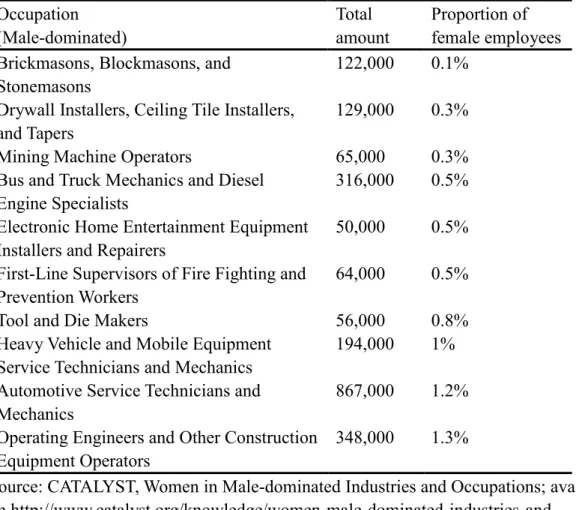
Anker (1998) discussed early researchers’ definition of “gender-integrated” occupation and “gender-dominated” occupation. He suggests the boundary of “gender-dominated” occupation should be minimum 80 percentage of male(female) in the whole gender composition. According to Anker’s definition, table 2.1 and 2.2 illustrate top ten occupations dominated by gender in America (CATALYST, 2015). It is clearly shown that female’s participation in male dominated occupations is far lower than that of male in female dominated industries, which implies that female may experience higher potential of segregation than male in the labour market.
Although there is source regional variation, it is possible to point out approximate ranges of male and female dominated industries on the basic of American employees’ selection. Men are largely concentrated on construction, mining, vehicle service and engineering
3 industries, while women are highly focus on education, nursing, household service and clerical domains. Similarly, European labour force survey indicated an alike distribution (OECD, 2005), and additionally emphasized that women’s range of professions is more restricted than that for men. ILO’s report (2003) summarized that women tend to choose occupations that require caring, domestic experience and cooperation skills while men are more inclined to select occupations that demand physical strength, technical support and scientific related knowledge. In addition, Anker’s(1998)data proved that female are less concentrated in administrative and managerial occupations, as well as in production occupations.
It is noteworthy that sales occupations present a mixed picture on the basic of specific positions across different economic sectors. Industrial and professional selling show a male-dominated tendency since it requires professionalism in products while retail selling performs a worldwide female overrepresentation (OECD, 2005).
Table 2.1 Male dominated occupations in United States
Occupation (Male-dominated) Total amount Proportion of female employees Brickmasons, Blockmasons, and
Stonemasons
122,000 0.1% Drywall Installers, Ceiling Tile Installers,
and Tapers
129,000 0.3%
Mining Machine Operators 65,000 0.3%
Bus and Truck Mechanics and Diesel Engine Specialists
316,000 0.5% Electronic Home Entertainment Equipment
Installers and Repairers
50,000 0.5% First-Line Supervisors of Fire Fighting and
Prevention Workers
64,000 0.5%
Tool and Die Makers 56,000 0.8%
Heavy Vehicle and Mobile Equipment Service Technicians and Mechanics
194,000 1% Automotive Service Technicians and
Mechanics
867,000 1.2% Operating Engineers and Other Construction
Equipment Operators
348,000 1.3%
Source: CATALYST, Women in Male-dominated Industries and Occupations; available on
4
Table 2.2 Female dominated occupation in United States
Occupation (Female-dominated) Total amount Proportion of male employees Secretaries and Administrative Assistants 2,768,000 4.7%
Childcare Workers 1,236,000 5.9%
Receptionists and Information Clerks 1,132,000 8.5%
Teacher Assistants 818,000 8.9%
Registered Nurses 2,605,000 9.4%
Bookkeeping, Accounting, and Auditing Clerks
1,130,000 10.9% Maids and Housekeeping Cleaners 1,284,000 11.9% Nursing, Psychiatric, and Home Health
Aides
1,863,000 12.1%
Personal Care Aides 907,000 15.3%
Office Clerks, General 920,000 16.6%
Source: CATALYST, Women in Male-dominated Industries and Occupations; available on
http://www.catalyst.org/knowledge/women-male-dominated-industries-and-occupations#footnote9_d58t5yk. Post on May 30, 2017
2.2. Explanations for gendered occupational segregation
In explaining gender segregation, it is possible to aggregate academic studies into three categories: neoclassical model, discrimination theory and feminist theory.
2.2.1. Neoclassical model
Under the assumption of rational choices on both employers and workers, women and men will make different human capital investment decisions since women has a discontinuous participation compared to men in the labour market (Becker, 1962). Neoclassical model underlined that women’s motherhood influence their career choices and it is on the supply side of labour to view women’s low level of human capital. During women’s absent period, their skills depreciate. Correspondingly, women tend to invest on general skills that cost less in human capital rather than specific skills with a high value of depreciation (Becker, 1985). Therefore, female is easily focused on low skilled occupations with attributes of low earning. Likewise, women would anticipate jobs with low penalties for interruptions from the labour market (Polachek, 1981) and high starting
5 pay.
2.2.2. Discrimination theory
However, the neoclassical model neglects practical factors and any gender segregation analysis could be very restricted if it only stands on the discontinuous participations of women in the labour market. Based on this, discrimination theory tries to advance upon another explanation.
One of the primary premises of discrimination theory is the institutions’ impact on employee hiring, promotion and dismiss. Employers are described as “gatekeepers” (Cook and Corey, 1991) since their practices directly or indirectly sustain occupational segregation. Women have the potential risk of being exclude from the entry in some jobs by employers’ discrimination. For example, the employer offers a full-time job and this job requires an extra training. Only after the employee has worked for a certain period the employer could have returns from the investment. Then women are probably discriminated if they are assumed to have possibilities to leave and have children (Estevez-Abe, 2005). Another argument on blocking female’s entry is female’s welfare support (Nielsen et al. 2004) during their pregnancy. In a word, employers are rational to discriminate against women on the account of men’s less costs.
2.2.3. Feminist theory
Apart from the forces inside the labour market, the whole market is still under the influence of the rest of society. Correll (2004) pointed out that the long-term social attitude towards “men” and “women” typical work would influence job applicants’ decision. A similar explanation was provided by Gottfredson (1981, 2002), who emphasised the perception on gender and social class identity, which is believed to shape their later occupational aspirations.
Feminist theory highlighted a close relationship between feminine stereotypes, woman’s supposed abilities and characteristics of typical-female jobs. For example, Charles and
6 Bradley (2009) emphasise that gender stereotypes would have an impact on gender-link abilities and traits. Gender-stereotyping of specific occupations will be consistent to a significant degree with typical socially prescribed gender roles and preconceived notions of gender-related abilities. Female and male developed gendered abilities under social and cultural construction, at the same time gender stereotype internalized. This was believed by McDonald and Hite (1998), who pointed out that both gender would receive evolutionary experiences in their special fields based on thetraditional labour division and finally enable them towards gender-based occupations. Table 2.3 shows Anker’s (1998) summary of female’s “positive” and “negative” stereotypes and makes a corresponding association with different occupations.
Feminist theory also assumes that the profound patriarchy’s influence is in all levels of the society, leading to women's vulnerable status in the labour market (Anker, 1998). Both workers and employers’ decision of jobs are constrained from learned cultural and social norms. For female, long term’s subordination in the family and society constructed a discrimination culture. Compared to men, women had less access to education and political environment didn’t provide them the same equal rights as men, which made them at a disadvantaged position in the labour market.
7
Table 2.3 Common stereotyped characteristics of women and their expected effect on occupational segregation by sex
Common stereotyped characteristics of women
Effect on occupational segregation
Examples of typical occupations affected
Comments
Positive
Caring nature Helps qualify women for occupations where others are cared for, such as children, the ill, older people.
Nurse, doctor, ayah, social worker, teacher, midwife
Often felt to be biological (i.e. sex difference), because women are mainly responsible for child care in all societies. This is, however, a learned, gender-based difference. Note that occupations that require care but also require greater
authority, such as medical doctor, are often male-dominated.
Skill (and experience) at household-related work
Helps qualify women for occupations that are
frequently done in the home (almost always by women), often as unpaid household work.
Maid, housekeeper, cleaner, cook, waiter, launderer, hairdresser, spinner, sewer, weaver, knitter, tailor/dressmaker
Skills easy to learn (therefore, women’s greater experience before entering the labour market should not be very important).
Greater honesty Helps qualify women for occupations where money is handled and/or trust is important.
Cashier, bookkeeper, salesperson, accountant
Higher paying and higher status occupations (such as accountant which is a professional occupation) are often male-dominated.
8
Other
Greater willingness to take orders
Greater docility and less likelihood of
complaining about work or working conditions Less likelihood of joining trade unions Greater willingness to do monotonous/repetitive work
General characteristics that help qualify women for occupations
and sectors of the economy where working conditions are poor, labour laws are not applied (e.g. informal sector) and work is routinized.
These general characteristics “qualify” women for many jobs that are low paid, unskilled, unprotected and repetitious in nature.
These stereotypes have been combined because they are similar in that all imply a subservient nature. These are archetypal learned (gender-type) characteristics.
Negative
Disinclination to supervise others
Helps disqualify women for all types of supervisory and managerial occupations.
Manager (general; production; trade; catering and lodging), supervisor (clerical; sales;
production), government executive officer, and administrator and legislative official
This is in many ways the opposite of
willingness to take orders. This often affects vertical occupational segregation (with lower level jobs for women).
Less physical (muscular) strength
Helps disqualify women for occupations requiring heavy lifting and/or physical effort.
Construction worker, miner/quarrier, well driller
There is considerable overlap in the physical strength of individual women and men, which means that many women are physically capable of doing this work. Becoming less and less important in today’s economy.
9
2.3 A closer look at Gender in the Salesforce
Because gender-based segregation restricts the individual’s choice of different occupations, women’s movement to male-dominated occupations has been seen as an important development towards decreasing occupation segregation and gender equality (Yavorsky et al., 2016; Levanon et al., 2009). Nevertheless, segregation has not been dissipated by women’s increasing participation. Gender differences are persistent in productivity, earning as well as social cognition. It has been suggested that the root of gender segregation is the result of the intertwinement of a multiplicity of factors. To better understand women in male-dominated sales occupations, an efficient conceptional framework is to investigate attitudes of gender differences from both the demand and supply side of the labour market, that is the employer—organizational level, and the employee—individual level.
2.3.1. Individual level
As increasing female salespeople pursue their professional career in traditional male-centred salesforce, the anxious demand for understanding female salespeople is obvious. At the individual level, the central argument is to understand whether the differences between male-female salespersons are significant and may be a barrier block to female’s entry and promotion.
Busch and Bush (1978) compared male and female salespeople in terms of pay, work, promotion, co-workers, supervision, customers and job satisfaction. Apparently, the differences were negligible and they concluded that there were no differences between male and female salesforce. Similar findings were obtained by Brief and Oliver’s (1976) study, who investigated the differences between male and female retail sale managers across 25 variables. The findings supported "no difference" hypothesis. More recently, Moncrief et al. (2000) also pointed out that there is no difference on sale performance from gender variable.
10 On the contrary, a number of scholars have argued that gender difference is noteworthy since it has contributed to disparate behaviours and attitudes between male and female with effects on sale performance outcome. For example, some academic researchers have underlined that female salespeople experience lower job satisfaction (Schul and Wren, 1992; Swan et al., 1978), lower organizational commitment (Deaux 1984), less self-confidence (Swan et al., 1978), less role clarity (Busch and Bush,1978) and higher role conflicts (Koberg and Chusmir, 1987) than their male colleagues. To gradually reduce these differences, Schul and Wren (1992) suggest that special training program should be prepared for female salespeople in order to enhance their integration into to the industry sales environment. In addition, Lane (2000) noted that the presence of women in the male-dominated salesforce is due to their inappropriateness for managerial posts. Empirical evidences also reported that female sales representatives have weaker product knowledge (Swan et al., 1984) and less persuasive selling skills (Linkemer, 1989) than their male colleagues, which reiterated gender disadvantages for female salespeople.
Although these existing differences appears not to be suitable for women in male-dominated salesforce, other scholars claim that many differences identified on the literature can be used in benefit of female workforce. For example, one possible explanation to women’s inferior results on job-related attitudes is the inconsistency of individual value to organizational norms. Pharmaceutical organizations in the early period promoted the “transactional-based” model and their norms mostly emphasised toughness, control, aggressiveness (Rosener, 1990), which are the reverse of women’s soft role (Carrier, 1995). Female’s lower score on job-related attitude also reflected early adaptation problem to the male-dominated organizational culture. However, Douvan and Adelson (1966) revealed that men highlight recompense, promotion and job security, while women’s demand is more on social and personal aspect to develop their career (Linkemer, 1989). This gender difference is also supported by Swan et al. (1978)’s survey on pharmaceutical sale group.Therefore, women’s attention on social and personal aspect gave them an advantage in socializing their customers (Linkemer, 1989) and could be
11 viewed positively in sale industry.
Different from salesmen’s task-related focus, female salespeople concentrate more on emotional responsive attitudes (Van Emmerik et al., 2006). Women’s natural ability of empathy help them knowing better about their customers, capacitate them to fulfil their customer's needs as well as avoiding conflicts. Gradually, women’s relationship-oriented is being regarded as an essential competence in sales industries (Crampton and Mishra, 1999), which turns out to be an advantage.
Likewise, women and men perform different communication styles, and language skill is especially vital for salespeople since their job is dealing with customers. Carlson (1971) pointed out that men sale representatives typically are with agentic style communication while women are more in communal style. Sojka and Tansuhaj (1997) found out that women salespeople are more self-disclosing, more cooperative and gain more trust in their customers than their male counterparts. It is probably that men’s agentic communication could be seen as adversarial by their clients and female’s communal form evoke collaborate intention instead.
However, gender difference would be accentuated when female is at a minority status in a male dominated concentration. Thus, rather than overlooking the gender difference, recognizing and penetrating it in a specific context is helpful for utilising female resources in the labour market. However, the organization’s viewpoint plays a key role in female employment.
2.3.2. Organizational level
Besides individual level’s consideration, employer is another crucial dimension in recruiting and maintaining female salesforce. Lane (2000) stressed that employers’ view on female reflects the job opportunities they offer for women. Their attitude pervades within the whole organisation. And the form of organizational structure is expressed exactly as a signal.
12 masculine ideology and it spill over to organisational culture today (Cha, 2013), which brings problems of acceptance and integration for women in male-dominated environments(Kanter, 1977). Today women’s entry to the labour market is more freely, but obstacles obviously still exist, like fewer possibilities of career development, less participation on decision-making positions.
Tokenism
It is suggested that when a new, emerging group attempts to enter into an organization with traditional dominants (like male group enter into female-dominated cosmetics companies or female group enter into male-dominated football club), the newcomers tend to be viewed as the “out-group” rather than as inside individual (Kanter, 1977). These outsiders are exactly the group experiencing the above dilemmas. This phenomenon is known as “tokenism”, which was first explored by Kanter (1977) to explain disproportionally women working in male-dominated sale industry.
Kanter (1977) indicated three types of negative experience that numerical underrepresentation could bring.The first is called visibility, which refers to token with high level concern. Enhanced visibility contributes to overachievement or underachievement because token’s performance is under the attention and they have to take extra pressure from others. Polarization is the second phenomenon related with heightened group boundary. Men as the majority tend to exaggerate the differences between women and themselves, thus creating social isolation and exclusion of women. Thirdly, female would experience assimilation. Men’s incomprehension of women makes them to relegate women to constrained expectations and social roles consistent with gender stereotypes.
Stereotypes
Prior literatures also suggested that negative gender stereotype is a key reason to exclude women from higher echelons in the organization (Comer and Drollinger, 1997). Stereotypes and decision makers’ gender preference in favour of people with the same
13 gender may have impact on individual’s perceptions and evaluation (Brewer and Brown 1998). For example, Gorman (2005) proposed that employer’s perceptions on job candidates is probably distorted by gender stereotypes.
Social gender roles illustrate men as “self-confident, forcefulness, aggressive, competitive, dominant, and toughness” (Lyness and Heilman, 2006). Conversely, women are more described as warmth, gentle, sympathetic, quiet, caring and passive (Adams and Yoder, 1985). Under the traditional male-cantered environment, employers would view male’s characteristics as the most appropriate ones to succeed in the organization and would perceive unfitness of women in management position if her characteristics are inconsistent with social view of a “competitive, dominant and toughness” male (Heilman and Eagly, 2008). Similarly, it would be transmitted to female that the perception of a successful role model is related with “male” characteristics (Orser and Foster, 1994). Especially, Leidner (1993) proposed sales jobs is linked with masculinity based on the aggressive reality that requires strong persuasion skills on customers. Lane (2000) demonstrated that sales industries generated distinct masculine and feminine identities, which were originated from gender stereotypes, largely separate men and women into different types of job. She found evident that growing female salespeople take up customer service jobs, while actual sales still remains masculinised.
Work family balance
Another factor that drift female away from central position in the organization is the role conflicts between family and work. Previously literatures argued that female sustain more pressure than male because women have to deal with family responsibilities, such as household and child caring, and have to take account of job responsibilities at the same time (Bhagat and Chassie,1981). Recently, it is intimated that high-status occupation’s time demand of job keeps constantly raise, which was regarded as a trigger that drove women to leave male-dominated jobs (Watt, 2009). Cha (2010) suggests that long-hours working culture potentially made women harder to give both consideration to career and family and finally brought work-life conflicts. Gender stereotypes, cultural norms and
14 conventional rules have implied the association between women and family. Compared to women’s close relationship with family, men are perceived as career-oriented images and their association with family are seem weaker than female (Nosek et al., 2002). It aroused employer’s concern on female’s ability of balancing work and family.
Since women have increased their participation in labour market, the number of dual-career couples have correspondingly grown, leading both male and female to assume family as well as career responsibility (Gilbert et al., 1994).Some organizations facilitate work-family program to help employees to manage the relationship, but the majority of companies hold an unzealous attitude (Thompson et al., 1999). Generally, employee’s preconceptions of devotion to work prioritize career instead of family (Lobel and Kossek, 1996). As a result, organizations are informally encouraging attitudes towards working overtime and personal life sacrifice. So, those employees, who care for their families, would take the risk to receive passive evaluation pertain to lack of organizational commitment in the unsupportive organizational cultures (Allen and Russell, 1999). Especially in the context of male-dominated industries, decision-makers within that culture would strengthen the traditional gender stereotypes. When organizational setting reinforceswomen–family association(Kalysh et al., 2016), female employees would be viewed more as mothers than potential talents, and the gender-based selection criteria would likely be used by decision-makers in employing and career advancement decisions (Perry et al., 1994).
15
Chapter 3: Methodology 3.1. Research Strategy
This study looks at pharmaceutical sales job’s segregation and aims to understand and analyze female salespeople’s underrepresentation in the male-dominated pharmaceutical sale industry in China. Based on literature reviews, gendered occupational segregation is the result of social, cultural, economic and political factors. This numerically imbalanced gender composition phenomenon refers to female workforce in human resources practices, furthermore it concerns gender disparity and inequality as a social problem. Dating from the phenomenon to reason behind, the “how and why” questions entail a qualitative research to identify the identity of sale job and the differences between female salespeople and male salespeople. Therefore, case study would be the perfect method for this kind of phenomenon, since it allows the researcher to explore further questions (Gog, 2015).
Generally, a case study describes an individual, a group, an organization or a situation, and exists in a specific time and place. According to Yin (2009: 13), a case study is “an empirical inquiry that investigates a contemporary phenomenon in depth and within its real-world context”. In other words, as a kind of research method case study tries to make causal links of a real existing objective or make deep explanation of what the object is. As shown in this study, what underrepresentation is, why GY company would have an underrepresentation situation of female salespeople and how this situation occurred, these “how”, “what” and “why” questions require authors to capture large information to interpret the reality (Lee, 1999). Using case study could provide an insight to the gap between reality and application of theory, which also helps to develop or refine theory (Crowe et.al, 2011). Usually researchers could make implications from a case study and apply this experience to other cases with similarities.
Previous scholars had identified advantages of case study in terms of accessibility, researchers’ real experiencing and defensiveness decreasing (Gomm et.al 2000). Different from quantitative research, which emphasizes variables and ignore phenomenon from its
16 context, case study research is on the basis of empirically and comprehensively perspective viewing specific phenomena. Yin (1984) suggests that data examination is most often conducted within the context of its use. Because it is complicated for survey and experimental strategies to explain the presumed causal links in real-life interventions, data collected through case study are valued at a more practical than theoretical level.
Another advantage of case study is that it allows both qualitative and quantitative data as a kind of qualitative research. As presents by Yin (2009: 19), “case studies can include, and even be limited to, quantitative evidence”. With a mix of qualitative and quantitative data, case study gives author more source information.
However, the voice of criticisms also exists when taking case study as a research methodology. The main concern of case study is about researcher’s subjectivity. Case study gives opportunities for author to observe and experience the specific reality. At the same time, the research himself describes what he sees and makes choices of what content to be included in the case. Then, the study is on a biased perspective because researcher’s individual perspective may not be representative and holistic.
3.2 Setting
In this study, a local Chinese pharmaceutical organization with an unbalanced gender composition in its sale department was selected to be the research object. The company is labelled GY. This company will be studied to understand female salespeople’s situation in male-dominated pharmaceutical sale occupation as well as the organization’s attitude on their female employee.
With sixty-six years’ history, GY pharmaceutical company is one of the largest Sino-foreign Joint Venture enterprise in China. As the leading pharmaceutical distributors, GY provides distribution services to around 4000 health care institutions, 1800 drug stores, and nearly 2900 retailers nation-wide.
17 In 2015, GY’s sales revenue reached RMB 37.8 billion, which was ranked the top five on the list of national pharmaceutical industries. GY’s great achievement in Chinese pharmaceutical market cannot be separated from its sale department’s contribution. Unlike other departments in GY company, the sale department is the only one with visibly female employee underrepresentation. Occupied by approximately 80% male salespeople, GY’s sale team is masculine. GY set up pharmaceutical sales in 1989 and since then male is the mainstream at this position. Female salespeople’s underrepresentation keeps a long-term trend in GY pharmaceutical company’s sale department, even after the influx of female workforce into professional selling fields.
3.3. Data generation
The key approach of data collection in this study is in-depth interviews with eighteen respondents in GY pharmaceutical company. They were interviewed in person or virtually, using a semi-structure interview format. The interview questions were constructed on the following aspects: job profile of pharmaceutical sales; the barriers and challenges people may encounter on this position; GY company’s working environment; the role of saleswomen in a sale team; the perceptions of female sales’ underrepresentation in GY company; and female salespeople’s personal experience.
3.4. Interview participant
Eighteen interviewees including six females and twelve males are the main participants of this study. The eighteen people are all working in GY pharmaceutical company but in different departments. They could be divided into three groups: the first group contains eleven salespeople, including four females and seven males in sale department; the second group has two female informants worked in human resource department; and, the third group is the executive layer that comprises three team leaders, a supervisor and one manager. Table 3.1 provides the basic information of all interviewees. The participants’ age ranges from 23 to 45 years old and their seniority in this company range from 1 to 15 years.
18 Table 3.1 Basic Information of interviewees in GY pharmaceutical company Interviewee Gender Age Marital Status Position Seniority
(years)
1 Female 27 Married Senior sale 3
2 Female 24 Single Junior sale 1
3 Male 35 Married Team leader 6
4 Male 23 Single Junior sale 1
5 Female 32 Married HR 6
6 Female 29 Married HR 2
7 Male 26 Married Senior sale 2
8 Female 23 Single Junior sale 1
9 Female 24 Single Junior sale 1
10 Male 24 Single Senior sale 1
11 Male 25 Single Senior sale 2
12 Male 28 Married Senior sale 2
13 Male 31 Single Team leader 5
14 Male 33 Married Team leader 4
15 Male 27 Single Senior sale 3
16 Male 29 Married Senior sale 4
17 Male 38 Married Supervisor 13
18 Male 45 Married Manager 15
3.5. The nature of the interviews
All interviews were undertaken in June and July in 2016. The participants were informed about the purpose of interview and their identities will not be exposed at any situation. The interviews lasted on average of one and a half hours. All interviews were recorded and transcribed from Chinese to English.
Using a semi-structure format, the interview allowed flexibility and freedom for interviewees to talk more about their experiences, while the interview guideline assured the respondents provided relevant information on the topic and the same general areas of interest.
All interviews were electronic recorded. The interviews were undertaken at different locations. Most salespeople were invited to have meals since this occasion lies in the convention of the sales job itself, other interviews took place from meeting room of GY
19 company or nearby coffee shops, according to the preference of participants. And notes were taken for some special jargon in this industry after informant’s explanation. In the meantime, participants’ emotions were also recorded in the notes especially when answering some sensitive questions.
Since there are three groups of interviewees, questions vary between the different targets. The first group are salespeople, so the interview questions focus on their perception about sales jobs, barriers they experienced and organization atmosphere. Female salespeople’s responses are specially emphasized and their experience are further explored.
The second group are employees in the human resource department. The key points of the interview are the recruitment and selection process of pharmaceutical sales, criteria of performance appraisal and the recall of female and male salespeople’s performance. The final group are executives in the sales department. The questions emphasize the personal attitudes on female at pharmaceutical sales position and their impressions on both male and female employees.
The interview guideline is addressed as follow:
Interview Guideline Salespeople
• Why did you want to be a pharmaceutical sale?
• How long have you been working for GY company? Why do you choose this company?
• How do you feel about GY’s company culture? What about your colleagues? How is your relationship?
• Did you have any work experience in this industry before joining GY company? What is the challenge of your position?
• Would these challenges turn to be barriers that impede your career development? Would you work at this position in the future?
20 situation in the company? Do you have any comments about it?
Employees in Human Resources Department
• What is the recruitment process in the company? And the selection criteria for the pharmaceutical sales position?
• How often does the company recruit new employees for this position? How is the turnover rate in this position?
• How does the company determine the compensation and benefit in this position? • What is the mobility paths in this position? How many people could be promoted to
management layer? Do women gain the same opportunities to be promoted as men? • I saw that the gender composition in the sales team is not so balanced as other
department. Why does sales department have less female employees?
• Based on your performance appraisal system, what is the difference between male and female salespeople?
• Recently the Chinese government abandon the one-child policy, and make extension of maternity leave, would it influence recruiting female employees?
Executives
• How long have you take charge of this team/ department?
• What qualities do you think are essential for the pharmaceutical sales position? • What is the criteria that you use to evaluate your subordinates? And how is your
subordinates’ performance? Do you think that male and female employees behave differently?
• I noticed that the sales department has less female employees. Why does the sales department have female’s underrepresentation? How do you think about it?
• How do you view ladies’ position in your team/department?
• Recently the government abandon the one-child policy, from your point of view, what will be the impact of extended maternity leaves on the recruitment policy and female career advancement in the company?
21
3.6. Interpretation of the empirical material
Different from quantitative research or scientific experiments, the qualitative research collects unstructured and unwieldy material, like transcription of interview, description of observation and discussion (Huberman and Miles, 2002). In the process of understanding, the researcher provides detailed interpretation and comprehensive information that allows the readers to experience what researcher’s perceived (Lincoln and Guba, 2000). In this sense, author’s interpretation demonstrates sufficient information and offer elements for readers to make their own judgment.
However, some early scholars put forward worries for providing coherence of cumbersome data set and communicating data through qualitative approach (Knafl and Howard, 1984). Nevertheless, like Berg and Lune (2012: 340) argued, “quantitative measures appear objective, but only so long as we don’t ask questions about where and how the data were produced… pure objectivity is not a meaningful concept if the goal is to measure intangibles (as) these concepts only exist because we can interpret them”.
The main goal of this study is to understand the reasons behind female salespeople’s minority situation in GY company. Interviews were gathered to gain information of the problem. To some extent, initial interpretations occurred throughout the interviews. And, interviewees’ responses make a composition of how these interview texts are used to portray the realities. Transcribing the recorded interviews was also involved in interpretation. Moreover, the process of interpretation continuous up to the writing up phase, as there was a need to read and record again the transcribed material and to use the theoretical lens to make sense of participants discourses for understanding women workforce in male-dominated occupations.
In order to find what was “unsaid” in the interviewees’ narratives, the discourse technique will be used to inquiry the insights from those interviewees, because “it is a methodology for analyzing social phenomena that is qualitative, interpretive, and constructionist”
22 (Hardy et al., 2004: 19).
Discourse analysis
Usually discourse analysis is seen in linguistic discipline. According to Brown and Yule’s (1983: 1) definition, the discourse analysis is “committed to an investigation of what that language is used for”. Thornbury (2005) also suggests that discourse analysis consider issues “beyond the sentence”. Not only the literal meaning, discourse analysis also emphasizes latent meaning of oral and written languages. Since pharmaceutical sales are at verbal position and they were trained especially in communication skills and networking ability, their expressions and comments during the interviews are courteous and tactful. To portray the realities, it’s not merely what they said should be highlighted, the implied information and what they withhold also would be a significant clue closing to the truth.
Fairclough (1995) suggests a broad context should be the presupposition when doing a discourse analysis since it helps understanding their constructive effects. Before making assumption of this research, I checked out earlier internal annual reports and background information from GY’s parent company, locating this company “historically and socially” (Hardy et al., 2004: 20). My half year’s internship experience in GY company provided a basic understanding of GY’s enterprise culture and atmosphere inside the office. And before the data generation process, I obtained the permission from an executive leader of the sale department, which motivated me to develop my research. All these factors assist me to construct the presupposition of my research question.
After making the assumption, I started to invite participants for the interview. Trying to get a full description of pharmaceutical sale job, I selected three groups of participants from different positions and hierarchies to undertake interview. On the basic of participants’ position, I revised the interview guidelines in order to acquire information from various angles. Discourse analysis is standing at these angles to analyze their languages. Stenvoll’s (2002) view on social world outlined the significance of language.
23 Through our language, we construct, reconstruct our surroundings, and use it to explain certain social phenomena. In this study, the interview texts are transcribed from interviewees’ language. By understanding how these participants’ meaning is made and the hidden message they transmit helps making correlation between discursive content and social contexts as Fairclough and Wodak (1997) underlined.
Besides standing at a researcher’s perspective during the interview, I was inclined to be on the side of a newcomer of pharmaceutical sales industry to communicate with interviewees. It is to uncover how their meaning was made as well as to avoid “respondent bias” (Lincoln and Guba, 1985). Interviewees sometimes would view researcher as a threat, therefore providing a researcher’s expecting answer. Since majority interviewees had the same academic background as I, newcomer’s role helped me to reduce the distance and engage myself and interviewees in interaction. Just like Alvesson (2010: 1) suggests, when researchers are undertaking interviews, “they are not just revealing the truth about social conditions and people’s experiences through accessing data, they are also producing specific representation of something”.
At the same time, Alvesson (2010: 15) also mentioned author’s personal experience would have an impact when researcher was “producing the specific representation”. Robson (2011) stressed the importance of using reflexivity in qualitative research to identify researcher’s bias. To put it in another way, in this study, my pharmacy trade background and my presumed objectivity would lead me to be distant, removed, neutral, disengaged from the subjects and their context. However, during the interviews I realized that I was reacting when interviewees didn’t answer or react as I expected them to do so. At that time, I begun to reflect on how this assumption was made and use this preconceived idea to remind myself that I should learn to allow my scholar, cultural and social perspectives to interact with the participants’ discourses, experiences and knowledge. For example, when asking about the essential requirement of pharmaceutical sales position, I expected a medical or healthcare background would be a key requirement to succeed in this business area. However, the HR and team leaders responded that
24 network in sales channel is the key competitive advantage, which indicated that social relations would be more welcome on this position. So, in the next interview, I would query pharmaceutical salespeople about nurturing relationships instead of concerning their professional background.
Thus, in conducting the research, reflexivity was adopted as a methodological position (Alvesson and Sköldberg, 2000). It means that this research does not argue for the validity of the findings. Instead, I have to recognize my influences on the research process and the vital role that my authorial self takes in my writing. It means that this document registers an account of my thinking and emotions, where I question speaking subjects, discourses, roles and power relations in order to look at what it is not capable of saying.
25
Chapter 4 Finding
This chapter will progressively present some findings following three themes: employees’ perception of sales job, internal and external environment’s influence and different groups’ reactions towards female salespeople’s underrepresentation.
4.1 Job Requirements
4.1.1. Perceptions of Team Members
Pharmaceutical salespeople work as a link that connects doctors, hospitals and pharmaceutical companies. They inform doctors the cutting-edge information and industry trend. In the meantime, they convey doctors’ feedback on clinical prescription to the pharmaceutical manufacturers, like adverse drug reaction and medicine treatment coverage. Pharmaceutical sale job is described as a “messenger” between medicine manufacturers and hospitals. However, their main task is medicine marketing and selling products. To achieve sales quota, organizing academic discussion with clients and partnering stakeholders up with local networks are commonly undertaken to maximize sales growth, which means that outside working environment and extensive travelling are an inherent necessity of this position.
In this study, almost all participants pointed out that sales’ representatives schedule is inconstant since there is high demand for geographical mobility and time flexibility. However, men and women have different perceptions and career goals, and the appeared interviewees’ narratives vary differently.
Male salespeople tend to have a positive experience. Some participants considered that sales job enables them to learn relevant medical knowledge and is a personally enriching process. Moreover, the high inconstancy of this position allows them to develop time management and adaptability skills, which would be useful applied and easily transferable to a new job:
26 “It’s (schedule) tight, but I can handle everything at this moment. The working pace of medicine sale representative is really fast...To communicate with doctors, medical office management, and staff of medical facilities, the familiarity with life science and medical knowledge is required, which means you have to keep most recent information with industry changes, products and scientific updates. Now I enjoy this job, which requires me to study hard and enrich myself...” (Interviewee 4, male, single, junior salesman)
Yet, the majority of women had mixed feeling about sale’s job. On the one hand, they highlight the fulfilling aspect referred by male participants. On the other hand, they experience negative attitudes. The personal safety problem was often mentioned by female salespeople. Some ladies feel uneasy about traveling alone and working late in the evening. For instance, two females expressed their feelings about working on this position:
“I grew quickly from the interaction with patients and their family, and my clients. The first time I was blamed I was at a complete loss what to do and even had grievance about it. After several times, I learned to soothe their emotions. I learned how to talk to them, with comforting words but not weakly yielding to them. With the doctors’ support try to explain all possible happen reactions, convince them and make them understand side effect of drug depends on person to person. Such situation develops my ability of communication, and remaining calm in an emergency.” (Interviewee 5, female, married, HR, used to be in sales department)
“I would say this work is both physically and mentally demanding, the long hours walking, standing, and traveling between multiple locations could be essential…Sometimes our clients like doctors have busy schedule in the daytime, so it is common to visit them after their work in the evening or before they go to wards in the early morning. To be honest, as a woman I don’t want to work so late. Going home along late at nights always make me feel insecure.” (Interviewee 9, female, single, junior saleswoman)
With regard to business trips, female was less satisfied with poor working condition and intense workload. They described business trips as “work around the clock”. Sometimes they even work on the way, waiting time at train station; airport is utilized to prepare meetings or presentation for clients. Half of female participants explicitly think business travel brings extra work-related stress, including accumulation of preparation and follow-up work, social engagement obligation and physical fatigue. More importantly, frequent business trips and long hours working condition bring the possibility of absence from
27 home and family.
4.1.2. Perceptions of Middle Management
However, the executives in GY company view geographical mobility as an advantage of sale job. Having extensive travels and finishing heavy workload are regarded as a positive element in developing personal career:
“Employees’ initiative to extra work and business travel it’s like a signal showing that you have ambition on your career and willing to spend time on work. I think these employees would be more helpful than those with less willingness, there is no doubt.” (Interviewee 13, male, single, team leader)
“I understand ladies have family responsibilities are not that willing to travel a lot and be far away from home. But the availability of business travel is good for your future development. Though it takes time, you will feel tired getting to a new place, you have the opportunities meeting different people and working in another culture. Moreover, it enables you to develop professional networks there, network means resources in a salesman’s dictionary. That is valuable, no matter personally or organizationally.” (Interviewee 17, male, married, supervisor)
GY explicitly encourages salespeople to move to different places to build business or personal connections. From these statements, it could be speculated that the company culture in GY values employees’ devotion to work. Both willingness and competencies to business travel and extra workload are key requirements to career advancement. However, GY’s value is inconsistent with female’s lives when they undertake primary family responsibilities. Even though both female and male salespeople face work-family conflicts, concerns on female balancing work and private life seems to be much higher than that of male counterparts, this situation leads female salespeople to be perceived with less willingness to business trips and extra work. GY Company’s encouragement of dedication to work might pose greater challenge for female to achieve career pursuit and work-family balance.
28
4.1.3. The Reality: Work, Family and Private life balance
It is recognized that job requirements of pharmaceutical sales job could create potential work and family conflicts, supported by all participants regardless of their gender. Those in a cohabiting or marital relationship indicated that overtime working and business travel would affect their private life and have influence on their relations with family or partner:
“My girlfriend complains many time I couldn’t be with her, in her eye I was a ‘workaholic’ – sometimes even work on weekends and days off. But this is my job, I am involuntary to leave her home. I even couldn’t play my favorite football at regular times. Usually I play it every Friday afternoon. It’s hard to have this activity now.” (Interviewee 10, male, single, senior salesman)
This participant expressed his job encroached on private life. In his case, there are not that much responsibilities like childcare because the participant is single. Although this participant experienced work life conflicts, it didn’t go to a severe situation. But the dual career couples, particularly women, would suffer more pressure on this issue. Apart from working tasks, they still have household chores and private leisure desire. The work -family conflicts would be even more intense with children caring and education situation. Some women with children indicated they have to squeeze out the time to meet multiple demands. A respondent from HR department shared her experience previously working at sale department when talking about work family balance:
“The situation was problematic and embarrassed when I was in the sale department. The ‘lack of time’ dilemma frequently occurring after being a mother. I have conflicts between time management and family life under this working environment… At weekdays, I have to send my kid to a day nursery school because I and my husband are the ‘dual career couple’, neither of us could take a look. After work, picking up my son from school, cooking for dinner, doing housework, checking my son’s homework…I just feel time flies and there still much work to do… If I had unavoidable business trips and weekend meetings, not allowing me to accompany my child, I have to make several notes about childcare issue for my husband because he would be at a loss and doesn’t know what to do. In the morning, I even call him up to deliver our son to school, otherwise he’ll forget then it would be a problem...” (Interviewee 5, female, married, HR, used to be in the sales department)