ContentslistsavailableatSciVerseScienceDirect
Journal
of
Chromatography
A
j o ur na l ho me p a g e :w w w . e l s e v i e r . c o m / l o c a te / c h r o m a
Allergic
asthma
exhaled
breath
metabolome:
A
challenge
for
comprehensive
two-dimensional
gas
chromatography
M.
Caldeira
a,b,
R.
Perestrelo
a,b,
A.S.
Barros
a,
M.J.
Bilelo
c,
A.
Morête
c,
J.S.
Câmara
b,
S.M.
Rocha
a,∗aQOPNA,DepartamentodeQuímica,UniversidadedeAveiro,3810-193Aveiro,Portugal
bCQM/UMa,CentrodeQuímicadaMadeira,CentrodeCiênciasExactasedeEngenhariadaUniversidadedaMadeira,CampusUniversitáriodaPenteada,9000-390Funchal,Portugal cHospitalInfanteD.PedroE.P.E,AvenidaArturRavara,3814-501Aveiro,Portugal
a
r
t
i
c
l
e
i
n
f
o
Articlehistory: Received12March2012
Receivedinrevisedform5July2012 Accepted9July2012
Available online 16 July 2012 Keywords:
Allergicasthma Exhaledbreath Volatilemetabolites
Headspace-solidphasemicroextraction Comprehensivetwo-dimensionalgas chromatography–timeofflightmass spectrometry
a
b
s
t
r
a
c
t
Allergicasthmarepresentsanimportantpublichealthissue,mostcommoninthepaediatric popula-tion,characterizedbyairwayinflammationthatmayleadtochangesinvolatilessecretedviathelungs. Thus,exhaledbreathhaspotentialtobeamatrixwithrelevantmetabolomicinformationto character-izethisdisease.Progressinbiochemistry,healthsciencesandrelatedareasdependsoninstrumental advances,andahighthroughputandsensitiveequipmentsuchascomprehensivetwo-dimensionalgas chromatography–timeofflightmassspectrometry(GC× GC–ToFMS)wasconsidered.GC×GC–ToFMS applicationintheanalysisoftheexhaledbreathof32childrenwithallergicasthma,fromwhich10had alsoallergicrhinitis,and27controlchildrenallowedtheidentificationofseveralhundredsofcompounds belongingtodifferentchemicalfamilies.Multivariateanalysis,usingPartialLeastSquares-Discriminant AnalysisintandemwithMonteCarloCrossValidationwasperformedtoassessthepredictivepower andtohelptheinterpretationofrecoveredcompoundspossiblylinkedtooxidativestress,inflammation processesorothercellularprocessesthatmaycharacterizeasthma.Theresultssuggestthatthemodel isrobust,consideringthehighclassificationrate,sensitivity,andspecificity.Apatternofsixcompounds belongingtothealkanescharacterizedtheasthmaticpopulation:nonane,2,2,4,6,6-pentamethylheptane, decane,3,6-dimethyldecane,dodecane,andtetradecane.Toexplorefutureclinicalapplications,and con-sideringthefutureroleofmolecular-basedmethodologies,acompoundsetwasestablishedtorapid accessofinformationfromexhaledbreath,reducingthetimeofdataprocessing,andthus,becoming moreexpeditemethodfortheclinicalpurposes.
© 2012 Published by Elsevier B.V.
1. Introduction
Asthma is a complex inflammatory disorder characterized byallergic inflammation,smooth muscle contraction,bronchial hyperresponsiveness, hypertrophy and hyperplasia of smooth muscle,hypersecretionofbronchialmucus,activationofmastcells, eosinophils,lymphocytes,epithelialcells,macrophages,disruption ofthebronchialepitheliumandproductionoffreeradicalswith variablesymptoms(e.g.cough,dyspnoea,wheezing,chestpain)[1]. Allergicasthmaisthemostcommonformofasthmaandis increas-ingconsiderably,indevelopedcountriessuchthatitisnowoneof thecommonestchronicdisordersintheworld,andisalso associ-atedwithhighdirectandindirecthealthcosts,especiallyrelated withdiagnosisandtreatment.
In recent years, non-invasivetechniques that maybeuseful for theassessmentof airway inflammationhave beenfoundin theanalysisofexhaledbreath.Inflammationplaysacriticalrole
∗ Correspondingauthor.Tel.:+351234401524;fax:+351234370084. E-mailaddress:[email protected](S.M.Rocha).
inmany physiologicalchangesofthebody including inflamma-torylung diseaseslikeasthma.Inflammationisaccompaniedby oxidativestressandsubsequently lipidperoxidationandduring thisprocesspolyunsaturatedfattyacidsareconvertedintovolatiles thataresecretedviathelungs.Hundredsofdifferentvolatilesare presentin humanbreath,and theirrelativeconcentrations may alter viathedisease[2].Exhaledbreathhasbeenstudiedusing one-dimensionalgaschromatographic(1D-GC)processinlung dis-eases,suchasasthma[2,3],cysticfibrosis[4]andlungcancer[5,6]. Althoughsuchapproachoftenprovidessatisfyinganalyticalresults anin-depthchromatogramanalysisfrequentlyindicatesthatsome peaksaretheresultoftwoormoreco-elutingcompounds. Compre-hensivetwodimensionalgaschromatography(GC×GC)employs two orthogonalmechanismstoseparatetheconstituentsof the samplewithinasingleanalysis,basedontheapplicationoftwoGC columnscoatedwithdifferentstationaryphases,whichincreases peakcapacity asaresultof theproductof thepeak capacityof thetwodimensions.Forexample,anon-polar/polarphase com-bination(NP/P),connectedinseriesthroughamodulatorinterface achievesthisgoal.Forinstance,usingacryogenicmodulator,the interface samples small (several seconds) portions of the first
0021-9673/$–seefrontmatter © 2012 Published by Elsevier B.V.
Table1
Characteristicsofthestudiedpopulation:allergicasthmaandcontrolchildren.
Allergicasthma(n=32) Control(n=27)
Ageinyears(range/median) 4–16/9 3–6/5
Gender(male/female) 18/14 15/12
Pathology
Allergicasthma(AA) 22(69%) –
Allergicasthma+allergicrhinitis(AA+AR) 10(31%) –
Allergensa
Dustmite 18(56%) –
Dustmite+gramineae 5(16%) –
Gramineae 4(13%) –
Dustmite+catfur+gramineae 2(6%) –
Dustmite+catfur 1(3%) –
Gramineae+catfur 1(3%) –
Dustmite+cockroach 1(3%) –
Therapy
Corticosteroid Leukotrienereceptorantagonist Bronchodilator Anti-histamine Nasalcorticosteroid Allergicasthma(n=32) Control(n=27)
x x x – – 1(3%) – x – x – – 9(28%) – x x – – – 5(16%) – – x – x x 2(6%) – – – x x – 5(16%) – – x x – – 1(3%) – – – – x x 2(6%) – – x – x – 1(3%) – Notherapy – 6(19%)
aResultsobtainedbyprick-tests.
dimension(1D)eluatebycryofocusing,andre-injectstheminto thesecondcolumn(2D).Each1Dpeakismodulatedseveraltimes, largelypreservatingthe1Dseparation.Co-elutingcompoundsfrom 1Dundergoadditionalseparationon2D[7].Sensitivityandlimitsof detectionareimprovedduetofocusingofthepeakinthemodulator andseparationofanalytesfromchemicalbackground[8]compared to1D-GC.ToFMS(time-of-flightmassspectrometry)bringsseveral advantagessuchasfullmassspectraacquisitionattracelevel sensi-tivityandmassspectralcontinuity,whichallowsfordeconvolution ofspectraofco-eluted peaks[9].Tothebestofourknowledge, GC×GC–ToFMSmethodologyhasneverbeenreportedbeforeto studyallergicasthmaexhaledbreathvolatilecomposition. How-ever,GC×GC–ToFMShasbeenusedwithmultibedsorptiontrap forexploringhumanexhaledbreathvolatilecomposition[10],and searchingpotentialbiomarkersforactivesmoking[11],and com-binedwithautomatedneedletrapforbreathanalysisofpatients undergoingcardiacsurgery[12].Thesestudiesrevealedthe poten-tialofthistechniqueinbreathanalysis.Thus,thisstudyaimsto obtainadeeperknowledgeofallergicasthmabasedonexhaled breathanalysisusingapreviouslydevelopedHS-SPMEextraction technique,aswellasseveralotherexhaledbreathsampling param-eters[3],combinedwithGC×GC–ToFMSsystem.Thefirst step wastochecktheseparationpotentialofGC×GC–ToFMSand sen-sitivityissues,importantparameters inexhaledbreathanalysis, acomplexmatrixwithseveralcompoundsinthemicromolarto nanomolarrange[13].Secondly,PartialLeastSquares-Discriminant Analysis(PLS-DA)andMonteCarloCrossValidation(MCCV)were performedtoassessboththepredictivepowerandclassification modelsrobustness.MoreoverPLS-DAregressionvectorswereused tohelpunderstandmetabolicvariationsimportanttoclass discrim-ination.
2. Experimental
2.1. Standardsandmaterials
Severalreagentswereusedtoperformthisstudy:linear alka-nes(C8–C20)inhexane(99.5%,Fluka,Madrid,Spain),linearalkenes
(C8–C20)(98%,Sigma–Aldrich,Madrid,Spain),aldehydes:hexanal (98%, Sigma–Aldrich,Madrid, Spain), (E)-2-nonenal (95%,Acros Organics, Geel Belgium), decanal (98%, Sigma–Aldrich, Madrid, Spain),ketones:3-heptanone(97%,Sigma–Aldrich,Madrid,Spain), 5-methyl-3-heptanone (94%, Sigma–Aldrich, Madrid, Spain), 3-octanone(98%,Sigma–Aldrich,Madrid,Spain), absoluteethanol wassuppliedbyPanreac(99.5%,analyticalgrade,Barcelone,Spain). UltrapurewaterwasobtainedfromaMilli-QsystemfromMillipore (Milford,MA,USA).
For thesensitivitystudies,a stocksolutionof each standard (1g/L)waspreparedinabsoluteethanolandmadeuptovolume, andfromthisasolutionof100mg/Lwassetup.Aworkingsolution waspreparedtoyielddifferentconcentrationsandtoreproducea two-phasesystem(headspaceandcoatingfibre),asinbreath anal-ysis,5Lwasaddedtoa120mLSPMEflaskandsealedwithan aluminiumcrimpcapwithavialwascappedwithaPTFEseptum (Chromacol,Hertfordshire,UK),andconcentrationsrangedfrom20 to200×103pg/L.
The SPME holder for manual sampling and fibre were pur-chased from Supelco (Aldrich, Bellefonte, PA, USA). The SPME deviceincludedafusedsilicafibrecoatingpartiallycross-linked with50/30mdivinylbenzene-carboxen-poly(dimethylsiloxane) (DVB/CAR/PDMS).Priortouse,theSPMEfibrewasconditionedat 270◦Cfor60minintheGCinjector,accordingtothemanufacturer’s recommendations.Then,thefibrewasdailyconditionedfor10min at250◦C.
2.2. Samples
Agroupof32childrenwithallergicasthma,fromwhich10had allergicasthmaandallergicrhinitis,and27healthycontrol chil-drenvolunteeredforthisstudy(n=59).Thecharacteristicsofthe patientsandcontrolsarepresentedinTable1.Anaivepatientwas alsoincludedinthisstudy.Thispatientwasa9yearsoldfemale child thathad never taken anasthma drugand wasdiagnosed byphysicians withallergic asthmabased onsymptoms history andskinpricktestswereperformedbeingpositivefordustmites. Afterthefirst consult,this child was prescribeda combination
ofanti-histamineanda leukotrienereceptorantagonist. The59 individualscorrespondtoatotalof69exhaledbreathsamples. Usu-ally,eachindividualcorrespondstoonebreathsample,exceptfor anallergicasthmachildthatwascollectedupto6timesin differ-entlocations/timeperiodsandforthenaiveexhaledbreathwas collectedatfourdifferentmoments.
Allparentssignedaninformedconsentforparticipationinthe study.Thechildrenwithallergicasthmawererecruitedfromthe outpatient clinicof paediatric immunoalergologyand fromthe immunoalergologydepartmentsoftheHospitalInfanteD.Pedro E.P.E(Aveiro,Portugal)whilsthealthycontrolswererecruitedat twolocaldaycarefacilitiesthatpresentednoasthmaepisodesor symptoms.Asthmadiagnosiswasmadebasedonclinical symp-toms and exams (skin prick tests and IgEvalues). Appropriate therapywasprescribedbythepatient’sownphysician.Theallergic asthmapopulationrepresenteda controlledasthmastatus,with exceptionofanaivechild(seeSection3.3).Norestrictionswere appliedregardingdrugsordiet,andeachallergicasthmaand con-trolgroupsweresampledintwodistinctlocations(inatotaloffour collectionssites).Thestudywasapprovedbythehospitalethics committeeandthedaycareadministration.
2.3. Breathsampling
Thebreathsamplingparameterswerepreviouslyoptimized[3]. Exhaledbreathwascollectedin1LTedlar® bags.Childrenwere askedtocleansetheirmouthwithwaterbeforesampling. Subse-quently,childrenwereinstructedtoinhaleandexhalednormally andthenexhaledeeplyintotheTedlar® bagpreviouslyholding theirbreathfor5s.Thecollectionmethodwassuccessfullydone byallvolunteers.Eachsubjectprovidedonesampleusinga dispos-ablemouthpiece.Beforecollectingexhaledbreath,allbagswere thoroughlycleanedtoremoveresidualcontaminantsbyflushing withhighpuritynitrogengas.Thebagsweretransportedtothe laboratoryandtheanalysiswasperformedtoamaximumofsix hoursasrecommendedbyMochalskietal.[14].Onaverage,the analysiswasperformedafter2–3haftersampling.Thebagswere storedat22◦C.
2.4. HS-SPMEmethodology
TheSPMEcoatingfibreandtheexperimentalparameterswere adoptedfromamethodologypreviouslydeveloped inour labo-ratory[3]: DVB/CAR/PDMSfibre,and anextractiontemperature andtimeof22◦Cand60min,respectively.Followingthe extrac-tionprocedure, the SPMEfibrewas retractedfrom theTedlar® bagand insertedintheGCsysteminjectionport.TheHS-SPME methodologywasalsoappliedtoselectedstandardstoverifythe GC×GC sensitivity aspreviously described in Section2.1.Each breathrepresentsasinglesample,andwasanalysedonce.Toverify theabsenceofanycarryover,blanks(thatcorrespondstothe anal-ysisofthecoatingfibrenotsubmittedtoanyextractionprocedure andTedlar®bags)wereperformed.
2.5. GC×GC–ToFMSanalysis
Aftertheextraction/concentrationstep,theSPMEcoatingfibre wasmanuallyintroducedintotheGC×GC–ToFMSinjectionport at250◦C.Theinjectionportwaslinedwitha0.75mmI.D. split-lessglassliner.Splitlessinjectionswereused(2min).LECOPegasus 4D(LECO,St.Joseph,MI,USA)GC×GC–ToFMSsystemconsisted of an Agilent GC 7890A gas chromatograph, with a dual stage jet cryogenic modulator (licensed from Zoex) and a secondary oven.Thedetectorwasahigh-speedToFmassspectrometer.An HP-5 column (30m× 0.32mm I.D., 0.25m film thickness, 5% Phenyl-methylpolysiloxane,J&WScientificInc.,Folsom,CA,USA)
was used as1Dcolumn and a DB-FFAP (0.79m×0.25mm I.D., 0.25mfilmthickness,nitroterephthalicacidmodified polyethy-leneglycol,J&WScientificInc.,Folsom,CA,USA)wasusedas2D column. The carrier gaswas heliumat a constant flow rateof 2.50mL/min.TheGC×GC–ToFMSinjectionportwasat250◦C.The primaryoven temperatureprogrammewas: initialtemperature 35◦C(hold1min), raisedto40◦C (1◦C/min),andfinallyroseto 220◦C(7◦C/min)andholdfor1min.Thesecondaryoven temper-atureprogrammewas15◦Coffsetabovetheprimaryoven.TheMS transferlinetemperaturewas250◦CandtheMSsource temper-aturewas250◦C. A6smodulationtimewitha30◦Csecondary oventemperatureoffset(aboveprimaryoven)waschosentobe asuitablecompromiseasitmaintainedthe1Dseparation, max-imizedthe2D resolution,and avoidingwrap-aroundeffect(the elutiontimeofapulsedsoluteexceedsthemodulationperiod)for compoundsthatwerelatetoelutefromthe2D.Ideally,allpeaks mustbedetectedbeforethesubsequentre-injectionand,hence, 2t
Rmustbeequalorlessthanthemodulationperiod[15,16].The ToFMSwasoperatedataspectrumstoragerateof125spectra/s. ThemassspectrometerwasoperatedintheEImodeat70eVusing arangeofm/z35–350andthedetectorvoltagewas−1695V.Total ionchromatograms(TIC)wereprocessedusingtheautomateddata processingsoftwareChromaToF(LECO)atsignal-to-noise thresh-old of 80. Contour plots were used to evaluatethe separation general qualityand for manual peak identification.In order to identifythedifferentcompounds,themassspectrumofeach com-pounddetectedwascomparedtothoseinmassspectrallibrariesof onehome-made(usingstandards)andtwocommercialdatabases (Wiley275andUS NationalInstituteofScienceand Technology (NIST)V. 2.0– Mainliband Replib).The identificationwasalso supportedbyexperimentallydeterminingtheretentionindex(RI) valuesthatwerecompared,whenavailable,withvaluesreportedin literatureforchromatographiccolumnssimilartothatusedasthe 1DcolumnandwheneveravailablecomparedtoRIvaluesobtained byGC×GC[17–52].For determinationofRIvalues aC8–C20 n-alkanesserieswasused,calculatedaccordingtotheVandenDool andKratzequation[53].Themajority(>90%)oftheidentified com-poundspresentedsimilaritymatches>850.TheGC×GCareadata wasusedasanapproachtoestimatetherelativecontentofeach volatilecomponentofexhaledbreath.
2.6. Multivariateanalysis
Afulldatasetcomprises134metabolitesbelongingtoselected chemicalfamilies.Asub-setof23metaboliteswasalsoestablished bythecompoundssimultaneouslyidentifiedbyGC×GC–ToFMS, andthosepreviouslyreportedinaallergicasthmastudy[3] (indi-cated in Table 2).Partial Least Squares (PLS) is a widely used procedurefor both regression and classification purposes. Con-cerningtheclassificationapplicationofPLS,knownasPartialLeast Squares-DiscriminantAnalysis(PLS-DA)[54],themostcommon approachistouseaYmatrixcontainingdummyvariableswhich defines sample memberships to pre-defined groups and allow extractingrelevantinformation/variabilitythatcoulddescribethe reasons for the observed patterns (clusters). Thismethodology allowsonetounderstandwhichvariables(metabolites)contribute themostfortheobservedseparation.Eachsamplewasmean nor-malizedandUV(unitvariance)scaledwhichisadatapre-treatment process that gives to variables the same weight. The PLS-DA wasapplied tovolatilemetabolites(both datasets:23 and 134 metabolites)tentativelyidentifiedbyHS-SPME/GC× GC–ToFMSin allexhaledbreathsamples(69)andforclassificationpurposestwo groupswereused(controlandasthma).
Theclassificationmodelcomplexity(numberoflatentvariables) of thefull dataset(134 metabolites) wascomputed, aswellas
Table2
ListofvolatilecompoundsidentifiedbyGC×GC–ToFMSinexhaledbreathofallergicasthmaandcontrolchildren.
Peaknumber 1t
Ra(s) 2tRa(s) Compounds CASnumber RIcalcb RIlit.c(GC) RIlit.d(GC×GC)
Alkanes
Linearandramified
1 138 0.48 Hexane 110-54-3 600 600 600 4 210 0.52 2,4-Dimethylhexane 589-43-5 727 736 729 7 252 0.54 Octane 111-65-9 800 800 800 11 276 0.55 2,2,4-Trimethylhexanee 921-47-1 817 810 –f 12 288 0.55 2,4-Dimethylheptanee 2213-23-2 817 820 822 13 318 0.56 4-Ethyl-2-methylhexane 3074-75-7 831 833 – 15 366 0.58 Alkaneisomer(m/z43,57,85) – 853 – – 20 468 0.56 Nonane 111-84-2 900 900 900 22 504 0.55 Alkaneisomer(m/z43,57,85) – 919 – – 23 516 0.55 2,4-Dimethyloctanee 15869-93-9 925 924 – 24 528 0.56 3-Ethyl-3-methylheptanee 17302-01-1 932 – 942 26 540 0.55 2,6-Dimethyloctane 2051-30-1 938 936 933 28 552 0.55 3-Ethyl-2-methylheptane 14676-29-0 944 – 942 30 558 0.55 Alkaneisomer(m/z57,43,71) – 947 – – 31 564 0.55 Alkaneisomer(m/z43,57,71) – 950 – – 33 576 0.56 4-Ethyloctane 15869-86-0 957 956 – 36 582 0.55 4-Methylnonane 17301-94-9 960 962 956 38 588 0.54 Alkaneisomer(m/z57,43,85) – 963 – – 40 594 0.55 Alkaneisomer(m/z57,43,71) – 966 – – 42 600 0.55 2-Methylnonane 871-83-0 969 970 – 43 606 0.55 Alkaneisomer(m/z57,43,41) – 972 – – 45 612 0.55 3-Methylnonanee 5911-04-6 975 976 – 52 636 0.54 2,2,4,6,6-Pentamethylheptane 13475-82-6 988 997 – 58 660 0.56 Decanee 124-18-5 1000 1000 1000 60 672 0.54 Alkaneisomer(m/z57,41,71) – 1008 – – 61 720 0.54 3,9-Dimethylnonanee 17302-32-8 1039 1038 64 756 0.54 3,6-Dimethyldecanee 17301-30-3 1062 1063 – 66 768 0.54 Alkaneisomer(m/z57,43,85) – 1070 – – 68 774 0.55 3-Methyldecanee 13151-34-3 1073 1073 – 72 786 0.55 Alkaneisomer(m/z57,43,71) – 1081 – – 74 798 0.55 2-Methyldecanee 6975-98-0 1089 1073 – 76 804 0.55 Alkaneisomer(m/z43,71,57) – 1093 – – 81 822 0.55 Undecanee 1120-21-4 1100 1100 1100 84 864 0.56 2,3-Dimethyldecanee 1632-71-9 1135 1118 – 86 876 0.56 Alkaneisomer(m/z57,43,71) – 1144 – – 87 894 0.55 5-Methylundecanee 1632-70-8 1157 1154 – 89 906 0.57 Alkaneisomer(m/z57,43,71) – 1166 – – 90 912 0.57 3,9-Dimethylundecanee 7045-71-8 1170 1165 – 95 948 0.57 Dodecanee 112-40-3 1200 1200 1200 96 960 0.58 Alkaneisomer(m/z57,71,43) – 1206 – – 99 966 0.57 Alkaneisomer(m/z57,43,71) – 1211 – – 100 972 0.56 2,5,6-Trimethyldecanee 17301-28-9 1216 1206 – 101 978 0.57 Alkaneisomer(m/z57,43,71) – 1221 – – 104 996 0.56 Alkaneisomer(m/z57,43,71) – 1236 – – 106 1002 0.57 Alkaneisomer(m/z57,43,71) – 1241 – – 107 1008 0.57 6-Methyldodecane 6044-71-9 1246 1253 – 108 1020 0.57 Alkaneisomer(m/z43,57,71) – 1256 – – 110 1044 0.55 Alkaneisomer(m/z57,43,71) – 1276 – – 111 1050 0.55 4-Ethylundecane 17312-59-3 1281 – – 112 1056 0.57 Alkaneisomer(m/z57,43,71) – 1286 – – 113 1062 0.55 Alkaneisomer(m/z57,71,43) – 1291 – – 115 1068 0.56 Alkaneisomer(m/z43,57,71) – 1296 – – 117 1074 0.57 Tridecanee 629-50-5 1300 1300 1300 120 1092 0.57 2,2-Dimethyldodecane 49598-54-1 1316 1315 – 121 1104 0.57 Alkaneisomer(m/z57,43,71) – 1327 – – 122 1110 0.57 Alkaneisomer(m/z57,43,71) – 1332 – – 123 1116 0.57 Alkaneisomer(m/z57,71,43) – 1337 – – 124 1128 0.57 3-Ethyl-3-methylundecanee – 1348 1347 – 125 1152 0.60 2-Methyltridecanee 6418-41-3 1369 1371 – 126 1158 0.59 Alkaneisomer(m/z57,43,71) – 1374 – – 127 1170 0.61 Alkaneisomer(m/z57,43,71) – 1385 – – 128 1188 0.61 Tetradecanee 629-59-4 1400 1400 1400 130 1284 0.58 Alkaneisomer(m/z57,43,85) – 1489 – – 131 1290 0.58 6,6-Diethyldodecane – 1495 1498 – 132 1296 0.64 Pentadecanee 629-62-9 1500 1500 1500 133 1302 0.59 5-Ethyl-5-methyltridecane – 1507 1511 – 134 1338 0.61 3-Ethyl-3-methyltridecane – 1544 1549 – Cycloalkanes 5 240 0.57 1,2,4-Trimethylcyclopentane 930-57-4 780 779 – 8 252 0.58 1,4-Dimethylcyclohexane 589-90-2 800 – 806 25 534 0.60 Propylcyclohexane 2040-95-1 935 929 – 34 576 0.59 1,1,2,3-Tetramethylcyclohexane 6783-92-2 953 958 – 47 618 0.60 2-Ethyl-1,3-dimethylcyclohexane 7045-67-2 978 – – 48 624 0.59 1-Methyl-3-propylcyclohexane 4291-80-9 982 – –
Table2(Continued)
Peaknumber 1t
Ra(s) 2tRa(s) Compounds CASnumber RIcalcb RIlit.c(GC) RIlit.d(GC×GC)
49 630 0.58 1-Methyl-3-(2-methylpropyl)cyclopentane 29053-04-1 985 – – 53 642 0.59 Ethylpropylcyclopentane 54111-97-6 991 – – 57 654 0.59 1-Methyl-2-propylcyclohexane 4291-79-6 997 – – 63 732 0.57 Hexylcyclopentane 1003-19-6 1047 – – 73 792 0.57 1,4-Dimethylcycloctane 13151-98-9 1085 – – 77 804 0.59 1-Ethyl-2-propycylohexane 62238-33-9 1093 – – 105 996 0.62 Hexylcyclohexane 4292-75-5 1236 1237 – 116 1068 0.65 1-Hexyl-3-methylcyclohexane 591-48-0 1296 – – 118 1080 0.60 1-Butyl-2-propylcyclopentane 62199-50-2 1306 – – Alkenes Linear 10 252 0.60 3-Octene 592-98-3 803 800 – 14 330 0.61 2,4-Dimethyl-1-heptene 19549-87-2 836 842 – 17 450 0.61 1-Nonene 124-11-8 892 889 – 27 546 0.57 Alkeneisomer(m/z55,41,69) – 941 – – 29 552 0.57 3-Methyl-1-nonene 2980-41-4 944 944 – 32 570 0.59 3,4-Diethyl-2-hexene 19550-82-4 957 – – 37 582 0.59 Alkeneisomer(m/z69,41,56) – 960 – – 44 606 0.59 Alkeneisomer(m/z69,41,56) – 972 – – 46 612 059 7-Methyl-1-nonene 2980-71-4 975 960 – 56 648 0.59 4-Decene 19398-89-1 994 – 994 65 762 0.55 Alkeneisomer(m/z55,69,41) – 1066 – – 67 768 0.56 Alkeneisomer(m/z55,69,41) – 1070 – – 70 780 0.56 (Z)-2-Decene 20348-51-0 1077 1072 – 75 798 0.56 Alkeneisomer(m/z55,69,41) – 1089 – – 79 810 0.55 Alkeneisomer(m/z69,55,41) – 1097 – – 83 828 0.57 Alkeneisomer(m/z55,69,41) – 1109 – – 85 870 0.59 2-Methyl-1-undecene 18516-37-5 1140 1144 – 92 918 0.60 (E)-5-Methyl-4-undecene 41851-94-9 1174 – – 93 924 0.60 (Z)-5-Methyl-5-undecene 57024-93-8 1179 – – 94 942 0.60 1-Dodecene 112-41-4 1192 1192 – 97 960 0.62 Alkeneisomer(m/z55,69,41) – 1206 – – 102 978 0.59 Alkeneisomer(m/z55,69,43) – 1221 – – 114 1062 0.61 1-Tridecene 2437-56-1 1291 1292 – Aldehydes Linear 3 144 0.78 Butanal 123-72-8 614 595 – 9 252 1.17 Hexanal 66-25-1 801 802 – 21 474 1.22 Heptanal 111-71-7 904 904 – 35 576 0.92 2-Ethylhexanal 123-05-7 957 – 957 59 666 1.06 Octanal 124-13-0 1005 1003 – 82 822 1.00 Nonanale 124-19-6 1105 1106 – 88 900 1.28 (E)-2-Nonenal 18829-56-6 1162 1164 – 98 960 0.97 Decanal 112-31-2 1206 1206 – 109 1038 1.03 Aldehydeisomer(m/z41,55,71) – 1266 – – 119 1086 1.02 Undecanal 112-44-7 1311 1310 – 129 1200 1.09 Dodecanal 112-54-9 1412 1410 – Aromaticaldehyde 39 588 3.58 Benzaldehydee 100-52-7 964 964 – Ketones 2 138 0.79 2-Butanone 78-93-3 601 602 – 6 240 1.16 2-Hexanone 591-78-6 781 790 – 16 438 1.19 3-Heptanone 106-35-4 887 885 884 18 450 1.29 Ketoneisomer(m/z43,58,71) – 892 – – 54 642 1.10 3-Octanone 106-68-3 991 989 – 55 642 1.33 6-Methyl-5-hepten-2-one 110-93-0 991 989 – 78 804 1.03 2-Nonanone 821-55-6 1093 1093 – 80 810 1.02 Ketoneisomer(m/z43,58,71) – 1097 – – Cyclicketone 19 450 2.07 Ciclohexanone 108-94-1 893 895 – Miscellaneous 50 630 2.13 1-Octen-3-ol 3391-86-4 985 986 – 62 720 1.78 2-Ethyl-1-hexanol 104-46-7 1040 1026 – 69 774 0.99 2-Nonen-1-ol 22104-79-6 1074 1105 – 71 780 1.86 1-Octanol 111-87-5 1078 1068 – 91 912 0.97 2-Decen-1-ol 22104-80-9 1170 – – 51 630 3.78 Aniline 62-53-3 986 971 – 41 594 1.83 Dimethyltrisulfide 58-80-8 967 972 – 103 978 3.73 Benzothiazole 95-16-9 1223 1227 –
aRetentiontimesinseconds(s)forfirst(1t
R)andsecond(2tR)dimensions. bRI:retentionindexobtainedthroughthemodulatedchromatogram.
c RI:retentionindexreportedintheliteratureforonedimensionalGCwitha5%-Phenyl-methylpolysiloxaneGCcolumnorequivalent[17–19,21–46,48–52]. d RI:retentionindexreportedintheliteratureforacomprehensiveGC×GCsystemwithEquity-5forthefirstdimension[20,47].
eSetof23metabolitespreviouslyreportedinastudyrelatedtoallergicasthma[3]thatwasusedinFig.4. f Informationnotavailable.
classificationrateandQ2 wereestimatedbycross-validation(7 blockssplits).Modelrobustness wasassessedusing MCCVwith 1000iterations.Foreachofthe1000randomlygenerated classifica-tionmodels,thenumberoflatentvariables(LV),theQ2(expressing thecross-validatedexplainedvariability),andtheconfusionmatrix wascomputed.Theselectionofmodelcomplexitywasbasedon themostfrequentlistofmodelpropertiesthatmaximizesthe pre-dictivepower(i.e.,lowerLV andhigherQ2).Thesensitivityand thespecificityofthemodelwerethendepictedfromtheconfusion matrixresultingintoaROCmaptofurtherassesstheresults sig-nificance.Then,thesameprocedurewasappliedusingpermuted classmembership.Sensitivityiscalculatedfromtheratiobetween truepositives(allergicasthmasamplescorrectlypredicted)andthe totalnumberofmodelledbreathsamples,whereasspecificityis determinedfromtheratiobetweentruenegatives(control sam-plescorrectlypredicted)andthetotalnumberofmodelledcontrol GC× GCdata.
3. Resultsanddiscussion
A previous study [3] reported the development of an HS-SPME/GC–qMS methodology, as well as the optimization of important breath samplingparameters and its application to a groupofchildrenwithallergicasthmaandcontrols.Toincrease theinformationobtainedonexhaledbreath,inthepresentstudy theHS-SPME techniquewasappliedtoexhaledbreath ofa dif-ferent population (n=59) using a powerful tool such as the GC×GC–ToFMS, that is more sensitive, has higher chromato-graphicresolution and a structured chromatogramis obtained, threerelevantadvantagesrelativelyto1D-GCanalysis.
3.1. Structuredchromatogramandsensitivity
GC×GChasproventobeapowerfultechniqueintheanalysis ofcomplexsamplesandtodetecttracecomponents[55,56]. Auto-matedprocessingofHS-SPME/GC×GC–ToFMSdatawasusedto tentativelyidentifyallpeaksintheGC×GCchromatogramcontour plotswithsignal-to-noisethreshold>80.Thepeakfindingroutine basedondeconvolutionmethodallowedtoidentifyca.350 com-poundspersample comprisingseveralchemicalfamilies:linear andramified alkanes,cycloalkanes,alkenes,aldehydes,ketones, aromaticcompounds,terpenoidsandesters.Fromthese,134 com-pounds belongingtolinear, ramified and cycloalkanes,alkenes, aldehydes, ketones and a group of miscellaneous compounds, were selected for further studies. The remaining compounds wereconsideredaspossiblecontaminants,as forexample, aro-maticcompoundsfromenvironmentalcumulativeexposure[57], whereasterpenoidsandesterscanhaveitsorigininingestedfoods [58]. Otherwise, the linear, ramified and cycloalkanes, alkenes, aldehydesandketoneshavebeenreportedtobeassociatedto sev-eralbiochemicalprocessesthatmayoccurinhumans[59].
Thetotal number ofcompounds detectedinallergic asthma exhaled breath substantially increased with the use of the GC×GC–ToFMS,approximately8 times,when comparedtothe obtainedresultsby1D-GC-qMS[3].By1D-GC-qMSatotalof44 compoundswereidentifiedwhereasbyGC×GC–ToFMSca.350 compounds were tentatively identified. For example, consider-ingthealkanes,alkenes,aldehydesand ketones,thenumber of detectedcompoundsincreasedby66%,96%,67%and56%, respec-tively.
Thecompoundsincludedintheselecteddatasetwere tenta-tively identified based on comparison of their mass spectrato home-madeandcommercialdatabases(MS),andbycomparison oftheRIscalculated(RIcalc)withthevaluesreportedinthe litera-ture(RIlit)for5%phenylpolysilphenylene-siloxane(orequivalent)
Fig.1.Peakapexplotofthealkanes(linear,ramifiedandcyclic),alkenes,aldehydes andketonesidentifiedusingallergicasthmaexhaledbreathsample.
column(Table2).Arangebetween1and30wasobtainedforRIcal comparedtotheRIlitreportedintheliterature(|RIcalc−RIlit|)for 1D-GCwith5%-phenyl-methylpolysiloxaneGCcolumnor equiva-lent.ThisdifferenceinRIisconsideredminimal(onaveragelower than0.5%),andiswelljustifiedifonetakesintoaccountthat:(i) theliteraturedataisobtainedfromalargerangeofGC station-aryphases(severalcommercialGCcolumnsarecomposedof5% phenylpolysilphenylene-siloxaneorequivalentstationaryphases), and(ii)theliteraturevaluesweredeterminedina1D-GC separa-tionsystem,andthemodulationcausessomeinaccuracyinfirst dimensionretentiontime[56].
Themostreliablewaytoconfirmtheidentificationofeach com-poundisbasedonauthenticstandardco-injection,whichinseveral casesiseconomicallyprohibitive,andoftenunachievableinthe timeavailableforanalysis[60],orarenotcommerciallyavailable. Thus,GC×GCisanidealtechniquefortheanalysisofcomplex mix-tureswherecompoundsofsimilarchemicalstructurearegrouped intodistinctpatternsinthe2Dchromatographicplaneproviding usefulinformationonboththeirboilingpointandpolarity(ifNP/P setofcolumnswasused),andrelationshipsofstructured reten-tionshave provedespecially usefulforcompound identification [61].Todemonstratethestructuredchromatograma chromato-graphicspacewithhigherpeakdensity,rangingbetween2tR0.45 and1.45s,waschosen,andapeakapexplotwasdepicted regard-ingthealkanes,alkenes,aldehydesandketonestobettervisualise theattainedstructuredchromatogram(Fig.1).Thecomponentsof eachchemicalgroupweredispersedthroughthepeakapexplot according totheirvolatility (1D)and polarity (2D)obtainedby acombinationofNP/Pcolumns.Fortheselectedchemical fami-lies,asexpected,it wasobserved thatthedecreaseinvolatility (high1t
R)ismainlyrelatedtotheincreaseinthenumberof car-bons. Thestructured 2D chromatographic profilewasobserved withineach chemical family based onthepropertiesand posi-tionsoftheirfunctionalgroups.Globally,basedonthefunctional groupofthechemicalfamiliesunderstudy,the2t
Rvaluesincrease asfollows:alkanes<alkenes∼cycloalkanes<ketones∼aldehydes. This information can be also confirmed in Table 2. Alka-nes have the lowest polarity (2t
R∼= 0.48−0.64s), followed by alkenes (2tR∼= 0.57−0.62s), cycloalkanes(2tR∼= 0.57−0.65s), ketones (2tR∼= 0.79−1.33s), and aldehydes (2tR∼= 0.78−3.58s). Thisinformation is especially usefulfor classifyingunidentified compounds.
Afurtheradvantageofacomprehensivechromatographic sys-temcanbeverified,ascompoundswithsimilarboilingpointsthat couldco-eluteina1Dsystem,asforexample4-ethyloctane(33), 1,1,2,3-tetramethylcyclohexane(34)and2-ethylhexanal(35)[3], areabletobeseparatedusingthecomprehensivechromatographic system(Fig.2).Thesecompoundshavesimilarvolatility,thesame 1tRof576sbutpresentdifferentpolarities,andasaconsequence
Fig. 2. Blow-up of a part of total ion GC×GC chromatogram contour plot obtained from anallergicasthma exhaledbreath showingthe corresponding ramifiedalkane,cycloalkaneandramifiedaldehyde:4-ethyloctane(33), 1,1,2,3-tetramethylcyclohexane(34)and2-ethylhexanal(35),respectively.
theywereseparatedbythesecondcolumn(2t
Rof0.56,0.59and 0.92s,respectively).
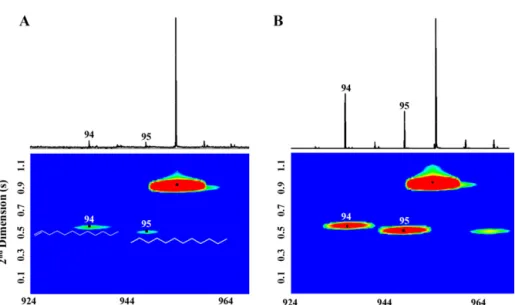
Differentconcentrations,rangingfromnmolartomolarhave beenreportedforvolatilebreathcomponents[13,62],soan impor-tantissueisthesensitivityoftheusedequipment.Consequently, theGC×GC–ToFMSsensitivitywasverified,andforthispurpose astandardsolutioncomprisingstandardspertainingtothe previ-ouslyselectedfamilies(alkanes,alkenes,aldehydesandketones) was used, whose concentration, for instance, varied between 20pg/Lto200ng/L.Thestandardsfromthetestedcompound fam-ilies were detectedat thelevel under study (datanot shown). Fordemonstrationpurposes,1-dodecene(94)anddodecane(95), showedinFig.3,weredetectedatpg/Landng/Llevels.The stud-iedrangewaslowerthanthereportedvaluestoverifythatthis equipmentisabletodetectcompoundsatthisconcentrationlevel, whichcouldberelevanttoidentifytargetcompoundsthatcould beimportantforasthmametabolomicstudies.
3.2. Multivariateanalysisintheestablishmentofasthma “breath-print”
Inthepreviousstudy[3],28compounds,fromatotalof44,were selectedanddistinctionwasachievedwithtworelativelydefined
clustersbetweenthecontrolandtheallergicasthmagroups.As afirstapproach,usingadifferentallergicasthmaandcontrol chil-drenpopulation,fromthe28compoundsidentifiedbyGC–qMS[3], 23werealsoidentifiedbyGC×GC–ToFMSandselectedfor multi-variateanalysis(indicatedinTable2)toverifytheresultsobtained inthepreviousstudy.PLS-DAwasappliedtotheGC×GC chro-matographicunitvariancescaledareastoestablishapreliminary classificationmodelandassesstherelationshipsbetweenthe com-poundsandthesamplesunderstudy.Fig.4Ashowsthatthereare twodefinedclusterswiththecontrolgroupbeingmainlyassociated toLV1negativevaluesandtheallergicasthmagrouptoLV1positive values.Fromthepreviousstudy[3],theallergicasthmagroupwas mainlycharacterizedbydecane,dodecaneandtetradecane,which wereconfirmedwiththisnewsetofchildren(Fig.4B).
However a clear distinction was sought, thus PLS-DA was applied to the full dataset of 134 metabolites identified by GC× GC–ToFMS. Theresultsobtainedare shownin Fig.5Athat presentsthescoresscatterplotofthefirsttwo LatentVariables (LV1×LV2),whileFig.5B(correspondingLV1loadingweightsplot) establishesthecontributionofeachvolatilemetabolitethat pro-motestheobserveddistinction.AccordingtoMCCVstatistics,the PLS-DAmodel had aclassification rateof98% andshowed96% sensitivity(∼=4%allergicasthmachildrenbeingmisclassifiedas con-trols)and95%specificity(∼=5%offalsepositives).Themostfrequent Q2valuewasaround0.9(Fig.6),withalargeprevalenceofvaluesin therangeof0.8–1.Theseresultssuggestthatconfoundingfactors, suchas,ambientair,genderorageseemstohavenosignificance inthedistinctionpower.
Scoresscatterplot(Fig.5A)showsthatthecontrolgroupis asso-ciatedtoLV1negativevalueswhereastheallergicasthmagroup islinkedtopositiveLV1values.AsobservedinFig.5B,nonane, 2,2,4,6,6-pentamethylheptane,decane,3,6-dimethyldecane, dode-cane, and tetradecaneare relatedto theallergicasthma group. Thecontrolgroupismainlycharacterizedby 6-methyl-5-hepten-2-one,1-dodecene,nonanal,decanal,anddodecanal.Comparing theseresultstothepreviousstudy[3],therewasanincreaseinthe numberofcompoundsthatcharacterizeallergicasthmaand con-trolsamples.Interestinglythecontrolsarecharacterizedmainlyby aldehydesandtheasthmaticchildrenarecharacterizedby alka-nes,namelythose thatarisefromthecorrespondingaldehydes. Henceapatternseemstobenoticeablethatmainlyinvolvesthese twochemicalfamilies.Thebehaviourshowninthecontrolgroup hasalsobeenreportedbyCorradietal.[63]asnonanalhadlower
A
B
-0.8 -0.6 -0.4 -0.2 0.0 0.2 0.4 0.6 11 12 23 24 45 58 61 64 68 74 81 84 87 90 95 100117124 125 12813282 39 Loading w[1] Compound Alkanes Aldehydes decanedodecane tetradecane
-8 -6 -4 -2 0 2 4 6 8 -5 -4 -3 -2 -1 0 1 2 3 4 5 L V 2 (31%) LV1 (15%) Control Asthma
Fig.4.PLS-DALV1×LV2scoresscatterplot(A)andLV1loadingweightsplot(B) ofexhaledbreathforallergicasthmaandcontrolchildrenusingasub-setof23 metabolitesidentifiedbyGC×GC–ToFMS,andpreviouslyreportedinastudyrelated toallergicasthma[7](peakattributionshowninTable2).
valuesinexhaledbreathcondensateofchildrenwithexacerbated asthma(beforeandaftertreatment)whencomparedtocontrol.The behaviouroftheremainingaldehydescompoundsthathavehigher weightinthecontrolgrouphasnotbeenpreviouslydescribed.
Arelevantaspectbroughtbytheresultsisthatfromthe67 iden-tifiedalkanes19aremethylated,whichcorrespondsto28%ofthis chemicalfamilyandfromthese,twomethylatedcompounds,asfor example 2,2,4,6,6-pentamethylheptane and 3,6-dimethyldecane haveamajorcontributionintheobserveddistinction.The methy-latedalkanesfamilyhavealsobeenpreviouslyreportedasthese maywellbeimportantinasthmacharacterization[2,64].These compoundsalsohaveanimportantroleindiseases,inwhich oxida-tivestressapparentlymaybeinvolved,buttootherextents,and withdifferentconsequencesthanasthma,suchaslungandbreast cancer,aswellasin lungcancercelllines[65–67].These com-poundshavebeenreportedinliteratureinotherexhaledbreath studiesassociatedtopathologicalstatesofthelungs,butas indi-vidualmarkers.For example,2,2,4,6,6-pentamethylheptane and decanewereidentifiedandcomparedbyPolietal.[68]inexhaled breath of patients withnon-small lung cancer(NSLC), chronic obstructivepulmonarydisease(COPD),smokersandcontrolsand theirconcentrations were higher for NSLC, COPD and smokers whencomparedtocontrols.Dodecanehasbeenproposedaslung cancermarkers[69,70].
These results evidence that overall, for the allergic asthma group,thereisagreaterweightofthealkanesconfirmingthe pre-viousstudy [3]whereas aldehydeshave amajorimportance in thecharacterizationofthecontrolgroup.Alkanes,inthesequence
ofoxidationreactions,areend-compoundsthathavebeen associ-atedtooxidativestressandinflammationprocesses[71]andthe hypothesisformedisthatthesecompoundsindicatethatthe oxida-tivestateisatahigherextentinasthmaticswhencomparedto controlsleadingtotheobtaineddifferencesandconsequentlythe alkanescanbeassociatedtoallergicasthma.Theseparticular com-poundscanbeformedintheinflammatoryresponseinducedbythe immunesystemthatleadstotheproductionofactivatedleukocytes causingthecellstouptakeoxygenreleasingreactiveoxygenspecies whichcandamagelungtissuecontributingtoelevatedoxidative stressinasthma[72]andthereisevidencethatalkanescanarise asproductsof lipidperoxidationofunsaturated fats[73]. Lipid metabolismandoxidativemetabolisminthemitochondriahave beenreportedrecentlytobealteredinurineofasthmapatients[74] andaconjecturecouldbemadethatthisalterationshowninurine canalsobenoticedinexhaledbreath,consideringthealkanesasa measurementoflipidandoxidativemetabolismthatcharacterize theallergicasthmagroup.
3.3. “Breath-print”explorationasapotentialaidtotheclinical practice
Therapymonitoringisoneofthechallengesofactualmedicine aspatientsmayormaynotfollowtreatmentasprescribedbythe physician.Totestthehypothesisthatachangewouldoccurinthe exhaledbreathcompositionwiththeintakeoftheprescribed medi-cation,anaivepatient(patientthathadnevertakenanasthmadrug) wasrecruited.Thisnaivepatientwasdiagnosedbyphysicianas havingallergicasthma,andexhaledbreathwascollectedprevious medicationintakeandthreeothermomentsafterintake.The med-icationthatwasprescribedwasthecombinationofanti-histamine andaleukotrienereceptorantagonist.Anti-histaminesaredrugs thatinhibittheactionofhistaminewhereasleukotrienereceptor antagonistinhibitsleukotrienesthatarecompoundsproducedby theimmunesystemthatcauseinflammation.Thistherapy combi-nationdirectedtoblocktheeffectsofhistamineandleukotriene mediatorswasperformedasitisshownthatitisbetterthan stand-alonetherapy[75].Thebehaviourofanaivechildwasmonitored throughout24days(Fig.5A,markedbythepathtrajectory). Ini-tiallyandafter18 daysaftertheintakeoftheprescribeddrugs, thenaiveindividualremainsinLV1positivevaluesbutfarfrom theremainingcontrolledsubjects.Thereisanevolution through-outLV1axiswithtreatmentadministrationexplainedbythearea reductionofnonane,2,2,4,6,6-pentamethylheptane,decane, 3,6-dimethyldecane,andtetradecane.Consideringthatasthmacrisis ismainlycharacterizedbyinflammation,which isaccompanied byoxidativestressandsubsequentlylipidperoxidation,andthat alkanesareevidenceofthesebiochemicalprocesses,theobserved decreasemaybeduetoalesserinflammationstateofthissubject leadingtolowerareasofthesecompounds.Clinically,thechildin theinitialstageswasinacrisissituationalmostinadailybasisand throughoutthe24daystherewasasignificantimprovementofthe asthmastatuscontrol.
Asverified,theobtained“breath-print”allowedthedistinction betweenallergicasthmaticand controlchildren whichcouldbe helpfulinunderstandingthispathologythroughabetterinsight intothemetabolicpathwaysthatmaybeassociatedtothis con-dition.Nevertheless,forclinicalpurposes,andhavinginmindthe futureofmoleculardiagnosis,asmallersetofcompoundsis nec-essarytoallowarapiduseofexhaledbreathforcomplementary purposesindiagnosis,tofollowthediseasestatusand/orthe med-icationeffect. For thisintent,and takinginto considerationthe previousassertionthatapatternofalkanesandaldehydesclearly definesbothpopulationsunderstudy,just9compounds(nonane, 2,2,4,6,6-pentamethylheptane,decane,3,6-dimethyldecane, dode-cane,tetradecane,nonanal,decanal,anddodecanal)wereselected
A
B
-0.6 -0.4 -0.2 0 0.2 0.4 0.6 Lo ad in g s w [ 1 ] CompoundAlkanes Cycloalkanes Alkenes
2,2,4,6,6-pentamethylheptane decane 2,3,4-trimethylhexane dodecane 1-dodecene nonanal decanal 6-methyl-5-hepten-2-one tetradecane nonane dodecanal -20 -15 -10 -5 0 5 10 15 -15 -10 -5 0 5 10 15 20 L V 2 (14%) LV1 (16%) Control Asthma
1stExhaledBreathSample
2ndExhaledBreathSample -18 days
3rdExhaledBreathSample -24 days
Fig.5. PLS-DALV1× LV2scoresscatterplot(A)andLV1loadingweightsplot(B)ofexhaledbreathforallergicasthmaandcontrolchildrenusingdatasetof134metabolites identifiedbyGC×GC–ToFMS. 0% 10% 20% 30% 40% 50% 60% -1-0.9-0.8-0.7-0.6-0.5-0.4-0.3-0.2-0.1 0 0.10.20.30.40.50.60.70.80.9 1 Frequency (%) Q2values Original Permutation
Fig.6. Q2valuesdistributionoftheoriginalandpermutedMonte-CarloCross
Vali-dationforPLS-DAofexhaledbreathoffulldataset(134metabolites).
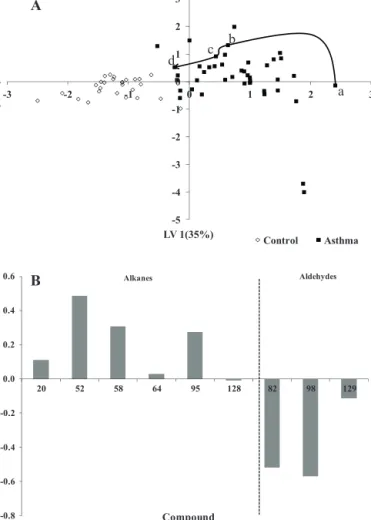
foranewPLS-DAmodel.TheresultsareshowninFig.7Aandthe chosenpatternwasabletodiscriminatebothgroupsshowingthe exhaledbreathtestingisatoolthatcanbeusedasnon-invasive diagnosticmethodforallergicasthma.Toassessboththe predic-tivepowerand classificationmodelrobustness, MCCVwasalso performed,usingsimilarconditionstotheprevioustest. Accord-ingtoMCCVstatistics,thePLS-DAmodelhadaclassificationrate of96%andshowed98%sensitivity(∼=2%allergicasthmachildren beingmisclassifiedascontrols)and93%specificity(∼=7%offalse positives). Themost frequentQ2 value wasaround0.8 (Fig.8), withalargeprevalenceofvaluesintherangeof0.7–0.9. Classi-ficationrateandspecificitywereslightlylowerthanthoseobtain forthefulldataset,but,still,remainedhigh.Thesensitivitywas improved. These resultssuggestthat themodel is robust,even using this setof 9 metabolites, reducing thetime of data pro-cessing,andthus,becomingmoreexpeditemethodfortheclinical purposes.
AremarkableresultobservedinFig.7isshownbythepathof thenaivechild(athroughd– fourbreathsampling),which sug-gest themitigationofasthma symptomsfollowing drugintake.
A
B
-0.8 -0.6 -0.4 -0.2 0.0 0.2 0.4 0.6 129 98 82 128 95 64 58 52 20 L oadi n g s w [1] Compound Alkanes Aldehydes -5 -4 -3 -2 -1 0 1 2 3 -3 -2 -1 0 1 2 3 L V 2(21%) LV 1(35%) Control Asthmaa
b
c
d
Fig.7. PLS-DALV1×LV2scoresscatterplot(A)andLV1 loadingweightsplot (B)ofexhaledbreathforallergicasthmaandcontrolchildrenusingasub-setof 9compounds:nonane(20),2,2,4,6,6-pentamethylheptane(52),decane(58), 3,6-dimethyldecane(64),dodecane(95),tetradecane(128),nonanal(82),decanal(98), dodecanal(129).Pathofthenaivechild–athroughd–fourbreathsampling.
Thissuggeststheapplicationofexhaledbreathanalysis,notonly formetabolomicprofilingofallergicasthma,butalsoinclinical practiceasapossiblesurrogatetotheinvasivediagnosistests per-formedactually. 0% 10% 20% 30% 40% 50% -1 -0.9-0.8-0.7-0.6-0.5-0.4-0.3-0.2-0.1 0 0.10.20.30.40.50.60.70.80.9 1 Frequency (%) Q2values
Model Permutation
Fig.8. Q2valuesdistributionoftheoriginalandpermutedMonte-CarloCross
ValidationforPLS-DAofexhaledbreath ofsub-setof9metabolites:nonane, 2,2,4,6,6-pentamethylheptane,decane, 3,6-dimethyldecane, dodecane, tetrade-cane,nonanal,decanal,anddodecanal.
4. Conclusions
In this study, the development of the first
HS–SPME/GC×GC–ToFMS methodology was reported for the analysis of exhaled breath of allergic asthma children and the advantages of comprehensivechromatography was exploredin issuessuchasthestructuredchromatogramandsensitivity.The structured2Dchromatogramthatarosefrom1Dvolatilityand2D polaritywasshownandsensitivitywasassessed.Awell-defined chromatographicspacewasobtainedwiththeresultingstructured chromatogram,whichcanaidposteriorexhaledbreathanalysisfor exampleintheidentificationofotherwiseunknowncompounds. Subsequently,thepotentialityoftheGC×GC–ToFMSwasverified in exhaled breath samples from allergic asthma and control children.
The methodology allowedthe identification of several hun-dredcompoundspertainingtodifferentchemicalfamilies(linear andramified alkanes,cycloalkanes,alkenes,aldehydes, ketones, aromaticcompounds,terpenoidsandesters).Multivariate analy-siswasperformedbyPLS-DAtoa groupofselectedcompounds pertaining to alkanes, alkenes, aldehydes,and ketonesand the GC× GC–ToFMSshowedtobeadvantageousasdistinctionbetween both groups was attained and a high classification rate was achieved. The obtained “breath-print” allowed the discrimina-tionbetweenallergic asthmatic andcontrol children, providing insightsintothemetabolicpathwaysthatmaybeassociatedto allergicasthma.Ingeneral,apatternofsixcompoundspertaining to the alkanes characterized the asthmatic population: 3,6-dimethyldecane, nonane,2,2,4,6,6-pentamethylheptane, decane, dodecane,andtetradecane.Otherwise,asetofaldehydes(nonanal, decanal,anddodecanal)characterizesthecontrolpopulation.Thus, asmallersetof9compoundscomprisingalkanesandaldehydes waschosentoverifythepotentialclinicalusefulnessofexhaled breathforallergicasthmaevaluationandtheobtainedresultsare verysatisfactoryas,withthisset,distinctionwasobtained.Itwas alsoconfirmedthatitisalsopossibletofollowthroughtheeffects ofmedication.
Exhaledbreathmetabolomepresentsitselfasachallenge,and inouropinion,GC×GC–ToFMSoffersadvantagesthatwere veri-fiedinthepresentstudythatcorrespondedtothechallenge.This newmethodologicalapproachtocharacterizeallergicasthmaasa functionofitsmetabolomicpatternswillenhancethepossibilityof furtherallergicasthmapathwaysknowledge.Italsoprovideswith aneasiermethodologycombined witha non-invasive sampling forallergicrespiratorydiseaseassessment,regarding diagnostic, prognosticandtreatmentfollow-up.Furtherstudieswithalarger populationarenecessarytoconfirmthesefindings.
Acknowledgements
M.CaldeirathanksFCT(Fundac¸ãoparaaCiênciaeTecnologia) forhisPh.D.grant(SFRH/BD/40374/2007).Theauthorsaregrateful tothedonorsthatkindlysuppliedthesamplesandtoPaediatric andImmunoalergologyServicesoftheHospitalInfanteD.Pedro E.P.E(Aveiro,Portugal)forallergicasthmasamples,aswellas,CIAQ (CentrodeInfânciadeArteeQualidade,Aveiro,Portugal)forcontrol samples.ThefinancialsupportoftheResearchUnit62/94,QOPNA (ProjectPEst-C/QUI/UI0062/2011)andtheconditionstoperform thisstudyarealsoacknowledged.TheauthorsalsothankSigma –Aldrich(Portugal)forprovidingthefirstdimensioncolumnfor GC×GC–ToFMSanalysis.
References
[1] Global Strategyfor Asthma Management and Prevention. National Insti-tutes of Health, National Heart, Lung and Blood Institute, Bethesda.
[2]J.W.Dallinga,C.M.Robroeks,J.J.B.N.VanBerkel,E.J.C.Moonen,R.W.L. God-schalk,Q.Jobsis,E.Dompeling,E.F.M.Wouters,F.J.VanSchooten,Clin.Exp. Allergy40(2009)68.
[3]M.Caldeira,A.S.Barros,M.J.Bilelo,A.Parada,J.S.Câmara,S.M.Rocha,J. Chro-matogr.A1218(2011)3771.
[4]M.Barker,M.Hengst,J.Schmid,H.-J.Buers,B.Mittermaier,D.Klemp,R. Kopp-mann,Eur.Respir.J.27(2006)929.
[5] I.Horváth,Z.Lázár,N.Gyulai,M.Kollai,.G.Losonczy,Eur.Respir.J.34(2009) 261.
[6] E.M.Gaspar,A.F.Lucena,J.D.daCosta,H.C.dasNeves,J.Chromatogr.A1216 (2009)2749.
[7] T.Górecki,O.Pani ´c,N.Oldridge,J.Liq.Chromatogr.Relat.Technol.29(2006) 1077.
[8] P.Marriott,R.Shellie,Trend.Anal.Chem.21(2002)573. [9]R.Shellie,P.J.Marriott,P.Morrison,Anal.Chem.73(2001)1336.
[10] M.Libardoni,P.T.Stevens,J.H.Waite,R.Sacks,J.Chromatogr.B842(2006)13. [11]J.M.Sanchez,R.D.Sacks,Anal.Chem.78(2006)3046.
[12] M.Mieth,J.K.Schubert,T.Groger,B.Sabel,S.Kischel,P.Fuchs,D.Hein,R. Zimmermann,W.Miekisch,Anal.Chem.82(2010)2541.
[13] N.Marczin,S.A.Kharitonov, M.H.Yacoub,P.J.Barnes, DiseaseMarkersin ExhaledBreath,Taylor&Francis,NewYork,2005,p.220.
[14]P.Mochalski,B.Wzorek,I.Sliwka,A.Amann,J.Chromatogr.B877(2009)189. [15]J.Dallüge,J.Beens,U.A.T.Brinkman,J.Chromatogr.A1000(2003)69. [16]L.Mondello,P.Q.Tranchida,P.Dugo,G.Dugo,MassSpectrom.Rev.27(2008)
101.
[17]E.Engel,C.Baty,D.LeCorre,I.Souchon,N.Martin,J.Agric.FoodChem.50(2002) 6459.
[18]P.Ciccioli,E.Brancaleoni,A.Cecinato,R.Sparapani,M.Frattoni,J.Chromatogr. A643(1993)55.
[19]S.Wu,H.Zorn,U.Krings,R.G.Berger,FlavourFrag.J.22(2007)53.
[20]X.Xu,L.L.P.vanStee,J.Williams,J.Beens,M.Adahchour,R.J.J.Vreuls,U.A.T. Brinkman,Atmos.Chem.Phys.3(2003)665.
[21]C.E.Quijano,G.Salamanca,J.A.Pino,FlavourFrag.J.22(2007)401.
[22]E.A.Courtois,C.E.Paine,P.A.Blandinieres,D.Stien,J.Bessiere,E.Houel,C. Baraloto,J.Chave,J.Chem.Ecol.35(2009)1349.
[23] N.Ramarathnam,L.J.Rubin,L.L.Diosady,J.Agric.FoodChem.41(1993)933. [24]N.Ramarathnam,L.J.Rubin,L.L.Diosady,J.Agric.FoodChem.41(1993)939. [25]E.Alissandrakis,A.C.Kibaris,P.A.Tarantilis,P.C.Polissiou,J.Sci.FoodAgric.85
(2005)1444.
[26] V.G.Zaikin,R.S.Borisov,J.Anal.Chem.57(2002)544.
[27]J.A.Pino,J.Mesa,Y.Mu ˜noz,M.P.Martí,R.Marbot,J.Agric.FoodChem.53(2005) 2213.
[28]G.Flamini,M.Tebano,P.L.Cioni,Y.Bagci,H.Dural,K.Ertugrul,A.Savran,Plant Syst.Evol.261(2006)217.
[29] Z.Wang,M.Fingas,K.Li,J.Chromatogr.Sci.32(1991)367. [30]C.Macku,T.Shibamoto,J.Agric.FoodChem.11(1991)1987.
[31]X.Zhang,L.Ding,Z.Sun,L.Song,T.Sun,Chromatographia70(2009)511. [32] A.Jarunrattanasri,C.Theerakulkait,K.R.Cadwallader,J.Agric.FoodChem.55
(2007)3044.
[33]M.Hazzit,A.Baaliouamer,M.L.Faleiro,M.G.Miguel,J.Agric.FoodChem.54 (2006)6314.
[34] C.E.Rostad,W.E.Pereira,J.Hist.Res.Chromatogr.Chromatogr.Commun.9 (1986)328.
[35]K.Insausti,V.Go ˜ni,E.Petri,C.Gorraiz,M.J.Beriain,MeatSci.70(2005)83. [36]G.Flamini,L.Cioni,I.Morelli,FlavourFrag.J.19(2004)327.
[37]R.B.Singer,A.Flach,S.Koehler,A.J.Marsaioli,M.C.E.Amaral,Ann.Bot.Rome93 (2004)755.
[38]S.Maccioni,R.Baldini,P.Cioni,M.Tebano,G.Flamini,FlavourFragr.J.22(2007) 61.
[39]E.Gómez,C.A.Ledbetter,P.L.Hartsell,J.Agric.Food.Chem.41(1993)1669. [40]Y.X.Zeng,C.X.Zhao,Y.Z.Liang,H.Yang,H.Z.Fang,L.Z.Yi,Z.D.Zeng,Anal.Chim.
Acta595(2007)328.
[41]J.L.Berdague,C.Denoyer,J.L.Wuéré,E.Sermon,J.Agric.FoodChem.39(1991) 1257.
[42]W.A.Asuming,P.S.Beauchamp,J.T.Descalzo,B.C.Dev,V.Dev,S.Frost,C.W.Ma, Biochem.Syst.Ecol.33(2005)17.
[43]S.Celik,R.S.Gokturk,G.Flamini,P.L.Cioni,I.Morelli,Biochem.Syst.Ecol.33 (2005)617.
[44]G.Flamini,M.Tebano,P.L.Cioni,Anal.Chim.Acta589(2007)120. [45] H.Widmer,J.GasChromatogr.5(1967)506.
[46]C.E.Quijano,G.Salamanca,J.A.Pino,FlavourFragr.J.22(2007)401. [47] M.Kallio,M.Jussila,T.Rissanen,P.Antilla,K.Hartonen,A.Reissel,R.Vreuis,M.
Adahchour,T.Hyotylainen,J.Chromatogr.A1125(2006)234. [48] W.C.Lai,C.Song,Fuel37(1995)1436.
[49]H.Rembold,P.Wallner,S.Nitz,H.Kollmannsberger,F.Drawert,J.Agric.Food Chem.37(1989)659.
[50]E.Alissandrakis,P.A.Tarantilis,P.C.Harizanis,M.Polissiou,J.Agric.FoodChem. 55(2007)8152.
[51]G.Flamini,P.Cioni,I.Morelli,FoodChem.91(2005)63.
[52] F.Kenig,D.J.H.Simons,D.Crich,J.P.Cowen,G.T.Ventura,T.Rehbein-Khalily, Org.Geochem.36(2005)117.
[53] H.VandenDool,P.D.Kratz,J.Chromatogr.11(1963)463.
[54] L.Eriksson,E.Johansson,N.Kettaneh,N.Wold,S.Wold,Multiand Megavari-ateDataAnalysis,PrinciplesandApplications,UmetricsAB,Umea,Sweden, 2001.
[55]R.Perestrelo,A.S.Barros,J.S.Câmara,S.M.Rocha,J.Agric.FoodChem.59(2011) 3186.
[56]I.Silva,S.M.Rocha,M.A.Coimbra,J.Marriott,Chromatogr.A1217(2010) 5511.
[57]J.D.Pleil,M.A.Stigiel,J.R.Sobus,S.Tabucchi,A.J.Ghio,M.C.Madden,J. Chro-matogr.B878(2010)1753.
[58]J.Beauchamp,F.Kirsch,A.Buettner,J.BreathRes.4(2010)1.
[59]W.Miekisch,J.Schubert,G.Noeldge-Schomburg,Anal.Chim.Acta347(2004) 25.
[60]C.vonMühlen,P.J.Marriott,Anal.Bioanal.Chem.401(2011)2351.
[61]T.C.Tran,G.A.Logan,E.Grosjean,D.Ryan,P.J.Marriott,Geochim.Cosmochim. Acta74(2010)6468.
[62] J.Rudnicka,T.Kowalkowski,T.Ligor,B.Buszewski,J.Chromatogr.B879(2011) 3360.
[63]M.Corradi,G.Folesani,R.Andreoli,P.Manini,A.Bodini,G.Piacentini,S.Carraro, S.Zanconato,E.Baraldi,Am.J.Respir.Crit.CareMed.167(2003)395. [64] B.Ibrahim,M.Basanta,P.Cadden,D.Singh,D.Douce,A.Woodcock,S.J.Fowler,
Thorax66(2011)804.
[65]M.Ligor,T.Ligor,A.Bajtarevic,C.Ager,M.Pienz,M.Klieber,H.Denz,M.Fiegl, W.Hilbe,W.Weiss,P.Lukas,H.Jamnig,M.Hackl,B.Buszewski,W.Miekisch,J. Schubert,A.Amann,Clin.Chem.Lab.Med.47(2009)550.
[66] W.Filipiak,A.Sponring,A.Filipiak,C.Ager,J.Schubert,W.Miekisch,A.Amann, J.Troppmair,CancerEpidemiol.BiomarkersPrev.19(2010)182.
[67]A.Bajtarevic,C.Ager,M.Pienz,M.Klieber,K.Schwarz,M.Ligor,T.Ligor,W. Filipiak,H.Denz,M.Fiegl,W.Hilbe,W.Weiss,P.Lukas,H.Jamnig,M.Hackl,A. Haidenberger,B.Buszewski,W.Miekisch,J.Schubert,A.Amann,BMCCancer9 (2009)348.
[68]D.Poli,P.Carbognani,M.Corradi,M.Goldoni,O.Acampa,B.Balbi,L.Bianchi, M.Rusca,A.Mutti,Respir.Res.6(2005)71.
[69] X.Chen,F.Xu,Y.Wang,Y.Pan,D.Lu,P.Wang,K.Ying,E.Chen,W.Zhang,Cancer 110(2007)835.
[70]H.Yu,L.Xu,P.Wang,J.Chromatogr.B826(2005)69.
[71]S.A.Kharitonov,P.J.Barnes,Am.J.Respir.Crit.CareMed.163(2001)1693. [72]W.MacNee,Eur.J.Pharmacol.429(2001)195.
[73]E.Aghdassi,J.Allard,FreeRad.Biol.Med.28(2000)880.
[74]E.Saude,C.Skappak,S.Regush,K.Cook,A.Ben-Zvi,A.Becker,R.Moqbel,B. Skyes,B.Rowe,D.Adamko,J.AllergyClin.Immunol.127(2011)757. [75]A.Roquet,B.Dahlen,M.Kumlin,E.Ihre,G.Anstren,S.Binks,S.E.Dahlen,Am.J.