1
Acknowledgements
I would like to thank to the following:1. Dr. Sergi Bermúdez. My advisor and supervisor, his critiques and guidance throughout this process were extremely invaluable.
2. My family and friends who have supported me in many ways through this difficult journey. Thank you to my Father Luciano Vieira, my Mother Fátima Vieira and my sisters, Diana Vieira and Daniela Vieira. A especially reference to my girlfriend Ana Nunes, for all the support and words of incentive that kept me going during this process.
3. To all my Computer Science colleagues for their help and insightful comments through the years. Aquilino Viveiros, Roberto Nunes were key elements during this journey. The exchange of ideas has proven to be most helpful in many aspects of this thesis.
3
Abstract
Social network sites (SNSs) have gained much popularity and attention of academic and industry researchers intrigued by the opportunities they give people to reach others in an easy and timely manner, to exchange and share various kinds of information. As recognition of this fact, there has been a growing attention over the last years in the development of health social networks and their impact on the people. However current health social networks suffer different limitations related with their functionality and usability. Furthermore, the majority of these health social networks only meet present information about treatments and symptoms, and do not are designed for health professionals and researchers. This work presents the implementation of a health social network which aims at filling existing gaps, allowing people to have a direct interaction with the health professionals and the possibility to participate from home in training activities and research studies to improve their recovery. Additionally, offers health professionals and researchers the possibility to create and deploy new types of trainings and assess the impact in the recovery of people. Surveys and usability tests were performed to validate the conceptual and design ideas.
Keywords
Social network sites (SNSs), Patients, Health Professionals, Researchers, Remote monitoring, At home training, Survey, Usability.
5
Resumo
Sites de redes sociais ganharam muita popularidade e atenção de investigadores acadêmicos e da indústria intrigados com as oportunidades que eles dão às pessoas para comunicar com outros de uma maneira fácil e em tempo oportuno, para trocar e partilhar vários tipos de informação. Como reconhecimento deste facto, tem havido uma crescente atenção nos últimos anos no desenvolvimento das redes sociais de saúde e no seu impacto nas pessoas. No entanto redes sociais de saúde atuais sofrem de diferentes limitações relacionados com a sua funcionalidade e usabilidade. Além disso, a maioria dessas redes sociais de saúde só apresenta informações sobre tratamentos e os sintomas, e não são projetados para profissionais de saúde e investigadores. Este trabalho apresenta a implementação de uma rede social de saúde com o objectivo de preencher lacunas existentes, permitindo que as pessoas tenham uma interação direta com os profissionais de saúde e a possibilidade participar desde casa em actividades e pesquisas para melhorar a sua recuperação. Além disso, oferece aos profissionais de saúde e investigadores a possibilidade de criar e implementar novos tipos de exercícios e avaliar o impacto na recuperação de pessoas. Foram realizados questionários e testes de usabilidade para validar as ideias conceituais e de design.
Palavras-chave
Sites de redes sociais, Pacientes, Profissionais de Saúde, Investigadores, Monitoramento remoto, Treinamento em casa, Questionários, Usabilidade.
7
Table of Content
Table of Content ... 7 List of Figures ... 9 List of Tables ... 11 Chapter 1. Introduction ... 13 1.1. Motivation ... 15 1.2. Contribution ... 15Chapter 2. State of the art ... 17
2.1. Social networks ... 17
2.2. Social Networks in Health ... 21
2.3. Services provided by health social networks ... 21
2.3.1. Information sharing and emotional support ... 22
2.3.2. Health Professionals Questions and Answers (Q&A) ... 22
2.3.3. Quantified self-tracking ... 23
2.3.4. Clinical trials access ... 25
2.3.5. Summary ... 25
Chapter 3. Functional analysis of existing systems ... 29
Chapter 4. Assessing the needs of end users ... 35
4.1. Patients needs... 35
4.2. Health professionals needs... 45
Chapter 5. System development ... 57
5.1. Use Cases ... 57
5.1.1. What is Use Cases ... 57
5.1.2. RehabNet Use Cases ... 58
5.2. Functional Requirements ... 61
5.2.1. Registration requirements... 61
5.2.2. Visualization requirements ... 62
5.3. Non-Functional Requirements ... 64
5.4. RehabNet mockups and Evaluation ... 64
5.5. Prototype development ... 74
5.5.1. Top open source social networks ... 75
5.5.2. Elgg Social Networking ... 76
8
5.6.1. User Interface ... 78
5.6.2. Standard social features ... 80
5.6.3. Advanced RehabNet features ... 82
Chapter 6. Conclusions ... 89
References ... 91
ANNEX I. Major Health Social Networks ... 95
ANNEX II. Ethics Document ... 99
ANNEX III. Usability Questionnaire... 113
III.1. Health Professionals Questionnaire ... 113
III.2. Patients Questionnaire ... 116
III.3. Mockups test ... 118
9
List of Figures
Figure 1 - The rise of the global social networking audience between 2007 and 2011 ... 17
Figure 2 - Percentage of online population using social networking around the world ... 18
Figure 3 – World map of social networks in June 2013 ... 19
Figure 4 - Social networking penetration among worldwide demographic groups ... 20
Figure 5 – Analysis of social networking in Portugal... 20
Figure 6 - PatientsLikeMe profile examples ... 22
Figure 7 - Example of a MedHelp physician homepage ... 23
Figure 8 - PatientsLikeMe ALS profile charts example ... 24
Figure 9 - CureTogether patient-entered treatment statistics ... 24
Figure 10 - Main features offered by health social networks ... 29
Figure 11 - Features offered by health social networks ... 30
Figure 12 - Hours of usage of the computer by the patients separated by age ... 37
Figure 13 - Hours of usage of the internet with the patients separated by age ... 37
Figure 14 - Hours of usage of social networks with the patients separated by age ... 38
Figure 15 - Number of consultations needed by the patients ... 38
Figure 16 - Time that the patients spent in treatment, including the transportation. ... 39
Figure 17 - Means of communication normally used by the patients to contact the health professionals... 40
Figure 18- Potential of each mean of communication... 40
Figure 19 – Frequency that the patients would like to receive evaluations by health professionals... 41
Figure 20 - The importance of having remote evaluations with the patients separated by age 42 Figure 21 -The content that should be on the forum ... 42
Figure 22 - By whom the forum should be used ... 43
Figure 23 - Level of interest in using the tool presented with the patients separated by age ... 44
Figure 24 - Potential of each mean of communication ... 47
Figure 25 - Level of actualization about new therapies / technologies ... 47
Figure 26 - Need to find new treatments ... 48
Figure 27 - Importance of follow frequently the patient ... 48
Figure 28 - Frequency of notifications that would want to receive... 49
Figure 29 - Utility of the family members having access to patients developments ... 50
Figure 30 - Importance of having remote consultations with the patients ... 51
Figure 31 - Amount of patients that can benefit from this site ... 51
Figure 32 - The forum should contain ... 52
Figure 33 - By whom the forum should be used ... 53
Figure 34 - Level of interest in using the tool presented ... 54
Figure 35 - Use case example ... 57
Figure 36 - New user use case ... 58
Figure 37 - Patients Use Case ... 59
Figure 38 - Researcher use case ... 60
Figure 39 - Doctor use case ... 61
10
Figure 41 - Registration form... 66
Figure 42 - Initial researcher page ... 66
Figure 43 - Messages page ... 67
Figure 44 - Compose message ... 68
Figure 45 - Received message page ... 68
Figure 46 - My researches ... 69
Figure 47 - New research page ... 70
Figure 48 - Create a new research ... 70
Figure 49 - Forums page ... 71
Figure 50 - New topic page ... 71
Figure 51 - Members page ... 72
Figure 52 - Other user profile page ... 72
Figure 53 - Add a user as a friend ... 73
Figure 54 - Profile page ... 73
Figure 55 - Elgg default theme ... 78
Figure 56 – Home Page of RehabNet ... 79
Figure 57 - Messages page ... 80
Figure 58 - Forums page ... 81
Figure 59 - Members page ... 81
Figure 60 - Agenda page ... 82
Figure 61 - Trainings List... 83
Figure 62 - My trainings page for doctors or researchers ... 83
Figure 63 - My trainings page for patients ... 84
Figure 64 - Training page with external game ... 84
Figure 65 - Create research step 1/3 ... 85
Figure 66 – Create research step 2/3 ... 86
Figure 67 - Create research step 3/3 ... 86
Figure 68 - All researches page ... 87
Figure 69 - My researches page ... 87
Figure 70 - Results page ... 88
Figure 71 - Daily Strengh features ... 95
Figure 72 - Ehealth features ... 96
Figure 73 - Patients like me features ... 96
Figure 74 - Inspire features ... 97
11
List of Tables
Table 1 - List of health social networks and the services offered. ... 26
Table 2 - Gender distribution of the patients ... 35
Table 3 - Age distribution of the patients that answered the inquiry ... 36
Table 4 - Scholarship distribution of the patients... 36
Table 5 - Diagnosis distribution of the patients ... 36
Table 6 - Health professionals that answered the inquiry ... 45
Table 7 - Age distribution of the health professionals ... 46
Table 8 - Gender distribution of the health professionals ... 46
13
Chapter 1. Introduction
Movement disorders are a group of conditions and syndromes affecting the ability to produce and control bodily movements. It seems simple and effortless, but normal movement requires an astonishingly complex control system. Disruption of any portion of this system can cause a person to produce movements that are too weak, too forceful, too uncoordinated, or too poorly controlled for the task at hand. Unwanted movements may occur at rest, intentional movement may become impossible. Abnormal movements are symptoms of underlying disorders. Disorders or conditions that may cause abnormal movements include: cerebral palsy, choreoasthetosis, encephalopathiesc, essential tremor, inherited ataxias, parkinson disease, psychogenic disorders, restless legs syndrome, spasticity, stroke, tourette syndrome, wilson disease [1]. Inside this group of movement disorders, stroke is one of the main causes of adult disability in high-and-middle-income countries with about 16 million first event stroke incidents per year [2] . Despite this project it is designed for all the people with movement disorders, it is more focused on stroke survivors because the high economic and social cost[2].
The process of recovering from a stroke usually includes hospitalization treatment and continued at home rehabilitation. Because stroke survivors often have complex rehabilitation needs, progress and recovery are different for each person. Treatment for stroke begins in a hospital with "acute care". This first step includes helping the patient survive, preventing another stroke, and taking care of any other medical problems. Spontaneous recovery happens naturally soon after the stroke, and some abilities that have been lost usually start to come back. This process is quickest during the first few weeks. Rehabilitation helps the person keep abilities and gain back lost abilities to become more independent. It usually begins while the patient is still in acute care. For many patients, it continues afterward, either as a formal rehabilitation program or as at home individual rehabilitation services. Many decisions about rehabilitation are made by the patient, family, and hospital staff before discharge from acute care [3].
There are several kinds of rehabilitation programs:
Hospital programs – These programs can be provided by special rehabilitation hospitals or by
rehabilitation units in acute care hospitals. Complete rehabilitation services are available. The patient stays in the hospital during rehabilitation. An organized team of specially trained professionals provides the therapy. Hospital programs are usually more intense than other programs and require more effort from the patient.
14
Nursing facility programs - As in hospital programs, the person stays at the facility during
rehabilitation. Some provide a complete range of rehabilitation services, with specially trained professionals, machines and therapies to improve the patient rehabilitation. Others provide only limited services, with less trained professionals or machines during rehabilitation.
Outpatient programs - Outpatient programs allow a patient who lives at home to get a full
range of services by visiting a hospital outpatient department, outpatient rehabilitation facility, or day hospital program.
Home-based programs - The patient can live at home and receive rehabilitation services from
visiting professionals. An important advantage of home programs is that patients learn skills in the same place where they will use them [3].
Each of the above programs has advantages and disadvantages, and do not cover the total aspects of a person with special needs. Hence, both the economical and the psycho-social impact of stroke emphasize that we need to find more effective diagnostics, treatment and rehabilitation approaches.
ICT based new approaches to stroke rehabilitation have appeared in recent years, such as Virtual Reality, Telemedicine among others. Telemedicine has been defined broadly as the use of telecommunications technologies to provide medical information and services [4]. Technically, this encompasses all aspects of medicine practiced at a distance, including use of telephone, fax, and electronic mail technology, as well as the use of interactive full-motion integrated video and audio that brings together patients and providers separated by distance [5].
One of the approaches that are emerging in telemedicine is social network sites. These platforms provide a fast and easy way to reach large populations in variety of ways, with great diversity of services and in a short time. Among the services that can be used in health social networks are messages, chats, videos, forums besides contents like calendars, games, among others. This work contributes to the creation of a novel method in the area of telemedicine by using a social network that allow patients to recover at home but with direct interaction with other patients, health professionals, contributing to the validation of at home based therapies.
15
1.1.
Motivation
This thesis has the following motivations:
The necessity to provide a more accessible recovery program for people with movement disorders.
The necessity to provide tools to reduce both economical and social costs for the patients and families.
Allow patients with movement disorders to train different activities without getting out of their home.
Allow the health professionals to follow the progress of their patients after hospital discharge.1.2.
Contribution
The main contribution of this thesis refers to the creation of a social network that allows people to recover at home with direct interaction between patients them and with health professionals. By addressing this current limitation of rehabilitation programs, our project contributes to improve the communication between patients, health professionals, researchers and other practitioners. Additionally this thesis also contributes to:
Create a platform to validate different methods of rehabilitation for patients with movement disorders and their acceptation and utility for patients, health professionals and other practitioners.
Provide a novel tool to improve the quality of life of patients and their families by allowing at home training and reduce associated costs with transportation and increased dependencies of patients.
Identify limitation of current rehabilitation programs and reuse the solution for future developments.17
Chapter 2. State of the art
This chapter includes the state of the art of social network sites, and their use on health, by discussing how they emerged and their history.
2.1.
Social networks
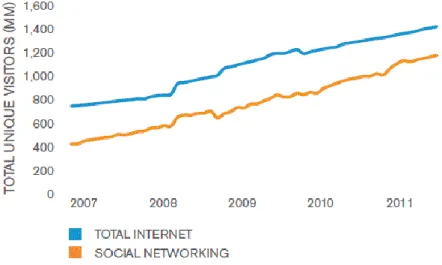
Social networking has become an everyday term and a common method of communication for many people. This phenomenon occurred after the rise of the Internet, despite the concept exists since 1960 (with the University of Illinois Plato computer-based education tool) [6]. Since the launch of SixDegrees.com in 1997, thousands of networks with different formats and objectives appeared online [6]. To be considered a social network, a website should give the users the possibility create a public or semi-public profile, share connections with others inside that system and view the content that is shared by their list of connections. The way that those connections are made may vary from site to site [7]. According to comScore, social networking sites reach 82% of the world’s online population, representing 1.2 billion users around the world (figure 1). In terms of time spent on social networks, the percentage has more than tripled in the last years. In October 2011, social networking ranked as the most popular content category in worldwide engagement, accounting for 19% of all time spent online. Nearly 1 in every 5 minutes spent online is now spent on social network sites [8].
Figure 1 - The rise of the global social networking audience between 2007 and 2011. Adapted from [8].
18
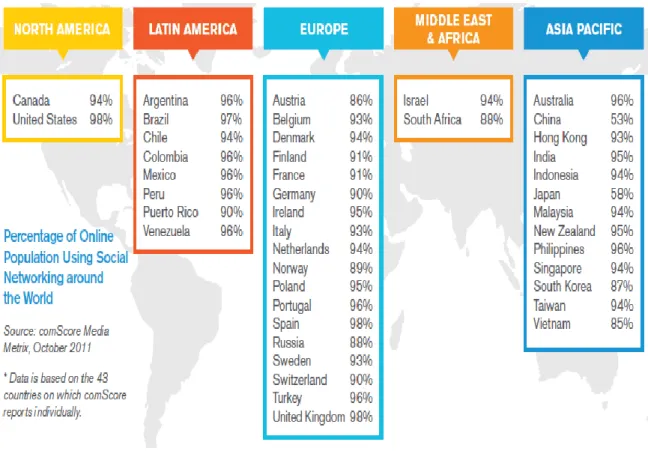
The growth of social networks surpassed all barriers. Regardless of language, available technology, culture or habits, social networks grew all over the world. When we analyze country by country it is possible to see that the percentage of online population that uses social networks vary from 54 percent in China to an impressive 98% in the United States (figure 2) [8]. Another fact that demonstrates the enthusiasm of people for social networks is the increase of time spent using those platforms, with at least 35 percent of growth around the world in 2011 [8].
Figure 2 - Percentage of online population using social networking around the world. Adapted from [8].
The growth of social networks is so present worldwide, that Facebook is the third largest web property behind Google and Microsoft sites. In the beginning of 2010, Facebook was the category leader in 30 of the 43 markets. In 2013, Facebook was the leader in 127 of 137 markets with 1.155 billion monthly active users (figure 3) [9]. Another important milestone was the fact that Facebook accounted for approximately 3 in every 4 minutes spent on social networking sites and 1 in every 7 minutes spent online around the world [8].
19
Figure 3 – World map of social networks in June 2013 Adapted from [9]
The internet and social networking is generally associated with young people, because older people tend to participate less in community and social activities. Besides, physical and health problems can lead to social isolation. But that changed with social network becoming part of the live of older people. In fact, users 55 years old and older represent the fastest growing segment in social networking usage (figure 4). Even more striking, in regions such as North America and Latin America, Social Networking reached at least 93% of online users age 55 and older. As is possible to see in figure 4, males is other group that represent a fast growing segment in social, with almost 10 percent point increase in reach from July 2010 to October 2011 [8].
In the case of Portugal (figure 5), the percentage of online population visiting social networks (96%), it is possible to see that almost people that uses internet uses social networks, with Facebook having the more percentage of visitors. One significant aspect is the difference between males and females visiting social networks, and this difference increases with the age of the users.
20
Figure 4 - Social networking penetration among worldwide demographic groups between July 2010 and October 2011. Adapted from [8]
Figure 5 – Analysis of social networking in Portugal. Upper left - Percentage of online population using social networking in Portugal. Upper right – Top 5 social networks by unique vistiors and average minutes per visitor. Lower left – Social networking demographic reach. Lower center – Average engagement with social networking.
21
2.2.
Social Networks in Health
About 20% of the content generated by internet users mentions health in some way [10]. According to Pew Internet Research, 60 percent of connected people use internet as their first source of information about health-related matter [10]. Due to the high percentage of the world’s online population social networks is one of the biggest online locations for searching about health care. Health social networks can be viewed as platforms where users can find or share information related with different types of health conditions. An essential feature on a health social network is the possibility to provide emotional support through interaction and sharing of knowledge between people who have the same kind of health problems. In recent years, some health social networks such as CarePages (www.carepages.com), PatientsLikeMe (www.patientslikeme.com), and CureTogether (www.curetogether.com) do an excellent job in this regard, providing access to more health-related information. Research made on this non-traditional way of sharing and finding information show this can increase the level of knowledge and change the decision-making of people in health-related matters. Research shows positive feedback from the patients, when the subject is share and seek information in this type of platforms. Health social networks should be seen as an extension, not a replacement, of patients existing social networks. This platform could serve to patients to interact, but are open to friends and family to join and offer additional knowledge and support [11].
Health professionals can give a major contribution to any online health social network. In these platforms they can connect with patients when they find it is appropriate, besides having face to face meetings. This option allows health professionals to know sooner about patient conditions, complaints, rehabilitations process or behaviors. The possibility to have extra knowledge concedes more information to health professionals to perform better diagnosis and prescriptions. Online health social networks can be a great tool to reduce the support gap between big city and rural community [11].
2.3.
Services provided by health social networks
This section has an in-depth review of the services provided by health social networks: information sharing and emotional support, health professionals questions and answers (Q&A), quantified self-tracking and clinical trials access.
22
2.3.1.
Information sharing and emotional support
The major health social networks offer a mix of information sharing and emotional support with no costs associated. There are some differences in the methods and the objectives, some giving more importance to information and research publications and others to social connection and support. Generally this information is auto-populated using Wikipedia articles and PubMed links. Besides this information, patients might give a more personal experience and contribute with more information by inserting their own conditions, symptoms, treatments. Information sharing gives the patient an escape that could lead to emotional and social support. Emotional support can be experienced by being a community member, seeing that there are other people in the same situation; and how they describe the same conditions and symptoms; knowing what type of remedies others have tried; and though user interaction (Figure 6). By giving all of this possibilities health social networks attract patients, who suffer from a particular condition and their relatives, that seek more information about it and to know what they could do to help [12].
Figure 6: Left - PatientsLikeMe profile examples that allow people to see each other profile for an HIV, MS, Parkinson’s Disease and Anxiety patient. Right - DailyStrength activity feed items in chat. Adapted from [13]
2.3.2. Health Professionals Questions and Answers (Q&A)
Information sharing and emotional support between patients allows them to know and interact with people with the same type of problems, but do not give the patients the same type of assurance that a health professional can give. This can be solved by offering a possibility to pose questions to health professionals. There are different health social networks that offer this feature (such as MedHelp, WellSphere, MDJunction, ehealth forum, iMedix, WeGoHealth) but they use different methods. In some health social networks it is possible to make questions to the medical community for free, either publicly or privately, but in other
23
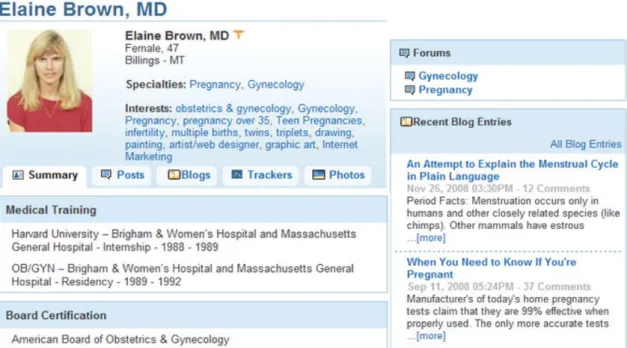
cases there is a fee associated to it. In these websites there are multiple health professionals with different types of expertise and background, which answer the questions in their area of expertise (Figure 7). This is a great way to improve the reputation of health professionals. Many of them are willing to answer questions, to know more about the patients and their conditions, symptoms and behavior, and to recommend what type of treatment they should do and what to do next. By doing this the health care systems can be much more efficient, less expensive and give a more personal experience in the health professional-patient relationship.
Figure 7 - Example of a MedHelp physician homepage. Upper left – Personal details. Upper right – Forums that are attending. Lower left – Physician medical training. Middle right – Recent blog entries. Adapted from [13]
2.3.3.
Quantified self-tracking
Another type of service offered by some health social networks (for instance: PatientsLikeMe, CureTogether, MedHelp) is quantified self-tracking. This feature allows the users that are registered to enter data for their conditions, symptoms, treatments and other relevant information. Afterwards this information is shown in a graphical manner to give the user a better perception either in individual, aggregated or custom groups views. For example, Figure 8 shows a detailed patient profile from PatientsLikeMe including disease progression, prescription drugs and symptom tracking for a 37 year-old male who has had amyotrophic lateral sclerosis (ALS) for six years, and Figure 9 shows an aggregated view of the top treatments tried by the CureTogether endometriosis community. Some health social networks have the possibility to print this data so that can be showed directly to health professionals to better understanding of the evolution of the patient.
24
Figure 8 - PatientsLikeMe ALS profile charts example. Upper left – Progression of the patient condition Middle left – Prescription drug and the reasons that had taken a drug. Lower left – Primary symptoms and the
severity of them. Adapted from [13]
Figure 9 - CureTogether patient-entered treatment statistics, with the number of people that tried a particular treatment and if had or not a improvement. Adapted from [13]
25
2.3.4. Clinical trials access
Another type of service offered by some health social networks is information regarding clinical trials (PatientsLikeMe, Inspire). This feature allows running more efficient clinical trials because it is easier to filter them. By having large databases it is possible to choose what type of patients should participate in terms of condition, age, country, etc. This fact already called the attention of other parties besides health professionals, such as pharmaceutical companies. PatientsLikeMe and Inspire are two of health social networks offering access to clinical trials, selling anonymized data to pharmaceutical companies, universities and research labs. By having these data the companies and other parties of the health care system can save time and money, but still obtain information from relevant patients. Besides the lower-cost patient recruitment, there are three other ways that health social networks are improving the quality of clinical trials. First, the new findings with quantitative tracking tools. Secondly, the feedback loop that is provided to the health professionals. Lastly, the direct feedback from the patients that publicly can give meaningful answers. Inevitably, fraud is likely to appear or may already exist in health social networks as there are significant economic incentives to have high patient usage statistics and favorable reputations for drugs and other treatments. The communities in the health social networks may be the best resource to detect fraud, due to their deep knowledge about condition, symptoms and time spent on the websites[13].
2.3.5. Summary
A list of health social networks is presented in Table 1, organized into three categories: general multi-condition websites, cause-specific websites and health professional-focused social networks. Most patient-focused health social networks offer the basic level of service, emotional support and information sharing, for a variety of medical conditions. About half also offer the second level of service, some sort of Q&A with health professionals, and a few offers the third and fourth levels of service, quantitative self-tracking and clinical trials access. There is little doubt that the growth of the Internet and social networks has opened up and continues to widen possibilities of accessing health information and processing such information to impact health outcomes. Currently the majority of health social networks offer as key characteristic the interaction that can support sharing information and/or providing emotional support for individuals dealing with health-related questions and problems affecting them or other people they care about. This service allows patients to know people with same kind of problems and exchange details about that problem, or other aspects, such the health professional or treatment used to solve the problem. The impact of patient information sharing and emotional support is thought to be quite positive but is not fully understood yet. If
26
it can be used to help the patient emotionally and help to self-manage their situation, it can also lead to a bad treatment like choosing a drug that is not the indicated to that problem.
Table 1: ES&IS stands for emotional support and information sharing, Q&A represents health
professionals Q&A, QS means quantified self-tracking, CT represents clinical trial access and N&I signifies for networking and information.
Name Focus Services
ES&IS Q& A
QS CT N&I
General health social networks
PatientsLikeMe 500+ conditions, ex: ALS, MS, HIV/AIDS
CureTogether 175 conditions, ex: endometriosis, migraine
MedHelp General: tracking, physician Q&A
Inspire Over 1,000 health and wellness groups, journaling
DailyStrength 600+ conditions
OrganizedWisdom 60 conditions, referenced research citations
WellSphere 50+ communities, ask an MD feature
MDJunction 750+ conditions, physician listings and marketplace
EhealthForum Physician Q&A;1.2M questions logged on site
HealthChapter General: 715 groups
Trusera General: 23 main topic areas
iMedix General, support and answer response
WeGoHealth General: answer response from health activists
ExperienceProject General: members, stories, discussions
Cause-specific health social networks
TuDiabetes Diabetes
SugarStats Diabetes;SugarStatsoffers selftracking
ImTooYoungforThis Youth with cancer
CareFlash
CarePages Personal webpages to share health updates with family and friends
WeAreDiabetic General/support: 14 communities
Health Professionals social networks
Sermo Medscape
General: free membership to verified physicians
Medting Online research, publishing and case collaboration withimages and videos
OR-Live Online surgical and health care video and webcast
communication platform
27
Q&A allows the patients to make questions to health professionals. This service is very powerful but lacks on direct contact between the patient and the health. Self-tracking allows patients to have a graphical representation of their evolution on conditions, symptoms or treatments but can be a little confusing if it has a lot information or complex information to present to the user. Another service that some health social networks offer is information about clinical trials, because of the large databases of patients with health history and condition information. This service is very useful to pharmaceutical companies, industry analysts, and other interested parties. This has the advantage of giving a quick feedback of some clinical trials to the patients, and gives them the opportunity to use some findings before a formal research and pharmaceutical company-sponsored clinical trials. The advantage also can turn into a disadvantage because fraud can appear with significant economic incentives for drug tests and other treatments. To conclude it is possible to see through table 1 that currently none of the health social networks offer the four services described above and only a minor part offer the maximum of two services to the users. Hence it is needed the creation of a health social network that can offer the possibility of information sharing and emotional support as the current offer, but can take a step offering the patient a direct contact with the health professionals and give them the opportunity to follow their progress during the treatments and, if available, allow the patients to participate in new treatments computer based at home trainings or treatments.
29
Chapter 3. Functional analysis of existing
systems
The growth of internet, and specially the social networks along with the economic problems around the world made people search new ways of managing their health. Currently much of the people worldwide use internet and consequently health social networks as their first source of information about health-related matters. The health social networks evolved so much that people make their decision of consulting a physician after analyzing all the information available online. Currently the major health social networks offer a variety of features that includes emotional support and information sharing, physician Q&A, quantified self-tracking, clinical trial access, networking and information, but none of them offers all the services in an integrated manner. In the Annex I are the features offered by each one of the major health social networks. In the following analysis only CureTogether, DailyStrength, EhealtForum, Inspire, MedHelp and PatientsLikeMe are considered because offer more services to the users. Figure 10 & 11 show the features available and the percentage (%) of health social networks that offer them.
Figure 10 - Main features offered by health social networks
100% 100% 100% 83% 67% 83% 100% 50% 67% 33% 100% 0% 20% 40% 60% 80% 100% 120%
Features
30
31
Sign up, Home, Profile and Friends
To access the contents of some websites the user needs to make a sign up, which is a way to registera user with website and to avoid the creation of spam. In Figure 10 it is possible to see that the all the health social networks analysed (CureTogether, DailyStrength, EhealtForum, Inspire, MedHelp and PatientsLikeMe) offer the possibility to sign up. The majority only ask the user name, email and password to do it, only PatientsLikeMe and MedHelp offer the possibility to choose what type of user you are: Patients, Doctor or Researcher. After completing the process of registration, the user can enter the website, where he is redirected to his Home page. The home page is the first page that is displayed after the log in and serves as index to other sections on the website. In the home pages of the analyzed health social networks, there are common features that are available such as the profile, friends, messages and to search something. The profile feature normally contains personal or work information. All the health social networks analyzed have this feature where the user can view and edit their basic information. The member/friends feature allows the users to see other users that are registered in the website, and to have some type of relationship with them. This feature is available in the six health social networks analyzed and offers the possibility to search a person, add a user as a friend, send a private message to another user and send an email to invite others to join the site.
Support Group/Forums and Blog/Pages
The support group/forums feature is a discussion area on a website. In this area the user can start some threads, and reply to other people’s threads. This feature is not offered by all but CureTogether. In here the user can view the existing support groups/forums, their information, search what is for their best interest and start or participate in discussions. All the health social networks analyzed that offer the support group/forum feature have the same options available except for my groups/forums that is only available in Inspire. A list of the members of the topic/forum that is available only in Inspire and DailyStrength. The blogs/pages feature is a collection of posts that appears in reverse chronological order. This posts can composed by only words, as well as audio, video or embeddable objects. This feature is available on 67% of health social networks analyzed, not being available in CureTogether and PatientsLikeMe. There the user can view the blogs/pages, or search their information and post replies.
32
Treatments, Symptoms and Experts answers
The treatments feature is a page that allows the users to see the different types of treatments for different conditions. The feature is available in all the health social networks analyzed is treatments. This feature is immediately visible in DailyStrength and PatientsLikeMe, in the other networks the user needs to make a search or find it through forums or blogs. In here the user is able to view or search for treatments, know more about them and in DailyStrength and PatientsLikeMe can add a treatment to their status. The symptoms feature is a page that allows the user to see what condition corresponds to different symptoms. This feature is also available in all of the health social networks analyzed, but only immediately visible to the user in PatientsLikeMe. In here the user can view or search symptoms, their information and add a symptom to their status. The feature “experts’ answer” is page where the patients can post questions to health professional about conditions, treatments and symptoms. This is available in DailyStrength, EhealthForum and MedHelp. In there the user can view and search questions of their interest. If he/she does not find the answer to his/her question, he/she can post a question that then can be answered by an expert or by someone with experience in the matter. The question may or may not be answered by an expert because there is not a direct connection between the user and the health professional. However a user of the health social network can post a comment to help solving the problem. Only MedHelp have the feature to find a health professional.
Research and Trackers
The trackers feature allows the users to record and review some data about their health. This is available on CureTogether, DailyStrength, MedHelp and PatientsLikeMe. Trackers of weight and sleep are available in 50% of the health social networks. Exercise tracker is available only on CureTogether and MedHelp. Finally, DailyStrength offers a health event calendar where the user can to view the past, current and the future events made by the website. The research feature allows the user to find clinical trials that can help with their condition. This is available in Inspire and PatientsLikeMe, but only immediately visible in PatientsLikeMe. However it is possible to find clinical trials on Inspire after making a search. In PatientsLikeMe “clinical trials” feature the user enters his/her their condition, age and gender and it is possible to see clinical trials that match with the data. In addition, in PatientsLikeMe the user can view videos of presentations about a great variety of health issues and researches that were made by PatientsLikeMe that involved registered users. Finally in publications that feature the site the
33
user is redirected to Google scholar where he can see publications that mentions the PatientsLikeMe website.
Conclusion
After this analysis it is possible to see that there is a great similarity in the features offered, such as home, profile, friends, treatments, symptoms and even support groups/forums services, available in five out of six health social networks analyzed. But when taking a deep look at the services (Figure 11) such as treatments, symptoms, experts answers, trackers and research it is possible to see that the services offered are limited. Among health social networks that offer information about treatments and symptoms, only MedHelp offers the possibility to make questions to experts and have quantified self-tracking. MedHelp does not offer the possibility to participate on new clinical trials or have direct contact with the health professionals. While some health social networks are included in the Figure 11 as offering some services, many times the users need to make searches to find them, like symptoms or clinical trials.
35
Chapter 4. Assessing the needs of end users
In the following we will investigate what the best way to host information about the features that we saw as essential and see what are the biggest aspects needed by the patients, researchers and health professionals to enable a better interaction between them. This chapter includes the study that was approved by the SESARAM (Annex II) with doctors, physiotherapists, speech therapists, occupational therapists and patients. From the state of the art we have seen that successful projects are those with greater user interaction. To evaluate the satisfaction and expectations of the health professional and patients with the support services an inquiry was made. For this analysis were considered all the people that were being treated in the service of Physical Medicine and Rehabilitation of the Dr. Nélio Mendonça Hospital and the doctors, physiotherapists, speech therapists and occupational therapists. A total of 54 inquiries were made between the 11th of December 2012 and 8th of January 2013 and can be found in Annex III.4.1.
Patients needs
Were made 18 inquiries of the 54 to an average age of 52,6 years old, 8 of them were male and 10 female, with different scholarship (Table 4) and diagnosis (Table 5). The patients questionnaire was composed by 19 questions, which 14 of them were multiple choices, and the other 5 open answers. Most of the questions to the patients were made to let them chose from multiple choices to facilitate the answering. Patients were asked about computer usage (question 1 through 3); usual means of transportation and communication (questions 4 through 7); best way to interact with health professionals (questions 8 through 11); content and usage of the forum (questions 12 and 13); level interest, and positive and negative aspects of the approach (questions 14 through 19). The goal was to understand the need and costumes of the patients. In the following the answers given to each question are analyzed.
Demographics - Patients
Gender
Female 10
Male 8
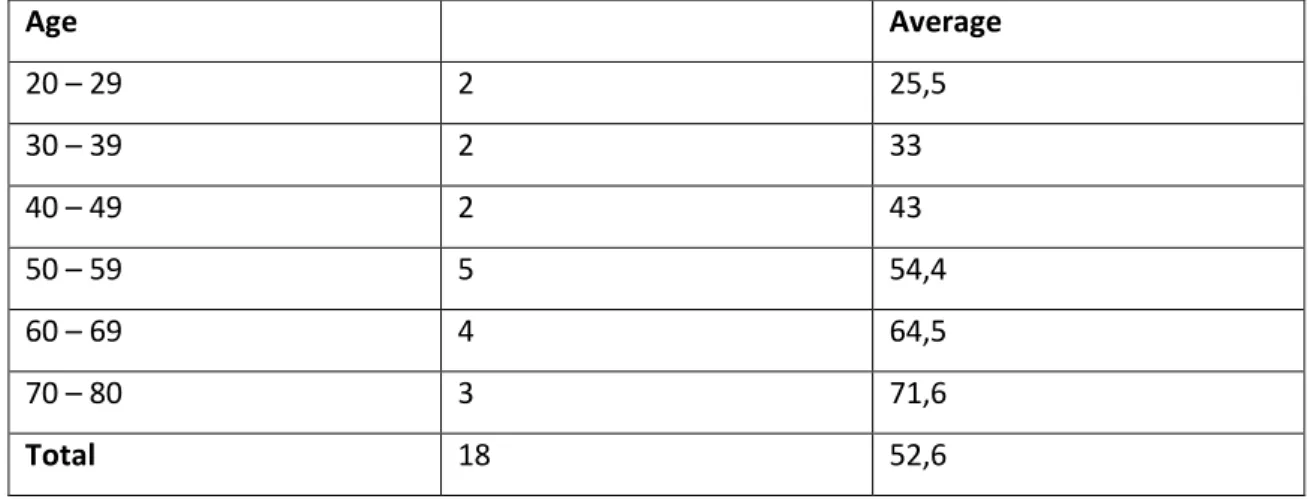
36 Age Average 20 – 29 2 25,5 30 – 39 2 33 40 – 49 2 43 50 – 59 5 54,4 60 – 69 4 64,5 70 – 80 3 71,6 Total 18 52,6
Table 3 - Age distribution of the patients that answered the inquiry
Education Average
Elementary education 7 3,6
Secondary education 10 11,1
Higher education 1 15
Total 18 9,9
Table 4 - Scholarship distribution of the patients
Diagnosis
Stroke 9
Cervical fracture 1
Traumatic spinal vertebroplasty 1
Brachial plexus injury 1
Guillain Barré syndrome 1
Low back pain 5
Total 18
Table 5 - Diagnosis distribution of the patients
Question 1: “Do you use a computer? How many times a day?”
In Figure 12 it is possible to see 50% (9/18) of the patients use the computer at least 1 hour per day, and that below 55 years old are the ones who use it more frequently.
37
Question 2. “Do you use internet? How many times a day?”
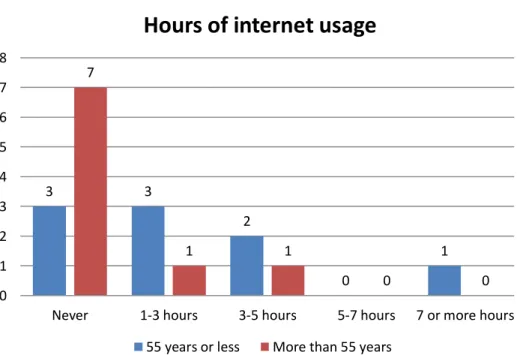
In Figure 12 - Hours of usage of the computer by the patients separated by age it is possible to see 44% (8/18) of the patients use the internet at least 1 hour per day, and that below 55 years old are the ones who use it more frequently.
Figure 12 - Hours of usage of the computer by the patients separated by age
Figure 13 - Hours of usage of the internet with the patients separated by age
2 4 1 0 2 7 1 1 0 0 0 1 2 3 4 5 6 7 8
Never 1-3 hours 3-5 hours 5-7 hours 7 or more hours
Hours of usage of the PC
55 years or less More than 55 years
3 3 2 0 1 7 1 1 0 0 0 1 2 3 4 5 6 7 8
Never 1-3 hours 3-5 hours 5-7 hours 7 or more hours
Hours of internet usage
38
Question 3. “Do you use social network (facebook, twitter, etc.)”?
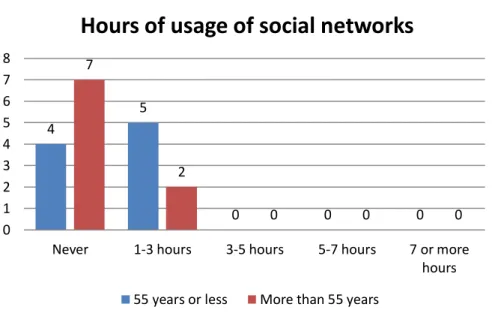
38% use social networks. This represents that 87% of the patients that use internet. All that use social networks use them 1-3 hours a day (Figure 14).
Figure 14 - Hours of usage of social networks with the patients separated by age
Question 4. “How often do you need a consultation form a doctor/therapist?”
Patients need to see the doctors or go to therapy mostly (77%) at least 2 days per week. No difference was focused in the answer depending on the patient age (Figure 15).
Figure 15 - Number of consultations needed by the patients
4 5 0 0 0 7 2 0 0 0 0 1 2 3 4 5 6 7 8
Never 1-3 hours 3-5 hours 5-7 hours 7 or more hours
Hours of usage of social networks
55 years or less More than 55 years
0 14 3 1 0 0 0 2 4 6 8 10 12 14 16
None 2 or more days per week
Weekly Monthly Quarterly Semiannual or more
39
Question 5. ”How much time do you spend on consulting a doctor/therapist since leaving
home?”
The total of time that each patient spend between leaving their houses and seeing the doctor or having therapy depends on the place where they live and the mean of transport they use., but is mostly between 1 and 4 hours. Most patients (66%) spend more than 2 hours (Figure 17).
Figure 16 - Time that the patients spent in treatment, including the transportation.
Question 6. “What is the distance between that you travel to have a consultation?”
The distance between the patient’s home and their health care is between 1 and 10 km for 67 % of the patients. The maximum distance reported by patients was 40 km.
Question 7. “What means of communication normally uses to communicate with
doctors/therapists?”
The answers show that besides the medical appointments, only the phone is used and very sporadically, mainly to make the appointments (Figure 18). None of the communication channels that involve a computer is used.
0 6 5 4 3 0 1 2 3 4 5 6 7
0-1 hours 1-2 hours 2-3 hours 3-4 hours 5 or more hours
40
Figure 17 - Means of communication normally used by the patients to contact the health professionals
Question 8. “Rate the potential of each mean of communication for their potential?”
With the graphic it is possible to see the potential that each means of communication has for the patients. To the patients the medical appointments will continue to be extremely important in the future, but only one of the patients thinks that Internet, Forum or a Chat has no potential 5% (Figure 19). Patients give extreme relevance to personal appointments but also much relevance to all the rest.
Figure 18- Potential of each mean of communication
18 10 0 0 0 0 0 2 4 6 8 10 12 14 16 18 20 Medical Consultations
Phone Internet Forum Chat Other
Mean of communication normally used
0 0 0 0 18 0 2 3 9 4 1 3 3 10 1 1 3 3 10 1 1 3 3 10 1 0 2 4 6 8 10 12 14 16 18 20
None Few Some Much Extreme
Potential for each means of communication
41
Question 9. “What is the relevance you give to be frequently follow-up by the doctors /
therapist?”
94 % of the patients (17/18) considered that is extremely important to be followed frequently by a doctor or therapist, and one said that was very important.
Question 10. “How often would you like to receive evaluations from doctors / therapists?”
More than 50% of the patients would like to receive evaluations from the doctors/therapists at least one time per week, in order to knew their progress.
Figure 19 – Frequency that the patients would like to receive evaluations by health professionals
Question 11. “What is the importance of having remote evaluations?”
In this question we find differences between age groups (patients that have more than 55 years old). Of the 18 patients, 12 (66 % of them) think that it is important to have direct contact with the health professionals even if they are not face to face. This was predominant in younger patients (<55 years old) (Figure 21).
0 1 11 5 1 0 0 2 4 6 8 10 12
None Daily Weekly Monthly Every 3 months Every 6 months
Frequency would like to receive evaluations by
doctors / therapists
42
Figure 20 - The importance of having remote evaluations with the patients separated by age
Question 12. “What content should be in the forum? You can select more than one!”
The answers show that patients think that the forum should contain information about treatments above all (77%), with the advices coming in second place (50%) (Figure 22).
Figure 21 -The content that should be on the forum
Question 13. “How do you think the forum should be used? You can select more than one!”
The Figure 22 shows that for patients the part that includes researches is not as important (38%), the essential part is to have a direct contact among patients (77%), and between the patients and health professionals (77%).
0 1 1 4 3 2 3 1 1 2 0 0,5 1 1,5 2 2,5 3 3,5 4 4,5
None Little Some Very Extreme
The importance of having remote evaluations
55 years or less More than 55 years
0 4 9 4 5 4 3 5 2 4 0 2 4 6 8 10
None FAQ Informations about treatments
Articules Advices
The forum should contain
43
Figure 22 - By whom the forum should be used
Question 14. “What were the 2 aspects you liked more? Why?”
In this question patients provided open answers, and the results are very different. 5 of the patients (27%) said the most interesting thing is the possibility to have a direct communication through the forum or messages. 4 (22 %) said that the all idea is interesting, 4 (22%) said that do not know how to use the PC. 2 (11%) appreciated to have access to information about treatments. 1 (5%) said the only fact to use the PC and to have exercises is very good, and other 2 (11%) did not know.
Question 15. “What were the 2 aspects you liked less? Why?”
8 out of 18 (44%) said that did not find anything that they did not like, 4 (22%) said that do not know how the use the PC. 4 (22%) said that did not know. 1 (5%) said that the time available may not allow the use of the site, and another (5%) said the forum may not be a good idea because it is public.
Question 16. “What aspects are the most confusing for you, if you had some?”
Patients said that did not find anything confusing about the topics that were explained (61%). 33% said that did not know and another (5%) said the need to use the PC.
Question 17. “Aspects that would improve or add?”
44% of the patients answered that did not have anything to add or to improve. 33% said that did not know. 11% said to have an agenda to make appointments. 5% said that should have music, another 5% said that should have information about treatments.
0 6 6 6 9 9 4 1 1 3 5 5 0 2 4 6 8 10
Should not exist Researcher -Doctor
Researcher -Researcher
Doctor - Doctor Patient - Patient Patient -Doctor
The forum should be used
44
Question 18. “What is your level of interest in using the tool presented even is not a user of
the internet or social networks?”
Figure 23 show that patients bellow 55 years or less have great interest in using this toll whereas older patients were not so interested. Even two patients above 55 reported interest in using it, even if they did not know how to use a computer.
Figure 23 - Level of interest in using the tool presented with the patients separated by age
Question 19. “Any additional comments you would like to leave? ”
15 of 18 of patients (83%) did not have anything else to report. 1 said that the idea was good. Another patient said that should have video/audio material, and another one said that wanted to learn to use the PC.
Conclusion
The 18 patients that participated in this survey had an average of 53 years old and an average of 10 years of study. These were representative of the target population of our system. The answers show that at least 50 % of them use the computer and have some experience using the internet and social networks. Therefore, these patients are potential users of our system. The majority of the patients visit health professionals twice a week and 66% spend more than 2 hours when in each appointment .Besides the medical appointments the 56 % of the patients use to phone to communicate with the health professionals, but only occasionally and normally to make an appointment. This means that still exists room for improvement in this area, with the use of systems like ours to streamline and optimize the interaction between the patients and the health professionals. Only one in eighteen patients think that Internet, Forum or a Chat will not serve as a mean of communication between them and the health professionals. Patients answered that would like to receive regular evaluations by health
0 0 1 4 4 4 3 1 0 1 0 1 2 3 4 5
None Little Some Very Extreme
Level of interest in using the tool presented
45
professionals, and 66 % of them value the importance of having remote evaluations. So these patients view systems like ours as a way to complement face to face interactions. Most patients think that forum could be useful, and should contain at least information about treatments and advices. Patients consider that the forum should be used between patients, and between patients and health professionals, leaving aside the communication between health professionals and researchers. To sum up we could see that 61 % of the patients showed interest in using the tool presented, even when they did not know how to use a computer.
4.2.
Health professionals needs
The questions to the 36 health professionals, divided by doctors (13, with average age of 39,8 years old), physiotherapists (15, with average age of 40,9 years old), speech therapists (4, with minimum age of 45,8 years old) and occupational therapists (4, with average age of 41 years old). The health professional inquiry was composed with 24 questions, where 18 of them were 5-point Likert scale and the other 6 were open answer. The health professional were asked about computer usage (questions 1 and 2); usual information needed from the patient and means of communication (questions 3 through 5); level and way of update about new therapies and treatments (questions 6, 7 and 14, 15); best way to interact with patients (questions 8 through 14); content and usage of the forum (questions 17 and 18); level of interest, positive and negative aspects of the approach (questions 19 through 24). The goal was to understand the health professional needs, habits and availability to use this type of tool to interact with patients. In this section the answers given to each question is analyzed. The questions that use Likert scale will be evaluated quantitatively with a value between 1(none) and 5(extreme).
Demographics – Health professionals
Specialty
Doctors 13
Physiotherapists 15
Speech therapists 4
Occupational therapists 4
46 Age Average 20 – 29 6 27,2 30 – 39 10 34,9 40 – 49 12 46 50 – 59 8 52 Total 36 40,0
Table 7 - Age distribution of the health professionals
Gender
Female 25
Male 11
Table 8 - Gender distribution of the health professionals
Question 1. “Do you use internet? How many times a day?””
Only 5 of the 36 (14%) health professionals do not use the internet at least 1 hour per day, meaning that 86 % of them have experience using the computer and internet.
Question 2. ““Do you use social network (facebook, twitter, etc.)”?”
The answers show that 50 % uses at least one hour the social networks and the other 50% uses less than one hour or do not use at all.
Question 3. “What kinds of questions are "mandatory" in an appointment?”
The majority said that the questions more asked are: Age; What brings the patients to that consultation; Level of pain; Type of medication that are using; Definition of the objectives.
Question 4. ““What means of communication normally uses to communicate with patients?””
All of them choose the face to face type and 50% said that uses the phone but only sporadically. None of the communications that involves the computer is used.
Question 5. “Rate the potential of each mean of communication for their potential?”
With the graphic it is possible to see the potential that each mean of communication has for the health professionals. 33% of health professionals think that internet, forum or chat has few or less possibility to be a mean of communication between them and patients (Figure 25).
47
Figure 24 - Potential of each mean of communication
Question 6. “What is your level of knowledge about new therapies / technologies?”
Health professionals have at least some level of knowledge about new therapies and technologies. Only 2 of 36 (5%) of health professionals have little knowledge about new therapies and technologies (Figure 26). The average in our Likert scale was 4,03 out of 5, meaning that they have a great level of knowledge about new therapies and technologies.
Figure 25 - Level of actualization about new therapies / technologies
0 0 0 1 35 2 8 2 13 11 2 6 14 12 2 4 8 11 11 2 4 8 11 11 2 0 5 10 15 20 25 30 35 40
None Few Some Much Extreme
Potential of each means of communication
Medical Consultations Phone Internet? Forum? Chat?
0% 25% 0% 75% 0% 0% 0% 27% 47% 27% 0% 25% 50% 25% 0% 0% 0% 8% 31% 62% 0% 10% 20% 30% 40% 50% 60% 70% 80%
None Little Some Much Extreme
Level of knowledge about new therapies &
technologies
48
Question 7. “What is the need you feel to look for new treatments or investigations?”
Health professionals feel a need to search for new treatments. They do not have a service that keep them updated about new investigations (Figure 27). In the Likert scale that was defined the average was 4,44 out of 5, meaning that they feel a need very high to find new treatments.
Figure 26 - Need to find new treatments
Question 8. “What is the relevance you give to frequently follow the patients?”
Health professionals find at least very important to follow the patient, while the percentages at column other is because for some it depends on each case (Figure 28). In the Likert scale that was defined the average was 4,00 out of 5, meaning that is extremely important to follow the patient frequently.
Figure 27 - Importance of follow frequently the patient
0% 0% 25% 75% 0% 0% 0% 7% 13% 80% 0% 25% 0% 75% 0% 0% 0% 0% 38% 62% 0% 10% 20% 30% 40% 50% 60% 70% 80% 90%
None Little Some Very Extreme
Need to find new treatments
Speech therapists Physiotherapists Occupational therapists Doctors
0% 0% 25% 75% 0% 0% 0% 0% 0% 20% 67% 13% 0% 0% 0% 100% 0% 0% 0% 0% 8% 15% 62% 15% 0% 20% 40% 60% 80% 100% 120%
None Little Some Very Extreme Other
Importance of follow frequently the patient
49
Question 9. “How often would you like to receive notifications of the patients’ evolution?”
Most of the health professionals prefer to have notifications about the patient at least one time per week, and 10 of 36 (27%) of the health professionals choose the option “Other” because depends on each case. There is a contrast between the doctors and the therapists because the different therapists follow more frequently a patient than the doctors (Figure 29). In the Likert scale that was defined the average was 2,22 out of 5, meaning that option preferred is at least one time per week.
Question 10. “What aspects would you like to follow from patients?”
In this questions health professionals provided open answers, and reported that would like to know how the patients feels, if there was changes in is condition, if the patients is doing the exercises, how is doing with the thing at home and job, if the treatment is helping.
Figure 28 - Frequency of notifications that would want to receive
Question 11. “How useful would be if family members had access to evolutions of patients?”
Figure 29 shows that the answers are aggregate between some and extreme. The doctors are the ones that presents more disparity, including the column other that is because two of them questioned the ethic of the others having access to the patients medical condition. In the Likert scale that was defined the average was 3,5 out of 5, meaning that to the health professionals the family members having access to the patients developments has some importance. 0% 0% 75% 0% 0% 25% 0% 27% 47% 7% 0% 20% 0% 50% 50% 0% 0% 0% 0% 0% 15% 23% 15% 46% 0% 10% 20% 30% 40% 50% 60% 70% 80%
None Daily Weekly Monthly Every 3 months Other
Frequency of notifications that would want to
receive
50
Figure 29 - Utility of the family members having access to patients developments
Question 12. “What is the importance of having direct communication with the patients?”
75% of health professionals answered that was extremely important to have a direct communication with patients, 22 % said that was very important and 2% said that has some importance.
Question 13. “Importance of having remote appointments?”
Only 6 out of 36 (16%) of the health professional choose the options much or extreme, that is because all of them, including three physiotherapists that choose the option other, said that only trying they could have a definitive answer (Figure 31). The answers were based by the habit and need that health professional have to be with patients face to face. In the Likert scale that was defined the average was 3,05 out of 5, meaning that to the health professional is somehow important to have remote consultations with the patients.
0% 0% 50% 50% 0% 0% 0% 7% 33% 20% 40% 0% 0% 0% 25% 75% 0% 0% 8% 15% 15% 23% 23% 15% 0% 10% 20% 30% 40% 50% 60% 70% 80%
None Little Some Very Extreme Other
![Figure 3 – World map of social networks in June 2013 Adapted from [9]](https://thumb-eu.123doks.com/thumbv2/123dok_br/19279131.986619/21.892.134.764.106.620/figure-world-map-social-networks-june-adapted.webp)