Personnel Identity, Organizational Commitment and
High Performance Working Practice System
in Chinese Power Companies
QING Song
Thesis submitted as partial requirement for the conferral of
Doctor of Management
Supervisor:
Professor Henrique Duarte, Assistant Professor, ISCTE University Institute of Lisbon
Co-supervisor:
Professor JING Runtian, Professor, University of Electronic Science and Technology of China, School of Management and Economics
Spine –
Personnel Identity
, Or
ganizational Co
mmitment and High Performance
W
o
rking Practice System in
Chinese Power Compani
es
QING
Son
Personnel Identity, Organizational Commitment and
High Performance Working Practice System
in Chinese Power Companies
QING Song
Thesis submitted as partial requirement for the conferral of
Doctor of Management
Supervisor:
Professor Henrique Duarte, Assistant Professor, ISCTE University Institute of Lisbon
Co-supervisor:
Professor JING Runtian, Professor, University of Electronic Science and Technology of China, School of Management and Economics
Declaration
I declare that this thesis does not incorporate without acknowledgement any material previously submitted for a degree or diploma in any university and that to the best of my knowledge it does not contain any material previously published or written by another person except where due reference is made in the text.
Signed Date _________________ Name: _____________ 作者申明 本人郑重申明:除了论文致谢中明确说明并致以谢意的部分外,所呈交的论文不 包含任何他人或作者本人已用于获得任何教育机构的学位和证书而使用过的材 料。同时尽我所知,除了文中特别加以标注引用的内容外,本论文不包含任何其 他个人或集体已经发表或撰写的成果作品。 作者签名: 日期: 姓名(拼音)
Abstract
With the in-depth reform of China’s power enterprises, the management of multiple personnel identities has become a vital task during the process of enterprise renovation. Based on social identity theory and vast interviews and survey in a power companies, this paper explores the relationship between the various personnel identities and organizational commitments, and verified the important moderating function of the High Performance Working Practice system (HPWP system) on the relationship between personnel identity and organizational commitments. The research results have shown that: First, personnel identity has a significant impact on the organizational commitments of enterprise personnel, and a significant diversity has shown among the three dimensions of personnel identity. Second, this research also indictes that a fair management procedure, overall and reasonable salary system and the publication of information related can upgrade significantly the sense of participating, justice and security of empoyees, and consequently the level of the organizational commitments will be increased. Third, for workers serving in the companies implementing HPWP system, their level of organizational commitments is significantly higher than that of the workers serving in those without HPWP system. Fourth, the evaluation of workers on the HPWP system implemented in the companies they serve plays an important up-regulation role in the relationship between personnel identity and organizational commitments.
This research explores a specific but prevelent phenomenon in China transitional economy, where employees are systematically given different identities which supply a good opportunity to broaden the social identity theory by combining it with organizational commitment. The research on the moderating role of HPWP system contributes much in practical management by indicating that a well implementation of HPWP system could substantially upgrade the level of organizational commitments of empoyees and beneficial to the long-term enterprise development, especially under China current situation in which the personnel identities can’t be simply unified in short term.
Key Words: Organizational Commitment; HPWP system; Personnel identity; Employment Relationship
Resumo
Com a reforma profunda das empresas energéticas na China, a gestão das múltiplas identidades do pessoal tornou-se uma tarefa determinante na renovação das empresas. Baseando-se na teoria da identidade social, em entrevistas aprofundadas e na aplicação de um questionário, esta investigação explora a relação entre as diferentes identidades do pessoal e o compromisso organizacional. Verifica-se ainda a função moderadora dos Sistemas de Recursos Humanos de Elevado Desempenho (SRHED), na relação entre as identidades pessoais e o compromisso organizacional. Os resultados da investigação evidenciam: primeiro que a identidade pessoal possui um impacto significativo no compromisso organizacional e uma diversidade significativa entre as três dimensões da identidade pessoal; segundo, a investigação indica que procedimentos justos, um nível salarial razoável e a publicação de informação relativa pode incrementar o sentido de participação, justiça e segurança dos empregados e consequentemente aumentar o nível de compromisso organizacional; em terceiro lugar, empregados de empresas que implementaram SRHED apresentam níveis de compromisso significativamente superiores do que empresas que não implementaram SRHED. Em quarto lugar a avaliação que os trabalhadores fazem dos SRHED implementados nas empresas em que trabalham jogam um papel importante de regulação entre a identidade pessoal e o compromisso organizacional.
Esta investigação explora o fenómeno específico mas frequente na transição económica da China, em que são atribuídas diferentes identidades aos trabalhadores permitindo combinar a teoria da identidade social com o compromisso organizacional. A investigação sobre o papel moderador dos SRHED contribuem para a gestão prática indicando que uma boa implementação de SRHED podem contribuir para aumentar o nível de compromisso organizacional dos empregados e beneficiar o desenvolvimento das empresas no longo prazo, sobretudo na presente situação da China na qual, no curto prazo, não podem ser unificadas as identidades pessoas dos trabalhadores.
Palavras Chave: Compromisso organizacional; SRHED; Identidades pessoais; Relação de emprego
Acknowledgements
I would like to firstly thank my supervisor Professor Runtian Jing, Professor Henrique Duarte and advisor Professor Tianli Feng, they have give me many detailed suggestions from topic choosing, structuring to writing skills. Great thanks to these three teachers for their precious time and energy in conceiving, composing, modifying and finalizing this paper, for their valuable and constructive suggestions which help me finish this paper in a more rigorous, reasonable, standard and academic way. Their academic spirit, strict attitude and standardized research methods have helped me a lot. I hereby give my great respect and deep gratitude to them!
I also appreciate other teachers in the School of Management and Economics, University of Electronic Science and Technology of China, who have helped and supported me during my postgraduate period! Besides, I also want to thank Group A’s provincial grid company in B province for their support, since they have provided abundant detailed specialized technology materials and empirical report for the sake of my paper.
Thank all my doctor senior fellows, for they have given me many instructional and oriented composing philosophy and method, and some constructive suggestions and advice about demonstration of hypothesis they gave to me in later stage of my composing.
At last, I want to thank all my families! For all these years, they always take me under their care with their support and encouragement and I can not finish my studies without their care. Their selfless caring and support is and will always make me proud and motivate me to move forward.
Contents
CHAPTER 1: INTRODUCTION ... 1 1.1 RESEARCH BACKGROUND... 1 1.2 RESEARCH GOALS... 4 1.3 RESEARCH METHODS... 5 1.4 INNOVATION POINTS... 6CHAPTER 2: LITERATURE REVIEW... 7
2.1 SOCIAL IDENTIRY... 7
2.1.1 Employment System of SOEs and Personel identity ... 7
2.1.2 Distinctions of Personnel Different Identities in SOE ... 9
2.1.3 Four Types of personel identities in Power Enterprises ... 10
2.1.4 Challenges facing with SOE’s employ sistem... 11
2.2 ORGANIZATIONAL COMMITMENT... 12
2.2.1 Influencing Factors of Organizational Commitments... 15
2.3 HPWP SYSTEM AND ORGANIZATIONAL COMMITMENTS... 16
CHAPTER 3: RESEARCH SETTING... 19
3.1 BASIC CONDITION OF THE ENTERPRISES... 19
3.2 PERSONNEL STRUCTURE OF THE ENTERPRISES... 19
3.3 CURRENT STATUS OF PERSONNEL MANAGEMENT... 21
3.3.1 Differences in compensation... 22
3.3.2 Current Status of Social Security ... 23
3.4 REFORM OF POWER COMPANY C... 25
3.4.1 Post setting scheme ... 26
3.4.2 Reform Scheme of Wages ... 26
3.4.3 Group Employment Program for Personnel Management... 27
3.4.4 Implementation Plan on Personnel Dynamic Management ... 28
3.5 ACHIEVEMENTS FROM INNOVATION... 29
3.6 REFORM OF POWER COMPANY D... 30
3.6.1 Comparison before and after Comprehensive Innovation of Human Resources .... 30
3.6.2 Problems and Difficulties after Comprehensive Reform of Human Resource ... 32
4.1 THEORETICAL MODEL... 35
4.2 HYPOTHESIS... 36
4.2.1 Hypothesis on the Relationships between Personnel with Different Identities and Organizational Commitments... 36
4.2.2 Hypothesis Based on the Relationships between Personnel in HPWP system and Organizational Commitments... 41
4.2.3 Control Variables... 47
CHAPTER 5: RESEARCH DESIGNS AND METHODS... 53
5.1 VARIABLE DEFINITION... 53
5.1.1 Employee ID ... 53
5.1.2 Organizational commitment ... 54
5.1.3 High Performance Working Practice system... 54
5.1.4 Control variable... 55
5.2 RESEARCH DESIGN AND QUESTIONNAIRE SURVEY... 56
5.2.1 Preliminary investigation ... 56
5.2.2 Formal investigation and sampling analysis ... 58
5.3 DATA ANALYSIS METHODS... 61
CHAPTER 6: RESEARCH RESULTS AND DISCUSSION ... 63
6.1 FACTOR ANALYSIS ON HPWP SYSTEM AND ORGANIZATIONAL COMMITMENTS... 63
6.1.1 Efficient Performance Working System (HPWP system) ... 63
6.1.2 Organizational Commitments... 65
6.2 DESCRIPTIVE RESULTS OF ANALYSIS... 68
6.3 HYPOTHESIS TESTING... 75
6.3.1 Distinction of Organizational Commitments and Their Various Dimensions at Personnel Identity... 76
6.3.2 Effect of Implementing HPWP system on Personnel Evaluation ... 80
6.3.3 Effect of Implementing HPWP system on Organizational Commitments and Various Dimensions... 81
6.3.4 Analysis of Variations Grouped in Terms of Personnel Identity... 83
6.3.5 Regression Analysis ... 86
6.3.6 Supplementary analysis... 98
6.4 DISCUSSIONS... 100
6.4.1 Relationships between personnel identity and organizational commitments... 100
Commitments ... 103
6.4.4 Moderating effect of HPWP system... 104
CHAPTER 7: RESEARCH CONCLUSIONS ... 109
7.1 MAJOR CONCLUSIONS... 109
7.2 RESEARCH INNOVATION... 110
7.3 DEFICIENCIES AND OUTLOOK... 111
7.4 SUGGESTIONS ON PRACTICE... 112
REFERENCES... 116
List of Tables
Table 4- 1 Summary of Research Hypothesis ... 50
Table 5- 1 Classifications of Personnel Identity... 53
Table 5- 2 Pilot survey of the sampling schemes of each unit ... 57
Table 5- 3 distributions of samples for pilot study... 57
Table 5- 4 distributions of samples for formal study... 59
Table 5- 5 The grouping and distribution of formal investigating samples ... 60
Table 6- 1 Scale Rotation Component Matrix of HPWP system ... 63
Table 6- 2 Result of Confirmatory Factor Analysis of HPWP system Scale ... 64
Table 6- 3 Rotation Component Matrix of Organizational Commitments Scale ... 65
Table 6- 4 Result of Confirmatory Factor Analysis of Organizational Commitments Scale ... 66
Table 6- 5 Descriptive Analysis of HPWP system, Organizational Commitments,... 68
Table 6- 6 Results of Simple Relevant Analysis ... 74
Table 6- 7 The Normal Distribution Test on Continuous Variables ... 75
Table 6- 8 The Results of Normal Test after Normalization ... 76
Table 6- 9 Setting up Dummy Variables for Personnel Identity... 87
Table 6- 10 Setting up Dummy Variables for Working Position... 87
Table 6- 11 Moderating effect on the Relationships between Personnel Identity and ... 88
Table 6- 12 Moderating Effect on the Relationships between Personnel Identity and Affective Commitments by the Various Dimensions of HPWP system ... 90
Table 6- 13 Moderating effect on the Relationships between Personnel Identity and Normative Commitments by the Various Dimensions of HPWP system ... 93
Table 6- 14 The Moderating Function of All Dimensions of HPWP system... 96
Table 6- 15 Collection of the Results of Hypothesis Testing ... 105
Table 6- 16 Collection of the Results of Hypothesis Testing ... 107
List of Figures
Figure 4- 1 Framework for Research ... 35
Figure 5- 1 The histogram (frequency map) of various demographic variables ... 60
Figure 6- 1 Distinctions of Organizational Commitments and Their Various Dimensions among Groups at Different Ages... 70
Figure 6- 2 Distinctions of HPWP system and Their Various Dimensions among Groups at Different Ages ... 70
Figure 6- 3Distinctions of Organizational Commitments and Various Dimensions among .... 71
Figure 6- 4 Distinctions of HPWP system and Various Dimensions among Groups... 71
Figure 6- 5 Distinctions of Organizational Commitments, HPWP system and ... 72
Figure 6- 6 Distinctions of Organizational Commitments, HPWP system and Various Dimensions on Different Educational Levels ... 73
Figure 6- 7 Distinctions of Organizational Commitments, HPWP system and Various Dimensions on Different Working Positions... 73
Figure 6- 8 Relationship between Organizational Commitments and Personnel Identity ... 77
Figure 6- 9 Relationship between Personnel Identity and Affective Commitments. ... 78
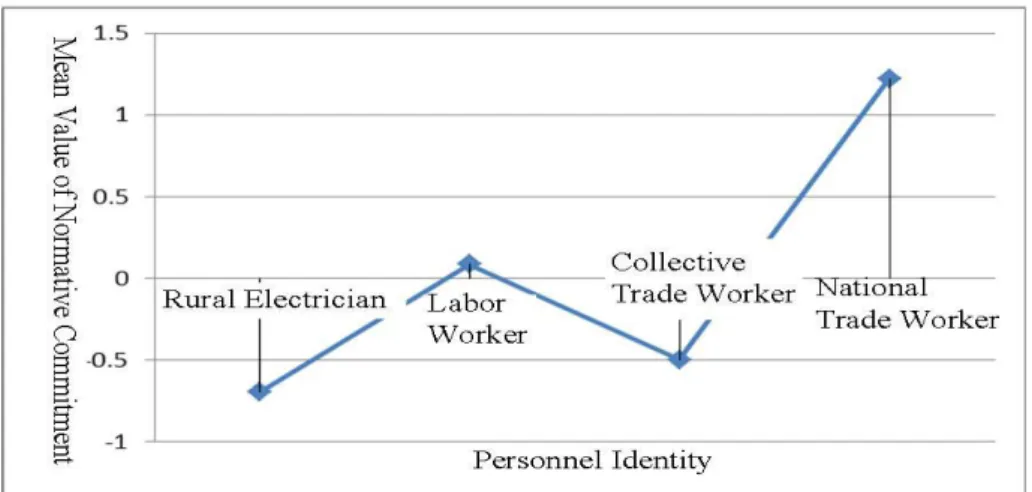
Figure 6- 10 Relationship between Personnel Identity and Normative Commitments... 79
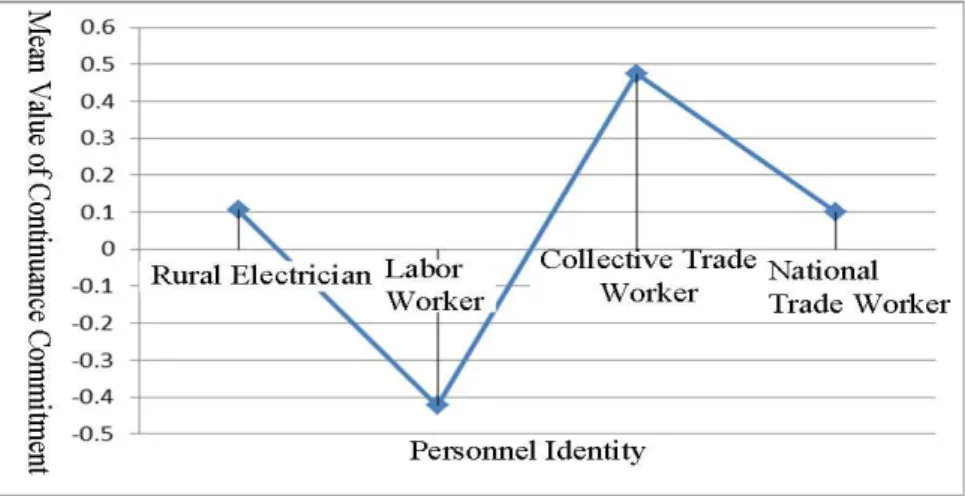
Figure 6- 11 Relationship between Personnel Identity and Continuance Commitments... 80
Figure 6- 12 Effect of Implementing HPWP system on Personnel Evaluation ... 81
Figure 6- 13 Effect of Implementing HPWP system on the Level of Organizational Commitments ... 82
Figure 6- 14 Effect of Implementing HPWP system on the Level of Affective Commitments82 Figure 6- 15 Effect of Implementing HPWP system on the Level of Normative Commitments ... 83
Figure 6- 16 Effect of Implementing HPWP system on the Level of Continuance ... 83
Figure 6- 17 Effect of Implementing HPWP system on Workers in Enterprises Owned... 85
Figure 6- 18 Effect of Implementing HPWP system on Labor Workers... 85
Figure 6- 19 Effect of Implementing HPWP system on Rural Electrician ... 86
Figure 6- 20 Moderating effect on the Relationships between Personnel Identity and ... 89
Figure 6- 21 Moderating effect on the Relationships between Personnel Identity and Affective Commitments by Procedural Justice ... 91
Figure 6- 22 Moderating effect on the Relationships between Personnel Identity and Affective Commitments by Comprehensive Salary... 92 Figure 6- 23 Moderating effect on the Relationships between Personnel Identity and Affective
Commitments by Information Sharing... 93 Figure 6- 24 Moderating effect on the Relationships between Personnel Identity and
Normative Commitments by Procedural Justice... 95 Figure 6- 25 Moderating effect on the Relationships between Personnel Identity and
Normative Commitments by Comprehensive Salary... 95 Figure 6- 26 Moderating effect on the Relationships between Personnel Identity and
Normative Commitments by Information Sharing... 96 Figure 6- 27 Moderating effect on the Relationships between Personnel Identity and
Continuance Commitments by Procedural Justice... 98 Figure 6- 28 Moderating Effect on the Relationships between Personnel Identity and
Continuance Commitments by Comprehensive Salary... 98 Figure 6- 29 Moderating Effect on the Relationships between Personnel Identity and
Continuance Commitments by Information Sharing ... 98 Figure 6- 30 The Relationship between Personnel Identity and Educational Average Level 102
Chinese Power Companies
Chapter 1: Introduction
1.1 Research Background
Power enterprise refers to the enterprise that obtaines Power Business License pursuant to laws and undertakes the basic responsibilities for supplying safe, reliable and sufficient power and services for customers. Power enterprise is not only the stated-owned key enterprise that concerns national energy security and national economic lifeline, but also undertakes the major responsibilities for maintaining and increasing the state-owned assets, enhancing national economic strength and industrial competitiveness.
Human resource management, as the core of modern enterprise management, has been accepted by more and more enterprise managers and the corresponding Human resource management practices have already penetrated into daily production and operation activities. However, power enterprises have lagged far behind many enterprises both at home and abroad whether the cognition degree of Human resource management theory or the implementation degree of Human resource management practice for various reasons or as limited by many conditions. As a direct consequence that power enterprises will be in a disadvantageous position in market competition and the development of them will be eventually affected if such bottleneck is not improved as soon as possible.
With new breakthrough in reform and new changes in development, especially the significance impact of social, political and cultural factors, renovation, development and stability will become the major contradictions at different history period and different history conditions. This kind of contraditions require Human resource managers of enterprises to rethink the role of enterprises’ human resources and value added issues from an entirely new perspective and to establish new working mode and process, thus improving the competitive ability of enterprises. Therefore, a new round of reform in employment form of power enterprises is imperative. From analysis, the reform of China's labor employment will lead enterprise employment to transform to marketization, standardization, personnel agency system (personnel management outsourcing) and personalization. The content of labor laws and regulations will be perfecting; the magnitude to integrate with international labor standards will be increasing and the operability will also be growing. At the same time, the
Chinese Power Companies
external environment of power enterprises under globalization has also quietly changed. In view of the actual situation of power enterprises, China's power enterprises will experience triple changes in complete separation of main and secondary, deepening electricity price reform and transforming regulation mode. The changes in external environment promote power enterprises to attach importance to the guarantee of employees’ rights and reasonably develop and utilize human resources.
To deeply understanding the human management problems of China’s power enterprises, we choose State Grid Company as a case in which we examine its human management practices and identity the problems caused by its multiple employment modes.State Grid is the largest Chinese state-owned enterprises headquartered in Beijing and ranked 3rd on the 2011 Fortune Global 500 list of the largest companies in the world. In recent years, it has started personnel reform by establishing fair and rational, mutually beneficial and win-win, harmonious and stable new socialist labor relations, which stimulates employee’s enthusiasm, subjective initiative and creativity and gain employee’s loyalty and commimemt. However, for a long time, State Grid Company and other power enterprises have formed many employment modes (including workers in enterprises owned by the whole people, workers in enterprises of collective ownership, labor workers and rural electrician, etc.). The coexistence of a variety of employment modes is result from the transition of state-owned enterprises from planned economy to market economy, which is now increasingly becoming a serious problem that may hinder corporate’s development.
Whilethe multiple employment modes had played a stimulating role in improving employee’s performance, they have brought increasing negative effects.
Scattered parallel operation of employment modes in power enterprises have largely aroused the injustice among different types of employees and affect the cohesive force and working performance of enterprises..
In recent ten years, State Grid has been rapidly developed. With the expension of State Grid, the rapidly increasing of employee leads to the more serious conflicts about mitiple employment modes.
Limited by employment plan, the long-term workers in power enterprises have, been negatively increased and the newly employed personnel are not enough to make up the gap of natural reduction of personnel. As a consequence, it is unable to provide necessary maintenance personnel and personnel reserve forunning thoses newly added power grid
Chinese Power Companies
collective ownership to participate in practical production and had to recruit labor workers from society to fill vacancy and to satisfy the demands of safe production and quality service. At the same time, limited by the employment system and the related cost, employers have to deal with the labor relations of those personnel with collective or diversified enterprises and undertake the labor cost of those personnel, or try by hook or by crook to solve the salary problems for those personnel from controllable cost or maintenance cost of rural power grids. As a result, “confusion of responsibilities” of workers in enterprises of collective ownership, rural electrician and other personnel in employers’ post occurred. Meanwhile, labor workers and rural electrician require equal pay for equal work and the called for signing labor contract. For the reasons given above, to straighten out the labor relations and carry out human resources renovation, State Grid Company (State Grid Company in B Province) have made effort to straighten and standardize the employment situations, specified that only two employment modes are allowed for the posts of employers- Long-term workers and labor workers. In 2007 and 2008, Grid Company in B Province carried out the pilot of Comprehensive Reform for Human resource Management in D Power Grid Company and C Power Grid Company to break the "identity" boundary and incorporate a variety of labors into the same set of post system and compensation system management, which preliminarily solved the post promotion channels and salary problems and avoid the contradiction of unequal pay for equal work.
However, the problems of employment and allocation mechanism of most power enterprises, at present, are still prominent. On employment allocation, long-term workers of power enterprises have been negatively increasing in recent years, but the overall redundancy and structural imbalance of vacancies in production line in enterprises is very outstanding, especially serious insufficiency of technical and skilled talents in production and marketing line for the expansion of production scale, introduction of labor employment and a large amount of newly added county-level power enterprises managed by holding. As a consequence, the promotion of fixed member to reach the mark is difficult. On employment distribution, serious redundancy in power enterprises in central cities and overall vacancies in power enterprises in remote areas are present. For the latter enterprise, they need workers, but there are no workers willing to work there; although there are workers to come there, the enterprises are unable to remain them. On employment management, after the diversification of employment mode, confusion of responsibilities is more and more common and the risk of equal pay for equal work and standardized employment is larger with the increasing labor
Chinese Power Companies workers and decreasing long-term workers of employers.
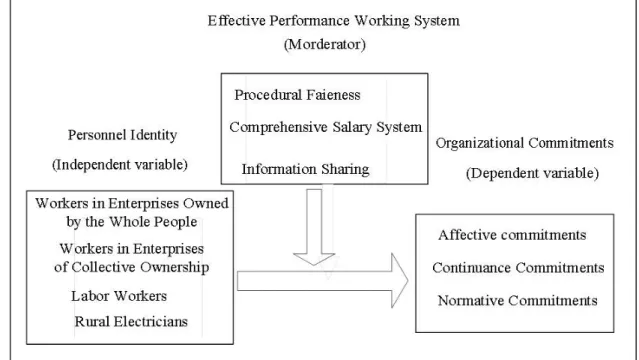
In order to provide some answers for these problems happened in many power enterprises, we use State Grid Company as a samle case and try to explore how their multiple employment modes work in their companies, how these employment modes influence personnel identity, and how these personnel identity affect employee’s organizational commitment. In addition, many prior studies demonstrate that high performance work practice system (HPWP) is a core concept in the area of strategic human resource management (SHRM) (Becker and Huselid, 1998). HPWP is significantly related with employee’s commitment and performance (Huselid, 1995). Therefore, we bring the cocept of HPWP into our model and explore the moderator effect of HPWP on the relationship between personnel identity and organizational commitment.
1.2 Research Goals
Based on the above background, this paper intends to find how different types of personnel identity related with organizational commitment and how HPWP moderator this relationship. We hope the findings of this study could provide support for the reform of State Grid’s human resources development. We first summarize the problems of State Grid’s Human resource management experience and establish taking post management as core, standardize post setting system, perfect new salary distribution system, dredge the channel of personnel career, change identity management to post management, improve Human resource management level of power enterprises, realize the organizational commitment of electrical personnel and finally propose concrete solutions against the problems in Human resource management concept, labor employment management system, labor contract management, labor employment mode, employment management on labor workers and rural electrician, personnel management for diversified enterprises under universal support, equal pay for equal work, coordination mechanism of labor relations and other aspects of power enterprises through analysis of problems in Human resource management of power enterprises. Research contents are as follows:
Chapter 1 is introduction, mainly demonstrating research background, reasons for selecting the topic, purpose of selecting the topic, research methods and research phases, problems to be solved and innovation points. Chapter 2 is overview of theories and literature. This part is mainly to define personnel identity, review, analyze, generalize HPWP system,
Chinese Power Companies
organizational commitments, HPWP system and organizational commitments, etc. Chapter3 is the introduction of research objects, mainly demonstrating the development history, current situation and origin of research problems of enterprises involved in this paper, explaining and personnel identity with special background of China's state-owned enterprises. Chapter 4 is the model and hypothesis proposal, putting forward the research frame and hypothesis to be proved in this paper in accordance with relevant theories and in combination with the existing model. Chapter 5 is research methods, specifically analyzing and describing the definition of variables, research objects and data collection, sampling description and statistics, data analysis method and questionnaire analysis, etc. Chapter 6 is research results and discussion, mainly analyzing and discussing the key theories of paper, namely, the impact of HPWP system on organizational commitment, impact of control variables on organizational commitment and moderating effect of personnel “identity” and then obtaining research results. Chapter 7 is research conclusions and outlook, mainly summarizing the research results of this paper, putting forward Human resource management strategy and suggestions of power enterprises, obtaining the reform revelation of labor employment mode of power enterprises and pointing out the research innovation and insufficiency of this paper.
1.3 Research Methods
This paper adopts the combination of literature overview and questionnaire investigation to carry out comprehensive research. Placing HPWP system of enterprise in certain theory background for research fully explains the academic significance of study.
In this paper, we will comprehensively use multiple research methods on the basis of theoretical analysis and deepen the understanding of enterprise's HPWP system through the introduction to relevant research from domestic and overseas scholars to lay a good theory foundation for the research on HPWP system of power enterprises. In addition, we will measure organizational commitment from emotional commitment, continuance commitment and normative commitment through literature review and theoretical analysis and form measurement questionnaire of HPWP system and organizational commitment according to the existing mature measuring scale. On this basis and in combination with the history background of China's state-owned enterprise, we will define enterprises’ personnel identity and issue questionnaire to personnel with different identities. At the same time, we will collect a large amount of public information of relevant enterprises and verify the proposed hypothesis and effectiveness of model with empirical research methods.
Chinese Power Companies
1.4 Innovation Points
Firstly, the relationship between the recognition of organization to personnel (namely, different personnel identity in this paper) and recognition of personnel to organization reflects the interaction between organization and personnel, which is further verified by the moderating effect of HPWP system. Special personnel identity of China's state-owned enterprises enriches and expands the existing literature, which has certain theoretical value.
Secondly, power enterprise has a long history and experienced various policies of national labor and personnel renovation. Furthermore, the labor employment is diverse, so the research on Human resource management strategy has important guiding significance to the enterprise.
Thirdly, A Group Power Grid Company (Power Grid Company in B Province) firstly made the reform in the industry throughout the country, and has specific reform measures and rich pilot experience, so its research conclusions can provide useful reference for other enterprises.
Chinese Power Companies
Chapter 2: Literature Review
2.1 Social identiry
Social Identity Theory provides new thoughts to explain group behavior. “Social Identity” originally means identity. In Chinese, the word “identity” means the social status and qualification of a person. Social Identity Theory thinks that social identity is an important component of self-concept. An individual affects his own social perception, social attitude and social behavior through the cognition to members who belong to the same group with him (Hogg & Tindale, 2005). Individual identity and social identity are the bases of distinguishing interpersonal relation and intergroup relation (Tajfel & Turner, 1986). In interpersonal communication, behaviors are controlled by personality variable; in intergroup communication, behaviors are controlled by group sorting process from individual. Individual identity means individual’s self-recognition with some peculiarity. Thus individual identity lets individual confirm in space-time that he and himself are the same person rather than anyone else. Social identity is individual recognition that he stays in a social group and a social category. Thus social identity lets individual recognize and intensify that he is same to or similar with other people in a social category, but different with other people. In social communication, people always try to get or maintain active social identity (to promote their self-esteem). To a great extent, the active identity comes from the advantageous comparison between in-group and related out-group. When people are unsatisfied with current social identity, they can choose to leave the group or find ways to achieve active identity. The creator of Social Identity Theory (Tajfel,1978) defined social identity as individual cognition of the qualification possessed by the members who belong to the same group with him, and the qualification’s importance in value and affection.
2.1.1 Employment System of SOEs and Personel identity
The transformation of SOE in China is pushed out as the reform and improvement after reform and open, which means the SOE bring part of the market mechanism to lead to the situation which carries out both plan and market mechanisms at the state-owned economic mechanism in general. The “two-track system” in SOE indicates as the “two-track”
Chinese Power Companies
employment in employment system. The reform of employment system in SOE can be divided into three stages since 1987: the first stage is unitary employment system from 1987 to 1985, i.e. regular employment system; the second stage is the transformation from regular employment system to binary employment system from 1986 to 1991, i.e. the appearance of “two-track” employment system; the third stage is the situation which dominated by “two-track” employment system, and at the same time diversification of employment form and labor relation also exists. The employment forms in SOE include employee, contractor, temp and dispatched labor under this employment system. Each employment form has very different origin and significant belongs to different group.
Employee, also called “regular worker”, has the features shared by conventional “regular worker”. They are employed for long term and have no specific service time that form a stable and normative labor relation with SOE and have a high standard in working hours, income, working environment, social insurance and career development, etc. There are three sources of employee in SOE: the first is the old personnel are directly transited to employees during SOE transformation. Though all personnel are required to sign labor contract, there are many personnel avoid the limitation of labor contract. The second is the open recruitment which leads SOE to employ the excellent people and sign official labor contract. The quota of people is very small. The third is the internal recruitment in SOE which is usually left for “relational group” such as employees’ families.
Contractor, also called labor workers, is the laborer who signs labor contract with SOE to determine the obligation and right of two parties through the employment form which combines the responsibility, power and interests. Most of these employment personnel is recruited in society and settled on positions which need a certain period time of usage. They are divided into unskilled labor and skilled labor. The contract can be long-term and short-term according to the demand of SOE. In common the contract period is three years or five years. The labor relation between contractor and SOE is lower than employee and higher than temp and dispatched labor and so on. It is possible for them to transit to employee if they work for a long time and have good job performance.
Temp is a kind of worker who is recruited and appointed with the approval of labor department for a specific service life because of the temporary and seasonal tasks in SOE. The labor relation is unstable and the treatment is lower than employee, labor worker or contractor without welfare and social insurance. There is a kind of unstable part-time temp who only need the oral agreement and can stop the employment without any economic compensation.
Chinese Power Companies They can come and go as soon as called.
Dispatched labor refers to the staff in labor dispatch agency signing labor contract and dispatched to work in other Employers. This employment form forms a complex relation between Employer, labor dispatch agency and labor worker. There is labor relation and no real position between labor worker and labor dispatch agency, while there is real position and no labor relation between Employer and labor worker, i.e.” with labor relation and without working; with working and without labor relation”. Dispatch employment is officially legalized as a flexible and complementary employment form after issued Labor Contract Law in 2007. More and more enterprises employ dispatched labor to avoid relevant legal liabilities which leads to the informal prosperity of labor dispatch and the mainstreaming of labor dispatching employment. During this procedure, SOE act as the pioneer to employ many dispatched labor in many important and long-term positions which constitute main part of the “two-track” employment system. The reason that labor dispatch is popular on SOE is that its flexibility and convenience saves a lot of labor cost for them. Compared to the employee, the dispatched labor's salary, welfare and social premiums are lower, and they are easy to be ordered. Once accident happens, enterprise can pass the responsibility to labor dispatch agency and avoid legal liability. Besides, enterprise can reduce the stafftrimmer without undertaking any legal liabilities and economic compensation.
From above SOEs’ employment history and employment forms which systermatically devides workers into different category, since categories are defined by prototypical characteristics abstracted from the members (Turner, 1985), providing the individual with a systematic means of defining others, thus these employment forms indicates completely diferent identity, according to Social Identity Theory (Tajfel,1978) , we defined these diferent employment forms as personel identity in this paper.
2.1.2 Distinctions of Personnel Different Identities in SOE
The starting point of “two-track” employment system in SOE is to adapt the needs of marketization reform of SOE, which presents a flexible, diversified and effective image. It develops a graded and discriminatory employment system, however, because of the incomplete social security system and the uncommitted law of labor rights protection. This employment system causes the giant gap between “in system” and “out system”, and the big differences in income distribution, political rights and other aspects Among groups “in system” represented as employee and “out system” represented as contractor, temp and
Chinese Power Companies dispatched labor.
The most obvious and direct inequality between the personnel in/out system of SOE is indicated at the payment of labor. The basic wage of personnel in system is 3 to 4 times as the basic wage of personnel out system. The great attraction of SOE to workers not only depends on the increase of basic wage, but also the better welfare compared to the non-stated-operated economic units. Because of the disguised welfare income compared to wage income, it becomes the major method to increase the income of personnel “in system” in many SOE. Especially the SOE in monopolized industry gain fat profit rely on strong political advantage. On the condition of independent allocation, the welfare income is breathtaking. The welfare income of personnel “in system” is unattainable for workers “out system”. The differences between them are enormous. Workers participate in working and enjoy the achievability, who not only pursue the payment to meet the demand of material life, but also gain attention, voice and political rights. They expect opportunity for career development and make steady progress in career path. Regarding these aspects, personnel" in/out system “receive different treatments. In aspect of political rights, employees have various kinds of voice and activity fees to take part in rich employee activities. The informal employees such as temporary temp and dispatched labor can rarely participate in labor union because of the awkward situation; it is possible for contractor and long-term temp to become members of labor union, while it is hard for them to get participation rights, supervision rights, and the rights to vote and to be elected as employee. In general, personnel “out system” are short of interest expression representation mechanism and effective channels and usually “are informed”, and belong to the “silent majority” in enterprises. In the aspect of career development, there are different trains and promotion system for personnel “in/out system”. The former have educational training fees, more training opportunities to increase the professional knowledge and skills and large development and promotion spaces through their efforts. It is hard for the latter to work out a clear personal plan of career development. They are lack of employment security and satisfaction and impossible to overcome the obstacle of “authorized size”. The differences and formation history of employment status
2.1.3 Four Types of personel identities in Power Enterprises
There are many employment forms such as workers under ownership by the whole people, collective workers, labor workers and rural electrician, etc. in power supply enterprises.Workers under ownership by the whole people refer to employees signing labor
Chinese Power Companies
contract with power supply enterprises who are regular with high stability. Collective workers are also the employees signing labor contract with power supply enterprises who are relative regular with relative high stability. Labor worker is short for dispatched labor. This kind of employment is that workers sign labor contract with labor dispatch agency registered in administration for industry and commerce and are dispatched to Employer, i.e. power supply enterprises to provide labor service with the approval of labor administration department. There is stable labor contract relation between labor worker and labor dispatch agency instead of electric power bureau. Therefore the stability of working relationship is lower than collective worker for electric power bureau. Rural electricians refer to the village electrician providing service for rural electricity supply and a group of administrators in power management stations before electricity reform. They are a kind of dispatched labor now who are dispatched to power supply enterprises and responsible for the construction, operation, maintenance, repair of line with voltage no more than 10 KV in village, and electricity service and electric charge collection. They do not sign labor contract with electric power bureau, and the stability of labor relation with electric power bureau is the lowest.
2.1.4 Challenges facing with SOE’s employ sistem
The Labor Contract Law, put into force on January1, 2008, embodies the idea of securing fair labor, equal employment and equal pay for equal work and put significant impact on power enterprises in labor and employment, salary distribution, position setting, social security as well as education and training system.
On one hand, the Law increases the cost and difficulty of human resource management. If the HR management system couldn’t match with the Law, it would put the power enterprises on huge legal risk in terms operation and management.On the other hand, the issuance and implementing of the Labor Contract Law will accelerate the reform of employment and distribution system so that to promote the construction of professionalization, refining and standardization to realize the HR management goal of “proper scale, reasonable structure, innovative mechanism, good quality, standard management, improved environment”.
One the other hand, newly recruited college graduates and demobilized soldier can hardly fill the gap caused by the enterprises’ scaling up while staff naturally reducing. Except for planned recruiting, to alleviate the disparities between power construction, operation and management with the shortage in labor, these enterprises have adopted marketized
Chinese Power Companies
employment ways including labor dispatching, provisional employment and business outsourcing, which helped ease the tension caused by labor shortage in some extent. However, the Labor Contract Law conducts strict limits on the management pattern of diversified employment, which causes difficulty for the unplanned employment, as well as legal risks as problems in actual labor contractual relation, and same work with different pay.
2.2 Organizational Commitment
The research of personnel commitment action was begin in 1960s and was developed in the next several decades. The concept of organizational commitment was first introduced by Becker (1960), he viewed commitment as a kind of feeling and aspiration which was produced along with the increasing endeavor of personnel putting into organization and made employees to be willing to anticipate in organizational each work. Here from Side-bet Theory was proposed which insists that the employees would lose all kinds of welfare once leaving the organization, such as house, pension, and allowance and so on. This welfare would increase as more time, energy or money was put into organization. Meanwhile, the skill obtained by spending much time might not be used which formed the cost of leaving organization. Once personnel left the organization, he (she) had to burden these cost.
Though the concept of Organizational Commitments was first put forward by Becker (1960) but he didn’t carry out further research on this concept. Buehanan (1974) and Porter (1976) et al had refined Organizational Commitments based on their new research of emotional dependence of personnel to their organization. In the probing of influencing elements on Organizational Commitments, they thought the elements of influencing affective commitments were more widespread than the Becker’s instrumental commitment, the elements like salary, personnel status, sense of responsibility, freedom of work and the opportunity of promotion would influence personnel commitments. But comparatively speaking, the age of staff and working life are the more important elements.
Porter et al (1976) had researched the relationship between affective commitments and job satisfaction, two-stage (superior and the same level) assessment and promotion. The research pointed out that the personnel with high commitments was presented as the following three features: (1) Approving the goal and value of organization; (2) Putting as much as energy into each organization work; (3) Being proud of becoming a member of organization. The level of origination commitments and the personnel evaluation from
Chinese Power Companies
superior and the same level and the personnel’s own evaluation of its work, reward and promotion is positive correlation.
To evaluate the character of personnel psychological commitment effectively, Ritzer and Trice (1969) worked out the Ritzer-Triee measuring scale (HS-S). Hrebiniak and Alutto (1972) revised the measuring scale and formed THrebiniak-Alutto measuring scale (HA-S).While the organization commitment questionnaire (OCQ) was developed by Porter and Mowday has provided effective tools for latter research of organization commitment. These measuring scales are used to measure the psychological commitment of personnel but they are different in the measuring context in fact, and they also show different researchers with different definition and understanding of organization commitment.
According to the previous researches, a kind of scale is formed in summary of them by Meyer and Allen(1990). After one-dimension model and (Porter, 1976) and two-dimension model (Angle & perry, 1981; O’Reilly & Chatman,1986)), the present wide-accepted three-dimensions model is gradually developed, which are affective commitment, continuance commitment and normative commitment. Meyer and Anen (1990) have an overall analysis and review on the previous research results on normative commitment by many researchers and propose the three-factor model of commitment on the basis of their own practical researches. They explain the organizational commitment in terms of reasons that they want to stay, they have to stay or they need to stay for personnel’s stay in an organization. The organizational commitment is defined a kind of psychological state presenting the relationship between personnel and organization that implies whether personnel are determined to stay in the organization. Three factors are as followed respectively:
Firstly, affective commitment is the individual personnel’s identity degree on organization, which includes the belief and acceptance for the goal and value of organization, the willing to devote to organization and to work for it. Personnel emotionally identify and take part in organization. And the reason for those with high affective commitment is that they want. There are some similar opinions: Kanter says that when individual psychologically and emotionally identity on organization, they will stay in it (Kanter,1968). Porter etc. and Morrow etc. both believe that organizational commitment is the relative degree of personal identity on organization and devotion. It has the following three features: (1) a strong belief and acceptance for the goal and value of organization. (2) Willing to devote intellectually. (3) Desire to be continuously part of organization.
Chinese Power Companies
organization, which is an accumulated dimension. It is a kind of commitment that they have to stay in the organization for not losing the exchanged treatment after several years devotion on the basis of personnel’s cognition on losses after leaving it. The commitment is built on interest and has a strong feeling of trade. With time accumulated, the personnel working in it will get a satisfactory salary and pension. Besides, they are able to master a specific technology of it and develop good interpersonal relationship in it. They are in the possess of a higher qualified position, etc. If they quit, all of these will be gone. And due to the possibility that they are not necessarily able to find out a better organization than the present one, the difficulty of quitting increases. In a word, in order to maintain all of these personnel have to stay in organization.
Thirdly, normative commitment is the influence of social regulation on the degree of individual’s obedience to organization. It reflects the personnel’s compulsory feeling on their further stay in it. It is a kind of commitment that they stay in organization with the influence of the sense of social responsibility formed by the long-time social influences.
After the proposal of three-factor organizational commitments model by Meyer and Allen (1990), it has widespread effects. Then a large amount of researches are made to test its universality. The main arguments are following (Zhangmin and Zhangde, 2002): in ① empirical research on affective commitment and normative commitment it is found that they are highly related. They overlap in definition. Even though these two definitions are proposed by Meyer and Allen (1990), they are indicated to overlap inside between them. But the theoretical existence of normative commitment appears the evidences are not accurate enough. When the measurement of normative commitment built up by Meyer and Allen is carried ②
out in cross-cultural research, the meaning of bi-directionally translated words is difficult for the surveyees to understand. The results of different empirical research are not in ③ accordance as to the problem whether continuance commitment can be further divided into two factors: lack of chance and individual losses.
Ling Wenqing (2000) etc. made further study on organizational commitments of domestic enterprise personnel, based on which he has put forward five-factor model of organizational commitments on enterprise personnel in China,namely, affective commitment, normative commitment, ideal commitment, economic commitment and opportunity commitment. Affective commitment is willingness to make contribution to survival and development of organization regardless of rewards with organizational identification and profound feelings; ideal commitment is emphasizing growth of individuals, pursuing
Chinese Power Companies
achievement of ideals, paying attention to the probability of exercising of personal specialty in the organization and providing of various working conditions and learning for improvement as well as opportunities of promotion to facilitate achieving ideals; normative commitment is that attitude and behavior expression of enterprise are guided by social norms and work ethic with responsibility for the organization and fulfilling of one’s due responsibility and obligation for the organization; economic commitment is staying in the organization because one is afraid that the organization will suffer economic loss; opportunity commitment is that he stays in the organization for the root cause of failure to find any other satisfactory working organization or no opportunity of finding work owing to his low technical levels. Therefore, five-factor organizational commitment put forward by Ling Wenqing (2000) has big relationship with three-dimensionality organizational commitment by Meyer and Allen (1990). Connotation of affective commitment and normative commitment in the five-factor structure is in agreement with that in three-dimensionality organizational commitment. Economic commitment and opportunity commitment are two factors which are divided from continuance commitment in China and ideal commitment is unique characteristic in China. The ideal commitment is systematic and profound in the domestic research on organizational commitment. Five-factor structural model has realistic meaning for guiding personnel management practice of Chinese enterprises. Further empirical research is needed on the issue whether the theoretical model applies to all Chinese enterprises.
In accordance with need of research of the paper, we adopt three-factor model by Meyer and Allen (1990), namely, organizational commitment mainly consists of affective commitment, continuance commitment and normative commitment.
2.2.1 Influencing Factors of Organizational Commitments
Steers (1977) investigated the degree of correlation between organizational commitments and variables such as individuals, work, roles and organizational characteristics. Eisenberger(1986) put forward according to norms of mutual benefits and communication theory that care and support felt by members from the organization is key factor of forming organizational commitments. Mathieu and Zajac(1990) conducted element analysis on main research of organizational commitments and classified relevant factors of organizational commitments into eight types: apart from stimuli, satisfaction of work and working performance, other types such as personal variable, work pressure, characteristic variable of work, team and leader relationship, characteristic variable of organization were deemed to
Chinese Power Companies cause organizational commitments.
Recently more research have focused on effect on organizational commitments of sense of organization support by the personnel and held that sense of organization support is main intervening variable. Liu Xiaoping and Wang Chongming (2002)built a model for formation mechanism of organizational commitments based on social exchange. The formation mechanism of organizational commitments contains two main systems: judgment and comparison system of organization support and attributing and generation system of organizational commitments. The former mainly judges the size of organizational support and the latter explains and weighs the comparison results.
The paper makes primary conclusion and classification of influencing factors of organizational commitments based on previous relevant research (Steers, 1977; Meyer and Allen,1991;Ling Wenlun, etc. 2000;Liu Xiaoping and Wang Chongming, 2004). There are mainly three types: ① organization factor, mainly including organizational support, organizational dependability, justice, acceptance degree of new opinions and new thoughts by the management level and collective work ethos, etc. ② work factor, including challenge of work, degree of clearness of position, degree of clearness of objective and difficulty of objectivem, etc.③ personal factor of personnel, including age, length of service, educational level and working experience, etc.
2.3 HPWP system and Organizational Commitments
Ferris, etc. (2001) held that main factors influencing enterprise performance is effect on personnel behavior of human resource management practice of enterprise and some corresponding empirical research had proved organizational citizenship behavior and organizational commitments of personnel had direct influence on enterprise performance. American scholars held that HPWP system had direct influence on enterprise performance which is realized through member relationship and behavior of the organization (Wright Dunford & Snell, 2001).
Champon and Porter (1976) once investigated interests in life and organizational commitments of blue collar and white collar, only to find: higher organizational commitment is, higher working performance is (Jing & Xiao-hua, 2009). Johnston investigated developing and testing of comprehensive model of organizational commitments in the sale environment,
Chinese Power Companies
only to find: organizational commitments are highly responsible and significant factor influencing personnel change and performance (Johnston, 2001). Personnel with low organizational commitments have low working quality (O'Driscoll & Randall, 1999; Randall, Cropanzano, Bormann, & Birjulin, 1999). In terms of managers at basic level, their working performance has positive correlation with affective commitment and has negative correlation with continuance commitment (Meyer, Paunonen, Gellatly, Goffin, & Jackson, 1989). On the whole, relationship between affective commitments and working performance of personnel is extremely weak, which is not that obvious as that between resigning and absence (Mathieu & Zajac, 1990). The conclusion that commitment to organization is unrelated to working performance of personnel and to the superior influences working performance of personnel (Becker, Billings, Eveleth, & Gilbert, 1996) has been confirmed by the research (ChenTsui & Farh, 2002).
Organizational commitments have remarkable effect on organizational citizenship behavior of personnel (Williams & Anderson, 1991). Research results of Shore & Wayne (2004) indicated that affective commitments and organizational support consciousness and organizational citizenship behavior are positively correlated and continuance commitments and organizational citizenship behavior are negatively correlated. In the meanwhile, the research also indicated that organizational support consciousness can explain variation of organizational citizenship behavior better than continuance commitments, namely, organizational citizenship behavior is influenced deeper by organizational support consciousness in organizational commitments. According to research of some researchers, especially research of Feather in Australian teacher groups indicated organizational commitments have strong correlation with organizational citizenship behavior (Feather & Rauter, 2004). Furthermore, Meyer reviewed antecedents, results and relevant variables of organizational commitments with the method of element analysis, only to find organizational commitments have positive correlation with organizational citizenship behavior. In particular, correlation between affective commitments and organizational citizenship behavior is stronger (Meyer, Stanley, Herscovitch, & Topolnytsky, 2002).
Model of human resource value put forward by Dyer, etc held that good human resource management practice influences working attitude and behavior of personnel and further causes a series of chain reaction. Good working attitude and behavior will influence output of personnel; improvement of output of personnel can enhance productivity and product quality of enterprise without less loss, thus improving output of enterprise; improvement of enterprise
Chinese Power Companies
output is reduction of costs and increasing of enterprise profitability with respect to finance; as increasing of enterprise profitability improves financial situation of enterprise, finally share price of enterprise increases and enterprise assets appreciate in securities market. Ultimately, enterprise performance is improved (Dyer & Reeves, 1995).
Chinese scholars hold that HPWP system will influence improvement of organizational commitments of personnel and prompt enterprise personnel to generate high sense of attachment and identity for the organization, finally producing favorable effect on development of enterprise (Qi Zhenjiang & Zhu Jiping, 2007). Zhao Shuming, etc. found in the research on more than 200 enterprises in Hong Kong that HPWP system will indirectly influence market performance through personnel performance (Zhao Shuming & Liu Hong, 2002). Yang Dongtao discussed correlation analysis of HPWP system and affective commitments of personnel and concluded in investigation analysis of more than 700 enterprises in Shanghai, Guangdong and Jiangsu that HPWP system and affective commitments of personnel are remarkably correlated. Proper and effective human resource management practice can improve affective commitments of personnel and make more contribution for the enterprise (Yang Dongtao, Chen Tongyang & Xu Guohua, 2005). Chen Jinlin, etc. discussed the issue of introducing intervening variables to HPWP system and held that introducing two-level intervening variables between HPWP system and enterprise performance is proper human resource management practice, directly influencing attitude and behavior of personnel (Chen Jinlin & Shi Jintao, 2007)
In general, the above research indicates that HPWP system can improve organizational commitments through influencing some factors such as workers’ working attitude and behavior, finally influencing improvement of enterprise performance. Additionally it is worth mentioning that as far as the first author is concerned, HPWP system and relevant theories of organizational commitments are applied in other production enterprise to certain degree and there are quite some relevant researches. However, research on personnel identity which is very specific but prevalent phenomina in Chinese SOEs is very rare, thus exploring the relationship between personnel identity with organizational commitment, and the morerating role of HPWP system not only has practical value but also has very good potencial contribution to social identity theory.
Chinese Power Companies
Chapter 3: Research Setting
3.1 Basic Condition of the Enterprises
The Grid Company in province B is a wholly-owned subsidiary of Enterprise A. The Company, as a state-owned mega corporation with grid operation as its core business, owing 58 subordinate bodies, 65 county-level power supply companies under direct supply and management, 98 county-level power supply holding or hosting companies and with employers of95560 members, is in charge of major power system planning, construction, operation and power supply in province B. The Company is equipped with 27 substations (including convertor station) of 500 Kv with total power transmission capacity of 48.53 million kVA, of which the 83 electric transmission lines cover 8281 km, 133 substations of 220 Kv with total power transmission capacity of 34.49 million kVA, of which the 377 electric transmission lines cover 11404 km, 443 substations of 110 kV with total power transmission capacity of 30.24 million kVA, of which the 1094 electric transmission lines cover 13554 km.
3.2 Personnel Structure of the Enterprises
By the end of 2011, the Company has 82128 employees which can be classified into four types: workers in enterprises owned by the whole people, workers in enterprises of collective ownership, labor workers and rural electricians working in villages and towns. The first type of workers is regular employees in a power supply company, with the second type as its supplement, who are usually children of the former. The third and the fourth type usually undertake labor dispatching. Labor workers are mainly of college degree or from technical secondary schools while rural electricians who are usually work in the electric management station under the old system are of low education degree. The latter two types of personnel and other dispatching personnel usually undertake subsidiary or executional work with low technical demanding.
Firstly, Classification according to employment form: long-term personnel (regular employees) of 27969 working in major grid accounting for 34.06% of the total staff members; permanent employees of (regular employees) of 24776 working in holding or hosting
Chinese Power Companies
companies, accounting for 30.17%; contract employees of 4521, accounting for 5.50%; electricians of 21270 working in villages, accounting for 25.9%; other personnel of 3592, accounting for 4.37%.
Sencondly, Classification according to type of enterprises: employees of 347 in headquarter, accounting for 0.42%; 72309 in power supply companies, accounting for 88.04%; 1178 in power generation stations, accounting for 1.43%; 495 in R&D institutions, accounting for 0.61%; 530 in training units, accounting for 0.65%; 7269 in other institutions, accounting for 8085%.
Third, classification according to position: operators of 360, accounting for 0.44%; managers of 6080, accounting for 7.40%; professionals of 11195, accounting for 13.63%; technicians of 49159 in charge of production, accounting for 59.86%; other personnel of 15334, accounting for 18.67%.
Forth, classification of long-term personnel in major grid according to positions: operators of 360 accounting for 1.07%; managers of 4046 accounting for 14.47%; professionals of 6730 accounting for 24.06%; technicians of 13960 in charge of production accounting for 49.91%; other personnel of 2933 accounting for 10.49%.
Furthermore, among the whole personnel, employees of 898 have a degree of postgraduate or above, accounting for 1.09% of the total number of staff members; 7983 have a bachelors’ degree, accounting for 9.72%; 19627 are of college education level, accounting for 23.9%; 14072 are from technical secondary schools, accounting for 17.13%; 14914 are of senior high school education level, accounting for 18.16%; 21744 are of junior high school education level, accounting for 26.48%; 2890 are with education level below meddle school, accounting for 3.52%.
Lastly, among the personnel in major grid, employees of 844 have a degree of postgraduate or above, accounting for 3.01% of the total number of staff members in the major grid; 6502 have a bachelors’ degree, accounting for 23.25%; 9270 are of college education level, accounting for 33.14%; 5460 are from technical secondary schools, accounting for 20.18%; 1785are of senior high school education level, accounting for 6.38%; 3543 are of junior high school education level, accounting for 12.67%; 382 are with education level below meddle school, accounting for 1.37%.
Employees of 1880 are entitled with a senior professional title accounting for 2.29% of the total number of staff; 5698 with a medium professional title, accounting for 6.94%; 12943
Chinese Power Companies
with a primary professional title, accounting for 15.76%. Additionally, there are senior technicians of 243, accounting for 0.30%; technicians of 2418, accounting for 2.94%, senior workers of 11014, accounting for 13.41%, medium workers of 6981, accounting for 8.5% and primary workers of 1687, accounting for 2.05%.
3.3 Current Status of Personnel Management
In 2007 and 2008, the subordinate companies – Power Company C and Power Company D of Grid Company in B Province make experiments of “comprehensive reform of human resources management”. However, the reform is still in pilot phase, so the comprehensive system of human resources management is not launched fully and the labor workers and rural electrician in all basic units still raise appeal of “equal pay for equal work and direct signing of labor contract”. At the same time, Labor Contract Law is formally implemented on January 1, 2008 and Regulation on Implementation of the Labor Contract Law is issued on September 18, 2008, all of which clearly specify that we must establish new labor relation of socialism with “standard and order, fair and reason, mutual benefit and win-win result and harmony and stability”.
In light of the Financial Accounting Standard, staff can be defined as the following three types of personnel which still affect the current HR plan and management.
(1) Personnel concluding a labor contract with the enterprises, including full-time, part-time and temporary workers.
(2) Personnel appointed officially by the enterprises but without concluding a labor contract, including members of Board of Directors and board of supervisors.
(3) Personnel neither concluding a labor contract with the enterprises nor being appointed officially, but providing services to the enterprises as the staff do.
The Labor Contract Law provides standards on paying for overtime work and on compensation for non-paid overtime pay, which forces enterprises to scientifically revise and improve the current standard on fixed number of labors, optimize employment allocation, reasonably define workload and guarantee the rest and vacation for employees, so that to avoid illegal acts.
To implement of the Labor Contract Law is, based on the current situation, to thoroughly implement of contract signing and registration system, changing, removing and terminating system, file management system, censorship system and statistic analysis system, to increase