PEARSON’S EXPERIENCE IN CHINA – ACQUISITION ON
GLOBAL EDUCATION: A PEDAGOGICAL CASE STUDY
Chen Wangting
Project submitted as partial requirement for the conferral of
Master in Business Administration
Supervisor:
Prof. Ana Margarida Simaens, ISCTE-IUL, Department of Marketing, Operations and General Management
I It has been a long process. Hereby, I am so grateful for the help, support and encouragement from everyone, including:
- Professor Ana Margarida Simaens, for her support and guidance every time when I was struggling. Without her guidance, I would not have been able to work things out.
- my family and friends. Thanks for their love and support so I can focus 100% on writing the thesis. Thanks for their encouragement when I was struggling.
- my former colleagues in GEDU who gave me insight and advice on the case.
- myself, for holding on balancing work and study.
II Internationalization is an old but ever charming topic. Driven by multiple motives, companies expand themselves in countries outside their home markets via various modes of entry and expansion. Under whatever mode, results are mixed with the good and bad. In cross-border M&A in China, this turns out to be extremely true as risks can arise from every aspect, especially cultural differences.
This case study with pedagogical notes explores the factors affecting international expansion, the determinants for choosing market entry/expansion mode, the M&A process and risks frequently made, and the challenges in post-merger M&A integration and management. It focuses on related issues and topics on the cross-border M&A between Pearson, a big British international publishing and educational company, and GEDU, a small Chinese company.
Building on international business, this case analyzes the process of international expansion and its risks, which presents: 1) the proactive and reactive reasons for going international expansion; 2) the entry and expansion choices; 3) the external and internal factors influencing decision-making; 4) M&A process and risks; and 5) post-M&A risks/challenges in China. Also, the role of culture in cross-border M&A in China is discussed.
The case design and analysis of such a case aims to present a general framework about internationalization, market entry and expansion modes, benefits and challenges in choosing different modes; moreover, by selecting one specific foreign operation mode: cross-border M&A, it explores its risks and downfalls in international management in China.
Key words: Internationalization; market entry and expansion; cross-border M&A; M&A risks in China.
JEL Classification System:
• M10 - General Business Administration • M16 - International Business Administration
III A internacionalização é um tópico antigo, mas sempre charmoso. Impulsionado por múltiplos motivos, as empresas expandem-se em países fora de seus mercados domésticos por meio de vários modos estrangeiros de entrada e expansão. Em qualquer modo, os resultados são misturados com o bom e o mau. Em cross-border M&A na China, isso se mostra extremamente verdadeiro, pois os riscos podem levantar-se de todos os aspectos, especialmente da diferença cultural.
Este caso com notas pedagógicas explora os fatores que afetam a expansão internacional, os determinantes escolhendo o modo de entrada / expansão do mercado, o processo de M&A e os riscos feitos, com frequência, e os desafios na integração e gestão de M&A. Concentra-se em questões e tópicos relacionados sobre cross-border M&A entre a Pearson, uma grande empresa britânica de publicação internacional e educacional, e a GEDU, uma pequena empresa chinesa desalistada.
Com base em negócios internacionais, este caso analisa o processo de expansão e riscos internacionais, que apresenta: 1) as razões pró-ativas e reativas para a expansão internacional; 2) as escolhas de entrada e expansão; 3) os fatores externos e internos que influenciam a tomada de decisões; 4) processo e riscos de M&A; 5) riscos / desafios de post-M&A na China. Além disso, o papel da cultura em cross-border M&A na China é discutido.
A concepção e a análise que utilizam esse caso visam apresentar um quadro geral sobre a internacionalização, modos de entrada e expansão no mercado, benefícios e desafios na escolha de diferentes modos; além disso, selecionando um modo específico de operação estrangeira: cross-border M&A, que explora seus riscos e quedas na gestão internacional na China.
Palavras-chave: Internacionalização; entrada e expansão do mercado; cross-border M&A; riscos de M&A na China
Sistema de classificação JEL:
• M10 - General Business Administration • M16 - International Business Administration
IV Acknowledgement ... I Abstract ... II Resumo ... III Contents ... IV Index of Tables ... VI Index of Graphs... VI Index of Figures ... VI List of Abbreviations ... VII
1 Case ... 1
1.1 Problem Identification ... 1
1.2 The Acquirer – Pearson ... 2
1.2.1 Pearson’s Development and Expansion ... 2
1.2.2 Pearson’s Performance, Strategy and Changes ... 3
1.2.3 Pearson Corporate Culture ... 5
1.3 The Host Country and the Acquired ... 6
1.3.1 The Host Country: China ... 6
1.3.2 The Acquired: Global Education and Technology (GEDU) ... 7
1.4 Pearson’s Acquisition on GEDU ... 12
1.4.1 The Marriage ... 12
1.4.2 Pearson’s Management Thoughts in China ... 15
1.4.3 Management on GEDU... 15
1.4.4 The Divorce ... 21
2 Pedagogical Note ... 22
2.1 Target Audience ... 22
V
2.4 Literature Review ... 23
2.4.1 Globalization and International Business ... 23
2.4.2 Motives for Internationalization ... 23
2.4.3 Modes of Market Entry and Expansion ... 26
2.4.4 Characteristics of Different Modes of Market Entry and Expansion ... 29
2.4.5 Determinants of Entry Mode Choices... 32
2.4.6 Mergers and Acquisitions ... 35
2.4.7 M&A Risks ... 36
2.4.8 Culture in Cross-border M&A ... 38
2.4.9 Cross-border M&A in China ... 41
2.5 Case Study Methodology ... 42
2.6 Analysis Tools ... 43 2.7 Animation Plan ... 43 2.8 Case Questions ... 46 2.9 Case Resolutions ... 47 2.9.1 Question 1. ... 47 2.9.2 Question 2. ... 48 2.9.3 Question 3. ... 49 2.9.4 Question 4. ... 50 2.9.5 Question 5. ... 50 2.9.6 Question 6. ... 52 2.9.7 Question 7. ... 54
2.10 Management Insights from the Case Study ... 57
Bibliography ... 59
Appendixes ... 68
VI
Index of Tables
Table 1: Motives for internationalization ... 24
Table 2: Characteristics of each mode ... 30
Table 3: Benefits and caveats of each mode ... 31
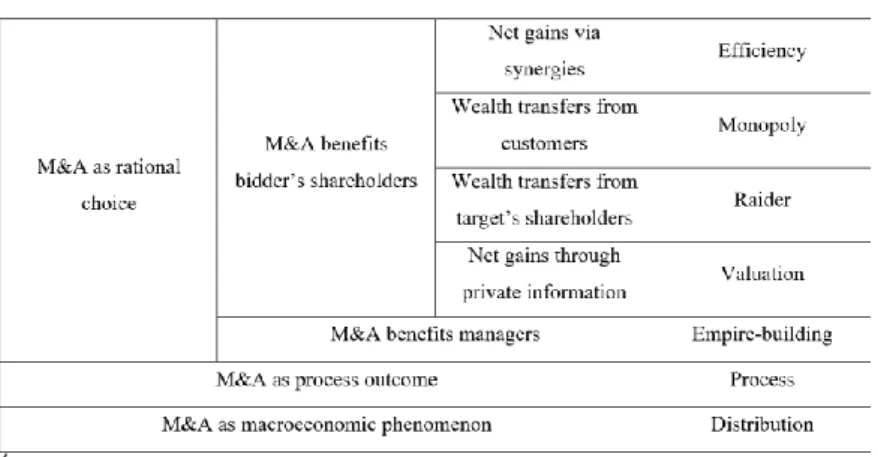
Table 4: Framework for the M &A motives ... 35
Table 5: Erin Meyer's culture theory ... 39
Index of Graphs
Graph 1: Household income spent on education ... 7Index of Figures
Figure 1: Person's values ... 6Figure 2: GEDU listed in Nasdaq in 2010 ... 9
VII FDI - Foreign Direct Investment
GDP - Gross Domestic Product
GEDU - Global Education & Technology Group Limited
IPO - Initial Public Offering
JV - Joint Ventures
M&A - Mergers & Acquisitions
1
1 Case
1.1 Problem Identification
Firstly founded as a construction company in 1840s, then acting as a publishing and educational company since 1920s and later shifting its focus only on education in 2015, Pearson is now a British educational company with presence in 70 countries and more than 32,000 employees around the globe, providing educational products and services (content, assessment and qualifications) to teachers, institutions and professional work places (Pearson, 2018). To survive, grow and prosper is said to any firm’s first and basic goal (Grant, 2012). Facing new opportunities and challenges in the past decade, Pearson has made huge effort in transforming itself in this gradually digitalized world, including the massive expansion into more different countries, especially growth markets like China, India, Brazil, and South Africa.
Strategies and ways to enter and expand into foreign markets are various, with or without Foreign Direct investment (FDI). Among all the choices like exporting, licencing/franchising, joint ventures (JV), mergers&acquisitions (M&A), greenfield investment, each of which has different advantages and disadvantages, the decision must be made considering multi-faceted factors.
China, since the promulgation of reform and opening policy and adoption of market-based economy, has attracted and accumulated foreign direct investment (FDI) in exponential figure due to its booming economy and market potential. Statistics show that the figures have continued to climb to around $1300 million in 2017 in the past decade (Trading economics, 2018). One of the methods to conduct FDI for foreign companies to play in Chinese markets is to merger and acquire Chinese companies. However, the performance of multinationals managing in the world’s second largest economy is mixed (Yu, et al., 2016), as M&A in China carries not only great profits but also huge risks. Pearson is no exception in its road to expansion in China with the acquisition of three Chinese companies.
This pedagogical case study takes Pearson’s expansion and its acquisition of one Chinese educational company, Global Education & Technology Group (GEDU), as an example to talks about foreign market entry and expansion, and M&A risks in China.
2 1.2 The Acquirer – Pearson
1.2.1 Pearson’s Development and Expansion
Pearson plc was founded as a construction company by an English man named Samuel Pearson in 1844. He later expanded by the acquisition of publishing, information and educational companies and reached today’s size with a presence in 70 countries, hiring more than 32,000 employees (Pearson, 2018).
Since the 1920s, Pearson has diversified itself via acquisitions and divestitures. With the 100% takeover of Financial Times in 1957, 50% of The Economist in the same year, Longman in 1968, Penguin in 1970, Ladybird Books in 1972, some other TV companies, broadcasters and media companies during 1980s and 1990s, and many others in later years, Pearson had shifted completely from a construction company into an important player in the publishing and information economy. Later in the 2000s, the acquisition of different education-related companies like HarperCollins, Prentice Hall Textbooks, Addison-Wesley led Pearson into an essential area of business activities: education (Pearson, 2018; Companyhistories, 2018).
By the time before the Financial Crisis in 2008, Pearson had been set itself with fame due to its great performance of business activities in around the world. Pearson plc’s revenues were from its three pillars of business: Pearson Education, Penguin Group and Financial Times Group until the year 2015 (Pearson, 2016).
Among these businesses, Financial Times Group provided information about everything related to business and finance online and in printed versions globally, including Financial Times, FT.com, Merger-market, Interactive Data, FTSE index business, and The Economist Group. Penguin Group provided services in the publishing sector, including imprints like Penguin and Berkley, while Pearson Education provides products and services in all educational areas for teachers, institutions, schools, universities, learning centers and other related areas (Pearson, 2011).
Compared with the other business, Pearson Education has always been the biggest revenue contributor. Financial figures shows that among all the sales of Pearson’s three main business, the part from Education was 65%, 67%, 74%, 75%, 76% and 84% in 2007, 2008, 2009, 2010, 2011 and 2012 respectively, compared to other two pillars of Pearson’s business (Penguin
3 Group and Financial Times Group) during the years (Pearson, 2008; Pearson, 2009; Pearson, 2010; Pearson, 2011; Pearson, 2012; Pearson, 2013).
And, North America is the main region where most of the sales of education-related business came from. According to Pearson’s Financial reports, US has its biggest business and the business is mainly in Education, including services to schools, higher education and professional related business. In 2007, among all the 70 countries where Pearson operated, 63% of the sales were from the US; in 2008, 63%; in 2009, 65%; in 2010, 64%; in 2011, 60%; in 2012, 59% (Pearson, 2008; Pearson, 2009; Pearson, 2010; Pearson, 2011; Pearson, 2012; Pearson, 2013; Pearson, 2018).
Pearson has built up this strong cow for milking sales from expansion in the last decades with the acquisition of US educational providers, testing systems, and qualification assessors, including National Computer System in 2001, Meximerica Media and Knowledge Technology in 2004, AGS publishing in 2005, Promissor for measurement services and National Evaluation System for teachers’ certification in 2006, Harcourt Assessment and Harcourt Education International, eCollege in 2007, GlobalEnglish Corporation in 2012 (Pearson, 2013).
1.2.2 Pearson’s Performance, Strategy and Changes
Before 2009, Pearson had been doing good financially in its business with their long-lasting strategy focusing on four parts: content, technology and digital services, international expansion, and efficiency (Pearson, 2009).
However, the circumstances were slightly changing. In 2009 when its 2008-Annual-Report was released, strategy revealed concerns about the influence of the Financial Crisis, especially the aggressive downturn economy in developed countries like the UK, the US, and Europe, which raised some risks in sales and reduction in market share. Financial Times Group had seen decline by 3% in advertising, its main source of sales (Pearson, 2009). At the same time, other markets had attracted their attention as business in these countries when sales and profit in education business in countries other than the main North-America region doubled in the past few years. This figure in 2010 also showed 1% decline (Pearson, 2011).
4 Moreover, in the 2011 Annual Report, the financial figures showed that there was a decline from 64% in 2010 to 60% in 2011 in its biggest market: the US, as newer risks arose for Pearson in the US’s political environment (Pearson, 2012). Due to the fact that the US Common Core Standard Initiative launched in 2009 and gradually finalized in 2011, government in many states required to adopt this Standard tighten their educational budgets, and when Pearson proactively participated into the provision of services and assistance in the implementation of this initiative, there were much controversy against Pearson’s hand reaching to the education of the young generation of the United States (Pearson, 2010; Pearson, 2012).
Also, in 2011, Pearson officially admitted the huge negative impact of technology and digitalization (e.g. iPad, Kindle) on Pearson publishing and educational business, especially due to the great popularity of e-books around the world (Pearson, 2012).
Yet, situation in Pearson’s selected emerging markets had encouraging news. From 2009 to 2012, revenue in these countries had doubled, among which digital services contributed around $3bn (Pearson, 2013). According to IBIS Capital in 2012, the potential value of online education was estimated to as high as $91bn and would continue to grow rapidly (IBIS Capital, 2013).
Although Pearson has always valued the importance of technology and digitalization and international expansion in its CEO’s yearly strategy statement, they started to tilt the weight of focus to booming developing countries and digital education. In 2010, the Pearson 2009 Annual Report stated, “particular emphasis on fast-growing markets in China, India, Africa and Latin America.” (Pearson, 2010:13) and the 2010 Annual Report demonstrated strongly the gap in economic growth between developed countries whose economy was slow from recovery from Financial Crisis and developing ones with booming GDP, especially China being the second biggest economy and India’s growth (Pearson, 2011).
“We expect to benefit from a series of powerful long-term global trends: increasing public and private spending on education (despite current pressures on public spending in developed markets); growing participation rates; the demand for assessment to provide measures of achievement; the growing technology infrastructure in educational institutions; and the rise of English as a global language” (Pearson, 2011:20).
5 Numbers in 2011 showed that the amount in Pearson’s acquisitions in the past five years had been reached £2.5bn, and most the acquisitions were on education companies outside its main stream Anglo-American markets, revealing a change in strategic directions. Until 2011, Pearson had stated itself “now a truly international markets with market-leading businesses from China to India to Brazil to Southern Africa. ‘Emerging markets’ last year added up to 11% of our sales – and 22% of our people (because we’re generating rapid growth there and getting ready for more)” (Pearson, 2011:12).
To name a few, such acquisition activities in emerging markets in those years include the takeover of education-related companies like:
- Maskew Miller Longman in South Africa in 2008;
- Longman Nigeria in Nigeria in 2008;
- Learning provide English language schools for children from 5 to 12 in China in 2008; - Dell English, English language training center for people aged 15 to 35 in China in
2008;
- Wall Street English, English Language training institution for adults in China in 2009 and in 2010 Wall Street Institute who has presence in areas like the whole Asia, Middle East and Africa;
- TutorVista, online English tutoring platform and digital content and service provider to K-12 students in India in 2009 and 2011;
- Sistema Educacional Brasileiro, provider of school learning systems and other services, in Brazil in 2010;
- CTI Education Group in South Africa in 2010;
- Global Education and Technology Group, provider of English training in IELTS test and other certifications and qualifications, in China in 2011 (Pearson, 2009; Pearson, 2010; Pearson, 2011; Pearson, 2012).
1.2.3 Pearson Corporate Culture
As a big international company, Pearson promotes “Always learning” (Pearson, 2018). With a lot of subsidiaries and assets around the world, it designed its organization in very clear governance structure, with many layers of managers in charge of different business units, regions and products. Usually, the executive level decides (BBC, 2012).
6 Some people who have been working in the company are proud of working for Pearson because it offers good work and life balance, but there are also voices complaining about the organization is too bulky with too many mid-level managers who have slow pace in today fast changing business world (Indeed, 2018).
They define their values as “brave, imaginative, decent and accountable” (Pearson, 2017:6), as Figure 1 shows.
Figure 1: Person's values
Source: The Little guide to Pearson (Pearson, 2017:6)
1.3 The Host Country and the Acquired 1.3.1 The Host Country: China
In the past decade, China’s GDP has risen in a good and steady pace at around 1.8% in the past decade, making China among the countries with the fastest economic growth (Trading economics, 2018).
Chinese people have always valued the investment in Children’s education. Compared to other countries, Graph 1 shows China has been the No.1 in the amount of spending on education (Pearson , 2013).
7 Graph 1: Household income spent on education
Source: Pearson annual report and accounts 2012 (Pearson , 2013:10)
Also, among the education expenditure, the parents or the increasing middle class have seen English proficiency as an important part in Children’s education, especially when these Children want to study abroad. To get an English qualification to meet overseas universities’ enrolment requirements, these students usually take internationally qualified English tests like International English Language Testing System (IELTS) to evaluate their English proficiency. Statistics show that the number of IELTS exam candidates’ number was 400,000 in 2012 and more than 300, 000 in 2013 (Iyiou, 2017).
In China, there are many private schools and learning centers providing training services and helping the IELTS exam candidate to get their qualification as quick as possible. The ones dominate in the markets in 2010 were XinDongFang and GEDU (Sina, 2010). GEDU ranked the first in brand awareness, followed by XinDongFang (Iyiou, 2017).
1.3.2 The Acquired: Global Education and Technology (GEDU)
Global Education & Technology Group Limited (GEDU) provides educational courses and related services in China. It offers products and services about test preparation and educational programs, services, and products in relation to the International English Language Testing System, iBT-TOEFL. Besides, it also has business in publishing about books and periodicals (Nasdaq, 2010).
The history of GEDU dated back to the year of 1997. In 1997, Zhang Yongqi and his wife were thinking about emigrating into Canada. To meet the immigration requirement for English
8 language level, they needed to prove their language ability by taking IELTS. In the age when English training was not popular in China, they felt the great difficulty of receiving English training in taking standardized tests. They suddenly realized the business opportunity to provide such a demand from those who must take English test for emigration, study and other requirements. At that time, they opened a small learning center in Beijing China (Sina, 2011; Sohu, 2010).
In 2001, Zhang Yongqi, his wife Zhang Xiaodong and other of his closest friends officially founded Global Education. As an entrepreneur, Zhang devoted all his life into this start-up. As a young passionate entrepreneur and idealist, he wanted to provide the customers the best services and he knew the secret was teachers and employees. The company was run like a small family (some of them are actually related) (Money, 2012).
The brand was developed with awareness after years’ nurturing by all the dedicated employees, especially the front-line training teachers who also devoted their time and effort in studying the testing pattern of a standardized English testing system and sharing the tricks of improving the test grade/band. These front-line teachers were the super star of the company as they contributed value to the learners/customers. Their effort in teaching made GEDU enjoy a good fame in IELTS exam taking candidates who spread good words mouth-by-mouth among their friends. This then again was used as the selling point for the company intensive marketing strategy, which ensure quality and value creation to the customers. The front-line teachers’ professionality and reputation, together with the marketing strategy became the sword in the fierce competitive industry (Money, 2012).
After expansion over a few years, in 2006, it received investment from SAIF Partners, a big venture capital fund, and changed its name into Global Education & Technology Group Limited (GEDU). After the capital injection, GEDU continued its expansion around the whole China, opening learning centers directly branded and managed by the headquarters and at the same time franchising its brand to other similar and smaller learning centers (Sina, 2011). In 2010, GEDU had a company business network comprised 66 directly operated and 226 franchised learning centers (Nasdaq, 2010). For those franchisees, usually they had close guanxi/relationship with local educational authorities and public-school deans, whom become the source for exclusive advertisement in local markets (Money, 2012).
9 In October of 2010, it went public in Nasdaq and during which time, its brand awareness was 54.4% compared to its Competitor XDF’s 16.5% and market share reached 60% (Sina, 2010). According to its company description in Nasdaq profile, “we generally operate our directly operated learning centers in the larger and more developed testing markets, while expanding our learning center network into new cities through franchise arrangements with local business partners. This growth model allows us to rapidly expand our learning center network in a capital-efficient and flexible manner, while maintaining quality and consistency in our educational service deliver” (Nasdaq, 2010). See Figure 2 for the moment of the listing.
Figure 2: GEDU listed in Nasdaq in 2010
Source: Sina (2010)
For many people GEDU ‘s road to going public was a miracle considering its short years of operation in the market, especially the fact that it was only three years after the investment by venture capital SAIF Partners in 2006. The stock price of GEDU on the first issue day in Nasdaq increased as high as 16.19%, cheerful news for all the stakeholders (Money, 2012).
However, since the second day of the IPO, GEDU’s stock price had been keeping going down and down. On the 7th day, bad news was that it dipped even lower than the stock issue price (Money, 2012).
10 The miracle turned out to be a nightmare. Many of the top managers started to leave the company within the new two weeks of the IPO. According to a former employee of GEDU, almost 50% of the managers in the company’s headquarters in Beijing left the company, including the Chief Financial Officer (Money, 2012).
Former employees shared the reasons behind their leaving: the decline of stock price was one of them, but the most weighted factor was the management style and the corporate culture (Money, 2012).
The management on GEDU depended mainly on the founder Zhang Yongqi, who ran the company as a family company, mainly because the founders of GEDU are husband and wife, brothers and sisters and friends. They worked hard and fought with each other hand by hand, making decisions by discussions and usually decided by the leader (the most powerful of the company), so responsibilities were not clearly defined and delegated. Sometimes, Zhang Yongqi had to be in many places at the same time. Also, decisions were usually made informally, and procedures were not always standardized as the mission was to get things done for the “family”. Also, businesses were done with local accounting principle and most finance was managed in cashes (Aliyun, 2014)
Before the IPO, the committed employees were encouraged earnestly by the company leaders who gave out promises of getting them rich and promoted, which most Chinese people wish to have in the whole life. The way they motivated employees is similar to the way parents promise rewards to their children to get straight A-s for the final (Money, 2012).
After the IPO when the stock price dropped and almost become penny stocks, anger arose within the company. Some former employees said they felt like being tricked and betrayed as promise could not be delivered. However, because the complicated relationship and network in the family-like company, even though some left the company with disappointment, some were still hanging on owing to the effort and time devoted to the “family”, with a slim hope that the “parents” would lead them to success (Aliyun, 2014).
Besides, the corporate culture nurtured in the company was proud, reckless and competitive. The preparation for the success of going public within the years made GEDU this way. To go public, GEDU needed to take as more and more market share, and cut as less and less cost as
11 possible, as what was suggested by the venture capital SAIF Partners. SAIF Partners required “sales in GEDU should increase in a rate which can never be lower than 40%”, a former employee recalled (Money, 2012).
Under such pressure, one practice was that the company had to take short cut to create new line of products and services. Usually, the R&D of educational products, the building of the brand, and the ensuring of quality services take time. Yet, GEDU wanted to jump to the top in one step: thinking less about the implementation of a product (e.g. training services of other foreign languages besides English). These sub-brands and products made GEDU’s IPO profile look nicer but actually it promoted a non-down-to-the-earth working attitude (Money, 2012; Aliyun, 2014).
Other practices included that employees were given sales quota and the one who could not meet it should be the one to be fired first. To win, colleagues competed with one another and made dirty tricks to steal their colleagues’ customers and clients and to gain more market share for the company. Everyone was necking forward with a nerve and anxiety; within the company, employees grouped together to form small unions, so as to win out of other groups (Money, 2012).
For this, GEDU did whatever it took them to do. They gave any internal employee and external people the percentage of commission much higher than the industry “secretly-defaulted” one. As mentioned before, this private family-like company did not have a standardized accounting system, and the commission sometimes was just loosely decided by the sales people, which means there could be many insider trading and falsely reported spending as commission that gave out (Aliyun, 2014).
However, the company’s IPO changed non-transparent way of doing business. To comply with international standard, every business activity of GEDU should be written down as clearly as possible, leaving no chance for those who wanted to make tricks (Money, 2012).
Therefore, after GEDU’s IPO in October, 2010, some employees saw no chances in making quick money from it and left to the GEDU’s competitors; some stayed only for the sake of the family relationship or the feeling of belonging to the “family”, but demotivated (Money, 2012) (Aliyun, 2014).
12 1.4 Pearson’s Acquisition on GEDU
1.4.1 The Marriage
Before 2011, Pearson had been present in China for decades, being the provider of books and contracted services like consulting, and professional training.
In 2008, it helped the New York Institute of Finance to provide training to financial professionals and managers; in the same year, it made acquisition on two Chinse private language schools which offered English training courses to kids and teenagers (Pearson, 2009). In 2009, another acquisition was made on another educational company (Wall Street English) which also provided English training class, but mainly to adults who want to attain more leverage on their career path (Pearson, 2010).
As to Global Education and Technology, a provider of test and qualification training who enjoy great fame in the industry, Pearson had already had business cooperation with, mainly about the license of using Pearson products like New Concept English books and other services (Iyiou, 2017).
However, starting from April 2011, Pearson begun to think about the possibility of two firms merging together due to the strategic importance, and gave the first round of price quotation. Yet later, to further the process of the transaction, Pearson raised the price of buying GEDU to $294 million. Since July 26, 2011, due diligence process had been made ongoing (TheGuardian, 2011).
The due diligence took a few months. Then the discussion for the marriage of Pearson and GEDU continued as any M&A did. In October 2011, negotiation began and at the first week of November 2011, both parties finalized the price of such a takeover (GEDU, 2011).
On November 21, 2011, the news of Pearson taking over GEDU was announced (GEDU, 2011). Many employees of GEDU got the news of their company having been sold from newspaper and social media, according to an employee who used to work in GEDU (Tencent, 2013).
13 Such a marriage between these two companies was considered as a big strategic move which tents to benefit both parties.
The seller GEDU thought that through the acquisition by a prestigious international company like Pearson, it could help avoid its dilemma being stuck in Nasdaq where its stocks were undervalued in the market as the price plunged into the figure lower than issuing price; also, this transaction also could help itself pace the way to expand outside China into markets around the world. According to its founder and former CEO Zhang Yongqi, with the fame and resources from Pearson, GEDU could copy the business model and apply it into international arena, starting from Southern Asian countries (Xiamag, 2018).
The buying party Pearson also had good reason behind this marriage. It planned to expand in the “large scale direct delivery services” to Chinese customers and built a comprehensive chain for providing English language training service, by adding GEDU to its existing assets in China. By having Dell English targeting at customers from age 4 to 18, GEDU at teenagers and college students, and Wall Street English at adults, Pearson wanted to cover all the services related to English language training, test and qualification to people in all age groups. For this, the combination between GEDU and Pearson was then considered as a perfect example for M&A (Iyiou, 2017; Xiamag, 2018).
Only one surprise was that, one month after the official announcement of the acquisition, an incident was reported (Imeigu, 2011; SEC, 2011), and some shareholders had expressed some concerns on the insider trading. This was because some GEDU founders including Wang (friend of the wife of the GEDU’s CEO), one executive director (also the brother-in-law of the CEO’s wife) and some others were investigated by the US Securities and Exchange Commission and their assets got frozen (Axler, 2011). It was reported that “A Global Education co-founder and Chairman of the Board apparently tipped Wang and possibly others about the potential acquisition. Wang then transferred new funds into her previously dormant brokerage account and bought 28,000 Global Education shares.” and “Their illicit gains totaled more than $2.7 million.” (SEC, 2011)
However, an acquisition that had been done was done. GEDU delisted itself from Nasdaq and became one Pearson’s asset in China (Tencent, 2013). Pearson’s management on GEDU started in 2012.
14 From 2012 to 2017, Pearson had been putting effort in integrating the combined business. However, such effort was not rewarded with promising results: the performance of GEDU during these few years under the ownership and control by Pearson was mixed. In 2017, GEDU’s 2016-financial-figure was only equivalent to the amount of its 2008-revenue, without growth in a growing industry, which cut GEDU’s value into only 1/3 of its original one (Iyiou, 2017). Also, synergies between GEDU and other Pearson’s assets like Dell English (which had been closed in 2014) and Wall Street English did not reach the expected amount (Xiamag, 2018).
In 2017 revenue dropped (Fortune, 2017). It is said the change of Chinese customers’ preference to online learning over face-to-face training greatly impacted GEDU’s English language training services (Iyiou, 2017).
Later, Pearson made modification of its strategy in China. In its website, it announced, “Pearson’s strategic shift away from large scale direct delivery services to focus on more scalable online, virtual, and blended services” (Pearson, 2017). To put it simply, Pearson decided to sell GEDU and Wall Street English, stepping back from Customer to Customer (C2C) business and instead, focusing on Business to Business (B2B) business in China, meaning it shifted its business focus from directly to indirectly providing services to customers. According to Pearson’ head of Pearson Asia at that time, Pearson would focus on developing the core competency in education industry, which is content and testing services driven by technology (NTES, 2017).
This looks like that this is just a change of strategy in changing market environment. Yet, internal people revealed that it is not that simple. A female senior manager commented, “Many people thought Pearson is a company who specializes in education and knows the best about education. What I have feel is that it is a company good at buying and selling but not business integration. It is not something they care, and actually (I think) they can actually do well.” Also, in GEDU’s founder Zhang Yongqi words, “One year after the acquisition, business localization made little progress. Pearson seems not to have the controlling capability in localizing its business in China as we expected.” (Xiamag, 2018; Iyiou, 2017).
15 1.4.2 Pearson’s Management Thoughts in China
This marriage above was not Pearson’s first case. As mentioned previously, Pearson had acquired two other Chinese educational companies: Dell English and Wall Street English, so Pearson had had management experience in managing business in China. In an interview in 2012 with BBC News, Mr. David Kedwards, Chief executive of Wall Street English and head of Pearson Asia, shared his insights in doing business in the country of China since 2001 (BBC, 2012). He mentioned concerns:
1. About leading. There was difficulty in getting the right managers who not only have skills in business, but also language and cultural awareness in managing in “highly matrixed multinational corporations” (BBC, 2012).
2. About decision-making. He thought Chinese people follow orders from us in a very careful and discrete way but still not with satisfactory result due to Chinese subordinates’’ lack of “initiative or creativity” (BBC, 2012).
3. About markets and products. He realized the great desire of Chinese people for English education and their way of “teaching English by rote”, so “We(Pearson) offer a super-premium product and are more expensive than our competitors……, (using) a blended learning approach (that students) will be doing a lot of the learning on their own, (with) About 60% of the curriculum involves students interacting with our proprietary software, 30% is with teachers, and (……)to interact with a computer instead of a teacher. (and) We're not here to teach people how to pass a language exam to get into a university or for foreign immigration.” (BBC, 2012)
4. On people and cultural difference. He knew that “in China and a couple of other Asian countries - Korea, Japan - the issue of "face" is critical. And teaching is a glorified profession - in contrast with the West. (However), our software is now available online, and (students) interact with a computer instead of a teacher.” “In China, (there) is the bureaucracy, (……) agencies and departments for everything.” To help business in China, “We (Pearson) also hired a couple of key people who used to work in the department of education.” (BBC, 2012)
1.4.3 Management on GEDU
After the acquisition of GEDU in the end of 2011, Pearson international expansion into Chinese market reached a higher level.
16 For Pearson, a big international company who has business in 70 countries around the world, risk management has been a major topic and to mitigate risks in business operation, control over business activities in various countries has been closely monitored (Pearson, 2012).
1.4.3.1 On Administration and Structure
In GEDU, Pearson required the use of Oracle system for administration and monitoring business operations. “Foreign companies prefer rigorous and standardized management process. It is understandable”, the founder and former CEO of GEDU said, “Oracle system is a good system for big manufacturing and industrialized companies, but not suitable for private schools and learning centers like us (a private company with flexible system)” (Xiamag, 2018).
The management style of adapting standardized procedure lengthened the time for the approval of a task. A former employee said, “it took around one to two months for the headquarter to approve the rental contract of a newly opened learning center after numerous emails back and forth between different departments, offices and managers, which was really inefficient while competing in such a competitive China market” (Xiamag, 2018).
Even, after Zhang left GEDU in 2014, Pearson headquarter even named several managers who has no or little experience in educational business. Within the next 3 years, GEDU’s CEO had changed in four people, who were Feng (2014-2015), Li (the beginning of 2016), Xiao (also the MD of Pearson Greater China) and then Soo Kang (2016-2017) (Iyiou, 2017; NTES, 2017).
In 2014, this new managing director Ms. Xiao who had been working in the IT-related retail industry, adopted matrix structure for GEDU (Xiamag, 2018). According to Grant (2012:193), matrix structure is an organizational structure to “formalize coordination and control across multiple dimensions”. Local heads lost the power of being independent for its business activities as they had to report upward as well as to different product managers, function heads and regional heads, which again compromised efficiency (Grant, 2012).
Besides, due to the adoption of this matrix structure, more new employees were hired. The result was that the number of total employees doubled, from only 1200 to around 4000 and the number of managers with different level of titles were even more than those active in the front line and implementation roles (Sinomanager, 2017). This is the very opposite from what GEDU
17 did: front line employees, especially the marketing specialists, were very quick and independent while responding to the ever-changing customers’ needs and the fierce competition from competitors.
Flexibility was compromised in such a situation. Many good managers who had been working in GDEU left in groups, together with their subordinates, leaving the company in a situation of chaos and confusion (Xiamag, 2018). According to a former employee, before 2014, most employees had been in the company for at least 8 years but in 2016, the figure was only 2.7 years (Iyiou, 2017).
Moreover, for those who cooperated with Pearson, slowness in business progress became normal. A former employee said, “A task which takes others to finish in days, could take Pearson months. …we are also upset about it because we feel like no power and independence in doing our job…... (for Pearson) finance need control; policies need control….” (Sinomanager, 2017).
1.4.3.2 On Market
Since 2013, Pearson had been promoting Pearson Test of English (PTE), a standardized test newly developed for those English language learners who need to prove English competency to higher education institutions for enrollment purpose. As China has the biggest population and it values the importance of education, for this standardized test, it saw China the primary market in sales (Pearson , 2013).
To put this test into Chinese market, Pearson headquarters asked every employee to sell such a standardized test to Chinese students who wanted to study abroad. However, nobody at that time had ever heard about PTE, but later told that such a standardized test is an alternative for the qualification of English proficiency to International English Language Testing System (IELTS) certified by British Council. Also, to promote PTE, many related systems like My lab and book series Cutting Edge were required to use, which put all the existing teachers in an uncomfortable situation. They felt Pearson’s idea to use automated systems and replace teachers in some way (Anon., 2018).
18 After this, many existing employees resisted the promotion of PTE exam because it is contradicted to GEDU’s current competitive advantage. Since the birth of GEDU, all the employees put their time and effort in building the company as the top brand in providing test preparation training for IELTS. The reputation set was well-known to the potential IELTS exam taker that GEDU is the one who help them in the success of studying abroad, with the assistance of GEDU’s experienced teachers. According to some former employees of GEDU, they thought Pearson did not understand Chinese market and did not know the position it stood for the future of GEDU. Others commented, Pearson were undermining its own asset, GEDU and even when they were doing this, they should have a new department separate from its existing business (Anon., 2018).
Many IELTS teachers were worried about their future in the company, and some left to other companies or, some of them left together to just start their own business (Iyiou, 2017).
Those who stayed received training about PTE product functions and exam-taking tips for a short period. Then, some started to give training to a small number of PTE takers. However, exam results from those exam takers had been mixed with bless and curse. “Chinese students who want an English qualification usually just need a piece of paper proving their language proficiency in a short time so as not to miss their school enrollment. They want it fast and rather easily. PTE was still very new to them, without prestigious brand and professional teachers to help them to do it quickly”, according to a former employee, “They needed to train the teachers, marketing specialists and all other employees well about PTE, so that potential PTE exam takers could reach their objectives. Then many people would have chosen PTE over IELTS” (Anon., 2018:4).
At that time, existing competitors took advantage of this, investing huge amount in advertising and attracting those students who just want quick results on English grades. Worse was that, because the entry barriers in English language teaching industry are quite low, some employee left the company with current clients and set up their own learning centers. So, for Pearson’s GEDU, concentrated market was divided and diluted by different competitors.
Yet, Pearson did not realize this. They made the decision on top and then implemented it, not taking much feedback from the front-line voices. Actually, “It is such a shame. Before, there
19 were a huge group of passionate teachers who help each other to know about the products and its characteristics. That was the R&D team who did research in how to meet Chinese students’ actual needs, rather than just follow the book and teach standardized content. ……now they just want to sell the product but to invest in training the teachers who use its product in adding value to customers.” another former GEDU employees quoted (Sinomanager, 2017).
Another example of Pearson lack of attention of local voices is that, in 2012 during the time while Chinese online learning was at the very early age, GEDU was the first one in the educational industry to cooperate with YY (now top online education company) and used live online video teaching. Only one year later, online business contributed around $500,000 each month when every other companies tried to break even or was in finance struggling with adopting different business models. In 2013, it accounted more than 15% of the total revenue and seeing an increase in the future. Those employees setting up the website and the online training business model thought it was a good opportunity to set competitive advantage in the online business, asking more financial support for further development and brand-building, especially on intensive advertising.
However, Pearson did not agree, ignoring the local front-line marketing experts’ experiences and perspective and just putting their focus on promoting PTE. Without support financially and managerially, GEDU’s online business could not see great growth and profit was slim. In December 2014, it was sold to YY and only kept the part for English training. Yet after the core professional responsible left the company (Yi, 2017).
1.4.3.3 On People
After listing in Nasdaq in 2010 and the unexpected low market price of the listed stocks, GEDU had high turnover rate, so at the time when the acquisition happened, the employees were those loyal to the company, either because they were relatives or friends of the founders or top managers, or they had special bonding and a feeling of belonging to the family-like company (Tencent, 2013).
Among these employees, the teachers who delivered training services to the customers were a group respected by the company. This is partly because of the meaning of the profession “teacher”, which Chinese people have always paid respect to (BBC, 2012).
20 Also, these teachers in GEDU helped built the brand awareness. For some students seeking help to improve their English and exam grade, they think choosing a learning center for “the good quality these teachers can deliver in their teaching.” GEDU realized the importance of teachers’ reputation and quality delivery, so they had always been providing intensive training and practices to improve them. Those who stood out would usually get promoted and paid more. Also, they were given 100% support in their work. One GEDU employee mentioned the benefits of training system, which helped the good delivery of good class.
After the acquisition, things started to change slightly due to Pearson’s plan in cutting costs and increased sales and revenue. There was less training programs and some teachers were just stuck in where they stood, without further improvement programs and promotion opportunities. Instead, Pearson adjusted its hiring strategies for new teachers, having preferences to newly-graduates from top university, even those from Ivy League in the US. “……but teaching is not about where you graduate, but how you deliver the content and knowledge. A lack of training for those new employees does not help ensure the quality of education.” a GEDU employee said (Anon., 2018:5).
Before the acquisition when Pearson was still just a service provider to GEDU, Pearson sent professional training specialist in helping GEDU’s teachers to know well about its products to deliver the true value to local students. These Pearson’s training specialists usually spent almost every working day in training others. Disappointedly, after the acquisition, almost all of them were let go by Pearson so there were no well-functioning and comprehensive training system. “It is very important that teachers are valued and get trained to know the books, and teaching materials. That is how education works.” A former employee expresses this (Iyiou, 2017).
Moreover, some experienced teachers did not get more teaching hours because they were too expensive. Not being valued, these teachers left the company, bringing away their reputation, influence and network with customers (Anon., 2018).
This high turnover rate did not just apply for the teachers but also employees from other departments. As mentioned before, Pearson’s ignorance of local voices caused a lot of people’s resign, usually in groups, such as those who worked for the online education project. Even, an internal source revealed the reason for the founder and former CEO’s leave in 2014 was related
21 to that he was undervalued in strategy-making process and business practices. His leaving caused another group of employees resignation (Sinomanager, 2017; Anon., 2018).
1.4.4 The Divorce
In 2017, Pearson divested GEDU and sold it to a Chinese education group in $80 million dollar, with a huge loss (Chinahighereducation, 2017; Pearson, 2017; Wood, 2017).
22
2 Pedagogical Note
2.1 Target Audience
This case study aims to be used for lectures to undergraduates’ students who do programs on international business, international management, cultural issues in M&A, and strategy implementation and localization. It can also be referred to lectures related to doing business in China.
Moreover, this case study is available for business managers and management professionals to learn from others’ business practices and prepare the reoccurrence of similar mistakes.
2.2 Pedagogical Goals
This case is formed and written specifically for teaching about topics on international business and management. For this, the pedagogical goals here are: 1) to cover all related basics about internationalization and modes of market entry and expansion, M&A risks in China and cultural role in cross-border management; 2) to relate to and understand the theoretical concepts and framework under a context of real life events; 3) to develop students’ analytical skills, presentation and communication skills, teamwork spirits, problem-solving capability; 4) to learn from past business activities and accumulate knowledge and experiences for future management challenges.
2.3 Educational Objectives
After the study of this case study, students are expected to:
✓ Understand internationalization and the proactive and reactive motives behind; ✓ Understand each mode of market entry and expansion, their characteristics and benefits
and challenges;
✓ Understand M&A process, risks in inbound investment in China and the reasons for management challenges;
✓ Draw cultural map for groups of countries and conduct culture due diligence on companies;
23 2.4 Literature Review
2.4.1 Globalization and International Business
Globalization is a word not new to everyone living in a global village nowadays. Hodgetts, et al. (2006: 7) defined globalization as “the process of social, political, economic, cultural and technological integration among countries around the world”. For Menipaz and Menipaz (2011: 29), it is “a worldwide integration of markets for goods, services and capital”.
According to Kotabe and Helsen (2010), markets and competition have always been described using the term global rather than its old words international or multinational, which have similar meaning, greatly because of the changes in the society. The influence of saturated markets in developed countries, the emerging of developing countries like China, India, Brazil and so on, the revolution of internet, and the competitiveness and cooperation of countries around the world has led to globalization.
In business world, globalization is not an overnight thing but a process, according to Morrison (2011). Such a perspective is shared by Yip (2002) that a total global strategy is the core strategy firstly developed, then internationalized and globalized.
In current world of globalization, the survival, development and prosperity are closely related to the enterprise’ s exploitation of opportunities across nations. Doing business internationally means to plan and implement business transactions and activities outside domestic markets to accomplish the goals and reach the objectives set by the companies (Czinkota, et al., 2011).
2.4.2 Motives for Internationalization
Behind the decision to go abroad, there are many forces making effect. Morschett, et al.(2010) concluded that a firm’s decision of going international aims at seeking markets, efficiency, resources, capacity and/or following the trend.
Czinkota, et al. (2011) divide the factors into two groups: proactive and reactive motives, based on whether the internationalization process is actively or passively pursuit by the firm.
Based on the explanation of the motivations, it is noticed that some of them, even if put in different terms, belong to the same category of internationalization objectives. Here as Table
24 1, the motivations of internationalization are adapted from both models and organized using Czinkota et al. (2010)’s term: proactive and reactive motivations.
Table 1: Motives for internationalization
Source: adapted by the author from Morschett, et al. (2010) and Czinkota, et al. (2011).
a. Proactive Motives
According to Czinkota et al. (2011), firms stimulated by proactive motivations are those who have internal needs and actively seek internationalization.
a1) Market/profit seeking is considered as the primary and the major motive when companies enter and expand in other foreign markets. These companies expect high probability and increase in sales, especially when there is great market size and potential, and promising number of customers with a high demand (Morschett, et al., 2010; Czinkota, et al., 2011).
25 a2) Unique product(s) or service held by a company is also a weighted factor for it to go international. The company thinks that such a product/service/technological edge differentiates itself, hence giving itself a competitive advantage to win in international markets (Czinkota, et al., 2011).
a3) Resource/capability seeking includes the seeking for tangible and intangible resources (Morschett, et al., 2010). According to Grant (2012), resources include tangible resource (plant, equipment, land and mineral reserve), intangible resource (patents, industry secrets, brand reputation, business relationships, organizational culture) and human resources (know-how, teamwork ability, motivated people). Morschett, et al. (2010) recognize that those companies who lack or wish to gain such resource are motivated to expand into those foreign markets with those resources.
a4) Inside knowledge about foreign customers or market sectors is a stimulus for a company’s active adoption of an internationalization path. The firm may accumulate such special and market information during its business activities, or networks of managing personnel and see the opportunity of taking advantage of it before their competitors (Czinkota, et al., 2011).
a5) Efficiency seeking/economies of scale play an important role in companies’ choice of internationalization. Companies seeks to improve profit via cost efficiency, which can be reached from mass production or economic of scale or other difference in cost factors outside their domestic base, like lower of materials, labor, and logistics (Morschett, et al., 2010; Czinkota, et al., 2011).
a6) Tax benefits is also a motivating factor to push companies to internationalize. In some countries, government give tax benefits to encourage companies to do business abroad, or some design tax policies favorable to foreign players (Czinkota, et al., 2011).
b. Reactive Motives
For Czinkota, et al. (2011), companies must make a responding move to adapt to external changes in business environment and are motived reactively to go internationalize.
26 b1) Stagnation/decline in sales or market share in domestic market is one of the external factors which push firms to seek outside home (Czinkota, et al., 2011). Every product has its product life cycle: introduction, growth, maturity and decline (Theodore, 1965). While the product arrives to its decline stage in domestic market, companies tend to extend the life cycle in foreign markets via international business (Czinkota, et al., 2011)
b2) Competitive pressure forces firms to follow the leader to also compete in other markets. Due to the internationalization of domestic competitors who may have benefited from cost efficiency, economic of scale, home market becomes an arena with more difficulty to compete. Under such a condition, firms also go international (Morschett, et al., 2010; Czinkota, et al., 2011).
b3) Overproduction results into extra inventory so companies need to seek ways to deal with letting them out. Markets outside the borders is a good choice, so companies enter new markets (Czinkota, et al., 2011).
b4) Closeness to customers or international markets can also represent a reactive factor making firms to play in international playgrounds. Phycological closeness between countries naturally make internationalization reasonable among them. Physical changes may make firms close to a port, or shorten the physical distance of markets, leaving those firms opportunists to go international more easily (Czinkota, et al., 2011).
Generally, according to both Morschett et al. (2010) and Czinkota et al. (2011), a firm’s decision to go international is not the result of a single motive but a combination of different objectives. Both internal and external factors act together as the motivations for a firm’s internationalization process, but Czinkota et al. (2011) also points out that the effect of proactive motives tends to override the influence of reactive ones, as firms strategically take actions to grow, survive and prosper.
2.4.3 Modes of Market Entry and Expansion
International business can take on many forms, and the would-be entrants faces these choices of forms of operating in other countries, which researchers classified into three groups (Figure 3).
27 They are 1) export-related modes: direct and indirect exporting; 2) contract-related modes: licensing and franchising; and 3) foreign direct investment: joint ventures and wholly-owned subsidiaries, both of which can be greenfield- or -brownfield investment (Root, 1998; Kotabe & Helsen, 2010; Ebel & Hofer, 2010; Morschett, et al., 2010; Czinkota, et al., 2011).
Figure 3:Mode of market entry and expansion
Source: Adapted from (Root, 1998; Kotabe & Helsen, 2010; Hofer& Ebel, 2010; Morschett, et al., 2010; Czinkota, et al., 2011).
1) Exporting
Exporting is the first way that most companies enter into other markets besides home market and it mainly has two ways: indirect and direct exporting. Both indirect and direct exporting require a middleman to sell their products.
For indirect exporting, the company finds the middleman in its home market and lets those intermediate parties responsible for other business related to the selling of its own products to foreign markets.
28 Under direct exporting, the middleman is based in foreign markets. Direct exporting works in a way that the firm itself needs to set up an independent department to take on all the activities arose from selling its goods through national borders, including screening and selecting middlemen in targeted countries where it wants to enter, dealing with all the logistic issues like filing to customers (Root, 1998; Kotabe & Helsen, 2010).
2) Contractual Agreements
Through Licensing, the firm, called the licensor here, makes a business transaction via a contract detailing a certain specific asset of the firm, like trademarks, know-how, patents and technology knowledge, which can use in foreign markets by another party: the licensee. In return, the firm gets profit or royalty fees from a certain percentage of the licensee’s sales revenue.
Franchising is with some similarity of the practice of licensing, but the difference is that the franchisor provides more than just some of its assets, but a package of business formula to conquer the franchisee’s markets. Such a set of business formula includes the first step of starting a business like selecting a location, providing a business model, organizational structure, supply chain model, marketing ways, support services, or the whole set of business activities in the value chain (Root, 1998; Lafontaine, 1999; Hollensen, 2007; Kotabe & Helsen, 2010; Czinkota, et al., 2011).
3) Foreign Direct Investment
Representative office is taken as an easy way to entry a foreign market during the early stage of direct investment. By setting a representative office in other countries outside home market, the firm could present itself to some local customers and at the same time gather information regarding to local markets, though not doing business directly and making profits. In this way, the headquarter receives feedback from these liaison offices and stay to the trends of market changes in foreign countries (Ebel & Hofer, 2010).
Under Joint-venture, a firm enters and expands into foreign markets by establishing a partnership with two or more parties including local companies, other foreign enterprises, local authorities, in which they share resources and capabilities to reach specific goals. For projects, products or services that relate to infrastructure, high-technology and so on, joint-venture is a
29 good and viable way for foreign entry players to succeed, as local partner(s) bring(s) into local knowledge.
There are two kinds of joint venture: cooperative and equity. In cooperative joint ventures, each party sustains responsibilities stated in the written agreements, but for equity JVs, everyone needs to take certain shares of capital committed, shoulder the amount of risks and share the profits equivalent to the percentage of the investment.
Having wholly-owned subsidiaries for a firm means entering and expanding into foreign markets in which it has subsidiaries with 100 percent ownership and control. Such a market entry strategy can be achieved either in cross-border acquisition or in greenfield investment.
Cross-border acquisition is also referred as brownfield investment, as the market entry player buys or takes over local companies who has already had some foundation in local markets, rather than starting from scratch as greenfield investment (Root, 1998; Lafontaine, 1999; Hollensen, 2007; Kotabe & Helsen, 2010; Czinkota, et al., 2011).
2.4.4 Characteristics of Different Modes of Market Entry and Expansion
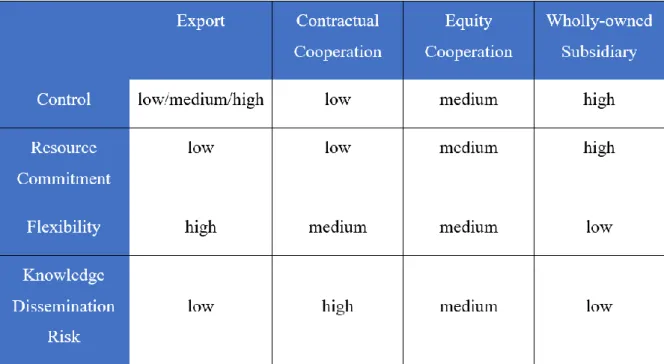
According to many researchers (Anderson & Gatignon , 1986; Hill, et al., 1990; Zhao, et al., 2004; Morschett, et al., 2010; Kotabe& Helsen, 2010), four characteristics are mainly presented by various foreign market operation modes: control, resource commitment, flexibility and the risk of knowledge dissemination.
Here, definitions on these terms are as the following:
Control means “the ability to influence systems, methods and decisions” (Anderson & Gatignon, 1986:3), and “the authority over strategies and operational decisions” (Morschett et al., 2010: 245), including the control over decision making, operation coordination, strategy implementation and revision, conflicts resolving, profits and return.
Resource commitment refers to the transaction cost related to the choice of a mode of entry and expansion, including the necessary resources required to dedicate during the foreign operation. Resources committed relates to flexibility (Morschett, et al., 2010).
30 Flexibility means the speed and effort to exit foreign markets after having committed certain resources to those markets. When the recourse commitment is high, the flexibility is rather low, showing an opposite trend (Anderson & Gatignon, 1986; Morschett, et al., 2010).
The risk of knowledge dissemination refers to the possibility that players in foreign markets obtain a certain amount of knowledge and capacity from entry firms and then use that to turn against the entry firms or become the competitors of those entry firms. Such knowledge is mainly about the important one which is usually treated as the source of competitive advantage of the entry firms in foreign markets, like know-how in technology and marketing, so the firms entering foreign markets need to protect their knowledge and avoid of risk of leaking it (Hill, et al., 1990; Agarwal & Ramaswami, 1992; Morschett, et al., 2010).
For each entry mode, the degree of the propensity to every characteristic comes differently (Table 2). Anderson and Gatignon (1986) group them mainly from the level of control; Hill, et al. (1990) from control, resource commitment (strategic flexibility) and dissemination risk; Driscoll & Paliwoda (1997) and Morschett et al. (2010) put them comprehensively by the degree from low, medium to high.
Table 2:Characteristics of each mode
31 Based on these characteristics of different modes, on Table 3 it compares the benefits and drawbacks in every mode, according to Kotabe and Helsen (2010).
32 Source: Kotabe & Helsen (2010)
2.4.5 Determinants of Entry Mode Choices 2.4.5.1 Transactional Cost Theory
Under transactional cost analysis, the decisions on the ways to enter and expand foreign market are made based on the comparative costs under alternative foreign operation modes, and companies tend to choose foreign market entry modes that can best reduce the cost for the transaction.