Physical exercise on serum electrolytes and acid base balance in
Mangalarga Marchador horses submitted to cavalcade of 4, 8 and 20km
Influência do exercício físico sobre o equilíbrio ácido base e hidroeletrolítico em cavalos da raça Mangalarga Marchador submetidos a provas de cavalgadas de 4, 8 e 20km
Jessica Martins Linhares1 Paula Alessandra Di Filippo1* Paulo Moreira Bogossian1 Rafael Vianna Barbosa de Almeida Guerra1 Sebastian Ricardo Bustamante Bustamante1 Cláudio Baptista de Carvalho1 Felipp da Silveira Ferreira1
ISSNe 1678-4596
INTRODUTION
Physical exercise is responsible for alterations in various blood parameters (KIENZLE et al., 2006). Biochemical (TOLEDO et al., 2001), hydroelectrolytic (DI FILIPPO et al., 2009; DI FILIPPO et al., 2016), hormonal and metabolic (NOLETO et al., 2016) changes have been described in horses submitted to exercise of different intensities and durations. These changes occur as the organism
attempts to adapt and supply the increased metabolic demand triggered by physical effort (PICCIONE et al., 2007) and are under most circumstances considered beneficial to the animal. However, physical exertion, when overly exhaustive or without proper training, can induce severe organic alterations, especially when the different tissues, organs or systems are not sufficiently adapted to support the different types of overload required of them without causing large changes in homeostasis (OGONOVSZKY et al., 2005).
1Laboratório de Clínica e Cirurgia Animal (LCCA), Centro de Ciências e Tecnologias Agropecuárias (CCTA), Universidade Estadual do Norte Fluminense. “Darcy Ribeiro” (UENF), Avenida Alberto Lamego, 2000, 28013-602, Campos dos Goytacazes, RJ, Brasil. E-mail: [email protected]. *Corresponding author.
ABSTRACT: Acid-base and electrolyte disorders have been described in horses associated during and after exercise. The aim of the present study was to evaluate the effect of cavalcade competition on the acid-base and hydroelectrolytic balance in Mangalarga Marchador horses. For this purpose, 15 geldings,
6.2 ± 1.2 years old and clinically healthy, were distributed into three groups of five animals each. Horses were trained to take part in cavalcade competitions. Animals were submitted to cavalcade along 4km (G4), 8km (G8), and 20km (G20) at mean speeds of 15km h-1, 12km h-1, and 12km h-1, respectively. From each horse, venous blood samples were collected before exercise (T0) and immediately after (T1) cavalcade. Bicarbonate ion (HCO3-), pH, partial pressure of carbon dioxide (pCO2), partial pressure of oxygen (pO2), base excess (BE), hematocrit (Hct), sodium (Na+), potassium (K+), chloride (Cl-) and lactate were determined. The variables pH, pO2 and pCO2 were corrected in function of rectal temperature of each animal. Blood samples were analyzed for acid-base balance, as well as biochemical and electrolyte parameters using an i-STAT analyzer. Significant (P<0.05) increase in Hct, Na+, pH, HCO
3
- and BE were observed after cavalcade in G20 group. Decrease (P<0.05) in K+ and Cl- were also observed in G20 animals after cavalcade (T1). Changes in the acid-base balance and hydroelectrolytic profile of the Mangalarga Marchador after cavalcade of 20km resulted in hypochloremic metabolic alkalosis. The 20km cavalcade induced significant hydroelectrolytic and acid-base imbalances in Mangalarga Marchador horses.
Key words: blood gas, electrolytes, equines, acidosis, alkalosis, cavalcade.
RESUMO: Distúrbios ácido-base e eletrolíticos têm sido descritos em cavalos durante e após diferentes modalidades de exercícios. Este estudo foi
realizado com o objetivo de investigar o efeito do esforço físico de cavalgada sobre o equilíbrio ácido base e hidroeletrolítico de cavalos da raça Mangalarga Marchador. Quinze cavalos castrados com média de idade de 6.2±1.2 anos foram distribuídos em três grupos com 05 indivíduos cada. Os animais percorreram percursos de 4 (G4), 8 (G8) e 20 (G20) km de extensão os quais, foram realizados à velocidade média de 15km h-1, 12km h-1 e
12km h-1, respectivamente. Íon bicarbonato (HCO3-), pH, pressão parcial de dióxido de carbono (pCO2), pressão parcial de oxigênio (pO2), excesso de bases (BE), hematócrito (Hct), sódio (Na+), potássio (K+), cloreto (Cl-) e lactato foram mensurados. As variáveis pH, pO2 e pCO2 foram corrigidas em função da temperatura corporal dos animais. De cada cavalo, amostras de sangue venoso foram coletadas antes do exercício (T0) e após o término da cavalgada (T1). As amostras foram analisadas através do i-STAT. Houve aumento (P<0,05) nos valores de Hct, Na+, pH, HCO
3 - e BE nos
animais do G20, após o término da cavalgada (T1). Após a cavalgada, os animais do G20 apresentaram ainda diminuição na concentração de K+ e de Cl-. As alterações no equilíbrio ácido-base e hidroeletrolítico pós-cavalgada de 20km resultou em alcalose metabólica hipoclorêmica. O esforço físico de cavalgada de 20km resultou em desequilíbrios hidroeletrolíticos e ácido-base significativos em cavalos da raça Mangalarga Marchador.
Palavras-chave: gases sanguíneos, eletrólitos, equino, acidose, alcalose, cavalgada.
Lack of physical conditioning can be responsible for high serum concentrations of haptoglobin observed in horses after long-distance competitions (CYWINSKA et al., 2010). The persistence of the sharp increase in the enzymatic activity of CK and LDH has also been associated with lack of proper physical preparation of horses submitted to endurance competitions. Finally, declassification of horses during endurance riding events covering 100km was associated with severe depletion of K+ ions (ROSE et al., 1980).
In Brazil, the long distance transport (cavalcade) has in recent years become an important equestrian competition. In cavalcades, participation of horses of different breeds are common (MANSO FILHO et al., 2012). Participation of the Mangalarga Marchador breed in these events stands out due to these horses’ rusticity and particularly their more comfortable marcha instead of trotting gait. However, the effects of cavalcade exercise on these animals are still unknown. The objective of this study was to investigate the effect of the physical effort of cavalcades covering 4km, 8km and 20km on the acid-base and hydroelectrolytic balance in Mangalarga Marchador horses.
MATERIALS AND METHODS
The study involved 15 healthy Mangalarga
Marchador geldings (age 6.2±1.2 years, weight
420±58kg). Horses were distributed in three different
groups according to the distance covered, namely, G4 (4km, 15km h-1), G8 (8km, 12km h-1), and G20
(20km, 12km h-1). All horses included in the study
were privately owned and were prepared to participate in cavalcade by owners. These horses were trained two to four times a week for 30-60min for more than
three months.
Before the cavalcade, horses underwent a complete clinical examination. Body temperature, heart rate, and respiratory rate were recorded, and cardiac and pulmonary auscultation was carried out. Horses included had a normal clinical examination, and complete blood count, and biochemical parameters were performed.
Data were collected at a cavalcade held in Campos dos Goytacazes, Rio de Janeiro, Brazil on February 8, 2010 (20º48’21”S, 40º38’52”W, altitude 13m a.s.l.). The previously marked had a length of 20km, and was taken in a single day, without rest. Mean environmental temperature was 30.7ºC and relative humidity was 79.3%. Animals started the course together, but stopped after the predetermined
distance according to the group. These weather
indices were obtained from the agrometeorology database of the Center for Science and Technology of Norte Fluminense State University (CCT/UENF).
Blood samples (7mL) were obtained in heparinized syringes from the jugular vein of each
horse before the cavalcade (T0) and immediately after reaching the predetermined distance (T1). After
collection, samples were immediately stored in ice and then analyzed with a portable clinical analyzer (I-Stat®
Analyzer, Abbot Point of Care Inc., East Windsor, New Jersey, USA, with CG4 + and CG8 + cartridges) to determine the following variables: pH, partial pressure of carbon dioxide (pCO2), partial pressure of oxygen (pO2), bicarbonate ion (HCO3-), base excess (BE), lactate, hematocrit (Hct) and concentrations of sodium (Na+), potassium (K+) and chloride (Cl-). Blood pH measurements (pH, pO2, and pCO2) were corrected
according to the rectal body temperature.
The experimental design was completely randomized and represented by the statistical model: Yij=µ + αj + eij, where Yij=variables analyzed in the i-th animal over the j-th distance; µ=general average; αj=j-th distance; and eij= random error, assuming
a normal and uniform distribution N~(0,δ2). We
tested the basic requirements for analysis of variance (normality and homoscedasticity) and analyzed the variables as repeated measures in time using the SAS program. Results are presented as mean ± standard deviation. After the analysis of variance, the variables were submitted to the Tukey test. In all cases P-values ≤0.05 were considered significant.
RESULTS AND DISCUSSION
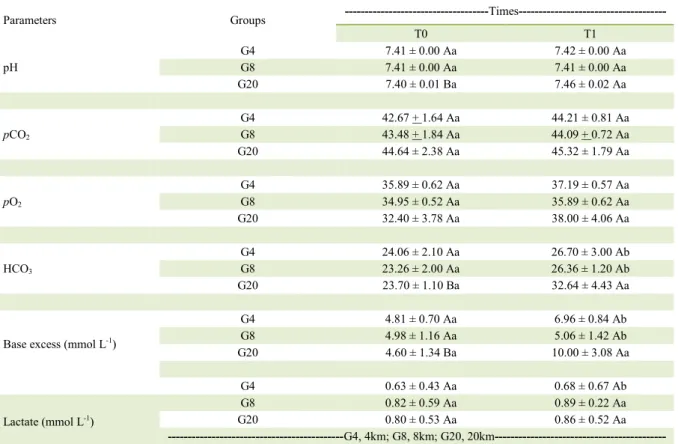
All horses from G4, G8, and G20 managed to complete the cavalcade without abnormal signs. Mean values of acid-base and hydroelectrolytic balance in Mangalarga Marchador horses are reported in table 1 and 2.
The values of pH, HCO3
-, BE, Hct and
Na+ concentrations in G20 were significantly higher
(P<0.05) than the pre-cavalcade values. Values of K+
and Cl- decrease only in G20 horses after cavalcade
competition (P<0.05).
Increases in the pH values of the animals in G20 were associated with loss of chloride ions in the sweat (Table 2). Because of the body’s need to restore the balance of negative charges, the loss of chlorine ions in the sweat results in retention of the second most abundant ions in the organism, bicarbonate ions (HCO3
-). In turn, the excess of
HCO3
(DAY, 2002). According to JOHNSON (1995), this alkalosis is an important clinical complication in the exhaustion syndrome and in cases of exertional rhabdomyolysis. These affirmations are corroborated by the results reported in tables 1 and 2. The animals in G20 after the exercise (T1) presented a significant decrease (P<0.05) in the blood concentration of Cl
-and a concomitant increase in HCO3
- and BE.
Results observed in horses after cavalcade of 20km (T1) were similar to the results reported by ROSE et al. (1979) and DI FILIPPO et al. (2009) in horses after endurance competition and by MARTINS et al. (2016) after marcha competition. However, WATANABE et al. (2006), evaluating Arabian horses submitted to high-speed treadmill exercise, and SILVA et al. (2013), studying Quarter horses participating in barrel races, observed metabolic acidosis. According to both groups of authors, the metabolic alteration was due to the diffusion of H+
and lactate ions produced by the muscle cells to the
bloodstream. The energy demands of muscle cells under moderate to high intensity exercises, unlike in cavalcade and endurance events, is maintained predominantly by anaerobic metabolism of glucose, resulting in buildup of H+ and lactate ions in the
muscle cells with consequent development of blood acidemia. According to AGUILERA-TEJERO et al. (2000), consumption of HCO3
- in the process of lactic
acid buffering, caused by anaerobic metabolism, also contributed to blood acidemia.
The main organs involved in regulating the acid-base balance are lungs and kidneys. Through changes in the blood pH, the respiratory compensations occur almost immediately, altering the pCO2 (ROBINSON, 2004). Nevertheless, compensatory respiratory response only allows the correction of slight disturbances and occurs for a brief period. Over the long run, regulation of acid-base balance requires excretion of H+ ions and retention of bicarbonate ions
by the kidneys, as described by FETTMAN (2004).
Table 1 - Mean ± s.d. values of venous pH, pCO2, pO2, HCO3-, base excess and lactate concentration of Mangalarga Marchador horses before (T0) and after (T1) a cavalcade of 4, 8 and 20km.
Parameters Groups ---Times
---T0 T1
pH
G4 7.41 ± 0.00 Aa 7.42 ± 0.00 Aa
G8 7.41 ± 0.00 Aa 7.41 ± 0.00 Aa
G20 7.40 ± 0.01 Ba 7.46 ± 0.02 Aa
pCO2
G4 42.67 + 1.64 Aa 44.21 ± 0.81 Aa
G8 43.48 + 1.84 Aa 44.09 + 0.72 Aa
G20 44.64 ± 2.38 Aa 45.32 ± 1.79 Aa
pO2
G4 35.89 ± 0.62 Aa 37.19 ± 0.57 Aa
G8 34.95 ± 0.52 Aa 35.89 ± 0.62 Aa
G20 32.40 ± 3.78 Aa 38.00 ± 4.06 Aa
HCO3
G4 24.06 ± 2.10 Aa 26.70 ± 3.00 Ab
G8 23.26 ± 2.00 Aa 26.36 ± 1.20 Ab
G20 23.70 ± 1.10 Ba 32.64 ± 4.43 Aa
Base excess (mmol L-1)
G4 4.81 ± 0.70 Aa 6.96 ± 0.84 Ab
G8 4.98 ± 1.16 Aa 5.06 ± 1.42 Ab
G20 4.60 ± 1.34 Ba 10.00 ± 3.08 Aa
G4 0.63 ± 0.43 Aa 0.68 ± 0.67 Ab
Lactate (mmol L-1)
G8 0.82 ± 0.59 Aa 0.89 ± 0.22 Aa
G20 0.80 ± 0.53 Aa 0.86 ± 0.52 Aa
---G4, 4km; G8, 8km; G20, 20km
In line with these findings, the results in table 1 show changes in pCO2 and pO2 post-cavalcade of 20km (G3); however, the differences were statistically significant (P>0.05). These findings indicated respiratory acidosis, which added to metabolic alteration, is called metabolic alkalosis with respiratory compensation. That respiratory modification is common in sporting animals when faced with metabolic alkalosis (DI FILIPPO et al., 2009), and is a reflection of the animals’ organic health.
No significant increase was observed in the lactate concentrations of the animals in the three groups (P>0.05). These results differ from those reported in Quarter horses after barrel racing (SILVA et al., 2013) and team roping competition (CAIADO et al., 2011). Sharp increase in the lactate concentration in these two events was associated with metabolic demands of high-intensity effort, predominantly anaerobic. Lactate is considered a valuable substrate, with a significant role in producing energy for the myocardium, non-contracting muscles and even the brain (PÖSÖ, 2002). After the end of physical exertion (the period when O2 level is low),
the lactate produced by the anaerobic metabolism is converted into glucose by the liver. In this way, lactate is removed from the bloodstream, serving as a beneficial energy substrate instead of acidifying
the blood (WASSERMAN et al., 1991). Finally, the increase in the lactate values is expected after any type of exercise, because all the energy sources are activated (McGOWAN, 2008). However, this increase depends mainly on the intensity and duration of the physical effort (PÖSÖ, 2002). Based on these findings and the results of this study, the lactate values observed after the competition indicated that cavalcade exercise is not physically very demanding of the animals and allowed the organism to metabolize the lactate produced.
Increase in the hematocrit values presented by the animals of G20 after cavalcade was attributed to hemoconcentration resulting from loss of liquids from sweating, water losses from hyperventilation and passage of water from the dilated vascular bed to the hyperosmotic muscle in action (JOHNSON, 1995). Hemoconcentration can also be associated with the larger entry of erythrocytes in the bloodstream as a result of spleen contraction, a common reaction in horses. According to BABUSCI & LÓPEZ (2007), spleen has capacity to store about 50% of the volume of erythrocytes in the body and its contraction can raise the hematocrit level from between 32 and 42% at rest to between 60 and 70% during exercise. The release of these erythrocytes into the bloodstream can be related to the level of stress generated by exercise,
Table 2 - Mean ± s.d values of hematocrit, Na+, K+ and Cl- of Mangalarga Marchador horses before (T0) and after (T1) a cavalcade of 4, 8 and 20km.
Parameters Groups ---Times---
T0 T1
Hematocrit (%)
G4 34±1.27 Aa 34±1.27 Ab
G8 33±1.12 Aa 34±1.20 Ab
G20 34±0.97 Ba 41±1.46 Aa
Na+ (mmol L-1)
G4 135.8±2.5 Aa 136.8±1.7 Ab
G8 137.0±4.5 Aa 139.6±5.2 Ab
G20 139.4±1.5 Ba 142.0±2.9 Aa
K+ (mmol L-1)
G4 3.78±0.25 Ab 3.74±0.28 Ab
G8 3.78±0.25 Ab 3.68±0.52 Ab
G20 4.02±0.16 Aa 3.74±0.25 Ba
Cl- (mmol L-1)
G4 101.2±1.3 Aa 100.6±2.5 Aa
G8 104.2±4.9 Aa 101.6±2.0 Aa
G20 103.4±4.5 Aa 98.4±3.6 Bb
G4, 4km; G8, 8km; G20, 20km.
responsible for releasing adrenaline, which acts on the deposits of erythrocytes in the spleen, inducing their release (McGOWAN, 2008).
Higher Hct values observed in horses after cavalcade competition of 20km were similar to the results reported in Mangalarga Marchador horses after official marcha tests (DI FILIPPO et al., 2016) and in many other studies of horses of different breeds involved in a variety of equestrian competitions (SNOW et al., 1982; KOWAL et al., 2006).
Increase in Na+ concentration observed
in the horses of G20 after cavalcade was similar to that detected in other investigation during endurance competitions of 60km (DI FILIPPO et al., 2009) and 80km (SNOW et al., 1982). According to FERRAZ et al. (2010), a possible mechanism to explain the elevation of serum concentrations of sodium is the exchange of ions and water that occurs between the active and inactive muscles. Dehydration increases the renal reabsorption of sodium so as to maintain the osmotic balance (MARTINS et al., 2005). However, the sodium levels of Arabian and Pantaneiro horses declined after a cavalcade competition covering 62km (MARTINS et al., 2004). The authors associated this result with the loss of sodium from sweating. Finally, Mangalarga Marchador horses submitted to marcha tests (FOLADOR et al., 2014; MARTINS et al., 2016), did not show changes in sodium levels. According to the authors, the concentrations of sodium remained relatively normal because an equivalent volume of fluid was lost and because marcha exercise has shorter duration and slower speed than endurance exercise (such as cavalcade).
The concentration of K+ in the blood
declined after the cavalcade in the animals of G3. In another study, similar findings were associated with the loss of this element in the sweat and renal reabsorption of sodium at the cost of excretion of potassium and hydrogen ions (MARTINS et al., 2005). DI FILIPPO et al. (2009) also reported that Arabian horses showed lower serum concentration of K+ after an endurance
competition of 60km. Losses of potassium during exercise have a significant influence on horses’ performance (SNOW et al., 1982). Reduction of levels of K+ can result in weakness, reduced intestinal
motility, paralytic ileum and even alterations in the electrocardiographic trace (DAY, 2002).
CONCLUSION
Physical exertion during cavalcade competition promoted hydroelectrolytic and acid-base imbalances in Mangalarga Marchador horses after concluding a course with length of 20km.
Metabolic alkalosis triggered was due to the loss of Cl- ions in the sweat and consequent increase in
bicarbonate retention by the kidneys. In turn, courses of 4 and 8km did not cause hydroelectrolytic or acid-base imbalance in Mangalarga Marchador horses.
BIOETHICS AND BIOSSECURITY COMMITTEE APPROVAL
This study was approved by the Ethics Committee on
Animal Use of Universidade Estadual do Norte Fluminense Darcy Ribeiro (UENF), Rio de Janeiro, Brazil (protocol number 304).
REFERENCES
BABUSCI, M.; LÓPEZ, E. F. Sistema cardiovascular. In: BOFFI, F. M. Fisiologia del ejercicio em equinos. Buenos Aires: Inter-Médica, 2007. p.123-132.
CAIADO, J. C. C. et al. Influence of physical exercise on serum activities of AST and CK and plasma concentration of lactate in Quarter horses submitted to team roping. Pesquisa Veterinária Brasileira, v.31, n.5, p.452-458, 2011.Available from: <http://www.scielo.br/ scielo.php?script=sci_arttext&pid=S0100-736X2011000500014>. Accessed: Mar. 16, 2016.
CYWINSKA, A. et al. Acute phase protein concentrations after limited distance and long distance endurance rides in horses.
Research in Veterinary Science.v.93, n.3, p.1402-1406, 2012.
Available from: <http://www.ncbi.nlm.nih.gov/pubmed/22390917>. Accessed: Mar. 16, 2016.
DAY, T. K. Blood gas analysis. The Veterinary Clinics of North
America: Small Animal Practice, v.32, n.5, p.1031-1048, 2002.
Available from: <https://www.ncbi.nlm.nih.gov/pubmed/12380163>. Accessed: Mar. 16, 2016.
DI FILIPPO, P. A. et al. Changes in electrolytes and blood gases in Arabian horses during 60km endurance race. Ciência Animal
Brasileira, v.10, n.3, p.840-846, 2009. Available from: <http://revistas.
bvs-vet.org.br/cab/article/view/7096>. Accessed: Mar. 16, 2016.
DI FILIPPO, P. A. et al. Gender differences - induced changes in serum hematologic and biochemical variables in Mangalarga Marchador horses after a marcha gait competition. Journal of Equine Veterinary
Science,v.43, p.18-22, 2016. Available from: <http://www.j-evs.com/
article/S0737-0806(16)30036-3/pdf>. Accessed: May. 29, 2016.
FERRAZ, G. C. et al. The workload and plasma ion concentration in a
training match session of high-goal (elite) polo ponies. Equine Veterinary
Journal, v.42, suppl.38, p.191-195, 2010. Available from: <http://www.
ncbi.nlm.nih.gov/pubmed/21059005>. Accessed: Mar. 16, 2016.
FETTMAN, M. J. Fluid and electrolyte metabolism. In: THRALL,
M. A. et al. Veterinary hematology and clinical chemistry. Philadelphia: Lippincott Williams & Wilkins, 2004. p.329-355.
FOLADOR, J. C. et al. Serum concentration of sodium, potassium and calcium in Mangalarga Marchador horses after physical exercise.
Archives of Veterinary Science,v.19, n.2, p.60-68, 2014. Available from:
JOHNSON, P. J. Electrolyte and acid-base disturbances in the horse.
Clinical Pathology, v.11, n.3, p.491-514, 1995. Available from: <http://
www.ncbi.nlm.nih.gov/pubmed/8925422>. Accessed: Mar. 16, 2016.
KIENZLE, E. et al. Double blind placebo controlled vitamin E or selenium
supplementation of Sport horses with unspecified muscle problems.
Journal Nutrition, v.136, n.7, p.2045-2047, 2006. Available from: <http://
www.scielo.br/scielo.php?script=sci_nlinks&ref=000099&pid=S0100-736X201100090000600011&lng=pt>. Accessed: Mar. 16, 2016.
KOWAL, R. J. et al. Evaluation of hematologic values in thoroughbred (PSI) horses (Equus caballus) submitted to effort tests on treadmill.
Revista Brasileira Ciência Veterinária, v.13, p.25-31, 2006. Available from: <http://www.uff.br/rbcv/ojs/index.php/rbcv/article/
view/447>. Accessed: Mar. 16, 2016.
MANSO FILHO, H. C. et al. Evaluation of heart rate and physical
effort in athlete horses by the use of a frequency meter. Ciências
Veterinária dos Trópicos, v.15, p.41-48, 2012. Available from:
<http://www.rcvt.org.br/volume15/Revista%20CVT%20Volume%20
15%20pag%20de%206.pdf>. Accessed: Mar. 16, 2016.
MARTINS, C. B. et al. Biochemical parameters in horses before and after endurance competition. Revista Brasileira de Ciências Veterinárias, v.12, n.1/3, p.62-65, 2005. Available from: <http://www.uff.br/rbcv/ojs/
index.php/rbcv/article/view/525>. Accessed: Mar. 16, 2016.
MARTINS, E. A. N. et al. Serum concentrations of urea, creatinine, sodium, potassium and calcium of the Pantaneiro and Arabian equines
submitted to prolonged low intensity exercise in Mato Grosso State
(cavalcade) – Brazil. Revista Brasileira de Ciências Veterinárias, v.11, n.1/2, pp. 32-36, 2004. Available from: <http://revistas.bvs-vet.
org.br/rbcv/article/view/16682>. Accessed: Mar. 16, 2016.
MARTINS, L. P. et al. Effect of marcha exercise on serum electrolytes and acid base balance in Mangalarga Marchador horses. Journal of
Equine Veterinary Science,v.49, p.108-112, 2016. Available from: <http://www.j-evs.com/article/S0737-0806(16)30404-X/fulltext>. Accessed: Nov. 29, 2016.
Mc GOWAN, C. Clinical pathology in the racing horse: the role
of clinical pathology in assessing fitness and performance in the
racehorse. Veterinary Clinics of North America: Equine Practice, v.24, p.405-421, 2008. Available from: <http://www.ncbi.nlm.nih. gov/pubmed/18652962>. Accessed: Mar. 16, 2016.
NOLETO, P. G. et al. Effect of a 130km endurance ride on the serum
biochemical profiles of Mangalarga Marchador horses. Journal of
Equine Veterinary Science, v.39, p.7-11, 2016. Available from: <http://www.j-evs.com/article/S0737-0806(15)00512-2/abstract>. Accessed: Mar. 16, 2016.
OGONOVSZKY, H. et al. The effects of moderate, strenuous, and
overtraining on oxidative stress markers and DNA repair in rat liver.
Canadian journal of applied physiology, v.30, n.2, p.186-195, 2005.
Available from: <http://www.ncbi.nlm.nih.gov/pubmed/15981787>. Accessed: Mar. 16, 2016.
PICCIONE, G. et al. Haematological response to different
workload in jumper horses. Bulgarian Journal of Veterinary
Medicine, v.10, p.21–28, 2007. Available from: <http://www.
scielo.br/scielo.php?script=sci_nlinks&ref=000102&pid=S1809-6891201300020000800024&lng=en>. Accessed: Mar. 16, 2016.
PÖSÖ, A. R. Monocarboxylate transporters and lactate metabo lism
in equine athletes: a review. Acta Veterinaria Scandinaviaca,
v.43, p.63-74, 2002. Available from: <http://www.ncbi.nlm.nih. gov/pmc/articles/PMC1764192/>. Accessed: Mar. 16, 2016.
ROBINSON, N. E. Homeostase ácido-básica. In: CUNNINGHAM,
J. G. Tratado de fisiologia veterinária.Rio de Janeiro: Guanabara Koogan, 2004. p.539-550.
ROSE, R. J. et al. Blood-gas, acid-base and haematological values in horses during an endurance ride. Equine Veterinary Journal, v.11, n.2, p.56-59, 1979. Available from: <http://www.ncbi.nlm. nih.gov/pubmed/34511>. Accessed: Mar. 16, 2016.
ROSE, R. J. et al. Plasma and sweat electrolyte concentrations
in the horse during long distance exercise. Equine Veterinary
Journal, v.12, n.1, p.19-22, 1980. Available from: <http://www.
ncbi.nlm.nih.gov/pubmed/7363879>. Accessed: Mar. 16, 2016.
SILVA, M. A. G. et al. Acid base balance in Quarter Horses performing Three Barrel Racing.Revista Brasileira de Medicina Veterinária, v.35, n.2, p.188-192, 2013. Available from: <http://www.rbmv.com. br/?link=verart&tipo=ID&campo1=763>. Accessed: Mar. 16, 2016.
SNOW, D. H. et al. Alterations in blood, sweat, urine and muscle
composition during prolonged exercise in the horse. Veterinary
Record, v.110, p.377-384, 1982. Available from: <http://www.
ncbi.nlm.nih.gov/pubmed/7080430>. Accessed: Mar. 16, 2016.
TOLEDO, P. S. et al. Serum activities of aspartate aminotransferase, creatine kinase, gamma glutamyltransferase, lactate dehydrogenase and glycaemia in thoroughbred horses submitted to exercise of different intensities. Revista Brasileira de Ciências Veterinárias, v.8, p.73-77, 2001. Available from: <
file:///C:/Users/HV/Downloads/1200-4418-1-SM%20(1).pdf>. Accessed: Mar. 16, 2016.
WASSERMAN, D. H. et al. Regulation of hepatic lactate balance
during exercise. Medicine and Science in Sports and Exercises, v.23, p.912-919, 1991. Available from: <http://www.ncbi.nlm.nih. gov/pubmed/1956264>. Accessed: Mar. 16, 2016.
WATANABE, M. J. et al. Changes in arterial pH, PO2, PCO2 and blood lactate concentration in Arabian horses during exercise on a high-speed treadmill.