Vol.52, n. 4: pp.785-793, July-August 2009
ISSN 1516-8913 Printed in Brazil BRAZILIAN ARCHIVES OF
BIOLOGY AND TECHNOLOGY
A N I N T E R N A T I O N A L J O U R N A L
A New Biosurfactant Produced by Candida glabrata UCP
1002: Characteristics of Stability and Application in Oil
Recovery
Juliana Moura de Luna
1, Leonie Sarubbo
2,3and Galba Maria de Campos-Takaki
2,3*1
Universidade Federal de Pernambuco; Av. Prof. Moraes Rêgo, s/n; Cidade Universitária; 50.900-000; Recife - PE
- Brasil. 2,3Departamento de Química; Universidade Católica de Pernambuco; Rua Nunes Machado, 42; Bloco J;
Térreo; Boa Vista; 50050-590; Recife - PE - Brasil
ABSTRACT
The production of a new biosurfactant by Candida glabrata UCP1002 was studied to evaluate the influence of the concentration of the cotton seed oil, glucose and yeast extract. The dynamics of the growth and surfactant production were showed for all the cultivation conditions studied. The best emulsification of the n-hexadecane, quantified by the emulsifying index was observed in the medium containing 7.5% cotton seed oil, 5% glucose and 0.3% yeast extract. The isolated biosurfactant showed a CMC of 2.5% and the surface tension at that point showed to be 31mN/m. The potential application of the biosurfactant in oil recovery from the sand, in acid and alkaline
environments and over exposure to high salinity and different temperatures was demonstrated by the percentageof
oil removal and by the stability of the surface tension, respectively.
Key words: Biosurfactant, Candida glabrata, surface tension, stability, cotton seed oil, oil removal
* Author for correspondence: [email protected]
INTRODUCTION
Surfactants are amphipathic molecules, which reduce the interfacial tensions between liquids, solids and gases and confer excellent detergency, emulsifying, foaming and other versatile chemical process (Dubey and Juwarkar, 2001). Biosurfactants constitute one of the main classes of natural surfactants produced by the microrganisms, being classified in accordance with their chemical composition or microbial origin. The main classes include glycolipids, lipopeptides and lipoproteins (Ron, 2001; Hua et al., 2003). These polymers have attracted, in the last few years, considerable interest due to
biodegradable nature, low toxicity and diversity of applications. The possibility of modification of the chemical structure and the physical properties of biosurfactants through genetic, biological or chemical manipulations, allows the development of products for specific necessities (Rahman et al., 2003; Queiroga et al., 2003).
of low cost. The effluents of vegetable oil industries, petrochemical oil residues or the by-products from the food industries have been extensively studied for the microbial production at an experimental scale (Mercade et al., 1993; Mercade et al., 1996; Vollbrecht et al., 1999; Deleu and Paquot, 2004).
A large number of carbon sources, such as the sugars and oils are described, as attractive substrates for the production of biosurfactants (Gallert et al., 2002). High incomes in the products have been used through the combination between a vegetable oil and carbohydrate as substrate (Zhou and Kosaric, 1993). Between yeasts, species of Candida have been widely used in the production of biosurfactants from soluble and insoluble carbon sources (Sarubbo et al., 1997; 1999; 2001). In this work, the production of a biosurfactant by Candida glabrata UCP1002 was investigated using different concentrations of cotton seed oil, glucose and yeast extract as. The surface active properties under specific environmental conditions and the application of the biopolymer in oil removal had been carried through.
MATERIALS AND METHODS
Microrganism
C. glabrata UCP 1002 was isolated from the mangrove sediments of Rio Formoso city, Pernambuco, Brazil (Gomes et al., 2000). It was kindly supplied from the culture collection of the Universidade Católica de Pernambuco (UNICAP), Brazil, maintained at 5°C on Yeast Mold Agar (YMA) slants containing (w/v) yeast extract (0.3%), malt extract (0.3%), tryptone (0.5%), D-glucose (1%), and agar (5%). Transfers were done to fresh agar slants each month to maintain viability.
Reagents
N-Hexadecane was obtained from Sigma Chemical Co. (St. Louis, MO); food grade cotton seed oil was obtained from Bunge Alimentos S.A. (SC, Brasil). Other chemicals used were analytical grade.
Inoculum preparation
The C. glabrata was grown in solid medium at 27°C for 48-72 h, then, a loopful of the cells were transferred to Erlenmeyer flasks of 250mL containing 50mL of the Yeast Mold Broth (CYM) and incubated aerobically for one day at 27°C on a rotary shaker (150 rpm).
Culture conditions
The yeast was cultivated in submerged culture with shaking in a New Bruswick G-25 shaker. The medium was composed of the following components: NH4NO3 (0.1%), KH2PO4 (0.02%),
MgSO4.7H2O (0.02%) and cotton seed oil, glucose
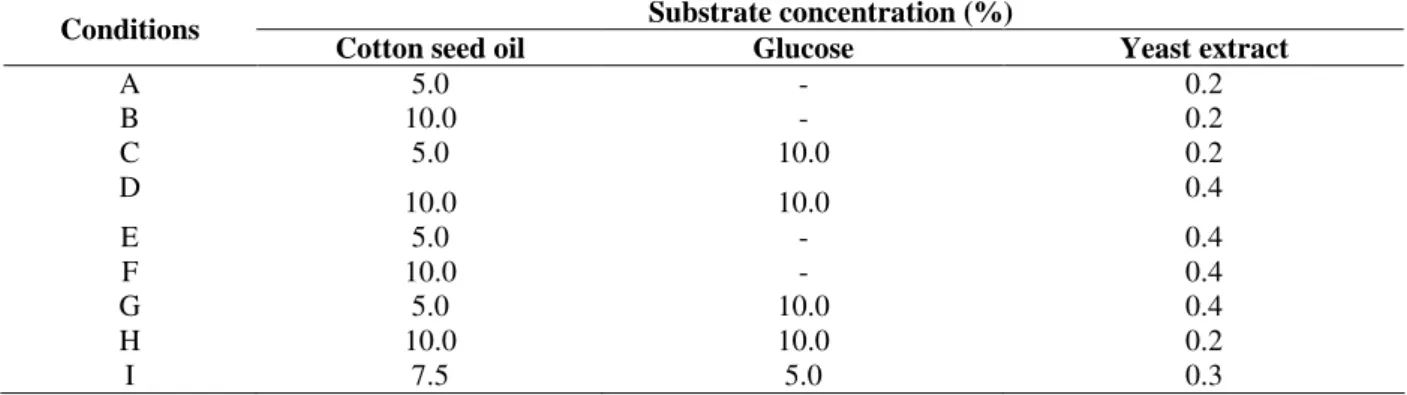
and yeast extract in different concentrations, as described in Table 1. The pH was adjusted to pH 5.7 with 1M HCl solution. Erlenmeyer’s flasks (1000ml) were filled with 300 ml of liquid medium and sterilized at 121°C for 20 min. The inoculum was introduced in the amount of 104 cells/ml of the 24h culture grown on CYM. The flasks were incubated at 27 °C with shaking at 200 rpm for 144 h. The pH of the media was not adjusted during cultivation. The efficiency of biosurfactant biosynthesis was evaluated in correlation with the doses of substrates used during the fermentation. Samples were taken every 6 h during the first 24 h and every 24 h until the end of cultivation period (144 hours) and analysed too biomass, monitored by cells counts on Neubauer Camera and plated on Yeast Mold Agar, pH, and emulsification activity. Experiments were done in duplicate and results reported are the average from three independent experiments.
Emulsification activity
Table 1 - Substrates concentrations utilized in the cultivation of C. glabrata UCP1002 in mineral medium Substrate concentration (%)
Conditions
Cotton seed oil Glucose Yeast extract
5.0 10.0
5.0
- - 10.0 A
B C
D 10.0 10.0
0.2 0.2 0.2 0.4
E 5.0 - 0.4
F 10.0 - 0.4
G 5.0 10.0 0.4
H 10.0 10.0 0.2
I 7.5 5.0 0.3
Determination of the stability of the biosurfactant
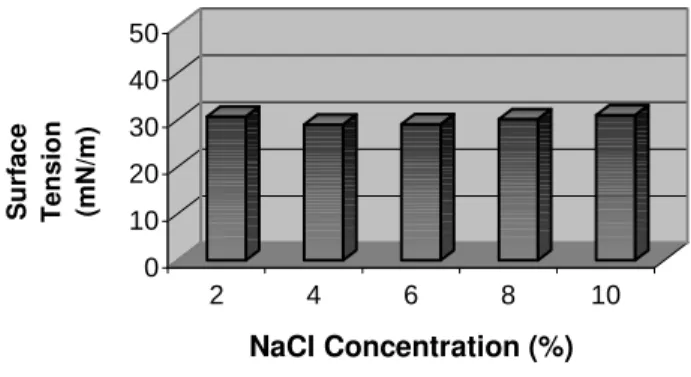
Stability studies were done using the cell-free broth obtained by centrifuging the cultures at 5000 rpm for 20 minutes. Samples of the cell - free culture broth were maintained at 4, 27 and 80ºC to 10 minutes and cooled to room temperature, after which the surface tension was measured. To study the pH stability of the cell-free broth, the pH of the cell-free broth was adjusted to different pH values (2 to 12) and the surface tension was measured. The effect of NaCl concentrations (2 to 10%) on the surface tension of the culture broth free of cells was also determined.
Isolation of biosurfactant
The 144h culture was refrigerated for 24h to solidify the remaining oil and to effect yeast settling. The culture was filtered through Whatman no. 1 filter paper and centrifuged at 10000 x g for 15 minutes. The cell-free broth was concentrated (500 ml) by freeze drying and extracted three times with chloroform (1:1, by vol.) in a separatory funnel at 28°C (Sarubbo et al. 2006).
Determination of surface tension and critical micellar concentration (CMC)
The measurement of the surface tension was carried out on the cell-free broth obtained by centrifuging the cultures at 5000 rpm for 20 minutes by the ring method using a Sigma 70 Tensiometer (KSV Instruments LTD - Finland) at room temperature. Stabilization was allowed to occur until standard deviation of 10 successive measurements was less than 0.4 mN/m. Each result was the average of 10 determinations after stabilization.
Biosurfactant production reduces the interfacial tension oil/water and the superficial tension
air/water. These effects are proportional to biosurfactant concentration in dissolution until this reaches the Critical Micelle Concentration (CMC). The CMC was determined by measuring the surface tensions of dilutions of purified biosurfactant in distilled water up to a constant value of surface tension. The value of CMC was obtained from the plot of surface tension versus the logarithm of the concentration. The CMC value was determined to be g l-1 of biosurfactant.
Application of the biosurfactant in motor oil removal from contaminated sand
Biosurfactant suitability for enhanced oil recovery was carried using 60g of beach sand impregnated with 5 mL of motor oil. Fractions of 20g of the contaminated sand were transferred to 250mL Erlenmeyer flasks, which were submitted to the following treatments: addition of 60mL distilled water (control) and addition of 60 mL of aqueous solution of biosurfactant at 1.5% and at the CMC (2.5% concentration). The samples were incubated on a rotary shaker (150 rpm) for 24 h at 27°C and then were centrifuged at 5000 rpm for 20 minutes for separation of the laundering solution and the sand. The amount of oil residing in the sand after the impact of biosurfactant was gravimetrically determined as the amount of material extracted from the sand by hexane (Nistchke and Pastore, 2002).
RESULTS AND DISCUSSION
Kinetic growth of Candida glabrata
Garcia-Ochoa and Casas, 1999; Zhou and Kosaric, 1993; 1995; Sarubbo et al., 2006).
Biosurfactant production was studied in experiments by varying the initials concentrations
of the cotton seed oil, glucose and yeast extract, as showen in Table 1. The change in the biomass, emulsification activity and pH of the cultivations with time is shown in Fig. 1.
Figure 1 - Biosurfactant production by Candida glabrata grown in mineral medium supplemented
with: (A) 5% cotton seed oil and 0.2% yeast extract; (B) 10% cotton seed and 0.2% yeast extract; (C) 5% cotton seed oil, 10% glucose and 0.2 % yeast extract; (D) 10 % cotton seed oil, 10% glucose and 0.4 % yeast extract; (E) 5 % cotton seed oil and 0.4 % yeast extract; (F) 10% cotton seed oil and 0.4% yeast extract; (G) 5% cotton seed oil, 10 % glucose and 0.4% yeast extract; (H) 10% cotton seed oil, 10 % glucose and 0.2 % yeast extract; (I) 7.5 % cotton seed oil, 5% glucose and 0.3 % yeast extract. Biomass produced, pH and emulsification activity.
The kinetics of growth of C. glabrata demonstrated a diauxic profile. The presence of glucose in the cultivation medium was a decisive factor for the acidity of the culture since with its presence there was a reduction in the pH (Figs. 1C, 1D, 1G, 1H and 1I), which reached stable values, around 3.0, in the beginning of the stationary
phase of the growth, probably due the production of metabolic organic acids. On the other hand, in the absence of glucose (Figs. 1A, 1B, 1E and 1F), an increase of the pH was observed in the initial hours of cultivation, which reached values close to 8.0, with stabilization around 7.0 until the end of 144 h. The kinetics of emulsification activity Time (hours)
0 20 40 60 80 100 120 140 160
L n c e lls / m L 10 12 14 16 18 20 22 p H 2 3 4 5 n -h e x a d e c a n e E m u ls if ic a ti o n ( % ) 0 20 40 60 80 100 Time (hours)
0 20 40 60 80 100 120 140 160
L n c e lls / m L 10 12 14 16 18 20 p H 4 5 6 7 8 9 n -h e x a d e c a n e E m u ls if ic a ti o n ( % ) 0 20 40 60 80 100 Time (hours)
0 20 40 60 80 100 120 140 160
L n c e lls / m L 11 12 13 14 15 16 17 18 19 p H 4 5 6 7 8 n -h e x a d e c a n e E m u ls if ic a ti o n ( % ) 0 20 40 60 80 100 Time (hours)
0 20 40 60 80 100 120 140 160
L n c e lls / m L 10 12 14 16 18 20 p H 2 3 4 5 6 n -h e x a d e c a n e E m u ls if ic a ti o n ( % ) 0 20 40 60 80 100
Time (hours)
0 20 40 60 80 100 120 140 160
L n c e lls / m L 11 12 13 14 15 16 17 18 19 p H 4 5 6 7 8 n -h e x a d e c a n e E m u ls if ic a ti o n ( % ) 0 20 40 60 80 100 Time (hours)
0 20 40 60 80 100 120 140 160
L n c e lls / m L 10 12 14 16 18 20 22 p H 2 3 4 5 6 7 n -h e x a d e c a n e E m u ls if ic a ti o n ( % ) 0 20 40 60 80 100 Time (hours)
0 20 40 60 80 100 120 140 160
L n c e lls / m L 11 12 13 14 15 16 17 18 19 p H 4 5 6 7 8 9 n -h e x a d e c a n e E m u ls if ic a ti o n (% ) 0 20 40 60 80 100 Time (hours)
0 20 40 60 80 100 120 140 160
L n c e lls / m L 10 12 14 16 18 20 p H 1 2 3 4 5 6 n -h e x a d e c a n e E m u ls if ic a ti o n ( % ) 0 20 40 60 80 100 Time (hours)
0 20 40 60 80 100 120 140 160
L n c e lls / m L 10 12 14 16 18 20 22 p H 2 3 4 5 6 n -h e x a d e c a n e E m u ls if ic a ti o n ( % ) 0 20 40 60 80 100
A
B
C
D
E
F
G
H
I
Time (hours)0 20 40 60 80 100 120 140 160
L n c e lls / m L 10 12 14 16 18 20 22 p H 2 3 4 5 n -h e x a d e c a n e E m u ls if ic a ti o n ( % ) 0 20 40 60 80 100 Time (hours)
0 20 40 60 80 100 120 140 160
L n c e lls / m L 10 12 14 16 18 20 p H 4 5 6 7 8 9 n -h e x a d e c a n e E m u ls if ic a ti o n ( % ) 0 20 40 60 80 100 Time (hours)
0 20 40 60 80 100 120 140 160
L n c e lls / m L 11 12 13 14 15 16 17 18 19 p H 4 5 6 7 8 n -h e x a d e c a n e E m u ls if ic a ti o n ( % ) 0 20 40 60 80 100 Time (hours)
0 20 40 60 80 100 120 140 160
L n c e lls / m L 10 12 14 16 18 20 p H 2 3 4 5 6 n -h e x a d e c a n e E m u ls if ic a ti o n ( % ) 0 20 40 60 80 100
Time (hours)
0 20 40 60 80 100 120 140 160
L n c e lls / m L 11 12 13 14 15 16 17 18 19 p H 4 5 6 7 8 n -h e x a d e c a n e E m u ls if ic a ti o n ( % ) 0 20 40 60 80 100 Time (hours)
0 20 40 60 80 100 120 140 160
L n c e lls / m L 10 12 14 16 18 20 22 p H 2 3 4 5 6 7 n -h e x a d e c a n e E m u ls if ic a ti o n ( % ) 0 20 40 60 80 100 Time (hours)
0 20 40 60 80 100 120 140 160
L n c e lls / m L 11 12 13 14 15 16 17 18 19 p H 4 5 6 7 8 9 n -h e x a d e c a n e E m u ls if ic a ti o n (% ) 0 20 40 60 80 100 Time (hours)
0 20 40 60 80 100 120 140 160
L n c e lls / m L 10 12 14 16 18 20 p H 1 2 3 4 5 6 n -h e x a d e c a n e E m u ls if ic a ti o n ( % ) 0 20 40 60 80 100 Time (hours)
0 20 40 60 80 100 120 140 160
demonstrated that C. glabrata was not able to emulsify the n-hexadecane indeed in the medium without glucose (Figs. 1A, 1B, 1E and 1F). In the media containing cotton seed oil and glucose (Figs. 1C, 1D, 1G 1H and 1I), peaks of emulsification activity were observed along the cultivation. The medium cultivation containing 7.5% cotton seed oil, 5% glucose and 0.3% yeast extract (Fig. 1I), presented similar results to the conditions obtained in Figs. 1G and 1H, in what it referred to the emulsification of n-hexadecane. The results obtained permitted to select the medium cultivation containing 7.5% cotton seed oil, 5% glucose and 0.3% yeast extract (Fig. 1I) as the best condition for biosurfactant production regarding the emulsification with n-hexadecane (66%) after 96 h of fermentation.
Properties of the selected biosurfactant
The tests accomplished in the cell-free broth, regarding the variation of the pH, demonstrated an effective stability of the surface tension (Fig. 2). These results were in agreement with the surface tension values found for the biosurfactant of Nocardia sp. L-417, which remained stable in all the pH values tested (from 2 to 12), indicating that the variation of the pH didn't also have significant effect on the superficial tension (Kim et al., 2000). The surface tension of the biosurfactant produced by Bacillus subtillis was also stable under different pH values (Makkar and Cameotra, 1998), although the effectiveness of liposan of C. lipolytica as emulsifier was limited to the acid to neutral pH (Cirigliano and Carman, 1984).
Figure 2 - Influence of pH on the surface tension of cell-free broth of Candida glabrata grown on
mineral medium supplemented with 7.5% cotton seed oil, 5.0% glucose and 0.3% yeast extract.
The surface tension of the cell-free broth containing the biosurfactant showed to be stable, independent of the concentration of salt added (Fig. 3).
Desai and Banat (1997), reported that concentrations above 2% of NaCl were enough to inactivate a synthetic surfactant. Reductions were also observed in the emulsification activity of the surfactant produced by C. lipolytica cultivated in n-hexadecane (Cirigliano and Carman, 1984) and of the surfactant from mixed cultures cultivated in molasses (Ghurye et al., 1994).
Regarding the influence of the temperature on the surface tension of the cell-free broth containing the
biosurfactant (Fig.4), it was observed that the same stable front stayed to the studied temperatures. The results obtained by Brown et al., (1991) for the biosurfactant produced by a bacterium designated as isolated 1165 showed a reduction of the surface tension in the cell-free broth when submitted to temperatures among 0 Cº and 4ºC, although exposure to high temperatures (100 and 120 ºC) did not affect the surface tension values. On the other hand, Markkar and Cameotra (2002) observed the stability of the surface tension after the exposure of the biosurfactant produced by Bacillus subtilis at 100
ºC.
0 10 20 30 40 50
S
u
ra
fc
e
T
e
n
s
io
n
(m
N
/m
)
2 4 6 8 10 12
0 10 20 30 40 50
S
u
rf
a
c
e
T
e
n
s
io
n
(m
N
/m
)
2 4 6 8 10
NaCl Concentration (%)
Figure 3 - Influence of different sodium chloride concentrations on the surface tension of cell-free
broth of Candida glabrata grown on mineral medium supplemented with 7.5% cotton seed oil, 5.0% glucose and 0.3% yeast extract.
Figure 4 -Influence of temperatureon the surface tension of cell-free broth of Candida glabrata
grown on mineral medium supplemented with 7.5% cotton seed oil, 5.0% glucose and 0.3% yeast extract.
Surface tension and critical micellar concentration (CMC) of the biosurfactant
The presence of a surfactant reduces the surface tension air/water, which was proportional to the concentration of the biosurfactant in the solution, until it reached the CMC (Ron and Ronsenberg, 2001). As shown in Fig. 5, the CMC of the
biosurfactant produced by C. glabrata was of approximately 2.5% and the surface tension at that point was of 31 mN/m. This tension value was similar to the values described for other potent biosurfactants produced by the yeasts cultivated in the vegetable oils plus carbohydrates as substrates (Davila et al., 1992; Marin, 1996).
0 10 20 30 40 50
S
u
rf
a
c
e
T
e
n
s
io
n
(
m
N
/m
)
4 27 80
0 10 20 30 40 50 60 70 80
0 0,5 1 1,5 2 2,5 3 3,5
Biosurfactant Concentration (%)
S
u
rf
a
c
e
T
e
n
s
io
n
(
m
N
/m
)
Figure 5 - Surface tension versus concentration of the isolated biosurfactant produced by Candida
glabrata grown on mineral medium supplemented with 7.5% cotton seed oil, 5.0%
glucose and 0.3%yeast extract.
Application of the biosurfactant in the oil removal
Table 2 describes the removal of motor oil by different concentrations of the biosurfactant. The results obtained demonstrated that the biosurfactant solution at 2.5% concentration (at the CMC) was capable to remove 84% of the oil adsorbed in the sand, while the distilled water (control) removed 56% of the contaminated oil. Similar results were obtained by Abu-Ruwaida et
al., (1991) for the cell-free broth containing a biosurfactant produced by Rhodococcus cells, which was able to recover 86% of crude residual oil adsorbed in the sand, while distilled water removed about 65% of the oil.
Cameotra and Makkar (1998) demonstrated that the biosurfactant isolated form Pseudomonas aeruginosa was able to recover 56% of the oil adsorbed to the sand contained in a column.
Table 2 - Removal of motor oil from contaminated sand by the grown on mineral medium supplemented with 7.5%
cotton seed oil, 5.0% glucose and 0.3%yeast extract.
Treatment Residual oil (%) Removed oil (%)
1.5% biosurfactant solution 36.4 63.6
2.5% biosurfactant solution 16 84
Distilled water (control) 43.7 56.3
CONCLUSIONS
The results obtained in this work showed that the biosurfactant produced by C. glabrata had attractive properties as low surface tension at the CMC, stability over a wide range of pH and temperature and exposure to high salinity. The ability in recovering the oil from oil-saturated sand was also demonstrated. Thus, these characteristics indicated potential use of the biosurfactant in the oil industry, especially in MEOR (microbial Enhanced Oil Recovery). Studies are in progress
to scale up the growth conditions and biosurfactant production in the bioreactors.
ACKNOWLEDGEMENTS
RESUMO
A produção de um novo biossurfactante por Candida glabrata UCP1002 foi inicialmente investigada com a finalidade de avaliar a influência da concentração dos substratos óleo de algodão, glicose e extrato de levedura. As cinéticas de crescimento e de produção do surfactante foram demonstradas para todas as condições de cultivo testadas. A melhor emulsificação do n-hexadecano, quantificada através do índice de emulsificação foi observada na condição de cultivo contendo 7,5% de óleo de algodão, 5% de glicose e 0,3% de extrato de levedura. O biossurfactante produzido apresentou uma concentração micelar crítica de 2,5%, sendo a tensão superficial nesse ponto de 31mN/m. O potencial de aplicação do biossurfactante na recuperação de óleo de areia contaminada, em condições ácidas e alcalinas, bem como sob exposição a altas salinidades e diferentes temperaturas, foram demonstrados com base no percentual de remoção do óleo e na estabilidade da tensão superficial, respectivamente.
REFERENCES
Abu-Ruwaida, A.S.; Banat, I.M.; Haditirto, S.; Salem, A. and Kadri, M. (1991), Isolation of biosurfactant-producing bacteria-Product characterization, and evolution. Acta Biotecnologica, Berlin 2, 315-324. Brown, M.J. (1991), Biosurfactants for cosmetic
applications. International Journal of Cosmetic
Science . 13, 61-64.
Casas, J.A. (1996), Producción de soforolípidos por
Candida bombicola. Tese phD - Universidad
Complutense, Madri.
Cameotra, S.S. and Makkar, R.S. (1998), Synthesis of biosurfactants in extreme conditions. Applied
Microbiology and Biotechnology . 50, 520-529.
Cirigliano, M.C. and Carman, G.M. (1985), Purification and characterization of liposan a bioemulsier from
Candida lipolytica. Applied and Environmental
Microbiology. Washington. 50, 846-850.
Cirigliano, M.C. and Carman, G.M. (1984), Isolation of a bioemulsifier from Candida lipolytica. Applied and
Environmental Microbiology. 48, 747-750.
Cooper, D.G. and Goldenberg, B.G. (1987), Surface active agents from two Bacillus species. Applied
Enviromental Microbiology. 53, 224-229.
Davila, A.M.; Marchal, R. and Vandecastele, J.P. (1992), Kinetics and balance of a fermentation free from product inhibition: sophorose lipid production
by Candida bombicola. Applied Microbiology and
Biotechnology. 38 6-11.
Desai J.D. and Banat, I.M. (1997), Microbial production of surfactants and their commercial potential. Microbial Molecular Reviews. 61, 47-64. Deleu, M. and Paquot, M. (2004), From renewable
vegetables resources to microorganisms: new trends in surfactants Compters Rendus Chimie. (article in press).
Dubey, K. and Juwarkar, A. (2001), Destillery and curd whey wastes as viable alternative sources for biosurfactants production. World Journal of
Microbiology and Biotechnology.17, 61-69.
Garcia-Ochoa, F. and Casas, J.A. (1999), Unstructured kinetic model for sophorolipid production by
Candida bombicola. Enzyme and Microbial
Technology. 25, 613-621.
Gallert, C. and Winter, J. (2002), Solid and liquid residues as raw materials for biotechnology.
Zeitschrift fur Naturforschung. 89, 483-496.
Gerson, D. F.(1993), Biosurfactants: prodution-properties - applications. In: Biotechnology.
Gomes, P.F.; Nascimento, A.E.; Okada, K.; Messias, A.S.; Sharia, A.E.N. and Campos-TakakiI, G.M. (2000), Aspectos da qualidade de ecossistemas do Município do Rio Formoso. In: International Conference: Sustainable use of estuaries and
mangroves: challenges and prospects. Abstracts, p.
82.
Ghurye, G. L.; Vipulananda, C. and Wilson, R. C. A. (1994), Practical approach to biosurfactant production using nonaseptic fermantation of mixed cultures.
Biotechnology and Bioengineering. 44, 661-666.
Hanson, R.S.; Phillips, J.A. and Gherhardt, P. (1981), Manual of Methods for General Bacteriology, American Society for Microbiology, Washington, DC. 328-364.
Hua, Z.; Chen, J.; Lun, S. and Wang, X. (2003), Influence of biosurfactants produced by Candida
antarctica on surface properties of microorganism
and biodegradation of n-alkanes. Water Research. 37, 4143-4150.
Kim, S.H.; Lim, E.J.; Lee,S.O.; Lee, J.D. and Lee, T.H. (2000), Purification and characterization of biosurfactants from Nocardia sp. L - 417.
Biotechnology and Applied Biochemistry. 31,
249-253.
Kuyukina, M.S.; Ivshina, I.B.; Philp, J.C.; Christofi, N.; Dunbar, S.A. and Ritchkova, MI. (2001), Recovery
of Rhodococcus biosurfactants using methyl
Lang, S.; Katsiwala, E. and Wagner F. (1989), Antimicrobial effects of biosurfactants. Fat Science
and Technology. 9, 363-366.
Lowry, O.H.; Rosenbrough, N.J.; Farr, A.L. and Randall, R.J. (1951), Protein measurement with the folin phenol reagent. Journal of Biological
Chemistry. 193, 265-275.
Manocha, M.S., San-Blas, G. and Centeno, S. (1980), Lipid composition of Paracoccidioides brasilienses: possible correlation with virulence of different strains. Journal of General Microbiology. 117, 147-154.
Makkar, R.S and Cameotra, S.S. (1998), Production of biosurfactant at mesophilic and thermophilic conditions by a strain of Bacillus subtillis. Journal of
Microbiology and Biotechnology.20, 48-52.
Makkar, R.S. and Cameotra, S.S. (2002), An update on the use of uncoventional substrates for biosurfactant production and their new applications. Applied and
Environmental Microbiology. 58, 428.
Marín, M. and Pedregosa, A . (1996), International.
Biodeterioration and Biodegradation. 69-75.
Mercadé., M.E.; Moneon, L.; de Andes, C.; Rondon, I., Martinez, E.; Espuny, M.J. and Manresa, A. (1996), Screening and selection of surfactant- producing bacteria from waste lubrificating oil. Journal applied
Bacteriology. 8, 161-168.
Mercade, M.E.; Manresa, M.A.; Robert, M.; Espuny, C. and Guinea, J. (1993), Olive oil mill efluent (OOME) new substrate for biosurfactant production.
Bioresource Technology. 43, 1-6.
Nascimento, R.M.L; Pimentel, A. C.M.; Araújo, S.F.S.; Okada, k.; Nascimento, A.E.; Alves da Silva.; C.A and Campos Takaki, G.M. (2000), Symposium 56-59. Nitschke, M. and Pastore, G.M. (2002),
Biosurfactantes: propriedades e aplicações. Química Nova. 25, 772-776.
Pareilleux, A. (1979), Hydrocarbon assimilation by
Candida lipolytica: formation of a biossufactant,
effects on respiratory activity and growth. Europen..
Journal of Applied Microbiology andBiotechnology,
Berlin. 8, 91-101.
Paraszkiewicz, K.; Kanwal, A. and Dlugonski, J. (2002), Emulsifier production by steroid transforming filamentous fungus Curvularia lunata. Growth and product characterization. Journal of Biotechnology. 92, 287-294.
Pirt, S. J. (1975), Principles of microbe and cell cultivation. London: Blackwell Scientific. 214-215. Queiroga, C.L.; Nascimento, L.R. and Serrra, G.E.
(2003), Evalution of paraffins biodegradation and biossurfactant production by Bacillus subtilis in the presence of crude oil. Brazilian Journal of
Microbiology . 34, 1321-324.
Rahman, K.S.M.; Rahman, T.J.; Kourkoutas, Y.; Petsas, I., Marchant, R and Banat, I.M. (2003), Enhanced bioremediation of n- alkanes in petroleum sludge using bacterial consortium amended with rhamnolipid and micronutrients. Bioresouce
Technology. 90, 159-168
Ron, E.Z. and Rosenberg, E. (2001), Natural roles of biosurfactants, Zeitschrift fur Naturforschung. 3, 229-236.
Sarubbo, L.A.; Marcel M.C.R. and Campos-Takaki G.M. (1997), Comparative study on bioemulsifiers produced by Candida lipolylica strains. Brazilian
Archives of Biology and Technolog.40, 707-720.
Sarubbo, L. A.; Porto, A.L.F. and Campos-Takaki, G.M.(1999), The use of babassu oil as substrate to produce bioemulsifiers by Candida lipolytica.
Canadian Journal of Microbiology. 45, 423-426.
Sarubbo, L.A.; Marçal, M.C.; Neves, M.L.C.; Silva, M.P.C.; Porto, A.L.F. and Campos-Takaki, G.M. (2001), Bioemulsifier production in batch culture using glucose as carbon source by Candida lipolytica.
Applied Biochemistry and Biotechnology. 95, 59-67.
Sarubbo, L.A.; Luna, J.M.; and Campos-Takaki, G.M.(2006), Production and stability studies of the bioemulsifier obtained from a new strain of Candida
glabrata UCP 1002. Eletronic Journal of
Biotechnology.
Soon, E.L.; Salleh, A.B.; Basri, M.; Rahman, R.N. and Kamaruddin, K. (2004), Response surface methodological study on lipase-catalyze synthesis of amino acid surfactants. Process Biochemistry 39, 1511-1518.
Vollbrecht E.; Rau U. and Lang S. (1999), Microbial conversion of vegetable oils into surface-active di- tri-, and tetrasaccharide lipids (biosurfactants) by the bacterial strain Tsukamurella spec.Fet/Lipd 101, 389-394.
Zhou, Q. H. and Kosaric, N. (1993), Effect of lactose and olive oil on intra- and extracellular lipids of
Torulopsis bombicola. Biotechnology Letters15,
477-482.
Zhou, Q.H. and N. Kosaric. (1995), Utilization of Canola Oil and lactose to produce biosurfactant with
Candida bombicola. Journal of American Oil and
Chemistry Society. 72, p. 67-71.