Objective: To analyze the literature on the effectiveness of exergames in physical education classes and in the acquisition and development of motor skills and abilities.
Data source: The analyses were carried out by two independent evaluators, limited to English and Portuguese, in four databases: Web of Science, Science Direct, Scopus and PubMed, without restrictions related with year. The keywords used were: “Exergames and motor learning and motor skill” and “Exergames and motor skill and physical education”. The inclusion criteria were: articles that evaluated the efectiveness of exergames in physical education classes regarding the acquisition and development of motor skills. The following were excluded: books, theses and dissertations; repetitions; articles published in proceedings and conference summaries; and studies with sick children and/or use of the tool for rehabilitation purposes.
Data synthesis: 96 publications were found, and 8 studies were selected for a inal review. The quality of the articles was evaluated using the Strengthening the Reporting of Observational Studies in Epidemiology (STROBE) scale and the Physiotherapy Evidence Database (PEDro) scale. Evidence was found on the recurring positive efects of exergames in both motor skills acquisition and motor skills development.
Conclusions: Exergames, when used in a conscious manner — so as to not completely replace sports and other recreational activities —, incorporate good strategies for parents and physical education teachers in motivating children and adolescents to practice physical exercise.
Keywords: Motor skills; Physical education; Literature review.
Objetivo: Analisar a literatura quanto à eicácia da utilização dos exergames nas aulas de Educação Física e na aquisição e desenvolvimento de habilidades e capacidades motoras.
Fontes de dados: As buscas dos estudos foram realizadas por duas avaliadoras de forma independente, limitadas às línguas inglesa e portuguesa, em quatro bases de dados: Web of Science, Science Direct, Scopus e PubMed, sem restrições de ano. As palavras‑chave utilizadas foram: “Exergames and motor learning and skill motor” e “Exergames and skill motor and physical education”. Adotaram‑se como critérios de inclusão: artigos que avaliaram a eficácia da utilização dos exergames nas aulas de Educação Física e na aquisição e desenvolvimento de habilidades e capacidades motoras. Excluíram‑se da análise: livros, teses e dissertações; artigos repetidos; conferências, artigos publicados em anais e resumos de congressos; amostras com patologias e/ou com ins de reabilitação. Síntese dos dados: Foram encontradas 96 publicações. Após a aplicação dos critérios de exclusão, oito artigos foram selecionados. A qualidade dos artigos foi avaliada pelas escalas Strengthening the Reporting of Observational Studies in Epidemiology (STROBE) e The Physiotherapy Evidence Database (PEDro). Foi possível veriicarevidências sobre os efeitos positivos da utilização dos exergames tanto na aquisição de habilidades motoras quanto no desenvolvimento de capacidades motoras.
Conclusões: Os exergames, quando utilizados de forma consciente — de modo a não substituir completamente os esportes e outras atividades lúdicas —, representam boas estratégias para pais e professores de Educação Física na motivação à prática do exercício físico. Palavras‑chave: Habilidade motora; Educação física; Revisão.
ABSTRACT
RESUMO
*Corresponding author. E‑mail: [email protected] (P. Medeiros). aUniversidade do Estado de Santa Catarina, Florianópolis, SC, Brazil.
bUniversidade do Minho, Braga, Portugal.
cUniversidade Federal de Ouro Preto, Ouro Preto, MG, Brazil.
Received on November 1st, 2016; approved on March 12, 2017; available online on September 14, 2017.
EXERGAMES
AS A TOOL FOR THE ACQUISITION
AND DEVELOPMENT OF MOTOR SKILLS AND
ABILITIES: A SYSTEMATIC REVIEW
Exergames
como ferramenta de aquisição e desenvolvimento de
habilidades e capacidades motoras: uma revisão sistemática
INTRODUCTION
As an indispensable factor for success in sports activities, games and other physical activities, basic motor skills in childhood are determinant for a healthy and active lifestyle.1 On the
other hand, physical inactivity in childhood may result in the inability to acquire and develop motor skills and abilities, which leads to posterior deicit in learning and in the perfec‑ tion of specialized motor abilities.2 Some variables make it
diicult to practice physical activity in school environments, such as: limited time, large number of students per class and lack of adequate spaces. Besides, throughout the years there has been a change in the behavior of children, leading to the removal of games that involve the movement of several body segments, and to the approximation with technology and entertainment using a screen. Facing this phenomenon, new strategies are required to keep the children motivated for the practice of physical activity.3
Aiming at allying technology and physical activity, the active games came up — or exergames, name given to the technologies that require the whole body to move, combining physical exercises and videogames.4 hese tools
convert the real movements to the virtual environment, allowing the users to be more active5, practicing virtual
sports, itness exercises and/or other ludic and interactive physical activities, using movements that are similar to real life tasks.6 he exergames are diferent from sedentary vid‑
eogames7 due to the physical efort and motor skills and
abilities required during the games.5
he insertion of exergames in the daily life may help children and adolescents to reach the recommended levels of physical activity, and, probably, have a positive impactive on the lives of children, since this is a useful way to acquire and develop motor skills and abilities.4,8‑10 Even if exergames are a reality
in the lives of children and adolescents — and some research‑ ers have been studying their applicability for the motor per‑ formance —, identifying evidence in the scientiic literature that indicates the successful or little eicient initiatives in rela‑ tion to their use for the acquisition and development of motor skills and abilities is essential to formulate new proposals for its broad application in the school context.
In this context, the objective of this study was to analyze the literature as to the eicacy of the use of exergames in Physical Education classes and in the acquisition and development of motor skills and abilities.
METHOD
A systematic review was conducted according to criteria in the Prisma declaration.11
he search was conducted in May, 2015, and was limited to texts in English and in Portuguese, only in scientiic pub‑ lications, without year‑related restrictions. Inclusion criteria were: articles that assessed the eicacy of the use of exerga‑ mes in Physical Education classes and in the acquisition and development of motor skills and abilities; free‑access studies.
On the other hand, exclusion criteria were: books, chap‑ ters of books, theses and dissertations; repeated scientiic arti‑ cles, conferences, articles published in annals and abstracts of congresses; samples with pathologies and/or with rehabilita‑ tion purposes.
he search for productions referring to the theme were conducted by two independente evaluators, without year restrictions, and in four databases: Web of Science (https:// isiknowledge.com), Science Direct (http://www.sciencedirect. com), Scopus (http://www.scopus.com) and PubMed (http:// www.pubmed.com). he following terms were crossed for the search: “Exergames e aprendizagem motora e habilidade motora”, “Exergames e habilidade motora e educação física”, “Exergames AND motor learning AND skill motor”, “Exergames AND skill motor AND physical education”.
At irst, the titles related with the subject were demon‑ strated. hen, the studies were selected by reading the titles, using the inclusion and exclusion criteria that were previ‑ ously established. Afterwards, there was a detailed reading of the abstracts, and then, the articles whose abstracts did not include the aforementioned eligibility criteria were excluded. Finally, the remaining texts were assessed in full. In the study, there was also an analysis of the references of the selected manuscripts.12
he quality of the studies was evaluated independently by two reviewers/authors, by the recommendations of two instruments: he Physiotherapy Evidence Database (PEDro), recommended for the evaluation of intervention studies, and the Strengthening the Reporting of Observational Studies in Epidemiology (STROBE), recommended for the evaluation of observational studies.
he PEDro scale,13 based on the Delphi list14 and trans‑
According to Verhagen et al.14, for the analyses to be classiied
as high quality, the intervention studies should have scores higher than 50% in relation to the maximum classiication. herefore, for this review, all randomized studies with scores higher than or equal to ive were considered to have high meth‑ odological quality.
Besides the PEDro scale, the STROBE scale was also used.16
Each one of the 22 criteria received scores of 0 to 1. After the evaluation of the criteria, each article received grades from 0 to 22 from each reviser. he inal grade was obtained by the average of the grades, and the variation of grades between the revisers was not higher than 1. he scores of the instru‑ ments were turned into percentage rates in order to evaluate the quality of the articles better. hree categories for the eval‑ uation of quality were established: when the study fulilled more than 80% of the criteria established; when 50 to 80% of the criteria were met; and when less than 50% of the cri‑ teria were fulilled.
As an example, in the STROBE scale, the articles scored considering the details in the theoretical references, the rea‑ sons to execute the study and the information about the sampling size. In the PEDro scale, the intervention studies scored, for instance, considering the eligibility criteria that were speciied and the subjects that were randomly distrib‑ uted in groups. Considering the reduced number of articles selected, these analyses aimed at discussing factors related with the quality of the articles, instead of constituting an exclusion criterion.
RESULTS
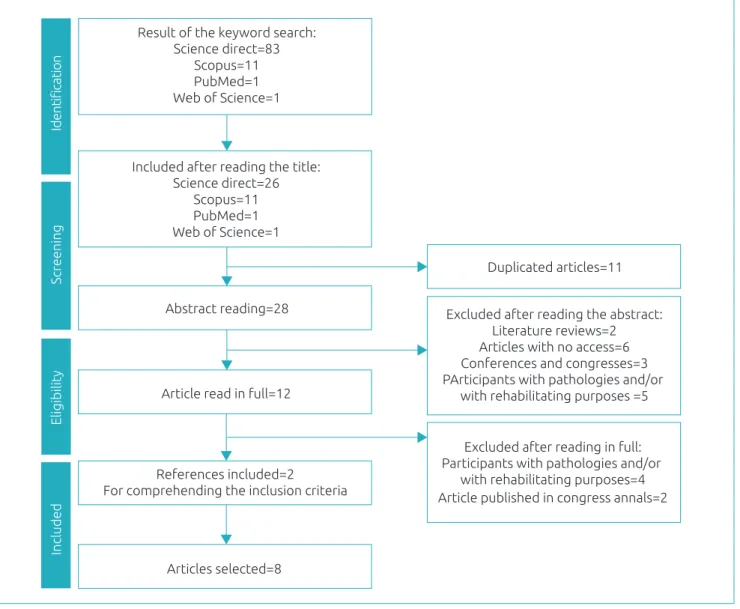
We found 96 publications in the databases Science Direct (n=83), Scopus (n=11), PubMed (n=1), and Web of Science (n=1). After the exclusion for duplicity (n=11), 28 articles were
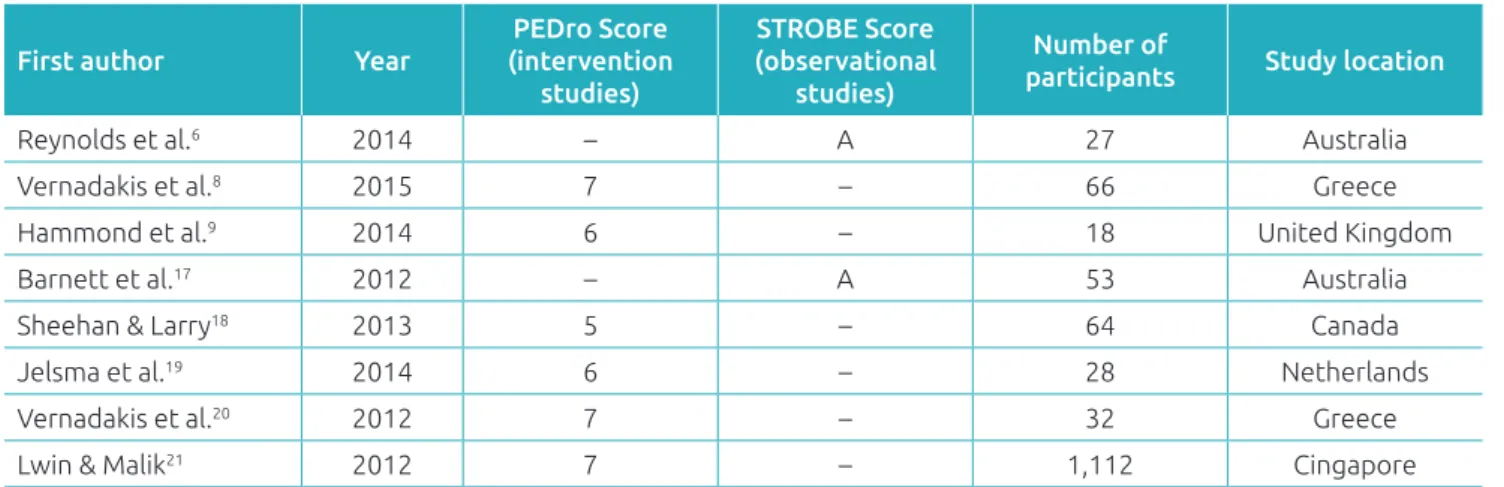
selected for the abstract reading. After this stage, 16 articles were excluded; 2 for being literature reviews, 6 for not presenting free access to the study in full, 5 for assessing children with pathol‑ ogies and/or with rehabilitating purposes, and 3 for being pub‑ lished in conferences and congresses. Twelve studies were left for the full reading, of which 6 were excluded: 4 for assessing children with pathologies and/or with rehabilitating purposes, and 2 for being published in congress annals. hroughout the reading, two relevant references were included in the analysis for approaching the inclusion criteria. herefore, eight articles were selected for the inal review, as shown in Figure 1. Chart 1 presents the main information about the eight articles selected for the inal review.
Table 1 demonstrates the data about the methodological quality of the articles. All studies were published from 2012 to 2015, in journals classiied with an “A” in Qualis Brasil. Regarding the scores obtained in the PEDro scale, for inter‑ vention studies, and in the STROBE scale, for observational studies, the eight articles were considered to have high meth‑ odological quality.
DISCUSSION
In the evaluation of the quality of the studies, most of them met the criteria to it category “A” in the STROBE classiication (more than 80% of the criteria were fulilled), and the inter‑ vention studies presented scores higher than 5 in the PEDro evaluation, which values the credibility of the evidence pro‑ duced in the analyzed studies.
In the literature selected, four studies were directly related with the acquisition of motor skills. In the irst one, Hammond et al.9 evaluated the possible beneits of exerga‑
mes in the motor proiciency of children with developmen‑ tal coordination disorder (DCD). he authors conducted a
Table 1 Articles included in the review.
First author Year
PEDro Score (intervention
studies)
STROBE Score (observational
studies)
Number of
participants Study location
Reynolds et al.6 2014 – A 27 Australia
Vernadakis et al.8 2015 7 – 66 Greece
Hammond et al.9 2014 6 – 18 United Kingdom
Barnett et al.17 2012 – A 53 Australia
Sheehan & Larry18 2013 5 – 64 Canada
Jelsma et al.19 2014 6 – 28 Netherlands
Vernadakis et al.20 2012 7 – 32 Greece
Lwin & Malik21 2012 7 – 1,112 Cingapore
motor intervention with Wii Fit for one month, 3 times a week, with 18 children distributed in 2 groups: control (n=8), and experimental (n=10). After the motor evaluation using the BOT‑2 battery, before and after the interventions, it was possible to observe signiicant gain in motor skills, indicat‑ ing that exergames are simple instruments, able to improve the children’s motor performance.
In the second study, a cross‑sectional study by Reynolds et al.6 investigated the relationship between the performance of
the real movement and the performance of the virtual move‑ ment in the exergame, including 27 children aged from 10 to 15 years. he results showed that the children with better scores in real life tasks, veriied by the MABC‑2 battery, also performed better in the Kinect Sports game (athletics modal‑ ity). he authors concluded that the virtual games reproduce real life tasks, therefore being a useful source of intervention for the acquisition of motor skills.
In the third study, also cross‑sectional, Barnett et al.17 ana‑
lyzed the associations between the time spent on electronic games and the fundamental motor skills in 53 children aged from 3 to 6 years. he authors veriied that the longer the time spent playing videogames, the better the performance in object control skills. However, they conclude that longitudinal and experimental studies are necessary to determine if the games actually improve these abilities.
In the fourth study, Vernadakis et al.8 analyzed the evi‑
dence from the previous study. he authors investigated if there are diferences between an intervention program based on an exergame and a traditional training of object control skills in elementary school children. Sixty‑six children took part, and 22 were in the control group, whereas 22 formed the experimental group and 22 were involved in the tradi‑ tional approaches. he intervention was divided in 8 sessions of 30 minutes each, twice a week. hree evaluations were
Figure 1 Flowchart of the articles found.
Screening
Identiication
Eligibility
Included
Abstract reading=28
Article read in full=12
Articles selected=8
Duplicated articles=11 Result of the keyword search:
Science direct=83 Scopus=11 PubMed=1
Web of Science=1
Included after reading the title: Science direct=26
Scopus=11 PubMed=1
Web of Science=1
References included=2
For comprehending the inclusion criteria
Excluded after reading the abstract: Literature reviews=2 Articles with no access=6 Conferences and congresses=3
PArticipants with pathologies and/or
with rehabilitating purposes =5
Excluded after reading in full:
Participants with pathologies and/or
Authors and year Objective Design Sample Main results
Reynolds
et al.,6 2014
To investigate the relationship between the real and the virtual
performance of movements
Cross‑
sectional
27 children and adolescents aged 10
to 15 years
The children with the best results in real life tasks also performed better in the exergames, indicating that these reproduce real
life tasks
Vernadakis
et al.,8 2015
To verify the diference
between an intervention program based on exergames and the traditional training of object control skills in children
Randomized clinical trial
66 children aged from 6 to 7 years divided in: control group, experimental
group – exergames, and experimental
group ‑ traditional
Both experimental groups presented improved object control skills.
The group with exergames
presented higher score in the pleasure scale
Hammond
et al.,9 2014
To assess if short and regular sessions of exergames lead
to beneits in motor and psychosocial proiciency in
children with DCD
Randomized clinical trial
18 children aged from 8 to 9 years: 10
in the experimental group and 8 in the
control group
There were gains in motor
proiciency of children in
the experimental group
Barnett
et al.,17 2012
To investigate the association between time spent with electronic games and essential
movement skills
Cross‑
sectional
53 children aged from 3 to 6 years
The longer the time spent with electronic games, the better the performance in
object control skills
Sheehan & Larry,18 2013
To investigate the efect of
the insertion of exergames in the PE curriculum in relation to
children’s balance
Non‑
randomized clinical trial
61 children aged from 9 to 10 years:
21 in the control group (traditional
PE classes); 19 in the experimental group with activities
addressed to speed, balance and coordination; and 21
in the experimental group with exergames
Both experimental groups showed improvement in
relation to the control group. The children in the experimental group with exergames had more
signiicant improvement in
balance in relation to those in the PE group
Jelsma
et al.,19 2014
To verify diferences in balance
between children with DCD and children with typical development after intervention
with exergames
Non‑
randomized clinical trial
48 children aged from 6 to 12 years: 28
children presented balance issues, and 20 had typical development. There was no control group
After the intervention with exergames, children with
DCD had more signiicant
improvement in balance than those with typical
development
Vernadakis
et al.,20 2012
To verify if there is a diference
between the program based on exergames and the traditional
balance training program in graduation students
Non‑
randomized clinical trial
32 university students: 16 in traditional training
and 16 with exergames
Both programs presented
signiicant balance
improvement, without
signiicant diferences
Lwin & Malik,21
2012
To examine the eicacy of
incorporating exergames in PE in
children and pre‑adolescents, as well as its inluence on physical
activity behavioral factors.
Non‑
randomized clinical trial
1,112 children aged from 10 to 12 years: 555 in the control group, with traditional
PE classes, and 557 in the experimental group with exergames
Exergames inluenced
the behavior related with physical activity, suggesting
they are more eicient
to stimulate the active behavior than traditional
PE classes
PE: Physical Education; DCD: developmental coordination disorder.
conducted with the TGMD‑2 battery, before and after the interventions and one month later, to verify learning reten‑ tion. he authors observed improvement in the object con‑ trol skills in both experimental groups, suggesting that the use of the Kinect for motor interventions is a valuable, viable and pleasant approach.
he results found in these four articles can be explained by the fact that the exergames require motor skills and abilities in a variety of cognitive and motor tasks, with a wide range of sen‑ sory feedback.22 he latter is an essential element in the process
of teaching‑learning of motor skills, besides being essential to detect and correct errors aiming at the good performance in the motor learning.23
Exergames are tools that attract and motivate children for the practice of physical activities. he studies by Jelsma et al.19 and Vernadakis et al.20 show that interventions with
exergames are more attractive than the traditional approaches, and, therefore, might be more eicient in the development of motivation for physical activity and in the assistance to acquire motor skills, since they incorporate essential learn‑ ing elements.8,24 Besides, the active games do not just ofer
the practice of motor skills in real time, but also the oppor‑ tunity to be involved in intense movements related to inter‑ ests of daily life.24‑26
Of the four articles left from the search, three used exer‑ games as an intervention tool to improve the balance in chil‑
dren18,19 and Young adults.20 Interventions occurred from six
to ten weeks, and they all had positive results, showing the eicacy of the use of exergames. he authors conclude that the motor intervention with the use of the exergame should be considered as a tool to improve the balance and develop motor skills, so the exergame would be a practical resource for school Physical Education. Such results can be a result of physical efort, of the greater energy expenditure and of the motor skills required by the game, such as balance, resis‑ tance, upper and lower limb coordination, speed, strength and lexibility,5,27 contradicting the idea of a sedentary lifestyle,
passivity and physical inactivity of the videogame player.28
Besides, the exergames stimulate rhythm, cooperation, cre‑ ativity and the sports spirit, also developing the motor rep‑ ertoire.26 For Sousa,29 the exergames lead to motor learning
and to the improvement of aspects related with health and physical shape.
Finally, the last article selected examined the eiciency of the incorporation of the exergame in Physical Education for children and pre‑adolescents, as well as its inluence in phys‑ ical activity behavioral factors.21 Lwin & Malik conducted
a motor intervention based on exergames during Physical
Education lessons for 6 weeks, with 557 children aged between 10 and 12 years. he results show that the exergame had a signiicant inluence on physical activity behaviors, and the authors concluded that its incorporation may be an eicient alternative to reinforce such behaviors in regular Physical Education classes. 21
his resource is already used in the state of West Virginia, in the United States, where the schools are betting on exer‑ games during Physical Education classes as a more encour‑ aging way to practice physical exercises. In terms of beneits to health, the exergames have the power to help the children to adopt a healthy lifestyle and to become physically active for life, besides being appropriate to reinforce the levels of physical activity.9 However, it is important to emphasize that
active games do not replace sports and other forms of phys‑ ical activity completely.30.31 Although the movements sim‑
ulate activities of daily life, the performance of the skill is not identical in virtual environments.30 Besides, the games
should be ministered in a controlled manner, because of the role of school Physical Education overcomes the lim‑ its of the practice of physical activity, since it also plays the role of developing social, afective, emotional and personal relationships. However, the exergames should be seen as a movement innovation, expanding its possibilities27 and sub‑
sidizing Physical Education classes for being a more ludic and more attractive tool nowadays.
he theme of exergames is very recent in the literature. Despite having its eicacy proven, its use is not common in the school context, so only few schools know the real func‑ tionality and the beneits of these games in the motor perfor‑ mance of children. herefore, this study aimed at bringing to light studies that have already been published on the subject, showing that these results are positive and that the exergames can be used as an alternative work tool in Physical Education classes. However, the review also presents some limitations, such as: use of articles published only in English and in Portuguese, which may have caused the exclusion of studies that approached the theme in other languages; use of only four data bases, pre‑ venting the generalization of the results to all scientiic pub‑ lications about the subject; and the exclusion of full articles without free access to researchers, which may have limited the interpretation of results.
CONCLUSION
REFERENCES
1. Cermak SA, Katz NW, Weintraub N, Steinhart S, Raz Silbiger S, Munoz M, et al. Participation in Physical Activity, Fitness, and Risk for Obesity in Children with Developmental Coordination Disorder: A Cross cultural Study. Occup Ther Int. 2015;22:163‑73.
2. Gallahue DL, Ozmun JC, Goodway JD. Compreendendo o Desenvolvimento motor: bebês, crianças, adolescentes e adultos. São Paulo: Editora McGraw Hill; 2013.
3. Finco MD, Reategui EB, Zaro MA. Exergames laboratory: a complementary space for physical education classes. Movimento. 2015;3:687‑99.
4. Lin JH. “Just Dance”: The Efects of Exergame Feedback and Controller Use on Physical Activity and Psychological Outcomes. Games Health J. 2015;4:183‑9.
5. Deutsch JE, Bretter A, Smith C, Welsen J, John R, Guarrera Bowlby P, et al. Nintendo Wii Sports and Wi Fit game analysis validation and application to stroke rehabilitation. Top Stroke Rehabil. 2011;18:701‑19.
6. Reynolds JE, Thornton AL, Lay BS, Braham LR, Rosenberg M. Does movement proficiency impact on exergaming performance? Hum Mov Sci. 2014;34:1‑11.
7. Biddiss E, Irwin J. Active video games to promote physical activity in children and youth. Arch Pediatr Adolesc Med. 2010;164:664‑72.
8. Vernadakis N, Papastergiou M, Zeteu E, Antoniou P. The impact of an exergame bases intervention on children’s fundamental motor skills. Computers & Education. 2015;83:90‑102.
9. Hammond J, Jones V, Hill EL, Green D, Male I. An investigation of the impact of regular use of the Wii Fit to improve motor and psychosocial outcomes in children with movement dificulties: a pilot stud. Child Care Health Dev. 2014;40:165‑75.
10. Papastergiou M. Exploring the potencial of computer and video game for health and physical education: A literature review. Computers & Education. 2009;53:603‑22.
11. Urrútia G, Bonill X. PRISMA declaration: A proposal to improve the publication of systematic reviews andmeta analyses. Med Clin (Barc). 2010;135:507‑11.
12. Arab C, Dias DP, Barbosa RT, Carvalho TD, Valenti VE, Crocetta TB, et al. Heart rate variability measure in breast cancer patients and survivors: A systematic review. Psychoneuroendocrinology. 2016;68:57‑68.
13. The Centre of Evidence Based Physiotherapy [homepage na Internet]. PEDro: physiotherapy evidence database [cited 2015 May 04]. Available from: https://www.pedro.org.au/.
14. Verhagen AP, Vet HC, Bie RA, Kessels AG, Boers M, Bouter LM, et al. The Delphi list: a criteria list for quality assessment of randomized clinical trials for conducting systematic reviews developed by Delphi consensus. J Clin Epidemiol. 1998;51:1235‑41.
15. Maher CG, Sherrington C, Hernet RD, Moseley AM, Elkins M. Reliability of the PEDro scale for rating quality of randomized controlled trials. Phys Ther. 2003;83:713‑21.
16. Elm E, Altman DG, Egger M, Pocock SJ, Gøtzsche PC, Vandenbroucke JP. The strengthening the reporting of observational studies in epidemiology (STROBE) statement: guidelines for reporting observational studies. Int J Surg. 2014;12:1495‑9.
17. Barnett LM, Hinkley T, Okely AD, Hesketh K, Salmon J. Use of electronic games by young children and fundamental movement skills? Percept Mot Skills. 2012;114:1023‑34.16.
18. Sheehan D, Larry K. The efects of a daily, 6 week exergaming curriculum on balance in fourth grade children. J Sport Health Sci. 2013;2:131‑7.
19. Jelsma D, Geuze RH, Mombarg R, Smits Engelsman BC. The impact of Wii Fit intervention on dynamic balance control in children with probable Developmental Coordination Disorder and balance problems. Hum Mov Sci. 2014;33:404‑18.
20. Vernadakis N, Gioftsidou A, Antoniou P, Ioannidis D, Giannousi M. The impact of nintendo Wii to physical education students’balance compared to the traditional approaches. Computers & Education. 2012;59:196‑205.
place all over the world, bringing limitations to childhood motor opportunities, the exergames, when used properly — not completely replacing sports and other ludic activities —, represent good strategies for parents and Physical Education teachers. his tool can help and motivate the practice of phys‑ ical exercises in domestic and school environments, in order to facilitate the acquisition and improvement of skills, as well as the development of motor skills in a more fun man‑ ner for the children.
This review can stimulate the current educators and researchers in the ield of motor development and motor learn‑ ing to be more interested in these popular digital resources.
herefore, we will have one more tool at hand to increase dig‑ ital inclusion in the current methodological school resources, encouraging physical practices and healthy life habits. Likewise, we can stimulate educational researchers to develop research projects of intervention that continue to study the efects of its use in detail.
Funding
his study did not receive funding.
Conflict of interests
© 2017 Sociedade de Pediatria de São Paulo. Published by Zeppelini Publishers. This is an open access article under the CC BY license (http://creativecommons.org/licenses/by/4.0/).
21. Lwin MO, Malik S. The eicacy of exergames incorporated physical education lessons in inluencing drivers of physical activity: A comparison of children and pre adolescents. Psychol Sport Exerc. 2012;3:756‑60.
22. Salem Y, Gropack SJ, Coin D, Godwinc EM. Efectiveness of a low cost virtual reality system for children with developmental delay: a preliminary randomised single blind controlled trial. Physioterapy. 2012;98:189‑95.
23. Magill RA. Aprendizagem e controle motor: conceitos e aplicações. São Paulo: Phorte; 2011.
24. Yen C, Lin KH, Hu M, Wu RM, Lu TW, Lin CH. Efects of virtual reality augmented balance training on sensory organization and attentionaldemand for postural control in people with Parkinson disease: a randomized controlled trial. Phys Ther. 2011;91:862‑74.
25. Teasell R, Meyer MJ, McClure A, Pan C, Murie Fernandez M, Foley N, et al. Stroke rehabilitation: an international perspective. Top Stroke Rehabil. 2009;16:44‑56.
26. Trout J, Zamora K. Using dance dance revolution in Physical Education. Teaching Elementary Physical Education. 2005;16:22‑5.
27. Vaghetti CA, Botelho SS. [Virtual learning environments in physical education: a review of the use of Exergames]. Cien Cogn. 2010;15:76‑88.
28. Baracho AF, Gripp FJ, Lima MR. [Exergames and the school physical education in the digital culture]. Rev Bras Ciênc Esporte, Florianópolis. 2012;34:111‑26.
29. Sousa FH. Uma revisão bibliográica sobre a utilização do Nintendo® Wii como instrumento terapêutico e seus fatores de risco. Revista Espaço Acadêmico. 2011;11:155‑60.
30. Daley AJ. Pode contribuir para a melhoria exergaming níveis de atividade física e os resultados de saúde em crianças? Pediatria. 2009;24:763‑71.