Prioritization of strategies to approach the
judicialization of health in Latin America
and the Caribbean
Carlos Eduardo Pinzón-FlórezI, Evelina ChapmanII, Leonardo CubillosIII, Ludovic ReveizIV
I Grupo de Investigación en Salud. Universidad de La Sabana. Chía, Colombia II Organização Pan-americana de Saúde. Brasília, DF, Brasil
III World Bank Institute. Washington, DC, USA
IV Department of Knowledge Management, Bioethics and Research. Pan American Health Organization. Washington, DC, USA
ABSTRACT
OBJECTIVE:
To describe strategies that contribute to the comprehensive approach to the
judicialization of health in countries of Latin America and the Caribbean.
METHODS:
A search was structured to identify articles presenting strategies to approach the
judicialization of health. A survey was designed, which included actors of the health system and
judiciary sector. We prioritized the strategies qualiied by more than the 50.0% of the participants
as “very relevant”. Strategies were categorized according to: governance, provision of services,
human resources, information systems, inancing, and medical products.
RESULTS: We included 64 studies, which identiied 50 strategies, related to the sub-functions
and components of health systems. Of the 165 people who answered the survey, 80.0% were aged
35-64 years. he distribution of men and women was homogeneous. Half of the respondents were
from Colombia (20.0%), Uruguay (16.9%), and Argentina (12.7%). We prioritized strategies that
addressed aspects of generation of useful scientiic evidence for decision making according to the
health needs of the population, empowerment for the society, and creating spaces for discussion
of measures of inclusion or exclusion of health technologies. he executive and judiciary decision
makers prioritized questions that dealt with strategies that would ensure accountability.
CONCLUSIONS: he results of this study contribute to the identiication of efective strategies
to approach the phenomenon of judicialization of health, guaranteeing the right to health.
DESCRIPTORS: Judicial Decisions. Jurisprudence. Patient Rights. Right to Health. Health
Priorities, legislation & jurisprudence. Health Systems.
Correspondence:
Ludovic Reveiz
Department of Knowledge Management
Bioethics and Research – PAHO 525 23rd St NW, Washington, DC 20037 USA
E-mail: [email protected]
Received: 15 Jul 2014
Approved: 22 Aug 2015
How to cite: Pinzón-Flórez CE, Chapman E, Cubillos L, Reveiz L. Prioritization of strategies to approach the judicialization of health in Latin America and the Caribbean. Rev Saude Publica. 2016;50:56.
Copyright: This is an open-access article distributed under the terms of the Creative Commons Attribution License, which permits unrestricted use, distribution, and reproduction in any medium, provided that the original author and source are credited.
INTRODUCTION
he right to health is well stablished in most constitutions of the countries of Latin America
and the Caribbean, as well as in numerous international and regional human rights treaties.
his obliges the States to ensure, among others: timely and appropriate availability of health
care; healthy and safe work conditions; adequate housing; and nutritious foods. When the
States cannot guarantee this right properly, they must adopt measures in accordance with
the principle of progressive realization, i.e., to progress in the most expeditious and eicient
way possible using the maximum of the resources available
a.
he legitimate role of a court in the process of litigation on health is to represent the
democratic processes and institutional capacity of the State to exercise them. his evolution
demonstrates a process of social maturation of the States, recognizing human rights and
their enforceability of protection, and clearly establishing governance and governability in
terms of establishing an inclusive mechanism of accountability in the society
12,20,b.
In 2005, universal health coverage became the objective of all the health care systems of
countries members of the World Health Organization (WHO), as an efective strategy to
achieve access to the health services needed to establish the health of populations, without
incurring in any impoverishing economic risk by individuals. In the medium and long
term, to increase the coverage in health services to inancial sustainability will enable the
improvement of health and well-being, and promote sustainable human development
c.
Several countries around the world have presented an accelerated demand of the population
by universal quality health services. his increase in demand is not often harmonized with
the development of systems, and is associated with a deterioration in the provision of health
services, either by endogenous or exogenous factors to the system itself
14 c,d,e.
Litigations in health have been eicient for acquiring such health services in an efective way.
hese mechanisms are being increasingly used. his is relected in the exponential increase in
the number of court judgments related to the requirement of fulilment of the right to health by
the State. As a result, the judiciary has participated more in the deinition and redeinition of
health policies, and has also been evolving and redeining: the type of responses, the functions
that must be exercised within the health system, and the role within the exercise of the right
to the health
13,39. While they may be a medium term solution to guarantee the individual right
and access to health, judicial tutelage and protections, criminal and civil, for example, may
require the increase of public inancing of health in a sustainable and efective way, to ensure
that it does not impacts negatively the inancial sustainability of the health system
13,39.
he aim of this article was to describe strategies that contribute to the comprehensive
approach to the judicialization of health in countries of Latin America and the Caribbean.
METHODS
A study with two methodological approaches was carried out. he irst was a review of the
literature to identify strategies that addressed the judicialization of health. he second was
a survey to prioritize the identiied strategies.
Literature Search
An advanced search of the literature (January 2000 – July 2013) was performed in the following
databases: PubMed; Cochrane Library, and Lilacs; as well as Google Scholar. As there are no
validated search strategies for this topic, the following keywords and synonyms, using the PubMed
search engine were identiied: PubMed: ((“litigation”[tw] OR judicialization [tw] OR lawsuits [tw]
OR judiciary [tw] OR legislation and jurisprudence [Subheading] OR jurisprudence [tw] OR court
[tw])) AND ((“health”[MeSH Terms] OR “health”[All Fields])) AND ((Latin america* OR South
America* central America* OR carribbean* OR Anguilla OR (Antigua Barbuda) OR Argentina
a Naciones Unidas, Asamblea General. El derecho de toda persona al disfrute del más alto nivel posible de salud física y mental: informe provisional del relator. New York; 2006. (A/61/338).
b World Health Organization. Social Health Insurance: sustainable health inancing, universal coverage and social health insurance: report by the Secretariat: Fifty-eight World Health Assembly. Provisional agenda item 13.16. New York; 2005. (A58/20). Available from: http://apps.who.int/iris/ bitstream/10665/20302/1/ A58_20-en.pdf
c Iunes R, Cubillos-Turriago L, Escobar ML. Universal health coverage and litigation in Latin America. Washington (DC): World Bank; 2012 [cited 2015 Oct 25]. Available from: http:// siteresources.worldbank.org/ INTLAC/Resources/257803 1269390034020/EnBreve_178_ English_Web.pdf
d Organización Mundial de la Salud. Informe sobre la salud en el mundo: la inanciación de los sistemas de salud: el camino hacia la cobertura universal. Ginebra; 2010 [cited 2012 Apr]. Available from: http://whqlibdoc.who.int/ whr/2010/9789243564029_ spa.pdf
OR Aruba OR Bahamas OR Barbados OR Belize OR Bermuda OR Bolivia OR Brazil OR brasil OR
(British Virgin Islands) OR (Cayman Islands) OR Chile OR Colombia OR (Costa Rica) OR Cuba OR
Dominica OR (Dominican Republic) OR (republica dominicana) OR “El Salvador” OR Ecuador OR
(French Guiana) OR Grenada OR Guadalupe OR Guatemala OR Guyana OR Haiti OR Honduras
OR Jamaica OR Martinique OR Mexico OR Montserrat OR (Netherlands Antilles) OR Nicaragua
OR Panama OR Paraguay OR Peru OR (Puerto Rico) OR (Saint Kitts Nevis) OR (Saint Lucia) OR
(Saint Vincent Grenadines) OR Suriname OR (Trinidad Tobago) OR Uruguay OR Venezuela)).
In addition, the bibliographic references of the identiied studies were revised for additional
references. One reviewer assessed the titles and abstracts identiied by the search, and
two reviewers independently assessed the studies that met the inclusion criteria, namely:
(a) studies whose theme was the judicialization of health; (b) studies that incorporate
mechanisms or strategies, or both, to deal with litigations in diferent health systems in
the region; and (c) evaluation of the implementation of structural sentences of courts.
he websites of the Ministries of Health and relevant institutions were also reviewed. he
search was limited to the languages Spanish, French, English and Portuguese, and was
geographically restricted to Latin America and the Caribbean.
Development of the Instrument (Survey)
A group formed by experts in epidemiology, public health, health systems and services,
and global health composed the identiied studies. Based on the indings of the review, we
developed a map of the diferent strategies evaluated or proposed by the authors of the
studies (Table 1).
Categorization of Strategies
he strategies were classiied in relation to the functions of the health system, from the
perspective of thinking proposed by WHO
e: 1) governance, 2) funding, 3) access to medical
products and technology, 4) information systems, 5) human resources, and 6) provision of
services
21. he instrument was developed in the SurveyMonkey
program. he strategies
were drafted and revised until a consensus was obtained among all members of the group,
ensuring that they were short and speciic, not ambiguous and established consistent and
measurable strategies, thus developing the inal instrument. he strategies were written in
Spanish and English.
Population and Participants
he countries of Latin America and the Caribbean were selected, and in each country decision
makers of all three branches of public power (legislative, judicial, and executive) were selected.
he participants were identiied by observation of the region’s health systems of health,
including the regional initiative on prioritization, equity and constitutional mandates for
the region of the Americas, driven by the World Bank Institute
f, and a search in PubMed and
Lilacs of actors key in this ield in countries of Latin America and the Caribbean. Seventeen
participants belonged to countries that are not part of Latin America and the Caribbean.
However, they are decision makers and researchers that have contributed on legislation and
knowledge over judicialization of health in the region, identiied in the literature search.
he characteristics of the participants are summarized in Table 2.
Statistical Analysis
To assess the validity of the construct of the designed instrument, a factor analysis was made
regarding the main components. A descriptive analysis of the responses given by participants
was performed, taking into account the current occupation and the country where they work.
A bivariate analysis was also performed, for the categorical variables current occupation,
country where the participant works and degree of prioritization using the X
2test. For all
statistical analyses, statistical signiicance values of p < 0.05 were established. he statistical
program Stata 12
was used to perform these tests.
f Instituto del Banco Mundial.Table 1. Strategies by category of analysis.
Question General measures
Q1 1. Is the generation of spaces for discussion of the actors in the health system, including representatives of patients, health professionals, and vulnerable populations, an effective measure to prevent litigations in health?
Q2 2. Is the funding, by the State, of the creation of scientiic and civilians associations to strengthen decision making in health, an effective measure to prevent litigations in health?
Q3 interventions, or beneits not included in the set of beneits of the health system, an effective measure to prevent litigation in health?3. Is the creation of a public policy that clariies explicitly the technical and administrative management of the procedures, inputs,
Q4 4. Is the creation of a strategy that clariies explicitly which medical inputs and procedures are excluded of the plan of attention in health, as well as the reason of exclusion, an effective measure to reduce litigations in health?
Q5 5. Are explicit strategies to protect the regulatory public institutions of health (for example, systems of incentives and sanctions) from corruption, effective measures to reduce litigation?
Q6 which monitor and audit the activities of buying and selling of health services, as well as appropriate provision of services by health 6. Is the institutionalization and/or strengthening of committees in the governing institution (Ministry or Secretariat of Health), professionals, an effective measure to reduce litigations in health?
Q7 7. Is the creation of the igure and the institutionalization of the advocacy of users or patients, an effective strategy to reduce litigations in health?
Q8 8. Is the creation of spaces such as scientiic advisory committees to the courts, with the purpose of supporting legal decisions with scientiic evidence, an effective measure for decision-making, and also for the regulation of litigation in health?
Q9 9. Is to grant punitive power to the institutions of surveillance and control of the health system for the compliance of processes and the provision of health services an effective measure to reduce litigations in health?
Leadership and governance
Q10 1. Is the deinition of a public policy of surveillance of litigations in health an useful strategy to regulate judicialization of health?
Q11 2. Is the creation of observatories for knowledge, monitoring, and decision making of litigation in health, integrating actors of the health, executive, and judicial sectors, an effective strategy to regulate the judicialization of health?
Q12 3. Is the training and advice by qualiied personnel of the Ministry of Health to the members of courts for decision-making in relation to the right to health, an effective strategy to regulate the judicialization of health?
Q13 4. Is training and advice by qualiied staff of the scientiic community in health (academic staff, researchers) to the members of the courts, an effective strategy to regulate the judicialization of health?
Q14 5. Can the continuous updating of the services and/or set of features based on the needs and priorities of public health regulate litigations in health?
Q15 6. Is the establishment of priorities in health to prevent possible budgetary expenditure and, therefore, catastrophic expenditure in high cost disease an effective measure for the regulation of the judicialization of the right to health?
Q16 7. Can the implementation of institutions or agencies for evaluating health technology that have the capacity to regulate the market in health and the entry of new technologies be an effective mechanism for the regulation of judicialization of health?
Q17 8. Can the reduction of the asymmetry of information between the offer and demand of health care (access, quality, and satisfaction) be a strategy to ensure protection to the consumer and, accordingly, to regulate the judicialization of health?
Q18 9. Can the establishment of a responsible mechanism of conlict resolution in health be an effective strategy for the regulation of the judicialization of health?
Q19 relation to the guarantee of this right, strategies of empowerment for the society that will ensure equity and therefore regulate of 10. Are to properly inform patients or family members on the right to health, the duties of the State and the system of health in litigations in health?
Q20 11. Is the planning and implementation of a monitoring and control system based on the guarantee of coverage of health insurers and health care providers a fair, effective, and eficient measure to reduce litigations in health?
Q21 12. Is the development of a strategic plan for the distribution and supplying of pharmacies in the nation and regional levels an effective and eficient measure to reduce litigation in health?
Provision of services
Q22 1. Is the explicit guarantee of financing and access to health services an action that can reduce the probability of judicialization of health?
Q23 2. Is implementing strategies of primary health care an effective and eficient mechanism to grant equity in the access and inancing of health and, consequently, can it be a measure to reduce litigation in health?
Q24
3. Is the implementation of strategies to increase access to health care in rural areas (eHealth, irst level health centers in rural areas or with dificult access, economic incentives for the retention of health professionals in rural areas, transportation in areas with geographic
access barriers) an effective measure to regulate litigations in health?
Q25 4. Is the redistribution of inancial resources for the care of vulnerable populations a measure that improves equity in health and, likewise, would reduce litigation in health?
Q26 5. Is the approval of the plan of services between different sub-sectors in segmented health systems an effective strategy to reduce inequality in access and, therefore, regulate litigations in health?
Ethical Aspects
All participants were contacted virtually and simultaneously by sending them the consent
form to participate and access to the survey structured in the SurveyMonkey
program.
In the header of the survey the purpose of the prioritization exercise and how results would
be used were explained. An e-mail contact and a speciic ield was available to participants
to include questions or formulate their concerns. Two reminders of the survey were sent. he
proposal was approved by the Ethics Committee of the Pan-American Health Organization
(PAHO-ERC – 2013-05-009).
Table 1. Strategies by category of analysis. Continuation
Q27 6. Is the creation of programs of conditional cash transfers as a strategy for reducing inequalities and empowerment of civil society an effective measure for the regulation of litigation in health?
Q28 7. Is optimizing the waiting times for the provision of health services an effective measure to reduce the number of litigations in health? Q29 8. Is the hiring of additional health personnel to optimize health care an effective measure for the reduction of litigation in health? Q30 9. Are the mechanisms of hiring of health services by legal mechanisms effective strategies for the reduction of litigation in health?
Q31 10. Is the generation and implementation of a system of incentives for health care quality and eficiency by health professionals an effective measure to reduce litigation in health?
Q32 11. Is the establishment of inter-agency agreements for the provision of health services an effective measure to ensure the eficient access to such services and, consequently, to reduce litigation in health?
Q33 12. Is the implementation of a system of incentives to offer health services, by insurers or providers, a strategy that ensures the access to services and, therefore, guarantee the right to health effectively and eficiently?
Q34 13. Is encouraging the prescription of generic drugs an effective measure for the regulation of litigations in health? Human resources
Q35 1. Is having undergraduate and graduation programs in Law Schools focused on health a good strategy to regulate litigation in health?
Q36 2. Is the timely training of health professionals and judges for decision-making in cases of judicial tutelage an effective strategy to regulate litigation in health?
Q37 3. Is the training of professionals in audit processes and health management an effective strategy to control the quality and management of health services delivery and, likewise, to prevent litigations in health?
Q38 4. Is the establishment of a certiication system of professionals and of accreditation of the institutions of health for the provision of quality health services and an effective strategy to regulate litigations in health?
Q39 5. Can developing a strategic plan for the training and distribution of human resources in your country be an effective strategy to reduce and regulate litigation in health?
Information
Q40 1. Can the development and implementation of clinical practice guidelines or protocols be a strategy to regulate litigations in health?
Q41 2. Is the development of a national plan for the development of guides of clinical practice, protocols of management or guidelines for the provision of health services an effective strategy to regulate litigations in health?
Q42 3. Can the implementation of an information system for decision-making on access, training, and distribution of human resources in health, drug supply and acquisition of new technologies, be an effective strategy to regulate ltigations in health?
Q43 4. Is the implementation of a national system of pharmaceutical information on the access, use, quality and prices of medicines an effective strategy to regulate litigations in health?
Q44 5. Will the creation and management of an information system on the juridical processes in health allow the population to know and characterize these processes, as well as helping decision-making of the actors involved in them?
Q45 6. Is the generation of scientiic evidence from research on the impact of judicialization in the management of the health system and the judicial system an effective strategy to regulate litigations in health?
Q46 7. Is the generation of scientiic evidence oriented to the identiication of health needs of populations an effective measure for the strategical planning of health systems and, therefore, for the regulation of litigations in health?
Financing
Q47 1. Is the calculation of the additional cost of the introduction of new interventions or technology in the health system an eficient and effective strategy to regulate litigations in health?
Q48 2. Can the creation of a subsystem of inancing for high-cost diseases, or that may incur in budgetary or catastrophic expenditure be an effective strategy to regulate litigations in health?
Q49 3. Can the establishment of a threshold of willingness to pay for access to a new health technology be an effective and eficient strategy to regulate litigations in health?
RESULTS
Literature Search
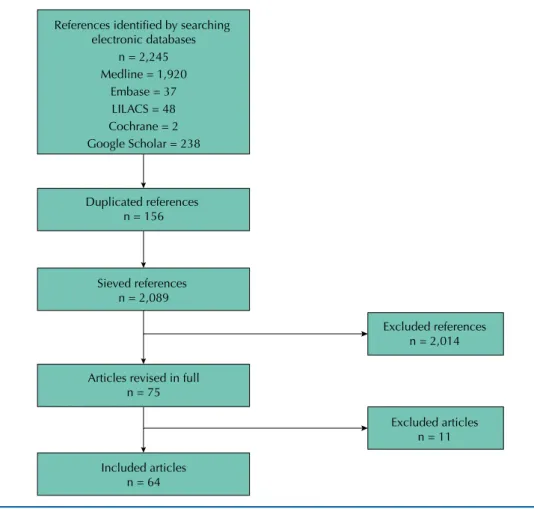
We identiied 2,245 references. Of these, 2,014 were excluded after application of the eligibility
criteria by title and abstract. We excluded 156 articles for being duplicates, and 11 for not
reporting strategies of intervention to the research problem addressed. Finally, we evaluated
Table 2. Characteristics of the participants.
Characteristics n %
Sex
Male 86 52.2
Female 79 47.8
Total 165 100
Age (years)
18 to 24 1 0.6
25 to 34 25 15.1
35 to 44 40 24.2
45 to 54 52 31.5
55 to 64 38 23.0
> 65 9 5.4
Total 165 100
Job position
Judiciary sector 21 12.7
Executive sector 8 4.8
Legislative sector 1 0.6
Public health sector 71 43.0
Private health sector 40 24.2
International Organization 24 14.5
Total 165 100
Country of origin
Argentina 21 12.7
Brazil 17 10.3
Canada 1 0.6
Chile 7 4.2
Colombia 33 20.0
Costa Rica 10 6.06
Ecuador 2 1.2
El Salvador 1 0.6
Spain 5 3.03
United States of America 9 5.4
Guatemala 1 0.6
Honduras 1 0.6
Morocco 2 1.2
Mexico 5 9.0
Nicaragua 1 0.6
Peru 9 5.4
Dominican Republic 1 0.6
Uruguay 28 16.9
Trinidad and Tobago 1 0.6
the full text of 64 articles
1-6,8-10,11-39,41-46,48-54,a,b,c,f,g,h,i,j,k,l,m,n,o,p,qthat identiied intervention proposals
to address the phenomenon of the judicialization of health, as shown in the Figure. All eligible
studies were in Spanish, English and Portuguese. he approach of judicialization of health
depends on the conceptualization of the right to health and the characteristics of the health
care system. All those studies addressed judicialization as a consequence of the relations and
performance of the system of health and its civic duty. he majority of legal processes iled
was to ensure access to medication (73.0%), and conduction of healing procedures (22.0%)
and public health events (5.0%). All litigations were due to medications or procedures. In
Colombia
1,4,19,26,29,32,39,49,g,h,i,j,k,l,m,nand Costa Rica
35,39, those medications were not included in the
plan of beneits. In Brazil, while they were inside the plan of beneits, there was no supply within
the evaluated municipalities
3,22,24,30. he countries with the largest number of publications were
Brazil (n = 32, 50.0%)
3,5-9,12,17-18,22-25,27,30,31,34,36-39,42,51,53,o,p, Colombia (n = 21, 32.8%)
1,2,19,26,29,32,39,41,49,g,i,j,k,l,m,n,
Costa Rica (n = 6, 9.3%)
35,39, Chile (n = 2, 3.1%)
8,9,54, and Argentina (n = 3, 4.7%)
10.
Construction of the Collection Instrument
he revision of the articles resulted in 91 proposed strategies, which were evaluated by the
group of authors. We excluded 41 of them for: being duplicated; being too general proposals,
which prevented implementation; not being applicable in the current context; or presenting
ambiguity or inconsistency. Finally, we identiied 50 proposals for the strategies, classiied as
follows: 9 (18.0%) general or systemic measures; 12 (24.0%) governances and leaderships; 13
(26.0%) provision of health services; ive (10.0%) human resources for health; seven (14.0%)
information; and four (8.0%) inancing (Table 3). In the factor analysis by main components
with 50 variables and 165 observations, the items were grouped into six factors that explained
the variance of the items by 50.0%, according to the proposed theoretical classiication. he
two irst factors presented the greater common variance (15.0%) and explained the construct;
this could be due to several proposals of factor 1 “general measures” being related to factor 2
“governance and leadership”. he six main factors with their respective items were: 13 items for
factor 1 “general measures” (eigenvalue 12.81); 11 items for factor 2 “governance and leadership”
(eigenvalue 2.81); four items for factor 3 “human resources for health” (eigenvalue 2.32); 11 items
for the factor 4 “provision of health services” (eigenvalue 1.89); six items for factor 5 “information”
(1.75 eigenvalue); and three for the factor 6 “inancing” (eigenvalue 1.61), X
2= 2452.29 (p < 0.001).
Prioritization of Strategies according to Categories
he participants prioritized, irstly, the category “general measures”, which involves the
establishment of policies and scientiic frameworks for the management of the system
and intersectoral participation. Secondly, they prioritized the “governance and leadership”
category, for the management of health institutions, with emphasis on guaranteeing the right
to health and the allocation of priorities in health. A third category prioritized at the same
level as the previous one was “information”, which highlights the importance of the use of the
evidence for the sets of beneits. Finally, there are the categories “human resources for health”
and “provision of health services”, which highlight processes of the quality of care (Table 3).
Prioritization of Strategies according to Participants
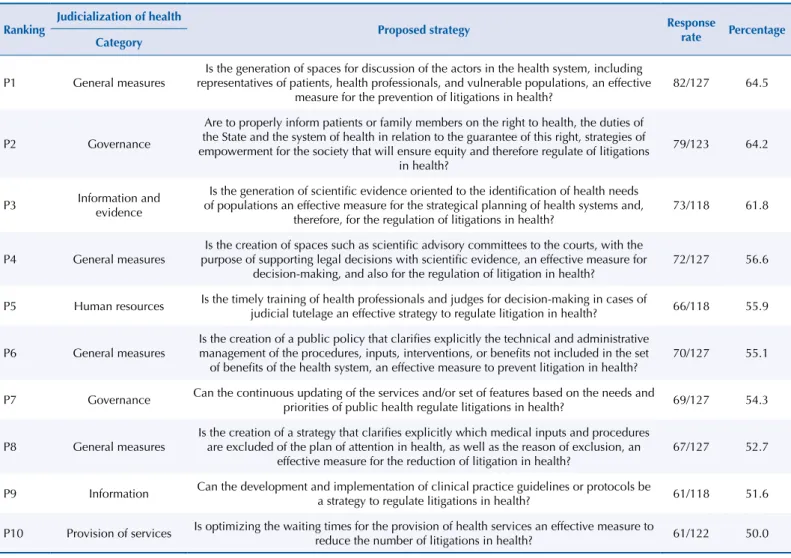
From the 10 prioritized strategies (Table 4), the irst three were: (1) to create spaces for
discussion for decision-making at diferent levels of power in the health care system,
(2) to duly inform the right to health to patients and families, and (3) to generate scientiic
evidence focused on the identiication of the health needs of the populations. he following
two priority strategies are correlated and propose the creation of technical and scientiic
committees and the training of health professionals and judges, to support the decisions
made in the courts, based on scientiic evidence, if there is a process of judicialization. hen,
the participants prioritized three strategies: the generation of a public policy of regulation of
new technologies; continuous updating of the health system’s plans of beneits; and updating
of the explicit regulatory mechanisms of evaluation and inclusion of new technologies in
the plan of beneits. Finally, priority was given to two strategies related to the optimization
g Acosta OL. La judicialización del derecho a la salud en Colombia. In: Comisión Económica para América Latina; Instituto Centroamericano de Estudios Fiscales; Analytical Spectral Devices; Agencia Española de Cooperación Internacional para el Desarrollo, editores. Panel IV: Perspectivas de los Sistemas de Salud en Seminario Internacional Repensar lo Social en Tiempos de Crisis; 2009 mayo 28-29; Antigua, Guatemala. CEPAL; 2009 [cited 2013 Aug]. Available from: http://www.eclac.cl/ dds/noticias/paginas/2/36122/ OlgaLuciaAcosta.pdf h Colombia, Defensoría del Pueblo. La tutela y el derecho a la salud: causas de las tutelas en salud 1999-2003. Bogotá; ano [cited 2014 Jan]. Available from: http://www.defensoria.gov.co/ attachment/142/Causas de las tutelas en salud.pdf
i Colombia, Defensoría del Pueblo. La tutela y el derecho a la salud, período 2003-2005. Bogotá; 2007. Available from: http://www.defensoria.gov.co/ es/nube/noticias/291/Informe- defensorial-sobre-la-Tutela-y- el-Derecho-a-la-Salud-Informe- defensorial-Salud-Derechos-Humanos.htm
j Rossi F. El precio exagerado de los medicamentos. Razón Pública, 27 Sep 2010 [cited 2010 Dec 20]. Available from: http:// www.razonpublica.com/index. php/economia-y-sociedad/1408- el-precio-exagerado-de-los-medicamentos
References identified by searching electronic databases
n = 2,245 Medline = 1,920
Embase = 37 LILACS = 48 Cochrane = 2 Google Scholar = 238
Duplicated references n = 156
Sieved references n = 2,089
Excluded references n = 2,014
Articles revised in full n = 75
Excluded articles n = 11
Included articles n = 64
Figure. Flowchart of the search strategy.
Table 3. Analysis according to categories.
Category Global Prioritized
n % n %
General measures 9 18.0 4 40.0
Leadership and Governance 12 24.0 2 20.0
Provision of health services 13 26.0 1 10.0
Human resources of health 5 10.0 1 10.0
Information 7 14.0 2 20.0
Financing 4 8.0 0 0
Total 50 100 10 100
of the action of the health professionals in the provision of services: the development and
implementation of clinical practice guidelines to standardize health interventions; and the
optimization of times of care by health professionals in required services.
Analysis of the Prioritized Strategies according to Type of Occupation
We identiied the trends in response of diferent individuals, according to their occupation,
in 10 prioritized strategies. We found a homogeneous tendency of prioritization of questions
of general measures by all actors. In the strategy related to the need of generating scientiic
evidence oriented to the identiication of the needs of the populations, as an efective and
eicient strategy for the regulation of litigation in health, health managers had a rate of
prioritization signiicantly greater (18/31 = 58.1%) that the other actors. In the strategy that
addressed the optimization of waiting times for the provision of health services as strategy
to regulate litigation, active health professionals (15/24 = 62.5%) and decision-makers of the
judiciary power (5/11 = 45.5%) had higher rates of prioritization.
m Romero LC. Judicialização das políticas de assistência farmacêutica: o caso do Distrito Federal. Brasília (DF): Consultoria Legislativa do Senado Federal; 2008 [cited 2012 Apr]. (Textos para discussão, 41). Available from: http://www12.senado. gov.br/publicacoes/estudos-legislativos/tipos-de-estudos/ textos-para-discussao/td-41- judicializacao-das-politicas-de- assistencia-farmaceutica-o-caso-do-distrito-federal
n Perlingeiro R. La tutela judicial del derecho público a la salud en Brasil. el.Dial.com Biblioteca Juridica. 2013 [cited 2014 Jan];16(3722). Available from: http://papers.ssrn.com/sol3/ papers.cfm?abstract_id=2239840 o Pepe VLE, Ventura M,
organizadores. Manual de indicadores de avaliação e monitoramento das demandas judiciais de medicamentos. Rio de Janeiro: Escola Nacional de Saúde Pública da Fundação Oswaldo Cruz; 2011 [cited 2014 jan]. Available from: http://www5. ensp.iocruz.br/biblioteca/dados/ txt_975659982.pdf
p Vargas Lorenzo I. Barreras en el acceso a la atención en salud en modelos de competencia gestionada: un estudio de caso en Colombia [these]. Bellaterra: Facultat de Medicina de la Universitat Autònoma de Barcelona; 2009.
he decision-makers of the executive and judiciary powers prioritized the strategies of
governance, in which strategies of inclusion of the civil society in the decisions in health
stood out, as well as the continuous evaluation of the services ofered to the users of the
health system.
Analysis of the Prioritized Strategies according to Country
In general, we observed a tendency to prioritize the strategies referred to in the
general measures, governance, and information and evidence measures among
countries. Brazil (13/17 = 76.5%) and Colombia (17/33 = 51.5%) prioritized strategies
of creating spaces of discussion for decision making; Chile, Costa Rica, Mexico, and
Peru prioritized homogeneously: strategies that address the creation of spaces for
discussion among the actors in the health system; granting of information on the right
to health and the duties of the State in relation to guaranteeing the right to health;
generation of scientific evidence for decision-making according to the needs of the
populations; and creation of scientific technical advisory committees to the courts.
The participants from Argentina prioritized the processes of governance, in terms
of accountability (11/21 = 52.4%) and the creation of a regulatory and evaluation
process of the interventions and health services that not are included in the basic
care plan (11/21 = 52.4%). Those of Uruguay, prioritized strategies seeking to clarify
explicitly what interventions and health services are excluded from the basic plan and
the reasons for this exclusion (18/28 = 64.3%), followed by the generation of oriented
scientific evidence to identify the health needs of populations (15/28 = 53.6%) and the
creation of scientific technical advisory committees to support legal decision-making
based on scientific evidence (15/28 = 53.6%).
Table 4. General ranking of strategies prioritized as “very important”.
Ranking
Judicialization of health
Proposed strategy Response
rate Percentage
Category
P1 General measures
Is the generation of spaces for discussion of the actors in the health system, including representatives of patients, health professionals, and vulnerable populations, an effective
measure for the prevention of litigations in health? 82/127 64.5
P2 Governance
Are to properly inform patients or family members on the right to health, the duties of the State and the system of health in relation to the guarantee of this right, strategies of empowerment for the society that will ensure equity and therefore regulate of litigations
in health?
79/123 64.2
P3 Information and evidence
Is the generation of scientiic evidence oriented to the identiication of health needs of populations an effective measure for the strategical planning of health systems and,
therefore, for the regulation of litigations in health?
73/118 61.8
P4 General measures purpose of supporting legal decisions with scientiic evidence, an effective measure for Is the creation of spaces such as scientiic advisory committees to the courts, with the decision-making, and also for the regulation of litigation in health?
72/127 56.6
P5 Human resources Is the timely training of health professionals and judges for decision-making in cases of
judicial tutelage an effective strategy to regulate litigation in health? 66/118 55.9
P6 General measures Is the creation of a public policy that clariies explicitly the technical and administrative management of the procedures, inputs, interventions, or beneits not included in the set of beneits of the health system, an effective measure to prevent litigation in health?
70/127 55.1
P7 Governance Can the continuous updating of the services and/or set of features based on the needs and priorities of public health regulate litigations in health? 69/127 54.3
P8 General measures Is the creation of a strategy that clariies explicitly which medical inputs and procedures are excluded of the plan of attention in health, as well as the reason of exclusion, an effective measure for the reduction of litigation in health?
67/127 52.7
P9 Information Can the development and implementation of clinical practice guidelines or protocols be a strategy to regulate litigations in health? 61/118 51.6
DISCUSSION
his study is one of the irst systematic approaches to identify and prioritize multidisciplinary
intervention strategies and diferent levels of action of health systems to address the
judicialization of health. he strategies identiied in the published scientiic literature
were prioritized by a heterogeneous group coming from diferent countries and contexts.
he strategies with greater prioritization scores were those that sought to generate discussion
spaces among the diferent stakeholders, including patients, health professionals and
populations in vulnerable situations; also those that ensured the empowerment of the society
in relation to the right to health. A second group of strategies highly prioritized is those
that establish rules, standards and processes based in scientiic data (e.g., the continuous
update of the set of continuous beneits, elaboration of guides and protocols of practice,
evaluation of technology, among others). A third group of strategies focused on the need to
inform and train society, in general, as well as judges and health professional, in particular.
Finally, strategies that sought to strengthen health systems to optimize waiting times for
the provision of health services, or to improve primary health care, among many others,
were considered highly relevant.
In some cases, the participants prioritized intervention strategies that had already been
incorporated in some countries in the region as part of the reform processes carried out,
such as Colombia, with the regulation of the health market, the costs of provision, and
the standardization and updating of the health services plan, which includes updated
interventions of the services ofered in this country
7,13. Also Argentina, Brazil and Costa Rica,
with the creation of spaces of training based in scientiic evidence for judges and courts.
The exercise of judicialization (of accountability) highlighted problems in the health
system, either in the provision of health services, financing, or rectory or availability of
human and structural resources of the system. At the same time, we observed limitations
in the judiciary sector to properly perform this role
20. An analysis point is to consider
whether other forms of accountability have been underutilized in the region, benefiting
judicial accountability.
In this study, we identiied more strategies for the sub-functions of 1) “governance and
leadership”, 2) “information”, and 3) “provision of health services”. Probably, the irst and
third sub-functions are those that have been most explored in relation to the causes of
litigation in health in the contexts where they have been studied
29,54. Others authors have
asserted that the inancing of the health system is the angular stone for a proper provision
of health services
8. However, this had poor prioritization on the part of the participants
of this study.
he judicialization of health is a social response to a need that is not met by the health
system. Litigations occur frequently as a result of the lack of health coverage, of limitations
on access or inequality of access or use, or use, and also detriment in the quality of the
care
50,d. In that sense, accomplishing universal health coverage would strengthen the
processes of provision of health services, and increase not only the population coverage but
the access and the quality of such services by means of a sustainable inancial investment,
reducing thus the possibility of incurring in expenditure from the budget and, accordingly,
in catastrophic expenditure
q.
here were statistically signiicant diferences of some strategies regarding the function of
the respondents. For example, the managers could understand better the role of evidence
in decision-making and, thus, of prioritization. We also observed diferences in the strategy
“optimization of waiting times”, by providers of the health and justice sectors, since the vision
of the latter was related to the direct contact between professionals and patients and with the
receiving of judiciary demands due to this contact. To ensure timely and proper availability
of services, regulate the introduction of new technologies and guarantee equality in access,
inancing and adequate spending in health are also considerations raised by other authors
r.
r República de Colombia,The integrality of the strategies for any action in the health system is necessary to
ensure their effectiveness. For example, to think of an intervention on the role of
governance and leadership will have impact and adjustments in other functions, both
for the provision of services, such as human resources and financing. In the region, an
example of this is the implementation of the Integrated Networks of Health Services
(RISS), proposed to reduce the excessive fragmentation of health services, thus reducing
the difficulties in access and low quality in the provision of services, increasing the
efficiency of the system
28,s.
Some strategies identiied in this study present relevant scientiic evidence that could support
its implementation in the countries of the region, taking into account this context
40,46.
Limitations of the Study
Although we sought to identify participants from various sources, it is not possible to assure
the representativeness of the indings. It is diicult to establish the total number of people
who had access to the survey on the platform. We estimate that about 35.0% of those who had
access to the survey answered it. On the other hand, the low rate of response of participants
from Brazil could be due to a language barrier, since the data collection instrument was
translated from Spanish into English, but not to Portuguese. Likewise, the representativeness
among countries was diferential, which could generate a possible selection bias. However,
countries that had more representatives were those that, in the literature review, presented
more processes of litigation and scientiic evidence with regarding judicialization of health.
Even having made a systematic search of articles which proposed strategies, it is likely that
various strategies have not been identiied, and therefore, evaluated by the participants.
he survey had a free ield so that participants could provide additional strategies, but this
resource was little used by them.
CONCLUSIONS
It is possible to identify priority strategies to efectively guarantee the right to health by the
proper performance of health systems. While Table 4 lists the 10 prioritized strategies as most
important by respondents in general, we should seek to develop comprehensive strategies
contextualized according to the type of model of system of each country. Strategies that are
implemented to move toward universal coverage in health can be efective for the reduction
of litigations in health in the region, since the dimensions of universal coverage deal with
the provision of health services and the inancing of such provision.
REFERENCE
1. Abadía CE, Oviedo DG. Bureaucratic itineraries in Colombia: a theoretical and methodological tool to assess managed-care health care system. Soc Sci Med. 2009(68):1153-60.
DOI:10.1016/j.socscimed.2008.12.049
2. Abramovich V, Pautassi L. El derecho a la salud en los tribunales. Algunos efectos del activismo judicial sobre el sistema de salud en Argentina. Salud Colect. 2008;4:261-82.
3. Alves DC, Bahia L, Barroso AF. O papel da Justiça nos planos e seguros de saúde no Brasil. Cad Saude Publica. 2009;25(2):279-90. DOI:10.1590/S0102-311X2009000200006
4. Alvis-Guzmán N, Alvis-Estrada L, Orozco-Africano J. Percepción sobre el derecho a la salud y acceso a servicios en usuarios del régimen subsidiado en un municipio colombiano, 2005. Rev Salud Publica(Bogota). 2008;10(3):386-94.
5. Baptista TWF, Machado CV, Lima LD. State responsibility and right to health in Brazil: a balance of the Branches’ actions. Cienc Saude Coletiva. 2009;14(3):829-39. DOI:10.1590/S1413-81232009000300018
6. Biehl J, Petryna A, Gertner A, Amon JJ, Picon PD. Judicialisation of the right to health in Brazil.
Lancet. 2009;373(9682):2182-4. DOI:10.1016/S0140-6736(09)61172-7
7. Bolis M. Legislación y equidad en salud. Rev Panam Salud Publica. 2002;11(5-6):444-8. DOI:10.1590/S1020-49892002000500022
8. Borges DC, Ugá MA. Conlitos e impasses da judicialização na obtenção de medicamentos: as decisões de 1ª instância nas ações individuais contra o Estado do Rio de Janeiro, Brasil, em 2005. Cad Saude Publica. 2010;26(1):59-69. DOI:10.1590/S0102-311X2010000100007 9. Candia P, Suazo Galdames I. Tasa de éxito del Sistema de Mediación Prejudicial por Daño
en Salud en Chile entre los años 2005 y 2009. Int J Odontostomat. 2011;5(3):300-3. DOI:10.4067/S0718-381X2011000300015
10. Cano LF. El litigio estructural en salud: un estudio comparado con base en casos de Sudáfrica, Argentina, India y Colombia. Rev Fac Nac Salud Publica. 2015;33(1):111-20.
11. Chiefi AL, Barata RCB. Judicialização da política pública de assistência farmacêutica e eqüidade. Cad Saude Publica. 2009;25(8):1839-49. DOI:10.1590/S0102-311X2009000800020 12. Chiefi AL, Barata RCB. Legal suits: pharmaceutical industry strategies to introduce new
drugs in the Brazilian public healthcare system. Rev Saude Publica. 2010;44(3):421-9. DOI:10.1590/S0034-89102010000300005
13. Cubillos L, Escobar ML, Pavlovic S, Iunes R. Universal health coverage and litigation in Latin America. J Health Organ Manag. 2012;26(3):390-406. DOI:10.1108/14777261211239034 14. Dallari SG, Adorno RCF, Faria MM, Shuqair NSMS, Trewikowski S. O direito à saúde
na visão de um conselho municipal de saúde. Cad Saude Publica. 1996;12(4):531-40. DOI:10.1590/S0102-311X1996000400012
15. Diniz D, Medeiros M, Schwartz IVD. Consequências da judicialização das políticas de saúde: custos de medicamentos para as mucopolissacaridoses. Cad Saude Publica. 2012;28(3):479-89.
DOI:10.1590/S0102-311X2012000300008
16. Diniz D, Machado TR, Penalva J. The judicialization of health in the Federal District of Brazil.
Cien Saude Colet. 2014;19(2):591-8.
17. Ferraz OLM. The right to health in the courts of Brazil: worsening health inequities? Health Hum Rights. 2009;11(2):33-45. DOI:10.2307/25653101
18. Gomes FFC, Cherchiglia ML, Machado CD, Santos VC, Acurcio FA, Andrade EIG. Acesso aos procedimentos de média e alta complexidade no Sistema Único de Saúde: uma questão de judicialização. Cad Saude Publica. 2014;30(1):31-43. DOI:10.1590/0102-311X00176812 19. González AC, Durán J. Impact of court rulings on health care coverage: the case of HIV/AIDS in
Colombia. MEDICC Rev. 2011;13(3):54-7. DOI:10.1590/S1555-79602011000300013
20. Knaul FM, González-Pier E, Gómez-Dántes O, García-Junco D, Arreola-Ornelas H, Barraza-Lloréns M et al. The quest for universal health coverage: achieving social protection for all in Mexico. Lancet. 2012;380(9849):1259-79. DOI:10.1016/S0140-6736(12)61068-X
21. Leite SN, Mafra AC. Que direito? Trajetórias e percepções dos usuários no processo de acesso a medicamentos por mandados judiciais em Santa Catarina. Cienc Saude Coletiva. 2010;15 Supl
1:1665-72. DOI:10.1590/S1413-81232010000700078
22. Lopes LC, Barberato-Filho S, Costa AC, Osorio-de-Castro CGS. Uso racional de medicamentos antineoplásicos e ações judiciais no Estado de São Paulo. Rev Saude Publica. 2010;44(4):620-8. DOI:10.1590/S0034-89102010000400005
23. Lopes MACQ, Lopes Filho MACQ, Gubolino LA, Mattos LA, Marin-Neto JA. Conlitos éticos e judiciais no emprego dos stents farmacológicos no Brasil: análise das principais controvérsias para incorporação dessa tecnologia nos sistemas de saúde público e privado no país. Rev Bras Cardiol Invasiva. 2009;17(1):117-32. DOI:10.1590/S2179-83972009000100020
24. Macedo EI, Lopes LC, Barberato-Filho S. Análise técnica para a tomada de decisão do fornecimento de medicamentos pela via judicial. Rev Saude Publica. 2011;45(4):706-13. DOI:10.1590/S0034-89102011005000044
25. Machado MAA, Acurcio FA, Brandão CMR, Faleiros DR, Guerra Jr AA, Cherchiglia ML et al. Judicialização do acesso a medicamentos no Estado de Minas Gerais, Brasil. Rev Saude Publica. 2011;45(3):590-8. DOI:10.1590/S0034-89102011005000015
26. Malca CG, Parra-Vera O, Yamin AE, Torres-Tovar M. ¿Deliberación democrática o mercadeo social? Los dilemas de la deinición pública en salud en el contexto del seguimiento de la sentencia T-760 de 2008. Health Hum Rights J. 2009;11(1):1-13.
28. Mate KS, Sifrim ZK, Chalkidou K, Cluzeau F, Cutler D, Kimball M et al. Improving health system quality in low- and middle-income countries that are expanding health coverage: a framework for insurance. Int J Qual Health Care. 2013;25(5):497-504. DOI:10.1093/intqhc/mzt053 29. Maya E. El derecho a la salud en la perspectiva de los derechos humanos y del sistema
de inspección, vigilancia y control de quejas en materia de salud. Rev Colomb Psiquiatr. 2008;37(4):496-503.
30. Menicucci TMG, Machado JA. Judicialization of health policy in the deinition of access to public goods: individual rights versus collective rights. Braz Polit Sci Rev. 2010;4(1):33-68.
31. Messeder AM, Osorio-de-Castro CGS, Luiza VL. Mandados judiciais como ferramenta para garantia do acesso a medicamentos no setor público: a experiência do Estado do Rio de Janeiro, Brasil. Cad Saude Publica. 2005;21(2):525-34. DOI:10.1590/S0102-311X2005000200019 32. Mogollón-Pérez AS, Vázquez ML. Factores que inciden en el acceso de la población desplazada
a las instituciones prestadoras de servicios de salud en Colombia. Cad Saude Publica. 2008;24(4):745-54. DOI:10.1590/S0102-311X2008000400004
33. Molina Marín G, Jiménez Campiño SA, Rodríguez Tejada CM, Berrío Castaño A, Vargas Jaramillo J. Acciones de tutela sobre el derecho a la salud en el municipio de Leticia, Amazonas, 2004-2008. Iatreia. 2010;23(4):335-43.
34. Nieto E, Arango C A. Costos de los servicios de salud tutelados y del proceso legal de las tutelas en Medellín, 2009. Rev Fac Nac Salud Publica. 2011;29(3):223-31.
35. Norheim F, Wilson BM. Health Rights Litigation and Access to Medicines: Priority Classiication of Successful Cases from Costa Rica’s Constitutional Chamber of the Supreme Court. Health and Human Rights. 2014;16(2).47-61.
36. Pepe VLE, Ventura M, Sant’ana JMB, Figueiredo TA, Souza VR, Simas L et al. Caracterização de demandas judiciais de fornecimento de medicamentos “essenciais” no Estado do Rio de Janeiro, Brasil. Cad Saude Publica. 2010;26(3):461-71. DOI:10.1590/S0102-311X2010000300004 37. Pereira JR, Santos RI, Nascimento Junior JM, Schenkel EP. Análise das demandas judiciais
para o fornecimento de medicamentos pela Secretaria de Estado da Saúde de Santa Catarina nos anos de 2003 e 2004. Cienc Saude Coletiva. 2010;15 Supl 3:3551-60. DOI:10.1590/S1413-81232010000900030.
38. Prado MM. The debatable role of courts in Brazil’s health care system: does litigation harm or help?. J Law Med Ethics. 2013;41(1):124-37.
39. Reveiz L, Chapman E, Torres R, Fitzgerald JF, Mendoza A, Bolis M et al. Litigios por derecho a la salud en tres países de América Latina: revisión sistemática de la literatura. Rev Panam Salud Publica. 2013;33(3):213-22. DOI:10.1590/S1020-49892013000300008
40. Rodwin VG, Sandier S. Health care under French national health insurance. Health Aff (Millwood). 1993;12(3):111-31.
41. Rodríguez Tejada CM, Molina Marín G, Jiménez SA. Características de las tutelas en salud tramitadas en Medellín, Colombia. Invest Educ Enferm. 2010;28(1):92-100.
42. Sant’Ana JMB, Pepe VLE, Osorio-de-Castro CGS, Ventura M. Essencialidade e assistência farmacêutica: considerações sobre o acesso a medicamentos mediante ações judiciais no Brasil.
Rev Panam Salud Publica. 2011:29(2):138-44. DOI:10.1590/S1020-49892011000200010 43. Silva VA, Vargas Terrazas F. Claiming the right to health in Brazilian courts: the exclusion of the
already excluded. Law Soc Inq. 2011;36(4):825-53. DOI:10.1111/j.1747-4469.2011.01252.x 44. Sojo A. Condiciones para el acceso universal a la salud en América Latina: derechos
sociales, protección social y restricciones inancieras y políticas. Cienc Saude Coletiva. 2011;16(6):2673-85. DOI:10.1590/S1413-81232011000600002
45. Sonobe HM, Buetto LS, Zago MM. O conhecimento dos pacientes com câncer sobre seus direitos legais. Rev Esc Enferm USP. 2011;45(2):342-8. DOI:10.1590/S0080-62342011000200006
46. Tian M, Feng D, Chen X, Chen Y, Sun X, Xiang Y et al. China’s rural public health system performance: a cross-sectional study. PLoS One. 2013;8(12):e83822. DOI:10.1371/journal.pone.0083822
48. Van Rompaey L. Algunas relexiones sobre el derecho a la salud y su judicialización. Judicatura. 2012;(52):145-52.
49. Vélez-Arango AL, Realpe-Delgado C, Gonzaga-Valencia J, Castro-Castro AP. Acción de tutela, acceso y protección del derecho a la salud en Manizales, Colombia. Rev Salud Publica. 2007;9(2):297-307.
50. Vélez- Arango AL. El derecho a la salud: políticas públicas y percepción de actores y grupos de población: del papel a la realidad: Manizales 2008. Hacia Promoc Salud. 2009;4(1):68-92. 51. Vieira FS, Zucchi P. Distortions to national drug policy caused by lawsuits in Brazil. Rev Saude
Publica. 2007;41(2):214-22. DOI:10.1590/S0034-89102007000200007
52. Yamin AE. Protecting and promoting the right to health in Latin America: selected experiences from the ield. Health Hum Rights. 2000;5(1):116-48.
53. Yamin AE, Parra-Vera O. How do courts set health policy? The case of the Colombian Constitutional Court. PLoS Med. 2009;6(2):e1000032. DOI:10.1371/journal.pmed.1000032 54. Zúñiga Fajuri A. When constitutional justice has the last word on health care: the case of Chile.
Int J Health Serv. 2014;44(2):373-81.
Authors’ Contribution: Conception of the idea and design of the study: CP, LR. Development of the systematic
review and proposal of the survey: CP, LR, EC. Analysis of the information: CP, EC, LC. Writing and revision of the article: CP, EC, LR, LC. All authors approved the inal version of the manuscript.