Case Report
Corresponding author: Dr. Maurício Lacerda Nogueira.
e-mail: [email protected]
Received 18 March 2016
Accepted 23 June 2016
Mayaro fever in an HIV-infected patient suspected
of having Chikungunya fever
Cássia Fernanda Estofolete
[1], Mânlio Tasso Oliveira Mota
[1], Danila Vedovello
[1],
Delzi Vinha Nunes de Góngora
[1], Irineu Luiz Maia
[1]and Maurício Lacerda Nogueira
[1][1]. Departamento de Doenças Dermatológicas, Infecciosas e Parasitárias, Faculdade de Medicina de São José do Rio Preto, São José do Rio Preto, São Paulo, Brasil.
Abstract
Arboviruses impose a serious threat to public health services. We report a case of a patient returning from a work trip to the Amazon basin with myalgia, arthralgia, fever, and headache. During this travel, the patient visited riverside communities. Both
dengue and Chikungunya fevers were irst suspected, tested for, and excluded. Mayaro fever was then conirmed by reverse transcription polymerase chain reaction followed by next-generation sequencing and phylogenetic reconstruction. The increased awareness of physicians and consequent detection of Mayaro virus in this case was only possible due a previous surveillance program with speciic health personnel training about these neglected arboviruses.
Keywords: Mayaro. Chikungunya. HIV.
INTRODUCTION
Arboviruses are a diverse set of viruses grouped together
by their complex life cycles, which involve arthropod-based transmission to vertebrate hosts. They pose a major threat
to public health in many tropical countries(1). In the tropical
Americas, the most important arboviruses are dengue virus
(DENV) and yellow fever virus (YFV)(1). However, other
neglected, emerging, or re-emerging arboviruses, such as
those belonging to the families Togaviridae or Bunyaviridae,
are also important(1). Mayaro virus (MAYV) belongs to the
arthritogenic group of alphaviruses along with Chikungunya
virus (CHIKV); they cause a dengue-like febrile syndrome
with arthralgia/arthritis. MAYV is the main arthritogenic virus in South America. CHIKV is predominant in Africa but has
spread to Asia, Paciic Oceanic countries and, recently, to South
America. MAYV causes a mild to severe illness characterized
by fever, headache, rash, malaise, myalgia, large joint arthralgia
and, sometimes, arthritis, similar to that caused by CHIKV. Although MAYV does not cause hemorrhagic fever, it can be
very debilitating due to the arthritis that can persist for months(2).
Since the first description of autochthonous cases of
Chikungunya fever in the Americas in November 2013(3),
Brazil’s Ministry of Health compiled a national contingency
plan, aiming to establish appropriate strategies to prevent the import and spread of the virus and to guide clinical management
of the disease(4). The irst outbreak of Mayaro fever in Brazil was
reported in 1957, in Para State, affecting about 100 individuals(5);
MAYV was isolated from six patients. Since then, there has
been no standardized federal system for surveillance of this
arbovirus. There are few studies on the true incidence of MAYV,
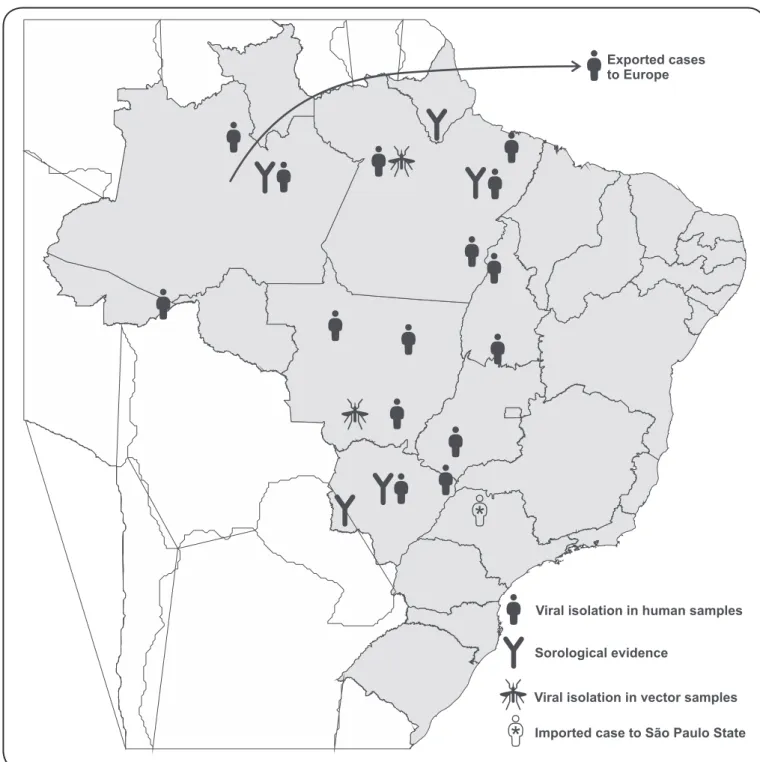
detected mostly in the Amazon region and Central Highlands(5)
(Figure 1). Many countries in these areas also face serious public
health problems because of the acquired immunodeiciency
syndrome (AIDS) epidemic, but the possible role of immunosuppression in the outcome of arbovirus infections is
unclear(6).
We report here the case of an HIV-infected patient who
returned from a work trip to the Amazon basin and was admitted at the infectious diseases service of the Hospital de Base (HB) of the Medical School of São José do Rio Preto, São Paulo State,
Brazil. Both DENV and CHIKV were tested for and excluded.
Based on clinical and epidemiological data, MAYV was
suspected and subsequently conirmed by reverse transcription -polymerase chain reaction (RT-PCR) testing, followed by next-generation sequencing and phylogenetic reconstruction.
CASE REPORT
A 27-year-old, human immunodeficiency virus (HIV )-infected man was admitted to the HB infectious diseases service
Viral isolation in human samples
Imported case to São Paulo State Exported cases to Europe
Sorological evidence
Viral isolation in vector samples
*
*
FIGURE 1. Circulation of Mayaro virus in Brazil. The map shows the locations of reports of MAYV, indicating the virus circulation. It indicates reports of virus isolation from human samples (human igure) or from culicids (insect igure) and also serological evidence from human, animal, or vector samples (antibody igure). The human igure with asterisk is the case described in this work. MAYV: Mayaro virus.
tobacco, or injectable drugs. He reported having been on a
work trip to the City of Portal in the interior of Pará State 40 days prior to admission. During this travel, he visited different populations, including riverside communities.
The early biochemical laboratory results were within
normal limits (C-reactive protein: 0.61mg/dL; alanine
aminotransferase (ALT): 30U/L; aspartate aminotransferase (AST): 17U/L; gamma glutamyl transferase (GGT): 17U/L;
total bilirubin: 0.38mg/dL; unconjugated bilirubin: 0.2mg/dL; conjugated bilirubin: 0.18mg/dL; alkaline phosphatase: 38U/L; creatinine: 0.9mg/dL; amylase: 40U/L; prothrombin activity:
91%; international normalized ratio (INR): 1.06; hemoglobin: 12.8g/dL). He had a reactive serological test for HIV, a
T CD4+ cell count of 306 cells/mm3, and viral load of 21,351
copies/mm3. The VDRL test result was positive (titer 1:8); the
hepatitis B was detected. Serological tests (IgM) for yellow fever were inconclusive, probably due to a vaccination burst 37 days before the start of the symptoms. A thick blood smear for malaria was also negative.
Both DENV and CHIKV were ruled out by serological
testing (IgM) and RT-PCR in a public health reference laboratory. Both viruses were also tested for by RT-PCR in our laboratory; the results were negative. An MAYV RT-PCR test,
developed by our laboratory for the E1 gene, was performed
and the result was conirmed as positive.
Viral isolation was performed in C6/36 cell culture, and
MAYV was conirmed by another RT-PCR test. The virus was directly sequenced from the patient serum using Next Generation Sequencing in an Ilumina Platform (Illumina, San Diego,
CA, USA). The genome was submitted to GenBank, named
MAYV BR/SJRP/01/2014 (accession number: KT818520.1)(7).
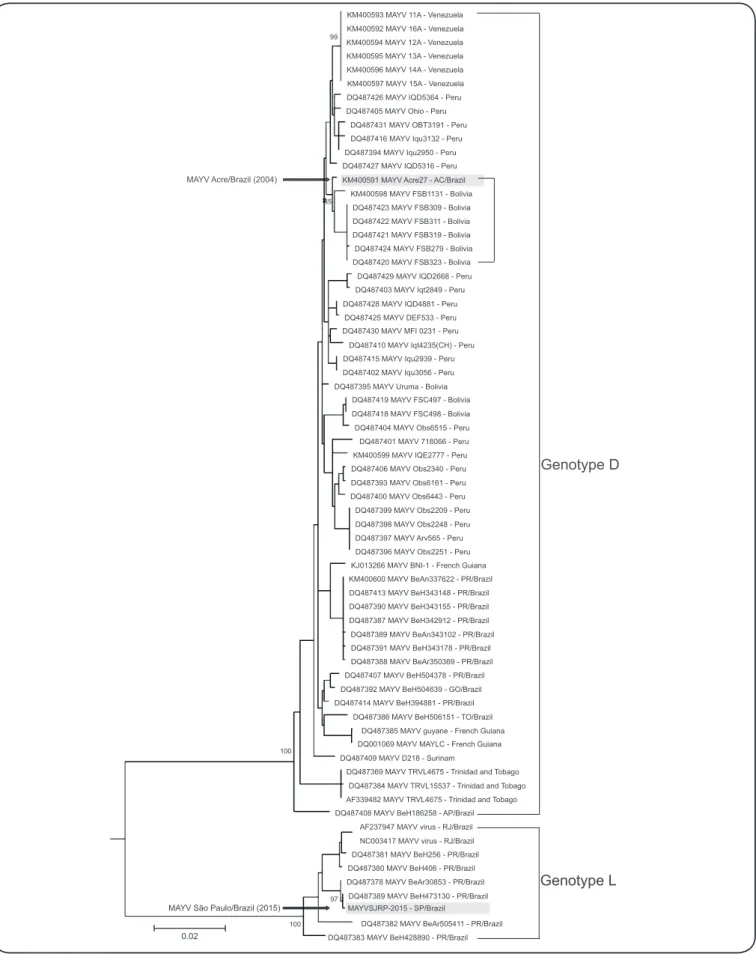
Phylogenetic reconstruction was performed with MEGA
v.6.0 (Figure 2). The MAYV BR/SJRP/01/2014 was grouped
within the L clade, found only in the Pará State, supporting the
epidemiological proile of the patient.
According to the recommended clinical protocol and
therapeutic guidelines for the management of an HIV-infected
patient with a CD4+ count <350 cell/mm3 and reactive serum
VDRL, a lumbar puncture was performed. The cerebrospinal luid (CSF) showed a slight increase in protein, a discrete lymphomonocytic pleocytosis, and a reactive CSF-VDRL test (titer 1:2). The patient was hospitalized for treatment of
asymptomatic neurosyphilis; he received parenteral penicillin
for 10 days. The patient experienced spontaneous relief of the
myalgia and arthralgia, and was discharged with no symptoms.
He remains under outpatient follow-up. Ethicals considerations
The patient’s serum was collected and tested in an
arbovirus surveillance program (Ethical Review Board # 2078812.8.00005414).
DISCUSSION
Mayaro fever is a neglected disease due to two factors:
inadequate surveillance in endemic areas and the generic nature
of clinical manifestations that results in misdiagnosis with other
viral fevers, mainly DENV(5). Viral fevers are endemic in low
socioeconomic areas and, subsequently, smaller investments are
made in research, surveillance, and investigation of epidemics; many studies on arboviruses merely describe cases. Furthermore,
this virus causes a dengue-like febrile syndrome with arthralgia/
arthritis and the diagnosis relies only on clinical manifestations(7):
what seems like dengue must be dengue. Diagnosis based only on
clinical indings may lead to misdiagnosis of MAYV as DENV or
other viruses, resulting in underestimation of MAYV infections. Because there is no standard method to detect MAYV, little investment is made in MAYV research, and awareness remains low, creating a vicious cycle.
Despite outbreaks in large cities, MAYV fever is generally
regarded as being limited to forests and rural areas(5). Usually the
patients are rural workers who use the forest for subsistence or
live in its proximity(1). In the urban centers, physicians attending
potential MAYV-infected patients do not even consider MAYV.
Many patients harboring the virus may be misdiagnosed due to
the lack of laboratory tests. The high mobility of the population
and the potential of MAYV to be propagated to urban Aedes
spp. mosquitoes highlights its urbanization potential, similar
to CHIKV. CHIKV, a related arthritogenic alphavirus, was originally limited to Africa but rapidly spread to Asian and
Paciic Oceanic countries, causing explosive outbreaks and
overburdening their health systems(8).
The emergency of CHIKV in South America, speciically
in Brazil, prompted the public health authority to start a
surveillance program with speciic health personnel training
about this arbovirus(4). This strategy included systematic
surveillance for acute febrile illnesses and an eficient laboratory diagnosis for arbovirus. This resulted in the discovery of this
case, that would probably have been ignored had it occurred in any other region, simultaneously with large dengue outbreaks, or in the absence of an arbovirus surveillance system or laboratory
diagnostic methods. Only three other cases have been reported in patients in São Paulo State, imported from Mato Grosso do
Sul(9), making us believe that many cases are misdiagnosed.
HIV is another major public health problem; it is highly prevalent in many arbovirus-endemic regions. Due to increased
mobility of the population, may we see an increase in imported
cases of MAYV and other arboviruses in urban areas.
HIV-infected patients may be more vulnerable to these infections, with an unpredictable outcome. Both arbovirus and HIV
infections change the host’s immunological response. The
interplay between these two infections is poorly understood.
Theoretically, the immunosuppression caused by HIV can
interfere with the severity of some infections, leading to more
aggressive and atypical manifestations(10). However, the inluence
of these infections on the outcome of HIV infection is not well
determined(11). DENV infection causes a transient reduction in
HIV load, apparently without impact on the clinical outcome
of dengue fever or AIDS(12). However, there is no information
about the interaction of HIV with other arboviruses. In this case, the virus was isolated after 10 days of the febrile illness. Since
MAYV viremia is usually limited to 3-7 days(5), this indicates
an extended viremia, which may have been due to the patient’s immunocompromised state. The relief of myalgia and arthralgia,
without the need for corticoids or analgesics, indicates spontaneous clearance of MAYV infection, despite a prolonged viremia, suggesting that HIV did not affect the outcome of Mayaro fever.
As no vaccine or speciic treatment is available, vector control
is the most effective action to limit the spread of arboviruses. Effective health policies are only achievable if based on correct
epidemiological data. This case report highlights the urgent need
for more effective and broader laboratory surveillance in endemic
areas in South America, speciically in Brazil. Training of health
personnel increases awareness about neglected viruses, and makes physicians more attentive to patients at higher risk, such
as travelers returning from endemic areas. This can improve the diagnostic accuracy of arbovirus infections and, consequently,
1 0 0 1 0 0
9 7 8 5
9 9
D Q 4 8 7 3 8 3 M A Y V B e H 4 2 8 8 9 0 - P R / B r a z i l D Q 4 8 7 3 8 9 M A Y V B e H 4 7 3 1 3 0 - P R / B r a z i l D Q 4 8 7 4 0 8 M A Y V B e H 1 8 6 2 5 8 - A P / B r a z i l
D Q 4 8 7 3 8 4 M A Y V T R V L 1 5 5 3 7 - T r i n i d a d a n d T o b a g o D Q 4 8 7 3 6 9 M A Y V T R V L 4 6 7 5 - T r i n i d a d a n d T o b a g o D Q 4 8 7 4 0 9 M A Y V D 2 1 8 - S u r i n a m
D Q 0 0 1 0 6 9 M A Y V M A Y L C - F r e n c h G u i a n a D Q 4 8 7 3 8 5 M A Y V g u y a n e - F r e n c h G u i a n a
M A Y V S J R P - 2 0 1 5 - S P / B r a z i l
M A Y V S ã o P a u l o / B r a z i l ( 2 0 1 5 )
G e n o t y p e L
G e n o t y p e D
M A Y V A c r e / B r a z i l ( 2 0 0 4 )
D Q 4 8 7 3 7 8 M A Y V B e A r 3 0 8 5 3 - P R / B r a z i l D Q 4 8 7 3 8 0 M A Y V B e H 4 0 6 - P R / B r a z i l
D Q 4 8 7 3 8 1 M A Y V B e H 2 5 6 - P R / B r a z i l D Q 4 8 7 3 8 6 M A Y V B e H 5 0 6 1 5 1 - T O / B r a z i l D Q 4 8 7 4 1 4 M A Y V B e H 3 9 4 8 8 1 - P R / B r a z i l
D Q 4 8 7 3 9 2 M A Y V B e H 5 0 4 6 3 9 - G O / B r a z i l D Q 4 8 7 4 0 7 M A Y V B e H 5 0 4 3 7 8 - P R / B r a z i l
D Q 4 8 7 3 8 8 M A Y V B e A r 3 5 0 3 6 9 - P R / B r a z i l D Q 4 8 7 3 9 1 M A Y V B e H 3 4 3 1 7 8 - P R / B r a z i l D Q 4 8 7 3 8 9 M A Y V B e A n 3 4 3 1 0 2 - P R / B r a z i l D Q 4 8 7 3 8 7 M A Y V B e H 3 4 2 9 1 2 - P R / B r a z i l D Q 4 8 7 3 9 0 M A Y V B e H 3 4 3 1 5 5 - P R / B r a z i l D Q 4 8 7 4 1 3 M A Y V B e H 3 4 3 1 4 8 - P R / B r a z i l
D Q 4 8 7 3 9 6 M A Y V O b s 2 2 5 1 - P e r u D Q 4 8 7 3 9 7 M A Y V A r v 5 6 5 - P e r u D Q 4 8 7 3 9 8 M A Y V O b s 2 2 4 8 - P e r u D Q 4 8 7 3 9 9 M A Y V O b s 2 2 0 9 - P e r u D Q 4 8 7 4 0 0 M A Y V O b s 6 4 4 3 - P e r u D Q 4 8 7 3 9 3 M A Y V O b s 6 1 6 1 - P e r u D Q 4 8 7 4 0 6 M A Y V O b s 2 3 4 0 - P e r u D Q 4 8 7 4 0 1 M A Y V 7 1 8 0 6 6 - P e r u D Q 4 8 7 4 0 4 M A Y V O b s 6 5 1 5 - P e r u D Q 4 8 7 4 0 2 M A Y V I q u 3 0 5 6 - P e r u D Q 4 8 7 4 1 5 M A Y V I q u 2 9 3 9 - P e r u
D Q 4 8 7 4 1 0 M A Y V I q t 4 2 3 5 ( C H ) - P e r u D Q 4 8 7 4 3 0 M A Y V M F I 0 2 3 1 - P e r u
D Q 4 8 7 4 2 5 M A Y V D E F 5 3 3 - P e r u D Q 4 8 7 4 2 8 M A Y V I Q D 4 8 8 1 - P e r u
D Q 4 8 7 4 2 9 M A Y V I Q D 2 6 6 8 - P e r u D Q 4 8 7 4 2 7 M A Y V I Q D 5 3 1 6 - P e r u
D Q 4 8 7 4 2 6 M A Y V I Q D 5 3 6 4 - P e r u
D Q 4 8 7 3 9 4 M A Y V I q u 2 9 5 0 - P e r u D Q 4 8 7 4 1 6 M A Y V I q u 3 1 3 2 - P e r u D Q 4 8 7 4 3 1 M A Y V O B T 3 1 9 1 - P e r u D Q 4 8 7 4 0 5 M A Y V O h i o - P e r u
D Q 4 8 7 4 0 3 M A Y V I q t 2 8 4 9 - P e r u
D Q 4 8 7 4 1 8 M A Y V F S C 4 9 8 - B o l i v i a D Q 4 8 7 4 1 9 M A Y V F S C 4 9 7 - B o l i v i a D Q 4 8 7 4 2 0 M A Y V F S B 3 2 3 - B o l i v i a D Q 4 8 7 4 2 4 M A Y V F S B 2 7 9 - B o l i v i a D Q 4 8 7 4 2 1 M A Y V F S B 3 1 9 - B o l i v i a D Q 4 8 7 4 2 2 M A Y V F S B 3 1 1 - B o l i v i a D Q 4 8 7 4 2 3 M A Y V F S B 3 0 9 - B o l i v i a K M 4 0 0 5 9 8 M A Y V F S B 1 1 3 1 - B o l i v i a K M 4 0 0 5 9 7 M A Y V 1 5 A - V e n e z u e l a K M 4 0 0 5 9 6 M A Y V 1 4 A - V e n e z u e l a K M 4 0 0 5 9 5 M A Y V 1 3 A - V e n e z u e l a K M 4 0 0 5 9 4 M A Y V 1 2 A - V e n e z u e l a K M 4 0 0 5 9 2 M A Y V 1 6 A - V e n e z u e l a K M 4 0 0 5 9 3 M A Y V 1 1 A - V e n e z u e l a
K M 4 0 0 5 9 1 M A Y V A c r e 2 7 - A C / B r a z i l
D Q 4 8 7 3 9 5 M A Y V U r u m a - B o l i v i a
K M 4 0 0 5 9 9 M A Y V I Q E 2 7 7 7 - P e r u
K M 4 0 0 6 0 0 M A Y V B e A n 3 3 7 6 2 2 - P R / B r a z i l K J 0 1 3 2 6 6 M A Y V B N I - 1 - F r e n c h G u i a n a
N C 0 0 3 4 1 7 M A Y V v i r u s - R J / B r a z i l A F 2 3 7 9 4 7 M A Y V v i r u s - R J / B r a z i l A F 3 3 9 4 8 2 M A Y V T R V L 4 6 7 5 - T r i n i d a d a n d T o b a g o
D Q 4 8 7 3 8 2 M A Y V B e A r 5 0 5 4 1 1 - P R / B r a z i l
0 . 0 2
FIGURE 2. Phylogenetic tree of some MAYV sequences.Maximum likelihood phylogenetic tree of 68 sequences of MAYV based on 1,740pb of partial envelope
Conlict of Interest
The authors declare that there is no conlict of interest.
Financial Support
This work was supported by the São Paulo Research Foundation [grants # 2013/21719-3 and 2014/05600-9]. Nogueira, ML is a recipient of a CNPq PQ Fellowship.
REFERENCES
1. Weaver SC, Reisen WK. Present and future arboviral threats. Antiviral Res 2010; 85:328-345.
2. Santiago FW, Halsey ES, Siles C, Vilcarromero S, Guevara C, Silvas JA, et al. long-term arthralgia after Mayaro virus infection correlates with sustained pro-inlammatory cytokine response. PLoS Negl Trop Dis 2015; 9:e0004104. doi: 10.1371/journal.pntd.0004104.
3. Pan American Health Organization (PAHO). Chikungunya (Internet), Washington 2014. Updated 30 June 2014; cited 2015 30 Setember 2015. Available from: http://www.paho.org/hq/index. php?option=com_content&view=article&id=8303&Itemid=40023 &lang=en
4. Ministério da Saúde. Secretaria de Viglância em Saúde. Departamento de Vigilância das Doenças Transmissíveis. Plano de Continĝncia Nacional para a Febre de Chikungunya. Brasília: Ministério da Saúde; 2014. p. 48.
5. Mota MTO, Ribeiro MR, Vedovello D, Nogueira ML. Mayaro virus: a neglected arbovirus of the Americas. Future Virol 2015; 10:1109-1122.
6. Simon V, Ho DD, Abdool Karim Q. HIV/AIDS epidemiology, pathogenesis, prevention, and treatment. Lancet 2006; 368:489-504. 7. Mota MTO, Vedovello D, Estofolete C, Malossi CD, Araujo Jr JP, Nogueira ML. Complete genome sequence of Mayaro virus imported from the Amazon basin to São Paulo State, Brazil. Genome Announc 2015; 3:e-01341-15. doi: 10.1128/genomeA.01341-15. 8. Long KC, Ziegler SA, Thangamani S, Hausser NL, Kochel TJ,
Higgs S, et al. Experimental transmission of Mayaro virus by Aedes aegypti. Am J Trop Med Hyg 2011; 85:750-757.
9. Coimbra TLM, Santos CLS, Suzuki A, Petrella SMC, Bisordi I, Nagamori AH, et al. Mayaro virus: imported cases of human infection in São Paulo State, Brazil. Rev Inst Med Trop São Paulo 2007; 49:221-224. 10. Karp CL, Neva FA. Tropical infectious diseases in human
immunodeiciency virus-infected patients. Clin Infect Dis 1999; 28:947-963.
11. Karp CL, Auwaerter PG. Coinfection with HIV and tropical infectious diseases. II. Helminthic, fungal, bacterial, and viral pathogens. Clin Infect Dis. 2007; 45:1214-1220.