www.jped.com.br
ORIGINAL ARTICLE
Association between breastfeeding and breathing
pattern in children: a sectional study
夽
,
夽夽
Teresinha S.P. Lopes
a,∗, Lúcia F.A.D. Moura
a, Maria C.M.P. Lima
baDivision of Pediatric Dentistry, Department of Pathology and Dental Clinic, Universidade Federal do Piauí, Teresina, PI, Brazil bDepartment of Human Development and Rehabilitation, Faculdade de Ciências Médicas, Universidade Estadual de Campinas,
Campinas, SP, Brazil
Received 28 August 2013; accepted 20 November 2013 Available online 2 April 2014
KEYWORDS Breastfeeding; Mouth breathing; Respiration; Sucking behavior
Abstract
Objective: to determine the prevalence of mouth breathing and to associate the history of breastfeeding with breathing patterns in children.
Methods: this was an observational study with 252 children of both genders, aged 30 to 48 months, who participated in a dental care program for mothers and newborns. As an instrument of data collection, a semi-structured questionnaire was administered to the children’s mothers assessing the form and duration of breastfeeding and the oral habits of non-nutritive sucking. To determine the breathing patterns that the children had developed, medical history and clinical examination were used. Statistical analysis was conducted to examine the effects of exposure on the primary outcome (mouth breathing), and the prevalence ratio was calculated with a 95% confidence interval.
Results: of the total sample, 43.1% of the children were mouth breathers, 48.4% had been breastfed exclusively until six months of age or more, and 27.4% had non-nutritive sucking habits. Statistically significant associations were found for bottle-feeding (p < 0.001) and oral habits of non-nutritive sucking (p = 0.009), with an increased likelihood of children exhibiting a predominantly oral breathing pattern. A statistically significant association was also observed between a longer duration of exclusive breastfeeding and a nasal breathing pattern presented by children.
Conclusion: an increased duration of exclusive breastfeeding lowers the chances of children exhibiting a predominantly oral breathing pattern.
© 2014 Sociedade Brasileira de Pediatria. Published by Elsevier Editora Ltda. All rights reserved.
夽 Please cite this article as: Lopes TS, Moura LF, Lima MC. Association between breastfeeding and breathing pattern in children: a sectional
study. J Pediatr (Rio J). 2014;90:396---402.
夽夽
Work linked to the Universidade Federal do Piauí, Teresina, PI, Brazil and Universidade Estadual de Campinas, Campinas, SP, Brazil.
∗Corresponding author.
E-mail:[email protected] (T.S.P. Lopes).
http://dx.doi.org/10.1016/j.jped.2013.12.011
PALAVRAS-CHAVE Amamentac¸ão; Respirac¸ão bucal; Respirac¸ão; Comportamento de succ¸ão
Associac¸ão entre amamentac¸ão e padrão de respirac¸ão em crianc¸as: estudo transversal
Resumo
Objetivo: determinar a prevalência da respirac¸ão bucal e associar o histórico de amamentac¸ão com os padrões de respirac¸ão em crianc¸as.
Métodos: este foi um estudo observacional com 252 crianc¸as de ambos os sexos, com idades entre 30-48 meses, que participaram de um programa de assistência odontológica para mães e recém-nascidos. Como um instrumento de coleta de dados, foi entregue um questionário semiestruturado para as mães das crianc¸as com perguntas sobre a forma e a durac¸ão da amamentac¸ão e os hábitos bucais de succ¸ão não nutritiva. Para determinar os padrões de respirac¸ão desenvolvidos nas crianc¸as, foram utilizados o histórico médico e o exame clínico. Foi realizada uma análise estatística para determinar os efeitos de exposic¸ão no principal resul-tado (respirac¸ão bucal), e o índice de prevalência foi calculado com um intervalo de confianc¸a de 95%.
Resultados: do total da amostra, 43,1% das crianc¸as apresentaram respirac¸ão bucal, 48,4% foram amamentados exclusivamente até os seis meses de idade ou mais e 27,4% apresentaram hábitos de succ¸ão não nutritiva. Foram encontradas associac¸ões estatisticamente significativas para uso de mamadeira (p < 0,001) e hábitos bucais de succ¸ão não nutritiva (p = 0,009), com um aumento da probabilidade de as crianc¸as apresentarem um padrão de respirac¸ão predominan-temente bucal. Também foi observada uma associac¸ão estatisticamente significativa entre uma maior durac¸ão do aleitamento materno exclusivo e um padrão de respirac¸ão bucal apresentado pelas crianc¸as.
Conclusão: uma maior durac¸ão do aleitamento materno exclusivo diminui as chances de as crianc¸as apresentarem um padrão de respirac¸ão predominantemente bucal.
© 2014 Sociedade Brasileira de Pediatria. Publicado por Elsevier Editora Ltda. Todos os direitos reservados.
Introduction
Nutrition plays an important role in the growth and develop-ment of children. Maternal milk contains essential nutrients for newborns in the first months of life and has important functions in socioeconomic and psycho-emotional domains; exclusive breastfeeding is recommended for the first six months of life, and should be continued up to 2 years or more.1,2
The mechanics of breastfeeding in newborn are com-plex, and require the central nervous system to coordinate procedures for sucking, breathing, and swallowing.3,4
Chil-dren who are exclusively breastfed (EBF) during the first months of life exhibit a physiological suction pattern with more sucking movements, and are better coordinated when compared to those who are artificially bottle-fed; this phe-nomenon occurs because the orofacial muscles are exercised less in formula-fed infants, making those muscles more flac-cid and hypotonic.5
The movements of milking executed by infants when breastfeeding favor a balance in the perioral muscle forces, and are key factors for the proper growth of the bones and the orofacial muscles, promoting the normal develop-ment of the stomatognathic system.6,7When early weaning
occurs, the child is unable to perform physiological move-ments and synchronized suction, and generally presents a tendency toward developing harmful habits, such as sucking a pacifier or the fingers, which can interfere in the process of nasal breathing.8
Breathing is a vital function of living organisms; in humans, breathing occurs physiologically through the nose.9
After birth, several factors can interfere with the regular breathing pattern; these factors can be conditional physi-cal such as anatomiphysi-cal predispositions or can be present in the environment, in weather conditions, sleeping position, artificial feeding, and oral habits, including nonnutritive sucking.10
Mouth-breathing children are more predisposed to the development of facial changes, poor dental positioning, improper posture, and speech disorders.11 These
condi-tions can further develop and trigger cardiorespiratory, endocrine, learning, sleep, and mood disorders that signif-icantly and negatively affect overall health and quality of life.5,12---14 Studies have demonstrated that nose breathers
have longer breastfeeding sessions, since the child keeps his/her lips sealed and lead up the tongue in a proper pos-ture and as consequence establishes a correct pattern of breathing.15,16Studies that accurately examine this
relation-ship are lacking.
The present study aimed to determine the prevalence of mouth-breathing in children, associated with the duration and type of breastfeeding.
Methods
da Crianc¸a (IHAC), in Maternidade Evangelina Rosa, Teresina, Piauí, Brazil.
From the total of medical records of 3,374 children assisted by the PPGB, 625 records initially filled the research criteria; from this data, the sample size was calculated. The inclusion criteria were as follows: complete primary denti-tion, normal birth weight, born at term, and good health. Children were excluded if they had tooth loss; had diseases such as dentofacial conditions; had large carious lesions that compromised occlusion; were syndromic; had neurological disorders or cleft lips or palates; or remained in the neonatal intensive care unit.
The present article is excerpted from a larger study about the implications of weaning on the oral motor system, with other variables. To calculate the sample size with the desired precision regarding the prevalence and to allow a confidence interval of 95%, a prevalence of 50% and an error of 4% were considered. The calculations were prepared using Epi-Info version 6.04b (CDC - Atlanta, Georgia, USA) in the StatCalc module, which uses the formula: s = [p (1-p)] * z2
/ d2, where p is the prevalence in the population, z is the
percentile of the standard normal distribution, and d is the maximum amplitude of the absolute value of the difference between the estimate and the population value, adjusted by a correction factor for finite populations. The result indi-cated that a sample of 252 children was required for the research.
Correspondence was sent to the parents of the identified children, inviting them to bring their children for a health evaluation, where they were informed of the study objec-tives. A semi-structured questionnaire was administered to the mothers of children, with open questions related to daily feeding habits and the use of bottle, and closed questions to characterize the following aspects of the population: gen-der, age, type and duration of breastfeeding, and presence of nutritive and non-nutritive oral sucking habits in the chil-dren. The data collection was conducted in the period from April of 2010 to June of 2011, by the researcher, previ-ously trained and calibrated, aided by interns of the PPGB, who are students of dentistry of UFPI, insofar as children returned to the project.
The definitions of breastfeeding recommended by the World Health Organization (WHO) were used for the study.17
For this work, three of them were chosen: exclusive breastfeeding, breastfeeding, and bottle-feeding. Exclusive breastfeeding was defined as feeding in which the child receives breast milk directly from the breast or expressed milk, with no other liquid or solid food, except for vita-min drops. Breastfeeding was defined as a form of feeding where the child is fed human milk (directly from the breast or expressed) regardless of other foods; in bottle-feeding, the child ingests any kind of liquid or semisolid food from a bottle.
In the absence of a single clinical protocol for the diag-nosis of mouth breathing, two methods were used. The first was a written history, as established by Abreu et al.,13which
advocates the following clinical manifestations as major signs: snoring, mouth open while sleeping, drool on the pil-low, stuffy nose every day. The following are considered as minor signs: itchy nose; occasional congested nose; difficulty breathing at night or restless sleep; irritability or drowsi-ness during the day; difficulty or delayed food swallowing;
episodes of throat infection, ear infection or sinusitis; and difficulty in school or grade repetition. The occurrence of two major signs or two minor signs in the patient’s history is compatible with mouth breathing.
The second method used was established by observation and palpation of the mentalis muscle. The relationship of the upper and lower lips to the resting position of the tongue was evaluated, and breath analysis of the child was performed while he/she was in a more relaxed position, according to the method established by Moyers.18The test was indicative
of mouth breathing if the child showed a lack of lip seal. With these two diagnostic methods, the child’s breath-ing pattern type was determined; children who presented characteristics compatible with mouth breathing in both methods were considered as mouth breathers.
A pre-test questionnaire was administered to 20 moth-ers who did not participate in the study, in an attempt to make the necessary adjustments for a better understand-ing of the addressed factors. The legal guardians signed the consent form, according to the recommendations of Resolu-tion 196/96 of the Ministry of Health and the DeclaraResolu-tion of Helsinki. The study was approved by the Ethics in Research Committee of UFPI (Opinion No. CAAE 0039.0.045.000-10).
The data were processed and analyzed using Stata, ver-sion 11.0 (Stata Corporation - College Station, TX, USA). To assess the association between variables, the chi-squared test was used. The multivariate analysis included variables with p < 0.20 in the bivariate analysis, using Poisson regres-sion in order to verify the independent variables associated with the presence of oral breathing, controlled for pos-sible confusion factors (adjusted prevalence ratios [PR]). The results were presented as PRs, and the 95% confi-dence interval and associations were verified by the Wald’s test. The results with p < 0.05 were considered statistically significant.
Results
The study population was composed of 139 male children (55.2%) and 113 female children (44.8%), aged 30 to 48 months, with a mean age of 39.3 (±4.7) months and a mean birth weight of 3,860.1 (±619.7) grams; 114 (45.2%) of the children were from families earning 2 to 3 Brazilian mini-mum wages. In relation to breastfeeding, 122 (48.4%) of the children were exclusively breastfed until 6 months of age or more, and 199 (79.0%) were breastfed until 24 months. The breathing pattern presented by the children, considering the sign test and the type of labial occlusion, were predomi-nantly oral in 109 (43.1%) children and predomipredomi-nantly nasal in 143 (56.9%) children.
Table 1 Prevalence of a predominantly mouth breathing pattern according to sex and age (n = 109).
N % pa
Gender 0.631
Male 47 43.1
Female 62 56.9
Age (months) 0.910
30-36 34 31.2
37-42 55 50.5
43-48 20 18.3
a Chi-squared test.
Table 1 presents the oral respiratory patterns (RP) by gen-der and age group. No association with respiratory pattern was observed for gender (p = 0.631) or age (p = 0.910).
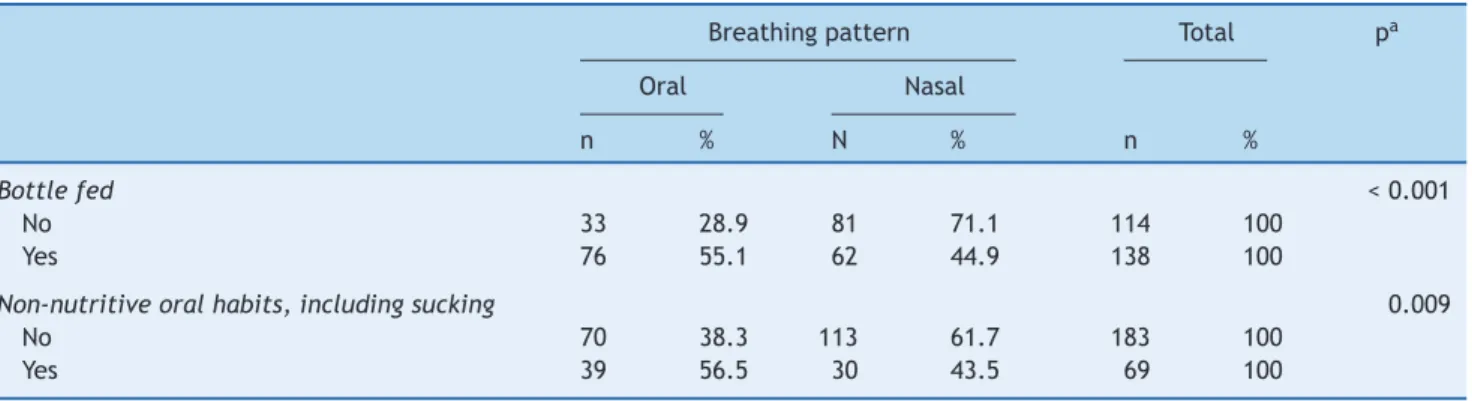
Tables 2 and 3 show that there was a statistically significant association between exclusive breastfeeding (p = 0.007), breastfeeding (p = 0.010), bottle feeding (p < 0.001), and non-nutritive sucking habits (p = 0.009) with the children’s type of respiratory pattern.
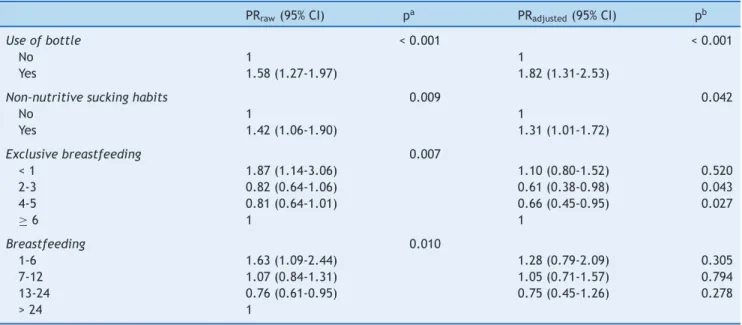
Table 4 presents the multivariate model using Pois-son regression with robust variance for the independent
factors associated with the predominant respiratory pattern, demonstrating that the use of bottle feed-ing (p = 0.001), presence of non-nutritive suckfeed-ing habits (p = 0.048), and exclusive breastfeeding for 2 to 3 months (p = 0.045) and from 4 to 5 months (p = 0.043) were the only statistically significant independent factors in the model.
Discussion
The findings of this study provide important information about the relationship between breastfeeding and the breathing pattern of children. Studies examining this rela-tionship and the prevalence of oral breathing during infancy are scare in the literature. Some researches have been conducted with school-aged children, but recall biases are almost always present; other studies have been conducted using convenience samples.7,12,19 Such samples may have
been used primarily due to the technical difficulties asso-ciated with operational or commonly used methods for the diagnosis of mouth breathing, which are complex examina-tions conducted in tertiary care.7,16,20The diagnosis of oral
breathing is clinically performed through detailed anam-nesis, since mothers typically do not report signs such as snoring, sleeping with the mouth open, and drooling on the pillow during routine visits.21
Table 2 Association between respiratory patterns and breastfeeding type (n = 252).
Breastfeeding types (months) Respiratory patterns Total pa
Oral Nasal
n % n % n %
Exclusive breastfeeding 0.007
< 1 11 32.4 23 67.6 34 100
2-3 26 66.7 13 33.3 39 100
4-5 38 66.7 19 33.3 57 100
≥6 68 55.7 54 44.3 122 100
Breastfeeding 0.010
1-6 16 37.2 27 62.8 43 100
7-12 55 55.0 45 45.0 100 100
13-24 39 69.6 17 30.4 56 100
> 24 33 62.3 20 37.7 53 100
a Chi-squared test.
Table 3 Associations of respiratory patterns with bottle feeding and the presence of non-nutritive oral habits (n = 252).
Breathing pattern Total pa
Oral Nasal
n % N % n %
Bottle fed < 0.001
No 33 28.9 81 71.1 114 100
Yes 76 55.1 62 44.9 138 100
Non-nutritive oral habits, including sucking 0.009
No 70 38.3 113 61.7 183 100
Yes 39 56.5 30 43.5 69 100
Table 4 Crude and adjusted prevalence ratio for the factors associated to the raw respiratory pattern (n = 252).
PRraw(95% CI) pa PRadjusted(95% CI) pb
Use of bottle < 0.001 < 0.001
No 1 1
Yes 1.58 (1.27-1.97) 1.82 (1.31-2.53)
Non-nutritive sucking habits 0.009 0.042
No 1 1
Yes 1.42 (1.06-1.90) 1.31 (1.01-1.72)
Exclusive breastfeeding 0.007
< 1 1.87 (1.14-3.06) 1.10 (0.80-1.52) 0.520
2-3 0.82 (0.64-1.06) 0.61 (0.38-0.98) 0.043
4-5 0.81 (0.64-1.01) 0.66 (0.45-0.95) 0.027
≥6 1 1
Breastfeeding 0.010
1-6 1.63 (1.09-2.44) 1.28 (0.79-2.09) 0.305
7-12 1.07 (0.84-1.31) 1.05 (0.71-1.57) 0.794
13-24 0.76 (0.61-0.95) 0.75 (0.45-1.26) 0.278
> 24 1
PRraw, unadjusted variables at the bivariate analysis; PRadjusted, adjustment for other variables; 95% CI, 95% confidence interval. aChi-squared test.
b Wald’s test.
In this study, the interview protocol proposed by Abreu et al.13 was used in combination with the technique
proposed by Moyers;18 these tests can be performed by
professionals in various areas of primary health care. Follow-ing the early diagnosis of mouth breathFollow-ing, it is important to refer the patient for interventional treatment, because mouth breathing has been associated with numerous adverse effects.13,15,20---22Just under half of the children examined
showed a predominantly oral breathing pattern, which is a high prevalence, but lower than that observed by other authors, including Abreu et al.,13Felcal et al.,19and Limeira
et al.15These studies were conducted with school-age
chil-dren, whereas in the present study, the majority of the subjects were 3 years of age.
In the present work, statistically significant relationships were observed for the durations of exclusive breastfeeding and total breastfeeding with breathing patterns (Table 3). Nasal breathers exhibited a normal breathing pattern and were breastfed for a longer period than mouth breathing children, which was also observed in other studies.6,8,15,16
Children who were exclusively breastfed for over one month had a decreasing prevalence of developing a predominantly oral breathing pattern, and the possibility increased as the duration of exclusive breastfeeding increased. After the multivariate analysis, no association between breastfeeding and oral breathing was observed.
There appears to be a consensus in the literature regarding the time required for the establishment of breastfeeding and nasal breathing patterns. According to Santos-Neto,9breastfeeding from the fifth month of life is a
preventive factor against loss of lip closure, but this protec-tion is only established in babies older than twelve months. However, the author did not specify whether the breast-feeding was exclusive or complete. Limeira et al.15showed
that protection occurred in children who were breastfed
exclusively for the first six months of life and that the like-lihood of developing a nasal breathing pattern increased as the breastfeeding duration increased, which was also observed in the present study.
Breastfeeding aids nasal breathing due to the physi-ology of this type of feeding, as it prevents air from entering through the mouth during feeding, forcing air to pass through the nose and stimulating all of the orofacial muscles.9,16 Moreover, the nutritional and immunological
protection provided by human milk prevents or reduces the risk of respiratory infection,22 which can result in mouth
breathing due to nasal obstruction.23
The WHO1recommends exclusive breastfeeding until six
months of age and complementary breastfeeding up to the age of 2 years or older. Children who are breastfed for a shorter period have been shown to present a higher risk for respiratory tract infections such as pneumonia, sinusitis, and otitis. The American Academy of Pediatrics24reaffirmed the
WHO recommendations for exclusive breastfeeding for the first six months of life and continued breastfeeding with the introduction of complementary foods for infants at least 12 months of age or older, as desired by the mother and child. In the present study, bottle feeding was a statistically significant risk factor for respiratory patterns because more than half of the children with a predominantly oral breath-ing pattern used a bottle, even considerbreath-ing that all of the children were breastfed initially for different periods. Breastfeeding by bottle negatively interferes with orofacial development and leads to loss of the labial seal; moreover, it favors an improper position of the tongue and changes the shape of the jaw.6,9 When a child is bottle-fed, the facial
of babies have observed other changes in the mechanics of sucking in bottle-fed children, such as changes in suction and a decrease in arrhythmic sucking movements.3,4
The absence of contact between the lips is undoubtedly a characteristic sign of mouth breathers. In this study, an analysis of the clinical manifestations in children classified as mouth breathers showed that sleeping with the mouth open was the most common sign, and was present in approx-imately half of the sample. The next most common signs were drooling on the pillow and snoring. The majority of children who had exclusively breastfed until six months of age showed a better seal of the lips, which was also observed in previous studies.6,15
The oral habit of non-nutritive sucking (pacifier or fin-ger) has been shown to have direct and indirect harmful effects on some aspects of the child’s health. When a baby frequently uses a pacifier, he/she will become a habitual mouth breather because of a compensatory facial and lin-gual muscle postural hypotonic4,5,9which further interferes
with normal breastfeeding mechanics.25---27 In the present
study, it was evident that non-nutritive sucking habits were related to the respiratory pattern of infants, and those with these habits were more likely to develop an oral breathing pattern (p = 0.009).
Currently, the majority of mothers believe in the benefits of breastfeeding, which has been confirmed by the observed increases in breastfeeding rates.28,29 However, bottles and
pacifiers are still introduced often, even in children who are exclusively breastfed; this practice appears to increase the risk of early weaning,26 demonstrating that the use of
the bottle is still an ingrained habit in Brazil and other countries.30
There is a high prevalence of a predominantly oral breathing pattern among children, and a significant associa-tion exists between exclusive breastfeeding and respiratory pattern. An increased duration of breastfeeding increases the likelihood of developing a normal breathing pattern. Motivational strategies and programs to increase the aware-ness of mothers should be implemented to make them more capable and to improve the safety of breastfeeding.
Conflicts of interest
The authors declare no conflicts of interest.
References
1. World Health Organization. The optimal duration of exclusive breastfeeding: a systematic review. Geneva: WHO; 2001. 2. Gerd AT, Bergman S, Dahlgren J, Roswall J, Alm B. Factors
asso-ciated with discontinuation of breastfeeding before 1 month of age. Acta Paediatr. 2012;101:55---60.
3. Moral A, Bolibar I, Seguranyes G, Ustrell JM, Sebastiá G, Martínez-Barba C, et al. Mechanics of sucking: compari-son between bottle feeding and breastfeeding. BMC Pediatr. 2010;10:6.
4. Nieuwenhuis T, da Costa SP, Bilderbeek E, Geven WB, van der Schans CP, Bos AF. Uncoordinated sucking patterns in preterm infants are associated with abnormal general movements. J Pediatr. 2012;161:792---8.
5. Cattoni DM, Fernandes FD, Di Francesco RC, Latorre M, do R. Characteristics of stomatognatic system of mouth breathing children: anthroposcopic approach. Pro Fono. 2007;19:347---51. 6. da Costa SP, van der Schans CP, Boelema SR, van der Meij E, Boer-man MA, Bos AF. Sucking patterns in full-term infants between birth and 10 weeks of age. Infant Behav Dev. 2010;33:61---7. 7. Carrascoza KM, Possobon RF, Tomita LM, Moraes AB.
Conse-quences of bottle-feeding to the oral facial development of initially breastfed children. J Pediatr (Rio J). 2006;82:395---7. 8. Santos DC, Martins-Filho J. Padrão respiratório (nasal ou
bucal) e amamentac¸ão: há relac¸ão? Rev Assoc Paul Cir Dent. 2005;59:379---84.
9. Santos-Neto ET, Barbosa RW, Oliveira AE, Zandonade E. Fatores associados ao surgimento da respirac¸ão bucal nos primeiros meses do desenvolvimento infantil. Rev Bras Crescimento Desenvolv Hum. 2009;19:237---48.
10. Barbosa C, Vasquez S, Parada MA, Gonzalez JC, Jackson C, Yanez ND, et al. The relationship of bottle feeding and other sucking behaviors with speech disorder in Patagonian preschoolers. BMC Pediatr. 2009;9:66.
11. Agarwal S, Gupta V, Malhotra S, Nagar A, Pandey R. The effect of mouth breathing on dentofacial morphology of growing child. J Indian Soc Pedod Prev Dent. 2012;30:27---31.
12. Souki BQ, Pimenta GB, Souki MQ, Franco LP, Becker HM, Pinto JA. Prevalence of malocclusion among mouth breathing children: do expectations meet reality? Int J Pediatr Otorhinolaryngol. 2009;73:767---73.
13. Abreu RR, Rocha RL, Lamounier JA, Guerra AF. Prevalence of mouth breathing among children. J Pediatr (Rio J). 2008;84:467---70.
14. Jedrychosk W, Perera F, Jankowski J, Brutscher M, Mroz E, Flak E, Kaim I, et al. Effect of exclusive breastfeeding on the development of children’s cognitive function in the Krakow prospective birth cohort study. Eur J Pediatr. 2012;171:151---8. 15. Limeira AB, Aguiar CM, Bezarra NS, Câmara AC. Association
between breastfeeding and the development of breathing pat-terns in children. Eur J Pediatr. 2013;172:519---24.
16. Trawitzk LV, Anselmo-Lima WT, Melchior MO, Grechi TH, Valera FC. Breast-feeding and deleterious oral habits in mouth and nose breathers. Braz J Otorhinolaryngol. 2005;71:747---51. 17. World Health Organization. Division of diarrheal and cute
respi-ratory disease control: indicators for assessing breast-feeding practices. Geneva: WHO; 1991.
18. Moyers RE. Ortodontia. Rio de Janeiro: Guanabara; 1991. 19. Felcar JM, Bueno IR, Massan AC, Torezan RP, Cardoso JR.
Prevalência de respiradores bucais em crianc¸as de idade escolar. Cienc Saude Colet. 2010;15:437---44.
20. Frasson JM, Magnani MB, Nouer DF, de Siqueira VC, Lunardi N. Estudo cefalométrico comparativo entre respiradores nasais e predominantemente bucais. Braz J Otorhinolaryngol. 2006;72:72---82.
21. Abreu RR, Rocha RL, Lamounier JA, Guerra AF. Etiology, clini-cal manifestations and concurrent findings in mouth-breathing children. J Pediatr (Rio J). 2008;84:529---35.
22. Boccolini CS, Carvalho ML, Oliveira MI, Boccolini PM. O papel do aleitamento materno na reduc¸ão das hospitalizac¸ões por pneu-monia em crianc¸as brasileiras menores de 1 ano. J Pediatr (Rio J). 2011;87:399---404.
23. Salone LR, Vann Jr WF, Dee DL. Breastfeeding: an overview of oral and general health benefits. J Am Dent Assoc. 2013;144:143---51.
24. American Academy of Pediatrics. Breastfeeding and the use of human milk. Pediatrics. 2012 Mar;129:e827---41.
25. Holanda AL, Santos SA, Sena MF, Ferreira MA. Relation between breast and bottle-feeding and non-nutritive sucking habits. Oral Health Prev Dent. 2009;7:331---7.
succ¸ão não nutritivos e prevenc¸ão de oclusopatias. Rev Odontol UNESP. 2013;42:31---6.
27. Carrascoza KC, Possobon Rde F, Ambrosano GM, Costa Júnior AL, Moraes AB. Determinantes do abandono do aleitamento materno exclusivo em crianc¸as assistidas por um programa interdisciplinar de promoc¸ão à amamentac¸ão. Cienc Saude Colet. 2011;16:4139---46.
28. Brasil. Ministério da Saúde. Secretaria de Atenc¸ão à Saúde. Departamento de Ac¸ões Programáticas e Estratégicas. II
Pesquisa de prevalência de aleitamento materno nas capitais brasileiras e Distrito Federal. Brasília: 2009.
29. Kacho MS, Zahedpasha Y, Eshkevari P. Comparison of the rate of exclusive breast-feeding between pacifier sucker and non-sucker infants. Iran J Ped. 2007;17:113---7.