Original Article
ANALYSIS OF THE TACTICAL BEHAVIOR OF YOUTH ACADEMY SOCCER PLAYERS
ANÁLISE DO COMPORTAMENTO TÁTICO DE JOGADORES DE FUTEBOL DE CATEGORIA DE BASE
Henrique Bueno Américo1, Felippe da Silva Leite Cardoso1, Guilherme Figueiredo Machado1, Marcelo Odilon Cabral de Andrade1, Elton Ribeiro Resende1 and Israel Teoldo da Costa1
1
Universidade Federal de Viçosa, Viçosa-MG, Brazil.
RESUMO
O objetivo do estudo foi comparar a eficiência do comportamento tático entre os jogadores de futebol de diferentes categorias etárias.A amostra foi composta por 400 jogadores divididos em quatro categorias (sub-11, sub-13, sub-15 e sub-17), que realizaram no total 23.855 ações táticas. Para avaliação da eficiência do comportamento tático dos jogadores foi utilizado o FUT-SAT. Para o tratamento estatístico, foram realizadas análises descritivas, os testes Kolmogorov-Smirnov, Kruskal-Wallis, Mann-Whitney e foi considerado um nível de significância de p<0,05. Os resultados indicam que a eficiência do comportamento tático tende a aumentar ao longo do tempo, com exceção da categoria Sub-15 que apresenta uma queda acentuada em relação às demais. Assim é possível concluir que existem variações na eficiência do comportamento tático de jogadores de futebol de diferentes categorias etárias.
Palavras-chave: Futebol. Comportamento tático. Categorias etárias.
ABSTRACT
The aim of this study was to compare the tactical behavior efficiency between soccer players from different age levels. The sample comprised 400 players from four age groups (Under-11, -13, -15, and -17), who performed 23,855 tactical actions. Players' tactical behavior efficiency was assessed through FUT-SAT. Statistical procedures included descriptive analysis and the tests Kolmogorov-Smirnov, Kruskal-Wallis and Mann-Whitney. The significance level adopted was p<0.05. Results indicated that the tactical behavior efficiency tends to increase over time, except for the U-15 age level, that displayed an accentuated drop in relation to the others. It is concluded that the efficiency of tactical behavior of the players in soccer displayed differences across different age levels.
Keywords: Soccer. Tactical behavior. Age levels.
Introduction
In soccer, the tactical component is key for the game, as it regards the position and movements performed by players within the playing space, thus supporting an organization for building up tactical actions1. This organization enables the players to perform actions with and without the ball in the offensive and defensive phases, as well as in occasional events and set-pieces, thus highlighting their tactical behavior2.
The tactical behavior is the response provided by the players to the different situations that occur in the game3. This behavior might be grouped into core tactical principles, which are a set of rules that guide players' movements in order to deal with the constraints in a soccer match4-7.
variable that might support the control of this component during the development process that players undergo10.
Lately, some studies have reported differences regarding the tactical behavior efficiency between different age levels. Teoldo and colleagues11 compared the tactical behavior efficiency of players from the U-11, U-13, U-15 and U-19 age levels. The authors verified that the players from the older level display a higher frequency of actions, and were more efficient, when compared to the other levels. Such fact was related to the ability to understand the logic of play that is learned accross the years, influenced by cognitive aspects, such as motor awareness and knowledge about the game, due to an increase of the technical and motor skills13.
Also, in a study conducted by Giacomini and Greco14, findings showed that the older the age level (chronologically speaking), the greater the players' procedural tactical knowledge. In addition, the same authors reported similar results with respect to the declarative tactical knowledge, whereas the players from younger age levels displayed lesser knowledge than their older counterparts15. The authors justify these findings by accounting for the fact that players from older age levels display higher ammount of practice and experience acquired through sport-specific training.
Accordingly, it is possible to notice that players need to develop their cognitive processes in order to better understand and perform their tasks during the game16 and each age level displays its own particularities17. Hence, it is important to assess the tactical behavior efficiency accross diferent age levels, in order to understand how this variable behaves during the development process, and to identify the attributes that need to be improved for practice. Thereby, it is reasonable to propose a methodological guide for teaching soccer, taking into account the changes in behavior that occur in each age level17-18.
In order to support these aforementioned aspects, the aim of the present study is to compare the tactical behavior efficiency between soccer players from different age levels.
Methods
Sample
The sample comprised 400 male soccer players, from the U-11 (n=100), U-13 (n=100) and U-17 (n=100) age levels of youth clubs from the countryside of the state of Minas Gerais. These players performed 23,292 tactical actions [U-11 (5,179); U-13 (5,269); U-15 (5,996) and U-17 (6,848)].
As inclusion criteria, the players should take part in systematic sport development programs aimed for performance, with at least three soccer-specific training sessions per week, and play in regional and/or state championships. The players should be participating in these training programs for at least one year, in the U-11 level, two years, in the U-13 level and three years in older levels.
Ethical procedures
The present study had the approval of the Ethics Committee of the Universidade Federal de Viçosa (CEPH. Of. 132/2012) and and meets the standards of the Declaration of Helsinki for research with human beings (2008). Data were collected with permission of the clubs' representatives. Parents or guardians signed a written informed consent form, authorizing players to take part in the research.
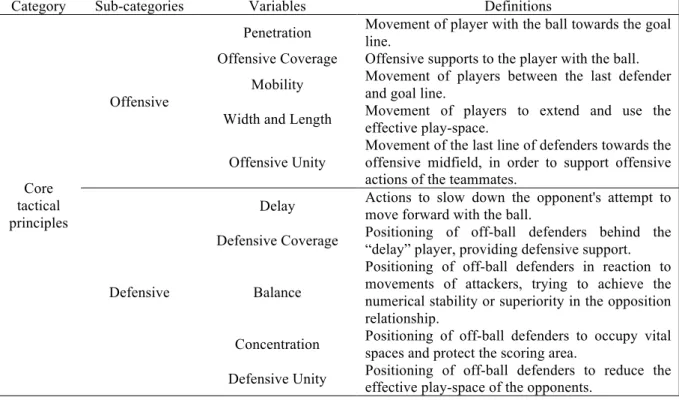
For the assessment of the players' tactical behavior efficiency the System of Tactical Assessment in Soccer (FUT-SAT)8 was used. This instrument enables the assessment of tactical actions performed by players with and without ball possession, based on then core tactical principles of soccer. The core tactical principles of soccer are divided in two groups, being 5 principles of the offensive phase and five principles of the defensive phase, as displayed in Figure 119.
Category Sub-categories Variables Definitions
Core tactical principles
Offensive
Penetration Movement of player with the ball towards the goal
line.
Offensive Coverage Offensive supports to the player with the ball.
Mobility Movement of players between the last defender
and goal line.
Width and Length Movement of players to extend and use the
effective play-space.
Offensive Unity
Movement of the last line of defenders towards the offensive midfield, in order to support offensive actions of the teammates.
Defensive
Delay Actions to slow down the opponent's attempt to
move forward with the ball.
Defensive Coverage Positioning of off-ball defenders behind the
“delay” player, providing defensive support.
Balance
Positioning of off-ball defenders in reaction to movements of attackers, trying to achieve the numerical stability or superiority in the opposition relationship.
Concentration Positioning of off-ball defenders to occupy vital
spaces and protect the scoring area.
Defensive Unity Positioning of off-ball defenders to reduce the
effective play-space of the opponents.
Figure 1. Core tactical principles of soccer. Source: Teoldo et al.7.
Data collection procedures
FUT-SAT’s field test (GK+3 vs. 3+GK) was conducted in a field of 36 meters long by 27 meters wide, during four minutes. Participants were randomly arranged in teams (with the purpose of balancing the quality of the teams, the coach helped in this process) of three players and a goalkeeper. The bouts were performed by teams from the same age level. Players wore numbered vests of different colours, so as to help in their identification during video analysis. Players were asked to perform the test considering all the rules of the soccer game.
Prior to the start of each session, players were informed about the purposes of the test and were given 30 seconds in order to familiarize with test procedures.
Material
Statistical analysis
Descriptive analysis (means and standard deviation) was used. Kolmogorov-Smirnov
test was used and displayed a nonparametric distribution of data. The comparison of tactical behavior efficiency with respect to the performance of the principles between age groups was performed through the Kruskal-Wallis test. Mann-Whitney test was used as a post-hoc procedure in order to display between each categories the differences occurred.
All statistical procedures were conducted through SPSS for Windows®, version 20.0. In order to account for the multiple comparisons, the significance level was corrected through the Bonferroni method. Thus, the corrected significance level was set at p<0.0083
Reliability
Test-retest reliability was performed. A three-week interval was respected before reanalysis, in order to avoid task familiarity20. Reliability was calculated through Cohen's Kappa test, whereas 4,290 actions (17.98% of the overall sample) were reassessed. This value is superior than the reference value established by literature21. Retest results displayed values of intra-observer reliability between 0.823 (SE=0.015) and 0.987 (SE=0.006). For inter-observer realiability, results displayed values between 0.847 (SE=0.033) and 0.987 (SE=0.005).
Results
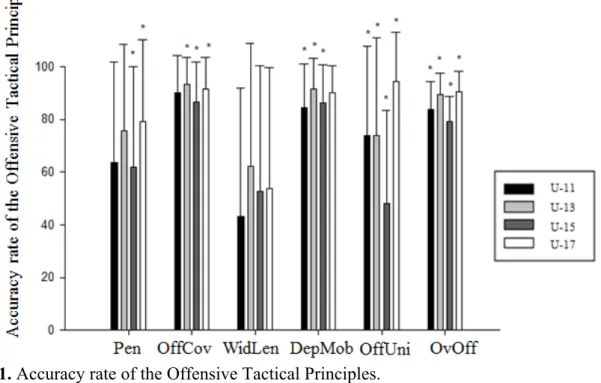
Figure 1 displays the results regarding the offensive tactical behavior efficiency (assessed through the accuracy rate of the core tactical principles) for the different age levels.
Figure 1. Accuracy rate of the Offensive Tactical Principles.
Through the results, it is possible to observe that players from the U-17 and U-13 age levels were more efficient when performing offensive tactical principles (OvOff) (90.32 ± 7.86 e 89.25 ± 8.32, respectively), followed by the players from the U-11 (83.59 ± 10.54) and U-15 (79.29 ± 9.20) age levels.
In addition, it was noticed that the offensive principles performed more efficiently were Offensive Coverage (OffCov) and Width and Length (WidLen). On the other hand, the principle of Depth Mobility (DepMob) displayed the lowest values of performance efficiency.
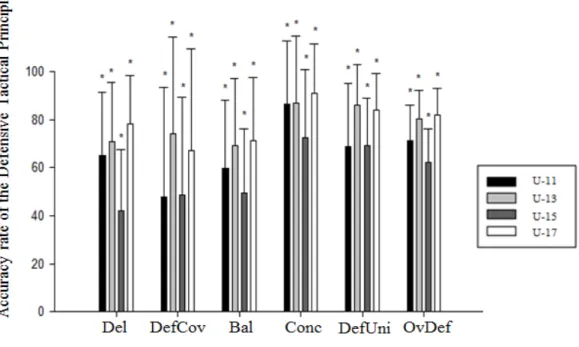
Figure 2 displays the results regarding the defensive tactical behavior efficiency in the different age levels.
Figure 2. Accuracy rate of the Defensive Tactical Principles.
*Significant differences: U-11 x U-13: Defensive Coverage (p=0.003), Balance (p=0.008), Defensive Unity (p<0.001) and Overall Defensive (p<0.001); U-11 x U-15: Delay (p<0.001), Balance (p=0.007), Concentration (p<0.001) and Overall Defensive (p<0.001); U-11 x U-17: Delay (p<0.001), Balance (p=0.002), Defensive Unity (p<0.001) and Overall Defensive (p<0.001); U-13 x U-15: Delay (p<0.001), Defensive Coverage (p<0.001), Balance (p<0.001), Concentration (p<0.001), Defensive Unity (p<0.001) and Overall Defensive (p<0.001); U-15 x U-17: Delay (p<0.001), Defensive Coverage (p<0.001), Balance (p<0.001), Concentration (p<0.001), Defensive Unity (p<0.001) and Overall Defensive (p<0.001).
Source: The authors.
It is possible to notice that the players from the U-17 (82.26 ± 10.81) and U-13 (80.44 ± 11.92) age levels were more efficient when performing the defensive tactical principles (OvDef), followed by the players from the U-11 (71.39 ± 14.85) and U-15 (62.11 ± 13.96) age levels.
In addition, it was observed that the defensive principle more efficiently performed was the Concentration (Conc). On the other hand, the principles of Defensive Coverage (DefCov) and Delay (Del) displayed the lowest values of performance efficiency.
Broadly speaking, results allow to observe an increase in the tactical behavior efficiency from the U-11 (77.49 ± 14.23) to the U-13 (88.85 ± 11.17) age levels, a decrease in the U-15 (70.71 ± 14.59) and again, an increase in the U-17 (86.29 ± 10.26) age level.
The aim of this study was to comapre the tactical behavior efficiency between soccer players from different age levels.
Results suggest that the players from the U-11 age level are less efficient when performing tactical actions in comparison to the players from the U-13 and U-17 age levels, which might be explained by the fact they are undergoing an initial stage of understanding the logic behind the soccer game16. These findings corroborate the study by Teoldo et al.10, which compared the tactical behavior efficiency between players from the U-11 to the U-20 age levels. In this study the authors found that the younger players are less efficient than their older counterparts, since, as the player progresses throughout the development process he will learn through the constraints, the training sessions and the competitive demands.
It is also possible to infer that these younger players might display limitations in space management and performance of the core tactical principles, taking into account that these principles involve abstract thinking and testing hypotheses for better positioning and movement of the players accross the playing space22-23,16. Considering that players from this age level have not yet reached their full cognitive development, training sessions focusing on the improvement of the core tactical principles should begin at the age of 12/13, a period in which the playrs's cognitive development is probably at its peak or close to it22,24,23.
In the U-13 age level, players display an increase in the tactical behavior efficiency, in comparison to the U-11 age level, a fact that could be anticipated and that was corroborated by studies such as that by Teoldo et al.12 and Vaeyens et al.25. The authors indicate that players from this age level display superior tactical knowledge about the game and attempt to position themselves behind the ball line when their teams are attacking, thus enabling passing actions. Therefore, they decrease the difficulty of performing the core tactical principles and display better results for the tactical behavior efficiency.
On the other hand, in the U-15 age level, results indicate a decrease in the tactical behavior efficiency. These findings suggest the need for special attention with this age level, as besides the body changes that occur due to the peak height velocity that may interfere in technical movements and motor skills26, there is also a modification of the social environment. In this period young boys begin to develop an interest in other 'social attractions', thus experiencing a marked drop in focus, what apparently influences the sporting aspect27. Besides this, Greco and Benda17, and Barth28, indicate that, at this age, there is a need for adapting, since, as the players are starting the direction phase, a stage in which the number of competitions is increased, and so is the pressure on the players. Thus, it is necessary that coaches and practitioners within this field pay special attention to players from this age level.
Lastly, results of the U-17 age level indicate that these players were more efficient when compared to their U-11 and U-15 counterparts. One of the factors that may have influenced this result regards the fact that the players are already adapted to the training and introduced to the specialization phase, having already consolidated the tactical knowledge about the game17. In the studies by Giacomini et al.29-30, it was evidenced that players from the U-17 age level display superior procedural and declarative tactical knowledge in comparison to the players from younger levels. Furthermore, Machado et al.13 report that players from this age level improve their performance by more efficiently executing the principles of 'Width and Length' and 'Penetration'. These principles demand greater knowledge about the playing space and superior technical skills, and consequently a better cognitive structure in order to make appropriate decisions.
understanding the tactical principles of play, even though the difficulty imposed by the opponents has increased. This enables them to make better decisions and, consequently, to increase their tactical behavior efficiency in the game33-34.
Future research may extend these results, by comparing other age groups and competitive levels, with the purpose of examining whether the tactical behavior efficiency is similar or different, when it comes to other groups of players. Besides that, we suggest a longitudinal research in order to follow-up the development of a given group of players since the beginning of their development process up to the senior team, with the purpose of analysing the progress throughout the entire development process.
Conclusion
Based on these results, it is possible to conclude that there are differences in the tactical behavior efficiency between youth academy players. We observed that there was an overall evolution from the younger to the older age levels. The exception were the players from the U-15 age level, who displayed results that show a decrease in the tactical behavior efficiency.
According to these findings, it is advisable that the coaching staff gradually introduce the teaching of the core tactical principles of play for the U-11 age level, through less complex drills. These drills may focus on tactical principles that occur within the center of play, such as penetration and offensive coverage, in the offensive phase, and delay and defensive coverage, in the defensive phase, as they are less complex. In the U-13 age level it is already possible to deepen the teaching of the core tactical principles, as players already display an abstract thinking of the soccer game. Therefore, drills that exercise the tactical principles performed close to the center of play, such as width and length, in the offensive phase, and concentration and defensive balance, in the defensive phase, are highly recommended.
For players from the U-15 age level, a gradual progression with respect to the complexity of training, patience when facing a potential decrease in performance due to the accentuated body changes during this age, and also attention to the social issues that usually occur in this age are suggested. Besides this, the tactical principles performed further from the center of play may be exercised with greater emphasis on this age level: depth mobility and offensive unity, in the offensive phase, and defensive unity, in the defensive phase. Moreover, in the U-17 age level, it is important to train with more emphasis on the principles that will significantly improve players' performance, such as creating spaces in the offensive phase, reducing the effective play-space in the defensive phase and improving technical skills to achieve better performance in the tactical principles through contact with the ball. Another specificity of this level is the possibility of practicing different core tactical principles, according to the players' positional roles, since these players are already undergoing a final sport development stage. Thus, it will be possible to develop more intelligent players, who are capable of making the best decision when facing the difficulties of the game during the entire development process.
References
2. Teoldo I. Comportamento tático no futebol: contributo para a avaliação do desempenho de jogadores em situações de jogo reduzido. [Tese de Doutorado]. Porto: Faculdade de Desporto e de Educação Física. Universidade do Porto; 2010.
3. Boulogne G. Organisation de jeu tactique/plan de jeu. Revue EP&S 1972;117:1-5. 4. Worthington E. Learning & Teaching soccer skills. Califórnia: Hal Leighton Printing
Company; 1974
5. Castelo J. Futebol: modelo técnico-táctico do jogo: identificação e caracterização das grandes tendências evolutivas das equipas de rendimento superior. Lisboa: Faculdade de Motricidade Humana. Universidade Técnica de Lisboa; 1994.
6. Garganta J, Pinto J. O ensino do futebol. In: Graça A, Oliveira J. O ensino dos jogos desportivos. Porto: CEJD/FCDEF-UP; 1994, p.97-137.
7. Teoldo I, Garganta J, Greco P, Mesquita I. Tactical principles of Soccer: concepts and application. Motriz Rev Educ Fis 2009b; 15(3):657-668.
8. Teoldo I, Garganta J, Greco PJ, Mesquita I, Maia J. System of tactical assessment in Soccer (FUT-SAT): Development and preliminary validation. Motri 2011;7(1):69-84. Doi:
10.6063/motricidade.7(1).121.
9. Garganta J, Gréhaigne JF. Abordagem sistêmica do jogo de futebol: moda ou necessidade? Movimento 1999;5(10):40-50.
10. Teoldo I, Garganta J, Greco P, Mesquita I, Afonso J. Assessment of tactical principles in youth soccer players of different age groups. Rev Port Ciên Desp 2010;10(1):147-157. 11. Teoldo I, Garganta J, Greco PJ, Mesquita I, Müller E, Silva B, et al. Comparação dos
comportamentos tácticos realizados por futebolistas de quatro escalões do futebol no teste ‘GR3-3GR’. Lec Edu Fís Dep 2010;15(144).
12. Teoldo I, Garganta J, Greco PJ, Mesquita I, Silva B, Müller E, et al. Análise da performance táctica de futebolistas de quatro escalões de formação. Lec Edu Fís Dep 2010;15(144).
13. Machado GF, Scaglia AJ, Costa ITD. Influência do efeito da idade relativa e do comportamento tático sobre o desempenho tático de jogadores de futebol da categoria sub-17. Rev Educ Fís UEM 2015;26(2):223-231. Doi: 10.4025/reveducfis.v26i2.23952. 14. Giacomini DS, Greco PJ. Comparação do conhecimento tático processual em jogadores de
futebol de diferentes categorias e posições. Rev Port Ciên Desp 2008;8:126-136. 15. Giacomini DS, Silva EG, Greco PJ. Comparação do conhecimento tático declarativo de
jogadores de futebol de diferentes categorias e posições. Rev Bras Ciênc Esporte 2011;33(2):445-463. Doi: 10.1590/s0101-32892011000200011.
16. González-Víllora S, Serra-Olivares J, Pastor-Vicedo JC, Costa ITD. Review of the tactical evaluation tools for youth players, assessing the tactics in team sports: football.
SpringerPlus 2015;4(1):663. Doi: 10.1186/s40064-015-1462-0.
17. Greco PJ, Benda RN. Iniciação esportiva universal: da aprendizagem motora ao treinamento técnico. Belo Horizonte: UFMG; 1998.
18. Teoldo I, Greco P, Garganta J, Costa V, Mesquita I. Ensino-aprendizagem e treinamento dos comportamentos tático-técnicos no futebol. RMEFE 2010;9(2):41-61.
20. Robinson G, O'donoghue PG. A weighted kappa statistic for reliability testing in performance analyses of sport. Int J Perform Anal Sport 2007;7(1):12-19.
21. Tabachnick B, Fidell L. Using Multivariate Statistics. 5th ed. New York: Harper Row Publishers; 2001.
22. Piaget J. Part I: cognitive development in children: Piaget development and learning. J Res Sci Teach 1964;2(3):176-186. Doi: 10.1002/tea.3660020306.
23. Teoldo I, Cardoso F. Formação no futebol: ensino e avaliação do comportamento tático. In: Ramos V, Saad MA, Milistetd M. Jogos desportivo coletivo: investigação e prática pedagógica. Florianópolis: UFSC; 2013, p.107-130.
24. Gallahue DL. Understanding motor development: infants, children, adolescents. 2nd ed. Indianapolis: Benchmark; 1989.
25. Vaeyens R, Lenoir M, Williams AM, Mazyn L, Philippaerts RM. The effects of task constraints on visual search behavior and decision-making skill in youth soccer players. J Sport Exerc Psychol 2007;29(2):147-169.
26. Philippaerts RM, Vaeyens R, Janssens M, Van Renterghem B, Matthys D, Craen R, et al. The relationship between peak height velocity and physical performance in youth soccer players. J Sports Sci 2006;24(3):221-230. Doi: 10.1080/02640410500189371.
27. Gallo AE, Williams LCDA. Adolescentes em conflito com a lei: uma revisão dos fatores de risco para a conduta infracional. Psicol Teor Prat 2005;7(1):81-95.
28. Barth B. Strategia e tattica nello sport. Riv Cult Sportiva 1994;12(31):10-20.
29. Giacomini DS, Greco PJ. Comparação do conhecimento tático processual em jogadores de futebol de diferentes categorias e posições. Rev Port Cien Desp 2008; 8(1): 126 - 136. 30. Giacomini DS, Soares V, Santos HF, Matias CJ, Greco PJ. O conhecimento tático
declarativo e processual em jogadores de futebol de diferentes escalões. Motri 2011;7(1):43-53. Doi: 10.6063/motricidade.7(1).119.
31. Ericsson KA, Krampe RT, Tesch-Römer C. The role of deliberate practice in the acquisition of expert performance. Psychol Rev 1993;100(3):363-406. Doi: 10.1037/0033-295x.100.3.363.
32. Ward P, Hodges NJ, Starkes JL, Williams MA. The road to excellence: deliberate practice and the development of expertise. High Abil Stud 2007;18(2):119-153.
33. Williams AM, Ward P. Anticipationn and decision makers: Exploring new horizons. In: G. Tenenbaum e R. C. Eklund. Handbook of Sport Psychology. Hoboken John Wiley & Sons; 2007,p.203-223.
34. Roca A. Perceptual-cognitive expertise and its acquisition in soccer. [Tese de Doutorado]. Liverpool: Portuguese Foundation for Science and Technology. Liverpool John Moores University; 2011.
Received on May, 06, 2015. Reviewed on Nov, 23, 2015. Accepted on Dec, 20, 2015.
Author address: Henrique Bueno Américo, Centre of Research and Studies in Soccer – NUPEF - Universidade Federal de Viçosa. Av. PH.