review of literature
Gabriela Crisina Canisani Pádua 1, Dirce Guilhem 2Abstract
Brazil is a country with an emerging and rapidly expanding body of scieniic research, and is correspondingly experiencing a signiicant increase in investment in research and researcher training. It is important to verify the quality and reliability of the knowledge arising from such research, in terms of integrity and adherence to good scieniic pracices. The aim of this study was to provide an overview scieniic integrity in Brazil through an analysis of studies published in scieniic journals. A systemaic review of the SciELO, PuBMed, LILACS/ IBECS and Web of Science electronic databases was performed, using keywords to select the relevant studies. Following applicaion of inclusion and exclusion criteria, 19 publicaions were selected and classiied into six previously deined categories. However, discussion of scieniic integrity remains incipient in Brazil. The sub -jects discussed were plagiarism and conlicts of interest regarding authorship. Early adherence to principles of integrity are important in the academic training of researchers and young scienists.
Keywords: Bioethics. Ethics, research. Scieniic integrity review. Scieniic misconduct. Fraud. Brazil. Resumo
Integridade cieníica e pesquisa em saúde no Brasil: revisão da literatura
O Brasil é um país com ciência emergente, em rápida expansão, apresentando aumento signiicaivo nos in -vesimentos desinados à pesquisa e capacitação de pesquisadores. Torna-se importante veriicar a qualidade e coniabilidade do conhecimento produzido, considerando a aderência aos critérios de integridade e às boas práicas cieníicas. Buscou-se traçar um panorama sobre o tema da integridade cieníica no Brasil por meio da análise de relexões e pesquisas publicadas em periódicos cieníicos. Foi realizada revisão sistemáica nos bancos de dados eletrônicos SciELO, PuBMed, Lilacs/Ibecs, Scopus e Web of Science, uilizando-se palavras --chave para capturar os arigos. Após aplicação dos critérios de inclusão e exclusão, foram selecionadas 19 publicações, agrupadas em seis categorias previamente deinidas. A discussão sobre a integridade cieníica é ainda incipiente no Brasil. Os assuntos mais discuidos foram plágio e conlitos de interesses sobre autoria. Torna-se necessária a abordagem precoce desses conhecimentos no processo de formação acadêmica de pesquisadores e jovens cienistas.
Palavras-chave: Bioéica. Éica em pesquisa. Revisão de integridade cieníica. Má conduta cieníica. Fraude. Brasil.
Resumen
Integridad cieníica y invesigación en salud en el Brasil: revisión de literatura
El Brasil es un país con ciencia emergente, en rápida expansión, con aumento signiicaivo de invesimentos desinados a invesigación y capacitación de invesigadores. Así, es importante veriicar la calidad y coniabi -lidad de los conocimientos producidos, considerándose la adherencia a los requisitos de integridad y buenas prácicas cieníicas. Se buscó el objeivo de esbozar un panorama sobre el tema de la integridad cieníica en el Brasil a través del análisis de relexiones e invesigaciones publicadas en revistas cieníicas. Se realizó una revisión sistemáica en bases de datos electrónicas: SciELO, PuBMed, LILACS/IBECS, Scopus y Web of Science, uilizándose palabras-clave para encontrar los arículos. Después de la aplicación de criterios de inclusión y exclusión fueron seleccionadas 19 publicaciones, agrupadas en seis categorías previamente deinidas. El debate sobre la integridad cieníica es aún incipiente en este país. Los temas más discuidos fueron plagio y conlictos de intereses sobre autoría. Es necesario el acercamiento precoz a ese conocimiento en el proceso de formación académica de invesigadores y jóvenes cienistas.
Palabras-clave: Bioéica. Éica en invesigación. Revisión de integridad cieníica. Mala conducta cieníica. Fraude. Brasil.
1. Doutoranda[email protected] 2. Pós-doutora [email protected] – Universidade de Brasília, Brasília/DF, Brasil.
Correspondência
Gabriela Crisina Canisani Pádua – Av. Diógenes Dolival Sampaio, Qd. 16, Lt. 8, Jardins Athenas CEP 74885-500. Goiânia/GO, Brasil.
Declaram não haver conlito de interesse.
R
esear
Scieniic producion is an indicator of eco -nomic growth that has been receiving atenion in the last decades. The technological capacity of a country is regarded as a source of inancial inde -pendence and may lead to greater autonomy and signiicant economic advances 1. The creaion of
human capital to provide support to an economy of knowledge establishes a scenario in which devel -oping naions may compete with great producers of knowledge as the Unites States or Europe, as long as they start invesing in science and technology and seek to qualify their labor through high level educaion. The BRICS (Brazil, Russia, India, China and South Africa) are countries that presently stand out for their economic and scieniic growth, com -peing with the great economies. They thus follow the trend of invesing increasingly more in research, technology, innovaion and educaion 2. The chal
-lenge of science has surpassed the race for new discoveries and creaivity, as it became the target of great inancial speculaion.
Scieniic and technological producion is necessarily followed by the process of dissemina-ion of knowledge. Data from the 2013 Triennial Assessment of the Brazilian Ministry of Educaion, performed by the Coordinaion of Improvement of Higher Educaion Personnel (Coordenação de Aper -feiçoamento de Pessoal de Nível Superior – Capes) on the growth of higher educaion in Brazil, show large extension in the number of graduate cours-es in the country 3. In the Global Research Report, published by the Thomson Reuters agency, Brazil has reached signiicant relevance in terms of the number of scieniic publicaions. The document considered the total number of publicaions in which at least one of the authors was Brazilian. From 3,000 publicaions in 1989, Brazil reached 19,000, in 2007, according to the research per -formed by the agency 4.
The graduate programs in Brazil are evaluated by producivity criteria and one of the consequenc -es of this is the increase in the number of scieniic publicaions. Brazilian researchers reproduce what happens in the internaional context and experi -ence the “publish or perish” rouine. Through this view, the number of publicaions and the number of citaions become more important than the qual -ity of the producion 5,6. However, the knowledge produced in the area of health brings and addiional issue to be evaluated when the quality of the pro -ducion is evaluated: the disseminaion of results that may be directly applied to the improvement of the quality of life of the populaion 7.
The relexion on topic of scieniic integrity, as well as the design of clear rules of good ethical and scieniic pracices to subsidize the process of producion and disseminaion of knowledge may contribute to develop and increased concern on the quality of the scieniic pracice and of the knowledge produced 8. The most discussed aspects of inadequate conduct in research – fabricaion, falsiicaion, and plagiarism of data or results (FFP) – receive more atenion not only in countries po -tenially creators of science but also in emerging naions that want to make the results of their re -search visible 9.
Centrality that scieniic integrity occupies in the pracice of research starts to be felt in Brazil. In 2010 the Primeiro Encontro Brasileiro de Integri -dade Cieníica e Publicação Éica – I Brispe 10 (“First Brazilian Meeing on Research Integrity, Science and Publicaion Ethics”) - took place with the purpose to simulate the engagement of the scieniic commu -nity to make the principles of scieniic integrity and good pracices in Science be adopted in the country. Subsequent meeings were promoted in the years 2012 (II Brispe) and 2014 (III Brispe), and the fourth is scheduled for 2015, in the city of Rio de Janeiro.
In Brazil, the design and promoion of guide -lines for scieniic integrity with naional reach are being iniially disseminated by research funding agencies and scieniic journals. One way to ver -ify the progress of the debate and examine the appropriaion of the topic by the Brazilian scienif -ic community is through the analysis of ar-icles on scieniic integrity published in the periods indexed in databases. This way, the objecive of the pres -ent study was to draw an outline on the theme of scieniic integrity in Brazil through the analysis of relecions and studies published in scieniic jour -nals.
Methods
This is a systemaic review study of the litera -ture on the producion of aricles related to scieniic integrity in Brazil. The following research quesion was designed to reach the proposed objecive: “What is the state of the art of the topic of scieniic integrity in Brazil?” Seeking to promote transparency on the methods and procedures uilized, the recom -mendaions of the Preferred Reporing Items for Systemaic Reviews and Meta-Analysis (Prisma) 11
were followed.
R
esear
Procedure for data collecion: literature search
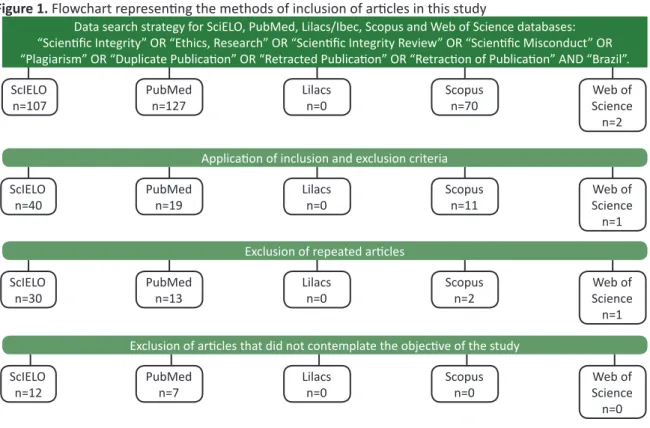
Research was conducted in electronic databa -ses that preferably contain Brazilian journals and in Portuguese. Aricles on the theme, writen in other languages and that referred to Brazil were also analyzed. Databases researched were the Scieniic Electronic Library Online (SciELO), Lilacs/Ibecs (La -in-American and Caribbean Literature - Literatura Laino-Americana e do Caribe/Índice Bibliográico Español en Ciencias de la Salud), PubMed, Scopus and Web of Science, as illustrated in Figure 1. The search was conducted in the period between Janua -ry and March 2014.
Aricles published unil January 2014 were considered, without restricion of date previous to this period. Since some aricles could be published in English or Spanish ans sill deal with Brazilian research, the same search matrix was used for all databases. The following keywords were employed, these are included in the Descritores em Ciências da Saúde - DeCS (Descriptors in Health Sciences), in their versions in English, Portuguese ans Spa -nish: “Scieniic Integrity” OR “Ethics, Research” OR “Scieniic Integrity Review” OR “Scieniic Miscon -duct” OR “Plagiarism” OR “Duplicate Publicaion” OR “Retracted Publicaion” OR “Retracion of Publi -caion” AND “Brazil”.
Figure 1. Flowchart represening the methods of inclusion of aricles in this study
Data search strategy for SciELO, PubMed, Lilacs/Ibec, Scopus and Web of Science databases: “Scieniic Integrity” OR “Ethics, Research” OR “Scieniic Integrity Review” OR “Scieniic Misconduct” OR “Plagiarism” OR “Duplicate Publicaion” OR “Retracted Publicaion” OR “Retracion of Publicaion” AND “Brazil”.
Number of aricles selected for analysis in the systemaic review: n= 19 Applicaion of inclusion and exclusion criteria
Exclusion of repeated aricles
Exclusion of aricles that did not contemplate the objecive of the study
ScIELO n=107
ScIELO n=40
ScIELO n=30
ScIELO
n=12
PubMed n=127
PubMed n=19
PubMed n=13
PubMed n=7
Lilacs n=0
Lilacs n=0
Lilacs n=0
Lilacs n=0
Scopus n=70
Scopus
n=11
Scopus
n=2
Scopus n=0
Web of Science
n=2
Web of Science
n=1
Web of Science
n=1
Web of Science
n=0
Inclusion Criteria
Studies published in Portuguese were prefer -ably included. Aricles in English and Spanish were considered only if published by Brazilian authors, representaive of the naional context. The ari -cles were available in electronic version and dealt strictly with scieniic integrity in its interface with the topics: ethics in research, quality of Brazilian re -search, percepion of researchers and students on the theme, and theoreical relecions involving this theme.
Exclusion Criteria
Aricles on clinical or observaional research in the ield of health in which the descriptors were among the keywords and the study object was not properly scieniic integrity or research ethics. Ari -cles for which the central object was distant form the discussion on scieniic integrity in Brazil or ed -itorials on the theme were not considered. In the case of duplicated aricles – that were present in more than one database – one of them was exclud -ed.
R
esear
Selecion and analysis
Ater the applicaion of inclusion and exclusion criteria, 19 aricles were selected for the review. Iniially they were analyzed in the secions deined each of the journals, which are: 1) Aricles: a) orig -inal, b) special, c) opinion, d) update; e) general aricles; 2) Review; 3) Comment; 4) Point of view; 5) Free topics. Ater this, the aricles were grouped in six categories represening the themes previous -ly deined for this study: 1) Authorship conlicts; 2) Rules and guidelines of the editorial process; 3) Bra -zilian rules and guidelines; 4) Plagiarism; 5) Conlicts of interest; 6) Percepion of scieniic integrity.
In case of doubt about the inclusion of an aricle, the decision was made by consensus ater evaluaion of the contents by the authors. Ater the iniial selecion, each aricle was analyzed through
its itle, abstract and keywords, to check its adequa -cy to the inclusion/exclusion criteria. In the following stage, the whole text was read and then classiied in the themaic categories created.
In the analysis of the selected aricles, the following aspects were considered: year of publi -caion, journal in which the aricle was published, impact factor and secion of the journal in which the manuscript was included. Thereater, each ari -cle was analyzed according to: objecives, methods, evidences produced and applicability and/or recom -mendaions.
Results
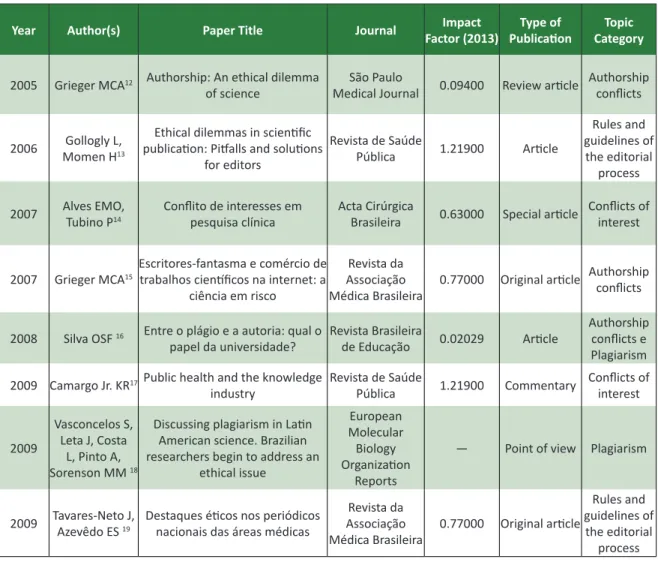
Table 1 shows the 19 aricles selected accord -ing to the date of publicaion.
Table 1. Aricles selected by year of publicaion, journal, impact factor, type of publicaion and topic category.
Year Author(s) Paper Title Journal Factor (2013)Impact PublicaionType of CategoryTopic
2005 Grieger MCA12 Authorship: An ethical dilemma
of science
São Paulo
Medical Journal 0.09400 Review aricle Authorship conlicts
2006 Momen HGollogly L, 13
Ethical dilemmas in scieniic publicaion: Pifalls and soluions
for editors
Revista de Saúde
Pública 1.21900 Aricle
Rules and
guidelines of the editorial
process
2007 Alves EMO, Tubino P14 Conlito de interesses em pesquisa clínica Acta Cirúrgica Brasileira 0.63000 Special aricle Conlicts of interest
2007 Grieger MCA15 Escritores-fantasma e comércio de trabalhos cieníicos na internet: a ciência em risco
Revista da Associação
Médica Brasileira 0.77000 Original aricle Authorship conlicts
2008 Silva OSF 16 Entre o plágio e a autoria: qual o
papel da universidade? Revista Brasileira de Educação 0.02029 Aricle
Authorship conlicts e Plagiarism
2009 Camargo Jr. KR17Public health and the knowledge
industry
Revista de Saúde
Pública 1.21900 Commentary Conlicts of interest
2009
Vasconcelos S, Leta J, Costa
L, Pinto A, Sorenson MM 18
Discussing plagiarism in Lain American science. Brazilian
researchers begin to address an ethical issue
European Molecular
Biology
Organizaion Reports
— Point of view Plagiarism
2009 Tavares-Neto J, Azevêdo ES 19 Destaques éicos nos periódicos nacionais das áreas médicas
Revista da Associação
Médica Brasileira 0.77000 Original aricle
Rules and
guidelines of the editorial
process
R
esear
Year Author(s) Paper Title Journal Factor (2013)Impact PublicaionType of CategoryTopic
2010
Garcia CC, Martrucelli CRN, Rossilho
M de MF, Denardin OVP 20
Autoria em arigos cieníicos: os novos desaios
Revista Brasileira de Cirurgia
Cardiovascular 1.23900 Special aricle Authorship conlicts
2010 Santana CC21
O tema da integridade cieníica nas pós-graduações em saúde no
Brasil
Revista Bioéica — Aricle
Percepion of scieniic
integrity
2011 Berlinck RGS22 The academic plagiarism and its
punishments: A review Revista Brasileira Farmacognosia 0.79600 Opinion aricle Plagiarism
2011
Fernandes
MR, Queiroz MCCAM, Moraes MR, Barbosa MA, Souza ALL23
Padrões éicos adotados pelas revistas cieníicas brasileiras das
especialidades médicas
Revista da Associação
Médica Brasileira 0.77000 Original aricle
Brazilian rules and guidelines
2011 Krokoscz M24
Abordagem do plágio nas três melhores universidades de cada
um dos cinco coninentes e do
Brasil
Revista Brasileira
de Educação — Aricle Plagiarism
2012 Menezes M, Schmitz PD, Lins L25
Percepção de integridade cieníica para o estudante de
medicina
Revista Brasileira de Educação
Médica — Aricle
Percepion of scieniic
integrity
2013 Guerriero ICZ, Minayo MCS26
O desaio de revisar aspectos éicos das pesquisas em ciências sociais e humanas: a necessidade
de diretrizes especíicas
Physis 0.03450 Free Topics rules and Brazilian guidelines
2013
Souza RP, Rapoport A, Dediviis RA, Cernea CR, Brandão LG27
Conlitos de interesse na pesquisa
médico-farmacológica Revista Bioéica — Update aricle Conlicts of interest
2013 Malafaia G, Guilhem D, Talvani A28
Do Brazilian scieniic journals
promote the adherence of
Chagas disease researchers to internaional ethical principles?
Revista do Insituto de Medicina Tropical
de São Paulo
0.95900 Aricle
Brazilian rules and guidelines
2014 Russo M29 Éica e integridade na ciência: da responsabilidade do cienista à responsabilidade coleiva
Estudos
Avançados 0.09470 Aricle
Brazilian rules and guidelines
2014 Watanabe EH30 A não linearidade entre a reação de quem copia e de quem é
copiado
Estudos
Avançados 0.09470 Aricle Plagiarism
The 19 aricles analyzed were included in di -ferent secions of the scieniic journals, as follows: general aricles: eight; special aricles: two; original aricles: three; opinion aricle: one: update aricle: um. The secions of Review, Commentary Point of view and Free Topics showed one aricle each. The main themes approached were computed in
de-creasing order of frequency of occurrence in the aricles analyzed: 1) Plagiarism: ive; 2) Authorship conlicts: four; 3) Brazilian rules and guidelines: four; 4) Conlicts of interest: three; 5) Rules and guideli -nes of the editorial process: two; 6) Percepion of scieniic integrity: two. It is important to menion that one of the aricles approached two diferent
R
esear
themes – authorship conlicts and plagiarism –, and was included in both categories.
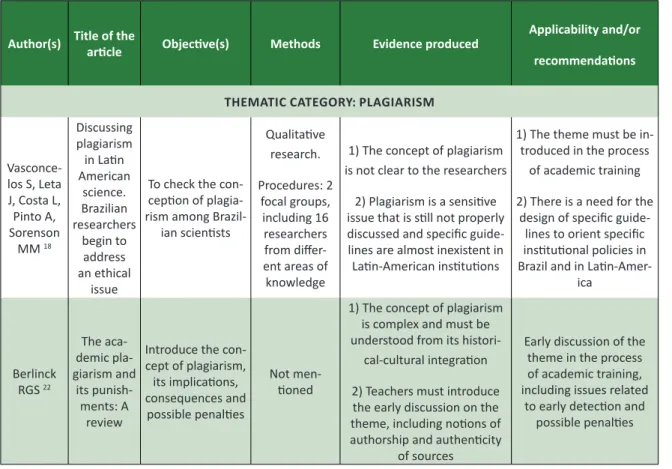
Table 2 at the end of this paper, shows the re -sults according to the themaic category the aricle was classiied in, according to aspects of its scieniic classiicaion. Concerning the methods adopted, the following designs were recorded: 1) Exploratory stu
-dy: ive; 3) Qualitaive research: three; 3) Narraive review: three; 4) Documentary descripive research: one; 5) Literature review and case study: one; 6) Wi -thout any scieniic method, based on experience and register: one; 7) Methods not menioned: ive. In all aricles selected it was possible to ind or infer the objecives proposed and the evidence produ -ced, from the research or the arguments presented.
Table 2. Distribuion of the selected aricles according to the following aspects: objecives, methods, evidence produced, applicability and/or recommendaions.
Author(s) Title of the aricle Objecive(s) Methods Evidence produced Applicability and/or recommendaions
THEMATIC CATEGORY: PLAGIARISM
Vasconce-los S, Leta J, Costa L, Pinto A, Sorenson
MM 18
Discussing
plagiarism
in Lain American
science.
Brazilian researchers
begin to address an ethical
issue
To check the con
-cepion of plagia -rism among
Brazil-ian scienists
Qualitaive research.
Procedures: 2 focal groups,
including 16
researchers
from difer -ent areas of
knowledge
1) The concept of plagiarism
is not clear to the researchers
2) Plagiarism is a sensiive issue that is sill not properly discussed and speciic guide -lines are almost inexistent in
Lain-American insituions
1) The theme must be in -troduced in the process
of academic training
2) There is a need for the design of speciic guide
-lines to orient speciic insituional policies in Brazil and in Lain-Amer
-ica
Berlinck
RGS 22
The aca -demic pla-giarism and
its
punish-ments: A review
Introduce the con
-cept of plagiarism, its implicaions,
consequences and
possible penalies
Not men
-ioned
1) The concept of plagiarism
is complex and must be understood from its
histori-cal-cultural integraion
2) Teachers must introduce
the early discussion on the
theme, including noions of authorship and authenicity
of sources
Early discussion of the
theme in the process
of academic training,
including issues related
to early detecion and possible penalies
R
esear
Author(s) Title of the aricle Objecive(s) Methods Evidence produced Applicability and/or recommendaions
Krokoscz M 24
Abordagem do plágio
nas três
melhores
universi -dades de
cada um dos cinco
coninen -tes e do Brasil
1) Idenify and
analyze the ap-proaches to pla-giarism adopted in
these insituions 2) Compare the
approaches of the world's best
universiies with
the approaches of the best Brazilian
universiies 3) Present proposals
to combat plagia-rism in Brazil
Documentary descripive
research
1) Presentaion of compara
-ive data on plagiarism in the ive coninents and the three
best Brazilian universiies
2) Systemaizaion of infor
-maion about plagiarism: a) Insituional hotsite with
exclusive content on plagia
-rism; b) insituional policy on plagiarism; c) Availability
of guides, manuals and/or oicial documents on the subject; d) academic integrity
commitee, disciplinary com
-mitee, inquiry commitee etc.
3) Adopion of prevenive, diagnosic and correcive
measures.
1) The confrontaion
of plagiarism should
include a set of acions
and strategies of training and capacity building
2) Adopion of a forma
-ive approach for the promoion of scieniic
culture of integrity
3) Elaboraion and adop
-ion of insitu-ional poli
-cies for the prevenion of
plagiarism
4)Introducion of the theme and speciic strat
-egies to minimize this problem
Watanabe EH 30
A não li -nearidade
entre a
reação de
quem copia e de quem
é copiado
To present some
measures taken
within Coppe/ UFRJ to prevent
plagiarism and certain correlated
problems
No speciic sci
-eniic method was adopted.
Experience
and record along the
years
Discussion on the following aspects:
a) declaraion of non-in -fringement of third party
rights; b) important deini
-ions; c) Ordinance 13/2006 by Capes; d) inclusion of
parts copied from others or
from the author himself; e) interesing examples of copy
-right violaions
Construcion of a culture of plagiarism prevenion, adoping the following acions: a) raise aware -ness of the need to respect the copyrights
of others; b) indicate the
authorship of material
published (published or not) when using quotes, third-party ideas; c) ob -tain permission from the
copyright owners when using copyrighted
mate-rial; d) end the culture of “copy and paste”; e) comply with Aricles 297-299 of the Brazilian Penal Code (Código Penal
Brasileiro)
R
esear
Author(s) Title of the aricle Objecive(s) Methods Evidence produced Applicability and/or recommendaions
THEMATIC CATEGORY: AUTHORSHIP CONFLICTS AND PLAGIARISM
Silva OSF 16
Entre o plágio e a autoria:
qual o papel da
universida -de?
To relect on au
-thorship, author
-ship conlicts and
plagiarism
Qualitaive
research with
20 language
undergradu-ate students
taking a
semi-presen-ial course
1) The interface to technol
-ogy allows the use of virtual
hypertext as the main source
of informaion
2) Ease of access predisposes
students to use third party material as their own
3) The consituion of au -thorship should be seen as an exercise of autonomy and
awareness of the other
1) It is necessary to
broaden the discussion
on the subject of author -ship and plagiarism in
academic context
2) There is the need to promote acions to min -imize the occurrence of this problem in the
aca-demic environment
THEMATIC CATEGORY: AUTHORSHIP CONFLICTS
Grieger
MCA 12
Author
-ship: An
ethical dilemma of
science
1) To review aricles in the
literature regard-ing misconduct
in authorship: its types, causes,
consequences and ethical guidelines
2) To propose alternaives for
ethical
commit-ment in scieniic publicaions
Narraive review
1) Frequent types of miscon -duct are cases of ghost-writer
and shared and redundant
publicaions 2) The main causes of these pracices are
the pressure to publish and the desire for social and
pro-fessional mobility 3) These pracices are sill present despite the criteria deined by the Internaional Commit
-tee of Medical Journal Editors (ICMJE)
Academic insituions,
research funding
agen-cies, regulatory agencies
and professional
associa-ions should establish as -sessment policies on the
quality of publicaions
and adherence to ethical
principles of scieniic
research
Grieger
MCA 15
Escritores --fantasma
e comércio
de traba-lhos
cien-íicos na internet: a ciência em
risco
To analyze the trade of scieniic
papers and how
these services are ofered
Exploratory study.
Analysis of 18
internet sites
that ofer ser
-vices of elabo
-raion of sci
-eniic aricles, monographs, dissertaions
and theses
1) Ten enterprises accepted the order and, except for one, they did not object to
the condiions imposed: Field research, approval by a research ethics commitee
(REC) and the use of the Vancouver norms. Six did not
reply and two did not accept the order alleging that they
have no staf available 2) The trade of scieniic papers is a fact which can negaively in
-terfere in the ethical, scienif
-ic and professional develop -ment of undergraduate and
graduate students, as well as in scieniic producion by
adulteraing data and infor
-maion from the literature
Necessity to develop
reliable strategies for
assessment of inal proj -ects and monographs
R
esear
Author(s) Title of the aricle Objecive(s) Methods Evidence produced Applicability and/or recommendaions Garcia CC, Martru -celli CRN, Rossilho MMF, Denardin
OVP 20
Autoria em arigos cieníicos: os novos desaios
To relect on crite -ria for authorship
atribuion, the
reasons for the growth of co-au-thorship rates and
the challenges of establishing au-thorship in
elec-tronic journals
Literature review and
case study
(database)
1) There are strategies to avoid misconduct regarding
the authorship atribuion from afecing the credibility
of science 2) Bad behaviors in relaion to authorship are:
guest, pressured and ghost
authoring and co-authoring
1) Disseminated prac
-ices such as a guest,
pressured or ghost au-thoring must be fought
2) Journals should re -quire transparency on
the contribuion of each
of the co-authors
THEMATIC CATEGORY: BRAZILIAN RULES AND GUIDELINES
Fernan-des MR, Queiroz MCCAM,
Moraes MR, Bar
-bosa MA, Souza
ALL23
Padrões éicos ado -tados pelas revistas cieníicas brasileiras das espe-cialidades médicas
To analyze ethical
standards in the guidelines for au-thors of Brazilian
scieniic journals of various medical specialies and to invesigate the
standardizaion available
Exploratory
study per-formed on the
Health Sci
-ences Portal of BVS (Portal
de Ciências da Saúde da BVS). 95 journals were
included
Of the journals analyzed: a) 80% referred to the ap
-proval of the study by a REC; b) 43.15% menioned the Declaraion of Helsinki and informed consent; c) 32.63%
reported uniform
require-ments; d) 15.78% reported protecion of conideniality;
e) 9.47% made no menion
of ethical aspects to submit
aricles; f) 90% menioned ethical aspects for aricle
submission.
The Brazilian scieniic journals should improve
the requirements for
submission and review of aricles in order to
ensure the quality and reliability of the results
presented
Guerri-ero ICZ, Minayo MCS 26
O desaio de revisar aspectos éicos das pesquisas em ciências sociais e humanas: a neces-sidade de diretrizes especíicas
Quesion the un -due
standardiza-ion of ethical pro -cedures focused on research in the social sciences and
humaniies
Narraive review
Brazilian regulaions on re -search ethics are inadequate
to assess the research proj -ects from the social sciences
and humaniies
The need to discuss the speciicity of ethics in
research in social
scienc-es and humaniiscienc-es
Malafaia G, Gui
-lhem D, Talvani
A 28
Do Brazil
-ian scienif
-ic journals promote the ad-herence of Chagas disease researchers to inter-naional ethical principles?
To examine the
ethical aspects of
publicaions on Chagas disease in the 1966-2010
period and the policies adopted
for publicaion by
Brazilian medical
journals
Exploratory
study con-ducted in the
SciELO data -base
1) Of the 158 aricles ana
-lyzed, 58.9% did not menion
the ethical aspects used in the study
2) Among the 25 evaluated journals, only 13 clearly in -dicated the ethical aspects
required for publicaion of aricles
Brazilian scieniic jour
-nals should improve the
ethical requirements for
submission and review aricles in order to adapt
to the Brazilian guide-lines on ethics in
re-search involving human subjects
R
esear
Author(s) Title of the aricle Objecive(s) Methods Evidence produced Applicability and/or recommendaions
Russo M 29
Éica e
integridade
na ciência:
da respon-sabilidade
do cienista à respon -sabilidade
coleiva
To show that
issues on ethics and integrity in research must be
addressed both from the discus-sion on the re-sponsibility of the
scienist as from the collecive
responsibility
Narraive review
Three quesions were de -signed to support the
discus-sion on the subject: a) “We
are less ethical and less
righ-teous than our ancestors?”; b) “What values are coupled to scieniic work and pub
-licaion today?”; c) “Watch, punish, prevent or trans
-form? Where are we and
where do we want to go?”
1) It is necessary to re
-sume values in scieniic pracice as a form of op
-posiion to the impulse
of fraud
2) Responsibility emerg -es as a possibility which will direct one's own
scieniic research to -ward ethics
THEMATIC CATEGORY: CONFLICTS OF INTEREST
Alves EMO, Tubino
P 14
Conlito de
interesses em
pesqui-sa clínica
To relect on
issues related
to conlicts of
interest in clinical research
Not men
-ioned
1) Conlicts of interest are common and inevitable in
academic life
2) The challenge is not to eradicate them, but their recogniion allows managing
them properly
1) All research involving human subjects should be evaluated by ethics review commitees;
2) The results of the
studies must meet the standards for the
man-agement of conlicts of
interest proposed by the
ICMJE
Camargo Jr KR 17
Public
health and the knowledge
industry
To examine issues
related to the interface between
public health and the knowledge
industry
Not men
-ioned
1) There is an industry of
knowledge that confers
pow-ers to the countries, insitu
-ions and researchers
2) Oten the knowledge is linked to markeing as a way
to allow their sale to possible bidders
Producion and distri
-buion of knowledge
should be addressed as a strategic component of
public health
Souza RP, Rapoport A, Dedi
-viis RA, Cernea CR, Bran
-dão LG 27
Conlitos
de inte-resse na pesquisa
médico-
farma-cológica
To relect on is -sues related to
conlicts of inter -est in medical and
pharmacological research
Not men
-ioned
1) Research conducted with
funding from the
pharma-ceuical industry have higher proporion of favorable
results
2) Conlicts of interest repre
-sent biases that may afect
results
1) Transparency in the declaraion of conlicts of interest involved in
research
2) Contribute to rigor -ous analysis of clinical
research projects, which should be reviewed by
ethics review commit -tees
R
esear
Author(s) Title of the aricle Objecive(s) Methods Evidence produced Applicability and/or recommendaions
THEMATIC CATEGORY: PERCEPTION OF SCIENTIFIC INTEGRITY
Santana CC 21
O tema da
integridade
cieníica nas pós -
-gradua-ções em saúde no
Brasil
To know the con -cern of health graduate pro-grams about the theme of research
integrity
Exploratory
study through research in
126 pages of
Brazilian pro-grams in the
ield of health
1) There is sill no concern over the issue of integrity in
research in most health grad-uate programs in the country
2) Scieniic honesty is sill not a priority in educaional
insituions
Educaional insituions and the scieniic com -munity should assume a fundamental role in the
formaion of ethically
responsible research
Schmitz PD, Menezes
M, Lins L 25
Percepção
de integridade
cieníica
para o estudante
de medi-cina
1) To understand the percepion of
the medical
stu-dent on scieniic
integrity
2) To discuss the
need to address the issue in the training of ethi-cally responsible
research
3) To clarify the
importance of
educaional pracices aimed ethics educaion the formaion of
students
Qualitaive Study. Themaic anal
-ysis technique. Procedure:
semi-struc-tured
inter-view
1) the need for more efec
-ive approach was evident on the REC / ERC System 2) The subject of scieniic integrity seems to be litle
discussed in the academic
environment, which can lead to the pracice of misconduct in scieniic producion, for lack of recogniion of these
behaviors by students
1) Theoreical and pracical strategies for
the scieniic integrity of educaion must be
adopted in the medical curriculum
2) The issue must be
introduced early in the academic process
THEMATIC CATEGORY: RULES AND GUIDELINES OF THE EDITORIAL PROCESS
Gollogly
L, Momen H 13
Ethical
dilemmas in
scien-iic pub
-licaion: Pifalls and
soluions
for editors
To provide deini
-ions, ways to doc -ument the extent of the problem and examples of
iniiaives to con -tain editorial fraud
Not men
-ioned
1) Common problems of misconduct in science are: manufacturing, falsiicaion,
duplicaion, ghost author
-ship, git author-ship, lack of ethics in the approval of manuscripts, non disclosure of these facts, “salami” (frac
-ionated) publicaion, con
-licts of interest, self-citaion,
duplicate submission and
publicaion as well as plagia
-rism 2) Editorial misconduct
includes failure to follow the
due process, delay in decision making and communicaion
with the authors, failure to review and confusion of the
contents of a journal with their promoional and adver
-ising potenial
1) Editors take privi
-leged posiions in the process of promoing appropriate pracices for
publicaion 2) Journals
should adopt clear ethi-cal guidelines about the procedures adopted for
publicaion
R
esear
Author(s) Title of the aricle Objecive(s) Methods Evidence produced Applicability and/or recommendaions
Tavares
--Neto J, Azevêdo ES 19
Destaques éicos nos periódicos
nacionais
das áreas médicas
To evaluate exising ethical
highlights in the
instrucions to authors of naion
-al journ-als jointly
cited by the four medical areas of
Capes and quali
-ied naionally as “A” internaionally
as “I”.
Exploratory study.
Procedures:
analysis if the
instrucions
to authors of
20 naional journals
1) Regarding research eth
-ics, 50% of the analyzed the journals require that the study has been approved by a research ethics commitee 2) Regarding scieniic integri
-ty, 55% of the journal require declaraions of conlict of interest. However, all (100%)
Periodicals are silent as to the veriicaion of conlicts of
interest between authors and
reviewers, as well as the pre
-venion of fraud, plagiarism and manufacturing data 3) About editorial policies, 65%
of the journals require the
copyright to be transferred to
them and the rest (35%) do not menion the subject
The prevenion of scien
-iic dishonesty must be
a responsibility shared
by researchers, funding agencies, educaional insituions, scieniic journals and the society
in general
Discussion
It is shown that the topic of scieniic integri -ty is sill recent in the Brazilian context, considering the irst aricle found on the subject dates back to 2005. However, this discussion has grown in Brazil as it exposes the need to establish clear rules about the conducts of researchers. Funding agencies, such as the Conselho Nacional de Desenvolvimento Cieníico e Tecnológico (CNPq) and the Fundação de Amparo à Pesquisa do Estado de São Paulo (Fapesp), develop guidelines to ensure the adopion of good scieniic pracices in the projects supported by these insituions 31,32. Such strategy is very wel -come, considering the growth of Brazilian science.
The aricles dealt with various issues about scieniic integrity, among them the most discussed by authors were plagiarism 16,18,22,24,30 and authorship conlicts involving several collaborators 12,15,16,20. This concern is understandable in a scieniic scenario where researchers are pressured to increase their producion of aricles for publicaion, puing at risk the quality and validity of the results presented 33.
Although the concept of plagiarism is complex and must be understood from its historical-cultur-al context 22, it is a delicate issue that has not been discussed properly, also because there are speciic guidelines on the subject in Lain-American insituions are pracically nonexistent 18. It was shown that this
topic was approached by publicaions in journals form several ields, such as molecular biology, pharmacolo -gy, educaion and mulidisciplinary, as it equally afects diferent areas of knowledge. Another important aspect in this discussion refers to the possibility of vio -laion of rights of third paries, authorship rights, which implies the unduly use of texts and ideas without the due menion and or authorizaion when dealing with copyrighted documents 30. Authors are unanimous in poining to the need of early approach to this theme in the academic training, through educaional strategies and the promoion of a culture of plagiarism preven -ion 16,18.22,24,30.
Authorship conlicts entered the repertoire of scieniic integrity especially when the growing number of aricles published in scieniic journals form the 1990s is considered. This is atributed to the way of assessment the quality of a researcher is performed through the number of scieniic ari -cles the researcher publishes 12. The high demand
for producivity in shorter ime may be harmful to the creaivity and the originality of the studies published. As a consequence, co-authorship has grown signiicantly as a way of demonstraing the establishment of naional and/or internaional part -nerships of researchers and research groups, which also increased the chances of publicaion in journals of internaional visibility. An interesing strategy co-authored studies is to establish transparency criteria that show the efecive paricipaion and col
-R
esear
laboraion of each of the authors in the producion of the material submited for publicaion 20.
Regarding the themaic category “Brazilian rules and guidelines” 23,26,28,29, the authors point out interesing aspects. Two aricles focused in the anal -ysis of the adherence to ethical requirements from the Brazilian normaive framework by journals of dif -ferent medical specialies. It was also observed that there are gaps in the standardizaion or the orien -taions to authors presented in the journals. In this sense, it becomes urgent to improve the require -ments for submission and assessment of aricles, in order to ensure the quality and reliability of the re-sults presented 23,28.
One of the aricles in quite incisive in poining out the inadequacy of Brazilian regulaions for re -search involving human beings when applied to the areas of social sciences and humaniies. The authors argue on the need to deine speciic regulaions for the assessment of projects in these areas 26. Another text considers that it is necessary to resume using val -ues in the scieniic pracice, in order to keep ethics and integrity in science. This is a responsibility shared by researchers and the general society, a principle that emerges as an element that will subsidize the conduct of researches and oppose the impulse of 29. That is, it becomes necessary to advance in the con -solidaion of speciic regulaions that contribute to the adopion of reliable and trustworthy behaviors.
Conlicts of interest in clinical research emerged as a relevant topic that causes concern among re -searchers who propose the discussion on scieniic integrity 14,17,27. An issue related to the interface between inancing coming from the pharmaceui -cal industry and the distribuion of knowledge as a strategic component for the process of atenion in public health also arose 17. The authors point out that conlicts of interest are inevitable and consi -tuive of academic life and scieniic pracice. The great challenge, then, is not their eradicaion but to approach them transparently, because their recog -niion allows for their proper management 14.
In order to minimize the conlicts of interest arising from biomedical research, all studies involv -ing human be-ings must be assessed by research ethics commitees before their start 27. This idea must be widely disseminated and adopted in order to ensure the safety and dignity of the research par-icipants, and presented to students early in their academic life.
Two studies presented research results on the subject of scieniic integrity: one focusing on
the concepion of health graduate programs on the subject 21, and another addressing the percepion of
scieniic integrity on the part of medical students 25. In the irst one, web sites of 126 Brazilian programs in health were analyzed. It became clear that, be -sides the lack of concern over the issue of integrity in research in most graduate programs, scieniic honesty is sill not a priority for educaional insitu -ions 21. In the second study, medical students were
interviewed using qualitaive research, and their re -sults showed three disinct needs: 1) more efecive approach to the Research Ethics Commitee System; 2) further discussion in academia on the subject of scieniic integrity; 3) adopion of theoreical and pracical strategies for teaching scieniic integrity in the medical curriculum 25.
The last themaic category – Rules and guide -lines of the editorial process – included two aricles with disinct approaches 13,19. In the irst one, the authors set the objecive as to supply deiniions, ways of documening the extension of the problem and examples of measures to avoid editorial fraud. Listed common problems of misconduct in science include: manufacturing, falsiicaion, duplicaion, ghost authorship, git authorship, lack of ethics in the approval of manuscripts, non disclosure of these facts, “salami” (fracionated) publicaion, con -licts of interest, self-citaion, duplicate submission and publicaion, as well as plagiarism. At the same ime, editorial misconduct includes failure to fol -low the due process, delay in decision making and communicaion with the authors, failure to review and confusion of the contents of a journal with their promoional and adverising potenial. It was also ev -idenced that editors take privileged posiions in the process of promoing appropriate pracices for pub -licaion 13. In the second aricle, the authors sought to assess the ethical highlights in the instrucions to authors of naional journals jointly cited by the four medical areas of Capes and qualiied naionally as “A” internaionally as “I”. Although several gaps were found in the instrucions to authors, the prevenion of dishonesty mus be a responsibility shared among researchers, funding agencies, educaional insitu -ions scieniic journals and the society in general 19. One of the recurring aspects in the aricles analyzed was the need of early inserion of the sci -eniic integrity theme and its diferent sides in the process of academic educaion. It becomes neces -sary to develop strategies to teach scieniic integrity values in the undergraduate and graduate curricula 15,16,18,19,21,22,24,25,29,30. The incorporaion of ethical val -ues and the consolidaion of adequate behaviors
R
esear
for the scieniic pracice must be widely difused during the training of students and researchers. This must come with adequate methods that sim -ulate personal and collecive strengthening toward scieniic good pracices and ethics 34.
Final consideraions
It is important to point out that the limitaions of this research are related to technical aspects as the restricted or inadequate use of the descriptors used for aricle indexing, which prevented the cap -ture of some publicaions that could prove relevant to the discussion; and the unavailability of some ar -icles in the electronic format.
However, this study veriied the complexity the theme of scieniic integrity assumes nowadays
due to the accelerated growth of the scieniic pro -ducion. The early approach of this issue becomes mandatory, so that young scienists and researchers may acquire the terminology and concepts related to science integrity, which will contribute to the adopion of an ethical culture of scieniic integrity.
Brazil needs to advance in the discussion of this theme, incorporaing it to the process of academ -ic training and coninued educaion of researchers. However, this responsibility is not restricted to edu -caional insituions. It must be shared by diferent actors and social insituions, extending to society as a whole. It is necessary to work in conjuncion in to -ward establishing standards to be followed without costs for science and the producers of knowledge. It is necessary, sill to deine the possible penalies in case of misconduct in research so that abusive behav -iors can be ideniied and corrected.
Referências
1. Organisaion for Economic Co-operaion and Development. Policy Brief: Science, technology and innovaion in the new economy. [Internet]. Paris: OECD; 2000 set [acesso 10 out 2014]. Disponível: htp://www.oecd.org/science/sci-tech/1918259.pdf
2. Scieniic Electronic Library Online. Países em desenvolvimento liderados pela China ameaçam domínio norte-americano na ciência. SciELO em Perspeciva. [Internet]. 2014 abr [acesso 8 out 2014]. Disponível: htp://blog.scielo.org/blog/2014/04/17/paises-em-desenvolvimento-liderados-pela-china-ameacam-dominio-norte-americano-na-ciencia
3. Brasil. Ministério da Educação/Coordenação de Aperfeiçoamento de Pessoal de Nível Superior. Capes divulga resultado inal da avaliação trienal 2013 após análise de recursos. [Internet]. 2014 maio [acesso 10 out 2014]. Disponível: htp://www.capes.gov.br/36-noicias/6908-capes-divulga-resultado-inal-da-avaliacao-trienal-2013-apos-analise-de-recursos
4. Adams J, Christopher K. Global research report Brazil: Research and collaboraion in the new geography of science. New York: Thomson Reuters; 2009 jun [acesso 10 out 2014]. Disponível: htp://sciencewatch.com/sites/sw/iles/sw-aricle/media/grr-brazil-Jun09.pdf.
5. Fischer J, Ritchie EG, Hanspach J. Academia’s obsession with quanity. Trends Ecol Evol. 2012;27(9):473-4.
6. Reverter Masià J. Publicaciones cieníicas y evaluación de la vida profesional de un cieníico. Nutr Hosp. 2012;27(4):1.368-9.
7. Chaudhry B, Wang J, Wu S, Maglione M, Mojica W, Roth E et al. Systemaic review: Impact of health informaion technology on quality, eiciency, and costs of medical care. Ann Intern Med. 2006;144(10):742-52.
8. Macrina FL. Scieniic integrity: Text and cases in responsible conduct of research. 3ª ed. Washington: American Society for Microbiology (ASM) Press; 2005.
9. Fanelli D. How many scienists fabricate and falsify research? A systemaic review and meta-analysis of survey data. PLoS ONE. [Internet]. 2009 [acesso 15 out 2014]; 4(5):e5738; 2009. Disponível: htp://www.plosone.org/aricle/info%3Adoi%2F10.1371%2Fjournal.pone.0005738 10. First Brazilian Meeing on Research Integrity, Science and Publicaion Ethics. I Brispe; 2010 dez
10-16 [acesso 15 ago 2014]; Rio de Janeiro e São Paulo, Brasil. Disponível: htp://www.ibrispe. coppe.ufrj.br/port.php
11. PRISMA Statement. Transparent reporing of systemaic reviews and meta-analyses. [Internet]. [acesso 22 maio 2014]. Disponível: htp://www.prisma-statement.org
12. Grieger MCA. Authorship: An ethical dilemma of science. São Paulo Med J. 2005;123(5):242-6. 13. Gollogly L, Momen H. Ethical dilemmas in scieniic publicaion: Pifalls and soluions for editors.
Rev Saúde Pública. 2006;40(N Esp):24-9.
14. Alves EMO, Tubino P. Conlito de interesses em pesquisa clínica. Acta Cir Bras. 2007;22(5):412-5. 15. Grieger MCA. Escritores-fantasma e comércio de trabalhos cieníicos na internet: a ciência em
risco. Rev Assoc Med Bras. 2007;53(3):247-51.
16. Silva OSF. Entre o plágio e a autoria: qual o papel da universidade? Rev Bras Educ. 2008;13(38):357-414.
R
esear
Recebido: 28.10.2014 Revisado: 31. 1.2015 Aprovado: 5. 2.2015
17. Camargo Jr KR. Public health and the knowledge industry. Rev Saúde Pública. 2009;43(6):1.078-83. 18. Vasconcelos S, Leta J, Costa L, Pinto A, Sorenson MM. Discussing plagiarism in Lain American
science. Brazilian researchers begin to address an ethical issue. EMBO Reports. 2009;10(7):677-82.
19. Tavares-Neto J, Azevêdo ES. Destaques éicos nos periódicos nacionais das áreas médicas. Rev Assoc Med Bras. 2009;55(4):400-4.
20. Garcia CC, Martrucelli CRN, Rossilho MMF, Denardin OVP. Autoria em arigos cieníicos: os novos desaios. Rev Bras Cir Cardiovasc. 2010;25(4):559-67.
21. Santana CC. O tema da integridade cieníica nas pós-graduações em saúde no Brasil. Rev. bioét. (Impr.). 2010; 18(3):637-44.
22. Berlinck RGS. The academic plagiarism and its punishments: A review. Rev Bras Farmacogn. 2011;21(3):365-72.
23. Fernandes MR, Queiroz MCCAM, Moraes MR, Barbosa MA, Souza ALL. Padrões éicos adotados pelas revistas cieníicas brasileiras das especialidades médicas. Rev Assoc Med Bras. 2011;57(3):267-71.
24. Krokoscz M. Abordagem do plágio nas três melhores universidades de cada um dos cinco coninentes e do Brasil. Rev Bras Educ. 2011;16(48):745-68.
25. Schmitz PD, Menezes M, Lins L. Percepção de integridade cieníica para o estudante de medicina. Rev Bras Educ Med. 2012;36(4):447-55.
26. Guerriero ICZ, Minayo MCS. O desaio de revisar aspectos éicos das pesquisas em ciências sociais e humanas: a necessidade de diretrizes especíicas. Physis. 2013;23(3):763-82.
27. Souza RP, Rapoport A, Dediviis RA, Cernea CR, Brandão LG. Conlitos de interesses na pesquisa médico-farmacológica. Rev Bioét. (Impr.). 2013;21(2):237-40.
28. Malafaia G, Guilhem D, Talvani A. Do Brazilian scieniic journals promote the adherence of Chagas disease researchers to internaional ethical principles? Rev Inst Med Trop São Paulo. 2013;55(3):159-65.
29. Russo M. Éica e integridade na ciência: da responsabilidade do cienista à responsabilidade coleiva. Estud Av. 2014;28(80):189-98.
30. Watanabe EH. A não linearidade entre a reação de quem copia e de quem é copiado. Estud Av. 2014;28(80): 199-212.
31. Brasil. Conselho Nacional de Desenvolvimento Cieníico e Tecnológico. Diretrizes sobre integridade cieníica. [Internet]. Brasília: CNPq; 2012 [acesso 20 out 2014]. Disponível: htp:// www.cnpq.br/pt/web/guest/documentos-do-cic
32. Estado de São Paulo. Fundação de Amparo à Pesquisa do Estado de São Paulo. Código de boas práicas cieníicas. [Internet]. São Paulo: Fapesp; 2014 [acesso 20 out 2014]. Disponível: htp:// www.fapesp.br/boaspraicas/FAPESP-Codigo_de_Boas_Praicas_Cieniicas_2014.pdf
33. Tijdink JK, Vergouwen ACM, Smulders YM. Publicaion pressure and burn out among Dutch medical professors: A naionwide survey. PLoS ONE. [Internet]. 2013 [acesso 10 out 2014]; 2013;8(9):e73381. Disponível: htp://www.plosone.org/aricle/info%3Adoi%2F10.1371%2Fjournal.pone.0073381 34. Guilhem D. Éica em pesquisa: avanços e desaios. RECIIS – R. Eletr. de Com. Inf. Inov. Saúde.
[Internet]. 2008 [acesso 10 out 2014]; 2008;2(Sup 1):91-7. Disponível: htp://www.reciis.icict. iocruz.br/index.php/reciis/aricle/view/212/191
Paricipaion of the authors
Gabriela Crisina Canisani Pádua took part in the concepion of the aricle, the database research process, the analysis of the results and in producing the inal version to be published. Dirce Guilhem took part in the concepion of the aricle, the analysis and interpretaion of the results, wriing, criical review and in producing the inal version to be published.