Survey on Aesthetic Vulvovaginal Procedures:
What do Portuguese Doctors and Medical Students
Think?
Inquérito sobre procedimentos estéticos vulvovaginais: qual a
opinião dos médicos e estudantes de medicina portugueses?
Pedro Vieira-Baptista
1Joana Lima-Silva
1José Fonseca-Moutinho
2Virgínia Monteiro
3Fernanda Águas
41Department of Obstetrics and Gynecology, Centro Hospitalar de São João, Porto, Portugal
2Faculdade de Ciências da Saúde, Universidade da Beira Interior, Covilhã, Portugal
3Colposcopy and Laser Unit, Hospital da Luz, Lisboa, Portugal 4Department of Gynecology, Centro Hospitalar e Universitário de
Coimbra, Coimbra, Portugal
Rev Bras Ginecol Obstet 2017;39:415–423.
Address for correspondence Pedro Vieira Baptista, MD,
Departmento de Obstetrícia e Ginecologia, Centro Hospitalar de São João, Alameda Prof. Hernâni Monteiro, 4200-319, Porto, Portugal (e-mail: [email protected]).
Keywords
►
nymphoplasty
►
hymenoplasty
►
aesthetic surgery
►
ethics
►
vulvar surgery
►
laser
Abstract
Objective
To assess the medical doctors and medical students
’
opinion regarding the
evidence and ethical background of the performance of vulvovaginal aesthetic
procedures (VVAPs).
Methods
Cross-sectional online survey among 664 Portuguese medical doctors and
students.
Results
Most participants considered that there is never or there rarely is a medical reason
to perform: vulvar whitening (85.9% [502/584]); hymenoplasty (72.0% [437/607]); mons
pubis liposuction (71.6% [426/595]);
“
G-spot
”
augmentation (71.0% [409/576]); labia
majora augmentation (66.3% [390/588]); labia minora augmentation (58.3% [326/559]);
or laser vaginal tightening (52.3% [313/599]). Gynecologists and specialists were more likely
to consider that there are no medical reasons to perform VVAPs; the opposite was true for
plastic surgeons and students/residents.
Hymenoplasty raised ethical doubts in 51.1% (283/554) of the participants. Plastic
surgeons and students/residents were less likely to raise ethical objections, while the
opposite was true for gynecologists and specialists.
Most considered that VVAPs could contribute to an improvement in self-esteem (92.3%
[613/664]); sexual function (78.5% [521/664]); vaginal atrophy (69.9% [464/664]);
quality of life (66.3% [440/664]); and sexual pain (61.4% [408/664]).
Conclusions
While medical doctors and students acknowledge the lack of evidence
and scienti
fi
c support for the performance of VVAPs, most do not raise ethical
objections about them, especially if they are students or plastic surgeons, or if they
have had or have considered having plastic surgery.
received January 4, 2017 accepted April 17, 2017 published online June 23, 2017
DOI https://doi.org/ 10.1055/s-0037-1603967. ISSN 0100-7203.
Introduction
Vulvovaginal aesthetic procedures (VVAPs), also referred to as “intimate surgery”or“female cosmetic genital surgery”, are a trending topic in the media that has been poorly addressed in the medical literature so far. Despite being available all over the world, these procedures are a marginal, gray area of medicine: there is no coherent classification of the procedures, and there is an evident lack of good quality, long-term, randomized, independent studies.1This lack of evidence has not restricted the performance or advertisement of these procedures, which is easier than ever before in this digital era, due to the inability of other health professionals and/or medical societies tofilter the information available.2 It has been shown that these advertisements are mostly inaccurate, omit risks and compli-cations, and exaggerate the potential benefits.2,3There is also indirect pressure to perform these procedures, since the pornographic industry and the media in general have created a new standard for the ideal“normal”vulva:4hairless and with the labia minora totally hidden by the labia majora; anything that is different from this pre-pubertal model is now consid-ered unaesthetic, abnormal and, thus, eligible for correction or perfection by the surgeon’s blade or laser.
Medical societies are slowly starting to take public positions and publish guidelines,5–8and more of them are expected to do the same in the near future. In the absence of good scientific evidence, it is difficult to assure the fulfillment of all medical ethical principles, which these guidelines must encompass:
although the autonomy principle is the most important, in this setting, the principle of non-maleficence must not be disregarded.
Given the availability of VVAPs, the number of women demanding it, and the lack of data, it is critically important to know the clinicians’ perception, knowledge and personal opinion on this topic. This could help in the development of reasonable and fair guidelines, while providing information for the public in general.
This study aimed at evaluating the opinions of medical doctors and medical students on the existence of any medical justification or ethical concerns regarding the different avail-able VVAPs, as well as which factors might affect their opinion.
Methods
A cross sectional study was performed between September 01, 2015 and February 28, 2016. The study was approved by the Ethical Committee of one of our institutions. The participants were informed of the objectives of the study, and total con-fidentiality of the data was assured. Consent for participation was declared prior to the questionnaire. The eligibility criteria were: being a medical student at a Portuguese University, or being a medical doctor working in Portuguese territory.
Due to the unavailability of validated scales, a web-based (https://docs.google.com/forms/, Mountain View, CA, USA) ques-tionnaire was specifically designed by the authors, following the checklist for reporting results of internet surveys (CHERRIES)
Resumo
Objetivos
Avaliar a opinião de médicos e estudantes de medicina relativamente à
evidência e contexto ético para a realização de procedimentos estéticos vulvovaginais
(PEVVs).
Métodos
Estudo transversal, consistindo de inquérito online a 664 médicos e
estudantes de medicina portugueses.
Resultados
A maioria dos participantes considerou que nunca ou raramente há uma
razão médica para a realização de: branqueamento vulvar (85,9% [502/584]);
hime-noplastia (72,0% [437/607]); lipoaspiração do
mons pubis
(71,6% [426/595]); aumento
do
“
ponto G
”
(71,0% [409/576]); aumento dos grandes lábios (66,3% [390/588]);
aumento dos pequenos lábios (58,3% [326/559]) ou aperto vaginal com laser (52,3%
[313/599]). Ser ginecologista e especialista associou-se a maior probabilidade de
considerar não haver razões médicas para a realização de PEVV; o oposto foi verdade
para os cirurgiões plásticos e estudantes/internos.
A himenoplastia levantou dúvidas em termos éticos em 51,1% (283/554) dos
partici-pantes. Cirurgiões plásticos e estudantes/internos relataram menos dúvidas em termos
éticos; o oposto foi verdade para os ginecologistas ou especialistas.
A maioria considerou que os PEVVs podem contribuir para uma melhoria na autoestima
(92,3% [613/664]); função sexual (78,5% [521/664]); atro
fi
a vaginal (69,9% [464/664]);
qualidade de vida (66,3% [440/664]); e dor sexual (61,4% [408/664]).
Conclusões
Ainda que os médicos e estudantes de medicina reconheçam a falta de
evidência e bases cientí
fi
cas para a realização de PEVVs, a maioria não levanta
objecções em termos éticos, especialmente se forem estudantes, cirurgiões plásticos,
ou se eles próprios tiverem sido submetidos a cirurgia plástica ou considerem vir a sê-lo.
Palavras Chave►
ninfoplastia
►
himenoplastia
►
cirurgia estética
►
ética
protocol.9It consisted of 25 questions, divided into 3 sections. Thefirst section was intended to characterize the demographics of the participants (age, district of residence), differentiation (student, resident or specialist), specialty, type of practice (public and/or private), and if the participants themselves have had or have considered having plastic surgery (yes/no).
In the second section, the participants’opinion about any medical justification for, and ethical objections against, VVAPs was addressed. Given that there is currently no coherent nomenclature for these procedures, they were explained and clarified whenever necessary.
In this section of the questionnaire, the 3 or 4-point Likert scales were used. The participants were asked to answer whether several VVAPs were medically justifiable, with the following answer options:“it is never justifiable,” “it is rarely justifiable,” “it is sometimes justifiable,”or“it is frequently justifiable”). For the purpose of analysis, thefirst two options were considered as a single answer, and the same was done with the last two.
For the question of whether or not a procedure was ethical, considering the scientific data available, the answer options included:“clearly against medical ethics,” “doubtful in terms of medical ethics,”and“no medical ethical objections.”For the purpose of analysis, thefirst two options were grouped and compared against“no medical ethical objections.”
In the third section, the participants were questioned about the possible benefits of VVAPs, and general statements and guidance on this topic were evaluated. A set of statements concerning practical issues regarding VVAPs (minimum age of performance, whether or not it should be performed in public hospitals, etc.) was evaluated using a 4-point Likert scale with the following options: “totally agree,” “partially agree,” “neither agree nor disagree,”and“totally disagree.”
Several potential benefits were presented, and the parti-cipants had to choose whether they agreed or not with the statements (yes/no).
There was an option of“don’t answer/don’t know”in the second and third sections of the questionnaire, but not on the first one.
The online survey was sent to the target population via email (collected from the databases of medical societies), and posted in the Web sites of medical societies and in specific social network groups (exclusively for doctors/medical stu-dents). According to the number of sent emails and the number of members on the social network groups, it was estimated that the questionnaire reached around 4,000 potential parti-cipants. According to the estimated size of the population of doctors and medical students, a sample of 382 would be enough to achieve a confidence level of 95% and a confidence interval of 5% (http://www.surveysystem.com/sscalc.htm, Sebastopol, CA, USA).
The statistical analysis was performed using the Microsoft Excel 2011 software (Microsoft Corporation, Redmond, WA, USA) and the Statistical Package for the Social Sciences (SPSS) software, version 20.0 (IBM Corp., Armonk, NY, USA). The chi-squared test was used for the nominal variables, and the Student’st-test for the continuous variables. Ap<0.05 was considered statistically significant.
Results
Questionnaires from 664 participants were obtained. The largest group of respondents were specialists (37.0% [246/664], followed by students (34.2% [227/664]) and residents (28.8% [191/664]). The age of the sample ranged from 18 to 69 years (32.912.15 years old), and most participants were female (67.2% [442/664]).
About one third had had or had considered having plastic surgery (29.7% [188/633]), and there were no differences re-garding the stage of medical differentiation (specialists - 27.9% [63/226] versus residents 30.1% [57/189] versus students -31.2% [68/218];p¼0.88). However, women were more likely to consider plastic surgery for themselves (34.1% [145/425] versus 20.7% [43/208]). Additionally, plastic surgeons (residents or specialists) or students intending to be become plastic surgeons were nearly twice as likely to report this than gynecologists (50.0% [13/26] versus 26.7% [36/135],p¼0.018]).
Most specialists work in private practice (exclusively or not) (65.9% [162/246]).
The representation by specialties (students were divided according to the specialty they intend to choose) was: gyne-cology (25.4%; 155/611); plastic surgery (4.2%; 28/611); other surgical specialty (14.2%; 94/611); and other non-surgical specialty (50.3%; 334/611).
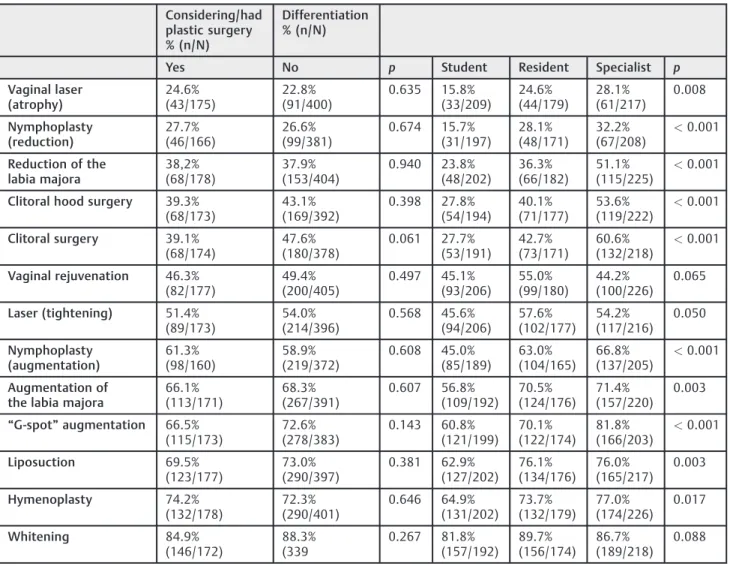
More than half of the participants considered that there never or there rarely exists a medical reason to perform the following: vulvar whitening (85.9% [502/584]); hymeno-plasty (72.0% [437/607]); liposuction of the mons pubis (71.6% [426/595]); “G-spot” augmentation (71.0% [409/576]); aug-mentation of the labia majora (66.3% [390/588]); augmenta-tion of the labia minora (58.3% [326/559]); and vaginal tightening with laser (52.3% [313/599]). Laser treatment of vaginal atrophy and nymphoplasty were the procedures that most participants considered as having a medical indication (77.2% [467/605] and 74.7% [430/576] respectively) (►Fig. 1). The answers in this topic were independent of the fact that the respondents worked in private practice or not, of if they had had or had considered having plastic surgery themselves. Gender did not influence this opinion, except in the case of liposuction of the mons pubis (female - 74.1% [303/409] versus male - 66.1% [123/186]; p¼0.046) and vulvar whitening (female 89.1% [351/394] versus male -79.5% [151/190];p¼0.002). Gynecologists were much more likely to consider that there is no medical reason to perform these procedures, while the opposite was true for plastic surgeons. The answers of the group of other medical specialties, which was considered as a whole, scored in-between. The grade of differentiation also had an influence on the outcome, with specialists more likely to consider there was an absence of medical justification for the proce-dures, while students were more likely to consider the opposite (►Table 1).
The gender of the participants and the fact that they worked in private practice did not influence the opinion about the ethical issues associated with these procedures. On the contrary, specialty had an effect, since being a plastic surgeon was associated with a lower likelihood of having ethical objections, while being a gynecologist was associated with the opposite. Those who had considered having or who
had had plastic surgery themselves were less likely to raise ethical concerns; the same was true for the residents, and even more so for the students (►Table 2).
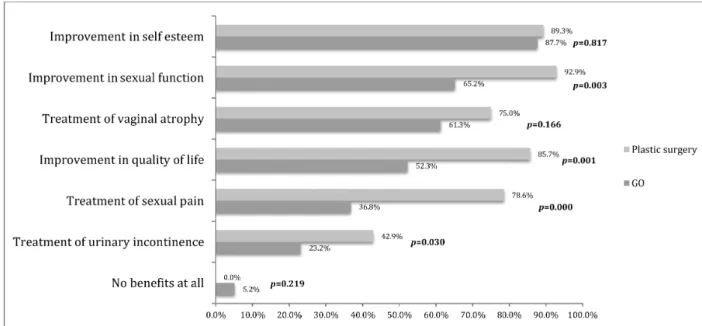
Only 2.1% (14/664) of the participants considered that there is never any benefit from VVAPs. Most participants considered that they could contribute to an improvement in: self-esteem (92.3% [613/664]); sexual function (78.5%
Table 1 Percentage of participants who answered that a specific procedure did not or rarely had a medical indication
Gender % (n/N) Private practice % (n/N) Specialty % (n/N)
Female Male p Yes No p ObGyn Plastic
surgery Other non-surgical Other surgical p Vaginal laser (atrophy) 23.2% (96/413) 21.9% (42/192) 0.709 27.0% (38/141) 30.0% (23/76) 0.873 33.8% (50/148) 4.2% (1/24) 21.7% (65/300) 17.6% (15/85) 0.001 Nymphoplasty (reduction) 25.3% (47/184) 25.3% (99/392) 0.941 32.6% (44/135) 31.5% (23/73) 1.000 30.9% (47/152) 0.0% (0/26) 24.5% (68/278) 26.2% (21/80) 0.009
Reduction of the labia majora 38.8% (161/415) 35.1% (68/194) 0.374 52.7% (78/148) 48,1% (37/77) 0.508 59.2% (90/152) 16.7% (4/24) 31.2% (95/304) 36.5% (31/85) <0.001 Clitoral hood surgery 43.1% (172/399) 37.1% (72/194) 0.164 53.4% (79/148) 54.1% (40/74) 0.924 61.7% (92/149) 20,0% (5/25) 35.6% (104/292) 38.6% (32/83) <0.001
Clitoral surgery 44.1%
(173/392) 45.2%(85/182) 0.806 59.9%(88/147) 62.0%(44/71) 0.765 65.8%(96/146) 25%(6/24) 38.1%(107/281) 41.2%(35/85)
<0.001 Vaginal rejuvenation 50.0% (208/416) 42.9% (84/196) 0.099 42.3% (63/149) 48.1% (37/77) 0.408 55.8% (86/154) 30.8% (8/26) 45.2% (137/303) 44.6% (37/83) 0.043
Laser (tightening) 54.6% (224/410) 47.1% (89/189) 0.086 54.0% (75/139) 54.5% (42/77) 0.934 63.3% (93/147) 40.0% (10/25) 48.0% (144/300) 50.0% (40/80) 0.012 Nymphoplasty (augmentation) 59.3% (224/378) 56.4% (102/181) 0.514 66.4% (89/134) 67.6% (48/71) 0.864 74.7% (109/146) 56.0% (14/25) 55.0% (149/271) 46.2% (36/78) <0.001 Augmentation of the labia majora
65.7%
(262/399) 67.7%(128/189) 0.621 70.3%(102/145) 73.3%(55/75) 0.642 78.9%(116/147)) 60.9%(14/23) 62.3%(182/292) 65.1%(54/83) 0.005
“G-spot”
augmentation 71.8% (285/397) 69.3% (124/179) 0.538 84.2% (112/133) 77.1% (54/70) 0.215 86.4% (121/140) 56.0% (14/25) 69.0% (196/284) 61.4% (51/83) <0.001 Liposuction 74.1% (303/409) 66.1% (123/186) 0.046 75.0% (105/140) 77.9% (60/77) 0.629 83.8% (119/142) 56.0% (14/25) 71.1% (212/298) 72.3% (52/84) 0.001 Hymenoplasty 73.9%
(303/410) 68.0%(134/197) 0.131 73.6%(109/148) 83.3%(65/78) 0.100 75.8%(113/149) 57.7%(15/26) 74.3%(225/303) 70.4%(57/81) 0.238
Whitening 89.1% (351/394) 79.5% (151/190) 0.002 83.9% (120/143) 92.0% (69/75) 0.095 91.0% (132/145) 76.0% (19/25) 86.9% (252/290) 79.3% (65/82) 0.036
(continues)
[521/664]); vaginal atrophy (69.9% [464/664]); quality of life (66.3% [440/664]); and sexual pain (61.4% [408/664]). There were no differences when the stratification for gender was performed (data not shown). Plastic surgeons, when com-pared with gynecologists, were more likely to consider the
possible benefits of these procedures, and the differences were statistically significant regarding the improvements in: sexual function (92.9% [26/28] versus 65.2% [101/155]; p¼0.003); quality of life (85.7% [24/28] versus 52.3% [81/155]; p¼0.001]); sexual pain (78.6% [22/28] versus Table 1 Percentage of participants who answered that a specific procedure did not or rarely had a medical indication (continuation)
Considering/had plastic surgery % (n/N)
Differentiation % (n/N)
Yes No p Student Resident Specialist p
Vaginal laser (atrophy)
24.6%
(43/175) 22.8%(91/400) 0.635 15.8%(33/209) 24.6%(44/179) 28.1%(61/217) 0.008
Nymphoplasty (reduction)
27.7%
(46/166) 26.6%(99/381) 0.674 15.7%(31/197) 28.1%(48/171) 32.2%(67/208)
<0.001
Reduction of the labia majora
38,2%
(68/178) 37.9%(153/404) 0.940 23.8%(48/202) 36.3%(66/182) 51.1%(115/225)
<0.001
Clitoral hood surgery 39.3%
(68/173) 43.1%(169/392) 0.398 27.8%(54/194) 40.1%(71/177) 53.6%(119/222)
<0.001
Clitoral surgery 39.1%
(68/174) 47.6%(180/378) 0.061 27.7%(53/191) 42.7%(73/171) 60.6%(132/218)
<0.001
Vaginal rejuvenation 46.3%
(82/177) 49.4%(200/405) 0.497 45.1%(93/206) 55.0%(99/180) 44.2%(100/226) 0.065
Laser (tightening) 51.4%
(89/173) 54.0%(214/396) 0.568 45.6%(94/206) 57.6%(102/177) 54.2%(117/216) 0.050
Nymphoplasty (augmentation)
61.3%
(98/160) 58.9%(219/372) 0.608 45.0%(85/189) 63.0%(104/165) 66.8%(137/205)
<0.001
Augmentation of the labia majora
66.1%
(113/171) 68.3%(267/391) 0.607 56.8%(109/192) 70.5%(124/176) 71.4%(157/220) 0.003
“G-spot”augmentation 66.5%
(115/173) 72.6%(278/383) 0.143 60.8%(121/199) 70.1%(122/174) 81.8%(166/203)
<0.001
Liposuction 69.5%
(123/177) 73.0%(290/397) 0.381 62.9%(127/202) 76.1%(134/176) 76.0%(165/217) 0.003
Hymenoplasty 74.2%
(132/178) 72.3%(290/401) 0.646 64.9%(131/202) 73.7%(132/179) 77.0%(174/226) 0.017
Whitening 84.9%
(146/172) 88.3%(339 0.267 81.8%(157/192) 89.7%(156/174) 86.7%(189/218) 0.088
Abbreviation: ObGyn, Gynaecologists/Obstetricians. Note: Includes only specialists.
Table 2 Percentage of participants who considered that there may be ethical issues concerning the performance of specific vulvovaginal aesthetic procedures
Gender % (n/N) Private practice % (n/N) Specialty % (n/N)
Female Male p Yes No P ObGyn Plastic
surgery Other non-surgical Other surgical p Nymphoplasty (reduction) 16.9% (58/343) 21.6% (37/171) 0.193 20.6% (13/63) 22.7% (30/132) 0.742 21.3% (30/141) 8.7% (2/21) 17.1% (41/240) 19.2% (15/78) 0.468 Vaginal laser (atrophy) 19.9% (73/366) 22.3% (39/175) 0.530 26.6% (37/139) 23.1% (15/65) 0.589 29.6% (40/135) 8.3% (2/24) 17.0% (45/265) 22.0% (18/82) 0.011
Reduction of the labia majora 25.0% (91/364) 25.7% (47/183) 0.862 33.8% (48/142) 29.9% (20/67) 0.569 41.3% (59/143) 12.5% (3/24) 19.1% (51/267) 25.0% (20/80) <0.001
Clitoral hood surgery 33.5% (119/355) 29.0% (53/183) 0.283 43.3% (61/141) 39.7% (25/63) 0.632 48.2% (66/137) 17.4% (4/23) 26.8% (70/261) 28.9% (24/83) <0.001
Laser (tightening) 33.9% (121/357) 30.7% (54/176) 0.458 40.3% (56/139) 38.7% (24/62) 0.833 49.3% (66/134) 12.5% (3/24) 27.6% (71/257) 31.3% (26/83)) <0.001
Vaginal rejuvenation 34.0% (123/362) 31.3% (56/180) 0.504 38.0% (54/142) 31.2% (20/64) 0.348 44.9% (62/138) 16.7% (4/24) 28.6% (74/259) 32.9% (28/85) 0.003 Liposuction 34.5% (123/357) 32.6% (56/172) 0.666 43.8% (57/130) 44.8% (30/67) 0.901 54.3% (69/127) 16.7% (4/24) 29.6% (77/260) 24.1% (20/83) <0.001
Clitoral surgery 35.0% (122/349) 32.6% (58/178) 0.587 45.3% (63/139) 41.9% (26/62) 0.655 51.5% (70/136) 13.6% (3/22) 29.5% (75/254) 28.4% (23/81) <0.001 Nymphoplasty (augmentation) 35.1% (119/339) 37.8% (65/172) 0.550 50.4% (66/131) 46.0% (29/63) 0.570 54.7% (76/139) 18.2% (4/22) 28.7% (69/240) 36.7% (29/79) <0.001 Augmentation of the labia majora
37.1% (132/356) 36.0% (64/178) 0.800 47.5% (66/139) 50.0% (32/64) 0.739 56.5% (78/138) 17.4% (4/23) 29.3% (76/259) 37.0% (30/81) <0.001 Whitening 43.5% (154/354) 41.7% (75/180) 0.685 52.9% (73/138) 55.4% (36/65) 0.740 57.8% (78/135) 26.1% (6/23) 39.4% (102/259) 41.0% (34/83) 0.001
“G-spot” augmentation 45.4% (164/361) 42.0% (71/169) 0.460 59.2% (77/130) 52.3% (34/65) 0.357 68.0% (87/128) 30.4% (7/23) 36.9% (96/260) 42.9% (36/84) <0.001 Hymenoplasty 53.7% (198/369) 45.9% (85/185) 0.087 58.5% (83/142) 62.7% (42/67) 0.560 65.0% (91/140) 37.5% (9/24) 48.5% (132/272) 48.1% (39/81) 0.004
Considering/had plastic surgery % (n/N)
Differentiation % (n/N)
Yes No p Student Resident Specialist p
Nymphoplasty (reduction) 16.4% (25/152) 20.5% (69/336) 0.289 15.1% (26/172) 17.7% (26/147) 22.1% (43/195) 0.223
Vaginal laser (atrophy) 15.2% (25/164) 23.0% (81/352) 0.042 16.5% (30/182) 19.4% (30/155) 25.5% (52/204) 0.082
Reduction of the labia majora 19.1% (31/162) 28.1% (101/359) 0.029 19.6% (35/179) 22.0% (35/179) 32.5% (68/209) 0.007
Clitoral hood surgery 25.8% (42/121) 34.4% (120/329) 0.051 24.6% (44/179) 27.1% (42/155) 42.2% (86/204) <0.001
Laser (tightening) 27.3% (44/161) 35.7% (124/347) 0.061 24.7% (45/182) 33.3% (50/150) 39.8% (80/201) 0.007
Vaginal rejuvenation 26.7% (43/161) 35.8% (127/355) 0.042 29.2% (54/185) 33.8% (51/151) 35.9% (74/206) 0.359 Liposuction 25.3% (41/162) 37.1% (130/350) 0.008 27.5% (50/182) 28.0% (42/150) 44.2% (87/197) 0.001
Clitoral surgery 25.8%
(41/159) 37.7% (129/342) 0.009 25.7% (45/175) 30.5% (46/151) 44.3% (89/201) <0.001
Nymphoplasty (augmentation) 30.9% (46/149) 39.0% (131/336) 0.087 27.1% (46/170) 29.3% (43/147) 49.0% (95/194) <0.001
Augmentation of the labia majora 28.9% (46/159) 40.7% (142/349) 0.011 29.9% (53/177) 29.2% (45/154) 48.3% (98/203) <0.001 Whitening 33.5% (54/161) 47.6% (166/349) 0.003 34.5% (61/177) 38.3% (59/154) 53.7% (109/203) <0.001
“G-spot”augmentation 35.2% (58/165) 47.7% (166/348) 0.007 34.1% (62/182) 40.5% (62/153) 56.9% (111/195) <0.001 Hymenoplasty 47.9% (81/169) 52,9% (190/359) 0.284 42.7% (79/185) 49.4% (79/160) 59.8% (125/209) 0.003
36.8% [57/155],p¼0.000); and urinary incontinence (42.9% [12/28] versus 23.2%,p¼0.030) (►Fig. 3).
Most participants disagreed that VVAPsfit into the World Health Organization’s (WHO) definition of female genital mutilation (51.4% [341/664]). The majority agreed, at least partially, that: these procedures should not be performed in patients under the age of 18 years old (582/664 [87.6%]); they should be considered in the same way as surgery at any other anatomical site (568/664 [85.5%]); all women should be evaluated by a psychiatrist/sexologist prior to surgery (552/664 [83.1%]); if performed, these surgeries should take place in public hospitals (381/664 [57.3%]); advertising them should be forbidden (339/664 [51.0%]) (►Fig. 4).
Discussion
The primary objective of this study was to evaluate the opinion of medical students and doctors on the existence of any
medical justification or ethical concerns about the perfor-mance of VVAPs. The secondary outcomes included the determining factors that influenced their answers, and which potential impacts the participants considered these proce-dures can have.
For most VVAPs, more than half of the participants con-sidered that there is never or there rarely is any medical justification to perform the procedures. Despite this common opinion, the percentage of participants who considered VVAPs to be unethical was much lower, and most even considered that VVAPs could have a positive impact in terms of self-esteem, sexual function, vaginal atrophy, quality of life, and sexual pain.
Vulvar whitening was considered the procedure with the least scientific background supporting its performance. It is frequently performed along with anal whitening,1,10and is not exempt from complications. It was followed by hymenoplasty, liposuction of the mons pubis, “G-spot” augmentation, Fig. 3 Percentage of participants who considered that aesthetic procedures can have a positive impact in several questions (total includes all participants).
augmentation of the labia majora, augmentation of the labia minora, and the use of laser for vaginal tightening. The existence of the“G-spot”itself is debatable, and all procedures aiming at its augmentation, despite being offered by some providers, are considered useless and unethical – just like laser vaginal tightening.5,11,12 Hymenoplasty was suggested by Reziciner as a way to prevent recurrent post-coital cystitis,13but without any scientific support to recommend it. Although there is never any medical indication to perform it, it has been life-saving for some Muslim girls, and this highlights how important relative ethical issues can be in different communities.14Liposuction can be considered after significant weight loss.15Augmentation of the labia majora and minora is often offered as an aesthetic procedure for aging women–especially with the use offillers or autologous fat; despite the absence of studies, it can be con-sidered in very special cases (marked loss of weight, neoplasia, hidradenitis suppurative, antiretroviral use).15,16
On the contrary, only a quarter or less of the respondents considered that there is no scientific evidence for the use of laser for the treatment of vaginal atrophy and for nymphoplasty. Despite the wide commercialization and use of laser for the treatment of vaginal atrophy,17there have been no randomized, case control studies published. The long-term effects and safety have not been demonstrated so far. Nymphoplasty is probably the most performed VVAP, and the one with most published papers. However, there is still no definition of labial hypertro-phy,18–20no studies comparing surgery and non-intervention, as well as no data about the long-term satisfaction or late complications (scar retraction in menopause, for example).
Despite the heterogeneity of the sample, there was a good correlation between the opinion of the participants and the evidence or lack thereof in the literature. However, some factors influenced the opinion of the participants, namely the specialty and the degree of differentiation, as plastic surgeons and students were more likely to consider that there were medical indications for the procedures. On the other hand, gynecologists were more likely to raise doubts about medical indications. Gender, not having a private practice, and having had or considering having plastic sur-gery did not play a significant role in the opinions. The general overview changed when they were questioned if the performance of such procedures was unethical or not: more than half of the subjects only raised ethical issues about hymenoplasty. Concerning the medical justification, despite minor variations in the order, the results were fairly similar to those obtained previously. Unlike what was found in the previous question, the participants who had had or had considered having plastic surgery (nearly one third of them) were less likely to raise ethical questions about the procedures. While personal beliefs did not seem to affect the opinion in terms of the medical reason for the procedures, they had an effect when the ethics question was asked. This shows the importance and relativity of one of the four ethical principles, the principle of autonomy:21,22the participants state that there is no medical reason for the performance of the procedures, but respect one’s right to undergo them. However, the autonomy principle implies informed consent, and it cannot exist in the absence of scientific data (about
complications, outcomes, etc.). It is generally assumed that the risk associated with most procedures is low (non-maleficence principle), and that they can have some benefits (beneficence principle). However, the few studies in this area do not support the idea that the risk is low enough to overcome the non-maleficence principle.10,23–25It must be kept in mind that the beneficence principle is secondary to the autonomy one, but the perceptions of the benefits may not be real, and there are no long-term satisfaction studies.22 Almost all participants stated that the performance of VVAPs can have advantages. Systematically, gynecologists considered VVAPs less likely to have benefits than plastic surgeons. It is relevant to state that 61% of all participants (79% of plastic surgeons and 37% of gynecologists) consid-ered that some of these procedures can treat sexual pain. We highlight the dangers of the performance of VVAPs without a previous evaluation by a gynecologist to exclude vulvar and/ or pelvicfloor diseases. It is not uncommon to encounter in the clinical practice women with vulvodynia attributing their symptoms to the size of their labia minora. Failure to recognize lichen sclerosus can lead to unexpected results, as the disease tends to manifest in the scars (isomorphism).
More than 80% of the participants agreed that VVAPs should not be performed in patients under the age of 18 years old. Full genital growth and development is not achieved before that age, so VVAPs should never be performed in adolescents (patients with genital malformations are special cases that should be evaluated by adolescent gynecology experts).6,7,26
The claim that VVAPs are not different from procedures in other anatomical regions was also accepted by the majority of participants. Therefore, the ethical concern threshold must be raised to the same level as other procedures (breast augmen-tation, rhinoplasty, etc.). However, the vulva is a part of the body that is not directly exposed; therefore, many women do not know the normal range of anatomical variation. In reality, most women seeking surgery are anatomically normal.27
The need for previous evaluation by a sexologist/psychia-trist was acknowledged by nearly 75% of the participants. Body dysmorphic disorder is quite rare in the population in general, but is very common in women seeking plastic surgery.28These patients are likely to be dissatisfied with their surgical out-come and go on to have repeated procedures.29
In Portugal, most VVAPs are performed in private settings, without insurance coverage. This clearly does notfit the justice principle, as not everyone can have access to undergo these procedures. More than half of the respondents considered that these procedures should be performed in public hospitals, where there is afiner triage of the patients and thorough psychiatric and gynecologic evaluations are performed.
Only 41% of participants agreed with the statement that advertising puts pressure in women;22however some med-ical societies have already recommended against it.8
most countries. Although only one third of the respondents agreed with this statement, this highlights the need for clear definitions and guidelines for the procedures, for the protec-tion of both the patients and doctors involved in them.
The weak points of the present study include the fact that there may have been several biases in the participants’ enrol-ment: those interested in the subject and the younger ones (who are more likely to use the internet) may have been more prone to answer–as shown by the fact that the distribution of the answers was balanced between the different grades of differentiation, despite the fact that medical doctors comprise the largest group. The lack of validated scores to evaluate one’s opinion/attitudes toward these procedures can make it more difficult for future comparisons.
Medical doctors and medical students acknowledge the lack of scientific support for the performance of VVAPs. However, most of them do not raise ethical objections for their perfor-mance, especially if they are less specialized, are plastic surgeons, or have themselves had or considered having plastic surgery. This, in part, may be due to an assumed potential benefit, despite the inexistence of reliable clinical data.
Acknowledgments
The authors would like to thank to Sociedade Portuguesa de Ginecologia (Portuguese Society of Gynecology), and Mr. Peter Greenhouse, FRCOG, from Bristol, UK, for his assistance with the text. The authors have received no funding for the preparation or writing of this paper.
References
1 Vieira-Baptista P, Lima-Silva J, Beires J.“Intimate surgery”: what is done and under which scientif basis? Acta Obstet Ginecol Port. 2015;9(05):393–399
2 Liao LM, Taghinejadi N, Creighton SM. An analysis of the content and clinical implications of online advertisements for female genital cosmetic surgery. BMJ Open 2012;2(06):e001908
3 Vieira-Baptista P.“Cirurgia íntima” –tempo de impor limites. Acta Obstet Ginecol Port. 2014;8(03):223–225
4 Sharp G, Tiggemann M, Mattiske J. Factors that influence the decision to undergo labiaplasty: media, relationships, and psy-chological well-being. Aesthet Surg J 2016;36(04):469–478
5 Committee on Gynecologic Practice, American College of Obste-tricians and Gynecologists. ACOG Committee Opinion No. 378: Vaginal“rejuvenation”and cosmetic vaginal procedures. Obstet Gynecol 2007;110(03):737–738
6 Female genital cosmetic surgery: a resource for general practi-tioners and other health professionals. Melbourne: The Royal Australian College of General Practitioners; 2015
7 British Society for Paediatric & Adolescent Gynaecology [Inter-net]. Position Statement: labial reduction surgery (Labiaplasty) on adolescents. 2013 [cited 2016 Dec 10]. Available from: http:// www.britspag.org/sites/default/files/downloads/Labiaplasty% 20%20final%20Position%20Statement.pdf
8 Society of Obstetricians and Gynaecologists of Canada. Female genital cosmetic surgery: SOGC Policy Statement, 300. J Obstet Gynaecol Can [Internet]. 2013 [cited 2016 Feb 12];35(12):e1-e5.
Available from: https://sogc.org/wp-content/uploads/2013/09/ December2013-CPG300-ENG-Online_final.pdf
9 Eysenbach G. Improving the quality of Web surveys: the Checklist for Reporting Results of Internet E-Surveys (CHERRIES). J Med Internet Res 2004;6(03):e34
10 Cihantimur B, Herold C. Genital beautification: a concept that offers more than reduction of the labia minora. Aesthetic Plast Surg 2013;37(06):1128–1133
11 Puppo V, Gruenwald I. Does the G-spot exist? A review of the current literature. Int Urogynecol J Pelvic Floor Dysfunct 2012; 23(12):1665–1669
12 Kilchevsky A, Vardi Y, Lowenstein L, Gruenwald I. Is the female G-spot truly a distinct anatomic entity? J Sex Med 2012;9(03):719–726
13 Reziciner S. [Prevention of recurrent post-coital cystitis using hymenoplasty]. Ann Urol (Paris) 1988;22(06):446–451 French
14 Ahmadi A. Ethical issues in hymenoplasty: views from Tehran’s physicians. J Med Ethics 2014;40(06):429–430
15 Alter GJ. Management of the mons pubis and labia majora in the massive weight loss patient. Aesthet Surg J 2009;29(05):432–442
16 Lapalorcia LM, Podda S, Campiglio G, Cordellini M. Labia majora labioplasty in HIV-related vaginal lipodystrophy: technique descrip-tion and literature review. Aesthetic Plast Surg 2013;37(04):711–714
17 Sokol ER, Karram MM. An assessment of the safety and efficacy of a fractional CO2 laser system for the treatment of vulvovaginal atrophy. Menopause 2016;23(10):1102–1107
18 Goodman MP. Female genital cosmetic and plastic surgery: a review. J Sex Med 2011;8(06):1813–1825
19 Ostrzenski A. Selecting aesthetic gynecologic procedures for plastic surgeons: a review of target methodology. Aesthetic Plast Surg 2013;37(02):256–265
20 Radman HM. Hypertrophy of the labia minora. Obstet Gynecol 1976;48(1, Suppl)78S–79S
21 Gillon R. Medical ethics: four principles plus attention to scope. BMJ 1994;309(6948):184–188
22 Goldstein AT, Jutrzonka SL. Ethical considerations of female genital plastic/cosmetic surgery. In: Goodman MP, editor. Female genital plastic and cosmetic surgery. Hoboken: John Wiley & Sons; 2016. p. 39–44
23 Alter GJ. Aesthetic labia minora and clitoral hood reduction using extended central wedge resection. Plast Reconstr Surg 2008; 122(06):1780–1789
24 Rouzier R, Louis-Sylvestre C, Paniel BJ, Haddad B. Hypertrophy of labia minora: experience with 163 reductions. Am J Obstet Gynecol 2000;182(1 Pt 1):35–40
25 Goodman MP, Placik OJ, Benson RH III, et al. A large multicenter outcome study of female genital plastic surgery. J Sex Med 2010; 7(4 Pt 1):1565–1577
26 Lloyd J, Crouch NS, Minto CL, Liao LM, Creighton SM. Female genital appearance:“normality”unfolds. BJOG 2005;112(05):643–646
27 McDougall LJ. Towards a clean slit: how medicine and notions of normality are shaping female genital aesthetics. Cult Health Sex 2013;15(07):774–787
28 Tadisina KK, Chopra K, Singh DP. Body dysmorphic disorder in plastic surgery. Eplasty 2013;13:ic48
29 Likes WM, Sideri M, Haefner H, Cunningham P, Albani F. Aesthetic practice of labial reduction. J Low Genit Tract Dis 2008;12(03): 210–216
30 World Health Organization [Internet]. Eliminating female genital mutilation: an interagency statement: UNAIDS, UNDP, UNECA, UNESCO, UNFPA, UNHCHR, UNHCR, UNICEF, UNIFEM, WHO. Gene-vaWHO2008 [cited 2014 Aug 29]. Available from: http://apps.who. int/iris/bitstream/10665/43839/1/9789241596442_eng.pdf