www.scielo.br/rbg
MESOSPHERIC 2-DAY WAVES OBSERVED SIMULTANEOUSLY IN THE EQUATORIAL
AND LOW LATITUDES REGIONS OF BRAZIL
Lourivaldo Mota Lima
1, Amauri F. Medeiros
2, Ricardo A. Buriti
2, Paulo P. Batista
3,
Barclay R. Clemesha
3and Hisao Takahashi
3Recebido em 17 janeiro, 2006 / Aceito em 26 marc¸o, 2007 Received on January 17, 2006 / Accepted on March 26, 2007
ABSTRACT.Simultaneous observations of the atmospheric neutral winds in the mesosphere and lower thermosphere (MLT) by meteor radar have been carried out at S˜ao Jo˜ao do Cariri (7.4◦S, 36.5◦W) and Cachoeira Paulista (22.7◦S, 45.0◦W). From the wind variability we investigate the atmospheric planetary-scale quasi-two-day
waves, which were present at both the sites during the winter of 2004 and summer of 2004/2005. The amplitude of the meridional component was larger than that of the zonal component, reaching a maximum value of∼60 m/s at the equatorial site and∼25 m/s at the low latitude site during the winter. During the January-February period the 2-day wave was very similar at the two sites, with a maximum amplitude of∼50 m/s. The phase propagation with height shows a descending mode and upward energy propagation. The vertical wavelength estimated for Cachoeira Paulista (40-67 km) was longer than for S˜ao Jo˜ao do Cariri (30-35 km), for all of the observed events. Cross-spectral analysis showed a significant coherence between the quasi-two-day oscillations observed at the two sites. From the phase difference between the two sites we concluded that S˜ao Jo˜ao do Cariri leads Cachoeira Paulista. These results denote that amplitude peak at 36.5◦W and subsequently at 45◦W, compatible
with a westward propagating wave.
Keywords: quasi-2-day wave, planetary-waves, meteor radar, upper mesosphere.
RESUMO.Este trabalho tem como base medidas dos ventos da parte superior da mesosfera e da baixa termosfera obtidas simultaneamente atrav´es de radares mete´oricos em S˜ao Jo˜ao do Cariri (7.4◦S, 36.5◦O) e Cachoeira Paulista (22.7◦S, 45.0◦O). As ondas atmosf´ericas de escala planet´aria com per´ıodos pr´oximos de 2
dias s˜ao investigadas, as quais estiveram presentes nos ventos das duas localidades durante o inverno de 2004 e ver˜ao de 2004/2005. As amplitudes das oscilac¸˜oes foram mais intensas na componente meridional, alcanc¸ando m´aximos de∼60 m/s na localidade equatorial e∼25 m/s na de baixa latitude durante o inverno. Durante o per´ıodo de janeiro-fevereiro a onda de 2 dias mostrou-se similar em ambas as localidades, com amplitude m´axima de∼50 m/s. A propagac¸˜ao de fase com a altura foi descendente, compat´ıvel com propagac¸˜ao ascendente de energia. Os comprimentos de onda verticais estimados para Cachoeira Paulista (40-67 km) foram maiores do que para S˜ao Jo˜ao do Cariri (30-35 km). An´alises de espectro cruzado mostraram coerˆencia significativa entre as oscilac¸˜oes de 2 dias nas duas localidades. Da diferenc¸a de fase entre as duas localidades verificou-se que os m´aximos em S˜ao Jo˜ao do Cariri (36,5◦O) ocorrem antes do que os de Cachoeira Paulista (45◦O),
indicando propagac¸˜ao para a direc¸˜ao oeste.
Palavras-chave: onda de quase 2 dias, ondas planet´arias, radar mete´orico, mesosfera superior.
1Departamento de F´ısica/CCT, Universidade Estadual da Para´ıba (UEPB), Rua Juvˆencio Arruda, s/n, Bodocong´o – 58109-790 Campina Grande, PB, Brasil. Tel.: (83) 3315-3371 – E-mail: [email protected]
2Universidade Federal de Campina Grande (UFCG), Av. Apr´ıgio Veloso, 882, Bloco CY, Bodocong´o – 58109-970 Campina Grande, PB, Brasil. Tel.: (83) 3310-1196 – E-mails: [email protected]; [email protected]
INTRODUCTION
The well-known quasi-two-day wave is a prominent feature of the mesosphere and lower thermosphere (MLT) regions. This wave is a planetary scale oscillation that migrates westward, which ma-ximizes soon after the summer solstice and which has been ob-served by ground-based and satellite techniques. Quasi-two-day waves are those oscillations with periods between 40-60 h and, in general, their amplitudes for the meridional wind component are greater than for the zonal at middle and high latitudes. In the Southern summer Hemisphere, the wave period is close to 48 h (e.g., Craig & Elford, 1981), while in the Northern summer Hemisphere the wave period is found to be more variable, ranging from 43 h to 53 h (e.g., Muller & Nelson, 1978; Thayaparan et al., 1997). Equatorial and low latitude observations have revealed the presence of this wave during the boreal and austral summers as well (Harris & Vincent, 1993; Gurubaran et al., 2001; Lima et al., 2004).
Most studies have used simultaneous radar and satellite measurements to determine the zonal structure of the wave. In the Southern Hemisphere the zonal wavenumber 3 prevails (Rodgers & Prata, 1981; Thayaparan et al., 1997; Limpasuvan & Wu, 2003). In the Northern Hemisphere, zonal wavenumbers between 2 and 5 have been reported, with wavenumbers 3 and 4 being the more important (Meek et al., 1996; Thayaparan et al., 1997).
The quasi-two-day wave was interpreted as a manifestation of the Rossby-gravity (3, 0) normal mode, in that the eigenstructure exhibits a predominant maximum in the meridional wind com-ponent at the equator. On the other hand, the zonal comcom-ponent passes through a node at the equator and is dominated by me-ridional component up to mi-latitudes (Salby, 1981). Using a mechanical model based on primitive equations, realistic back-ground winds and analytic temperatures, Salby (1981) showed that the (3, 0) mode produces a significant response in the sum-mer mesosphere. Hagan et al. (1993) performed a succession of numerical experiments using a linearized spectral model that includes realistic wind and temperature fields and dissipation ef-fects, and also found a response to the Rossby normal mode in the lower thermosphere compatible with the observations. An alternative explanation was proposed by Plumb (1983). Ba-sed on a one-dimensional model, he showed that a 2-day wave with a zonal wavenumber 3 can be the product of zones of ba-roclinic instability above the summer stratospheric westward jet. Pfister (1985) extended the simulations to two dimensions and found peaks in the unstable wave growth at zonal wave numbers
2-4, with periods between 1.4 and 3 days. The possibility that the 2-day wave could be caused by a combination of the two mecha-nisms was suggested by Randel (1994) and, Norton & Thuburn (1996). Salby & Callaghan (2001) also explored the possibility that the 2-day wave could be produced by a mixture of the two excitation mechanisms. Hence, there is no conclusive evidence pointing to the source of the 2-day wave observed at MLT region. In the present study, we investigate some aspects of the quasi-two-day wave observed in the horizontal winds obtained simultaneously in the equatorial and low latitudes MLT regi-ons of the Southern Hemisphere, during winter 2004 and sum-mer 2004/2005. The data and results are important since this comparison has not been previously done in this zone. In this way, further insights are supplied to better understand the rela-tionship between 2-day wave and the zonal mean circulation in the MLT region.
METEOR WINDS AND DATA ANALYSIS
This study is based on hourly mean wind measurements collec-ted simultaneously over S˜ao Jo˜ao do Cariri (7.4◦S, 36.5◦W) and Cachoeira Paulista (22.7◦S, 45◦W), Brazil, estimated in seven height intervals of 4 km thickness, separated by 3 km, centered at 81, 84, 87, 90,93,96 and 99 km. The data series cover the time interval from June 2004 to February 2005. The winds data were obtained by identical SKiYMET meteor radars. Both systems operate at a frequency of 35.24 MHz and use an interferometric receiver antenna array. From the relative phases of the signals at the various antennas together with the echo range information, the position of the meteor is accurately located. The radial wind velo-city is determined from the Doppler shift (Hocking et al., 2001).
quasi-2-day oscillation was more intense in the equatorial region than at lower latitudes, and during austral summer their intensities were similar.
Figure 1– Power spectra for 90 km meridional winds over S˜ao Jo˜ao do Cariri (solid line) and Cachoeira Paulista (dash dot line), A) for the periods 1-30 August 2004 and B) 15 January to 13 February 2005.
To examine the amplitude intensifications of the quasi-2-day wave, the wind data from June 2004 to February 2005 for both sites were subjected to harmonic analysis. The analysis was performed for sliding four-day segments stepped by one day. The quasi-2-day amplitudes and phases of the zonal and meridi-onal wind components were fitted in a least-mean-square sense, assuming that semidiurnal, diurnal and quasi-2-day oscillations were present in the horizontal wind components at all times. Figures 2A and 2B shows the amplitudes of the 2-day oscilla-tions for both the zonal and meridional components for altitude range centered at 90 km in the time interval from June 2004 to February 2005. It can be seen from these figures that the 2-day
wave has maximum amplitude during the solstice months, i.e. for time intervals from about day 212 (July 30, 2004) to day 243 (August 30, 2004) and from about day 356 (December 21, 2004) to day 414 (February 17, 2005). As can be seen, as at other sites, during 2-day wave events the meridional amplitudes (Fig. 2A) were larger than the zonal (Fig. 2B, reaching maximum values of∼60/25 (winter) and∼50/45 m/s (summer) at S˜ao Jo˜ao do Cariri/Cachoeira Paulista. The meridional amplitude indicates the weaker presence of 2-day activity at other times of the year, mainly over S˜ao Jo˜ao do Cariri. In this paper, the Southern winter and summer occurrences of the 2-day wave will be analyzed only for the meridional component.
Figure 2– Daily amplitudes of the 2-day oscillations at 90 km for S˜ao Jo˜ao do Cariri (solid line) and Cachoeira Paulista (dash dot line) for A) zonal and B) meridional components from June, 2004 to February, 2005.
Figure 3– Meridional component of the winds observed at 90 km for S˜ao Jo˜ao do Cariri and Cachoeira Paulista during 2004 winter and 2004/2005 summer. Data have been band-pass filtered to retain only periods between 42 h and 54 h.
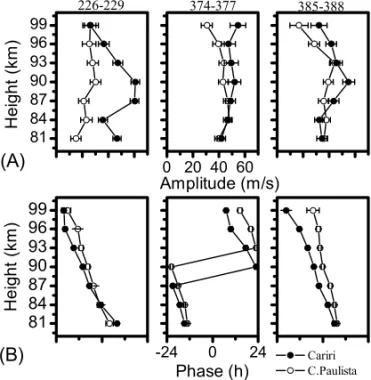
wave was more intense at the equatorial site than at the low lati-tude site, suggesting a leakage of the wave from the summer he-misphere to the winter hehe-misphere. During summer 2004/2005 the occurrence of the 2-day wave was very similar at the two sites, mainly during the interval from about day 370 to day 406 (January 04 to February 10). In general, the period of intense ac-tivity at the equatorial site was longer than at the low latitude site. To display the behavior of the amplitude and phase of the 2-day wave as a function of height, the results obtained by harmo-nic analysis, for meridional winds measured during the strongest events at both sites, are shown in Figures 4A and 4B.
As can be seen in Figure 4A, in general, maximum amplitude values occur for heights around 90 km at both sites. The larger amplitude in the S˜ao Jo˜ao do Cariri data observed during interval from 226-229 (austral winter) is in accordance with suggesting of leakage of the 2-day wave from the Northern summer hemisphere to the Southern winter hemisphere. The behavior of the phase with height (Fig. 4B) are very similar for each of the three event peri-ods and shows that the time of the maximum meridional wind, at both sites, is earlier at greater heights, suggesting a descending phase and upward energy propagation. From the phase structu-res, we estimate the vertical wavelengths. The results show that at Cachoeira Paulista the vertical wavelengths (∼41±2,∼41±2.4, and∼65±3.4 km) were consistently larger than at S˜ao Jo˜ao do Cariri (∼30±2.5, ∼30±2, and ∼35±2 km) for all 3 strong events.
Figure 4– Two-day wave meridional A) amplitude and B) phase as a function of height, for 3 groups of four days, obtained by harmonic analysis.
Cross-spectral analysis provides another way to explore the relation between the dynamics at S˜ao Jo˜ao do Cariri and
Ca-choeira Paulista. Mean cross-spectra were computed for 7 equally spaced height intervals using 10-day meridional wind segments and the results for day intervals 226-235, 370-379 and 390-399, are shown in the Figure 5. The mean square coherence values are significant at periods near 2 days for all 3 segments conside-red. This means that, when a quasi-two-day peak in the spectrum appears at equatorial latitudes, it emerges at low latitudes too. From the phase plot it is possible to observe that on the average S˜ao Jo˜ao do Cariri leads Cachoeira Paulista, that is, the ampli-tude peak at 36.5◦W and subsequently at 45◦W. Therefore, these results are consistent with westward propagation of the quasi-two-day wave.
SUMMARY AND CONCLUSIONS
Simultaneous observations of the meteor winds at S˜ao Jo˜ao do Cariri and Cachoeira Paulista, in the equatorial and low latitude MLT regions, respectively, have shown the presence of a 2-day wave during the winter of 2004 and the summer of 2004/2005. It is advantageous to use data from these two-stations, separated by 15◦in latitude, in order to compare and to resolve issues about the latitudinal dependence of the wave characteristics.
Spectral and harmonic analysis showed simultaneous quasi-two-day wave events in equatorial and low latitude wind data du-ring August, 2004 and January-February, 2005. The meridional amplitudes were larger by factor of 2 than the zonal ones reaching maximum values of∼60 and 45 m/s at equatorial site and, of
∼25 and 50 m/s at low latitude site, during austral winter and summer, respectively. Because the zonal amplification to be weak the 2-day analysis was focused on the meridional component.
Early observations from equatorial latitudes at Christmas Island (2◦N, 157◦W) and from low latitudes at Kauai (22◦N, 160◦W), in the Northern Hemisphere and, at Townsville (19◦S, 147◦E) and at Cachoeira Paulista, in the Southern Hemisphere, displayed significant 2-day wave amplitudes during both solstices in both wind components (Harris & Vincent, 1993; Fritts & Isler, 1994; Craig et al., 1983; Lima et al., 2004). Significant amplitu-des for∼2-day oscillations during winter solstices are predicted theoretically as being due to leakage of the 2-day wave across the equator from the summer hemisphere. In our analysis we obser-ved that the August 2004 event was intense at the equatorial site and weak at the low latitude location, which is consistent with this suggestion. During January-February 2005, the 2-day wave was very similar at the two sites.
Figure 5– Mean square coherence (top) and cross-spectral phase lag (bottom) between meridional wind measured at S˜ao Jo˜ao do Cariri and Cachoeira Paulista during 2004 winter and 2004/2005 summer, for 7 height intervals.
than for S˜ao Jo˜ao do Cariri, for all observed events. The verti-cal wavelengths take values from about 40 to 65 km at Cachoeira Paulista and from about 30 to 35 km at S˜ao Jo˜ao do Cariri. In recent investigation, Lima et al. (2004) found 2-day wave verti-cal wavelengths raging from 25 up to 100 km at Cachoeira Pau-lista, for three summer solstices. Our equatorial results are shorter than those found by Pancheva et al. (2004) that observed to be of 45 km at Ascension Island (7.9◦S, 14.4◦W) from meteor radar winds and than that observed at Christmas Island (∼70 km) from MF radar winds (Harris & Vincent, 1993). Vertical wavelengths for 2-day wave were found to be of 35-70 km at Tirunelveli (Guru-baran et al., 2001).
Cross-spectral analysis showed significant coherence be-tween the quasi-two-day activities observed at the two sites, showing that when a quasi-two-day peak appears in the equatorial region it will most often be seen also at low latitudes. From the phase difference between the two sites, we observed that on ave-rage S˜ao Jo˜ao do Cariri leads Cachoeira Paulista. These results are compatible with a westward propagating wave.
It is important to conduct further studies to explain issues about interaction of the 2-day wave with mean wind flow as well as with others wave modes. Since vertical wind shear would to affect the vertical wavelength of the waves, it is possible that in-teractions between the 2-day wave and mean wind flow cause the latitudinal difference of the vertical wavelength observed.
ACKNOWLEDGMENTS
The present work was partially supported by the Conselho Na-cional de Desenvolvimento Cient´ıfico e Tecnol´ogico, CNPq and the Fundac¸˜ao de Amparo `a Pesquisa do Estado de S˜ao Paulo, FAPESP.
REFERENCES
CRAIG RL & ELFORD WG. 1981. Observations of the quasi 2-day wave near 90 km altitude at Adelaide (35◦S). J. Atmos. Terr. Phys., 41(10):
1051–1056.
CRAIG RL, VINCENT RA, KINGSLEY SP & MULLER HG. 1983. Simulta-neous observations of the quasi 2-day wave in the northern and southern hemispheres. J. Atmos. Terr. Phys., 45(8-9): 539-541.
FRITTS DC & ISLER JR. 1994. Mean motions and tidal and two-day structure and variability in the mesosphere and lower thermosphere over Hawaii. J. Atmos. Sci., 51(14): 2145–2164.
GURUBARAN S, SRIDHARAN S, RAMKUMAR TK & RAJARAM R. 2001. The mesospheric quasi-2-day wave over Tirunelveli (8.7◦N). J. Atmos.
Sol. Terr. Phys., 63(10): 975–985.
HAGAN ME, FORBES JM & VIAL F. 1993. Numerical investigation of the propagation of the quasi-2-day wave into the lower thermosphere. J. Geophys. Res., 98(D12): 23193–23205.
HOCKING WK, FULLER B & VANDEPEER B. 2001. Real-time determi-nation of meteor-related parameters utilizing modern digital technology. J. Atmos. Sol. Terr. Phys., 63(2-3): 155–169.
LIMA LM, BATISTA PP, TAKAHASHI H & CLEMESHA BR. 2004. Quasi-two-day wave observed by meteor radar at 22.7◦S. J. Atmos. Sol. Terr.
Phys., 66(6-9): 529–537.
LIMPASUVAN V & WU DL. 2003. Two-day wave observations of UARS Microwave Limb Sounder mesospheric water vapor and temperature. J. Geophys. Res., 108(D10): ACL 4-1, CiteID 4307, DOI 10.1029/ 2002JD002903.
MEEK CE, MANSON AH, FRANKE SJ, SINGER W, HOFFMANN P, CLARK RR, TSUDA T, NAKAMURA T, TSUTSUMI M, HAGAN M, FRITTS DC, ISLER J & PORTNYAGIN YU I. 1996. Global study of northern hemi-sphere quasi 2-day wave events in recent summers near 90 km altitude. J. Atmos. Terr. Phys., 58(13): 1401–1412.
MULLER HG & NELSON L. 1978. A traveling quasi 2-day wave in the meteor region. J. Atmos. Terr. Phys, 40(6): 761–766.
NORTON WA & THUBURN J. 1996. The two-day wave in a middle at-mosphere GCM. Geophys. Res. Lett., 23(16): 2113–2116.
PANCHEVA D, MITCHELL NJ & YOUNGER PT. 2004. Meteor radar
obser-vations of atmospheric waves in the equatorial mesosphere/lower ther-mosphere over Ascension Island. Ann. Geophys., 22(2): 387–404.
PFISTER L. 1985. Baroclinic instability of easterly jets with applications to the summer mesosphere. J. Atmos. Sci., 42(4): 313–330.
PLUMB RA. 1983. Baroclinic instability of the summer mesosphere: a mechanism for the quasi-two-day wave? J. Atmos. Sci, 40(1): 262–270.
RANDEL WJ. 1994. Observations of the 2-day wave in NCM stratosphe-ric analyses. J. Atmos. Sci, 52(2): 306-313.
RODGERS CD & PRATA AJ. 1981. Evidence for a traveling two-day wave in the middle atmosphere. J. Geophys. Res., 86(C10): 9661–9664.
SALBY ML. 1981. The 2-day wave in the middle atmosphere – observa-tions and theory. J. Geophys. Res., 86(C10): 9654-9660.
SALBY ML & CALLAGHAN PF. 2001. Seasonal Amplification of the 2-Day Wave: Relationship between Normal Mode and Instability. J. Atmos. Sci, 58(14): 1858–1869.
THAYAPARAN T, HOCKING WK, MACDOUGALL J, MANSON AH & MEEK CE. 1997. Simultaneous observations of the 2-day wave at London (43◦N, 81◦W) and Saskatoon (52◦N, 107◦W) near 91 km altitude during
the two years of 1993 and 1994. Ann. Geophys., 15(10): 1324–1339.
NOTES ABOUT THE AUTHORS
Lourivaldo Mota Limais graduated in Physics by the Regional University of the Northeast (URNe), Brazil, obtained his MSc. Degree in Meteorology from Federal University of Para´ıba (UFPB), Brazil, and his Ph.D. in Space Geophysics from National Institute for Space Research (INPE). Since 1991 is a professor of Physics Department at Para´ıba University State (UEPB). His research interests include the upper atmospheric dynamics by meteor radar and airglow measurements.
Amauri Fragoso de Medeirosis a professor in the Physics at Federal University of Campina Grande (UFCG), Brazil. He is graduated in Physics at the Regional University of the Northeast (URNe), Brazil, obtained his MSc. Degree in Science Teaching from S˜ao Paulo University (USP), Brazil, and his Ph.D. in Space Geophysics from the National Institute for Space Research (INPE). His present research interests include the dynamics of the upper mesosphere using airglow and meteor radar experiments and irregularities in the ionosphere.
Ricardo Arlen Buritireceived his BSc in Physical from Federal University of Para´ıba (UFPB), Brazil. He obtained his MSc. in Physical Chemistry by the S˜ao Paulo University (USP), Brazil, and his Ph.D. in Space Geophysics from the National Institute for Space Research (INPE). He is a professor in the Physics at the Federal University of Campina Grande (UFCG), Brazil and his present research interests include the dynamics and chemistry of the upper mesosphere.
Paulo Prado Batistais graduated in Physics at the Federal University of Goi´as (UFG), Brazil, and received his Master and Ph.D. in Space Sciences at the National Institute for Space Research (INPE). He is a researcher at the INPE and his areas of interest include the dynamics of the upper atmosphere, sporadic metal layers, long-term trends in the mesosphere, mesospheric-lower thermospheric temperature.
Barclay Robert Clemeshais BSc. in Physics at the University of London in 1957 and obtained his Ph.D. at the University of the West Indies in 1968. At the end of 1968 he moved to Brazil to work for the National Institute for Space Research (INPE), and has been there ever since. His present interests include the dynamics, airglow and chemistry of the upper mesosphere and lower thermosphere, using lidar, airglow and rocket experiments.