An Analysis of the Status of Journals and Research in
Psychology from Latin America
Análise do Status de Periódicos e Pesquisas em Psicologia na América Latina
Gary R. VandenBos
a*& Jason M. Winkler
aaAmerican Psychological Association, Washington, D.C., United States
Abstract
Little is known about the breadth and depth of scholarly publishing within the ield of psychology and its related disciplines originating from Latin American authors. To better deine the subject area, we underwent a data analysis to examine the trends (e.g., status, quantity, and quality of publications) of scholarly publications emanating from Latin America origin (i.e., the location of the primary author). Our indings suggest that there has been a swift and steady increase in the quantity of scholarly
publications published by Latin American authors. This increase is marked as 880% between 2001
and 2013, with a slight increase in the number of International as opposed to Regional publications. This study reveals that scholarly publications originating from Latin America are on the rise, with
anticipated future growth.
Keywords: psychology, publication, Latin America, South America, Brazil
Resumo
Pouco se sabe sobre a amplitude e a profundidade da publicação acadêmica no campo da psicologia
e de suas disciplinas ains, provenientes de autores latino-americanos. Para melhor deinir as va-riações entre as subarea, realizamos uma análise para examinar as tendências (por exemplo, status, quantidade e qualidade) de publicações acadêmicas produzidas na América Latina, tomando como referência o primeiro autor. Os resultados sugerem que houve um aumento rápido e constante na quantidade de publicações acadêmicas produzidas por autores latino-americanos. A prondução aumentou 880% entre 2001 e 2013, com tendência para aumento na publicação internacional. Os dados indicaram que as publicações acadêmicas originárias da América Latina estão em ascensão e
com boas perspectivas para o futuro.
Palavras-chave: psicologia, publicação, América Latina, America do Sul, Brazil
* Correspondence concerning this article should be addressed to Gary R.
VandenBos, American Psychological Association, 750 First Street NE, Washington DC 20002-4242, US; e-mail: [email protected]
Questions periodically arise about the status of scholarly
publishing in psychology within, and from, Latin American countries. Dimensions of these questions often include the
current status of such publishing as well as how it has evolved
over time. In this report, we will examine some aspects of such questions as relected in the PsycINFO database of
psychological publications from around the world.
This PsycINFO analysis is divided into two separate questions. The irst concerns what Latin American countries publish psychology journals, in what languages, and are the journals included (covered) in the PsycINFO database. A second question addresses psychological research content
published by Latin American researchers regardless of
whether they are published in Latin American journals or journals published elsewhere in the world.
PsycINFO was developed by the American Psychological Association (APA) in the 1960s. PsycINFO is an abstracting
and indexing database of scholarly literature on psychology
and related disciplines. To date, it includes over 3.7 million records, including scholarly journal articles, of both English and non-English speaking origin. Nearly every record within Historical Notes on Psychology in Brazil: The Creation, Growth and Sustenance of Postgraduate Education. and is tagged with relevant Keywords (98%) related to its subject
matter and country of origin. These data components allow all records to be easily indexed at a granular level.
Journals that appear in the PsycINFO database are included via a two-step selection process. The irst step is a “nomination process.” A journal can be nominated for inclusion in PsycINFO by anyone – the publisher, an author, a reader, a sponsoring society, or PsycINFO
staff. The only criteria for being nominated for inclusion
in PsycINFO is that someone believes the publication is
publishing scholarly material related to psychology or one
VandenBos, G. R., & Winkler, J. M. (2015). An Analysis of the Status of Journals and Research in Psychology from Latin America.
copies of at least three separate issues of the journal.
A selection committee consisting of seven or more
PsycINFO staff individually evaluates the journal using the criteria described in Table 1, and then in a group setting
they compare and contrast their evaluations and the reasons for those evaluations and arrive at a consensus decision
about whether to include the journal in PsycINFO or not.
Methods
The APA maintains two internal data repositories for
PsycINFO: 1) a Production System that captures metadata from journal applications to the database including the journal name, publisher country, languages published in the journal, and Journal Impact Factor (the measure relecting the relative importance of a journal within its ield), and 2) a Raw Data Set that includes information included in PsycINFO records such as country codes of the authors, country codes of journals, publication date, Keywords, and Classiication Codes. Systematic analyses were conducted on the publically available PsycINFO
database and the following privately held subsets within
the database: the PsycINFO Production System and the PsycINFO Raw Data Set. We limited our irst analysis to journals of Latin American origin. We limited our second
analysis to authors of Latin American origin.
For purposes of these analyses, we defined “Latin
American” countries as all countries in the western
hemisphere below the United States, and including all Caribbean islands. Thus, the involved countries were: Anguilla, Antigua and Barbuda, Argentina, Aruba, Bahamas, Barbados, Belize, Bolivia, Brazil, Cayman Islands, Chile, Colombia, Costa Rica, Cuba, Dominica, Dominican Republic, Ecuador, El Salvador, Falkland Islands, French
Guiana, Grenada, Guadeloupe, Guatemala, Guyana, Haiti, Honduras, Jamaica, Martinique, Mexico, Montserrat, Netherlands Antilles, Nicaragua, Panama, Paraguay, Peru, Puerto Rico, Suriname, Trinidad and Tobago, Turks and Caicos Islands, Uruguay, and Venezuela.
Our second analysis is focused on research articles
appearing in the scholarly literature covered by PsycINFO from around the world, where the corresponding author was identiied as being from a “Latin American” country (as deined above). Whereas the irst analysis was based on 170 Latin American journals, the second analysis was based on 2,550 journals covered in the PsycINFO database
regardless of where they are published in the world (and
this corpus of journals includes the 51 PsycINFO covered Latin American journals within the170 Latin American journals covered in analysis one).
For analysis 1, we examined privately held PsycINFO journal-level information on journals that had been nominated for PsycINFO coverage. This private data collection covers all journals nominated and considered by PsycINFO between 1965 and 2014.
In this analysis, we looked at country of publication, initial nomination/selection decision, current coverage status, and languages used in the publication. The resulting
data were aggregated by country and rank ordered on
the number of journals submitted (see Table 2). We also checked each journal title to determine its presence or absence from the Journal Impact Factor (a proxy for the relevance of the journal in its ield). We further examined the language(s) used in the journal and the various combinations of languages (see Table 3).
For analysis 2, we examined the entire PsycINFO abstract database of 3.7 million records. We selected all articles on which the corresponding author was identiied
• Be relevant to psychology
• Be of high quality and scope of interest to an international audience • Have an ISSN
• Be peer reviewed
◊ Peers who are knowledgeable in the subject area and who come from an array of perspectives and settings review submitted manuscripts and advise the editor on their originality, signiicance and scientiic rigor • Include all or mostly all original articles
• Contain articles that are substantiated with empirical data or other means
• Follow standard conventions for scholarly journals
◊ Have an informative journal title and descriptive article titles ◊ Include abstracts and keywords
◊ Include full address for authors
◊ Include references that are current, from quality journals, and of an appropriate number for the articles in a
standard format
• Contain usable abstracts, titles, and keywords in English
• Be published on a regular schedule appropriate for the established frequency of the journal
Table 1
as being from a Latin American country. Such “country of origin” information about authors has only been part of
the PsycINFO system since 2001, although the data were somewhat incomplete in the irst three years and became routine and comprehensive in 2004. Data for the period 2004
through 2013 should be considered the most accurate and
complete (see Table 4). Additional data examined included year of publication, Latin American Regional publication vs. International journal, Brazilian vs. non-Brazilian Latin American publication, PsycINFO classification codes, keywords, and number of authors per published article.
Results
Analysis 1 – Presence of Latin American Psychology Journals in PsycINFO Database
A total of 170 journals emanating from Latin America have been nominated for inclusion in the PsycINFO database over the last 49 years. Of these 170, 106 were initially selected for coverage in PsycINFO. Of the 106 initially selected, 52 journals were later dropped from coverage because the journals ceased publication, evolved into irregular and unpredictable publication patterns, or it was later determined
the content was no longer relevant to the database as the
journal’s editorial coverage evolved and changed. This leaves a total of 54 journals currently covered by PsycINFO. These
data are shown by country of publication in Table 2.
Brazilian journals make up the largest portion of covered journals with 50% (27 covered journals), followed by Colombia at 17% (9 covered journals), Mexico at 13%
(7 covered journals), Chile at 7% (4 covered journals), and Argentina at 5% (3 covered journals). Peru, Puerto Rico, Uruguay, and Costa Rica are represented in PsycINFO with 1 journal each.
Fourteen of the journals initially selected by PsycINFO currently have a Journal Impact Factor. Ten of these 14 journals are currently covered by PsycINFO, and four of these journals are no longer covered by PsycINFO
(primarily because of a change in the evaluation of their
“relevance” for inclusion in PsycINFO). The average 2011 Journal Impact Factor of the covered Latin American journals in PsycINFO is 0.50.
Thirty six of the covered journals publish at least some articles in English and 18 covered journals do not publish content in English (see Table 3). Twenty one journals that
are not currently covered publish at least some articles
in English and 95 journals not currently covered do not publish in English. Ten out of the covered journals had a 2011 Journal Impact Factor while 4 of the 115 journals not currently covered had a 2011 Journal Impact Factor. Of the 54 Latin American journals currently covered by PsycINFO, 67% publish some English language content. Only four are published solely in English. Fourteen are published in English and Spanish, and 10 are published in English and Portuguese. Thirty two additional journals are published in English and multiple other languages. Eight covered journals are in Spanish only, seven covered journals are in Portuguese only, two journals are published in Spanish and Portuguese, and one covered journal
publishes in a Language outside those parameters.
Country Considered Selected Dropped Covered Impact Factor Na
Brazil 70 36 9 27 7
Colombia 31 17 8 9 3
Mexico 19 19 12 7 2
Chile 10 6 2 4 1
Argentina 17 10 7 3 1
Cuba 3 3 3 0 0
Venezuela 3 2 2 0 0
Panama 2 2 2 0 0
Peru 3 2 1 1 0
Puerto Rico 3 3 2 1 0
Uruguay 3 3 2 1 0
Costa Rica 2 1 0 1 0
El Salvador 1 1 1 0 0
Trinidad and Tobago 1 1 1 0 0
Dominican Republic 1 0 0 0 0
Jamaica 1 0 0 0 0
aImpact Factor N, refers to the number of journals for that particular country that have a retrievable Impact Factor (vs. a mean of the journals’ Impact Factors).
Table 2
VandenBos,
G.
R.,
&
Wi
nkl
er, J
.
M
.
(2015).
An
Anal
ysi
s
of
the
Status
of
Journal
s
and
Research
in
Psych
ol
ogy
from
L
ati
n
Ameri
ca.
English Only
English Spanish Portuguese
English Spanish
English Portuguese
English French Portuguese
Spanish
English Non English
Spanish Only
Portuguese Only
Portuguese Spanish
Blank or outside ilter
parameters Total
Covered 4 6 14 10 2 0 8 7 2 1 54
Not Currently Covered
12 2 5 1 0 1 53 25 0 17 116
Total 16 8 19 11 2 1 61 32 2 18 170
Table 3
Languages of Journals Considered for Coverage in PsycINFO
2001 2002 2003 2004 2005 2006 2007 2008 2009 2010 2011 2012 2013
Articles in Regional Journals
223 517 752 779 899 979 1,156 1,409 1,410 1,621 1,615 1,538 1,361
Articles in International Journals
167 429 658 700 836 888 1,090 1,406 1,569 1,683 1,763 1,954 2,071
All Latin American Research Published Worldwide
390 946 1,410 1,479 1,735 1,867 2,246 2,815 2,979 3,304 3,378 3,492 3,432
All PsycINFO Articles 58,719 66,307 77,568 83,301 90,600 101,168 109,193 123,763 130,684 135,301 144,109 148,567 155,357 Table 4
Fifty three of the not covered journals were in Spanish only, 25 were in Portuguese only, and 12 were in English only. The other journals not covered were in small numbers
and a mix of combinations.
The total number of articles appearing in PsycINFO from the 170 Latin American journals ever considered, selected, and covered by PsycINFO totals 30,507. Of this total, 24,875 are from journals currently covered in PsycINFO and 5,632 are from journals no longer covered by PsycINFO. It should be noted that if a journal is covered by PsycINFO for three to ive years and then dropped from coverage, the abstracts already included in PsycINFO are not deleted.
Analysis 2 – Publication Trends of Latin American Authors
We will now shift our level of analysis from Latin
American journals to scholarly articles published by Latin American authors (published worldwide). It will
be recalled that in this case “author” means that the corresponding author on the research paper was located in
a Latin American country, but the articles published came from any of the 2,550 journals covered in PsycINFO. The total number of PsycINFO covered articles appearing in the worldwide literature of psychology and related ields for the period 2001 through 2013 was 26,041. This total is similar to the total reported in analysis 1, but it is important that the reader understand that this is a quite different pool of articles selected in a different manner, using different criteria, and providing different information.
The number of research articles by Latin American
authors increased from 1,479 in 2004 to 3,432 in 2013.
This represents a 232% increase in the number of articles published per year over this 10 year period of
time. For comparison, all peer-reviewed articles in the PsycINFO database saw a 187% increase from 2004 to 2013 (see Table 4).
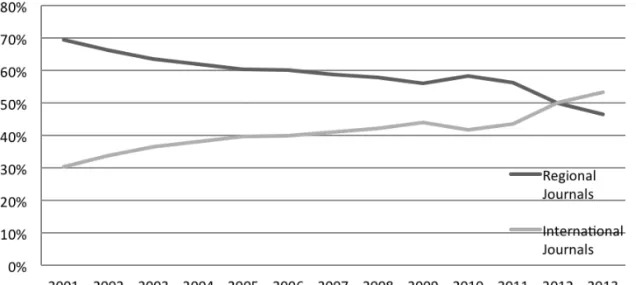
Table 4 also shows the number of articles published in Latin American Regional journals in comparison to articles published in non-Regional journals (“International journals”). In 2004, the number of articles published by Latin American researchers in Regional journals versus International journals was approximately equal, with 779 published regionally and 700 published internationally. By 2011, the distribution of research articles published by Latin American researchers in Regional versus International journals shifted to a 48% versus 52% distribution. Please
note that the data for 2012 and 2013 for Latin American
Regional journals is still incomplete because of delayed publications and delayed submission of issues to PsycINFO for these Latin American journals. We would estimate that the inal number of published articles will come out to a total somewhere between 1,400 and 1,500 for Regional journals and between 2,000 and 2,100 for International journals once receipts and processing is inal.
We did explore whether or not there were differences
between Latin American researchers and non-Latin American
research teams in terms of the assignment of publishing
credit as relected by co-authorships. Both Latin American authors and non-Latin American authors saw a slight increase in the number of authors per article over the time period, from 2.46 to 3.67 and 2.58 to 3.49, respectively. Thus we
see no differences in the number of authors per article for research emanating from Latin American researcher centers
in comparison to non-Latin American settings.
Differentiating Brazilian and Non-Brazilian authors
Because the data analyses to this point show the
heavy contribution of Brazilian researchers to the research
publications emanating from the Latin American (and
Caribbean) region, we further broke down the data on Latin
American research articles by whether the corresponding
author was located in Brazil or elsewhere in the Latin American region. Figure 1 presents the number of Latin American articles published each year from 2001 to 2013. It can be seen that in 2003-2004, Brazilian authors out-produced
researchers from all other areas of Latin America by a slight
amount (e.g., 800 articles vs. 575 articles). Over the next 10 years, the number of articles published per year by Brazilian authors nearly tripled, while the number of articles published
per year by all other Latin American researchers only doubled.
Thus by 2013, Brazilian authors collectively were publishing
twice as many scholarly articles as the total produced by all other Latin American researchers.
Figure 2 further breaks the Brazilian author versus non-Brazilian author data down into research published in Latin American Regional journals versus research published in International journals. In 2004, Brazilian authors published 536 articles in Latin American Regional journals and 330 articles in International journals. Also in 2004, non-Brazilian authors published 243 articles in Latin American Regional journals and 370 in International journals. By 2013, the growth in publications by Brazilian authors in both Regional and International journals grew substantially and in a nearly parallel manner, with Regional publications slightly outnumbering International publications. The pattern for non-Brazilian Latin American authors, however, reveals a different pattern. Over the 10 year period, non-Brazilian authors doubled their publication in International journals while their publications in Regional journals remained lat. Figure 3 looks only at the publishing behavior of Brazilian authors over the covered period of time. In 2004, Brazilian authors published 60% of their research in Regional Latin American journals and 40% of their publications in International journals. By 2012, that distribution had moved to 50:50. Figure 3 shows a crossover in 2013 with more publications in International journals than Regional journals but this is probably an artifact of the delay in publication, circulation, and processing of Latin American Regional journals. For 2012 and 2013, the distribution might still be equal, although
the trend data suggest that there might be a small margin
VandenBos, G. R., & Winkler, J. M. (2015). An Analysis of the Status of Journals and Research in Psychology from Latin America.
The topics researched by psychologists are very diverse. Studies are conducted using animal and human
research. The behavioral analysis can be physiological, cognitive, interpersonal, or at the group/society level. To capture this diversity, PsycINFO has developed classiication codes to capture the range of research topics of interest to psychologists. Therefore, we examined the set of articles published by Brazilian authors worldwide
from 2001 through 2013. The top two Classification Codes over the last seven years were articles on “physical
disorders” and articles on “neurological disorders.” These two categories have consistently represented 80 to 120 articles per year over the last seven years. These have been steadily increasing over this period of time. Articles on psychoanalytic theory and therapy have been relatively
stable over the past 10 years, after a spike in 2003.
Psychosocial and personality development has been the
sixth most frequently used classiication code for research articles by Brazilian authors in Regional journals over the
last 10 years.
Figure 1. Latin American Articles Published Each Year: 2001-2013.
T h e c l e a r n u m b e r o n e c a t e g o r y i n w h i c h
Brazilian researchers are publishing internationally is psychopharmacology. The second, third, and fourth highest areas of publication in international journals are neuropsychology, neurological disorders, and physical diseases. The ifth most frequently used Classiication Code for research published by Brazilian authors in International journals is social behavior.
Neuropsychology and neurological disorders are frequent topics of research in both Regional Latin American journals and International journals. Likewise, research on physical disorders is a frequent topic of publication by Brazilian authors in both Regional and International journals. Articles on psychoanalytic theory and therapy hold a prominent position for Brazilian authors in Regional Latin American journals; however, this same pattern is not true in International journals. The reverse is true for research
articles on psychopharmacology. Psychopharmacology is
the single most frequent focus of scholarly publication by Brazilian authors in International journals, but little such material is published by Brazilian authors in Regional Latin American journals. There is the suggestion that the research
area of social and personality is beginning to emerge as a
growing area of publication by Brazilian authors in both Regional Latin American journals and International journals.
Discussion
Brazil is by far the leading journal publishing country in Latin America. It has had the most journals considered and covered by the PsycINFO database and has the most journals with a Journal Impact Factor. Journals that publish at least some articles in the English language are more likely to be covered by PsycINFO; however, publishing English language articles is not a requirement. It is perhaps the case that journals publishing
in English are more likely to meet the coverage requirements
for the database. Previous research has shown that articles
published in English are more frequently cited than those published in Spanish (Buela-Casal & Zych, 2012). The same is true of Portuguese as there are fewer readers than English articles, thus restricting the audience and potential citations (Ariza & Granados, 2012). However, the lack of citations has also been attributed to the dificulty in accessing full text Latin American articles (Bressan, Gerolin, & Mari, 2005).
Clearly Latin American research in psychology and the related sciences has expanded rapidly over the last 10 years. This is consistent with general research output in
Latin America, where according to one study, there has been a 70% increase in Latin America’s share of the world’s research papers between 2000 and 2010 (Huggett, 2012).
The purpose of publishing Regional versus International journals is not the same. There are valid reasons why a robust regional journal publishing program is needed and can be credible and valuable. Regional journals allow for
the publication of topics of particular local and regional
importance. Educational policy issues, factors involved in the legal process, and some topics related to social and cultural behavior unique to a country or culture are possible examples. In a similar manner, topics which are heavily inluenced by
social and cultural factors are worthy of local and regional
journals in such ields as psychotherapy, psychopathology, educational assessment, and community intervention. Topics where the variables are more universal and less inluenced by cultural inluences may be more appropriate in international journals. Such content areas are brain structure, brain function, psychopharmacological agents, and statistics. Local and regional journals may often also provide new scholars with their irst publishing opportunity, with a greater likelihood of acceptance. Table 5 outlines differences between regional and international journals.
VandenBos, G. R., & Winkler, J. M. (2015). An Analysis of the Status of Journals and Research in Psychology from Latin America.
Limitations
The present research is based only on articles appearing
in the PsycINFO abstract database. While this database is large, consisting of 3.7 million citations to the world’s psychological and related ields’ literature, it is not truly comprehensive. Journals are nominated and evaluated, based on quality and other criteria, for inclusion in PsycINFO. Thus, PsycINFO attempts to capture all of the highest quality published scholarly articles worldwide in psychology and closely related disciplines. However, perhaps 10% to 20% of the world’s literature in psychology
is not captured because of various selection decisions about
appropriateness, quality, and other factors.
PsycINFO is a psychology-oriented database, but it is
a multidisciplinary database including articles that may be
primarily identiied with a ield other than psychology. This is seen in various areas such as neuropsychology/neurology, psychopharmacology/pharmacology, health psychology/ medicine, educational psychology/education, and industrial and organizational psychology/management and business. Therefore, when identifying authors of articles appearing in the PsycINFO database, it cannot be inferred that the author
is automatically and absolutely a psychologist.
In analysis two in the present paper, articles were
included in the analysis because the corresponding author
could be clearly identiied from PsycINFO information (private and public) to be located in a Latin American country. This method for selecting articles to be analyzed
leaves out other research articles on which Latin American
authors were contributing co-authors but were not the corresponding author. Thus, the present analysis is an
underestimate of the research productivity and contribution of Latin American scholars to the research literature in
psychology and related disciplines. Using our present methodology, we are unable to estimate the magnitude of
the under representation.
Conclusion
In closing, our indings suggest that in psychology and its related ields, over the last decade there has been a considerable increase (> 800%) in the quantity of scholarly publications published by Latin American authors. Our indings also note
that of the Latin American countries we examined (all Western
Hemispheric countries south of the US), Brazil is the leading producer (50%) of PsycINFO-covered journals. In sum, our indings indicate that in spite of the uphill climb faced by many Latin American authors and journals, due in no small part to non-native-English writing and publication format,
the publication output from Latin America has been steadily
increasing, and the present shows no slowing of this trend.
References
Ariza, T., & Granados, M. R. (2012). Análisis bibliométrico de las revistas iberoamericanas más relevantes aines a la psicología clínica y salud del Journal Citation Reports (2011) [Bibliometric analysis of the most relevant Iberoamerican journals related to clinical and health psychology of the Journal Citation Reports (2011)]. Terapia Psicológica, 30(3), 89-102. doi:10.4067/S0718-48082012000300009
Bressan, R. A., Gerolin, J., & Mari, J. J. (2005). The modest but growing Brazilian presence in psychiatric, psychobiological and mental health research: Assessment of the 1998-2002
period. Brazilian Journal of Medical and Biological Research, 38(5), 649-659.doi:10.1590/S0100-879X2005000500001 Buela-Casal, G., & Zych, I. (2012). What do the scientists
think about the impact factor? Scientometrics, 92, 281-292. doi:10.1007 / 012-0676 s11192--y
Huggett, S. (2012). The rise of Latin American science. Research Trends, 31. Retrieved from http://www.researchtrends.com/
issue-31-november-2012/the-rise-of-latin-american-science/
Regional Journals International Journals
Description oriented Theory driven
Higher percent description/summary Higher percent empirical reports
Locally focused issues Broad international issues
Unclear review standards Strict peer review standards
Low rejection rate High rejection rate
Local/regional editorial board International, US, European editorial board
Limited author range (institutional) Diverse array of authors (institution, country)
Local / mixed language International English
Less standardized abstract/poor English Well structured, coherent English abstract Unstandardized references Standardized references
Printer formatted tables/igures High quality tables and igures
Publisher low reputation/unstable Published by major society or commercial publisher
Probably no Journal Impact Factor Probably has a Journal Impact Factor Table 5
Common Differences between Regional and International Journals
Journal Country
Acta Psiquiátrica y Psicológica de América Latina Argentina
Interdisciplinaria Revista de Psicología y CienciasAines Argentina
Revista Argentina de ClínicaPsicológica Argentina
Ágora: Estudo em Teoria Psicanalítica Brazil
Arquivos Brasileiros de Psicologia Brazil
Arquivos de Neuro-Psiquiatria Brazil
Brazilian Journal of Medical and Biological Research Brazil
Cadernos de Psicanálise - SPCRJ Brazil
Dementia & Neuropsychologia Brazil
Estudos de Psicologia Brazil
Estudos de Psicologia Brazil
Jornal Brasileiro de Psiquiatria Brazil
Paidéia Brazil
PSICO Brazil
Psicologia & Sociedade Brazil
Psicologia Clínica Brazil
Psicologiaem Estudo Brazil
Psicologia: Ciência e Proissâo Brazil
Psicologia: Relexão e Crítica Brazil
Psicologia: Teoria e Pesquisa Brazil
Psicologia: Teoria e Prática Brazil
Psychology & Neuroscience Brazil
Revista Brasileira de Neurologia Brazil
Revista Brasileira de Psicanálise Brazil
Revista de Psicanálise da SPPA Brazil
Revista Interamericana de Psicología Brazil
Revista Latino-Americana de Enfermagem Brazil Revista Latinoamericana de Psicopatologia Fundamental Brazil
Tempo Psicanalítico Brazil
Trends in Psychiatry and Psychotherapy Brazil
Psicoperspectivas Chile
Psykhe: Revista de la Escuela de Psicología Chile
Revista Chilena de Psicoanálisis Chile
Terapia Psicológica Chile
Acta Colombiana de Psicología Colombia
Avancesen PsicologíaLatinoamericana Colombia
Pensamiento Psicológico Colombia
PROFILE Issues in Teachers’ Professional Development Colombia
Psicologíadesde el Caribe Colombia
Psychologia: Avances de la Disciplina Colombia
Revista Colombiana de Psicología Colombia
Revista Latinoamericana de Psicología Colombia
Universitas Psychologica Colombia
Actualidadesen Psicología Costa Rica
Acta Comportamentalia Mexico
Psicología Iberoamericana Mexico
Psicología y Salud Mexico
Psiquis Mexico
Revista Intercontinental de Psicología y Educación Mexico
Revista Mexicana de Psicología Mexico
Salud Mental Mexico
Revista de Psicología Peru
Revista Puertorriqueña de Psicología Puerto Rico
Revista Uruguaya de Psicoanálisis Uruguay
Appendix A
VandenBos, G. R., & Winkler, J. M. (2015). An Analysis of the Status of Journals and Research in Psychology from Latin America.
Appendix B
Latin American Journals Not Currently Covered in PsycINFO
Journal Country
Antropos Argentina
Interdisciplinaria Monographs Argentina
Investigacione sen Psicología Argentina
Neuropsiquiatría y Salud Mental Argentina
Orientacion y Sociedad Argentina
Psicoanálisis delas Coniguraciones Vingulares Argentina
Psicoanálisis: Revista de la asociación Psicoanalitíca de Buenos Aires Argentina
Psicología Médica Argentina
Psychologica: Revista Argentina de Psicología Realista Argentina
Revista de Psicoanálisis Argentina
Revista de Psicología/ Journal of Psychology Argentina
Revista Irice Argentina
Revista Universitaria de Psicoanálisis Argentina
Subjetividad y Procesos Cognitivos Argentina
Aletheia Brazil
Alter-Jornal de Estudos Psicodinâmicos Brazil
Arquivos Brasileiros de Medicina Brazil
Arquivos de Geriatria e Gerontologia Brazil
Avaliação Psicológica Brazil
Boletim de Psicologia Brazil
Boletim do Instituto de Psicologia Brazil
Cadernos de Psicanálise Brazil
Cadernos de Psicologia Brazil
Cadernos de Psicologia Social do Trabalho Brazil
Didatica Brazil
Educação Subjetividade & Poder Brazil
Educar Em Revista Brazil
Iniciacao Cientiica CESUMAR Brazil
Interaçao em Psicologia Brazil
Interacoes Brazil
Interpersona: An International Journal on Personal Relationships Brazil
Junguiana Brazil
Laboreal Brazil
Lex Humana Brazil
Memorandum: memory & history in psychology Brazil
Mudancas: Psicologia da Saude Brazil
Neurobiologia Brazil
Nova Perspectiva Sistêmica Brazil
O Hospital Brazil
Percurso Revista de Psicanálise Brazil
Psicologia Em Revista Brazil
Psychê Revista de Psicanalise Brazil
Pulsional: Revista de Psicanalise Brazil
Revista Brasileira de Cineantropometria e Desempenho Humano Brazil
Revista Brasileira De Crescimento E Desenvolvimento Humano Brazil
Revista Brasileira de Fisioterapia Brazil
Revista Brasileira de Psicoterapia Brazil
Revista Brasiliera de Deiciencia Mental Brazil
Revista da Associaçao Médica Brasileira Brazil
Revista Da Faeeba Educacao E Contemporaeidade Brazil Revista de Psicologia Normal e Patologica Brazil
Revista de Psiquiatria Clinica Brazil
Revista do Departamento de Psicologia UFF Brazil Revista Estilos da Clínica. Revista sobre a Infância com Problemas Brazil
Revista Estima Brazil
Revista Mal-Estar e Subjetividade Brazil
Revista Paulista de Psicologia e Educacão Brazil
Revista PSICO-USF Brazil
SMAD. Revista Eletrônica Saúde Mental Álcool e Drogas Brazil
Temas em Psicologia Brazil
Ciencia & Trabajo Chile
De Familias y Terapias Chile
Límite Chile
Revista Chilena de Neuro-psiquiatría Chile
Revista Chilena de Psicología Chile
Revista de Psicologia de la Universidad de Chile Chile
Revista de Psiquiatria Clinica Chile
Salud & Sociedad Chile
Academia, Revista Latinoamericana de Administración Colombia
Affectio Societatis Colombia
Cuadernos de Desarrollo Rural Colombia
Cuadernos de Psicología Colombia
Diversitas: Perspectivas en Psicología Colombia
Gaceta Neuro-Psiquiatrica Colombia
HOW A Colombian Journal for Teachers of English Colombia
Innovar Colombia
Investigación & Desarrollo Colombia
Magis, International Journal of Research in Education Colombia
Opinión Jurídica Colombia
Panorama Colombia
Perspectivasen Psicología Colombia
Psicogente Colombia
Revista Criminalidad Colombia
Revista de Análisis del Comportamiento Colombia
Revista de la Federación Colombiana de Psicología Colombia
VandenBos, G. R., & Winkler, J. M. (2015). An Analysis of the Status of Journals and Research in Psychology from Latin America.
Revista de Psicología (Colombia) Colombia
Revista Interamericana de Psicologia Ocupacional Colombia
Revista Latinoamericana de Sexología Colombia
Suma Psicológica Colombia
Revista Costarricense de Psicología Costa Rica
Boletin de Psicologia (Cuba) Cuba
Revista del Hospital Psiquiátrico de La Habana Cuba
Temas de Trabajo Social Cuba
Ciencia y Sociedad Dominican Republic
Boletin de Psicologia (El Salvador) El Salvador
West Indian Medical Journal Jamaica
Archivos Hispanoamericanos de Sexología Mexico
Cuadernos Cientiicos CEMESAM Mexico
Enseñanza e Investigaciónen Psicología Mexico
Neurología, Neurocirugía, Psiquiatría Mexico
Psiquiatría Mexico
Revista de la Asociación Latinoamericana de Psicología Social Mexico
Revista de la Clinica de la Conducta Mexico
Revista de Psicologia Social y Personalidad Mexico
Revista de Psicología, Universidad de Monterrey Mexico
Revista Latina de Pensamiento y Lenguaje Mexico
Revista Mexicana De Psicología Mexico
Revista Psicoanálisis, Psiquiatŕia y Psicologîa Mexico
Aprendizaje y Comportamiento Panama
Archivos Panameños de Psicología y Anuario del Sanatorio Las Cumbres Panama
Liberabit Peru
Revista de Neuro-Psiquiatria Peru
Revista de CienciasSociales Puerto Rico
Revista Puertorriqueña de Psicologia Puerto Rico
Caribbean Journal of Criminology & Social Psychology Trinidad and Tobago
CienciasPsicológicas Uruguay
Revista de Psicoterapia Psicoanalítica Uruguay
Boletin de la AVEPSO Venezuela
Fascículo de AVEPSO Venezuela