© FECAP
RBGN
Review of Business Management
DOI: 10.7819/rbgn.v0i0.2695 Received on
10/27/2015
Approved on
11/22/2016
Responsible editor:
PhD. Francisco Diez Martin
Evaluation process:
Double Blind Review
200
Socio-cultural factors and youth
entrepreneurship in rural regions
Eduardo Gómez-Araujo
Universidad del Norte, Finance and Organization, Barranquilla, Colombia
Manoj Chandra Bayon
Pontiicia Universidad Javeriana,Facultad de Ciencias Económicas y Administrativas, Cali, Colombia
Abstract
Purpose – his paper aims to demonstrate the impact of two important
socio-cultural factors on the level of the entrepreneurial activity of young individuals in rural regions.
Design/methodology/approach – Our empirical study is based on
a sample collected from an adult population survey, and analyzed using a logit model that controls for territorial and aging sources of heterogeneity. Our theoretical framework is anchored on a contingency perspective that emphasizes the unique inluences of the contextual environment in driving entrepreneurial behavior.
Findings – he main indings of our study is that in Spain the
likelihood of being entrepreneurially active is no diferent for young and old individuals, and between rural and urban regions. Surprisingly, unlike shown in most studies, entrepreneurial role models do not have any efect on the entrepreneurship by young individuals in rural regions of Spain, while the negative impact of fear of failure in the entrepreneurship on young individuals in rural regions is much higher compared to the rest of the population.
Originality/value – Our indings reveal that the context (regional)
has a more signiicant impact on entrepreneurship for some segments (younger individuals) of the population than for others.
1
Introduction
Entrepreneurship is increasingly recognized as a fundamental component of economic growth, employment generation, and innovation (Carree & Thurik, 2010; Fritsch &Wyrwich, in press; Organisation for Economic Co-operation and Development [OECD], 2003; Van Praag, Versloot, 2007). he strong positive correlation between entrepreneurship and economic growth (Acs, Desai, & Hessels, 2008; Bosma & Levie, 2010) has led some authors to suggest entrepreneurship as the key to rural revitalization (North & Smallbone, 2006; Organisation for Economic Co-operation and Development [OECD], 2009b). It is argued that the beneits of entrepreneurship in rural regions are manifold. Entrepreneurship helps diversify the rural economy, reducing dependence on a mono-industrial base (Bryden & Hart, 2005). Entrepreneurship provides opportunities for skill diversification among the rural population as well as attracting new residents, thereby providing stimulus for the growth of the rural economy (Akgun, Nijkamp, Baycan, & Brons, 2010;Demurger & Xu, 2011; Reichert, Cromartie, & Arthun, 2014; Siemens, 2014; Vaillant, Lafuente, & Serarols, 2012). As such, in recent years we have seen development agencies such as the European Union and the OECD giving priority to entrepreneurship as a tool for rural development and growth (European Commission, 2003, 2008; OECD, 2003, 2006, 2012). However, notwithstanding the importance of entrepreneurship in the rural regions, important barriers to entrepreneurship in rural regions still remain.
Several studies show that the impact of macro-level factors on entrepreneurial activities across urban and rural regions is not uniform (Driga, Lafuente, & Vaillant, 2009; Lafuente, Vaillant, & Rialp, 2007; Noguera, Álvarez, & Urbano, 2013). More importantly, rural regions lag behind in entrepreneurial activity, not necessarily because of (macro-level) physical or economic disadvantages, but because of
meso-level socio-cultural characteristics (Fornahl, 2003; Lafuente & Vaillant, 2008). In addition, evidence also suggests that such factors do not have a homogeneous impact on all segments of the population. In this regard, extant studies have mainly examined the distinctive efect of gender (see, e.g., Carter, Anderson, & Shaw,
2001; Delmar & Holmquist, 2004; Driga et al., 2009), and/or being native and immigrant at an aggregate level (see, e.g., Levie, 2007; Mancilla, Viladomiu, & Guallarte, 2010;Peroni, Riillo, & Sarracino, 2016). In this paper, we focus on young individuals at a regional level.
The study of young individuals and their involvement in entrepreneurial activities is increasingly gaining relevance due to the economic downturn of recent years (Brixiova, Ncube, & Bicaba, 2015;European Commission, 2012; Minola, Criaco, & Obschonka, 2016; O’higgins, 2012; Rojas & Siga, 2009; homas, 2009). Although it has afected all segments of the population, the igures are dire in Spain, where the unemployment of young individuals rose from 21 per cent in 2005 to a staggering 46 per cent and above between 2011 and 2014. he systematic rise of the unemployment amongst young individuals, together with the lack of new job opportunities for young people, especially in rural areas, has led to worries about the social and economic costs of youth inactivity (Vogel, 2015). Hence, the need to explore the impact of meso-level socio-cultural factors inluencing entrepreneurship among the youth in the rural regions. It is argued that the positive impact of entrepreneurship on rural development is ampliied when these entrepreneurial activities are carried out by young people residing in these areas (Brixiova et al., 2015; North & Smallbone, 2006). herefore, the main objective of our study is to determine the impact of socio-cultural factors, such as entrepreneurial role models and fear of failure, in the entrepreneurial activity of rural youths in Spain.
hypotheses tested in this study, followed by data and methodology in section three. he empirical results are presented in section four. Section ive discusses the conclusions and implications of the study. We conclude by indicating the possibilities for future studies.
2
Literature review and hypotheses
2.1
Young entrepreneurs
Entrepreneurship through the creation of a new business can be considered as an alternative vocational choice that has the potential to harness the human capital of young individuals. In recent years, several factors have inspired young individuals to set up their own businesses. First, the increasing human capital of young individuals has provided them with a wider range of alternatives and a higher capacity for the identiication and exploitation of business opportunities (Haynie, Shepherd, & McMullen, 2009). Young individuals today are generally better trained in comparison to previous generations. his, in turn, has made them more capable, for instance, to create and manage their own businesses (Honjo, 2004). his has been supported by the gradual change in the social attitude towards entrepreneurship. For instance, entrepreneurship through the creation of new business is increasingly being socially accepted (Begley & Tan, 2001; Blanchlower & Meyer, 1994; Kibler, Kautonen, & Fink, 2014). Development agencies have also contributed their bit by promoting entrepreneurship among the youth. For several years the European Commission (2003) and the OECD (2012) have been recommending programs to develop an entrepreneurial spirit among the younger population. Academia studies have also been directed towards understanding the issue of young individuals and entrepreneurship (Aidis & Van Praag, 2007; Brixiova et al., 2015; Fairlie, 2005; Honjo, 2004; Levesque & Minniti, 2006; Parker, 2006; Rojas & Siga, 2009; Thomas, 2009). Researchers comparing entrepreneurship
by young individuals with respect to the rest of the population suggest that younger individuals are more likely to be entrepreneurs (Bonnett & Furnham, 1991; Honjo, 2004; Lamotte & Colovic, 2013; Levesque & Minniti, 2006; Minola et al., 2016). For instance, Bonnett and Furnham (1991) claim that people with a greater internal locus of control tend to develop entrepreneurial attitudes more easily. In their study, Bonnett and Furnham (1991) found that young individuals, unlike their older counterparts have a greater internal locus of control. In similar fashion, Honjo (2004) proposes that the capacity for learning and changing in young individuals when it comes to accepting business challenges is much greater than in older individuals. Moreover, as individuals get older they ind the idea of starting a new business less desirable because the aversion to risk increases with age (Kautonen, Down, & Minniti, 2014; Levesque & Minniti, 2006). his greater propensity among young individuals to take risks therefore makes them more likely to choose entrepreneurship. In addition, young individuals have a lower opportunity cost when it comes to creating a business (Amit, Muller, & Cockburn, 1995) because it is easier for young individuals to return to salaried employment in case of a business failure compared to older individuals. herefore, we suggest that:
H1: The probability to engage in entrepreneurial activities is greater among younger individuals compared to older individuals.
More speciically, young individuals in urban regions are more likely to pursue entrepreneurship compared to rural ones (Akgun et al., 2010;
Fuller-Love, Midmore, Thomas, & Henley,
2006; Stathopoulou et al., 2004). In this context, classical and contemporary economic thinking has consistently portrayed urban agglomerations as the preferred setting for conducting business. It has been argued that urban centers ofer a greater division of labor (Smith, 1776), a larger (‘pool’) labor market supply (Marshall, 1920), a greater provision of non-traded inputs (Marshall, 1920), an easier and cheaper access to markets (Hoover, 1948), a greater availability of complementary services (Mydral, 1957), better infrastructures (Jacobs, 1969), and greater volumes of demand (Krugman, 1981, 1991). Wagner and Sternberg (2004) found that regions with high population density and high population growth rates show higher rates of nascent entrepreneurship. On the other hand, in rural regions, as mentioned earlier, there are greater socio-cultural barriers to the entrepreneurial activity (Fornahl, 2003). In many cases, young individuals may feel attracted to the city lifestyle, and the better professional opportunities available in urban agglomerations make them leave their places of origin to settle in cities. his discourages them from considering the possibility of creating a business or developing their profession in a rural environment (Meccheria & Pelloni, 2006). In a similar fashion, the embedded and relatively immobile character of most business activities makes an entrepreneurial career unattractive for those rural youths who long for the city (Akgun et al., 2010). Given the aforesaid arguments, we hypothesize that:
H2: Younger individuals in rural regions are less likely to engage in entrepreneurship compared to older individuals.
2.2
Role models
Over the years, researchers have identiied the importance of role models in entrepreneurship
(Bosma, Hessels, Schutjens, Van Praag, & Verheul, 2012; Contin-Pilart & Larraza-Kintana, 2015; Gibson, 2004; Gnyawali & Fogel, 1994; Krueger & Brazeal, 1994; Lafuente et al., 2007; Lucas, Cooper, Ward & Cave, 2009; Walstad & Kourilsky, 1998). Role models are individuals who set examples to be emulated by others and therefore may stimulate or inspire other individuals to make certain (career) decisions and achieve certain goals (Bosma et al., 2012). According to Gnyawali and Fogel (1994), entrepreneurial role models are important because they not only provide awareness about entrepreneurship, but also have a motivational efect on the intention to start a new business. Wood and Bandura (1989) argue that entrepreneurial role models can be used to develop entrepreneurial skills in young individuals. Similarly, Krueger and Brazeal (1994) argue that role models increase the
perception that setting up a business is a viable proposition. Several studies have conirmed the positive link between entrepreneurial role models and entrepreneurial activity (Chlosa, Patzell, Klein, & Dormann, 2012; Vaillant & Lafuente, 2007). Furthermore, role models are found to have a greater inluence on the entrepreneurial activity of younger individuals than the rest of the population (Murrell, 2003; Vaillant & Lafuente, 2007). his is because young individuals are at a psychological stage in which they are more receptive to such stimuli than older individuals (Erikson, 1985).
these arguments this study proposes the following hypotheses:
H3a: Entrepreneurial role models increase the likelihood of a youth getting involved in entrepreneurial activities.
H3b: he positive inluence of role models on the entrepreneurial activity of younger individuals in rural regions is lower.
2.3
Fear of failure
Emotions such as fear of failure have a strong influence on entrepreneurial behavior (Cacciotti & Hayton, 2015). Considered as a discrete negative emotion elicited by the appraisal of potential or actual threats such as business failure, evidence suggests that the likelihood of an individual becoming an entrepreneur is low(er) in regions with high levels of the social stigma of failure (Landier, 2004). In other words, in cultures where there are greater tolerance and acceptance of business failure, people tend to be more entrepreneurial (Landier, 2004). According to Landier, entrepreneurs fear social stigma if they do not achieve the expected business success. Other academics have also found this factor to be inluential on entrepreneurial activity (Busenitz, Gomez, & Spencer, 2000; Brochaus, 1980; Herron & Sapienza, 1992; Sitkin & Pablo, 1992;
Wennberg, Pathak, & Autio, 2013; Wyrwich,
Stuetzer, & Sternberg, 2016).
However, it has been shown that the impact of this social stigma on entrepreneurs depends upon several factors. One of these factors is the individual’s life cycle. People of diferent ages tend to react to the social stigma of failure in diferent ways (Levesque & Minniti, 2006). It is argued that among the diferent segments of the population, young individuals are less likely to consider the social stigma of failure an obstacle to creating a business. his is because young individuals face fewer opportunity costs in entrepreneurship (Amit et al., 1995). Also, younger individuals tend to be less swayed by the
perception of risk (Kautonen et al., 2014; Simon, Houghton, & Aquino, 2000) because of lesser work experience than older people (Blanchlower & Meyer, 1994).
Similarly, it has been found that there is a diferential impact of fear of failure across regions (Driga et al., 2009; Saxenian, 1994; Wagner, 2007). Vaillant and Lafuente (2007) ind that in Spain individuals in regions with high levels of the social stigma of failure are relatively less likely to become entrepreneurs. hey comment that the relatively tight social context found in certain rural areas increases the social consequences of entrepreneurial failure. In such a context, it is likely that young individuals in rural regions may be relatively more negatively inluenced by the perception of a social stigma to entrepreneurial failure than is the case of youths living in urban areas. In accordance with these perspectives, the following hypotheses can be inferred:
H4a: he perception of fear of failure reduces the likelihood of the youth getting involved in entrepreneurial activities.
H4b: he negative impact of the fear of failure on younger individuals in rural regions is greater than on their urban counterparts.
3
Data and method
3.1
Data and deinition of variables
use a random and representative population level sample of 20,868 individuals aged between 18 and 64 years.
According to several international bodies, such as the United Nations, the OECD, the International Labor Organization and the World Bank, young individuals are considered to be those who are aged between 16 and 24 years. However, the European Union and speciically the Spanish Government (INJUVE, http://www.injuve.migualdad.es/injuve/portal, accessed on June 15, 2013) share the criterion that young individuals are those aged between 16 and 29 years. Many academic studies have considered young entrepreneurs as those that have created or want to create a business and are aged between 18 and 29 years (Blanchlower & Meyer, 1994; Bonnett & Furnham, 1991; Honjo, 2004; Levesque & Minniti, 2006; Rojas &
Siga, 2009; Schiller & Crewson, 1997; homas, 2009; Walstad & Kourilsk, 1998). So, to ensure academic continuity, our study adopts this criterion (which is shared by the European Union, Government of Spain and the aforesaid studies) in order to classify an individual as young. Similarly, in relation to the method adopted to diferentiate urban areas from rural ones, this study uses the criterion proposed by the law (Real Decreto nº 752, 2010) of the Government of Spain. In our sample, 4,428 observations or 21.21% of the sample represent individuals younger than 30 years of age.
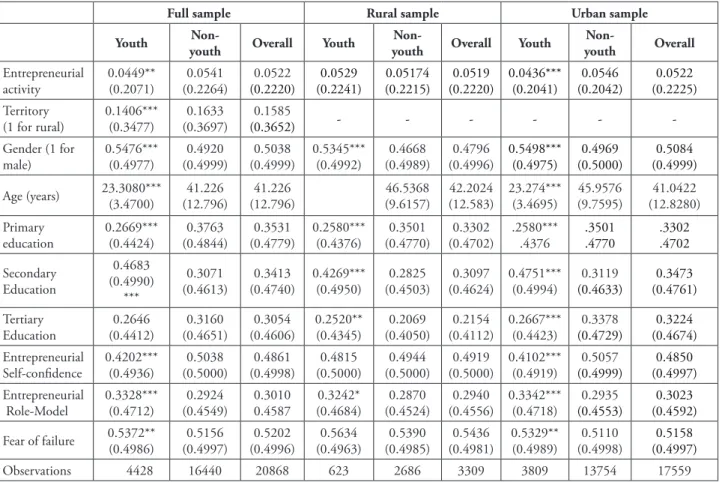
Table 1 shows the descriptive statistics for the variables used in this study, making a distinction between rural and urban regions, and also between young and non-young individuals in the diferent sub-samples (region-wise).
Table 1
Descriptive statistics for the selected variables
Full sample Rural sample Urban sample
Youth
Non-youth Overall Youth
Non-youth Overall Youth
Non-youth Overall Entrepreneurial
activity 0.0449**(0.2071) (0.2264)0.0541 (0.2220)0.0522 (0.2241)0.0529 (0.2215)0.05174 (0.2220)0.0519 0.0436***(0.2041) (0.2042)0.0546 (0.2225)0.0522
Territory
(1 for rural) 0.1406***(0.3477) (0.3697)0.1633 (0.3652)0.1585 - - -
-Gender (1 for male)
0.5476*** (0.4977)
0.4920 (0.4999)
0.5038 (0.4999)
0.5345*** (0.4992)
0.4668 (0.4989)
0.4796 (0.4996)
0.5498*** (0.4975)
0.4969 (0.5000)
0.5084 (0.4999)
Age (years) 23.3080***(3.4700) (12.796)41.226 (12.796)41.226 (9.6157)46.5368 (12.583)42.2024 23.274***(3.4695) (9.7595)45.9576 (12.8280)41.0422
Primary
education 0.2669***(0.4424) (0.4844)0.3763 (0.4779)0.3531 0.2580***(0.4376) (0.4770)0.3501 (0.4702)0.3302 .2580***.4376 .3501.4770 .3302.4702
Secondary Education
0.4683 (0.4990)
***
0.3071
(0.4613) (0.4740)0.3413 0.4269***(0.4950) (0.4503)0.2825 (0.4624)0.3097 0.4751***(0.4994) (0.4633)0.3119 (0.4761)0.3473
Tertiary
Education (0.4412)0.2646 (0.4651)0.3160 (0.4606)0.3054 0.2520**(0.4345) (0.4050)0.2069 (0.4112)0.2154 0.2667***(0.4423) (0.4729)0.3378 (0.4674)0.3224
Entrepreneurial
Self-conidence 0.4202***(0.4936) (0.5000)0.5038 (0.4998)0.4861 (0.5000)0.4815 (0.5000)0.4944 (0.5000)0.4919 0.4102***(0.4919) (0.4999)0.5057 (0.4997)0.4850
Entrepreneurial
Role-Model 0.3328***(0.4712) (0.4549)0.2924 0.30100.4587 (0.4684)0.3242* (0.4524)0.2870 (0.4556)0.2940 0.3342***(0.4718) (0.4553)0.2935 (0.4592)0.3023
Fear of failure 0.5372**(0.4986) (0.4997)0.5156 (0.4996)0.5202 (0.4963)0.5634 (0.4985)0.5390 (0.4981)0.5436 0.5329**(0.4989) (0.4998)0.5110 (0.4997)0.5158 Observations 4428 16440 20868 623 2686 3309 3809 13754 17559
For the purposes of this study, young individuals in the sample are measured using a dummy variable taking the value of one if the individual is under 30 years old, and zero otherwise. Table 1 shows that young individuals in our sample have a mean age of 23.308 years while the same for the rural sub-sample is 23.515 years. he dependent variable used in this research is entrepreneurial activity (Reynolds et al., 2005). his dichotomous variable takes the value of one if, in the last 12 months, a person was actively involved in the process of creating his/her own business or has a baby business less than 42 months old, and zero if the person is not entrepreneurially active. With respect to the descriptive statistics presented in Table 1, it is observed that individuals involved in entrepreneurial activities represent 5.22 per cent of the whole sample (Table 1). he rural population makes up 15.85 per cent of the full sample, and the entrepreneurship among them is 5.19 per cent. Moreover, of the full sample, 4.49 per cent of the young individuals are involved in entrepreneurial activities, a value that is signiicantly lower than the entrepreneurship rate for individuals above 30 years of age (5.41 per cent).
Our irst independent variable of interest relates to entrepreneurial role models. This variable takes the value of one for those who personally know an entrepreneur who has created a business over the past two years, and zero otherwise. In the inal sample, 30.10 per cent of respondents report the personal knowledge of an entrepreneur, and the proportion of youths who knows an entrepreneur (33.28 per cent) is signiicantly higher than the proportion shown by non-youths (29.24 percent) (Table 1). Our second independent variable fear of failure takes the value of one if the person states that the fear of failure is an impediment to creating a business. Table 1 shows that the youths perceive signiicantly higher fear of failure (53.72 percent) than the rest of the
adult population (51.56 per cent).
Finally, three control variables are considered in the empirical analysis. First, we introduce gender. his variable has been used, among others, by Driga et al. (2009), and Verheul, Thurik, Grilo and Van Der Zwan (2012) in the study of the gender gap in entrepreneurial activities, and was found to inluence both the dependent and independent variables. he second control variable relates to educational attainment. To create the education variable we considered three categories (dummy variables): 1) primary education, 2) secondary education, and 3) tertiary education. hese variables take the value of one to indicate the corresponding level of education. he last control variable used in this paper is the self-conidence in one’s entrepreneurial ability. his variable was added to the model as a control variable because of its impact on entrepreneurial activity (Lafuente et al., 2007; Mcgee, Peterson, Mueller, & Sequeira, 2009; Van Praag & Cramer, 2001).
3.2
Modeling entrepreneurial activity
in the presence of diferent sources of
heterogeneity
To determine the diferential impact of the selected explanatory variables on entrepreneurial activities by youths, we perform a logistic regression analysis (Greene, 2003). In our logit model, the probability of engaging in the entrepreneurial activity (Pr(Yi=1)= pˆi) is modeled as a function
of the aforementioned set of independent variables (Xi) where pˆi is expressed as ˆ i j
1
i ji
X X
p
=
e
b+
e
b ,and parameters (bj) are estimated by maximum
likelihood method.
We carry out two applications of the above model. he irst application, presented in equation (1), takes into consideration the joint efect of being young and rurality over entrepreneurship.
In the equation (1)
e
i is the logistic distributed error term for the ith cases. Controlvariables correspond to the entrepreneur’s proile, namely, gender, educational attainment and self-conidence in one’s own entrepreneurial skills. In our model speciications, T refers to the
variables related to the analyzed socio-cultural factors, i.e., the personal knowledge of recent entrepreneurs (role models), and the fear of entrepreneurial failure.
The magnitude of key explanatory variables is determined by the marginal efect (gX). However, unlike linear models, in non-linear models the interaction efect, i.e., the change in both interacted variables with respect to the dependent variable, does not equal the marginal efect of changing just the interaction term. In addition, the interaction effect in non-linear models may have diferent signs for diferent values of the covariates. hus, the parameter estimate of the interaction term in non-linear models does not necessarily indicate the sign of the interaction efect. Hence we use the method proposed by Ai and Norton (2003) which allows us to obtain robust interaction efects for the variables of interest. In this method the change in the predicted probability to pursue entrepreneurial activity results from the double discrete diference with respect to the rural dummy variable (x2)
among young individuals (x3), i.e., , where X = x2, x3 . he procedure developed by Ai and Norton (2003) also allows us to test whether the real magnitude of the interaction term is diferent from zero, gx1 0, even if the coeicient
obtained from the logistic model is not statistically signiicant.
In terms of our hypotheses, we expect thatg3 > 0 in equation (1), meaning that
young individuals are more likely to pursue entrepreneurial activities (H1). We also expect
that g23 < 0 indicating that rural youths are less likely to be involved in entrepreneurship (H2).
Concerning our hypothesis H3a, we expect g4
> 0 where T refers to the role-model variable,
indicating that the probability to engage in entrepreneurship increases among people who personally know an entrepreneur. A negative sign in the parameter estimate related to the fear of failure variableg4 < 0 would be an indication that the fear of failure reduces the likelihood of being involved in entrepreneurial activities (H4a).
In the second application as shown in equation (2), we test whether the impact of the selected socio-cultural factors on the probability of entrepreneurship in rural and urban regions difers between youths and non-youths in our sample.
(2)
In equation (2), second level interaction terms control for changes in the probability of entrepreneurship among rural and urban young (d23), and for changes in the impact of the selected socio-cultural factors across regions (d24) and among youth and non-youth (d34). he triple interaction term (d234) captures the efect of entrepreneurial activities of the analyzed socio-cultural factors (relative to those who are not exposed) in rural (relative to urban) youths (relative to non-youths). As in equation (1), the
and Sonderhof (2009). With respect to our hypotheses, a lower value of the triple interaction term g234 < 01 is an indication that the positive
inluence of role models over entrepreneurial activities is weaker among rural youths (H3b). A
higher absolute value of the impact of the variable related to the fear of failure among rural youths would support our hypothesis H4b.
4
Results
Table 2 below presents the results from the logit model used to determine the inluence as well as the impact of entrepreneurial role-models and fear of failure on the entrepreneurial activity of young individuals in rural regions. Rather than reporting coeicients, Table 2 reports the estimated change in the probability of engaging in entrepreneurial activities (Marginal efect). he complete set of logit estimates is presented in the Appendix.
In our results, table 2, column I, presents the model that includes all independent variables (direct effects), while columns II, III, and IV introduce several interaction terms. The interaction term (Column II) between territorial regions classified as rural and urban regions with youths and non-youths is used to take into account the fact that rural and urban youths are exposed to diferent economic settings, as well as respond to diferent incentives when it comes to their engagement in entrepreneurship. he territorial diferences in the probability of entrepreneurship among youths and non-youths become visible if such effects are accounted for with respect to the two main socio-cultural variables considered in this study. Column III of table 2 shows the results of the triple interaction between entrepreneurial role model, being young and living in rural regions, while column IV shows the same for the fear of failure variable. Unlike Honjo (2004) and as suggested by Levesque and
Minniti (2006), empirical results in columns I and II suggest that younger individuals are no diferent from their older counterparts as far as involvement in entrepreneurial activity is concerned, and this efect is similar in rural and urban regions. herefore, our hypothesis
H1 which suggested that younger individuals
are more likely to engage in entrepreneurship is not supported. From the results of column II in Table 2, it can be observed that the territorial source of heterogeneity(g23) does not help explain
diferences in the entrepreneurial activity between younger individuals and their older counterparts residing in rural areas. hus, our second hypothesis
H2 is also not supported.
he results from estimations as shown in column III of Table 2 (the double and triple interaction of entrepreneurial role model) indicate that although entrepreneurial role models have a positive efect on entrepreneurial activities in general, it has no efect among young individuals in rural regions. Thus, we find support for hypothesis H3a, but not H3b. Concerning the
indings related to the fear to failure variable (column IV of Table 2), we ind that fear of failure has a negative efect on entrepreneurial activities. his result is similar to other studies and supports our hypothesis H4a. However, if
Table 2
Logit estimates: the marginal efect of the probability of involvement in entrepreneurial activity
(1) (2) (3) (4)
Gender (male) 0.0063*** 0.0063*** 0.0062*** 0.0063***
Secondary education 0.0086*** 0.0086*** 0.0086*** 0.0086*** Tertiary education 0.0073*** 0.0072*** 0.0072*** 0.0074*** Entrepreneurial Self-conidence 0.0573*** 0.0573*** 0.0570*** 0.0571*** Young (less than 30 years old) -0.0028 -0.0034 -0.0043* -0.0036*
Rural 0.0014 0.0007 0.0042 0.0022
Rural X Young 0.0038 0.0069 0.0006
Entrepreneurial Role-Model 0.0406*** 0.0406*** 0.0408*** 0.0403***
Entrepreneurial Role-Model X vRural -0.0096
Entrepreneurial Role-Model XYoung -0.001
Entrepreneurial Role-ModelXRural X Young -0.0081
Social stigma of failure -0.0164*** -0.0164*** -0.0162*** -0.0166***
Social stigma X Rural 0.0059
Social stigma of failure X Young -0.0041
Social stigma of failure X Rural XYoung -0.0252*
Observations 20868 20868 20868 20868
Note. *, **, *** indicates signiicance at the 0.10, 0.05 and 0.01 levels, respectively.
he marginal efect represents the change in the probability as a result of a change in the independent variable. In the
following equations (1) and (2), the marginal efect of the interaction term for changes in two variables (x2, x3) is estimated
by , whereas for the triple interaction term the marginal efect emerges from .*, **, ***
indicate signiicance at the 0.10, 0.05 and 0.01 levels, respectively.
5
Discussion and implications
Entrepreneurship has become an alternative way for young individuals to satisfy their work and professional development needs (Blanchflower & Oswald, 1998). Although several scholars have suggested that young individuals have the advantages in the pursuit of an entrepreneurial career (Bonnett & Furnham, 1991; Honjo, 2004; Levesque & Minniti, 2006), empirical evidence though reveals that the probability of entrepreneurship decreases with respect to age (Katz, 1994; Parker, 2009; Vaillant & Lafuente, 2007). Several institutional, as well as socio-cultural factors, have been found to inluence the choice of entrepreneurship among younger individuals. In this study, we focused on the role of entrepreneurial role models and fear
of failure among younger individuals living in rural regions.
entrepreneurial activity of younger individuals as well as on the entrepreneurial activity in rural regions. In other words, entrepreneurial role models are not a signiicant factor in inluencing entrepreneurship among young individuals neither do they inluence entrepreneurship in rural regions (as compared to urban regions). When both age and region are taken into account there is still no efect of entrepreneurial role models on entrepreneurship. One explanation for this result could be that the economic downturn in Spain has made people more aware of the bleak prospects of self-employment and therefore indiferent to role models. In regard to the inluence and impact of fear of failure, we ind that the negative efect of fear of failure is signiicantly higher among younger individuals in rural regions.
Overall, our results show that important socio-cultural variables, like entrepreneurial role models and fear of failure, which have shown consistent efects at the aggregate level across many national contexts do not have similar effects in the presence of territorial and age related diferences. his evidence lends support to the contingency model in which the context surrounding the individual play a more dominant role in influencing entrepreneurial behavior (Welter, 2011; Zahra, Wright, & Abdelgawad, 2014). his is supported by the results of our study, in which when we take into account territorial context (urban/rural location) the importance of location on entrepreneurial activity diminishes. Similarly, by accounting for age-related diferences it is found that the impact of socio-cultural variables difers for aggregate level outcomes. As such our study reveals the importance of a disaggregate analysis that takes into consideration contextual heterogeneity surrounding entrepreneurial activity. Overall, the two main conclusions of our study are: 1) Context (regional) has a signiicant impact on entrepreneurship for some segments (younger individuals) of the population than for others; 2) he main inhibitor of entrepreneurship among young individuals in rural regions is the signiicant
fear of business failure that needs to be addressed by appropriate policy level interventions.
The main policy implication of our study is that policy to promote entrepreneurship needs to be more context speciic and focused on interventions aligned with the needs of the focal population. As such, unlike other contexts in which entrepreneurial role models are a useful tool for motivation training among aspiring entrepreneurs, such methods are less likely to be effective in Spain. Instead, policy makers should focus on addressing the signiicant fear of failure among young individuals in rural regions of Spain. he exact reasons why young individuals in rural regions sufer from high fear of failure go beyond the scope of this study, but recent analysis from the Global Entrepreneurship Monitor in Catalonia and Spain (Corduras et al., 2012) suggest that social desirability could be a factor. For instance, in many rural communities, talented youths are expected to move to the cities to further their studies and careers. he social perception in many rural communities is that professional and personal success for young individuals is determined by whether they have managed to move and establish themselves within a metropolitan region. he reverse would mean that young individuals who stay behind and become entrepreneurs are socially judged as less successful. A similar observation has been made by the OECD in rural regions of Sweden, which was limiting the generational continuity of Smaland’s strong entrepreneurial tradition (OECD, 2012). As such, at the policy level, the promotion of entrepreneurship requires long-term measures, which, among others, could include the social celebration of entrepreneurship as a career choice without emphasizing too much the person-related aspects of entrepreneurship. Such social celebration could be through mass media. Alternatively, entrepreneurship related training among the young individuals should emphasize the needs of the 21st-century workforce in which
6
Conclusion and further research
Using a sample from the Global Entrepreneurship Monitor’s 2012 Spanish Adult Population Survey, this study uses a logit model to test the inluence and impact of entrepreneurial role models and the fear of failure on the level of entrepreneurial activity of young individuals in rural regions of Spain. he main result of our study is that in Spain the likelihood of being entrepreneurially active is no diferent for young and older individuals, and between rural and urban regions. Surprisingly, unlike shown in most studies, entrepreneurial role models do not have any effect on the entrepreneurship of young individuals in rural regions of Spain, while the negative impact of fear of failure in the entrepreneurship on young individuals in rural regions is much higher compared to the rest of the population.
The results of our study reveal the importance of disaggregation and an empirical analysis that takes into account contextual sources of heterogeneity in entrepreneurship. Our study focuses on territorial sources of heterogeneity and age-related diferences in entrepreneurial activity. Extant studies have also demonstrated gender-related diferences in entrepreneurship. Future studies can include the moderating efect of gender along with contextual variables like territory and age in inluencing entrepreneurship. Secondly, our study considers two important socio-cultural variables. Further studies can add more socio-cultural variables. hirdly, our study is limited to Spain. Similar studies if replicated in other territorial contexts, both in developed and developing economies, could establish more irmly the role and importance of socio-cultural factors in entrepreneurial activity. Finally, a longitudinal analysis could provide even more rigor to the indings presented in this study.
Note
1It should be kept in mind that the results of the
third diference can be interpreted in diferent
ways. However, the paper has adopted an interpretation of this marginal efect based on the results of the cross diferences.
References
Acs, Z. J., Desai, S., & Hessels, J. (2008). Entrepreneurship, economic development and institutions. Small Business Economics, 31(3), 219-234.
Ai, C., & Norton, E. C. (2003). Interaction terms in logit and probit models. Economics Letters,
80(1), 123-129.
Aidis, R., & Van Praag, M. (2007). Illegal entrepreneurship experience: Does it make a diference for business performance and motivation? Journal of Business Venturing, 22(2), 283-310.
Aitken, K. (2006). Young entrepreneurs in rural Northumberland and county Durham [Centre for Rural Economy Research Report]. University of Newcastle Upon Tyne, Newcastle Upon Tyne, UK. Retrieved from http://citeseerx.ist.psu.edu/viewdoc/ summary?doi=10.1.1.598.7014
Akgün, A. A., Nijkamp, P., Baycan, T., & Brons, M. (2010). Embeddedness of entrepreneurs in rural areas: A comparative rough set data analysis. Tijdschrift Voor Economische en Sociale Geograie, 101(5), 538-553.
Amit, R., Muller, E., & Cockburn, I. (1995). Opportunity costs and entrepreneurial activity. Journal of Business Venturing, 10(2), 95-106.
Arenius, P., & Minniti, M. (2005). Perceptual variables and nascent entrepreneurship. Small Business Economics, 24(3), 233-247.
Anglo-Saxon countries. Journal of International Business Studies, 32(3), 537-553.
Blanchlower, D. G., & Meyer, B. D. (1994). A longitudinal analysis of the young self-employed in Australia and the United States.
Small Business Economics, 6(1), 1-19.
Blanchlower, D. G., & Oswald, A. J. (1998). Entrepreneurship and the youth labour market problem: A report for the OECD. Paris: OECD. Retrieved from http://www. dartmouth.edu/~blnchlr/papers/OECD.pdf
Bonnett, C., & Furnham, A. (1991). Who wants to be an entrepreneur? A study of adolescents interested in a young enterprise scheme.
Journal of Economic Psychology, 12(3), 465-478.
Bosma, N., Hessels, J., Schutjens, V., Van Praag, M., & Verheul, I. (2012). Entrepreneurship and role models. Journal of Economic Psychology, 33(2), 410-424.
Bosma, N., & Levie, J. (2010). Global Entrepreneurship Monitor: 2009 Global report. Retrieved from http://gemconsortium.org/ report
Brixiova, Z., Ncube, M., & Bicaba, Z. (2015). Skills and youth entrepreneurship in Africa: analysis with evidence from Swaziland. World Development, 67, 11-26.
Brockhaus, R. H. (1980). Risk taking propensity of entrepreneurs. Academy of Management Journal, 23(3), 509-520.
Bryden, J., & Hart, K. (2005). Why local economies difer: he dynamics of rural areas in Europe.
Aberdeen, Scotland: he Edwin Mellen Press.
Busenitz, L. W., Gomez, C., & Spencer, J. W. (2000). Country institutional profiles: Unlocking entrepreneurial phenomena.
Academy of Management journal, 43(5), 994-1003.
Carter S., Anderson, S., & Shaw, E. (2001). Women’s business ownership: A review of the academic, popular and internet literature [Report to the Small Business Service No. RR 002/01]. Retrieved from http://business. king.ac.uk/research/kbssbs/womsbus.pdf
Cacciotti, G., & Hayton, J. C. (2015). Fear and entrepreneurship: A review and research agenda. International Journal of Management Reviews, 17(2), 165-190.
Carree, M. A., & hurik, A. R. (2010). he impact of entrepreneurship on economic growth. In Z. J. Acs & D. B. Audretsch (Eds),
Handbook of entrepreneurship research (pp.
557-594). New York: Springer.
Chlosta, S., Patzelt, H., Klein, S. B., & Dormann, C. (2012). Parental role models and the decision to become self-employed: The moderating effect of personality. Small Business Economics,38(1), 121-138.
Contín‐Pilart, I., & Larraza‐Kintana, M. (2015). Do entrepreneurial role models inluence the nascent entrepreneurial activity of immigrants? Journal of Small Business Management, 53(4), 1146-1163.
Corduras, A., Hernández, R., Sánchez, M., Díaz, J., Vaillant, Y., & Lafuente, E. (2012).
Informe GEM España 2011. Retrieved from http://alumnatub.gapei.ub.edu/www-data/ adjunts/GEM2011esp.pdf
Cornelißen, T., & Sonderhof, K. (2009). Partial efects in probit and logit models with a triple dummy-variable interaction term. Stata Journal, 9(4), 571.
Delmar, F., & Holmquist, C. (2004, June). Women’s entrepreneurship: Issues and policies. Proceedings of the Oecd Conference Of Ministers Responsible For Small And Medium-Sized Enterprises (SMEs), Istanbul, Turkey,
Démurger, S., & Xu, H. (2011). Return migrants: he rise of new entrepreneurs in rural China.
World Development, 39(10), 1847-1861.
Driga, O., Lafuente, E., & Vaillant, Y. (2009). Reasons behind the relatively lower entrepreneurial activity levels of rural women: Looking into rural Spain. Sociologia Ruralis, 49(1), 70-96.
Erikson, E. (1985). Childhood and society. New York: W.W. Norton.
European Commission (2003) Rural development in the European Union. Retrieved from
http://ec.europa.eu/agriculture/publi/fact/ rurdev2003/en.pdf
European Commission (2008). Rural development policy 2007-2013. Retrieved from http://
ec.europa.eu/agriculture/rurdev/index_ en.htm.
European Commission. (2012). Focus on: Youth employment: European good practice projects
(Youth In Action Programme). Brussels, Belgium: Author. Retrieved from http:// ec.europa.eu/youth/pub/publications_ en.htm
Fairlie, R. W. (2005). Entrepreneurship and earnings among young adults from disadvantaged families. Small Business Economics, 25(3), 223-236.
Fornahl, D. (2003). Entrepreneurial activities in a regional context. In D. Fornahl & T. Brenner (Eds.), Co-operation, networks and institutions in regional innovation systems (pp. 38-57).
Cheltenham: Edward Elgar.
Fritsch, M., & Wyrwich, M. (in press). The effect of entrepreneurship on economic development: An empirical analysis using regional entrepreneurship culture. Journal of Economic Geography, 2016.
Fuller-Love, N., Midmore, P., homas, D., & Henley, A. (2006). Entrepreneurship and rural economic development: A scenario analysis approach. International Journal of Entrepreneurial Behavior & Research, 12(5), 289-305.
Gibson, D. E. (2004). Role models in career development: New directions for theory and research. Journal of Vocational Behavior,
65(1), 134-156.
Gnyawali, D. R., & Fogel, D. S. (1994). Environments for entrepreneurship development: Key dimensions and research implications. Entrepreneurship heory and Practice, 18, 43-43.
Greene, W. (2003). Econometric analysis (5thed.). New Jersey: Upper Saddler River.
Haynie, J. M., Shepherd, D. A., & McMullen, J. S. (2009). An opportunity for me? he role of resources in opportunity evaluation decisions. Journal of Management Studies, 46(3), 337-361.
Herron, L., & Sapienza, H. J. (1992). The entrepreneur and the initiation of new venture launch activities. Entrepreneurship heory and Practice, 17(1), 49-49.
Honjo, Y. (2004). Growth of new start-up irms: Evidence from the Japanese manufacturing industry. Applied Economics Letters, 11(1),
21-32.
Hoover, E. (1948). The location of economic activity. New York: McGraw-Hill.
Jacobs, J. (1969). he economy of cities. New York:
Vintage.
Katz, J. A. (1994). Modelling entrepreneurial career progressions: Concepts and considerations.
Entrepreneurship heory and Practice, 19(2),
Kautonen, T., Down, S., & Minniti, M. (2014). Ageing and entrepreneurial preferences.
Small Business Economics, 42(3), 579-594.
Kibler, E., Kautonen, T., & Fink, M. (2014). Regional social legitimacy of entrepreneurship: Implications for entrepreneurial intention and start-up behaviour. Regional Studies, 48(6), 995-1015.
Krueger, N. F., & Brazeal, D. V. (1994). Entrepreneurial potential and potential entrepreneurs. Entrepreneurship heory and Practice, 18, 91-104.
Krugman, P. (1981). Trade, accumulation, and uneven development. Journal of Development Economics, 8(2), 149-161.
Krugman, P. (1991). Geography and trade. Leuven:
Leuven University Press.
Lafuente, E., & Vaillant, Y. (2008). Generationally Driven Influence of Role-Models on Entrepreneurship: ‘Institutional memory’ in a transition economy [CEBR Working Paper Series, 03-2008]. Centre for Entrepreneurship and Business Research (CEBR), London, UK.
Lafuente, E., Vaillant, Y., & Rialp, J. (2007). Regional diferences in the inluence of role models: Comparing the entrepreneurial process of rural Catalonia. Regional Studies, 41(6), 779-796.
L a m o t t e , O . , & C o l ov i c , A . ( 2 0 1 3 ) . Do demographics influence aggregate entrepreneurship? Applied Economics Letters, 20(13), 1206-1210.
Landier, A. (2004). Entrepreneurship and the stigma of failure. Retrieved from https://pdfs. semanticscholar.org/168e/10b4d096d53048 7439753e55b1a82df2ca4b.pdf
Levesque, M., & Minniti, M. (2006). he efect of aging on entrepreneurial behavior. Journal of Business Venturing, 21(2), 177-194.
Levie, J. (2007). Immigration, in-migration, ethnicity and entrepreneurship in the United Kingdom. Small Business Economics, 28(2-3),
143-169.
Lucas, W. A., Cooper, S. Y., Ward, T., & Cave, F. (2009). Industry placement, authentic experience and the development of venturing and technology self-eicacy. Technovation,
29(11), 738-752.
Malecki, E. J. (1993). Entrepreneurship in regional and local development. International Regional Science Review, 16(1-2), 119-153.
Mancilla, C., Viladomiu, L., & Guallarte, C. (2010). Emprendimiento, inmigrantes y municipios rurales: El caso de España.
Economía Agraria y Recursos Naturales,10(2), 123-144.
Marshall A. (1920). Principles of economics.
London: Macmillan.
McGee, J. E., Peterson, M., Mueller, S. L., & Sequeira, J. M. (2009). Entrepreneurial self‐efficacy: Refining the measure.
Entrepreneurship heory and Practice, 33(4),
965-988.
Meccheri, N., & Pelloni, G. (2006). Rural entrepreneurs and institutional assistance: an empirical study from mountainous Italy.
Entrepreneurship and Tegional Development,
18(5), 371-392.
Minola, T., Criaco, G., & Obschonka, M. (2016). Age, culture, and self-employment motivation. Small Business Economics, 46(2), 187-213.
Murrell, P. (2003). Firms facing new institutions: transactional governance in Romania. Journal of Comparative Economics, 31(4), 695-714.
Noguera, M., Alvarez, C., & Urbano, D. (2013). Socio-cultural factors and female entrepreneurship. International Entrepreneurship and Management Journal,
9(2), 183-197.
North, D., & Smallbone, D. (2006). Developing entrepreneurship and enterprise in Europe’s peripheral rural areas: Some issues facing policy-makers. European Planning Studies, 14(1), 41-60.
O’Higgins, N. (2012). his time it’s diferent? Youth labour markets during ‘he Great Recession’. Comparative Economic Studies, 54(2), 395-412.
Organisation for Economic Co-operation and Development. (2003). Entrepreneurship and local economic development: Programme and policy recommendations. Paris: Author.
Organisation for Economic Co-operation and Development. (2006). he new rural paradigm: Policies and governance. Paris:
Author.
Organisation for Economic Co-operation and Development. (2009). OECD Rural Policy Reviews: Spain. Paris: Author.
Organisation for Economic Co-operation and Development. (2012) Policy brief on youth entrepreneurship: Entrepreneurial activities in Europe. Paris: Author.
Parker, S. C. (2006). Learning about the unknown: How fast do entrepreneurs adjust their beliefs? Journal of Business Venturing,
21(1), 1-26.
Parker, S. C. (2009). The economics of entrepreneurship. Cambridge: Cambridge University Press.
Peroni, C., Riillo, C. A., & Sarracino, F. (2016). Entrepreneurship and immigration: Evidence
from GEM Luxembourg. Small Business Economics,46(4), 639-656.
Real Decreto nº 752, de 4 de junio de 2010. Por el que se aprueba el primer programa de desarrollo rural sostenible para el período 2010-2014 en aplicación de la Ley 45/2007, de 13 de diciembre, para el desarrollo sostenible del medio rural. Boletín Oicial del Estado, nº 142, 11 de junio de 2010.
Reichert, C., Cromartie, J. B., & Arthun, R. O. (2014). Impacts of return migration on rural US communities. Rural Sociology, 79(2),
200-226.
Reynolds, P., Bosma, N., Autio, E., Hunt, S., De Bono, N., Servais, I., ... & Chin, N. (2005). Global entrepreneurship monitor: Data collection design and implementation 1998–2003. Small Business Economics, 24(3),
205-231.
Rojas, G. V., & Siga, L. (2009). On the nature of micro-entrepreneurship: Evidence from Argentina. Applied Economics, 41(21), 2667-2680.
Saxenian, A. (1994). Regional advantage. Chicago: Harvard University Press.
Schiller, B. R., & Crewson, P. E. (1997). Entrepreneurial origins: A longitudinal inquiry. Economic Inquiry, 35(3), 523-531.
Siemens, L. (2014). We moved here for the lifestyle: A picture of entrepreneurship in rural British Columbia. Journal of Small Business & Entrepreneurship, 27(2), 121-142.
Simon, M., Houghton, S. M., & Aquino, K. (2000). Cognitive biases, risk perception, and venture formation: How individuals decide to start companies. Journal of Business Venturing, 15(2), 113-134.
behavior. Academy of Management Review,
17(1), 9-38.
Smith, A. (1776). An inquiry into the nature and causes of the wealth of nations. London: British Encyclopedia 1952.
Stathopoulou, S., Psaltopoulos, D., & Skuras, D. (2004). Rural entrepreneurship in Europe: A research framework and agenda. International Journal of Entrepreneurial Behavior & Research, 10(6), 404-425.
homas, M. K. (2009). he impact of education histories on the decision to become self-employed: A study of young, aspiring, minority business owners. Small Business Economics, 33(4), 455-466.
Vaillant, Y., & Lafuente, E. (2007). Do diferent institutional frameworks condition the influence of local fear of failure and entrepreneurial examples over entrepreneurial activity? Entrepreneurship and Regional Development, 19(4), 313-337.
Vaillant, Y., Lafuente, E., & Serarols, C. (2012). Location decisions of new ‘Knowledge Intensive Service Activity’irms: he rural– urban divide. he Service Industries Journal, 32(16), 2543-2563.
Van Praag, C. M., & Cramer, J. S. (2001). he roots of entrepreneurship and labour demand: Individual ability and low risk aversion. Economica, 68(269), 45-62.
Van Praag, C. M., & Versloot, P. H. (2007). What is the value of entrepreneurship? A review of recent research. Small Business Economics, 29(4), 351-382.
Verheul, I., hurik, R., Grilo, I., & Van Der Zwan, P. (2012). Explaining preferences and actual involvement in self-employment: Gender and the entrepreneurial personality. Journal of Economic Psychology, 33(2), 325-341.
Vogel, P. (2015). Generation Jobless? Turning the youth unemployment crisis into opportunity.
New York: Palgrave Macmillan.
Wagner, J. (2007). What a diference a Y makes-female and male nascent entrepreneurs in Germany. Small Business Economics, 28(1), 1-21.
Wagner, J., & Sternberg, R. (2004). Start-up activities, individual characteristics, and the regional milieu: Lessons for entrepreneurship support policies from German micro data. he Annals of Regional Science, 38(2), 219-240.
Walstad, W. B., & Kourilsky, M. L. (1998). Entrepreneurial attitudes and knowledge of black youth. Entrepreneurship heory and Practice, 23, 5-18.
We l t e r, F. ( 2 0 1 1 ) . C o n t e x t u a l i z i n g entrepreneurship: Conceptual challenges and ways forward. Entrepreneurship heory and Practice, 35(1), 165-184.
Wennberg, K., Pathak, S., & Autio, E. (2013). How culture moulds the efects of self-eicacy and fear of failure on entrepreneurship.
Entrepreneurship & Regional Development,
25(9-10), 756-780.
Wood, R., & Bandura, A. (1989). Social cognitive theory of organizational management.
Academy of Management Review, 14(3),
361-384.
Wyrwich, M., Stuetzer, M., & Sternberg, R. (2016). Entrepreneurial role models, fear of failure, and institutional approval of entrepreneurship: A tale of two regions. Small Business Economics, 46(3), 467-492.
Zahra, S. A., Wright, M., & Abdelgawad, S. G. (2014). Contextualization and the advancement of entrepreneurship research.
Appendix – Logit estimates: change in the probability to being involved in
entrepreneurial activity
(1) (2) (3) (4)
Gender (male) 0.2506***
(0.0670)
0.2506*** (0.0670)
0.2504*** (0.0670)
0.2530*** (0.0671)
Secondary studies 0.3252***(0.0851) 0.3247***(0.0850) 0.3287***(0.0849) 0.3271***(0.0851)
Tertiary 0.2755***(0.0853) (0.2740)***(0.0853) 0.2763***(0.0853) 0.2805***(0.0855)
Entrepreneurial self-conidence 1.9554***(0.1019) 1.9533***(0.1019) 1.9531***(0.1019) 1.9562***(0.1018)
Young (less than 30 years old) -0.1180 (0.0840) (0.0914)-0.1407 -0.2960*(0.1637) (0.1119)-0.0972
Rural (0.0897)0.0566 (0.0996).0300 (0.1497)0.1788 (0.1306)-0.1537
Rural X Young (0.2283)0.1429 (0.3405)0.4183 (0.2885)0.4894*
Entrepreneurial Role-Model 1.2225*** (0.0667)
1.2229*** (0.0667)
1.2393*** (0.0804)
1.2203*** (0.0668)
Entrepreneurial Role-Model X Rural (0.1994)-0.2581
Entrepreneurial Role-Model X Young (0.1960)0.2283
Entrepreneurial Role-Model X Rural X Young (0.4560)-0.4404
Social stigma of failure -0.6372***(0.0678) -0.6376***(0.0678) -0.6342***(0.0679) -0.6626***(0.0824)
Social stigma of failure X Rural 0.4442**(0.2013)
Social stigma of failure X Young (0.1920)-0.1196
Social stigma of failure X Rural X Young -0.8624*(0.4831)
Intercept -4.9213***(0.1182) -4.9157***(0.1184) -4.9289***(0.1206) -4.913***(0.1209)
Pseudo R2 0.1592 0.1592 0.1598 0.1602
Log likelihood -3597.5873 -3597.3903 -3594.7947 -3593.312
LR (chi2) 924.38 923.86 927.58 950.16
Correctly predicted cases (full sample) 94.78% 94.78% 94.78% 94.78%
Observations 20868 24,695 24,695 24,695
About the authors:
1. Eduardo Gómez-Araujo, PhD. in Entrepreneurship and Business Management, Autonomous University
of Barcelona, Spain. E-mail: [email protected]
2. Manoj Chandra Bayon, PhD. in Entrepreneurship and Management, Autonomous University of
Barcelona, Spain. E-mail: [email protected]
Contribution of each author:
Contribution Eduardo Gómez-Araujo Manoj Chandra Bayon
1. Deinition of research problem √
2. Development of hypotheses or research questions (empirical studies) √
3. Development of theoretical propositions (theoretical work) √
4. heoretical foundation /Literature review √ √
5. Deinition of methodological procedures √ √
6. Data collection √ √
7. Statistical analysis √
8. Analysis and interpretation of data √
9. Critical revision of the manuscript √