ANTONIO BENEDITO DE OLIVEIRA JUNIOR
Doctoral student in Administration at Centro Universitário da FEI – São Paulo – SP, Brazil
FELIPE MENDES BORINI
Professor at Escola Superior de Propaganda e Marketing, Programa de Pós-Graduação em Administração – São Paulo – SP, Brazil
ROBERTO CARLOS BERNARDES
Professor at Centro Universitário da FEI – São Paulo – SP, Brazil
MAURO JOSÉ DE OLIVEIRA
[email protected] Doctor in Administration from Centro Universitário da FEI – São Paulo – SP, Brazil
ARTICLES
Submitted 09.17.2015. Approved 01.27.2016
Evaluated by double blind review process. Scientiic Editor: Teresia Diana L. V. A. de Macedo-Soares
IMPACT OF ENTREPRENEURIAL
ORIENTATION ON STRATEGIC ALLIANCES
AND THE ROLE OF TOP MANAGEMENT
Impacto da orientação empreendedora nas alianças estratégicas e a influência
da alta administração
Impacto de la orientación emprendedora en alianzas estratégicas y el papel de
la alta dirección
ABSTRACT
The management literature draws attention to the gap of strategic alliances (SA) in the paradigm of entre-preneurial orientation (EO). The aim of this paper is to propose a model where EO is associated with SA, this relationship being inluenced by its predecessor (top management), and EO working as a multidimen-sional construct. Data collected from 101 Brazilian irms were analyzed using structural equation modeling and supported those hypotheses. Improving irms’ EO, particularly risk taking (RT), is important in order to promote SA. Obviously, top management can inluence SA, but irms with an RT competence are more likely to promote SAs and conduct their implementation. Therefore, the present study ofers the following contributions: (1) consolidating the EO construct by using it in a multidimensional way in a relexive model, particularly the risk dimension; (2) advancing studies relating EO and SA by showing that top management has a signiicant inluence on the EO-SA relationship; (3) the model used is robust and representative of the ield of strategy and entrepreneurship as it explained 25.5% of the EO-SA relationship; (4) we suggest that EO should be used to increase SA and irm performance, which can reduce entrance barriers and business risks, particularly for small and medium-sized enterprises (SMEs).
KEYWORDS | Entrepreneurial orientation, strategic alliances, top management team, entrepreneurship, strategy.
RESUMO
A literatura de gestão chama a atenção para a lacuna de alianças estratégicas (AE) no paradigma da orien-tação empreendedora (OE). O objetivo deste trabalho é propor um modelo em que a OE está associada à AE, esta relação sendo inluenciada pelo antecessor (alta administração), e a OE atuando de forma multidimen-sional. Dados coletados junto a 101 empresas brasileiras foram analisados por modelagem de equações estruturais, e suportam essas hipóteses. Melhorar a OE da empresa, em especial o risco, é importante para alavancar AE. Obviamente, a alta administração inluencia a formação de alianças, mas as empresas com competência para assumir riscos são mais propensas a AE. Desta forma, esta pesquisa oferece as seguintes contribuições: (1) a consolidação do construto OE ao usá-lo de forma multidimensional em um modelo rele-xivo, especialmente a dimensão risco; (2) a extensão dos trabalhos relativos à OE e AE, ao mostrar que a alta administração da empresa é importante para a relação OE-AE; (3) o modelo utilizado é robusto e represen-tativo da área de estratégia e empreendedorismo, explicando 25,5% da relação OE-AE; (4) sugerimos que a OE deve ser usada para estimular as AEs e melhorar o desempenho da empresa, reduzindo as barreiras de entrada e riscos associados aos negócios, especialmente para as pequenas e médias empresas (PMEs). PALAVRAS-CHAVE | Orientação empreendedora, alianças estratégicas, alta administração, empreendedo-rismo, estratégia.
RESUMEN
La literatura de gestión llama la atención sobre la brecha de las alianzas estratégicas (AE) en el paradigma de la orientación emprendedora (OE). El objetivo de este trabajo es proponer un modelo donde la OE está asociada a las AE, esta relación siendo inluenciada por su predecesor (alta dirección), y la OE trabajando como un cons-tructo multidimensional. Los datos recogidos de 101 empresas brasileñas fueron analizados utilizando modelos de ecuaciones estructurales y apoyaron esas hipótesis. La mejora de la OE de las empresas, en particular la toma de riesgos (RT), es importante con el in de promover las AE. Obviamente, la alta dirección puede inluen-ciar la AE, pero las empresas con una competencia de TR son más propensas a promover las AE y conducir su implementación. Por lo tanto, el presente estudio ofrece las siguientes contribuciones: (1) la consolidación de la construcción de la OE mediante su uso de una manera multidimensional en un modelo relexivo, en particular la dimensión del riesgo; (2) el avance de los estudios relacionados a OE y AE, demostrando que la alta dirección tiene una inluencia signiicativa en la relación OE-AE; (3) el modelo utilizado es robusto y representativo del campo de la estrategia y emprendimiento, ya que explica 25,5% de la relación OE-AE; (4) sugerimos que la OE se debe utilizar para aumentar las AE y el desempeño de la empresa, lo que puede reducir las barreras de entrada y los riesgos de negocio, en particular para las pequeñas y medianas empresas (PYMEs).
PALABRAS CLAVE | Orientación emprendedora, alianzas estratégicas, equipo de alta dirección, espíritu empresarial, estrategia.
INTRODUCTION
Although the ields of entrepreneurship and alliances research provide valuable information on knowledge exploitation, studies relating entrepreneurial orientation (EO) potentialities to strategic alliances (SA) remain limited.
Marino, Strandholm, Steensma, and Weaver (2002)
related EO (risk taking, innovativeness and proactiveness) to SA by means of the moderating efect of national culture on the EO-SA relationship. Teng (2005) conducted a theoretical study focusing on SA by examining the paradigm of EO and Institutional Theory. Franco and Haase (2013) attempted to relate SA to Miller’s (1983) concept of EO. Brouthers, Nakos, and Dimitratos (2014)
described SA as a moderator between Miller’s (1983) EO and international performance. Bouncken, Pluschke, Pesch, and Kraus (2014) investigated how irms’ EO can afect joint product innovation within a vertical alliance and how this is inluenced by increasing technological uncertainty and the absorption of knowledge from alliance partners. Jiang, Yang, Pei, and Wang (2014) establish a parsimonious model that uses Miller’s view to link alliance-partnering irms’ EO to their performance by means of two knowledge management practices: knowledge acquisition from partners and knowledge creation within organizational boundaries. Shu, Liu, Gao, and Shanley (2014) established a framework for knowledge spillover theory of entrepreneurship in irm alliances. Talebi, Rezazadeh, and Najmabadi (2015)
investigated the delivery of SME entrepreneurship promises through their performance in building alliances. However, the studies above did not consider Lumpkin and Dess’ (1996)
perspective on EO as a multidimensional construct, nor did they consider, despite this apparent connection, how EO and top management team (TMT) interact, despite the apparent EO-TMT connection, and how this can inluence SA.
Overall, we believe that large corporations and SME which efectively integrate EO to SA are well positioned to continuously create wealth. In sum, due to resource limitations, economy instability, and environmental uncertainties, many irms with an EO have SA as their best option to get access to inancial capital, international expansion, resource basis, synergies, and to compete in the increasingly challenging environment of global economy. Therefore, the main goal of this article is to advance and contribute to the literature by looking into the multidimensional nature of the EO construct (Covin & Lumpkin, 2011; Lumpkin & Dess, 1996), thus generating a conceptual mechanism that can illustrate the impact of EO on SA and the role of TMT on the EO-SA relationship, thus bringing a new perspective into the EO literature
(Brouthers et al., 2014;Franco & Haase, 2013; Marino et al., 2002; Menz, 2012; Teng, 2005;Shu et al., 2014). To achieve these goals,
we chose a quantitative approach to the matter, using structural equation modeling in our analysis conducted in 2014, in order to answer the following questions: is there a relationship between EO’s ive dimensions and SA? Is the relation between EO and SA inluenced by the antecedent of EO (TMT)? In this article, in an efort to overcome some of the limitations of the existing theory, we develop a new approach to explain how irms with an EO relate to SA in their own local environments.
SAs represent a source of competitive advantage in the marketplace both for large corporations and small and medium-sized enterprises (SME) (Das & Rahman, 2010), mainly due to the economic value generated by the SAs of entrepreneurial companies (Alvarez & Barney, 2001). The greatest contribution of alliances to organizations is to provide them with the necessary resources and capabilities to compete in the marketplace, thus reducing entrance barriers (Hitt, Ireland, Camp, & Sexton, 2001; Robson, Skarmeas, & Spyropoulou, 2006). Nevertheless, more than half of all alliances are doomed to failure (Wittmann, 2007). Given SAs’ level of popularity, it is surprising that we still lack an adequate understanding of what can actually prompt SAs under the paradigm of entrepreneurial behavior (Teng, 2005). A special issue of the Journal of Business Venturing (Alvarez, Ireland, & Reuer, 2006) dedicated to entrepreneurship and SA acknowledges the importance of alliances to entrepreneurial irms, but knowledge of the role that SAs play in entrepreneurship, or vice-versa, is still limited (Montoro-Sánchez, Ortiz-Urbina-Criado, & Romero-Matinez, 2009).
The research ield on entrepreneurship needs more studies and empirical results to solidify and disseminate the importance of EO (Brown, Davidsson, & Wiklund, 2001) beyond its relation with irm performance. Covin and Lumpkin (2011) hypothesize that there is a gap in entrepreneurial conigurations since only a few empirical studies actually use the ive dimensions of the EO construct – i.e., autonomy (A), innovativeness (I), proactiveness (PA), risk taking (RT), and competitive aggressiveness (CA) – proposed by Lumpkin and Dess (1996). Even when these ive dimensions are considered, they are usually approached as a unidimensional construct. Remarkably enough, EO is a latent construct under the multidimensional conceptualization (Covin & Lumpkin, 2011; Lumpkin & Dess, 1996). Therefore, the contributions the present study aims to give are: (i) to examine the relationship between Lumpkin and Dess’ (1996) EO competitive value and its efects on irm growth patterns, leveraging resources, and capabilities through SA; (ii) to empirically conirm Covin and Lumpkin’s (2011) propositions that EO is a multidimensional construct.
(TM), which is responsible for making the company sustainable, overcoming ambiguity and uncertainty. To date, however, only one study (Simsek, Heavey, & Veiga, 2010) has examined TM as a predecessor of EO based on Covin and Slevin’s (1989)
conceptualization. Moreover, as far as we know, no study has ever related TMT as a predecessor of EO based on Lumpkin and Dess’ (1996) view and connected EO to SA. Our concern is not with the psychological characteristics of TMT, but with the various aspects of how they work. i.e., how they conceive, design and operate their systems of human activities in a irm in order to succeed as either entrepreneurs or managers (Filion, 2000).
Excelling in EO and SA dimensions is not easy, because each dimension demands many diferent organizational skills. However, when a irm pursues both dimensions, it may become easier for it to achieve opportunities and advantages that are necessary for irm survival in today’s globalized economy (Hitt et al., 2001; Ketchen, Ireland, & Snow, 2007). The reality of irms’ behavior is complex, but at the same time interesting as TMTs’ eforts to lead their irms to create wealth must deal with the challenges posed by EO, alliances and strategy (Hitt et al., 2001; Ketchen et al., 2007). We argue that ine-grained process-level research and a better theory about the mechanisms and processes that allow some TMs (but not others) to exploit irms’ EO in alliances is needed (Schulze, 2007). Thus, this article ofers a third contribution: to show the existence of a predecessor of EO (i.e., TMT) that afects the relationship between EO and SA. This helps to connect TMT into the entrepreneurship literature
(Menz, 2012).
THEORETICAL BACKGROUND
Entrepreneurial orientation
EO has received signiicant empirical and conceptual attention in research of entrepreneurship, of which EO represents one of the few areas where a cumulative body of knowledge has been developed (Rauch, Wiklund, Lumpkin, & Frese, 2009), and the literature suggests that organizations with higher EO tend to perform better (Covin & Slevin, 1991; Miller, 1983; Rauch et al., 2009;Wiklund & Shepherd, 2005; Zahra & Covin, 1993). Therefore, the time is now to review and evaluate the cumulative knowledge about the relationship between EO and others variables besides irm performance (Anderson, Kreiser, Kuratko, Hornsby, & Eshima, 2014). EO is a strategic process, the conceptual domain of which includes some performance indicators and managerial preferences, beliefs and behaviors expressed by irms’ TMs (Covin, Green, & Slevin, 2006). Organizations with an EO have several
advantages. We highlight the fact that EO has a positive impact on inancial performance and is positively associated with growth, as EO implies the ability to discover new opportunities, facilitating the diferentiation and creation of competitive advantages, the reduction or elimination of uncertainties and entrance barriers, among others (Covin & Slevin, 1991;Franco & Haase, 2013; Miller, 1983; Rauch et al., 2009; Teng, 2005;Wiklund & Shepherd, 2005; Zahra & Covin, 1993).
There are two main conceptualizations of the EO construct. Unidimensional, related to Miller’s (1983) and Covin and Slevin’s (1989) work, and multidimensional, related to Lumpkin and Dess’ (1996) view. Miller’s (1983) and Covin and Slevin’s (1989) concept is the dominant view of EO in the literature as two meta-analyses showed (Rauch et al., 2009; Rosenbusch, Rauch, & Bausch, 2013). We therefore focus our discussion in the Lumpkin and Dess (1996)
conceptualization, which needs more development. Anderson et al. (2014) outlined an EO reconceptualization suggesting that there is a nomological error in the EO literature due to a measurement model misspeciication concerning Miller’s (1983) and Covin and Slevin’s (1989) conceptualization, so he questions the meaning of being entrepreneurial at irm level. According to
Lumpkin and Dess (1996) and Covin and Lumpkin (2011), EO is a multidimensional construct that represents real phenomena and, as such, EO should be measured with a relexive model. EO exists as a continuous variable or as a set of variables represented by ive dimensions. Exhibit 1 presents the deinitions for each EO dimension. Thus, we follow the Lumpkin and Dess’ (1996)
deinition of EO, and Covin and Lumpkin’s (2011) propositions that EO is a multidimensional construct.
considering the external task environment, little is known about the mechanisms that enable large corporations and SME to beneit from a speciic environmental arrangement (Rosenbusch et al., 2013) like an SA. This impairs companies’ ability to create wealth, suggesting the need to identify ways to close the gap between EO and SA in order for companies to achieve strategic entrepreneurship
(Ketchen et al., 2007).
Exhibit1.
Entrepreneurial orientation construct
Dimension Deinition
Lumpkin and Dess’s (1996) construct
5 dimensions (Multidimensional)
Miller’s (1983) and Covin and Slevin’s (1989) construct
3dimensions (Unidimensional)
Proactiveness (PA)
Related to processes, seeking to anticipate and act upon future needs, searching for new opportunities that may or may not be related to the current line of operations, introduction of new products/trademarks ahead of the competition (Venkatraman, 1989).
Innovativeness (I)
Relects the tendency of a company to be involved and to support new ideas, singularities, experiments and creative processes that may result in new products, services or technological processes (Lumpkin & Dess, 1996).
Risk taking (RT)
Refers to the disposition to incur in elevated debts or to compromise a signiicant part of resources, aiming for high returns by seizing the opportunities and acting with courage even when a successful outcome is not certain (Lumpkin & Dess, 1996).
Autonomy (A)
Refers to the independency of action of individuals or groups to come up with an idea or view and fully develop it (Lumpkin & Dess, 1996).
Competitive aggressiveness (CA)
Relects the company’s willingness to challenge its competitors directly and intensively when entering a marketplace or to improve its market positioning outperforming its competitors (Lumpkin & Dess, 1996).
Entrepreneurial vision perceives SAs as a way to develop or create opportunities whether to reduce or eliminate uncertainties or entrance barriers, and those opportunities are related to new markets or product/technology innovation (Teng, 2005). The idea is that many SAs embody the entrepreneurial approach, which comprises risk taking, innovativeness, proactiveness, competitive aggressiveness and autonomy. Since an EO can mitigate many institutional pressures for conformity, it can encourage the emergence of a new business in a given ield, including an SA. Obviously, having an EO does not guarantee the boosting of SAs
(Teng, 2005).
Strategic alliances
SA refers to the strengthening of a company’s key positions through associations with strategic third parties and suppliers, as well as to the company’s ability to keep them over time as a means to reduce or eliminate uncertainties and entrance barriers
(Sarasvathy, 2001). Thus, alliances can be even more important to irms with an EO than to other organizations (Alvarez, Ireland, & Reuer, 2006).
While SA theory has been used to explore the topic at diferent levels of analysis, a growing body of research supports
the conception that alliances play an important role in inluencing many outcomes and forming a competitive context for the sustaining, establishing and increasing of irms’ wealth (Schulze, 2007). For example, large corporations tend to be able to set up competitive advantages, but sometimes they undermine their own ability to explore additional opportunities on an ongoing basis because their emphasis is often on operational efectiveness. On the other hand, SME opportunity-seeking capabilities can be strong, but their skills to get value from opportunities and competitive advantages are often restricted by their lack of market power and limited knowledge stocks (Hitt et al., 2001). As a consequence, SMEs may decide to establish some kind of SA with other SMEs in order to get access to the resources and capabilities of the alliance partner as a means of reducing risks, exploiting innovation, and increasing wealth (Ketchen et al., 2007).
particularly important to new institutions, which usually have limited access to resources. In other words, the prosperity of partners and/or competitors could increase their chances of survival and success (Hitt et al., 2001). One of the advantages of a partnership between an SME and a large corporation would be the access to inancial capital or to the global market (Alvarez et al., 2006). In addition, a large portfolio allows exposition to a wider resource basis, thus providing expertise in the efects of scale on the organization’s development and growth (Yli-Renko & Janakiraman, 2008).
In such a partnership, the parties can have non-economic benefits (learning opportunities, capabilities, and market development) and economic beneits (revenue). However, if a company decides to make an alliance in order to ill a strategic resource gap, then the company’s performance standards must be well-developed before the alliance begins (Wittmann, 2007). Another kind of partnership that can bring beneits to a small or new company is the maintenance of a strong, close relationship with its clients (Yli-Renko & Janakiraman, 2008). Alliances can represent both risks and opportunities, particularly for SMEs with limited resources. An opportunistic behavior by one of the partners is frequently pointed as a primary cause of failure of SA purposes (Dickson, Weaver, & Hoy, 2006). Thus, an opportunistic partner is one of the main concerns in a collaborative alliance
(Das & Rahman, 2010).
Despite these considerations, the association between alliances and entrepreneurship has received little attention from the academic community (Journal of Business Venturing, v. 21, 2006). Particularly, the inluence of EO on decision to enter an alliance is poorly studied (Teng, 2015; Journal of Business Venturing, 21, 2006). In addition, EO is a key concept to entrepreneurship and should be studied within the perspective of SAs (Bouncken et al., 2014; Brouthers et al., 2014; Franco & Haase, 2013; Jiang et al., 2014; Marino et al., 2002; Shu et al., 2014; Talebi et al., 2015; Teng, 2005).
Conceptual framework and research
hypotheses
The entrepreneurial orientation in strategic alliances
Research of EO in SA has used diferent approaches to study the relationship between EO and SA. Approaches include EO and SA
(Marino et al., 2002), institutional theory and EO theory (Teng, 2005), collaborative entrepreneurship (Franco & Haase, 2013), international performance and marketing alliances (Brouthers et al., 2014), and knowledge spillover theory of entrepreneurship
(Shu et al., 2014). Most of them (Brouthers et al., 2014;Franco &
Haase, 2013; Marino et al., 2002;Shu et al., 2014) found support for their hypotheses, but none of them investigated the direct efect of EO based on Lumpkin and Dess’ (1996) view of EO as multidimensional construct, nor has any of them used TMT as a predecessor of irm EO.
Corroborating the theories on the importance of SA to entrepreneurial institutions, Han et al. (2012) showed that companies have significant and abnormally positive returns when their participation in collaborative innovation alliances is publicly announced. On the other hand, results by Montoro-Sánchez et al. (2009) indicate that financial resources and physical resources are not determinant in firms’ decisions to make alliances. However, capabilities are the most important factors to the establishment of an alliance.
Marino et al. (2002) showed that a unidimensional EO (RT, innovativeness, and proactiveness) was positively associated to SA. Franco and Haase (2013) confirmed that innovativeness was positively related with SA. Brouthers et al. (2014) affirmed that participation in research or marketing alliances had a positive moderating impact on the relationship between EO and international performance. Shu et al. (2014) found that focal firms’ EO (RT, innovativeness, proactiveness and CA) was positively related to knowledge spillovers in alliances. Hence, we propose Hypothesis 1 (H1):
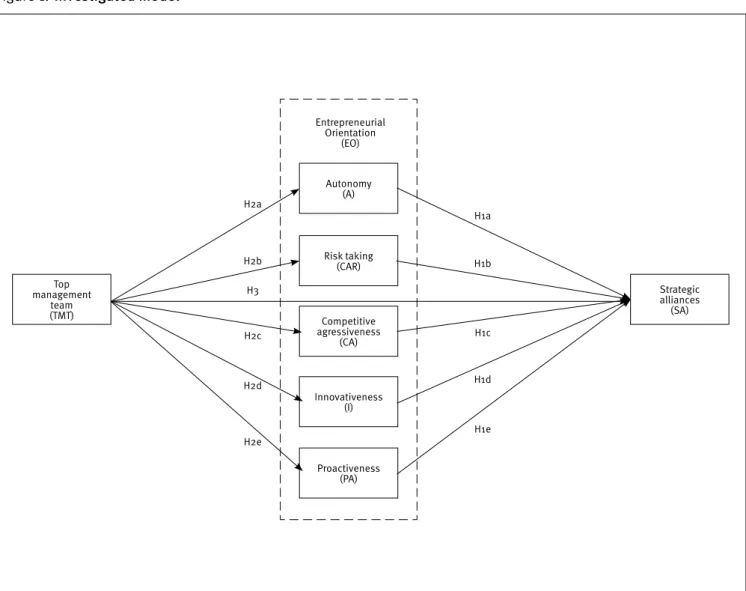
H1a:There is a positive association between autonomy (A) and SA.
H1b: There is a positive association between risk taking (RT) and SA, i.e., the higher the RT, the higher the SA.
H1c: There is a positive association between competitive aggressiveness (CA) and SA.
H1d: There is a positive association between innovativeness (I) and SA.
H1e: There is a positive association between proactiveness (PA) and SA.
Top management team as a predecessor of
entrepreneurial orientation
TMT members are deined as the senior executives in the TMT responsible for one or more functional areas in their organizations
(Menz, 2012). In the present study, we diferentiate TMTs according to how they predominantly act, i.e., either as entrepreneurs or as managers (Filion, 2000). Since Hambrick and Mason’s (1984)
individual TMT members other than CEOs (Menz, 2012). In this context, an entrepreneur vision within TMTs plays an important role for irms, particularly irms with an EO.
Although irms encourage their employees to have an entrepreneurial behavior in their functions, it is not clear why some TMTs have an entrepreneurial behavior while others do not (Hashimoto & Nassif, 2014), or, most importantly, how TMTs can inluence irms’ EO (Simsek et al., 2010) and, consequently, irms’ SA. In the case of SA, one of the reasons why managers choose not to make an SA is that they are focusing exclusively on private beneits (obtained by subsets of members of the alliance), aiming at value generation (e.g., shared beneits) (Dickson et al., 2006; Wittmann, 2007). The simplest reason why organizations decide not to establish partnerships is the lack of a strategy for alliances from the TM point of view. That decision is a strategic one (Wittmann, 2007). Therefore, the role of TMT is important to decisions about SA.
A superior business performance is more frequently achieved by internal leaders or groups of leaders (Burgelman, 1983;Lumpkin & Dess, 1996). Miller (1983) showed that, in the case of small entrepreneurial companies and planned companies (those which follow the path of bureaucratic structure, decision making, and planning), the high level of entrepreneurship was associated with presidents with a strong central authority who were able to act as leaders, with sound knowledge of markets and emerging technologies. Drummond and Stone (2007) complement this finding by showing that successful enterprises have management philosophies that operate through open, inclusive approaches, stressing a routine communication with no mediation between managers and workers, as well as flat hierarchy, autonomy, trust, and team work.
As Menz (2012) suggests, future studies on TMT members should focus on the nature of TMT members’ work, TMT processes, TMT members’ ties beyond the TMT, TMT impact, and TMT changes over time. This can involve scholars from diferent ields, facilitating the cross-fertilization of theories. Following Menz’s (2012) suggestions, we argue that TMT is relevant to SA, but not as a moderator between EO and SA like some studies (Lumpkin & Dess, 1996; Messersmith & Wales, 2011) propose when analyzing EO and irm performance. We followed Menz’s (2012) suggestion and agree with Simsek et al.’s (2010), Miller’s (1983)
and Burgelman’s (1983) view that TM is the heart of the company, acting as a predecessor of the EO-SA relation. Although we airm that TMT is important for decisions about SA, we argue that TMT is also important to develop and maintain an EO. Therefore, TMT is a predecessor of EO-based conditions to promote SA. Hence, we propose Hypothesis 2 (H2):
H2a: There is a positive association between TMT and autonomy (A).
H2b: There is a positive association betweenTMT and risk taking (RT).
H2c: There is a positive association between TMT and competitive aggressiveness (CA).
H2d: There is a positive association between TMT and innovativeness (I).
H2e: There is a positive association between TMT and proactiveness (PA).
We propose Hypothesis 3 (H3): There is a positive association betweenTMT and SA.
METHOD
To test our hypotheses, we conducted a quantitative survey. The present study used structural equation modeling (SEM) in order to assess the proposed model. SEM can ofer signiicant opportunities for insights in the ield of strategic management, particularly because the ield’s core constructs (e.g., strategy, entrepreneurship, performance) are multidimensional and the relationships among them are complex (Shook, Ketchen, Hult, & Kacmar, 2004). A key strength of SEM is that it allows concomitant psychometric and econometric analyses, being better suited to evaluate theoretical models (Fornell & Larcker, 1981). Partial least squares (PLS) modeling is particularly well suited to many of the problems studied in management (Robins, 2014). PLS is a modeling approach to SEM without any previous assumptions about data distribution. Thus, the PLS-SEM combination is a suitable alternative analysis technique whenever the sample is small, the theoretical support available is scarce (in the sense that it does not provide exhaustive explanations of dependent phenomena), the predictive precision is primary, and the speciication of the correct model cannot be assured (Robins, 2014; Sarstedt, Ringle, & Hair, 2014;Wong, 2013). Furthermore, PLS-SEM plays an important role both in research and business practice (Hair, Ringle, & Sarsted, 2012). PLS-SEM has been used to estimate the conceptual model. We conducted the analysis using SmartPLS 2.0 M3 (Ringle, Wende, & Will, 2005).
Sampling and data collection
Brasileiro de Apoio às Micro e Pequenas Empresas (Brazilian Micro and Small Business Support Service [Sebrae]) to represent companies in a range of industries, sizes, ownership structures and regions. We identiied our target population, i.e., TMT members (owners, presidents, vice-presidents and/or directors). We chose to focus on this population because it is directly involved in the creation of irms’ policies. We sent online survey emails to the 500 randomly selected irms containing a link to the questionnaire we designed to measure the ive dimensions of the independent variable EO (A, RT, CA, I and PA), the dependent variable (SA), and EO’s predecessor variable – TMT. Data collection was conducted in 2014. A total of 101 valid responses were analyzed, yielding an efective response rate of 20.20 %. The model is shown in Figure 1.
Measures
Established multiple-item scales were used and scale items were disposed at random to minimize survey method biases. Each scale item was measured using three seven-point Likert-type items.
SA was measured using three seven-point Likert-type items designed for this study based on SA theory (Dickson et al., 2006; Hitt et al., 2001; Sarasvathy, 2001): (SA1) “Usually, what my company (or business unit) uses (or focuses on) as its business strategy is: 1: strategic analysis, to a large extent (market research, long-term planning, etc.); 2: strategic analysis; 3: strategic analysis, to a small extent; 4: neither strategic analysis, nor partnerships; 5: partnerships, to a small extent; 6: partnerships; 7: partnerships, to a large extent (strategic alliances)”; (SA2) “In general, my company (or business unit) uses partnerships (alliances) as a business strategy to eliminate entrance barriers: 1: very rarely; 2: rarely; 3: more rarely than not; 4: neither rarely, nor often; 5: more often than not; 6: often; 7: very often”; and (SA3) “When establishing partnerships with other companies, my company (or business unit) seeks a relationship for: 1: the short term, to a large extent (the “partner” is just another client); 2: the short term; 3: the short term, to a small extent; 4: neither a short, nor a long term; 5: the long term, to a small extent; 6: the long term; 7: the long term, to a large extent (through a mutual, cooperative efort)”.
The EO construct was measured using ive subdomains. The autonomy dimension was measured using three seven-point Likert-type scales adapted from Dess and Lumpkin (2005) in a reverse translation: (A1) “In general, my company’s managers work at independent units, like incubators, to reinforce creative thinking: from 1 (very rarely) to 7 (very often)”; (A2) “In general, my company’s managers allow autonomous groups to conduct initiatives that are still not succeeding: from 1 (very rarely) to 7 (very often)”; (A3) “In general, my company’s managers implement necessary changes in the irm’s structure to stimulate new ideas,
thus facilitating the decision-making process: from 1 (very rarely) to 7 (very often)”.
The risk taking dimension was measured using three seven-point Likert-type scales adapted from Miller and Friesen (1982) in a reverse translation: (RT1) “In general, my company’s managers have a strong tendency towards projects that are: from 1 (very conservative, i.e., normal and safe return rate normal) to 7 (high-risk, i.e., with chances very high returns)”; (RT2) “In general and due to the nature of the business environment, my company’s managers assume an attitude that is: from 1 (very cautious, i.e., the best is to explore gradually) to 7 (very dashing, i.e., risk actions are necessary to achieve the company’s goals)”; (RT3) “When confronted with decision-making situations involving uncertainties, my company usually adopts an attitude that is: from 1 (very cautious, i.e., “wait to see” to minimize the probability of making a hasty decision) to 7 (very aggressive, i.e., maximizing the likelihood of exploring potential opportunities)”.
The competitive aggressiveness dimension was measured using three seven-point Likert-type scales adapted from Covin and Covin (1990) in a reverse translation: (CA1) “In general, when dealing with competitors, my company takes the initiative and then competitors respond: from 1 (very rarely, i.e., the company typically responds to actions initiated by competitors) to 7 (very often, i.e., the company usually takes the initiative and competitors respond to it)”; (CA2) “In general, when dealing with competitors, my company is the first to introduce new products / services / technology / management techniques, etc.: from 1 (very rarely) to 7 (very often)”; (CA3) “In general, when dealing with competitors, my company typically assumes a competitive attitude to face competitors: from 1 (very rarely, i.e., the company tries to avoid confrontation with competitors, preferring a ‘live and let me live’ attitude) to 7 (very often, i.e., the company typically adopts a very competitive attitude to face competitors)”.
The innovativeness dimension was measured using three seven-point Likert-type scales adapted from Miller and Friesen (1982) in a reverse translation: (I1) “In general, my company’s managers usually give emphasis to: from 1 (much emphasis on product or service commercialization) to 7 (much emphasis on R & D, technology leadership, and innovation)”. (I2) In the last three years, my company has launched new product or service lines: from 1 (very rarely) to 7 (very often)”; (I3) “Over the last three years, my company has changed its product or service lines: from 1 (very rarely, i.e., it has made changes) to 7 (very often, i.e., it has made several changes)”.
trends by identifying customers’ future needs: from 1 (very rarely) to 7 (very often); (PA2) “In general, my company strives to be the ‘irst in’, thus reaping all the beneits of being a pioneer in its ield: from 1 (very rarely) to 7 (very often)”; (PA3) “In general, my company seeks to ofer new products / services / technologies...: from 1 (very rarely) to 7 (very often)”.
The TMT construct was measured using ive seven-point bipolar items that evaluated the diferences in an individual’s operational methods concerning his/her human activity system at work either as a manager or an entrepreneur (Filion, 2000; Menz, 2012). In other words, when a TM chooses an option higher than 4, he/she has a high degree of entrepreneurial behavior. (TMT1) “When dealing with activity systems, I seek: from 1 (very often, to work eiciently and use resources efectively to achieve goals and objectives) to 7 (very often, to establish a vision and goals and identify the resources to make
goals a reality)”; (TMT2) “For me, when dealing with activity systems, the key is: from 1 (very often, to adapt to changes) to 7 (very often, to initiate the changes)”; (TMT3) “When dealing with a system of activities, I look for a work pattern that involves: from 1 (very often, rational thinking) to 7 (very often, imagination and creative thinking)”; (TMT4) “With regard to the structure of work, I seek: from 1 (very often, to operate within the existing structure) to 7 (very often, to deine the tasks and functions that create a structure)”; (TMT5) “When dealing with activity systems, I try to work with focus on: 1 (very often, processes that take into consideration the environment in which the work is done) to 7 (very often, creative processes resulting from a diferent view of the environment)”. Data regarding irm size and sector were reported by TMs, according to the parameters of Sebrae and Dieese (2008), irm size classiications being micro, small, medium, and large, according to the number of employees.
Figure 1.
Investigated model
Autonomy (A)
Risk taking (CAR)
Proactiveness (PA) Innovativeness
(I) Competitive agressiveness
(CA)
Strategic alliances (SA) Entrepreneurial
Orientation (EO)
H1a H2a
H2b
H3
H2c
H2d
H2e
H1b
H1c
H1d
H1e Top
RESULTS AND ANALYSES
The demographic characteristics of the sample are shown in Table 1.
Table 1.
Sample
Items 2014
Total number of companies 101 (100%)
Large companies 37%
Mid-sized enterprises 15%
Small and micro-enterprises 48%
Industry 13%
Commerce 22%
Services 66%
Sample and statistical power
An a priori analysis is conducted to determine the necessary sample size N for a test, given a desired α level, a desired power level (1 - β), and the size of the efect to be detected (Mayr, Buchner, Erdfelder, & Faul, 2007). To that end, the following values were considered: α = 0.05, average efect = 0.15, six predictors and statistical power of 80% (Hair, Hult, Ringle, & Sarstedt, 2013). According to G*Power software (Faul, Erdfelder, Buchner, & Lang, 2009), the minimum required sample amount is 98 cases. In this study, the sample contains 101 cases, which meets the a priori test requirement. A post hoc analysis is normally performed after a study has been conducted, once the sample size N is already a fact. Given N, α, and a speciied efect size, this type of analysis returns the power (1 - β), or the β error probability of the test (Mayr et al., 2007). We performed a post hoc analysis of the sample. The efect of the population was 0.15, α = 0.05, N = 101 and 6 predictors. The value of the statistical test (1 - β) is 0.8183, therefore within the agreed value of 0.80 (Cohen, 1992).
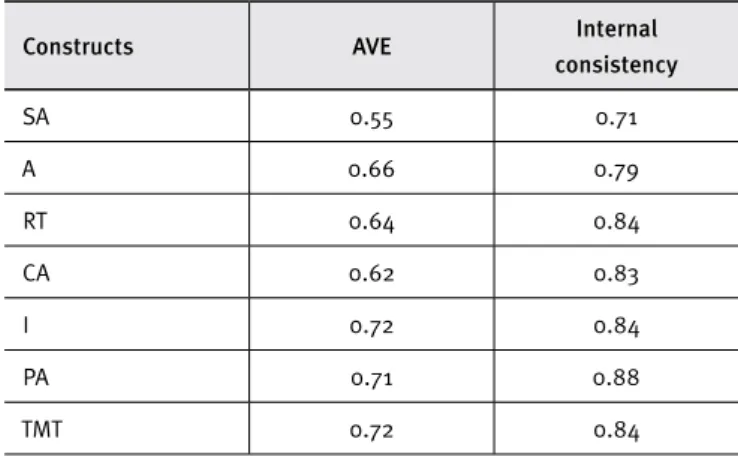
Reliability of measures
Reliability results are presented in Table 2. Data indicate robustness in terms of internal consistency, as seen in the reliability formed by diferent measures ranging from 0.71 to 0.88, which exceeds the recommended value of 0.7 (Fornell & Larcker, 1981). Moreover, in line with Fornell and Larcker’s guidelines, the average variance extracted (AVE) for each measurement exceeded 0.50.
Table 2.
Measurement model assessment
Constructs AVE Internal
consistency
SA 0.55 0.71
A 0.66 0.79
RT 0.64 0.84
CA 0.62 0.83
I 0.72 0.84
PA 0.71 0.88
TMT 0.72 0.84
Discriminant validity
Table 3 shows the results of discriminant validity evaluation of the scales. In all of the cases, the diagonal elements of the matrix, which represent the square root of AVEs, are greater than the elements out of the diagonal line, which supports the scales’ discriminant validity.
Table 3.
Discriminant validity (correlations) of the
construct variables
Latent
variable SA A RT CA I PA TMT
SA 0.74
A 0.39 0.81
RT 0.40 0.51 0.80
CA 0.26 0.45 0.43 0.79
I 0.26 0.49 0.43 0.60 0.85
PA 0.19 0.28 0.47 0.71 0.51 0.84
TMT 0.37 0.32 0.34 0.27 0.18 0.21 0.85
Convergent validity
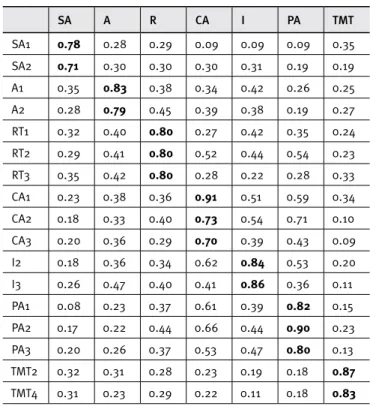
Convergent validity was evaluated by extracting the factors and factor loadings of each item for their respective latent constructs. Results (Table 4) indicate that every loaded item exceeded both the inferior (0.70) and superior (0.95) limits, i.e., for each item, the construct(s) corresponding to a speciic item was/were the largest one(s).
Confirmation of sample validity
number of records is above 60, which corroborates the sample size of 101 companies. Chin, Marcolin, and Newsted (2003)
suggest that the desired sample size should be 10 times the number of constructs assessed. Considering that seven constructs were used in the present study, the minimum sample size would be 70 companies, and since our sample includes 101 companies, the sample size is suitable to the purposes of our study.
Table 4.
Factor loading (bold) and cross loading
SA A R CA I PA TMT
SA1 0.78 0.28 0.29 0.09 0.09 0.09 0.35
SA2 0.71 0.30 0.30 0.30 0.31 0.19 0.19
A1 0.35 0.83 0.38 0.34 0.42 0.26 0.25
A2 0.28 0.79 0.45 0.39 0.38 0.19 0.27
RT1 0.32 0.40 0.80 0.27 0.42 0.35 0.24
RT2 0.29 0.41 0.80 0.52 0.44 0.54 0.23
RT3 0.35 0.42 0.80 0.28 0.22 0.28 0.33
CA1 0.23 0.38 0.36 0.91 0.51 0.59 0.34
CA2 0.18 0.33 0.40 0.73 0.54 0.71 0.10
CA3 0.20 0.36 0.29 0.70 0.39 0.43 0.09
I2 0.18 0.36 0.34 0.62 0.84 0.53 0.20
I3 0.26 0.47 0.40 0.41 0.86 0.36 0.11
PA1 0.08 0.23 0.37 0.61 0.39 0.82 0.15
PA2 0.17 0.22 0.44 0.66 0.44 0.90 0.23
PA3 0.20 0.26 0.37 0.53 0.47 0.80 0.13
TMT2 0.32 0.31 0.28 0.23 0.19 0.18 0.87
TMT4 0.31 0.23 0.29 0.22 0.11 0.18 0.83
Variance inlation factor (VIF) was also calculated using the SPSS, to evaluate cases of multicollinearity. When VIF is above 5.0, there are problems of collinearity (Hair et al., 2013). In Table 5, we can see that VIF values – and all values – are below 5.0, and their tolerance values are higher than 0.2, so there are no collinearity problems (Hair, Ringle, & Sarstedt, 2011).
Table 5.
Collinearity of Indicators
Constructs Tolerance VIF
Total number of companies 101 (100%)
A 0.898 1.114
CA 0.923 1.083
RT 0.959 1.043
TMT 0.934 1.071
I 0.962 1.040
PA 0.949 1.053
Note: Dependent variable: SA
With regard to normality, studies and laboratory tests
(Maroco, 2010) show that even results without a normal distribution may be acceptable provided that the ordinal element is greater than, or equal to, ive points, and the distribution of frequencies approaches the bell curve, giving a continuous character to variables without major distortions in the adjustment.
Thus, Maroco (2010) recommends that the kurtosis measures (ku) and univariate asymmetry (sk) approach zero and be no higher than 2 and 7, respectively. In the tests with this sample, although results are not normally distributed, none of the variables or the constructs alone has | sk | > 2 and | ku | > 7. Therefore, there is no extreme violation of normality.
Hypotheses testing (H1)
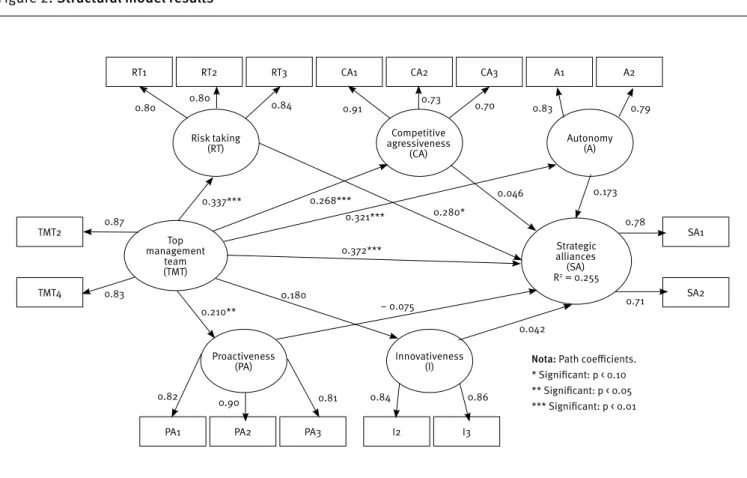
Results of the structural model without the inluence of EO’s predecessor variable (TMT) indicate that the beta coeicients of RT (beta = 0.280; p < 0.10) are positive and moderated signiicant. The other EO variables, i.e., A (beta = 0.173), CA (beta = 0.045), I (beta = 0.049) and PA (beta = -0.075), did not show a signiicant inluence on SA. Therefore, the dimension RT of the EO construct had a positive inluence on SA. Therefore, the Hypothesis H1b was accepted, considering Lumpkin and Dess’ EO deinition that in order for a irm to be considered entrepreneurially orientated, it needs to have at least one of the ive dimensions of EO. The results of the structural model are shown in the Figure 2, where all beta values for all path coeicients are shown, and beta values for the signiicant paths are indicated.
Hypotheses testing (H2)
With regard to the efect of EO’s predecessor variable (TMT), the results show that, except for innovativeness (beta = 0.180), all beta coeicients of the dimensions of EO are positive and signiicant: A (beta = 0.321; p < 0.01), RT (beta = 0.337; p < 0.01), CA (beta = 0.268; p < 0.01), PA (beta = 0.210; p < 0.05). As expected, virtually all of EO’s dimensions (A, RT, CA, and PA) associated with TMT showed a positive relationship with SA. Thus, Hypothesis H2 was almost fully accepted. Therefore, TM’s entrepreneurial behavior can be considered the company’s heart, acting as a predecessor of the EO-SA relationship, as suggested by some authors (Burgelman, 1983;Menz, 2012; Miller, 1983; Simsek et al., 2010).
Hypotheses testing (H3)
(beta = 0.372; p < 0.01). Thus, the role of TMT is relevant to decisions on SA, and such decisions are strategic choices, since the simplest reason why irms do not make partnerships is the lack of a strategy for alliances from the TMT point of view (Dickson et al., 2006; Wittmann, 2007). Hypotheses H3 was supported.
Evaluating model fit
The present model explained 25.5% of the EO variance in SA. The model’s explanatory power makes it representative of the strategy and entrepreneurship ields, since according to Cohen (1988) a R2 > 26% indicates a large efect size and an excellent explanatory power.
Figure 2.
Structural model results
RT1
PA1 RT2
PA2 I2
RT3
PA3 I3
SA1 TMT2
SA2 TMT4
CA1 CA2 CA3 A1 A2
0.80 0.80 0.84
0.84 0.86
0.87
0.83
0.82
0.90 0.81
0.83 0.79
0.91 0.73
0.78
0.71 0.173
0.042 0.046 0.280*
– 0.075 0.372***
0.321*** 0.268*** 0.337***
0.210**
0.180
0.70
Risk taking (RT)
Top management
team (TMT)
Proactiveness
(PA) Innovativeness(I)
Strategic alliances (SA) R2 = 0.255 Competitive
agressiveness (CA)
Autonomy (A)
Nota: Path coeicients. * Signiicant: p < 0.10 ** Signiicant: p < 0.05 *** Signiicant: p < 0.01
CONCLUSION AND IMPLICATIONS
The present study assumed the existence of a relationship between
Lumpkin and Dess’ EO (1996) concept and SA as a means to decrease business-associated risks. This relationship would be afected by irms’ TMT, and EO would work as a multidimensional construct. In line with what was suggested by Marino et al. (2002), Teng (2005), Franco and Haase (2013), Bouncken et al. (2014),
Jiang et al. (2014),Shu et al. (2014), and Talebi et al. (2015), the present study found a relationship between EO and SA as the RT dimension of EO showed a positive relationship with SA, although a moderate signiicant one. Results for the relationship between one dimension of EO (RT) and SA were afected by the TMT. In fact, four of the ive EO dimensions (A, RT, CA, and PA) worked as mediators
between TMT and SA. Moreover, our indings corroborate Covin and Lumpkin’s (2011) argument that EO is a multidimensional construct and would be inluenced by the company’s TMT.
that alliances are economic outcomes in a social context. Dickson et al. (2006) suggest that the resource base of a SME, measured by its size, can moderate the relationship between technology and the prevailing culture in its domestic market, raising concerns about opportunistic behaviors in a partnership with a SME.
Lumpkin and Dess (1996) and Covin et al. (2006) indicate that industry and irm size can inluence EO dimensions of interest.
In today’s globalized world, where social, economic and political structures have been continuously shaken, acquiring new knowledge is increasingly necessary. In this perspective, the power to anticipate the future or minimize the risks associated with a business can be understood as one of the key factors for organizations’ sustainability. This includes questions related with EO and SA, more speciically partnerships between irms (SA) driven by a TMT with an EO. As any irm ultimately relies on the strength, capacity and skills of the people that form it, knowing the key roles of TMT and EO, particularly RT, can be an advantage for SAs in the real business world.
Contribution to theory
This study empirically assessed cooperation as a means to put entrepreneurial concepts into practice and connected two areas of study, i.e., EO and SA, thus illing a theoretical and empirical gap that we identiied in the literature. In order to ind a relationship between Lumpkin and Dess’ (1996) EO competitive value and its efects on companies’ growth patterns, leveraging resources, and capabilities by means of SA, this article showed that RT is moderately associated with SA. This result reinforces the importance of Covin and Lumpkin’s (2011) propositions that EO is a multidimensional construct. A full relationship between EO and SA was not found. However, this does not mean that no such relations were found. By using a multidimensional construct
(Lumpkin & Dess, 1996), we showed that EO’s RT can be relevant to decisions concerning SAs. This supports the view of Lumpkin and Dess (1996) that EO dimensions would be present in certain situations but not in others, depending on internal and external factors (Lumpkin & Dess, 1996; Saxton, 1997;Covin et al., 2006;
Dickson et al., 2006), and that EO works in a multidimensional, relexive way (Covin & Lumpkin, 2011).
This result indicates that investing in EO, particularly its RT dimension, could become important in order to promote SA. Obviously, TMT afects SA, but companies with well-developed RT capabilities could be more likely to support a decision to establish an SA and proceed to implement it. In this perspective, the present study contributes to consolidate the EO construct by using it in a multidimensional way and in a relexive model in line with the work of Lumpkin and Dess (1996) and as suggested by
Covin and Lumpkin (2011), since EO represents real phenomena.
Lumpkin and Dess (1996) pointed out that researchers have failed to ind consistency in relations with/perceptions of RT concerning entrepreneurship, whether in the form of creation of new businesses or as misleading relations between RT and performance. Furthermore, most enterprise-related studies refer to individual rather than company risks.
RT primarily resides at the individual level and is then carried to company level. Companies’ RT can be shaped by the inluence of individuals’ risk perception, attitude, intention, and behavior. This applies to both large corporations and SMEs. Thus, the irm-level RT that seems to contribute to high performance in SA are: (1) a strong tendency to risky projects with a chance of high returns; (2) a bold approach in which big actions are necessary to achieve the company’s goals; and (3) adopting an aggressive attitude to maximize the likelihood of exploring potential opportunities.
The present study aims to draw attention to TMT as a predecessor of the EO efect on the relationship between EO and SA. TMT afects SA, being associated with EO dimensions (A, RT, CA, and PA) related to SA; if only one EO dimension (I) is not associated with TMT, others aspects of our results for TMT are still relevant. These results can encourage irms to develop TMT in order to have an EO. If RT is moderately associated with SA, other dimensions could be associated with other corporate or business strategies (Covin et al., 2006;Dickson et al., 2006; Lumpkin & Dess, 1996; Saxton, 1997). Although views and approaches about the entrepreneur can difer, there are many points of convergence among them. This study provides evidence and insights on the potential beneits associated with closer connections between TMT and irms’ EO and SA.
Implications
is related with SA and, therefore, OE and SA can and should be used as an approach to strategic management.
For academics, our ideas imply a new way of thinking strategic entrepreneurship, given our view of integrating two diferent subjects, i.e., EO (from the RT perspective) and SA. Our ideas also imply the need to approach research design from a broader perspective than has been applied by researchers so far. For example, there is a vast literature on EO and SA covering related diversiication strategies, but this literature has ignored the opportunity of wealth creation that can emerge from linking RT and SA within a irm. Thus, our integration of EO and SA suggests a diferent approach to strategic entrepreneurship, which ensures that academics interested in explaining the relationship between EO and SA can capture both opportunity and competitive advantages within a particular research design.
For practitioners, given their interest in making their organizations sustainable and successful, the ideas presented here can provide a better, easier way to achieve their goals. A irm can beneit from partners with a strong EO through the sharing of knowledge that can lead to an alliance that can enhance performance. This implies that companies must assume RT in the pursuit of a partnership. As a means to promote an EO, we have two suggestions. Firstly, TMTs must cultivate a good relationship with team members in order to encourage them to generate ideas and identify opportunities. Secondly, TMTs must protect their entrepreneurs from punishment, should the latter’s eforts fail, considering that employees with an autonomous entrepreneurial behavior already have an EO (Hashimoto & Nassif, 2014).
Limitations and future research
A few general reservations in this study should be considered. Firstly, our scales relied on subjective measures, although we took great care in our data analysis (by applying robustness checks) and biases reduction. Future research could verify the EO-SA relationship by using secondary data or combining survey and secondary data.
Secondly, while on the one hand, theoretical guidance on EO efectiveness suggests that EO-related outcomes should present moderation by internal organizational variables (Covin & Slevin, 1991;Lumpkin & Dess, 1996; Rauch et al., 2009), on the other hand, these variables could inluence EO. However, we do not consider this limitation a critical one. We argue that EO is inluenced by TMT’s practices and philosophies, which can help explain SA. Thus, we believe that our framing is appropriate and sheds light on a theoretically meaningful EO-SA relationship, as it has long been advocated in the EO literature (Alvarez, Ireland, & Reuer, 2006).
REFERENCES
Alvarez, S. A., & Barney, J. B. (2001). How entrepreneurial irms
can beneit from alliances with large partners. The Academy of
Management Executive, 15(1), 139-148.
Alvarez, S. A., Ireland, R. D., & Reuer, J. J. (2006). Entrepreneurship and
strategic alliances. Journal of Business Venturing, 21(4), 401-404.
doi:10.1016/j.jbusvent.2005.03.001
Anderson, B. S., Kreiser, P. M., Kuratko, D. F., Hornsby, J. S., & Eshima,
Y. (2014). Reconceptualizing entrepreneurial orientation. Strategic
Management Journal, 36(10), 1579-1596. doi:10.1002/smj.2298.
Bouncken, R. B., Pluschke, B. D., Pesch, R., & Kraus, S. (2014). Entrepreneurial orientation in vertical alliances: Joint product
innovation and learning from allies. Review of Managerial Science,
10(2)1-29, 381-409. doi:10.1007/s11846-014-0150-8.
Brouthers, K. D., Nakos, G., & Dimitratos, P. (2014). SME entrepreneurial orientation, international performance, and the moderating role of
strategic alliances. Entrepreneurship Theory and Practice, 39(5),
1161-1187. doi:10.1111/etap.12101
Brown, T. E., Davidsson, P., & Wiklund, J. (2001). An operationalization of Stevenson’s conceptualization of entrepreneurship as
opportunity-based irm behaviour. Strategic Management Journal, 22(10),
953-968. doi:10.1002/smj.190
Burgelman, R. A. (1983). A process model of internal corporate venturing
in the diversiied major irm. Administrative Science Quarterly, 28(2),
223-244. doi:10.2307/2392619
Chin, W. W., Marcolin, B. L., & Newsted, P. R. (2003). A partial least squares latent variable modeling approach for measuring interaction efects: Results from a Monte Carlo simulation study and an
electronic–mail emotion/adoption study. Information Systems
Research, 14(2), 189-217. doi:10.1287/isre.14.2.189.16018
Cohen, J. A. (1988). Statistical power analysis for the behavioral sciences. New Jersey, EUA: Lawrence Erlbaum Associates.
Cohen, J. A. (1992). A power primer. Psychological Bulletin, 112(1),
155-159. doi:10.1037/0033-2909.112.1.155
Covin, J. G., & Covin, T. J. (1990). Competitive aggressiveness,
environmental context, and small irm performance. Entrepreneurship
Theory and Practice, 14(4), 35-50.
Covin, J. G., Green, K. M., & Slevin, D. P. (2006). Strategic process efects on the entrepreneurial orientation-sales growth rate relationship.
Entrepreneurship Theory and Practice, 30(1), 57-81. doi:10.1111/
j.1540-6520.2006.00110.x
Covin, J. G., & Lumpkin, G. T. (2011). Entrepreneurial orientation theory
and research: Relections on a needed construct. Entrepreneurship
Theory and Practice, 35(5), 855-872.
doi:10.1111/j.1540-6520.2011.00482.x
Covin, J. G., & Slevin, D. P. (1989). Strategic management of small irms
in hostile and benign environments. Strategic Management Journal,
10(1), 75-87. doi:10.1002/smj.4250100107
Covin, J. G., & Slevin, D. P. (1991). A conceptual model of entrepreneurship
as irm behavior. Entrepreneurship Theory and Practice, 18(1), 7-25.
Das, T. K., & Rahman, N. (2010). Determinants of partner opportunism in
strategic alliances: A conceptual framework. Journal of Business and
Dess, G. G., & Lumpkin, G. T. (2005). The role of entrepreneurial orientation in stimulating efective corporate entrepreneurship.
Academy of Management Executive, 19(1), 147-156.
Dickson, P. H., Weaver, K. M., & Hoy, F. (2006). Opportunism in the R&D alliances of SMES: The roles of the institutional environment and SME
size. Journal of BusinessVenturing, 21(4), 487-513. doi:10.1016/j.
jbusvent.2005.02.003
Drummond, I., & Stone, I. (2007). Exploring the potential of high
performance work systems in SMEs. Employee Relations, 29(2),
192-207. 10.1108/01425450710720011
Faul, F., Erdfelder, E., Buchner, A., & Lang, A. G. (2009). Statistical power analyses using G*Power 3.1: Tests for correlation and regression
analyses. Behavior Research Methods, 41(4), 1149-1160. doi:10.3758/
brm.41.4.1149
Filion, L. J. (2000). Empreendedorismo e gerenciamento: Processos
distintos, porém complementares. RAE-Revista de Administração de
Empresas, 40(3), 2-7. doi:10.1590_S0034-75902000000300012
Fornell, C., & Lacker, D. (1981). Evaluating structural equation models
with unobservable variables and measurement error. Journal of
Marketing Research, 18(1), 39-50. doi:10.2307/3151312
Franco, M., & Haase, H. (2013). Firm resources and entrepreneurial orientation as determinants for collaborative
entrepreneurship. Management Decision, 51(3), 680-696.
doi:10.1108/00251741311309724
Hair, J. F., Anderson, R. E., Tatham, R. L., & Black, W. C. (2009). Análise multivariada de dados. Porto Alegre, RS: Bookman.
Hair, J. F., Hult, G. T., Ringle, C. M., & Sarstedt, M. (2013). A primer on partial least squares structural equation modeling (PLS–SEM). Thousand Oaks, California, USA: Sage.
Hair, J. F., Ringle, C. M., & Sarstedt, M. (2011). PLS-SEM: Indeed a silver
bullet. Journal of Marketing Theory and Practice, 19(2), 139-151.
doi:10.2753/mtp1069-6679190202
Hair, J. F., Ringle, C. M., & Sarstedt, M. (2012). Partial least squares:
The better approach to structural equation modeling? Long Range
Planning, 45(5-6), 312-319. doi:10.1016/j.lrp.2012.09.011
Hambrick, D. C., & Mason, P. A. (1984). Upper echelons: The organization
as a relection of its top managers. Academy of Management Review,
9(2), 193-206.
Han, K., Oh, W., Im, K. S., Cang, R. M., Oh, H., & Pinsonneault, A. (2012). Value cocreation and wealth spillover in open innovation alliances.
MIS Quartely, 36(1), 291-315.
Hashimoto, M., & Nassif, V. (2014). Inhibition and encouragement of entrepreneurial behavior: Antecedents analysis from managers’
perspectives. BAR-Brazilian Administration Review, 11(4), 385-406.
doi:10.1590/1807-7692bar2014130008
Hitt, M. A., Ireland, R. D., Camp, S. M., & Sexton, D. L. (2001). Strategic entrepreneurship: Entrepreneurial strategies for wealth creation.
Strategic Management Journal, 22(6-7), 479-491. doi:10.1002/
smj.196
Jiang, X., Yang, Y., Pei, Y-L., & Wang, G. (in press). Entrepreneurial orientation, strategic alliances, and irm performance: Inside the black box. Long Range Planning. Retrived from http://ac.els-cdn. com/S0024630114000715/1-s2.0-S0024630114000715-main.pdf?_ tid=a6296610-ec6d-11e5-bd11-00000aab0f26&acdnat=145823931 8_7ee5dbe637865be782eccf43674cee5c
Ketchen, D. J., Ireland, R. D., & Snow, C. C. (2007). Strategic
entrepre-neurship, collaborative innovation, and wealth creation. Strategic
Entrepreneurship Journal, 1(3-4), 371-385. doi:10.1002/sej.20
Lumpkin, G. T., & Dess, G. G. (1996). Clarifying the entrepreneurial
ori-entation construct and linking it to performance. Academy of
Man-agement Review, 21(1), 135-172. doi:10.5465/AMR.1996.9602161568
Marino, L., Strandholm, K. Steensma, H. K., & Weaver, K. M. (2002). The moderating efect of national culture on the relationship between entrepreneurial orientation and strategic alliance portfolio
extensiveness. Entrepreneurship Theory and Practice, 26(4), 145-160.
Maroco, J. (2010). Análise de equações estruturais: Fundamentos teóricos, software & aplicações. Lisboa, Portugal: Editora Report Number.
Mayr, S., Buchner, A., Erdfelder, E., & Faul, F. (2007). A short tutorial of
GPower. Tutorials in Quantitative Methods for Psychology, 32(2), 51-59.
Menz, M. (2012). Functional top management team members: A review,
synthesis, and research agenda. Journal of Management, 38(1),
45-80. doi:10.1177/0149206311421830
Messersmith, J. G., & Wales, W. J. (2011). Entrepreneurial orientation and performance in young irms: The role of human resource
management. International Small Business Journal, 31(2), 115-136.
doi:10.1177/0266242611416141
Miller, D. (1983). The correlates of entrepreneurship in three types
of irms. Management Science, 29(7), 770-791. doi:10.1287/
mnsc.29.7.770
Miller, D., & Friesen, P. (1982). Innovation in conservative and
entrepreneurial irms: Two models of strategic momentum. Strategic
Management Journal, 3(1), 1-25. doi:10.1002/smj.4250030102
Montoro-Sánchez, A., Ortiz-Urbina-Criado, M., & Romero-Matinez, A. M. (2009). The decision to use alliances as corporate entrepreneurship:
The role of resources and skills. Group Decision and Negotiation, 18,
431-448. doi:10.1007/s10726-008-9135-9
Rauch, A., Wiklund, J., Lumpkin, G. T., & Frese, M. (2009). Entrepreneurial orientation and business performance: An assessment of past
research and suggestions for the future. Entrepreneurship Theory
and Practice, 33(3), 761-787. doi:10.1111/j.1540-6520.2009.00308.x
Ringle, C. M., Wende, S., & Will, A. (2005). SmartPLS 2.0 M3. SmartPLS, Hamburg, Germany. Retrieved from http://www.smartpls.de/.
Robins, J. A. (2014). Partial least squares revisited. Long Range Planning,
47(3), 131. doi:10.1016/j.lrp.2014.02.006
Robson, M. J., Skarmeas, D., & Spyropoulou, S. (2006). Behavioral attributes and performance in international strategic alliances:
Review and future directions. International Marketing Review, 23(6),
585-609. doi:10.1108/02651330610712120
Rosenbusch, N., Rauch, A., & Bausch, A. (2013). The mediating role of entrepreneurial orientation in the task environmental-performance
relationship: A meta-analysis. Journal of Management, 39(3),
633-659. doi:10.1177/0149206311425612
Sarasvathy, S. D. (2001). Causation and efectuation: Toward a theoretical shift from economic inevitability to entrepreneurial
contingency. Academy of Management Review, 26(2), 243-263.
Sarstedt. M., Ringle, C. M., & Hair, J. F. (2014). PLS-SEM: Looking
back and moving forward. Long Range Planning, 47(3), 132-137.
doi:10.1016/j.lrp.2014.02.008
Saxton, T. (1997). The efects of partner and relationship characteristics
on alliance outcomes. Academy of Management Journal, 40(2),
Schulze, W. (2007). Networks and strategic entrepreneurship: Com-ments on comparing alliance network structure across industries: Observations and explanations and strategic networks and
entrepre-neurial ventures. Strategic Entrepreneurship Journal, 1(3-4), 229-231.
doi:10.1002/sej.32
Sebrae & Dieese. (2008). Anuário do trabalho na micro e pequena empresa 2008. Brasília, DF: DIEESE.
Shook, C. L., Ketchen, D. J., Hult, G. T. M., & Kacmar, K. M. (2004). An assessment of the use of structural equation modeling in strategic
management research. Strategic Management Journal, 25(4),
397-404. doi:10.1002/smj.385
Shu, C., Liu, C., Gao, & S. Shanley, M. (2014). The knowledge spillover
theory of entrepreneurship in alliances. Entrepreneurship Theory
and Practice, 38(4), 913-940. doi:10.1111/etap.12024
Simsek, Z., Heavey, C., & Veiga, J. F. (2010). The impact of CEO core
self-evaluation on the irm’s entrepreneurial orientation. Strategic
Management Journal, 31(1), 110-119. doi:10.1002/smj.800
Su, J., Zhai, Q., & Landstrom, H. (2015). Entrepreneurship research in
China: Internalization or contextualization? Entrepreneurship &
Regional Development: An International Journal, 27(1-2), 50-79. doi
:10.1080/08985626.2014.999718
Talebi, K., Rezazadeh, A., & Najmabadi, A. D. (2015). SME alliance performance: The impacts of alliance entrepreneurship,
entrepreneurial orientation, and intellectual capital. International
Journal of Entrepreneurship and Small Business, 24(2), 187-207.
doi:10.1504/jesb.2015.067286
Teng, B.-S. (2005). The emergence and popularization of strategic
alliances: Institutional and entrepreneurial views. International
Entrepreneurship and Management Journal, 1(1), 61-82. doi:10.1007/
s11365-005-6676-0
Venkatraman, N. (1989). Strategic orientation of business enterprises:
The construct, dimensionality, and measurement. Management
Science, 35(8), 942-962.
Wiklund, J., & Shepherd, D. A. (2005). Entrepreneurial orientation and
small business performance: A conigurational approach. Journal of
Business Venturing, 20(1), 71-91. doi:10.1016/j.jbusvent.2004.01.001
Wittmann, C. M. (2007). Strategic alliances: What can we learn when
they fail? Journal of Business–to–Business Marketing, 14(3), 1-19.
doi:10.1300/j033v14n03_01
Wong, K. K. (2013). Partial least squares structural equation modeling
(PLS–SEM): Techniques using SmartPLS. Marketing Bulletin, 24(1),
1-32.
Yli-Renko, H., & Janakiraman, R. (2008). How customer portfolio afects new product development in technology-based entrepreneurial irms.
Journal of Marketing, 72(5), 131-148. doi:10.1509/jmkg.72.5.131
Zahra, S. A., & Covin, J. G. (1993). Business strategy, technology policy
and irm performance. Strategic Management Journal, 14(6), 451-478.