A Work Project, presented as part of the requirements for the Award of a Master Degree in Finance from the NOVA – School of Business and Economics.
Sitting and waiting will not be enough
José Maria Parreira Jonet, 33941
A Project carried out on the master’s in finance Program, under the supervision of: Francisco Martins
Abstract
I conduct an analysis on Booking Holdings’ main opportunities, namely the Asian market. I estimate its impact on the company’s value and discuss the possible penetration strategies in the market: organic growth, partnerships with Chinese online travel agents, partnerships with other Asian companies and acquisitions.
Keywords: booking, accommodations, asia, growth
This work used infrastructure and resources funded by Fundação para a Ciência e a Tecnologia (UID/ECO/00124/2013, UID/ECO/00124/2019 and Social Sciences DataLab, Project 22209), POR Lisboa (LISBOA-01-0145-FEDER-007722 and Social Sciences DataLab, Project 22209) and POR Norte (Social Sciences DataLab, Project 22209).
Sitting and waiting will not be enough
An overview of value creation
In our group report, we forecasted Booking Holdings’ operating margins to slowly decrease throughout the explicit period of forecasts, driven by strategic
decisions and market pressures (Figure 1). Firstly, we expect the company to further expand in the alternative accommodations and the Asian market, which offer lower average daily rates (ADRs).
Secondly, the expected increase in customer’s preference for metasearch price-comparing platforms will increase BKNG’s performance marketing costs and competition, forcing the company to lower its average fees charged in the long run.
Nevertheless, according to our forecasts, these factors will not have a deep impact on operating margin. I foresee BKNG’s value will be mostly determined by its ability to extend its reach and increase the number of room nights sold.
Growth opportunities
I see the Asian market (in the short term) and the Connected Trip (in the medium to long term) as the most impacting room nights growth drivers for BKNG. Benefiting from tourism growth in Asia (Figure 2), and considering its population’s dimension compared to Europe, the market has potential to grow at high levels for a long time, particularly in China (Figure 3). Nevertheless, there are considerable barriers to entry in the Chinese online travel agents (OTAs) market. Firstly, established competitors like Trip.com, that held 46.4% of the market in 20181. Secondly, customers preference for the
1 CIW Team, China online accommodation market in Q4 2018
7.6%
5.6% 6.8%
2016 2017 2018
Figure 2: International Tourist Arrivals in East Asia (change); Source: World Tourism Organization
Figure 1: BKNG's operating margin forecast; Source: analyst estimates
9.9%
7.2% 9.7%
2021 2022 2023
Figure 3: China's outbound tourists (change); Source: COTRI analytics 30% 32% 34% 36% 38%
super-app’s model, where they can use the same mobile apps to communicate, travel, shop, pay (Alibaba, Meituan-Dianping) 2. Finally, Google – Booking’s most important paid channel – is restricted from operating in China. Furthermore, to pursue the connected trip, Booking needs to incorporate more levels of the consumer’s travel journey, as well as the capabilities to integrate them under one software and one smooth and frictionless experience. To provide a complete Connected Trip, Booking must offer accommodations, flights, rental cars, restaurants, experiences and tour reservations in every country it operates.
Taking these challenges into account, I believe organic growth would be an inefficient process that would hardly meet investors’ implied room nights growth (Figure 4). I see inorganic growth as the most efficient way to seize the opportunities Booking currently has on the horizon. In fact, the company has been investing in strategic
acquisitions and partnerships (Appendix). Since 2014, it has partnered with 5 Asian companies (Trip.com, Meituan-Dianping, Yanolja, Didi and Grab), of which the first two are the largest Chinese OTAs and the last two are transportation companies, linked to Connected Trip and brand recognition efforts.
Asian market’s influence on Booking
In Q1 2019’s earnings call, BKNG’s Chief Financial Officer David Goulden stated that roughly half of the ADR’s 3.4% drop in 2019 (1.7%) was
due to higher growth rates in countries with lower ADRs. Using this information, I was able to isolate the impact of the Asian market on the company and forecast its growth in the future. In order to do that, I performed an analysis in
2 M. Edmonds, The Rise of the Super App in China, 2018
“(…) there are 2 factors that are really almost equal weighing [ADRs]. One has to do with (…) rate and pricing pressure in the marketplace. And the other was geo mix impact as some of the higher growth countries are some of the countries with lower ADRs.”, Davin Goulden in BKNG’s 2019’s 1st quarter earnings call
0 500 1,000 1,500 2,000 2,500
Figure 4: Share price and room nights' CAGR; Source: analyst estimates
which only two main regions were considered: 1) Europe, which includes European countries, the US and other developed countries and 2) Asia, which includes China, India, the Southeast Asian countries and other emerging economies. Considering a weighted ADR in these regions3, P
E and PA, respectively, I estimated the weight of each region in Booking’s total room nights (WE and WA) by solving Equation 1 for WE, which is equal to 1 - WA. PT is the company’s total ADR.
Eq. 1: 𝑃 ∗ 𝑊 + 𝑃 ∗ 𝑊 = 𝑃 ; Eq. 2: 𝑃 = 𝑃 ∗ (1 − 3.4%);
Eq. 3: 𝑃 , = 𝑃 , ∗ (1 − 1.7%)
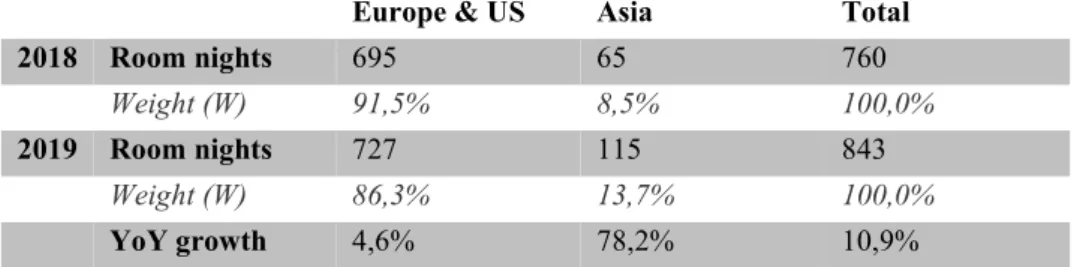
Firstly, I found 2018’s WE and WA by making PT equal to our group’s report total estimated ADR in 2018 (PT2018). Secondly, I found 2019’s weights by making: 1) PT equal to PT2019 (Eq. 2), accounting for the 3.4% ADR’s drop; 2) PA and PE drop 1.7% (Eq. 3), due to “rate and pricing pressure in the marketplace”, as mentioned by the CFO. Outcome is shown in Table 1.
The analysis supports that Asia’s room nights must have grown 78.2% from 2018 to 2019 to have been responsible for a 1.7% drop in the company’s total ADRs. Taking the output obtained, I forecasted each region’s growth separately to better understand their impact on BKNG’s value. For Europe, I assumed decelerating room nights growth rates
3 The average rates were estimated by the analyst through extensive data collection on Booking’s websites, using
the number of listings in each price range for each country. Regional ADRs were calculated using an average, weighted by each country’s number of listings. PE = $115.98 and PA =$73.33.
Europe & US Asia Total
2018 Room nights 695 65 760 Weight (W) 91,5% 8,5% 100,0% 2019 Room nights 727 115 843 Weight (W) 86,3% 13,7% 100,0% YoY growth 4,6% 78,2% 10,9% Europe & US 2019E 4,6% 2020F 4,5% 2021F 4,4% 2022F 4,2% 2023F 4,0% 2024F 3,9% 2025F 3,8% 2026F 3,7%
Table 1: Outcome of Asian market’s impact analysis; Source: analyst estimates
Table 2: Room nights growth, Europe; Source: analyst estimates
(Table 2) from 2019 onwards, due to the general tourism slowdown trend in the region4. I do not expect the connected trip to impact Booking’s room nights in the short term.
With these assumptions, BKNG’s current share price would imply a room nights’ Compounded Annual Growth Rate (CAGR) of 19.04% for the Asian market, from 2020 to 2026. Furthermore, a sensitivity analysis to this figure shows Booking’s great dependence on the ability to derive room nights growth in the Asian market (Figure 5). I consider the
company will not be able to keep these high growth rates in Asia organically and will be dependent on the success of its acquisitions and partnerships in the region.
Partnership impact
Through partnerships, companies list Booking’s properties in their websites and vice versa (inventory exchange agreement). For instance, when Trip.com’s mostly Chinese customers travel outbound, they can still book through the brand they are familiar with, having access to Booking’s universe of properties. Conversely, when Booking’s customers travel to China, they can book accommodations that were provided by Trip.com through Booking’s websites. BKNG benefits largely from this, considering that China’s number of outbound trips exceeds inbound trips5. BKNG holds partnerships with the Chinese OTAs Trip.com and
Meituan-Dianping, that held together 60.7% of Chinese market share in 20186. Assuming that 81.2%
of the 71.25 million Chinese travelling outbound7 in 2018 booked through an OTA8, that 60.7% of those booked through Trip.com or Meituan-Dianping, and that 50% of those customers booked Booking’s accommodations, these partnerships alone would have
4 European Parliament, Fact Sheets on the European Union – Tourism, 2019 5 Ministry of Culture and Tourism of the People's Republic of China, 2018 6 CIW Team, China online accommodation market in Q4 2018, 2019 7 China Tourism Academy and Trip.com, Tourism report, 2018 8 Meredith Pistulka, OTAs dominate the Chinese travel market, 2017
-3.0% -2.0% -1.0% 0.0% 1.0% 0 750 1,500 2,250 3,000 13% 19% 25% A D R 's C A G R Sh ar e Pr ic e ($ )
Asia room nights CAGR
Figure 5: Sensitivity analysis to share price and ADR’s CAGR, changing Asia’s room nights CAGR: Source: analyst estimates
accounted for 17.5 million room nights, 27.1% of Asia region total room nights in 2018. According to the China Outbound Tourism Research Institute, China’s outbound tourist arrivals will grow at around 9% in the next 6 years (Figure 3), way below the 19.04% Asia’s room nights CAGR implied by the current share price.
A multi-front strategy
Summing all up, I conclude Booking Holdings’ value is extremely reliant on its performance in the Asian market. Furthermore, I find that inventory partnerships with Chinese OTAs will help, but they will not be enough since BKNG already holds partnerships with the OTAs that hold 60% of that market. The other assumptions used to estimate partnerships contribution are not forecasted to change deeply in the following years. Therefore, I believe BKNG will need to derive further growth from higher brand recognition in Asia, obtained from creating partnerships with established Asian companies that redirect its customers to Booking’s websites (Didi Chuxing, Grab). Moreover, I expect the company to keep pursuing acquisitions like HotelsCombined, the leader in South Korea and acquired in November 2017 (Appendix). Sitting and waiting will not be enough: only through active market inorganic enlargement will Booking Holdings be able to derive its investors’ room nights expectations.
Acquisition date Type Description
Trip.com August 2014 Partnership Chinese online travel agency leader (46% market share). Two-way inventory exchange agreement
Meituan-Dianping October 2017 Partnership Chinese e-commerce giant (14% market share). Two-way inventory agreement FareHarbor April 2018 Acquisition Reservation platform for tours, activities, experiences (Connected Trip efforts) Didi Chuxing July 2018 Partnership Chinese transportation platform (Connected Trip and brand recognition)
Grab October 2018 Partnership On-demand transportation and mobile services platform in Southeast Asia. Two-way inventory exchange agreement (Connected Trip and brand recognition)
HotelsCombined November 2018 Acquisition Hotel metasearch engine, the leader in the South Korean market,added 2% to 2018’s total room nights (analyst estimate)
Yanolja June 2019 Partnership Hotel booking website in South Korea. Two-way inventory exchange agreement