Numerical
semigrou
Tese de DoutoramenloManuel
Baptista Branco
Dissertação apresentada na Universidade de Évora para a obtenção do grau de Doutor em Matemática sob orientação do PÍof. J- C. Rosales. Esta Têse não
inclú
as cíticas e sugestõesfeitas pelo júri.
Departamento
de
Matemática
Universidade
de
Évora
Acknowledgements
First
and foremostI
would
like to
thankmy
supervisor,the
indefatigable Prof. J.C.
Rosales,for
his
guidance, constant support and many valuable suggestions.I
alsoúank
Prof.
P.A.
García-Sánchez and J'I.
Garcia-Garciafor
their comments and suggestions and constant support.Contents
Introdução
Inroduction
ChapterL
PreliminariesChapter
2.
Ineducible
numerical semigroups1.
Symmetric and pseudo-symmetric numerical semigroups2.
Minimal
presentationsfor
irreducible numerical semigroups3.
Numerical
semigroupsúat
can be expressed as an intersectionof
symmetric numericai semigroups4.
Decompositionof
a numerical semigroup as an intersectionof ineducible
numerical semigrouPs5.
Irreducible
numerical semigroupswith
arbitrarymultiplicity
and embedding dimensionChapter
3.
Systems of inequalities and numerical semigroups1
,
Nonnegative integer solutions to Diophantine linear inequalities2.
Systemsof
inequalities associated to the setof
numerical semigroupswith
frxedmultiplicitY
3.
MED-semigrouPs4.
Symmetric numerical semigrouPs5.
Numerical semigroupswith
monotonic Apéry set7 13
t9
20 27 34 48 607t
72 77 82 87 95l! CONTENTS
Chapter
4.
MED,
Arf
and satuÍated closuÍeof
a numerical semigroup1.
MED
systems of generators2.
Arf
systems of generatoÍs3.
SAf
systems of generatoÍsBibliography
Index 101 103lll
121 133 137Introdução
Um
semigrupo numérico § é um submonoide de(N,+)
tal que o miáximodivisor
comum dos seus elementos é igual aum'
Usando esta definição, S admite um único sistema de geradores{n0,."
,np}
e designamosnoe
P+
1 como amultiplicidade
e adimensão de imersão, respectivamente.
Além
disto o conjuntoN\s
éfinito
e referi-mos omaior inteiro
não pertencente a S como o número de Frobenius edenotamolo
por
g(§).
o
estudo dos semigrupos numéricos éum
problema clássico equivalente ao estudo do conjunto das soluções das equações lineares com coeficientes emN
(verlg, L0,52,541). A
partir
de 1970(ver
124,25, 191), o estudo dos subsemigrupos era essencialmente motivado pelas suas aplicações em Geometria Algébrica.como
exem-plo,
temos que seK
é um corpo, I<[S] é uma K-aigebra detipo
finito
associada a S ef[X]
-
iK[Xg,...,Xr]
é um anel de polinómios emp*
I
indeterminadas, o epimorfismo K-algebraÀ:
f[X]
-+f[S]
definidoporXl
r+r'i
é homomorfismo de anéis S-graduado com grau zero. Assim, o idealprimo
associado P=
kernel(},) (chamado ideal associ-ado aS) é homogéneo e define uma curva num espaço afim de dimensãop+
1' Herzog prova em[z]
que encontrar um sistema de geradores para P é equivalente a encontraÍ uma apresentação para .t.Todo
o
semigrupo numérico S gerado peloconjunto
{n0,"'
,np}
éisomorfo
ao monoide quocienteN/'+1/o
(ver [39]) com o uma congruência em N[2+1. Rédei mostraem
[28]
que a congruênciao
emNP+l
é finitamente gerada e portanto existep
um subconjunto deNp+l x
NP+1 tal queo
-
(p). Ao
conjunto p chamamos apresentação para.§ e dizemos quep
é uma apresentaçãominimal
se nenhum subconjunto próprio2
INTRODUçÃOde p gerar
o.
No processo de encontraÍ uma apresentaçãominimal
parao
vamos usar alguma teoria dosgrafos.
Estaidéia
de caracterizar uma apÍesentaçãominimal
em termos da conexidade de certos grafosfoi
introduzida por Rosales (ver por exemplo[30]).
Além
dissomultiplicidade
e a dimensão de imersão desempenharn um papel fundamental para uma cota miíxima de uma apresentação minimal para S. De facto em [32] demonstra-se que o caÍdinal de qualquer apresentação minimal para § é menoÍ ou igual a!sE:U
-
2@s-
1-
p).
Definimos semigrupo numérico irredutível como um semigrupo numérico que não pode ser expÍesso como intersecção de dois semigrupos numéricos que o contenham
propriamente.
Em [25]
temos queum
anel de semigrupoK[§]
é
de Gorestin se esó
se .§é
siméaico;
e em [5]
temos queum
anelK§
é de
Kunz
see
só
se§
épseudo-simétrico.
O
capítulo2
é dedicado ao estudo dos semigrupos numéricosir-reduúveis e os seus resultados encontram-se em ([35,361 37r
38]).
Mostramos que§
éirredutível
se e só se§
é maximal no conjunto de todos os semigrupos numéricoscom
númerode
Frobeniusg(S).
Em [31] é feito
o
estudodos
semigruposirre-dutíveis com
númerode
Frobeniusímpar.
Assim,
o
nossoobjectivo
naprimeira
secção é generalizar este estudo para semigrupos numéricos irredutíveis em geral (com númeÍo de Frobenius par ouímpar).
Caracterizamos os semigrupos numéricosirrc-duúveis dando especial atenção aos seus conjuntos de
Apéry.
Estabelecemos uma cota para o cardinal de uma apresentaçãominimal
paÍa estes semigrupos em termos da suamultiplicidade
e da sua dimensão deimersão.
Estudamos também os semi-grupos irredutíveis com miíxima dimensão de imersão. Sabemos que um semigrupo numérico pode ser expresso como uma intersecção finita de semigrupos numéricosir-redutíveis.
Donde é natural questionar quando é queum
semigrupo numérico pode ser expresso como intersecção de semigrupos numéricossimétricos.
RespondemosINTRODUÇÃO
3a esta questiÍo caracterizando a classe dos semigrupos numéricos que podem ser ex-pressos como intersecção
finita
de semigrupos numéricos simétricos (chamados ISY-semigrupos).A
partir
do conceito de pseudo-número de Frobenius damos uma nova cxacterizaçáo de ISY-semigrupo e obtemos um método algoritmo para encontrar uma sua decomposição.Além
disto caracterizamos as classes dos semigrupos numéricos quepodem
ser expressos como intersecçãofinita
de
semigrupos simétrico§com
o mesmo número de Frobenius (chamados ISYG-semigrupos) e com a mesma dimensão de imersão (chamadosISYM:semigrupos).
Sejam S um semigrupo numérico er(S)
o menor inteiro positivo tal que S=
§r O"'O§n
com Si semigrupo numéricoinedutível'
Usando novamente o conceito de pseudo-número de Frobenius damos uma cotasupe-rior
e uma cotainferior
parar(§).
Com estes resultados caracterizamos os semigru-pos numéricos que são intersecção de semigrupos numéricos simétricos e os que são intersecção de semigrupos numéricos pseudo-simétricos.Um
problema subjacente a decompor um semigrupo em irredutíveis é encontrar uma decomposição com o menor número de elementos. Para resolver esta questão usamos [48] o qual nos descreve um algoritmo para uma decomposiçãominimal
emirredutíveis.
A
finalizar
este capítulo completamos os resultados de[33].
Provamos que se m ee
sáo inteiros positivos tal 31
e1
m-
l,
então existe um semigrupo numérico irredutível com número de Frobe-nius par tal que m(S)-
m e p(S)=
e. Esta prova é construtiva e permite-nos obter umafamflia
de semigrupos numéricos irredutíveis com número de Frobenius par com mul-tiplicidade e dimensão de imersão arbitriírias. Mostramos ainda que sep(S)
)
4, então o cardinal de uma apresentação minimal para estafamília
de semigrupos numéricos éieualaaQ'0f):!-1.
No
capítulo3
estudamoso
conjunto dos semigrupos numéricos com multiplici-dade m e os seus resultados encontram-se em([44]).
Dado um semigrupo numérico S4
INIRODUçÃO.§ ls
-
z
I
S).
Supoúamosw(i)
o menor elemento em .S congruente comi
módulo m(denotado por
w(i)
:
i(modz))
comi e {0,..
., z-
I},
então temos que Ap(s, ru):
{0
:
w(0), w(t),.
..,w(m
-
1)}
ew(i)
:
kim+i
para algum /<;€
N.
Por outro lado, 132, Lema 3.31 afirma que parai,
j
e
{0,...,m
-
I}
existem r € N e ft€
{0,...,*
-
1} tal quew(i)
+w(j)
:
tm+
w(k).
Partindo destes resultados deduzimos que (/c1 , . . . ,t
-
1 ) é solução do sistema linear deinequações Diophantino.
4)l
ie{1,...,m-l},
n*xi-n+i)O
|
<i< j
<m-l,i+
j
<m-1,
xi*xj-xi+j-^) -l
l<i< j<m-l,i*
j>m.
Estudamos
o
conjunto
das soluções inteiras positivas deum
sistemade
equaçõesDiophantino.
Mostramos que estas soluções podem ser descritas como um conjuntofinito
de parâmetros e que estes podem ser calculados Neste con-texto construimos uma bijecção entrc,J(z),
o
conjunto dos semigrupos numéricoscom multiplicidade m e
o
conjunto das soluções positivas deum
sistemalinear
de inequações Diophantino. Como vimos anteriormente um sistema linear de inequaçõesDiophantino
pode ser descritopor
um
conjuntofinito
de parâmetroslogo
obtemos descriçãosimilar
paraJ(z).
Em
seguida estudamosos MED-semigrupos
(semi-grupos numéricos com máxima dimensão deimersão).
Mostramos queo
conjunto,n{ED(m),
de
MED-semigruposcom
multiplicidade
m é bijectivo com um
sub-semigrupo deNIu-l
este suÍge de uma adaptação das inequaçõesdo
caso anterior paramiíxima
dimensão deimersão.
Particularizamos também estes resultados parao
caso dos semigrupos numéricossimétricos.
Neste casoos
sistemasque
apaÍe-cem contêm também equações lineares eo
conjunto dos semigrupos numéricosé
a união do conjunto das soluções inteiras não negativas dos sistemas destetipo.
Dize-mos que
um
semigrupo numérico .§tem
um conjunto de Apéry monotónico
seINTRODUÇÃO
5Finalizamos este capítulo estudando o conjunto C(rrr) dos semigrupos numéricos com conjunto de
Apéry
monotónico e multiplicidade m. Mostramos que existe umacorre-spondência biunívoca entre o conjunto C(m) e um subsemigrupo de
N'-1
finitamente gerado.Existem na
literaturaum
grande número de resultados referentes ao estudo de domínios locais analiticamente irredutíveis de dimensão um via os valores de um semi-grupo(ver
[8,17, L9,21,20,25,56, 55]).
Entre as propriedades estudadas para estetipo
de aneis, à parte das estudadas anteriormente neste trabalho (Gorestein e Kunz), focamos as seguintes: máxima dimensão de imersão, (ver[1,5,
14,15,50,51])'
Arf
(ver,126,49,16))
e ser saturado (ver, [57,27,12]).
O capítulo 4 é dedicado ao estudo das classes dos MED-semigrupos e dois interessantes tipos destes semigrupos: semi-grupos numéricosArf
e saturados. Quando descrevemos e trabalhamos com osMED-semigrupos (respectivamente MED-semigrupos numéricos
Arf
e semigrupos numéricos sat-urados) usualmente usamoso
seu sistema de geradores.Assim,
não obtemos van-tagens da estrutuÍa extra MED-semigrupo (respectivamente semigrupo numéricoArf
e semigrupo numérico saturado) que têm estes semigruposnuméricos.
começamos por demonstrar que a intersecção de dois semigrupos numéricosArf
(respectivamente saturado) é ainda um semigrupoArf
(respectivamente saturado)'No
caso dos MED-semigrupos é necessiíriofixaÍ
amultiplicidade
para provalmos que a intersecção dedois
MED-semigruposé
aindaum MED-semigrupo.
Neste contexto, introduzimos o conceito de MED-sistema de geradores (respectivamenteArf
sistema de geradorese
SAI
sistemade
geradores)e
concluimos que qualquerMED-semigrupo
(respec-tivamenteArf
semigrupoe
saturado semigrupo) admiteum
único MED-sistema de geradores (respectivamenteArf
sistema de geradorese
sAT
sistema de geradores). Provamos que se.!
é um semigrupo numéricoArf
(respectivamente saturado) então SU{g(S)}
éArf
(respectivamentesaturado).
Poroutro lado,
se S éum
semigrupo6
INTRIODUçÃOnúmérico
tal
queÁ o
seu sistemaminimal
de geradoresArf
(respectivamente satu-rado), então a€
Á
se e somente se§\
{a}
é um semigrupo numéricoArf
(respecti-vamente saturado). Em consequência deste rcsultado ordenamos o conjunto de todos os semigrupos numéricosArf
(respectivamente saturados) numa árvorebinária
cuja raíz éN
(no caso saturado semfolhas).
No caso dos MED-semigrupos temos que seS é um MED-semigrupo e
g(S)
>
m(§),
então SU{g(§)}
é umMED-semigrupo;
e se§
é um MED-semigrupo comÁ
o
seuminimal
MED-sistema de geradores, então a e Á\
{m(S)}
se e somente se S\
{a}
é um MED-semigrupo demultiplicidade
m. Análogamente isto permite-nos ordenar o conjunto dos MED-semigrupos commulti-plicidade m numa árvore
atja
raíz é o semigrupolm,m*
1,...,2m
-
1).
Finalmenrc, dado um semigrupo numérico obtemos um método para calcúarmos o seu fechoMED,
Arf
eSAÍ,
que é, o menor semigrupo numérico MED,Arf
e saturado, respectivamente, que o contém.Introduction
A
numerical semigroup ,§ is a submonoidof
(N,*)
such that the greatest commondivisor of
its elements is equal to one. From this definition, one obtains that S admits a uniqueminimal
systemof
geneÍators {nq<
"'
<
np}.
We refer to the numbeͧ noand p
*
1 as themultiplicity
and embedding dimension of §, and denote them by m(S) and p(S), Íespectively. Moreover N\
S is finite, and the greatest integer not in § is the Frobenius numberof
,s andit
is denoted byg(s).
The studyof
numerical semigroups is a classical problem, which is equivalent to the study of the setsof
natural solutionsof
linear equationswith
coeffrcients inN
(see for instance [9,10,52'
54])'
From
1970 (seefor
instance 124, 25,Lgl),
the studyof
subsemigroupsof N
has been motivatedby its
applications to Algebraic Geometry. As an example,if
K
is afield,
K[§]
is thefinite
type K-algebra associated to § andK[X]
=
,<[&'
',Xr]
is thepolynomiai ring
in
p+
1 unknowns, the K-algebras epimorphisml,:
iKlX]-»
K[§]
defined by X1+
tniis a s-graduate ring homomorphism
with
degree zero. Therefore, the prime ideal P-kemel(À)
(called the ideal associated to the semigroup) is homogeneous and defines a monomial curvein
the(p+
l)-dimensional
affine space onÍ(.
Herzog provesin
[24] thatfinding
a system of generators for P is equivalent to finding a presentationfor
s.Every
numerical semigroup ,Swith
minimal
systemof
generators {29, ' ' ' ,nr}
isisomorphic
to
the quotient monoidNp+l/o
(seefor
instance[39])
where6
is
a con-gruence on N2+1. Rédei showsin
[28] that the congÍuenceo
onNP+l
isfinitely
gen-erated and therefore there existsp
afinite
subsetof Nz+l x N2+l
such thato
=
(p)'
The
setp
is
called pÍesentationof
§.
We say thatp
is
aminimal
presentationif
no8 INTRODUCTION
proper subset
of
p
generateso.
In
the pÍocessof
frnding aminimal
presentationfor
o,
it
is used some graph theory. This idea of characterizing aminimal
presentationin
terms of the connectedness of certain graphs is due to Rosales (see
for
example [30]). Furthermore themultiplicity
and the embedding dimensionplay
an imponant rolein
order to find boundsfor
the cardinalityofa
minimal presentationfor
S. In factin
[32]it
is shown that the cardinalof
anyminimal
presentationfor
S is less than or equal to ino(no-
l)
-
z(ns-
1-
p).
Bresinsky provesin
[11] that an upper boundfor
thecar-dinality of
aminimal
presentation of § can not be given by usingonly
the embedding dimension of §.We say that a numerical semigroup is
ineducible
if
it
can not be expressed as an intersectionof
two numerical semigroups that containit
properly.In
[25]
it
is shown that the semigroup ringIí[§]
is Goresteinif
andonly
if
§ is symmetric; andin
[5]
it
is shown that the semigroupring
1([S]is
Kunzif
only
if
§
is pseudo-symmetric. From[5]
and[20]
we
deduce that§
is ineducible
wiú
odd Frobenius numberif
only
if
,S
is
symmetric; and that§
is
irreduciblewith
even Frobenius numberif
only
if
§
is pseudo-symmetric. Chapter 2is
devotedto
the studyof
irreducible numerical semi-groups and the results presented there can be foundin ([35,36,37, 38]).
We prove that Sis irreducible
if
only
if
§
is maximal
in
the setof all
numeÍical
semigroupswith
Frobenius number g(S). Rosalesin
[31] gives us a study of symmetric numerical semigroups. Our aimin
thefirst
sectionof
this chapteris
to generalizethis
study to irreducible numerical semigroups in general (that is,with
even or odd Frobeniusnum-ber).
We characterize irreducible numerical semigroupsgiving
especial attentionto
their Apéry sets. We give an upper boundfor
the cardinalityof
theminimal
presenta-tion for this kind of numerical semigroups in terms of theirmultiplicity
and embedding dimension. We also study those irreducible numerical semigroupswith
maximal em-beddingdimension.
A
numerical semigroup can be expressed as an intersectionof
INTRODUCTION
finitely
manyineducible
numericalsemigroups. Then,
it
is
naturalto
ask whether ornot
a numerical semigroup can be expressed as an intersectionof only
symmetric numerical semigroups. We answer this motivating question, characterizing this classof
semigroups that can be expressed as afinite
intersectionof
symmetric semigroups (called ISY-semigroups). From the conceptof
pseudo-Frobenius numbers we give a new characterizationof
ISY-semigroups andwe
derivealgorithmic
methodsto find
such decomposition. Moreover we chaÍacterize the class of numerical semigroups that can be expressed as afinite
intersectionof
symmetric numerical semigroupswith
the same Frobenius-number (called ISYG-semigroups) and the samemultiplicity
(calledISYM-semigroups). Now
suppose that S is a numerical semigroup and we denoteby
r(s)
the least positive integern
such that §-
,srn...o§,
with §i
an irreduciblenu-merical semigroup.
using
again the conceptof
pseudo-Frobenius numberswe
give an upper bound and lower boundfor
r(S).
Wewill
use these resultsto
characterize those numerical semigroups that aÍe intersectionof
symmetric numerical semigroups and thoseúat
aÍe intersectionof
pseudo-symmetric numerical semigroups.A
subja-cent problemfor
such decompositions in ineducibles is to found a decompositionwith
the least possible numberof irreducibles. In
order to achieve this resultwe
use [48]which
describes an algorithmfor
computing aminimal
decompositionof
a numeri-cal semigroupin
termsof
irreducible numerical semigroups.Finally,
in
this chapter, we complete the results givenin
t331. We prove thatif m
and e are positive integers suchthat
33
e<
m-
1,
then theÍe exists anineducible
numerical semigroupwith
even Frobenius-number such that m(S):
m andp(§)
=
e'
The prove we give iscon-structive and so we can obtain a
family of
ineducible numerical semigroupswith
even Frobenius-number andwith
arbitÍarymultiplicity
and embedding dimension. Also we show thatif
g(S)
à
4, then thecardinality of
aminimal
presentationfor
any element of thisfamily
is equal to s(s)(p(s)-l)-
1.l0 INTRODUCTION
In
Chapter 3 we study the setof
numerical semigroupswith multiplicity
z.
The results presentedin
this chapter ale collectedin
([44]).
Given a numerical semigroupandz:
m(§), the Apéry set of §wiú
rcspecttom
isúe
setAp(§,m)
--
{s e Sls-m
/
S).
It
can be shown thatif
for
everyi
€
{0,...,n-
l}
we
takew(i)
to
be the least elementin
S congruentwith i
modulo ,,l (denotedw(i)
=
i(modz)),
úen
Ap(S,z)
:
{0
-
w(0),w(l),...,w(zr-
l)}
and
w(i) =
&im*
ifor
some /ct€ N.
Furthermore, [32,Irmma
3.3] stâtes that for everyi,
j
e
{0,...,m
-
1}
ttrere existt €
N and,t
€
{0,...,m
-
l}
such thatw(i) +
w(j)
:
tm+ w(k).
From this fact
it
can be deducedúat
(,tr,...,/cr-1)
is
asolution
of
the system of linear Diophantine inequalitiesxi21
íe
{1,...,n-
1},xi+xj-ri+j>O
l<i!
j
<m-l,i*
j
1m-
l,
xi*xi-xiai-n)
-l
l1i<
j<m-1,i+
j>m.
We study the set
of
nonnegative integer solutionsof
systemsof
linear
Diophantine equations. We show that these solutions can be describedwiú
afinite
setof
param-eters and that the coefficientsof
úese
can be computedalgorithmically. With
thisrcsult we
construct a oneto
one map between the setS(zt) of all
numerical semi-groupswith multiplicity
rz
and the setof
nonnegative integer solutionsof
a systemof
linear Diophantineinequalities.
Since the above the systemof
linear Diophantine inequalities can be describedby
afinite
setof
parameters that can be computed, we have a similar description ofJ(m).
Next we study MED-semigroups (numerical semi-groupswith
maximal embedding dimension) and we show that the setfu{ED(n)
ot
MED-semigroups
with multiplicity
z
is bijectivewith
a subsemigroupof
N'-l
aris-ing from the adaptation of the above inequalities to the maximal embedding dimension case.Finalln
we particularizetlese
resultsfor
symmetric numerical semigroups.In
this
setting the systems that appear also contain linear equations and the setof
sym-metric numerical semigroups is a union ofúe
sets of nonnegative integer solutionsof
INTRODUCTION
systems
of
this type. We say that a numerical semigroup § hasmonotonic
Apéry
setif
w(1)
<
w(2)
< ...
<
w(m(s)
-
1),with
{0,w(1),...,w(m(s)
-
I)}
:
Ap(§'
m(s)).
We finishúis
chapter studding the setC(z)
of
the numerical semigroupswith
mono-tonic Apéry set andmultiplicity
,r4. We show that there is a one-to-one conespondence betweenC(m)
and afinitely
generated subsemigroup ofN'-1.
In
theliteratuÍe
one canfind
along
list
of
works dealingwith
the studyof
one dimEnsional analyticallyineducible
local domains via their value §emigÍouPs (§eefor
instance 18r 17r19,21,20,25,56,
551). Among the properties studiedfor
thiskind
of
ring
apartfrom
the one§
studied so farin
thiswork
(Gorestein andKunz),
we focus on thefollowing:
maximal embedding dimension (see [1, 5, 14, 15, 50,51])'
Arf
(see126,4grL6l)
and saturated (see [57,27,L2».
Chapter4 is
devotedto
the §tudyof
üe
class of MED-semigroups and two interesting kindsof
these semigroups:Arf
and saturated numerical semigroups. For describing andworking
with
MED-semigroups (respectivelyArf
numerical semigroups and saturated numerical semigroups) one canuse their systems of generators (usually this is the case). In this way one does not take advantage
on
the extra structure that MED-semigroups (respectivelyArf
numerical semigroups and saturated numerical semigroups) have over general numerical semi-groups. Here we show that the intersection of twoArf
(respectively saturated)numer-ical
semigroupsis
again anArf
(respectively saturated) numericalsemigroup' In
the caseof
MED-semigroups we need tofix
themultiplicity
to plove that the intersectionof
two MED-semigroups is again a MED-semigroup. From this fact we introduce the concept of MED-system of generators (respectivelyArf
system of generator§ andSAf
systemof
generators) andwe
will
§ee that every MED-semigroup (respectivelyArf
semigroup and saturated semigroup) admits a uniqueminimal
MED-systemof
gener-ators (respectivelyArf
system of generators andSAI
system of generators)' We show thatif
,S is anArf
(respectively saturated) numerical semigroup then so is§U
{8(S)}'
t2 INIRODUCTION
Furthermore,
if
§ is a numerical semigroup and Áit
isminimal
Arf
(respectively SAf,) systemof
generatom thena
€Á
if
only
if
S\
{a}
is
anArf
(respectively saturated) numerical semigroup. As a consequenceof
this result we show that the setof all
Arf
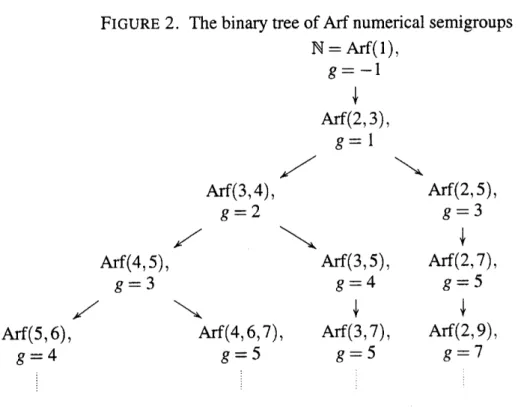
(respectively saturated) numerical semigroups can be arrangedin
abinary
treewith
root
§tr(no
leavesin
úe
saturatedcase). For
MED-semigroups,we
haveúat
if
Sis
a MED-semigroup andg(S)
>
m(S),
then SU{g(S)}
is
again a MED-semigroup; andif
§ is
a MED-semigroupwith Á its
minimal
MED-systemof
generators, thena
e Á\
{m(S)}
if
only
if
S\ {a}
is a MED-semigroupwith multiplicity
z.
Thiswill
allow us to show that the set of MED-semigroupswith
multiplicity
m can be arranged in a tree whose root is thesemigÍotp
(m,m*
1,. . . ,2m-
1). We also give a procedurefor
computing theMED, Arf
and SÁf, closurcfor
a given numerical semigroup, that is, the smallestMED,
Arf
and saturated numerical semigroup, respectively, containingCHAPTER
1In this chapter we give a brief introduction to numerical semigroups and we
fix
thenotation used along this work.
We use N and
Z
to denote the set of nonnegative integers and the set of the integers, respectively.A
semigroup is
apair (S,+), with §
a non empty set and+
abinary
operation deflned on ,§verifying
the associativelaw.
If
there exists aneiement, € s
such thatÍ+s: s+Í:
sfor
all s€
s we say that(s,+)
is amonoid.
This elementt
is usuallyreferred
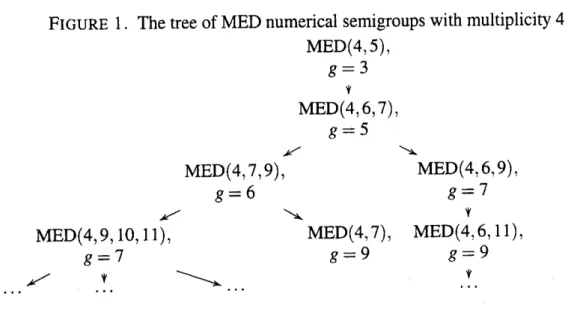
to
as theidentity
element andit
is
denotedby
0.
In
addition,
s is
acom-mutative
monoid
if
for all, a,b e
S,a|$
-
b*
a.
Asubmonoid
of
a monoid'!
is a subsetÁ
of
S suchthat0
€A
andfor
everya,b
€A
we have thata+
b eA'
Given asubset B
of
a monoids,
themonoid
generatedby (8),
is the least(with
respect to setinclusion)
submonoidof
S containingB, which
tums out to be the intersectionof all
submonoids of s containing B.If
s:
(B) we say that B is a system of generators ofs
or that
s
is generated by B. Furthermoreif
s:
(B) and there exists no proper subsetof
B that generates s we say that B is aminimal
system of generators for §.A
monoid .§ isfinitely
generatedif
it has a finite system of generators.A
mapg
:F
-+
S, whereF
and S are monoids, is called monoid morphismif q(0)
:
0 and «p(a+
b):9@)
+ 9(b)
for
alla,b
it
F .A numerical
semignoupis
a submonoidof N
such that the greatest common di-visorof
its elements is equal to one. Thefollowing
result gives us alternative waysof
defining a numerical semigÍoup.t4 1. PRELIMINARIES
PRoPoSITIoN
l.
lzt
S a submonoid off§. Thefollowing conditions are equivalent:l)
S is a numerical semigroup,2)
the group spanned by S is Z,3) N\Srsfinira.
Then
it
makes senseto
takeinto
account the gÍeatest elementof
V, noÍin
.§. Wecall
this elementFrobenius number
of .t and denoteit
by g(S).Suppose that Á
-
{a1,..., aa}
Ç N and m€
N\
{0}
are such that ai*
a.;(mod m)for
all
1< i <
j
<
m. We say that Á is a complete systemmodulo
m. Forz e
§\ {0},
we define the
Apéry
set of n in § (see [4]) as the setAp(S,n):ix€Slx-nlSj.
Next result
follows
easily.PRoPoSITIoN
2.
Let
Sbe
a
numerical
semigroupand let n
e
S\
{0}.
Tran Ap(§,z)
is a complete system modulo n.Hence #Ap(§, n)
:
n (where #Á stands for cardinality of Á).LEMMA
3.
kt
S be a numerical semigroup and let n e §\ {0}.
Tftenr(t)
g(s) =
max(Ap(s,n))
-
z,(2)
s=
(inluAp(s,n)),
max(A) denotes maximum of A.
As
a
consequenceof
the above lemma every numerical semigroup§ is finitely
generated. Clearly § has a unique
minimal
systemof
generatoÍs. Assume that {n9<
q
<
. . ,<
rr)
is aminimal
system of generators of .t, we refer to the numbers ng (the least integerin
S\
{0})
and p.l I
(cardinalityof
itsminimal
systemof
generators) asthe multiplicity
and embedding dimension of §, and denote them bym(§) andp(S),
respectively.I. PRELIMIIIARIES l5
nelation
if
thefollowing
A
binary relation
o
on
amonoid
Sis
an properties hold:l.
foralla€.§,
aoa
(reflexive),2.
for
alla,b
e S,if
ao
b thenbo
a (symmetric),3.
for
all a, b, ce
S,tf
ao
b
and bo
c, thelr ao
c (transitive).Inaddition,ifoisanequivalencerelationsuchthataoáimpliesthata+cob+cfor
all
c€
§ we sayo
is a congruence on S.An
alternative notâtion for ao
á is (4, à)e
o.
For p a subset of §F
x
Ntr, there always odsts the smallest congruence(p)
contain-ing p,which
can be described in thÍee steps:l.
p0=pup-rnt,wherep-r
:i(v,w)
| (w,v)ep)'andt=
{(w,w)
|weM}'
2. pt
=
{(v*u,w+z)
|(v,w)
e
p0, and ne
N'},
3.
(v,w)
€
(p)
if
thereexist
vo:
v-..,vk:
w with
(vi,v+t)
€
pl
for all
i
e
{0,...,t-
l}.
lVe also refer to the congruence
(p)
as the cong(uence generatedby
p.Let
F
-
{ad6
+
"'*apXp
I
oo,...,o,
e
N}
be thefree
commutative monoid generatedby
{Xo,.. .,Xp}
and letI
:F
-+ § be the monoid epimorphism definedby
(aú{o*
"'-laiÇ)
-
asns*
"'Iapnp'
It
is
well
known thatif
o
is the kemel congruenceof
I
(that is,xoy
if
9(x)
:
q(y))'
then ,s is isomorphic to the quotient monoidF/o
(seet39l).
Rédei showsin
[28]
that the congruenceo
isfinitely
generated and therefore there existsP:
{(xr,Yr),
"',
(*,'Y,)}
ÇF x
F
such that
o
is the congruence onF
generatedby
p. The set p is called afor
the numerical semigroup§.
We say thatp
isminimat
presentation
if
no proper subsetof
p generateso.
In fact the conceptsof
minimal presentation and presentationwith
úe
lowest cardinality coincidefor
a numerical semigroup (seefor
instance[30]).
and
l6 1. PRELIMINARIES
Let
S be a numerical semigmupwith
minimal
systemof
generato$
{ro <
,r
<
- .
.
<
np\
and consider againg
:F
-+ §
defined asabove.
Denoteby
o
the kemelcongruence
of
g
and,for
z
e
S\
{0},
denoteby
[z]=
{x
e
F. Ig(r)
:
z}
(the inverse image of nby g).
We definein
[z] thefollowing
equivalence relation(:
aúh
+.'.
+ lpxp
&
bolh+
.. .+
bPxp
if
there exist elements&Ulfo
+'''
+
f9, Xp, hoXo*'''
*
k1oXp,''
.,
kioXo*...
+
kj
oxpe
lnl
such that
aoXo
4
"'
*
arX.o=
knfu
+...
+
larXe
bdh +
"'
+
bép
=
kio)rc,*"'
I
kjpXpand fr;o/c;a1o
*
"
'*kiokr+to
l0
for all
,€ {0,...
j
-
l}.
I,et
X
be aset,
lP:
{Xr,...JÇ}
be a partiüonofX
and"lçX
xX
be a binary relation onX.
We define the graph G,y associated to ywith
respectto
thepartition
?
as a graph whose vertices are the elementsin
e
and,*ff,
wiú
i
I
j,
is an edgeof
G,
whenever there exist .r € Xr and
y
eX;
such that (.r,y) e yu
p
I .The
following
results can be foundin
[30].PRoposITIoN
4.
Lct
n
e
S be andlet
g
= {Xr,...,)fi}
be the setof
\-classes
containedin
fnl.
If y
k
a presentationof
S, andy,
-
1n
([z]
x
ln)),
then the graph associated to Gy, with respect to thepartition
e oflnl
is a connected graph.PRoPoSITIoN
5.
Let y be a subset ofo
such that Gy^ is connectedfor
all
n
e
S. Then y is apresentationfor
S.I.
PR,ELIMIIIARIES
I7 THEoREM6.
Izt
\
be a subsetoÍ
6.
Tlun
7 is presenmtion of Sif
only
d
Gy" iscowrectedforallnes.
Now
we show how aminimal
prcsentationof
a numerical semigroup can be com-putedfÍom
itsminimal
system of generators.For
z
€
§ defrne the graphG, with
vertices V, and edgesE,
asv,
-
{n;
e
{no,"',np}
Ir-
zi e
s},
En
:
{wi
I n-
(ni+
ni
€,s,i,i
€
{0,"',
p},i
*
i}'
The next result illustrates the connection between R-classes and the graphs
Gr.
PRoPosITIoN 7. (l3Ll)
For everyn€
S\ {0},
there is a biiectivenap
berween theseÍ oÍ connected components of
G,
and set of\'classes offnl.
For every
z
€
§, define Y, ast
)
lf
cn
is
not connected andG)
:
(Vl,
E),),. - ., Cl,:
(Ví,E)
areits
connected components, thenfor
eachi €
{1,...,t}
we choose a vertexn|,
€Vi
and an elementori
:
(ae,...,
ap) such thatq(cq)
:
n
and akt+
0; set Y,,:
{(a1,
oz),"',
(cr, a')
}'
2)
lf
G,
is connected, set T,,:
0'
Using the above rcsult§ we have the
following
statement.THEoREM
8.
ít301) The set^1:
U11çy1\n is a minimal prcsentation of S'Therefore, the
main
ideafor
computinga minimal
presentationof a
numerical semigroup § consistsin finding
the elementsin
s
such that the graphG,
is
not con-nected. Next result shows thatÇ
is not connected onlyfor finitely
manyz e
§'
THEoREM
9.
ít301)Izt
{ns
<
\
1
"'
<
nrl
be a minimal system of generatorsof
the numerical semigroupS.
IÍ
Gn is not connectedfor
ne
S, then thereexi$
w e
suchthatn-w*ni-18 I. PRELIMINARIES
And
since g(§)+zs:
max(Ap(§,no))
then there are at most g(S)+zs+n,
ele-ments of theform
w*n;
wiú
w€ Ap(§,ns)
andj
e
{1,...,p}.
CHAPTER
2numerical
semigroups
In this chapter, we study irreducible numerical semigroups. From [20] and
[5]'
we deduce that the class of irreducible semigroupswith
odd (respectively even) Frobenius numberis
úe
same as the cla§sof
symmetric (respectively pseudo-symmetric) nu-merical semigroups. Thiskind of
numerical semigroups have beenwidely
studiedin
literatuÍe, notonly from
the semigroupist pointof
view, but also by their applicationsin
Ring Theory.In
[25]it
is shown that the semigroupring
associatedto
a numerical semigroups
(ir[s]
:
o.,esKy,) is
Goresteinif
andonly
if
s
is irreducible
with
odd Frobenius number; andin
[5]
it
is shown that the semigroupring
r[s]
is Kunzif
only
if
§ isineducible with
odd Frobenius number.Section
I
is devoted to characterize irreducible numerical semigroups payingspe-cial
attention to their APéry sets.In
Section 2 we give an upper boundfor
the cardinalityof
aminimal
presentationfor
an irreducible numerical semigroup,in function of
theirmultiplicity
andembed-ding dimension. Finally,
in
this
section, we study those irreducible numerical semi-groupswith
maximal embedding dimension.In
Section 3,from
the conceptof
pseudo-Frobenius numberof
a numericalsemi-group, we
characterizethe
classof
numerical semigroups that can be expressed asan intersection
of
irreducible numerical semigroupswith
odd Frobenius number (thatis,
symmeric). we
construct algorithmsfor
decompositionsin
symmetric numerical semigroups in general, and then we study the problem of finding such decompositions20
2. IRREDUCIBLE NI.JMERICAL SEMIGROI,'PSwith
the restrictionúat
all
symmetric numerical semigroup ,§ involved have the same Frobenius number ormultiplicity.
We know that every numerical semigroup can be expressed as a
finite
intersectionof
irreducible numerical semigroups.ln
Section4,
we give lower and upper boundsfor
theminimal
numberof
irreduciblesin
suchdecompositions.
Associatedto
the problemoffinding
a decomposition into ineducibleswith
the same Frobenius number, we introduce and study the concept of atomic numerical semigroup. Finally, we use the results givenin
[48] to describe an algorithm for computing aminimal
decompositionof
a numerical semigroup in terms of irreducible numerical semigroups.In
Section 5, we construct families of ineducible numerical semigroupswith
even Frobenius number,for
arbitrary
multiplicity m(§)
and embedding dimensionp(s).
Furthermore, we show who are the presentation
with minimal
cardinality for thisfam-ily
of
numerical semigroups.This
section complete the results givenin
[33], to
thecase of families
of
irreducible numerical semigroupswith
odd Frobenius number.1.
Symmetric
and pseudo-symmetricnumerical
semigroupsIn this section we characterize and study symmetric and pseudo-symmetric numer-ical semigroups. Separately, we study semigroups of this kind
with
multiplicity
3 and 4.Throughout this section § denotes a numerical semigÍoup, such that §
I
N. It
iswell
known (seefor
instance [32]) that SUig(§)]
is also a numerical semigroup.A
numerical semigroup S isirreducible
ifit
can not be expressed as an intersection of two numerical semigroups containingit
properly.From this definition we have the
following
characterization ofineducible
numeri-cal semigroup.1. SYMME'IRIC AND PSEUDO.SYMMETRIC NI.'MERICAL
SEMGROTJPS
211)
S is irreducible,2)
S is maximalin the
set ofall
numertcal semigroupswith
Frobenius numberc(s),
3)
S is maximalin the
set ofall
numerical semigroups that do not contain g(S)' where the order taken is set inclusion.PRooF.
1)+
2)LetSbe
a numerical semigroup such thatSç
5 andg(5)
=
g(S)'
Then §:
(Su
{g(S)i)
n3.
Since § is ineducible, we deduce that S:'l'
2)
+
3) Let 3
be
a numerical semigroup such that§
Ç
5
andg(S)
l3'
Then 3u ig(S)
+
1, g(S)+2,.
..\
is
a numerical semigroup that contains '§with
Frobeniusnumber g(,§). Therefore, S
=
3u
{g(S)+
1, g(S)+
2,'''
}
and so §-
5'
3)=+/)Let§rand52betwonumericalsemigroupsthatcontainsproperly.Then'
by hypothesis, g(S)
e
Sr andg(§) €
,§2. Therefore §I
SrnSz
and so S is irreducible'x
Using t20l
and [5] we deduce the next result.PRoPosIrIoN 11.
1)f
g(S)
is
odd,
then Sis
irred'ucibleif
andonly
iffor
all
h,h' e
V', suchthat
h+h' =g(§),
we have thateither h
e
Sor h' e
S(that
is' S is symmetric).2)
{f g(§)
is even, then S is irreducibleif
anil
onlvif
for
all h'ht
e
V'\{fl}'
suchthat
h*
ht=
g(§),
we have that either he
S or hte
S(that
is, S is pseudo-symmetric)'The
following
result is alsowell
known (see[4],
[11] or[31])'
PRoPosIrIoN
12.Izt
n €
S\
{O}
with
Ap(S,n)=
i0
:
w(l) <
w(2)
<
"'
<
w(n)\.
Then Sis irreducible with
odd Frobenius number(that
is' S is symmetric)if
and onlyif
w(i)
+w(n-
i+
l)
=
w1n\7o' alt i
e
{1," '
'n}'
22
2. IRREDUCELE NUMERICAL SEMIGROUPSPRooF. For
i
€
{1,...,
n}
asw(í)
e Ap(S,z)
thenw(i)
-
n(
S and, by proposition1 1, we obtain that
w(n)
-
w(i)
=
g(S)-
(w(i)
-
z) e
s.
We have thatw(z)
-
w(i)
e
Ap(§,2)
becausew(n) € Ap(S,n).
tr
Now we see how is
Ap(§,n)
when S is irreduciblewith
an even Frobenius number.c(s)
-2-LEMMA
13.I/S
is irreduciblewith
even Frobenius number and ne
s\
{0},
ràez*z
e
Ap(S,n).
Pnoor.
It
is enough to prove thatÇ
+ n € s, since$
I
S, Uut ttrisfollows from
Proposition 11 (note that(ry
+n)
+
(4P
-r)
=
c(S)).
tr
PRoPoSITIoN L4.lzt
S be anumertcd
semigroupwith
even Frobenius number and let n€
§\
{0}.
Then S is irreducibleif
anil onlyif
Ap(§, n)
-
{o
=
w( 1)<
w(2)
<
...
< w(n
-1) =
g(§)+
n} u
{*
*
rl
andw(i)
+w(n-
i)
-
w(n-
t)for
all i e
{1,...,n
-
l}.
PRooF. First
note thatif
g(§)
is
even,then
4p
+,
e Ap(S,z)
and
f
+n
<
max
Ap(§,2). If j €
{1,...,
n-
1},
thenw(i)
-
n(
S andw(i)
-
n*
*.
SVProposi-tion
11, we have thatg(S)-
(w(i)
-n)
e §andthusw(n-
1)-w(i)
-
g(s)+z-w(i)
e
§.
Since w(n-
1) € Ap(S, n) we deduce that w(n-
1)-
w(i)
e
Ap(S,n).
Furthermorew(n-l)-w(i)
+
$+,
b."ro..
otherwise wewouldhave
w(i)
-
sts).
Hence thereader can check that
w(i)
+
w(n-
i)
=
w(n-
1).Conversely,
let
x
be
an integer such thatx
* S
andx
I
S.
Let
us show thar g(S)-.rۤ.
Takewe
Ap(,9,n)
such thatw=x(modn).
Thenx
:
w-
/<nfor
some e€
N\
{0}.
We distinguish two cases.1. SYMMETRIC AND PSEUDO.SYMMETRIC NI,'MERICAL
SEMIGROUPS
23(1) If
w=
9*r,theng(§)-x=g(§)
-(*+r-*n)
=
9+(/t-
l)n.
Be-sides,
x
I $
rcaaso
kl
I
andüerefore
k)
2.
Hence we can assert thatg(s)-res.
(2) n
w*
I
*
r,
then g(§)-
x=
e(s)
-
(w-
kn):
g(§)+
n-
w+
(k-
t)n
=
w(n-
l)
-w
+
(k-
1)ne
§, since w(z-
1)-
1,€
,S by hypothesis'ú
Note that
if
,s has embedding dimension two, then ,s is ineduciblewith
odd Frobe-nius number (that is, § is symmetric); in fact,s is a complete intersection (see [24]).Observe also that trr(S)
<
m(§)
for every numerical semigroup S'PRoPosITIoN
15. Let S be an irreducible numerical semigroup't)
fe(s)
is odd and m(S)>
3, then 1t(S)S m(s)
-
1' 2)tf
g(S) is even and m(S)/
4, thenp(S)
<
m(§)
-
I 'PRooF.l.Supposethat§isasymmetricsemigroupwithminimalsystemof
generators
{m(,S),21,.",rr1q-r}
then{0
<
h
<
"'
<
,?1,(fl-1}Ç
Ap(s,m(s))
andnrçs1t
*
lv(n).
HenceP(s)
I
m(s)-
1'2.
It
is
enoughto
PÍove thatp(S)
#
m(§).
If
g(S)
=
m(§),
then§
is
minimally
generated
by {m(§),n1,
'..,2r(s)-r}
and thereforeAp(S,n)
is of theform
Ap(§,2)
:
{0 <
n2<
"'
(
r,(s)-r}u{zr
: f
+m(S)}'
Since
m(S)-
1)
3 thenu+n2+nm(s)-l.
By
Proposition 14we
deduce that nm(s\-t-
nze
S, which contradicts the fact that{m(S)'
nt , . . . ,nn(s)-l
}
is aminimal
system of generator§
foÍ
S.
tr
Note that S
=
(3, ?, I 1) is an irreducible numerical semigroupwith
Frobeniusnum-ber
g(s)
_
8(it
is easy to see that 8 belongs to every numerical semigroup that properly containss).
That iswhy
in 2) of the above proposition we need thatm(§) >
4 instead ofm(§) >
3.24 2. IRREDUCELE NUMERICAL SEMIGROIJPS
Using
1) and 2)of
the above proposition we can assert thatif
Sis
an irreducible numerical semigroupwith
m(S))
a, thenp(§)
!
m(S)-
1.Next we study irreducible numerical semigroups wirh
multipticiry
3 and4. By
the remark made afterProposition
14,we know
thatif
p(S)
:
2,
thens
is
irreducible. Recall also, that from Proposition 15,if
m(S)=
4 and § is irreducible thenp(S)
S
3.Therefore, we focus our study in the cases: 1) § is ineducible
with
m(S)=,u(§)
=
3,2)
§ is ineduciblewith m(§)
-
4 and g(S)=
3.THEoREM
16.
Thefollowing
conditions are equivalent:1) S is an irreducible numerical semigroup with m(S)
= p(§)
-
3,2)
S is generated by{3,x*3,?-x*3}
withx
a positive integer not amultiple
of
3.
PRooF.
1)+
2)If
m(S)=,tl(S)
:3,then
{3,ny,n2}
is aminimal
systemof
gen-eratorsfor,5.
From Proposition 15 we deduce thatg(§)
is even and by Proposition 14we have that
_
g(s)
2
Ap(S,3)
=
{0,n1*3,n2-g(S) +3).
Taking.x=
I
*t
huu"thatnl
=r+3
andn2:2x+3.
Furthermore,Í=
I
e
Sand thus
x
is not amultiple of
3.2)
+
1)Cleaiy
{3,x+3,2x+3}
is a minimal system of generators for S and thus m(S)=
p(S)=
3. We have that Ap(S, 3)=
{0, x*
3,?-r*3}.
Hence2x+
3:
g(S)+
3 and therefore$+S-x+S.
From Proposition 14 we deduce that s isineducible.
tr
The semigroup S
-
(3,3*x,?.x*
3) is a MED-semigroup(MED
standsfor
Maxi-mal Embedding Dimension, that is a numerical semigroup with p(S)
:
m(S)).
Apply-ing the results obtained
in
[32] we deduce that a minimal presentation for,S is:1. SYM]úE'TRIC AND PSEI,JDO.SYMIVÍETRIC NI'MERICAL
SEMIGROIJPS
25Now
we
study irreducible numerical semigroupswith multiplicity
4.
We distin-guish two cases taking into account thatüe
Frobenius number can be odd (a symmetric semigroup) or even (a pseudo-symmetric semigroup).Herzog proves
in
[Z]
that a numerical semigroup ,Swith minimal
system ofgeneÍ-ators
{ns,n1,n2}
is irreduciblewith
an odd Frobenius number(i.e.
symmetric)if
andonly
if
it
is a complete intersection.Applying
the results obtainedin
[19]
this occursif
andonly
it
nte
(ffi,ffi)
for
some{,,i,&}
-
{0,
1,2},
where(z;,n1)
denotes the greatest common divisor (gcdfor
short)ofz;,
n1.THEoREM
17.
Thefollowing
conditions are equivalent:1)
§ is az irreducible numerical semigroup, g(S) is odd, m(S)=
4andg(S)
-
3,2)
S is a numertcal semigroup generated by{4,2x,x*2y}
with ye
N\
{0}
andx an odd integer greater than or equal to 3.
PRooF.
/)
+
2)If
m(S):aandp(§)
-3,then
{4',n1,n2}
is aminimal
systemof
generatorsfor,s.
From the previous remark we only have distinguish two câses.a) Assume
thaíd
=
gcd{4,n1}
and n2e
(),'$).
Notice that
d
-2
andnt
=
?scwith
x
an odd
number greaterthan
or
equalto
3'
Furthermore1-
gcd{4,n1,n2}, then z2 is an odd number and z2€ (2,Í)
thusn2:
xl2y
(becauseall
odd numbersin (2,x)
are of thiskind)'
b)
Assume thatd
=
gcd{q,n2}
anda
e
(},Sl'
From
herewe
deduce thatnr -- 2d,
nz=
kzdwith
kz odd andd
an odd integer gÍeateÍ thanor
equalto
3.
TherefoÍe, nz-
d+
(kz-
\d
with
(/<2-
l)d
even'
Takingx
-
d
andy
:
(kzit\a
we obtain the desired result.2)
+
I)
Clearly, 2-
gcd{
,zx}
and x*
2ve
(i,
n'
By
remark made before this theoÍem we have that§
is an irreducible numerical semigroupwith
an odd Frobenius26
2. IRREDU'ÍRLE NI,JMERICAL SEMIGROI'PSnumber. Now, we need to show that {4,2-x,,x
+
2y}
is aminimal
systemof
generatonfor
S, but this is clear because:1)
x+2y
(
(4,2x),
sincex+2y
is odd,2)
?* Ç (4, x+
2y), sinceif
2x-
a4+
b (x+
2y)wiú
a, à€
N, then applying that 2x is an even integer notmultiple
of4
and thatx*
2y is odd, we deduce that à)
2, conuadicting that2(.r+
2y)>
2x.tr
The semigroup §
-
(4,2x,x*2y)
has Frobenius numberg(§)
-3x*2)-4.
Fur-thermore using thatit
is a complete intersection we deduceúat
a minimal presentation for § is:P
:
{(2Xr,r&),
(?.Xz,yxo +&)}.
Finally, we
studyirreducible numerical
semigroupsS for which g(S) is
even, m(S)=4andg(§)=3.
THEoREM
18.
Thefollowing
conditions are equivalent:l)
S is an irreducible ruanerical semigroup, g(S) is even, m(S)=
4 and p(S):3,
2)
S is generated by{4,x*2,t*4}
with x an odd integer greater thanor
equal to 3.PRooF.
1)+
2)If
m(§)
:+anap(S):3,then
{4,n1,n21is
aminimal
systemof
generatoÍsfor §.
From Lemma 13 we know ttrat$
++
€ Ap(S,4).
We distinguish two cases.a)
If
$
++
is aminimal
generator then, by Proposition 14, we deduce thatAp(S,a):
{0,n1
:
§+l,n
,,Zn
=g(S)+a}.
Taking
x
=
S,
rcn
U:
x+4
wtd n2-
x*2.
Furthermore g(S)(
§
and thereforc .r is odd.2. MINIM.AL PB,ESENTATIONS FOR IRREDUCELE NI'MERICAL
SEMIGROT'PS
27b)
If
ry
+4
is not a minimal generator, thenAp(s,a)
=
{0,n1,n2,f
+ 4}.
Hence
g(§)
14
=
nl
or g(§)+4
=
n2.
Supposeúat
g(S)14
-
n1 then,by
Proposition 14, we deduce lhaÍ n1-
n2€
§, contradicting that {4, n1,n2}
is aminimal
system of generators.2)
+
1) Clearly,{4,x*2,x+4}
is
aminimal
systemof
generatorsof
§, whence m(S):
a and p(S)=
3. The reader can check thatAp(S,4)
-
{O,x+
2,x*
4,2x +4}.
Therefore B(S)
:
2x and tnenAp(s,a)
=
10,f
++,
4p,
g(s)
+a].
Using Proposition 14 we obtain that § is
ineducible.
tr
Note
that §-
\4,x*2,x*4)
has Frobenius number2x'
Applying [24]
and thatthis
semigroupis
not symmetric (thereforeit
is
not a complete intersection), we can deduce that a minimal presentationfor
S is:p
=
{(2x2, xo+
2x),
(3Xr', kXo +x)'
(t xo'h
+
v')}
una r
-
EQ#@.
observe that3(x+2)
-
(x+4)
is amultiple
3 x*2