1
A Work Project, presented as part of the requirements for the Award of a Master Degree in Management from the NOVA – School of Business and Economics.
THE IMPACT OF TERRORISM ON THE PORTUGUESE TOURISM DEMAND
Margarida Filipe Pimenta Moreno Trindade; #2495
A Project carried out on the Master in Management Program, under the supervision of: Prof. Luís Correia da Silva
2 Abstract
This study focuses on the impacts of terrorist activity on the tourism industry of a significantly safer competing destination. Specifically, it concentrates on the effect that terrorist attacks on Turkey and Egypt exerted on the Portuguese inbound tourism demand for the period of January 2004 to December of 2015. Besides looking at the aggregated tourism demand, individual demand from Germany, France, United Kingdom, and United Stated were also analyzed to see if the effects differed across these nationalities. The estimation results indicated that all four individual demands suffered positive effects with the occurrence of acts of terrorism of high intensity, suggesting that the Portuguese tourism industry might benefit from such unfortunate events in the Middle-East.
3
Table of Contents
Introduction ...4
1. Literature Review...5
2. Methodology and Empirical Model ... 10
2.1. Research Methodology ... 10 2.2. Variables ... 11 2.2.1. Dependent Variables ... 11 2.2.2. Independent Variables ... 12 2.3 Empirical Model ... 14 3. Data Analysis ... 14 3.1. Descriptive Statistics ... 14
3.2. Testing Gauss-Markov Assumptions ... 15
4. Results ... 17
4.1. Total Portuguese Tourism Demand ... 17
4.2. Portuguese Tourism Demand - Germany ... 19
4.3. Portuguese Tourism Demand - France ... 19
4.4. Portuguese Tourism Demand – U.K. ... 19
4.5. Portuguese Tourism Demand - U.S. ... 20
5. Limitations ... 20
6. Conclusion ... 20
7. References ... 23
8. Appendix ... 25
4 Introduction
From time to time tourists end up being affected by terrorist incidents, whether because they are directly targeted or because they happen to be in the wrong place at the wrong time. Tourists may be targeted for terrorist attacks because these are perceived as ambassadors of their own countries, as well as easy targets. When tourists are involved, the media attention immediately amplifies, making it easier for perpetrators to clearly deliver their message and exert a higher pressure on the government of the country that suffered the attack (Richter, 1983).
Although the probability of being affected by a terrorist attack is extremely small, tourists’ risk perception toward a destination that suffered an attack seams to instantly increase (Ahlfeldt, Franke, & Maennig, 2015). The recent terrorism events in France reflect this as overnight stays dropped by 10% on average this year through July (Patel, 2016).
Terrorist activity impacts the tourism industry of the target destination at least in the short-term, and in some cases, perceived threats in one country may contaminate the entire neighboring region (Ahlfeldt et al., 2015; Bassil, 2014; Blomberg, Hess, & Orphanides, 2004; Drakos & Kutan, 2003; Enders & Sandler, 1991; Enders, Sandler, & Gaibulloev, 2011; Enders, Sandler, & Parise, 1992; Pizam & Fleischer, 2002; Saha & Yap, 2014).
Despite the recent events of terrorism, the Travel & Tourism sector continues to grow year after year as in 2015, for the fifth consecutive year, the sector growth (2.8%) surpassed that of the global economy (2.3%) (WTTC, 2016a). Additionally, its GDP contribution is expected to accelerate and outperform global economy’s growth once again in 2016 (WTTC, 2016). With the exception of extreme situations such as the 9/11 attacks that resulted on severe damages for the entire Travel & Tourism sector; it appears that tourists do not stop travelling when confronted with terrorism, instead they seem to modify their travelling plans by substituting away from high-risk destinations.
5
While the majority of literature to date has mostly focused on the impacts of terrorism on tourism through the perspective of targeted destinations, the present study is interested on the impacts of terrorism on the tourism flows of a safe competing destination. Particularly, it will attempt to estimate the impact of terrorist attacks in two Mediterranean countries – Turkey and Egypt – on the tourism demand of one of their safest competitors, Portugal. Additionally, it will try to figure whether tourists reaction differ according to their nationality. For this purpose, the impacts of terrorist attacks in these two countries will also be evaluated among four distinct countries originators of inbound tourism to Portugal during the period of January 2004 to December 2015, namely Germany; France; United Kingdom and United States of America.
This dissertation will be divided in six sections. Firstly, there will be presented a short literature review that summarizes the main conclusions taken on the impact of terrorism on tourism to date. This section will be followed by a methodology section in which the empirical models and corresponding variables will be explained in detail. Thirdly, the estimation procedures will be demonstrated. This will be followed by the analysis of the final results. Afterwards, the main limitations of this research will be presented and finally, in the last section, conclusions and recommendations for future research will be displayed.
1. Literature Review
The repercussions of terrorist activity on the Travel & Tourism industry has become an increasingly matter of interest, especially after the cases of international terrorism experienced during the mid-80s (Sönmez, 1998).
Although there is no universal definition of terrorism, one can easily identify it when observing an attack. The Global Terrorism Database (GTD) defines a terrorist incident as “the threatened or actual use of illegal force and violence by a non‐state actor to attain a political, economic, religious, or social goal through fear, coercion, or intimidation”. Hence, in order for an incident
6
to be included in the GTD it must be intentional; involve some sort of violence or threat of it; and the perpetrators need to be sub-national individual (GTD, 2016).
Although the probability of actually being involved in a terrorist incident is extremely small – the odds of dying in a terrorist incident on a foreign country is 1 in 25 million (Zeeshan ul Hassan, 2015) - it is quite common for tourists to radically alter their risk perception towards a destination that experienced some kind of terrorist incident (Kozak, Crotts, & Law, 2007; Seabra, Abrantes, & Kastenholz, 2014). When a terrorist event occurs, tourists become more alert to the possibility of being affected by an act of terrorism, this is particularly true when tourists are extremely attentive to the media (Floyd & Pennington-Gray, 2004; Seabra et al., 2014), as bad news result in higher audience and consequently these are continuously covered by mass media (Stafford, 2014). Kozak, Crotts, and Law (2007) explored the impact of perceived risk on the tendency to travel internationally between three clusters segmented based of Hofstede’s uncertainty avoidance risk and concluded that most travelers are more likely to alter their travel plans towards a destination that they perceive as highly risky, suggesting that tourists are significantly sensitive to the occurrence of any type of risk in possible travel destinations.
Risk perception plays a major role on tourists’ destination choice (Sonmez & Graefe, 1998), tourists are interested in acquiring information about terrorism in the media, which directly influences their risk perception. Subsequently, risk perception directly influences tourists’ involvement in planning their journeys, specifically information search before and throughout the trip which in turn influence their safety concern (Seabra et al., 2014).
When looking at tourists as rational consumers that take their decisions by comparing costs and benefits, one can see that the increase of the risk associated to a given destination due to the presence of terrorism increases its cost (Sönmez, 1998). Simultaneously, tourists possess a great
7
variety of options when choosing their travel destinations, leading to the substitution of a risky destination or region to a safer one that offers similar benefits (Drakos & Kutan, 2003; Enders & Sandler, 1991; Enders et al., 1992). This substitution effect results in serious damages to the avoided destination (or region), a terrorism incident may result in a severe tourism crisis (Sönmez, Apostolopoulos, & Tarlow, 1999). For instance, terrorist activity had a significant negative impact on the number of inbound tourists to Spain during the period of 1970-1988 as an average terrorist incident in Spain resulted in a decrease of 140 000 tourists (Enders & Sandler, 1991).
The existence of a negative impact of terrorism on a destination’s tourism demand is accepted by the majority of literature to date (Ahlfeldt et al., 2015; Bassil, 2014; Blomberg et al., 2004; Drakos & Kutan, 2003; Enders & Sandler, 1991; Enders et al., 1992; Feridun, 2011; Pizam & Fleischer, 2002; Saha & Yap, 2014; Sloboda, 2003). Frequently, terrorism on a destination ends up contaminating the entire neighboring region. Enders, Sandler, and Parise (1992) examined the impact of terrorism on tourism by estimating “a forecasting equation for a country’s (or region ‘s) share of tourism using an ARIMA model with a transfer function based on the time
series of terrorist attacks in that country or region”. They studied the impacts in Greece, Italy, and Austria as these European countries significantly suffered terrorist attacks during the period of 1968-1988. The authors also examined the aggregate impact of terrorism on tourism for 12 Western European countries. They concluded that terrorist attacks had negatively affected tourism in the three nations and the sample of 12 Western European countries, noticing that there is a contamination effect of terrorism as one incident in one country negatively affects tourism in neighboring regions.
Drakos and Kutan (2003) also concluded that although after a terrorist incident, neighboring countries may be considered as direct substitutes, the incident will always result in a negative impact on tourism demand for the entire region. The authors focused in three Mediterranean
8
nations – Greece, Israel, and Turkey – for the period of 1991-2000 and included Italy as a representation of other competing destinations that are not subject to high levels of terrorism, a safe destination. They choose to disaggregate terrorist incidents in two dimensions: intensity of causalities and location. Regarding intensity, they divided terrorist attacks in three levels – low, medium, and high. Regarding location, the authors divided terrorist incidents by urban vs. rural area. By employing the seemingly unrelated regression (SUR) methodology they concluded that terrorism significantly reduces tourist arrivals. Both intensity of causalities and geographic location of terrorist attacks showed significant own and cross-country effects on the market shares of involved countries.
On the other hand, Pizam and Fleisher (2002) confirmed that the frequency of terrorist attacks resulted in a larger drop in international tourist arrivals than the severity of the incidents in Israel for the period of May 1991 to May 2001.
Such as Drakos and Kutan, Bassil (2014) used a SUR model to analyze the effects of terrorism on tourism demand in Lebanon, Turkey, and Israel. Combining both disaggregation methodologies proposed by Drakos and Kutan (2003) and Enders, Sandler, and Gaibulloev (2011), the author divided terrorist incidents in terms of transnational vs. domestic and three levels of intensity, resulting in a total of six dummies. The author concluded that there were significant spillover effects for both domestic and transnational terrorism across the three nation and confirmed that the impact of terrorism on tourism depends on the intensity of the attacks. Domestic and transnational terrorism have different effects on tourism demand, and these depend on the intensity of the terrorist attacks. Terrorism in one country may have a positive or a negative spillover effect on other countries’ tourism demand (Bassil, 2014).
It is important to notice that geographic proximity is not the only factor that may contribute for a contamination effect of terrorism towards other countries’ tourism industries. Sometimes a
9
transmission mechanism occurs due to ethnic and religious similarities as it was the case of Islamic nations during the period of 1993-2005 that were temporarily substituted for south European countries by German tourists (Ahlfeldt et al., 2015).
Additionally, shocks to domestic terrorism produce persistent effects on transnational terrorism, this meaning that domestic terrorism may extend to transnational terrorism and, consequently, nations that might be targeted by terrorists cannot ignore domestic terrorism abroad and may need to assist in dominating these situations that at a first sight do not concern to them (Enders et al., 2011).
Nevertheless, although terrorism does have a negative impact on tourism demand, destinations may recover from even severe terrorist attacks, as long as these acts are not repeated. Only when terrorism occurs at a high frequency, tourism demand will continue to decrease and sooner or later the destination’s tourism industry will arrive to a standstill (Pizam & Fleischer,
2002).
Furthermore, while the impact on tourism is negative, this is significantly smaller and less persistent than the impact of external war or political instability (Blomberg et al., 2004; Saha & Yap, 2014). Nonetheless, political instability and terrorism simultaneously can result in serious damage to the entire tourism industry (Saha & Yap, 2014), making it imperative for nations that highly depend on tourism to ensure the maintenance of their political stability to obtain the benefits of tourism demand (Saha & Yap, 2014; Sönmez et al., 1999).
Although great progress has been done regarding the impacts of terrorism on tourism, most studies focused on the impacts of terrorism on the tourism industries of countries that are usually connected to political turmoil and high frequency of terrorism. The current study will try to look at this topic from another perspective by analyzing how terrorism in countries that are characterized by significant high levels of terrorism (Global Terrorism Index, 2015) affects
10
the tourism demand of a competing destination that is substantially safer and offers very similar tourism products.
2. Methodology and Empirical Model
2.1. Research Methodology
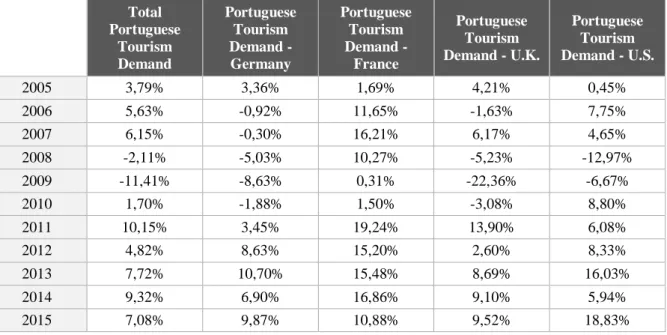
Table 1 – % Change of the Portuguese Tourism Demand in Comparison to the Previous Year
Total Portuguese Tourism Demand Portuguese Tourism Demand - Germany Portuguese Tourism Demand - France Portuguese Tourism Demand - U.K. Portuguese Tourism Demand - U.S. 2005 3,79% 3,36% 1,69% 4,21% 0,45% 2006 5,63% -0,92% 11,65% -1,63% 7,75% 2007 6,15% -0,30% 16,21% 6,17% 4,65% 2008 -2,11% -5,03% 10,27% -5,23% -12,97% 2009 -11,41% -8,63% 0,31% -22,36% -6,67% 2010 1,70% -1,88% 1,50% -3,08% 8,80% 2011 10,15% 3,45% 19,24% 13,90% 6,08% 2012 4,82% 8,63% 15,20% 2,60% 8,33% 2013 7,72% 10,70% 15,48% 8,69% 16,03% 2014 9,32% 6,90% 16,86% 9,10% 5,94% 2015 7,08% 9,87% 10,88% 9,52% 18,83%
As one can observe in the table above, the Portuguese tourism demand has grown every year from 2004-2015 with the exception of the years of 2008 and 2009 which registered decreases on demand, probably due to the financial crisis of 2008. Given that tourism demand showed significant increases during this period, one may hypothesize that part of this growth may be due to the occurrence of terrorist events in competing destinations that end up being substituted by safer destinations. Hence, the objective of this study is to evaluate the impacts of terrorist incidents that occurred in Turkey and Egypt on the tourism flows to Portugal during the period of January 2004 and December 2015. Specifically, the current analysis is focused on exploring whether tourists from different nationalities differ in their reactions towards terrorism. Consequently, German, French, British, and American tourist flows were chosen to be observed. German, French, and British tourists represent a big portion of the overall tourism
11
demand to Portugal (on average each of these countries represent 14%, 7%, and 26% of the monthly total tourism demand, respectively), hence it is important to understand whether or not terrorism in Turkey and Egypt affect their demand. On the other hand, demand from American tourists was also included on the analysis because their reaction may be representative of the response of tourists that come from non-European nations that support higher costs associated with geographic and cultural distance. For example, it may happen that American tourists perceive the entire Mediterranean area as dangerous and consequently avoid the entire region, this implying a negative impact for tourism demand in Portugal.
Egypt and Turkey were chosen because these two destinations offer very similar touristic products to the ones provided by Portugal and were characterized by a significant level of terrorism during the chosen timeframe. Israel could also be a possible country for this examination but since this country’s touristic products are strongly connected to pilgrimage tourism; it becomes more difficult for its tourists to substitute away towards safer destinations and, consequently, it does not seem reasonable to consider Portugal as a close substitute of Israel.
For the current study, five distributed lag models (one for the overall demand and one for each individual country) will be estimated by Ordinary Least od Squares (OLS) due the fact that problems such as serial correlation in the errors and heteroscedasticity can be easily accommodated to obtain reliable estimators.
2.2. Variables
2.2.1. Dependent Variables
The dependent variables of each of the five equations consist on the total monthly tourism demand and individual country demands from German, French, British, and American tourists that came to Portugal during the period of January 2004 to December 2015. For this purpose,
12
the logarithm of the total number of nights spent per month in Portugal was chosen as representative of tourism demand. This data was collected from the Statistics Online section in Banco de Portugal’s website.
2.2.2. Independent Variables
The independent variables are all common to the five equations and consist in the total number of terrorist attacks in Egypt and Turkey disaggregated in the three levels of intensity proposed by Drakos and Kutan. However, only medium and high incidents were included in the models as it does not seem reasonable to hypothesize the existence of significant impacts from low intensity attacks (which correspond to attacks with zero casualties). Furthermore, in order to observe the contemporaneous and lagged effect of these incidents, three lags of each of the two intensities were included in each equation as this was the usual number of lags used on most literature.
The data on the number of terrorist incidents in Egypt and Turkey was collected from the Global Terrorism Database (GTD, 2016) published by the National Consortium for the Study of Terrorism and Responses to Terrorism (START). In order for a terrorist incident to be included in the GTD it must at least satisfy two of the following criteria established by START:
“Criterion 1: The act must be aimed at attaining a political, economic, religious, or social goal. In terms of economic goals, the exclusive pursuit of profit does not satisfy this criterion. It must involve the pursuit of more profound, systemic economic change.
Criterion 2: There must be evidence of an intention to coerce, intimidate, or convey some other message to a larger audience (or audiences) than the immediate victims. It is the act taken as a totality that is considered, irrespective if every individual involved in carrying out the act was aware of this intention. As long as any of the planners
13
or decision‐makers behind the attack intended to coerce, intimidate or publicize,
the intentionality criterion is met.
Criterion 3: The action must be outside the context of legitimate warfare activities. That is, the act must be outside the parameters permitted by international humanitarian law (particularly the prohibition against deliberately targeting civilians or non‐ combatants).”
For the purpose of this study only terrorist incidents that satisfied these three requirements and were successful (this indicating that the planned attack actually took place) were selected to ensure that the incidents in question were definitely terrorist attacks that had the possibility to influence tourism demand. Additionally, since the terrorist incidents were disaggregated for their levels of intensity, terrorist events that did not provide data on the total number of kills or total number of injuries were eliminated from the sample as it would be impossible to calculate their total number of causalities with accuracy.
Furthermore, one dummy (d1) was included for the period of April 2008 to June 2010 to account for changes in the intercept that probably occurred due to the 2008 financial crisis.
The independent variables of interest for this study are the following:
Monthly number of terrorist incidents of medium intensity in Egypt (T2e): total number of terrorist attacks with 0 to 3 causalities in Egypt.
Monthly number of terrorist incidents of high intensity in Egypt (T3e): total number of terrorist attacks with more than 3 causalities in Egypt.
Monthly number of terrorist incidents of medium intensity in Turkey (T2t): total number of terrorist attacks with 0 to 3 causalities in Turkey.
14
Monthly number of terrorist incidents of high intensity in Turkey (T3t): total number of terrorist attacks with more than 3 causalities in Turkey.
2.3 Empirical Model
The individual equations for the total demand and the four nations’ individual demands were estimated through OLS, using the statistical software Stata. Each equation follows the following linear representation: 𝑌𝑡 = 𝛽0 + 𝛽1𝑑1𝑡+ 𝛽2𝑇2𝑒𝑡+ 𝛽3𝑇2𝑒𝑡−1+ 𝛽4𝑇2𝑒𝑡−2+ 𝛽5𝑇2𝑒𝑡−3+ 𝛽6𝑇3𝑒𝑡 + 𝛽7𝑇3𝑒𝑡−1+ 𝛽8𝑇3𝑒𝑡−2+ 𝛽9𝑇3𝑒𝑡−3+ 𝛽10𝑇2𝑡𝑡+ 𝛽11𝑇2𝑡𝑡−1 + 𝛽12𝑇2𝑡𝑡−2+ 𝛽13𝑇2𝑡𝑡−3+ 𝛽14𝑇3𝑡𝑡+ 𝛽15𝑇3𝑡𝑡−1+ 𝛽16𝑇3𝑡𝑡−2 + 𝛽17𝑇3𝑡𝑡−3+ 𝑢 (1)
𝑌 corresponds to the logarithm of the number of nights spent per month in Portugal.
3. Data Analysis
3.1. Descriptive Statistics
Table 2 – Descriptive Statistics
Mean Standard
Deviation Minimum Maximum
Total Portuguese Tourism Demand 2228959 916448.7 939320 4612756 Portuguese Tourism Demand – Germany 319238.3 102917.4 121723 585206 Portuguese Tourism Demand – France 157982.1 112100.7 32586 605592 Portuguese Tourism Demand – U.K. 579882 243721.8 180191 1098111 Portuguese Tourism Demand – U.S. 55093.35 24301.55 20094 131232 Terrorist incidents of medium intensity in Egypt 0.75 2.032945 0 15 Terrorist incidents of high intensity in Egypt 0.6319444 1.589944 0 10 Terrorist incidents of medium intensity in Turkey 1.152778 3.772034 0 35 Terrorist incidents of high intensity in Turkey 0.8055556 2.116462 0 18
The sample size contains 144 observations, but with the inclusion of three lags to the models, the sample lost three observations, resulting in a total of 141 observations. Regarding the
15
individual demands, U.K registered the highest mean of 579882 nights spent per month, and the U.S. had the lowest mean with only 55093.35 nights. In what concerns terrorist attacks, both Egypt and Turkey registered a higher number of medium intensity incidents per month, o average, than high intensity attacks. For both levels of intensity Turkey registered a higher average number of terrorist attacks per month than Egypt.
3.2. Testing Gauss-Markov Assumptions
In order for the OLS estimators to be consistent the five asymptotic Gauss-Markov assumptions need to hold. Consistency of OLS implies that the estimators converge in probability to the correct population value as the sample size increases.
The first assumption requires linearity in parameters, stationarity, and weak dependence. As it would be expected, tourism demand for the five nationalities exhibited strong seasonality and a linear time trend as the tourism industry is constantly growing at a worldwide perspective. For accurate estimation, the variables of the models need to be stationary. If a time series process contains seasonality and/or a time trend, then it is not stationary and needs to be transformed to avoid a spurious regression problem (Wooldridge, 2011). Consequently, these five variables were deseasonalized and detrended in order to be used for this analysis. This was done by regressing each dependent variable against 11 dummies (January to November) and a time trend that assumes the value of 1 for January 2004 and grows by one unit for each subsequent month, being its maximum value of 144 for December 2015. Afterwards, the residuals of these regressions were obtained and used as the final dependent variables.
Additionally, a Dickey-Fuller test was performed for each of the dependent and independent variables to check for the presence of a unit root process. For all variables the null hypothesis that the process contained a unit root process was rejected at, at least, a 5% significance level, suggesting that the variables are stationary.
16
Weak dependence is tested by executing the correlation of the independent and the dependent variables on future vales of themselves and since these correlations converge rapidly to zero, weak dependence is ensured.
The second assumption implies no perfect collinearity, which holds for all the variables as none is a linear combination of the other nor has a constant variance. The third one requires contemporaneous exogeneity, this meaning that the error term in any given time period is uncorrelated with the explanatory variables on the same period. This assumption is more reasonable to accept than strict exogeneity that is required by the classical Gauss-Markov assumptions for obtaining estimators that are BLUE (Best Linear Unbiased Estimator). Strict exogeneity is too strict as it implies that the error term in any given time period is uncorrelated with the explanatory variables in all time periods. To understand how this assumption probably fails, one can imagine that after a terrorist incident, it may happen that the destination where it has occurred lowers its prices in order to motivate tourists to continue to choose it, this decrease in price can affect tourism flows to Portugal as tourists that are less risk-averse and more attracted to lower prices can decide to go to that destination instead of going to Portugal. On the other hand, contemporaneous exogeneity makes more sense as prices usually do not drop immediately, rather decrease in the subsequent time periods.
Since the models satisfy the first three requirements, the estimators will be consistent. Consequently, the five equations were estimated so that the assumptions for inference - homokedasticity and serial correlation - could be tested.
If there is serial correlation in the errors, this invalidates the tests for heteroscedasticity, consequently serial correlation needs to be tested using heteroscedasticity-robust standard errors. To test for serial correlation, the Durbin’s alternative test with two lags (because the
17
not require strict exogeneity and allows the use of heteroscedasticity-robust standard errors. All five models rejected the null of this test, indicating the presence of serial correlation in the errors.
Serial correlation-robust standard errors were computed given that correcting for serial correlation through the Cochrane-Orcutt or the Prais-Winsten transformations requires strict exogeneity.
For testing heteroscedasticity, there cannot exist serial correlation. By computing serial correlation-robust standard errors, the Stata software does not allow the test for heteroscedasticity. Homoskedasticity implies that the error in a regression model to have a constant variance given any value of the explanatory variables (Wooldridge, 2011). Since it is impossible to test for heteroscedasticity, the Newey-West standard errors were employed as these are robust to both serial correlation and heteroscedasticity. The final results of the estimation can be observed section 8.1. of the Appendix and these will be discussed in the next section.
4. Results
Given that the sample is not extremely large, a 10% significance level was employed to decide on the statistical significance of the explanatory variables of the five models.
4.1. Total Portuguese Tourism Demand
As we can see from the table on section 8.1. of the Appendix, in what concerns the overall tourism demand, only terrorist attacks of high intensity showed to be significant at a 10% significance. According to the results, a terrorist attack of medium intensity in Egypt results in an increase of 0.9% on the total number of nights spent by foreigners in Portugal after 3 months, on average. Concerning terrorism in Turkey, the results were a little more interesting. The estimation results indicate that a terrorist attack of medium intensity in Turkey results in a
18
decrease of 0.7% of demand after one month, a decrease of 0.9% after 2 months, and a decrease of 1.1% after 3 months, on average. These results do not seem to make much sense as for high intensity attacks the coefficients have a different sign. When looking at the estimation results in the table on section 8.1. of the Appendix, one can see that the impact of medium intensity terrorist attacks indicates to be negative across the all models with the exception of France. One possible explanation for this result is the fact that the great majority of these attacks occurred in the second part of the year of 2015 with a strong frequency in some months (July 2015 had 14 attacks, August had 35, October had 15, and December 13), simultaneously this period of time overlaps with some major terrorist attacks that possibly negatively affected the entire Travel & Tourism sector, namely the Sousse attacks in Tunisia (June 2015) and the Paris attacks (November 2015). Both these incidents resulted in a significant death of tourists and consequently may have originated an overall reluctance to travel among tourists.
Regarding, terrorist attacks of high intensity in Turkey, an attack results in an immediate increase of 1.3% on tourism demand, after one month it generates an increase of 1.4%, and after 2 and 3 months it increases by 2% and 0.8% respectively, on average.
Additionally, the hypothesis of the long-run propensity (LRP) being equal to zero for both levels of intensity of terrorist attacks from Turkey and Egypt was tested. The long-run propensity is the possible change on the dependent variable given a permanent, unitary increase in the independent variable (Wooldridge, 2011), in this case it corresponds the occurrence of three consecutive attacks of the same level of intensity in the same country. For medium intensity attacks in Egypt the null hypothesis of the LRP being equal to zero was rejected with a p-value of 0.011, concluding that the occurrence of three consecutive medium intensity attacks in Egypt results on an average increase of 1.42% on the total Portuguese demand. Similarly, the null was rejected for the other 3 independent variables, indicating that the occurrence of three consecutive high intensity attacks in Egypt results in an increase on demand
19
of 1.77% on average (p-value = 0.08); three consecutive medium intensity attacks in Turkey result on an average decrease of 3.1% on total demand (p-value = 0.00); and three repeated high intensity attacks in Turkey result on am increase of 5.54% on average (p-value = 0.00).
4.2. Portuguese Tourism Demand - Germany
German demand shows an average increase of 1.4% one month after a terrorist attack of high intensity in Egypt, followed by an increase of 1.3% in two months, and an increase of 1.5% after 3 months, on average. In what concerns one terrorist attack of high intensity in Turkey, the impact looks slightly stronger with a contemporaneous increase of 1.6%; followed by increases of 1.3%, 1.8% and 0.9% in the three consecutive months, on average.
4.3. Portuguese Tourism Demand - France
Concerning French demand, this showed to be impacted by terrorist incidents in Egypt only contemporaneously. The results show that a medium intensity attack in Egypt originates a small average increase of 0.6% on the demand of that month, while an attack of high intensity creates an immediate increase of 1.7%, on average.
Regarding Turkish terrorism, the impact of a terrorist attack of high intensity is only felt after 2 months with an average increase of 1.6% on the French demand and an increase of 1% after 3 months, on average.
4.4. Portuguese Tourism Demand – U.K.
On what concerns British demand this was the one that registered the strongest impacts of terrorism among the 3 European countries. For this nationality, a terrorist attack of medium intensity in Egypt results on an average increase of 1.3% on demand after 3 months while a terrorist attack of high intensity originates a demand increase of 3.6% after 3 months, on average.
20
Regarding Turkish terrorism, the impact of a terrorist attack of high intensity lasts at least 3 months with an immediate increase of 1.7%, followed by increases of 1.9%, 2.6%, 1.8% in the subsequent 3 months, on average.
4.5. Portuguese Tourism Demand - U.S.
For the U.S. demand, contrarily to what was initially thought, there does not seem to exist a contamination effect of terrorism in Egypt and Turkey to Portugal as the demand from this country seems to increase with such events. An attack of medium intensity in Egypt results in an average increase of 1.1% on tourism demand after 3 months and a terrorist incident of high intensity in Turkey originates an increase of 3% on demand after one month, on average.
5. Limitations
In what concerns the limitations of the present study it should be recognized that the sample size is not very large. A bigger sample covering a larger timeframe would probably yield more reliable estimates and would allow for the inclusion of more lagged independent variables, permitting a stronger analysis on the long-run effect of terrorism. Additionally, a Seemingly Unrelated Regression could have been employed as this type of model would count for the correlation of the errors across the four country-specific tourism demand functions and consequently it would yield better standard errors although the coefficients would be the same as all equations share the same independent variables. The reason for the exclusion of this model was the fact that the Stata software does not allow for the estimation of a SUR model with robust standard errors which is critical for accurate estimation.
6. Conclusion
The results of this analysis are in accordance with the literature as it shows that terrorism does have an impact of tourism. Particularly, it shows similar conclusions as the ones taken by Drakos and Kutan since all individual country demands showed some sensibility to terrorist
21
attacks of high intensity in Egypt and Turkey. This suggests that tourists only choose to substitute towards a definitely safer destination when faced with extreme cases terrorism. Drakos and Kutan also concluded this by noticing that Italy only gained market share when high intensity attacks occurred in Egypt, Turkey, or Israel.
This analysis showed that the Portuguese tourism industry will probably benefit from terrorist attacks that happen on these two countries. This is not very surprising as, though offering similar touristic products, Turkey and Egypt are two Middle-East countries that are characterized by significant cultural differences from Portugal which makes it more difficult for the occurrence of a contamination effect towards this destination. However, future studies should be concerned about the impact of terrorist events from European nations on the Portuguese tourism sector as this may be different than the one presented in this dissertation. The negative impact of Turkish medium intensity terrorist attacks suggest that this result is due to the overlap of the majority of these events with the Paris and Sousse attacks that might have damaged the overall tourism demand at least in the short term.
Additionally, it is possible that terrorist attacks that occur in transportations modes such as airplanes might have strong negative impacts on tourism demand at a global level. Contrarily to a terrorist incident that happens in a specific destination and that tourists have the option to substitute by a safer destination, when faced with attacks on transports, tourists may be extremely reluctant to visit any type of destination. Hence, it would be interesting to analyze the impact of such events on the touristic flows.
The Portuguese tourism industry should ensure that Portugal continues to be perceived as a safe destination through its marketing strategy. Safety is probably one of the most powerful strengths of Portugal as a touristic destination, especially when concerning the current global context in
22
which not only acts of terrorism but also situations of political instability are becoming more frequent.
Ensuring a low risk perception cannot solely be done by the industry, the peaceful environment of the county needs to be guaranteed by the government through strict security measures to prevent the occurrence of similar events to the ones witnessed in France and Belgium. The damages of terrorism for the targeted destination have been proven throughout history, and this is a situation that needs to be avoided, especially for a country like Portugal which highly depends on its tourism industry. In 2015, the total contribution of the sector to the Portuguese GDP was 16.4% which is expected to grow by 3.6% in 2016 (WTTC, 2016b). Additionally, the sector total contribution to Portugal’s total employment was 19.3% in 2015 and this percentage is expected to rise by 3.7% in 2016 (WTTC, 2016b). These figures illustrate the importance of tourism to Portugal and reinforce how crucial it is to ensure its sustainable growth through the insurance of its peaceful atmosphere.
Finally, it cannot be ignored that destinations affected by terrorism will incur in strong efforts to recover their usual tourism demand during the subsequent periods after an attack. Their typical strategy consists in conducting strong marketing campaigns and price decreases after a period during which the incident has been forgotten. If the terrorism incident was occasional, their efforts are usually successful and the tourism demand recovers. Taking this in consideration, the Portuguese tourism industry should ensure that the gains from terrorism in competing destinations are sustained for the long-run. This meaning that the industry needs to be prepared to secure its demand once these destinations decide to initiate aggressive marketing campaigns. To do so, not only the image of Portugal as a safe destination needs to be promoted, but also its strongest touristic features need to be perfectly integrated on its destination marketing strategy.
23 7. References
Ahlfeldt, G. M., Franke, B., & Maennig, W. (2015). Terrorism and International Tourism: The Case of Germany. Jahrbucher Fur Nationalokonomie Und Statistik, 235(1), 3–21. Bassil, C. (2014). The Effect of Terrorism on Tourism Demand in the Middle East. Peace
Economics, Peace Science, and Public Policy, 20(4), 669–684.
https://doi.org/10.1515/peps-2014-0032
Blomberg, S. B., Hess, G. D., & Orphanides, A. (2004). The Macroeconomic Consequences of Terrorism. Journal of Monetary Economics, 51(5), 1007–32.
Drakos, K., & Kutan, A. M. (2003). Regional Effects of Terrorism on Tourism in Three Mediterranean Countries Stable. The Journal of Conflict Resolution, 47(5), 621–641. https://doi.org/10.1177/0022002703258198
Enders, W., & Sandler, T. (1991). Causality between transnational terrorism and tourism: The case of Spain. Terrorism, 14(1), 49–58. https://doi.org/10.1080/10576109108435856 Enders, W., Sandler, T., & Gaibulloev, K. (2011). Domestic versus transnational terrorism:
Data, decomposition, and dynamics. Journal of Peace Research, 43(3), 319–337. https://doi.org/10.1177/0022343311398926
Enders, W., Sandler, T., & Parise, G. F. (1992). An Econometric Analysis of the Impact of Terrorism on Tourism. Kyklos, 45(4), 531–554.
Feridun, M. (2011). Impact of terrorism on tourism in Turkey : empirical evidence from Turkey. Applied Economics, 43, 3349–3354.
https://doi.org/10.1080/00036841003636268
Floyd, M. F., & Pennington-Gray, L. (2004). Profiling Risk Perceptions of Tourists. Annals of
Tourism Research, 31(4), 1051–1054.
Global Terrorism Index: Measuring and Understanding the Impact of Terrorism. (2015).
Institute For Economics and Peace, 1–107. https://doi.org/10.1162/ISEC_a_00023
Kozak, M., Crotts, J. C., & Law, R. (2007). The Impact of the Perception of Risk on International Travellers. International Journal of Tourism Research, 9, 233–242. National Consortium for the Study of Terrorism and Responses to Terrorism. (2016). Global
Terrorism Database. Retrieved from https://www.start.umd.edu/gtd/
Patel, T. (2016). French Tourism Slumps as Terror Attacks Spook Foreign Travelers - Bloomberg. Retrieved from https://www.bloomberg.com/news/articles/2016-08-07/french-tourism-slumps-as-terror-attacks-spook-foreign-travelers
Pizam, A., & Fleischer, A. (2002). Severity versus Frequency of Acts of Terrorism : Which Has a Larger Impact on Tourism Demand ? Journal of Travel Research, 40(3), 337–339. Richter, L. K. (1983). Tourism politics and political science: A case of not so benign neglect.
Annals of Tourism Research, 10(3), 313–335.
https://doi.org/10.1016/0160-7383(83)90060-9
Saha, S., & Yap, G. (2014). The Moderation Effects of Political Instability and Terrorism on Tourism Development : A Cross-Country Panel Analysis. Journal of Travel Research,
24
Seabra, C., Abrantes, J. L., & Kastenholz, E. (2014). The influence of terrorism risk perception on purchase involvement and safety concern of international travellers.
Journal of Marketing Management, 30(Nos. 9–10), 874–903. Retrieved from
http://dx.doi.org/10.1080/0267257X.2014.934904
Sloboda, B. W. (2003). Assessing the effects of terrorism on tourism by use of time series methods. Tourism Economics, 9(2), 179–190.
Sönmez, S. F. (1998). Tourism, terrorism, and political instability. Annals of Tourism
Research, 25(2), 416–456. https://doi.org/10.1016/S0160-7383(97)00093-5
Sönmez, S. F., Apostolopoulos, Y., & Tarlow, P. (1999). Tourism in crisis: Managing the effects of terrorism. Journal of Travel Research, 38, 13–18.
https://doi.org/10.1017/CBO9781107415324.004
Sonmez, S. F., & Graefe, A. R. (1998). Influence of Terrorism Risk on Foreign Tourism Decision. Annals of Tourism Researc, 25(1), 112–144.
Stafford, T. (2014). Psychology: Why bad news dominates the headlines. Retrieved from http://www.bbc.com/future/story/20140728-why-is-all-the-news-bad
Wooldridge, J. M. (2011). Introductory Econometrics. Journal of contaminant hydrology (Vol. 120–121). https://doi.org/10.1016/j.jconhyd.2010.08.009
World Travel & Tourism Council. (2016a). Travel & Tourism Economic Impact 2016. World Travel & Tourism Council. (2016b). Travel & Tourism Economic Impact 2016
Portugal.
Zeeshan ul Hassan. (2015). A Data Scientist Explains Odds of Dying in a Terrorist Attack. Retrieved November 29, 2016, from https://www.techjuice.pk/a-data-scientist-explains-odds-of-dying-in-a-terrorist-attack/
25 9. Appendix 9.1. Estimation Results Total Portuguese Tourism Demand Portuguese Tourism Demand - Germany Portuguese Tourism Demand - France Portuguese Tourism Demand – U.K. Portuguese Tourism Demand – U.S. d1 -0.0838* (0 .0161) -0.1023* (0.0179) -0.0525** (0.0221) -0.1193* (0.0282) -0.1542* (0.0181) Monthly number of terrorist incidents
of medium intensity in Egypt
0.0011 (0.0031) -0.0015 (0.0037) 0.0055*** (0.0034) -0.0047 (0.0063) -0.0096 (0.0061) Monthly number of terrorist incidents
of medium intensity in Egypt (first lag) 0.0018 (0.0036) -0.0005 (0.0036) 0.0053 (0.0035) 0.0057 (0.0082) -0.0061 (0.0075) Monthly number of terrorist incidents
of medium intensity in Egypt (second lag) 0.0022 (0.0034) -0.0022 (0.0034) 0.0052 (0.0041) 0.0077 (0.0065) 0.0022 (0.0065) Monthly number of terrorist incidents
of medium intensity in Egypt (third lag) 0.0091** (0.0042) 0.0068 (0.0046) -0.0001 (0.0052) 0.0133*** (0.0075) 0.0108*** (0.0066) Monthly number of terrorist incidents
of high intensity in Egypt
-0.0013 (0.0084) 0.0056 (0.0095) 0.0171*** (0.0096) -0.0032 (0.0148) 0.0091 (0.0143) Monthly number of terrorist incidents
of high intensity in Egypt (first lag)
0 .0002 (0.0049) 0.0139** (0.0056) -0.0036 (0.0073) 0.0004 (0.0126) 0.013 (0.0090) Monthly number of terrorist incidents
of high intensity in Egypt (second lag)
0.0035 (0.0069) 0.0134** (0.0066) 0.01043 (0.0072) -0.0053 (0.0149) 0.0170 (0.0110) Monthly number of terrorist incidents
of high intensity in Egypt (third lag)
0.0151 (0.0098) 0.0147 (0.0125) -0.0122 (0.0100) 0.0358** (0.0161) 0.0149 (0.0155) Monthly number of terrorist incidents
of medium intensity in Turkey
-0.0031 (0.0024) -0.0065* (0.0025) -0.0014 (0.0038) -0.0016 (0.0043) -0.0039 (0.0042) Monthly number of terrorist incidents
of medium intensity in Turkey (first lag) -0.0073*** (0.0043) -0.0088** (0.0039) -0.0031 (0.0048) -0.0078 (0.0073) -0.0107*** (0.0066) Monthly number of terrorist incidents
of medium intensity in Turkey (second lag) -0.0097** (0.0049) -0.0090** (0.0045) -0.0065 (0.0059) -0.0126*** (0.0068) -0.0136** (0.0061) Monthly number of terrorist incidents
of medium intensity in Turkey (third lag) -0.0110* (0.0035) -0.0102* (0.0034) -0.0081 (0.0053) -0.0207* (0.0058) -0.0113* (0.0062) Monthly number of terrorist incidents
of high intensity in Turkey
0.0126** (0.0062) 0.0164** (0.0068) 0.0028 (0.0072) 0.0170*** (0.0103) 0.0138 (0.0104) Monthly number of terrorist incidents
of high intensity in Turkey (first lag)
0.0138** (0.0071) 0.0134** (0.0068) 0.0096 (0.0110) 0.0195*** (0.0115) 0.0296* (0.0106) Monthly number of terrorist incidents
of high intensity in Turkey (second lag) 0.0203* (0.0073) 0.0180* (0.0065) 0.0156*** (0.0089) 0.0264** (0.0118) 0.0159 (0.0107) Monthly number of terrorist incidents
of high intensity in Turkey (third lag)
0.0087*** (0.0051) 0.0087*** (0.0047) 0.0101*** (0.0057) 0.0176** (0.0088) 0.0101 (0.0071)
Note: The numbers between parentheses are the standard errors robust to both serial correlation and
heteroscedasticity