Cadmium Removal by Two Strains of
Desmodesmus
pleiomorphus Cells
Cristina M. Monteiro&Paula M. L. Castro& F. Xavier Malcata
Abstract The capacity of microalgae to accumulate heavy metals has been widely investigated for its potential applications in wastewater (bio)treatment. In this study, the ability of Desmodesmus pleiomorphus (strain L), a wild strain isolated from a polluted environment, to remove Cd from aqueous solutions was studied, by exposing its biomass to several Cd concentrations. Removal from solution reached a maximum of 61.2 mg Cd g−1 biomass by 1 day, at the highest initial supernatant concentration used (i.e., 5.0 mg Cd L−1), with most metal being adsorbed onto the cell surface. Metal removal by D. pleiomorphus (strain ACOI 561), a commercially available ecotype, was also assessed for comparative purposes; a removal of 76.4 mg Cd g−1biomass was attained by 1 day for the same initial metal concentration. Assays for metal removal using thermally inactivated cells were also performed; the maximum removal extent observed was 47.1 mg Cd g−1 biomass, at the initial concentration of 5 mg Cd L−1. In experiments conducted at various pH values, the highest removal was achieved at pH 4.0. Both microalga strains proved their feasibility as biotechnological tools to remove Cd from aqueous solution.
Keywords Microalgae . Heavy metals . Biosorption . pH . Inactive biomass
The presence of heavy metals in aquatic ecosystems is a situation of major environmental concern, because they are essentially indestructible and difficult to remove (Yoshida et al.2006), while being harmful to a variety of living species including human beings (Gupta and Rastogi2008). Cadmium, one of the most toxic heavy metals commonly found in contaminated ecosystems, is frequently considered as a non-essential element for living organisms (Leborans and Novillo 1996; Tukaj et al. 2007). However, Lee and Morel (1995) have demonstrated that Cd can act as a nutrient of certain microalga species, including a significant enhancement of growth of Zn-limited cultures of Thalassiosira weissflogii, Pleurochrysis carterae, and Tetraselmis maculate, provided that it exists at sufficiently low concentrations. In addition, Price and Morel (1990) reported that, in sea water containing a low Zn concentration, Cd stimulates growth of T. weissflogii, and claimed that the reason therefor was that Cd can substitute Zn in certain macromolecules. The major vehicles of release of this metal into aquatic environments are effluents of electro-plating, dyeing, plastic, battery, and refining industrial processes (Gupta and Rastogi2008; Özer et al.1999; Pérez-Rama et al.2002). Cadmium has been claimed C. M. Monteiro
:
P. M. L. Castro:
F.X.MalcataCBQF/Escola Superior de Biotecnologia, Universidade Católica Portuguesa, Rua Dr. António Bernardino de Almeida, 4200-072 Porto, Portugal
e-mail: [email protected]
to accumulate in higher animals, and thus cause renal disturbances, lung insufficiency, bone lesions, and even cancer (Gupta and Rastogi2008; Özer et al.1999).
The classical physico-chemical methods employed to remove toxic metals, viz. precipitation, evaporation, ion exchange, and oxidation/reduction (Aksu 2001; Gupta and Rastogi 2008), pose severe constraints associated with high capital and operating costs, in addition to generating several by-products (Aksu 2001). Therefore, development of more economically feasible techniques to remove this metal from the environment is in order. One possibility is biosorption, which takes advantage of the ability of biological materials, including microalgae, to remove heavy metals from waste streams (Gupta and Rastogi 2008; Yoshida et al.2006).
Microalgae play, in general, a key role in aquatic environments, since they constitute the first step in the food chain—and are accordingly able to transfer metals up to higher trophic levels (Leborans and Novillo1996; Moreno-Garrido 2008). Their application in environ-mental biotechnology has been increasingly exploited in recent years, owing, e.g., to their outstanding accumulation capacity of toxic metals from polluted waters, even at low supernatant concentrations, which facilitates removal thereof at lower costs via physico-chemical methods (Gong et al.2005; Moreno-Garrido 2008; Singh and Prasad2000).
The aim of the present study was to assess the Cd removal capacity, by both living and inactivated cells, of a wild strain of the freshwater microalga Desmodesmus pleiomorphus that had been previously isolated from a heavy metal-polluted region in Northern Portugal (which will hereafter be labeled as L). Furthermore, the removal capacity of living cells of a commercial registered ecotype of D. pleiomorphus (ACOI 561) was also considered. The aforementioned site has for long been contaminated with heavy metals, e.g., Pb (ca. 835 mg Pb kg−1), Hg (ca. 66 mg Hg kg−1), and Zn (ca. 3620 mg Zn kg−1), and Cd to a much lower extent (Oliveira et al.2001).
The unicellular freshwater green microalga D. pleiomorphus (L) was obtained from a heavy
metal-polluted site in Northern Portugal (Oliveira et al. 2001), by enrichment, using culture media supple-mented with the toxic metal of interest, whereas D. pleiomorphus (ACOI 561) was obtained from Coimbra Culture Collection of Algae (ACOI, Portugal). Both microalgal cultures were cultivated batchwise in Optimal Hematococcus Medium, OHM (Bishop and Senger 1971), without ethylenediaminetetracetic acid (EDTA), previously sterilized, and maintained at 25°C under continuous light at an irradiance of 29.18μE s−1m−2provided by cool fluorescent lamps. After reaching the exponential growth phase, micro-algal cells were collected from the growing culture with a micropipette and used as inoculum in the subsequent experiments. All materials and culture media used to carry out the experiments were sterilized prior to use via autoclaving at 121°C and 1 atm for 15 min.
A cadmium stock solution was prepared by diluting CdCl2 in deionized water to a final concentration of 0.5 g Cd L−1. For each experiment, an appropriate volume of this stock solution was added in advance to the experimental medium, so as to obtain the desired final metal concentration. All glassware material was previously rinsed with nitric acid, and several times afterwards with deionized water prior to use so as to avoid any analytical interference.
Cell growth was determined by measuring optical density (OD) at 600 nm, using a Shimadzu mini 1240 spectrophotometer (Japan), and subsequently convert-ing to dry weight (DW) accordconvert-ing to a previously prepared calibration curve; recall that relationships between OD and microalgal dry weight have been followed elsewhere (Schmitt et al. 2001; Scragg and Bonnet 2002; Yan and Pan 2002) for similar purposes.
The metal removal capacity by both strains of D. pleiomorphus was determined in triplicate batch tests, by exposing 0.02 g L−1of microalgal biomass to culture medium containing initial Cd concentrations of 0.5, 1, 2.5, and 5 mg L−1. From each flask, duplicate samples of 75 mL each were collected just before addition of the microalga biomass, and then daily for 7 days, to assay for biomass and Cd removal (as described below). Samples were centrifuged, and
Materials and methods
Microalga culture conditions
the supernatant was collected for analysis of Cd concentration. Subsequently, the pellet was washed with a 0.02 M EDTA solution for 20 min to remove Cd ions adsorbed onto the cell surface. A subsequent centrifugation was completed, and the pellet was digested overnight by acid treatment (1 mL of 15 M HNO3+0.5 mL of 70% HClO4) to determine the amount of intracellular Cd—according to the method described below. Experiments were run in triplicate.
Blank controls (containing only culture medium plus metal) were also carried out for each concentration tested, to confirm that the supernatant Cd concentration initially provided was not affected by any factor other than those conveyed by the microalgae during the timeframe of the experiments.
The amount of Cd left in the supernatant and the amount incorporated into the cells were both analyzed in the samples via atomic absorption spectrophotometry with flame atomization (FA-AAS), in a Perkin Elmer 3100 (USA) spectrophotometer, according to the method by Matsunaga et al. (1999) and Pérez-Rama et al. (2002); the measuring threshold was 0.011 mg Cd/L.
The concentration of metal removed was calculated as follows: the total Cd removed by microalgal cells corresponded to the difference between the initial Cd concentration in the solution and the remaining Cd concentration in the supernatant, at each sampling time; and the amount of metal adsorbed onto the microalga cell surface was calculated as the difference between the total amount of Cd removed and the amount incorporated into the cells.
To determine the removal capacity of inactivated cells of D. pleiomorphus (L), microalgal biomass harvested from a growing culture in the exponential phase was subjected to heating at 100°C for 24 h. An aliquot of 0.02 g L−1 dry weight of inactivated microalgal biomass was then exposed to OHM medium, con-taining Cd at 0.5, 1, 2.5, and 5 mg L−1. Experiments were run in triplicate.
Samples were collected at 0, 5, 15, 30, 60, and 90 min, and the supernatant was assayed for the residual metal concentration after centrifugation. The
amount of total Cd removed was evaluated as described above for the viable biomass.
The extent of Cd removal was determined as a function of pH, by exposing aliquots of 0.27 g L−1 of living microalgal biomass to OHM medium containing an initial Cd concentration of 2.5 mg L−1, at a pH previously adjusted to between 3.0 and 7.0 using 1 M NaOH or 1 M HCl. Experiments were run in triplicate. At the end of the test, pH values were measured again—with no significant variation detected within the experimental timeframe.
Samples were collected at 0, 5, 15, 30, 45, 60, 90, and 120 min, and the supernatant was assayed for residual Cd concentration as described above.
The experimental data were subjected to statistical analysis using SPSS software, v. 16.0 (USA), via analysis of variance (ANOVA). Tukey’s test was further applied to statistically pinpoint significant differences (at the 5% level) between means. Statistical analysis of biomass data was done using normalized values, obtained by dividing biomass at each time by their initial counterpart.
Assessment of the bioremoval capacity of the two strains of D. pleiomorphus (L and ACOI 561) included exposure of the microalgal cells, for 7 days, to media containing various initial Cd concentrations. Although Cd is not listed at the contaminated site as a major pollutant, this metal was chosen for this study as a model of toxic element to characterize the removal capacity of the wild microalgal cells. Even though the actual maximum removal level was attained within a few hours (or even minutes), following exposure of the microalgal cells, because adsorption dominates— and it is not connected to cell metabolism, exposure of said cells for a longer period was tested so as to assess their capacity to incorporate the toxic metal intracellularly.
Cd removal at variable pH
Cd analysis
Statistical analyses
Cd adsorptioin and absorption by living cells
Cd removal by inactivated cells
The growth curves associated with each microalga are shown in Fig.1. Comparison of the growth rate of the two strains by the last day of exposure (via a Student’s t test) indicated that the L ecotype was significantly (p<0.05) more tolerant at 0.5 mg Cd L−1; for the other concentrations tested, no significant differences (p>0.05) were detected in biomass density. Additionally, one-way ANOVA indicated that growth decreased significantly (p<0.05) with increasing Cd concentrations for both microalga strains; similar decreasing patterns over time were reported before by Carr et al. (1998), Costa and França (1998), and Torres et al. (1998), when Chlorella vulgaris (a freshwater microalga), Tetraselmis chuii (a seawater microalga), and Phaeodactylum tricornutum (a seawater micro-alga), respectively, were exposed to various initial Cd concentrations (1–160 mg L−1). Two-way ANOVA was
performed on data concerning growth of each ecotype vs. initial Cd concentration and incubation time; for the two strains, both factors (as well as their interactions) had a significant effect (p<0.001) on biomass growth.
Both D. pleiomorphus strains were able to remove Cd via adsorption onto the cell surface, coupled with intracellular uptake. The total amounts of Cd removed, adsorbed, and incorporated by the cells of both ecotypes, as a function of exposure time and initial Cd concentration, are shown in Fig.2. It can be noticed that the total amount of Cd removed by microalgae increased with increasing initial metal concentration.
For both microalga ecotypes, the total Cd removal underwent an initial fast uptake, with the maximum removal observed after 1 day of exposure, irrespective of the initial concentration considered (except the
0 2 4 6 8 10 12 14 16 18 20 22 24 0 1 2 3 4 7 0 1 2 3 4 7 Biomass Biomass A 0 2 4 6 8 10 12 14 16 18 20 22 24 Contact time (d) Control 0.5 mg/L 1 mg/L 2.5 mg/L 5 mg/L B c c c a c c a a a b b c cd d bc c a b b b a b b b c a a a b b a a a b c a a a a c b a c d b b c d b b Fig. 1 Growth of a
Desmo-desmus pleiomorphus (L) and b D. pleiomorphus (ACOI 561) throughout time, at various initial Cd concentrations. Results are expressed as means; error bars represent standard deviations (n=3). For each contact time, columns labeled with different letters are significantly different from each other (p<0.05). Biomass data refer to the ratio between biomass at each sampling stage and initial biomass
commercial ecotype when exposed to the highest Cd concentration, which reached its maximum removal only by ca. 2 days). Afterwards, a consistent decline in the total Cd removal was observed.
On the other hand, Cd ions were mainly removed by adsorption onto the cell surface by both microalgae— except when D. pleiomorphus (ACOI 561) was exposed to the two lowest Cd concentrations tested; 0 20 40 60 80 100
Contact time (d) Contact time (d)
Total Cd removed Cd adsorbed Cd incorporated Total Cd removed Cd adsorbed Cd incorporated
0 5 10 15 20 0 10 20 30 40 50 0 2 4 6 8 10 0 20 40 60 80 100 0 5 10 15 20 0 10 20 30 40 50 0 2 4 6 8 10 0 1 2 3 4 5 6 7 0 1 2 3 4 5 6 7 0 1 2 3 4 5 6 7 0 1 2 3 4 5 6 7 0 1 2 3 4 5 6 7 0 1 2 3 4 5 6 7 0 1 2 3 4 5 6 7 0 1 2 3 4 5 6 7 Cd concentration (mg/g) Cd concentration (mg/g) Cd concentration (mg/g) Cd concentration (mg/g) (A.i) (A.ii) (A.iii) (A.iv) (B.i) (B.ii) (B.iii) (B.iv)
Fig. 2 Total amounts of Cd removed, adsorbed, and incorporated by (A) Desmodesmus pleiomorphus (L) and (B) Desmodesmus pleiomorphus (ACOI 561) throughout time, at various initial Cd
concentrations: (i) 0.5, (ii) 1, (iii) 2.5, and (iv) 5 mg/L. Results are expressed as means; error bars represent standard deviations (n=3)
in this case, a considerable amount of Cd removed was accumulated intracellularly (Fig. 2B.i and B.ii). The aforementioned dominant pattern was observed right from start up of the experiment; by the last day of exposure, the amount of Cd accumulated intracellularly by D. pleiomorphus (ACOI 561), at 0.5 mg Cd L−1 initial metal concentration, was higher than that adsorbed onto the cell surface (or reached similar amounts, as happened with 1 mg Cd L−1). Torres et al. (1998) have reported similar results at the lowest metal concentration tested: they described that, 25 mg L−1, intracellular Cd content was always higher than that adsorbed onto the cells; this realization was rationalized by the fact that Cd uptake by the cells is mainly an energy-dependent process since, at higher metal concen-trations, toxicity of Cd to cells led to reduction of uptake thereof, with consequent decrease in degree of removal by incorporation. On the other hand, Cd removal, mainly by adsorption onto the cell surface, has been described elsewhere: Carr et al. (1998) claimed that the microalga cell wall acts so as to protect the intracellular micro-environment, via obstructing the inlet of metal into the cytoplasm in the first place; Sakaguchi et al. (1979) reported that the uptake of Cd by C. vulgaris was not mediated by any metabolic process, and thus was basically a surface phenomenon of adsorption; and Torres et al. (1998) also found a decline in intracellular Cd accumulation by P. tricornutum, at the higher concentrations tested (25–100 mg/L), probably due to the severe toxic effects of the metal on the microalga cells. Hence, metabolism-dependent up-take of metal ions appears not so relevant for this microalga.
For both cultures, the maximum amount of metal removal took place at the highest initial Cd concen-tration tested (i.e., 5 mg L−1)—thus leading to a total removal of 61.2 (i.e., 52.6%) and 85.3 mg Cd g−1 biomass (i.e., 53.9%), for D. pleiomorphus (L) and (ACOI 561), respectively. Nonetheless, the highest percent removals, 98.8% and 98.1%, were effected by D. pleiomorphus (L) and (ACOI 561), respectively, when exposed to 0.5 mg Cd L−1. Consistent results have previously been produced by Costa and Leite (1990), who detected a less effective percent removal at higher initial metal concentrations.
According to Student’s t-tests, D. pleiomorphus (ACOI 561) yielded significantly (p<0.05) higher
total Cd removal levels when compared with its (L) counterpart—except by 3 and 4 days of exposure, at 1 and 2.5 mg Cd L−1.
The degrees of total Cd removal obtained in this study are higher than those reported by a number of authors. Rangsayatorn et al. (2002) and Solisio et al. (2008) stated that Spirulina platensis sorbed 23.8 and 49 mg Cd g−1, respectively, whereas Tüzün et al. (2005) reported that Chlamydomonas reinhardtii could adsorb up to 42.6 mg Cd g−1. Maeda et al. (1990) described, in turn, a maximum accumulation capacity of Cd by C. vulgaris of 18.0×10⁴μg g−1, by 4-day exposure to 10 mg Cd L−1. Jennings and Rainbow (1979) tackled accumulation of Cd by Dunaliella tertiolecta for 5 days at several initial metal concentrations, and observed a rapid initial uptake, followed by a stabilization of the amounts of Cd adsorbed, reaching a maximum of 1.57μg mg−1at an initial concentration of 5.0 mg L−1. However, a previous study encompassing the same microalgal strains but exposed to Zn (which was present in the contaminated soil to relatively high levels) indicated an opposing trend—i.e., the wild strain removed higher amounts of the toxic metal from the culture medium, when compared with the commercial strain (Monteiro et al.2009).
It is widely accepted that the capacity to remove metal ions from solution is both metal and microalga specific (Radway et al. 2001). However, uptake of metal ions is a two-step mechanism: an initial, rapid step followed by a later, slower one. In the former (sorption), metal ions are adsorbed by physical binding onto the surface of microalgal cells, whereas in the latter (intracellular uptake), metal ions are actually transported across the cell membrane into the cytoplasm (Matsunaga et al.1999; Rangsayatorn et al. 2002). Costa and Leite (1990) observed that Cd removal by Chlorella homosphaera followed an essentially uniform profile over the range 0.5– 14.0 mg/L, with a marked initial Cd retention followed by a slower retention. In general, adsorption of Cd ions onto the cell surface appears to be the dominant mechanism of metal removal by the two microalga ecotypes considered, although the commer-cial ecotype is apparently more efficient in doing so. Similar results have been reported by Sakaguchi et al. (1979), who claimed that most Cd removed by Chlorella regularis cells was via plain adsorption onto the cell surface (ca. 4,000 μg g−1), thus being
dependent upon local physico-chemical conditions encompassing the cell surface ligands. It has been claimed that microalgal species isolated from con-taminated environments may exhibit higher tolerance and metal removal capacity than those grown in clean environments (Chong et al. 2000); however, this was not the case of our findings. This outcome could be related to the fact that Cd was not one of the major pollutants of the source environment of the strain isolated. Therefore, it may be presumed that the strains isolated from polluted locations can be more effective in removing (as well as tolerate higher levels of) toxic metals from solution than commercial strains only when such metals are already present in their natural environments.
A few studies available in the literature have shown that metal uptake by dead microalgae occurs through (rapid) adsorption, since this is a passive, non-metabolic process that essentially takes place on the cell wall surface (Chu and Hashim 2004; Kaduková and Virčíková2005; Sakaguchi et al.1979).
As shown in Fig.3, inactivated biomass underwent fast metal removal from solution, hence reaching its maximum within the first minutes of contact at all supernatant Cd concentrations tested. Other authors have shown a similar trend: Pawlik-Skowrońska et al. (1998) stated that 70% of the total Cd available in the
supernatant did bind to Chlorella kessleri dead biomass within the first 15 min of contact; and Matheickal et al. (1999) revealed that 90% of the total soluble Cd was removed from solution by Durvillaea potatorum within 30 min.
In our study, the extent of Cd removal by inactivated biomass by 90 min was higher at higher initial Cd concentrations, with a maximum attained at the highest Cd concentration tested (i.e., 47.1 mg Cd g−1, at 5 mg Cd L−1)—as shown in Fig.3. Following ANOVA of data pertaining to Cd removal vs. initial Cd concentration by the end of each experiment, a significant effect (p<0.001) was found. The total amount of Cd removal at 5 mg Cd L−1 was significantly (p<0.05) higher than at the other con-centrations considered; the degrees of Cd removal attained at the two lowest Cd concentrations (0.5 and 1 mg L−1) were not significantly (p>0.05) different from each other, but both were significantly (p<0.05) lower than those obtained at the other concentrations. Additionally, application of a Student’s t-test to data pertaining to removal of Cd via adsorption by inactivated and living biomass indicated that: the former was significantly (p<0.05) higher only at 0.5 and 2.5 mg Cd L−1; at 1 mg Cd L−1, no significant (p>0.05) differences were detected; and at 5 mg Cd L−1, metal removal by adsorption was significantly (p<0.05) lower. Reports available in the literature pertaining to metal removal capacity by dead and living microalgal cells point at different directions. A
0 5 10 15 20 25 30 35 40 45 50 0 10 20 30 40 50 60 70 80 90
Contact time (min)
Total Cd concentration removed (mg/g)
0.5 mg/L 1 mg/L 2.5 mg/L 5 mg/L
Fig. 3 Total amount of Cd removed by non-viable Desmodesmus pleiomorphus (L) throughout time, at various initial Cd concentrations. Results are expressed as means; error bars represent standard deviations (n=3)
few studies demonstrated a lower capacity of the former to remove metal cations when compared to living cells, due to a putative disruption of the functional groups on the surface of their cell walls (Costa and França 1998). However, other authors have reported that thermally processed cells take up heavy metals to a greater extent than do living ones (Özer et al.1999; Sakaguchi et al.1979).
The maximum adsorption extents observed in our study were higher than those reported by Aksu (2001) with C. vulgaris, even when the Cd concentration employed was one fifth of that reported (i.e., 22.2 mg Cd g−1) upon exposure to 25 mg Cd L−1.
In general, non-viable biomass is preferred for sorption processes, because it is not affected by toxicity of the metal ions, and is also more econom-ical because stringent conditions for maintenance and growth (e.g., light, temperature, and nutrients) are no longer required. Moreover, it has been reported (Chu and Hashim 2004; Maeda and Sakaguchi 1990; Yan and Pan 2002) that dead biomass often displays a better metal binding capacity than living cells. Nevertheless, living biomass has the ability to remove toxic metals also via intracellular incorporation, a metabolic process that is obviously not possible for dead cells (Garnham et al.1992). Finally, inactivated microorganisms were found more advantageous than living ones, because they can repeatedly be used as (bio)sorbents—as adsorbed metals can easily be recovered from the biomass they are bound to, via physical or chemical means (Chu and Hashim2004). Although the biomass of several microorganisms has been used for heavy metal removal, activated carbon columns as adsorbent are an alternative; Ahn et al. (2009) focused on the capacity of activated carbon, impregnated with anionic surfactants, to adsorb Cd (II), and attained removals up to 0.198 mmol g−1(or 22.26 mg g−1)—a value that was lower than ours.
In view of the above, adsorption via inactivated biomass of D. pleiomorphus (L) appears as well to be a valuable method for Cd removal from polluted waters.
Removal of heavy metals by microalgae is signifi-cantly affected by the pH of the medium (Ahuja et al. 1999; Chojnacka et al.2005; Deng et al.2007; Gong et al.2005; Gupta et al.2006; Sheng et al.2007). The
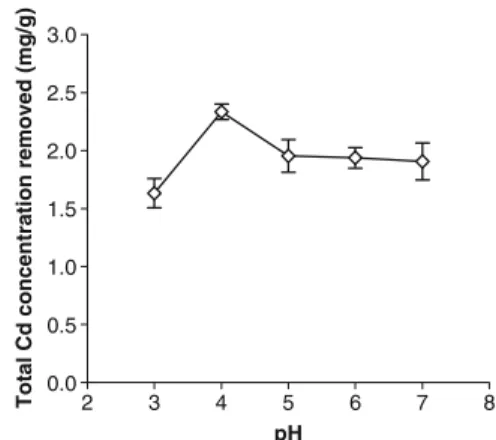
effect of pH on the biosorption capacity of Cd ions by D. pleiomorphus (L) is shown in Fig. 4; biosorption increased with pH up to 4.0, and then declined with further increase in pH.
The maximum biosorption observed was 2.3 mg Cd g−1at pH 4.0—and the lowest one was 1.6 mg Cd g−1at pH 3.0. This low binding capacity is consistent with earlier reports on microalgal biomass (Han et al. 2006; Rangsayatorn et al.2002; Sánchez et al.1999; Vannela and Verma 2006). Crist et al. (1981) suggested that a zero-point net charge (or isoelectric point) is found at pH 3 for microalgae, above which microalgal cells bear a negative charge that will lead to electrostatic attraction between positively charged cations, such as Cd2+, and negatively charged binding sites; this might justify the rapid rise in binding efficiency when pH rises above 3.0. The decrease in Cd binding at pH values above 4.0 is likely due to complexation of those ions by OH− groups, which will prevent adsorption.
ANOVA was performed on the data pertaining to Cd removal vs. pH: D. pleiomorphus (L) biomass was significantly (p<0.05) more efficient in removing Cd ions at pH 4; and removal extents at the other pH values tested (i.e., 3, 5, 6, and 7) were not significantly (p>0.05) different from each other.
Although the maximum sorption capacity reported in the literature is considerably higher than that observed in our study, similar findings were reported by Aksu (2001) in what concerns the pH dependence of removal: the sorption capacity of Cd by C. vulgaris was found to vary with pH, and the maximum uptake
0.0 0.5 1.0 1.5 2.0 2.5 3.0 2 3 4 5 6 7 8 pH
Total Cd concentration removed (mg/g)
Fig. 4 Total amount of Cd removed by Desmodesmus pleiomorphus (L) by 120 min, at various pH values, at an initial Cd concentration of 2.5 mg/L. Results are expressed as means; error bars represent standard deviations (n=3) Cd removal at variable pH
attained was 62.3 mg Cd g−1 at pH 4.0. Han et al. (2006) and Sánchez et al. (1999) also reported that the maximum sorption capacities of Cr3+ by Chlorella miniata and of Cu2+ by Cymodocea nodosa were 41.12 and 52.68 mg g−1, respectively, at pH 4.5.
The dependence of metal biosorption on pH is related to both the functional groups on the surface of the microalgal cell walls and the metal chemistry prevailing in solution (Gong et al.2005): an interme-diate pH affects the solubility of the metals and the ionization state of the functional groups (viz. carboxylate, phosphate, and amino groups) on the cell wall of microalgae. At low pH, the cell wall functional groups are closely associated with hydro-nium ions, and repulsion forces limit the approach of (positively charged) metal ions; as pH increases, more ligands (viz. amino and carboxyl groups) become exposed, so a more negative net charge will result that enhances adsorption (Bayramoğlu et al. 2006; Sheng et al.2004).
Based on our experimental results, D. pleiomorphus (L) can be considered suitable for bioremediation of contaminated waters, especially when pH lies in the vicinity of 4.0.
Both the wild and the commercial strains of D. pleiomorphus (i.e., L and ACOI 561) are able to remove Cd from aqueous solution—hence demon-strating the potential of either of those strains for bioremediation of metal-polluted waters or waste-waters. Both strains are apparently good biosorbents for Cd ions, with maximum removal extents of 61.2 and 85.3 mg g−1 by 1 day of exposure to 5 mg Cd L−1. Although some authors have claimed that micro-algal biomass isolated from polluted environments is more tolerant and able to remove higher amounts of toxic metals from its surroundings, that statement did not fully hold in our experiments—probably because Cd was not a major contaminant in the natural environment from where the sediments were collected. The dominant mechanism of Cd removal is adsorption onto the cell surface. Hence, thermally inactivated cells were also able to remove Cd ions from solution, although to a lesser extent than living ones. It was also found that pH influences Cd removal, with a maximum uptake at ca. pH 4.0.
The authors are grateful to Câmara Mu-nicipal de Estarreja (Portugal), for allowing full access to the contaminated site, and to Fundação para a Ciência e Tecnologia (Portugal) and Fundo Social Europeu (III Quadro Comunitário de Apoio, EC), for partial financial support of this work via a PhD fellowship granted to author C. M. Monteiro (ref. SFRH/BD/9332/ 2002), under the supervision of author F. X. Malcata.
Ahn, C. K., Park, D., Woo, S. H., & Park, J. M. (2009). Removal of cationic heavy metal from aqueous solution by activated carbon impregnated with anionic surfactants. Journal of Hazardous Materials, 164, 1130–1136. Ahuja, P., Gupta, R., & Saxena, R. K. (1999). Zn2+biosorption
by Oscillatoria anguistissima. Process Biochemistry, 34, 77–85.
Aksu, Z. (2001). Equilibrium and kinetic modelling of cadmium (II) biosorption by C. vulgaris in a batch system: effect of temperature. Separation and Purification Technology, 21, 285–294.
Bayramoğlu, G., Tuzun, I., Celik, G., Yilmaz, M., & Arica, M. Y. (2006). Biosorption of mercury(II), cadmium(II) and lead(II) ions from aqueous system by microalgae Chlamydomonas reinhardtii immobilized in alginate beads. International Journal of Mineral Processing, 81, 35–43.
Bishop, N. I., & Senger, H. (1971). Preparation and photosynthetic properties of synchronous cultures of Scenedesmus. In A. S. Pietro (Ed.), Methods in Enzymology (pp. 53–66). New York: Academic.
Carr, H. P., Cariño, F. A., Yang, M. S., & Wong, M. H. (1998). Characterization of the cadmium-binding capacity of Chlorella vulgaris. Bulletin of Environmental Contamination and Toxicology, 60, 433–440.
Chojnacka, K., Chojnacki, A., & Górecka, H. (2005). Biosorption of Cr3+, Cd2+, and Cu2+ions by blue-green alga Spirulina sp.: kinetics, equilibrium and the mechanism of the process. Chemosphere, 59, 75–84.
Chong, A. M. Y., Wong, Y. S., & Tam, N. F. Y. (2000). Performance of different microalgal species in removing nickel and zinc from industrial wastewater. Chemosphere, 41, 251–257.
Chu, K. H., & Hashim, M. A. (2004). Quantitative analysis of copper biosorption by the microalga Chlorella vulgaris. Environmental Engineering Science, 21, 139–147. Costa, A. C. A., & França, F. P. (1998). The behaviour of the
microalgae Tetraselmis chuii in cadmium-contaminated solutions. Aquaculture International, 6, 57–66.
Costa, A. C. A., & Leite, S. F. G. (1990). Cadmium and zinc biosorption by Chlorella homosphaera. Biotechnology Letters, 12, 941–944.
Crist, R. H., Oberholser, K., Shank, N., & Nguyen, M. (1981). Nature of bonding between metallic ions and algal cell walls. Environmental Science and Technology, 15, 1212–1217. Deng, L., Zhu, X., Wang, X., Su, Y., & Su, H. (2007).
Biosorption of copper(II) from aqueous solutions by green alga Cladophora fascicularis. Biodegradation, 18, 393– 402.
References
Conclusions
-Garnham, G. W., Codd, G. A., & Gadd, G. M. (1992). Kinetics of uptake and intracellular location of cobalt, manganese and zinc in the estuarine green alga Chlorella salina. Applied Microbiology and Biotechnology, 37, 270–276. Gong, R., Ding, Y., Liu, H., Chen, Q., & Liu, Z. (2005). Lead
biosorption and desorption by intact and pretreated Spirulina maxima biomass. Chemosphere, 58, 125–130. Gupta, V. K., & Rastogi, A. (2008). Equilibrium and kinetic
modelling of cadmium(II) biosorption by nonliving algal biomass Oedogonium sp. from aqueous phase. Journal of Hazardous Materials, 153, 759–766.
Gupta, V. K., Rastogi, A., Saini, V. K., & Jain, N. (2006). Biosorption of copper(II) from aqueous solutions by Spirogyra species. Journal of Colloid and Interface Science, 296, 59–63.
Han, X., Wong, Y. S., & Tam, N. F. Y. (2006). Surface complexation mechanism and modeling in Cr(III) biosorption by a microalgal isolate, Chlorella miniata. Journal of Colloid and Interface Science, 303, 365–371.
Jennings, J. R., & Rainbow, P. S. (1979). Accumulation of cadmium by Dunaliella tertiolecta Butcher. Journal of Plankton Research, 1, 67–74.
Kaduková, J., & Virčíková, E. (2005). Comparison of differences between copper bioaccumulation and biosorption. Environment International, 31, 227–232.
Leborans, G. F., & Novillo, A. (1996). Toxicity and bioaccumula-tion of cadmium in Olisthodiscus luteus (Raphidophyceae). Water Research, 30, 57–62.
Lee, J. G., & Morel, F. M. M. (1995). Replacement of zinc by cadmium in marine phytoplankton. Marine Ecology Progress Series, 127, 305–309.
Maeda, S., & Sakaguchi, T. (1990). Accumulation and detoxification of toxic elements by algae. In I. Akatsuka (Ed.), Introduction to Applied Phycology (pp. 109–136). The Hague: SPB Academic.
Maeda, S., Mizoguchi, M., Ohki, A., Inanaga, J., & Takeshita, T. (1990). Bioaccumulation of zinc and cadmium in freshwater alga, Chlorella vulgaris. Part II. Association mode of the metals and cell tissue. Chemosphere, 21, 965–973. Matheickal, J. T., Yu, Q., & Woodburn, G. M. (1999).
Biosorption of cadmium(II) from aqueous solutions by pre-treated biomass of marine alga Durvillaea potatorum. Water Research, 33, 335–342.
Matsunaga, T., Takeyama, H., Nakao, T., & Yamazawa, A. (1999). Screening of marine microalgae for bioremediation of cadmium-polluted seawater. Journal of Biotechnology, 70, 33–38.
Monteiro, C. M., Marques, A. P. G. C., Castro, P. M. L., & Malcata, F. X. (2009). Characterization of Desmodesmus pleiomorphus isolated from a heavy metal-contaminated site: biosorption of zinc. Biodegradation, 20, 629–641. Moreno-Garrido, I. (2008). Microalgae immobilization: current
techniques and uses. Bioresource Technology, 99, 3949– 3964.
Oliveira, R. S., Dodd, J. C., & Castro, P. M. L. (2001). The mycorrhizal status of Phragmites australis in several polluted soils and sediments of an industrialised region of Northern Portugal. Mycorrhiza, 10, 241–247. Özer, A., Özer, D., Dursun, G., & Bulak, S. (1999). Cadmium
(II) adsorption on Cladophora crispata in batch stirred reactors in series. Waste Management, 19, 233–240.
Pawlik-Skowrońska, B., Pirszel, J., & Skowronski, T. (1998). The sorption and removal of heavy metals by algal biomasses. Oceanological Studies, 1, 91–103.
Pérez-Rama, M., Alonso, J. A., López, C. H., & Vaamonde, E. T. (2002). Cadmium removal by living cells of the marine microalga Tetraselmis suecica. Bioresource Technology, 84, 265–270.
Price, N. M., & Morel, F. M. M. (1990). Cadmium and cobalt substitution for zinc in a marine diatom. Nature, 344, 658– 660.
Radway, J. C., Wilde, E. W., Whitaker, M. J., & Weissman, J. C. (2001). Screening of algal strains for metal removal capabilities. Journal of Applied Phycology, 13, 451–455. Rangsayatorn, N., Upatham, E. S., Kruatrachue, M.,
Pokethitiyook, P., & Lanza, G. R. (2002). Phytoremediation potential of Spirulina (Arthrospira) platensis: biosorption and toxicity studies of cadmium. Environmental Pollution, 119, 45–53.
Sakaguchi, T., Tsuji, T., Nakajima, A., & Horikoshi, T. (1979). Accumulation of cadmium by green microalgae. European Journal of Applied Microbiology and Biotechnology, 8, 207–215.
Sánchez, A., Ballester, A., Blázquez, M. L., González, F., Muñoz, J., & Hammaini, A. (1999). Biosorption of copper and zinc by Cymodocea nodosa. FEMS Microbiology Reviews, 23, 527–536.
Schmitt, D., Müller, A., Csögör, Z., Frimmel, F. H., & Posten, C. (2001). The adsorption kinetics of metal ions onto different microalgae and siliceous earth. Water Research, 35, 779– 785.
Scragg, A. H., & Bonnet, C. (2002). Inhibition of microalgal growth by silver nitrate. Biotechnology Letters, 24, 169– 172.
Sheng, P. X., Ting, Y.-P., Chen, J. P., & Hong, L. (2004). Sorption of lead, copper, cadmium, zinc, and nickel by marine algal biomass: characterization of biosorptive capacity and investigation mechanisms. Journal of Colloid and Interface Science, 275, 131–141.
Sheng, P. X., Ting, Y.-P., & Chen, J. P. (2007). Biosorption of heavy metals ions (Pb, Cu and Cd) from aqueous solutions by the marine algae Sargassum sp. in single- and multiple-metal systems. Industrial and Engineering Chemistry Research, 46, 2438–2444.
Singh, R., & Prasad, B. B. (2000). Trace metal analysis: selective sample (copper II) enrichment on an AlgaSORB column. Process Biochemistry, 35, 897–905.
Solisio, C., Lodi, A., Soletto, D., & Converti, A. (2008). Cadmium biosorption on Spirulina platensis biomass. Bioresource Technology, 99, 5933–5937.
Torres, E., Cid, A., Herrero, C., & Abalde, J. (1998). Removal of cadmium ions by the marine diatom Phaeodactylum tricornutum Bohlin: accumulation and long-term kinetics of uptake. Bioresource Technology, 63, 213–220.
Tüzün,İ., Bayramoğlu, G., Yalçin, E., Başaran, G., Çelik, G., & Arica, M. Y. (2005). Equilibrium and kinetic studies on biosorption of Hg(II), Cd(II) and Pb(II) ions onto microalgae Chlamydomonas reinhardtii. Journal of Environmental Management, 77, 85–92.
Tukaj, Z., Baścik-Remisiewicz, A., Skowroński, T., & Tukaj, C. (2007). Cadmium effect on growth, photosynthesis,
ultra-structure and phytochelatin content of green microalga Scenedesmus armatus: a study at low and elevated CO2 concentration. Environmental and Experimental Botany, 60, 291–299.
Vannela, R., & Verma, S. (2006). Co2+, Cu2+ and Zn2+ accumulation by Cyanobacterium Spirulina platensis. Biotechnology Progress, 22, 1282–1293.
Yan, H., & Pan, G. (2002). Toxicity and bioaccumulation of copper in three green microalgal species. Chemosphere, 49, 471–476.
Yoshida, N., Ikeda, R., & Okuno, T. (2006). Identification and characterization of heavy metal-resistant unicellular alga isolated from soil and its potential for phytoremediation. Bioresource Technology, 97, 1843–1849.