UNIVERSIDADE DE LISBOA
FACULDADE DE CIÊNCIAS
DEPARTAMENTO DE BIOLOGIA ANIMAL
Somitogenesis and Fibronectin:
United by tension?
Gonçalo Goulart da Silva Pinheiro
DISSERTAÇÃO
MESTRADO EM BIOLOGIA EVOLUTIVA E DO DESENVOLVIMENTO
2014
UNIVERSIDADE DE LISBOA
FACULDADE DE CIÊNCIAS
DEPARTAMENTO DE BIOLOGIA ANIMAL
Somitogenesis and Fibronectin:
United by tension?
Dissertação de Mestrado orientada por:
Prof. Doutora Sólveig Thorsteinsdóttir
Gonçalo Goulart da Silva Pinheiro
DISSERTAÇÃO
MESTRADO EM BIOLOGIA EVOLUTIVA E DO DESENVOLVIMENTO
2014
1
Contents
Acknowledgments ... 2 Resumo ... 3 Abstract ... 6 Introduction ... 7Materials and Methods ... 15
Embryo Development ... 15
Experimentation ... 15
Explant cultures ... 15
In Situ Hybridization ... 16
Immunolabelling ... 17
Image Acquisition and Treatment ... 19
Stereoscope Microscopy ... 19
Confocal Microscopy ... 19
Results ... 20
Expression pattern of fn1 and itga5, key genes involved in FN matrix assembly ... 20
FN matrix assembly and development ... 24
Culturing with RockOut, a cellular tension-reducing drug ... 26
Effects of loss of tension in somite formation, maturation, and matrix assembly ... 26
Effects of loss of tension on gene expression during somitogenesis ... 33
Discussion ... 41
The Development of Matrix Assembly ... 41
The complicated relationship between tension and matrix ... 43
Does tension affect patterning? ... 44
2
Acknowledgments
3
Resumo
A somitogénese é um processo conservado em vertebrados, responsável pela determinação da segmentação do sistema musculo-esquelético que permitiu a adaptação dos métodos de locomoção aquática a ambientes terrestres. A extrema importância do correcto desenvolvimento deste processo para a formação do embrião fez com que a rede regulatória responsável por coordenar este processo tivesse evoluído para uma das mais complexas observáveis no embrião. Todos os dias novos intervenientes neste processo são descobertos, tornando-se cada vez mais óbvio que este é de facto um processo altamente complexo e robusto, garantindo vias alternativas de regulação em caso de falhas no sistema.
Para tentar explicar, de uma forma simplificada e teórica, o modo de regulação do processo de somitogénese, no século passado vários modelos foram propostos. Hoje em dia o modelo mais aceite é o de “Clock and Wavefront”. Este modelo, proposto em 1976 por Cooke and Zeeman, supoe a existência de uma interacção de factores, cuja produção é cíclica, que marca o “tempo” que as células passam numa zona indeterminada da mesoderme paraxial. Associada a esta ciclicidade de factores encontra-se-ía um gradiente de um outro factor, distinto dos primeiros, que seria responsável por determinar a maturidade das células. Quando células que já passaram por um certo número de ciclos atingem uma determinada região do gradiente, estas interpretariam a combinação de ambos os sinais como informação para se diferenciarem e aglomerarem, formando um novo sómito.
Desde a proposta deste modelo, vários genes foram descobertos que suportam este processo de regulação da somitogénese. Estes foram associados ao “relógio” molecular, quer como fazendo parte, quer como sendo regulados por ele, contando-se entre eles os genes
hairy/hes, meso/mesp e lunatic fringe, e os genes aparentemente responsáveis pela
determinação do gradiente caudal foram identificados, sendo eles raldh (responsável pela transformação de retinaldeído em ácido retinóico) e fgf8.
Para além destes genes muitos outros foram sugeridos como participantes no processo de somitogénese. Ephrinas, caderinas, integrinas, fibronectina, sonic hedgehog e WNT’s foram associados ao processo de somitogénese uma vez que os mutantes para cada um dos genes, para além de outros defeitos, apresentam interrupção ou perturbação do processo de somitogénese.
De entre estes, um gene que suscitou bastante interesse foi o de Fa. Há muito que se sabe que a FNa é um componente da matriz extracelular importante para vários processos durante o desenvolvimento do embrião. Embriões mutantes para fibronectina apresentam incapacidade de formar sómitos. No entanto, o papel exacto da matriz de fibronectina neste processo mantém-se pouco claro. Certamente que em parte funcionará como suporte físico, mas um número crescente de estudos têm surgido que demonstram que a matriz extracelular não serve apenas de “andaime” para as células, mas contém de facto informações químicas e físicas muito importantes para os processos de morfogénese que ocorrem durante o desenvolvimento embrionário.
4
Dois destes estudos tiveram como foco do seu trabalho a própria fibronectina, e o seu papel na regulação do processo de somitogénese. Rifes et al. e Rifes e Thorsteinsdóttir, em 2007 e 2012, respectivamente, demonstraram que: (1) a fibronectina é expressa pela ectoderme e montada em redor da mesoderme presomítica, (2) que sem a ectoderme e matriz a somitogénese pára, (3) e que a matriz existe num gradiente decrescente de complexidade, de anterior para posterior, levando à proposta de que o gradiente poderia estar a criar um gradiente de signalização física, participante provável na regulação da somitogénese.
Neste trabalho propusémo-nos em testar esta hipótese, focando-nos em particular no efeito que a perda de sinalização física (i.e. tensão) celular tem na matriz e no processo da somitogénese, e por sua vez que efeitos tem a disrupção da matriz na regulação da somitogénese.
Começámos por realizar hibridações in situ para os genes fn1 e itga5 (respectivamente o gene que codifica para fibronectina em galinha e o gene que codifica o seu principal receptor na mesoderme paraxial) nos primeiros 12 estádios de desenvolvimento embrionário da galinha, in
ovo, e a fazer imunomarcação para a proteína de fibronectina. Observámos que o padrão de
expressão destes genes se correlaciona intimamente com o padrão de montagem da matriz de fibronectina nos primeiros quatro estádios do desenvolvimento. Após esses 4 estádios a correlação contínua muito forte, mas começa a ser observável a existência de alguns tecidos que mostram montagem de matriz, mas não expressão do receptor, indicando a participação de outros receptores. É também observável o aparecimento de tecidos que expressam fibronectina, mas não o seu receptor, e tecidos que apenas expressam o receptor, mas onde existe montagem da matriz. Isto indica, como já tinha sido sugerido por Rifes et al., em 2007, que alguns tecidos produzem a matriz de FNa que outros irão montar, actuando esta como uma espécie de factor “parácrino”.
A seguir decidimos testar o efeito da perda de tensão na montagem de novo e manutenção da matriz e na morfologia dos sómitos, em explantes de embriões entre o estádio HH10 e HH13. Ao cultivar com RockOut, uma droga que inibe a fosforilação da Rho cinase III (ROCK), responsável pela estimulação da contracção da miosina não-muscular II, observámos um decréscimo acentuado da montagem da matriz de fibronectina, tanto após 6h de cultura como após 12h. Observámos também uma perturbação do processo de epitelialização dos sómitos, tanto nos sómitos formados antes como durante cultura, correlacionado com alterações na matriz de laminina. Enquanto que após 6h de cultura a epitelialização parece bastante afectada, a matriz de laminina encontra-se mais densa. Após 12h, quando a epitelialização parece já ter recuperado, tendo um aspecto mais normal, a densidade da matriz de laminina também se aparenta mais com a observada nos explantes controlo. Isto sugere que a matriz de FNa é importante para a epitelialização dos sómitos, mas caso esta se apresente perturbada a matriz de laminina tem a capacidade de compensar por ela, permitindo uma epitelialização correcta, ainda que com um atraso de pelo menos 6 horas.
Por fim decidimos analisar de que modo alguns genes, conhecidos por fazerem parte da regulação da somitogénese, são afectados pela perda de tensão. Para isso procedemos à cultura de explantes bissectados, nos quais as estruturas axiais foram divididas equitativamente por ambas as metades, de modo a cultivarmos cada metade num meio diferente, servindo uma de controlo à outra.
5
Este método permitiu-nos observar que a expressão dos genes responsáveis pela montagem da matriz de fibronectina não é afectada pela falta de tensão, mas que a expressão dos genes responsáveis pela frente de determinação da mesoderme pré-somítica sofre um ligeiro avanço rostral e que os genes de expressão cíclica, hairy1 e meso1, apresentam um atraso na sua expressão. Estes resultados sugerem um atraso geral nos mecanismos celulares, tanto na maturação celular como na formação de novos sómitos.
Todos juntos, estes resultados indicam que a tensão celular é importante para o correcto estabelecimento da matriz extracelular da mesoderme paraxial, que por sua vez é muito importante para a correcta e atempada epitelialização dos sómitos, inicialmente auxiliada pela matriz de fibronectina, mas que pode ser compensada mais tarde pela matriz de laminina.
Palavras-chave:
6
Abstract
Somitogenesis is the founding morphogenetic process to all the skeletomuscular components of the vertebrate body. To describe the regulation of this process, in 1976, Cooke and Zeeman postulated the “Clock and Wavefront” model. From then on several genes have been found to be responsible for the regulation of somitogenesis through the process suggested by Cooke and Zeeman. Hairy1, Hairy2, Lunatic Fringe, Meso1 and Notch have been, in chicken, associated with the “clock” part of the model, where Fgf8 and retinoic acid have been associated with the “wavefront” part. Besides this regulatory network, other genes have been found to influence somitogenesis, like Wnt family genes, Sonic Hedgehog, BMP’s and others. One of these genes, Wnt3a, was proposed in 2004, by Schmidt et al., to be the gene that confers ectoderm its indispensable role in somitogenesis. In 2007 Rifes et al. proposed that the gene responsible for the ectoderm’s essential role was FN. In this work the authors showed that the unavailability of both the ectoderm and the FN matrix led to an arrest of somite formation, while with one or the other this arrest would not happen. It was proposed that the FN matrix, produced by the ectoderm and assembled by the paraxial mesoderm, would be essential for somitogenesis, and it’s role is to confer the proper tension information to the presomitic mesoderm (PSM), which might be indispensable for the PSM’s correct and timely maturation.
In this work we continue the exploration of this hypothesis. First we analyzed the expression patterns of fn1 and itga5 (the α chain of the major FN receptor, the α5β1 integrin) and how they correlate with matrix assembly in the early embryo, from stage HH1 to HH12. Then we cultured explants in RockOut, a Rho kinase III inhibitor that leads to the disassembly of non-muscle myosin II (resulting in a loss of tension) and assessed the effects on morphology and matrix assembly. Finally, we produced bisected explants that were also cultured with RockOut to test for effects on the genetic regulation of somitogenesis. We conclude that loss of tension leads to a delay in somite formation and epithelialization, which is later compensated by an increase in laminin matrix deposition.
Key words:
7
Introduction
Evolutionarily, the appearance of a third embryonic cell layer was a major breakthrough in animal development. While diploblastic animals are rather simple and form few differentiated tissues, that act as “jack-of-all-trades”, where each tissue is responsible for several different functions and metabolisms, triploblastic animals exist in an immensity of forms, shapes and sizes, and inhabit almost all existing ecosystems on Earth. The separation of functions between different organs and tissues made it possible to exert selective pressures upon each individual tissue and its function, without interfering with other vital functions, allowing triploblastic embryos to adapt and exist in the most variable conditions1.
The third embryonic layer, mesoderm, forms during an embryonic process named gastrulation, which in amniote embryos (reptiles, mammals and birds) occurs in very similar ways. In all of them the blastula stage embryo is formed by a two-layered disc of cells, the epiblast and the hypoblast, and the cells of the epiblast converge to the center of the embryo to form the primitive streak, which establishes the Anterior-Posterior (A-P) (also denominated Rostro-Caudal, R-C) and Dorso-Ventral (D-V) axes, as well as determine left and right sides. This converging leads to the formation of a depression, the primitive groove, through which migrating cells pass into the deep layers of the embryo. In the most anterior region of the primitive streak a regional thickening of cells, the Hensen’s Node, forms when the primitive streak starts to expand anteriorly. Hensen’s Node forms a depression in its center through which cells can also migrate as it moves in a caudal direction along the A-P axis, allowing cells to migrate through it at all levels of the axis, maintaining a steady production of mesodermal cells even after Hensen’s Node reaches the most caudal region of the embryo, while the embryo is still elongating. At the end of gastrulation, mesodermal cells that migrated through the Hensen’s Node will have given rise to prechordal mesoderm, notochord and medial parts of the somites, while cells that migrated through the middle of the streak will have given rise to the lateral part of the somites, heart and kidneys, and the cells that migrated through the more posterior parts of the primitive streak will have given rise to lateral plate and extraembryonic mesoderm2,3,4.
Gastrulation is therefore the basis for the establishment of the paraxial mesoderm, a very important subset of the third embryonic layer, since this mesodermal region, which surrounds the axial structures, notochord and neural tube, will give rise to all the muscles and the axial skeleton of the vertebrate body, as well as axial tendons and articulations, blood vessels, dorsal dermis and brown fat cells5,6. Paraxial mesoderm can be divided into two different regions, a more anterior cephalic mesoderm, which will give rise to cephalic muscles, some connective tissue and sphenoidal and otic bones7,8, and a more posterior segmented mesoderm, which will give rise to the basoccipital bone of the cranium and all of the axial skeleton, tendons, blood vessels, dorsal dermis and brown fat cells as well as all the skeletal muscle of trunk and limbs.
8
The segmented mesoderm received its name due to the fact that it goes through a periodical segmentation process, from rostral to caudal, where metameric sphere-like structures, called somites, are formed. The periodicity of this process is, in normal conditions, very regular and species specific (although some species can have different periodicities along the A-P axis), and have very little intra-species variability in the total number of somites formed9. Somites are transient aggregates of mesodermal cells that acquire a dynamic epithelial/mesenchymal state10. They are formed by a wave of epithelialization, from medial to caudal, then to anterior, and finally lateral, that transforms the cylindrical anterior presomitic mesoderm (PSM) into a sphere-like structure11,12,13,10, with the outside cells becoming elongated, and polarized with their apical side turned towards a central cavity, called the somitocoel, while some inner cells are present within the somitocoel (Fig. 1 A).
About 7 and a half hours after its formation in the chicken embryo the dorsal side of the somite continues to be a compact sheet of epithelial cells, the dermomyotome, while the ventral side has undergone an epithelial-to-mesenchymal transition (EMT), becoming the sclerotome (Fig. 1 B). The distinction between these two populations is of extreme importance because, even though there is extensive cross-talk between them, each one will give rise to very distinct tissues that will have intercalating dispositions in the embryo.
The dermomyotome is a transient epithelial sheet formed from the dorsal somitic cells, which include the progenitors for all the muscles in the trunk and limbs, as well as dorsal dermis, among others6. It originates the myotome, which forms the scaffold upon which the deep back muscles (derived from the epaxial dermomyotome), as well as abdominal and intercostal muscles (derived from the hypaxial dermomyotome), will form. The formation of the myotome occurs through a progression of waves of cells coming from the dermomyotome. The first wave of cells comes from the dorsomedial lip and expands bidireccionally, both rostrally and caudally, forming the primary myotome. In the second wave the caudal, cranial, and finally ventrolateral,
Figure 1- Scanning electron microscopic views on transverse fractures of a 2-day (A) and a 3-day (B) chick embryo showing the change in morphology of the somites between these two stages (ao aorta, ch notochord, dm dermomyotome, ds dorsal somite, nt neural tube, sc sclerotome, so somitocoele, sm somatopleure, sp splanchnopleure, vs ventral somite, wd Wolffian duct). Adapted from Christ et al., 2004.
9
border, in this order, also release myotomal precursors that will differentiate and enlarge the myotome. Finally, the central dermomyotome will deepithelialize, before the lips, and cells will both move dorsally to form the dermis, or parachute ventrally into the myotome, to add a third round of myogenic precursor cells. These processes will establish the embryonic “primitive” muscles, which show the ancestral segmentation pattern. Because this pattern is proper for aquatic locomotion, but not for life on land, the myotomes of reptilian, avian and mammalian embryos undergo a process called translocation, where the muscles realign to form the attachments appropriate for terrestrial locomotion. Besides the myotomal muscles, the hypaxial lip of the dermomyotome, at limb level, will also deepithelialize and migrate into the forming limbs, originating all the musculature found there, and at cervical level populations of cells also detache to migrate ventrally to give rise to the diaphrahm or cranially to originate the tongue muscles.
The sclerotome is a mesenchymal bundle of cells, formed by the Pax1 expressing cells of the somitocoel and ventral somite, which will also start to express Pax95. This region of the somite will then, through interactions with the axial structures and involving tissues, become regionalized, and in each region a population of distinct progenitors will arise. The sclerotome also forms a fissure between its rostral and caudal halves, called the von Ebner fissure14,15, which allows the caudal region of one sclerotome to fuse with the rostral region of the next one, in a process called resegmentation. This process is essential for vertebrate movements, because it allows the intercalation of muscles with the axial skeleton, important feature that can be seen in Osteichthyes, but also because it permits the migration of peripheral spinal nerves and initial blood vessels5. The regionalization of the sclerotome leads to the formation of distinct groups of progenitos which will give rise to tendon precursors, vertebrae, ribs and intervertebral discs, endothelial structures and meninges of the spine, intervertebral discs and joints of the vertebral column, and regulate the development of the DRG and spinal nerves. These regionalizations are depicted in Figure 2.
10
Although both myotome and sclerotome go through complex morphological events (translocation and resegmentation, respectively) to bridge functionally, neither of these processes would be able to occur without the initial segmentation, established during somitogenesis. This must happen not only in the correct periodicity, but also in the correct direction, axial level and extension, because it is not only important that somites have a developmental difference of “n” minutes (species-specific) for proper ressegmentation and muscle development to occur, but also that segmentation always happens first more rostrally, and progresses caudally in a gradual fashion, and that segments have the correct sizes, otherwise defects in the axial skeleton and muscle anchorage will occur.
Since so much depends on correct somitogenesis it is of no astonishment that this process must be highly regulated and robust. The model most accepted nowadays to represent the regulation of somitogenesis is the “Clock and Wavefront” model, proposed in 1976 by Cooke and Zeeman. They proposed that somitogenesis is regulated mainly by two factors, the first a “molecular clock”, that will establish the periodicity with which somites form based on the anabolic and catabolic dynamics of its constituents, in a repeating cycle. The second would be a
Figure 2-(A–F) Schematic representation of transverse and longitudinal sections of chick embryos at different developmental stages. (A, B) Epithelial somites. (C, D) Somites after compartmentalization.
(E, F) Mature somites. Prospective sclerotome and
sclerotome subdomains in color. The broken line in A,
C, E indicates the section plane of B, D, E (1 neural
tube, 2 notochord, 3 aorta, 4 dorsal half- somite, 5 ventral half-somite, 6 surface ectoderm, 7 dermomyotome, 8 myotome, 9 central sclerotome, 9a cranial half of central sclerotome, 9b caudal half of central sclerotome, 10 ventral sclerotome, 11 lateral sclerotome, 12 dorsal sclero- tome, 13 spinal nerve, 14 von Ebner’s fissure, 15 meningotome, 16 syndetome, 17 somitocoele cells/arthrotome, 18 dermis, 19 Wolffian duct. Adapted from Christ et al., 2004.
11
diffusible factor that exists in a gradient along the PSM, thus forming a “wavefront” (a certain concentration of that gradient) which moves posteriorly as the axis elongates. When the cells reach this wavefront, if they are in the correct cycle of the molecular clock, they will interpret the union of both signals as the signal to segment and epithelialize, forming a new somite.
From the proposal of this model researchers have tried to find a gene that would play one of the proposed roles by Cooke and Zeeman. In 1997 Palmeirim et al. found that hairy1, a chicken gene codifying a transcription factor downstream of the notch signaling pathway, shows a cyclic expression along the PSM, with a periodicity of 90 minutes (the same as somite formation) and its expression in the rostral PSM is concomitant with the formation of a new somite. From then on, several genes were found that fitted this model, like Notch1, Delta1 and 3, Lunatic Fringe, Hes/Hey/Her/Hairy family genes and Meso/Mesp family genes for the clock, and Fgf8, Fgfr1 and Raldh2 (enzyme responsible for the production of Retinoic Acid, RA) for the wavefront18-32.
Based on the expression patterns of these genes and how they interact with each other, it became apparent that the Notch signaling pathway is a major regulator of the “molecular clock’s” mechanism. As far as it is known now, it appears that Delta recognition activates Notch. Notch intracellular domain (NICD), which is produced when Notch is activated, is then translocated to the nucleus, where it induces the expression of Lunatic Fringe (lnfg) and hairy1.
hairy1 will inhibit lnfg and, when its expression levels get high enough, itself. lnfg then modifies
Notch’s activation by Delta, establishing this way the cycle of the “clock”. This cycle then signals boundary formation by inducing in the posterior “presumptive” s-I somite, through NICD, Meso1/Mesp2 expression, which will in turn induce expression of EphA4 in the rostral region of the presumptive s-I somite. EphA4 will bind to EphrinB2, present in the caudal region of s0, which will antagonize EphA4 and induce the formation of the cleft22,33-35 As for the gradient, RA inhibits Fgf8 expression anteriorly, limiting its rostral activity allowing the activation of the expression of Mesp/Meso, which in the posterior PSM is blocked by Fgf8 signalling through pERK36,37. A scheme of how the process might happen is represented in Figure 3.
12 D LL 1 N O TC H 1 N IC D LN FG H A IR Y 1 M ES O 1 D LL 1 N O TC H 1 N IC D M ES O 1 EP H A 4 EP H R IN B 2
R
eti
noic Ac
id
FGF8
Fi g u re 3 Sim p lified sc h ema ti c rep rese n ta ti o n o f th e re g u la to ry n etw o rk o f so m ito g en esi s. T h e “m o lecu la r cl o ck ” is co m p o sed of th e in ter a ct io n s b etw ee n N o tc h , Delt a , H a ir y1 a n d L u n a ti c F ri n g e r ep resen te d , w h ich lea d s to cy cl ic ex p ressi o n a n d /o r si g n a lin g th ro u g h th ese p a th w a ys. T h e w a vef ro n t i s est a b lish ed b y co n fr o n ti n g g ra d ie n ts o f FG F8 a n d R eti n o ic A ci d , w h ich is ex p ressed b y th e so m ites a n d in h ib its F G F8, ex p ressed in th e PS M. A n ew s o m ite is fo rm ed w h en , d u e to en teri n g a n a re a o f the PSM w ith lo w en o u g h l ev el s o f FG F8, cel ls c a n esc a p e th e rep ress io n o f M eso 1 ex p re ss io n . M eso 1 w ill l ea d to the ex p re ss io n a n d in ter a ct io n o f Ep h /E p h ri n d u o s th a t w ill in d u ce th e fo rm a ti o n o f a cl ef t. A rr o w s in d ica te in d u ct io n /a ct iv a ti o n . “F la th ea d ” lin es in d ica te rep ressi o n /c o m p eti ti o n . “Di a m o n d h ea d ” li n es in d ica te r ep u lse.13
Besides these genes, several others have been identified whose mutants show defects in somitogenesis and/or in the expression of the genes above, or whose expression is altered in mutants for the above genes. Some of the most studied include adhesion molecules like N-Cadherin38,10, essential for polarization and epithelialization of the somite, pFAK39, a phosphokinase involved in the signaling pathways of several adhesion molecules, transcription factors like Paraxis40-43, necessary for proper epithelialization of the somite, and Pax1, and Pax3 and Pax744,6, responsible for determining dermomyotomal and sclerotomal lineages. Morphogens like Shh45-47, responsible for dorsal-ventral patterning of the somite, Noggin48, a BMP inhibitor necessary for paraxial mesoderm specification, and Wnt43,46,48-52, a group of genes that appear to have several functions, like gradient and clock establishment, regulation of epithelialization and participation in polarization, also have very important roles in somitogenesis. Although it was widely accepted that somitogenesis was a process independent of neighbouring tissues, some studies showed that even though the ectoderm is not necessary for molecular segmentation, it is required for physical segmentation53-55. Following these works it was initially proposed that the factor that confers ectoderm its importance was Wnt6, necessary for the correct polarization of the somites49,50.
In 2007, following several works on the topic of FN’s role in somitogenesis38,53,56-62, Rifes et. al showed that the fibronectin (FN) matrix existent around the PSM is produced, in a rostral-to-caudal gradient, by the ectoderm, and to a lesser extent, endoderm, and then is assembled by the PSM, which expresses Itga5, the α subunit of its assembly receptor, α5β163. They also showed that when this matrix is destroyed by enzymatic digestion somitogenesis is abolished, unless isolated PSMs are cultured with the ectoderm, or in a medium supplemented with FN. Furthermore, this matrix exhibits a gradient of increasing complexity, concomitant with the gradient of fn1 expression in the ectoderm64.
These results suggest that FN is the ectodermal element necessary for somitogenesis to occur, and that this matrix protein might act like a “paracrine” factor. Since supplementing isolated PSMs with FN in the medium leads to a partial recovery of somitogenesis, it seems plausible that the matrix gradient established around the PSM could also create a gradient of physical signaling (i.e tension) that helps regulate somitogenesis.
It has been extensively demonstrated in other models, especially in vitro65-68, that tension, or physical cues, play important regulatory roles in several developmental processes, like cell migration and differentiation. Tension is as complex a characteristic to study as it is to characterize, since it is composed of so many levels and so many interactions with other regulatory systems. However, we can simplify it by looking at it at three distinct levels.
14
Tissue tension is the conjunction of pressures a tissue experiences from its neighbors as they undergo morphogenesis and change shape and size. At a smaller scale level there is matrix tension, which is defined by the density and rigidity of each individual component of the extracellular matrix (ECM), but also by the ability cells have to interact with each individual component, and then translate this physical information into chemical signaling (or internal physical signaling) that can then be dispersed through the cell, and to its neighbors. Finally, the lowest level is the one in which cells transmit the information to each other, and transform internal chemical and physical information into ECM alterations or cell-cell interaction alterations.
At this last level the effects of pathway signaling alterations and tension force alterations usually become hard to separate. This is due to the fact that it is at this level that the two merge, and inducing alterations in outside-in signaling leads mostly to the same defects as altering inside-out signaling. This makes it very hard, when studying tension, to determine whether or not tension is playing a role, or the effects induced are just from creating more system noise, like reducing cytoskeleton dynamics or generating ECM instability. However, since all of these are physical alterations, it becomes hard to say, even in those situations, that tension is not playing a part. In the end, tension bears some resemblances to a deity. Its existence and functions are hard to prove, but when you analyze all the effects your experiment produced, all could, in different degrees, be attributed to it. However, unlike a deity, you can remove it, and appreciate that it does have a clear effect, whether or not it is through influences in several systems.
Because it is hard to clarify their roles, how each level of tension regulates morphogenetic processes, and how they interact with each other, but there is a theoretical basis for the existence and functions of tension in somitogenesis, we decided to try and understand how it participates in the regulation of somitogenesis. To this end we cultured explants in the presence of a tension inhibiting drug, RockOut, and assessed how this affected (1) somite formation, (2) the morphological development of formed somites and PSM, (3) the deposition and assembly of FN and laminin (LN) matrix, two important components of the PSM and somite ECM and (4) the expression of genes implicated in somitogenesis, to try to understand how the first level of tension, the cellular level, interacts with the second level, ECM tension.
15
Materials and Methods
Embryo Development
Fertilized chicken (Gallus gallus) eggs were obtained from a commercial source (Sociedade Agrícola Quinta da Freiria, Portugal) and kept at 13°C until the desired incubation start time. Fertilized eggs were never kept for more than a week at 13°C. The eggs were incubated at 37°C (± 1°C) in a humidified atmosphere (≈70% humidity) for the required amount of time necessary to obtain embryos at developmental stages ranging from HH1 to HH14 (Hamburger and Hamilton, 1951).
Experimentation
Explant cultures
Cultures of posterior embryo explants (PSM and last four somites) were performed, to be processed for mRNA expression and protein localization. Embryos used ranged from HH10 to HH14, since this is the period of development where forming somites are all toraxic somites (which have a different genetic regulation than the more rostral ones, Freitas et al., 2005; Rodrigues et al., 2006), the PSM has its longest length and cirurgical manipulation of axial structures is the easiest. Explants were recovered, staged and dissected in Complete Phosphate Buffer Solution (PBS, 137mM of NaCl, 2.68mM of KCl, 8.1mM of Na2HPO4 and 1.47mM of KH2PO4, with 0.905mM of CaCl2 and 0.492mM of MgCl2) and cultured in Normal Chicken Medium [M199 medium (Lonza #7331682) 10% Chicken Serum (Invitrogen #16110082) 5% Fetal Bovine Serum (Invitrogen #10500004) and 1% Penicillin/Streptomycin (Invitrogen #15140022)] on top of 0.8μm filters (Merck Millipore, #ATTP02500) floating on 200μL of medium, in 4-well plates (Thermo Scientific, #144444). Cultures had the duration of 6h or 12h, and were performed in an incubator (Nuaire AutoFlow NU-4750 Water Jacket CO2) at 37°C, with a humidified atmosphere with 5% CO2.
The explants were cultured under three different conditions. They were either cultured in Normal Chicken Medium, with 1% DMSO (Sigma, #D2650) or with 50μM of Rho Kinase Inhibitor III (RockOut, Merck Millipore #555553, dissolved in DMSO) added to this medium. Explant experiments were performed in two different ways, depending on what technique was used to analyze them: (1) explants to be processed for in situ hybridization were bisected along the axial structures (notochord and neural tube) and each half was cultured under one of two different conditions (control and experimental); (2) in order to preserve tissue architecture for immunolabelling and confocal analysis, explants were prepared and cultured as intact posterior portions of the embryo where control and experimental explants were from different individuals of the same stage. In both cases, two experimental groups were used, the first serving as a control for the potentially toxic effect of DMSO (Normal Chicken Medium vs DMSO) and the second as a test for the effect of RockOut (DMSO vs RockOut).
16
After culture the number of somites formed during culture was counted, using the nomenclature of Christ and Ordahl, 1995.
In Situ Hybridization
Probe Production
Probes for Hairy117, Hairy222, Meso127, Fgf8, Raldh2, Shh and Patched2 (referenced in
Resende et al., 2010) were kind gifts from Isabel Palmeirim and Joaquín Rodriguez-León, and probes for Itga5 and Fn1 were generated in our lab55. An extended protocol for probe production can be found in supplementary protocols
Whole Mount In Situ Hybridization
Embryos were collected and staged in DEPC-treated 1x PBS and fixed O/N in WISH [4% Formaldehyde (Sigma #F1635) in 150mM NaOH with 100mM EGTA (Sigma #E4378) in DEPC-treated water, to prevent mRNA deterioration]. Whole mount in situ hybridization was performed on HH10-14 embryos for all the probes mentioned previously. Whole mount in situ hybridization for fn1 expression was also performed, in embryos staging from HH1 (first stage in
ovo) to HH14.
After O/N fixation, embryos were dehydrated in methanol (50% first, then 2x 100% washes, 5 minutes each) and left at -20°C, at least O/N (and no more than 3 months).
On day 1 of the in situ hybridization protocol embryos were rehydrated in a 75%-50%-25% methanol series. After that they were bleached for an hour in 6% H2O2 solution in Phosphate Buffer Saline (PBS) with 0.1% Tween (PBT). Embryos were then permeabilized with Proteinase K (Roche #3115879001) at 10μg/mL. Exposure times to Proteinase K depended on embryo stage (one minute per stage, i.e HH1=1 minute, HH10=10 minutes and so on). After that the embryos were post-fixed in 4% formaldehyde and 0.1% glutaraldehyde (Sigma #G5882) in PBT, to inactivate the Proteinase K and prevent deterioration of the tissues. Finally, embryos were passed through Hybmix by rinsing in a 1:1 PBT:Hybmix solution, and then left to incubate in Hybmix at 65°C/70°C for at least an hour. Instead of the incubation time, some embryos were put in Hybmix and stored at -20°C for future hybridization. After the 1h incubation they were submerged in 200-500μL of probe (depending on number of embryos per well/size of wells).
On day 2, the probe was recollected from the embryos and stored at -20°C to be reused. After that embryos were washed, for 30 minutes, twice in Post-Hybridization Mix (Post-Hybmix, 50% Formaline, 600mM NaCl, 60mM Trisodium Citrate and 0.2% Tween) at 65°C/70°C, and then transitioned to MABT (Maleic acid buffer solution, 100mM of Malic Acid, 150mM of NaCl, with 1% Tween) by washeding in a 1:1 MABT:Post-Hybmix solution for 10 minutes at 65°C/70°C, and then twice in MABT. The embryos were then washed twice for one hour in blocking solutions, at room temperature (RT) and with agitation, first in a 2% Blocking reagent (Roche #11096176001) solution in MABT, and second in a 2% Blocking, 20% Sheep Serum (Sigma #S2263) solution in MABT. Finally, the embryos were incubated O/N, at 4°C, , with Anti-Digoxigenin-AP Fab
17
fragments (Roche #1093274) or Anti-Fluorescein-AP Fab fragments (Roche #11426338910), depending on the probe, diluted 1:2000 in 2% Blocking, 20% Sheep Serum solution in MABT.
On day 3, depending on how clean (less background) the probe’s development is, embryos were either washed for ≈3h (often more) in MABT, or washed all day, several times, in MABT. In the last case, they were then stored O/N, at 4°C, in MABT, and the rest of the protocol happened on day 4. Embryos were then washed twice, for 10 minutes, at RT, in Alkaline Phosphatase (AP) Buffer (NTMT, 100mM MgCl2, 100mM Tris-HCl pH9,5, 100mM NaCl and 1% Tween, in H2O), and then developed in a 0.5mg/mL NBT (Roche #1383213) and 0.1875mg/mL BCIP (Roche #1383221) solution in NTMT.
To photograph, the AP reaction was either temporarily paused in MABT, or completely stopped in PBT. If paused in MABT, the reaction was continued incubating again in NTMT followed by NBT/BCIP solution in NTMT. After stopping the reaction in PBT and photographing the embryos, they were placed in 1% Sodium Azide in PBT at stored at 4°C.
Explant In Situ Hybridization
After culture (6h or 12h) the explant’s somites were counted in DEPC-treated 1x PBS, rinsed once or twice with DEPC-treated 1x PBS, and then fixed O/N in DEPC-treated WISH fixative.
Hybridization was performed with all the probes mentioned previously, in order to ascertain the influence of each culture condition on gene expression.
Explants were subjected to the exactly same protocol as intact embryos, except for Proteinase K incubation time, which was 10 minutes for all explants, regardless of their original stage.
Since not all explants ended up having a clear probe signal, and some explants were lost, broken or bent, only complete pairs of straight, well developed, explants were used to analyze the effects of each culture condition on gene expression.
Immunolabelling
Whole Mount Immunolabelling
Embryos ranging from HH1 to HH8
were processed for whole mount immunolabelling
10 , to analyze FN matrix deposition and fibrillogenesis. Embryos at stages HH10 and HH13 were also immunolabelled to compare somite morphology with that of cultured explants. Immunolabelling in these experiments was performed using, as primary antibodies, a rabbit anti-Fibronectin (Sigma #F3648 polyclonal antibody, at a 1:400 dilution and a mouse anti-N-Cadherin (BD Biosciences #610920) monoclonal antibody, at a 1:100 dilution in 1% ID (0,01g/mL Bovine Serum Albumin and 1% Tween in PBS). These dilutions were used to have a final concentration of about 15-25μg/mL of antibody. Secondary antibodies were an Alexa 488-coupled, goat anti-mouse antibody(Molecular Probes #A11017) and an Alexa 568-coupled, goat anti-rabbit antibody18
(Alfagene #A21069) at a 1:1000 dilution in 1% ID in PBS. For nuclear staining we used the DNA-intercalator ToPro3 (Invitrogen #T3605).
Embryos were collected in complete PBS (with Ca++ and Mg++) and fixed O/N in 4% FISH (4% Paraformaldehyde, PFA, Merck #1030051000, with 4% Sucrose, 0.12mM of CaCl2, 0.077mM of Na2HPO4, and 0.023mM of NaH2PO4). On the next day they were washed briefly, several times, in Complete PBS, and then in 1% ID in PBS for 2 hours. After that the antibody solutions were prepared, and the embryos were incubated O/N, at 4°C (with or without agitation).
On the following day, embryos were washed extensively in Complete PBS, and then incubated in the secondary antibody solutions, which were made in 1% ID in PBS O/N, at 4°C (with or without agitation).
On the third day, embryos were washed several times in Complete PBS, then incubated O/N, at 4°C (with or without agitation) in a 1% ID solution containing 2μM of ToPro3 and 10μg/mL of RNAse, to allow better intercalation of the ToPro with the DNA, and not with RNA.
On the final day, embryos were fixed in a 1% PFA solution (in the ID-diluted ToPro solution, to help maintain the staining in the nuclei) for 1-2h at RT, without agitation. After that, they were quickly washed in Complete PBS, and then slowly dehydrated in a 10% increment methanol series, or in a 10-20-40-60-80-100% methanol series. For the first series, transitions were made every 10 minutes, while for the second the first two transitions were 10 minutes apart, and the rest 20 minutes apart. Finally, they were laid to rest at -20°C until the day they were mounted in methyl salicylate and observed.
Explant Immunolabelling
Whole posterior section explants were also immunolabelled in order to describe N-Cadherin, Fibronectin and Laminin protein distribution after culture. For this purpose, two combinations of primary antibodies were used: (1) anti-Fibronectin polyclonal antibody and the anti-N-Cadherin monoclonal antibody, previously mentioned; (2) mouse anti-Fibronectin (DSHB #B3/D6) monoclonal antibody and a rabbit anti-Laminin (Sigma #L9393) polyclonal antibody. Polyclonal antibodies were used at a 1:400 dilution, while monoclonal antibodies were used at a 1:100 (N-Cadherin) and 1:5 (Fibronectin) dilutions. These dilutions were used to have a final concentration of about 15-25μg/mL of antibody. Secondary antibodies were an Alexa 488-coupled, goat anti-mouse antibody and an Alexa 568-488-coupled, goat anti-rabbit antibody, and for nucleic staining we used the DNA-intercalater ToPro3.
Collected explants were washed in Complete PBS to remove the leftover medium and their somites were counted. Afterwards they were fixed O/N in 4% FISH. The rest of the protocol was performed as previously described for whole mount immunolabelling.
19
Image Acquisition and Treatment
Stereoscope Microscopy
Stereoscopic imaging was performed in a Zeiss Lumar.V12 with a ImagingSource DFK 23U274 camera, coupled to a 0,63x coupling ring, through a ApoLumar S 1,2x FWD 47mm lens.
Image acquisition was done through the IC Capture V2.3 software and image processing was done using the FIJI software. To allow better comparison of the expression patterns, PSM’s were straightened with the FIJI plugin “Straighten” and aligned by s0, marked by a white dashed line in the images.
Confocal Microscopy
Confocal imaging was performed using a Leica DMI 4000B microscope coupled with a Leica TCS SPE scanner head, either using a 20x, 0.7 NA air APO CS lens or a 40x, 1.15 NA oil ACS APO lens. Images were acquired with the LAS AF software and processed using the Amira v5.3.3 software. Reconstructions of matrix protein labelling and merged images represent the ventral one-third to half of the somite, while N-Cadherin labelling reconstructions represent the medial three-quarters of the somite.
20
Results
Expression pattern of fn1 and itga5, key genes involved in
FN matrix assembly
As previously mentioned, the FN matrix plays a very important role during somitogenesis. It has been extensively shown that a FN matrix is primarily assembled through integrin α5β1-mediated ligation and extension of the FN dimer63,70-74. To better understand the role of this matrix during somitogenesis, we decided to analyze how it is set up from the earliest stages of development of the chick embryo until the formation of 13-15 somites. We started with the earliest available stage to us, HH1, and followed the expression of fn1 and itga5 until stage HH12. At stages HH1 to HH3, fn1 is expressed in a punctuated, “salt-and-pepper” pattern (Fig. 4 A-C), while itga5 expression seems to follow the establishment of the primitive streak (Fig. 4 G-I).
As the primitive streak expands rostrally the punctuated expression of fn1 also moves rostrally, while more caudally the expression becomes restricted to the primitive streak and becomes uniform (Fig. 4 D, arrowheads). fn1 also starts to be expressed around the embryo, in the anterior two-thirds of the extraembryonic tissues. itga5 continues to only be expressed in and around the primitive streak, although its expression is almost nonexistent in the most caudal part of the primitive streak (Fig. 4 J, arrowhead). At stage HH5 gastrulation has already started in the most rostral region of the embryo, and cephalic mesoderm and the primordial cephalic neuro epithelium have formed rostrally. At this stage fn1 expression in the extraembryonic tissue has almost reached the most caudal point of the embryo, while the punctuated expression pattern in the more rostral region has practically disappeared (Fig. 4 E). Both fn1 and
itga5 are still being expressed in the primitive streak, although now they show an expression
gradient that increases from posterior to anterior, being strongest in the most rostral region of the streak, closest to the node (Fig. 4 E, K, arrowheads). As gastrulation proceeds and the node regresses along the primitive streak, fn1 expression becomes increasingly caudal. At stage HH6
fn1 expression has reached the most caudal region of the extraembryonic tissues, and starts
being expressed in the remaining caudal epiblast, forming a V-shaped expression pattern (Fig. 4 F). Expression also becomes more intense in the border between the neuroepithelium and the epidermal ectoderm, where a very dark band of expression is found (Fig. 4 F, arrowhead). At these stages, itga5 starts to be expressed in the cephalic neuroepithelium (Fig. 4 L, arrowhead).
21 Fi g u re 4 E xp ressi o n p a tt er n s o f th e m a trix g en e fn 1 a n d i ts i n te g ri n r ecep to r, i tg a 5 fr o m H H 1 to H H 6. (A -F ) fn 1 ex p ressi o n p a tt er n . (G -L ) itg a 5 ex p ressi o n p a tte rn . (A -C) fn 1 st a rts to b e ex p ressed i n a sp a rse sa lt a n d p ep p er p a tt er n a n d sl o w ly b eco m es d en se r a n d ex p a n d s to a ll th e emb ry o n ic ti ss u e. .( D, E) f n 1 p u n ctu a ted ex p res si o n b eco m es less a n d l ess ev id en t in t h e a n ter io r o f th e emb ry o , w h ile b ei n g m a in ta in ed a ro u n d th e p ri m iti ve st rea k. (G -I) i tg a 5 ex p ressi o n seems to f o llo w th e p ri m iti ve st rea k fo rm a ti o n , b ein g ex p ressed in i ts cre st s. (K, L ) itg a 5 ex p ressi o n d isa p p ea rs fr o m th e m id lin e o f th e e m b ry o in a rea s w h er e g a st ru la ti o n h a s o cc u rr ed , b u t l a ter r ea p p ea rs i n th e n eu ro ep ith eli u m . F u ll a rr o w h ea d s rep rese n t a rea s o f e xp ressi o n o f th e r esp ecti ve g en e, w h ile h o llo w a rr o w h ea d s r ep rese n t a rea s w it h o u t o r w ith w ea k ex p ressi o n . S ca le b a r r ep resen ts 200 μ m fo r A -C ,G -I; 500 μ m fo r D -F ,J -L ; a n d 100 μ m fo r th e a m p lific a ti o n s in D a n d E .
22
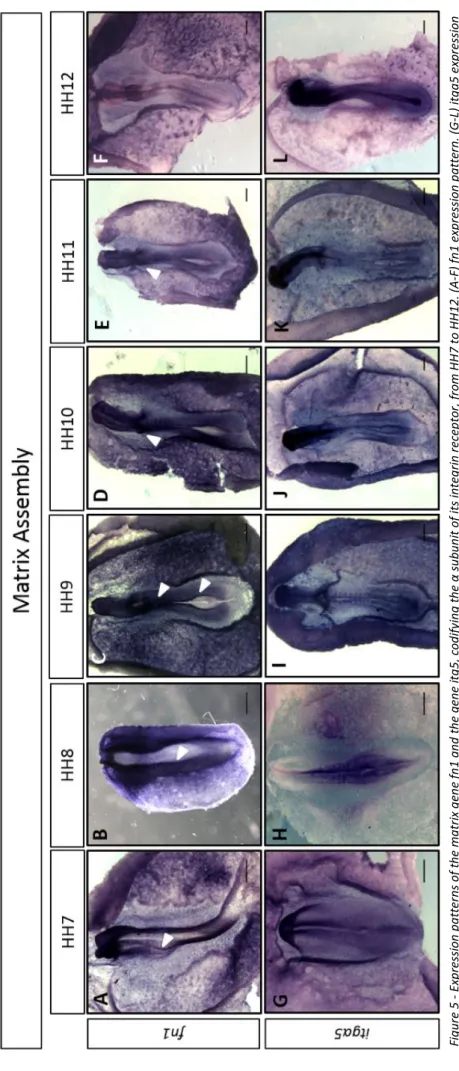
Starting at stage HH7 we can clearly see that the epidermal ectoderm strongly expresses
fn1, but the neuroepithelium shows no sign of expression, and the intense expression in the
border between these two tissues becomes clearer (Fig. 5 A-E, arrowheads). At this same stage,
itga5 has started being expressed in the most caudal PSM, as well as in somites, lateral
mesoderm and around the node, and this expression is maintained at least until stage HH12 (Fig. 5 G-L). During stage HH8 and HH9 fn1 expression starts to decrease in the epiblast as this tissue disappears, and epidermal ectoderm expression becomes more medial as the neural tube starts to close (Fig. 5 B, C). Somites also start to show expression of fn1 at this stage (Fig. 5 C, arrowhead). From stage HH10 to HH12 this expression pattern is maintained, while fn1 expression becomes increasingly strong in the heart primordia (Fig. 5 D-F, arrowheads).
23 Fi g u re 5 E xp ressi o n p a tt er n s o f t h e ma trix g en e fn 1 a n d t h e g en e itg 5 , co d ify in g t h e α su b u n it o f its in teg ri n r ecep to r, f ro m H H 7 to H H 12. ( A -F ) fn 1 ex p ressi o n p a tt er n . ( G -L ) it g a 5 ex p ressi o n p a tt er n . (A -C) A b a n d o f st ro n g e xp ressi o n o f fn 1 b eco m es in cre a si n g ly ev id en t in th e fr o n ti er b etw een ep id er m a l ecto d er m a n d n eu ro ep ith e liu m . ( G ,H ) itg a 5 b eco m es m o re ex p ressed in th e p a ra xi a l m eso d er m . (D -F ) fn 1 ex p ressi o n st a rts to b eco m e a p p a ren t in th e fo rm in g h ea rt p ri m o rd ia . Fu ll a rr o w h ea d s rep resen t a rea s o f ex p ressi o n o f th e resp ecti ve g en e, w h ile h o llo w a rr o w h ea d s rep resen t a rea s w ith o u t, o r w ith w ea k ex p ressi o n . Sca le b a r r ep resen ts 500 μ m in a ll i m a g es.
24
FN matrix assembly and development
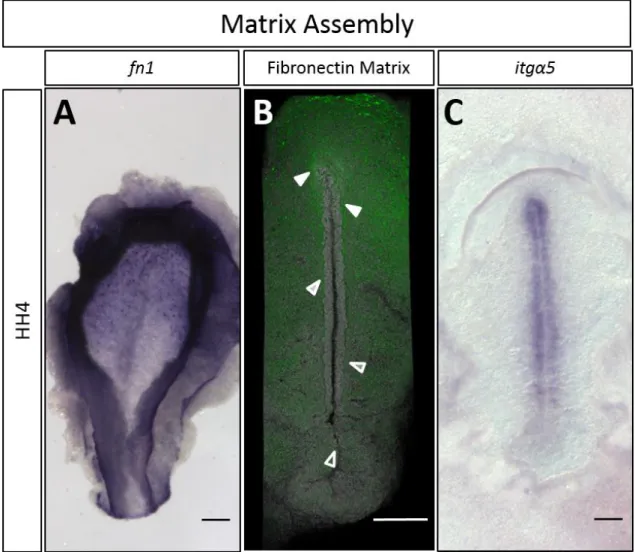
To determine how the matrix assembly correlates with the expression pattern of both genes we performed whole mount immunofluorescense in two representative stages, stage HH4, when the embryo is preparing to start gastrulation, and stage HH8, when gastulation is still proceeding caudally and somitogenesis and heart formation are underway. At stage HH4 we can see that there is more labelling of FN in the rostral part of the embryo than in the caudal region, and we can also distinctly see a gradient of matrix assembly around the primitive streak, but nowhere else (Fig. 6 B, arrowheads). This pattern is overlappable with the expression patterns of both fn1 and itga5 described above for this stage (shown in Fig. 5 A,C), suggesting that these genes expression patterns are intimately correlated with FN matrix deposition and assembly at this stage.
Figure 6- Comparison of fn1 and itga5 gene expression with assembly of FN matrix at stage HH4. (A) fn1 expression pattern. (B) FN matrix deposition and assembly pattern. (C) itga5 expression pattern. Matrix deposition and assembly seems to follow both fn1 and itga5 expression patterns, suggesting a relation between the expression of both genes and the assembly of the FN matrix. Full arrowheads represent areas of dense protein deposition, while progressively more hollow arrowheads represent areas of progressively sparser protein. In B, green represents FN marking and grey represents nuclear staining. Scale bar represents 250μm in all images.
25
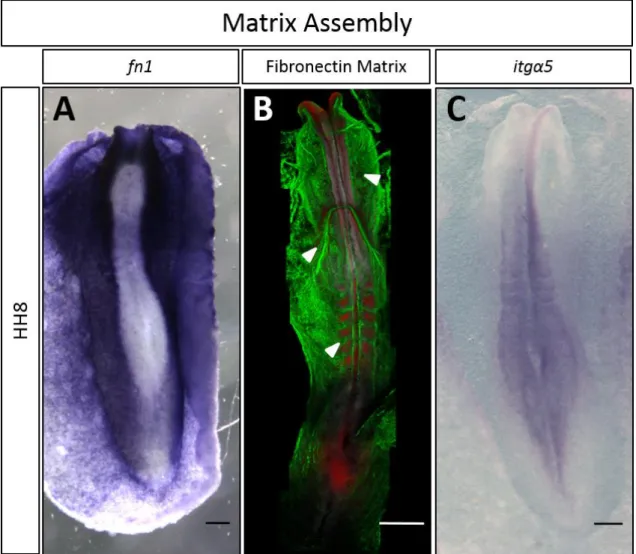
To check if the expression patterns were actually indicative of the matrix assembly pattern across early development we decided to perform the same experiment on a later stage, where more organogenic processes are under way. For the reasons mentioned above, we chose stage HH8. At stage HH8 a high degree of FN matrix assembly is observed in the rostral half of the embryo, particularly in the head, primordial heart and around formed somites. As we move caudally, labelling becomes less intense and the matrix seems less assembled, congruent with our observations made at stage HH4 and the expression patterns of both genes at stage HH8 (Fig. 7 B, arrowheads). Again, this FN matrix deposition and assembly patterns seem to be, mostly, correlated with the expression patterns of the genes in study. However, at this stage we can clearly start to see that there is FN matrix being assembled in places where there is no fn1 expression, but where itga5 is expressed. These results indicate that FN protein can be exchanged between tissues in the early embryo.
Figure 7 – Comparison of fn1 and itga5 gene expression with assembly of FN matrix at stage HH8 (A) fn1 expression pattern. (B) FN matrix deposition and assembly pattern. (C) itga5 expression pattern. Again, both expression patterns correlate with matrix assembly. However, now we can see that there is assembly of FN matrix in places where there is no itga5 expression, indicating the participation of other known receptors. In B green represents FN labelling, red represents N-Cadherin labelling and grey represents nuclear staining. Full arrowheads represent areas of dense protein deposition. Scale bar represents 250μm in all images.
26
Culturing with RockOut, a cellular tension-reducing drug
Effects of loss of tension in somite formation, maturation, and
matrix assembly
With the previous observations we give further evidence that during early chick embryo development fn1 expression and FN matrix assembly exists in a gradient that decreases from rostral to caudal. As detailed before, it has been suggested that a gradient of tension exists in the embryo at these stages, suggesting that processes such as e.g. somitogenesis might be, in some way, regulated or influenced by this gradient. To test whether cellular tension indeed plays a role at these stages, and focusing on somitogenesis, we examined the effect of RockOut, a ROCK kinase inhibitor, which prevents non-muscle myosin II phosphorylation and assembly, on two processes: (1) the morphology of somite formation, and (2) gene expression of PSM and somites. By inhibiting non-muscle myosin-II phosphorylation and assembly we are interfering with the ability of the cell to contract and, therefore, exert tension upon the matrix.
We decided to examine the effect of the inhibitor on the ability of the somite to form a sphere of polarized epitheloid cells10. In addition, we also assessed the effects of the RockOut treatment on matrix assembly. For that purpose we chose to examine the FN matrix, and also the LN matrix, another major, and very important, component of the extracellular matrix around the somites64.
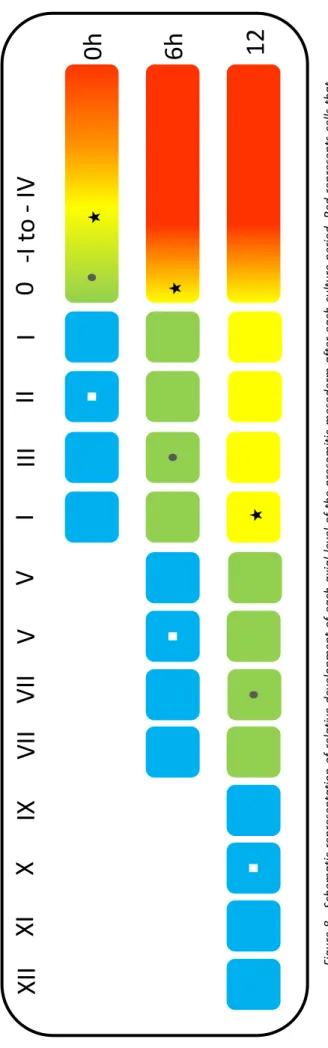
We cultured explants of caudal parts of embryos, as previously described, and performed immunofluorescense labeling against FN and N-Cadherin, or FN and LN, and selected somites at certain levels to compare, always from the left side of the embryo (to standardize). We selected somite sII and s-II and also s-IV (when existent, i.e. 12h cultures) pre-culture. These specific somites were chosen because sII represents a somite formed before culture, s-II represents a somite formed during culture but whose PSM region was already determined at the moment culture started, and s-IV represents a somite that was both formed, and derived from PSM determined, after the culture was initiated, allowing us to test the effect of RockOut treatment over three distinct stages of somite formation.
After 6h culture, sII (which became sV or sVI after culture, Fig. 8) control and DMSO somites show a dense FN matrix, especially on their lateral side, while the medial side shows a slightly less assembled matrix, with several aggregates of globular FN (Fig. 9 and 10 A, B, M, N). Epithelialization seems to be rather variable, with somites showing better or worse definition of the somitocoel, but in any case most show a higher degree of N-Cadherin deposition in the dorso-medial region of the somite (Fig. 9 G, H) than in other regions. The LN matrix, in turn, shows less assembly and compaction than FN, as previously described (Fig. 10 G, H, M, N, and Rifes and Thorsteinsdóttir, 2012). s-II ( after, sI or sII, Fig. 8) shows, overall, the same conditions as sII, but with a slightly less compact FN matrix (Fig. 9, 10 D, E, P, Q), a slightly less organized epithelialization (Fig. 9 J, K), and also a less compact LN matrix (Fig. 10 J, K, P, Q).
As for RockOut treated-explants, both sII and s-II, after 6h culture, show less assembly of the FN matrix, with more globular aggregates, particularly noticeable in the lateral side and the ventro-medial side of the somites (Fig. 9, 10 C, F, O, R). Both also show a generalized N-Cadherin staining, all around the edge of the somite, which is a compact agglomerate of cells, with no
27
discernable somitocoel (Fig. 9 I, L). Interestingly, the LN matrix is much denser in explants cultured with RockOut compared to control explants, especially in the most medial region (Fig. 10 I, L, O, R).
After 12h culture, sII (after, sVII to sX, Fig. 8), s-II (after, sIII to sVI,Fig. 8) and s-IV (after, sI to sIV, Fig. 8) of control and DMSO explants all show the same progression of protein assembly and deposition observed at 6h, with the oldest somites showing a more dense FN matrix than the youngest, as well as a better defined epithelialization (Fig. 11, 12, except C, F, I, L, O, R, U, X, Þ). However, this is best observed on the dorsal side of the somites (data not shown), and only slightly at the ventral side, because the FN matrix is starting to disassemble medially, and in older somites also more ventrally, in preparation for sclerotome differentiation and expansion5. It should be noted that at 12h there is more variability in terms of effects of the treatment than observed at 6h, with some explants having almost no matrix around the paraxial mesoderm, while others have almost normal amounts of protein. However, upon closer inspection, it is evident that the matrix shows a much lower degree of assembly, and has a very different structure than the one observed for control somites. Furthermore, RockOut cultured somites seem to have less matrix around their ventral sides at all time points, suggesting that lack of tension also interferes with the transportation of the protein to that side of the somite.
This lack of matrix leads to some defects. First, as is the case with the somite shown in Figure 11 F, O and X, several RockOut treated explants show fused somites (21% of somites, n = 43; compared to 3.3% of somites in control explants, n = 240; normal medium and medium with DMSO), indicating a failure in the maintenance of somitic clefts (Fig. 11 C, F, I, U, X, Þ). Although not all somites show such a strong a consequence of impaired matrix assembly, they still have a higher globular/fibrillar ratio than their control counterparts, and seem delayed in assembling the typical matrix organization necessary for sclerotome development (Fig. 12 C, F, I, U, X, Þ). Second, although somites treated with RockOut have recovered somewhat from the epithelialization defect observed at 6h they still seem to have a slightly less defined epithelialization than their control counterparts (Fig. 11 L, O, R). Finally, the LN matrix is not as dense as at 6h of culture, although it still looks slightly denser than in the control and DMSO somites (Fig. 12 L, O, R, U, X, Þ).