Teacher training processes and teachers’ competence
A sociological study in the primary school
Ana M. Morais Isabel P. Neves Margarida Afonso
Centre for Educational Research School of Science University of Lisbon
Revised personal version of the final text of the article published in:
Teaching and Teacher Education, 21, 415-437 (2005). Teaching and Teacher Education homepage:
Teacher training processes and teachers’ competence A sociological study in the primary school
Ana M. Morais Isabel P. Neves Margarida Afonso
Centre for Educational Research School of Science University of Lisbon
1. INTRODUCTION
This study is part of a broader project which involved the training and professional development of primary school teachers (Afonso, 2002) and the analysis of the influence of their pedagogic practices on children’s scientific and socio-affective development (Pires, 2001). The analysis of the relation between training programmes, teachers’ professional development and children’s learning has been defended by many authors such as Liston and Zeichner (1993), Monk and Dillon (1995), Tuomi (1997) and Wilson and Berne (1999).
The conceptual frameworks underlying teacher training have been fundamentally based on psychology and epistemology. Literature reviews on teacher training done, for example, by Zeichner (1992) and Lemke (2001) have showed that there are very few programmes of teacher training with a sociological and multicultural character and that there are few programmes which carry out systematic research and evaluation to find out the extent to which teachers are prepared to teach all children. Anderson and Mitchener (1994) also show that many studies on initial teacher training and teachers’ professional development do not have a consistent conceptual framework of reference. They call for the development of studies which involve multiple perspectives considering, for example, the analysis of teachers’ competence in psychological, sociological and epistemological terms.
It is now essential to teach and to learn science, as scientific knowledge and competences are a cultural driving force of the modern world and are needed for citizenship and decision making (e.g. De Boer, 2000; Wellington, 1998 a, b; Hodson, 1998, 2000; Saez & Riquatz, 1996). Science education should not disregard its experimental dimension as this constitutes one of the foundations of science, and scientific education without experimental work fails to reproduce its very nature. Science teaching and learning should involve the acquisition of high levels of scientific knowledge and investigative competences since, as Wenham says (1995), science is not only a type of knowledge, but it is also a way of doing, each part
modelling and determining the other.
However, many studies, namely those related to the first years of schooling, show that many teachers do not value science teaching and learning and its experimental character, that teachers are not scientifically or pedagogically well prepared and that they do not emphasise high level competences needed, for example, to problem solving or to the application of scientific knowledge to everyday situations (Sá & Carvalho, 1997; Harlen & Jelly, 1993; Harlen & Holroyd, 1997; Tilgner, 1990; Radford, 1998; Hodson, 1998; Briscoe, Peters & O’Brien, 1993; Lewis & Barufaldi, 1993). According to Briscoe, Peters and O’Brien (1993), and many others, science learning should start in the first years of schooling. The question that is now raised is how to prepare primary school teachers to improve their science teaching.
The professional development of science teachers requires the learning of fundamental scientific contents, the integration of knowledges from science, education and child studies and requires also the application of these knowledges to science teaching (Radford, 1998; Briscoe, Peters & O’Brien, 1993; National Academy of Sciences, 1996). Professional development should occur through inquiry methods and perspectives, that is teachers should first experiment the methods and activities that they are expected to use in their classrooms, in an environment of support and reflection of their experiences.
This study intends to give a contribution to this problematic. The study addressed the following problem: What is the extent to which the specific training context influence specific
teachers’ performances in the science classroom context, in terms of specific coding orientation. This problem led to the following research questions: (1) What are the
sociological characteristics of the training modality which favour teachers’ scientific and pedagogic competence?; (2) How does teachers’ specific coding orientation (recognition and realisation rules) evolve, in relation to each one of the characteristics of the pedagogic practice to be implemented in the science classroom?
In order to answer the research questions we developed a study specifically focused on science learning. The study involved the training of primary school teachers and the implementation by teachers of a pedagogic practice with specific characteristics. The study is within an action-research perspective where professional development is achieved through the involvement and participation of teachers and researchers. We are aware that “it is possible to distinguish degrees of participation varying with the characteristics of the process […] which
relate to the perspectives of the external team, the greater or smaller degree of orientation and the forms of relation it establishes with other actors” (Silva, 1996, p. 194) and that distinct forms of collaboration lead to distinct action-research modalities. As a consequence, the form of collaboration of social actors should be carefully analysed, characterised and conceptualised.
2. THEORETICAL FRAMEWORK
We consider that teacher training should have a clear theoretical basis and its conceptualisation and characterisation should be deep and coherent and should also take into account a sociological dimension. On the basis of these principles, we decided to concentrate on Bernstein’s theory of pedagogic discourse as the main theoretical framework of the study (Bernstein, 1990, 2000; Bernstein, & Solomon, 1999; Domingos et al, 1986), as this theory contains a strong conceptual structure and operational concepts with a high analytical power. If we consider Bernstein’s model of pedagogic discourse, teacher training is part of the meso level of that model.
Training modalities can be thought of pedagogic practices and as such can be characterised in
terms of the instructional and regulative contexts.1 In the instructional context we can
consider the relation between agents (discursive rules – selection, sequence, pacing and evaluation criteria – related with the transmission-acquisition of discourse) and between discourses (intradisciplinary, interdisciplinary and researcher-teacher knowledges). In the regulative context we can consider the relation between agents (hierarchical rules) and between spaces.
The characterisation of any pedagogic practice is made by using the two operational concepts of classification and framing. Classification (C) defines the degree of insulation between categories (agencies, agents, discourses) and framing (F) defines the control that the various categories have in the communicative practices. In the teacher training context, the framing refers to the control given to transmitters (researchers/teacher trainers) and acquirers (teachers), in both the regulative and the instructional contexts.
Categories can be sharply separated with strong boundaries between them; this can be referred to as strong classification. When the boundary between categories is blurred, the classification is weak. Framing is strong if, in the relation of communication, the control is exercised by the
transmitter (researcher/teacher trainer) and is weak if the acquirer (teacher) has also some form of control in that relation. Classification and framing of diverse relations of the instructional and regulative contexts differ in degree, from very weak to very strong and, to a certain extent, they can vary independently. Different combinations lead to diverse forms of realisation of the pedagogic code.
In terms of teacher training, distinct training modalities lead to distinct coding orientations, that is, “distinct interactional practices originate, at the level of the subject, differences in recognition and realisation rules” (Domingos et al, 1986, p. 245).
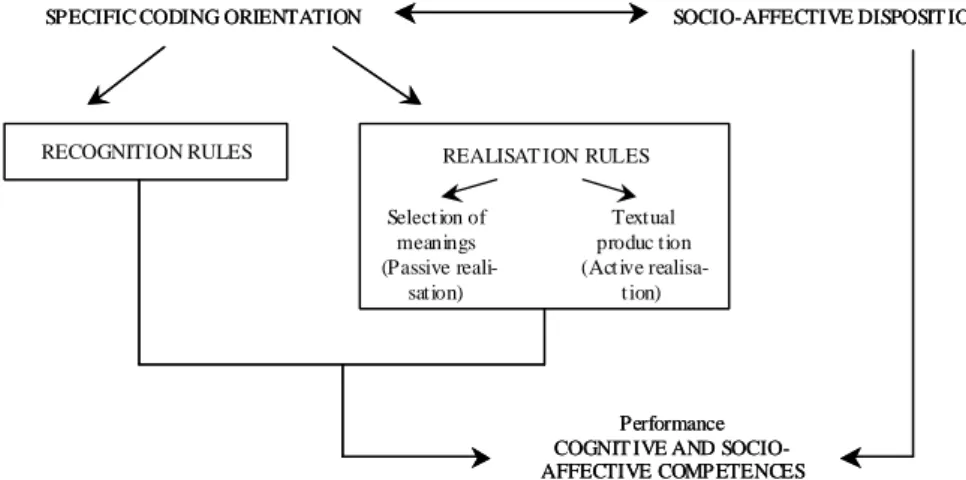
For Bernstein, the acquisition of the specific coding orientation, that is the acquisition of recognition and realisation rules (passive and active) for a given context, is fundamental for acquirers success in that context. However, Bernstein argues that in order that the subject produces the legitimate text in a given context, s/he should also have the socio-affective dispositions favourable to that context, that is s/he should have aspirations, motivations, values and attitudes adequate to the production of that text (Figure 1).
Figure 1 – Specific coding orientation, socio-affective dispositions and performance in specific learning contexts
(Morais & Neves, 2001).
In the teacher training context, a teachers’ performance adequated to a given pedagogic practice requires the acquisition of: (a) recognition rules to distinguish the specificity of the context of that practice; (b) passive realisation rules to select the appropriate meanings to that context; (c) active realisation rules to implement in the classroom that pedagogic practice. Teachers’ adequate performance requires also to have socio-affective dispositions towards the implementation of that practice.
SPECIFIC CODING ORIENTATION SOCIO-AFFECTIVE DISPOSIT IONS
RECOGNITION RULES REALISAT ION RULES
Select ion of Textual meanings produc tion (Passive reali- (Act ive
realisa-sation) t ion)
Performance COGNIT IVE AND SOCIO-AFFECTIVE COMP ETENCES
SPECIFIC CODING ORIENTATION SOCIO-AFFECTIVE DISPOSIT IONS
RECOGNITION RULES REALISAT ION RULES
Select ion of Textual meanings produc tion (Passive reali- (Act ive
realisa-sation) t ion)
Performance COGNIT IVE AND SOCIO-AFFECTIVE COMP ETENCES
3. METHODOLOGY
The study involved four female teachers of two primary schools located in two country towns (Afonso, 2002). The school classes, of the fourth year of schooling (age 9-10), were socially heterogeneous in terms of gender and social class. The training of teachers followed an action-research methodology (Neves, Morais, & Afonso, 2004) and was done by two researchers each of whom worked with the two teachers of the same school. We intended to develop a joint training programme, in order to control the variables ‘researcher’ and ‘scientific contents and competences to be developed’, but teachers were unable to meet this requirement. However, the variable ‘researcher’ was controlled to a great extent because the two researchers had followed similar academic paths in their initial and in-service training,
had similar academic positions,2 and developed jointly the teacher training programme (the
what and the how), analysing and discussing it systematically.
In terms of themes/contents to be explored with teachers (the what of the training), the training included the learning of scientific knowledges and processes and the learning of pedagogic content of the fields of epistemology, psychology and sociology, particularly Bernstein’s theory. We intended to promote a sound scientific training which valued the acquisition of scientific contents and the development of competences related with investigative processes. We also intended to develop a sound pedagogic training which valued the sociological and psycho-sociological dimensions. All these dimensions were discussed with teachers. In terms of the modality of pedagogic code underlying the training context (the
how of the training), we defined a theoretical profile similar, in general, to the profile of the
pedagogic practice to be implemented by teachers. This profile contained sociological characteristics of a mixed pedagogic practice, that is a practice with strong or weak classifications and framings according to specific aspects of that practice (Morais, & Neves, 2001; Morais, Neves, & Pires, 2004). Since one of the objectives of the research was to lead teachers to develop practices which previous studies of the ESSA Group had shown to be favourable to children’s learning (Morais et al, 1993, 2000), it would be important to conduct a training process with parallel characteristics, in order that the transference of knowledges, competences and attitudes could be facilitated. On the other hand, the fact that we were using the same conceptual and methodological structure in the conception and analysis of the training modality and in the conception and analysis of the modality of pedagogic practice would give a broader dimension and significance to the acting and reflection which should exist along the whole process of action-research.
The teacher training programme took two years and involved two stages, one more structured and intensive in the first year and another more flexible and extended in the second year. During the first stage, the piloting of the pedagogic practice to be implemented by teachers took place in the classroom context of a science teaching unit. In the second stage, the teachers implemented, in two science teaching units (State changes and Experiments with air), the pedagogic practice previously piloted. The first unit was implemented in the beginning of the year and the second at the end of the year.
The theoretical profiles of the modality of the pedagogic code which characterised the first and second stages of teacher training were only distinct in the instructional context, at the level of the control on selection and sequence. We intended that in the second stage teachers would have greater control over aspects related to these two discursive rules. This option was based on the belief that we could not expect that, in the beginning, all teachers would have enough knowledge to intervene at the level of the selection and macro-sequence, selecting scientific and pedagogic themes/contents and choosing a sequence to their study. In the second stage, after a period of implementing pedagogic practices, discussing them, and reflecting on the basis of theoretical frameworks they had access to it, would be more important to meet each teacher’s motivations, interests and particular needs. In this way, we expected that the macro selection and the macro sequence would
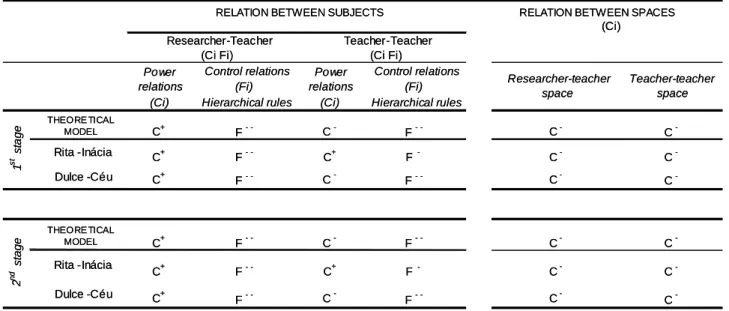
also be controlled by teachers3. Figures 2 and 3 show, for the instructional context and
regulative context respectively, the theoretical profiles of the modalities of teacher training. They also show, for each set of two teachers (Rita–Inácia and Dulce-Céu), and for both contexts, the teacher training modalities which actually occurred during the
action-research process. Power relations refer to a two degree scale of classification (C +
and C -)4 and control relations to a four degree scale of framing (F + +, F +, F -, F --). In
order to characterise those modalities we developed an instrument following a
constructive research methodology.5 Starting from the data of empirical observation,
provided by actual situations of the teacher training context and keeping the dialectical relation between those data and the theoretical propositions derived from the conceptual framework in which we based the study, we constructed indicators to each one of the relations to be analysed and respective descriptives which corresponded to distinct
situations for each indicator.6 This characterisation was based on the observation records
made by each of the researchers during the whole process of training and was validated by two other researchers. The data obtained from teachers’ opinions and from the characterisation teachers themselves made on the basis of the same instrument of analysis
was also used to validate former researchers’ characterisation.
Figure 2 - Teacher training context - Instructional dimension (1st and 2nd stages)
Figure 3 - Teacher training context – Regulative dimension (1st and 2nd stages)
Teachers’ professional development was analysed along two dimensions, the how of teaching in terms of recognition and realisation rules (specific coding orientation) and the what of teaching, i.e., the scientific knowledge and investigative competences involved in children’s scientific learning. Power relations Intradisciplinary relations Interdisciplinary relations Researcher-teacher knowledges
(Ci) Selection Sequence Pacing Evaluationcriteria (Ci) (Ci) (Ce) THEORETICAL MODEL C + F+ F+ F - - F++ C - C - C -Rita - Inácia C+ F+ F+ F - - F++ C - C - C -Dulce - Céu C+ F+ F+ F - - F++ C - C - C -THEORETICAL MODEL C + F - F - F - - F++ C - C - C -Rita - Inácia C+ F-/ F + F-/ F + F - - F++ C - C - C -Dulce - Céu C+ F-/ F + F-/ F + F - - F++ C - C - C -1 s t s ta g e 2 n d s ta g e
RELA TION BE TWEEN DISCOURSES
(Cie)
Control relations (Fi) Discursive rules
RELA TION BE TWEEN SUBJECTS
(Researcher-Teachers) (Ci Fi) Power relations Intradisciplinary relations Interdisciplinary relations Researcher-teacher knowledges
(Ci) Selection Sequence Pacing Evaluationcriteria (Ci) (Ci) (Ce) THEORETICAL MODEL C + F+ F+ F - - F++ C - C - C -Rita - Inácia C+ F+ F+ F - - F++ C - C - C -Dulce - Céu C+ F+ F+ F - - F++ C - C - C -THEORETICAL MODEL C + F - F - F - - F++ C - C - C -Rita - Inácia C+ F-/ F + F-/ F + F - - F++ C - C - C -Dulce - Céu C+ F-/ F + F-/ F + F - - F++ C - C - C -1 s t s ta g e 2 n d s ta g e
RELA TION BE TWEEN DISCOURSES
(Cie)
Control relations (Fi) Discursive rules
RELA TION BE TWEEN SUBJECTS
(Researcher-Teachers) (Ci Fi) Power relations Power relations (Ci) (Ci) THEORE TICAL MODEL C+ C - C -Rita -Inácia C+ C+ C -Dulce -Céu C+ C - C -THEORE TICAL MODEL C+ C - C -Rita -Inácia C+ C+ C -Dulce -Céu C+ C - C -F - - F - - C -F - - F - - C -F - - F - C -F - - F - - C -F - - F - - C -F - - F - C -Control relations (Fi) Hierarchical rules Hierarchical rules
Researcher-teacher space Control relations (Fi) Teacher-teacher space 1 s t s ta g e 2 n d s ta g e
RELATION BETWEEN SUBJECTS RELATION BETWEEN SPACES (Ci)
Researcher-Teacher Teacher-Teacher
(Ci Fi) (Ci Fi)
Power relations Power relations (Ci) (Ci) THEORE TICAL MODEL C+ C - C -Rita -Inácia C+ C+ C -Dulce -Céu C+ C - C -THEORE TICAL MODEL C+ C - C -Rita -Inácia C+ C+ C -Dulce -Céu C+ C - C -F - - F - - C -F - - F - - C -F - - F - C -F - - F - - C -F - - F - - C -F - - F - C -Control relations (Fi) Hierarchical rules Hierarchical rules
Researcher-teacher space Control relations (Fi) Teacher-teacher space 1 s t s ta g e 2 n d s ta g e
RELATION BETWEEN SUBJECTS RELATION BETWEEN SPACES (Ci)
Researcher-Teacher Teacher-Teacher
3.1. The specific coding orientation – Pedagogic competences
The teachers’ acquisition of recognition and passive realisation rules was obtained through the analysis of answers to questionnaires/interviews (Afonso, 2002). The questionnaires/ interviews contained general questions to teachers related to aspects of a personal, social and professional character and a specific set of questions related to the modality of pedagogic practice to be implemented in the classroom. These questions were constructed to provide data about the sociological characteristics that teachers valued, at the level of the instructional and regulative contexts, as being more favourable to the scientific learning of all children (recognition rules). The questions were constructed so as to provide data about reasons teachers gave to justify that valuing (passive realisation rules). The questions addressed the various sociological relations considered as defining the theoretical profile of the pedagogic practices to be implemented and as characterising the pedagogic practices valued and
implemented by teachers7. This was justified because we intended that, in the course of the
action-research process, the teachers acquired the knowledges and competences necessary to implement a modality of pedagogic practice with given characteristics (see above).
The questionnaires/interviews were applied in two moments, the first before the starting of the teacher training process and the second a month after the study was finished. Comparison of the results of the two moments provided a perspective on teachers’ evolution in the acquisition of these rules, and this data was used to analyse the influence of the teacher training actually developed on teachers’ professional development.
We created categories to evaluate the possession/absence of the rules of recognition and
passive realisation8. These categories were used in the analysis of each one of the relations
of the pedagogic practice (Afonso, 2002). In order to minimise the degree of subjectivity, inherent to any interpretation, we made a detailed analysis of the interviews with teachers and mapped this information against information from researchers’ records, teachers’ answers to other interviews and the analysis of the pedagogic practices implemented by teachers. Thus, the analysis of the presence/absence of the rules of recognition and passive realisation resulted from various kinds of information. The acquisition of active realisation was evaluated through the analysis of the pedagogic practice of each teacher in the first and second teaching units. This means that the active realisation was appreciated after the first stage of teacher training and the implementation of the pilot teaching unit had taken place and at the end of the teaching process. Comparison of the pedagogic practices implemented and the theoretical model proposed provided information on the
extent to which teachers had acquired the rules of active realisation and enabled us to appreciate the influence of the teacher training on teachers’ performance.
The lessons were observed and video recorded. The transcripts were analysed using an instrument constructed to characterise the teachers’ pedagogic practices (Afonso, 2002). Each teacher’s “behaviour” type corresponded to one specific indicator and to a given
position in a four points scale of framing(F + +/F - -) and/or classification (C + +/C - -). The
categorised situations were recorded in tables for each teachers’ pedagogic practice. The various spots constituted clusters which allowed the visualisation of the quadrant(s) to which the teacher’s behaviour would tend and as such to characterise the respective pedagogic practice. Whenever the teacher’s behaviour could be analysed in more than one aspect that behaviour was accorded in all of these aspects. This ‘more quantitative’ data together with the researchers’ global evaluation while observing all lessons of the teaching units and the teachers’ appreciation of their own lessons enabled us to characterise the modalities of pedagogic practice.
The whole procedure used to determine each teachers’ pedagogic practice is described in Afonso (2002) and Morais, Neves and Pires (2004), where the four teachers’ pedagogic
practice is presented and compared with the theoretical model proposed9. According to that
comparison, active realisation was measured in a 1-4 points scale where degree 1 indicates a situation where the teacher is very distanced from the theoretical model and degree 4 a
situation close to the theoretical model. For example, if the theoretical model indicates F + +
for the evaluation criteria, the following degrees would be attributed to teachers: F + + − 4; F +
− 3; F - − 2; F -- − 1. If the theoretical model indicates F - - for the hierarchical rules, the
following degrees would be attributed to teachers: F - - − 4; F - − 3; F + − 2; F + + − 1. If the
theoretical model indicates F - for the interdisciplinary relations, the following degrees would
be attributed to teachers: F - − 4; F - - − 3; F + − 2: F + + − 1.
In summary, on the basis of the interviews/questionnaires applied before and after teacher training and on the basis of the characterisation of teachers’ pedagogic practice, we wanted to analyse if, after the training process, the teachers were able to:
(a) Recognise the specificity of a given pedagogic practice, in its multiple aspects,
distinguishing it from other possible contexts of a pedagogic practice (teachers have recognition rules);
(b) Select the meanings/justifications appropriate to that context, that is, know the principles to act in that pedagogic practice (teachers have passive realisation);
(c) Produce the intended text, that is, use in the classroom a pedagogic practice according to
the principles underlying the proposed theoretical profile (teachers have active realisation).
In the text that follows, we present the instruments of analysis for recognition and passive realisation rules and examples of excerpts of the interviews with teachers relating to two aspects of the pedagogic practice, evaluation criteria and hierarchical rules (teacher-children). In order to make clear how active realisation was determined, we then present an example for one indicator of the instrument we constructed for characterising teachers’ pedagogic practice. This is followed by two examples of classroom interactions, one of which corresponds to the theoretical model proposed. This is again done in relation to two aspects of the pedagogic practice, evaluation criteria and hierarchical rules (teacher-children).
Characterisation of specific coding orientation
Instrument of analysis – Recognition rules (RC)
INDICATOR Does not have RC May have RC Has RC
CHARACTERISTICS OF PEDAGOGIC PRACTICE
Characteristics indicated are different from/opposite to those of the theoretical model
Characteristics indicated are ambiguous/not clear
Characteristics indicated are similar to those of the theoretical model
Examples of excerpts of interviews
Discursive rules – Evaluation criteria
Does not have RC – This situation did not occur.
May have RC - I think that in the primary school the teacher should explicate what children must do but not how
they should do it, so that creativity and imagination can be developed.
Has RC - After directions given in the beginning, they [the children] are always asking for more… some help, and later
on… when they do not reach the objectives I have proposed… when we are evaluating the work… they can do it… if it isn’t the group itself it is somebody from another group… children of other groups say “ah! This or that is missing there”, “that is not needed”, “this subject was not sufficiently developed”, “ah! This or that should be referred to”.
Hierarchical rules- Teacher/children
Does not have RC - Sometimes I listen to their [the children] reasons, but my present children enjoy talk a lot
and sometimes I have to tell them that we cannot talk too much and I get cross with them to make them shut up, and I tell them that we are wasting our time […] I am unable to make them understand that we should not have too much talk […].
May have RC – This situation did not occur.
Has RC - For example, I had given them [the children] some work to do and the time had run out, and I would try
to lead them to understand that the time had run out and that next time they should have to keep more quiet […] to pay more attention to what they are doing […] because the time would run out and the work was not done.
Instrument of analysis – Passive realisation (RLp)
INDICATOR Does not have RLp May have RLp Has RLp
REASONS GIVEN FOR PEDAGOGIC PRACTICE CHOOSEN
Reasons given are different from/opposite to those of the theoretical model
Reasons given are ambi-guous/not clear or no reasons are given
Reasons given are simi-lar to those of the theore-tical model
Examples of excerpts of interviews
Discursive rules – Evaluation criteria
Does not have RLp – […] the teacher may give some clues to the children, but the work is done according to
each child’s criteria. It is important to educate for autonomy and responsibility, to develop the capacity of discovery.
May have RLp - Because I think that in doing it this way I lead them [the children] to do their own investigation.
Not so much my investigation but theirs. [...] If I am giving them the structure of the work they [the children] do only what they are asked [...] usually I give them the main points. Then they can do what they want.
Has RLp - I think it is essential [for learning, the evaluation criteria to be clarified] also for further work… yes I
usually [I clarify when children do not do it], yes. And they ask “ah! What do you think?” “Look, I think that this or that is missing, this is not needed, this is all fine, but if it was better worked out, it would have been better… it was incomplete or it is complete.
Hierarchical rules – Teacher/children
Does not have RLp – The teacher did not give any justification [the teacher started by showing not to have
recognition rules – see example for Does not have RC].
May have RLp – The teacher did not give a justification for the characteristic she chose and which corresponded
to the theoretical model.
Has RLp – I think it is very important to call their [the children] attention […] to the fact that the work was not
properly done, they will have a shock when they leave primary school10 […] they are accustomed to keep going without bothering with the time they are spending! This is not going to happen later on, therefore we have to call their attention so that they are prepared… it is a way of getting the habit of doing things properly.
Active realisation
Discursive rules – Evaluation criteria
Instrument of analysis – Excerpt
INDICATOR F ++ F + F - F -WHEN CHILDRENS’ PARTICIPATION CONTAINS INCORRECTIONS Child’s participation is reformulated/corr-ected/completed in detail. Child’s participation is reformulated/corrected /completed, but comp-leted only in general terms.
The incorrection is pointed out to the child, but no reformu-lation is made.
Child’s participation is neither corrected nor reformulated.
Examples of transcripts
Fi + Teacher – What should happen so that the alcohol evaporates? … Group three.
Child (in the name of the group) – I think that inside the bottle was hot and outside was cooler and it evaporates. Teacher– Are you not saying the opposite? […] What did you say? … [you said that] the temperature of
the bottle was higher, that it changed to a lower temperature and that evaporates.
Child (in the name of the group) – It must be the opposite.
Teacher – The alcohol when passing to the outside temperature got warmer.
Fi- - The children are observing what happened to ice cubes which had been taken out of the freezer. Teacher – What did you observe during these ten minutes?
Child – I saw that the ice melted and changed into water.
The teacher hears the incorrect answer but does not correct it at any moment of the lessons about the theme “state changes of substances”.
Hierarchical rules – Teacher/children
Instrument of analysis – Excerpt
INDICATOR F ++ F + F - F
-WHEN ADDRESSING CHILDREN
The teacher does not give any reason, using the imperati-ve control
The teacher uses po-sitional control, gi-ving reasons related to school/classroom rules
The teacher uses per-sonal control, appea-ling to her own rea-sons
The teacher uses personal control, appealing to child-ren’s personal attri-butes
Examples of transcripts
Fi++ Child – Teacher, may I drink some water?
Teacher – Talk less and you won’t need to drink so much.
Fi - - Teacher – […] respect for others so that nobody is disturbed […] and now you are going to look at your
worksheet, do what it is indicated […] cooperating with each other, waiting for your turn, right? And, keeping your voice down, for the group only, right? – Has RLa
3.2. Scientific competences
The scientific knowledge and the investigative competences showed by teachers in the lessons of the two teaching units (the what of the pedagogic practice) were explored through a detailed analysis of the transcripts of the video recordings of those lessons and of the researchers’ observation notes. Comparison between the data obtained in the two moments led to an analysis of the influence of the teacher training process on the professional development of teachers with regard to their scientific competences.
In order to analyse scientific knowledges and investigative competences developed by teachers, we created, for each one of these two dimensions, a 1-5 points scale from a very low level to a very high level. Degree 1 was attributed when the teacher showed many difficulties in terms of the scientific knowledge/investigative competences required in the teaching units implemented. Degree 5 was attributed when the teacher showed a high degree of proficiency.
The examples which follow show for each one of the two dimensions of the what of the pedagogic practice, two degrees of the scale, ‘very low’ and ‘good’. The very low level of
scientific knowledge can be exemplified by a teacher who gave ‘disappearance’ of a substance or ‘dissolution’ of a substance to mean evaporation of that substance. The high level can be exemplified by a teacher who never considered ‘heat’, ‘cold’, ‘sun’ as causes for state changes of matter and corrected it whenever children used these terms.
The very low level of investigative competences can be exemplified by a teacher who was not aware that, when doing an experiment, it is important to consider the variables present and to make the control of these variables. The very good level can be exemplified by a teacher who had the capacity of making predictions, controlling variables and exploring thoroughly the results of an experiment.
4. RESULTS AND ANALYSIS
This section is divided in two parts. The first concerns the pedagogic competences (specific coding orientation to the pedagogic practice) and the second concerns the scientific competences (scientific knowledge and investigative competences of the pedagogic practice).
4.1. Teachers’ pedagogic competence
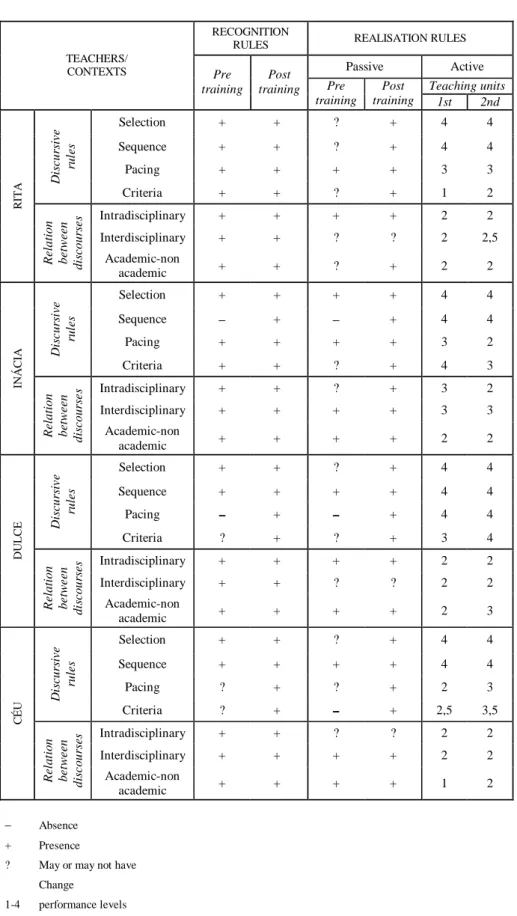
Figure 4 shows the specific coding orientation of each teacher and its evolution, for the specific aspects of the pedagogic practice studied, in the instructional context of the classroom.
As we said before, this evolution was appreciated by comparing, in the two moments, the teachers’ possession of recognition and realisation rules, passive and active, to implement a pedagogic practice with the sociological characteristics of the theoretical model proposed. For the analysis of active realisation one needs to consider the data presented in note 8 about the characterisation of the pedagogic practice. We also have to remember that, in this case, the data about the first moment was obtained after the first stage of the teacher training process had already occurred and not before that process started, as in the case of recognition and realisation rules.
RECOGNITION
RULES REALISATION RULES
Passive Active Teaching units TEACHERS/ CONTEXTS Pre training Post training Pre training Post training 1st 2nd Selection + + ? + 4 4 Sequence + + ? + 4 4 Pacing + + + + 3 3 D is cu rs iv e ru le s Criteria + + ? + 1 2 Intradisciplinary + + + + 2 2 Interdisciplinary + + ? ? 2 2,5 R IT A R el a ti o n b et w ee n d is co u rs e s Academic-non academic + + ? + 2 2 Selection + + + + 4 4 Sequence − + − + 4 4 Pacing + + + + 3 2 D is c u rs iv e ru le s Criteria + + ? + 4 3 Intradisciplinary + + ? + 3 2 Interdisciplinary + + + + 3 3 IN Á C IA R el a ti o n b et w ee n d is co u rs e s Academic-non academic + + + + 2 2 Selection + + ? + 4 4 Sequence + + + + 4 4 Pacing −−−− + −−−− + 4 4 D is cu rs iv e ru le s Criteria ? + ? + 3 4 Intradisciplinary + + + + 2 2 Interdisciplinary + + ? ? 2 2 D U L C E R el a ti o n b e tw e en d is co u rs es Academic-non academic + + + + 2 3 Selection + + ? + 4 4 Sequence + + + + 4 4 Pacing ? + ? + 2 3 D is cu rs iv e ru le s Criteria ? + −−−− + 2,5 3,5 Intradisciplinary + + ? ? 2 2 Interdisciplinary + + + + 2 2 C É U R el a ti o n b et w ee n d is c o u rs es Academic-non academic + + + + 1 2 − Absence + Presence
? May or may not have Change
1-4 performance levels
Figure 4 – Evolution of teachers’ specific coding orientation – Instructional context
teachers easily implemented the pedagogic practice proposed. Even teacher Inácia who did not have recognition rules and passive realisation for sequence, in the beginning of the study, demonstrated to have acquired those rules in the course of the first stage of the training process. We should keep in mind that the inconsistency that seems to exist between the data of the first moment, with regard to the various rules, is a consequence of the analysis of the active realisation rules having been done after the first stage of training. This positive evolution of all teachers with reference to selection and sequence is probably related to similarities between the theoretical profile proposed and that of the pedagogic practice valued by teachers.
In the discursive rule pacing teacher Dulce demonstrated a clear evolution – before starting the training programme she could not even recognise the context but, during the implementation of the first teaching unit, she already possessed active realisation relating to this characteristic of the pedagogic practice. This shows that she had acquired the recognition and passive realisation rules in the course of the first stage of the training process. Teacher Céu seems to have had a positive evolution with respect to the acquisition, at the end of the study, of recognition and passive realisation rules and, to some extent, active realisation rules. No evolution was noticed in the case of teacher Rita because she already possessed from the beginning recognition rules, passive realisation and partially active realisation, which she continued to demonstrate. Teacher Inácia seems to have ‘lost’, to some extent, the active realisation she possessed in the beginning. However, that was not the case. Time constraints, independent of the teacher and the researcher and related with unpredicted school activities, influenced the pacing of the pedagogic practice during the implementation of the second teaching unit in a direction opposite to the intended one. The fact that not all teachers have demonstrated the specific coding orientation to the pacing of the pedagogic practice may be a surprise, as it seems that there is the generalised idea that at the level of primary school that it is the children who control the pacing of learning. This study showed that this was not the case.
The evolution at the level of the evaluation criteria was also positive. All teachers moved forward in their performance at the level of this discursive rule. Teacher Rita clearly demonstrated to have passive realisation and demonstrated some evolution at the level of active realisation. Teacher Inácia also demonstrated to have a clear passive realisation. However this teacher implemented a pedagogic practice in the second teaching unit where the evaluation criteria were not so well explicated as they had been in the first unit. This was found to be related to the stronger pacing referred above and not to a retrocession of the teacher. Teacher Dulce demonstrated to have the recognition rules and the realisation rules,
passive and active. Teacher Céu demonstrated to have evolved and was close to a total acquisition of the active realisation.
Teachers’ evolution with respect to discursive rules was related to two aspects common to all of them. The first aspect relates to the fact that all teachers (even teacher Céu who had a high degree in science and mathematics) changed in the direction of giving more value to the acquisition of scientific knowledge and development of investigative competences by primary school children. The second aspect is related to the fact that all teachers changed their theory of instruction namely at the level of the evaluation criteria. Initially, and in a more or less explicit way, they considered that learning should often be left to children’s criteria, in order not to limit their creativity and development. As the training process progressed, teachers developed the idea that explicating the evaluation criteria may lead simultaneously to creativity and cognitive development, and that it is very important to children’s scientific learning.
There was also some evolution of the teachers at the level of the relations between discourses, but these were the aspects of the practice where change was more difficult to achieve. None of the teachers were able to acquire totally the specific coding orientation, particularly at the level of active realisation to any of the relations between discourses (intradisciplinary, interdisciplinary and academic-non academic). Teacher Inácia was the teacher who demonstrated at the beginning to have a pedagogic practice nearer to the theoretical model, with reference to intra and interdisciplinarity. The fact that she demonstrates a retrocession in the second moment, at the level of intradisciplinarity, is again related to a lack of time to make interrelations between scientific content.
The common difficulty felt by teachers at the level of the relations between discourses may be related to the general principle of our societies according to which “things should be kept separate”. Another reason was related to the low level of scientific knowledge teachers were found to have and/or with the how to make relations between distinct parts of that knowledge and between the scientific knowledge and other knowledges (other disciplines and common sense). All teachers criticised their initial and in-service training, pointing out how it had failed in leading them to acquire a sufficient level of scientific knowledge and/or to be able to explore this knowledge in the classroom. In the cases where these knowledges were considered appropriate, as in the case of teacher Céu, the education she received reinforced still more the idea that these relations should not be made. A third reason to explain teachers’ difficulty in making relations between discourses may be related to the conception of interrelation itself. It seemed that, sometimes, teachers considered that it would be enough to
“speak about given subjects” for the intradisciplinary, interdisciplinary and academic-non academic relations to be made.
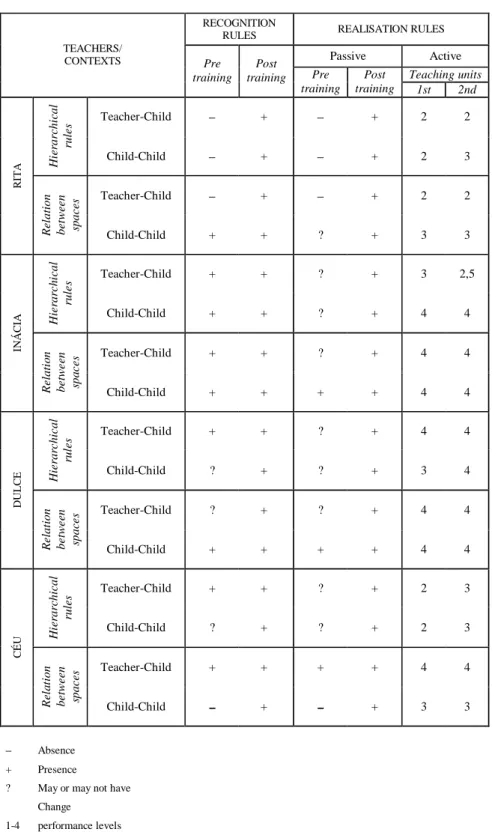
Figure 5 shows the specific coding orientation of each teacher and its evolution for the specific aspects of the pedagogic practice studied, in the regulative context of the classroom.
Figure 5 – Evolution of teachers’ specific coding orientation – Regulative context
RECOGNITION
RULES REALISATION RULES
Passive Active Teaching units TEACHERS/ CONTEXTS Pre training Post training Pre training Post training 1st 2nd Teacher-Child − + − + 2 2 H ie ra rc h ic a l ru le s Child-Child − + − + 2 3 Teacher-Child − + − + 2 2 R IT A R el a ti o n b et w ee n sp a c es Child-Child + + ? + 3 3 Teacher-Child + + ? + 3 2,5 H ie ra rc h ic a l ru le s Child-Child + + ? + 4 4 Teacher-Child + + ? + 4 4 IN Á C IA R e la ti o n b e tw e en sp a c e s Child-Child + + + + 4 4 Teacher-Child + + ? + 4 4 H ie ra rc h ic a l ru le s Child-Child ? + ? + 3 4 Teacher-Child ? + ? + 4 4 D U L C E R e la ti o n b e tw e en sp a ce s Child-Child + + + + 4 4 Teacher-Child + + ? + 2 3 H ie ra rc h ic a l ru le s Child-Child ? + ? + 2 3 Teacher-Child + + + + 4 4 C É U R el a ti o n b e tw e e n sp a c es Child-Child −−−− + −−−− + 3 3 − Absence + Presence
? May or may not have Change
At the level of the regulative context, particularly in the aspects related to the hierarchical rules, which regulate the relation between the teacher and her children, the evolution was very clear. Teacher Rita acquired the recognition rules and passive realisation. Teacher Inácia demonstrated clearly to have passive realisation rules and although it seems to have retroceded at the level of active realisation, this was again a result of the stronger framing of pacing. Teacher Dulce acquired the rules of passive realisation showing active realisation as early as in the implementation of the first teaching unit. Teacher Céu showed clearly to have the rules of passive realisation and partially of active realisation. Teachers were gradually being aware of the meaning and real importance of very weak framings at the level of the hierarchical rules in the teacher-children relation and that some of their former attitudes might have a negative influence on children’s cognitive and socio-affective development.
The evolution at the level of the hierarchical rules in the child-child relation was also evident. Teacher Rita acquired the recognition rules, the passive realisation rules and partially the active realisation. Teacher Inácia had already acquired, in the first teaching unit, the specific coding orientation to this aspect of the pedagogic practice. Teachers Dulce and Céu demonstrate a clear possession of recognition and passive realisation and acquired the active realisation rules, although this was only partially in the case of teacher Céu. The evolution of the teachers, partially of teachers Rita and Céu, was a consequence of their progressive awareness of the consequences of some of their attitudes and decisions taken in the classroom; for example their change from the idea that working in homogeneous groups, in terms of school achievement, creates better conditions for children’s development and learning, to the idea that this may in fact lead to the creation of hierarchies between children, with the consequent decreasing of the positioning of low school achievement children. For teachers Dulce and Inácia, who already used to set up heterogeneous working groups, the training process helped them to see better its advantages and to provide them with more sound arguments in favour of the methodology they already used.
Also within the regulative context, but regarding the relation between the spaces of the agents in the classroom, the teachers demonstrated an evolution in the direction of the pedagogic practice proposed. In the relation between the spaces of teacher and children, teacher Rita acquired the recognition and passive realisation rules and the other three teachers possessed already active realisation rules when the first teaching unit was
implemented, following the first stage of the teacher training process. The teacher training programme throughout the whole process was effective in leading teacher Rita, who seemed not to have the specific coding orientation to the required weak classification between the teacher and the children’s spaces to become aware of the fact that the organisation and use of spaces is an important variable in the creation of an environment favourable to learning. However, this teacher demonstrated some resistance to the implementation of a pedagogic practice characterised by a weak classification between the teacher and children’s spaces, saying that it confused her to see children standing up and going around the classroom.
In the relation between children’s spaces, teachers Inácia and Dulce demonstrated, from the beginning, as possessing the specific coding orientation to the required weak classification between the spaces of the various children. Teacher Rita s demonstrated clearly to have passive realisation rules and teacher Céu acquired recognition rules and passive realisation. Both of these teachers demonstrated to have partially the active realisation rules already in the first teaching unit. Teachers Céu and Rita were progressively aware of the relation between the spaces of the various children to create a good working environment. Teachers Inácia and Dulce reinforced their belief that a classroom characterised by a weak classification between the spaces of the children had the potential to favour their learning.
To summarise teachers’ evolution in the acquisition of the specific coding orientation to a given pedagogic practice, we would say that there was an evolution which was more or less clear depending on the contexts – instructional and regulative – and on the various characteristics of the pedagogic practice. Looking at the teachers as a whole, the study showed that teachers had a positive evolution as they progressively acquired the recognition and the realisation rules, passive and active, in the various aspects of the pedagogic practice, that is they were able to become more proficient in implementating a pedagogic practice nearer to the model proposed.
4.2. Teachers’ scientific competence
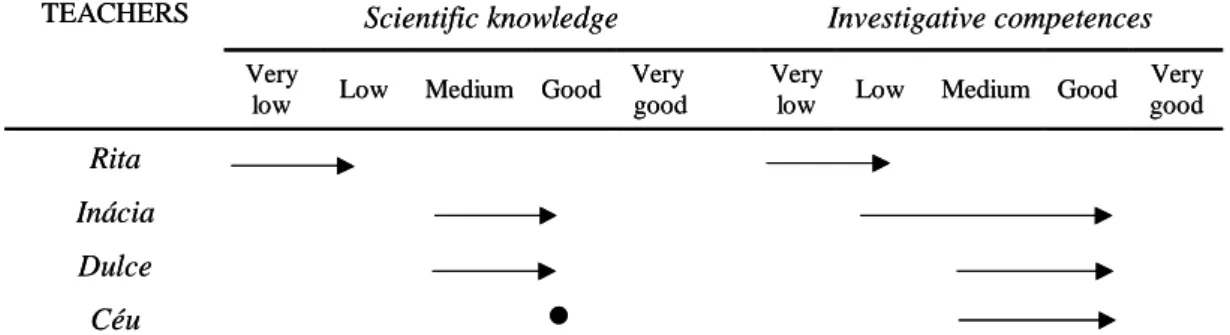
Figure 6 – Evolution of teachers’ scientific knowledge and competences
Teachers Inácia, Dulce and Céu demonstrated an evolution, having reached, in the second teaching unit, the level ‘good’ at both scientific knowledge and investigative competences. Teacher Rita demonstrated great difficulties, although there was some evolution from the very low level to the low level in the two components of the scientific competence. Teachers’ difficulties were related to a lack of sensitivity to particular aspects, some of which were more related to their knowledge of the investigative processes, particularly the most complex as for example the planning of experiments and the control of variables (Afonso, 2002). These difficulties either in the scientific knowledge or in the investigative competences, were mostly a consequence of their initial and in-service teacher training which had deficiencies related to the little importance attributed to science knowledge and also to investigative competences (the case of teachers Dulce, Inácia and Rita). Even when the first degree was in science, as it was the case of teacher Céu, the teacher education she received did not prepare her to teach scientific knowledge and investigative competences in the classroom context.
To summarise, the results of the study show that, as a whole, teachers demonstrated to a smaller or greater extent evolution at the level of both scientific knowledge and investigative competences.
5. CONCLUSIONS
The teacher training programme we developed, following an action-research methodology in the course of two years, presented the following main characteristics: (a) explicating the text
SCIENTIFIC COMPETENCE
Scientific knowledge Investigative competences
TEACHERS
Very
low Low Medium Good
Very good
Very
low Low Medium Good
Very good Rita Inácia Dulce Céu SCIENTIFIC COMPETENCE
Scientific knowledge Investigative competences
TEACHERS
Very
low Low Medium Good
Very good
Very
low Low Medium Good
Very good Rita Inácia Dulce Céu
legitimised in the interaction context (strong framing of the evaluation criteria); (b) relation between teachers’ knowledges and knowledges to be acquired (weaker classification between discourses); (c) personal relations of communication between the researcher and the teachers and between teachers (weak framing of the hierarchical rules); (d) clear distinction between participants with distinct statuses (strong classification researcher-teacher). This modality of teacher training led teachers to develop professionally. The four teachers changed at the level of being more able to explore, in the classroom, scientific content and investigative competences and they changed in the form used to explore them. In terms of a specific coding orientation, the study suggests that teachers’ professional development is the result of the acquisition of recognition and realisation rules, passive and active, for a broad range of components of the pedagogic practice. Even when the teacher training did not lead to the total acquisition of active realisation, it led to the acquisition of the recognition rules and passive realisation rules and to the acquisition, at least to some extent, of the active realisation for various aspects of their pedagogic practice.
The aspect of the teacher training, which seems to have greatly helped teachers to acquire the recognition and realisation rules related to a given pedagogic practice, was the explicating of the evaluation criteria. This was attained by making clear to teachers the specificity of the scientific learning contexts and the foundational principles which underly their characteristics and also by making clear the aspects of their performance in the classroom which placed them closer to the characteristics of the pedagogic practice to be implemented.
On the other hand, the open relationship between the researcher and the teachers, in which reasons for content and procedures were explained, was favourable to the acceptance and valuing by teachers of the various aspects of the pedagogic practice that we intended them to implement. This relationship had, in its turn, an influence on the acquisition of recognition and realisation rules. The acquisition of these rules was certainly also influenced by the relation between researcher and teachers knowledges that was established in the course of the intense discussions of the many working sessions. The open relations between teachers was also shown to be important.
In the case of teacher Rita, progress could have been more evident if the training process had been characterised by weaker classification and framing of the teachers power relations and control relations, at the level of the hierarchical rules. The two teachers participated actively but teacher Inácia, through her more frequent interventions and knowledge, led her to acquire a somehow higher status than the status of teacher Rita. These aspects may have led teacher
Rita to decrease her positioning and to lower her socio-affective dispositions and, as a consequence, to have a lower evolution.
The teacher training programme was even very positive for the evolution of teachers discourse. Teachers reached a higher awareness of the characteristics of their own pedagogic practice and were able to characterise it. The teacher training gave teachers instruments of analysis and reflection useful for their teaching practice. When questioned about the importance of the training received, teachers acknowledge the importance of going beyond the psychological to consider also the sociological, in teacher training, if professional competence of all teachers is to be achieved.
We would hypothesise that if the training process had been prolonged for a longer period of time, teachers’ evolution could have been greater and perhaps faster. In fact teachers acquired the recognition and passive realisation rules for most characteristics of the pedagogic practice and the active realisation for many characteristics. Active realisation appeared to be more difficult to acquire than passive realisation and recognition rules. This was particularly evident in the case of the relations between knowledges (intradisciplinary, interdisciplinary, academic-non academic), where teachers demonstrated great difficulties in making those relations. If the training process had continued it could then have been (nearly) exclusively focused on the acquisition of the active dimension of the realisation rules in the aspects not yet acquired by teachers. Teachers also showed difficulties at the level of the what to teach, related to both scientific knowledge and competences (particularly the complex competences). This aspect may also have functioned as a limitant factor to teachers’ competence, at the level of the how of pedagogic practice.
We believe that an important aspect of the modality of teacher training that may have contributed to the acquisition of the specific coding orientation to the pedagogic practice to be implemented is the isomorphism between the training modality and the modality of pedagogic practice. The fact that the training modality and pedagogic practice to be implemented by teachers contained similar characteristics seems to facilitate the transference of knowledges and competences from the former to the latter. One of the problems identified in teacher training, both initial and in-service, pointed out by several authors (Tilgner, 1990; Perrenoud, 1993; Monk & Dillon, 1995; Lea, 1997), is that the teaching models used in teacher training contexts contradict what is theoretically defended by trainers. Teacher trainers defend and call for a constructivist approach to teaching but they implement a reception learning in their own lessons, they argue for an active learning process but implement a passive
teaching-learning process in their own lessons, they call for an ‘open pedagogy’ but develop a ‘close pedagogy’.
Another aspect is that the results of the teacher training developed, through an action-research methodology, contradict the idea globally defended by various action-research lines, according to which the relations in the training context should be characterised by weak classifications and framings. The results of our study suggest that although the global values of classification and framing should be weak, this should not be the case in the researcher-teachers power relations and in aspects of selection and sequence and also in the evaluation criteria. It is important that these values are strong in order that the training process is successful. The strong classification between researcher and teachers gives the possibility of distinguishing the various participants of the training process and allows the researcher (trainer) to determine how other relations present in the training context should be defined. The strong framing at the level of selection and sequence is needed if teachers are expected to learn something. In fact teachers cannot select a knowledge that they have not yet acquired and cannot give it a proper sequence. Only at the micro-level can framing be weak and/or, later on, when teachers have already acquired to some extent the recognition and realisation rules for a context where scientific knowledge should be learned, investigative competences should be developed and an efficient teaching-learning process should be implemented. However, it should be stressed that strong classification between the researcher and the teachers should always go together with weak framing of the hierarchical rules.
The results of the study suggest that the values of framing of the pacing and the hierarchical rules should be weak to allow the participation of all participants of the training process to control the time required for learning and the opportunity to consider all contents selected. Weak framing at the level of the hierarchical rules contributes to the participation of all in the communication situation.
The modality of the teacher training implemented in this study, and defended by some action-research lines, allowed a constant relation between theory and practice and as such also positively influenced teachers development. The valuing of practice prevented the teacher training from being ‘too theoretical’, ‘far from the real problems’, as felt by teachers. The valuing of the theory prevented the teacher training from being ‘too practical’, ‘too context specific’ and ‘without foundational principles and reasons’, demanding for deepness, relation and coherence.
Calderhead & Gates, 1995), is the important role that researchers played in the teachers’ professional development, as they acted as facilitators developing reflection, (re)acquiring knowledges, changing pedagogic practice, solving conflicts at the level of conceptions and beliefs, learning the specific language and concepts to describe and understand teachers’ practices and children’s learning. We consider that the teacher should have some degree of responsibility in her professional development but we also consider that the individual teacher has limited power to change knowledges and performances socially and culturally constructed. Even a competent adult can benefit from the participation of others to improve and maintain his/her performance (Manning & Payne, 1993; Jones, Rua & Carter, 1998). The role of the teacher trainer can change throughout the various stages of the action-research cycle, contributing in this way to the future professional development of teachers (Calderhead & Gates, 1995). However, the teacher trainer will always play an important role in the collaboration s/he can give to teachers’ professional development, although his/her importance may diminish throughout the process as teachers would, in principle, have already acquired the knowledge and competences needed for the prosecution of their development in an autonomous and independent way.
We are aware that teachers’ professional development does not depend only on the characteristics of the teacher training processes, but is influenced by many personal, social and professional factors. The personal characteristics, the working environment at school, the relations between colleagues, relations with children’s parents and with the community also influence professional development. Another factor that influenced the evolution of teachers acquisition of the specific coding orientation which would lead to the implementation of the proposed pedagogic practice was the initial and in-service training they had already received. In spite of the four teachers having got their degrees in different schools, at different times, in different locations, the teacher education they received was similar and quite distinct from the proposed modality of pedagogic practice, with reference to the what and particularly to the
how that they were taught. The what, both scientific and pedagogic, was referred to by
teachers as having deficiencies essentially related to the theoretical way in which it was taught and not including the development of scientific competences. The how of their in-service teacher training, but particularly of the initial training, was predominantly centred on the teacher in both the instructional and the regulative contexts. The pedagogic practice in schools, which is part of their first degree and which constitutes an important stage of the education of future teachers, was also developed in the direction of teachers centring the
whole teaching-learning process on themselves, limiting the children’s control on that process. To lead teachers to implement a mixed pedagogic practice centred on children in some aspects (e.g. pacing) and on the teacher in some other aspects (e.g. evaluation criteria) may, in fact, be a difficult task for both teachers and teacher trainers.
Although the results of the study were obtained with a relatively small sample of teachers and children, we believe that it contributes to the field of educational research, at the level of teacher training and of pedagogic intervention. From the point of view of educational research, this study furthers our understanding of the inability of some teachers to implementing classroom pedagogic practices distinct from the practices they are used to implement and to understand that such inability does not depend only on personal, social and professional characteristics, but also on the contexts of initial and in-service teacher training in which they were involved.
From the point of view of pedagogic intervention, the study shows that the creation of favourable conditions to teachers’ professional development requires the implementation of modalities of teacher training which not only consider the experiences of all teachers but give teachers some control over their process of professional development. This teacher training should also give teachers some control over the acquisition of the specific coding orientation needed to the implementation of modalities of pedagogic practice innovative and capable of leading to the scientific and socio-affective development of children of distinct social groups. This should take place within a researcher/trainer-teacher relation characterised by a strong classification which allows the researcher/trainer to decide which aspects s/he should control and which aspects teachers should control.
We should point to the importance of making teacher trainers aware that the factors which interfere with teachers’ professional development are not only psychological but are profoundly sociological and that the sociological characteristics of the training modality are important and should be considered if an improvement of professional performance of all teachers is to be achieved. A second aspect is that the models of analysis in educational research should be such that makes possible the analysis at the various levels of the pedagogic discourse using the same principles and concepts. In the case of this study the same concepts were used at the meso level of teacher training and the micro level of the classroom. This was possible given the strong conceptual structure and great explanatory power of the theory in which the study was predominantly grounded.