2018
UNIVERSIDADE DE LISBOA FACULDADE DE CIÊNCIAS DEPARTAMENTO DE INFORMÁTICA
Supporting homeless people with IVR systems
Luís Augusto Pipa Carvalho
Mestrado em Engenharia Informática
Engenharia de Software
Dissertação orientada por:
Prof. Doutor Tiago João Viera Guerreiro
I would first like to thank Professor Tiago Guerreiro, who was always available whe-never I ran into trouble or had a question about my research and writing, steering me in the right the direction.
I would also like to thank to all participants in the studies performed in the context. of this master’s thesis, without them this work was not possible.
Finally, I must express my very profound gratitude to my parents and to my friends for providing me with unfailing support and continuous encouragement throughout my years of study and through the process of researching and writing this thesis. This accom-plishment would not have been possible without them.
A quantidade de pessoas em situac¸˜ao de sem-abrigo est´a a aumentar em todo o mundo, principalmente devido aos efeitos da crise econ´omica de 2008, que elevou os prec¸os das habitac¸˜oes, o custo de vida e o desemprego. E tamb´em devido `a atual crise migrat´oria que a Europa enfrenta. As implicac¸˜oes sociais de ambos os eventos e a atual incapaci-dade dos servic¸os de apoio e de emergˆencia para ajudar a grande quantiincapaci-dade de pessoas rec´em-desabrigadas levaram a uma mudanc¸a no perfil t´ıpico de uma pessoa em situac¸˜ao de sem-abrigo. Hoje, a maioria das pessoas em situac¸˜ao de sem-abrigo s˜ao jovem adultos, crianc¸as e fam´ılias. Embora este perfil seja visto na Europa e nos Estados Unidos em Por-tugal, o perfil t´ıpico de um sem-abrigo ´e distinto. Um sem-abrigo caracteriza-se por ser portuguˆes, masculino, em idade ativa, solteiro ou divorciado, com dependˆencias, proble-mas mentais e desempregado. Hoje em dia, o acesso `a informac¸˜ao e `a comunicac¸˜ao est´a a tornar-se cada vez mais f´acil devido ao aparecimento de novas tecnologias com prec¸os mais razo´aveis. A populac¸˜ao dos sem-abrigo n˜ao ´e excec¸˜ao e usa dispositivos digitais na sua vida quotidiana. Seja usando os seus pr´oprios dispositivos ou recorrendo a tecnologias fornecidas por servic¸os p´ublicos, como bibliotecas e abrigos sociais. Embora o acesso a dispositivos digitais possa ser f´acil, o acesso `as informac¸˜oes necess´arias para a sua so-brevivˆencia pode ser uma tarefa desafiadora, uma vez que a maior parte das informac¸˜oes ´e obtida cara-a-cara com outras pessoas em situac¸˜ao de sem-abrigo ou conversando com volunt´arios.
Algumas tecnologias foram desenvolvidas para a populac¸˜ao dos sem-abrigo, mas to-dos os sistemas encontrato-dos s˜ao especializato-dos em tentar satisfazer apenas uma neces-sidade de informac¸˜ao, como pontos de distribuic¸˜ao de alimentos. O que embora seja ´util, para um sem-abrigo que queira algumas das suas necessidades de informac¸˜ao sa-tisfeitas precisaria instalar e saber como navegar uma grande quantidade de aplicac¸˜oes distintas, colocando uma poss´ıvel sobrecarga sobre o utilizador e tornando a obtenc¸˜ao de informac¸˜ao pouco atrativa.
Em relac¸˜ao aos sistemas de IVR existentes, n˜ao foi encontrado nenhum sistema com os sem-abrigo como sua populac¸˜ao alvo, mas a maioria das populac¸˜oes onde o IVR foi aplicado partilha qualidades semelhantes com a populac¸˜ao dos sem-abrigo. Em todos os estudos apresentados envolvendo IVR, o p´ublico-alvo vivia num ambiente com recursos
assistˆencia m´edica e possuiam n´ıveis elevados de analfabetismo. Estas semelhanc¸as tor-nam o IVR uma boa tecnologia para ajudar a fornecer informac¸˜oes as pessoas que vivem nas ruas.
Este projeto visa melhorar a obtenc¸˜ao, propagac¸˜ao de informac¸˜ao e comunicac¸˜ao en-tre os indiv´ıduos em situac¸˜ao de sem-abrigo, proporcionando-lhes um sistema interativo de resposta por voz (IVR), facilmente acess´ıvel atrav´es de um simples telefonema. Essa plataforma permite que as pessoas em situac¸˜ao de sem-abrigo obtenham informac¸˜oes so-bre pontos de interesse, contactem volunt´arios e t´ecnicos de forma f´acil e remota, criem e recebam lembretes dos seus compromissos, obtenham informac¸˜oes sobre as rotas de distribuic¸˜ao de comida, fac¸am pedidos `a associac¸˜ao e que partilhem informac¸˜oes atrav´es de um f´orum ´audio.
Para obter os requisitos do sistema, recolhemos dados referentes `a relac¸˜ao entre in-div´ıduos em situac¸˜ao de sem-abrigo, tecnologia e informac¸˜ao. O nosso objetivo era saber quais as informac¸˜oes a que acedem e com quem comunicam atualmente os sem-abrigo, que tipo de tecnologias eles usam e quais s˜ao as suas necessidades atuais de informac¸˜ao e comunicac¸˜ao, bem como podem ser suportadas por tecnologia. Com esse objetivo re-alizamos trˆes atividades: como primeiro contacto com a realidade dos sem-abrigo, inte-gramos as voltas noturnas de distribuic¸˜ao de comida e suporte de sem-abrigo realizadas por volunt´arios. Nesta atividade opt´amos por uma abordagem n˜ao intrusiva, onde apenas observamos as ac¸˜oes dos volunt´arios e as suas interac¸˜oes com os sem-abrigo.
Na segunda atividade nesta fase realizamos entrevistas semiestruturadas com volunt´arios. Todas as entrevistas foram realizadas cara-a-cara antes dos volunt´arios comec¸arem as suas voltas noturnas. N´os privilegiamos entrevistas com grupos de volunt´arios que trabalha-vam juntos, em vez de entrevistas individuais, porque quer´ıamos uma maior diversidade de respostas num curto espac¸o de tempo e compreender a dinˆamica entre volunt´arios den-tro dos seus grupos de trabalho. A quest˜oes colocadas focaram-se sobre o uso atual de tecnologia e as necessidades informac¸˜ao e da comunicac¸˜ao de pessoas na situac¸˜ao de sem-abrigo e volunt´arios. A ´ultima atividade consistiu num grupo de foco com pessoas que comec¸aram o processo de abandono da situac¸˜ao de sem-abrigo. Comec¸amos por questio-nar os participantes em relac¸˜ao ao papel da tecnologia nas suas vidas e em que atividades a usam. De seguida realizamos uma atividade de escrita de cart˜oes, onde pedimos aos participantes que escrevessem em cart˜oes as suas necessidades, atividades, limitac¸˜oes e desejos em relac¸˜ao `a tecnologia, informac¸˜ao e comunicac¸˜ao. No final do grupo de foco, apresentamos as poss´ıveis funcionalidades de um sistema futuro, numa tentativa de obter feedback em relac¸˜ao `a sua utilidade e de descobrir novas poss´ıveis funcionalidades. Ap´os o estudo, tivemos dados suficientes para iniciar o desenvolvimento de um prot´otipo de uma plataforma orientada a pessoas em situac¸˜ao de sem-abrigo e suas necessidades de
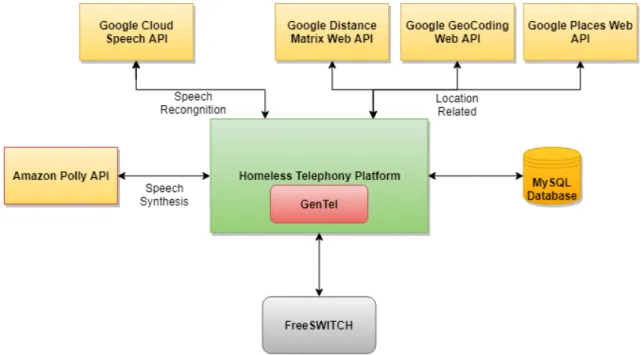
tar uma plataforma de telefonia, incluindo a interac¸˜ao com o servidor de comunicac¸˜ao em tempo real FreeSWITCH, e a s´ıntese de texto para voz atrav´es da API Amazon Polly. Em relac¸˜ao a APIs externas, a plataforma usa a API do Google Places, GeoCoding e Distance Matrix Web para obter informac¸˜oes sobre pontos de interesse, enderec¸os e distˆancias entre locais. A Google Cloud Speech API ´e usada para reconhecimento de fala.
O prot´otipo desenvolvido foi depois apresentado aos t´ecnicos e volunt´arios da associac¸˜ao, assim como aos sem-abrigo em processo de reintegrac¸˜ao na sociedade. O nosso objetivo foi mostrar o prot´otipo desenvolvido e obter feedback quanto `a sua funcionalidade, usa-bilidade e satisfac¸˜ao das necessidades dos diferentes stakeholders. Tamb´em continuamos a nossa procura por novas necessidades que nos possam ter escapado em estudos anteri-ores. Numa vis˜ao geral, a plataforma foi aceite pela maioria dos participantes como uma ferramenta potencialmente ´util para ajudar pessoas em situac¸˜ao de sem-abrigo na sua vida di´aria e dando `as instituic¸˜oes mais ferramentas para apoiar as pessoas em situac¸˜ao de sem-abrigo. Cada stakeholder parece se concentrar e avaliar a plataforma com uma perspetiva distinta. Os t´ecnicos concentram-se no seu trabalho de ajudar as pessoas a abandonar a situac¸˜ao de sem-abrigo, querendo que todas a funcionalidades da plataforma estejam conectadas com a instituic¸˜ao e visualizaram a plataforma como um ve´ıculo para tornar a instituic¸˜ao e as pessoas em situac¸˜ao de sem-abrigo mais pr´oximas. Por outro lado, temos as pessoas em situac¸˜ao de sem-abrigo que querem a plataforma a suportar todas as suas necessidades de informac¸˜ao, com o objetivo de melhorar a suas condic¸˜oes de vida.
Os volunt´arios parecem ser o grupo mais dividido em relac¸˜ao `a utilidade plataforma. Alguns volunt´arios partilham das mesmas ideias que os t´ecnicos em relac¸˜ao `a plataforma e aos seus objetivos, mas a outra metade pensa que o objetivo da plataforma deveria ser apoiar diretamente os volunt´arios e ajud´a-los a coordenar as suas voltas de apoio aos sem-abrigo, sugerindo uma reformulac¸˜ao completa da plataforma.
Palavras-chave: IVR, Sem-abrigo, HCI, Melhoria do Acesso `a Informac¸˜ao, Tecnologias Digitais
The homelessness in the world is in increasing, mainly due to the effects of the 2008 economic crisis which increased house prices, the cost of living and unemployment. And due to the current migration crisis, Europe faces. The social implications of both events and the current incapability of the support and the emergency services aiding a large amount of newly homeless people lead to a change of the typical profile of the homeless population, now most homeless people are now young adults, children, and families.
Although this profile seems through Europe and the United States, in Portugal the typical profile of a homeless person is distinct. A homeless person is characterized be being Portuguese, male, in a working-age spectrum, single or divorced, with addictions, mental problems and unemployed.
Current technologies and always-available connectivity enable just-in-time access to information and services. Homeless people can be great beneficiaries of such prompt access to information if it is easily attainable. We performed a set of formative studies with volunteers from a homeless helping association and with individuals who started the process of abandoning homelessness at a shelter to understand current technology usage, and access to information and services, by among the homeless population. We found that access to devices is pervasive in their everyday life. Either by using their own devices or by recurring to technologies provided by public services, like libraries and shelters. Although access to digital devices can be easy, access to needed information can be a challenging task, since most information is either obtained mouth-to-mouth among the homeless community or by talking with volunteers in person.
We designed low-demand information access and communication platform, as an in-teractive voice response (IVR) system, featuring location services, information storage, asynchronous communication, information boards, among others. To inspect its perceived usefulness and elicit novel usages, we exposed the platform to several stakeholders (home-less people, volunteers, technicians), in a series of workshops. The developed platform helped homeless people find information for their survival in streets, while also allowing associations to better support those who seek help.
Keywords: IVR, Homelessness, HCI, Improving Information Access, Digital Technologies
Lista de Figuras xv 1 Introduction 1 1.1 Research goals . . . 2 1.2 Approach . . . 2 1.3 Contributions . . . 2 2 Background 5 2.1 Homelessness in Portugal . . . 5
2.2 Causes, Needs, Practices and Limitations . . . 6
2.3 Technology among homeless people . . . 7
2.4 Adversity to Technology . . . 8
2.5 Developed Technologies . . . 8
2.6 Developed Interactive Voice Response Systems . . . 9
2.6.1 Synchronous Systems . . . 9
2.6.2 Asynchronous Systems . . . 13
2.7 Discussion . . . 14
3 Understanding the stakeholders 17 3.1 Observation study . . . 18 3.1.1 Goals . . . 18 3.1.2 Participants . . . 18 3.1.3 Methodology . . . 18 3.1.4 Results . . . 18 3.2 Interview study . . . 20 3.2.1 Goals . . . 20 3.2.2 Participants . . . 21 3.2.3 Methodology . . . 21 3.2.4 Results . . . 21
3.3 Focus Group study . . . 24
3.3.1 Goals . . . 24 xi
3.3.4 Results . . . 25
3.4 Discussion . . . 27
4 IVR Platform 29 4.1 Use scenarios . . . 30
4.2 System Requirements . . . 31
4.3 Homeless Telephony Platform . . . 31
4.3.1 Software architecture . . . 32
4.3.2 GenTel (Generic Telephony Application) . . . 32
4.3.3 Input Methods . . . 35 4.3.4 Location . . . 37 4.3.5 Contact List . . . 39 4.3.6 Reminders . . . 40 4.3.7 Routes . . . 42 4.3.8 Tickets . . . 43 4.3.9 Forum . . . 44
4.3.10 Remote Account and Authentication . . . 46
4.3.11 Prototype Deployment . . . 47
5 Prospective Evaluation 49 5.1 Methodology . . . 50
5.2 Focus Groups with Volunteers . . . 50
5.2.1 Participants . . . 50
5.2.2 Results . . . 50
5.3 Focus Group with Homeless People . . . 53
5.3.1 Participants . . . 53
5.3.2 Results . . . 53
5.4 Focus Groups with Social Workers . . . 55
5.4.1 Participants . . . 55 5.4.2 Results . . . 56 5.5 Discussion . . . 58 6 Conclusions 61 6.1 Benefits . . . 61 6.2 Limitations . . . 62 6.3 Future Work . . . 63 Abreviaturas 66 xii
A Documents for the Ethic Commission 69 B Volunteers Interview and Homeless People Focus Group Script 87 C Prospective Evaluation Script 93 D Database Entity Relationship Diagram 103 E M.A.P.A - Requirements Analysis Report and Prototyping 105
4.1 Software Architecture Diagram . . . 32
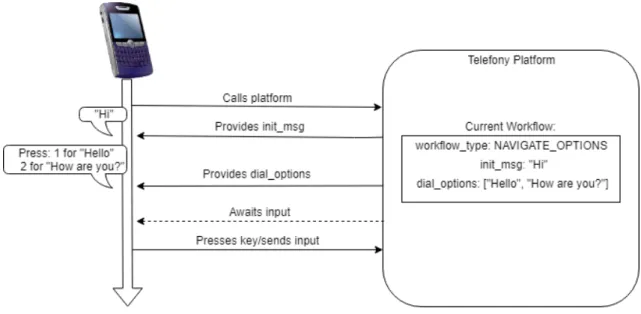
4.2 System Interaction Diagram . . . 33
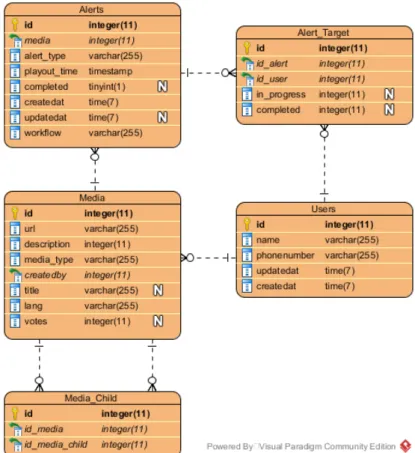
4.3 GenTel Entity-Relationship Diagram . . . 35
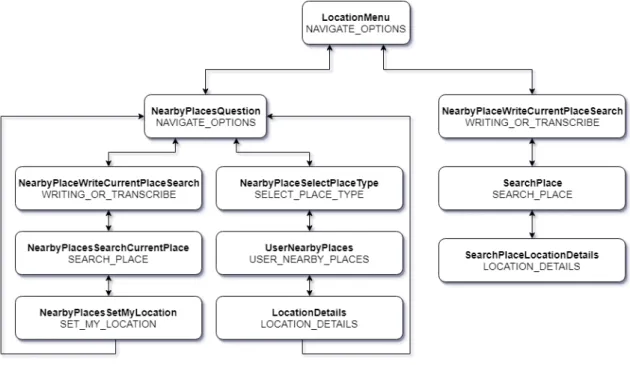
4.4 Location Workflow Sequence Diagram . . . 38
4.5 Location Entity Relationship Diagram . . . 39
4.6 Contact Workflow Sequence Diagram . . . 40
4.7 Contact Entity Relationship Diagram . . . 40
4.8 Reminder Workflow Sequence Diagram . . . 41
4.9 Reminder Entity Relationship Diagram . . . 42
4.10 Route Workflow Sequence Diagram . . . 42
4.11 Route Entity Relationship Diagram . . . 43
4.12 Tickets Workflow Sequence Diagram . . . 44
4.13 Forum Workflow Sequence Diagram . . . 45
4.14 Forum Entity Relationship Diagram . . . 46
4.15 Account Workflow Sequence Diagram . . . 46
Introduction
The homelessness in the world is in increasing, mainly because of the 2008 economic crisis which increased house prices, the cost of living and unemployment, and due to the current migration crisis Europe faces. The social implications of both events and the current incapability of the support and the emergency services in aiding the large amount of newly homeless people lead to a change of the typical profile of the homeless population. Currently most homeless people are now young adults, children and families [6][5].
Although this profile is seen through Europe and the United States, in Portugal the typical profile of a homeless person is distinct. A homeless person is characterized by being Portuguese, male, in the working age spectrum, single or divorced, with addictions, mental problems and unemployed[1].
Nowadays, accessing information and communicating is becoming easier due to novel, better and more reasonably priced technologies. The homeless population is no excep-tion and uses digital devices in their everyday life [3]. This happens by either using their own devices or by recurring to technologies provided by public services, like libraries and shelters [10][17]. Although access to digital devices can be easy, access to needed information can be a challenging task, since most information is either obtained mouth-to-mouth among the homeless community or by talking with volunteers in person [9].
This difficulty in obtaining information is especially visible in the first weeks of home-lessness, when the person does not know anyone living in the streets or services essential to his or her survival. This reveals other problem, which is information persistence among homeless people [12]. Due to the, sometimes temporary, nature of homelessness, essential information is always getting lost, since there is no way of propagating street knowledge from individuals who abandon homelessness to the more recent homeless people [9]. On the other hand, previous studies have also showed that the homeless community suffers from information overload, due to the large amount of information service providers share about their programs. This means that for some individuals this information is not essen-tial to their survival and therefore considered useless [12].
1.1
Research goals
The main objective of this thesis is to design and develop technologies that facilitate the obtainment of information and communication among homeless people and their sur-rounding environment. The sub-objectives are:
• Understand the current relationship between technology and homeless people. • Understand their unfulfilled communication and information needs.
• Design and evaluate a platform aimed at fulfilling those needs.
1.2
Approach
First, I started by researching for scientific papers regarding the relationship between homeless people and technology, in hope of finding their current activities and needs. After, I started looking for previous projects and systems developed aimed at homeless people. In the last part of my research, I focused on the previously developed Interactive Voice Response systems, analyzing their use and the target population.
Since the homeless community is difficult to approach due to its nature, we worked with an organization aimed at helping people abandoning homelessness, to obtain data regarding the homeless community in Lisbon. We started by observing the volunteers during their food distribution routes as the first contact with this reality. In these routes, they would distribute food as a pretext to establish contact with the homeless people.
With the information gathered from the observations, we created and performed group interviews with the volunteers from the organization and a focus group with homeless people, who started the process of leaving homelessness. The objective of the interviews was collecting data regarding the homeless people use of technologies, their limitations, and needs.
This information was then used to design an IVR platform aimed at both homeless people and institutions, in hopes of enhancing the quality of life of those living in the streets, but also facilitate information flow between homeless people and institutions.
After the development, we returned to the stakeholders and showed the prototype to obtain feedback and preliminary validation regarding the implemented features, their usefulness and directions for future research.
1.3
Contributions
In this master’s thesis, we contribute with:
• A Characterization of the relationship between homeless people and technol-ogy, by knowing their current ways of technology use and information obtainment.
But also, by knowing their information and communications needs, and how tech-nology could fulfill said needs.
• An Interactive Voice Response System that allows homeless people to obtain in-formation, regarded as crucial for their survival in streets, and at the same time allowing better communication between the homeless people and the organization. It addresses promises to facilitate the abandonment of homelessness and the infor-mation regarding the process.
• M.A.P.A web platform, developed for an organization as a way to support people who left homelessness and are integrated into mainstream society but want to keep in contact with the organization. The platform allows the user to access job oppor-tunities, workshops, and habitations for rent. This contribution is only addressed in Appendix E as it was a parallel contribution, although derived from the preliminary studies.
Background
According to the United Nations Office of Human Rights1, the definition of homeless-ness can be divided into two categories. The first, primary homelesshomeless-ness, includes peo-ple living in the streets and without shelter or living quarter. And the second, secondary homeless, includes people with no place of usual residence who move frequently between diverse types of accommodation, people resident in long-term transitional shelters or sim-ilar arrangements and people living in private dwelling but reporting ’no usual address’ on their census form.
In previous research by Woelfer [16], it is discussed the two ways homelessness can be interpreted. Either as a legitimate way of living or a problem in need of fixing. The study assumes that this distinction is necessary because, depending on the interpretation, distinct technological solutions with distinct objectives should be created.
For the first case, the solutions should aim at improving the homeless way of life, by facilitating access to services (like food, health-care, safety...), enhance communication within the community and allowing the homeless to expand their networks. In the sec-ond case, it should aim at helping people abandon homelessness, by giving the homeless people information and skills with that goal, by making possible their participation in mainstream society and enabling communication between the homeless community and institutions.
2.1
Homelessness in Portugal
A study carried out by ’Santa Casa da Miseric´ordia’[2] in 2013 about the existing home-less population in central Lisbon counted in total 853 individuals classified as homehome-less. From this amount, 509 lived and slept in the streets and 343 were housed in tempo-rary shelters. Most individuals were male (87%), Portuguese (59%) and didn’t have any source of income (72%). In terms of time being homeless, the majority was less than a
1http://www.ohchr.org/Documents/Issues/Housing/homelessness.pdf (last
ac-cessed on 05/10/17)
year (32%) or between 6 and 20 years (32%) living in the street. Suggesting that for every 10.000 residents, 18 individuals were homeless, and 11 individuals slept in the street.
’Santa Casa’ performed another counting of homeless people in the streets of Lisbon in 2005. This time, the total number of individuals classified as homeless was 818, with 431 living in the streets and without home and 387 living in shelters. Although the num-bers do not show a great distinction from the 2 years before, is possible to observe that not only the number of homeless people diminished but also the number of people living in the streets diminished and the number of people living in shelters increased.
In these studies, the typical profile of a homeless person is Portuguese male, in work-ing age (between 30 and 49), swork-ingle or divorced, with addictions, mental problems and unemployed.
A social-demographic study conducted in Lisbon by the local government aimed to interview the homeless population and obtain their social and health characterization and general profile. The study revealed that from 630 individuals interviewed, a typical home-less people is male (88,6%), between 35 and 64 years old (68,1%), single(48,3%) or divorced (14,3%), Portuguese (56,5%), either finished secondary school (20.0%) or pri-mary school (19.4%) and with no income (27,9%) or precarious jobs (27,8%) or receiving Social Integration Income(13,5%). In regard to health problems, the most frequent are muscular-skeletal disorders (30%), followed by respiratory problems (20%), cardiovas-cular problems (16%) and psychological problems (15.5%)[1].
Also in 2013, AMI (Assitˆencia M´edica Internacional) a health and support related organization stated that supported 1,679 homeless people, being mostly men (76%) and Portuguese (79%), where 50% had between 40 and 59 years old and 20% between 30 and 39 years.
On Porto, the NPISA (N´ucleo de Planeamento e Intervenc¸˜ao Sem Abrigo), reported 1300 people living in shelters and about 300 without a house, living in the streets [4].
2.2
Causes, Needs, Practices and Limitations
The European Commission for Employment, Social Affairs & Inclusion points out that the current typical causes of homelessness are the following:
• unemployment and poverty; • migration;
• aging;
• health problems;
• lack of affordable housing for rent and for sale;
• inadequate support for people leaving care facilities, hospitals, prisons or other pub-lic institutions;
The EU commission also points out that due to the current crisis the homelessness levels have risen over Europe and that the typical profile of the homeless population is changing. Now including more young people and children, migrants, disadvantaged mi-norities, women and families.
A study by Thompson et al. in 2005 [14] aimed at discovering what were the needs of the homeless and how to fulfill them. They found that food is a much-needed resource among the community since services providing food were the most utilized. The impor-tance of a place to stay overnight is also shown because most participants slept in a shelter, only if properly maintained, or in a tent. Another important need was hygiene and clothing since the participants like to appear ”not homeless”, which increased their opportunity of getting a job. This leads to the next need, a consistent source of income. Most individuals to have some sort of income end up doing odd jobs, like picking up cans [12], to ensure their survival because most employers of full-time jobs have requirements that are nearly impossible to overcome by the homeless, like maintaining important documents over an extended period, having a fixed house address or effective way of communicating.
Case Managers were also found to be needed by the homeless community because they negotiated with the social service systems and advocate on their behalf. They help to find a job, housing, getting documentation, locating supplies and helping the homeless develop goals and strategies to successfully accomplish those goals and stay motivated. The study also revealed the limitations people suffer due to the nature of homelessness. One example is, the existing cumbersome process of accessing some services and thus discouraging the service use. A disconcerting example was the case of homeless indi-viduals that had to choose between trying to find a job and eating because many services were only open or serving food during regular business hours. Must of the time services are not necessarily found in a confined area of the city, so to access them individuals must spend a great deal of time traveling from a location to another and spending income.
2.3
Technology among homeless people
In their research, Roberson and Nardi [12], classified the way the homeless community used technology into two categories, those who used it for survival, like finding shelter and food, and those who use it for social inclusion to connect with other communities and diminish their isolation. But, as Woelfer and Henry [16] found, the use of technology is heavily conditioned by people’s circumstances of homelessness, meaning that survival can sometimes force the homeless to pawn their digital devices to fulfill other immediate needs, like food.
The opposite was also found, in Woelfe’s study [17], where the homeless gave their digital devices to others has an act of goodwill, which apparently seems to go against their self-interest, but this was a way of creating social capital, and thus, increasing their connections and consequently their survival. At the same time, in a study by Le Dantec [8], when members of the community were asked if they would sell their cell phones, they all responded no. This way showing the importance of staying connected with their family and friends, and that the cell phone is the preferred way of staying connected. But still, the homeless community finds barriers in their usage of mobile devices, like having to pay a message or data plan to keep using it, difficulties accessing the infrastructure to recharge the devices and the risk of having them stolen[10].
2.4
Adversity to Technology
Not all stakeholders in the homelessness sphere think technology could be useful to de-velop solutions to this problem. One point Le Dantec [8] makes is that the homeless prefer interaction to be personal instead of through technology because it creates a sense of emergency and also helps them feel included. Having that in mind is suggested that a technological solution should focus on enhancing personal contact time and not substitute it. Also, most homeless people think that most digital devices aren’t useful to either in-crease their survival in the streets or make more connections, being the exception, mobile phones, and music playing devices.
Most homeless people have very little to no experience with computers, because of the difficulty in keeping digital devices safe while living in street, existing always a high risk of theft and due to the time and location restrictions when using public computers from service providers like libraries and shelters. These reasons make the homeless community feel disinterest about the use of computers. From service agencies, the homeless use of technologies is also found with adversity, some agencies consider the use of social media applications as a way of procrastination and addiction because it takes time away from the homeless people to develop in-person relations with case managers and because they perceive social media as a way to reinforce a ”street life” identity, making it more difficult to abandon homelessness. [16]
2.5
Developed Technologies
Mohan and Sarmo [10] design and develop a mobile system, called Elevate, aimed at enhancing the access to information regarding the serving of hot meals. They started by designing and testing a smartphone application that allowed users to find the nearest places serving food via GPS and sign up for daily notifications associated with specific food sources. Although the testing revealed that the application addressed the homeless
needs, it also revealed the previously referred community limitations.
The access to smartphones able to run the application among the homeless was low and that the number of homeless people with data plans was even lower or nonexistent. So, they redesign the system to be SMS text-message based so that it would work on any mobile phone. The system worked by allowing the user to send the zip code of their current location and receive a list containing: name, address, days of the week, times food is served and requirements to receive the free meal. The system allowed the user to also receive weekly notifications to the zip codes entered and update the database by sending additional information they discover. The system was also aimed at the social workers by allowing them to update the database and at the same time have access to crowd-sourced information that allowed them to improve their work.
The use of technology has helped shelters and organizations interacting and rescuing homeless from the streets, with systems that allow and make easier the communication between the homeless and the staff, like the CRM (Community Resource Messenger). This system allows permanent communication between the homeless and the shelter staff, without the physical presence of staff. And at the same time, allows information sharing between all staff, about each person in care. [9]
2.6
Developed Interactive Voice Response Systems
2.6.1
Synchronous Systems
In his research, Kazakos et al. [7] designed and developed a synchronous IVR platform called Sebat Ki Vaani, that enables the hosting of radio chat shows through an Android application and enables listeners to participant in the show through a simple call with their mobile phone without any cost. This system was tested in North India with two local com-munity health workers, that hosted a total of six radio shows, discussing Type 2 diabetes and maternal health. The platform aimed at filling the existing research gap in terms of the synchronous low-cost community-led IVR system in resource-limited settings. Due to the elevated levels of illiteracy in this community text-based communication wasn’t a good option, so the researchers opted by using a non-text communication approach, an IVR system. Before starting the development of the platform, the researchers conducted a field study with the target population where they learned two aspects: first, that individ-uals valued connecting with others who live in the same conditions have them, by sharing their experiences and giving/receiving tips about a better self-management. Second, in-dividuals adverted that the system should be free and provide support to illiterate users, ensuring to some degree the same opportunity of opinion sharing and information access. Researchers proceeded to create and test medium-fidelity prototypes using a commer-cial VoIP app that allowed groups chats using mobiles phones. The result was a chaotic user experience because many individuals tried to talk at once and due to technical
prob-lems since the app required stable internet access. The developed platform was based in a client-server architecture with two different clients: the Radiohosts and the Listeners. The Radiohost client was an Android-based application and required an Internet connection. It allowed the registration of individuals that are interested in listening to the show, cre-ate and distribute a trailer of the show to registered numbers, broadcasting and stopping a radio show, monitoring the radio show duration, viewing the number of listeners and displaying the list of listeners who want to interact with the show. The Listeners through their mobile phones could show interest in listening to the show, listen to the show, show an interest in contributing to the show by dialing 1 and talk with the host. The back-end was hosted on a cloud-based service and accepted requests from the Radiohost client. The server managed all the telephony functions through an open-source VoIP server technol-ogy called FreeSWITCH, accepting audio from the Radiohost client and sending it to all Listeners that are using a standard phone connection. For Listeners the platform was free, but running a show had a cost of 5 INR (Indian rupee) a minute for the host.
During piloting, it was found that the Radiohost client made unnecessary pull requests to the IVR server and that the telephony networks were less stable than what was expected, resulting in connectivity problems with some Listeners. During the deployment of the platform, the hosts not only had to plan the shows and register listeners but also encourage listeners to participate, help the participant make their point, address the questions and topics of conversations the participant raised. Meanwhile, for the listeners, the show provided them with comfort because their questions and concerns were answered. But, the act of listening sometimes resulted in a frustrating, boring or confusing experience, either because of the poor telephony networks or because the long time they would need to wait to participate in the show since there was no way for the listeners to know how long they had to wait.
In his research Yadav et al. [18] designed and developed a synchronous IVR platform called Sangoshthi. This platform aimed at being low-cost and allowing training and learn-ing in a low-Internet access environment, by combinlearn-ing Internet and IVR technology to host real-time training sessions through basic cellphones. This platform was tested with Accredited Social Health Activists (ASHAs), these activists exist in rural and low-literacy areas has a way of improving the health of newborns by visiting their homes. To become an ASHA, each woman receives an initial modular training, but once finished her training continues, to ensure continuous improvement of skills. However, in practice, the imple-mentation and execution of this training and re-skilling programs face many challenges, like the shortage of skilled trainers, insufficient funds, inadequate training space and lack of training aids.
To better understand the needs, the researchers collaborated with a non-government organization that works in the field of maternal and child health. Because of this col-laboration, two key components of training were found: the creation of standard content
and its delivery to the ASHAs timely and uniformly. After conducting a focus group with some ASHAs they found that ‘peer ASHAs’, either face-to-face or through phone calls, was the main point of contact for discussion and knowledge propagation among the ASHAs.
The solution presented by the researchers was remote learning. This approach was found to be cost-effective, scalable and appropriate for decentralized communities, like the ASHAs. To materialize this solution, they proposed a platform using the Internet connection and IVR technology that allows trainers and learners in separate places to exchange information in a class like an environment. This environment is achieved by having a conference call that is comprised by a host, that facilitates the communication, an expert and learners that listen to and intervene in the call. The system developed in this research is built upon the one developed by Kazakos et al. [7] in his research. It is a client-server architecture where the client is an Android application built using the existing beta-versing of Citizen Radio, allowing the host to create and manage shows. The server is built upon the open source telephone platform FreeSWITCH that manages all telephony related activities.
To test the Sangoshthi usefulness and user-experience, the researchers created two groups of ASHA, a treatment group that would learn through the radio show and a control group. In terms of the host user experience with the app, problems arose due to the slow internet connection, which increased the app’s processing times and resulting in a frustrated host. The show had two segments, an initial that delivered information about the topic, and the final segment where listeners could interact with the expert. To measure the knowledge level of the members of the two groups a questionnaire was made before and after training. The results showed an improved knowledge in both groups. The increasing knowledge showed by the control group is attributed to the sharing of information among ASHAs outside the training lessons.
Talhouk et al. [13] studied the influence of radio shows on Syrian refugee’s health and community. The motivation behind this research was the difficulties refugees have in communicating with health care providers, the non-existing transportation to clinics and the fact that most refugee’s families have at least one smartphone. The study was conducted in an Informal Tent Settlement in rural Lebanon for two months. The following activities were realized:
• Discussion regarding the way people would commission a community radio show. • Exploring how a community show would run, researchers conducted radio shows
using paper mockups, a function limited Citizen Radio as host and one listener phone, where each woman could ask her questions.
• Interviews and focus groups after each show with the users, to capture their experi-ence in the show.
• Questionnaires before and after the show to assess knowledge improvement within the community.
During these activities, some social considerations arose. First, the community considered the role of host a prestigious position and with impact in the community. Second, the selection of a host should be done carefully since it influences the community dynamics. Third, the topic and time of the show should be discussed and decided by the community. This revealed to be a critical point since some women were pressured to leave the shows earlier.
During the show runs the researchers observed a high degree of self-organization among women. The women self-organized in a way to ensure that the same question would not be asked twice and that the queuing order of interaction was respected. In terms of privacy, initially the use of one phone and the sharing of health conditions and doubts was not a problem, but later when unwanted community members started attend-ing the shows it became a problem since some women refuse to share their questions. The research shows that the use of the communication radio shows to obtain health infor-mation was more benefit than face to face consultations because the remote participation allowed the listeners to expose their question in a more comfortable way. Also made the listeners feel more accompanied by the health providers since they had time to explain and existed a host to moderate the talk between listener and health provider in case of misunderstanding. The health providers also point out that the remote nature of commu-nication was a benefit to them since they did not need to leave their current locations to consult various people. And point out that the refugees were normally not responsive in face-to-face consultation but through the radio shows they engaged more easily, providing this way, a better understating of the refugee community. The functionality of recording radio shows was found to be useful to both listeners and health providers. For listeners was useful because it allowed the propagation of information to the non-listeners mem-ber of the community and for the providers was a benefit because the recording could be used in the training of other providers. The researchers suggest that community-led commissioning of radios shows should be divided into three stages:
• Initiation – In this stage hosts, topics, health providers and audience are selected. • Mediation – Where the hosts and health providers discuss and refine the selected
topics and the preferable times and dates of shows.
• Validation – In this stage, the Ministry of Public Health will evaluate randomly se-lected recording of radios shows to guaranty information correctness and the quality of health providers.
2.6.2
Asynchronous Systems
In the field of asynchronous IVR systems, Patel et al. [11] designed, deployed and evalu-ated an asynchronous voice message forum called Avaaj Otalo. This research was made in India and aimed at providing farmers with an interactive on-demand way to access and share agricultural knowledge, that would complement and be supervised by an already ex-isting agricultural radio program, called Sajjata No Sang Lave Kheti ma Rang, produced by the Development Support Center, an NGO. The developed system would facilitate de communication with the radio listeners, allow the incorporation of listener feedback into the program and allow the agricultural experts to respond effectively to shared questions. To design the system the researchers conducted interviews with farmers, experts, DSC staff and radio producers. Farmers also participated in questionnaires and focus groups. Based on the data gathered, the researchers concluded that a voice-based system accessi-ble through simple mobile phones is the most appropriate technology to use since most farmers had a cell phone and did not use text messages. The system had three features: a Questions and Answer Forum, where users could record and post a 30 seconds ques-tion/answer and browse a list of existing questions, ordered by latest. The system did not allow to search specific content and only played to two answers of each question; an An-nouncements Board, where the DSC posted anAn-nouncements and news; a Radio Archive, where users could listen to previously broadcasted programs.
The system was implemented as a VoiceSite using IBM Research’s Spoken Web plat-form. Phone calls were routed to a Cisco Gateway through an ISDN connection, support-ing up to 30 simultaneous calls. The deployment was conducted for 7 months and with 51 participants. All participants receive a briefing, from DSC, on the system features and how to use them. The researchers collected data through a logging system that recorded the interaction between the system and the call; transcription and coding of questions and answers posted in the system; interviews with the stakeholders.
During deployment, 71% of users called the system at least once, resulting in a total of 6,975 calls. The Q&A forum revealed to be the most used featured of the system and the most liked (65%) by the participants. The system could be interacted with through voice commands and touchtone input, but results showed that touchtone was the most used among participants, with 100% of the interviewed showing preference for the touchtone. This unanimous opinion was attributed to the low accuracy of the speech recognizer, re-sulting in faulty user experience. Participants also showed interest in the implementation of a message skipping mechanism, since it would increase the browsing user experience. When asked if the forum content should be ordered by time, user or topic, 85% of the participants preferred a topic organization. About 77% of the farmers revealed their satis-faction with the forum, due to the huge value they found in listening to others’ questions. Regarding the answer source, 65% of users said they preferred staff only answers and 35% preferred answers from both staff and farmers. The studies also found that some farmers
hesitated in responding to question. Either because they did not want to be held account-able over the effect of their answer on others or because they lack confidence in their own knowledge. Overall, the DSC also had reservations regarding the quality of the answers provided by farmers, since the DSC wanted to ensure that only accurate and high-quality information was shared. With that said, some users expected answers to come from DSC and for farmers to offer their practical experience was a way to complement the DSC information.
In his research Vashistha et al [15] developed and deployed a voice forum, called Sangeet Swara, for cultural content where posts were curated by the users. This forum used an IVR system, allowing the user to record and listen to messages via phone call. In this research, they aimed at evaluating three topics: the engagement of users, the accuracy of community moderation and financial sustainability.
The developed system would present the menu options available and would allow users to select the desired option using key presses (DTMF). The system had the follow-ing functionalities: Check the user previous posts and its rankfollow-ing; Record a post with a limitation of 60 seconds. For each new post, the user would receive a message with the post unique ID. The ID allowed sharing the post and jumping directly to the post when entered in the main menu; Listen to other posts and rate them. First, the system would play the top-ranked post and then play a mixture of low and top-ranked posts. After lis-tening to each post, the user was prompt to rate it, giving a like or a dislike; The ranking system sorted posts by increasing order of quality. The quality of the posts was deter-mined by the user’s vote, existing two criteria in the rank order: high scores, a post with mores likes were more likely to be of high quality; high confidence: a post was better if it had more votes. The order of the posts provided to the listeners was obtained through the combination of posts’ fraction of positive posts and posts with a small number of votes.
The system was deployed for a total of eleven weeks. During the first 7 weeks, a toll-free number was used, but due to its excessive cost, in the last 4 weeks, the system used a regular number. During deployment, the system receives a total of 25,000 calls from 1,500 people, with 5,000 posts and 140,000 votes cast. About 26% of users were found to be visually impaired, while in terms of location 50% were from small towns and the remainder from larger cities. In terms of the content half were songs and poems and the remain general social media. The users considered the platform to be useful and impact in their lives, allowing them to show their creativity and opinions.
2.7
Discussion
As presented in this chapter, technology use and ownership were found amount the home-less population in previous studies, but their relationship with it and level of importance varies. On the one hand, studies showed that technology is one of the first assets to be
sold if survival is at stake, but in the other hand, a study revealed the opposite, in which the homeless people would never sell their device. This reveals the variation in behavior among the homeless population in different locations and conditions, showing the need of analyzing the current homeless population before starting the development [16] [8].
Many technologies have been designed and developed for the homeless population, but all found systems specialize in trying to satisfy only one information need, like food distribution spots. Which although useful, for the homeless person to have some of his information needs satisfied would need to install and know how to navigate a large num-ber of distinct applications, placing a possible overburden over the homeless person and making information obtainment unattractive [10].
Regarding the existing IVR systems, none was found to be targeted at the homeless people, but most of the populations where IVR was applied share similarities with the homeless population. In all studies presented involving IVR, the population target lived in a resource-limited setting with low or none internet and information access, were de-centralized communities, had difficulties accessing certain services like healthcare and had elevated levels of illiteracy. These similarities make the IVR a good technology to help to deliver information to people living in the streets [7][11][15][18].
Understanding the stakeholders
The previous chapter showed that the most important needs of homeless people are food, a place to sleep and hygiene and that the use of technology in conditioned by the circum-stance of homeless, meaning the satisfaction of those 3 important needs. Since the typical profile of a homeless person in Portugal seems to be distinct to the one described on Eu-rope and on the previous research, it is essential that we characterize and understand the homeless population we are facing and their relationship with technology.
For us to be able to characterize the homeless people relationship with technology, the kind of technologies that are used and how, the current information and communication needs and access practices of the homeless, and how can they be supported by technology, we worked with an organization aimed at helping people abandon homelessness.
This partnership allowed us to observe and interview volunteers and homeless people. The volunteers worked in the food distribution routes, contacting directly with homeless people, delivering them food as a pretext to communicate with them and help the homeless people abandoning the streets. The homeless people we interview were integrated at a temporary shelter, the first step for a person to leave homelessness and be reintegrated into mainstream society.
To guaranty a correct, legal and ethical approach to the homeless community, we created and submitted the required documentation to the Ethics Committee for Collec-tion and Data ProtecCollec-tion of The Faculty of Sciences (CERPDC)1, which approved our methodology, allowing us to perform the following studies with the stakeholders. The full documentation can be found in Appendix A.
1https://ciencias.ulisboa.pt/pt/protecao-de-dados
3.1
Observation study
3.1.1
Goals
To obtain a first contact with homeless people and their reality, we accompanied volun-teers from an organization during their food distribution routes. With this study, our goal was gaining a basic understanding of their way of action and gaining a first impression of the homeless way of life and its problems, with emphasis on discovering more regarding technology and its uses in both volunteers and homeless people.
3.1.2
Participants
In pairs, we were integrated into 3 food distribution routes, each with a distinct volunteer group. Each volunteer group was constituted by 3 to 4 active members, where some members have specific roles like driving and report writing. The number of homeless people intercepted by a volunteer group averaged on 20 people a night.
3.1.3
Methodology
In this study, we opted for a non-intrusive approach. We mainly only observed the vol-unteers, their actions and their interactions with homeless people. Informal speaking also occurred with volunteers and homeless people when the opportunity arose. Data was only collected after the night rounds through written notes, since taking notes during could dis-turb the volunteer’s work.
3.1.4
Results
Rounds and Homeless people
Every night the routes started around 8 pm and departed from the organization center. Each route had a specific group of volunteers attributed and a determinate set of locations, where the volunteers had to pass for no order. The volunteers’ goal was helping people abandoning homelessness and helping them in everything they could, using food as a pretext of approximation to homeless people. To avoid the creation of a strong bond with the homeless people each member of a volunteer group would only participate in the routes every 14 days.
Each route had two types of stops: those where the volunteers expected to be ap-proached by homeless people and those where volunteers would search in a specific loca-tion for homeless people or for a specific person. In the first case, homeless people know where to approach the volunteers because the distribution routes had specific meeting lo-cations. Generally, homeless people who approach the volunteers only wanted food and left. Others only wanted to chat with the volunteers, a person even refused to accept the
food even though had not eaten during the day. During these conversations, the volunteers asked questions regarding the state of their lives and regarding their health, their medi-cal examinations and the latest doctor’s appointments. Not all people that approach the volunteers lived in streets, since some said to have a home, but lived precariously.
Most of the homeless people approached by the volunteers were in a location where they would stay for the night. These locations include front porches of major build-ings, park benches, and camping tents. Since we arrive at some stops late at night, most homeless people would already be asleep or would not want to be disturbed, either way, volunteers left food.
It was also observed and stated by the volunteers the interaction between the popula-tion and the homeless people. Most residents help the homeless living in their streets and show empathy toward them but most wish they were not there, complaining about their smell due to lack of personal hygiene. Residents also play an important role in informa-tion propagainforma-tion regarding the homeless people, since they keep track of homeless people locations and their disappearances, relaying this information to the volunteers.
Tension
The tension between various stakeholders was found:
1. Between the people homeless and the shelter organization - Some homeless people reported their attempts in abandoning homelessness through the existing shelter organizations but were unable to conclude the process. Volunteers said that the rules and schedules imposed by the workers at the shelters and the poor relations between shelter-users made them dislike the environment in the shelters and quit the process.
2. Between the homeless people and the volunteers - Not all homeless saw positively the visits of volunteers. Some simple refused help, while others made loud accusa-tions and confronted volunteers. An example we observed, was a group of homeless people inebriated lying down in the street that when approached by the volunteers, accused them of distributing spoiled food.
3. Between the volunteers and the population - During the rounds some individuals, for example, private security guards, obstructed the access to places where homeless people were staying during the night.
Technology
We observed that technology existed among homeless people since some homeless people possessed basic cellphones. Some volunteers had good relations with specific homeless people, they would share their phone number in case any problem arises.
Currently, volunteers use a platform online called ”E-Volta” for writing and storing the round reports. In these reports is written whom they encounter, where was the encounter, what they talked about and the state of the person they encounter. Before starting a route, the volunteers have access to previous reports to prepare their route, although many admit sometimes not having time to consult them. Although the platform is online, during the route the report is written on a paper sheet and only later is copied to the online platform. A missing feature in the platform pointed out by the volunteers was the impossibility of adding photos to the report. This would be useful to record visually the homeless people life conditions.
When we explained the objective of our project, the volunteers responded positively. Stating that free technologies for access and sharing of information would be useful since they find the transmission of information between the organization and the homeless com-munity to be currently deficient and delayed. An example given was the clothes request made by homeless people. Since the requests take a long time to be fulfilled by the orga-nization, volunteers end up getting clothes to minimize the delay. Yet they showed some doubt stating that the only way of understating its usability and impact on the stakeholders would be through real-world testing.
Volunteers
All the volunteers we accompanied had at least 4 years on experience in volunteering. Most started because they saw volunteers in action on television or saw many homeless people in their daily life and wished to help. Others started through challenges promoted by their employers and later decided to continue.
According to the volunteers, the main reason for people living in the street is the absence of income due to unemployment. Other reasons stated are the lack of documents in the case of immigrates, addictions, and mental health illnesses. According to them, lack of food and famine among homeless people is nonexistent due to organizations like this one and food kitchens.
3.2
Interview study
3.2.1
Goals
Our goal was obtaining the volunteers’ point of view regarding the relationship between homeless people and technology. We aimed to know the current use, limitations and problems of technology for homeless people. While also focusing on the communication and information needs of both homeless and volunteers.
3.2.2
Participants
A total of 17 volunteers were interviewed, 16 participants through 5 group interviews and 1 through an individual interview. From the participants, 8 were men and 9 were women. The ages ranged between 22 and 56 years, with and sample average age of 39.41 years, a standard deviation of 10.20 years, and a median of 40 years. On average the participants spent 3.45 years volunteering with a standard deviation of 2.42 years, with the least time volunteering being 1 month and the most time being 10 years.
3.2.3
Methodology
All interviews were held face-to-face at a shelter in Lisbon before the volunteers stated their distribution routes. We privileged interviews with groups of volunteers that worked together, instead of individual interviews, because we wanted the greatest diversity of answers in a restricted time schedule and to understand the dynamic between volunteers within their groups. The interview followed semi-instructed planning, with questions focused on the current use of technology, the information and communications needs of homeless people and volunteers. The script for this study can be found in Appendix B on the section Volunteers Interview.
3.2.4
Results
Homeless people do not use technology
Some volunteer groups answered that the homeless population does not use any type of technology or that only a small proportion of homeless uses cellphones, about 2 in 10 individuals. The reasons presented for the (almost) nonexistent use of technology were the homeless life conditions, which do not allow the possession of many material goods since they do not have a place to store them safely, making them an easy target of thefts. Another fact presented was that they do not have money to spend on either obtaining technology or maintaining technology, like paying for data plans, calls, and messages. The volunteers describing this scenery also said that usually do not question the homeless about their life and their material goods, because the volunteers consider it an “invasion of personal space”, hence the opinion that homeless do not use technology.
These volunteer groups found absurd discussing technology among the homeless since they thought we should instead be discussing ways of promoting the interaction between volunteers, the organization and the management of volunteers. Other volunteer groups said that never had seen any homeless use any technology during their routes but assume that own it since during the organization Christmas fest they saw many homeless use cellphones.
Homeless people use technology
In contrast to previous volunteer groups, most groups answered that the homeless commu-nity uses technology actively. The most used type of technology by the homeless people is the cellphone, but there are also reports of the smartphone, tablet and radio use but in a much smaller proportion. In terms of internet use, only an even smaller proportion of homeless people uses it through free Wi-Fi access points in cafes and train stations.
The volunteers declared that the technology use and ownership are correlated with the current individual situation and the age of the individual. For the first case, two types of situation: individuals that do not own a home and individuals that are in a precarious living situation. The later ones usually own more technology like smartphones, since their life is more organized than the first ones. For the second case, older individuals do not find interest in cell phones and do not have money to spend on it but, in individuals, under 40-50 years old the use and ownership of cellphones is more prevalent.
In terms of homeless people resorting to the use of technology existing in public places, it was found that the usage is very reduced due to people’s preconception home-lessness, and thus not allowing them to attend those places. The homeless use technology mainly to communicate with people which they do not see on a regular basis, this may encompass relatives and friends. An example given by the volunteers is the case of a homeless person in Lisbon that once a week calls his family on Madeira.
Other current uses of technology are: 1. Contacting social services;
2. Contacting medical services;
3. Using the internet to access news and meteorology; 4. Using the internet to search;
5. Mainly for leisure activities. Information Needs
Currently, the main way for homeless people to obtain information is through direct com-munication with the volunteers and other homeless people. The volunteers claim that in-formation flows relatively well and quickly in the homeless population since their survival and well-being most times depends on it. For the volunteers the homeless information and communication needs are the following:
1. Where to stay during the night; 2. Where to obtain food;
3. Where to obtain clothing/blankets; 4. Where to do the hygiene;
5. Where to obtain medical care, either mobile medical posts like the Doctors of the World organization vans, or fixed ones like health centers;
6. Houses/Rooms available and the process of how to apply for; 7. Available shelters and their occupancy rate;
8. Support/Information for people wanting to leave homelessness and registration in treatments;
9. Existing institutions, including their address, contacts, and services provided (In-cluding state (’Cˆamara Municipal’) and private (’Santa Casa da Miseric´ordia’) in-stitutions);
10. Initiatives and Events
11. Public transportation (schedules, stops, and prices);
12. A platform where the homeless could ask questions anonymously and obtain an-swers from an instructed individual in the theme of the question. An example pro-vided by the volunteers was the setting where someone wants to abandon its drug addiction and to obtain information on how posts an anonymous question;
13. Schedule of each institution round and their stopping points, since must institutions only do rounds some days of the week;
14. How and where to obtain documentation and treat bureaucracy;
15. Information about activities they like, to improve them and at the same time reinte-grating them back in mainstream society;
Volunteers also pointed out that some of this information is already available to homeless people, but they lack the will and pro-activity to access it since their life is so unstructured and lacking priorities mainly due to addiction problems.
Interaction between volunteers and homeless outside volunteering
In this topic, two distinct groups were found: those who interact with the homeless people outside their volunteer time and those who do not. In the first case, there were volunteers who shared their cellphone number with some homeless people, to keep in touch with them and as a support in case something bad happens and would invite them to lunch or talk. In the second case, volunteers saw sharing their cell phone number or asking for
the homeless their number as something offensive, since to them it must exist a certain distance between the volunteers and the homeless people.
Technology suggestions, requisites and restrictions
Volunteers felt that is missing some type of platform through which homeless people could access services and obtain information. They also found useful if the platform could warn the individuals of appointments and activities since it would make the homeless less erratic in terms of scheduling and allow some stability. A crucial requirement of the platform is that should only contain practical and useful information and avoid generic information because the homeless can easily obtain that type of information. Another requisite is that should be user-friendly, and the information should be well divided in logic categories like the example given by a volunteer:
1. Habitation → Shelters...
2. Well-being and Health → Health Centers...
The platform should also have some type of GPS integration, has a way to know the homeless current position and display the closest points of interest. A restriction imposed by a clear majority of volunteers is that the platform cannot replace any type of service or face-to-face contact with the homeless, should only be used as an auxiliary tool. Some volunteers suggested a platform that consisted of a street panel installed in well know and easy access place, that would display information targeted at homeless and the in-formation needed by them. To solve the lack of pro-activity of the homeless population regarding obtaining information, the volunteers admit that would be needed an awareness campaign aimed at homeless people and involving the volunteers’ teams.
3.3
Focus Group study
3.3.1
Goals
After obtaining the volunteers’ point of view of the relationship between homeless peo-ple and technology, we aimed at obtaining input directly from homeless peopeo-ple. Since elicitation of people currently in homelessness was not possible, we conducted a focus group with people that started the process of abandoning homelessness and currently at the organization. The goal was obtaining their relationship with technology, including its uses, needs and limitations, and finding their communication and information needs.
3.3.2
Participants
We conducted a focus group with 11 people, which stated the process of abandoning homelessness, and a social worker. Most participants were between 35-50 years old, with
the minority between 20-35 and 60+. This activity took place at a temporary shelter for people who want to start the process of abandoning homelessness.
3.3.3
Methodology
The focus group was divided into 3 phases:
Conversation about technology - In this phase, we question the participants about the role of technology in their lives and activities in which it is used;
Card Writing - We asked the participants to write in card their needs, activities, limita-tions, and wishes regarding technology, information, and communication.
Features Presentation - We described the possible features of the future system in an attempt of obtaining feedback regarding its usefully and finding new features. During this activity, when possible, notes were taken, and audio was recorded for later transcription. The script for this study can be found in Appendix B on the section Focus Group with the Homeless People and Social Workers.
3.3.4
Results
Technology, Activities and Services
The use of technology seems prevalent among the focus group participants. Most partic-ipants either currently or previously had owned and used cell phones. Its use was mainly for sending text messages and making calls. The use of the Internet was also mentioned, although not specified if only through a computer or also through smartphones. Activ-ities reported include visiting websites like social networks, house renting websites and the search of locations to afterward print the map. The main points of access to the in-ternet through a computer were public locations like libraries and inin-ternet cafes. Other technologies participants used were radios and TVs.
Limitations
The first limitation presented by the participants was lack of knowledge and ineptness regarding technology. Being directly correlated with the age of the participant, meaning the older the more difficult was using technology and vice-versa. Another limitation was low income, resulting in the inability of using and owning technology since with low income was almost impossible buying a cell phone or paying a fixed data plan. Access to technology, like computers, internet or telephony, was also a problem due to lack of places with the technology available for free. One participant that had been in the situa-tion of homelessness in various countries stated that in some counties access and use of
technologies is easier and cheaper for homeless people. Giving the example that with 1 euro a person could have access to telephony and internet through phone booth during a certain among of time and that information was more available and more accessible. The lack of information persistence also manifested itself, since the participants complained about losing their contacts and reminders every time they lose their cellphone.
Unfulfilled Information and Communication Needs
The following information and Communications needs were found: 1. Location and information of:
(a) Where to get the help; (b) Social Canteens; (c) Dormitories; (d) Churches;
(e) Shelters and Organizations; (f) Free Internet Spots;
(g) Pharmacies; (h) information Posts;
(i) Rounds and volunteers vans location; 2. News; 3. Weather; 4. Emergency Information; 5. Targeted Messages; 6. Customizable Information; Participants Passivity
Although we were able to obtain some results during this study, they fell short of the overall objectives. The participants proved to be very passive with only one or two being more active and responsive. The card writing activity was the most successful phase during this study but when asked to discuss their opinions few or none responded. It was necessary to spend most of the time eliciting an answer from them and when it happens were mostly yes or no. From the last phase of the study, no feedback regarding possible features was given.