Accepted Manuscript
Comparative sensitivity of Crassostrea angulata and Crassostrea gigas embryo-larval development to As under varying salinity and temperature
Anthony Moreira, Etelvina Figueira, Giovanni Libralato, Amadeu M.V.M. Soares, Marco Guida, Rosa Freitas
PII: S0141-1136(18)30271-X
DOI: 10.1016/j.marenvres.2018.06.003
Reference: MERE 4539
To appear in: Marine Environmental Research Received Date: 2 April 2018
Revised Date: 29 May 2018 Accepted Date: 4 June 2018
Please cite this article as: Moreira, A., Figueira, E., Libralato, G., Soares, A.M.V.M., Guida, M., Freitas, R., Comparative sensitivity of Crassostrea angulata and Crassostrea gigas embryo-larval development to As under varying salinity and temperature, Marine Environmental Research (2018), doi: 10.1016/ j.marenvres.2018.06.003.
This is a PDF file of an unedited manuscript that has been accepted for publication. As a service to our customers we are providing this early version of the manuscript. The manuscript will undergo copyediting, typesetting, and review of the resulting proof before it is published in its final form. Please note that during the production process errors may be discovered which could affect the content, and all legal disclaimers that apply to the journal pertain.
M
AN
US
CR
IP
T
AC
CE
PT
ED
Comparative sensitivity of Crassostrea angulata and
1
Crassostrea gigas embryo-larval development to As under varying
2
salinity and temperature
3 4 5
Anthony Moreira1, Etelvina Figueira1, Giovanni Libralato2, Amadeu M.V.M.
6
Soares1, Marco Guida2, Rosa Freitas1
7 8
1
Department of Biology & CESAM, University of Aveiro, Campus Universitário de 9
Santiago, Aveiro, Portugal 10
11
2
Department of Biology, University of Naples Federico II, via Cinthia ed. 7, 80126, 12 Naples, Italy 13 14 15 16 17 18 19 20 21
Corresponding author: Rosa Freitas 22
Address: Departamento de Biologia, Universidade de Aveiro 23
Campus Universitário de Santiago 24 3810-193 Aveiro, Portugal 25 Tel: +351234370782 26 Fax: +351234372587 27
e-mail address: [email protected] 28
M
AN
US
CR
IP
T
AC
CE
PT
ED
2 29Abstract
30Oysters are a diverse group of marine bivalves that inhabit coastal systems of
31
the world’s oceans, providing a variety of ecosystem services and represent a major
32
socioeconomic resource. However, oyster reefs have become inevitably impacted from
33
habitat destruction, overfishing, pollution and disease outbreaks that have pushed
34
these structures to the break of extinction. In addition, the increased frequency of
35
climate change related events promise to further challenge oyster species survival
36
worldwide.
37
Oysters’ early embryonic development is likely the most vulnerable stage to
38
climate change related stressors (e.g. salinity and temperature shifts) as well as to
39
pollutants (e.g. arsenic), and therefore can represent the most important bottleneck that
40
define populations’ survival in a changing environment. In light of this, the present
41
study aimed to assess two important oyster species, Crassostrea angulata and
42
Crassostrea gigas embryo-larval development, under combinations of salinity (20, 26 43
and 33), temperature (20, 24 and 28 ºC) and arsenic (As) exposure (0, 30, 60, 120,
44
240, 480, 960 and 1920 µg. As L-1), to infer on different oyster species capacity to cope
45
with these environmental stressors under the eminent threat of climate change and
46
increase of pollution worldwide.
47
Results showed differences in each species range of salinity and temperature
48
for successful embryonic development. For C angulata, embryo-larval development
49
was successful at a narrower range of both salinity and temperature, compared to C.
50
gigas. 51
Overall, As induced higher toxicity to C. angulata embryos, with calculated EC50
52
values at least an order of magnitude lower than those calculated for C. gigas.
53
The toxicity of As (measured as median effective concentration, EC50) showed
54
to be influenced by both salinity and temperature in both species. Nonetheless, salinity
M
AN
US
CR
IP
T
AC
CE
PT
ED
3had a greater influence on embryos’ sensitivity to As. This pattern was mostly noticed
56
for C. gigas, with lower salinity inducing higher sensitivity to As. Results were
57
discussed considering the existing literature and suggest that C. angulata populations
58
are likely to become more vulnerable under near future predictions for temperature
59
rise, salinity shifts and pollution.
60 61
Keywords: Arsenic, climate change, development, embryotoxicity, 62 oyster, thermohaline. 63 64 65 66 67
M
AN
US
CR
IP
T
AC
CE
PT
ED
41. INTRODUCTION
68For centuries, oyster reefs formed the dominant structural habitat in 69
temperate estuarine systems of the world. Such biogenic features are formed 70
by one or few oyster species that provide the physical structure for entire 71
ecosystems (Beck et al., 2009). Oyster reefs render a variety of ecosystem 72
services, including the formation of habitat structure for commercially important 73
fish species, water quality improvement, shoreline defence against coastal 74
erosion and carbon dioxide storage (Coen et al., 2007; Ridge et al., 2017; 75
Fodrie et al., 2017; Grabowski et al., 2012). Currently, these ecosystems are 76
globally threatened, and the majority are classified as functionally extinct (Beck 77
et al., 2011). 78
The main factors affecting the loss of important oyster reefs around the 79
globe include overexploitation and habitat degradation (Cranfield et al., 1999; 80
Leniham and Peterson, 1998), pollution (Ruano, 1997), exotic species 81
introduction (Miossec et al., 2009; Ruesink et al., 2005), and disease outbreaks 82
(Virvilis and Angelidis, 2006; Comps et al., 1988). In addition, climate change 83
related impacts (i.e. temperature rise, seawater acidification and salinity regime 84
alterations) will further challenge oyster species survival worldwide (Brander, 85
2007; Dekshenieks et al., 2000; Hoehg-Guldberg and Bruno, 2010; Knight, 86
2017; Levinton et al., 2011). The comprehension of the factors influencing 87
oysters’ environmental sensitivity can increase the background knowledge and 88
the possibility to better protect and manage this important biological resource. 89
According to FAO (2015), oysters form an important global aquaculture 90
shellfish resource. Particularly, Crassostrea gigas (Thunberg, 1793) a native 91
species to Japan, is nowadays virtually present in coastal systems of the entire 92
M
AN
US
CR
IP
T
AC
CE
PT
ED
5 planet (Miossec et al., 2009). In Europe, C. gigas is cultured in several 93countries, with France leading C. gigas production and consumption statistics 94
(Heral, 1989; Buestel et al., 2009). However, wild populations have become 95
naturalized and established in several European countries, and reports on C. 96
gigas natural occurrences stretch from Norway to southern Portugal (Miossec et
97
al., 2009 and references therein). 98
Another important species contributing for global oyster fishery 99
landings, Crassostrea angulata (Lamarck, 1819), is the main species cultured in 100
southern China (Hsiao et al., 2016; Qin et al., 2012), also occurring in southern 101
Europe (Batista et al., 2015) and North Africa (Fabioux et al., 2002). At present, 102
the geographical distribution of C. angulata in Europe is limited to the Iberian 103
Peninsula (Buestel et al., 2009; Batista et al. 2015), where the most pristine 104
population naturally occurs in the Sado estuary (Portugal), making it an 105
important biological resource to be protected. 106
Under the increasing pressure of climate change related phenomena to 107
estuarine systems worldwide, the combined effects of stressors such as 108
temperature rise, salinity alterations and pollution (Harley et al., 2006; Lejeusne 109
et al., 2010; Robins et al., 2016), are likely to increase the selective pressure on 110
oyster species in the environment. Although adult C. angulata and C. gigas can 111
be fairly resilient to fluctuations of abiotic factors and to pollutants (Cross et al., 112
2014; Moreira et al., 2016a,b; Zanette et al., 2011), early developmental stages 113
are more susceptible to physico-chemical environmental changes compared to 114
juveniles and adults (Beiras and His, 1994; His et al., 1999; MacInnes and 115
Calabrese, 1978; Ringwood, 1990). Thus, they represent the bottleneck that 116
define oyster species resilience to environmental change (Byrne et al., 2012), 117
M
AN
US
CR
IP
T
AC
CE
PT
ED
6 and therefore are important to be studied to infer on different species 118sensitivities in a changing environment. 119
The aim of the present study was to compare the sensitivities of C. 120
angulata and C. gigas embryo-larval development, considering various
121
exposure scenarios including changes in arsenic (As) concentration, salinity 122
and temperature. For this, C. angulata from the Sado estuary and C. gigas from 123
Guernsey Island embryo-larval development were studied under different 124
combinations of salinity and temperature to assess possible impacts of climate 125
driven alterations, and the combined effect of these conditions with As. Arsenic 126
was chosen as reference stressor due to: a) its toxicity to oyster embryos is 127
strongly influenced by salinity and temperature variations (Moreira et al., 2018); 128
b) its ubiquity in estuarine ecosystems (Neff, 2002) and tendency to remobilize 129
from sediment (De Gieter et al., 2005; Ereira et al., 2015; Masson et al., 2007); 130
and c) its propensity to increase in concentration from climatic events (Henke, 131
2009; Galloway et al., 2017). Arsenic concentrations in estuarine systems are 132
therefore highly dynamic (Henke, 2009). For instance Ereira et al (2015) 133
reported As concentrations of 5.2 µg L-1 in seawater, 20 mg kg-1 in sediment and 134
260 µg kg-1 in suspended particulate matter, evidencing the exposure of 135
relatively high As concentrations to resident biota. 136
Embryotoxicity tests on C. angulata and C. gigas, were carried out 137
considering a range of As concentrations (30, 60, 120, 240, 480, 960 and 1920 138
µg L-1), different salinity (20, 26 and 33) and temperature (20, 24 and 28 ºC) 139
levels, as well as different time of exposure (24 and 48 h) to investigate: i) the 140
effect of varying salinity and temperature on both species embryo-larval 141
M
AN
US
CR
IP
T
AC
CE
PT
ED
7 development; ii) As embryotoxicity to both species; and iii) the effects of varying 142salinity and temperature on embryos sensitivity to As. 143 144
2. METHODS
1452.1 Experimental setup
146Experiments were conducted separately for each species, using 147
previously cleaned and sterilised glassware for the entire experimental setup. 148
Analytical grade artificial seawater (Tropic Marine Sea Salt) from the same 149
batch was used for exposure media preparation and spawning, prepared 150
according to the manufacturer’s instructions using reverse osmosis (RO) water, 151
3 days before the experiments took place too achieve a salinity of 33 (i.e 152
reference salinity) (Leverett and Thain, 2013). After complete salt dissolution 153
and equilibration (24 h) seawater was filtered (0.2 µm) through cellulose acetate 154
filters (Millipore) using a vacuum filtration unit. Seawater salinity was adjusted to 155
obtain 3 separate batches at three different salinity levels (20, 26 and 33 ± 1) for 156
exposure media preparation using RO water as dilution media (measured pH 157
for all batches of seawater used ranged from 8.16 – 8.29 (Hanna-Instruments)). 158
Salinity levels were in accordance to Moreira et al. (2018), that showed As 159
toxicity to C. gigas embryos could restrict embryo-larval development within 20-160
33 of salinity. 161
A stock solution of sodium arsenate (Na3AsO4) (CAS no. 10048-95-0, 162
Sigma-Aldrich, Missouri, USA) was prepared in ultra-pure water and spiked in 163
separate volumetric vessels to achieve nominal As concentrations of 30, 60, 164
120, 240, 480, 960 and 1920 µg L-1, for each target salinity. Exposure 165
concentrations were chosen based on previous studies on C. gigas embryonic 166
M
AN
US
CR
IP
T
AC
CE
PT
ED
8 development and As exposure (Martin et al., 1981; Mamindy-Pajany et al., 1672016). Exposure solutions were distributed in 24-well sterile capped polystyrene 168
microplates (VWR), giving one microplate per salinity level, 3 wells (3 ml each) 169
per exposure condition (As concentration) including negative controls. Each 170
microplate corresponding to salinity and As conditions, were 3 fold replicated for 171
incubations at different temperatures (20, 24 and 28 ºC) to test two levels of 4 172
ºC increase of temperature within projected global surface temperature rise by 173
the end of the 21st century relative to years (1986-2005) (RCP8.5) (IPCC, 174
2014), while testing a temperature range that would allow to infer on embryo 175
development under As exposure based on previous data (Moreira et al., 2018). 176
All the above stated microplates were further replicated twice, to test all 177
conditions after two different timeframes of embryonic development, to allow for 178
the assessment of As induced delayed development to oyster embryos (Moreira 179
et al., 2018), while testing valid exposure time criteria of 24 h (His et al., 1999) 180
and 48 h (Knezovich et al., 1981) for C. gigas. Each microplate was incubated 181
at the desired temperature overnight in separate climatic chambers (±1 ºC) 182
before spawning induction took place to stabilize testing media at the target 183
temperature. Copper (Cu(NO3)2) was used as reference toxicant (positive 184
control) (Libralato et at., 2009) at 3, 6, 12, 18 and, 30 µg L-1 of Cu, for which 185
incubations took place at standard salinity 33 and temperature 24 ºC. 186
Each stock of seawater used for the embryotoxicity assays (at every 187
combination of salinity and As concentration) were analysed by Inductively 188
Coupled Plasma - Mass Spectrometry (ICP-MS) to determine effective As 189
concentrations for each condition. Multi-Element Standard IV - 71A (Inorganic 190
Ventures) was used as standard for As quantification, and calibration curve 191
M
AN
US
CR
IP
T
AC
CE
PT
ED
9 verified with standard reference material (NIST SRM 1643f) (Supplementary 192table S6). 193
2.2 Spawning and fertilization
194
C. gigas progenitors were obtained from Guernsey Sea Farms (UK), and
195
C. angulata progenitors were provided by an aquaculture facility operating in the
196
Sado estuary (Exporsado). C. angulata were collected during spawning season, 197
from intertidal growing tables, and stimulated to spawn one day after collection. 198
Spawning was induced by thermal stimulation, by consecutively changing 199
oysters from seawater baths set at 18 and 28 ºC in 30 min consecutive intervals 200
(Libralato et al., 2007). Gamete emission and quality (oocyte shape and sperm 201
motility) were visually inspected under a microscope. The number of male and 202
female oysters selected for fertilization were 4 and 3 (C. gigas) and 6 and 5 (C. 203
angulata), respectively.
204
Selected females were left to spawn in separate beakers, oocyte 205
suspensions were filtered through a 100 µm nylon mesh and mixed in a final 206
500 ml suspension (salinity 33, 24 ºC). Male gametes were collected in 207
separate, filtered through a 45 µm nylon mesh into a mixed suspension, and left 208
to activate for 20 min. Oocyte suspensions were fertilized by adding 209
approximately 1 to 106 oocyte-to-sperm ratios, and fertilization success verified 210
by microscopy. 211
Zygotes were immediately transferred to microplates containing the 212
exposure media to reach approximately 200 embryos per well. Microplates with 213
the exposure media (0, 30, 60, 120, 240, 480, 960 and 1920 µg L-1 of As) at 214
different salinities (20, 26, 33) and fertilized oocytes were left to incubate in the 215
dark, at different temperatures (20, 24 and 28 ±1 ºC) for 24 and 48 h post 216
M
AN
US
CR
IP
T
AC
CE
PT
ED
10 fertilization. Embryo-larval development was stopped by adding buffered 217formalin (4%). Analysis followed visual inspection of embryo-larval development 218
under an inverted microscope and camera (Leica: DMIL-1; MC170 HD) by 219
counting 100 embryos per well, and characterizing the relative frequencies of 220
different types of development (D-shape, pre-D, protruded mantle, kidney 221
shape, indented shell and dead larvae) according to His et al. (1997) (Fig. 1). 222
The zygote suspensions from each species that remained unused from 223
embryotoxicity assays were analysed for trace elements (As, Cd, Cr, Cu, Hg, 224
Ni, Pb, Sn and Zn), following an adaptation of Weng and Wang (2017) protocol 225
as follows. Zygote suspensions of each species were centrifuged at 3000 g for 226
20 min (4 ºC) followed by pellet collection. The pellets consisting of each 227
species zygotes were freeze dried, and posteriorly digested overnight with 228
analytical grade nitric acid and hydrogen peroxide (30% w/w) (Chem-Lab NV), 229
alongside with TORT-3 (Lobster Hepatopancreas Reference Material for Trace 230
Metals, NRC Canada) for analytical control by elements recovery percentages 231
calculation. The digested samples were analysed for As, Cd, Cr, Cu, Hg, Ni, Sn 232
and Zn by ICP-MS, with IV- 71A (Inorganic Ventures) as standard, and 233
calibration curves verified with standard reference material (NIST SRM 1643f), 234
calculated measure of trueness over 90%. Recovery percentages based on 235
TORT-3 reference values varied between 93.7 and 111.6%. 236
237
2.3 Data analysis
238
Results obtained were analysed as percentages of abnormal larvae 239
(including pre-D and other malformations) according to His et al. (1999), and the 240
validity of the experiments verified by results for negative and positive controls, 241
M
AN
US
CR
IP
T
AC
CE
PT
ED
11 considering the acceptability ranges proposed by ASTM (2004) (>70% D-shape 242larvae) for negative controls, and Libralato et al. (2009) (9.47 µg. L-1 ≤ EC50 ≤ 243
21.72 µg. L-1) for positive controls. 244
To represent embryo-larval development under different salinity and 245
temperature levels, frequencies of malformed larvae observed at different 246
salinities and temperature (negative controls), after 24 and 48 h development 247
were represented in Contour plots using SigmaPlot version 11.0. 248
To assess As embryotoxicity, data from As exposures were corrected for 249
the effects observed in the respective negative control (salinity and 250
temperature) using the Abbott’s formula (ASTM, 2004). Data were submitted to 251
non-linear regression analysis using GraphPad Prism version 6.01. Effective As 252
concentrations retrieved from ICP-MS for each condition were used for toxicity 253
calculations, after lognormal transformation. The best fit dose-response curve 254
values allowed to estimate the median effect concentrations (EC50s) and 255
respective 95% confidence intervals for conditions where larvae development 256
was successful. To test the effects of salinity and temperature on embryos 257
sensitivities to As, the following null hypotheses were tested: i) H0’: no 258
differences existed among EC50s at different salinity levels considering fixed 259
temperature; ii) H0’’: no differences existed among EC50s at different 260
temperature levels considering fixed salinity; iii) H0’’’: no differences existed 261
between EC50s at 24 and 48 h for each combination of salinity and 262
temperature. To test for differences among EC50 values between conditions, 263
analysis of variance was performed using one-way ANOVA, followed by 264
Tukey’s multiple comparisons tests, based on values of Log(EC50) and the 265
associated standard error returned by the software for each estimated curve 266
M
AN
US
CR
IP
T
AC
CE
PT
ED
12 (GraphPad Prism version 6.01). EC50 values are provided for each species in 267separate graphs showing the relative 95% confidence intervals, and significant 268
differences (p-values ≤ 0.05) were represented with different letters: lower-case 269
letters for comparisons of EC50s at different temperature and different salinities 270
after 24 h exposure; upper-case letters for comparisons of EC50s at different 271
temperature levels and different salinities, after 48 h exposure; asterisks (*) 272
when statistical differences between 24 h and 48 h exposures at each fixed 273
combination of salinity and temperature were observed. 274
275
3. RESULTS and DISCUSSION
276
3.1 Embryonic development, salinity and temperature
277
Crassostrea angulata
278
C. angulata embryo-larval development under different combinations of
279
salinity and temperature are depicted in Fig. 2A and B (24 and 48 h post 280
fertilization respectively). Contour plots show that C. angulata presented low 281
frequencies of malformed larvae (<20%) at intermediate and high salinity levels 282
(26 and 32) and temperatures of 24 and 28 ºC, after 24 h development (Fig. 283
2B). On the other hand, C. angulata presented high frequencies of malformed 284
larvae at every salinity level combined to low temperature (20 ºC) (100% 285
identified as Pre-D) after 24 h development (Fig. 2A). At higher temperatures 286
and low salinity (20), results showed higher percentages of malformed larvae of 287
90% (28 ºC) and 75% (24 ºC). 288
Studies concerning this species teratogenesis date back to the 19th 289
century, when the first trials on artificial fecundation of C. angulata were 290
described for full salinity and 22 ºC (Bouchon-Brandely, 1882), however scarce 291
M
AN
US
CR
IP
T
AC
CE
PT
ED
13 information is available on the effects of varying salinity and temperature on this 292species embryonic development in laboratory conditions. Nonetheless, early 293
studies by Amemiya (1926) found that the lowest limit of salinity for C. angulata 294
embryonic development was 21, and optimum salinity to be between 28 and 35 295
(studies performed at 20-23,5 ºC, 24 h). Similarly, our data showed that low 296
salinity (20) induced poor embryonic development (75-100% malformations) at 297
all tested temperatures, and malformation frequency decreased with the 298
increase of salinity. 299
After 48 h of embryo-larval development, C. angulata showed lower 300
frequencies of malformed larvae at the intermediate salinity (26) at all 301
temperature levels (Fig. 2B), while relatively higher malformation percentages 302
were observed at the highest salinity (33), at 26 and 28 ºC at 48 h, compared to 303
results obtained at 24 h (Fig. 2A). 304
The relative increase of the range of temperature and salinity at which 305
embryos successfully developed into D-shape larvae observed between 24 and 306
48 h, reflected differences in developing rates that depend on the surrounding 307
media characteristics, namely temperature and salinity. Because increasing the 308
time of exposure allowed for embryo development completion, at suboptimal 309
temperature and salinity conditions. Both these environmental factors affect 310
oyster embryo development rate. For instance, studies on Pinctata imbricata 311
pearl oysters from the tropical Atlantic (Urban, 2000) showed that suboptimal 312
temperature and salinity delayed embryonic development (O’Connor and 313
Lawler, 2004). This delayed effect is also observed in later stages, namely D-314
shape larvae of C. angulata (Thiyagarajan and Ko, 2012), C. gigas (His et al., 315
1989) and P. imbricata (Dove and O’Connor et al. 2007). Moreover, data 316
M
AN
US
CR
IP
T
AC
CE
PT
ED
14 obtained in the present study show that intermediate salinity (26) is likely 317closest to the optimum salinity for this species under laboratory conditions, the 318
salinity at which we observed the widest thermal tolerance range (Le Dantec, 319
1868) (most noticed after 48 h development). This is in accordance with studies 320
by Thiyagarajan and Ko, (2012) that described optimum salinity for C. angulata 321
D-shape larvae development between 24 and 27. Also in line with 322
environmental studies showing higher survival rates of C. angulata larvae at 323
temperatures over 22 ºC and salinities between 28 and 32 (Le Dantec, 1868). 324
325
Crassostrea gigas
326
C. gigas embryo-larval development under different salinity and
327
temperature combinations is depicted in Figure 2C and D (24 and 48 h 328
respectively). Contour plots show that C. gigas presented low frequencies of 329
malformed larvae (<30%) at all combinations of salinity and temperature after 330
24 h development, except for embryos exposed to low salinity (20) and low 331
temperature (20 ºC), where high percentages of malformed larvae were 332
observed (100% identified as pre-D, supplementary table S2) (Fig. 2C). 333
Previous studies showed low percentages of D-shape C. gigas at 20 ºC 334
and full salinity (Gamain et al., 2017) (40% D-shape larvae after 24 h post 335
fertilization), or even complete arrest of development at salinities ranging from 336
15-32 at 20 ºC (100% trochophore stage at 24 h) (Moreira et al., 2018). 337
C. gigas embryos exposed to the same conditions for 48 h, showed high
338
frequencies of developing D-shape larvae at all combinations of salinity and 339
temperature (<35% malformed larvae), including low salinity (20) and low 340
temperature (20 ºC) (Fig. 2D). 341
M
AN
US
CR
IP
T
AC
CE
PT
ED
15 These results indicate some degree of variability in the developing rate of 342C. gigas at suboptimal temperature (20 ºC) and are likely related to differences
343
in development rates at suboptimal temperature. This is corroborated by results 344
obtained at 48 h post-fertilization, for which high frequencies of D-shape larvae 345
were observed in the present study, and in accordance with results from Parker 346
et al. (2010) that also observed high rates of embryonic development at 48 h 347
and low temperature (20 ºC). Differences in methodology during the embryo-348
larval assay, namely the origin of seawater source (His et al., 1997; Beiras and 349
His, 2004), as well as phenotypic plasticity and genetic variability (Pace et al., 350
2006; Taris et al., 2006 and references therein), could explain the differences 351
observed between our findings and some of the results reported in literature. 352
353
Comparison between species
354
Differences between species successful embryonic development under 355
different combinations of salinity and temperature were evident, with C. 356
angulata embryos presenting a narrower range of salinity and temperature for
357
complete development than C. gigas. Implications of such findings under the 358
eminence of climate change could mean differentiated resilience capacities 359
between these species to cope with near future shifts in salinity and 360
temperature regimes, and possibly constrain C. angulata populations’ 361
geographical distribution comparing to that of C. gigas. 362
363
3.2 Arsenic embryotoxicity
364
Results obtained from the embryotoxicity assay for each species 365
showed that negative controls for both species were within the accepted values 366
M
AN
US
CR
IP
T
AC
CE
PT
ED
16 described for Crassostrea gigas embryotoxicity standard protocols (ASTM, 3672004; His et al., 1999), with frequencies of normal developed larvae (D-shape) 368
after 24 h development exceeding 70%, at standard salinity (33) and 369
temperature (24 ºC) for both species (C. gigas 75% and C. angulata 90%). 370
Moreover, results obtained regarding positive controls (Cu) were within 371
previously reported values (9.47 µg. L-1 ≤ EC50 ≤ 21.72 µg. L-1) (Libralato et al., 372
2009), and were similar for both species (10.07 (8.98-1.30) µg L-1 of Cu for C. 373
angulata and 11.40 (9.59-13.54) µg L-1 of Cu for C. gigas. These results confirm 374
the validity of the experiment and show that the sensitivity of both species to Cu 375 were identical. 376 377
Crassostrea angulata
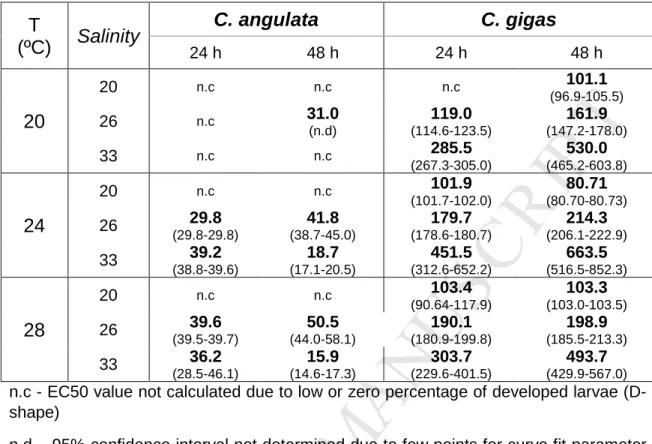
378As toxicity measured in terms of EC50 considering standard toxicity 379
assay conditions with oyster embryos (24 ºC, 33 salinity, 24 h) for C. angulata 380
was 39.2 µg L-1 As (18.7 µg L-1 As at 48 h) (Table I). To our knowledge, this is 381
the first study on the effects of contaminants to C. angulata embryonic 382
development. The toxicity of As (EC50) measured in the present study for C. 383
angulata was in the lower range of previously reported toxicity threshold values
384
for related oyster species such as Crassostrea virginica (with LC50 of 7.2 mg L -385
1
) (Calabrese et al., 1973) and C. gigas (EC50 ranging from ca. 1 to 920 µg L-1 386
of As) (Moreira et al., 2018 and Mamindy-Pajany et al., 2013). 387
388
Crassostrea gigas
389
EC50 considering standard conditions for C. gigas (24 ºC, 33 salinity, 390
24 h) of 452 µg L-1 As (663.5 µg L-1 As at 48 h) (Table I), was within previously 391
M
AN
US
CR
IP
T
AC
CE
PT
ED
17 reported EC50 values (920 µg L-1 As from Mamindy-Pajany et al. (2013) and 392326 µg L-1 As from Martin et al. (1981)). Moreover, in a previous study (Moreira 393
et al., 2018) As toxicity determined at standard salinity and temperature assay 394
conditions revealed an EC50 lower than 1 µg L-1 As. 395
Among the few available data on As toxicity to bivalve embryos, a great 396
variability is observed, in contrast to other types of pollutants (His et al., 1999). 397
These discrepancies could be related to different reference seawater 398
characteristics (Beiras and Albentosa, 2004), as observed in a previous study 399
(Moreira et al., 2018), or different methodological approaches (Martin et al. 400
(1981), that used different incubation temperature (20 ºC), different time (48 h) 401
and As form AsO5, no reference to real concentrations (Mamindy-Pajany et al., 402
2013). 403
404
Comparisons between species
405
Our results suggest that C. angulata is likely more sensitive to As than 406
C. gigas, with at least an order of magnitude lower EC50 values (Table I),
407
despite that positive control for Cu toxicity showed similar results for both 408
species, indicating sensitivity to As should be different between species, and 409
was not related to batch’s overall sensitivity (confirmed by results obtained for 410
Cu). Several factors could be hypothesised to have influenced these results, but 411
the most important one could be a differentiated species-specific sensitivity to 412
As. 413
Indeed, species specific tolerance to As seemed to be the main reason 414
explaining the differentiated toxicity observed. Moreover, these results are 415
supported by other studies, namely those that showed taxon related differences 416
M
AN
US
CR
IP
T
AC
CE
PT
ED
18 between C. angulata (Spanish origin) and C. gigas (French origin), regarding 417each progenies’ maturation traits as well as mortality (Soletchnik et al., 2002). 418
Also, Huvet et al., (2002) suggested that C. gigas could present overall better 419
gamete quality than C. angulata, while studying hybrid crosses between both 420
species. To our knowledge this is the first study on C. angulata embryotoxicity, 421
and our data add to the body of evidence that show differences in 422
ecophysiological traits between these closely related species (Soletchnik et al., 423
2002; His et al., 1972; Goulletquer et al., 1999; Heral, 1996; Moreira et al., 424
2016). 425
Other factors such as broodstock origin or parental exposure history 426
could also have influenced each species sensitivity to As but were unlikely 427
given our results and the existing literature as follows. 428
Gamain and co-workers (2017) studied C. gigas from different origins 429
(hatchery, cultivated and wild) and found no major differences in embryotoxicity 430
of metolachlor to embryos of different parental origins. However, and in contrast 431
with our study, progeny from hatchery oysters were more sensitive to Cu than 432
wild and cultivated ones. Considering this, it would be unlikely that oysters 433
(hatchery C. gigas, and cultivated C. angulata) from our study, would have 434
presented the observed differentiated response to As, solely based on 435
broodstock origin (hatchery and cultivated). 436
A recent study by Weng and Wang (2017) demonstrated maternal 437
transfer of trace metals in Crassostrea hongkongensis adults to their progeny 438
(oocytes and larvae) reflecting parental exposure from contaminated sites, with 439
negative impacts on the most contaminated embryos’ development. Therefore, 440
parental transfer of trace elements to zygotes in C. angulata could have 441
M
AN
US
CR
IP
T
AC
CE
PT
ED
19 influenced final As toxicity, knowing that the Sado estuary is anthropogenically 442polluted (Costa et al., 2009). However, the results obtained in the present study 443
on trace element content in fertilized oocytes showed only marginal differences 444
in trace element concentrations between species, except for Cr and Ni (higher 445
in C. angulata) and Zn (higher in C. gigas) (Table II). Trace element content 446
from both C. angulata and C. gigas were in the lower range of those described 447
by Weng and Wang (2017) for C. hongkongensis embryos, considering the 448
lowest reported values (lowest contaminated sites) for As, Cd, Cr, Cu, Ni and 449
Zn (4.26 ± 0.83; 0.21 ± 0.11; 0.71 ± 0.39; 45.3 ± 21.0; 1,42 ± 1.03; 300 ± 87.8 450
µg g-1 dry weight, respectively). Hence, in the present study, parental element 451
transfer to embryos was not likely to have influenced final As toxicity in either 452
species, given that we observed overall low contamination, and few differences 453
in element concentrations in embryos between species. 454
455
3.3 Effects of salinity and temperature on species sensitivity
456
to As
457
Crassostrea angulata
458
EC50 values determined for C. angulata at all tested combinations of 459
salinity and temperature levels, at both 24 and 48 h of exposure are depicted in 460
Fig. 3. For C. angulata, EC50 was not possible to calculate at the lowest salinity 461
(20), regardless of temperature and duration of exposure. Moreover, at higher 462
salinities and 20 ºC, EC50 was only possible to determine for the intermediate 463
salinity (26) and only at 48 h development (Fig. 3). These findings reflected the 464
observed thermohaline tolerance of this species, with overall lower toxicity at 465
optimum salinity (26). 466
M
AN
US
CR
IP
T
AC
CE
PT
ED
20 To assess the effects of salinity on embryo sensitivity to As, pairwise 467comparisons among EC50 values obtained at each salinity were performed 468
considering fixed temperature. Pairwise comparisons showed that at 24 h, 469
EC50 values between salinities were significantly different only at 24 ºC, for 470
which EC50 was higher at salinity 33 than at salinity 26. On the other hand, 471
results for C. angulata embryos exposed for 48 h, showed significantly higher 472
EC50 values at salinity 26 at both compared temperature levels (24 and 28 ºC) 473
(Fig. 3). These findings illustrate that different salinities as well as time of 474
exposure altered the sensitivity of embryos to As. 475
Salinity can influence oyster embryo development rate, by increasing 476
the rate with the increase of salinity (O’Connor and Lawler, 2004), and therefore 477
the retardation effect of As previously described (Moreira et al., 2018) at 478
intermediate salinity (26) could be more noticeable than at higher salinity (33), 479
as observed after 24 h development. However, these differences were 480
counteracted after 48 h exposure, for which significantly higher EC50 values 481
were observed at salinity 26 comparing to salinity 33, for both comparable 482
temperature levels (24 and 28 ºC). These results, showed that extending the 483
exposure period from 24 to 48 h had a beneficial effect at salinity 26 (significant 484
increase of EC50 at 24 ºC), corroborating the above stated hypothesis that 485
developing rates influenced final As toxicity. On the other hand, sensitivity to As 486
(lower EC50) increased significantly at higher salinity (33) comparing 24 and 48 487
h exposures, likely resulting from poor physiological status at higher salinities 488
(Thiyagarajan and Ko, 2012), also supported by results obtained in negative 489
controls at the same conditions for which we observed relatively high 490
frequencies of dead larvae (data not shown). 491
M
AN
US
CR
IP
T
AC
CE
PT
ED
21 To evaluate the effect of temperature on embryos sensitivity to As, 492pairwise comparisons between EC50 values obtained at different temperatures, 493
within each salinity level were performed. Results showed significant increases 494
of EC50s with the increase of temperature (24 and 28 ºC) at salinity 26 for both 495
24 and 48 h exposures. At salinity 33 no significant differences were observed 496
between temperature levels, at either 24 and 48 h exposures (Fig 3). 497
Studies on the effects of temperature on the toxicity of pollutants to 498
bivalve embryos, have reported contrasting results. For instance, increased 499
toxicity with the increase of temperature has been shown for Cu and Ag 500
(Boukadida et al. (2016), and for Pb (Hrs-Brecko, 1977) in Mytillus 501
galloprovincialis. However, studies on C. virginica showed that Cu was more
502
toxic at lower temperatures, presumably because closer to suboptimal 503
temperature conditions would induce higher toxicity (MacInnes and Calabrese, 504
1979). Assuming that higher temperature increases the rate of chemical 505
reactions in the media, the uptake of contaminants through biological 506
membranes can be promoted at higher temperatures (Hazel, 1997), hence 507
toxicity could be expected to increase at higher temperatures. 508
In the present study results obtained for C. angulata at optimum salinity 509
(26) and both exposure periods (24 and 48 h) showed the opposite trend, for 510
which the effect of increasing temperature resulted in lower As toxicity. These 511
results were likely related to a counteractive effect of increased rates of embryo 512
development at higher temperatures, with the retarding effect of As (Moreira et 513
al., 2018), thus resulting in higher EC50s at higher temperatures. 514
515
M
AN
US
CR
IP
T
AC
CE
PT
ED
22Crassostrea gigas
517Median effect concentrations (EC50’s) of As under different salinity and 518
temperature conditions after 24 and 48 h incubation for C. gigas are presented 519
in Fig. 4. Results obtained show a clear increase of EC50’s with the increase of 520
salinity, considering both 24 and 48 h larval development, considering fixed 521
temperature levels (Fig. 4). 522
These results are in line with previous studies using C. gigas exposed 523
to As (Moreira et al., 2018), Ag and Cu (Coglianese, 1982), Cu and metalochlor 524
(Gamain et al., 2016) at different salinities. The increased sensitivity to As 525
(lower EC50s) with the decrease of salinity is likely related to different 526
osmoregulation status of oyster embryos in response to lower salinities. Under 527
hypoosmotic conditions, the ion flux between the embryos and surrounding 528
media may increase, inducing higher uptake of soluble contaminant through 529
active transport processes (Connel, 1989; Grosell et al., 2007). Another factor 530
contributing to higher sensitivity to As at lower salinities, could be related to 531
differences in As speciation with salinity variation, however we discarded such 532
possibility, because under a similar range of salinity (and temperature) 533
conditions, As speciation analysis showed no important differences in prevailing 534
As species and bioavailability with varying salinity and temperature (Moreira et 535
al., 2018). 536
The effect of varying temperature on C. gigas embryos’ sensitivity to As, 537
inferred by pairwise comparisons of EC50 values among temperature levels, 538
were variable within each salinity level and incubation period (Fig. 4). At the 539
lowest salinity (20), no significant differences were observed among EC50’s 540
obtained for all temperature levels (at both 24 and 48 h). At salinity 26, EC50 541
M
AN
US
CR
IP
T
AC
CE
PT
ED
23 was significantly lower at 20 ºC, comparing to the remaining temperature levels, 542after 24 h incubation. At salinity 33 after 24 h embryo development, the highest 543
EC50 value was observed at 24 ºC, with significant differences towards that 544
obtained at 20 ºC. (Fig. 4). 545
These findings suggest that higher sensitivity (lower EC50s) observed at 546
lower temperatures (20 ºC, 24 hours) for all tested salinity levels likely resulted 547
from an additive effect of delayed development induced by both As and low 548
temperature, considering that the developing rate of oyster larvae decrease at 549
lower temperatures (His et al., 1989; Dove and O´Conner, 2007), and that As 550
induces a retarding effect on embryo development (Moreira et al., 2018) 551
Results further revealed that after 48 h no significant differences were 552
observed among temperature levels at salinity 26 and 33 (Fig 4). These findings 553
demonstrate that the arresting effect of As on C. gigas larvae development 554
previously described is not permanent, because extending the exposure period 555
to 48 h revealed higher frequencies of embryo-larval development completion 556
(lower frequencies of Pre-D larvae) (Supplementary table S2), which in turn 557
resulted in similar toxicity effects to larvae exposed at different temperature 558
levels at 48 h, unlike results obtained at 24 h for which temperature showed a 559
higher effect. 560
Comparisons between EC50 values obtained for each combination of 561
salinity and temperature at 24 h incubation and the corresponding conditions 562
after 48 h exposure (Fig. 4), revealed no differences in EC50 values at any 563
combination of low (20) and intermediate salinities (26) at every temperature 564
level between 24 and 48 h exposures (Fig. 4 and Table S3). However, 565
significant differences were observed at all temperature levels tested at salinity 566
M
AN
US
CR
IP
T
AC
CE
PT
ED
24 33, where significantly higher EC50 values were observed after 48 h comparing 567to values obtained after 24 h. It is important to note that at salinity 20 at 20 ºC, 568
EC50 was only possible to calculate after 48 h exposure, since after 24 h 569
embryo development was not completed in these conditions (Fig. 2B and D). 570
Comparisons between results obtained for C. gigas at 24 and 48 h 571
further revealed a significant increase of EC50s at the highest salinity (33), and 572
all combinations of temperature, with the increase of exposure time. These 573
results illustrated that toxicity threshold determination can depend on time of 574
exposure for toxicants that affect embryonic development by retarding 575
development such as As. 576
577
4. Concluding remarks
578
The present study allowed to assess the embryotoxicity of As under 579
different thermohaline conditions to C. angulata and to compare results with 580
those from an important worldwide distributed species C. gigas. Results 581
obtained showed marked differences on each species embryo-development 582
capacity, namely concerning the tolerance range to varying salinity and 583
temperature, which further reflected in the pattern of As toxicity observed. C. 584
angulata presented a narrower range of salinity and temperature than C. gigas
585
for which embryo-development successfully occurred, considering 24 and 48 h 586
post fertilization. C. angulata presented better embryonic development at 587
intermediate salinity (26) and at temperatures above 20 ºC, while C. gigas 588
presented high frequencies of developing embryos at all combinations of salinity 589
and temperatures tested. Overall, these results suggest that early ontogeny of 590
C. angulata may be limited to a narrower range of abiotic factors (salinity and
M
AN
US
CR
IP
T
AC
CE
PT
ED
25 temperature) compared to C. gigas, with possible implications at the population 592level. Considering that early life stages generally constitute the most susceptible 593
stage of oysters’ life cycle, the thermohaline differences observed for embryo 594
development may dictate species competitive advantages towards one another 595
under the projected scenarios of climate driven alterations of temperature and 596
salinity regimes in estuarine systems worldwide. Hence, C. angulata may be 597
more susceptible to environmental change than C. gigas. 598
Concerning As toxicity, EC50 values for C. angulata showed that the 599
effect of As was overall lower at the intermediate salinity 26, however 600
temperature also showed to influence As toxicity in an antagonistic manner, 601
with higher temperatures inducing lower toxicity effects. For C. gigas the effect 602
of As was highly dependent on salinity, with sensitivity to As showing to 603
decrease with the increase of salinity. The effect of temperature was only 604
noticeable after 24 h exposure, when low temperatures induced higher 605
sensitivity, while after 48 h development the effect of temperature was 606
mitigated. 607
Comparisons on As toxicity measured as EC50 values between 608
species, showed that C. angulata was at least 10 times more sensitive to As 609
than C. gigas and these differences were likely species related. Our results 610
suggest that the survival of C. angulata strongly depends on a narrower range 611
of abiotic factors compared to its closely related congener, and therefore the 612
future of this population may be endangered considering the future projections 613
on climate change and pollution worldwide. 614
Other issues rise from the present study, namely the observations that 615
the delay effects of As on Crassostrea embryo development is not permanent 616
M
AN
US
CR
IP
T
AC
CE
PT
ED
26 (noted by differences between 24 and 48 h exposures) and add to recent 617findings that showed that sea urchin embryos can recover from toxicity induced 618
by different trace metals (Morroni et al., 2018). These results are also important 619
for future studies considering differentiated effects under varying physico-620
chemical parameters that may consider the 48-h criterion. For future studies 621
relying on bivalves collected in the environment we suggest trace elements 622
analysis to be performed on oocyte suspensions. All together these issues 623
should be considered for future ecotoxicological studies and water quality 624
framework directives relying on embryotoxicity assays. 625
626
Acknowledgements 627
This study was supported by the Portuguese Science Foundation (FCT) through 628
CESAM (UID/AMB/50017), by FCT/MEC through national funds, and the co-funding by FEDER, 629
within the PT2020 Partnership Agreement and Compete 2020. Anthony Moreira benefited from 630
PhD grant SFRH/BD/93107/2013. Rosa Freitas benefited from a research position funded by 631
the Integrated Programme of SR&TD “Smart Valorization of Endogenous Marine Biological 632
Resources Under a Changing Climate” (reference Centro-01-0145-FEDER-000018), co-funded 633
by Centro 2020 program, Portugal 2020, European Union, through the European Regional 634
Development Fund. The authors would like to thank Mr. Pedro Ferreira from Exporsado for 635
providing C. angulata progenitors. 636
637
6. References
638
Amemiya, I., 1926. Notes on experiments on the early developmental stages of the
639
Portuguese, American and English native oysters, with special reference to the
640
effect of varying salinity. Journal of the Marine Biological Association of the
641
United Kingdom 14, 161–176.
642
Batista, F.M., López-Sanmartín, M., Grade, A., Morgado, I., Valente, M., Navas, J.I.,
643
Power, D.M., Ruano, F., 2015. Sequence variation in ostreid herpesvirus 1
644
microvar isolates detected in dying and asymptomatic Crassostrea angulata
645
adults in the Iberian Peninsula: Insights into viral origin and spread. Aquaculture
646
435, 43–51. https://doi.org/10.1016/j.aquaculture.2014.09.016
647
Beck, M.W., Brumbaugh, R.D., Airoldi, L., Carranza, A., Coen, L.D., Crawford, C.,
M
AN
US
CR
IP
T
AC
CE
PT
ED
27Defeo, O., Edgar, G.J., Hancock, B., Kay, M.C., Lenihan, H.S., Luckenbach,
649
M.W., Toropova, C.L., Zhang, G., Guo, X., 2011. Oyster Reefs at Risk and
650
Recommendations for Conservation, Restoration, and Management. BioScience
651
61, 107–116. https://doi.org/10.1525/bio.2011.61.2.5
652
Beck, M.W., R. D. Brumbaugh, L. Airoldi, A. Carranza, L.D. Coen, C. Crawford, O.
653
Defeo, G.J. Edgar, B. Hancock, M. Kay, H. Lenihan, M.W. Luckenbach, C.L.
654
Toropova, G. Zhang. 2009. Shellfish Reefs at Risk: A Global Analysis of
655
Problems and Solutions. The Nature Conservancy, Arlington VA. 52 pp.
656
Beiras, R., Albentosa, M., 2004. Inhibition of embryo development of the commercial
657
bivalves Ruditapes decussatus and Mytilus galloprovincialis by trace metals;
658
implications for the implementation of seawater quality criteria. Aquaculture
659
230, 205–213. https://doi.org/10.1016/S0044-8486(03)00432-0
660
Beiras, R., His, E., 1994. Effects of dissolved mercury on embryogenesis, survival,
661
growth and metamorphosis of Crassostrea gigas oyster larvae. Marine Ecology
662
Progress Series 113, 95–103. https://doi.org/10.3354/meps113095
663
Bouchon-Brandely, M., 1882. On the sexuality of the common oyster (Ostrea edulis)
664
and that of the Portuguese oyster (O. angulata). Artificial fecundation of the
665
Portuguese oyster. Annals and Magazine of Natural History 10, 328–330.
666
https://doi.org/10.1080/00222938209459717
667
Boukadida, K., Banni, M., Gourves, P.-Y., Cachot, J., 2016. High sensitivity of
embryo-668
larval stage of the Mediterranean mussel, Mytilus galloprovincialis to metal
669
pollution in combination with temperature increase. Marine Environmental
670
Research 122, 59–66. https://doi.org/10.1016/j.marenvres.2016.09.007
671
Brander, K.M., 2007. Global fish production and climate change. PNAS 104, 19709–
672
19714. https://doi.org/10.1073/pnas.0702059104
673
Buestel, D., Ropert, M., Prou, J., Goulletquer, P., 2009. History, status, and future of
674
oyster culture in France. Journal of Shellfish Research 28, 813–820.
675
Byrne, M., 2012. Global change ecotoxicology: Identification of early life history
676
bottlenecks in marine invertebrates, variable species responses and variable
677
experimental approaches. Marine Environmental Research, Emerging and
678
persistent impacts on Marine Organisms: Detection methods and action
679
mechanisms 76, 3–15. https://doi.org/10.1016/j.marenvres.2011.10.004
680
Calabrese, A., Collier, R.S., Nelson, D.A., MacInnes, J.R., 1973. The toxicity of heavy
681
metals to embryos of the American oyster <Emphasis
682
Type=“Italic”>Crassostrea virginica</Emphasis>. Marine Biology 18, 162–166.
683
https://doi.org/10.1007/BF00367984
684
Coen, L.D., Brumbaugh, R.D., Bushek, D., Grizzle, R., Luckenbach, M.W., Posey,
685
M.H., Powers, S.P., Tolley, S.G., 2007. Ecosystem services related to oyster
686
restoration. Mar Ecol Prog Ser 341, 303–307.
687
https://doi.org/10.3354/meps341303
688
Coglianese, M.P., 1982. The effects of salinity on copper and silver toxicity to embryos
689
of the Pacific Oyster. Arch. Environ. Contam. Toxicol. 11, 297–303.
690
https://doi.org/10.1007/BF01055206
691
Comps, M., 1988. Epizootic diseases of oysters associated with viral infections.
692
American Fisheries Society Special Publication 18, 23–37.
693
Connell, D.W., 1989. Bioaccumulation of xenobiotic compounds. CRC Press.
694
Costa, P.M., Diniz, M.S., Caeiro, S., Lobo, J., Martins, M., Ferreira, A.M., Caetano, M.,
695
Vale, C., DelValls, T.Á., Costa, M.H., 2009. Histological biomarkers in liver
696
and gills of juvenile Solea senegalensis exposed to contaminated estuarine
697
sediments: A weighted indices approach. Aquatic Toxicology 92, 202–212.
M
AN
US
CR
IP
T
AC
CE
PT
ED
28 https://doi.org/10.1016/j.aquatox.2008.12.009 699Cranfield, H.J., Michael, K.P., Doonan, I.J., 1999. Changes in the distribution of
700
epifaunal reefs and oysters during 130 years of dredging for oysters in Foveaux
701
Strait, southern New Zealand. Aquatic Conserv: Mar. Freshw. Ecosyst. 9, 461–
702
483.
https://doi.org/10.1002/(SICI)1099-0755(199909/10)9:5<461::AID-703
AQC353>3.0.CO;2-Z
704
Cross, I., Merlo, M.A., Rodríguez, M.E., Portela-Bens, S., Rebordinos, L., 2014.
705
Adaptation to abiotic stress in the oyster Crassostrea angulata relays on genetic
706
polymorphisms. Fish & Shellfish Immunology 41, 618–624.
707
https://doi.org/10.1016/j.fsi.2014.10.011
708
De Gieter, M., Elskens, M., Baeyens, W., 2005. Fluxes and major transport routes of
709
Arsenic in the Scheldt estuary. Marine Chemistry 95, 15–30.
710
https://doi.org/10.1016/j.marchem.2004.06.012
711
Dekshenieks, M.M., Hofmann, E.E., Klinck, J.M., Powell, E.N., 2000. Quantifying the
712
effects of environmental change on an oyster population: A modeling study.
713
Estuaries 23, 593. https://doi.org/10.2307/1352887
714
Dove, M.C., O’connor, W.A., 2007. Salinity and temperature tolerance of sydney rock
715
oysters saccostrea glomerata during early ontogeny. Journal of Shellfish
716
Research 26, 939–947.
https://doi.org/10.2983/0730-717
8000(2007)26[939:SATTOS]2.0.CO;2
718
Ereira, T., Coelho, J.P., Duarte, A.C., Pardal, M.A., Pereira, M.E., 2015.
Size-719
Dependent Arsenic Accumulation in Scrobicularia plana in a Temperate Coastal
720
Lagoon (Ria de Aveiro, Portugal). Water Air Soil Pollut 226, 1–7.
721
https://doi.org/10.1007/s11270-015-2484-5
722
Fabioux, C., Huvet, A., Lapegue, S., Heurtebise, S., Boudry, P., 2002. Past and present
723
geographical distribution of populations of Portuguese (Crassostrea angulata)
724
and Pacific (C. gigas) oysters along the European and north African Atlantic
725
coats. Haliotis 31, 33–44.
726
Food and Agriculture Organization (FAO) , 2015. World aquaculture production of
727
fish, crustaceans, molluscs, etc., by principal species in 2013. Available at:
728
fao.org/fishery/docs/STAT/summary/a-6.pdf
729
Fodrie, F.J., Rodriguez, A.B., Gittman, R.K., Grabowski, J.H., Lindquist, N.L.,
730
Peterson, C.H., Piehler, M.F., Ridge, J.T., 2017. Oyster reefs as carbon sources
731
and sinks. Proc. R. Soc. B 284, 20170891.
732
https://doi.org/10.1098/rspb.2017.0891
733
Galloway, J.M., Swindles, G.T., Jamieson, H.E., Palmer, M., Parsons, M.B., Sanei, H.,
734
Macumber, A.L., Timothy Patterson, R., Falck, H., 2017. Organic matter control
735
on the distribution of arsenic in lake sediments impacted by ~65years of gold ore
736
processing in subarctic Canada. Science of The Total Environment.
737
https://doi.org/10.1016/j.scitotenv.2017.10.048
738
Gamain, P., Gonzalez, P., Cachot, J., Clérandeau, C., Mazzella, N., Gourves, P.Y.,
739
Morin, B., 2017. Combined effects of temperature and copper and S-metolachlor
740
on embryo-larval development of the Pacific oyster, Crassostrea gigas. Marine
741
pollution bulletin 115, 201–210.
742
Gamain, P., Gonzalez, P., Cachot, J., Pardon, P., Tapie, N., Gourves, P.Y., Budzinski,
743
H., Morin, B., 2016. Combined effects of pollutants and salinity on
embryo-744
larval development of the Pacific oyster, Crassostrea gigas. Marine
745
Environmental Research 113, 31–38.
746
https://doi.org/10.1016/j.marenvres.2015.11.002
747
Goulletquer, P., Wolowicz, M., Latala, A., Geairon, P., Huvet, A., Boudry, P., 1999.
M
AN
US
CR
IP
T
AC
CE
PT
ED
29Comparative analysis of oxygen consumption rates between cupped oyster spat
749
of Crassostrea gigas of French, Japanese, Spanish and Taiwanese origins.
750
Aquatic Living Resources 12, 271–277.
751
Grabowski, J.H., Brumbaugh, R.D., Conrad, R.F., Keeler, A.G., Opaluch, J.J., Peterson,
752
C.H., Piehler, M.F., Powers, S.P., Smyth, A.R., 2012. Economic Valuation of
753
Ecosystem Services Provided by Oyster Reefs. BioScience 62, 900–909.
754
https://doi.org/10.1525/bio.2012.62.10.10
755
Grosell, M., Blanchard, J., Brix, K.V., Gerdes, R., 2007. Physiology is pivotal for
756
interactions between salinity and acute copper toxicity to fish and invertebrates.
757
Aquatic toxicology 84, 162–172.
758
Harley, C.D.G., Randall Hughes, A., Hultgren, K.M., Miner, B.G., Sorte, C.J.B.,
759
Thornber, C.S., Rodriguez, L.F., Tomanek, L., Williams, S.L., 2006. The
760
impacts of climate change in coastal marine systems. Ecology Letters 9, 228–
761
241. https://doi.org/10.1111/j.1461-0248.2005.00871.x
762
Hazel, J.R., 1995. Thermal adaptation in biological membranes: is homeoviscous
763
adaptation the explanation? Annu. Rev. Physiol. 57, 19–42.
764
https://doi.org/10.1146/annurev.ph.57.030195.000315
765
Henke, K., 2009. Arsenic: Environmental Chemistry, Health Threats and Waste
766
Treatment. John Wiley & Sons.
767
Heral, M., 1989. Traditional oyster culture in France. In: Barnabe Aquaculture 342–387.
768
Heral, M., Deslous-Paoli, J.-M., Prou, J., 1986. Dynamiques des productions et des
769
biomasses des huîtres creuses cultivées (Crassostrea angulata et Crassostrea
770
gigas) dans le bassin de Marennes-Oléron depuis un siècle, in: CIEM Conseil
771
International Pour l’Exploration de La Mer.
772
His, E., 1972. Premiers éléments de comparaison entre l’huître portugaise et l’huître
773
japonaise. Science et Pêche 219, 1–9.
774
His, E., Beiras, R., Seaman, M.N.L., 1999. The Assessment of Marine Pollution -
775
Bioassays with Bivalve Embryos and Larvae, in: A.J. Southward, P.A.T. and
776
C.M.Y. (Ed.), Advances in Marine Biology. Academic Press, pp. 1–178.
777
His, E., Robert, R., Dinet, A., 1989. Combined effects of temperature and salinity on
778
fed and starved larvae of the mediterranean mussel Mytilus galloprovincialis and
779
the Japanese oyster Crassostrea gigas. Mar. Biol. 100, 455–463.
780
https://doi.org/10.1007/BF00394822
781
His, E., Seaman, M.N.L., Beiras, R., 1997. A simplification the bivalve embryogenesis
782
and larval development bioassay method for water quality assessment. Water
783
Research 31, 351–355. https://doi.org/10.1016/S0043-1354(96)00244-8
784
Hoegh-Guldberg, O., Bruno, J.F., 2010. The Impact of Climate Change on the World’s
785
Marine Ecosystems. Science 328, 1523–1528.
786
https://doi.org/10.1126/science.1189930
787
Hrs-Brenko, M., Claus, C., Bubic, S., 1977. Synergistic effects of lead, salinity and
788
temperature on embryonic development of the mussel Mytilus galloprovincialis.
789
Mar. Biol. 44, 109–115. https://doi.org/10.1007/BF00386951
790
Hsiao, S.-T., Chuang, S.-C., Chen, K.-S., Ho, P.-H., Wu, C.-L., Chen, C.A., 2016. DNA
791
barcoding reveals that the common cupped oyster in Taiwan is the Portuguese
792
oyster Crassostrea angulata (Ostreoida; Ostreidae), not C. gigas. Scientific
793
Reports 6, 34057. https://doi.org/10.1038/srep34057
794
Huvet, A., Gérard, A., Ledu, C., Phélipot, P., Heurtebise, S., Boudry, P., 2002. Is
795
fertility of hybrids enough to conclude that the two oysters <span
796
class=“italic”>Crassostrea gigas</span> and <span class=“italic”>Crassostrea
797
angulata</span> are the same species? Aquatic Living Resources 15, 45–52.