Universidade de Aveiro 2017
Departamento de Química
Vanessa Alexandra
Teixeira Reis
Contribuição para a avaliação da acumulação de
arsénio e desenvolvimento de um método de
especiação no processo de produção de algas
Contribution for assessment of arsenic accumulation
and development of a speciation method in an algae
production process
Universidade de Aveiro 2017
Departamento de Química
Vanessa Alexandra
Teixeira Reis
Contribuição para a avaliação da acumulação de
arsénio e desenvolvimento de um método de
especiação no processo de produção de algas
Dissertação apresentada à Universidade de Aveiro para cumprimento dos requisitos necessários à obtenção do grau de Mestre em Biotecnologia, realizada sob a orientação científica do Doutor Armando da Costa Duarte, Professor Catedrático do Departamento de Química da Universidade de Aveiro e da Doutora Maria Helena Trindade de Abreu, co-fundadora da empresa ALGAplus, Lda
o júri
presidente Prof. Doutor Jorge Manuel Alexandre Saraiva
investigador auxiliar do Departamento de Química da Universidade de Aveiro
Doutor Pedro Emanuel Pato Martins
responsável de Investigação, Desenvolvimento e Inovação- ALS Controlvet
Prof. Doutor Armando da Costa Duarte
agradecimentos Agradeço em especial, ao Doutor Armando da Costa Duarte pela orientação científica, ensinamentos, apoio e disponibilidade durante a realização deste trabalho.
À Doutora Helena Abreu, pela partilha de conhecimentos e sugestões.
À Doutora Carla Patinha, pela ajuda inicial no tratamento e análise das amostras, e pelos ensinamentos e disponibilidade prestada na realização deste trabalho.
À Doutora Anabela Cachada e à Doutora Regina Duarte pela disponibilidade prestada durante toda a realização deste trabalho. Ao Leandro, por toda a compreensão, e apoio nestes últimos meses. Aos meus pais, e irmão, por tudo.
palavras-chave Arsénio, arsénio inorgânico, bioacumulação, especiação, macroalgas
resumo O crescente aumento no interesse de consumo de algas marinhas devido aos respetivos benefícios nutricionais, tem realçado a preocupação com a saúde humana devido à eventual presença de contaminantes e substâncias indesejáveis, nomeadamente o arsénio (As).
O presente trabalho reporta o estudo da bioacumulação de arsénio por macroalgas (Fucus vesiculosus, Ulva rigida, Porphyra dioica e Gracilaria sp.) cultivadas de forma sustentável num sistema de aquacultura multi-trófica integrada (IMTA) operado pela empresa, ALGAplus, Lda.
O interesse pela determinação de As inorgânico (iAs), arsenito e arsenato, nos alimentos é regido pelo conhecimento dos seus efeitos tóxicos em seres humanos, mesmo em baixas concentrações. Tornou-se assim importante a contribuição deste estudo para o desenvolvimento de um método de especiação de baixo custo (HPLC-HG-AFS), capaz de detetar e quantificar a presença de iAs nas macroalgas cultivadas pela ALGAplus, Lda.
Os resultados evidenciaram que a maior acumulação de As ocorre no inverno presumivelmente devido à baixa taxa de crescimento das espécies, causando um aumento na concentração de As. Os resultados mostraram também que o aumento da acumulação de As seguiu a seguinte ordem: algas castanhas> algas vermelhas> algas verdes, sugerindo que as diferenças na concentração de As podem resultar das diferentes ordens taxonómicas.
A metodologia analítica HPLC-HG-AFS demonstrou ser eficiente e adequada para o processo de especiação revelando ser uma possível alternativa aos métodos de elevado custo. As baixas concentrações de arsenito e arsenato obtidas nos estudos de especiação, evidenciaram, tomando como base a legislação francesa, que a ingestão das macroalgas cultivadas na ALGAplus, Lda não é tóxica para humanos.
keywords Arsenic, bioaccumulation, inorganic arsenic, macroalgae, speciation
abstract The increasing interest in edible macroalgae due to its nutritional benefits, has promoted the research about harmful contaminants and other unwanted substances, such as arsenic (As).
The present work reports the study of the bioaccumulation of As by macroalgae (Fucus vesiculosus, Ulva rigida, Porphyra dioica and Gracilaria sp.) produced on a sustainable integrated multi-trophic aquaculture (IMTA) system, operated by ALGAplus, Lda.
The interest in the determination of inorganic As (iAs), arsenite and arsenate, in food is governed by the knowledge of its toxic effects on humans, even at low concentrations. Thus, the development of a relatively inexpensive speciation method (HPLC-HG-AFS), reported in this study, contributed to an improvement in detection and quantification of the presence of iAs in macroalgae cultivated by ALGAplus, Lda.
The results highlighted that the highest accumulation of As occurs in winter, presumably due to the low growth rate of the species, causing an increase in As concentration. The increase in As accumulation in macroalgae showed the following order: brown> red> green; suggesting that the differences in the concentration of As is the result of the different taxonomic orders.
HPLC-HG-AFS has proved to be efficient and fit for purpose in this study of speciation, thus becoming a possible alternative to high costly methods. The low concentrations of iAs obtained during speciation, revealed, based on French legislation, that the ingestion of macroalgae produced in ALGAplus, Lda is not toxic to humans.
i Contents
List of Figures ... iii
List of Tables ... iv
List of Abbreviations ... v
1. Introduction... 1
1.1. General aspects ... 1
1.2. Physical and chemical properties of arsenic compounds ... 1
1.2.1. Acid-base equilibrium: pH as a master variable ... 4
1.2.2. pH-Eh equilibrium ... 5
1.2.3. Effect of ionic strength ... 6
1.3. Sources of arsenic in environment ... 7
1.4. Toxicity of arsenic compounds ... 7
1.5. Limits for arsenic compounds in drinking water and foodstuffs ... 8
2. Biotic and abiotic factors influencing arsenic accumulation in algae ... 10
2.1. Introduction ... 10
2.2. Factors influencing arsenic bioaccumulation and detoxification ... 10
3. Cultive of macroalgae in ALGAplus ... 13
3.1. Integrate Multi-trophic Aquaculture system (IMTA) ... 13
3.2. Macroalgae cultivated in ALGAplus. ... 14
3.2.1. Fucus vesiculosus ... 15
3.2.2. Porphyra dioica ... 15
3.2.3. Ulva rigida ... 16
3.2.4. Gracilaria sp. ... 16
4. Inductively Coupled Plasma Mass Spectrometry for total arsenic determination ... 17
5. Analytical speciation of arsenic accumulated in algae: introduction and challenges ... 18
5.1. Sample preparation ... 18
5.2. Separation of arsenic compounds followed by detection and quantification ... 20
5.3. Specific parameters for analytical quality control and quality assurance ... 21
5.4. Reference materials, certified reference materials, and the matrix effect ... 21
6. Analytical speciation of arsenic in algae: focus on fit for purpose methods ... 24
6.1. Sample clean-up with emphasis in solid phase extraction (SPE) ... 24
6.2. Development of fit for purpose methodologies for arsenic speciation ... 26
6.2.1.1. Anion exchange chromatography ... 26
6.2.2. Fundamentals of separation and detection by HPLC-HG-AAS ... 26
6.2.2.1. Mechanisms and operational conditions ... 27
ii
6.2.3.1. Mechanisms and principles of operation ... 28
6.2.3.2. Operational conditions ... 30
7. Materials and methods... 31
7.1. Sampling and sample preparation... 31
7.2. Acid digestion for total arsenic determination ... 31
7.3. Total arsenic determination ... 32
7.4. Standards and reagents for arsenic speciation ... 33
7.5. Extraction for arsenic speciation ... 34
7.6. Phosphate determination ... 34
8. Results and discussion ... 36
8.1. Characterization of samples by elemental analysis (CHNS) ... 36
8.2. Influence of the washing in the total As concentration in macroalgae ... 37
8.3. Physical and chemical parameters determined in situ ... 37
8.4. Concentration of total arsenic in macroalgae ... 40
8.5. Speciation of inorganic arsenic compounds ... 44
8.5.1. Clean-up of samples prior speciation analysis... 44
8.5.1.1. Effects of sample cleaning by the SPE method ... 45
8.5.2. Separation and detection of arsenic compounds ... 47
8.5.2.1. Arsenic compounds detected in Gracilaria sp. ... 47
8.5.2.2. Arsenic compounds detected in Porphyra dioica ... 48
8.5.2.3. Arsenic compounds detected in Fucus vesiculosus ... 49
8.5.2.4. Arsenic compounds detected in Ulva rigida ... 50
8.5.3. Quantification of arsenic compounds ... 51
9. Conclusions and further research ... 54
10. References ... 56
iii
List of Figures
Figure 1: Distribution of arsenite species... 4
Figure 2: Distribution of arsenate species ... 5
Figure 3: Eh-pH diagram of aqueous arsenic species ... 6
Figure 4: Mechanism of As transformation by algae. ... 12
Figure 5: Concept of Integrated Multi-Trophic Aquaculture... 13
Figure 6: Brown macroalgae, Fucus vesiculosus ... 15
Figure 7: Red macroalgae, Porphyra dioica... 15
Figure 8: Green macroalgae, Ulva rigida ... 16
Figure 9: Red macroalgae, Gracilaria sp... 16
Figure 10: Schematic diagram of HPLC-HG-AAS ... 27
Figure 11: HPLC-HG-AFS system for arsenic speciation ... 29
Figure 12: Inductively Coupled Plasma-Mass Spectrometry ... 32
Figure 13: Seasonal variation of temperature, salinity, Eh and dissolved oxygen ... 38
Figure 14: Operating intervals of pH and Eh during physicochemical characterization ... 40
Figure 15: Concentration of total As ... 41
Figure 16: Seasonal concentration of total arsenic in Ulva rigida ... 42
Figure 17: Stages of cleaning the extracts. ... 44
Figure 18: Representation of the elution chromatogram before and after the SPE. ... 46
Figure 19: HPLC-HG-AFS chromatograms of standard solution and Gracilaria sp. extract ... 48
Figure 20: HPLC-HG-AFS chromatograms of standard solution and P. dioica extract ... 48
Figure 21: HPLC-HG-AFS chromatograms of standard solution and F. vesiculosus extract ... 50
Figure 22: HPLC-HG-AFS chromatograms of standard solution and U. rigida extract... 51
iv
List of Tables
Table 1: CAS number, chemical name, formula, and structure of relevant arsenic compounds in
this work. ... 2
Table 2: Main types of arsenosugars present in algae. ... 3
Table 3: Reference materials available for validation of As determinations in algae ... 22
Table 4: Instrumental operating conditions for As speciation by HPLC-HG-AFS ... 30
Table 5: Concentration and volume of iAs for calibration curve based on the uniform design 33 Table 6: Elemental analysis ... 36
Table 7: Results of arsenic speciation in macroalgae from ALGAplus ... 52
Table A.1: Sample pre-treatment, extraction and digestion, separation, detection, and arsenic species determined in macroalga……….………..66
Table A.2: Physical and chemical parameters determined in situ……….…………..79
v
List of Abbreviations
AB AC As Arsenobetaine Arsenocholine Arsenic As-sug CONTAM DMA EFSA EPA ESMS HG-AAS HG-AFS HPLC IARC iAs ICP-AES ICP-MS IMTA IUPAC IRMM JRC LD LQ MMA oAs ArsenosugarsPanel on Contaminants in the Food Chain Dimethylarsinic acid
European Food Safety Authority Environmental Protection Agency Electrospray Mass Spectrometry
Hydride Generation Coupled to Atomic Fluorescence Spectrometry Hydride Generation Coupled to Atomic Fluorescence Spectrometry High Performance Liquid Chromatography
International Agency for Research on Cancer Inorganic arsenic
Inductively Coupled Plasma Atomic Emission Spectroscopy Inductively Coupled Plasma Mass Spectrometry
Integrated Multi-Trophic Aquaculture
International Union of Pure and Applied Chemistry Institute for Reference Materials and Measurements Join Research Centre
Limit of Detection Limit of Quantification Monomethylarsonic acid Organic arsenic OH-sug Glycerol-arsenosugar PO4-sug Phosphate-arsenosugar SO3-sug Sulfonate-arsenosugar SO4-sug Sulfate-arsenosugar
SPE Solid Phase Extraction WHO World Health Organization
1
1. Introduction
1.1. General aspects
Nowadays, more than 25 million tonnes of macroalgae are annually collected worldwide, being China and Japan the biggest producers, followed by United States of America. In Europe, Norway leads the production with approximately 140 tonnes of seaweed1. Algae were
firstly used as biofertilizers but currently they are used in many countries also for several other purposes, such as, directly as food, in pharmaceutical and cosmetic industries, and in the extraction of antiviral and antibacterial compounds1, 2. The health benefits of seaweeds and/or isolates of macroalgae origin is, nowadays, generally agreed in nutrition sciences. Macroalgae are naturally rich in essential nutrients and in various health-promoting compounds, representing promising candidates for the development of functional foods, in order to take advantages of their benefit3,4.
On the other hand, despite the associated nutritional properties, algae may also contain harmful contaminants and other unwanted substances, such as arsenic (As). Therefore, it is important to set a proper limit of As concentration in various environmental compartments because this metalloid can become toxic at low concentrations. However, due the differences in toxicity among the different arsenicals, there is a need for speciation, that is, for assessing the distribution of the different species of As with a view to properly assess the risk due to the amount of arsenic ingested from macroalgae consumption. Furthermore, the speciation studies should always be closely followed by the identification of biotic and abiotic factors influencing As accumulation in an algal production process.
In above mentioned context, this dissertation has two main goals: firstly, to evaluate the accumulation of As in algae during the production process, as well as the factors that promote this accumulation; and secondly, to contribute for the development of a low cost and efficient speciation method, in order to evaluate the distribution of arsenic species present in edible macroalgae.
1.2. Physical and chemical properties of arsenic compounds
Arsenic is a metalloid, element characterized by metallic and non-metallic properties but often incorrectly mentioned to as a metal, with symbol As, atomic number 33 and atomic weight 74.922 g mol-1 within Group 15 of the Periodic Table. Elemental As comprises the following
2
allotropic forms: grey, yellow, and black. Yellow As is a waxy solid that convert into grey As after exposure to light at room temperature and it is the most stable form5.
Arsenic occurs in four oxidation states, –3 as in arsine gas or arsenic hydride (AsH3), 0 as in
crystalline arsenic (As), +3 as in arsenite (AsO33−), and +5 as in arsenate (AsO43−), for a large variety
of organic and inorganic As compounds6, 7. However, in the environment, inorganic arsenic (iAs) is usually present under the form of either trivalent arsenic (arsenite, As(III)) or pentavalent arsenic (arsenate, As(V))6, 7 while the dominant organic As forms found include monomethylarsonic acid (MMA; CH3AsO(OH)2), dimethylarsinic acid (DMA; (CH3)2 C5H11AsO2),
arsenocholine (AC, C5H14AsO+), and arsenoribosides (arsenosugars, As-sug)6, 7.
The CAS number, chemical name, formula of arsenic and arsenic compounds most relevant for this work are shown in Table 1.
Table 1: CAS number, chemical name, formula and structure of relevant arsenic compounds in this work. (Structure
obtained from: http://molview.org/)
CAS number Chemical name Formula Structure
7440-38-2 Arsenic As
15584-04-0 Arsenate AsO4
3-15502-74-6 Arsenite AsO3
3-7784-42-1 Arsine AsH3
124-58-3 Monomethylarsonic acid CH3AsO(OH)2
3 Arsine gas (AsH3) can be found only in very highly reducing environments, while arsenite
and arsenate, are the most common oxidation states in slightly reducing and oxygenated conditions, respectively8.
Inorganic As can be biotransformed into organic As (oAs), such as methylated arsenicals, with an associated toxicity distinctly lower than that of the inorganic species and into arsenosugars, which are chemical species without reported toxicity. The mechanisms of As biotransformation including oxidation, reduction, and methylation will be discussed in Section 2.
The macroalgae, that are the object of this study, contain high concentrations of As in organic forms, which depend generally on the species of algae, the geographical location and seasonal variations9. While the arsenobetaine is the major arsenic species found in fish, mollusc,
and crustacean, in marine plants like algae, the most frequently arsenic species are arsenosugars. Besides these species, also DMA, MMA, AC, and iAs can be found, but in significantly lower amounts when compared to AB and As-sug10, 11, 12.
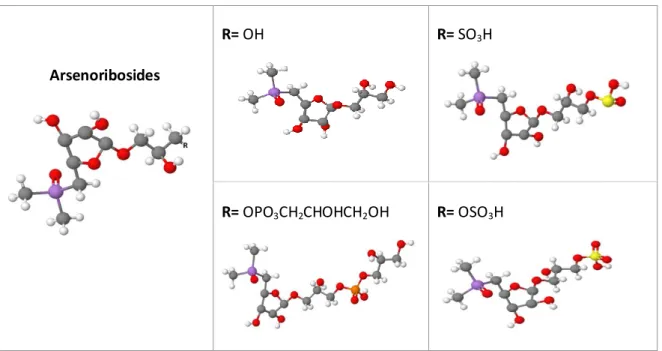
Most of the As in algae is bound to carbohydrate molecules and these As compounds are collectively referred to as sug; marine algae are considered to be the principal producers of As-sug and over 20 different chemical species have been reported in different classes of algal organisms11, 13. There are various types of arsenosugars dominant in algae, which are differentiated by end groups containing glycerol (OH), phosphate (PO4) sulfonate (SO3), and
sulphate (SO4) as shown in Table 2.
Table 2: Main types of arsenosugars present in algae. (Structure obtained from: http://molview.org/)
Arsenoribosides
R= OH R= SO3H
4
Glycerol-arsenoriboside and phosphate-arsenoriboside are common to all macroalgae species, while sulfonate-arsenoriboside and sulfate-arsenoriboside are limited to brown and a few red macroalgae species14.
1.2.1. Acid-base equilibrium: pH as a master variable
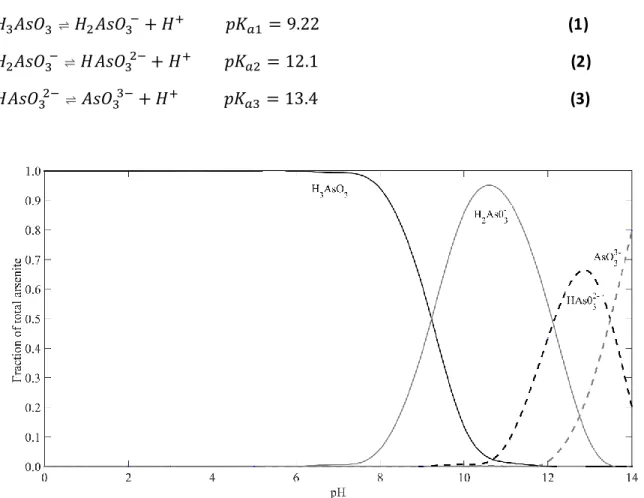
Two of the most important factors controlling arsenic speciation are pH and redox potential15. As shown in Figure 1, the distribution of the several forms of arsenite (H3AsO3, H2AsO3
-, HAsO32−, AsO33−) depends on the value of pH and the same happens for the several forms of
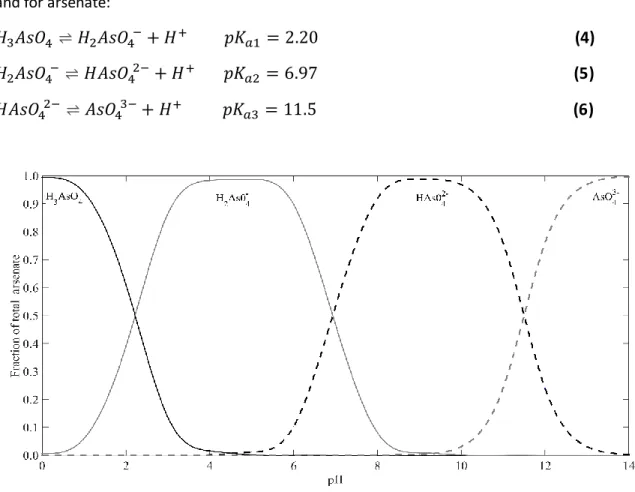
arsenate (H3AsO4, H2AsO4−, HAsO42−, AsO43−), as shown in Figure 2. Figures 1 and 2 are the
diagrams translating the acid-base equilibrium relationships, respectively, for arsenite:
(1)
(2)
(3)
5 and for arsenate:
(4)
(5)
(6)
Figure 2: Distribution of arsenate species as a function of pH at 25 °C
Figures 1 and 2 shows that the degree of protonation of both arsenite and arsenate is an important modulation factor for the mobility of those chemical species. For example, the pH of groundwater is often between 6.5 and 8.515, and within this range, H
3AsO3 and (H2AsO4- + HAsO42-)
are the dominant species.
In the present work, the study area is inserted in an estuary where the pH values vary between 7.5 and 9.9, and within this range, the dominant species are about the same as those found in groundwater: H3AsO3 for the arsenite while HAsO42- becomes predominant for the
arsenate.
1.2.2. pH-Eh equilibrium
The value of redox potential (Eh) indicates the strength of oxidation or reduction reaction
set in the environment under study. Its negative value confirms that solution demonstrates reducing properties, while positive value indicates about oxidizing reactions in the solution. Figure 3 shows the distributions of the inorganic species as a function of both pH and Eh.
6
Figure 3: Eh-pH diagram of aqueous arsenic species at 25 °C and 1 bar total pressure
.
Under oxidizing conditions, H2AsO4 is dominant at low pH (less than about pH 6.9), while
at higher pH, HAsO42– becomes dominant. Chemical compounds containing iAs might undergo a
series of transformations and turn into one another under the influence of different processes. Most of these conversions are caused by change of pH15.
The Eh of groundwater is often between -0.100 and 0.200 V15, and within this range
HAsO42- and H3AsO3 are the predominant species. However, in the present work, the study area is
inserted in an estuary where the Eh values vary between 0.119 to 0.446 V, and within this range, the dominant species are about the same as those found in groundwater: H3AsO3 for the arsenite
and HAsO42- becomes predominant for the arsenate.
1.2.3. Effect of ionic strength
In the Figures 1, 2, and 3, the ionic strength (I) has been considered zero whereas for estuaries it is necessary to apply corrections because the I derived from the salt concentration is much higher than that of the groundwater. Truesdell-Jones16 proposed a model for application in NaCl-containing solutions and concluded that the ionic strength of seawater is approximately 0.7 M and the coefficient of activity (γi) is approximately 0.3, thus causing activity (ai) to decrease
comparatively to concentration (Ci). Thus, the distribution of the species is not greatly affected,
7 (I = ~0.7 M ⇒γi = ~0.3 ⇒ ai = ~0.3 Ci, contrary to the ideal situation, where I = ~0 M ⇒γi = 1 ⇒ ai =
Ci). Therefore, it is possible to deduce that the relative distribution of the species is not much
affected, in contrast to their activities, which decrease due to the increase in ionic strength. However, the influence of ionic strength on estuarine systems should be studied in order to understand in detail and more accurately its influence on the activity and actual distribution of arsenic species.
1.3. Sources of arsenic in environment
Arsenic is the 20th most common element in the earth´s crust. Normal occurrence
concentrations are 0.2-15 mg kg-1 in the lithosphere, less than 15 mg kg-1 in soils, 0.02-2.8 ng/m3 in the atmosphere, and in the order of µg/L in the aquatic environment where the concentrations are typically around 1.5 µg/L in open seawater and 4 µg/L in estuarine water7, 17. In the marine environment, As occurs mainly in the inorganic forms (arsenite and arsenate), with a large predominance of arsenate18.
Arsenic has been made available mostly by natural sources, such as rock weathering and volcanic emissions, and it is widely distributed in soil, sediments, water, atmosphere, minerals, and biological tissues19. The rocks are the principal source of As, occurring primarily in sulphide
form in complex minerals containing also Ag, Pb, Cu, Ni, Sb, Co, and Fe. Although present in more than 200 mineral species, the most common arsenic minerals are arsenopyrite (FeAsS) and sulphides, such as realgar (As4S4) and orpiment (As2S3)19. The volcanic activity is the second major
source of As due to release of highly volatile compounds of As into the atmosphere.
Nevertheless, there is also a significant contribution from anthropogenic processes to the dispersion of As compounds into the environment, As it has been used in medicine (i.e. drugs), agriculture (i.e. arsenical pesticides, insecticides, wood preservatives, and soil sterility), livestock (i.e. feed additive), industry (i.e. pharmaceutical substances and electrophotography), electronics (i.e. solar cells and optoelectronic devices), and metallurgy (i.e. plates and alloys)5.
1.4. Toxicity of arsenic compounds
In general, the toxicity of As compounds depends on several factors such as oxidation number, physical state, particle size, rate of absorption into cells, and rate of elimination6, 20. Usually the lower the oxidation number the higher the toxicity, and the higher the methylation
8
the lower the toxicity21, 22, thus producing the following order of decreasing toxicity: arsine > arsenite > arsenate > monomethylarsonic acid > dimethylarsinic acid.
The arsenic compounds are also toxic to humans and the effects depend primarily on the chemical specie, route of entry, age, sex, dose, and duration of exposure. Humans are directly exposed to various forms of As, mainly through food and water. Although the As bioavailability depends also on the type of matrix in which it is ingested, the daily intake is considered to be about 20-300 µg for this type of exposure. Finally, the inhalation of As from ambient air is generally low, assuming a breathing rate of 20 m3d-1, the estimated daily intake is about 20-200 ng in rural areas and 400-600 ng in cities without significant industrial emission of arsenic8.
According to World Health Organization (WHO), the immediate symptoms of acute As poisoning include vomiting, abdominal pain, and diarrhea. These are followed by numbness and tingling of the extremities, muscle cramping and death, in extreme cases23. For long term exposure to high levels of inorganic As (iAs), the first changes occur in skin pigmentation and then skin lesions with patches on the hand palms and feet; it may also occur other pathologies such as peripheral neuropathy, gastrointestinal problems, conjunctivitis, diabetes, renal system failure, enlarged liver, bone marrow depression, destruction of erythrocytes, high blood pressure, and cardiovascular disease23.
Furthermore, there is also some evidence showing that As can lead to the development of cancers in skin, bladder, and lungs23, the International Agency for Research on Cancer (IARC) has classified iAs compounds as carcinogenic to humans (Group 1), while DMA and MMA are considered possibly carcinogenic (Group 2B)24.
1.5. Limits for arsenic compounds in drinking water and foodstuffs
High concentration of total As in drinking water is a potential health danger with serious toxicological concerns for human health. The Environmental Protection Agency (EPA) and WHO state that the threshold level of total As in drinking water is 10 µg L-1, while the limit values fordifferent As species has not been established25, which makes a compelling need for regulation based on the individual As compounds.
Moreover, there are no general accepted limits for algae based products. However, since the analysis of iAs is reliable for rice and rice based products, maximum levels were delimited and the European Union (EU) introduced regulations of 0.2 mg kg-1, expressed as As, for iAs in white rice and 0.1 mg kg-1 for iAs in rice-based foods aimed at infants and children26. In 2009, the
9 scientific Panel on Contaminants in the Food Chain (CONTAM) of the European Food Safety Authority (EFSA) identified a range of benchmark dose lower confidence limit values between 0.3 d 8 μg kg-1 body weight per day for inorganic arsenic species, but this range still is under revision26.
France was the first and only European country to lay down specific regulations on the consumption of seaweed, stipulating maximum values of 3 mg kg-1 for iAs27. Therefore, in several
European countries, such as Portugal, there is no specific legislation regarding contaminants in algal products.
10
2. Biotic and abiotic factors influencing arsenic accumulation in algae
2.1. Introduction
Bioaccumulation of As in aquatic organisms can derive from water, suspended particles, sediments, and through the food chain. The occurrence, distribution, and As speciation are of utmost importance for assessing the effects of bioaccumulation and trophic transfer through the food chain28.
Bioaccumulation is a combined result of two different processes: a) bioconcentration, where absorption of pollutants from water into organisms occurs across the whole trophic chain; and, b) bioamplification, where there is an increase in pollutant concentration as the trophic level increases across the trophic chain, thus higher trophic levels show progressively higher degree of contamination until reaching the top of the chain29.
2.2. Factors influencing arsenic bioaccumulation and detoxification
The accumulation rate depends not only on the availability of arsenic but also on biological, chemical, and environmental factors. Biotic and abiotic parameters such as, species, stage of life cycle, biological activities, biomass density, water temperature, water salinity, pH, light exposure, light intensity, dissolved oxygen, seasonal variation, and concentration of nutrients, namely nitrogen (N) and phosphorus (P) influence the bioavailability and bioaccumulation of As in algae28, 30, 31. Some studies demonstrate that As can be accumulated from water, food, and sediment, while seaweed accumulates arsenic directly from water, marine animals incorporate arsenic from feeding algae and can biotransform this iAs into oAs compounds28, 32, 33, 34.Maugh35 has attempted to explain the processes influencing As bioaccumulation in macroalgae and they have shown that the principal mechanism responsible for bioaccumulation is the competition between AsO43- and PO43- for absorption into the cells of algae. Arsenate is a
chemical analogue of phosphate, in size, geometry and ability to enter biochemical reactions thus facilitating its entry into the cells by transport mechanisms, unable to discriminate between PO4
3-and AsO43-. Hence, macroalgae absorb AsO43-probably due to their inability to distinguish it from
the essential anion PO43- 36,37.
Sanders and Windom36, found that the major inputs of As to the marine and estuarine environment were freshwater inflow and atmospheric deposition, resulting that macroalgae are exposed to arsenic as AsO43- at comparable concentrations of PO43-, which is an essential and
11 often growth-limiting nutrient in surface waters, and therefore accumulating dissolved AsO43- via
a cellular PO43- transport system.
Sanders38determined that PO43- concentration affected the AsO43- uptake at the different
arsenate concentrations tested. Increased phosphate significantly decreased the arsenate uptake in the culture and reduced the total arsenic concentration, while the increased uptake of AsO43- as
PO43- uptake increases at low PO43- concentrations is attributed to the increasing PO43- metabolism
and indiscriminate AsO43- uptake. One of the parameters previously mentioned that can influence
the bioavailability and bioaccumulation of As is the species of algae. According to Sanders38 there is a general trend: brown seaweeds (phaeophyta) contain higher concentrations of arsenic than red (rhodophyta) and green (chlorophyta) macroalgae. This trend may be due to the fact that brown algae have a higher phosphorus concentration in their cell and consequently accumulate more arsenic.
However, Klumpp30 considered that macroalgae exhibit a different mechanism for AsO4
3-and PO43- absorption, since in some marine algae the AsO43- does not compete with PO43-. He
studied the mechanisms and influence of various parameters in As uptake by Fucus spiralis and concluded that parameters like pH and salinity had no effect, however, an increase in temperature enhanced the uptake. The same author concluded also that the effect of PO43- at low
levels is of little importance in determining As levels in organisms in the natural environment. In relation to the effect of light as a parameter of As bioaccumulation, Bottino et al.39, showed that As uptake in marine alga Tetruselmis chui is light-dependent, and more light causes higher AsO43- uptake, suggesting that AsO43- adsorption is an endergonic process that may
compete with cell growth for available photosynthetic energy. However, contradictory results have been reported by Klumpp30 because for the macroalga Fucus spiralis, As uptake in the dark or in the presence of photosynthetic inhibitors is greater than in the presence of light. With this information it becomes possible conclude that the duration of exposure influences As concentration, depending on the macroalgae specie.
According to Challenger et al.40, after AsO43- uptake, algae reduce AsO43- to AsO33-, and
then subsequent methylation leads to the formation of methylated forms, such as MMA and DMA. Based on mechanism of As transformation by algae proposed by Challenger et al.40, Hellweger et al.41 proposed the mechanism depicted in Figure 4. In Figure 4 (a), under P-limiting conditions, the following steps are assumed: AsO43- uptake by algae, reduction of AsO43- to
AsO33-, sequential methylation of AsO33- to MMA and DMA, and finally excretion. Nevertheless,
3-12
active transport system and AsO43- is incorporated into the metabolic cycle of algae due to the
similarity between the PO43- and AsO43-, within the cell, the reduction of AsO43- to AsO33- is fast,
but the methylation is slower, causing AsO33- to build up in the cell. The consequence is the
occurrence of a peak in the intracellular AsO33- concentration and, because AsO33- is excreted,
inducing a peak in extracellular AsO33- concentration.
Figure 4: Mechanism of As transformation by algae. a) P-limiting conditions and b) non–P-limiting conditions41.
Challenger et al.40, refers that in seaweeds AsO43- accumulation is four times higher than
AsO33- accumulation, and this fact suggests more toxic AsO33- is excreted after the reduction
mediated by membrane associated transporter protein. Furthermore, methylated arsenic, MMA and DMA, are excreted rapidly, indicating that As methylation is a powerful detoxification mechanism present in algae.
Although the presence of As-sug in algae was not explained by Challenger et al.40, the presence of high concentration of this organic arsenical and the mechanism of As-sug synthesis need to be enlightened. Thus, Edmonds and Francesconi42, proposed a possible pathway for the
biotransformation of As(V) to As-sug by marine algae based on the sequential reduction of arsenate followed by oxidative methylation. These authors suggested that As-sug are produced by transferring the methyl and adenosyl groups of the methylating agent S-adenosylmethionine (SAM) to suitable agents, such as DMA. However, the mechanism for As-sug biosynthesis in seaweed involves no clear but complex mechanisms and it has not been completely established43.
13
3. Cultive of macroalgae in ALGAplus
3.1. Integrate Multi-trophic Aquaculture system (IMTA)
Integrated Multi-trophic Aquaculture (IMTA) systems are recognized as a suitable tool to sustainably increase animal aquaculture. The concept is based on the recycling of residues derived from the production of upper trophic levels by lower trophic organisms, with a production of an added value44. This approach has been used to convert monoculture into an ecological and more
sustainable aquaculture45, 46, 47, with positive environmental and socio-economic benefits for the
aquaculture industry.
The cultivation of seaweeds in IMTA promotes higher productivity and less variability than natural seaweed beds due to the higher availability of a constant supply of nutrients. As depicted in Figure 5, seaweeds assimilate the fish-excreted ammonia (NH4+), PO43-, and carbon dioxide
(CO2), converting them into potentially valuable biomass. With this integrated approach, effluents
can be recycled back into the fish ponds or can be discharged without endangering the environment48, 49. The IMTA can then minimize the load of nutrients normally discharged by fish
aquaculture processes into coastal waters, since seaweeds can remove up to 90% of the nutrient load from an intensive fish farm50.
Figure 5:Concept of Integrated Multi-Trophic Aquaculture. (adapted from Pereira and Abreu 51)
ALGAplus ( http://www.algaplus.pt/ ) is a company devoted to the production of seaweed and seaweed based products in controlled environment and with organic certification sited at Ílhavo (Aveiro, Portugal). This company is d R d v 40° 38’ N 8° 44’ W f h
14
most important and extensive coastal lagoon in the northern west Atlantic coast, of Portugal. This estuarine system is considered as a highly productive ecosystem due to its richness in nutrients and organic matter52. The lagoon has a maximum width of 8.5 km and a length of 45 km. The facilities of ALGAplus are sited in Ílhavo channel, which is an elongated shallow arm, of 15 km length.
ALGAplus is a pioneer Portuguese company in implementing a land-based seaweed cultivation system, under the IMTA sustainable concept, that is within a fish farm producing sea bass and sea bream. Infra-structures for algae production include an indoor nursery, a land-based tank cultivation system with several capacities, as well as earthen-ponds with variable sizes with water renewal related to the tidal cycles. Green, red, and brown seaweed species are grown with manipulation of production factors, such as stocking density, water renewal, harvest time, and aeration. ALGAplus has a strong focus in R&D associated with the production of macroalgae adapted to the food market needs also developing the crop species of interest. Processing currently includes washing, low-temperature drying and milling, and commercializes sustainable and high-quality seaweeds and seaweed-based products.
3.2. Macroalgae cultivated in ALGAplus
Algae are unicellular or multicellular autotrophs comprising a large diversity of organisms in relation to morphology, complexity, and size. There are two main types of algae: a) the microalgae, which constitute the phytoplankton found in euphotic zone and at the base of food chain; and, b) the macroalgae, which are also primary producers at the base of the food chain but can attain very large sizes, since some stalks of algae can achieve 65 m of extension when they are not subject to predation1.
Under the scope of this work, four species of macroalgae were selected from 3 distinct phyla, Phorphyra dioica and Gracilaria sp. (Rhodophyta), Ulva rigida (Chlorophyta) and Fucus
vesiculosus (Phaeophyta). They were cultivated in IMTA system and supplied by ALGAplus, Lda.
The excess of nutrients released in aquaculture production are used for the cultivation of the macroalgae U. rigida, Gracilaria sp. and P. dioica, although P. dioica is cultivated in laboratorial environment at ALGAplus, being placed in tanks to grow like U. rigida and Gracilaria
sp.. F. vesiculosus is captured from populations that grow naturally in Ílhavo channel and placed in
15 The following sub-headings displays the visual features of the macroalgae under study (Fucus vesiculosus, Ulva rigida, Porphyra dioica, and Gracilaria sp.) as well as the respective morphological characterization.
3.2.1. Fucus vesiculosus
Fucus vesiculosus (Figure 6) are very well known brown seaweeds which live completely
submerged as an intertidal marine alga commonly found on the coasts of the North Sea, Baltic Sea, and the Atlantic and Pacific Oceans53. They are useful as sources of bioactive compounds, and besides becoming a common food in Japan it is used as an additive and flavoring agent in various food products in Europe. Recently, fucoidan extracted from F. vesiculosus gained interest because of its biological activities and potential medical applications54.
Figure 6: Brown macroalgae, Fucus vesiculosus
Morphologically, F. vesiculosus varies in color from olive green to olive brown and it is typically about 40 cm in length. It is characterized by the small nearly spherical gas–filled vesicles which look like bubblewrap and it occurs in pairs55.
3.2.2. Porphyra dioica
Porphyra (Figure 7), known as nori, is considered the most valuable seaweed in the world,
with a continuous increase in production. In Asian continent these red algae have a high economic value, being widely used in human alimentation and they one of most eaten seaweeds56.
Porphyra are rich in proteins, vitamins and minerals such as iron, zinc, sodium, potassium, and
calcium57.
Figure 7: Red macroalgae, Porphyra dioica
Porphyra dioica is also of interest in this study since this specie is common in the North of
16
within a wide range of temperatures, photoperiod, and light intensity59. Morphologically are membranous, monostromatic, olive-green to brown-purple or blackish fronds, depending on the species and can reach 5 to 35 cm in length59.
3.2.3. Ulva rigida
Ulva rigida (Figure 8) comprise the genus Ulva, order Ulvaves and phylum Chlorophyta.
This green algae are found in a variety of habitats and on several different substrates60. They have a good vitamin and mineral profile and are especially rich in glutamic and ascorbic acids, alanine, and iron61, 62. Ulva has been widely used as a source of food in the farming of invertebrates, as fertilizer, biofilter, as well as complement ingredient in traditional food63, 64.
Figure 8: Green macroalgae, Ulva rigida
Morphologically, it is a green colored seaweed, with a laminar thallus with a rigid surface with waved margins and it is slippery to the touch. Ulva rigida can reach up to 10 cm in height, but size and blade shape are both highly variable65.
3.2.4. Gracilaria sp.
Gracilaria sp. (Figure 9) are one of the seaweed most exploited worldwide66. They are a non-indigenous Asian red algae naturalized in Ria de Aveiro, where it became the dominant
Gracilaria genus67, since they are well adapted to estuaries and highly resistant to various stressful factors such as darkness, sedimentation, desiccation, and variable nutrients conditions45,
68
. Gracilaria species are also efficient biofilters due to their good capacity to remove ammonia and nitrate from the water45, 69.
Figure 9: Red macroalgae, Gracilaria sp.
Morphologically, Gracilaria is a red macroalga that is cartilaginous, cylindrical and up to 50 cm long. Besides, it is coarsely branched70, 71.
17
4. Inductively Coupled Plasma Mass Spectrometry for total arsenic
determination
Inductively Coupled Plasma Mass Spectrometry (ICP-MS) was used in this work to determine the total concentration of arsenic in samples of algae grown in ALGAplus.
ICP-MS is an instrumental technique that in the last two decades has contributed significantly to studies involving the analysis of environmental, biological and geological samples, and allowed to identify and quantify the different chemical elements that compose a substance. This method can attain a very fast and high throughput multi-elemental analysis (10 - 40 elements per minute per sample) with a detection limit in the sub parts per trillion (ppt) range, and it enables quantitation at the high parts per million (ppm) level. ICP-MS also works over eight orders of magnitude detection level as a result of its higher sensitivity72.
ICP-MS technique consists of sample introduction into the plasma through the aid of a peristaltic pump so that the sample is aspirated into the nebulizer and converted into an aerosol using a gas flow (argon). The larger aerosol droplets are separated from finer droplets, which is optimal for efficient ionization in the ICP. Then, the finer aerosol droplets can then be swept into the ICP torch via argon gas flow. These newly formed ions then travel out of the torch and come to the ICP-MS interface where ions enter in the vacuum system and proceed to the mass spectrometer. Then the ions travel in the lens system where they are directed or focused to enter the quadrupole analyzer where they are separated based on their mass/charge ratio72.
18
5. Analytical speciation of arsenic accumulated in algae: introduction and
challenges
Chemical speciation can be considered as the determination of the concentration of the various chemical forms of an element in a matrix, and these species, together, constitute the total concentration of the element in the sample. The mobility, bioavailability, toxicity, and even biological metabolism of As depend on its chemical forms and respective structure. Therefore, the development of analytical techniques not only for the determination of total As concentration but for the selective determination of As compounds in different matrices such as, algae, becomes of extreme importance to acquire an adequate knowledge of the effects of As compounds on the environment, namely in marine and estuarine environmental compartments helping too in the introduction of regulations for iAs in seafood.
The importance of As speciation in algae led to important advances in the development of new analytical methodologies, that when used are subjected to a validation to ensure that analytical method generates reliable and interpretable information about the sample. The validation studies involve the evaluation of the performance characteristics of the method under defined experimental conditions in order to guarantee its applicability, quality control and quality assurance in the different steps of speciation. In addition, to ensure the reliability of the analytical results, it is necessary to take into account possible sources of error that may occur during the various steps prior to the quantification of the different As components, namely: sample collection and preparation, extraction, separation, and detection.
Table A. 1 in the Annex section depicts a summary of the work carried out by several researchers and it includes information about methods for sample preparation, extraction, preservation, separation, detection, and quantification of arsenic species in macroalgae.
5.1. Sample preparation
The setup of procedures for sampling is extremely important for the interpretation of the results in a survey. In order to sample representatively it should be included information on what the samples represent and how they were selected, as well as the weight and number of samples. Sampling procedures often involve a risk of contaminating the sample itself because the transportation and storage of samples involve risks of overheating or freezing, contamination, and chemical changes of matrix. Therefore, a clear description of these procedures becomes
19 necessary, which will make it possible to conclude where and how the eventual contamination occurred.
Sample preparation is the preliminary step of the analytical methodology and its adequate development is crucial for achieving results fit for purpose. The first step in this operation is the removal of epiphytic communities living in symbiosis with algae and other substances that might interfere in further stages of the analytical methodology: sample washing is often performed either with deionized and ultra-pure water or saline solutions similar to seawater. Whenever it is not possible to remove the epiphytic only by simple washing, the process is carefully performed manually or with the help of tweezers73. After the cleaning operation, algal material is generally dried and crushed until obtaining a fine powder. Freeze-drying and thermal treatments are the two options used for removing water from samples. For freeze-drying, the temperature conditions are from -30°C to -60°C, and the time of operation ranges between 24 and 48 hours and for thermal treatments, the samples are kept at temperature between room temperature and 60 °C for 18h to 48h73, 74.
According to Michalke75 and Rajakovic et al.76 problems such as stability, contamination or losses of samples, are frequent and they need to be well thought of and solved in advance. Salgado et al.77 investigated the stability of total arsenic, arsenite, and arsenate in Sargassum
fulvellum and Hizikia fusiformis, as well as in their aqueous extracts, and the results suggested
that samples remained stable for at least a period of 12 months without showing any degradation of the analytical signals. This information becomes essential when it comes to establish the most suitable preservation conditions to ensure the accuracy of the analytical results.
In the extraction process for the purpose of As speciation, the water and mixtures of MeOH:water are the extractants most widely-used. However, the extraction conditions vary significantly, for the following aspects: the range of extractants ratio volume to algal mass; sample exposure to thermal heating; conditions for microwave extraction; ultrasound aided extraction; and mechanical shaking. Not only those conditions influence the extraction efficiency and also the integrity of the native arsenic species during extraction, but also the extract may need further treatment prior to separation, like filtration, because particulates could damage chromatographic columns78.
20
5.2. Separation of arsenic compounds followed by detection and
quantification
Unlike detection and quantification of total elemental As concentration, speciation is only possible when detection methods are associated with a previous separation step. However, according to Welz79 , for samples containing only arsenite and arsenate the chromatographic
separation is not necessary and the determination of these components can supposedly be performed only by hydride generation coupled to atomic adoption spectrometry (HG-AAS). This technique is assumed to be efficient and consists on the determination of total inorganic arsenic (As(III) + As (V)) after pre-reduction of arsenate to arsenite generally with thiourea, ascorbic acid, or L-cysteine, while the determination of As(III) is conducted generally using hydride generation in controlled conditions, namely, HCl and NaBH4 concentrations in order to inhibit the reduction of
arsenate to arsine. Finally, the As(V) concentration is determined by the difference of both measurements. However, although this technique is accepted by various researchers79, 80, 81, several drawbacks have been reported82, 83, since this technique is extremely laborious, the reaction conditions must be well controlled and needs high amount of sample.
Hence, the methods available for the As speciation of macroalgae are generally a combination of separation techniques with systems of detection. The separation method most employed is high performance liquid chromatography (HPLC), due to the ease of coupling it with several detection systems, such as: HG-AAS, hydride generation coupled to atomic fluorescence spectrometry (HG-AFS); inductively coupled plasma atomic emission spectrometry (ICP-AES); or inductively coupled plasma mass spectrometry (ICP-MS)84, 85. Furthermore, the ICP-MS coupled with HPLC is the most popular technique used, because it is more efficient and provides very low quantification limits (1 µg L-1) and high selectivity for several species of arsenic, besides avoiding
several issues associated with matrix effects. However, this technique may have problems associated with interference from Cl- which depending on the respective concentration can produce 40Ar35Cl+ in the plasma and this interference is proportional to the concentrations of Cl- in the sample. Another disadvantage associated with this technique is the high costs of instrumentation and operation, leading many companies to attempting to find alternative and suitable methods for As speciation.
The combination of HPLC either with HG-AAS or HG-AFS is considered simple, fast and relatively inexpensive for As speciation, thus providing a tool that allows the separation and identification of known As species from their retention times as well as their detection and quantification for quantitative purposes86, 87.
21 The principal difference between HPLC-HG-AAS and HPLC-HG-AFS is the sensitivity of the method. Although detection limits, in the order of µg L-1, are achieved with the couplings
HPLC-HG-AAS these levels are sometimes not low enough to detect the As species present in biological samples. However, the sensitivity can be further increased with the HPLC-HG-AFS coupling, with limits of detection below µg L-1 similar to ICP-MS detection79.
5.3. Specific parameters for analytical quality control and quality
assurance
The quality control always plays a dominant role in any study of chemical speciation if the results are intended for example in the assessment of environmental quality or food safety. The key to successful speciation is the preservation of species information during the analytical procedure from sampling to the final result75. According to IUPAC88, the total analytical procedure must not modify the integrity of species and the result must reflect the original species information. Also, the choice of the method must be fit for the analytical purpose, thus becoming necessary to make the correct description and a statement on the degree of method validation. With respect to the method used it is important to clearly assess the predominant interferences present89.
The analytical performance of an analytical method must be evaluated through validation protocols and two of the most important parameters are the LD (limit of detection) and the LQ (limit of quantification). Through those limits, it is possible to define the lowest concentration of an analyte that can be reliably detected and quantified76, 89. Finally, a validation study is indispensable for the proper characterization of the analytical method used and it is also fundamental for achieving not only reproducibility but also trueness in results.
5.4. Reference materials, certified reference materials, and the matrix
effect
The certified reference materials (CRM) are materials sufficiently homogeneous and stable with respect to one or more specified properties, which have been established to be fit for its intended use in a measurement process characterized by a metrologically valid procedure for one or more specified properties, accompanied by a certificate that provides the value of the specified property, its associated uncertainty, and a statement of metrological traceability90.
22
One of the solutions to solving frequent methodological and analytical problems is the use of CRMs, which should be regularly used to ensure an appropriate level of quality assurance. However, the main problem associated with the determination of As species and their toxicological evaluation in seaweeds is the lack of reference materials for analysis of speciation, which have certified values of different chemical forms of the element analyzed78. Unfortunately, CRM certified species are only available for total As and arsenate, and for arsenate, the price of such materials is very high.
Table 3 lists the reference materials available for validation of As determinations and their certified values. The material NMIJ CRM 7405-a presents certified values not only for total As but also for arsenate, which allows some degree of checking for speciation analysis, at least for As(V).
Table 3: Reference materials available for validation of As determinations in algae
Material Reference Certified values
ERM-CD200
Fucus vesiculosus As: 55 ± 4 mg kg
-1
NMIJ CRM 7405-a
Sargassum fusiforme
As: 35.8 ± 0.9 mg kg-1 As(V): 10.1 ± 0.5 mg kg-1
The Institute for Reference Materials and Measurements (IRMM) of the Joint Research Centre (JRC), appointed seventy-four laboratories from 31 countries including the National Reference Laboratories which focused on the determination of total and iAs in wheat, vegetable food, and algae (Fucus vesiculosus)91. Most of the participants performed satisfactorily for total and inorganic As in vegetable food and wheat (85 and 60%, respectively), but only 20 % of the laboratories reported satisfactory results in the algae test material.
The matrix algae were considered much more challenging than the others, especially because they contain a large variety of organic As species that make the determination of iAs much more complex. Just only 20% of the laboratories involved in the study manage to fully operate under optimal analytical conditions and although an agreement on a value for iAs in algae could be reached, the low number of laboratories obtaining a satisfactory score suggests that this matrix poses special problems for this type of analysis.
Raab et al.92 performed a study where seven algae samples were distributed by 13 laboratories, and 5 of them attempted a full characterization of the water-soluble fraction regarding to the As species. From the 5 labs, only 3 produced results acceptable in what concerns
23 the identification and quantification of As species, although different chromatographic methods were used. The extraction efficiency was largely dependent on the algae species and varied from 3% to 96%. The results demonstrated that the three samples of Hijiki seaweed have a nearly quantitative extraction of As, while As in the Sea lettuce is only 30% extractable and even less in the freshwater algae Black moss (below 5%).
Khan et al.93 determined the levels of total As by ICP-MS and iAs speciation by LC-ICP-MS
in various edible species of seaweed. For the analysis of CRM (NMIJ CRM 7405-a) the spiking recovery for arsenic species was 102% which further confirmed that there was no significant loss or gain for each analyte during the digestion/extraction procedures. The mean values of recovery for the CRM was found to be within the interval of confidence (p < 0.05) calculated for the certified values, confirming the applicability of the analytical method94. Based on these results for the analytical quality parameters, the methods were found to be very efficient for application to the determination of for As species in edible seaweed samples.
However, through the study of the literature, it is possible to perceive the difficulties in obtaining credible and consistent values for the iAs. It is important to reinforce the need to develop CRMs to assist in the validation of analytical methods, especially in complex matrices such as edible algae.
24
6. Analytical speciation of arsenic in algae: focus on fit for purpose methods
6.1. Sample clean-up with emphasis in solid phase extraction (SPE)
The various techniques of clean-up of samples aim at selectively separating the analyte of interest from all the other components of the sample matrix which may interfere in the analysis.Although there is already some information about the series of important steps involved in the analytical process before the chromatographic separation of As species, in order to achieving results fit for purpose, the literature often neglects the relevance of clean-up of sample extracts prior to their injection into the HPLC system. This is a crucial step in the whole analytical process because residual matrix components that are introduced to the column along with the analytes can be problematical and interfere heavily both the separation and detection steps. The extract clean-up procedure is particularly important and difficult for the biological samples, like macroalgae. The organic matter due to the presence of significant amounts of lipids, polysaccharides, proteins, pigments, and salt in the sample matrix can result in some deleterious effects in column chromatographic, such as blockage inside the column and loss of resolution between the chromatographic peaks, thus shortening drastically the overall column life.
In order to achieve a cleaner extract, free of pigments and to preserve the chromatographic system, Choi et al.95, incorporated a single clean-up step in sample extracts was by passing the final extract (50% (v/v) MeOH in 1% HNO3) through Oasis® MAX (150 mg). After
cleanup, Choi et al.95 verified that most of the seaweed pigments were removed and the eluate
was clearer, concluding that this method provided a quick and suitable clean-up for the crude seaweed extract with good recoveries (104-120%).
Yuan et al. 96, in a study on As speciation in rice, reported that the large amount of organic matter in extracts can origin interferences and loss of resolution between the chromatographic peaks during the chromatographic separation. Thereby, the researchers investigated three clean-up methods: C18 cartridges, activated carbon, and hexane. They concluded that when C18
cartridges were used, the hydrophobic matter and large organic molecules could be removed and the recoveries for As(III) and As(V) were nearly 100%, while the recoveries when hexane was used were 80.4 ± 6.2 to 95.9 ± 2.9%, and finally the activated carbon no recovery detected. Narukawa and Chiba97 reported similar undesirable effects when they observed the tendency for peak width to increase and peak height to decrease with increasing number of replicates. The measurement errors occurred because the viscosity of the rice flour extract was high and the problem was
25 solved with internal standardization. There was no need for cleanup, other than centrifugation and filtration.
Moreda-Piñero et al.98, in a study about pre-treatment for the As speciation in seafood, considered the use of a clean-up procedure based on C18 for preventing polar substances and salts
to reach the analytical column during the analysis of extracts, and verified that C18 produced the
highest extraction efficiencies, with recoveries around 100%.
López-Gonzálvez et al.99 highlighted the importance of a clean-up procedure in the analysis of urine due to the high amount of salt and organic material content with deleterious consequences for the analytical system, when the urine sample is directly injected into a HPLC system. These investigators referred the importance of the use of C18 to partially clean-up the
urine prior to injection into the HPLC column in order to avoid lack of species separation, peak splitting, and peak broadening owing to column overload which causes a dramatically reduction in column lifetime. Low et al.100, in a similar study, documented the presence of high chloride concentration in urine and seawater samples. They verified notorious consequences in the separation of As species by ion chromatography, leading to the splitting of a single peak into two or more discrete peaks, as a result of the large differences in the ionic strengths of the mobile phase and injected volume of sample. The authors concluded that the peak splitting can be minimized by inclusion, in the mobile phase, of a column surface modifier, di-n-butylamine phosphate. This modifier enhances the selectivity of As speciation by anchoring positively-charged amine molecules on the column surface, then allowing the modified column surface to accommodate a larger concentration of anions.
Therefore, according to the studies of the literature reported above, solid phase extraction method (SPE) is widely used in biological, clinical, and environmental sample cleaning. The steps involved in a SPE procedure are dependent on the type of matrix, and consists initially of conditioning the cartridges in order to wet and settle the stationary phase, and activate the packing materials, to increase the effective surface area and to remove interferences. After conditioning, the sample matrix is retained in the sorbent and the analyte elutes through the cartridge.
26
6.2. Development of fit for purpose methodologies for arsenic
speciation
6.2.1.1. Anion exchange chromatography
Ion exchange chromatography is a process wherein a solution of an electrolyte is brought into contact with an ion exchange resin and active ions on the resin are replaced by ionic species of a similar charge from the analyte solution14. Competition between ions of the stationary phase
and those of the analyte allow chromatographic separation to occur based on the difference in migration rates among the analyte components. To achieve a successful separation, the effects of pH and ionic strength of the eluent can be manipulated until optimum conditions are obtained.
The anion character of the species of iAs under particular pH and redox conditions determined that greater flexibility and suitable separation would be obtained using anion-exchange chromatography. Thereby, a Phenomenex Phenosphere SAX 80 A (150 x 2.0 mm) was used in this work, wherein the anion exchanger used in the stationary phase is a silica gel resin having a strong basic quaternary ammonium functional group. The quaternary ammonium functional groups are positively charged and when the sample is injected into the mobile phase the present anions (arsenite and arsenate) interact with the cations in the stationary phase. The differences of adsorption, ion exchange and size lead to different degrees of interaction, resulting in the separation of the ionic compounds. The higher the degree of interaction of the analyte with the stationary phase, the longer it takes to elute, thus exhibiting a longer retention time. A good example is the arsenic speciation, where the arsenite elutes rapidly due to little interaction with the stationary phase, while arsenate elutes slower due to the high interaction with the stationary phase.
6.2.2. Fundamentals of separation and detection by HPLC-HG-AAS
According to the previous study of the methods used for the speciation of arsenic (Section 5.2), it was decided to couple HPLC with HG-AAS, because this method is a simple methodology requiring relatively inexpensive and versatile instrumentation, with a good detection power for inorganic arsenic.
An HPLC pump (Jasco PU-2089 Plus quaternary gradient pump) was coupled with a continuous flow hydride generation system installed in an atomic absorption spectrometer (GBC HG3000 Avanta). For coupling the chromatographic and the detection systems, it was necessary
27 to connect the column effluent to the bottom of the mixing manifold, while the HCl and NaBH4
were fed on the left side of the mixing block as shown in Figure 10.
Figure 10: Schematic diagram of HPLC-HG-AAS
The principle of this method consists in injecting the sample into the HPLC injection port and separation the different components of inorganic arsenic in a chromatographic column. Then, after separation, inorganic arsenic compounds will react with NaBH4 in acid medium (HCl) to
produce volatile arsenic hydride, AsH3. The generated hydride is separated from the liquid phase
in the gas-liquid separator and subsequently transferred by an inert carrier gas (nitrogen), to the adsorption quartz cell atomizer, heated up by a blanket (900 °C) (EHG3000) which provides more accurate temperature control than the flame. For detection, an arsenic hollow cathode lamp (Orpington, Kent, UK) was used, with a wavelength of 193.7 nm and bandpass of 2.0 nm.
6.2.2.1. Mechanisms and operational conditions
The chromatographic conditions used in the determination of iAs compounds were attained with the use of a Phenomenex Phenosphere SAX 80 A (150 x 2.0 mm) anion exchange column. The mobile phase was 8 mM di-Sodium hydrogenphosphate (Na2HPO4, Scharlau) and 8
mM Sodium di-Hydrogenphosphate-monohydrate (NaH2PO4H2O, Panreac) adjusted to pH 6, with