MAIN ORIENTATIONS OF SCIENCE EDUCATION RESEARCH AND
RESEARCH TYPES: A CRITICAL ANALYSIS OF THE MOST INFLUENTIAL
PAPERS (1993-2002)
J. Bernardino Lopes [1] [4], Fátima Paixão [2] [4], António Cachapuz [3] [4] [1] Associate Professor, Departamento de Física, UTAD, Vila Real, [email protected] [2] Coordinator Professor, ESE, Instituto Politécnico de Castelo Branco, Castelo Branco,
[3] Full Professor, Departamento de Didáctica e Tecnologia Educativa, Universidade de Aveiro, Aveiro, [email protected]
[4] Centro de Investigação Didáctica e Tecnologia na Formação de Formadores. Universidade de Aveiro. Portugal
Abstract
In the last few years, there has been a trend inside the Science Education Research (SER) community to analyze the “health” of SER (e.g. Fensham, 2004; Gilbert, 1995; Horton et al. 1993; Jenkins, 2000; Millar & Osborne, 1998).
Our aim is to explicit the relationship between the main orientations of science education research (for practice or theory) with research type (categories defined by Tsai & Wen, 2005, e.g. empirical, theoretical, position papers and revision research).
The corpus of the selected papers was formed by the most influential SER papers in the period between1993-2002. Two main criteria were used to select the papers:
i) Papers published in three of the most important international SER journals (SE - Science Education, JRST - Journal of Research in Science Teaching and IJSE - International Journal of Science Education);
ii) Papers of a restricted group of “more times cited” in each year.
We identified the 152 most influential papers: 43 from SE; 73 from JRST; and 36 from IJSE. Our analysis show that the empiric research type prevails among all main orientations of SER (for practice, for theory or for policy). Only a small group of studies is concern to find and make explicit the reference points of Science Education field. This work may contribute to transpose the fragmentation obstacle of present SE knowledge. A good start point would be characterize what we know about SE and identify the persistent problems and the new problems.
Introduction
In the last few years, there has been a trend inside the SER community to analyze the “health” of science education research (SER) (e.g. Fensham, 2004; Gilbert, 1995; Horton et al. 1993; Jenkins, 2000, 2001; Millar & Osborne, 1998; Osborne, 1992) or new trends in science education (e.g. Gil-Perez, 1996; Fraser & Tobin, 1998; Gabel, 1994; Perales, & Cañal, 2000; Behrendt et al. 2001; White, 2001). With different emphasis and focus, these type of studies soon appeared in the origins of SER (e.g. Curtis, 1963). What is new in recent studies, in particular during the last decade, is their systematic nature. These studies, published in the main international journals, point to some relevant aspects of SER or make explicit general relationships. In our view, the interest of such exercise is to gain a better comprehension of the nature of SER knowledge, to define research priorities and to propose ways to improve the field.
In spite of the added value of all these studies to SER, two general remarks should be made concerning these reviews.
The methodologies followed, in some cases, may lead to somewhat ambiguous results. For example Fensham (2004) looks to „the emergence of science education as an international field of research from three dimensions: (1) its identity as a research field; (2) the researcher as a person; and (3) trends in the research. He interviewed several prominent researchers asking them two questions: “Tell me about two of your publications in the field that you regard as significant”; “Tell me about up to three publications by others that have had a major influence on your research work in the field”. Holliday (2003) has the “goal of selecting a representative sampling of the best articles published since 1963” in the Journal of Research in Science Teaching. Seven researchers in the Holliday list were also in the Fensham pool of interviewees. However, a comparison of the major influential articles in the Fensham and Holliday lists indicates a little overlap (Kahle, 2005). In addition, among the articles that Fensham‟s interviewees identified as “publications by others that have had a major influence on your research,” there was only one overlap (Kahle, 2005). “The Holliday list was culled from many nominators, who tried to look at the whole field, not only their own work. That perspective may explain the discrepancy between the two lists” (Kahle, 2005). In short, the approach to identify influential SER through their experts‟ choices has limitations.
There are authors analysing SER in terms of its theory or practice characteristics or in terms of implications for theory or practice development (e.g. Hogan, 1999; Brown, 2005; Evans & Benefield, 2001; Simmons et al., 2005; Furlong & Oancea, 2005; Clements, 2007). However, the main research orientation as a construct to analyse the purposive focus of the research contribution is absent in the studies referred above in spite of any knowledge body have main purposive orientations (Lijnse, 2004) in which its community members can work and the respective knowledge can grow, change and mature (Eybe & Schmidt, 2001). Eybe and Schmidt (2001) recognize that, in the context of evaluation of quality criteria in chemistry education research, the orientation toward practice can be observed on the meta-level. Simmons et al. (2005), in the context of trying to develop a research agenda in science education, use the Pasteur‟s Quadrant (quoting Stokes, 1997) to organize scientific research as a systematic and pragmatic process of inquiry in a quadrant with two dimensional structure for theory and practice divided into four cells. Brown (2005) and Furlong and Oancea (2005), in the context of describing what is to count as applied or practice-based research, discuss and propose a “multiple models of research conducted in with and/or for practice”. So several authors recognize (e.g., Hogan, 1999; Springer, Stanne & Donovan, 1999; Brown, 2005; Evans & Benefield, 2001; Simmons et al., 2005; Furlong & Oancea, 2005; Clements, 2007), at least implicitly, that there are two dimensions that structure the SER: the orientation toward theory and the orientation toward practice. The epistemological status of the
theoretical dimension is consensual. As Meleis (1997) notes, theory analysis can be used to: compare and contrast different explanations of the same phenomenon; identify schools of thought; identify effective theories; identify gaps in knowledge; enhance the potential of constructive changes and further theory development; identify strategies for theory development; define research priorities. The epistemological status of the practical dimension is not consensual as source of knowing or knowledge. In general, the majority of authors discuss these questions concerned with the importance of the practical dimension of SER (Eybe, & Schmidt, 2001). This issue were traditionally viewed as “implications for practice” (e.g. Hogan, 1999) or conduct to a research informed practice (Brown, 2005). Recently the practice is view a source of knowing and knowledge (Cook & Brown, 1999) calling for an epistemology of practice that are been pursued in SER (e.g. Wickman, 2004).
Category system of main research orientation of SER
In table 1 we present the rationale of the category system for main research orientations used to analyse the corpus together with illustrative examples of the papers (see Appendix I).
Table 1 Rationale of category system of main research orientations and examples
Meta Dimensions Examples
Oriented towards practice.
The research focus is to produce knowledge aiming to improve the practice (e.g. teaching, learning and/or of the practice of teachers' education).
Papers 01, 02, 03, 04, 05 and 06 of the corpus (Appendix I)
Oriented towards theory.
The research focus is to test hypothesis and/or "theoretical models" already proposed or to propose a theoretical alternative to the existent one. It is not primarily concerned about the practical use of the produced knowledge.
Papers 07, 08, 09, 10, 11 and 12 of the corpus, (Appendix I)
The reasons and purposes of this study
This study is a part of a large study about the state of art of SER (Cachapuz, Lopes, Paixão & Praia, 2005; Paixão, Lopes, Praia, Guerra, & Cachapuz, 2008; Cachapuz, Paixão, Lopes, Guerra, 2008).
The focus of this paper is to understand why it is difficult to construct a “specific and coherent corpus of knowledge, to bring together the too many fragmented results still existing” (Cachapuz, Lopes, Paixão & Praia, 2005). Our aim is to identify the main orientations of SER (and its evolution over time) and to identify possible relationships with research type (categories defined by Tsai & Wen, 2005, e.g. empirical, theoretical, position papers and revision research).
Methods
The corpus of the selected papers was formed by the most influential SER papers in the period between1993-2002. Two main criteria were used to select the papers:
i) Papers published in three of the most important international SER journals; ii) Papers of a restricted group of “more times cited”.
The first criterion was accomplished by using the factor impact of each SER journal indexed in the most important database: Institute for Scientific Information (ISI). Three important journals were selected: SE - Science Education, JRST - Journal of Research in Science Teaching and IJSE -
International Journal of Science Education corresponding to a universe of 1898 papers published
(459 in SE, 724 in JRST and 715 in IJSE).
The second criterion was more difficult to make operational. If the criterion “times cited” per paper was applied in a blind way the most recent papers might be, in their great majority, rejected. Besides, the three journals do not present the same impact factor. In other words, if the criterion "times cited" was used indiscriminately we might privilege the oldest papers and papers of a certain journal. So, we introduce two additional sub-criteria: “temporary partition of the considered decade” and the "impact factor" of each journal. Thus, based on ISI database, the papers were listed in each journal and in each year by decreasing order of times cited. The papers were selected until reaching the order number whose value is given by the following formula:
Nyeari.journalA 0,1*fA*nAi,
where, Nyeari.journalA - number of papers of journal A in the year i that is in the percentage 0,1*fA of
the most cited papers; nAi - total number of papers of journal A in the year i; fA - mean impact factor
of journal A. So, the number of selected papers for journal A is given by:
2002 1993 i.j ournalA y ear N i journalA N .As a result we identified the 152 most influential papers: 43 from SE; 73 from JRST; and 36 from IJSE.
It should be noted that our study involves the most influential SER papers in the decade referred to above. In any way do we assume that they represent the universe of SER. We simply assume that they represent a significant corpus which may have an important influence on SER. Each article was analyzed until saturation of the data in order to identify its main orientation, year of publication, research line and type, research context as well as a synthesis of the most important results. Consistency of the dimensions of analysis with the research aims was assured.
Following a pilot study (three papers independently analyzed by all the members of the research team in order to test the consistency of the analysis), papers were randomly assigned to the researchers so that each paper was independently analyzed by two researchers. The results obtained were crossed analyzed and discussed to reach a consensus decision. After this first step, the concordance was of 95%. The remaining cases were reanalyzed by a third researcher in order to reach a decision and to be included in the final corpus.
Results
SER main orientations over time and their main characteristics
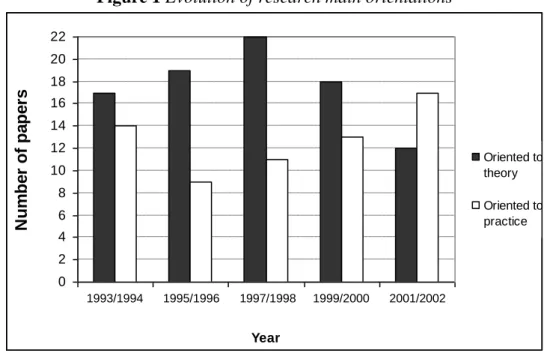
We chose to present the results per pair of years to make the trend clearer along the time. However, this trend is analogous with the one obtained when the analysis is made per year. The pattern of the results (figure 1) shows that the SER is mainly oriented towards theory. The frequency presents a maximum in 1997/1998 and decreases in the decade‟s following years. A supplementary analysis shows that papers oriented towards theory have one of the following general characteristics:
i) Empirical evidences of aspects which may help to construct a theoretical framework of science education (the major part of papers).
ii) They establish some milestones on a theoretical framework of one given aspect of science education.
iv) They test the usefulness of a theoretical framework to describe or examine tools, and practices.
In addition we verify that a small group of researches oriented to theory present a new theoretical framework on a new issue or an alternative framework to an existing one.
Figure 1 Evolution of research main orientations
0 2 4 6 8 10 12 14 16 18 20 22 1 2 3 4 5 Year N u m b e r o f p a p e rs Oriented to theory Oriented to practice
Another relevant aspect of the results is the increase in the number of papers about practice oriented research, in particular in 2001/2002. Generally speaking these type of papers: (i) Identify a specific characteristic or difficulty in teaching, learning, or teacher education and suggest a way of solving it. (ii) Investigate how to use a model to deal with specific learning difficulties. (iii) Describe teaching strategies on a specific subject content or identify a given teaching aspect and their working conditions to improve teaching and learning. (iv) Describe practices and identify patterns about a particular issue (e.g. types of discursive resources used by students. (v) Evaluate ways of using a given educational tool. (vi) Evaluate the relationships between a new practice introduced and its effects on a specific learning aspect. None of these characteristics are particularly dominant. Very few papers are concerned with establishing the milestones of the theory or practice of science education.
Main research orientation and research type
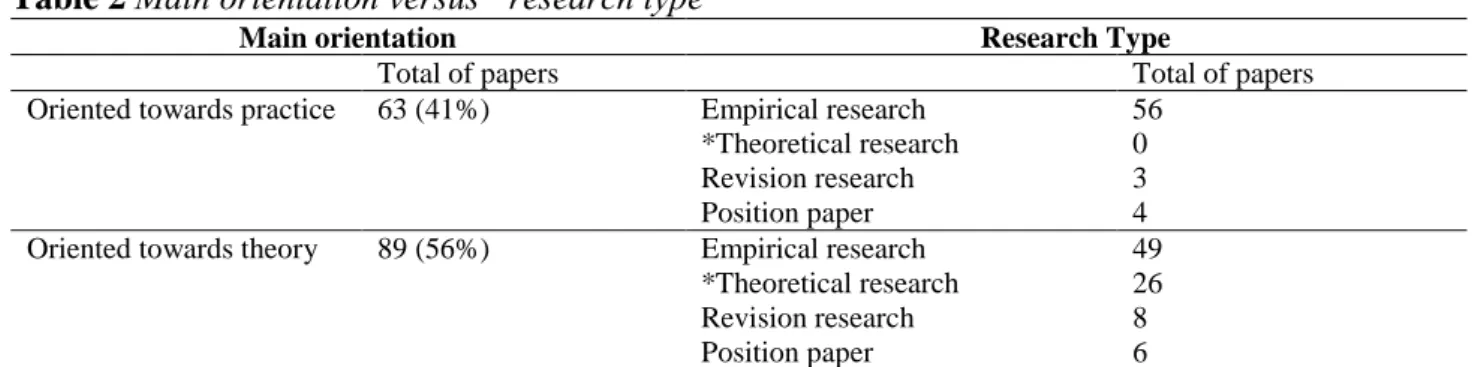
Table 2 shows the cross tabulation of the main SER orientations with research type papers. Empirical type papers are dominant both in the case of theory and practice oriented research. Position and revision type papers have a small contribution to theory oriented research.
Research oriented to practice is largely supported by empirical type papers. A small number of papers explore controversial issues (eg. the role of Sociology of Science to promote a more inclusive science education). Consistently, we note that theoretical type papers are absent in the case of research oriented towards practice and more salient in research oriented towards theory. As a whole, revision and position type papers have only a residual relevance to practice oriented research.
Table 2 Main orientation versus “research type”
Main orientation Research Type
Total of papers Total of papers
Oriented towards practice 63 (41%) Empirical research *Theoretical research Revision research Position paper 56 0 3 4 Oriented towards theory 89 (56%) Empirical research
*Theoretical research Revision research Position paper 49 26 8 6
Note: *Theoretical research may be considered as non empirical research aiming to theorize specific aspects of science education.
As table 2 shows the research oriented to theory is mostly supported by the empirical type papers. They are almost the double of theoretical type papers. This result is in agreement with the dominant general characteristic of the papers oriented to theory referred to above. The number of position papers oriented to theory is relatively small considering the need to tackle in depth a diversity of important SER issues.
The structure of the research types that support research evidences two general characteristics: i) There are many theorizations of several specific domains without overlap.
ii) The empirical research type support, in majority, the research oriented to practice. They do not seem to offer an instrument to corroborate most of the theoretical effort which is known to be quite dispersed in many research lines and several scientific disciplines (Paixão, Lopes, Praia, Guerra, & Cachapuz, 2008).
Discussion and conclusions
It is known that SER results are not necessarily mutually coherent, that is, the problems posed, the foundations, methodologies and the interpretation of results are not the only ones possible (Jenkins, 2000). In this paper we focused our attention on a meta-dimension (main orientations) of SER and its relationships with research type that may help towards a better comprehension of the field. As a whole, research oriented towards theory was predominant though it seems to lose its predominance with time in favour of practice. It would be interesting, in a follow up study, to involve researches since 2003, to check whether this pattern is maintained. Even though the majority of analyzed researches were theory oriented, a small group of them presented a new theoretical framework. Theory oriented research helps to explore other knowledge domains not accessible from practice oriented research. The research oriented to practice increased over time but are dispersed. This dispersion may be caused by the richness and complexity of science education practice. However, what is important to discuss is whether SER needs a lot of researches oriented to practice to produce a large corpus of evidences or needs another research approach to science education practice.
Some structural aspects which may help to explain the difficulties in constructing a coherent science education body of knowledge were identified, namely: (i) few studies that identify the relevant milestones both in theoretical and practical oriented research; (ii) Missing aspects in both theory and practice oriented research; for example, the frequent lack of evidence that empirical
research studies offer to corroborate existing theoretical frameworks. So, there is a lack of high quality revision and position papers binding the still fragmented pieces of knowledge. A good starting point is to characterize what we already know as the SER milestones and to identify the problems lying ahead. The SER community should begin from now, as a priority, to analyze relevant contributions in order to construct a more coherent body of knowledge, and the revision researches oriented to theory or oriented to practice have an important role to help the teachers and to construct a more coherent body of knowledge. So research policy in SER should change to accommodate these needs.
Implications of the study
There are many studies on the reduced influence of SER on practice (e.g. Costa, Marques, & Kempa, 2000; Gilbert, 2002; Kempa, 2002). In our view, the existence of such a gap is not surprising, simply because the nature of SER is different from the practice of science education. For example, SER tends to look far and not for immediate results. Thus, the professional concerns and the questions that science teachers have to answer on their day-to-day teaching do not frequently coincide with those of researchers. The problem is how to minimize such a gap in a fruitful manner for all parties involved. Our research may better illuminate some of the reasons for such a gap as it suggests a minority of studies oriented towards the practice of science education, in particular revision type studies. SER policy should change in order to accommodate these needs. It seems that the key question is: What is the role of the practice oriented research in the research priorities? Although it has been frequently acknowledge that the selection of research priorities should be guided by relevant criteria like “should be relevant for solving science education problems (questions that researchers, teachers, schools, society… consider important)” (Cachapuz et al. 2005), the most influential papers in SER community are still not oriented to this kind of priorities. Going back to the goal of this paper we hope that, though with limitations, the contributions presented in this paper may foster the advance of science education research.
This research was supported by FCT (Portuguese Ministry of Science, Technology and Higher Education), grant POCTI/CED 45497/2002.
References
Behrendt, H., Dahncke, H., Duit, R., Graber, W., Komorek, M., Kross A. & Reiska P. (Ed.). (2001). Research in Science Education - Past, Present and Future. Dordrecht: Kluwer Academic Publishers.
Brown, S. (2005). How can research inform ideas of good practice in teaching? The contributions of some official initiatives in the UK. Cambridge Journal of Education, 35(3), 383 – 405.
Cachapuz, A., Paixão, F. Lopes, J. B., Guerra, C. (2008). Do Estado da Arte da Pesquisa em Educação em Ciências: Linhas de Pesquisa e o Caso “Ciência-Tecnologia-Sociedade”.
ALEXANDRIA Revista de Educação em Ciência e Tecnologia, 1(1), 27-49.
Cachapuz, A.; Lopes, J. B.; Paixão, F. & Praia, J. (Eds.) (2005). Proceedings of the International
Seminar on “The state of the art in Science Education Research”,15th -16th October, 2004,
Portugal. (CD-Rom, ISBN: 972-789-174-8). (Available in http://www.ua.pt/PageText.aspx?id=5760).
Clements, D.H. (2007). Curriculum Research: Toward a framework for “Research-based curricula”.
Journal for Research in Mathematics Education, 38(1), 35-70.
Cook, S. D. & Brown, J. S. (1999). Bridging epistemologies: the generative dance between organizational knowledge and organizational knowing. Organizational Science, 10(4), 381-400. Costa, N., Marques, L. & Kempa, R. (2000). Science Teachers‟ Awareness of Findings from Education Research. Research in Science & Technological Education, 18(1), 37-44.
Curtis, F.D. (1963). The evolution of science-education research. Journal of Research in Science
Teaching, 1(1), 13-14.
Evans, J. and Benefield, P. (2001). Systematic Reviews of Educational Research: does the medical model fit? British Educational Research Journal, 27(5), 527 – 541.
Eybe, H. and Schmidt, H.-J. (2001) 'Quality criteria and exemplary papers in chemistry education research', International Journal of Science Education, 23(2), 209 – 225.
Fensham, P.J. (2004). Defining an Identity: The Evolution of Science Education as a Field of
Research. Dordrecht: Kluwer Academic Publishers.
Fraser, B., & Tobin, K. G. (eds.) (1998). International handbook of science education. London: Kluber Academic Publishers.
Furlong, J. & Oancea, A. (2005). Assessing quality in applied and practice-based educational research: A Framework for discussion. Oxford University Department of Educational Studies. Research report. Available online at: http://www.aare.edu.au/05papc/fu05018y.pdf (accessed Jun 2007.
Gabel, D. L. (ed.) (1994). Handbook of research on science teaching and learning. New York: MacMillan Pub Co.
Gilbert, J. K. (1995). Studies and fields: directions of research in science education. Studies in
Science Education, 25, 173-197.
Gilbert, J. K. (2002). Science Education and Research. In S. Arons & R. Boohan (Eds.), Teaching
Science in Secondary Schools (pp. 217-222). London: Routledge Flamer.
Gil-Pérez, D. (1996). New Trends in Science Education. International Journal of Science
Education, 18(8), 889-901.
Hogan, K. (1999). Relating Students‟ Personal Frameworks for Science Learning to Their Cognition in Collaborative Contexts. Science Education, 83,1–32.
Holliday, W. G. (2003). Influential Research in Science Teaching: 1963–Present. Journal of
Research in Science Teaching, 40, supplement, pp. v–x.
Horton, PB; Mcconney, AA; Woods, AL; Barry, K; Krout, HL & Doyle, BK (1993). A content-analysis of research published in the journal-of-research-in-science-teaching from 1985 through 1989. Journal of Research in Science Teaching, 30 (8): 857-869.
Jenkins, E.W. (2000). Research in Science Education: Time for a Health Check? Studies in Science
Education, 35, 1-26.
Jenkins, E.W. (2001). Science Education as a Field of Research. Canadian Journal of Science,
Mathematics and Technology Education, 1(1), 9-21.
Kahle, J. B. (2005). Defining an identity: The evolution of science education as a field of research.
Science Education, 89(3), 522-524.
Kempa, R. (2002). Research and Research utilisation in Chemical Education. Chemistry Education:
Research and Practice in Europe, 3(3), 327-343.
Lijnse, P. (2004). Didactical structures as an outcome of research on teaching-learning sequences?
Meleis, A I. (1997). Theoretical nursing. Development and progress. 3rd.. New York, Lippincott. Millar, R. and Osborne, J. (1998). Beyond 2000: Science education for the future. A report with tem
recommendations. King‟s College. London. School of Education.
Osborne, B. (1992). Science Education: a concise review of the past thirty years. Perspectives, 45, 6-13.
Paixão,F.; Lopes, J. B.; Praia, J.; Guerra, G and Cachapuz, A. (2008). Where are we? A contribution to a better understanding of the state of the art in science education research. Journal of
Science Education, 9(1), 4-8.
Perales, J.;& Cañal P. (eds.) (2000). Didáctica de las ciencias experimentales: teoría y práctica de
la enseñanza de las ciencias. Alcoy: Marfil.
Simmons, P. E.; Brunkhorst, H., Lunetta, V., Penick, J., Peterson, J., Pietrucha, B., and Staver, J. (2005). Developing a Research Agenda in Science Education. Journal of Science Education and
Technology, 14(2), 239-252.
Springer, L., Stanne, M. E., Donovan, S. S. (1999). Effects of Small-Group Learning on Undergraduates in Science, Mathematics, Engineering, and Technology: A Meta-Analysis. Review
of Educational Research, 69(1), 21-51.
Tsai, C.-C. & Wen, L.M.C. (2005). Research and trends in science education from 1998 to 2002: A content analysis of publication in selected journals. International Journal of Science Education, 27, 3-14.
White, R. T. (2001). The revolution in research in science education. In V. Richardson (Ed.).
Handbook of research on teaching (4th ed.). Washington DC: American Educational Research
Association.
Wickman, P.-O. (2004). The Practical Epistemologies of the Classroom: A Study of Laboratory Work. Science Education, 88,325– 344.
APPENDIX I – EXAMPLES OF THE CORPUS
[01] Harrison, A. & Treagust, D. (2000). Learning about atoms, molecules, and chemical bonds: a case study of multiple-model use in grade 11 chemistry. Science Education, 84, 352-381.
[02] Appleton, K (1995). Student teachers‟ confidence to teach science: is more science knowlwdge necessary to improve self-confidence. International Journal of Science Education, 17(3), 357-369. [03] Glasson, G. & Lalik, R. (1993). Reinterpreting the learning cycle from a social construtivist perspective: a qualitative study of teachers‟ beliefs and practices. Journal of Research in Science
Teaching, 30(2), 187-207.
[04] Roth, W. & Lucas, K. (1997). From “truth” to “invented reality”: a discourse analysis of high school physics students‟ talk about knowledge. Journal of Research in Science Teaching, 34(2), 145-179.
[05] Ramey-Gassert, L.; Walberg III, H. & Walberg, H. (1994). Reexamining connections: museums as science learning environments. Science Education, 78(4), 345-363.
[06] Cunninghant, C. & Helms, J. (1998). Sociology of science as a means to a more authentic inclusive science education. Journal of Research in Science Teaching, 35(5), 483-499.
[07] Chinn, C. & Malhotra, B. (2002). Epistemologically authentic inquiry in schools: a theoretical framework for evaluation inquiry tasks. Science Education, 86, 175-218.
[08] Alters, B. (1997). Whose nature of science? Journal of Research in Science Teaching, 34(1), 39-55.
[09] Howe, A. (1996). Development of science concepts within a vygotskian framework. Science
Education, 80(1), 35-51.
[10] Kolstφ, S. (2001). Scientific literacy for citizenship: tools for dealing with the science dimension of controversial socioscientific issues. Science Education, 85, 291-310.
[11] Tyson, L.; Venville, G. Harrison, A. & Treagust, D. (1997). A multidimensional framework for interpreting conceptual change events in the classroom. Science Education, 81, 387-404.
[12] diSessa, A. & Sherin, B. (1998). What changes in conceptual change? International Journal of