
Extensive livestock production systems in Portugal
29
0
0
Texto
(2) Portuguese Edapho-climatic conditions. Relief -. Mainly low altitude areas (av. Altitude 310 m) o 72% with < 400 m and less than 12% with more than 700 m - Relief distribution not uniform within North and South of Tagus River o North (av. Altitude 421m with high relief; 47% soils < 700m o South (av. Altitude 169m; only 0,2% > 700m; mainly plaine. Weather (generally classified as Mediterranic) -. North and Center Littoral - Atlantic influence; North/Centre Interior and South (Alentejo) - Continental influence. Temperature and humidity -. similar in all the country; differences mainly between the littoral and the Interior; low amplitude and high air humidity in the Littoral; high amplitude and low air humidity in the Interior.
(3) Portuguese Edapho-climatic conditions Rainfall - higher in the North. Soils o generally poor; o sandy soils, sediment and eruptive rocks represents 16,7%; o podzols and vertisols only 11% and located in sub-humid areas with excess water availability in winter and dry during summer. From the edapho-climatic characterization it is understood that the country can be divided in two great zones. Close proximity, in terms of conditionings for the agriculture systems within the Interior North and Centre, with the South, specially during Summer Which justifies the analysis and the presentation, where all the Alentejo region, including is littoral, is aggregated to the Parcel Interior North and Centre.
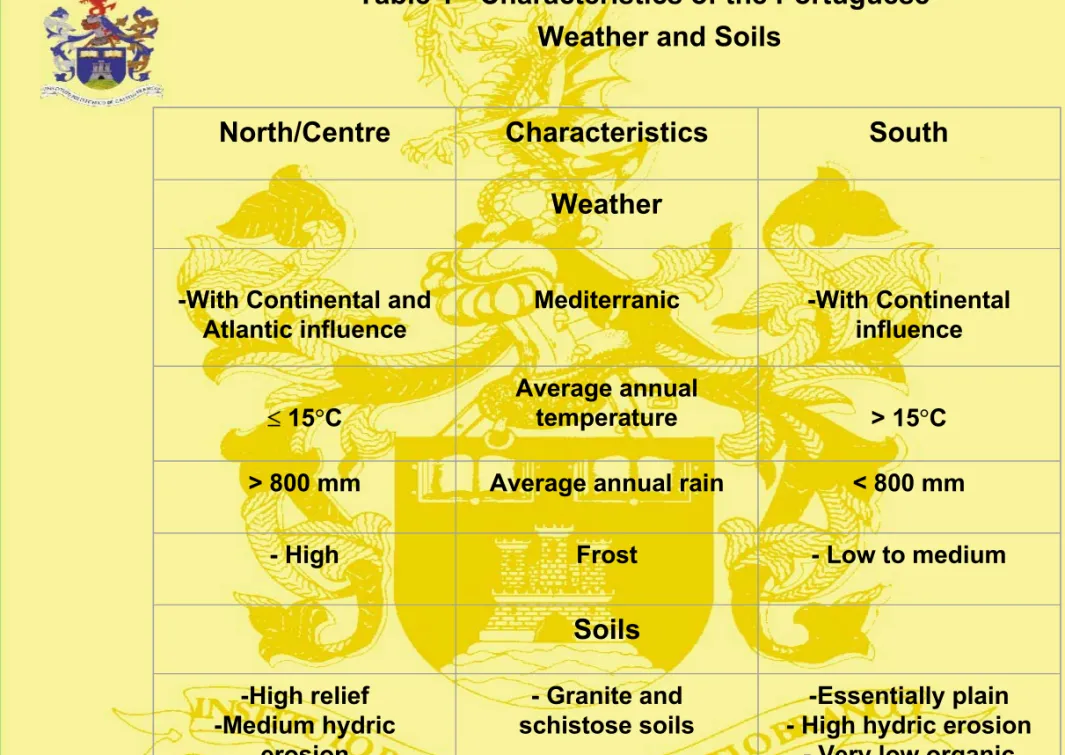
(4) Table 1 - Characteristics of the Portuguese Weather and Soils North/Centre. Characteristics. South. Weather -With Continental and Atlantic influence. Mediterranic. -With Continental influence. £ 15°C. Average annual temperature. > 15°C. > 800 mm. Average annual rain. < 800 mm. - High. Frost. - Low to medium. Soils -High relief -Medium hydric erosion - Low organic matter. - Granite and schistose soils. -Essentially plain - High hydric erosion - Very low organic matter.
(5) North Views. South Views.
(6) Cattle Animals. Animals/farm. Total. 1 415 188. 13,81. Continent. 1 172 437. 12,93. Total cows. 904 255. Dairy cows. 355 731. 10,78. Beef cows. 341 262. 8,17. Total cows. % 28,3. Dairy cows. 32,2. Beef cows. 13,8 %. Total cows. 11,4. Dairy cows. 8,0. Beef cows. 5,8. % 7,2. Total cows. 4,9. Dairy cows. 7,5. Beef cows. % 5,1. Total cows. 4,2. Dairy cows. 2,7. Beef cows. % Total cows. 1,7. Dairy cows. 0,2. Beef cows. 1,3. Littoral without Alentejo % Dairy cows. 57,0. Beef cows. 24,8. % 33,3. Total cows. 5,9 59,5. Dairy cows Beef cows. te n e Al. jo. % Total cows. 1,7. Dairy cows. 0,2. Beef cows. 1,3. Interior with all Alentejo % Dairy cows. 15,0. Beef cows. 69,7.
(7) Sheep and Goats Goats. Animals/farm. Total. 537 241. 9,8. 42,0. Continent. 519 018. 10,6. 35,5. Females. 456 431. 8,5. Sheep. Animals/farm. Total. 2 929 765. 41,1. Continent. 2 917 719. Females. 2 428 937. Sheep in Littoral (1) Animals Sheep. 546 875. Sheep in Interior (2). % 22,6. Sheep. Goats in Littoral (1) Goats. Animals. %. 181 294. 39,8. Animals. %. 1 871 997. 77,1. Goats in Interior (2). nt e Al. o ej. Goats. • •. Animals. %. 260 632. 57,1. Without Alentejo With Alentejo.
(8) Portuguese Indigenous Breeds. A significant part of extensive grazing production systems is based: n use of animals with unique characteristics; n different from region to region; n good maternal aptitude; n high rusticity; n low growing performance; n not very specialised in meat production (cattle) or milk and/or meat (sheep and goat); n exceptional adaptation to the environment; n these breeds are used as line mother (pure breed or crossbreed);.
(9) Table 2 - Indigenous Portuguese Cattle Breeds Indigenous Breeds. Geographic Origin. Animals in Herd Book. Goal. Alentejana. South. 7,430. Meat. Arouquesa. Centre North. 6,118. Traction/Meat/Milk. Barrosã. Interior North. 6,715. Meat/Traction. Brava. Centre South and South. 9,000. Bullfighting. Cachena. North. 471. Meat/Traction. Garvonesa. Litoral South. 55. Meat. Marinhoa. Litoral Centre. 4,426. Traction/Meat. Maronesa. Interior North. 7,194. Traction/Meat. Mertolenga. South. 7,370. Meat. Minhota. Litoral North. 6,000. Milk/Meat/Traction. Mirandesa. Interior North. 4,270. Meat/Traction. Preta. South. 2,800. Meat.
(10) In the North and Center. Cachena Barrosã Minhota. Arouquesa. Marinhoa. Mirandesa. Maronesa.
(11) In the South. Preta. Brava Alentejana. Garvonesa Mertolenga.
(12) Table 3- Indigenous Portuguese Sheep breeds Indigenous Breeds. Geographic Origin. Animals in Herd Book. Goal. B. Entre Douro e Minho. Littoral North. -. Meat. Campaniça. South. 3,014. Meat/milk/Wool. Churra Algarvia. Littoral South. 5,270. Meat. Churra Badana. Interior North. 2,669. Meat. Churra Galega Bragançana. Interior North. 8,585. Meat. Churra Galega Mirandesa. Interior North. -. Meat/wool. Churra Terra Quente. Interior North. 80,000. Milk/Meat. Merino Beira Baixa. Interior Centre. 2,251. Milk/meat. Merino Branco. South. 22,000. Meat/milk/wool. Merino Preto. Interior South. 6,900. Meat/milk/wool. Mondegueira. Interior Centre. 3,750. Milk. Saloia. South littoral Centre Centre. 4,577. Milk. 6,000. Milk. B. Serra da Estrela.
(13) Churra Galego Mirandesa. Churra Galego Bragançana. Bordaleiro Entre Douro e Minho Badana. Churro Campo extinguished. Merino Branco. Indigenous Sheep Breeds Meat Meat + Milk. Merino Preto. Churro Algarvio.
(14) Churro da Terra Quente. Serra da Estrela. Churro Mondegueira. Saloia Merino Beira Baixa. Indigenous Sheep Breeds Milk Campaniça.
(15) Table 4 - Indigenous Portuguese Goat Breeds. Indigenous Breeds. Geographic Origin. Animals in Herd Book. Goal. Algarvia. South. 3,997. Milk. Bravia. Interior North. -. Meat. Charnequeira. Interior Centre and South. 5,200. Milk/Meat. Serpentina. South. 4,000. Meat/milk. Serrana. Centre and North. 21,013. Milk.
(16) 9- Bravia. 9 1 Serrana- 1 - Transmontana 2 – Jarmelista 3 – Da Serra 3. 4 - Ribatejana. 2. Charnequeira: 5- Beiroa 6- Alentejana. 5. 4. 8- Algarvia. Indigenous Goat Breeds. 7 6. Milk – 1,2,3,4,8 Milk+Meat – 5 Meat – 6,7,9. 8. 7- Serpentina.
(17) Table 5 – Indigenous Portuguese Pig Breeds. Indigenous Breeds. Geographic Origin. Animals in Herd Book. Goal. Alentejana. South Centre and South. 6,500. - Meat. Bísaro. North. 196. - Meat.
(18) Indigenous Pig Breeds. Bísaro. Alentejano.
(19) Table 6 - In Portugal we have the traditional duality in Animal Production Systems. Extensive. Production Systems. Intensive. Indigenous Breeds. Genetic Resources. - Local Resources - Indigenous flora - Quality submitted to the vegetative cycle - Photosynthetic capacity -Limited -Specific and with particularities. Feed. Exotic Breeds Mainly crossbred - Mainly Imported - Concentrate - High energy and protein - More expensive -Mass supply -Standardised product. - Market Niches increasing tendency - More expensive -Biological response in function of local availabilities - Low stocking rate - Well adapted but less efficient. Product quantity Search Cost per unit produced. -More generalised decreasing tendency - Less expensive. Animal welfare. -To maximise income - High stocking rate. Animal - Biological adaptation. -Higher sensitivity -Higher production capacity. -Geographical location. Location. -Sparse. -Small. Influence in environment. - Potentially aggressive. - Limited. Labour. -Specialized. - Possible. Genetic resources preservation. -Hard.
(20) EXTENSIVE SYSTEMS. In Extensive systems : -. diversity and quality of environment and landscape is ensured;. -. animals in equilibrium with the environment (welfare);. -. sustainable;. -. based on the use of local available resources;. -. respect the use of the soils;. -. well adapted to the climatic conditions;. -. one way of giving life and quality to rural landscape (avoid rural exodus). -. grazing system avoid soil erosion (physical desertification). The characteristics indicated for the extensive systems refers mainly to the ones used on the indigenous breeds. The feeding of this breeds is based on natural resources and is submitted to the conditions that influence those resources: soil, rain and temperature..
(21) We can identify two extensive beef cattle production systems in Portugal:. These systems considers: -the use of low capital inputs but with production costs only potentially competitive; -the warranty of the product quality ant typicity, which are essential characteristics for the intended added value; -the preference and demand for the product by the consumer; -the defence of the environmental quality..
(22) Table 7 - Characteristics of the Portuguese Extensive Beef Cattle Production Systems North/Centre. Characteristics. South. » 3 ha 3. Farming size Average size of the herd. » 300 ha 75. Diversified and family type. Agricultural kind. Entrepreneurship. Meat/traction. Meat. Mainly “Lameiros”. Aptitude of Indigenous breeds Grazing. Mainly “Montados”. Natural irrigation + Dry land. Pasture. Dry land. April - July. High digestibility and high production High digestibility and low production Null or low growth. March - May. March and October August, September, November - February Hay, cereal straw, turnip, ferrejos, potatoes and fruits Along the year 7 months -. Supplementary feeds Calving Slaughter age. October and November June - September, December - February Cereal straw, hay, crop residue, cereal grain and acorn. Summer and Winter 18 - 24 months. Lameiros -Permanent pastures of natural grassland in the slopes of mountains with runoff irrigation and overflow. Montados – Extensive Agrosilvopastoral system with Quercus spp. trees, very large area of unit production with grazing surface under trees.-- ferrejos - barley of wheat cutted as green forage.
(23) Table 8 - Characteristics of the Portuguese Extensive Meat Sheep Production Systems based in traditional grazing in the North/Centre and South North/Centre. Characteristics. South. -. Farming size. > 200 ha. Littoral < 50 Interior 100 - 200 Long wool breeds. Herd size. > 400. Genetic basis. Merino Breeds. < specialized for meat. Aptitude. Meat; good carcasses. All year. Mating season. One cycle of reproduction (April-. All year. Lambing. Sept./Oct.. 1 – 2 month. Weaning age. 5 month. 7 kg. Carcass weight. 15 kg. North- "pastoreio de percurso" "baldios". Centre- Transition All year. Grazing Type (characteristics). Farms/fences; “Montado” -Under trees (Quercus spp.). Grazing period. All year. North – Family; Centre – family and entrepreneurship. Agricultural kind. Entrepreneurship. Yes for some breeds. PDO and PGI. Yes. After cattle, crop residues. Complementary feed. Crop residues, acorn (Quercus spp.). May).
(24) Table 9 - Characteristics of the Portuguese Extensive Milk Sheep Production Systems based in traditional grazing in small and large farms Small farms. Characteristics. Large Farms. < 10 ha. > 100 ha. Bordaleira Serra Estrela (BSE). Farming size Herd size Genetic basis. Reasonable - BSE. Aptitude. One cycle of reproduction (April). Mating season. One cycle of reproduction (April-. August/September. Lambing Weaning age Carcass weight Grazing Type. September/October. 40 - 50. 3 weeks 7 kg "Pastoreio de Percurso" Transhumance (30%) All year Diversified and family type September/July Milking parlour Standing sheep house. Cured cheese with milk of only of this breed Yes Hay in winter. Grazing period Agricultural kind Milking Infrastructure Production PDO Complementar feed. 200 - 300 Bordaleira Saloia (BS); Merino Beira Baixa (MBB) Reasonable – BS No aptitude - MBB. May). 1 – 2 month 7 kg for BS and MBB In let lands or owned areas with shepherds few fences All year Entrepreneurship October/June Few milking parlour Apriscos (open air). Milk and fresh cheese (8 days); some cured cheese Yes Straw and Cereals - Autumn/winter.
(25) Table 10 - Characteristics of the Portuguese Extensive Goat Production Systems based in traditional grazing in small and large farms Small farms < 10 ha(Se); »50 ha(Al) 40 - 70. Characteristics Farming size Herd size. > 100 ha 150/250 (Ch); 100/200 (S). Serrana (Se); Algarvia (Al). Genetic basis. Charnequeira (Ch); Serpentina (S). Good. Milk Aptitude. Reasonable (Ch)-No aptitude (S). One cycle of reproduction (April). Mating season. August/September 4/5 weeks(Se); 6/8 weeks (Al). Lambing Weaning age. One cycle of reproduction (April-May) September/October 1/2 month ( Ch; S) - 3/4 month (S). 6/8 Kg(Se); 7/10 Kg(Al). Liveweight. 8/10 Kg (Ch) 9/12 Kg(S);16/20 Kg(S). "Pastoreio de Percurso" Mostly in highlands All year. Grazing Type. In let lands or owned areas with shepherds few fences All year. Diversified and family type September/July 540/600 L (Se)-210 days 350/650 L (Al) -£275. Grazing period Agricultural kind Milking Milk Yield. Large Farms. Entrepreneurship September/July (Ch) 220/250 L (Ch) - 180 L (S) in irrigated areas. Milking parlour (bigger flocks) Standing sheep house Cured cheese or sell milk or self consumption Yes (Se). Infrastructure. PDO. Yes (Ch) ewe and goat milk. Hay in winter. Complementar feed. Straw and Cereals - Autumn/winter. Production. Milking parlour Apriscos (open air) Milk and fresh cheese- -mixed milk ewe (8 days); some cured cheese.
(26) Conclusions Portugal has edaphoclimatic conditions typically Mediterranean with some Atlantic climatic influence in the littoral North and Centre. In the main territory there are a low rainfall in Winter and a deficit of water in Summer with a water soil availability during only 2 – 3 months. The forages production, is conditioned for those environmental conditions and characterized by 2 peaks of production and by high quality variations. Thus:.
(27) Endogenous resources must be valorised. n. Thus is only possible if we produce what others can’t: n. either by absence of biological diversity;. n. by a different genetic potential.. Indigenous breeds are a viable alternative in LFAs: n. contributing to the farm income;. n. to the settlement of population;. n. landscape diversity preservation.. In terms of productive levels: n. they can’t compete with imported breeds;. n. but must be protected (preserve genetic diversity)..
(28) n. We have an old rural population and an growing abandonment of the rural areas, and in some cases a great risk of desertification exists, mainly in the interior areas of the country;. n. The valorisation of the indigenous breeds can contribute for the fixation of that population and contribute for the interest of young people in the agricultural activities;. Must be guaranteed the tipicity of the final product and since it is a limited production there are conditions to revindicate the added value..
(29) It is necessary to support the valorisation of the indigenous breeds in order to: n n. defend and preserve the genetic inheritage; diversify the agricultural activities in order to a better use of the natural resources;. n. increase farming income which promotes the fixation of the population in rural areas with low or very low population density;. n promote. production systems with low or very low animals/ha,. environmental friendly; n. to maintain the characteristics of the indigenous breeds and its feeding systems in order to obtain products with guaranteed quality, responsible for an added value..
(30)
Imagem


+7


Documentos relacionados
Ousasse apontar algumas hipóteses para a solução desse problema público a partir do exposto dos autores usados como base para fundamentação teórica, da análise dos dados
Neste capítulo propomo-nos analisar a língua criativa de Mia Couto, a partir das obras que constituem o corpus do trabalho, que tem como objetivo principal refletir sobre
Prof. Maria do Carmo de Lima Bezerra, FAU-UNB, orientadora. Fernando Scardua, Faculdade do Gama, membro. Rômulo Jose Da Costa Ribeiro, Faculdade de Planaltina, UNB, membro.. A
reduzindo a centralizado universitá- k a a um aspecto da centralização b&o&tica, quer que o sistema francês deva as suas características mais significativas
consequências negativas do avanço do capital no campo, pois mesmo tendo se tornado comum o uso de máquinas na produção agrícola, o tempo de trabalho do camponês não foi
Furthermore, Nellore have greater lipidogram parameters and serum urea nitrogen levels, which indicate that Zebu cattle may have lower serum removal of nutrients due to a lower
Cabe principalmente aos enfermeiros a observação dessa prática no centro cirúrgico, bem como a busca por estratégias de promoção da adesão dos profissionais circulantes de sala
- Aplicar guiões construídos para textos com função predominantemente informativa, exercitando o aluno na superação de dificuldades na compreensão desse tipo de textos -
