Table of Contents
Chapter 1: Introduction
1.1 Research Questions ………... . 1.2 Structure of the Research………... . 1.3 Higher Education in Hong Kong……….. 1.4 The University of Hong Kong ………. ………..
1 2 3 4
Chapter 2: Literature Review
2.1 The Concept of Internationalisation ………... 2.1.1 Internationalisation and the Nation States ………..……….. 2.1.2 Internationalisation and Globalisation………..…………... 2.1.3 Diversity of Rationales………..………....…………... 2.1.4 Competition and Cooperation………..……… 2.1.5 Internationalisation Activities………..……….. 2.2 Organisation and the Environment ………..………...
2.2.1 Neo-Institutional Theory ………..………. 2.2.2 The Three Pillars of an Institution ………..………... 2.2.2.1 The Regulative Pillar ………..………... 2.2.2.2 The Cultural-cognitive Pillar……..……….... 2.2.2.3 The Normative Pillar………..………...…… 2.2.3 Organisational Change and Legitimacy………..……….….. 2.2.4 Isomorphism – Mechanism of Change toward Homogenization…
2.2.4.1 Coercive Isomorphism ………..………... 2.2.4.2 Mimetic Isomorphism ………..………. 2.2.4.3 Normative Isomorphism ………..……….. 2.2.5 Theoretical Framework and Expectation of the Research ……...
6 6 7 9 10 11 12 13 14 14 15 16 16 17 18 19 19 20
Chapter 3: Research Methodology
3.1 Selection of the Case ……….. 3.2 Data Collection Methods ………...
3.2.1 Document Reviews and Policy Analyses ……….. 3.2.2 Interviews ………....….. 3.2.1.1 The Design ………. 3.2.1.2 The Sample ……….... 3.2.1.3 The Process of Interviews ……….. 3.3 Data Reduction and Analysis ……….. 3.4 Reliability and Validity ………... 3.5 Summary ………. 22 24 24 25 25 26 27 29 30 31
Chapter 4: Internationalisation Activities and Changes in HKU
4.1 Strategic Plan on Internationalisation ………. 4.2 Perceived Internationalisation Activities and Changes by Institutional
Actors ………. 4.2.1 Academic Programmes ………..
4.2.1.1 Recruitment of International Students ………... 4.2.1.2 Student Exchange ……….. 4.2.1.3 Internationalised Curricula, Cross-cultural Training and
Work/Study Abroad ………... 4.2.1.4 Other Academic Programmes which Contain International
Emphasis ………. 4.2.2 Domestic and Cross-Border Activities ………..
33 33 34 34 34 36 37 39 40
4.2.3 Extra-Curricular Activities ……….... 4.2.4 Research and Scholarly Collaboration ……….. 4.2.5 Other Organisational Strategies ……….
43 44 45 4.3 Summary ………
4.4 Analysis ……….. 4.4.1. “Internationalisation at Home” with Focus on Students ………… 4.4.2. Mainstreaming of Internationalisation Activities ………. 4.4.3. Institutionalization of Internationalisation Activities ………
4.4.4. Internationalisation Versus “Chinalisation” ………..
47 50 52 52 53 53
Chapter 5: The Three Pillars and Changes of Internationalisation in HKU
5.1 The Regulative Pillar and Internationalisation Activities in HKU……. 5.1.1. Government Polices and Strategies on Internationalisation …….. 5.1.2. Perceived Components of the Regulative Pillar ……… 5.1.3. A Match between the Perceived and Actual Components of
Government Policies on Internationalisation of HKU …………... 5.1.4. The Regulative Pillar and Changes of Internationalisation Activities in
HKU ………..
5.1.5. Summary and Analysis ……….. 5.2 The Cultural-cognitive Pillar and Internationalisation Activities in
HKU ………... 5.2.1 Perceived Components of the Cultural-cognitive Pillar ………… 5.2.1.1 Positioning and Branding ……….. 5.2.1.2 Benchmarking ……… 5.2.1.3 Ranking ………. 5.2.2 Interaction of the Cultural-cognitive Components ………. 5.2.2.1 Globalisation, Internationalisation Trend, Necessity and
Survival ………...………...………...………. 5.2.2.2 Positioning and Branding Through Competition, Comparison
and Policy Referencing ……….
5.2.2.3 Benchmarking, Branding and Reputation ………. 5.2.2.4 Ranking and Reputation ……… 5.2.3 Perceived Relationship Between the Cultural-cognitive Pillar and Internationalisation Activities in HKU ………..……… 5.2.4 Summary and Analysis ……….. 5.3 The Normative Pillar and Internationalisation Activities in HKU ……. 5.3.1 History of the University of Hong Kong ………... 5.3.2 Perceived Components of the Normative Pillar …..………….. 5.3.2.1 Use of English ……… 5.3.2.1 International Student and Staff Compositions ………… 5.3.2.1 Educational Principles and Values ……….. 5.3.2.1 Institutional Autonomy ……….. 5.1.2 Interaction of the Normative Components
5.1.3 The Perceived Relationship Between the Normative Pillar and Changes of Internationalisation Activities in HKU ………….. 5.1.4 Summary and Analysis ……….. 5.2 The Three Pillars and Their Interaction ……….. 5.3 Summary ……… 55 55 62 65 68 74 76 76 77 79 80 81 81 82 83 84 85 87 88 88 90 92 92 93 93 95 99 101 102 106
Chapter 6: Conclusion
6.1 Major Findings ………... 6.1.1 Sub-question 1: How can internationalisation activities in HKU being
characterised? ………
6.1.2 Sub-question 2: Are there any changes in the internationalisation activities at HKU in recent years? ………. 6.1.3 Sub-question 3: Do government policies contribute to the changes in
internationalisation activities? ………...
6.1.4 Sub-question 4: What are the institutional actors’ perceptions about the mechanisms that stimulate internationalisation in
HKU? ………. 6.1.5 Main Question 1: What are the mechanisms underlying
internationalisation in higher education institutions? ……… 6.1.6 Main Question 2: How does university respond to
internationalisation? ………... 6.2 Significance of the Research ……….. 6.3 Limitations of the Research Design ………... 6.4 Recommendations ……….. 6.5 Conclusion ……….. 109 109 110 110 111 114 114 115 117 118 119 References ……… Appendix 1 ……… Appendix 2 ……… 121 130 132
Tables
Table 1 Degree-awarding Higher Education Institutions in Hong Kong ………. 132
Table 2 Number of UGC-funded Headcount Enrollment (Full-time) ………….. 132
Table 3 Programme Strategies for Internationalisation of Higher Education Institutions ………... 133
Table 4 Three Pillars of an Institution ………. 14
Table 5 Pillars of Institutions and Isomorphic Mechanisms ……… 20
Table 6 Characteristics of the Interviewees ………. 27
Table 7 Internationalisation Activities of HKU ……….. 134
Table 8 Non-local Students Enrolled in Regular UGC-funded Programmes ….. 35
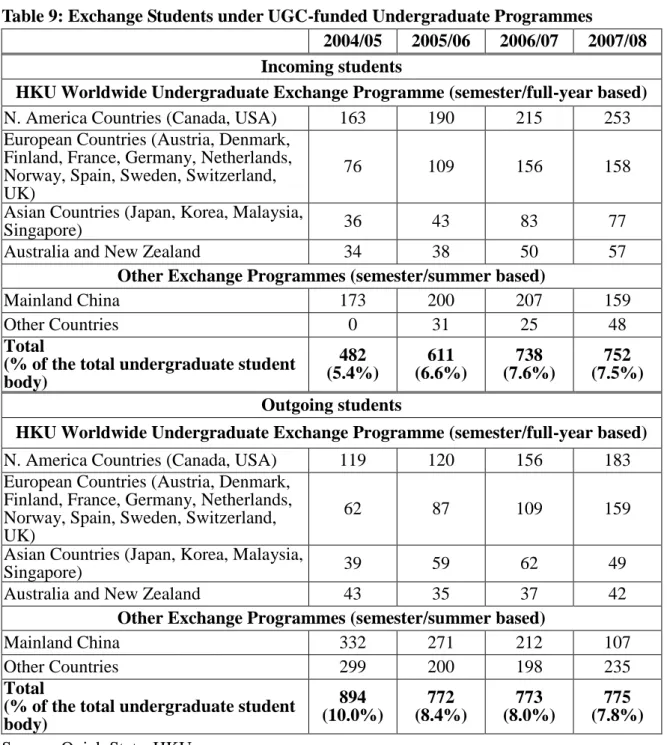
Table 9 Exchange Students under UGC-funded Undergraduate Programmes … 37 Table 10 HKU’s Outreach Degree Programmes ……… 135
Table 11 Joint Research Laboratories ……… 135
Table 12 Categorisation of Strategies and Changes in International Activities of HKU ………..…………...…………...………..……….. 48
Table 13 A Match of the Strategic Plan & Policies with Actual Strategies for Internationalisation in HKU ………..……….. 136
Table 14 Percentage of Non-local Student Recruitment to Total Student Number. 136 Table 15 Scholarship Support for Outstanding Non-local Students ………. 137
Table 16 Government Policies and Strategies on Internationalisation of Higher Education in Hong Kong ………. 138
Table 17 Perceived Influence of Government Policy on Internationalisation of Hong Kong ……….. 64
Table 18 A Match Between Actual and Perceived Components of Government Policies which Influence Internationalisation in HKU..…...…………... 66
Table 19 Perceived Cultural-cognitive Influences for Internationalisation at HKU ……… 77
Table 20 Perceived Normative Components for Internationalisation in HKU Perceived by Institutional Actors ……… 91
Table 21 A Match between the Actual and Perceived Components of the Normative Pillar which Influences on Internationalisation in HKU ……… 96
Diagrams Diagram 1 Theoretical Framework for Understanding Changes in Internationalisation Activities of an Higher Education Institution ………..………... 21
Diagram 2 Strategic Plans, Policies and Empirical Findings on Changes of Internationalisation Activities in HKU………. 51
Diagram 3 Rationales of Government’s Internationalisation Policy in Hong Kong ……… 67
Diagram 4 A Match of the Regulative Pillar with the Strategies and Changes of Internationalisation in HKU ……….………... 69
Diagram 5 Interaction between Different Components of the Cultural-Cognitive Pillar ………... 81
Diagram 6 Perceived Relationship between the Cultural-Cognitive Pillar and Changes in Internationalisation Activities at HKU ………... 86
Diagram 7 Interaction of Normative Components in the Formation of Culture and Tradition at HKU ………... 97
Diagram 8 Perceived Relationship between the Normative Pillar and Changes in Internationalisation at HKU ……… 100
Diagram 9 Interaction of the Regulative, Cultural-cognitive and Normative Pillars and Internationalisation in HKU ………... 104
Chapter 1: Introduction
During the past few decades, international dimension in higher education (HE) is
becoming increasingly complex. World trend and globalisation forces have accelerated
their pace of internationalisation. Under intensified pressures for survival and improving
their competence, higher education institutions (HEIs) have to adopt a wide range of
internationalisation strategies. This study is designed to examine the existing
internationalisation activities in the University of Hong Kong (HKU), their extent and
nature of change, and to explain the underlying mechanisms leading to such changes. This
first chapter will give an overview of the whole research. It lists out the central research
questions, outlines the structure of the study, provides the basic information of the higher
education system in Hong Kong and the University of Hong Kong.
1.1 Research Questions
The central questions of the research are:
1. What are the mechanisms underlying internationalisation in higher education
institutions?
2. How does university respond to internationalisation?
These two main research questions are divided into the following sub-questions:
i. How can internationalisation activities in HKU be characterised?
ii. Are there any changes in the internationalisation activities of HKU in recent
years?
activities?
iv. What are the institutional actors’ perceptions about the mechanisms that stimulate
internationalisation in HKU?
1.2 Structure of the Study
The whole study is divided into six chapters. Chapter one introduces the purpose of
this study, the research questions, the higher education system in Hong Kong and the
University of Hong Kong. In chapter two, there is a review of literature on
internationalisation and organisational changes. It first examines the meanings, concept
and rationales of internationalisation. Then, the programme strategies for
internationalisation categorised by Jane Knight, and the institutional theory which explains
organisational changes based on the three pillars (regulative, normative and
cultural-cognitive) of an institution are introduced. The institutional theory will form the
theoretical framework of this research, from which, assumptions about the underlying
mechanisms of internationalisation in HKU are deducted.
Chapter three describes the research methodology in details. This research uses a case
study to discover why and how internationalisation is being taken place in higher education
institutions. The data collection methods include document reviews, policy analyses and
interviews. Document reviews and policy analyses are expected to reveal the role of
government in influencing internationalisation in HKU. Interviews gather institutional
actors’ perceptions on the impact of the three pillars on internationalisation. These different
data sources help to triangulate the findings, which are presented in chapters four and five.
Chapter four depicts the main internationalisation activities and changes (what)
programme strategies put forward by Knight. In chapter five, perceptions of the
institutional actors on the components of the three pillars, and their impact on the changes
of internationalisation strategies and activities in HKU are discussed. The final chapter is a
conclusion, which points out the significance and limitation of this study, and provides
some suggestions for future research.
1.3 Higher Education in Hong Kong
As a British colony for more than 150 years (1842-1997), the education system in
Hong Kong was established by the former British colonial administration in accordance
with the British model (Morris et al., 1994). Up till now, Hong Kong has 12
degree-awarding higher education institutions, of which nine are universities and eight are
funded by the University Grant Committee (UGC)1. The eight UGC-funded institutions are City University of Hong Kong (CityU), Hong Kong Baptist University (HKBU), Lingnan
University (LU), The Chinese University of Hong Kong (CUHK), The Hong Kong
Institute of Education (HKIEd), The Hong Kong Polytechnic University (PolyU), The
Hong Kong University of Science and Technology (HKUST) and The University of Hong
Kong (HKU). The other four non-UGC funded institutions are Chu Hai College of Higher
Education, Hong Kong Shue Yan University (HKSYU), the Hong Kong Academy for
Performing Arts (HKAPA) and the Open University of Hong Kong (OUHK) (Table 1 in
Appendix 2).
The University of Hong Kong (HKU), the first university in Hong Kong, was
established in 1911 by incorporating of the College of Medicine established in 1887. The
1
The University Grants Committee (UGC) was set up in Hong Kong in 1965 to give “advice on the development and funding of higher education and to administer public grants to the eight higher education institutions.” (HKSAR, 2007a:
second university, CUHK, was established in 1963 with the merger of three post-secondary
colleges of New Asia College (founded in 1949), Chung Chi College (founded in 1951)
and United College (founded in 1956). The two Polytechnic universities in Hong Kong,
The Hong Kong Polytechnic University and City Polytechnic University of Hong Kong
(formerly known as The Hong Kong Polytechnic and City Polytechnic of Hong Kong),
were established in 1972 and 1984 respectively and were awarded full university statuses
together with Hong Kong Baptist University (established in 1956 as Hong Kong Baptist
College) in 1994 (HKSAR, 1997a; UGC, 1996).
The Hong Kong University of Science and Technology was established in 1991 with
the idea initiated by the then Governor Edward Youde, as an Asian equivalent of the
Massachusetts Institute of Technology (MIT) (Wong, 2004), whereas the Lingnan
University (formerly known as Lingnan College) was founded in Hong Kong in 1976 and
acquired its full university status in 1999. The HKIEd was established in 1994 by merging
four former colleges of education and the Institute of Language in Education (HKSAR,
1997a; UGC, 1996). It is currently the only UGC-funded non-university HE institution in
Hong Kong. Altogether, these eight UGC-funded institutions provide around 14,500
first-year-first-degree places for 18 per cent of the 17-20 year-old age group in Hong Kong
(HKSAR, 2007a).
1.4 The University of Hong Kong
The University of Hong Kong (HKU) was founded as Hong Kong’s first university in
1911 with the effort of the then governor, Sir Frederick Lugard. He then became the first
Chancellor of the University after its establishment. Today, HKU is a dynamic,
comprehensive university with world-class standing, reputation and recognition. With its
by the “Times Higher Education – QS World University Ranking” (THE ranking) as 33rd in 2005 and 2006; 18th in 2007 and 26th in 2008 (HKU, 2007b; HKU, 2008a).
In terms of academic structure, the University is subdivided into faculties,
departments and schools. At its establishment, the University had only three faculties:
Medicine, Engineering and Arts. Approaching its 100th anniversary in 2011, the University now has ten faculties, including these three plus the Faculties of Social Sciences
(established in 1967), Education (established in 1976), Dentistry (established in 1982),
Architecture (established in 1984), Law (established in 1984), Business and Economics
(established in 2001) and School of Professional and Continuing Education (HKU SPACE)
(HKU, 2008a) (HKU, 2008a), and over 20,000 students. In 2007-08, there were 12,409
full-time UGC-funded students, of which 9,976 were undergraduates and 2,433 were
postgraduates. Figures on the UGC-funded enrolment in the last four years are shown in
Table 2. In addition to local students, the University also welcomes non-local students
from Mainland China and all over the world. In 2007-8, there were about 3,300 non-local
students in the campus (HKU, 2009f).
In terms of internal governance, the University still largely follows the British
tradition. The Chief Executive of Hong Kong Special Administrative Region (HKSAR) is
the Chancellor and nominal head of the University. The main governance structures are the
Court, the Council, the Senate and the Boards of the Faculties (HKU, 2008a). Due to its
British heritage, it enjoys a substantial degree of autonomy in the control of curricula,
academic standards, selection of staff and students, and internal allocation of resources
(Shils and Roberts, 2004). Since its early days, English has been the main working
language in HKU. Further details of the history and development of the University will be
Chapter 2: Literature Review
This chapter is a literature review on the concept of internationalisation in higher
education and theory on organisational change. The discussion on the concept of
internationalisation starts from the notion of nation states, followed by the relationship
between internationalisation and globalisation, the diversity of rationales underlying
internationalisation and the argument of competition and cooperation in
internationalisation. Then, the programme strategies for internationalisation suggested by
Jane Knight (2005) are listed out, which will be used to categorize the internationalisation
activities in HKU in chapter four. The last part of this chapter focuses on theory of
organisational change, particularly the institutional theory and the notions of isomorphisms.
They will be used to construct the theoretical framework and provide explanation on the
changes of internationalisation in this study.
2.1 The Concept of Internationalisation
2.1.1 Internationalisation and the Nation States
Describing and defining internationalisation is quite complex. University is inherently
international. The process of establishing knowledge, the desire and effort to enhance the
quality of research and the cooperation for the advancement of science push research
activities across borders and contribute to the international character of research and
academic activities. In fact, some scholars argued that internationalisation is not a new
concept. Looking back to the Middle Ages, students and scholars wandered across Europe
for teaching and study (De Wit, 2000). With a common religious belief, a uniform
scholarly language (Latin), and a standardised study programme (the studium generale),
to institutions beyond their local regions.
However, Neave (2001) commented that this phenomenon should not be classified as
“international mobility” and at most only “inter-territorial” as it was the time that the concept of nations still not yet existed. Similarly, Scott (1998) argued that only very few
universities can claim to have a century-old international tradition. It is because, even
though modern university was born in the beginning of 11th century, most universities nowadays are creations of the nation states in the early 20th century. They are national institutions under the states, which are responsible for steering, funding and setting policy
for them.
2.1.2 Internationalisation and Globalisation
The concept of internationalisation is a confusing one, conveying a wide variety of
meanings in different contexts by different people. Traditionally, internationalisation
mainly concerned mobility which based on personal network and coordination of
individual academic staff. It focused on academic cooperation and exchanges within
disciplinary specialties, and involved only a minority of students. This kind of international
mobility was expected to contribute to academic learning, cultural awareness and
international understanding (Luijten-Lub, 2007). It was not regarded as a mainstream
activity of the university, and was seldom supported by any university units or
infrastructures, such as the international office (Teekens, 2004).
From the mid 1990s, internationalisation has started to form a major theme in higher
education, when the concept of traditional internationalisation becomes intertwined with
globalisation (Luijten-Lub, 2007). Despite so, they are different concepts with different
emphasizes the increasing convergence and interdependence of economies and societies.
With increasing integration of regulatory systems, boundaries between states become
blurred and the role of nation-states diminishes. It is argued that globalisation will end up
with de-nationalisation (van der Wende, 2004). On the other hand, internationalisation
refers to the relationship between different nations, or between single institutions situated
within different national systems. It foresees nation-states will continue to function as
bounded economic, social and cultural systems. As nation states become more
interconnected and cross-border activities increase, national policies put a stronger
emphasis on regulating or facilitating these activities (Van de Wende, 2004). In higher
education, the notion of internationalisation stresses the interconnectedness of national
education systems.
In discussing the relationship between globalisation and internationalisation, different
authors perceive it in different ways. For example, van der Wende (2007) sees
internationalisation as a response to globalisation, whereas Scott proclaims the two
concepts are neither linear or cumulative, nor one form higher than the other, but
dialectical. He argued that “not all universities are international, but all universities are subject to the same process of globalization” (1998:122) either as victims or key players.
In Europe, it can be observed that not only individual institutions but also entire national
higher education systems are now changing under the influences and external pressure of
internationalisation, Europeanisation and globalisation from higher levels (van der Wende,
1997). Education policy has become more internationalised and more often being
discussed and implemented in supranational or international contexts. Internationalisation
2.1.3 Diversity of Rationales
Today, a mix of underlying rationales and activities for internationalisation can be
observed, and more actors on different levels are involved (van der Wende and Huisan,
2004). Van der Wende (2002, based on Blumenthal et al., 1996) distinguished four values
or rationales which are relevant in understanding internationalisation in higher education:
the academic, cultural, political and economic rationales. Each of them implies a different
means and end to internationalisation. Academic value rationalizes internationalisation as a
means of enhancing the quality of education and research. Cultural rationale justifies
internationalisation for the enhancement of mutual understanding and knowledge of
different cultures. Political rationale suggests internationalisation as a strategy for
nation-building and economic reform. Last but not least, economic rationale is related to
the competitive power and stance of a country, an education system or an individual
institution in the international market of higher education. Tracing back to medieval
Europe and Arabic world, academic and cultural rationales were already dominant values
underlying internationalisation, when scholars wandered around to seek for knowledge and
understanding of other cultures. Up till today, universities still have incentives from the
inside to internationalise.
In comparison with the persistence of academic and cultural values, political and
economic rationales undergo more changes (De Wit, 2000). For example, in Europe, the
importance of political rationale in internationalisation was particularly prevalent during
the development of nation-states, and the era of colonial expansion, when the European
models of higher education were spread and reproduced in colonies in the Americas, Africa
and Asia to demonstrate the political, cultural, economic and academic dominance of the
international power encouraged the Americans to learn the knowledge, cultures and
languages of other systems so as to maintain and expand their influences. As a result, area
studies, foreign languages and study abroad programmes began to flourish (Luijten-Lub,
2007).
After the cold war, emphasis on internationalisation changed from political to
economic rationales. On the one hand, the transformation of society to knowledge-driven
economies changes the education and training needs of countries. Education and
internationalisation activities are expected to improve the international competiveness of
the higher education sector and that of national economy. As a result, university is more
linked to increased economic performance of the knowledge-economy. On the other hand,
with the New Public Management Reform, application of market discourse becomes
prevalent in non-commercial domains. Facing stringent resources from government and
competitive demands from other social sectors, public funding for higher education
decreases and universities are expected to become self-reliant and entrepreneurial
(Slaughter and Leslie, 1997). They need to adopt more aggressive approaches on the
recruitment of international students and position themselves in the international market. In
this context, higher education turns into an export commodity for earning income for the
institutions and countries (Scott, 2004).
2.1.4 Competition and Cooperation
The trend towards more economically oriented rationales for internationalisation can
also be viewed as the result of competition in internationalisation activities. According to
van der Wende (2004), approaches to internationalisation can be distinguished between
competition and cooperation. Both are ways to respond to the pressures of globalisation
involves the increasing integration of flows and processes over and across borders. It is
especially true in those English speaking countries, such as the UK and Australia, where
marketisation and entrepreneurship are going hand in hand with internationalisation (van
der Wende, 2001). As a result, internationalisation policies on student mobility and
transnational education gain importance and new relevance. They become the means to
generate income by attracting more foreign fee-paying students to study at the home
institutions or off-shore campuses. To respond and survive, universities join the
competition of student recruitment in the global market.
In contrast, internationalisation in Europe is more associated with the cooperation
approach. Both the Bologna Declaration and Lisbon Strategy can be regarded as
cooperative responses to globalisation and internationalisation on the European level (van
der Wende, 2004). By agreeing on the establishment of a “European Higher Education
Area” by 2010, the Bologna Declaration signed in 1999 aims to increase the
competitiveness and attractiveness of European higher education through cooperation
among the signatory countries. Similarly, in the Lisbon Summit in 2000, leaders of the
European Union agreed on the strategic target of making Europe to become the most
competitive and dynamic knowledge-based economy in the world, capable of sustainable
growth with more and better jobs and greater social cohesion by 2010. Though these two
processes are different in ownership, rationales and level of involvement by the European
Union, they overlap and are moving towards further convergence on increasing the
cooperation among different European higher education systems (van der Wende, 2004).
2.1.5 Internationalisation Activities
According to Knight (1997), it can be seen that internationalisation can be understood
institutions. Second, they are activities undertaken by HEIs in response to the external
pressures. The term indicates not only changes of general trends and specific polices in the
environment, but also institutional responses to them. Knight and De Wit define
internationalisation as a “process which integrates an international dimension or perspective into the major functions of the organisation” (1995: 16-17). In other words, it
means incorporating “a perspective, activity or programme which introduces or integrates
an international/intercultural/global outlook” into the teaching, research and service functions of a university or college (Knight and De Wit, 1995:15).
When Knight and De Wit (1995) were studying the internationalisation strategies of
Australia, Canada, the USA and Europe, they used the term “programme strategies” to
characterize those academic activities and services taken by institutions which integrate
such an international dimension into their main functions. In this research, the programmes
strategies based on the 1995 study but further updated by Knight (2005) (Table 3 in
Appendix 2) are used to characterize the internationalisation activities of HKU, which are
assumed to be developed in the interplay between its changing contexts and core tasks. It
should be noted that all these activities can be part of the internationalisation strategy of an
institution; they are not exclusive to each other. In reality, not every institution can cover
all or even most of these activities (Knight, 2005).
2.2 Organisation and the Environment
Higher education institutions are not isolated institutions, but part of a wider network
in society. Organisational choices and actions are conditioned by various external pressures
and demands. Organisation must be responsive to survive. In analysing organisational
change in internationalisation activities in higher education institution, this research makes
2.2.1 Neo-Institutional Theory
Neo-institutional theory assumes that organisations operate in an environment
dominated by rules, requirements, understanding and norms. It departs from the
rationalistic explanation of organisational behavior and recognises the larger cultural and
political contexts in which organisations are embedded in. In the neoclassical economic
theory, human behavior is explained as maximizing behaviors engaged by an individual
rational actor. In this perspective, actors construct institutions to deal with collective
problems, which are primarily based on regulative frameworks. Actors respond to
institutions because the regulations are backed by incentives and sanctions.
In addition to maximize efficiency, neo-institutional theory interprets organisations
which take up new practices, embrace new strategies, structures and processes as their
ways to react to and accommodate pressures from external scrutiny and regulation. Actors
are still regarded as rational but their rationality is bounded. The theory holds an organist
view on human behavior which is regarded as the product of interactions of norms, rules,
beliefs and resources. As a result, social action is assumed to be grounded in social
contexts which take into account the social rules and guidelines for behavior. Situational
elements are important in the individual’s decision-making process and form the basis of
their “internal subjective reference of action” (Alexander 1983, 1:74). In this perspective,
organisations are assumed to be influenced by institutional pressures from the external
environment as well as demands internal to the organisation, which would both facilitate
and constraint organisational behavior. The theory represents a shift of emphasis on the
2.2.2 The Three Pillars of an Institution
Although the institutional theory remains more of an orientation than a scientific
theory (DiMaggio and Powell, 1991), Scott proposes there are three pillars (the regulative,
normative and cultural-cognitive pillars) which constitute and support an institution.
According to Scott, “institutions are multifaceted, durable social structures, made up of
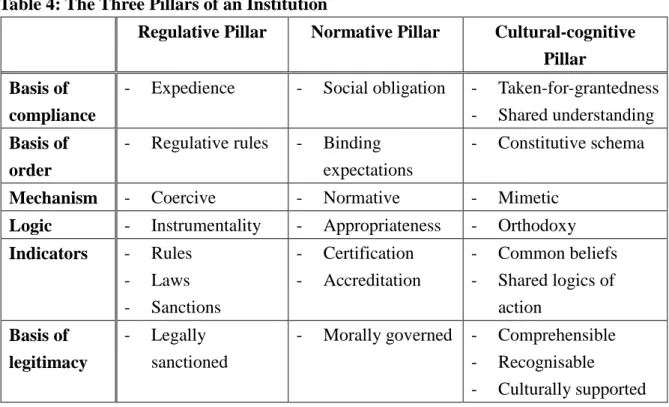
symbolic elements, social activities and material resources” (2001: 49). In this framework, each pillar operates through its own mechanisms and processes (Table 4). Even the
distinction and boundary among them in reality is not very clear, they are the core elements
which influence the way organisations operate.
Table 4: The Three Pillars of an Institution
Regulative Pillar Normative Pillar Cultural-cognitive Pillar Basis of
compliance
- Expedience - Social obligation - Taken-for-grantedness
- Shared understanding
Basis of order
- Regulative rules - Binding expectations
- Constitutive schema
Mechanism - Coercive - Normative - Mimetic
Logic - Instrumentality - Appropriateness - Orthodoxy
Indicators - Rules - Laws - Sanctions - Certification - Accreditation - Common beliefs - Shared logics of action Basis of legitimacy - Legally sanctioned
- Morally governed - Comprehensible - Recognisable
- Culturally supported Source: Scott (2001:52).
2.2.2.1 The Regulative Pillar
The regulative pillar includes laws, rules and sanctions of institutions. Under this
and manipulate sanctions to influence the future behaviours of actors. These regulative
processes of rule-setting, monitoring and sanctioning can be done through both formal
channels (such as the police and the court) and informal mechanism (such as folkways).
The primary mechanism of control is coercion and the state is always involved as a
third-party enforcement agent (DiMaggio and Powell, 1991). In this pillar, rulers try to
cultivate a belief in their legitimacy by imposing their will through threat or sanction.
Institutions are thought to be legitimate because they are legally sanctioned, and actors
comply with the regulations as a result of expedience. In higher education, the regulative
pillars refer to the rules, regulations and policies set by the state in governing higher
education (Scott, 2001). They lay out the steering model between the state and higher
education institutions in a country, the extent of institutional autonomy higher education
institutions can enjoy, the government’s funding arrangement and quality assurance
measures.
2.2.2.2 The Cultural-cognitive Pillar
The cultural-cognitive pillar is “the shared conceptions that constitute the nature of
social reality and the frames through which meaning is made” (Scott, 2001:57). This pillar stresses the common framework of meaning constructed socially and internalised by actors.
They are the symbolic representation of the world which mediate between the external
world of stimuli and the response of the individual organism (Scott, 2001). In higher
education, the cultural-cognitive pillar includes the “education and research model” of
university education (Luijten-Lub, 2007), the dominant policy paradigm of a country, or
the shared understanding and perception within an academic discipline. According to Clark
(1983), academic discipline has its own culture, beliefs and definition of academic work. It
and its interpretation of the effects on its work, identity and tradition. Therefore, discipline
is the primary frame of reference for academics to filter external changes and demands.
2.2.2.3 The Normative Pillar
In this pillar, “normative rules introduce a prescriptive, evaluative and obligatory dimension into social life” (Scott, 2001: 54). They encompass both values and norms.
Values are the desirable goals and objectives, or standards to which existing structures and
behavior can be compared and assessed with. Norms are the legitimate means to pursue the
valued ends. According to this pillar, institutions rest on a moral basis for legitimacy. When
certain normative expectations for particular individuals or particular social positions exist,
roles arise. They are prescriptions of how the specified actors are supposed to behave.
More than external pressures, actors may also internalize them to certain extent. In higher
education, the main values and norms refer to the academic freedom, the quality of
education, and the formal and informal institutional hierarchies, such as the stratification of
different types of higher education institutions (Scott, 2001). These norms and values guide
the behavior of higher education institutions and prescribe what is appropriate for them.
They are usually derived from tradition.
2.2.3 Organisational Change and Legitimacy
Neo institutionalism and the three pillars of an institution justify the changes in an
organisation. From the institutional point of view, an organisation changes and responds
not just for resources and customers, but also for political power, institutional legitimacy,
social as well as economic fitness. According to Meyer and Scott (1983:201),
“organisational legitimacy refers to the degree of cultural support for an organisation”. To be legitimate, an organisation needs the support of various types of authorities to confer
them cultural and moral legitimacy, in addition to the legal one. Organisational conformity
to institutional environments has survival value. Under the three pillars of an institution,
the regulatory pillar emphasizes on conformity to rules. Legitimate organisations are those
established by and operate in accordance with relevant legal or quasi-legal requirements. It
suggests that organisational change is derived from the legitimation of management
practices in response to influential external institutions, such as the state (Scott, 2001). To
legitimize itself and to gain society’s continued support, an organisation adopts certain
policies and procedures to exhibit conformity (DiMaggio and Powell, 1991).
From the normative point of view, a deeper moral base for assessing legitimacy is
stressed. Normative controls are more likely to be internalized, and incentives for
conformity include both intrinsic and extrinsic rewards. Therefore, an organisation changes
when there is a normative match between the values and beliefs underlying a proposed
policy and the identity, values, norms and traditions of the organisation. Finally, legitimacy
in the eyes of cultural-cognitive theorists comes from adopting a common frame of
reference or definition of the situation. It is the deepest level which rests on preconscious,
take-for granted understandings (Scott, 2001). In some occasions, in order to maintain
organisational stability, an organization even constructs symbols of compliance to
environmental change and result in ritualistic conformity (DiMaggio and Powell, 1991,
Gornitzka, 1999).
2.2.4 Isomorphism – Mechanism of Change toward Homogenisation
An interesting point about studying institutions in institutional theory is to look for
forces which make organisations in the same field converge in similar ways, i.e. change
towards being homogenous. An organisational field refers to those organisations that, in
mimetic and normative isomorphisms. Homogenisation of organisational forms emerges
out of structuration (Giddens, 1979), which is supposed to consist of four parts: an increase
in interaction among organisations in the field, emergence of sharply defined
inter-organisational structures of domination and patterns of coalition, an increase in the
information load with which organisations in a field must contend, and development of a
mutual awareness among participants of organisations in the same field. The definition
points out the importance of connectedness and structural equivalence (DiMaggio and
Powell, 1991) in the process of homogenisation and convergence of organisational forms.
By acting as an information network, a field fuels the practices of standardization and
professionalisation among its organisations. Moreover, highly structured organisational
fields provide a context in which individuals can deal rationally with uncertainty and
constraint, resulting in homogeneity of structure, culture and output. DiMaggio and Powell
(1991) suggested that there are three forces driving the institutionalisation and
homogenisation of organisational operations or practices. They are the coercive, mimetic
and normative isomorphisms.
2.2.4.1 Coercive Isomorphism
Coercive isomorphism is the result of political influence and need for legitimacy. It
stems from both formal and informal pressure imposed by another party upon which the
organisation depends on, and the expectations of society within which it operates. Today,
as rational states and other large rational organisations expand their dominance over more
areas of social life, organisational structures increasingly come to reflect the rules which
are institutionalised and legitimated by and within the state (Sharma and Lawrence, 2005).
By setting a common legal environment and the legal and technical requirements of
increasingly homogenous.
2.2.4.2 Mimetic Isomorphism
Mimetic isomorphism can be regarded as imitations among organisations. When face
with uncertainty, poor organisational technologies or ambiguous goals, organisations may
model themselves on similar organisations in their field that they perceive to be more
legitimate or successful. It yields a viable and economic solution for the organisations
which are encountering change and help them to demonstrate to the public that they are
trying to improve their working conditions. It is a cost-effective way of getting legitimacy
(Sharma and Lawrence, 2005). Normally, models in a field are diffused in two ways, either
unintentionally and indirectly through employee transfer or turnover, or explicitly through
organisations such as consulting firms or industry trade associations.
2.2.4.3 Normative Isomorphism
Normative isomorphism stems from professionalisation. When professionals define
their conditions and methods of practice, normative pressures arise from within a
profession. Professionalisation drives isomorphism through the formal education received
by the professionals in university, and professional networks which span across different
organisations. By filling in individuals with similar educational background, orientation
and disposition across a range of organisations (Perrow, 1974, cited in DiMaggio and
Powell, 1991), similar management models and practices can diffuse easily and rapidly,
making organisations more similar in nature. It is also true that when some large and
leading firms become the pivotal models of polices and organisational structure in their
fields (DiMaggio and Powell, 1991).
(micro) organisational context of change. Coercive isomorphism is linked to the
environment surrounding the organisational field; whereas the mimetic and normative
processes are internal to the field and help to spread the roles and structures. Though they
overlap and intermingle, they derive from different conditions and lead to different
outcomes. The relations between the three pillars of institutions can be matched with the
three isomorphic mechanisms (Table 5).
Table 5: Pillars of Institutions and Isomorphic Mechanisms Pillars of Institutions Isomorphic Mechanisms
Regulative pillars Coercive isomorphism
Normative pillars Normative isomorphism
Cultural-cognitive pillars Mimetic isomorphism
Source: Scott (2001) and DiMaggio and Powell (1991).
2.2.5 Theoretical Framework and Expectation of the Research
This study aims to investigate the dynamic interaction between the changing
environment and the ways which HEIs handle changes. It is the basic assumption in
institutional theory that environment influences organisations, and organisations, being
influenced by the changing environment, can respond to the changes. In this study, the
process of internationalisation in higher education can be regarded both as a process of
organisational change and organisational response to the changes in the environment. It is
assumed that the impact of internationalisation may lead to changes in the institutional
elements (the regulative, normative and cultural-cognitive pillars) of the higher education
institutions and thus exert influences onto them. By examining the case of HKU, this study
is expected to answer what, how and why internationalisation is happening in higher
Diagram 1: Theoretical Framework for Understanding Changes in the Internationalisation Activities of An Higher Education Institution
In this study, we start with the basic assumption that changes in the extent, nature and
scope of internationalisation activities in HKU are the result of changes in the three pillars.
The research first reviews and analyses the government policy to demonstrate the extent to
which the coercive force of the regulative pillar is influencing internationalisation in HKU.
Then interviews with institutional actors are conducted to show that normative and
cultural-cognitive pillars may also be critical and exert pressures on the University to
change through normative and mimetic isomorphisms. It is believed that the aim of all
these changes is to secure legitimacy and consolidate the international position of the
University in the international arena. By analysing such changes, it is expected to unravel
Chapter 3: Research Methodology
Conducting research involves a lot of choices. From the selection of topic, research
approach, to data collection and analysing techniques, all require deliberate effort and
consideration so as to keep the anticipated process under control. According to Blaikie
(2000), methods and techniques (how) to answer the research questions is a natural outflow
from the subject matter or problem being studied (what), and the purpose of research (why)
being determined earlier. The whole research design is not isolated linear steps but spiral
and cyclical in nature, in which the choices and steps are interrelated. This research is an
original study set in the context of higher education to study about organisational changes
and the underlying mechanisms. In order to examine the process of internationalisation in
response to globalisation and internationalisation trend, it adopts a qualitative research
approach and uses a case study. According to Kvale, the focus on one single case makes it
possible to investigate in detail the relationship of a special behaviour to its context, as well
as to work out the logic of the relationship between the individual and the situation (1996:
103). By focusing on one university (HKU), it is hoped to reveal the extent of changes in
its internationalisation activities and tap the institutional actors’ perception on the underlying mechanisms that stimulate such changes. By putting the findings against the
postulates of the institutional theory on organisational change, the case serves both
explorative and hypothesis testing functions.
3.1 Selection of the Case
Use of single cases in qualitative research is vivid and illuminating, especially if the
chosen cases are “critical”, extreme or unique, and “revelatory” (Yin, 1984, cited in Miles and Huberman, 1994). There are three reasons why HKU is selected for this case study.
in cultivating internationalisation. It has a strong identity as an international institution
since its establishment in the early 1910s when it already admitted students from around
the region and further away (HKU, 2006b). More recently, the University re-emphasizes
on fostering internationalisation as one of the elements of its strategic development (HKU,
2003). In fact, internationalisation effort of the University has been recognised
internationally. According to the “Times Higher Education - QS World University
Rankings”, HKU was ranked within the top 50 universities in the world in the past few years and the first in Asia in 2009. One of the components of this ranking is “international
factors” (comprises of indicators on “international students” and “international faculty”), which the University has done very well on it. The Times Higher Education Ranking stated
that: “The University recruits excellent academic staff locally and internationally, and
about 45% of academic staff are drawn from overseas, mostly from leading universities in
the United Kingdom, North America, Australia, and a number of Asian countries. It also
attracts outstanding students from all over the world, with around 10% international
students from more than 40 countries.” (Times Higher Education, 2008).
Second, the University is unique in the sense that it is a western-model planted on the
eastern soil. With nearly 100 years of history, HKU has now developed into a dynamic,
comprehensive and internationally recognized university as most of its western
counterparts. In one sense, as a westernised university, it serves well as a representative
case for studying the process and mechanism of internationalisation in higher education
institution. In another sense, with its location in Asia and the East, it would test the validity
of the institutional theory in a different geo-political and cultural context. This research
would reveal the extent to which the proposed mechanisms are “workable” universally.
an on-going phenomenon in Hong Kong’s higher education sector, in-depth and concrete
indigenous studies into the phenomena at institutional level is lacking. By focusing on a
local university in Hong Kong, the research helps to build up the pool of empirical studies
for Hong Kong, and provides a reference point for other higher education institutions in
Asia which are on the way of internationalisation.
3.2 Data Collection Methods
This research employs a three-staged multiple data-collection method, with the aim to
generate both primary and secondary data for analyses. The first stage involves making
reviews and analyses on government policies concerning the internationalisation of higher
education sector in Hong Kong. The second stage is the review of HKU’s policy
documents. In the last stage, interviews with key actors and top administrators of HKU are
conducted to unravel their views, opinions, and explanation of the mechanisms underlying
internationalisation. Altogether, these three data collection methods are combined to ensure
the generation of rich and complementary information.
3.2.1 Document Reviews and Policy Analyses
The fist stage of review focuses on government documents, which include reports of
the University Grants Committee (UGC), policy addresses of the Chief Executive of
HKSAR, year books and annual budgets of Hong Kong Government, and policy papers of
the Legislative Council of Hong Kong. This stage aims to examine the context of
internationalisation in Hong Kong’s higher education system and the extent of government influence on the University’s internationalisation activities. The second stage of review focuses on the University, and the materials utilized include annual reports (The Review),
(Quick Stats), and publications (e.g. Introducing HKU) of the University. It is designed to
depict the internationalisation activities of HKU.
3.2.2 Interviews
“The qualitative research interview is a construction site of knowledge.” (Kvale, 1996:2). Through “inter-change of views”, or conversation, between two partners on a
theme of mutual interest, interview is a process of knowledge discovery and creation. Its
purpose is to obtain qualitative descriptions and interpretations of themes in the subjects’ lived world. When applying in case studies, interview can develop knowledge about one
specific institution (Kvale, 1996). In this study, it is expected to explore and “dig out” the
reasons and mechanisms of internationalisation in HKU. With this aim in mind, interview
is a good means which allows informants to provide a “thick description” of the phenomena in the course of a genuine human exchange. It allows openness and flexibility
in informants while answering. Such spontaneity can illicit rich and detailed materials, and
provide insight into the topic area. As a result, an in-depth understanding on the research
topic is able to be reached. Interview is also a kind of craftsmanship, which includes a shift
from methods to the researcher (Kvale, 1996: 105). In interview, “the researcher as a
person” is the main measuring instrument for obtaining knowledge. In this study, interviews with institutional actors can provide an opportunity for the researcher to
experience the process of doing fieldwork. Lastly, interviews also help to triangulate the
findings in the first and second stage of policy and document analyses.
3.2.2.1 Design of the Interviews
This study employs semi-structured interviews as the main data collection tool.
questions was produced in relation to the research theme. There are a total of twelve
questions, spreading evenly into three areas: general questions, specific questions and
personal questions. General questions ask about the main internationalisation activities in
the University, the reasons for such activities, the trend and the perceived changes. Specific
questions aim to investigate into the mechanisms which underlie the internationalisation
process, and more specifically, the role played by government policy, norms, values,
traditions, and the influences of other higher education institutions. Finally, personal
questions tap the views, reasons of engagement, effort of enhancing the internationalisation
process, as well as the background of interviewees. The design of the interview guide was
subjected to comments and approval by a third person, the researcher’s supervisor, before
interviews were carried out. While interviews can be ensured to remain in focus according
to the pre-set questions, the flexibility to change the sequences and forms of question in
semi-structured interviews allows the researcher to follow up the answers given by the
interviewees immediately and ask for clarification on vague responses when needed.
3.2.2.2 The Sample
According to Blaikie (2000), purposive sampling means selecting some cases of a
particular type which are rich in information in respect to the purpose of the study. In this
study, as bounded by the availability of time and resources, and relevance to the research
purpose, studying the whole population was impossible and unnecessary. Only those
people who were judged to be the key actors of internationalisation in HKU were drawn
into the sampling frame. Therefore, the study uses a non-probability purposive sampling
method. In the beginning, the Vice-Chancellor and three Pro Vice-Chancellors, who are
responsible for overall policy and development direction of the University, were contacted
reasons and three of them referred the researcher to other persons whom are regarded as
more directly and specifically involved in the internationalisation activities of the
University. At last, a total of six interviewees were secured for the research. They are four
senior management staff (two Senior Advisors to the Vice-Chancellor, one Dean and one
Associate Dean) and two senior administrative staff (Dean of Student Affairs, and Director
of Academic Liaison Section of the Registry). Given their positions and scope of duties, it
is believed that these interviewees are able to give rich information on the
internationalisation process and activities of HKU. Some basic characteristics of the
interviewees are summarized in Table 6.
Table 6: Characteristics of the Interviewees
Interviewees Sex Age
A M Around 60 B F 40+ C M Around 60 D M 40+ E M 50+ F M Around 50
Source: From fieldwork interviews by the researcher.
Though the sample size in this research is small, making statistical representativeness
impossible, it is believed that the interviewees constitute a sociologically representative
sample and would “bring a case to life” through their thick description in the interviewing process. In fact, Miles and Huberman (1994) argued that “the most useful generalizations from qualitative studies are analytic, not “sample-to-population” (28).
3.2.2.3 The Process of Interviews
In late February, 2009, the researcher went to Hong Kong for the field research for
were sent to the targeted sample to invite them to participate in the study. In the emails,
their involvements were promised to be kept confidential and anonymous. If target samples
agreed to participate, follow-up emails or phone calls were made to fix the date and time.
All the interviews were carried during late February to early March of 2009. Each
interview lasted approximately 30 minutes to one-and-a-half hour in duration and took
place in the offices or meeting rooms of the interviewees. The large range of interview
duration was accounted by the availability of time of the interviewees. Short interviews
were usually because the interviewees were busy and had limited time available. Long
interviews were mostly due to the time spent on building up rapport and the rich content
that the interviewees were able to reveal. Regarding the language, half of the interviews
were conducted in the local dialect of Cantonese (with informants A, C and E) and half in
English (with informants B, D and F).
Every interview started with obtaining the informed consent of the interviewees on
being interviewed and tape-recorded, followed by an introduction of the overall purpose of
the research. Interviewees were also reassured again that the interviews would be treated
confidentially. To ensure the quality of the interviews, questions were short and were asked
in an open-ended manner to help interviewees respond in their own ways and express
themselves fully. Besides tape-recording, the researcher also took back-up notes. As the
main research instrument, the researcher kept active and sensitive throughout all interviews.
While listening, the researcher tried to sense the immediate meaning of the answers given
and the possible meanings they revealed and opened up. Expressions, such as nodding,
utterance of “aha”, “um”, etc., were used as reflections and confirmative responses to interviewees. Whenever felt needed and appropriate, clarifications on the meanings of
interpretation of the interviewees’ answers in the course of interview. Interviews were
rounded up by stating that “I have no further questions.” and asking the interviewees if he or she has anything to bring up or add. The tapes were transcribed immediately after every
interview. When transcribing the Cantonese interviews into English, special care was taken
to ensure the essence of the answers is preserved and revealed. Both back-up notes and
transcripts form the main data sources for further analyses. They also serve as an audit trail
to enhance readers’ creditability and confidence in the research findings.
3.3 Data Reduction and Analysis
Data reduction refers to the transformation of raw data into a form which can be
analysed and used for drawing final conclusions. According to Blaikie (2000), the
processes of data reduction and analysis in qualitative research are integrated with data
collection into a continuous and evolving process of theory construction. In this study, data
gathered from the three sources of government policy, university’s documents and
interviews were condensed, reduced and analysed continuously in accordance with the
theoretical framework and research questions. In processing the documents and policies,
the main steps include the selection of relevant information, summary of main points, and
noting for patterns and themes. To assist the analyses, different types of data and causal
displays, such as statistical tables (e.g. Tables 8 and 9), thematic conceptual matrix (e.g.
Tables 12 and 13), and causal networks (e.g. Diagrams 3 and 5) are constructed to show
the patterns, changes and relationships between different parts of findings.
Concerning the interviews, the researcher first read the transcripts for patterns and
categories in accordance with the research questions. After categorisation, regularly
appeared phases were noted and coded to form themes. From these evolving themes,
conceptually clustered matrix (e.g. Table 17) and thematic conceptual matrix (e.g. Table
18). From these matrixes and continuous reference back to the coded notes, causal
networks are made to map out the interaction of the components of the three pillars (e.g.
Diagrams 3, 5 and 7), as well as to display the relationships between these pillars and the
internationalisation strategies, activities and changes in HKU (e.g. Diagrams 4, 6 and 8).
Finally, an overall causal network (Diagram 9) linking all the previous findings on the
University’s strategies, changes of internationalisation, as well as components and interactions of different pillars is constructed to facilitate the final analysis and drawing up
of conclusions.
3.4 Reliability and Validity
The quality of any research depends on its reliability and validity. Reliability refers to
the consistence of the research process over time, place, researcher and method. Validity
can refer to two kinds of operations: 1) if the findings measure what they intend to measure
(internal validity), and 2) if the findings can be generalised to other situations (external
validity) (Miles and Huberman, 1994). In this study, special measures and attentions have
been paid to ensure the research quality in two ways. First, the overall research approach,
data gathering, data reduction and data analysis processes are described in a very detailed
and explicit way. Such descriptions increase the transparence of the research process, and
enable readers to see how the researcher arrives at the conclusion step-by-step. This clear
audit trail also helps to increase the trustworthiness and creditability of the results, as well
as the replicability or external validity of the research. Second, in this research,
triangulation from different data sources (institutional actors in different positions), data
types (both qualitative text and quantitative figures) and methods (interviews, document
other. This can check for “researcher effect” and increase the credibility and internal validity of the research.
3.5 Summary
In sum, this study is a deductive-inductive qualitative research. After literature review
of major concepts and theories, deductive reasoning was used to formulate some expected
findings from the institutional theory. Then, the researcher worked back and forth on the
documents, polices and interview data. During the process, the logic of analytic induction
was used to link up different clues and variables, and establish their causal relationships.
The researcher worked step-by-step from “what” and “how” to “why”, and from the theory
(to work out expectations of findings), to data (to gather evidence to support or validate
those expectations) and back to the theory (for interpretation of findings). The final aim is
to explore the perception of interviewees on the reason, rationales and means which
underlie internationalisation, and gain an understanding of the mechanisms which guide
the university to respond to changes in the environment. Throughout the study, the