Knowledge, Technology and Innovation Flows across
National
Boundaries: Developing a Research Agenda
First Working Paper of the International Research Staff Exchange Scheme
(IRSES) ‘Crossing Boundaries’ project
November 2013
Paper authored by contributors to the Tallinn Workshop, 17-‐25th June 2013:
Bradford University School of Management, UK: Christos Kalantaridis
Caroline Parkinson
Rana Tassabehji
Higher School of Economics, Russia: Thomas Thurner
Jawaharlal Nehru University, India: Saradindu Bhaduri
Madhav Govind
V.V. Krishna
Tallinn University of Technology, Estonia: Gunnar Klaus Prause
Merle Kuttim
Merli Reidolf
Urve Venesaar
University Institute Lisbon, Portugal: Maria de Fátima Ferreiro
Cristina de Sousa
Pedro Oliveira
If citing this working paper, please use the following: Crossing Boundaries (2013)
‘Knowledge, Technology and Innovation Flows across National Boundaries: Developing a
Research Agenda’, Working Paper 13-‐1. Tallinn, Estonia.
The Crossing Boundaries Project is funded by MARIE CURIE ACTIONS: International
Research Staff Exchange Scheme (FP7-‐PEOPLE-‐2012-‐IRSES).
1. Introduction
During, the past twenty years or so innovation emerged as the engine of economic growth in advanced market economies and beyond: seeking advantage in ‘putting productive resources to uses hitherto untried in practice, and withdrawing them from the uses they have served so far’ (Schumpeter, 1928, 378). The positive contribution of innovation in economic advancement is supported by a growing body of empirical evidence. More specifically, research shows that innovation (measured using various proxies such as levels of R&D intensity, patent activity and others) has significant positive effects on growth in real per capita GDP (OECD, 2003), multi factor productivity (Guellec and van Pottelsberghe de la Potterie, 2001), and productivity growth (Khan and Luintel, 2006).
Knowledge and technology are key enabling factors in the innovation process. At its most elementary the processes of innovation involve using existing knowledge, but often also require generating and acquiring new knowledge and this centrally involves learning. Innovation also involves sharing learned knowledge (Howells, 2002). It is also widely recognised in the literature that technology is a key determinant of innovation and economic performance. This is articulated best in the development studies literature. This shows that there are large technological differences (or gaps) between rich and poor countries. Therefore, engaging in technological catch-‐ up (narrowing the technology gap) emerges as perhaps the most promising avenue that poor countries could follow for achieving long-‐run growth.
It seems safe to assume that the transfer of knowledge and technology is not a straightforward process across geographical boundaries (Fagerberg et al., 2009). It requires considerable effort and organisational and institutional change to succeed. This revolves primarily around the development of capabilities, including ‘social capabilities’ (Abramovitz, 1986), ‘technological capabilities’ (Kim, 1997), ‘absorptive capacity of firms’ (Cohen and Levintal, 1990) and the development of a strong ‘innovation system’ (Lundvall, 1992). Rather surprisingly, because of the growing importance of international and global integration (Ohmae, 1990) there is precious little research in this area.
Within this context, Crossing Boundaries1 is setting out to explore how the processes and
challenges of knowledge and technology transfer across national boundaries, affect innovation performance. In addressing this overarching aim Crossing Boundaries set out to examine four research objectives:
1. Who are the actors involved in the process of knowledge & technology transfer for the purposes of innovation across national boundaries?
1
The Working Paper is the result of collective effort. It was developed during the first project
Workshop, organised in Tallinn in June 2013. Whilst the authors are identified it is attributed to the Crossing Boundaries community.
2. What are the processes of knowledge & technology transfer across national boundaries & how do these differ according to the actors involved?
3. How do contextual factors (such as institutional divergence, cultural differences & geographic distance) influence the processes of knowledge & technology transfer across national boundaries?
4. How do organisational factors (such as technological capabilities, & the absorptive capacity of the firm) influence the processes of knowledge & technology transfer across national boundaries?
The advancement of these objectives depends on the development of a clear understanding of the key concepts and flows under examination. This is particularly important as there is precious little agreement about the conceptualisation of knowledge, technology and innovation in the existing body of literature and an acknowledgment that though these concepts are different they also partially overlap. The extent of overlap depends on the scope/broadness of the concepts adopted. Therefore, this Working Paper sets out to introduce these concepts and discuss them particularly in light of the crossing boundaries theme. Challenging clear-‐cut conceptualisations of knowledge and technology, the paper sets out to examine their transfer across national boundaries, exploring implications for the globalisation of innovation.
The paper is organised as follows. The next section discusses conceptual issues around knowledge, and then focuses on the knowledge transfer literature (also examining proximate concepts such as knowledge exchange). Then it proceeds to explore the implications of Crossing Boundaries. A very similar structure is adopted regarding technology in the subsequent section of this paper. The fourth section explores competing understanding and manifestations of innovations. Key theoretical advances are also identified, whilst the Crossing Boundaries theme is advanced within the globalisation of innovation literature.
2. Knowledge
2.1. The Concept of Knowledge
There are numerous definitions of knowledge. Most of them agree that there is a distinction between data, information and knowledge. Commonly understood is that knowledge is a complex and almost boundless notion. Knowledge can be defined as “a fluid mix of framed experience, values, contextual information, and expert insight that provides a framework for evaluating and incorporating new experiences and information. It originates and is applied in the minds of knowers. In organizations, it often becomes embedded not only in documents or repositories, but also in organizational routines, processes, practices and norms.” (Davenport and Prusak, 1998: 5). Nonaka and Takeuchi regard knowledge as “a dynamic human process of justifying personal belief toward the truth.” (Nonaka and Takeuchi, 1995: 58). Sveiby describes knowledge as “dynamic, personal and distinctly different from data (discrete, unstructured symbols) and information (a medium for explicit communication). Since the dynamic properties of knowledge are most
important for managers, the notion individual competence can be used as a fair synonym to a capacity-‐to-‐act.” (Sveiby, 2001: 345).
2.2. Knowledge types
There are numerous typologies of knowledge. In general, it can be observed in economic literature that knowledge is distinguished in various pair-‐wise ways. The most used in the literature are the pair codified and non-‐codified (tacit) knowledge and the pair individual and collective (organisational) knowledge.
The first pair reflects an epistemological dimension (Lam, 2000). Both types of knowledge are directly linked and tacit knowledge is an indispensable component of explicit knowledge (Polanyi, 1966, 1985). Tacit knowledge can be seen as closely associated with skills and knowledge from experience (Nelson and Winter, 1982), practical intelligence and action-‐oriented (Sternberg et al., 2000, 1995), know-‐how (Wagner, 1987), it is context-‐dependent (Sternberg, 1994), includes both technical and cognitive elements (Nonaka and Takeuchi, 1997), and also a social dimension (Leonard and Insch, 2005). Codified knowledge can develop into information, when patents become available on the market or when they are widely communicated in publications.
The second pair reflects an ontological dimension (Lam, 2000). “Individual knowledge reflects individual experiences and constitutes the basis for the development of organizational knowledge. Organizational knowledge is embedded knowledge and comprises belief systems, collective memories, references and values” (Chini, 2005; cited in Thomas & Pretat, 2009). Individual knowledge is often non-‐codified. According to Spender (1998) and others in the strategy literature (Prahalad and Hamel, 1990) collective knowledge is a core competence and key to an organisation’s success.
There are numerous typologies of knowledge in the literature. For example, Blackler (1995) categorises five types of organisational knowledge as:
• Embrained knowledge -‐ conceptual skills and cognitive abilities
• Embodied knowledge -‐ action oriented, contextual and non-‐explicit
• Encultured knowledge -‐ shared cultural / social understandings
• Embedded knowledge -‐ tacit, in systematic routines.
• Encoded knowledge -‐ decontextualized into codes of practice; transmission, storage and
interrogation of knowledge.
Also Lundvall and Johnson (1994) proposes a useful typology, distinguishing four types of knowledge:
• Know-‐what: information encoded as facts; this kind of knowledge is relevant in specific
areas of expertise. It can be stored and provided to the company through consultancy, databases, etc;
• Know-‐why: involves the understanding of basic scientific principles, rules and ideas;
• Know-‐how: involves direct experience, capabilities and practical skills;
• Know-‐who: is specific and selective social knowledge, requiring contact between
In general, the know-‐what and know-‐why can easily be formalized, written or reproduced as information encoded, while the know-‐how and know-‐who have a greater social dimension, being acquired in social contexts such as the workplace, meetings, conferences, etc. Thus, the latter two forms of knowledge have a strong tacit character.
2.3. Knowledge production
Economic literature considers that knowledge can be produced and accumulated and is subject to depreciation, like any other capital good (Soete, 2000, 2001). It also considers that investment in knowledge is cumulative and path dependent (Breschi et al., 2000; Rizzello, 2004). This suggests that new knowledge is created from the novel combination of existing knowledge (Fleming, 2001) and also that previous knowledge management capabilities (search for, access, transfer, absorb, and apply knowledge) influence the ability to create new knowledge (Nahapiet and Ghoshal, 1998).
Knowledge generation and accumulation occur in many forms (Metcalfe et al., 2006) and through the use of various sources (Ancori et al., 2000). In the organisational context, scholars typically distinguish between internal and external sources of knowledge, that is between own generation (for example via in-‐house R&D) and transfer (for example bought-‐in or R&D collaborations) (Frenz and Ietto-‐Gillies, 2009).
One useful perspective on this subject considers that knowledge is socially bound. An organization cannot create knowledge on its own; the organization is dependent on the individuals (Nonaka and Takeuchi, 1995). Beyond, there is another dimension that takes into account that new knowledge in an organization is also created by the combination of knowledge of the individuals. This refers to a creation of knowledge through social interactions within groups of people (Chini, 2005; cited in Thomas & Pretat, 2009).
From a social perspective, knowledge is also understood as constructed in the spaces between people and organisations. According to Nonaka et al (2002), “Knowledge is dynamic since it is created in social interactions amongst individuals and organisations. Knowledge is context specific as it is dependent on a particular time and space.” The implications are that there is no single holder of knowledge (as truth). Instead, knowledge is tacit (Polyani, 1966; Nonaka, 1994). Working with knowledge in this sense means appreciating knowledge as a practice rather than a possession (Cook and Brown, 1999), negotiated and co-‐constructed, and produced through communities of practice. Communities of practice accumulate and develop new information through the sharing of knowledge (Nonaka, 1994). These communities of practice tend to develop their own rituals, practices, norms, and values (Von Krogh et al., 2000).
Trust is perceived to be a critical part of this knowledge production process, particularly in the transmission of tacit knowledge. Trust is not a simple concept. For example, Schindler and Thomas (1993) note five key dimensions of trust: integrity, competence, consistency, loyalty and openness. Levin and Cross (2004) also suggest that trust required differs according to the type of
knowledge, proposing that benevolence based trust and competence based trust facilitate in different ways the exchange of tacit or explicit knowledge. For this reason, technology-‐transfer is challenging as private firms and research universities have profoundly different missions and often display mutual distrust (Slaughter and Leslie, 1997; cited in Bercovitz & Feldmann, 2006).
2.4. The Concept of Knowledge Transfer
There are many interconnected notions relating to the flow of knowledge. As cited in Locket et al. (2009) these include ‘knowledge transfer’ (RCUK 2006), ‘knowledge exchange’ (Schartinger et al., 2002; Swart and Henneberg, 2007), ‘knowledge dialogue’ (Ruddle, 2000), ‘knowledge translation’ (Czarniawska and Sevon, 1996; Savory, 2006), ‘knowledge sharing’ (de Man et al, 2008) and ‘knowledge networks’ (Huggins et al., 2011). There are multiple definitions of each.
Knowledge transfer (KT) could be defined as the use of expert knowledge, resources and services
to support new knowledge creation or learning. Knowledge transfer can be said to take place both in the area of explicit and partially also in terms of tacit knowledge. E.g. published research findings constitute codified and explicit, formulated, available knowledge. But not all relevant information is codified in publications and the missing tacit knowledge must be obtained by face-‐ to-‐face contact. Consequently, social contacts and informal communications became an important part in the process of commercializing universities knowledge (Audretsch and Stephan, 1996).
Knowledge exchange (KE) is generally considered to be more fluid and multidimensional than
knowledge transfer. It embraces learning as well as research and avoids the narrow research— technology push. In many countries there has been a broad policy shift from ‘knowledge transfer’ to ‘knowledge exchange’. In practices of KE, there is less focus on what is done, more on how it is done.
Knowledge sharing refers to “all knowledge processes that enable two or more organisations to
access, transfer, integrate or develop knowledge together” (de Man et al, 2008: 8).
Knowledge networks can be defined as “a set of nodes -‐ individuals or higher level collectives that
serve as heterogeneously distributed repositories of knowledge and agents that search for, transmit, and create knowledge—interconnected by social relationships that enable and constrain nodes’ efforts to acquire, transfer, and create knowledge” (Phelps et al., 2012: 117). This concept stresses the collaborative nature of knowledge production and diffusion.
For the purposes of this paper, the term knowledge transfer is used as an overarching term for various forms of knowledge diffusion. This is not to reject the nuanced differences between the above (or other associated) concepts but, like Locket et al. (2009), we have chosen to use the KT term as used predominantly in policy and funding to cover university—industry interaction.
However, knowledge transfer is the most widely used perspective in the literature. It assumes that knowledge is forwarded from one actor to another through the process of knowledge transfer (KT). As with knowledge more broadly there is a variety of definitions of KT. In a concise manner it can be said that KT is the process through which one network member is affected by the experience of another (Argote & Ingram, 2000). At its broadest level, the term KT refers to a push for the increase of interactions between universities, the economy, and society and for knowledge to be more ‘useful’. However, more detailed definitions of KT are often both elusive and unsatisfactory, because of the multitude of meanings that can be attached to the individual words ‘knowledge’ and ‘transfer’ and the term ‘knowledge transfer’ itself (Wersun 2010).
KT can be characterised by different dimensions, like formal and informal transactions, research, educational and consulting activities, commercial and non-‐commercial objectives. It is difficult to value and appropriate, as there are transaction costs and spill-‐overs to other market actors. The contractual mechanisms used to transfer knowledge such as licensing agreements can be seen as market transactions. Although the terms of the transaction are mutually negotiated, however, the value of that knowledge is uncertain. Formal agreements are negotiated prior to the research being complete and the commercial value of the end results known. Thus, negotiations are based on estimates of the subjective expected value of that portion of the knowledge that a firm will be able to appropriate and it may entail a market failure as the contractual price may significantly differ from the social value. (Bercovitz & Feldmann, 2006). Another aspect of KT is that cooperation between universities and industry is characterized by “high uncertainty, high information asymmetries between partners, high transaction costs for knowledge exchanges requiring the presence of absorptive capacity, and high spill-‐overs to other market actors” (Veugelers and Cassiman, 2005).
In terms of transfer content, universities’ relationships with industry are formed through a series of sequential transactions such as sponsored research, licenses, spin-‐off firms and the hiring of students. Scholars have tended to analyze formal mechanisms such as sponsored research agreements, licenses, or equity swaps when investigating technology transfer. This focus has been found to be too narrow as firm–industry interactions combine formal and informal interactions, and are influenced by firm strategy and industry characteristics, university policies as well as the structure of the technology transfer operations and the parameters defined by government policy. (Bercovitz & Feldmann, 2006).
Reflecting this, there has been a move in the literature away from a rational cognitive perspective on KT that focuses on these linear models, towards a perspective that understands KT as more socially constructed, in keeping with the discussions of knowledge above. Newell et al. (2002), for example, point to the dangers of seeing knowledge as a fixed entity in terms of information and data that can be transferred and ‘stockpiled’. A broad critique of policy is that it limits KT to these fixed outputs, based on the success of high profile clusters, rather than embracing the processes through which clusters develop and knowledge creation/development is practised (Leydesdorff 2004). Tacit knowledge in particular – noted above as being of critical importance in areas of knowledge linked to know-‐how and know-‐who (and also as prerequisite for explicit knowledge
production) -‐ is not easily transferred. According to Duguid (2005) tacit knowledge has a ‘sticky quality’ around and between organisations making it difficult to communicate or transfer. This stickiness, in turn, is hindered where there is a lack of trust, control or support (Roos and von Krogh, 2002).
All-‐embracing definitions/characterisations of KT are increasingly accepted. Dosi (1982) and Bozeman (2000) have defined knowledge and technology transfer (KTT) activities more broadly: knowledge and technology transfer between academic institutions and the business sector is understood as any activities aimed at transferring knowledge or technology that may help either the company or the academic institute— depending on the direction of transfer—to further pursue its activities. According to this definition knowledge and technology transfer includes not only research activities (e.g. R&D cooperation projects, contract R&D when one partner is a university) but also informal acquisition and exchange of information (e.g. informal contacts, attending conferences), educational activities (e.g. joint PhDs, hiring scientists with new PhDs in firm R&D), joint technical infrastructure projects and consulting activities (cited in Arvanitis et al., 2011).
Policy documents from different countries emphasise the importance of benefits of KT for the public at large. In Australia, for example, knowledge transfer is seen as the process of engaging, for mutual benefit, with business, government or the community to generate, acquire, apply and make accessible the knowledge needed to enhance material, human, social and environmental wellbeing. Knowledge transfer for commercial benefit, on the other hand, is the process of engaging, for mutual benefit, with business or government to generate, acquire, apply and make accessible the knowledge needed to enhance the success of commercial enterprises. (PhillipsKPA Pty Ltd, 2006, p. vi). In the US, the American Association of State Colleges and Universities finds in its guidelines that there are inextricable linkages with the community which embrace a wide variety of activities. Public engagement is defined as ‘direct, two-‐way interaction with communities and other external constituencies through the development, exchange, and application of knowledge, information, and expertise for mutual benefit’ (American Association of State Colleges and Universities, 2002, p. 7). In the UK, these activities are considered to be the third stream of academic work and these “third stream activities are therefore concerned with the generation, use, application and exploitation of knowledge and other university capabilities outside academic environments. In other words, the Third Stream is about the interactions between universities and the rest of society” (Molas-‐Gallart et al., 2002:p. iii-‐iv). It follows that KT means the two-‐way transfer of ideas, research results, expertise or skills between one party and another that enables the creation of new knowledge and its use in: 1) the development of innovative new products, processes and/or services, 2) the development and implementation of public policy (Lockett et al., 2009).
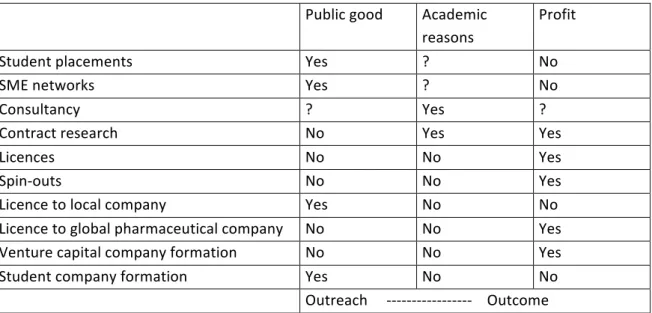
In an attempt to operationalise the term KT, Cullen (2003) has developed the ‘outreach to outcome framework’ for KT. Cullen’s framework is based on the view that universities sometimes act as an agent of local economic development (outreach) and sometimes as a ‘venturer’ to make financial returns and profit (outcome) (Table 1) (cited in Wersun, 2010).
Table 1. The outreach to outcome framework
Public good Academic
reasons
Profit
Student placements Yes ? No
SME networks Yes ? No
Consultancy ? Yes ?
Contract research No Yes Yes
Licences No No Yes
Spin-‐outs No No Yes
Licence to local company Yes No No Licence to global pharmaceutical company No No Yes Venture capital company formation No No Yes Student company formation Yes No No Outreach -‐-‐-‐-‐-‐-‐-‐-‐-‐-‐-‐-‐-‐-‐-‐-‐-‐ Outcome Source: Cullen, 2003, cited in Wersun, 2010.
The above discussion highlights notions of KT as a more engaged and multi-‐directional practice rather than a linear/sequential, one directional process – in turn based on different characterisations of knowledge itself. Missing from this is the subject of scale or geography, which will have implications for understanding the role of knowledge in innovation across national boundaries. While territory is not homogenous and may be considered a central component of innovation processes, in this project we will be focusing on the crossing of national boundaries rather than specific territorial dimensions although some aspects (for instance rurality) will be investigated as a context in one of the project’s work packages.
2.5 Implications for Crossing Boundaries
Although most attention has been given to the concept of "national" innovation systems, it is clear that much innovation involves knowledge transfer and exchange across national borders (for example, within transnational enterprises or in the context of European Union research and technology programmes) (Mason & Wagner, 1999). Such transfer of knowledge is facilitated by Multi-‐National Corporations (MNC), Transnational organisations, International Joint Ventures (IJV), and international projects supported by governments, the United Nations, the European Commission and other national and international funding organisations (Duan et al., 2010). While all knowledge transfer faces some obstacles, cross-‐border KT faces extra challenges due to cross-‐ cultural, political, economic, and geographical gaps. Knowledge sharing is often seen as resulting in a loss of power, and, as a result, knowledge that should be transferred is often withheld, leading to inefficiency.
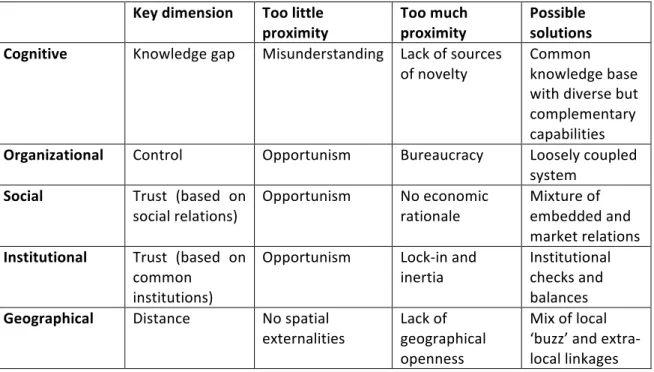
There are different dimensions of proximity that include cognitive, organizational, social, institutional and geographical proximity (Boschma, 2005). Each relate to different parameters of how proximity in networks and crossing boundaries can be understood (Table 2).
Table 2. Features of 5 forms of proximity
Source: Boschma, 2005.
It has been found that if applicable knowledge is available locally, firms and other institutions will attempt to source and acquire it, if not they will look elsewhere (Kingsley and Malecki, 2004; Davenport, 2005; Huggins and Johnston, 2010). In addition, firms with higher absorptive capacity (ability to recognize, transfer and utilise knowledge) are often more connected to global networks (Drejer and Lund Vinding, 2007). The increased reliance on wider spatial knowledge pipelines is reflected by the growing number of firms choosing to work with the best universities regardless of location in order to take advantage of high talent pools, favourable intellectual property rules and government incentives for joint industry–university research (NSF, 2006; Polenske, 2007). However, there are often considerable differences in the capability of universities to effectively transfer their knowledge, and of firms to effectively absorb such knowledge (Di Gregorio and Shane, 2003; Lawton Smith and Bagchi-‐Sen, 2006; Perkmann and Walsh, 2007, cited in Huggins et al., 2011).
Given the nebulous and socially embedded nature of knowledge, the emphasis is more on knowledge transfer as a fluid, multi-‐directional process involving broad activities, actors and networks. As the changing landscape of knowledge exchange is increasingly less dependent on geographical proximity, international knowledge flows are affecting who and how knowledge is transferred and absorbed. The relationship between knowledge and technology is becoming
Key dimension Too little
proximity Too much proximity Possible solutions Cognitive Knowledge gap Misunderstanding Lack of sources
of novelty Common knowledge base with diverse but complementary capabilities
Organizational Control Opportunism Bureaucracy Loosely coupled system
Social Trust (based on
social relations) Opportunism No economic rationale Mixture of embedded and market relations
Institutional Trust (based on common
institutions)
Opportunism Lock-‐in and
inertia Institutional checks and balances
Geographical Distance No spatial
externalities Lack of geographical openness
Mix of local ‘buzz’ and extra-‐ local linkages
increasingly inter-‐dependent in this process, which, ultimately, has implications for the incidence and character of innovation exploitation. How these dynamics are operating in relation to the use of technology (in particular information technology) by organisations operating within national boundaries and the technology transfer across national boundaries is considered in the next section.
3. Technology
3.1 The Concept of Technology
The concept of technology has been understood in different ways from different perspectives. Wahab et al. (2012) have produced a comprehensive paper that tracks the development and application of the different definitions of technology. They acknowledge the complexity of the term and its different definitions according to the different disciplinary approaches, a point also emphasized by Lan and Young (1996).
Technology is a collection of physical processes that transform inputs into outputs with procedural techniques and organisational arrangements for carrying out the transformation (Putranto et al., 2003). Technology has also been defined as technical knowledge that could also be associated with a machine, an electrical or mechanical components, a chemical process, software code, a patent, a technique, communication or a combination of different components (Omar et al., 2011: 328).
Examples of technology can be taken from the invention of fire and man’s ability to control it, through to the invention of the wheel, the printing press, the telephone, the discovery of radioactivity and man’s ability to enhance it for good (nuclear power and x-‐rays) or evil (the atom bomb). More recent technological developments include the internet and the consequent ability of the technology to inter-‐connect almost all organic inhabitants and inorganic ‘things‘ on the planet into a collective ’internet of things’ (Ashton, 2009). These examples demonstrate the complexity of technology that incorporates the elements of product, process and person operating as a socio-‐technical ecosystem. The generic term “technology” can also refer to a ‘class of knowledge’ for making a specific product and also a technical skill necessary to use a production technique and a product.
Institutionalist scholars have considered technology to be a dynamic force in the process of cultural evolution. They do not make functional distinction between ‘technology’ and science or ‘tool’ and ‘skills’ rather they consider them as a cumulative technological life process and of evolving potential, not one of the evolved technologies. Veblen (1908) used the concept of technology ‘as knowledge’ in a comprehensive way of understanding the material culture of a society. He argued that
“whenever a human community is met with [… ] it is found in possession of something in the way of a body of technological knowledge-‐knowledge serviceable and requisite to the quest of a livelihood comprising at least such elementary acquirements as language, the
use of fire, or of a cutting edge[… ]This information and proficiency in the ways and means of life vests in the groups, it is the product of the given group (Veblen, 1908: 519).
From the above quotation it seems that technological knowledge can also be borrowed from other groups/communities. Thus, there is a transcultural aspect of the technological process that is not evident in other cultural phenomena. Veblen argued that the technological knowledge and the skills to use the tools there is a complete interdependence between the two during the process of technological development. However, Ayres argued that all skills are the part of culture-‐ a body of core from which individual human beings learn whatever they learn in their life. But it is true that all technological behaviour patterns are objectified in tools, instruments, formulas and notations of many kinds; and that fact is vey important, for it is the basis of technological development (Ayres, 1953:282). Technological development is not the result of heroic effort or the genius ills of individual; it is rather the outcome of its inherent logic of development. Ayres argued that
“since technology is objectified in physical tools and apparatus, it is always capable of progressive development. Every tool contains within itself, the possibility of being applied in new situation or different materials and in different ways from its historical use. This process is the universal pattern of invention and discovery (Ayres, 1953:282).
Thus, Ayres added the ‘tool combination principle’ to the concept of technological development. He called this principle as a law of progress, which he explained to mean simply that as in a mathematical progression, each member of the series is derived from the preceding member by the same operation (Ayres, 1944, 119-‐20).
Technology has been defined from a utilitarian approach where technology is considered to be the process of accumulating knowledge, skills and procedures for the making, using and doing of useful things (Merril, 1968; Natarajan and Tan, 1992). Mumford (1996) made a distinction between ‘tools’ and ‘machines’ where the user directly manipulates tools, while machines are more independent of the skills of the users. Burgelman et al. (1996) consider technology to be the embodiment of people, materials, cognitive and physical processes facilities, machines and tools. While others focus on technology from a knowledge perspective where knowledge is accumulated and organized in a way to develop and apply tools, machines, materials and processes to solve human problems (Resiman, 2006).
However, the technological development does not require only the knowledge about the precise characteristics of the artifact, but also the social universe in which the artifact would function (Callon, 1986). Technological knowledge is unique and cannot be learned entirely from textbooks or briefings as its uniqueness is marked by its non-‐transferability and non-‐tradability (Gusterson, 1996: 156). This kind of ‘tacit knowledge’ can only be transferred by ‘a person-‐to-‐person’ sharing of technical and managerial experience, attitudes and viewpoints. It is believed that the more
complex the technology, the more crucial is the favourable personal chemistry between transferor and recipient. Moreover, both need to be highly motivated for such exchanges (Shelp, 1984: 13-‐14).
Scientists working on a particular technology share a ‘technical frame’ (Bijker, 1995), which represents the meanings of technological system for the group members. Hence, transfer of technology involved the transfer of ‘technological frame’-‐ a whole way of looking at producing, selling and providing credit for goods. Technological frames, like paradigms, can begin with a research team pursuing a new technology or discovery. Knowledge of a new frame is usually distributed among a small network of innovators. These innovators form communities of interpretation (Brown & Duguid, 1999) in which they develop and collaborate to modify the shared mental model. Only such community of practice could translate a ‘shared mental model’ into a product.
For the purpose of achieving a common understanding for this project, technology can be broadly defined as:
a process of making, modifying, using, applying knowledge related to tools, machines, techniques, systems and methods of organization in order to solve a problem, achieve a goal or perform a function to affect human ability to control and adapt their environments.
As has been established, technology is not a stand-‐alone entity but rather is a socio-‐technical system where transfer of technology is critical and often driven by national and international policies. For this project in particular, the transfer of technology across multi-‐national and cultural boundaries is especially important and needs conceptual definition.
3.2 The Concept of Technology Transfer
Technology transfer has been seen from different disciplinary perspectives: In management, technology transfer is seen as an ‘intentional, goal oriented interaction’ between two or more persons, group or organizations in order to exchange technological knowledge and / or artifacts and rights (Amesse and Cohendet, 2001: 1460). Since technology refers to a whole range of ideas, know how and logistics, the term technology transfer has become very complex. Before 1980s the idea of technology transfer was seen as a process of transferring the knowledge and technology from developed to less technically developed countries (William & Gibbons, 1990). The current emphasis is more on exchange of ideas, knowledge and technology across national and cultural boundaries. Technology is not a specific tool, artifact or product that is transferred from producers to users. In the context of research organization, technology transfer refers to the processes by which ideas, proofs or concept, and prototypes move from research stage to product development stage (Bozeman, 2000: 629).
Technology transfer could be understood in terms of three core processes: the introduction of new techniques by means of investment in new plants, the improvement of existing techniques and the generation of new knowledge (Hoffman and Girvan, 1990). Many scholars believe that
technology and knowledge are so intertwined that any mention of one implies the other; technology is considered a form of knowledge since it not only consist of machines and mechanical equipment but also comprises technical knowledge and operating skills.
That is why knowledge and technology transfer are considered as an interactive process with a great deal of back and forth exchange among individuals over an extended period of time (Gibson and Smilor, 1991). Sung and Gibson (2005) identified four levels of technology and knowledge transfers: Creation level, Sharing level, Implementation level and Commercialisation level. At each level there are four important factors that affect the process and result of knowledge and technology transfer across the boundaries. These factors are: Communication, Distance, Equivocality, and Motivation (Sung and Gibson, 2005).
Sahal (1981) defined technology as ‘configuration’, transfer of which must rely on a subjectively determined but special set of process and products. However, technology transfer could not be understood only by focusing on a particular ‘product’ because in the process of technology transfer, it is not merely the product that is transferred but also the knowledge of its use and application. From this perspective there is no difference between ‘knowledge transfer’ and ‘technology transfer’ (Sahal, 1982). Without the knowledge base the physical entity could not be put in practice. Hyden (1992) suggested that technology transfer is nothing but the transfer of knowledge that can be used as inputs, such as patents right, scientific principles and R&D , but which must be able to be used to make product. Technology transfer is a socio technical process that implies the transfer of cultural skills accompanying the movement of machinery, equipment and tools (Levin, 1993) from one organizational setting to another (Rossener, 1993). When a technological product is transferred, the knowledge upon which its composition is based is also transferred.
However, ‘technology transfer’ and ‘knowledge transfer’ are not the same thing, although some scholars used the these terms interchangeably (Levinson and Minoru, 1995; Oliver and Liebeskind,1998). In fact, technology transfer is much narrower construct than knowledge transfer (Allen, 1984; Corsten, 1987). Technology transfer refers to new tools, methodologies, processes, and products (Tornatzky and Fliescher, 1990) and, as such, is used primarily as an instrument for changing the environment. Knowledge transfer, on the other hand, is a broader concept, embodying comprehensive learning, reflected in the changes in the strategic thinking, culture, and problem-‐solving techniques used by a firm (Grants, 1996), as described in section 2. Therefore, the transfer of knowledge and the transfer of technology can be seen as two separate processes.
It has also been reported that different types of organizational structures and processes affect technology transfer and knowledge transfer activities differently. Moreover, the factors shaping the external and internal context of the firm also affect the transfer of knowledge as well as technology. The external context of a firm includes the prevailing conditions in a country that affect technological collaboration between universities and firms. The firm’s internal context
refers to a firm’s capacity to absorb the knowledge and technology transferred from other organizations.
The technology transfer process becomes smooth when there are conducive rules and policies allowing the regular interaction among scientists, technology transfer personnel and managers/administrators of the organizations (Oliver and Liebeskind, 1998). Such interaction, whether it is face-‐to-‐face or virtual helps over a period of time in the creation of ‘communities of practice’. These tend to develop their own rules and practices, as mentioned in the section on knowledge.
Some scholars have also reported that ‘mechanistic structures’ and stable and direction oriented culture facilitate knowledge transfer activities more than they did for technology transfer activities. Similarly the ‘flexible and change-‐oriented cultures’ and more customized university policies for IPR, patent ownership, and licensing facilitate technology transfer across the organizational boundaries (Gopalakrishnan and Santoro, 2004). However, the trust between Universities and Industries are important for transfer of knowledge as well as technology because trust help cementing industry—university alliances (Pfeffer and Salancik, 1978; Smith, et al. 1995). But trust is a temporal phenomenon; a change in the leadership of university research centre, untrustworthy action by the university or availability of new partnership can quickly change the firm’s level of trust in its university partner. Thus, the effect is of both knowledge transfer and technology transfer.
3.3 Implications for Crossing Boundaries
Sung and Gibson (2010) reported a range of factors that make the transfer of knowledge and technology across national boundaries successful (p.8): a high degree of interactive communication, a variety of incentives and recognition for transfer of knowledge and technology, cultural proximity among developers and users, and unambiguous nature of knowledge and technology and their application. However, the success of technology transfer depends on the absorptive capacity of the recipient firms, organizations or institutions (Sazali et al., 2009). The absorptive capacity of a firm is basically a function of the recipient firm’s level of prior related knowledge which includes basic skills, a shared language, positive attitudes towards learning, relevant prior experience and up to date information on knowledge domain as all these are essential for an organization to assimilate and exploit new knowledge (cited in Sazali, et al., 2009).
Therefore, an organisation’s absorptive capacity does not simply depend on the organization’s direct interface with the external environment, but on the transfer of technology which include knowledge, skills and tools, across and within sub-‐organizations (Cohen and Levinthal, 1990). Information Communication Technologies (ICTs) have been very effective in bringing internationally dispersed R&D teams together and facilitating the transfer and sharing of codified knowledge. But ICTs have not been successful in transferring related sensory information, feelings, intuition and non-‐verbal communication that were important to the ultimate implementation of knowledge (Boutellier et al. 1998). Sanjay Lall (2000) also suggested that