i
MODELING THE IMPACT OF THE VOLATIliTY OF
THE PERCEIVED COUNTERPARTY CREDIT RISK ON
HEDGE ACCOUNTING EFFECTIVENESS
1
NOVA Information Management School
Instituto Superior de Estatística e Gestão de Informação
Universidade Nova de Lisboa
MODELING THE IMPACT OF THE VOLATILITY OF THE PERCEIVED
COUNTERPARTY CREDIT RISK ON HEDGE ACCOUNTING
EFFECTIVENESS
by
José Eduardo Justo Neto
Dissertation presented as partial requirement for obtaining the Master’s degree in Statistics and Information Management, with a specialization in Risk Analysis and Management
Advisor: Jorge Miguel Ventura Bravo, PhD
2
ABSTRACT
The recent publication of IFRS 9 facilitates the use of hedge accounting, although some challenges arise as well. Hedge effectiveness is to be more align with risk management meaning that hedge accounting ineffectiveness will now be only related to factors such as counterparty credit risk whenever uncollateralized derivatives are to be used as hedge instruments. This master thesis is concerned with what may go wrong in a designated hedging relationship due to CVA and DVS volatility. Using Monte Carlo simulations and regression analysis the probability of hedging ineffectiveness as a function of probability of default perceived implied volatility is to be modelled.
KEYWORDS
3
RESUMO
A recente publicação da IFRS 9 facilita o uso da contabilidade de cobertura, ainda que acrescente de igual modo alguns desafios. A contabilidade de cobertura passa a estar mais alinhada com a gestão de risco o que significa que a sua ineficácia passa a estar mais relacionada com fatores com risco de contraparte sempre que se usem derivados não coletaralizados como instrumentos de cobertura. Esta tese de mestrado foca-se no impacto da volatilidade do CVA/DVA na contabilidade de cobertura. Fazendo uso de simulações Montes Carlo e regressões estatísticas, procura-se modelizar a probabilidade de ineficácia das coberturas em função em da volatilidade das probabilidades de default.
PALAVRAS-CHAVE
4
INDEX
1.
Introduction ... 8
1.1.
The use of derivatives ... 8
1.2.
Hedge accounting standards ... 9
1.3.
The importance of hedge accounting ... 10
1.4.
IFRS 9 ... 10
2.
Literature review ... 13
2.1.
Hedge accounting ... 13
2.2.
Risk management after de 2007 credit crisis ... 13
2.3.
Credit risk measurement basic approaches and value adjustments ... 15
2.3.1. Market-based estimation of default probabilities ... 15
2.3.2. XVAs family ... 17
2.4.
Other research ... 18
2.4.1. Cash flows projection and discounting ... 18
2.4.2. Stochastic processes ... 19
3.
Methodology ... 21
3.1.
Setting up an IRS ... 21
3.2.
Predicting hedge accounting effectiveness ... 25
3.3.
The impact of PDs volatilities and cross-correlation on hedge effectiveness ... 26
3.4.
Generic approach ... 27
4.
Results and discussion ... 29
4.1.
IRS hedging effectiveness ... 29
4.2.
Estimating the probability of ineffectiveness... 31
4.3.
Ineffectiveness drivers... 33
4.4.
Generic approach ... 34
4.4.1. Probabilities of default ... 35
4.4.2. Loss given default ... 36
4.4.3. Volatility of perceived credit risk and cross-correlation ... 37
4.4.4. Interest rates ... 38
4.4.5. Interpreting the results of the multivariate polynomial regression ... 39
4.4.6. Statistical classification ... 39
5.
Conclusions ... 40
6.
Appendix ... 42
5
ILLUSTRATIONS
Illustrations 1 - Fluctuations of the NPV of the bond ... 29
Illustrations 2 - Flutations of bond’s prices and of both the collateralized and uncolleteralized IRS ... 30
Illustrations 3 - Hedge Accounting Innefectiveness ... 30
Illustrations 4 - Simultations on the BPI's financials and their impact on the PD ... 31
Illustrations 5 - Distribution of that PDs that arise from the Wiener Process ... 32
Illustrations 6 - The impact of the volatalities of the PDs on innefectiveness rate ... 33
Illustrations 7 - The impact of correlation of the PDs on ineffectiveness rate ... 34
Illustrations 8 - 3rd order polynomial regression for the PD0 ... 35
Illustrations 9 - Standard fluctuation range for the DVA at the 2nd year per PD0 ... 36
Illustrations 10 - 1st order regression of the LGD ... 36
Illustrations 11 - Standard fluctuation range for the DVA at the 2nd year per LGD ... 37
Illustrations 12 - 1st order regression of the volalities of perceived counterparties credit risk ... 37
Illustrations 13 - 2nd order regression of the PDs cross-correlations ... 38
Illustrations 14 - 2nd order polynomial regression the interest rates ... 38
6
TABLES
Table 3-1 - Expected Cash-Flows as of the begenning of 2010 ... 22
Table 3-2 - Companies' 1-year PDs ... 24
Table 3-3 - Marginal conditional PDs at inception (2010) ... 24
Table 4-1 - Evolution of the hedge innefectiveness rates troughout the years ... 32
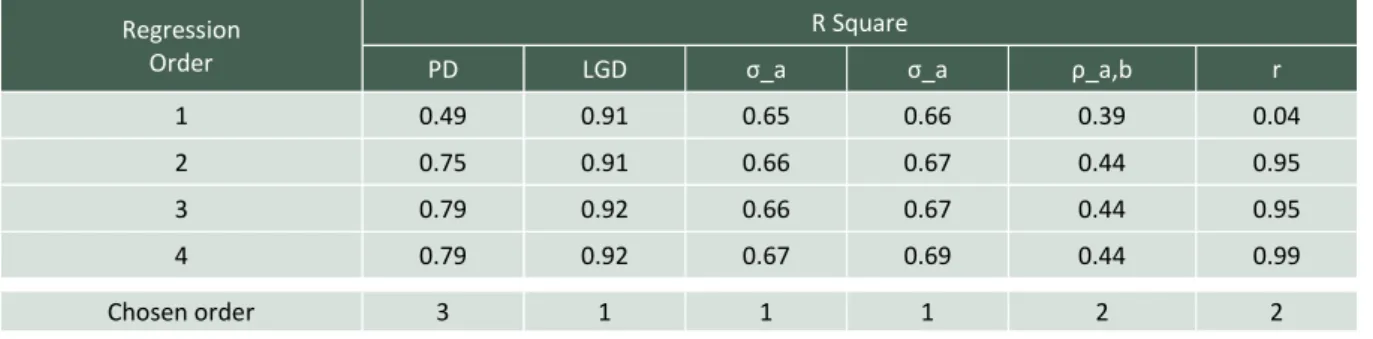
Table 4-2 - Polynomial Regressions R Squared ... 33
Tabla 4-3 - Univariate polynamial regressions ... 35
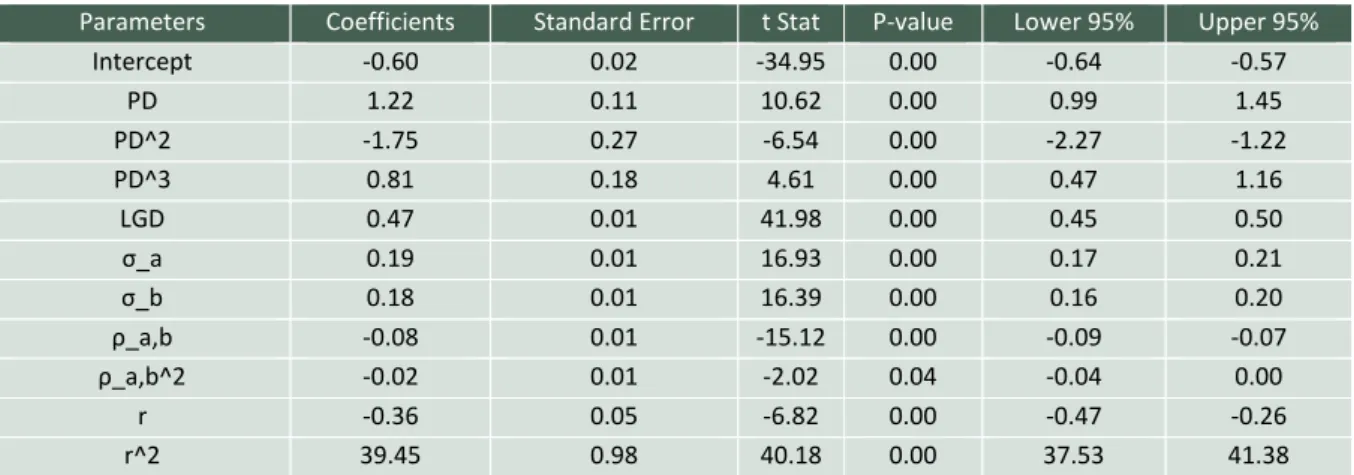
Tabla 4-4 - Multivariate polynomial regressions ... 39
Tabla 4-5 - Statistical classification ... 39
Table 6-1 - Year-end AAA rated bonds interest rates according to ECB ... 42
Table 6-2 - Companies' Financials ... 43
Table 6-3 - PDs' estimation inputs ... 44
Table 6-4 - Using risk-free rate as predictor to comapnies financials' evolution ... 44
7
LIST OF ABBREVIATIONS AND ACRONYMS
CCP Central Counterparty Clearing House CEO Chief Executive Officer
CPD Conditional Probability of Default CRO Chief Risk Officer
CVA Credit Valuation Adjustment EAD Exposure at Default
ERM Enterprise Risk Management Euribor Euro Interbank Offered Rate EV Enterprise Value
EY Ernest and Young
FASB Financial Accounting Standards Board
FV Face Value
FRA Forward Rate Agreements FSLI Financial Statement Line Item GWP Gross World Product
IAS International Accounting Standards IASB International Accounting Standards Board IFRS International Financial Reporting Standards IRR Interest Rate Risk
IRS Interest Rate Swap LGD Loss Given Default NPV Net Present Value OIS Overnight Swap Index OTC Over-the-counter PD Probability of default
8
1. INTRODUCTION
The uncertain economic times of the past few years have had a major effect on how companies operate these days. Its impacts are observable in the increase of risk management professionals out there1 as well as in the number of companies using derivatives to manage market risk (thereby referred to as risk)2. When using the derivatives to manage risk, companies consider two main factors: the derivatives’ abilities to offset risks efficiently; and whether or not they are able to demonstrate to investors (trough the financial statements) their risk management activities.
1.1. T
HE USE OF DERIVATIVESDerivatives are financial securities with a value that derived from an underlying asset or group of assets. The derivative itself is a contract between two or more parties, whose price is determined by fluctuations in the underlying asset. The most common underlying assets include stocks, bonds, commodities, currencies, interest rates and market indexes.
Derivatives can either be traded over-the-counter (OTC) or on an exchange. OTC derivatives constitute the greater proportion of derivatives in existence and are unregulated, whereas derivatives traded on exchanges are standardized. OTC derivatives generally have greater risk for the counterparty than do standardized derivatives.
According the statistics release ‘OTC derivatives statistics at end-June 2018’ published on 31st of October of 2018 by Bank of International Settlements, the “activity in OTC derivatives markets increased in the first half of 2018, driven mainly by short-term interest rate contracts”, with this increase in activity being driven largely by US dollar interest rate contracts. According to the same report, the notional amount of outstanding the OTC derivatives increased to $539 trillion at end-June 2018 (6 times higher than the GWP3), reaching back the values of the beginning 2008.
These figures are often used to illustrate how these contracts may present a significant risk to the global economy. Instead, the gross market value of outstanding derivatives contracts provides a more meaningful measure of amounts at risk. Its amount has been declining steadily since 2009 and is about to get below $10 trillion (11% of the GWP).
This report further decomposes the current gross market value of outstanding derivatives into three risk categories: interest rate (64%), foreign exchange (25%) and credit derivatives (10%).
Across the world, within non-financial firms 50% of them use derivatives in general, while 43% use currency derivatives and only 10% commodity price derivatives (Bartram, Brown, & Fehle, 2003). This suggests that the use of interest rate derivatives is mainly conducted by financial companies.
1 An EY report named ‘Rethinking risk management’ issued recently base on a survey of major financial
institutions in the beginning of 2015 apprises that “64% [of the CROs] report increases in the size of the risk function over the past 12 months, and 60% expect such increases to continue next year”.
2 According to an ISDA survey of derivatives usage by the world's 500 largest companies conducted in
2009, “94% of these companies use derivative instruments to manage and hedge their business and financial risks”
3 The GWP is the combined gross national product of all the countries in the world. As imports and exports
offset when considering the whole world, this is the equivelent to world’s total global gross domestic product (GDP).
9 As to what the interest rate derivatives market is concerned, the Swaps represent 89% of the market value of OTC interest rate derivatives, followed by FRAs (10%).
All these figures suggest that derivatives markets have been exceptionally successful. The main reason is that they have involved many different types of traders and have a great deal of liquidity. When an investor wants to take one side of a deal, there is usually no problem in finding someone who is prepared to take the other side. Three wide groups of traders can be identified: hedgers, speculators, and arbitrageurs (Hull, 2015).
Hedgers use derivatives to reduce the risk that they face from possible future movements in a market variable. Speculators use them to gamble on the future direction of a market variable. Arbitrageurs take offsetting positions in two or more instruments to lock in a return.
In the literature, research on risk management in the late 90s focused on the question of why firms should hedge a given risk (Petersen & Thiagarajan, 2000). This literature makes the point that measuring risk exposures is an essential component of a firm’s risk management strategy. This measuring, within the most recent accounting standards, tend sto be translated on the firms’ financials.
More recent literature suggests the managers’ concern with the financial accounting of their risk management activities is positive for investors as firm’s abilities to meet earning targets are positively associated with the likelihood that firms will focus on accounting earnings rather than economic earnings (Hughen, 2010)
From the risk management point of view, the most important thing in the financials is not only how the financal instruments are recognized but also how the financial statements reflect their hedging practices. Hedge accounting is therefore of great importance.
1.2. H
EDGE ACCOUNTING STANDARDSHedge accounting is the accountancy practice that allows a company to offset to the mark-to-market movement of the derivative in the P&L account of the instrument (risk) being hedged. As hedge accounting entails much compliance – involving documenting the hedge relationship and demonstrating the hedge relationship is effective – the implementation of a recencly published hedge accounting stantard poses some challenges to risk managers. This new guidance (IFRS 9) has been recently finalised by IASB (International Accounting Standards Board), which is the independent accounting standard-setting body of the IFRS Foundation founded in 2001, as the successor to the International Accounting Standards Committee (IASC). It is responsible for developing International Financial Reporting Standards (IFRS), previously known as International Accounting Standards (IAS) and promoting the use and application of these standards.
In terms of hedge accounting, the new requirements introduced in IFRS 9 (also refered to as the Standard) were, in some extent, a response to criticism of IAS 39 which was often viewed as too stringent and not capable of reflecting risk managagement principles. Theese changes aim to reduce accounting earnings volatility by representing, in the financial statements, the effect of an entity’s risk management activities that use financial instruments to manage exposures arising from particular risks that could affect profit or loss (IFRS 9 - par. 6.1.1)
10 The principal of economic relationship between the hedged item and the hedging instrument has therefore been introduced (IFRS 9 - par. 6.4.1.c). Henceforward hedge accounting converges with economic hedging, although that is so just as long as the effect of credit risk does not dominate the value changes that result from that economic relationship.
Because the hedge accounting model is based on a general notion of offset between gains and losses on the hedging instrument and the hedged item, hedge effectiveness is determined not only by the economic relationship between those items (ie the changes in their underlyings) but also by the effect of credit risk on the value of both the hedging instrument and the hedged item (IFRS 9 - par. B6.4.7). An example of credit risk dominating a hedging relationship may be when an entity hedges an exposure to certain risk using an uncollateralised derivative. If the counterparty to that derivative experiences a severe deterioration in its credit standing, the effect of the changes in the counterparty’s credit standing might outweight the effect of changes on the fair value of the hedging instrument. In such a case the hedging relationship would turn out to became innefective and hedge accounting should be discountinued. This, therefore, poses a risk of hedge accounting being discountinued whenever the hedging instrument consists of an uncollateralized OTC derivative.
1.3. T
HE IMPORTANCE OF HEDGE ACCOUNTINGFor businesses that use derivatives for risk management, failure to qualify for hedge accounting may induce income volatility that does not accurately reflect underlying economic performance. This income volatility can have a substantial impact on other managerial decisions and contractual obligations faced by the company, which may influence the choice of hedging instrument or even whether to hedge at all.
Franklin Savings and Loan is an extreme example of the consequences of income volatility resulting from failure to qualify for hedge accounting. In 1990, Franklin experienced losses on a hedging instrument they claimed would be offset by subsequent expected gains in their business. Although they documented their anticipation of hedge effectiveness, no hedge accounting treatment was undertaken. This resulted in income statement volatility that triggered debt covenants that later reduced the firm’s equity below minimum capitalization requirements and ultimately resulting in its demise
One, therefore, ought to properly account for hedging relationships in the financial statements and furthermore assess properly the probability of a hedging to become ineffective.
1.4. IFRS
9
This Standard is to be applied by all entities preparing IFRS financial information and to almost all types of financial instruments. IFRS 9 is effective for annual periods beginning on or after 1 January 2018, with earlier application permitted.
IFRS 9 is one of the most significant financial reporting developments in recent years and its implications could be wide ranging, affecting business strategies, processes, systems, controls, financial statement preparation and disclosures. Although IFRS 9 applies to all entities, financial institutions and other entities, with large portfolios of financial assets measured at Amortized Cost
11 (AC) or Fair Value through Other Comprehensive Income (FVOCI) under IAS 39 will be most significantly affected, particularly by:
the new classification and measurement requirements;
the change to the Expected Credit Loss (ECL) model introduced by IFRS 9; and the hedge accounting requirements
Under the new standard, the core principles of hedge accounting have not changed significantly from IAS 39, with IFRS 9 still requiring all hedges to be formally designated and documented at inception. There are still 3 types of hedging relationships: fair value hedge; cash flow hedge; and hedge of a net investment in a foreign operation (IFRS 9 - par. 6.5.2).
The focus of this dissertation is fair value hedge which IFRS 9 defines as “a hedge of the exposure to changes in fair value of recognized asset or liability or an unrecognized firm commitment, or a component of any such item, that is attributable to a particular risk and could affect profit or loss” (IFRS 9 - par. 6.5.2). In practice, it means that the fair value hedge is a hedge of the risk that the hedge item’s fair value will change in response to variables such as interest rates, foreign exchange rates or market prices. An example is an IRS, which converts fixed rate debt into floating rate debt.
In fact, as the main players in derivatives markets are financial institutions, the main risk they want hedge is the interest rate risk. Hence, fair value hedge is often done by these participants to switch their fixed income or cost structures in variable ones, which reflect the better their funding costs. As mentioned before, the derivatives may be contracted either within the OTC market or through CCP4. While derivatives in CPPs tend to be collateralized, the ones contracted within OTC markets may not be. When there is not collateral, counterparty credit risk arises, which may affect the hedge accounting effectiveness. One of the main IFRS 9 requirements hedge effectiveness is therefore that the effect of credit risk does not dominate the value changes that result from the economic relationship between the hedged item and the hedging instrument (IFRS 9 - par. 6.4.1).
The effect of credit risk means that even if there is an economic relationship between the hedging instrument and the hedged item, the level of offset might become unreliable. This may arise from an alteration in the credit risk of either the hedging instrument or the hedged item.
An example of credit risk dominating a hedging relationship is when an entity hedges an exposure to bond’s interest rate risk using an uncollateralised derivative. If the counterparty to that derivative experiences a severe deterioration in its credit quality, the effect of the changes in the counterparty’s credit standing might outweigh the effect of changes in the bond’s price, given that changes in the value of the hedged item depend largely on the interest rate changes.
The credit standing of a company is not static. Instead, credit risk is driven both by idiosyncratic firm characteristics and by systematic factors is an important issue for the assessment of financial stability (Bonfim, 2009). These results in uncertainty, reason why credit risk volatile. At the same time the fact
4 A central counterparty clearing house (CCP) is an organization that exists in various countries to facilitate
trading done in the derivatives and equities markets. These clearing houses are often operated by the major banks to provide efficiency and stability to the financial markets in which they operate. CCPs bear most of the credit risk of buyers and sellers when clearing and settling market transactions.
12 the credit risk also depends on macroeconomics developments, for instance, illustrate that up to some extent credit risk between two companies may be correlated as well.
This suggests that even if, in one hand, the higher the volatilities of credit risk the higher the probability of hedge accounting ineffectiveness, on the other hand, the significant correlation between the credit risk may outcome the volatility effect on the hedge ineffectiveness.
In this thesis we analyse whether a given accounting hedging a relationship is going to be effective. Our goal is to demonstrate that increased volatility of perceived counterparty credit risk increases the odds that an hedging accounting relationship turns out to be effective. Additionally, we aim to corroborate the hypothesis that the higher the correlation of perceived counterparty credit risk the lower the probabilities of an accounting hedging relationship to turn out to be effective.
In order to do so we explore the financial information available within the Portuguese stock market, by setting up a hypothetical uncollateralized IRS between BPI and BCP and then corroborate each of the above mentioned hypothesis. In setting up an IRS, we explain the contractual characteristics of an hypothetical contact and discuss its valuation methodology. To predict hedge accounting effectiveness, we adopt a classical Black-Scholes framework and test for the impact of PDs volatilities and cross-correlation on hedge effectiveness. As the hedging innefectiveness may arise from both CVA and DVA fluctuations, this thesis uses a bilateral CVA approach in order to account for credit risk. In the thesis we recognize that hedge accounting ineffectiveness does not depend solely on factors such as the volatility of the PDs and its correlation. To test the hypothesis that BPI and BCP hypothetical IRS is affected by other factors, a parallel approach is tested in which we analyse the sensitivity of hedge effectiveness to changes in the PDs, LGDs and interest rates.
This thesis is organized as follows. First the author has conducted a LITERATURE REVIEW on three main research topics: valuation of IRS; accounting for the CVA/DVA adjustments; estimating the default probabilities. Then, on the METHODOLOGY, based on the literature, the author explores in what extent
the hedge accounting practices may be affected by both the volatility of the perceived counterparty credit risk and the correlation of the of fluctuations in the credit risk of the counterparties, when using an uncollateralized IRS (Interest Rate Swap) to hedge against interest rate risk. Having gone trough the main the qualitative and quantitative research assumptions, the results are shown in the RESULTS AND DISCUSSION section. Finnaly, having the results been interpreted, the author concludes.
13
2. LITERATURE REVIEW
2.1. H
EDGE ACCOUNTINGUp to the nineties risk management had received little attention by economists. That has changed with growth of over the counter derivatives occurred in this decade as managers started to use these instruments for financial hedging with DeMarzo & Duffie (1995) demonstrating that managers often hedge accounting risk as opposed to, or in addition to, economic risk.
Notwithstanding, later on, based on the hedge accounting methods prescribed by SFAS No. 1335, which introduced the concepts of “fair-value” and “cash-flow” hedge accounting methods, it is demonstrated that under no-hedge accounting at all, the hedge choice would still be different from the optimal economic hedge (Melumad, Weyns, & Ziv, 1999). At that time the research focused on the documentation of hedging effectiveness proposed correlation coefficients and several other non-regression-based effectiveness-testing methodologies (Kawaller & Koch, 2000).
The use of correlation coefficients is of major importance as it allows to demonstrate that a hedge is expected to be effective in the future (at least, based on historical date). In 2003, Lopes & Santos demonstrate how regulators were late in recognizing methodologies such as the one proposed Kawaller & Koch (2000) to oversee the use of hedge accounting effectiveness. Their work also showed how the absence of such methodologies in the hedge accounting documentations made the hedge accounting vulnerable to manipulations.
Notwithstanding, the growth of the recognition of hedge accounting had already started. Research conducted on the NYSE listed companies show that the more the duration of a company’s debt the more they made use of hedge accounting (Galdi & Guerra, 2009).
Although the use of hedge accounting is related directly to the extent in which a company uses derivatives to manage their risk, the hedging behaviour in corporations is associated with frequency of derivatives usage, IFRS experience, perceived importance of reduced earnings volatility and low growth opportunities, with more than half of the companies using hedge accounting indicate that the accounting rules influence their hedging behaviour (Glaum & Klocker, 2011).
As the ability of companies to undertake hedge accounting and document it increased so did concern of regulators. The hedging documentation started to be challenged more often. One of the main concerns of regulators and auditors started to be how credit risk of uncollateralized derivatives counterparties could affect economic and hedge accounting effectiveness
2.2. R
ISK MANAGEMENT AFTER DE2007
CREDIT CRISISThe critical role of the mortgage market in triggering the recent global financial crisis has led to a surge in policy interest, bank regulation and academic research in this area. Encouraged by regulators, banks now devote significant resources in developing internal credit risk models to better quantify expected credit losses and to assign the mandatory economic capital. Rigorous credit risk analysis is not only of
5 SFAS No. 133, Accounting for Derivative Instruments and Hedging Activities is an accounting standard
issued in June 1998 by the FASB that, in response to significant hedging losses involving derivatives years ago, started to require companies to measure all assets and liabilities on their balance sheet at “fair value”.
14 significance to lenders and banks, but is also of paramount importance for sound economic policy making and regulation as it provides a good check on the “health” of a financial system and at large, the course of the economy (Chamboko & Bravo, 2016, 2018a,b,c).
In fact, credit risk has only become a topical issue since the 2007 Credit Crisis with the main approaches to credit risk modelling only starting to be consolidated in the upcoming years. Credit Valuation Adjustments for pricing derivatives contracts were stepping and, subsequently researchers started to take a closer look at stochastic default rate models (Finger, 2000) previously made public. Three of these models (CreditMetrics, CreditRisk+, and CreditPortfolio) had been introduced by Wilson (1998). It impresses how the state of the credit risk measurement has progressed in the two years after the financial crises. Many of the models have entered their second generation. A consensus has developed about certain model parameters and methodologies. Two schools of thought have emerged. One “school” followed the intellectual heritages of Merton’s options theoretical approach and explains default in structural terms related to the market value of the firm’s assets as compared to its debt obligations. Another “reduced form school” statistically decomposed observed risky debt prices into default risk premiums without necessarily scrutinizing their underlying causalities. Under these circumstances, Sanders & Allen (2010) have tried to cope with the economic intuition of each of the models accurately.
Consequently, Enterprise risk management (ERM) started to be a topic of increased media attention, with this being the key motivation for Hoyt & Liebenberg (2011) to measure the extent to which specific firms had implemented ERM programs and, then, to assess the value implications of these programs. These authors found a positive relationship between firm value and the use of ERM. A similar approach has been taken later on by Aebi, Sabato, & Schmid (2012). This time authors focused on the banking industry, by investigating whether risk management-related corporate governance tools, such as for example the attendance of a chief risk officer (CRO) in a bank’s executive board and whether the CRO reported to the CEO or directly to the board of directors, were associated with a better bank performance during the financial crisis of 2007/2008. The results indicate that banks, in which the CRO directly reported to the board of directors and not to the CEO (or other corporate entities), displayed significantly higher stock returns and ROE during the crisis.
By 2013, the question was not anymore whether financial services companies should have the ERM functions, but rather how to have high-quality ERM programs. Using ERM quality ratings of financial companies by Standard & Poor's (S&P)6, Baxter, Bedard, Hoitash, & Yezegel found that higher ERM quality is associated less resource constraint and better corporate governance. They also found that higher ERM quality is associated with improved accounting performance.
6 S&P Global Ratings' ERM assessment centers on the following five key areas: risk governance;
operational risk; market risk; credit risk; and liquidity and funding. As to what the credit risk component of the ERM evaluation structure, is concerned, S&P looks at how an institution's underwriting practices are linked to its credit risk appetite, as well as the robustness of the techniques used in monitoring and managing its credit portfolio.
15 The quest for a proper ERM continues and the attentions start to shift to the operation aspects of ERM. Concepts such has Risk Analytics, Data and Technology and Dashboard Reporting are start to be assessed (Lam, 2014).
In these years, it has been demonstrated how the ERM programs were important, for the firms who had it, to go through the financial crisis. After companies started to create their ERM programs, the focus started to be their quality and proper reporting tools. As ERM becomes more mature, research is focusing on the quantitative questions rather than qualitative ones. In 2015, McNeil, Frey, & Embrechts’s work got a lot of attention has their book revises all the advances made in the past years in quantitative risk management. After revising the history of ERM, the authors introduce the basic risk management concepts. Then the readers are provide with an overview with the statistival properties of financial data and its aplications to market and credit risk. The last chapter is dedicated to the dynamic credit risk models, revising concepts such as uncolleteralized value adjustments.
2.3. C
REDIT RISK MEASUREMENT BASIC APPROACHES AND VALUE ADJUSTMENTS2.3.1. Market-based estimation of default probabilities
Estimating default probabilities, however, could be challenging due to limitations on data availability. Still, there are a number of techniques that allows one to overcome these limitations. These techniques can either be market-based (which rely on security prices and ratings) or fundamental-based (which rely on financial statement data and/or systematic market and economic factors).
Market-based techniques can be applied whenever there is a relatively liquid secondary market for securities issued by, or credit derivatives referencing, the obligor or entity of interest. Under the assumption of market efficiency, securities and credit derivatives prices are forward-looking and capture all publicly available information on the default risk of an obligor. Based on these market prices obligor’s default probability may be inferred. Three main instruments may then be used:
1. Credit Default Swaps 2. Bonds
3. Equity Prices
2.3.1.1.
Credit default swaps
Credit default swaps (CDSs) are the most liquid credit derivatives contracts. These contracts are the equivalent to insurance against default. The buyer of the CDS pays a regular fee or CDS spread, in exchange for protection against the default of a reference obligor during the life of the derivative. If the obligor defaults, the buyer delivers the bond or loan of the reference obligor to the protection seller in exchange for the face value of the bond or loan. CDS contracts are widely available worldwide. The contract maturity usually ranges from 1 to 10 years. Clearly, the CDS spread price depends heavily on the default probability of the reference obligor, a fact exploited by (Chan-Lau, 2003) and for predicting sovereign defaults, using credit default swap spreads.
This dependence is illustrated in the next example. Assuming a one-period CDS contract with a unit notional amount. The protection seller is exposed to an expected loss, 𝐿, equal to
16
𝐿 = 𝑝(1 − 𝑅𝑅) (1)
where 𝑝 is the default probability, and 𝑅𝑅 is the expected recovery rate at default. The 𝑅𝑅 and default probability are assumed to be independent. In the absence of market frictions, fair pricing arguments and risk neutrality imply that the CDS spread, 𝑆, should be equal to the present value of the expected loss:
𝑆 =𝑝(1 − 𝑅𝑅) 1 + 𝑟
(2) where 𝑟 is the risk free interest rate. The default probability can then be recovered from (2) if the 𝑅𝑅, the 𝑆, and 𝑟 are known. This is so as long as CDSs are liquid, which in general is only true for sovereign bonds and corporationes with a significant market capitalization.
2.3.1.2.
Bonds
Bond prices also provide information about default probabilities as illustrated in the next one-period example. Assuming a zero-coupon bond paying one unit of value at maturity. The probability of default of the bond is 𝑝, the fixed recovery rate is 𝑅𝑅, and the risk-free discount rate is 𝑟. If the bond is currently valued at 𝐵, risk neutrality implies:
𝐵 =(1 − 𝑝) + 𝑝𝑅𝑅 1 + 𝑟
(3)
Equation (3) can be solved for 𝑝 as a function of the recovery rate, the risk-free discount rate, and the price of the bond:
𝑝 =1 − (1 − 𝑟) + 𝐵 1 − 𝑅𝑅
(4) Fons (1987) have generalized the intuition derived from the previous example, by presenting an introduction to risk-neutral models of risky-bond pricing. In this article, the relationship between the default premiums embodied in bond yields and actual default rates is also examined.
2.3.1.3.
Equity prices
The first to draw attention to the insight that corporate securities could be seen as contingent claims on the asset value of the issuing firm were Black & Scholes (1973) and Merton (1974). This insight is illustrated in the case of a firm issuing one unit of equity and one unit of a zerocoupon bond with face value 𝐷 and maturity 𝑇. At expiration, the value of debt, 𝐵𝑇, and equity, 𝐸𝑇, are given by:
𝐵𝑇 = min(𝑉𝑇, 𝐷) = 𝐷 − max(𝐷 − 𝑉𝑇; 0) (5)
𝐸𝑇 = max(𝑉𝑇− 𝐷; 0) (6)
where 𝑉𝑇 is the asset value of the firm at expiration. The interpretation of equations (5) and (6) is
simple. Bondholders only get paid if the firm’s assets exceed the face value of debt. Otherwise, the firm is liquidated and assets are used to partially compensate them. Equity holders, thus, are residual claimants in the firm since they only are paid subsequently to bondholders. By taking a closer look at these equations one notes that they correspond to the payoff of European options. The first equation states that the 𝐵𝑇 corresponds to a long position on a risk-free bond and a short position on a put
17 option with strike price equal to the 𝐷. The second equation states that 𝐸𝑇 is equivalent to a long
position on a call option with strike price equal to 𝐷. Given the assumptions of the Black-Scholes option pricing formulas, the default probability in period 𝑡 for a horizon of 𝑇 years can be seen as
𝑝𝑡 = 𝑁 [− 𝑙𝑛𝑉𝑡 𝐷 + (𝑟 − 𝜎𝐴2 2 ) 𝑇 𝜎𝐴√𝑇 ] (7)
where 𝑁 is the cumulative normal distribution, 𝑉𝑡 is the value of assets in period 𝑡, 𝑟 is the risk-free
rate, and 𝜎𝐴 is the asset volatility.
The numerator in equation (7) is referred to as distance-to-default. Empirical results by Moody’s KMV have shown that distance-to-default does a good job in predicting corporate defaults. Furthermore, work by Gropp, Vesala, & Vulpes (2002) and Lau-Chan, Arnaud, & Kong (2004) showed that it predicts as well banks’ downgrades in developed and emerging market countries.
Due to public information availability, this is PD estimation method to be considered in this thesis.
2.3.2. XVAs family
Historically OTC derivatives pricing has relied solely on risk neutral pricing methods, not taking into consideration factors such as credit risk, funding costs of collaterals, adjustments regarding the implication of the derivatives in regaluatory capital and so on. After the 2008 financial crisis the XVA family started to take shape. The XVAs are a family of adjustments that may be made to the valuation of derivatives, reflecting things such as:
1. Counterparty risk (CVA);
2. Own-default risk (DVA);
3. Funding costs (FVA);
4. Margin requirements (MVA);
5. Capital requirements (KVA), and
Their definitions and estimation methods are still debated, but in general nowadays entities that ignore XVAs are at risk of mispricing a derivative. One may found further literature regarding the first three valuation adjustments in the subsections below.
2.3.2.1.
CVA and DVA
CVA (and DVA) is the difference between the price of a derivative with default risk free counterparties and that with default risky counterparties. CVA therefore ends up being an adjustment in a valuation due to one of the two parties being considered default risky. From the point of view an entity, the default risk of a counterparty leads to the entity to charge the counterparty a risk premium (unilateral CVA). As usually both counterparties are default risky this risk premium may change signs depending on the relative riskiness of the two (bilateral CVA). The dynamics of change in sign of the net of CVD and DVA is explored by Brigo (2009).
As the hedging innefectiveness may arise from both CVA and DVA fluctuations, this thesis is going to make use of the bilateral CVA approach in order to account for credit risk.
18
2.3.2.2.
FVA
The impact of collateralization on default risk and on CVA and DVA has been addressed in Cherubini (2005) and particularly in Brigo, Capponi, Pallavicini, & Papatheodorou (2011). These works look at CVA and DVA gap risk under several collateralization strategies as a function of the margining frequency.
Using this approach would imply the author to take several assumptions on margin requirments and on margin frequency. For that reason, valuation adjustments other than CVA and DVA are not to be take into consideration.
2.4. O
THER RESEARCHIn order to go deeper in the research topics to be used in the METHODOLOGY, the author has further
focused its literature review on the following areas: 1. Cash flows projection and discounting; 2. Stochastic processes.
The literature review on this topics aims focus on the foundations of the stat of art research rather than on the lastest works, as the approach to be conducted by the author further on is to be a simplified one.
2.4.1. Cash flows projection and discounting
There are two main approaches to be considered when valuing an IRS. In the 2.1.1. Single Curve Discounting, the main assumption is that the underlying reference floating rate is risk free. Before the financial crisis, the market generally accepted reference interest rates such as Libor or Euribor as risk free, thus using this reference rates to discount cash-flows. However, after the financial crisis, these rates are no longer considered to be risk free. As a significant spread between these reference rates and the OIS rates may exist, the markets started to use the 2.1.2 Dual Curve Discounting.
2.4.1.1.
Single Curve Discounting
Under this approach one starts from the valuation of FRAs, based on the reference rates. From these one may infer the expected payments of each cash flow of a given IRS and then discount to get their present value. In order to obtain the discount factors for long tenors, one turns to the market swap rates of new IRS contracts. Whenever it is needed one uses the bootstrapping method to infer some interest rates. In this framework, the reference rate is assumed to be risk free, and is the only floating rate involved. In the following context, we refer to this method as the single curve discounting method. This, as explained in the in the following subsection, is going to be the method adopted in this thesis.
2.4.1.2.
Dual Curve Discounting
To address the limitations that arise from the fact that the reference rates don’t reflect the risk-free rates, the market has moved to a dual curve discounting approach, which projects the cash flows linked to the reference rates (by using valuation the FRAs in the same way) but then discounts them by the risk free rate (Siliadin, 2013). Essentially, the dual curve discounting approach takes into consideration
19 the credit and liquidity risks of the financial institutions participating in the generation of the reference interest rates.
Although the author believes that, as pointed out by Siliadin (2013), dual curve discounting method is the appropriate one to be use, for the purpose of this thesis the method to be used is going to be the first one due to lack of public available data on OIS discount rates.
2.4.2. Stochastic processes
A stochastic process is a mathematical object usually defined as a collection of random variables. These may be associated with points in time, giving the interpretation of a stochastic process representing numerical values randomly changing over time. Based on their mathematical properties, stochastic processes may be categorized (for example) as:
1. Bernoulli process; 2. Random walk; 3. Wiener process; and 4. Poisson process.
2.4.2.1.
Bernoulli Process
A Bernoulli process is a sequence of binary random variables, so it is a discrete-time stochastic process that takes only two values, usually 0 and 1. The component Bernoulli variables 𝑋𝑖 are identically
distributed and independent. A common example of a Bernoulli process is a flipping repeatedly a coin. Every variable 𝑋𝑖 in the sequence is associated with a Bernoulli trial or experiment. They all have the
same distribution. The Bernoulli process can also be generalized to more than two outcomes (such as the process for a dice). This generalization is called a Bernoulli scheme. One possible utility of the Bernoulli process may be assessing whether or not a coin is fair.
This process might be used for several purposes such as estimate a certain probability of HIV transmission each time a susceptible person has unprotected sex or engages in other HIV-risk behaviours (Pinkerton & Abramson, 1993) or to estimate the probability of an uncolleteralized hedging relationship being effective by running a set of Monte Carlo Simulation.
2.4.2.2.
Random Walk
A random walk is a mathematical object that describes a path of a succession of random steps on some mathematical space. An example of a random walk is the random walk of a probability of default, which starts at 50% and at each step moves +1 p.p. or −1 p.p. with a given probability. Other examples include the FSLI of companies even though they may not be truly random in reality. Random walks have applications to many scientific fields other than Finance, including ecology, psychology, computer science, physics, chemistry, biology as well as economics. Random walks explain the observed behaviours of many processes in these fields, and thus may be used as a model for the recorded stochastic activities. As a more mathematical application, the value of π can be approximated by the usage of random walk in agent-based modelling environment. The term random walk was first introduced by Karl Pearson (1905).
20
2.4.2.3.
Wiener Process
In contrast to the Bernoulli Process and Random Walk, the Wiener process is a continuous-time stochastic process, named in honour of Norbert Wiener. It is often called Brownian motion due to its historical connection with the physical process known as Brownian motion originally observed by Robert Brown. It occurs frequently in pure and applied mathematics, economics, quantitative finance, evolutionary biology, and physics.
The Wiener process has applications throughout the mathematical sciences. In physics it is used to study the diffusion of minute particles suspended in fluid, and other types of diffusions, such as materials and components degradation (Whitmore, 1995). It also forms the basis for the path formulation of quantum mechanics and the study of eternal inflation in physical cosmology. It is also prominent in the mathematical theory of finance, in particular the Black-Scholes option pricing model (see EQUITY PRICES).
2.4.2.4.
Poisson Process
In statistics, probability and other fields, a Poisson process is a type of random mathematical object that consists of points randomly located on a mathematical space. This process has convenient mathematical properties, which has led to being used as a mathematical model for random processes in numerous disciplines such as astronomy, physics, economics, and image processing and quantum physics as in (Nualar & Vives, 1990).
In this thesis, the Wiener Process is to be used to model the fluctuations of the FSLI of the companies engaged in IRS. Based on those moves it is going to be assessed the probability of hedge accounting to become ineffective through the Bernoulli Process of running Monte Carlo Simulations.
21
3. METHODOLOGY
In this section the author starts by setting the goals of the methodological approach to be followed. In each subsection the review of the methodology is accompanied with mentions of the literature review and the statistical concepts to be used as in LITERATURE REVIEW. In each subsection the reader is
provided as well with the subsections of RESULTS AND DISCUSSION where the outputs of these methodological approaches are going to be analysed in interpreted.
The main goals of this thesis are to:
(i) come up with a way to predict whether a given accounting hedging a relationship is going to be effectiveness;
(ii) to demonstrate the higher the volatilities of perceived counterparty credit risk the higher the odds of an accounting hedging relationship to turn out to be effective; and
(iii) to corroborate the hypothesis that the higher the correlation of perceived counterparty credit risk the lower the probabilities of an accounting hedging relationship to turn out to be effective.
In order to do so the author is going to explore the financial information available within the Portuguese stock market, by setting up an hypothetical uncollateralized IRS between BPI and BCP and then corroborate each of the above mentioned hypothesis. In SETTING UP AN IRS it is explained the contractual characteristics of an hypothetical IRS to be set up as well as how it is going to be priced. Later it is going to be explained, in PREDICTING HEDGE ACCOUNTING EFFECTIVENESS, the methodology under which one could have estimated the probability of the hedge accounting (implied in the IRS set-up) to become inefective. Then, THE IMPACT OF PDS VOLATILITIES AND CROSS-CORRELATION ON HEDGE EFFECTIVENESS, it is going to be assessed how the volatility of the PDs and their cross-correlation affect the hedge effectiveness.
The author recognizes that hedge accounting ineffectiveness does not depend solely on factors such as the volatility of the PDs and its correlation. Therefore, in order to access in what extent the work done on the BPI and BCP hypothetical IRS is affected by other factors, a parallel approach is going to be considered in GENERIC APPROACH. This approach aims to be as much generic as possible, by looking
at the response of the hedge inefectiveness for a similar contract but with different PDs, LGDs and interest rates. Its results are interpreted in GENERIC APPROACH. In the same to subsection its applicability to the BCP and BPI interest rate swap is going to be checked.
3.1. S
ETTING UP ANIRS
An interest rate swap (IRS) is an agreement, often done in OTC market, between two companies in which one company agrees to pay to another company cash flows equal to interest at a predetermined fixed rate on a notional principal for a predetermined number of years. In return, it receives interest at a floating rate on the same notional principal for the same period of time from the other company. If one assumes that principal payments are both received and paid at the end of the swap without changing its value, from the point of view of the floating-rate payer a swap can be regarded as a long position in a fixed-rate bond and a short position in a floating-rate bond, so that
22
𝑉𝑠𝑤𝑎𝑝= 𝐵𝑓𝑖𝑥− 𝐵𝑓𝑙 (8)
where 𝑉𝑠𝑤𝑎𝑝 is the value of the swap (assuming no default), 𝐵𝑓𝑙 is the value of the floating-rate bond
(corresponding to payments that are made), and 𝐵𝑓𝑖𝑥 is the value of the fixed-rate bond
(corresponding to payments that are received).
This being so, assuming the floating rate is the Euribor – daily reference rate, published by the European Money Markets Institute, based on the averaged interest rates at which Eurozone banks offer to lend unsecured funds to other banks in the euro wholesale money market (or interbank market) – for a 5-years IRS contracted at the 1st of January 2010 the fixed rate received annually would be 2,15% (see TABLE 6-1 - Year-end AAA rated bonds interest rates according to ECB). In this thesis, due to lack data availability regarding the swap curve, it will be assumed to be matching hat of interest rates paid by AAA rated bonds within the Eurozone, as reported by the ECB. This is reasonable assumption as the Euribor is often regarded as risk-free rate.
The future cash flows can then be estimated from the implied forward rates as follows:
𝑓𝑚 1 =
(1 + 𝑧𝑚+1)𝑚+1
(1 + 𝑧𝑚)𝑚
− 1 (9)
being 𝑓1 𝑚 the expected one 1-period forward rate at the 𝑚th period, 𝑧𝑚 the spot rate for the 𝑚th
period as well. See the complete stream of cash flows in the table below:
Table 3-1 - Expected Cash-Flows as of the begenning of 2010 Interes Rates 2011 2012 2012 2012 2012
Variable Forward 0,6% 1,3% 2,2% 3,0% 3,7%
Fixed 2,2% 2,2% 2,2% 2,2% 2,2%
Source: author’s calculations on the information provided by BCE
By discounting each estimated future cash flow TABLE 3-1 - Expected Cash-Flows as of the begenning of 2010to the its present value based on the interest rates on TABLE 6-1 - Year-end AAA rated bonds interest rates according to ECBone would get an interest rate swap with a nil NPV at inception. The purpose of the valuations we have described so far is to calculate the value of the derivative assuming that neither side will default. Credit risk – CVA and DVA – is generally taken into account by a separate calculation.
Taking both CVA and DVA into account, the value of the derivative (𝑓) to the bank is
𝑓 = 𝑓𝑛𝑑− 𝐶𝑉𝐴 + 𝐷𝑉𝐴 (10)
defining 𝑓𝑛𝑑 as the no-default value of the derivatives portfolio to the bank, which is the equivalent to
𝑉𝑠𝑤𝑎𝑝 as in equation (8).
To calculate CVA and DVA, one divides the next T years into a number of intervals. Hence CVA is calculated as
23 𝐶𝑉𝐴 = ∑ 𝑞𝑖𝑣𝑖
𝑁 𝑖=1
(11)
when 𝑞𝑖 is the probability of an early termination during the interval arising from a counterparty
default, 𝑣𝑖 is the present value of the expected loss of the derivatives portfolio if there is an early
termination at the midpoint of the interval and 𝑁 is the number of intervals, whereas DVA is calculated as
𝐷𝑉𝐴 = ∑ 𝑞𝑖∗𝑣𝑖∗
𝑁 𝑖=1
(12)
where 𝑞𝑖∗ is the probability of a default by the bank during the 𝑖th interval and 𝑣𝑖∗ is the present value
of the bank’s gain (and the counterparty’s loss) if the bank defaults at the midpoint of the interval. Letting 𝑉𝑠𝑤𝑎𝑝= 𝑓𝑛𝑑, by combining (10), (11) and (12), one gets
𝑓 = 𝐵𝑓𝑖𝑥− 𝐵𝑓𝑙 − ∑ 𝑞𝑖𝑣𝑖 𝑁 𝑖=1 + ∑ 𝑞𝑖∗𝑣𝑖∗ 𝑁 𝑖=1 (13)
As we’ll be seeing further on, such CVA/DVA adjustment as an implication on the IRS spreads. As the CVA/DVA tend to differ from each other, 𝑓 may turn not to be zero at incpetion. Therefore, a spread should be added either to 𝐵𝑓𝑖𝑥 or to 𝐵𝑓𝑙 in such way that 𝑓 = 0 at inception. This is called the credit
spread.
In order to get to that credit spread on has to go through each component of the CVA/DVA. Letting
𝑞𝑖 = 𝐶𝑃𝐷𝑡;𝑦𝐵 (14)
𝑞𝑖∗= 𝐶𝑃𝐷𝑡;𝑦𝐴 (15)
𝑣𝑖 = 𝑣𝑖∗= 𝐸𝐴𝐷𝑡;𝑦× 𝐿𝐺𝐷 (16)
with 𝐶𝑃𝐷𝑡;𝑦𝑋 (𝑋 = 𝐵𝑃𝐼, 𝐵𝐶𝑃) being the perceived probability at 𝑡 of counterparty 𝑋 defaulting during
the 𝑦th year conditional to no prior default, 𝐸𝐴𝐷
𝑡;𝑦 being the present value of the EAD at 𝑡 in case of
default during the 𝑦th year and 𝐿𝐺𝐷 being the expected LGD, one has
𝐶𝑉𝐴𝐵𝑃𝐼𝑡 = ∑ 𝐸𝐴𝐷𝑡;𝑦× 𝐶𝑃𝐷𝑡;𝑦𝐵𝐶𝑃× 𝐿𝐺𝐷 5−𝑡 𝑦=1 (17) 𝐷𝑉𝐴𝑡𝐵𝑃𝐼= ∑ 𝐸𝐴𝐷𝑡;𝑦× 𝐶𝑃𝐷𝑡;𝑦𝐵𝑃𝐼 5−𝑡 𝑦=1 × 𝐿𝐺𝐷 (18)
Whereas 𝐸𝐴𝐷0;𝑦 is given by TABLE 3-1 - Expected Cash-Flows as of the begenning of 2010and 𝐿𝐺𝐷 is
to be assumed 25%. The 25% LGD is inferred from the 1983-2017 average recovery rate of 1st Lien Bank Loans as presented in the ‘Annual Default Study: Corporate Default and Recovery Rates, 1920 - 2017’ report by Moody’s from 15 February 2018.
24 On estimating the 𝐶𝑃𝐷0;𝑦𝑋 , as mentioned in MARKET-BASED ESTIMATION OF DEFAULT PROBABILITIES the
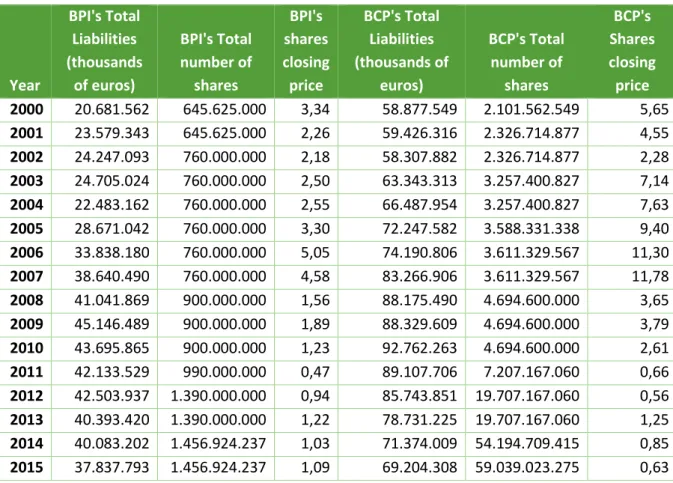
probabilities of default7 are to be infered from the equity prices of these two companies. In order to do the so, the author has gathered both the year-end audited financial statements of each company as well as the their year-end closing stock prices from 2000 to 2015 (see TABLE 6-2 - Companies'
Financials)8. The total FSLI amounts and the number of stocks at year-end for each company were extracted from the year-end audited financial statements of each company, the stock prices used were the ones provided by Euronext.
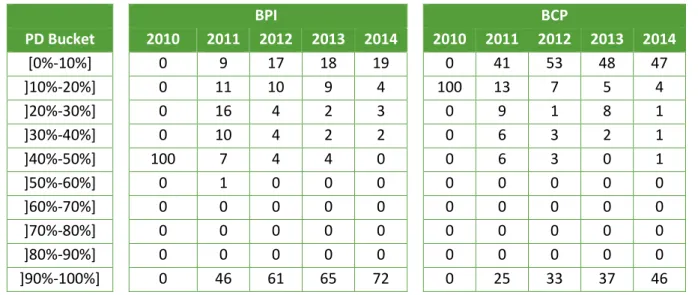
Based on the information available for each company since 2010 up to PD estimation date, using Black & Scholes and Merton model, the each year’s 1-year PD have been estimated (see TABLE 3-2 - Companies' 1-year PDs).
Table 3-2 - Companies' 1-year PDs
Company 2002 2003 2004 2005 2006 2007 2008 2009 2010 2011 2012 2013 2014 2015
BPI 4% 3% 5% 9% 17% 29% 41% 42% 45% 49% 47% 45% 47% 48%
BCP 9% 0% 0% 0% 0% 0% 6% 8% 20% 43% 41% 31% 21% 30%
Source: author’s calculations
Assuming the 1-year PDs old equal for the following periods, each year’s marginal conditional PDs (𝐶𝑃𝐷0;𝑦𝑋 ) have been computed (see TABLE 3-3 - Marginal conditional PDs at inception (2010)).
Table 3-3 - Marginal conditional PDs at inception (2010) Company 1 year 2 years 3 years 4 years 5 years
BPI 45% 25% 14% 7% 4%
BCP 20% 16% 13% 10% 8%
Source: author’s calculations
Based on the above-mentioned information, by applying formulas (17) and (18) one gets: 𝐶𝑉𝐴0𝐵𝑃𝐼= 1.4% 𝐷𝑉𝐴0𝐵𝑃𝐼= 2.3% With 𝐶𝑉𝐴0𝐵𝑃𝐼≠ 𝐷𝑉𝐴0𝐵𝑃𝐼 and 𝐵𝑓𝑖𝑥 = 𝐵𝑓𝑙
7 Another important assumption regarding the methodological approach of this thesis has to do with
relationship between the probability of default and LGD. In this thesis it is assumed these are independent variables which isn’t always true (Altman, Brady, Resti, & Sironi, 2005).
8 Financial restatements have been ignored as it is the author’s understanding that, not only the first
version of the financial statements are the ones that the investor’s view on the performance of the company, because being such restatements pro forma (and therefore related with past information) its impact on the current stock price is neglectable.
25 The fair value of the derivative with no credit spread is therefore from the BPI’s point of view 0.9% of its notional value. Theoretically, at inception the value of an IRS is nil. In this case, it is not, which means that BCP would not be charging BPI for the fact that it has a greater credit risk.
In order for the contract, not be beneficial to one of the counterparts BPI would have to pay a credit spread. In this case, only a credit spread of 0.11% would lead NPV of the swap to zero. It is assumed henceforward that such spread is going to be paid by BPI.
Based on further changes in perceived counterparties’ credit risk the author is going to access in RESULTS AND DISCUSSION whether or not PDs’ changes are going to impact the hedging relationship. Those results are going to be compared to the ones under the scenario of no credit risk.
3.2. P
REDICTING HEDGE ACCOUNTING EFFECTIVENESSIn order to estimate the each of PDs presented in TABLE 3-2 - Companies' 1-year PDsthree main types
inputs have to be considered: Debt per share (𝐷𝑡);
EV per share (𝐸𝑉𝑡); and
1-year interest rates (𝑟𝑡).
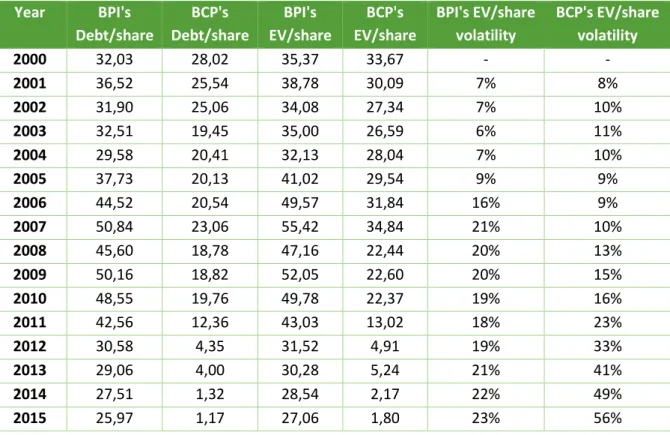
The use of indicators such as Debt per share, and Enterprise Value per share, instead of Total Debt and Total Enterprise Value, is a way of overcoming the many increases of capital these companies have been subject to during the period in analysis.
The Black and Scholes model premises that fair value of the Debt must be used, as mentioned in the EQUITY PRICES. In this thesis, the booking value of the sum of all liabilities is used as a proxy instead. This is mainly due to the lack of proper information available for the first years of time-period analyzed to make a good estimation of the fair value of the Debt for these companies.
The first two of the previously mentioned inputs are derived from TABLE 6-2 - Companies' Financials
as follows: 𝐷𝑡𝑋= 𝑇𝑜𝑡𝑎𝑙𝐷𝑒𝑏𝑡𝑜𝑓𝑋 𝑇𝑜𝑡𝑎𝑙𝑛𝑢𝑚𝑏𝑒𝑟𝑜𝑓𝑆ℎ𝑎𝑟𝑒𝑠 (18) 𝐸𝑉𝑡𝑋 = 𝑇𝑜𝑡𝑎𝑙𝐷𝑒𝑏𝑡𝑜𝑓𝑋 + 𝑀𝑎𝑟𝑘𝑒𝑡𝐶𝑎𝑝𝑖𝑡𝑎𝑙𝑖𝑧𝑎𝑡𝑖𝑜𝑛 𝑇𝑜𝑡𝑎𝑙𝑛𝑢𝑚𝑏𝑒𝑟𝑜𝑓𝑆ℎ𝑎𝑟𝑒𝑠 (19)
Then, having computed 𝐸𝑉𝑋 volatility one applies the equation (7) in order to get the PDs.
As explained in the INTRODUCTION the author assumes that the probability of hedge accounting
effectiveness is function of both counterparties PDs volatility and their cross-correlation.
In turn PDs, as shown in equation (7) are a function of a company’s total debt and enterprise value as wells as of the volatility of the EV itself. Therefore in order to compute the PDs in presented inTABLE
3-2 - Companies' 1-year PDs, one has to make the transformations presented in TABLE 6-3 - PDs' estimation inputs by applying formulas (18) and (19).
26 Being the author’s goal to predict hedge accounting effectiveness, next a set of Monte Carlo simulations is run on the companies’ financials from the year 2010 onwards. In order to so, to author computed, 𝜀𝐷
𝑡𝑋 and 𝜀𝐸𝑉𝑡𝑋, the differences between the actual debt/share (𝐷𝑡
𝑋) and EV/share (𝐸𝑉 𝑡𝑋) of
companies at years 𝑡 and the expected total debt/share (𝐸[𝐷𝑡𝑋]) and EV/share (𝐸[𝐸𝑉𝑡𝑋]) of those
companies’ based on previous-year financial information and interest rates, as follows: 𝜀𝐷 𝑡𝑋= 𝐷𝑡 𝑋− 𝐸[𝐷 𝑡𝑋] = 𝐷𝑡𝑋− 𝐷𝑡−1𝑋 × (1 + 𝑟𝑡−1) (20) 𝜀𝐸𝑉 𝑡𝑋 = 𝐸𝑉𝑡 𝑋− 𝐸[𝐸𝑉 𝑡𝑋] = 𝐸𝑉𝑡𝑋− 𝐸𝑉𝑡−1𝑋 × (1 + 𝑟𝑡−1) (21)
By taking a look at output of the above mentioned equations in TABLE 6-4 - Using risk-free rate as predictor to comapnies financials' evolution one may see that the risk free rate is reasonable predictor to the evolution of companies’ financials.
This being said, as mentioned in STOCHASTIC PROCESSES, a Weiner Processes is to be used in order to run the Monte Carlo simulations, being the increments randomly generated with mean being the increment that arises from the growth of the financial indicators at the risk free rate and standard deviation being 𝜀𝐷
𝑡𝑋 and 𝜀𝐸𝑉𝑡𝑋 (normal distribution is assumed).
Subsequently, 10,000 simulations are to be run using a routine specifically built on MS Excel9, with the evolution of the fluctuations on the derivative’s fair value to be monitored along side with the fluctuations of the fair value of the item to be hedged (fixed rate bond). The hedge effectiveness is assessed yearly and being it considered effective whenever evolution of the hedged and hedging item fall within the 80%-125% proposed by IAS 39. Although IFRS 9 does not specify any specific threshold for the hedge accounting effectiveness, it is the author’s view that market keeps on using such thresholds.
By interpreting these simulations as Bernoulli Process, in ESTIMATING THE PROBABILITY OF INEFFECTIVENESS the author is going to come up with a probability of the hedge accounting to become ineffective. Both that probability and classification problem (based on the inputs of the simulations) are going to be compared with actual outcome of the hedging relationship.
3.3. T
HE IMPACT OFPD
S VOLATILITIES AND CROSS-
CORRELATION ON HEDGE EFFECTIVENESSThen, based on the random walks taken by the Debt per share and Enterprise Value per share of each company (simulated based on the Wiener Process), the hedging accounting ineffectiveness is to be modelled based as polynomial function of each counterparty PD as well as their cross correlation. In section IN THE next section the author illustrates how variables such as volatilities of the PDs and their cross correlation affect hedge ineffectiveness.
Ineffectiveness drivers the author will be stepping in the components of the polynomial regression (counterparties’ PD volatilities and cross-correlation) in order to corroborate its hypotheses (ii) and (iii). The orders of the regressions are be chosen. The regressions that arise from those chosen orders
9 The author performs 100 simulations on the financials of both companies separately. By making all the
27 will later be of major importance, as it is going to be seen how other factor (covered by the generic approach) are affecting the results of the BPI-BCP hypothetical interest rate swap.
3.4. G
ENERIC APPROACHIn order to assess in what extent the work done on the BPI and BCP hypothetical IRS is affected by other factors, a parallel approach is going to be considered in GENERIC APPROACH. This approach allowes
on to see the response of the hedge efectiveness for a similar contract but with different PDs, LGDs and interest rates.
Another 10,00 simulations are to be run on the changes of the value of the IRS troughout time. The goal is to see how in general other factors such as the PDs at incepction, the interest rates and the LGDs contribute to hedge efectivenes as well.
A 5-year IRS is to be considered as well but this time an interest rate with flat term structure is to considered. It is to be assumed that such interets rate will not change trough time and, therefore, nor the NPV of the bond to hedged, in order to access the impact of EAD (driven by the interest rate of the swaps) on the hedging efectiveness. For a matter of simplicity, the PDs of both counterparties are always going to be equal at inception. This way no computation of credit psread is going to be needed. With the 𝐸𝐴𝐷𝑡;𝑦 being dependent solely on the flat interest rate curve (𝑟), 𝐶𝑃𝐷𝑡;𝑦𝑋 is set be dependent
on variables such as 𝑃𝐷0 (perceived marginal probability of default at inception which takes a flat term
structure as well), 𝜎𝑋 (standard deviation of the one-year changes of the PDs of counterparty 𝑋) and
𝜌𝐴,𝐵 (correlation between the annual PD changes of counterparties A and B).
As 𝑟 may take negative values, the EAD is to be computed as follows
𝐸𝐴𝐷𝑡;𝑦= ∑ |𝑟| (1 + 𝑟)𝑦−𝑡−0.5 𝑦−𝑡 5−𝑦=0 (22)
For the CPD, the computation is to be made as follows
𝐶𝑃𝐷𝑡;𝑦𝑋 = (1 − 𝑃𝐷𝑡𝑋)𝑦−𝑡−1× 𝑃𝐷𝑡𝑋 (23)
having 𝑃𝐷𝑡𝑋s following a stochastic process such a way that
𝑚𝑖𝑛 [𝑚𝑎𝑥 [𝑃𝐷𝑡
𝑋
𝑃𝐷𝑡−1𝑋
− 1~𝑁(0, 𝜎𝐴); 0.01] , 0.99]
(24)
and that the expected unconstrained correlation between the 𝑃𝐷𝑡𝑋s being 𝜌𝐴,𝐵.
Under this more generic approach, the value of Swap, 𝑓𝑡, is to be regard as being function of 𝑃𝐷0, 𝐿𝐺𝐷,
𝜎𝐴, 𝜎𝐵, 𝜌𝐴,𝐵 and 𝑟. To assess the sensitivity of the derivative to these values, 10,000 scenarios are to
be randomly generated in such a way that
𝑃𝐷0, 𝜎𝐴, 𝜎𝐵, 𝐿𝐺𝐷~𝑅𝑂𝑈𝑁𝐷(𝑈[0; 1] × 0.99 + 0.005; 2) (25)
28
𝑟~𝑅𝑂𝑈𝑁𝐷(𝑈[0; 1] × 0.21 − 0.105; 2) (27)
For each scenario (𝑠) one simulation is to be made, based on which the hedging relationship is to be classified as ineffective (𝐼 = 1) or not (𝐼 = 0):
I(F = max
𝑡=1,2,3,4𝑓𝑡) = {
1, 𝐹 > 0.05
0, 𝐹 ≤ 0.05 (28)
A multivariate polynomial regression model is then to be used in order measure the relationship between 𝐼 and the independent variables (See INTERPRETING THE RESULTS OF THE MULTIVARIATE POLYNOMIAL REGRESSION).
Having estimated 𝐼⃗̂, the optimal cut-off is to be selected based (as form of statistical classification) on its accuracy rate. Then the author is going to check if the this generic approach does a got job in predicting hedge accounting ineffectiveness when applied to hypothetical IRS set between BCP and BPI in the previous sections.
In the next section, author evaluates the results that ariseses from employing the methods of each of the three subsections. The results the methodological approaches define in each subsection of the section are presented, in RESULTS AND DISCUSSION, in the same order.