CERN-PH-EP/2015-299 2016/05/25
CMS-SMP-14-017
Measurement of the inclusive jet cross section in pp
collisions at
√
s
=
2.76 TeV
The CMS Collaboration
∗Abstract
The double-differential inclusive jet cross section is measured as a function of jet transverse momentum pT and absolute rapidity |y|, using proton-proton collision
data collected with the CMS experiment at the LHC, at a center-of-mass energy of
√
s = 2.76 TeV and corresponding to an integrated luminosity of 5.43 pb−1. Jets are reconstructed within the pT range of 74 to 592 GeV and the rapidity range|y| < 3.0.
The reconstructed jet spectrum is corrected for detector resolution. The measurements are compared to the theoretical prediction at next-to-leading-order QCD using differ-ent sets of parton distribution functions. This inclusive cross section measuremdiffer-ent explores a new kinematic region and is consistent with QCD predictions.
Published in the European Physical Journal C as doi:10.1140/epjc/s10052-016-4083-z.
c
2016 CERN for the benefit of the CMS Collaboration. CC-BY-3.0 license
∗See Appendix A for the list of collaboration members
1
Introduction
Jets are copiously produced in proton-proton (pp) collisions at the LHC. In the standard model, the hard-scattering interaction between partons inside the protons is described by perturbative quantum chromodynamics (QCD). Particle-level predictions, however, require a nonperturba-tive (NP) modeling of hadronization and multiple parton interactions in addition to the QCD calculation. The predicted rate and kinematics of jet production are sensitive to the compo-sition of the proton described by the parton distribution functions (PDF) and to the strong coupling constant (αS). The evolution of PDFs and αSwith the increase in the magnitude of the
four-momentum transfer is determined by the renormalization group equations of perturba-tive QCD [1–3]. Precision measurements of inclusive jet production cross sections at different center-of-mass energies can be used to determine PDFs and αS as well as to search for
devi-ations in their behavior from QCD predictions [4]. Inclusive jet cross section measurements have been performed at the LHC [5–8] and at other high energy colliders [9–16]. The mea-surements (up to 592 GeV) presented here extend the jet transverse momentum reach of the previous studies.
In this study, the inclusive jet production cross section, σ(pp→jet+X), is measured as a func-tion of the jet transverse momentum pT and absolute rapidity |y|. The analysis is performed
with data from pp collisions at√s =2.76 TeV with the CMS experiment corresponding to an in-tegrated luminosity of 5.43 pb−1. Originally designed as a reference for heavy ion studies, this data set also provides an opportunity to close the wide gap in jet measurements between the Tevatron at 1.96 TeV and the LHC at 7 and 8 TeV. When combined with the cross section mea-surements at other center of mass energies the present measurement can be used to improve PDF constraints. The data presented in this paper are collected at low instantaneous luminosity conditions with, on average, 1.2 primary interactions per triggered event. The measured cross section is compared to the prediction from a next-to-leading-order (NLO) QCD calculation, per-formed using the NLOJET++ (v.4.1.3) generator [17, 18] implemented in the FASTNLO (v.2.1.0)
framework [19]. NP contributions to the cross section are taken into account in the theoretical prediction; electroweak contributions are negligible [20].
2
The CMS detector
The central feature of the CMS apparatus is a superconducting solenoid which provides a mag-netic field of 3.8 T. Within the solenoid volume are a silicon pixel and strip tracker, a lead tungstate crystal electromagnetic calorimeter (ECAL), and a brass and scintillator hadron cal-orimeter (HCAL), each composed of a barrel and two endcap sections. Forward calorimetry complements the coverage provided by the barrel and endcap detectors. Muons are measured in gas-ionization detectors embedded in the steel flux-return yoke outside the solenoid. A more detailed description of the CMS detector, together with a definition of the coordinate system used and the relevant kinematic variables, can be found in Ref. [21].
3
Jet reconstruction and event selection
The particle-flow (PF) algorithm [22, 23] is used to reconstruct and identify individual particles in an event with optimally combined information from the various subsystems of the CMS de-tector. The particles are identified as: charged hadrons, neutral hadrons, muons, electrons, and photons. The PF candidates are combined into jets using the anti-kT algorithm [24] as
2 4 Cross section measurement
is used to reduce the sensitivity to final-state radiation. Particles identified as charged hadrons are assigned the pion mass, while neutral hadrons are considered massless and the four-vector sum of all reconstructed particles in the jet is calculated. The measurements of jet energy and momentum in the CMS detector are affected by a number of experimental factors, such as the limited coverage of the tracking system and the nonlinear calorimeter response. The tracking system provides superior jet reconstruction (i.e., systematic uncertainties due to energy cali-bration and resolution) in the central region of the detector (|η| <2.4). To correct for the
detec-tor response, the measurements are calibrated using reference processes with well-understood kinematics [26]. Jet energy corrections are derived using simulated events, generated with PYTHIA6 (v.6.4, tune Z2*) [27] and processed with GEANT4 [28]. The most recent PYTHIA6 Z2* tune is derived from the Z1 tune [29], which uses the CTEQ5L parton distribution set, whereas Z2* adopts CTEQ6L [30]. The corrections are verified in data using γ+jet and Z+jet processes, and additional corrections are applied to compensate for any mismatch between simulation and data. The correction factors depend on jet pT and η, and typically range between 1.02 and
1.10, while the jet energy resolution amounts to 15% at a jet pT of 10 GeV, 8% at 100 GeV, and
4% at 1 TeV.
The events are selected by a set of single-jet triggers with jet pTthresholds of 40, 60, and 80 GeV
with the first two triggers being prescaled. In Table 1, the effective integrated luminosity col-lected with each trigger and the corresponding jet pT range is presented. The triggers are
se-lected to ensure 99% efficiency for the events in the corresponding pTrange of the analysis.
Table 1: Effective integrated luminosities and jet pTranges for triggers used in this study.
Nominal trigger threshold (GeV) Lint,eff( pb−1) pTrange ( GeV)
40 0.59 74–97
60 3.48 97–133
80 5.43 133–592
Events with EmissT /ΣET < 0.3 are selected, consistent with the properties of QCD multijet
events, thereby removing any spurious jet-like features originating from isolated noise patterns in certain HCAL and ECAL regions. The quantities EmissT andΣETare calculated as the negative
vector sum of transverse energy and the scalar sum of transverse energy, respectively, of all PF candidates in the event. The selected events are required to have at least one well-reconstructed primary vertex. Each jet should contain more than one PF candidate. The fraction of jet energy carried by charged leptons (e, µ) should be less than 90%. In addition, jets reconstructed within the acceptance range of the tracking system (|η| < 2.4) must contain at least one charged
par-ticle. The electromagnetic energy fraction of such jets is required to be less than 99%, while the neutral-hadron and the photon energy fractions are required to be less than 90%. The jet selection efficiency is estimated to be 99% or higher for all pTand rapidity ranges used in this
study.
4
Cross section measurement
The double-differential jet cross section is calculated as d2σ dpTdy = 1 eLint,eff N ∆pT(2∆|y|) , (1)
whereLint,effis the effective integrated luminosity corrected for trigger prescales, e is the overall reconstruction efficiency including the trigger and jet selection efficiencies,∆pTand∆|y|are the
sizes of a particular jet pTand rapidity bin, and N is the number of jets in that bin. Six uniform
bins in|y|are used between 0.0 and 3.0. The jet pT values range from 74 to 592 GeV, with bin
sizes increasing in proportion to the pTresolution.
In order to facilitate the comparison of measurements with theoretical predictions, the jet pT
spectrum is corrected for detector effects. Since the pTspectrum is steeply falling, the number
of jets migrating out of a bin into the higher adjacent bin significantly exceeds the number of jets migrating to the lower adjacent bin. The unfolding procedure compensates for this effect and recovers the particle-level spectrum from the observed spectrum. The detector response function is determined using multijet events simulated with the PYTHIA6 (v.6.4, tune Z2) [27, 31] event generator. A detailed detector simulation is carried out using the GEANT4 software
to model the particle interactions in the detector material.
The detector is characterized by a response function that represents the probability density to reconstruct a jet with transverse momentum pdetT when the particle-level jet transverse momen-tum is ppartT . The response function is initially derived by calculating jet resolution in Monte Carlo (MC) simulation for every pT and |y| bin. Jet resolution in data is found to be worse
than in simulations [26]. The response function is corrected for this defect by degrading the resolution by factors cdata/MCthat vary with|y|as listed in Table 2.
Table 2: The factors used to scale jet resolution determined in simulations to match the resolu-tion observed in data.
|y| cdata/MC 0.0–0.5 1.079±0.026 0.5–1.0 1.099±0.028 1.0–1.5 1.121±0.029 1.5–2.0 1.208±0.046 2.0–2.5 1.254±0.062 2.5–3.0 1.395±0.063
The response matrix is constructed by convolving the response function with the ppartT spectrum predicted by NLO QCD calculations and the CT10 PDF set [32]. (Results with other PDF sets are discussed in Sec. 6.) The response function is represented by a kernel density estimation (KDE) technique that accurately models the tails of the distribution. The theoretical ppartT spec-trum is fitted with an exponential of a continuously differentiable function (Akima spline) [33]. This spline function is sampled many times and convolved with the KDE response function to obtain the response matrix. The D’Agostini iterative unfolding method [34] is used, as imple-mented in the ROOUNFOLDsoftware package [35]. The unfolding procedure is regularized by
early termination of iterations; four iterations are performed in each rapidity bin.
5
Theoretical predictions
The theoretical predictions are derived at NLO using QCD calculations with NLOJET++ [17,
18], and corrected for the NP contributions from hadronization and multiple parton interac-tions. Electroweak corrections are negligible at 2.76 TeV according to the studies performed in Ref. [20]. The factorization and renormalization scales are set to the jet pT (µF = µR = pT).
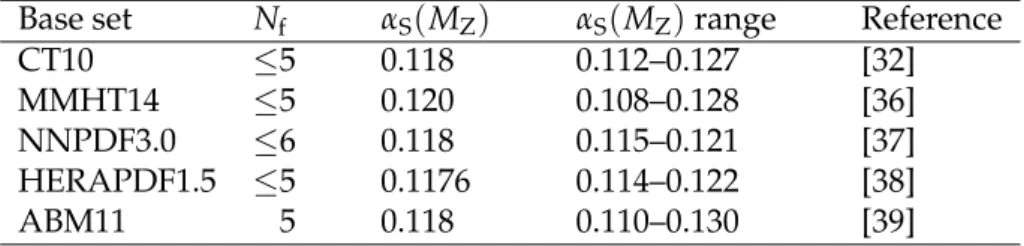
The theoretical predictions of the inclusive jet cross section are derived using five recent PDF sets at NLO, as listed in Table 3, with the central values of αS(MZ)for each PDF set. Most are
4 6 Systematic uncertainties
a fixed-flavor number scheme with the number of active flavors (Nf) set to 5 or 6. The details
related to determination of the PDFs are described in the corresponding references.
Table 3: The PDF sets used for deriving cross section predictions are given with the number of active flavors (Nf), the values and ranges of αS(MZ) used for the fits, and corresponding
references.
Base set Nf αS(MZ) αS(MZ)range Reference
CT10 ≤5 0.118 0.112–0.127 [32]
MMHT14 ≤5 0.120 0.108–0.128 [36]
NNPDF3.0 ≤6 0.118 0.115–0.121 [37]
HERAPDF1.5 ≤5 0.1176 0.114–0.122 [38]
ABM11 5 0.118 0.110–0.130 [39]
The NP effects include hadronization of parton cascades leading to the formation of color neu-tral jets and multiple interactions of spectator partons within the colliding protons that can re-sult in the appearance of additional jets. The corrections are derived using two event generators with different models for parton cascades and hadronization: PYTHIA6 (v.6.4, tune Z2) [27, 31] and HERWIG++ (v.2.5.0, tune UE EE 3C) [40, 41]. In PYTHIA6, the hadronization is simulated with the Lund string fragmentation model [42] while HERWIG++ employs the cluster frag-mentation model [43]. The pT- and |y|-dependent correction factors for the NP effects, CNP,
are derived from simulation as a ratio of differential jet cross sections with hadronization and multiple parton interactions turned on and off. The final correction factors are obtained by av-eraging PYTHIA6 and HERWIG++ predictions. The theoretical cross section is then calculated
as σtheory =σNLOCNP. The CNPfactors vary between 1.02 and 1.10 in the pTand rapidity range
of this analysis.
6
Systematic uncertainties
The major experimental uncertainties in this analysis come from imperfect measurement of jet energy, limited precision in simulating jet energy resolution, and imprecise knowledge of inte-grated luminosity. The first source affects the jet spectrum observed in data, while the second modifies the detector response matrix used in the unfolding procedure. The third source, mea-sured integrated luminosity, contributes an overall cross section uncertainty of 3.7% [44]. The uncertainty associated with the jet energy determination consists of several independent con-tributions identified in the process of deriving the jet energy corrections. These concon-tributions are described in detail in Ref. [26]. The corresponding cross section uncertainty is 5–22% for the low-rapidity bins (|y| <2.5), increasing to 78% in the highest rapidity bin (2.5≤ |y| <3.0). The jet energy resolution uncertainty is estimated using the uncertainties in the cdata/MCscaling
factors presented in Table 2. For the rapidity region|y| < 2.5, the corresponding cross section uncertainty is 2–3%, increasing to 22% for the most forward rapidity bin. The higher uncer-tainty at forward rapidities is caused by the significant increase in the jet energy and resolution uncertainties, and the more steeply falling pTspectrum in comparison with the central rapidity
region.
The energy offset due to additional interactions in the same bunch crossing (pileup) is small. For the lowest pT jets considered (74 GeV) the pileup contributes an average of only 0.3% of
the energy. This fraction decreases with increasing pT. Consequently, pileup corrections are
not required and the associated uncertainties are negligible. An uncertainty arising from the potential mismodeling of trigger and jet selection requirements is found to be 1%. The unfold-ing uncertainty due to the initial theoretical model is calculated by testunfold-ing various models and
finding the effect is negligible. The sum in quadrature of all experimental systematic uncer-tainties in the cross section is, on average, 6% at low rapidities (|y| <2.0) and varies from 10% to 80% at higher rapidities (2.0≤ |y| <3.0), across the corresponding pTranges.
The uncertainty in the theoretical cross section prediction is estimated from the PDF uncertain-ties, the choice for the factorization and renormalization scales (µFand µR), and the variation in
the modeling of NP corrections. The PDF uncertainty, for all PDF sets except NNPDF3.0, is cal-culated as the change in the cross section caused by varying decorrelated PDF parameters. The relevant PDF eigenvectors are provided in the PDF sets along with the central values. The un-certainty due to each parameter is determined at 68% confidence level (CL), and the resulting asymmetric uncertainties are combined in quadrature. In the case of NNPDF3.0, the PDF set contains an ensemble of replicas corresponding to one standard deviation in the PDF. The PDF uncertainty is calculated by evaluating the standard deviation in the cross section derived by using different replicas. The uncertainty due to the variation of the value of αS(MZ)in the PDF
sets is found to be much smaller than other uncertainties (<1%) and is not included. The scale uncertainty is determined by varying the factorization and renormalization scales with respect to the nominal value (µ = jet pT) using the following combinations of (µF/µ, µR/µ) ratios:
(0.5, 0.5), (1, 0.5), (0.5, 1), (1, 2), (2, 1), and (2, 2). The largest deviation from the nominal cross section, found separately in each pTand|y|bin, is taken to represent the scale uncertainty. The
scale uncertainty is asymmetric and its distribution is skewed towards lower cross sections. The largest deviation from the average value of the CNPcorrection factors, which are obtained
with the PYTHIA6 and HERWIG++ generators as discussed in Section 5, is used as the measure of the NP modeling uncertainty. It contributes a 2–5.6% uncertainty in the cross section pre-diction. The uncertainties in the theoretical predictions differ for each PDF set considered, and typically vary in the 10–20% range over most of the kinematic region.
7
Results
The measured inclusive jet cross section and the theoretical predictions are compared in Figs. 1– 3. In Fig. 1, the double-differential cross section is plotted as a function of jet pT and |y|.
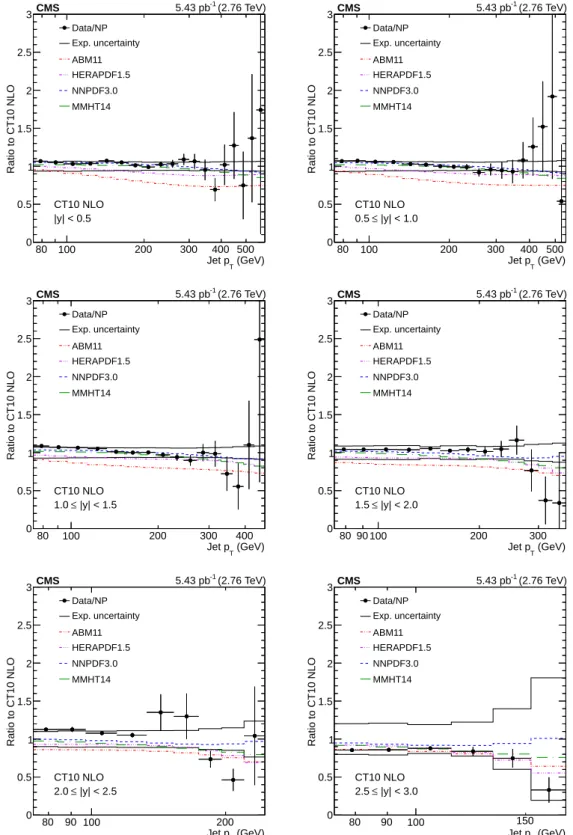
The theoretical prediction obtained with the CT10 PDF set is shown as well. A more detailed comparison for all|y|bins is presented in Fig. 2, where the ratios of data to theory using the CT10 PDF set are shown. Within the uncertainties, the data are well described by NLO QCD in the full kinematic range explored. In Fig. 3, the data, with NP corrections, are compared in a similar manner to the predictions from other PDF sets, normalized to the CT10 prediction. In general, all predictions describe the data well. Within experimental and theoretical (not shown) uncertainties, only the comparison to the prediction from the ABM11 PDF set exhibits slight differences between the data and theory, an effect that has been observed also in other measurements, e.g. Ref. [4].
8
Summary
A measurement of the double-differential inclusive jet cross section was presented. The data were collected by the CMS detector in pp collisions at√s= 2.76 TeV, with an integrated lumi-nosity of 5.43 pb−1. The measurement covers the jet kinematic ranges of 74 ≤ pT < 592 GeV
and|y| <3.0.
A detailed study of the experimental and theoretical uncertainties has been performed. Con-tributions to the experimental systematic uncertainty were evaluated from the jet energy cor-rections, jet energy resolution, and integrated luminosity. Jet energy corrections dominate the
6 8 Summary (GeV) T Jet p 80 90100 200 300 400 500 (pb/GeV) dy T dp σ 2 d -5 10 -3 10 -1 10 10 3 10 5 10 7 10 9 10 11 10 13 10 NP ⊗ CT10 NLO Exp. uncertainty ) 5 10 × |y| < 0.5 ( ) 4 10 × |y| < 1.0 ( ≤ 0.5 ) 3 10 × |y| < 1.5 ( ≤ 1.0 ) 2 10 × |y| < 2.0 ( ≤ 1.5 ) 1 10 × |y| < 2.5 ( ≤ 2.0 ) 0 10 × |y| < 3.0 ( ≤ 2.5 (2.76 TeV) -1 5.43 pb CMS
Figure 1: The inclusive jet production cross section, measured at√s = 2.76 TeV, shown as a function of jet pTin six|y|bins, as indicated by different symbols. The statistical (systematic)
ex-perimental uncertainties are indicated by vertical error bars (filled bands). The measurements are compared to the NLO QCD prediction using CT10 PDF set. The theoretical uncertainties are represented by hatched bands.
experimental uncertainty, followed by smaller contributions from jet energy resolution and luminosity. The theoretical uncertainty is dominated by the missing higher-order corrections that were estimated by varying the renormalization and factorization scales, and the PDF un-certainty; the contribution of nonperturbative correction uncertainty is small.
The data are corrected for detector resolution and efficiencies. The measured cross sections are compared to NLO QCD predictions obtained using different PDF sets. These cross section mea-surements test and confirm the predictions of QCD at√s=2.76 TeV and extend the kinematic range compared to previous studies.
Acknowledgments
We congratulate our colleagues in the CERN accelerator departments for the excellent perfor-mance of the LHC and thank the technical and administrative staffs at CERN and at other CMS institutes for their contributions to the success of the CMS effort. In addition, we grate-fully acknowledge the computing centers and personnel of the Worldwide LHC Computing Grid for delivering so effectively the computing infrastructure essential to our analyses. Fi-nally, we acknowledge the enduring support for the construction and operation of the LHC and the CMS detector provided by the following funding agencies: the Austrian Federal Min-istry of Science, Research and Economy and the Austrian Science Fund; the Belgian Fonds de la Recherche Scientifique, and Fonds voor Wetenschappelijk Onderzoek; the Brazilian Fund-ing Agencies (CNPq, CAPES, FAPERJ, and FAPESP); the Bulgarian Ministry of Education and Science; CERN; the Chinese Academy of Sciences, Ministry of Science and Technology, and Na-tional Natural Science Foundation of China; the Colombian Funding Agency (COLCIENCIAS); the Croatian Ministry of Science, Education and Sport, and the Croatian Science Foundation;
(GeV) T Jet p 80 100 200 300 400 500 D a ta / T h e o ry 0 0.5 1 1.5 2 2.5 3 (2.76 TeV) -1 5.43 pb NP ⊗ CT10 NLO |y| < 0.5 CMS Data Exp. uncertainty Theo. uncertainty PDF uncertainty (GeV) T Jet p 80 100 200 300 400 500 D a ta / T h e o ry 0 0.5 1 1.5 2 2.5 3 (2.76 TeV) -1 5.43 pb NP ⊗ CT10 NLO |y| < 1.0 ≤ 0.5 CMS Data Exp. uncertainty Theo. uncertainty PDF uncertainty (GeV) T Jet p 80 90100 200 300 400 D a ta / T h e o ry 0 0.5 1 1.5 2 2.5 3 (2.76 TeV) -1 5.43 pb NP ⊗ CT10 NLO |y| < 1.5 ≤ 1.0 CMS Data Exp. uncertainty Theo. uncertainty PDF uncertainty (GeV) T Jet p 80 90 100 200 300 D a ta / T h e o ry 0 0.5 1 1.5 2 2.5 3 (2.76 TeV) -1 5.43 pb NP ⊗ CT10 NLO |y| < 2.0 ≤ 1.5 CMS Data Exp. uncertainty Theo. uncertainty PDF uncertainty (GeV) T Jet p 80 90 100 200 D a ta / T h e o ry 0 0.5 1 1.5 2 2.5 3 (2.76 TeV) -1 5.43 pb NP ⊗ CT10 NLO |y| < 2.5 ≤ 2.0 CMS Data Exp. uncertainty Theo. uncertainty PDF uncertainty (GeV) T Jet p 80 90 100 D a ta / T h e o ry 0 0.5 1 1.5 2 2.5 3 150 (2.76 TeV) -1 5.43 pb NP ⊗ CT10 NLO |y| < 3.0 ≤ 2.5 CMS Data Exp. uncertainty Theo. uncertainty PDF uncertainty
Figure 2: The ratio of the measured inclusive jet production cross section (closed symbols) at
√
s = 2.76 TeV to the theoretical prediction using the CT10 PDF set is shown as a function of jet pT in each measured|y|range with the statistical (vertical error bars) and systematic (solid
lines) experimental uncertainties. The total theoretical uncertainties are shown by the dash-dotted lines with the contribution from PDF uncertainties (hatched band).
8 8 Summary (GeV) T Jet p 80 100 200 300 400 500 Ratio to CT10 NLO 0 0.5 1 1.5 2 2.5 3 (2.76 TeV) -1 5.43 pb CT10 NLO |y| < 0.5 CMS Data/NP Exp. uncertainty ABM11 HERAPDF1.5 NNPDF3.0 MMHT14 (GeV) T Jet p 80 100 200 300 400 500 Ratio to CT10 NLO 0 0.5 1 1.5 2 2.5 3 (2.76 TeV) -1 5.43 pb CT10 NLO |y| < 1.0 ≤ 0.5 CMS Data/NP Exp. uncertainty ABM11 HERAPDF1.5 NNPDF3.0 MMHT14 (GeV) T Jet p 80 100 200 300 400 Ratio to CT10 NLO 0 0.5 1 1.5 2 2.5 3 (2.76 TeV) -1 5.43 pb CT10 NLO |y| < 1.5 ≤ 1.0 CMS Data/NP Exp. uncertainty ABM11 HERAPDF1.5 NNPDF3.0 MMHT14 (GeV) T Jet p 80 90 100 200 300 Ratio to CT10 NLO 0 0.5 1 1.5 2 2.5 3 (2.76 TeV) -1 5.43 pb CT10 NLO |y| < 2.0 ≤ 1.5 CMS Data/NP Exp. uncertainty ABM11 HERAPDF1.5 NNPDF3.0 MMHT14 (GeV) T Jet p 80 90 100 200 Ratio to CT10 NLO 0 0.5 1 1.5 2 2.5 3 (2.76 TeV) -1 5.43 pb CT10 NLO |y| < 2.5 ≤ 2.0 CMS Data/NP Exp. uncertainty ABM11 HERAPDF1.5 NNPDF3.0 MMHT14 (GeV) T Jet p 80 90 100 Ratio to CT10 NLO 0 0.5 1 1.5 2 2.5 3 150 (2.76 TeV) -1 5.43 pb CT10 NLO |y| < 3.0 ≤ 2.5 CMS Data/NP Exp. uncertainty ABM11 HERAPDF1.5 NNPDF3.0 MMHT14
Figure 3: The same data shown in Fig. 2 are presented showing comparisons to the NLO QCD predictions using a variety of PDFs, which are denoted by different line styles. The uncertain-ties corresponding to the QCD predictions are not shown. For simplicity, the NP corrections needed for the various QCD predictions have been applied to the data in this figure.
the Research Promotion Foundation, Cyprus; the Ministry of Education and Research, Esto-nian Research Council via IUT23-4 and IUT23-6 and European Regional Development Fund, Estonia; the Academy of Finland, Finnish Ministry of Education and Culture, and Helsinki Institute of Physics; the Institut National de Physique Nucl´eaire et de Physique des Partic-ules / CNRS, and Commissariat `a l’ ´Energie Atomique et aux ´Energies Alternatives / CEA, France; the Bundesministerium f ¨ur Bildung und Forschung, Deutsche Forschungsgemeinschaft, and Helmholtz-Gemeinschaft Deutscher Forschungszentren, Germany; the General Secretariat for Research and Technology, Greece; the National Scientific Research Foundation, and Na-tional Innovation Office, Hungary; the Department of Atomic Energy and the Department of Science and Technology, India; the Institute for Studies in Theoretical Physics and Mathe-matics, Iran; the Science Foundation, Ireland; the Istituto Nazionale di Fisica Nucleare, Italy; the Ministry of Science, ICT and Future Planning, and National Research Foundation (NRF), Republic of Korea; the Lithuanian Academy of Sciences; the Ministry of Education, and Uni-versity of Malaya (Malaysia); the Mexican Funding Agencies (CINVESTAV, CONACYT, SEP, and UASLP-FAI); the Ministry of Business, Innovation and Employment, New Zealand; the Pakistan Atomic Energy Commission; the Ministry of Science and Higher Education and the National Science Centre, Poland; the Fundac¸˜ao para a Ciˆencia e a Tecnologia, Portugal; JINR, Dubna; the Ministry of Education and Science of the Russian Federation, the Federal Agency of Atomic Energy of the Russian Federation, Russian Academy of Sciences, and the Russian Foun-dation for Basic Research; the Ministry of Education, Science and Technological Development of Serbia; the Secretar´ıa de Estado de Investigaci ´on, Desarrollo e Innovaci ´on and Programa Consolider-Ingenio 2010, Spain; the Swiss Funding Agencies (ETH Board, ETH Zurich, PSI, SNF, UniZH, Canton Zurich, and SER); the Ministry of Science and Technology, Taipei; the Thailand Center of Excellence in Physics, the Institute for the Promotion of Teaching Science and Technology of Thailand, Special Task Force for Activating Research and the National Sci-ence and Technology Development Agency of Thailand; the Scientific and Technical Research Council of Turkey, and Turkish Atomic Energy Authority; the National Academy of Sciences of Ukraine, and State Fund for Fundamental Researches, Ukraine; the Science and Technology Facilities Council, UK; the US Department of Energy, and the US National Science Foundation. Individuals have received support from the Marie-Curie program and the European Research Council and EPLANET (European Union); the Leventis Foundation; the A. P. Sloan Foun-dation; the Alexander von Humboldt FounFoun-dation; the Belgian Federal Science Policy Office; the Fonds pour la Formation `a la Recherche dans l’Industrie et dans l’Agriculture (FRIA-Belgium); the Agentschap voor Innovatie door Wetenschap en Technologie (IWT-(FRIA-Belgium); the Ministry of Education, Youth and Sports (MEYS) of the Czech Republic; the Council of Science and Industrial Research, India; the HOMING PLUS program of the Foundation for Polish Science, cofinanced from European Union, Regional Development Fund; the OPUS pro-gram of the National Science Center (Poland); the Compagnia di San Paolo (Torino); MIUR project 20108T4XTM (Italy); the Thalis and Aristeia programs cofinanced by EU-ESF and the Greek NSRF; the National Priorities Research Program by Qatar National Research Fund; the Rachadapisek Sompot Fund for Postdoctoral Fellowship, Chulalongkorn University (Thailand); the Chulalongkorn Academic into Its 2nd Century Project Advancement Project (Thailand); and the Welch Foundation, contract C-1845.
10 References
References
[1] G. Altarelli and G. Parisi, “Asymptotic freedom in parton language”, Nucl. Phys. B 126 (1977) 298, doi:10.1016/0550-3213(77)90384-4.
[2] V. Gribov and L. Lipatov, “Deep inelastic ep scattering in perturbation theory”, Sov. J. Nucl. Phys. 15 (1972) 438.
[3] Y. L. Dokshitzer, “Calculation of the Structure Functions for Deep Inelastic Scattering and e+e−Annihilation by Perturbation Theory in Quantum Chromodynamics”, Sov. Phys. JETP 46 (1977) 641.
[4] CMS Collaboration, “Constraints on parton distribution functions and extraction of the strong coupling constant from the inclusive jet cross section in pp collisions at√
s =7 TeV”, Eur. Phys. J. C 75 (2015) 288, doi:10.1140/epjc/s10052-015-3499-1.
[5] CMS Collaboration, “Measurements of differential jet cross sections in proton-proton collisions at√s=7 TeV with the CMS detector”, Phys. Rev. D 87 (2013) 112002, doi:10.1103/PhysRevD.87.112002.
[6] ATLAS Collaboration, “Measurement of inclusive jet and dijet production in pp collisions at√s=7 TeV using the ATLAS detector”, Phys. Rev. D 86 (2012) 014022, doi:10.1103/PhysRevD.86.014022, arXiv:1112.6297.
[7] ATLAS Collaboration, “Measurement of the inclusive jet cross section in pp collisions at√ s =2.76 TeV and comparison to the inclusive jet cross section at√s =7 TeV using the ATLAS detector”, Eur. Phys. J. C 73 (2013) 2509,
doi:10.1140/epjc/s10052-013-2509-4, arXiv:1304.4739.
[8] ALICE Collaboration, “Measurement of the inclusive differential jet cross section in pp collisions at√s = 2.76 TeV”, Phys. Lett. B 722 (2013) 262,
doi:10.1016/j.physletb.2013.04.026, arXiv:1301.3475.
[9] UA1 Collaboration, “Hadronic jet production at the CERN proton-antiproton collider”, Phy. Lett. B 132 (1983) 214, doi:10.1016/0370-2693(83)90254-X.
[10] UA1 Collaboration, “Measurement of the inclusive jet cross-section at the CERN p ¯p collider”, Phys. Lett. B 172 (1986) 461, doi:10.1016/0370-2693(86)90290-X. [11] UA2 Collaboration, “Observation of very large transverse momentum jets at the CERN
p ¯p collider”, Phys. Lett. B 118 (1982) 203, doi:10.1016/0370-2693(82)90629-3. [12] UA2 Collaboration, “Measurement of the√s dependence of jet production at the CERN
¯pp collider”, Phys. Lett. B 160 (1985) 349, doi:10.1016/0370-2693(85)91341-3. [13] CDF Collaboration, “Measurement of the inclusive jet cross section using the kt
algorithm in p ¯p collisions at√s=1.96 TeV with the CDF II detector”, Phys. Rev. D 75 (2007) 092006, doi:10.1103/PhysRevD.75.092006, arXiv:hep-ex/0701051. [Erratum: doi:10.1103/PhysRevD.75.119901].
[14] CDF Collaboration, “Comparison of jet production in p ¯p collisions at√s =546 GeV and 1800 GeV”, Phys. Rev. Lett. 70 (1993) 1376, doi:10.1103/PhysRevLett.70.1376.
[15] D0 Collaboration, “Measurement of the inclusive jet cross section in p ¯p collisions at√ s =1.96 TeV”, Phys. Rev. D 85 (2012) 052006, doi:10.1103/PhysRevD.85.052006, arXiv:1110.3771.
[16] D0 Collaboration, “High-pT jets in p ¯p collisions at √
s=630 GeV and 1800 GeV”, Phys. Rev. D 64 (2001) 032003, doi:10.1103/PhysRevD.64.032003,
arXiv:hep-ex/0012046.
[17] Z. Nagy, “Three-jet cross sections in hadron-hadron collisions at next-to-leading order”, Phys. Rev. Lett. 88 (2002) 122003, doi:10.1103/PhysRevLett.88.122003,
arXiv:hep-ph/0110315.
[18] Z. Nagy, “Next-to-leading order calculation of three-jet observables in hadron-hadron collisions”, Phys. Rev. D 68 (2003) 094002, doi:10.1103/PhysRevD.68.094002, arXiv:hep-ph/0307268.
[19] D. Britzger, K. Rabbertz, F. Stober, and M. Wobisch, “New features in version 2 of the fastNLO project”, in XX Int’l Workshop on Deep-Inelastic Scattering and Related Subjects, p. 217. 2012. arXiv:1208.3641. doi:10.3204/DESY-PROC-2012-02/165.
[20] S. Dittmaier, A. Huss, and C. Speckner, “Weak radiative corrections to dijet production at hadron colliders”, JHEP 11 (2012) 095, doi:10.1007/JHEP11(2012)095,
arXiv:1210.0438.
[21] CMS Collaboration, “The CMS experiment at the CERN LHC”, JINST 3 (2008) S08004, doi:10.1088/1748-0221/3/08/S08004.
[22] CMS Collaboration, “Particle–Flow Event Reconstruction in CMS and Performance for Jets, Taus, and EmissT ”, CMS Physics Analysis Summary CMS-PAS-PFT-09-001, 2009. [23] CMS Collaboration, “Commissioning of the Particle-flow Event Reconstruction with the
first LHC collisions recorded in the CMS detector”, CMS Physics Analysis Summary CMS-PAS-PFT-10-001, 2010.
[24] C. Matteo, S. Gavin, and G. Soyez, “The anti-ktjet clustering algorithm”, JHEP 04 (2008)
063, doi:10.1088/1126-6708/2008/04/063, arXiv:0802.1189.
[25] M. Cacciari, G. Salam, and G. Soyez, “FastJet user manual”, Eur. Phys. J. C 72 (2012) 1896, doi:10.1140/epjc/s10052-012-1896-2, arXiv:1111.6097.
[26] CMS Collaboration, “Determination of jet energy calibration and transverse momentum resolution in CMS”, J. Instrum. 6 (2011) P11002,
doi:10.1088/1748-0221/6/11/P11002.
[27] T. Sj ¨ostrand, S. Mrenna, and P. Skands, “PYTHIA 6.4 physics and manual”, JHEP 05 (2006) 26, doi:10.1088/1126-6708/2006/05/026, arXiv:hep-ph/0603175. [28] GEANT4 Collaboration, “GEANT4—a simulation toolkit”, Nucl. Instrum. Meth. A 506
(2003) 250, doi:10.1016/S0168-9002(03)01368-8.
[29] R. Field, “Early LHC Underlying Event Data - Findings and Surprises”, (2010). arXiv:1010.3558.
[30] J. Pumplin et al., “New generation of parton distributions with uncertainties from global QCD analysis”, JHEP 07 (2002) 012, doi:10.1088/1126-6708/2002/07/012, arXiv:hep-ph/0201195.
12 References
[31] R. Field, “Min-Bias and the Underlying Event at the LHC”, (2011). arXiv:1110.5530. [32] H. Lai et al., “New parton distributions for collider physics”, Phys. Rev. D 82 (2010)
074024, doi:10.1103/PhysRevD.82.074024, arXiv:1007.2241.
[33] H. Akima, “A New Method of Interpolation and Smooth Curve Fitting Based on Local Procedures”, J. ACM 17 (1970) 589, doi:10.1145/321607.321609.
[34] G. D’Agostini, “A multidimensional unfolding method based on Bayes’ theorem”, Nucl. Instrum. Meth. A 362 (1995) 487, doi:10.1016/0168-9002(95)00274-X.
[35] T. Adye, “Unfolding algorithms and tests using RooUnfold”, (2011). arXiv:1105.1160. [36] L. A. Harland-Lang, A. D. Martin, P. Motylinski, and R. S. Thorne, “Parton distributions
in the LHC era: MMHT 2014 PDFs”, Eur. Phys. J. C 75 (2015) 204, doi:10.1140/epjc/s10052-015-3397-6, arXiv:1412.3989.
[37] R. D. Ball et al., “Parton distributions for the LHC run II”, JHEP 04 (2015) 40, doi:10.1007/JHEP04(2015)040, arXiv:1410.8849.
[38] H1 and ZEUS Collaborations, “Combined Measurement and QCD Analysis of the Inclusive e±p Scattering Cross Sections at HERA”, JHEP 01 (2010) 109,
doi:10.1007/JHEP01(2010)109, arXiv:0911.0884.
[39] S. Alekhin, J. Bl ¨umlein, and S. Moch, “Parton distribution functions and benchmark cross sections at next-to-next-to-leading order”, Phys. Rev. D 86 (2012) 054009,
doi:10.1103/PhysRevD.86.054009, arXiv:1202.2281.
[40] M. B¨ahr et al., “Herwig++ physics and manual”, Eur. Phys. J. C 58 (2008) 639, doi:10.1140/epjc/s10052-008-0798-9, arXiv:0803.0883.
[41] S. Gieseke, C. R ¨ohr, and A. Si ´odmok, “Colour reconnections in Herwig++”, Eur. Phys. J. C 72 (2012) 2225, doi:10.1140/epjc/s10052-012-2225-5, arXiv:1206.0041. [42] B. Andersson, “The Lund model”, Nucl. Phys. A 461 (1987) 513,
doi:10.1016/0375-9474(87)90510-0.
[43] B. R. Webber, “A QCD model for jet fragmentation including soft gluon interference”, Nucl. Phys. B 238 (1984) 492, doi:10.1016/0550-3213(84)90333-X.
[44] CMS Collaboration, “Luminosity Calibration for the 2013 Proton-Lead and Proton-Proton Data Taking”, CMS Physics Analysis Summary CMS-PAS-LUM-13-002, 2013.
A
The CMS Collaboration
Yerevan Physics Institute, Yerevan, Armenia
V. Khachatryan, A.M. Sirunyan, A. Tumasyan
Institut f ¨ur Hochenergiephysik der OeAW, Wien, Austria
W. Adam, E. Asilar, T. Bergauer, J. Brandstetter, E. Brondolin, M. Dragicevic, J. Er ¨o, M. Flechl, M. Friedl, R. Fr ¨uhwirth1, V.M. Ghete, C. Hartl, N. H ¨ormann, J. Hrubec, M. Jeitler1, V. Kn ¨unz, A. K ¨onig, M. Krammer1, I. Kr¨atschmer, D. Liko, T. Matsushita, I. Mikulec, D. Rabady2,
B. Rahbaran, H. Rohringer, J. Schieck1, R. Sch ¨ofbeck, J. Strauss, W. Treberer-Treberspurg, W. Waltenberger, C.-E. Wulz1
National Centre for Particle and High Energy Physics, Minsk, Belarus
V. Mossolov, N. Shumeiko, J. Suarez Gonzalez
Universiteit Antwerpen, Antwerpen, Belgium
S. Alderweireldt, T. Cornelis, E.A. De Wolf, X. Janssen, A. Knutsson, J. Lauwers, S. Luyckx, M. Van De Klundert, H. Van Haevermaet, P. Van Mechelen, N. Van Remortel, A. Van Spilbeeck
Vrije Universiteit Brussel, Brussel, Belgium
S. Abu Zeid, F. Blekman, J. D’Hondt, N. Daci, I. De Bruyn, K. Deroover, N. Heracleous, J. Keaveney, S. Lowette, L. Moreels, A. Olbrechts, Q. Python, D. Strom, S. Tavernier, W. Van Doninck, P. Van Mulders, G.P. Van Onsem, I. Van Parijs
Universit´e Libre de Bruxelles, Bruxelles, Belgium
P. Barria, H. Brun, C. Caillol, B. Clerbaux, G. De Lentdecker, G. Fasanella, L. Favart, R. Goldouzian, A. Grebenyuk, G. Karapostoli, T. Lenzi, A. L´eonard, T. Maerschalk, A. Marinov, L. Perni`e, A. Randle-conde, T. Seva, C. Vander Velde, P. Vanlaer, R. Yonamine, F. Zenoni, F. Zhang3
Ghent University, Ghent, Belgium
K. Beernaert, L. Benucci, A. Cimmino, S. Crucy, D. Dobur, A. Fagot, G. Garcia, M. Gul, J. Mccartin, A.A. Ocampo Rios, D. Poyraz, D. Ryckbosch, S. Salva, M. Sigamani, M. Tytgat, W. Van Driessche, E. Yazgan, N. Zaganidis
Universit´e Catholique de Louvain, Louvain-la-Neuve, Belgium
S. Basegmez, C. Beluffi4, O. Bondu, S. Brochet, G. Bruno, A. Caudron, L. Ceard, C. Delaere, D. Favart, L. Forthomme, A. Giammanco5, A. Jafari, P. Jez, M. Komm, V. Lemaitre, A. Mertens, M. Musich, C. Nuttens, L. Perrini, K. Piotrzkowski, A. Popov6, L. Quertenmont, M. Selvaggi, M. Vidal Marono
Universit´e de Mons, Mons, Belgium
N. Beliy, G.H. Hammad
Centro Brasileiro de Pesquisas Fisicas, Rio de Janeiro, Brazil
W.L. Ald´a J ´unior, F.L. Alves, G.A. Alves, L. Brito, M. Correa Martins Junior, M. Hamer, C. Hensel, A. Moraes, M.E. Pol, P. Rebello Teles
Universidade do Estado do Rio de Janeiro, Rio de Janeiro, Brazil
E. Belchior Batista Das Chagas, W. Carvalho, J. Chinellato7, A. Cust ´odio, E.M. Da Costa, D. De Jesus Damiao, C. De Oliveira Martins, S. Fonseca De Souza, L.M. Huertas Guativa, H. Malbouisson, D. Matos Figueiredo, C. Mora Herrera, L. Mundim, H. Nogima, W.L. Prado Da Silva, A. Santoro, A. Sznajder, E.J. Tonelli Manganote7, A. Vilela Pereira
14 A The CMS Collaboration
Universidade Estadual Paulistaa, Universidade Federal do ABCb, S˜ao Paulo, Brazil
S. Ahujaa, C.A. Bernardesb, A. De Souza Santosb, S. Dograa, T.R. Fernandez Perez Tomeia, E.M. Gregoresb, P.G. Mercadanteb, C.S. Moona,8, S.F. Novaesa, Sandra S. Padulaa, D. Romero Abad, J.C. Ruiz Vargas
Institute for Nuclear Research and Nuclear Energy, Sofia, Bulgaria
A. Aleksandrov, R. Hadjiiska, P. Iaydjiev, M. Rodozov, S. Stoykova, G. Sultanov, M. Vutova
University of Sofia, Sofia, Bulgaria
A. Dimitrov, I. Glushkov, L. Litov, B. Pavlov, P. Petkov
Institute of High Energy Physics, Beijing, China
M. Ahmad, J.G. Bian, G.M. Chen, H.S. Chen, M. Chen, T. Cheng, R. Du, C.H. Jiang, R. Plestina9, F. Romeo, S.M. Shaheen, A. Spiezia, J. Tao, C. Wang, Z. Wang, H. Zhang
State Key Laboratory of Nuclear Physics and Technology, Peking University, Beijing, China
C. Asawatangtrakuldee, Y. Ban, Q. Li, S. Liu, Y. Mao, S.J. Qian, D. Wang, Z. Xu
Universidad de Los Andes, Bogota, Colombia
C. Avila, A. Cabrera, L.F. Chaparro Sierra, C. Florez, J.P. Gomez, B. Gomez Moreno, J.C. Sanabria
University of Split, Faculty of Electrical Engineering, Mechanical Engineering and Naval Architecture, Split, Croatia
N. Godinovic, D. Lelas, I. Puljak, P.M. Ribeiro Cipriano
University of Split, Faculty of Science, Split, Croatia
Z. Antunovic, M. Kovac
Institute Rudjer Boskovic, Zagreb, Croatia
V. Brigljevic, K. Kadija, J. Luetic, S. Micanovic, L. Sudic
University of Cyprus, Nicosia, Cyprus
A. Attikis, G. Mavromanolakis, J. Mousa, C. Nicolaou, F. Ptochos, P.A. Razis, H. Rykaczewski
Charles University, Prague, Czech Republic
M. Bodlak, M. Finger10, M. Finger Jr.10
Academy of Scientific Research and Technology of the Arab Republic of Egypt, Egyptian Network of High Energy Physics, Cairo, Egypt
E. El-khateeb11,11, T. Elkafrawy11, A. Mohamed12, E. Salama13,11
National Institute of Chemical Physics and Biophysics, Tallinn, Estonia
B. Calpas, M. Kadastik, M. Murumaa, M. Raidal, A. Tiko, C. Veelken
Department of Physics, University of Helsinki, Helsinki, Finland
P. Eerola, J. Pekkanen, M. Voutilainen
Helsinki Institute of Physics, Helsinki, Finland
J. H¨ark ¨onen, V. Karim¨aki, R. Kinnunen, T. Lamp´en, K. Lassila-Perini, S. Lehti, T. Lind´en, P. Luukka, T. Peltola, E. Tuominen, J. Tuominiemi, E. Tuovinen, L. Wendland
Lappeenranta University of Technology, Lappeenranta, Finland
J. Talvitie, T. Tuuva
DSM/IRFU, CEA/Saclay, Gif-sur-Yvette, France
S. Ganjour, A. Givernaud, P. Gras, G. Hamel de Monchenault, P. Jarry, E. Locci, M. Machet, J. Malcles, J. Rander, A. Rosowsky, M. Titov, A. Zghiche
Laboratoire Leprince-Ringuet, Ecole Polytechnique, IN2P3-CNRS, Palaiseau, France
I. Antropov, S. Baffioni, F. Beaudette, P. Busson, L. Cadamuro, E. Chapon, C. Charlot, O. Davignon, N. Filipovic, R. Granier de Cassagnac, M. Jo, S. Lisniak, L. Mastrolorenzo, P. Min´e, I.N. Naranjo, M. Nguyen, C. Ochando, G. Ortona, P. Paganini, P. Pigard, S. Regnard, R. Salerno, J.B. Sauvan, Y. Sirois, T. Strebler, Y. Yilmaz, A. Zabi
Institut Pluridisciplinaire Hubert Curien, Universit´e de Strasbourg, Universit´e de Haute Alsace Mulhouse, CNRS/IN2P3, Strasbourg, France
J.-L. Agram14, J. Andrea, A. Aubin, D. Bloch, J.-M. Brom, M. Buttignol, E.C. Chabert,
N. Chanon, C. Collard, E. Conte14, X. Coubez, J.-C. Fontaine14, D. Gel´e, U. Goerlach, C. Goetzmann, A.-C. Le Bihan, J.A. Merlin2, K. Skovpen, P. Van Hove
Centre de Calcul de l’Institut National de Physique Nucleaire et de Physique des Particules, CNRS/IN2P3, Villeurbanne, France
S. Gadrat
Universit´e de Lyon, Universit´e Claude Bernard Lyon 1, CNRS-IN2P3, Institut de Physique Nucl´eaire de Lyon, Villeurbanne, France
S. Beauceron, C. Bernet, G. Boudoul, E. Bouvier, C.A. Carrillo Montoya, R. Chierici, D. Contardo, B. Courbon, P. Depasse, H. El Mamouni, J. Fan, J. Fay, S. Gascon, M. Gouzevitch, B. Ille, F. Lagarde, I.B. Laktineh, M. Lethuillier, L. Mirabito, A.L. Pequegnot, S. Perries, J.D. Ruiz Alvarez, D. Sabes, L. Sgandurra, V. Sordini, M. Vander Donckt, P. Verdier, S. Viret
Georgian Technical University, Tbilisi, Georgia
T. Toriashvili15
Tbilisi State University, Tbilisi, Georgia
Z. Tsamalaidze10
RWTH Aachen University, I. Physikalisches Institut, Aachen, Germany
C. Autermann, S. Beranek, L. Feld, A. Heister, M.K. Kiesel, K. Klein, M. Lipinski, A. Ostapchuk, M. Preuten, F. Raupach, S. Schael, J.F. Schulte, T. Verlage, H. Weber, V. Zhukov6
RWTH Aachen University, III. Physikalisches Institut A, Aachen, Germany
M. Ata, M. Brodski, E. Dietz-Laursonn, D. Duchardt, M. Endres, M. Erdmann, S. Erdweg, T. Esch, R. Fischer, A. G ¨uth, T. Hebbeker, C. Heidemann, K. Hoepfner, S. Knutzen, P. Kreuzer, M. Merschmeyer, A. Meyer, P. Millet, S. Mukherjee, M. Olschewski, K. Padeken, P. Papacz, T. Pook, M. Radziej, H. Reithler, M. Rieger, F. Scheuch, L. Sonnenschein, D. Teyssier, S. Th ¨uer
RWTH Aachen University, III. Physikalisches Institut B, Aachen, Germany
V. Cherepanov, Y. Erdogan, G. Fl ¨ugge, H. Geenen, M. Geisler, F. Hoehle, B. Kargoll, T. Kress, A. K ¨unsken, J. Lingemann, A. Nehrkorn, A. Nowack, I.M. Nugent, C. Pistone, O. Pooth, A. Stahl
Deutsches Elektronen-Synchrotron, Hamburg, Germany
M. Aldaya Martin, I. Asin, N. Bartosik, O. Behnke, U. Behrens, K. Borras16, A. Burgmeier, A. Campbell, C. Contreras-Campana, F. Costanza, C. Diez Pardos, G. Dolinska, S. Dooling, T. Dorland, G. Eckerlin, D. Eckstein, T. Eichhorn, G. Flucke, E. Gallo17, J. Garay Garcia,
A. Geiser, A. Gizhko, P. Gunnellini, J. Hauk, M. Hempel18, H. Jung, A. Kalogeropoulos, O. Karacheban18, M. Kasemann, P. Katsas, J. Kieseler, C. Kleinwort, I. Korol, W. Lange, J. Leonard, K. Lipka, A. Lobanov, W. Lohmann18, R. Mankel, I.-A. Melzer-Pellmann,
16 A The CMS Collaboration
A.B. Meyer, G. Mittag, J. Mnich, A. Mussgiller, S. Naumann-Emme, A. Nayak, E. Ntomari, H. Perrey, D. Pitzl, R. Placakyte, A. Raspereza, B. Roland, M. ¨O. Sahin, P. Saxena, T. Schoerner-Sadenius, C. Seitz, S. Spannagel, K.D. Trippkewitz, R. Walsh, C. Wissing
University of Hamburg, Hamburg, Germany
V. Blobel, M. Centis Vignali, A.R. Draeger, J. Erfle, E. Garutti, K. Goebel, D. Gonzalez, M. G ¨orner, J. Haller, M. Hoffmann, R.S. H ¨oing, A. Junkes, R. Klanner, R. Kogler, N. Kovalchuk, T. Lapsien, T. Lenz, I. Marchesini, D. Marconi, M. Meyer, D. Nowatschin, J. Ott, F. Pantaleo2, T. Peiffer, A. Perieanu, N. Pietsch, J. Poehlsen, D. Rathjens, C. Sander, C. Scharf, P. Schleper, E. Schlieckau, A. Schmidt, S. Schumann, J. Schwandt, V. Sola, H. Stadie, G. Steinbr ¨uck, F.M. Stober, H. Tholen, D. Troendle, E. Usai, L. Vanelderen, A. Vanhoefer, B. Vormwald
Institut f ¨ur Experimentelle Kernphysik, Karlsruhe, Germany
C. Barth, C. Baus, J. Berger, C. B ¨oser, E. Butz, T. Chwalek, F. Colombo, W. De Boer, A. Descroix, A. Dierlamm, S. Fink, F. Frensch, R. Friese, M. Giffels, A. Gilbert, D. Haitz, F. Hartmann2, S.M. Heindl, U. Husemann, I. Katkov6, A. Kornmayer2, P. Lobelle Pardo, B. Maier, H. Mildner, M.U. Mozer, T. M ¨uller, Th. M ¨uller, M. Plagge, G. Quast, K. Rabbertz, S. R ¨ocker, F. Roscher, M. Schr ¨oder, G. Sieber, H.J. Simonis, R. Ulrich, J. Wagner-Kuhr, S. Wayand, M. Weber, T. Weiler, S. Williamson, C. W ¨ohrmann, R. Wolf
Institute of Nuclear and Particle Physics (INPP), NCSR Demokritos, Aghia Paraskevi, Greece
G. Anagnostou, G. Daskalakis, T. Geralis, V.A. Giakoumopoulou, A. Kyriakis, D. Loukas, A. Psallidas, I. Topsis-Giotis
National and Kapodistrian University of Athens, Athens, Greece
A. Agapitos, S. Kesisoglou, A. Panagiotou, N. Saoulidou, E. Tziaferi
University of Io´annina, Io´annina, Greece
I. Evangelou, G. Flouris, C. Foudas, P. Kokkas, N. Loukas, N. Manthos, I. Papadopoulos, E. Paradas, J. Strologas
Wigner Research Centre for Physics, Budapest, Hungary
G. Bencze, C. Hajdu, A. Hazi, P. Hidas, D. Horvath19, F. Sikler, V. Veszpremi, G. Vesztergombi20, A.J. Zsigmond
Institute of Nuclear Research ATOMKI, Debrecen, Hungary
N. Beni, S. Czellar, J. Karancsi21, J. Molnar, Z. Szillasi2
University of Debrecen, Debrecen, Hungary
M. Bart ´ok22, A. Makovec, P. Raics, Z.L. Trocsanyi, B. Ujvari
National Institute of Science Education and Research, Bhubaneswar, India
S. Choudhury23, P. Mal, K. Mandal, D.K. Sahoo, N. Sahoo, S.K. Swain
Panjab University, Chandigarh, India
S. Bansal, S.B. Beri, V. Bhatnagar, R. Chawla, R. Gupta, U.Bhawandeep, A.K. Kalsi, A. Kaur, M. Kaur, R. Kumar, A. Mehta, M. Mittal, J.B. Singh, G. Walia
University of Delhi, Delhi, India
Ashok Kumar, A. Bhardwaj, B.C. Choudhary, R.B. Garg, S. Malhotra, M. Naimuddin, N. Nishu, K. Ranjan, R. Sharma, V. Sharma
Saha Institute of Nuclear Physics, Kolkata, India
S. Bhattacharya, K. Chatterjee, S. Dey, S. Dutta, N. Majumdar, A. Modak, K. Mondal, S. Mukhopadhyay, A. Roy, D. Roy, S. Roy Chowdhury, S. Sarkar, M. Sharan
Bhabha Atomic Research Centre, Mumbai, India
A. Abdulsalam, R. Chudasama, D. Dutta, V. Jha, V. Kumar, A.K. Mohanty2, L.M. Pant, P. Shukla, A. Topkar
Tata Institute of Fundamental Research, Mumbai, India
T. Aziz, S. Banerjee, S. Bhowmik24, R.M. Chatterjee, R.K. Dewanjee, S. Dugad, S. Ganguly, S. Ghosh, M. Guchait, A. Gurtu25, Sa. Jain, G. Kole, S. Kumar, B. Mahakud, M. Maity24,
G. Majumder, K. Mazumdar, S. Mitra, G.B. Mohanty, B. Parida, T. Sarkar24, N. Sur, B. Sutar,
N. Wickramage26
Indian Institute of Science Education and Research (IISER), Pune, India
S. Chauhan, S. Dube, A. Kapoor, K. Kothekar, S. Sharma
Institute for Research in Fundamental Sciences (IPM), Tehran, Iran
H. Bakhshiansohi, H. Behnamian, S.M. Etesami27, A. Fahim28, M. Khakzad, M. Mohammadi
Najafabadi, M. Naseri, S. Paktinat Mehdiabadi, F. Rezaei Hosseinabadi, B. Safarzadeh29,
M. Zeinali
University College Dublin, Dublin, Ireland
M. Felcini, M. Grunewald
INFN Sezione di Baria, Universit`a di Barib, Politecnico di Baric, Bari, Italy
M. Abbresciaa,b, C. Calabriaa,b, C. Caputoa,b, A. Colaleoa, D. Creanzaa,c, L. Cristellaa,b, N. De
Filippisa,c, M. De Palmaa,b, L. Fiorea, G. Iasellia,c, G. Maggia,c, M. Maggia, G. Minielloa,b, S. Mya,c, S. Nuzzoa,b, A. Pompilia,b, G. Pugliesea,c, R. Radognaa,b, A. Ranieria, G. Selvaggia,b, L. Silvestrisa,2, R. Vendittia,b
INFN Sezione di Bolognaa, Universit`a di Bolognab, Bologna, Italy
G. Abbiendia, C. Battilana2, A.C. Benvenutia, D. Bonacorsia,b, S. Braibant-Giacomellia,b, L. Brigliadoria,b, R. Campaninia,b, P. Capiluppia,b, A. Castroa,b, F.R. Cavalloa, S.S. Chhibraa,b, G. Codispotia,b, M. Cuffiania,b, G.M. Dallavallea, F. Fabbria, A. Fanfania,b, D. Fasanellaa,b,
P. Giacomellia, C. Grandia, L. Guiduccia,b, S. Marcellinia, G. Masettia, A. Montanaria, F.L. Navarriaa,b, A. Perrottaa, A.M. Rossia,b, T. Rovellia,b, G.P. Sirolia,b, N. Tosia,b,2, R. Travaglinia,b
INFN Sezione di Cataniaa, Universit`a di Cataniab, Catania, Italy
G. Cappelloa, M. Chiorbolia,b, S. Costaa,b, A. Di Mattiaa, F. Giordanoa,b, R. Potenzaa,b, A. Tricomia,b, C. Tuvea,b
INFN Sezione di Firenzea, Universit`a di Firenzeb, Firenze, Italy
G. Barbaglia, V. Ciullia,b, C. Civininia, R. D’Alessandroa,b, E. Focardia,b, V. Goria,b, P. Lenzia,b, M. Meschinia, S. Paolettia, G. Sguazzonia, L. Viliania,b,2
INFN Laboratori Nazionali di Frascati, Frascati, Italy
L. Benussi, S. Bianco, F. Fabbri, D. Piccolo, F. Primavera2
INFN Sezione di Genovaa, Universit`a di Genovab, Genova, Italy
V. Calvellia,b, F. Ferroa, M. Lo Veterea,b, M.R. Mongea,b, E. Robuttia, S. Tosia,b
INFN Sezione di Milano-Bicoccaa, Universit`a di Milano-Bicoccab, Milano, Italy
18 A The CMS Collaboration
S. Malvezzia, R.A. Manzonia,b,2, B. Marzocchia,b, D. Menascea, L. Moronia, M. Paganonia,b, D. Pedrinia, S. Ragazzia,b, N. Redaellia, T. Tabarelli de Fatisa,b
INFN Sezione di Napolia, Universit`a di Napoli ’Federico II’b, Napoli, Italy, Universit`a della Basilicatac, Potenza, Italy, Universit`a G. Marconid, Roma, Italy
S. Buontempoa, N. Cavalloa,c, S. Di Guidaa,d,2, M. Espositoa,b, F. Fabozzia,c, A.O.M. Iorioa,b, G. Lanzaa, L. Listaa, S. Meolaa,d,2, M. Merolaa, P. Paoluccia,2, C. Sciaccaa,b, F. Thyssen
INFN Sezione di Padova a, Universit`a di Padova b, Padova, Italy, Universit`a di Trento c, Trento, Italy
P. Azzia,2, N. Bacchettaa, L. Benatoa,b, D. Biselloa,b, A. Bolettia,b, A. Brancaa,b, R. Carlina,b, P. Checchiaa, M. Dall’Ossoa,b,2, T. Dorigoa, F. Fanzagoa, F. Gasparinia,b, U. Gasparinia,b,
F. Gonellaa, A. Gozzelinoa, K. Kanishcheva,c, S. Lacapraraa, M. Margonia,b, A.T. Meneguzzoa,b, J. Pazzinia,b,2, N. Pozzobona,b, P. Ronchesea,b, F. Simonettoa,b, E. Torassaa, M. Tosia,b, S. Venturaa, M. Zanetti, P. Zottoa,b, A. Zucchettaa,b,2
INFN Sezione di Paviaa, Universit`a di Paviab, Pavia, Italy
A. Braghieria, A. Magnania,b, P. Montagnaa,b, S.P. Rattia,b, V. Rea, C. Riccardia,b, P. Salvinia, I. Vaia,b, P. Vituloa,b
INFN Sezione di Perugiaa, Universit`a di Perugiab, Perugia, Italy
L. Alunni Solestizia,b, G.M. Bileia, D. Ciangottinia,b,2, L. Fan `oa,b, P. Laricciaa,b, G. Mantovania,b, M. Menichellia, A. Sahaa, A. Santocchiaa,b
INFN Sezione di Pisaa, Universit`a di Pisab, Scuola Normale Superiore di Pisac, Pisa, Italy
K. Androsova,30, P. Azzurria,2, G. Bagliesia, J. Bernardinia, T. Boccalia, R. Castaldia, M.A. Cioccia,30, R. Dell’Orsoa, S. Donatoa,c,2, G. Fedi, L. Fo`aa,c†, A. Giassia, M.T. Grippoa,30,
F. Ligabuea,c, T. Lomtadzea, L. Martinia,b, A. Messineoa,b, F. Pallaa, A. Rizzia,b, A.
Savoy-Navarroa,31, A.T. Serbana, P. Spagnoloa, R. Tenchinia, G. Tonellia,b, A. Venturia, P.G. Verdinia
INFN Sezione di Romaa, Universit`a di Romab, Roma, Italy
L. Baronea,b, F. Cavallaria, G. D’imperioa,b,2, D. Del Rea,b,2, M. Diemoza, S. Gellia,b, C. Jordaa, E. Longoa,b, F. Margarolia,b, P. Meridiania, G. Organtinia,b, R. Paramattia, F. Preiatoa,b, S. Rahatloua,b, C. Rovellia, F. Santanastasioa,b, P. Traczyka,b,2
INFN Sezione di Torino a, Universit`a di Torino b, Torino, Italy, Universit`a del Piemonte Orientalec, Novara, Italy
N. Amapanea,b, R. Arcidiaconoa,c,2, S. Argiroa,b, M. Arneodoa,c, R. Bellana,b, C. Biinoa, N. Cartigliaa, M. Costaa,b, R. Covarellia,b, A. Deganoa,b, N. Demariaa, L. Fincoa,b,2, B. Kiania,b, C. Mariottia, S. Masellia, E. Migliorea,b, V. Monacoa,b, E. Monteila,b, M.M. Obertinoa,b, L. Pachera,b, N. Pastronea, M. Pelliccionia, G.L. Pinna Angionia,b, F. Raveraa,b, A. Romeroa,b, M. Ruspaa,c, R. Sacchia,b, A. Solanoa,b, A. Staianoa
INFN Sezione di Triestea, Universit`a di Triesteb, Trieste, Italy
S. Belfortea, V. Candelisea,b, M. Casarsaa, F. Cossuttia, G. Della Riccaa,b, B. Gobboa, C. La Licataa,b, M. Maronea,b, A. Schizzia,b, A. Zanettia
Kangwon National University, Chunchon, Korea
A. Kropivnitskaya, S.K. Nam
Kyungpook National University, Daegu, Korea
D.H. Kim, G.N. Kim, M.S. Kim, D.J. Kong, S. Lee, Y.D. Oh, A. Sakharov, D.C. Son
Chonbuk National University, Jeonju, Korea
Chonnam National University, Institute for Universe and Elementary Particles, Kwangju, Korea
S. Song
Korea University, Seoul, Korea
S. Choi, Y. Go, D. Gyun, B. Hong, H. Kim, Y. Kim, B. Lee, K. Lee, K.S. Lee, S. Lee, S.K. Park, Y. Roh
Seoul National University, Seoul, Korea
H.D. Yoo
University of Seoul, Seoul, Korea
M. Choi, H. Kim, J.H. Kim, J.S.H. Lee, I.C. Park, G. Ryu, M.S. Ryu
Sungkyunkwan University, Suwon, Korea
Y. Choi, J. Goh, D. Kim, E. Kwon, J. Lee, I. Yu
Vilnius University, Vilnius, Lithuania
V. Dudenas, A. Juodagalvis, J. Vaitkus
National Centre for Particle Physics, Universiti Malaya, Kuala Lumpur, Malaysia
I. Ahmed, Z.A. Ibrahim, J.R. Komaragiri, M.A.B. Md Ali32, F. Mohamad Idris33, W.A.T. Wan Abdullah, M.N. Yusli
Centro de Investigacion y de Estudios Avanzados del IPN, Mexico City, Mexico
E. Casimiro Linares, H. Castilla-Valdez, E. De La Cruz-Burelo, I. Heredia-De La Cruz34,
A. Hernandez-Almada, R. Lopez-Fernandez, A. Sanchez-Hernandez
Universidad Iberoamericana, Mexico City, Mexico
S. Carrillo Moreno, F. Vazquez Valencia
Benemerita Universidad Autonoma de Puebla, Puebla, Mexico
I. Pedraza, H.A. Salazar Ibarguen
Universidad Aut ´onoma de San Luis Potos´ı, San Luis Potos´ı, Mexico
A. Morelos Pineda
University of Auckland, Auckland, New Zealand
D. Krofcheck
University of Canterbury, Christchurch, New Zealand
P.H. Butler
National Centre for Physics, Quaid-I-Azam University, Islamabad, Pakistan
A. Ahmad, M. Ahmad, Q. Hassan, H.R. Hoorani, W.A. Khan, T. Khurshid, M. Shoaib
National Centre for Nuclear Research, Swierk, Poland
H. Bialkowska, M. Bluj, B. Boimska, T. Frueboes, M. G ´orski, M. Kazana, K. Nawrocki, K. Romanowska-Rybinska, M. Szleper, P. Zalewski
Institute of Experimental Physics, Faculty of Physics, University of Warsaw, Warsaw, Poland
G. Brona, K. Bunkowski, A. Byszuk35, K. Doroba, A. Kalinowski, M. Konecki, J. Krolikowski, M. Misiura, M. Olszewski, M. Walczak
Laborat ´orio de Instrumenta¸c˜ao e F´ısica Experimental de Part´ıculas, Lisboa, Portugal
20 A The CMS Collaboration
M. Gallinaro, J. Hollar, N. Leonardo, L. Lloret Iglesias, F. Nguyen, J. Rodrigues Antunes, J. Seixas, O. Toldaiev, D. Vadruccio, J. Varela, P. Vischia
Joint Institute for Nuclear Research, Dubna, Russia
S. Afanasiev, P. Bunin, M. Gavrilenko, I. Golutvin, I. Gorbunov, A. Kamenev, V. Karjavin, A. Lanev, A. Malakhov, V. Matveev36,37, P. Moisenz, V. Palichik, V. Perelygin, S. Shmatov, S. Shulha, N. Skatchkov, V. Smirnov, A. Zarubin
Petersburg Nuclear Physics Institute, Gatchina (St. Petersburg), Russia
V. Golovtsov, Y. Ivanov, V. Kim38, E. Kuznetsova, P. Levchenko, V. Murzin, V. Oreshkin, I. Smirnov, V. Sulimov, L. Uvarov, S. Vavilov, A. Vorobyev
Institute for Nuclear Research, Moscow, Russia
Yu. Andreev, A. Dermenev, S. Gninenko, N. Golubev, A. Karneyeu, M. Kirsanov, N. Krasnikov, A. Pashenkov, D. Tlisov, A. Toropin
Institute for Theoretical and Experimental Physics, Moscow, Russia
V. Epshteyn, V. Gavrilov, N. Lychkovskaya, V. Popov, I. Pozdnyakov, G. Safronov, A. Spiridonov, E. Vlasov, A. Zhokin
National Research Nuclear University ’Moscow Engineering Physics Institute’ (MEPhI), Moscow, Russia
A. Bylinkin
P.N. Lebedev Physical Institute, Moscow, Russia
V. Andreev, M. Azarkin37, I. Dremin37, M. Kirakosyan, A. Leonidov37, G. Mesyats, S.V. Rusakov
Skobeltsyn Institute of Nuclear Physics, Lomonosov Moscow State University, Moscow, Russia
A. Baskakov, A. Belyaev, E. Boos, M. Dubinin39, L. Dudko, A. Ershov, A. Gribushin, V. Klyukhin, O. Kodolova, I. Lokhtin, I. Myagkov, S. Obraztsov, S. Petrushanko, V. Savrin, A. Snigirev
State Research Center of Russian Federation, Institute for High Energy Physics, Protvino, Russia
I. Azhgirey, I. Bayshev, S. Bitioukov, V. Kachanov, A. Kalinin, D. Konstantinov, V. Krychkine, V. Petrov, R. Ryutin, A. Sobol, L. Tourtchanovitch, S. Troshin, N. Tyurin, A. Uzunian, A. Volkov
University of Belgrade, Faculty of Physics and Vinca Institute of Nuclear Sciences, Belgrade, Serbia
P. Adzic40, P. Cirkovic, J. Milosevic, V. Rekovic
Centro de Investigaciones Energ´eticas Medioambientales y Tecnol ´ogicas (CIEMAT), Madrid, Spain
J. Alcaraz Maestre, E. Calvo, M. Cerrada, M. Chamizo Llatas, N. Colino, B. De La Cruz, A. Delgado Peris, A. Escalante Del Valle, C. Fernandez Bedoya, J.P. Fern´andez Ramos, J. Flix, M.C. Fouz, P. Garcia-Abia, O. Gonzalez Lopez, S. Goy Lopez, J.M. Hernandez, M.I. Josa, E. Navarro De Martino, A. P´erez-Calero Yzquierdo, J. Puerta Pelayo, A. Quintario Olmeda, I. Redondo, L. Romero, J. Santaolalla, M.S. Soares
Universidad Aut ´onoma de Madrid, Madrid, Spain
Universidad de Oviedo, Oviedo, Spain
J. Cuevas, J. Fernandez Menendez, S. Folgueras, I. Gonzalez Caballero, E. Palencia Cortezon, J.M. Vizan Garcia
Instituto de F´ısica de Cantabria (IFCA), CSIC-Universidad de Cantabria, Santander, Spain
I.J. Cabrillo, A. Calderon, J.R. Casti ˜neiras De Saa, P. De Castro Manzano, M. Fernandez, J. Garcia-Ferrero, G. Gomez, A. Lopez Virto, J. Marco, R. Marco, C. Martinez Rivero, F. Matorras, J. Piedra Gomez, T. Rodrigo, A.Y. Rodr´ıguez-Marrero, A. Ruiz-Jimeno, L. Scodellaro, N. Trevisani, I. Vila, R. Vilar Cortabitarte
CERN, European Organization for Nuclear Research, Geneva, Switzerland
D. Abbaneo, E. Auffray, G. Auzinger, M. Bachtis, P. Baillon, A.H. Ball, D. Barney, A. Benaglia, J. Bendavid, L. Benhabib, G.M. Berruti, P. Bloch, A. Bocci, A. Bonato, C. Botta, H. Breuker, T. Camporesi, R. Castello, G. Cerminara, M. D’Alfonso, D. d’Enterria, A. Dabrowski, V. Daponte, A. David, M. De Gruttola, F. De Guio, A. De Roeck, S. De Visscher, E. Di Marco41, M. Dobson, M. Dordevic, B. Dorney, T. du Pree, D. Duggan, M. D ¨unser, N. Dupont, A. Elliott-Peisert, G. Franzoni, J. Fulcher, W. Funk, D. Gigi, K. Gill, D. Giordano, M. Girone, F. Glege, R. Guida, S. Gundacker, M. Guthoff, J. Hammer, P. Harris, J. Hegeman, V. Innocente, P. Janot, H. Kirschenmann, M.J. Kortelainen, K. Kousouris, K. Krajczar, P. Lecoq, C. Lourenc¸o, M.T. Lucchini, N. Magini, L. Malgeri, M. Mannelli, A. Martelli, L. Masetti, F. Meijers, S. Mersi, E. Meschi, F. Moortgat, S. Morovic, M. Mulders, M.V. Nemallapudi, H. Neugebauer, S. Orfanelli42, L. Orsini, L. Pape, E. Perez, M. Peruzzi, A. Petrilli, G. Petrucciani, A. Pfeiffer, M. Pierini, D. Piparo, A. Racz, T. Reis, G. Rolandi43, M. Rovere, M. Ruan, H. Sakulin, C. Sch¨afer, C. Schwick, M. Seidel, A. Sharma, P. Silva, M. Simon, P. Sphicas44, J. Steggemann, B. Stieger, M. Stoye, Y. Takahashi, D. Treille, A. Triossi, A. Tsirou, G.I. Veres20, N. Wardle, H.K. W ¨ohri, A. Zagozdzinska35, W.D. Zeuner
Paul Scherrer Institut, Villigen, Switzerland
W. Bertl, K. Deiters, W. Erdmann, R. Horisberger, Q. Ingram, H.C. Kaestli, D. Kotlinski, U. Langenegger, D. Renker, T. Rohe
Institute for Particle Physics, ETH Zurich, Zurich, Switzerland
F. Bachmair, L. B¨ani, L. Bianchini, B. Casal, G. Dissertori, M. Dittmar, M. Doneg`a, P. Eller, C. Grab, C. Heidegger, D. Hits, J. Hoss, G. Kasieczka, P. Lecomte†, W. Lustermann, B. Mangano, M. Marionneau, P. Martinez Ruiz del Arbol, M. Masciovecchio, D. Meister, F. Micheli, P. Musella, F. Nessi-Tedaldi, F. Pandolfi, J. Pata, F. Pauss, L. Perrozzi, M. Quittnat, M. Rossini, M. Sch ¨onenberger, A. Starodumov45, M. Takahashi, V.R. Tavolaro, K. Theofilatos, R. Wallny
Universit¨at Z ¨urich, Zurich, Switzerland
T.K. Aarrestad, C. Amsler46, L. Caminada, M.F. Canelli, V. Chiochia, A. De Cosa, C. Galloni, A. Hinzmann, T. Hreus, B. Kilminster, C. Lange, J. Ngadiuba, D. Pinna, G. Rauco, P. Robmann, F.J. Ronga, D. Salerno, Y. Yang
National Central University, Chung-Li, Taiwan
M. Cardaci, K.H. Chen, T.H. Doan, Sh. Jain, R. Khurana, M. Konyushikhin, C.M. Kuo, W. Lin, Y.J. Lu, A. Pozdnyakov, S.S. Yu
National Taiwan University (NTU), Taipei, Taiwan
Arun Kumar, P. Chang, Y.H. Chang, Y.W. Chang, Y. Chao, K.F. Chen, P.H. Chen, C. Dietz, F. Fiori, U. Grundler, W.-S. Hou, Y. Hsiung, Y.F. Liu, R.-S. Lu, M. Mi ˜nano Moya, E. Petrakou, J.f. Tsai, Y.M. Tzeng
22 A The CMS Collaboration
Chulalongkorn University, Faculty of Science, Department of Physics, Bangkok, Thailand
B. Asavapibhop, K. Kovitanggoon, G. Singh, N. Srimanobhas, N. Suwonjandee
Cukurova University, Adana, Turkey
A. Adiguzel, S. Cerci47, Z.S. Demiroglu, C. Dozen, I. Dumanoglu, E. Eskut, F.H. Gecit, S. Girgis, G. Gokbulut, Y. Guler, E. Gurpinar, I. Hos, E.E. Kangal48, A. Kayis Topaksu, G. Onengut49, M. Ozcan, K. Ozdemir50, S. Ozturk51, A. Polatoz, C. Zorbilmez
Middle East Technical University, Physics Department, Ankara, Turkey
B. Bilin, S. Bilmis, B. Isildak52, G. Karapinar53, M. Yalvac, M. Zeyrek
Bogazici University, Istanbul, Turkey
E. G ¨ulmez, M. Kaya54, O. Kaya55, E.A. Yetkin56, T. Yetkin57
Istanbul Technical University, Istanbul, Turkey
A. Cakir, K. Cankocak, S. Sen58, F.I. Vardarlı
Institute for Scintillation Materials of National Academy of Science of Ukraine, Kharkov, Ukraine
B. Grynyov
National Scientific Center, Kharkov Institute of Physics and Technology, Kharkov, Ukraine
L. Levchuk, P. Sorokin
University of Bristol, Bristol, United Kingdom
R. Aggleton, F. Ball, L. Beck, J.J. Brooke, E. Clement, D. Cussans, H. Flacher, J. Goldstein, M. Grimes, G.P. Heath, H.F. Heath, J. Jacob, L. Kreczko, C. Lucas, Z. Meng, D.M. Newbold59,
S. Paramesvaran, A. Poll, T. Sakuma, S. Seif El Nasr-storey, S. Senkin, D. Smith, V.J. Smith
Rutherford Appleton Laboratory, Didcot, United Kingdom
K.W. Bell, A. Belyaev60, C. Brew, R.M. Brown, L. Calligaris, D. Cieri, D.J.A. Cockerill, J.A. Coughlan, K. Harder, S. Harper, E. Olaiya, D. Petyt, C.H. Shepherd-Themistocleous, A. Thea, I.R. Tomalin, T. Williams, S.D. Worm
Imperial College, London, United Kingdom
M. Baber, R. Bainbridge, O. Buchmuller, A. Bundock, D. Burton, S. Casasso, M. Citron, D. Colling, L. Corpe, P. Dauncey, G. Davies, A. De Wit, M. Della Negra, P. Dunne, A. Elwood, D. Futyan, G. Hall, G. Iles, R. Lane, R. Lucas59, L. Lyons, A.-M. Magnan, S. Malik, J. Nash, A. Nikitenko45, J. Pela, M. Pesaresi, K. Petridis, D.M. Raymond, A. Richards, A. Rose, C. Seez, A. Tapper, K. Uchida, M. Vazquez Acosta61, T. Virdee, S.C. Zenz
Brunel University, Uxbridge, United Kingdom
J.E. Cole, P.R. Hobson, A. Khan, P. Kyberd, D. Leggat, D. Leslie, I.D. Reid, P. Symonds, L. Teodorescu, M. Turner
Baylor University, Waco, USA
A. Borzou, K. Call, J. Dittmann, K. Hatakeyama, H. Liu, N. Pastika
The University of Alabama, Tuscaloosa, USA
O. Charaf, S.I. Cooper, C. Henderson, P. Rumerio
Boston University, Boston, USA
Brown University, Providence, USA
J. Alimena, E. Berry, D. Cutts, A. Ferapontov, A. Garabedian, J. Hakala, U. Heintz, E. Laird, G. Landsberg, Z. Mao, M. Narain, S. Piperov, S. Sagir, R. Syarif
University of California, Davis, Davis, USA
R. Breedon, G. Breto, M. Calderon De La Barca Sanchez, S. Chauhan, M. Chertok, J. Conway, R. Conway, P.T. Cox, R. Erbacher, G. Funk, M. Gardner, W. Ko, R. Lander, C. Mclean, M. Mulhearn, D. Pellett, J. Pilot, F. Ricci-Tam, S. Shalhout, J. Smith, M. Squires, D. Stolp, M. Tripathi, S. Wilbur, R. Yohay
University of California, Los Angeles, USA
R. Cousins, P. Everaerts, A. Florent, J. Hauser, M. Ignatenko, D. Saltzberg, E. Takasugi, V. Valuev, M. Weber
University of California, Riverside, Riverside, USA
K. Burt, R. Clare, J. Ellison, J.W. Gary, G. Hanson, J. Heilman, M. Ivova PANEVA, P. Jandir, E. Kennedy, F. Lacroix, O.R. Long, M. Malberti, M. Olmedo Negrete, A. Shrinivas, H. Wei, S. Wimpenny, B. R. Yates
University of California, San Diego, La Jolla, USA
J.G. Branson, G.B. Cerati, S. Cittolin, R.T. D’Agnolo, M. Derdzinski, A. Holzner, R. Kelley, D. Klein, J. Letts, I. Macneill, D. Olivito, S. Padhi, M. Pieri, M. Sani, V. Sharma, S. Simon, M. Tadel, A. Vartak, S. Wasserbaech62, C. Welke, F. W ¨urthwein, A. Yagil, G. Zevi Della Porta
University of California, Santa Barbara, Santa Barbara, USA
J. Bradmiller-Feld, C. Campagnari, A. Dishaw, V. Dutta, K. Flowers, M. Franco Sevilla, P. Geffert, C. George, F. Golf, L. Gouskos, J. Gran, J. Incandela, N. Mccoll, S.D. Mullin, J. Richman, D. Stuart, I. Suarez, C. West, J. Yoo
California Institute of Technology, Pasadena, USA
D. Anderson, A. Apresyan, A. Bornheim, J. Bunn, Y. Chen, J. Duarte, A. Mott, H.B. Newman, C. Pena, M. Spiropulu, J.R. Vlimant, S. Xie, R.Y. Zhu
Carnegie Mellon University, Pittsburgh, USA
M.B. Andrews, V. Azzolini, A. Calamba, B. Carlson, T. Ferguson, M. Paulini, J. Russ, M. Sun, H. Vogel, I. Vorobiev
University of Colorado Boulder, Boulder, USA
J.P. Cumalat, W.T. Ford, A. Gaz, F. Jensen, A. Johnson, M. Krohn, T. Mulholland, U. Nauenberg, K. Stenson, S.R. Wagner
Cornell University, Ithaca, USA
J. Alexander, A. Chatterjee, J. Chaves, J. Chu, S. Dittmer, N. Eggert, N. Mirman, G. Nicolas Kaufman, J.R. Patterson, A. Rinkevicius, A. Ryd, L. Skinnari, L. Soffi, W. Sun, S.M. Tan, W.D. Teo, J. Thom, J. Thompson, J. Tucker, Y. Weng, P. Wittich
Fermi National Accelerator Laboratory, Batavia, USA
S. Abdullin, M. Albrow, G. Apollinari, S. Banerjee, L.A.T. Bauerdick, A. Beretvas, J. Berryhill, P.C. Bhat, G. Bolla, K. Burkett, J.N. Butler, H.W.K. Cheung, F. Chlebana, S. Cihangir, V.D. Elvira, I. Fisk, J. Freeman, E. Gottschalk, L. Gray, D. Green, S. Gr ¨unendahl, O. Gutsche, J. Hanlon, D. Hare, R.M. Harris, S. Hasegawa, J. Hirschauer, Z. Hu, B. Jayatilaka, S. Jindariani, M. Johnson, U. Joshi, B. Klima, B. Kreis, S. Lammel, J. Linacre, D. Lincoln, R. Lipton, T. Liu, R. Lopes De S´a, J. Lykken, K. Maeshima, J.M. Marraffino, S. Maruyama, D. Mason, P. McBride, P. Merkel, S. Mrenna, S. Nahn, C. Newman-Holmes†, V. O’Dell, K. Pedro, O. Prokofyev, G. Rakness,
24 A The CMS Collaboration
E. Sexton-Kennedy, A. Soha, W.J. Spalding, L. Spiegel, S. Stoynev, N. Strobbe, L. Taylor, S. Tkaczyk, N.V. Tran, L. Uplegger, E.W. Vaandering, C. Vernieri, M. Verzocchi, R. Vidal, M. Wang, H.A. Weber, A. Whitbeck
University of Florida, Gainesville, USA
D. Acosta, P. Avery, P. Bortignon, D. Bourilkov, A. Carnes, M. Carver, D. Curry, S. Das, R.D. Field, I.K. Furic, S.V. Gleyzer, J. Konigsberg, A. Korytov, K. Kotov, P. Ma, K. Matchev, H. Mei, P. Milenovic63, G. Mitselmakher, D. Rank, R. Rossin, L. Shchutska, M. Snowball, D. Sperka, N. Terentyev, L. Thomas, J. Wang, S. Wang, J. Yelton
Florida International University, Miami, USA
S. Hewamanage, S. Linn, P. Markowitz, G. Martinez, J.L. Rodriguez
Florida State University, Tallahassee, USA
A. Ackert, J.R. Adams, T. Adams, A. Askew, S. Bein, J. Bochenek, B. Diamond, J. Haas, S. Hagopian, V. Hagopian, K.F. Johnson, A. Khatiwada, H. Prosper, M. Weinberg
Florida Institute of Technology, Melbourne, USA
M.M. Baarmand, V. Bhopatkar, S. Colafranceschi64, M. Hohlmann, H. Kalakhety, D. Noonan,
T. Roy, F. Yumiceva
University of Illinois at Chicago (UIC), Chicago, USA
M.R. Adams, L. Apanasevich, D. Berry, R.R. Betts, I. Bucinskaite, R. Cavanaugh, O. Evdokimov, L. Gauthier, C.E. Gerber, D.J. Hofman, P. Kurt, C. O’Brien, I.D. Sandoval Gonzalez, P. Turner, N. Varelas, Z. Wu, M. Zakaria
The University of Iowa, Iowa City, USA
B. Bilki65, W. Clarida, K. Dilsiz, S. Durgut, R.P. Gandrajula, M. Haytmyradov, V. Khristenko, J.-P. Merlo, H. Mermerkaya66, A. Mestvirishvili, A. Moeller, J. Nachtman, H. Ogul, Y. Onel, F. Ozok67, A. Penzo, C. Snyder, E. Tiras, J. Wetzel, K. Yi
Johns Hopkins University, Baltimore, USA
I. Anderson, B.A. Barnett, B. Blumenfeld, N. Eminizer, D. Fehling, L. Feng, A.V. Gritsan, P. Maksimovic, C. Martin, M. Osherson, J. Roskes, A. Sady, U. Sarica, M. Swartz, M. Xiao, Y. Xin, C. You
The University of Kansas, Lawrence, USA
P. Baringer, A. Bean, G. Benelli, C. Bruner, R.P. Kenny III, D. Majumder, M. Malek, M. Murray, S. Sanders, R. Stringer, Q. Wang
Kansas State University, Manhattan, USA
A. Ivanov, K. Kaadze, S. Khalil, M. Makouski, Y. Maravin, A. Mohammadi, L.K. Saini, N. Skhirtladze, S. Toda
Lawrence Livermore National Laboratory, Livermore, USA
D. Lange, F. Rebassoo, D. Wright
University of Maryland, College Park, USA
C. Anelli, A. Baden, O. Baron, A. Belloni, B. Calvert, S.C. Eno, C. Ferraioli, J.A. Gomez, N.J. Hadley, S. Jabeen, R.G. Kellogg, T. Kolberg, J. Kunkle, Y. Lu, A.C. Mignerey, Y.H. Shin, A. Skuja, M.B. Tonjes, S.C. Tonwar
Massachusetts Institute of Technology, Cambridge, USA
A. Apyan, R. Barbieri, A. Baty, K. Bierwagen, S. Brandt, W. Busza, I.A. Cali, Z. Demiragli, L. Di Matteo, G. Gomez Ceballos, M. Goncharov, D. Gulhan, Y. Iiyama, G.M. Innocenti, M. Klute,