Universidade de Aveiro Ano 2017 Departamento de Biologia
MARCELA CARRARO
DE MELO VAZ
CYANIDE FISHING: DETECTION METHODOLOGIES
AND PHYSIOLOGICAL EFFECTS IN CORAL REEF
FISH IN A WARMING OCEAN
PESCA COM CIANETO: METODOLOGIAS DE
DETECÇÃO E EFEITOS FISIOLÓGICOS EM PEIXES
DE RECIFES DE CORAL NUM OCEANO EM
MARCELA CARRARO
DE MELO VAZ
CYANIDE FISHING: DETECTION METHODOLOGIES
AND PHYSIOLOGICAL EFFECTS IN CORAL REEF
FISH IN A WARMING OCEAN
PESCA COM CIANETO: METODOLOGIAS DE
DETECÇÃO E EFEITOS FISIOLÓGICOS EM PEIXES
DE RECIFES DE CORAL NUM OCEANO EM
AQUECIMENTO
Tese apresentada à Universidade de Aveiro para cumprimento dos requisitos necessários à obtenção do grau de Doutor em Biologia, realizada sob a orientação científica do Doutor Ricardo Jorge Guerra Calado, Investigador Principal do Departamento de Biologia e CESAM - Centro de Estudos do Ambiente e do Mar da Universidade de Aveiro, com co-orientação dos professores doutores Valdemar Inocêncio Esteves, Professor Auxiliar do Departamento de Química e CESAM da Universidade de Aveiro, e Amadeu Mortágua Velho da Maia Soares, Professor Catedrático do Departamento de Biologia e CESAM da Universidade de Aveiro
Apoio financeiro da FCT e do FSE no âmbito do III Quadro Comunitário de Apoio através de uma bolsa de doutoramento atribuída a Marcela Carraro de Melo Vaz (FCT SFRH/BD/85180/2012).
“Tudo posso naquele que me fortalece” (Filipenses 4.13)
o júri / the jury
presidente / president Doutor João Filipe Colardelle da Luz Mano Professor Catedrático da Universidade de Aveiro
vogais / members Doutor Mário Emanuel Campos de Sousa Diniz Professor Auxiliar da Universidade Nova de Lisboa
Doutor João Pedro Santos Correia
Professor Adjunto do Instituto Politécnico de Leiria
Doutora Lúcia Maria das Candeias Guilhermino Professora Catedrática da Universidade do Porto
Doutor António José Arsénia Nogueira
Professor Associado com Agregação da Universidade de Aveiro
Doutor Ricardo Jorge Guerra Calado
Agradecimentos A Deus pelo sonho e concretização; aos Mestres pela paciência, ensinamentos e suporte (em especial ao Doutor Ricardo Calado por ter sonhado esse doutoramento comigo dividindo alegrias e frustrações inerentes ao processo doutoral); aos amigos, irmãos e colegas de profissão por me fazerem persistir e não deixarem a peteca cair nunca; aos meus pais, familiares e amigos por estarem sempre presentes mesmo do outro lado do oceano; e, finalmente, aos meus dois grandes amores Lucas e Bento, motivos indispensáveis para início e conclusão desse trabalho.
palavras-chave Indo-Pacífico, comércio de peixes marinhos ornamentais, pesca com cianeto, tiocianato, detecção analítica, aquecimento oceânico, desempenho de natação, estresse oxidativo, biomarcadores.
resumo A pesca com cianeto continua a representar uma das principais técnicas
adotadas para a captura de exemplares de peixes vivos nos recifes de coral do Indo-pacífico, mesmo após ter sido classificada como uma atividade ilegal pela maioria dos países da região. Incentivada pelo baixo custo dos químicos que permeiam este processo, o uso de cianeto (CN-)em recifes de coral de como ferramenta de pesca, compromete a integridade funcional e estrutural do ecossistema, uma vez que provoca uma mortalidade indiscriminada nas espécies alvo desta prática e todos os outros organismos vivos expostos de forma involuntária a este tóxico. Efetivamente, o cianeto é um composto de elevadíssima toxicidade, alta volatilidade e baixa estabilidade química, o que representa um desafio para a compreensão da sua toxicocinética, assim como para a caracterização dos processos fisiológicos envolvidos na sua detoxificação. Nesse sentido, o estudo de alternativas para deteção de CN -em vertebrados encontra-se -em constante revisão, tendo -em consideração que até 80% CN- absorvido pelo organismo poderá ser convertido em tiocianato (SCN-) e excretado através da urina. No presente trabalho é apresentada uma revisão detalhada das metodologias analíticas atualmente disponíveis para deteção de CN- e SCN- e potencialmente aplicáveis à problemática inerente à deteção de peixes marinhos ornamentais capturados ilegalmente com CN-. É igualmente apresentado um estudo que documenta o facto de que o mercado da aquariofilia marinha da União Europeia continua a ser abastecido com peixes capturados com recurso a este tóxico nos recifes do Indo-Pacífico, tendo esta monitorização sido realizada pela primeira vez através do recurso à uma técnica não invasiva e não destrutiva. Tendo em consideração as atuais evidências que documentam um aquecimento progressivo dos oceanos e que esta ameaça assume um carácter eminente e inevitável para as regiões atualmente afetadas pela pesca com cianeto, o presente trabalhou avaliou ainda os efeitos inerentes à exposição ao CN- no desempenho de natação, metabolismo e estresse oxidativo de uma espécie emblemática amplamente distribuída pelos recifes de coral dessa região geográfica e intensamente transacionada pela indústria de aquariofilia marinha, a donzela verde Chromis viridis. Os resultados obtidos indicaram que se após uma exposição sub-letal (25 mgL-1) ao cianeto, a temperaturas atuais, já foi possível detetar uma diminuição na capacidade de natação seguida do aumento no consumo de oxigênio, quando expostos à uma mesma concentração, num cenário de aquecimento oceânico (+3 °C), os efeitos deletérios observados foram significativamente potencializados. A exposição ao cianeto e o aumento da temperatura da água, foram considerados como possíveis fontes de stress oxidativo em C. viridis, podendo afetar de forma dramática a resiliência populacional destes organismos nos recifes de coral do Indo-Pacifico. Em conclusão é possível afirmar que caso a pesca com cianeto não seja efetivamente banida dos recifes de coral do Indo-pacífico, os efeitos esperados num cenário de aquecimento oceânico serão seguramente catastróficos para um dos mais
keywords Indo-Pacific, marine ornamental fish trade, cyanide fishing, thiocyanate, analytical detection, ocean warming, swimming performance, oxidative stress, biomarkers.
abstract Despite being illegal, cyanide fishing is still one of the most commonly
employed techniques to stun and capture live coral reef fish in the Indo-Pacific region. Encouraged by the low cost of the chemicals employed, the use of cyanide (CN-) as a fishing technique causes indiscriminate and high mortality on target and non-target species compromising the functional and structural integrity of poisoned coral reef ecosystems. Indeed, CN- is an extremely toxic compound that displays high volatility and low chemical stability, with the study of its toxicokinetics representing a challenging task, as well as the characterization of the physiological processes involved in its detoxification. The reasons detailed justify why the study of CN- detection techniques in vertebrates is remains an up to date research topic. Additionally, it is important to highlight that up to 80% of CN- absorbed by a poisoned organism can be converted into thiocyanate (SCN-) following its excretion through urine- In the present work a detailed review of analytical methodologies currently available for CN- and SCN- detection is presented and its potential application to the detection of illegally caught marine ornamental fish using cyanide poisoning is critically discussed. The present work also reports physiological evidences that fish caught by using this illegal practice in Indo-Pacific coral reefs are still supplying the marine ornamental fish trade (MOFT) in the EU, with the survey performed being the first ever to employ a non-invasive and non-destructive approach screening approach. Taking into account current evidence documenting the warming of world’s oceans and that this threat assumes an eminent and unavoidable character for the regions currently affected by cyanide fishing, the present work also evaluated the effects of CN -exposure in the swimming performance, metabolism and oxidative stress of an emblematic species widely distributed in Indo-Pacific coral reefs and intensely traded by the MOFT, the green damsel, Chromis viridis. Experimental results revealed that if after a sub-lethal exposure to 25 mgL-1 of CN- at 26 °C was already possible to detect a significant decrease in swimming capacity, followed by an increase in oxygen demand, when exposed to the same cyanide concentration in a warming scenario (+3 ºC), the deleterious effects observed were significantly enhanced. Exposure to cyanide and the increase in water temperature were also identified as possible sources of oxidative stress in C. viridis and that these stressors may dramatically affect the resilience of these organisms in Indo-Pacific coral reefs. In conclusion, though this work it is possible to state that if cyanide fishing is not effectively banned across Indo-Pacific coral reefs, the deleterious effects anticipated in the warmer oceans of tomorrow will be devastating in one of the most emblematic marine ecosystems of the planet.
Table of Contents
Chapter 1 - General Introduction ... 1
1.1- Introduction ... 2
1.2- Cyanide sources, contamination pathways and depuration processes ... 8
1.3- Cyanide fishing and the marine ornamental trade ... 16
1.4- Cyanide fishing in a warming ocean ... 21
1.5- Research questions and general goals ... 24
1.6- Thesis outline ... 25
1.7- References ... 26
Chapter 2 - A critical overview of recent cyanide and/or thiocyanate detection methods and their potential use to fight cyanide fishing of live coral reef fish ... 37
2.1- Abstract ... 38
2.2- Introduction ... 39
2.3- Currently available methods to detect cyanide and/or thiocyanate with potential applications on the fight against cyanide fishing ... 43
2.3.1. Selection of methodologies ... 43
2.3.2. Methodologies general definition ... 44
2.3.3. Current constraints of the presented methods to fight against cyanide fishing…...56
2.4- Non-invasive and non-destructive approaches currently available to detect thiocyanate on live coral reef fish ... 60
2.3.4. Optical Fiber Sensor described by Silva et al. [79] ... 62
2.3.5. HPLC technique described by L. Rong, et al. [73], and modified by Vaz, et al. [77]…… ... 63
2.5- General Remarks ... 67
2.6- References ... 70
2.7- Appendices ... 80
Chapter 3 - Live reef fish displaying physiological evidence of cyanide poisoning are still traded in the EU marine aquarium industry ... 83
3.1- Abstract ... 84
3.2- Introduction ... 85
3.3- Materials and Methods ... 87
3.4- Results ... 90
3.5- Discussion ... 91
3.6- References ... 95
4.2- Introduction ... 121
4.3- Materials and Methods ... 123
4.3.1. Selection of fish model species ... 123
4.3.2. Acclimation to laboratory conditions ... 123
4.3.3. Thermal acclimation ... 124
4.3.4. Pulse-exposure to cyanide ... 124
4.3.5. Swimming performance ... 127
4.3.6. Trial experiment procedures and SWT methodology set definition ... 128
4.3.7. Swim tunnel test (SWT) experimental procedures ... 130
4.3.8. Statistical analysis ... 134
4.4- Results ... 135
4.5- Discussion ... 142
4.6- References ... 145
4.7- Appendices ... 151
Chapter 5 - Oxidative stress response on a coral reef fish enduring a sub-lethal exposure to cyanide in a warming ocean ... 155
5.1- Abstract ... 156
5.2- Introduction ... 157
5.3- Materials and Methods ... 160
5.3.1. Selection of fish model species ... 160
5.3.2. Acclimation procedures ... 160
5.3.3. Thermal acclimation ... 161
5.3.4. Pulse-exposure to cyanide ... 161
5.3.5. Sample preparation and biomarker analyses ... 164
5.3.6. Antioxidant enzyme activities analysis ... 164
5.3.7. Statistical analyses ... 166
5.4- Results ... 167
5.5- Discussion ... 173
5.6- References ... 177
5.7- Appendices ... 182
Chapter 6 - Final Remarks and Future Perspectives ... 187
6.3- Future perspectives ... 192 6.4- References ... 194
locations for cyanide fishing according to Barber and Pratt [9]. Map elaborated in ArcMap v10.5………...3 Figure 2. Cyanide fishing purposes and respective techniques employed using NaCN (Sodium cyanide) and KCN (Potassium cyanide) to form HCN (Hydrogen cyanide) solution to stun and capture live reef fish species……….. 5 Figure 3. Natural antioxidant defence at the cellular level, including superoxide dismutase (SOD), catalase (CAT), glutathione-peroxidase (GPx) and glutathione-S-transferase (GST) activities………...10 Figure 4. Schematic representation of HCN/CN- detoxifications pathway………...13 Figure 5. Main exporting countries involved in the supply of marine ornamental fish trade (MOFT) to the European Union [13] and Switzerland [65], overlapped to the locations where cyanide fishing is suspected and confirmed to occur as detailed by Barber and Pratt [9]. Map elaborated in ArcMap v10.5………..16 Figure 6. World countries without or with unknown information on legislation regulating cyanide fishing and countries with specific laws related with this topic [74] overlapped to the locations where cyanide fishing is either suspected or confirmed to occur as identified by Barber and Pratt [9]. Map elaborated in ArcMap v10.5………..19 Figure 7. a. OF technique by Silva, et al. [79]. OF sensor composed by (A) mobile phase flask connected to a pump (B), followed by an injector (C), a C30 column (modified with 5 % PEG 20.000) (D), followed by an analytical tube (0.4 cm diameter and 6.5 cm long) (E) containing a monomode optical fiber pigtail (diameters of 9mm core and 125 mm cladding, also modified with PEG 5%), integrated into a directional 50:50 Y optical coupler (F), with an angle FC/PC connector and a super FC/PC (G)on the input ends. b. HPLC technique described by L. Rong, et al. [73], and modified by Vaz, et al. [77]. HPLC equipped with (A) mobile phase flask connected to a pump (B), followed by an
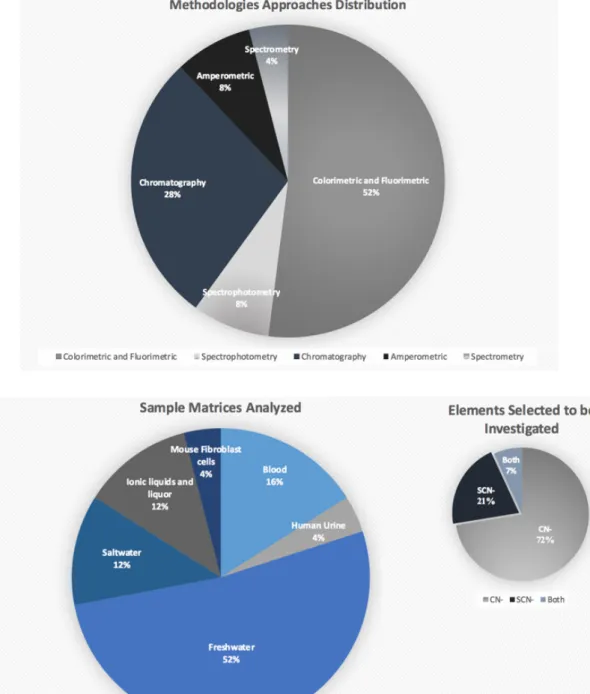
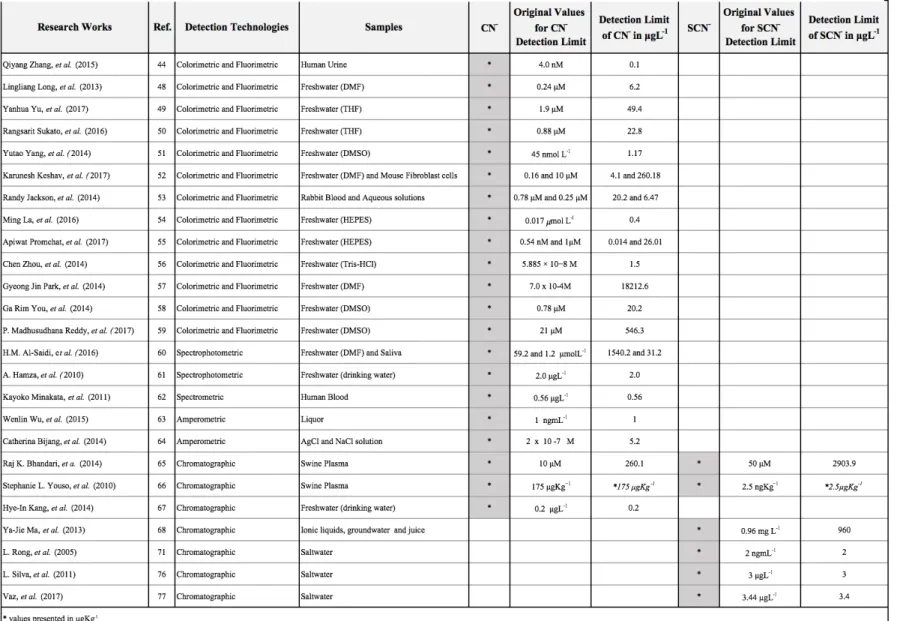
aqueous mobile phase with 350 mM of Sodium sulfate (D), followed by an (E) Detector UV-VIS, connected to a software data analyser………..61 Figure 8. A brief graphical resume of the detection methodologies selected to compose this review and in accordance to the following information presented at the Table 1…...65 Figure 9. Percentage of reef fish specimens, species, and families (pie charts) and number of specimens per fish family (bar chart) displaying concentrations of SCN- > 10 µg/L in the water at the end of the depuration period (24 h)………90 Figure 10. Representing the fish experimental groups division with F26 = Fish group acclimated under 26 ℃ and no exposed to cyanide; CN26 = Fish group acclimated under 26 ℃ and pulse exposed to cyanide at a concentration of 25 mgL-1; F29 = Fish group
acclimated under 29 ℃ and no exposed to cyanide; CN29 = Fish group acclimated under 29 ℃ and pulse exposed to cyanide at a concentration of 25 mgL-1. *Bath water
temperatures set in accordance to the group treatment………..126 Figure 11. (a) Swim tunnel equipment side view composed by (A) one-piece-unit swim tunnel respirometer associated to an (B) external pump for water re-circulation; a (C) water speed controller; and (D) an external water tank equipped with a submersible pump to provide clean saltwater return (though a flow-through) (Turbelle® nanostream - 6025, Tunze®) and a 300 W heater (Eheim® Jäger) for temperature maintenance. (b) System top view identifying the TEST AREA, composed by a fish chamber connected to a O2 Fiber
Optic Sensor (Loligo®Systems) for O2 and pH determinations; and the BATH AREA,
where all equipment and sensors responsible for water replacement and temperature maintenance were located (Temperature Probe °C (Loligo®Systems) surrounding the test area, a submersible heater and an submersible pump for water flush (same specifications as above presented); (A) indicates the top view of the swim tunnel unit set and; (B) the external pump (both also represented in system side view………128 Figure 12. Swim tunnel test (SWT) methodology set employed to access the prolonged swim performance of 28 specimens of C. viridis. Principal velocities steps [Vplat 01 (V 100 mm/s); Vplat 02 (V 200 mm/s); Vplat 03 (V 300 mm/s); Vplat 04 (V 400 mm/s); Vplat 05 (V 500 mm/s); and Vplat 06 (V 600 mm/s;)] associated to Secondary velocities steps [Vramp 01 (20 mm/s; 40 mm/s; 60 mm/s; 80 mm/s; and 100 mm/s); Vramp 02 (120
mm/s; and 400 mm/s); Vramp 05 (420 mm/s; 440 mm/s; 460 mm/s; 480 mm/s; and 500 mm/s); Vramp 06 (520 mm/s; 540 mm/s; 560 mm/s; 580 mm/s; and 600 mm/s)] were perform until fish exhaustion. Critical swimming speed (Ucrit) was calculated through the
equation [ui + ((ti/tii) x 10) = Ucrit)], where ui (cm) represents the highest velocity
accomplished in the assessment, ti the time (min) fish swam at the exhaustion velocity and
tii (min) the prescribed time for swimming under the fatigue velocity. Routine Metabolic
Rates (RMR) and Maximum Metabolic Rates (MMR) were also evaluated through the relation of oxygen consumption, total swim time and fish individual features (wet weight)………131 Figure 13. Methodology employed to measure the opercular movements beets (OM) and to identify the fish swim house preferred (Chamber positioning) during the swim tunnel test (SWT), Routine Metabolic Rates (RMR) and Maximum Metabolic Rates (MMR) measurements, with T0 representing the RMR, T10 to T120 the SWT, and TF the MMR evaluations………..131 Figure 14. Individual O2 consumption in regards to the fish weight (obtained through the
equation (O2/Kg/h), where O2 refers to the oxygen value measured, Kg to fish weigh and h
to the time span during oxygen measurements) obtained during the SWT prolonged performance and represented according to the time swam (min). In accordance to the respective experimental group, F26 represents the fish group acclimated under 26 and non-exposed to cyanide; CN26 the fish group acclimated under 26 and pulse-exposed to cyanide at a concentration of 25 mgL-1; F29 the fish group acclimated under 29 and non-exposed to cyanide; and CN29 the fish group acclimated under 29 and pulse-exposed to cyanide at a concentration of 25 mgL-1. For schematic representation O2 values
are divided by 107 (x/1E + 07)………...136 Figure 15. Slope determined between the Routine Metabolic (RMR) and Maximum Metabolic Rates (MMR) (MMR – RMR) and represented by experimental group (with F26 composed by the fish acclimated under 26 ℃ and non-exposed to cyanide; group CN26 by
1; group F29 by the fish acclimated under 29 ℃ and non-exposed to cyanide; and group
CN29 by the fish acclimated under 29 ℃ and pulse-exposed to cyanide at a concentration of 25 mgL-1. For schematic representation all O2 values are divided by 107 (x/1E +
07)………...137 Figure 16. Velocity accomplished during the SWT prolonged assessment with F26 representing the fish group acclimated under 26 and non-exposed to cyanide; CN26 the fish group acclimated under 26 and pulse-exposed to cyanide at a concentration of 25 mgL-1; F29 the fish group acclimated under 29 and non-exposed to cyanide; and CN29 the fish group acclimated under 29 and pulse-exposed to cyanide at a concentration of 25 mgL-1. Critical swimming speed (Ucrit) was calculated through the equation [ui + ((ti/tiii)
x 10) = Ucrit)], where ui. represents the highest velocity accomplished in the assessment, ti
the time (min) fish swam at the exhaustion velocity and tiii the prescribed time for
swimming under the fatigue velocity. ………139 Figure 17. Opercular Movements and Fish Positioning through time at SWT (swim tunnel test), RMR (routine metabolic rates) and MMR (maximum metabolic rates) determinations. At the SWT assessment, opercular observations were performed for 30 seconds with respective results represented in slots of 10 minutes (SWT from T0 to T120). At RMR, as at MMR, opercular observations were also performed for 30 seconds during the entire assessments (30 minutes duration each) and the obtained results are average represented. Individually, all 28 C. viridis were analyzed during SWT, RMR and MMR determinations with results represented according to the fish experimental group with F26 representing the fish group acclimated under 26 and no exposed to cyanide; CN26 the fish group acclimated under 26 and pulse-exposure to cyanide at a concentration of 25 mgL-1; F29 the fish group acclimated under 29 and no exposed to cyanide; and CN29 the fish group acclimated under 29 and pulse-exposure to cyanide at a concentration of
25 mgL-1……….141
Figure 18. Experimental design - F26 = Fish group acclimated under 26 ℃ and non-exposed to cyanide; CN26 = Fish group acclimated under 26 ℃ and pulse-exposed to cyanide at a concentration of 25 mgL-1; F29 = Fish group acclimated under 29 ℃ and non-exposed to cyanide; CN29 = Fish group acclimated under 29 ℃ and pulse-exposed to
Figure 19. Average enzymatic activities (± standard deviation) of superoxide dismutase (SOD), catalase (CAT) and glutathione S-transferase (GST) recorded in the gills, liver and brain of green damsels (Chromis viridis) acclimated 26 and non-exposed to cyanide (F26), acclimated at 26 and pulse-exposed to cyanide at a concentration of 25 mgL-1 (CN26), acclimated at 29 and non-exposed to cyanide (F29) and acclimated at 29 and pulse-exposed to cyanide at a concentration of 25 mgL-1 (CN29)………..169 Figure 20. Overlapped average enzymatic activities of superoxide dismutase (SOD), catalase (CAT) and glutathione S-transferase (GST) recorded in the gills, liver and brain of green damsels (Chromis viridis) acclimated 26 and non-exposed to cyanide (F26), acclimated at 26 and pulse-exposed to cyanide at a concentration of 25 mgL-1 (CN26), acclimated at 29 and non-exposed to cyanide (F29) and acclimated at 29 and pulse-exposed to cyanide at a concentration of 25 mgL-1 (CN29). Maximum activity values are highlighted and represented in accordance to the enzyme measured and to the experimental group analysed………171 Supplementary Figure 1. Chromatograms performed using HPLC to screen for the presence of SCN- in seawater used to depurate live reef fish traded for marine aquariums. All details concerning each chromatogram are summarized in Supplementary Table 3….98 Supplementary Figure 2. Chromatograms performed using HPLC to screen for the presence of SCN- in seawater used to depurate blue damsels Chrysiptera cyanea (family Pomacentridae) of similar size during 24 h. A) Chromatograms representing a sample displaying potential levels of SCN- (sample), with identification being confirmed through
the spiking of the sample with 40 µgL-1 of SCN- (SCN- 40 µgL-1) and detecting a proportional increase in the peak of SCN- present in the sampled spiked with 40 µgL-1 of SCN- (Sample + SCN- 40 µgL-1); B) Chromatograms representing a sample displaying no detectable level of SCN- (sample), with the absence of SCN- being confirmed through the spiking of the sample with 40 µgL-1 of SCN- (SCN- 40 µgL-1) and the sole detection of the
the absence of SCN- being confirmed through the spiking of the sample with 40 µgL-1 of SCN- (SCN- 40 µgL-1) and the detection of two peaks referring to the concentration of SCN- added to the sample and the ion initially detected that was not confirmed as SCN -(Sample + SCN- 40 µgL-1). Retention times recorded for the SCN- were always between 4.2 to 4.8 minutes, with shifts in retention times for SCN- peaks represented in the figure being due to the stripping of PEG (Polyethyleneglycol - H(OCH2CH2)nOH) used to modify the C30 column employed for HPLC analysis………..110 Supplementary Figure 3. Oxygen individual consumption at the SWT prolonged assessment. ... 151 Supplementary Figure 4. A) Routine Metabolic Rates (RMR) and B) Maximum Metabolic Rates (MMR) Oxygen consumption results. ... 152 Supplementary Figure 5. Tissue protein versus fish wet body weight ... 182
to 2017. ... 66 Supplementary Table 1. Research methodology applied to conceive this work. Performed from June 2016 to July 2017. ... 80 Supplementary Table 2. Expected chemical composition for general seawater and Java/Indonesia sediment. Seawater composition adapted from DOE [74], 1994 and Sediment composition average collected in Java, Indonesia, adapted from Plank & Langmuir [75], 1998. ... 81 Supplementary Table 3. HPLC chromatogram of standard solutions and all live reef fish screened for thiocyanate (SCN-) excretion after being depurated for 24 h in synthetic seawater along with their family, scientific and common names. Scientific names of fish species and families are reported according to WoRMS [19], while common names are reported according to Michael [20]. ... 111 Supplementary Table 4. Synthetic seawater volume employed to depurate selected fish according to their total length (measured from the tip of the snout to the tip of the longer lobe of the caudal fin). ... 117 Supplementary Table 5. Statistical Analysis. ... 153 Supplementary Table 6. Statistical Analysis. ... 183
Chapter 1
General Introduction
1.
1.1- Introduction
Coral reefs are the most-biodiverse marine ecosystem worldwide [1]. Essential for the survival of thousands of species, vertebrates and invertebrates alike rely on those areas for their most basic biological processes, such as feeding and reproduction. Several species use these ecosystems as refuges or travel routes, at least during part of their lifespan. Intimately related to local marine biodiversity, coral health is the key for the wellbeing of this ecosystem. If the coral is healthy, its associated fauna is abundant and high local biodiversity can be expected [2]. Indeed, the goods and services that coral reefs can provide to surrounding human communities are paramount for livelihood [3]. From coastal protection to the aggregation of cultural, aesthetic and economic values to the area, when well-managed, coral reefs can provide food and economical subsistence to whole communities that would otherwise face a more challenging way of life [4], [5]. Home to the largest coral reefs network worldwide, in 2008 Southeast Asia coral reef services were estimated to value up to $ 2.3 billion U.S. per year [3], and according to Elliff, et al. [4], these reef services can be expressed as food provision, shoreline protection, erosion regulation, biogeochemical cycling, tourism, recreation and the potential for business opportunities development.
When one thinks of coral reefs ecosystems, the Indo-Pacific region can easily be classified as the core of marine biodiversity [1]. Birth of several endemic species, route and temporary refuge to thousands of others, species abundance on this region drew attention to a number of business activities worldwide years ago [6]. The capture of exotic species to supply both the ornamental aquarium industry [7] and the live fish food market [8] is one of such activities, and has been stablished as one of the main economic activities of several Southeast Asia countries since 1970 [9]. Considering that 60 % of Southeast Asia’s population lives on the coast and 120 million citizens are directly dependent on local reefs for their economical sustenance [3], to support both markets became an interesting economic activity among local communities. Consequently, over the last decades, over the last decades, one of the most lucrative coral reefs ecosystem services described for the Indo-Pacific region is the regular supply of live reef fish to the international marine aquarium trade [1], [10]. However, this trade presents several constrains. Unlike freshwater
General Introduction
traded to supply this popular hobby, the marine aquarium trade still overwhelmingly relies on the supply of wild caught specimens [11]. Starting in the 1930s in Sri Lanka [11] and rapidly spreading among other Indo-Pacific countries, this trade of marine ornamental fish is presently represented by a multi-million dollars industry that has steadily continued to grow over the last decades [12], [13]. Even with insufficient information about the species and number of specimens traded, fish are likely the most important group of species within the extensive list of coral reef species traded in the marine ornamentals market, being represented by about 1800 different species with an estimated 30 million of specimens being commercialized worldwide [6], [11], [14], [15]. Considerable efforts to promote sustainability in this industry have been observed in the last decades [16]; nonetheless, the marine ornamental trade is still frequently associated to a generalized decline of coral reefs [13], [15]. This association is often due to the fact of a countless number of specimens being collected in the Indo-Pacific region still being captured through the use of harmful environmental techniques, namely cyanide fishing [9], [17] – [19]. In 1997, Barber and Pratt, through the International Marinelife Alliance and the World Resources Institute [9], have identified both confirmed and suspected areas in the Indo-Pacific where cyanide fishing activity had already been adopted. As cyanide fishing is the focus of the present work, the geographic identification of such regions is schematically represented in Figure 1.
Figure 1. Cyanide fishing in the Indo-Pacific. Suspected and confirmed geographical locations for cyanide fishing according to Barber and Pratt [9]. Map elaborated in ArcMap v10.5.
Cyanide fishing can be defined as an efficient and rapid technique to capture live species due to its low cost, efficacy, and very challenging traceability [20], as will later be detailed in the present work.
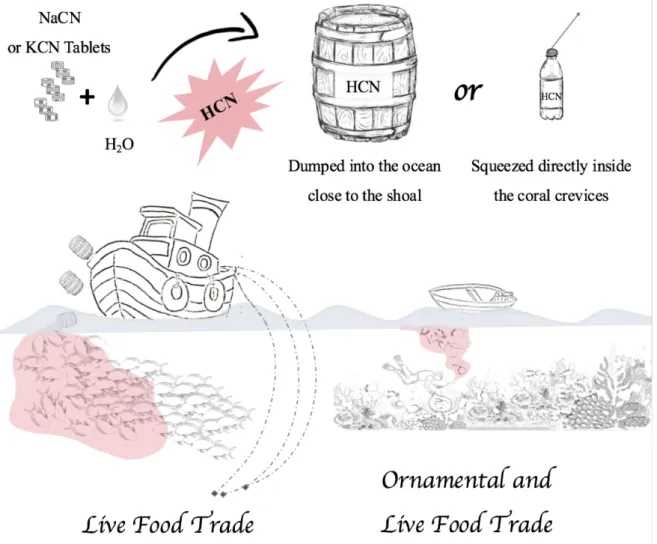
Widely available in the market, commonly being inexpensive and sold without any special regulation [21], sodium cyanide (NaCN) and potassium cyanide (KCN) became very popular among fisherman to capture a high number of coral reef species [22]. Fish, lobster, sea cucumbers, shrimps and many other coral reef species (with fish representing the majority of taxa targeted) are described to be captured by cyanide poisoning in order to collect the maximum of specimens as possible and minimize any physical damage during capture [21]. Relying on hydrogen cyanide (HCN) capacity to stun aquatic species (momentarily impairing their swimming capacity), NaCN (or less commonly, KCN) when mixed with water, releases cyanide in its ion form (CN-). Rapidly combined to H+, CN -will then originate one of the most toxic complexes for aquatic environments: HCN [23]. The toxic effects of cyanide in aquatic species, as well as on the surrounding environment, are, without a doubt, extremely severe. By killing the zooxanthellae (the endosymbiotic microalgae that allow corals to thrive), cyanide exposure can induce bleaching [24] and, by destroying this symbiotic association, this chemical poisoning leaves no gap for corals recovery [25]. Cyanide is also very toxic to many other species than the one being target ones by this illegal fishing practice [23]. Aiming (mainly) to capture adult specimens cyanide can, “accidentally”, poison juveniles and small-sized surrounding species resulting in a massive and indiscriminate mortality [8]. It is important to highlight that many poisoned specimens remain in the coral area, being frequently re-exposed to HCN during the next fishing procedures [22]. According to Cervino, et al. [24], these chemical effects on coral and anemones are devastating, independently of the CN- dosage employed. Cervino also points cyanide as responsible for a slow acting and long term damage to a number of coral groups tested, as it causes death even after a brief exposure. To fish species, and depending on the poison concentration used, some die immediately after cyanide exposure, while others may die during their recovery, transportation, or even at their final destination [22].
General Introduction
marine ornamental fish trade (MOFT) for aquarium display. Figure 2 presents a schematic representation of the most commonly employed cyanide fishing techniques.
Figure 2. Cyanide fishing purposes and respective techniques employed using NaCN (Sodium cyanide) and KCN (Potassium cyanide) to form HCN (Hydrogen cyanide) solution to stun and capture live reef fish species.
In coral reef areas, by squirting a bottle of a fresh mixture of NaCN and marine water directly on the coral reefs crevices, a few fishermen are capable to capture thousands of fish from different species with a considerably small effort [22]. This achievement is only possible because after being poisoned by cyanide, stunned fish go immediately to the water surface, making their capture faster and easier than any other knowing fishing technique [17]. It has been estimated that the CN- concentration range inside such bottles can reach up to 7347.6 mgL-1 of CN-, considering that fisherman usually spend one tablet of NaCN (13 g of NaCN) per liter of seawater [21]. Note that in Vaz, et al. [26], at a cyanide pulse-exposure trial with a concentration of only 25 mgL-1 of CN- Amphiprion clarkii were
already stunned and killed. To supply the Chinese live food trade market, reports from the Philippines indicated that 55 gallon of HCN solution have been dumped into the ocean close to shore areas for fishing purposes [27]. Typically, in small boats, fisherman visit different locations for two weeks, squirt HCN around individual fish or small aggregations, capture the maximum of fish possible and place them into maintenance tanks in the vessels until returning to dry land [21]. Not being able to precisely control the concentration from the squirt bottles (much less from the barrels), about 50 % of exposed fish die in the coral reef, while the remaining may flee or be stunned by cyanide [22]. The aquarium fish collectors select about 10 % of exposed fish, taking the most colorful species of interest to aquarists, while the remaining live fish are left lying on the bottom, may be collected to be served as food (to be sold in local markets) or simply left behind for predators [8]. In addition, poisoned fish that die during their capture, or in the vessels, and are not ideal to sell, can be dried (and then sold for local food markets), may be used as bait (for net fishing) or become part of the fisherman family’s next meal [21].
To supply the MOFT market, all coral reef fish species can be a potential target species for cyanide fishing [17]. However, the emperor angelfish (Pomacanthus imperator), the blue surgeonfish (Paracanthurus sp.), and the blue ring angelfish (Pomacanthus annularis) are usually the collectors first choice due to their high price in the market [28]. Considering the species destined to supply restaurants enrolled in the live fish trade for human consumption, the sea bass (Lates calcarifer), rock cod and groupers (Epinephelus spp.), the coral trout (Plectropomus spp., Cephalopholis and Variola spp.), barramundi cod (Cromileptes alitivelis) and the popular Napoleon wrasse (Cheilinus undulatus) are the most targeted species [8]. In 1996, a Napoleon’s wrasse of 40 kg live displayed on the best restaurants in Hong Kong, Singapore, Taiwan or China could be sold for up to US$ 5.000 (including US$245 for the fish lips alone) [8]. According to the same study, the live food market was, at that time, expanding from the Maldives to South Pacific Islands (with Indonesia and Philippines representing the major suppliers of the fish being stocked live in these markets) and from Papua New Guinea to the Pacific Islands, in case of suppliers replacement [8]. Napoleon’s wrasse capture was formally forbidden in Indonesia in 1995 (issued by the Minister of Agriculture decree n° 375/Kpts/IK.250/95 on the Prohibition of Napoleon Wrasse (Cheilinus undulatus) Fishing and the Directorate General of Fisheries
General Introduction
Ministry of Marine Affairs and Fisheries) [29]. In 2014 this species was listed as “endangered” on the International Union for Conservation of Nature (IUCN) Red List, and in 2011 the concerns about population declines due to its continued illegal trade remained high [30]. Considering this is one of the most famous species commonly and illegally captured with cyanide fishing, Napoleon’s wrasse populations are still suffering the pressure of a society full of laws but absent of a proper surveillance [30].
As will be frequently pointed out in this Ph.D. thesis, the lack of sufficient information in regards to cyanide (as chemical behavior), as to all subjects related to cyanide fishing (including the true status of this activity, countries involved, regulations, species traded and the fish market itself), appears to be a trend mark worldwide. With MOFT currently being of major economic importance in the cyanide fishing issue [13], the ornamental trade as experienced a remarkable increase grew motivated by the high biodiversity observed in the Indo-pacific coast [31]. However, prior to explore the fishing trade market behind the cyanide fishing and openly discuss about its current constrains, it is relevant to identify cyanide sources of environmental contamination, well as to understand the biological processes behind the cyanide dynamics inside the organism.
1.2- Cyanide sources, contamination pathways and depuration
processes
As a natural compound, cyanide can be produced and excreted by a large number of bacteria, fungi, algae and plants, having been detected on more than 1000 species of crops and plants consumed by humans (highlighting Manihot esculenta) [23]. However, artificial sources are the most commonly employed to introduce this toxic into ecosystems [32]. Extensively used for manufacture fabrics, plastics, as well as pesticides for predator control, cyanide is present in several laboratorial activities, including cyanogenic drugs, cigarettes, as well as fires and chemical warfare [33]. Cyanide is also very commonly employed at different anthropic operations, such as metal mining, oil refineries, solid waste combustion and biological specimens control or indistinct animal capture [34]. Sodium cyanide (NaCN), one of the main agents for artificial introduction of cyanide in ecosystems, was largely produced worldwide less than 30 years ago [23]. Extensively used for gold and silver extraction, Ronald Eisler concluded that until 1991, the United States produced up to 98 million kg of NaCN, directing about 80 % of the production to gold mining process, while 90 % of the gold mined in Canada was also obtained through NaCN use. Eisler also claims that for about 50 years the U. S. Fish and Wildlife Service produced NaCN guns (M-44) with the objective to control the coyote local population, and in the United Kingdom, NaCN was largely applied to reduce rabbits’ populations and to perform cyanide fishing [23].
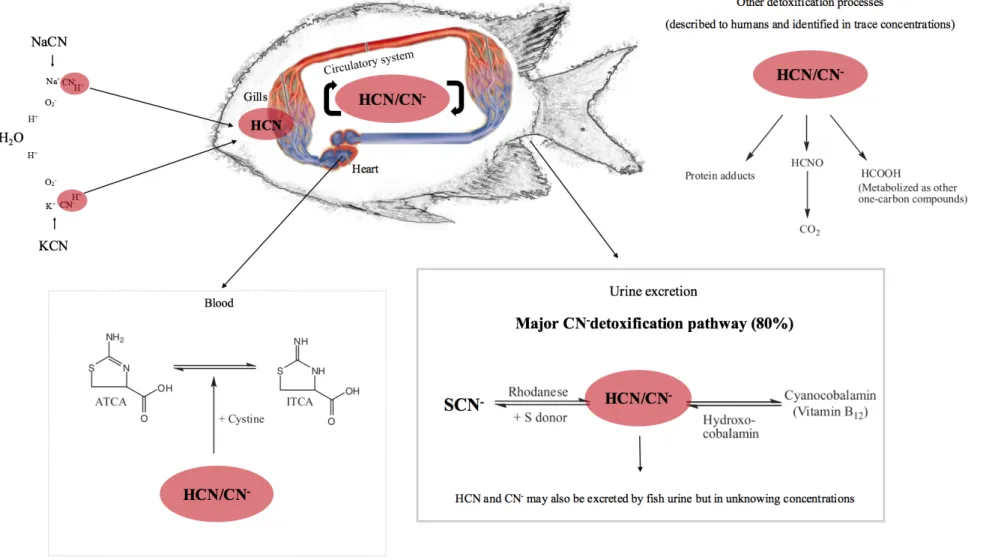
In general lines, cyanide in its free form (HCN or CN-) can be absorbed by aerobic organisms through the skin, through inhalation and/or ingestion. Once in the body, cyanide is quickly distributed through the blood by bounding with high affinity to an important enzyme (cytochrome c oxidase) from the respiratory chain [35]. In vertebrates this process may induce tissues to anoxia, followed by asphyxia and death [23], [36]. Fortunately, cyanide detoxification is a very rapid process, and according to the cyanide doses used, it may allow poisoned specimens to recover [37]. Specifically in fish and mainly through the gills, HCN will enter into the bloodstream, will partiality dissociate in CN- and H+ and both of its free forms (CN- and HCN), will impair cytochrome c oxidase (COx) by inhibiting its normal activity [37], [38]. Cyanide presents a natural and strong binding
General Introduction
identified as a heme-A transmembrane protein acting as a terminal enzyme of the respiratory chain, strongly correlated to the ATP production under cellular aerobic conditions [39]. By catalyzing the electron transference from the molecular oxygen (O2),
COx is reducted, generating cytochrome c (CO). Due to the electrochemical process, transferred protons will migrate across the inner mitochondrial membrane, with 4 protons producing water, with the other remaining 4 protons being translocated from the matrix to the mitochondrial intermembrane space (inner), establishing a proton gradient [40]. In addition, in order to successfully inhibit the enzyme activity, CN- may preferentially bind to porphyrinato iron(III) and ferric hemoproteins in the COx (due to their extreme affinity) [38], while HCN may bind to the fully oxidized binuclear COx complex [40]. However, even after a century after its discovery, the inhibition mechanisms of cytochrome c oxidase by both forms of free cyanide remain unclear [40] – [42]. Some authors refer to cyanide as a non-oxygen competitor due to COx inhibition [43], while others classify oxygen and cyanide as antagonist compounds [44]. Some lack information persists in what regards the rates of cyanide absorption by different tissues. While most authors agree that in fish HCN is mainly absorbed by the gills, others claim that this chemical can also be absorbed through the intestine [35], but absorption rates by both tissues are still unknown [20]. Indeed, no matter the tissue where cyanide will be absorbed, the precise loci of COx bounding, or the cyanide form of poison (HCN or CN-), interference in the oxygen metabolism of the target specimen will definitely observed due to its high toxicity [20]. Shifts on the respiration chain and, in the particular case of cyanide, expressed by interferences on the oxygen metabolism are commonly associated to an oxidative stress stage that can be triggered by: i) an increase of oxidant generation availability (expressed by reactive oxygen species (ROS) levels); ii) a decrease in antioxidant protection; and iii) a failure to repair oxidative cell damage [45]. The fight against oxidative stress involves the chemical transformation of one of ROS parental forms (superoxide (O)) into water (H2O)
and is generally evaluated through the differences in activity of the natural antioxidant enzymes present in the organism [46]. Metalloprotein under abundant and diverse cellular distribution, superoxide dismutase (SOD) represents the first line of anti-oxidative defense by accelerating the dismutation of the superoxide radical (O) into oxygen (O2) and
hydrogen peroxide (H2O2) [45] (as schematically represented in Figure 3). Superoxide
CAT (a heme-containing enzyme also under abundant and diverse cellular distribution) being responsible for increasing the rate of H2O2 transformation into water (H2O) and
oxygen (O2). Following this process, glutathione-peroxidase (a tetrameric enzyme found in
both selenium-containing (GPx) and selenium-independent forms (GST), distributed along the cytosol and in the mitochondria) will share CATs function by transforming H2O2 into
water solely [45]. With GPx being capable of accelerating the H2O production [47], both
glutathione forms (GPx and GST) will be evolved in the lipid peroxides detoxification by transforming lipid-OOH into alcohols (lipid-OH). Glutathione-S-transferase (GST) is usually determined as phase II enzyme of the anti-oxidative process, being represented by the total glutathione activity (GPx + GST) [48].
Figure 3. Natural antioxidant defence at the cellular level, including superoxide dismutase (SOD), catalase (CAT), glutathione-peroxidase (GPx) and glutathione-S-transferase (GST) activities.
Oxidative stress is generally followed by an oxidative damage stage, where lipids, proteins, and DNA integrity are structurally and functionally compromised [49]. Considering that oxidative damage can lead the organism to collapse and may be followed by death, the importance of an early oxidative stress diagnosis is paramount [50]. Oxidative stress in fish can be, therefore, assessed by examining the shifts in antioxidant enzymes activity (SOD, CAT and GST) within those enzymes acting as biomarkers of the organs affected by the toxicant agent (e.g., cyanide) [45], [49].
General Introduction
[52]. Capable to encompass cellular, genetic, molecular, immunological and physiological measurements, as well as offering a complete check-up of the organism, biomarkers can be one of the most sensitive self-response indicators that express instantaneously organisms’ health conditions under different sources of stress [53]. Widely used in ecotoxicological studies as a very helpful tool to predict environmental risks and modeling expected consequences on populations [51] for been ideal marks of exposure, according to the World Health Organization [52], the biomarkers selected to be evaluated must present sufficient relevance and validity for the study trial being performed [52]. This requirement aims to refer that only the biomarkers capable of providing information on questions of public interest and environmental health (directing appropriate decision-makers), with sufficient analytical accuracy, relevance to the study subjects and capacity to be generalized to other populations should be evaluated. Those criteria are applied in order to avoid invalid inferences and generalizations through a wrong selection of biomarkers, which can lead researchers to deliver erroneous risk assessments [52]. In addition, prior to the diagnosis, biomarkers results must be interpreted in what regards to be the unique biological aspects of the species being surveyed combined with a careful individual physiological and clinical examination (considering all particular signs and symptoms) [51]. Fish are by far the most popular vertebrate group used in environmental studies, as they play a key role in the clarification of toxicants potential risk to aquatic environments [54]. Unfortunately, following the lack of information about cyanide absorption mechanism in marine fish as already mentioned above, cyanide effects on antioxidant enzymes are still poorly understood.
The process involved in the cyanide detoxification in marine fish is another subject that urges to be clarified. Most of what is currently know about the toxicokinetics of this chemical comes either from studies on human [23] or freshwater fish [19], within little information on cyanide detoxification processes, namely in marine fish [35]. The detoxification process is of crucial importance to allow the poisoned organisms to survive under environmental conditions with sub-lethal concentrations of CN- [55]. Therefore,
cyanide toxicokinetics in marine fish remains a priority in terms of research gaps on the ongoing efforts to fight cyanide fishing in coral reefs.
It is known that in vertebrates the major metabolic product of HCN exposure is thiocyanate (SCN-) [35], expressing a conversion rate of about 80 % of the total cyanide intake, and following its excretion through urine [56]. Rhodanese, along with a recently identified sulphurtranferase enzyme (3- mercaptopyruvate (3-MST)), catalyzes the reaction of cyanide with thiosulfate converting CN- into SCN- and sulfite, as soon as cyanide poison enters the body [55]. Another indicator for HCN contamination, ATCA (2-aminothiazoline-4carboxylic acid), has been suggested as a possible biomarker for cyanide detection studies [57], although it is only recorded in the blood and in very low concentrations [58] (see Figure 4).
Figure 4. Schematic representation of HCN/CN- detoxifications pathway. 13 G ene ral Int roduc tion
In humans and some other vertebrates, as illustrated in Figure 4, other minor cyanide detoxification processes have been documented, namely: Fulminic acid (HCNO), later processed into carbon dioxide (CO2) and released by osmosis though the gills; and formic
acid (HCOOH), metabolized as other one-carbon compounds and protein adducts [35]. The Department of Animal Science - Plants Poisonous to Livestock - of the Cornell University [59], claims that, in Madagascar, the golden bamboo lemur (Hapalemur aureus) is capable of excreting cyanide apparently without passing to any chemical transformation. This species eats around 500 g of shoots of a local bamboo (C. cf. viguieri) daily, which contains 15 mg of cyanide per 100 g of fresh weight, and the large amounts of cyanide found in the golden lemur feces indicate its apparent capability to detoxify cyanide straight from the digestion phase. Unfortunately, the detoxification mechanisms used by H. aureus remain still unknown. It is likely that some portion of HCN/CN- (recently after the
exposure) may also be released through urine [60]. However, due to the high volatility of cyanide, the ability to detect any traces of HCN or CN- in marine fish urine detoxifying cyanide through this pathway would be, at least, very challenging.
So far, due to cyanide high volatility, it is known that free cyanide (HCN or CN-) is a non-persistent toxicant [23] being rapidly and fairly lost from standing test solutions in which fish are held [41]. Displaying a half-life of less than 1 hour in biological fluids, when analyzed in other matrices, the analytical values obtained for cyanide recovery are generally lower than the concentrations of cyanide that was added [61], [62]. In addition, cyanide reactivity also makes it a very difficult analyte to measure [34]. Thiocyanate, on the other hand, is considerably more stable then CN- [62] and this stability justifies its potential to be a longer-term repository for evidence to reveal cyanide exposure.
Thiocyanate is a sulfur compound naturally introduced in the ecosystem (by plants; biotic/abiotic bacteria through organic matter decomposition, as a defense to microbial infections, and from in vivo cyanide detoxification) or artificially, from numerous industrial processes (herbicide, insecticide and acrylic fiber production; photofinishing, electroplating, corrosion inhibition, dyeing, among others) [63]. Commonly, the analytical determination of SCN- involves the reaction of thiocyanate with ferric iron, producing a
General Introduction
development, such as S2-; SO2-3; CN-; C2O2-4; Fe2+; Cu2+; etc. Aiming to separate SCN
-from interfering ions, chromatography, followed by other visual determinations, became a possible tool to identify live fish captured with sub-lethal levels of cyanide [19], [26] as will be further stressed in this Ph.D. thesis (Chapter 2).
In what regards the use of ATCA to trace marine ornamental fish illegally collected using cyanide poisoning, one must acknowledge that screening must be performed in the fish blood and that this metabolite is only found in very low concentrations [58]; therefore, such blood analysis will probably require the fish being screened to be sacrificed (due to the small size most marine ornamental fish), which would make this approach not supported at all by the MOFT industry [20] (as discussed in this Ph.D. thesis).
1.3- Cyanide fishing and the marine ornamental trade
Cyanide fishing activity was first documented in the Philippines in 1962, spreading among other Indo-Pacific countries such as Vietnam, Maldives, Papua New Guinea, Fiji, until being adopted by the current main supplier of the MOFT market, Indonesia [9], [13], [22], [64]. Until today Indonesia and Philippines, alone, export more than 50 % of the entire marine ornamental fish stock annually imported by the European Community and supply about 80 % of the USA marine ornamental market. [6], [13].
In 2015, Leal, et al [13] determined the most relevant countries associated to the MOFT from the European Union (EU) in terms of main importers and suppliers, using an economic perspective. A similar market analysis was performed in 2017 by Biondo, et al. [65] to Switzerland alone, where the top importers and suppliers of the MOFT activity were also identified. Figure 5 overlaps the areas where cyanide fishing were expected and confirmed in 1997 [9], and the main current suppliers of the MOFT market in accordance to Biondo and Leal studies.
Figure 5. Main exporting countries involved in the supply of marine ornamental fish trade (MOFT) to the European Union [13] and Switzerland [65], overlapped to the locations where cyanide fishing is suspected and confirmed to occur as detailed by Barber and Pratt [9]. Map elaborated in ArcMap v10.5.
General Introduction
Endangered Species of Wild Fauna and Flora (CITES) database, is likely inadequate in what regards to the current number of specimens of marine fish species traded. Indeed, CITES solely surveys/regulates the trade of very few marine fish species by listing them in its Appendices [66]. The EUROSTAT (the European Statistical System), on the other hand, only provides the economic value of the marine fish traded in the EU without identifying traded species neither providing any detail on the number of specimens being traded. The information provided from shipment declarations and attached commercial invoices of animal products and marine imports has been surveyed for the United States of America (USA) [6] and Switzerland [65], but current datasets on ornamental fisheries are still limited and impair a complete understanding of this global activity [13]. Nevertheless, and even with incomplete trade information, it is known that Indo-Pacific countries, mainly Indonesia and the Philippines, are among the top exporting countries responsible for the supply of the MOFT worldwide, while the USA and the European Union (EU) are still the top importing players in this market [6], [11], [13], [65]. Although a total of 103 exporting countries can be related to the MOFT market in the EU, Indonesia and USA alone accounted for 53 % of all exports to the EU between 2000 and 2011. The other three countries ranking in the top five exporting players were the Philippines, Sri Lanka and the Maldives, representing 12 %, 10 % and 4 % of trade, respectively. As suppliers of Switzerland’s MOFT market, Indonesia comes in first place, represented by 11167 marine ornamental fish specimens traded in 2009, followed by Sri Lanka (2179 specimens), Singapore (1892 specimens), the Philippines (671 specimens) and the only African country in the list, Kenya, with (659 specimens) (see Figure 5). From about 1000 marine ornamental fish species traded in 2001 [6], to 2300 different marine ornamental fish species internationally traded today [14], the import declarations to Switzerland in 2009 reported a total of 17637 fish specimens in only one-year evaluation [65], with the MOFT market in EU representing an of ~12 million euros per year and 11 million euros in the USA (alone) [6], [11], [14].
In the Indo-pacific, motivated by the ambition to supply the MOFT with the largest number of specimens as possible, an overfishing approach is often employed and, as a direct result, effective techniques for mass capture, such as cyanide fishing are still employed [67]. While compromising the entire ecosystem structure [31], [68], in areas where cyanide is fishing is applied a reduction in species richness and genetic diversity
(from invertebrates to vertebrates) is also expected to occur [69] and, due to such overfishing approaches, the negative impacts of cyanide fishing are likely to be magnified [67]. Considering that both pressures (overfishing and cyanide poisoning) will act simultaneously in the same geographical area, the intrinsic potential to express cumulative deleterious effects are substantially increased in Indo-pacific coral reef areas [70]. In the last 3 decades, cyanide fishing has been considered the second most destructive human impact in the Indo-Pacific region. By being a non-selective fishing technique (cyanide may stun any species) and in addition to the cyanide side effects on the ecosystem [71], Bailey and Sumaila in 2015 claimed that cyanide fishing impacts on the Indo-Pacific coral reefs are considerable more devastating than blast fishing itself [31]. The impacts of fishing by bombing, as well as by natural poisoning, herbicides, pesticides and even by breaking corals structures have been openly discussed for the Indo-Pacific region for more than a half- century [21], [72], and apparently, among all, cyanide fishing remains the most efficient and “unstoppable” technique to capture live coral reef fish. Considering that bombing was legally forbidden in the Komodo National Park, Indonesia, in the early 1980s, and that the highest number of bombing inside the park was recorded in 1993 [21], it becomes easy to understand how the fishing legislations are largely ineffective in one of the main exporting countries of marine ornamental fish. If a strong surveillance is not applied in fishing areas, less scrupulous fishermen are not afraid to infringe the law. Furthermore, the use of herbicides and pesticides is very easy to detect, once the areas where they have been applied become a “field of death” (with apparently no fish available for months) [21].
Cyanide fishing is illegal in Indonesia since 1985 [21], but NaCN possession on the vessels is permitted for fish “tranquillizing purposes” [8]. This type of contradiction is found even in scientific publications, as many researchers suggest that cyanide fishing is no longer adopted by Indo-Pacific fishermen [67] and some even claim that this activity has been completely stopped around 1997 [21]. It is therefore difficult to understand how fish could display physiological symptoms of being caught using cyanide poisoning without being previously poisoned [9], [19], [73]. Despite cyanide fishing being an illegal practice in most Indo-Pacific countries, with the majority of them presenting specific legislation and regulations for the use of cyanide (see Figure 6), important MOFT suppliers, such as Sri
General Introduction
Figure 6. World countries without or with unknown information on legislation regulating cyanide fishing and countries with specific laws related with this topic [74] overlapped to the locations where cyanide fishing is either suspected or confirmed to occur as identified by Barber and Pratt [9]. Map elaborated in ArcMap v10.5.
Indeed, among the countries evaluated in 2014 [74] only Eritrea, Haiti, Kiribati and one of the top MOFT suppliers, Sri Lanka (as already referred), did not present information or specific legislation for the use of cyanide for fishing purposes. All other countries (Australia, Fiji, Indonesia, Maldives, Philippines, Papua New Guinea, Tonga, USA, Vanuatu, and Vietnam) were cited in the Dee, et al. [74] work, as properly regulated to fight this illegal practice. To the best of the authors’ knowledge, the biggest challenge for effectively stopping cyanide fishing in the Indo-Pacific is the absence of proper information (including reliable reports about the use of this fishing activity) and effective surveillance. Erroneous and insufficient information keep the cyanide fishing issue illusive and blurry, as poor or absent governmental surveillance projects a suitable resource management for the general public. In the Indo-Pacific, organisms from nearly all trophic levels are collected daily, which makes their identification an exceptionally challenging [74]. Most of the data about the ornamental local fish trade (including stock and fishing methods) relies on the fishermen’s words [8], [21], [64], [67]. Indeed, even countries with higher management and enforcement capacity, such as countries in the EU, the Switzerland and USA, do not present ideal data assessments policies to monitor the trade of marine ornamental species [6], [13], [65], [74]. The absence of surveillance in
Indo-Pacific countries for cyanide uses has been previously discussed by Calado, et al [18], along with the existence of challenging regulations in the USA to effectively fight cyanide fishing (due to potential Lacey Act violations). As an example of such challenges, in the USA, if a screened fish tests positive for being captured using cyanide poisoning, the testers could expose themselves to liability for indirectly engaging in an illegal act [18]. In this “cyanide fishing world”, another threat lurks in the near future of Indo-Pacific coral reefs: climate change. Unavoidably impacting all types of ecosystems, both terrestrial and marine, several studies have already addressed the potential effects that seawater temperature increase may have in fish [75] – [78]. The following section addresses the combined effects of cyanide fishing on coral reef fish in the warming oceans of tomorrow.
General Introduction
1.4- Cyanide fishing in a warming ocean
Coral reefs, as any other ecosystem on the planet, present a peculiar natural balance among their species composition and the surrounding environment [79]. However, more than in any other ecosystem, this natural balance is under a very severe threat [80]. This threat is explained by two main reasons: i) anthropogenic activities being more intense in coastal areas than in the inner regions of continents; and ii) coral reefs biodiversity being very sensitive to environmental shifts [80].
Due to coral reefs sensitivity to surrounding environment changes, their ability of adaptation is frequently on check. Under frequent natural and artificial selections, corals are capable to adapt by expanding their colonies and replacing damaged areas and often stimulate their reproduction [81]. However, as in any other ecosystem, coral reefs growth is also time dependent [82]. In addition, several points can impact the health of coral reefs, such as water quality, extreme climate shifts, amount/quality of food locally available and the ecosystem uses [83]. Corals are highly sensitive to water quality, with small changes in the pH and/or in water temperature triggering potentially catastrophic events [84]. Ocean acidification and the increase of seawater temperature expected for the next decades under climate change scenarios, can dramatically modify coral reef species composition and associated fauna [85]. The change in species number can prompt species themselves to other big ecological events, such as niche changes, migration, speciation or even extinction [86]. When associated to expected global stressors, such as ocean warming, the effect of existing pollutants in the ocean can be magnified [87].
Very likely, anthropogenic activities in association to the increase in concentration of atmospheric gases, such as carbon dioxide, methane, nitrous oxide, among others, are the dominant cause of temperature increase experienced worldwide in the last decades [88]. Moreover, the effects of climate change lead to intense modifications in all biological systems, continents and across oceans [84]. In what regards to IPCC predictions to the ocean global warming scenario, extreme precipitation events and heat waves formation will become more frequent and will last longer, as the ocean continues to warm, acidify and sea level to rise [85]. As a direct consequence, a gradual decrease in phytoplankton populations will reduce the availability of nutrients along food chains, followed by an
expectable disruption on many species ecological niche, reproduction and migration cycle [85].
Concerning global warming, marine organisms may be able to adapt to their new environmental conditions in a relatively short period of time [85]. However, in the Indo-Pacific region the real challenge is how all modifications resulting from climate change will impact an environment that is already under the action of so many stressors. According to the IPCC (2014), by 2100 the global surface will warm in a range between 0.3 to 4.8 °C while the ocean’s surface can reach a 4.0 °C temperature increase [88]. Cyanide toxicity effects on fish are strongly related to their swimming activity [37], with thermal stress also severely affecting their swimming ability [89]. Until cyanide starts to be processed by poisoned fish, these are completely incapable to swim, with such effect lasting over a period that is dependent on CN- dose usage and exposure time [26]. A deleterious effect on species that are unable to migrate can also be predicted [90]. Stimulated through their intrinsic temperature tolerance, and considering that at high temperatures a drastic decrease on the efficiency of fish swimming is expected [89], heat-tolerant species should expand northward, while less heat-tolerant species should retreat, eventually leading to their demise or speciation [85]. In addition, in the warming scenario, a reduction of the phytoplankton abundance and a significant calcium dynamics decrease is strongly expected [91]. Considering the coral reef fish specimens has on the phytoplankton their main source of nutrition and in the coral physical structure, their principal refuge and area for eggs deposition, the future perspectives of those effects are also very unpleasant [92].
Coral bleaching predicted to the coral reefs ecosystems are, very likely, one of the greatest threats to Indo-Pacific coral reefs. Wherever cyanide fishing activity is detected, coral bleaching effects can certainly be expected to occur [24] and if in case of prolonged temperature increases the zooxanthellae is only expelled from their associated coral (leaving, at least, a small gap for bleaching recovery [93]), with cyanide fishing the disruption of the symbiotic association may be permanent and impair any potential recovery [37]. If coral reefs are currently facing a range of serious anthropogenic threats that may significantly shift their ecological balance (consequently reducing their capacity
General Introduction
of such impacts may be considerably magnified. Large-scale coral bleaching is already being experienced over the last decades in the Indo-Pacific region [94], [95] and, consequently, massive impacts in their associated flora and fauna have already emerged [70], [96]. Such shifts may only be enhanced if thermal stress and cyanide poisoning continue to impact such endangered ecosystems and may ultimately push coral reefs ecosystems beyond a point-of-no-return.
1.5- Research questions and general goals
Considering that cyanide fishing was first reported in 1962 as a devastating fishing technique, despite all efforts, this illegal activity continues to harm Indo-Pacific coral reefs. In order to make the fight on cyanide fishing more effective and improve our perception of this illegal activity in the warming oceans of tomorrow, the following questions arise:
1) Considering that the production of SCN- is the major detoxification pathway for CN
-poisoning, can cyanide caught-fish be identified through SCN- detection? Is there any currently available and reliable methodology to identify cyanide caught-fish? Can this detection be performed in a non-invasive and non-destructive way? (Chapters 2 and 3)
2) Is there any reliable physiological evidence that cyanide caught-fish are still being traded by the marine ornamental industry? (Chapter 3)
3) Can pulse-exposure to sub-lethal concentrations of cyanide shift coral reef fish intrinsic abilities, such as swimming and respiration rates? (Chapter 4)
4) Can cyanide poisoning trigger physiological shifts in coral reef fish species by inducing oxidative stress? (Chapter 5)
5) Can the effects of cyanide poisoning in coral reef fish be magnified by ocean warming? (Chapters 4 and 5)
6) How can cyanide fishing be stopped in the Indo-Pacific? (Chapter 6)
Despite the constraints surrounding the cyanide fishing problematic, as outlined above, the aim of this thesis is to increase our understanding on the potential use of non-invasive methodologies currently available to identify cyanide caught-fish and better understand the potential effects that cyanide poisoning may have on coral reef fish species in a warming ocean.
![Figure 1. Cyanide fishing in the Indo-Pacific. Suspected and confirmed geographical locations for cyanide fishing according to Barber and Pratt [9]](https://thumb-eu.123doks.com/thumbv2/123dok_br/16036692.1104937/21.892.144.758.716.1057/figure-cyanide-pacific-suspected-confirmed-geographical-locations-according.webp)

![Figure 5. Main exporting countries involved in the supply of marine ornamental fish trade (MOFT) to the European Union [13] and Switzerland [65], overlapped to the locations where cyanide fishing is suspected and confirmed to occur as detailed by Barber](https://thumb-eu.123doks.com/thumbv2/123dok_br/16036692.1104937/34.892.135.738.610.970/exporting-countries-ornamental-european-switzerland-overlapped-locations-suspected.webp)
![Figure 6. World countries without or with unknown information on legislation regulating cyanide fishing and countries with specific laws related with this topic [74] overlapped to the locations where cyanide fishing is either suspected or co](https://thumb-eu.123doks.com/thumbv2/123dok_br/16036692.1104937/37.892.157.754.126.488/countries-information-legislation-regulating-countries-overlapped-locations-suspected.webp)
![Figure 7. a. OF technique by Silva, et al. [79]. OF sensor composed by (A) mobile phase flask connected to a pump (B), followed by an injector (C), a C30 column (modified with 5 % PEG 20.000) (D), followed by an analytical tube (0.4 cm diameter and 6.5 c](https://thumb-eu.123doks.com/thumbv2/123dok_br/16036692.1104937/79.892.151.738.126.461/technique-composed-connected-followed-injector-modified-followed-analytical.webp)