EUROPEAN ORGANIZATION FOR NUCLEAR RESEARCH (CERN)
CERN-PH-EP/2013-037 2015/04/24
CMS-SUS-14-010
Searches for supersymmetry based on events with b jets
and four W bosons in pp collisions at 8 TeV
The CMS Collaboration
∗Abstract
Five mutually exclusive searches for supersymmetry are presented based on events in which b jets and four W bosons are produced in proton-proton collisions at√s = 8 TeV. The data, corresponding to an integrated luminosity of 19.5 fb−1, were col-lected with the CMS experiment at the CERN LHC in 2012. The five studies differ in the leptonic signature from the W boson decays, and correspond to all-hadronic, single-lepton, opposite-sign dilepton, same-sign dilepton, and≥3 lepton final states. The results of the five studies are combined to yield 95% confidence level limits for the gluino and bottom-squark masses in the context of gluino and bottom-squark pair production, respectively. In the limit when the lightest supersymmetric parti-cle is light, gluino and bottom squark masses are excluded below 1280 and 570 GeV, respectively.
Published in Physics Letters B as doi:10.1016/j.physletb.2015.04.002.
c
2015 CERN for the benefit of the CMS Collaboration. CC-BY-3.0 license ∗See Appendix B for the list of collaboration members
1
1
Introduction
The standard model (SM) of particle physics provides an accurate description of known particle properties and interactions. The discovery of a Higgs boson by the ATLAS [1] and CMS [2] Collaborations at the CERN LHC represents the latest major milestone in the validation of the SM. Despite its success, the SM is known to be incomplete because, for example, it does not offer an explanation for dark matter and it contains ad-hoc features, such as the fine-tuning [3– 9] required to stabilize the Higgs boson mass at the electroweak scale. Many extensions to the SM have been proposed. In particular, supersymmetry (SUSY) may provide a candidate for dark matter in R-parity conserving models [10] as well as a natural solution to the fine-tuning problem [3–9].
The CMS and ATLAS Collaborations have performed many searches for physics beyond the SM. Thus far, no significant evidence for new physics has been obtained. The search for su-persymmetry is particularly interesting phenomenologically because of the large number of new particles expected. The LHC SUSY search program consists therefore of a wide array of searches [11–22]. Any particular manifestation of SUSY in nature would likely result in topologies that are detectable in a variety of final-states. Individual searches can therefore be combined to provide complementarity and enhanced sensitivity in the global search for new physics.
Naturalness arguments suggest that the supersymmetric partners of the gluon (gluino,eg) and third-generation quarks (the top and bottom squarks,et and eb) should not be too heavy [23–26]. Direct or cascade production of third-generation squarks can lead to final states with several W bosons and bottom quarks, and considerable imbalance~pmiss
T in transverse momentum. The
missing momentum arises from neutrinos in events where one or more W bosons decay lep-tonically, but also, for the R-parity conserving models considered here, because the lightest SUSY particle (LSP), taken to be the lightest neutralinoχe
0
1, is weakly interacting and stable,
es-caping without detection. The studies presented here focus on SUSY simplified model scenar-ios [27, 28] with four W bosons. Each of the W bosons can decay either into a quark-antiquark pair or into a charged lepton and its neutrino. Depending on the decay modes of the W bosons, the final states contain 0–4 leptons. This makes combining the final states with different lepton multiplicities beneficial. The dilepton signature is split according to the relative electric charges of the leptons, providing five mutually exclusive analyses for the combination: fully hadronic, single-lepton, opposite-sign dilepton, same-sign dilepton, and≥3 leptons (multilepton). The results are based on proton-proton collision data collected at√s=8 TeV with the CMS experi-ment at the LHC during 2012, and correspond to an integrated luminosity of 19.5 fb−1.
The first simplified model we consider describes gluino pair production, followed by the decay of each gluino to a top quark-antiquark pair (tt) and the LSP. For cases where the top squark mass is larger than the gluino mass, the decay will proceed through a virtual top squark (T1tttt model, Fig. 1 left). Alternatively, when the top squark mass is smaller than the gluino mass and phase space allows, the decay will proceed through an on-shell top squark (T5tttt model, Fig. 1 middle). Each top quark decays to a bottom quark and a W boson, leading to final states with four W bosons, four bottom-quark jets (b jets), and considerable~pmiss
T . The second
sim-plified model we consider describes bottom-antibottom squark pair production, where we as-sume that each bottom squark decays to a top quark and a chargino (χe
±), and that the chargino
then decays to yield a W boson and the LSP (T6ttWW model, Fig. 1 right). The final state thus contains four W bosons, two b jets, and large~pTmiss.
The paper is organized as follows. Section 2 describes the CMS detector. The event simulation, trigger, and reconstruction procedures are described in Section 3. Section 4 presents details of
2 3 Event reconstruction, trigger, and simulation
the individual analyses, with particular emphasis on the opposite-sign dilepton search, which is presented here for the first time. The combination methodology and results are presented in Section 5. Section 6 provides a summary.
P1 P2 ˜g ˜ g ¯t t ˜ χ0 1 ˜ χ0 1 ¯t t P1 P2 ˜g ˜ g ˜t∗ ˜t ¯t t ˜ χ0 1 ˜ χ0 1 ¯t t P1 P2 ˜ b∗ 1 ˜ b1 χ+ 1 χ−1 ¯t W+ ˜ χ0 1 ˜ χ0 1 W− t
Figure 1: Feynman diagrams for the signals from: (left) gluino pair production with intermedi-ate virtual top squarks (T1tttt), (middle) gluino pair production with intermediintermedi-ate on-shell top squarks (T5tttt), and (right) bottom squark pair production (T6ttWW).
2
Detector
The central feature of the CMS detector is a superconducting solenoid, of 6 m internal diameter, that produces an axial magnetic field of 3.8 T. Within the solenoid volume are a silicon pixel and strip tracker, a lead tungstate crystal electromagnetic calorimeter, and a brass and plastic scintillator hadron calorimeter. Muons are detected in gas ionization chambers embedded in the steel flux-return yoke outside the magnet. The tracking system covers the pseudorapidity range|η| <2.5, the muon detectors|η| <2.4, and the calorimeters|η| <3.0. Steel and
quartz-fiber forward calorimeters cover 3< |η| <5. A detailed description of the CMS apparatus and
coordinate system are given in Ref. [29].
3
Event reconstruction, trigger, and simulation
The recorded events are reconstructed using the CMS particle-flow algorithm [30, 31]. Electron candidates are reconstructed by associating tracks to energy clusters in the electromagnetic calorimeter [32, 33]. Muon candidates are reconstructed by combining information from the tracker and the muon detectors [34].
Particle-flow constituents are clustered into jets using the anti-kT clustering algorithm with a
distance parameter of 0.5 [35]. Corrections are applied as a function of jet transverse momen-tum (pT) and η to account for non-uniform detector response [36, 37]. Contributions from
additional pp collisions overlapping with the event of interest (pileup) are estimated using the jet area method [38, 39] and are subtracted from the jet pT. The total visible jet activity HT is
defined as the scalar sum of the jet pTin the event, and HTmissas the pT imbalance of the
recon-structed jets, where the pTand η requirements for accepted jets are specified for the individual
searches in Section 4. The identification of b jets is performed using the combined secondary vertex algorithm at the medium working point [40], which has a b-jet tagging efficiency of 70% and a light-flavor jet misidentification rate below 2% for jets with pT values in the range of
interest for this analysis. The missing transverse momentum vector~pTmissis defined as the pro-jection on the plane perpendicular to the beam axis of the negative vector sum of the momenta of all reconstructed particles. Its magnitude is referred to as EmissT .
The data sample used for the fully hadronic analysis was recorded with trigger algorithms that required events to have HT > 350 GeV and EmissT > 100 GeV. The single-lepton analysis uses
3
together with HT > 350 GeV and EmissT > 45 GeV. The double-object triggers have the same
HT requirement, no EmissT requirement, and a lepton pTthreshold of 40 GeV. The data samples
for the dilepton and multilepton analyses were collected with ee, eµ, and µµ double-lepton triggers, which require at least one e or one µ with pT >17 GeV and another with pT >8 GeV.
Simulated Monte Carlo (MC) samples of signal events are produced using the MADGRAPH
5.1.3.30 [41] generator, as are SM tt, Drell–Yan, W+jets, and single top quark events. The tt events include production in association with a photon, or with a W, Z, or H boson. The pro-duction of single top quarks in association with an additional quark and a Z boson is simulated with [email protected] [42, 43] generator. The PYTHIA 6.4.24 [44] generator is used to simulate the generic multijet QCD and diboson (WW, ZZ, and WZ) processes, as well as to describe the parton shower and hadronization for the MADGRAPHsamples. All SM samples are processed
with the full simulation of the CMS detector, based on the GEANT4 [45] package, while the signal samples are processed with the CMS fast simulation [46] program. The fast simulation is validated through comparison of its predictions with those of the full simulation, and effi-ciency corrections based on data are applied [47]. The effect of pileup interactions is included by superimposing a number of simulated minimum bias events on top of the hard-scattering process, with the distribution of the number of reconstructed vertices matching that in data.
4
Search channels
This paper reports the combination of five individual searches for new physics by CMS. The fully hadronic [19], single-lepton [20], same-sign dilepton [21], and multilepton [22] searches have all been published, and are summarized briefly below. The opposite-sign dilepton search is presented here for the first time and is therefore described in greater detail.
4.1 Fully hadronic analysis
Considering that signal events contain four W bosons, the fully hadronic branching fraction is about 24%. The fully hadronic analysis [19] requires at least three jets with pT > 50 GeV and
|η| < 2.5, and vetoes events containing an isolated electron or muon with pT > 10 GeV and
|η| < 2.5 (2.4) for electrons (muons). The HT and HTmissvalues are required to exceed 500 and
200 GeV, respectively. To render the analysis more sensitive to a variety of final-state topologies resulting from longer cascades of squarks and gluinos, and therefore a large number of jets, the events are divided into three exclusive jet-multiplicity regions: Njets = (3–5), (6–7), and ≥8.
The events are further divided into exclusive regions of HT and HTmiss. The exploitation of
higher jet multiplicities is motivated by natural SUSY models in which the gluino decays into top quarks [19]. This analysis does not impose a requirement on the number Nbjets of tagged b jets, thereby maintaining a high signal efficiency.
The main SM backgrounds for the fully hadronic channel arise from Z +jets events in which the Z boson decays to a νν neutrino pair; from W+jets and tt events with a W boson that decays directly or through a τ lepton to an e or µ and the associated neutrino(s), with the e or µ undetected or outside the acceptance of the analysis; from W+jets and tt events with a W boson that decays to a hadronically decaying τ lepton and its associated neutrino; and from QCD multijet events. For the first three background categories, the neutrinos provide a source of genuine Hmiss
T . For the QCD multijet event background, large values of HmissT arise from
the mismeasurement of jet pT or from the neutrinos produced in the semileptonic decays of
hadrons. All SM backgrounds are determined from control regions in the data, and are found to agree with the observed numbers of events in the signal regions.
4 4 Search channels
4.2 Single-lepton analysis
With four W bosons, the branching fraction of signal events to states with a single electron or muon is about 42%, including contributions from leptonically decaying τ leptons. The single-lepton analysis [20] requires the presence of an electron or muon with pT > 20 GeV and no
second electron or muon with pT > 15 GeV, with the same η restrictions on the e and µ as
in Section 4.1. Jets are required to have pT > 40 GeV and |η| < 2.4. The SlepT variable is
evaluated, defined by the scalar sum of EmissT and the lepton pT. Events must satisfy Njets ≥ 6,
Nbjets≥2, HT>400 GeV, and SlepT >250 GeV. A further variable, the azimuthal angle∆φ(W,`)
between the W boson candidate and the lepton, is evaluated. For this variable, the pTof the W
boson candidate is defined by the vector sum of the lepton pT and~pTmiss. For single-lepton tt
events, the angle between the directions of the W boson and the charged lepton has a maximum value that is determined by the mass of the W boson and its momentum. The requirement of large EmissT selects events with Lorentz-boosted W bosons. This leads to a narrow distribution in ∆φ(W,`). In SUSY decays there will be no such maximum, since the Emiss
T mostly results
from the two neutralinos and their directions are largely independent of the lepton direction. Therefore the∆φ(W,`)distribution is expected to be flat for SUSY events. The analysis requires ∆φ(W,`) > 1. The search is then performed in exclusive regions of SlepT for Nbjets = 2 and
Nbjets≥3.
The main SM backgrounds for the single-lepton channel arise from dilepton tt events in which one lepton is not reconstructed or lies outside the acceptance of the analysis, from residual single-lepton tt events, and from events with single-top quark production. The backgrounds are evaluated using data control samples. The total number of background events is found to agree with the observed number of events in each signal region.
4.3 Same-sign dilepton analysis
The branching fraction for events with four W bosons to a final state with at least two same-sign leptons (ee, µµ, or eµ) is 7%, including the contributions of τ leptons. For the present study, we make use of the high-pTselection of the same-sign dilepton analysis in Ref. [21], which requires
at least two same-sign light leptons (e, µ) with pT > 20 GeV, |η| < 2.4, and invariant mass
above 8 GeV. To prevent overlap between the same-sign dilepton and multilepton analyses, an explicit veto on additional leptons with pT >10 GeV and|η| <2.4 is added for the same-sign
dilepton analysis, as in the search foret2production described in Ref. [22]. Jets are required to satisfy pT > 40 GeV and |η| < 2.4. Events must have Njets > 2, HT > 200 GeV, and EmissT >
50 GeV. The events are examined in exclusive regions of HT and EmissT for 2 ≤ Njets ≤ 3 and
Njets ≥4, all for Nbjets=0, 1, and≥2.
There are three main sources of SM background in this analysis: non-prompt leptons, rare SM processes, and electrons with wrong charge assignments. The main sources of non-prompt leptons are leptons from bottom- and charm-quark decays, misidentified hadrons, muons from light-meson decays in flight, and electrons from unidentified photon conversions. The back-ground from non-prompt leptons is evaluated from data control regions. Diboson, ttW, and ttZ production are the most important rare SM background sources. Their contributions are esti-mated from MC simulation. Opposite-sign dileptons can also contribute to the background when the charge of an electron is misidentified because of bremsstrahlung emitted in the tracker material. This contribution is estimated using a technique based on Z → e+e− data. No significant deviations are observed from the SM expectations.
4.4 Multilepton analysis 5
4.4 Multilepton analysis
The branching fraction for events with four W bosons to decay to a final state with three or more charged leptons (e or µ) is 6%, including τ lepton contributions. The multilepton sample used in the present study corresponds to the selection of events with three or more such leptons presented in Ref. [22]. The electrons or muons are required to have pT >10 GeV and|η| <2.4,
except at least one of the three leptons must have pT > 20 GeV. Jets are required to have
pT > 30 GeV and |η| < 2.4. Events must satisfy Njets ≥ 2, Nbjets ≥ 1, HT > 60 GeV, and
Emiss
T >50 GeV. The events are examined in exclusive regions of HTand ETmissfor 2≤ Njets ≤3
and Njets ≥4, both with Nbjets =1 and 2, and for Njets ≥3 with Nbjets ≥3.
Compared to the fully hadronic, single-lepton, or dilepton signatures, the multilepton search targets final states with small branching fractions, but provides good signal sensitivity because the three-lepton requirement strongly suppresses backgrounds. Only a few SM processes ex-hibit such signatures. Background from diboson production is highly suppressed by the Nbjets
requirement. The main backgrounds arise from events with a combination of tt production and non-prompt leptons, as well as from rare SM processes like ttW and ttZ production. The non-prompt lepton background is evaluated using data control regions and the rare SM back-ground from simulation. There is no statistically significant excess of events found in the signal regions above the SM expectations.
4.5 Opposite-sign dilepton analysis
The branching fraction for events with four W bosons to a final state with at least one opposite-sign lepton pair (e or µ) is 14%, including the contributions of τ leptons. The opposite-opposite-sign dilepton search requires the presence of exactly two opposite-sign leptons (e or µ), each with pT >20 GeV and|η| <2.4. Events with a third lepton satisfying pT>20 GeV and|η| <2.4 are
vetoed. Jets must satisfy pT > 30 GeV and|η| <2.5. This analysis targets the T1tttt and T5tttt
scenarios described in the Introduction.
Many variables are examined in order to define a signal region (SR) that maximizes signal con-tent while minimizing the contributions of SM events. We choose those variables that demon-strate the greatest discriminating power between signal and SM events, and that exhibit the smallest level of correlation amongst themselves: Njets, Nbjets, ETmiss, and the η values of the two
jets with largest pT. The criteria that yield the highest sensitivity in the parameter space of the
T1tttt model, summarized in Table 1, are optimized using simulated events. Events are divided into bins of ETmiss. The bin with highest EmissT (>180 GeV) is the most sensitive for the bulk of the signal phase space, but the bins with lower Emiss
T are important for compressed spectra, i.e., for
signal scenarios with small mass differences between the SUSY particles. After applying the selection criteria summarized in Table 1, the remaining SM background is primarily composed of events with tt, Drell–Yan, and W+jets production.
Table 1: Selection criteria for the signal region in the opposite-sign dilepton analysis.
Variable Description Criterion
Emiss
T Missing transverse momentum >30 GeV
Njets Number of jets >4
Nbjets Number of b-tagged jets >2 |ηj1| Pseudorapidity for jet with largest pT <1 |ηj2| Pseudorapidity for jet with next-to-largest pT <1
A control region (CR) is defined by the sum of the two event samples obtained by separately inverting the ηj1 <1 and ηj2 <1 requirements. The contribution of signal events to the control
6 4 Search channels
region depends on the gluino mass (meg) and the LSP mass (mLSP) and can be as large as 10%.
The contributions of signal events to the CR are taken into account in the interpretation of the results.
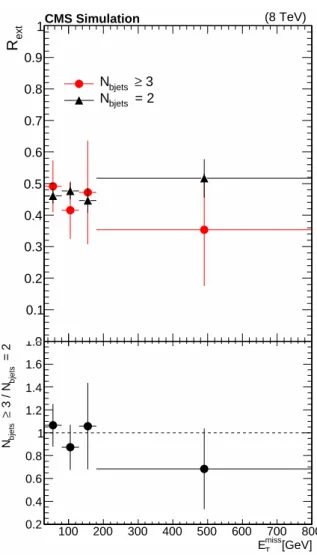
An extrapolation factor Rextis defined as a function of EmissT and Nbjets, as the ratio of the
num-ber of SM events in the SR to that in the CR. In simulated events the Rextfactor is observed to
change slowly as a function of EmissT , as shown in Fig. 2. The Rext ratio is similarly found to
be independent of Nbjets, making it possible to extract its value directly from data using events
with Nbjets = 2, without altering the other signal and control selection criteria. The
contribu-tion of signal events to the Nbjets = 2 region is small compared to the statistical uncertainty in
the extrapolation factor and is therefore neglected. Thus the background estimate is derived entirely from data, minimizing systematic uncertainties.
The SM background prediction for the SR is obtained by multiplying Rextwith the number of
data events in the CR:
NpredictedSR = RextNdataCR . (1)
100 200 300 400 500 600 700 800 ext R 0 0.1 0.2 0.3 0.4 0.5 0.6 0.7 0.8 0.9 1 3 ≥ bjets N = 2 bjets N CMS Simulation (8 TeV) [GeV] miss T E 100 200 300 400 500 600 700 800 = 2 b jets 3 / N ≥ bjets N 0.2 0.4 0.6 0.8 1 1.2 1.4 1.6 1.8
Figure 2: Extrapolation factors from the control region to the signal region, Rext, as a function
of ETmiss, for simulated events with Nbjets = 2 (black triangles) and Nbjets ≥ 3 (red points). All
the other signal selection criteria have been applied. The lower panel shows the ratio of the Nbjets≥3 to the Nbjets=2 results.
simu-4.5 Opposite-sign dilepton analysis 7
lation, and in a cross-check region defined by 2 ≤ Njets ≤ 4, using data and simulation. For
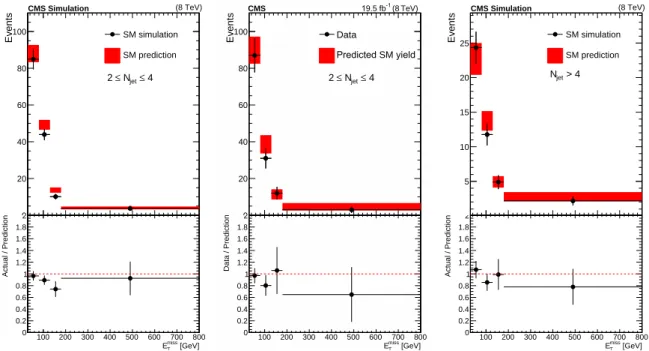
both regions, the SM background consists primarily of tt events, with a small contribution from W+jets production. Figure 3 shows agreement between the predicted and actual EmissT distribu-tions for the SR and cross-check regions.
100 200 300 400 500 600 700 800 Events 0 20 40 60 80 100 SM simulation SM prediction 4 ≤ jet N ≤ 2 CMS Simulation (8 TeV) [GeV] miss T E 100 200 300 400 500 600 700 800 Actual / Prediction 0 0.2 0.4 0.6 0.8 1 1.2 1.4 1.6 1.8 2 100 200 300 400 500 600 700 800 Events 0 20 40 60 80 100 Data Predicted SM yield 4 ≤ jet N ≤ 2 19.5 fb-1 (8 TeV) CMS [GeV] miss T E 100 200 300 400 500 600 700 800 Data / Prediction 0 0.2 0.4 0.6 0.8 1 1.2 1.4 1.6 1.8 2 100 200 300 400 500 600 700 800 Events 5 10 15 20 25 SM simulation SM prediction > 4 jet N CMS Simulation (8 TeV) [GeV] miss T E 100 200 300 400 500 600 700 800 Actual / Prediction 0 0.2 0.4 0.6 0.8 1 1.2 1.4 1.6 1.8 2
Figure 3: EmissT distribution predicted for SM backgrounds by extrapolation from the control region with the statistical and systematic uncertainties (red bands), compared to actual distri-bution (black points) for (left) simulated events in the cross-check region, (middle) data events in the cross-check region, and (right) simulated events in the search region. The lower panels show the ratios of the actual to predicted distributions.
The systematic uncertainty in the background prediction is based on the statistical uncertain-ties in the data, used to extract the Rext factors, and on the level of agreement between the
predicted and actual results found using simulation in the SR (Fig. 3 right). No significant bias in the method is observed in simulation, and an additional systematic uncertainty of 25–50% is assigned to account for the statistical precision of the latter term.
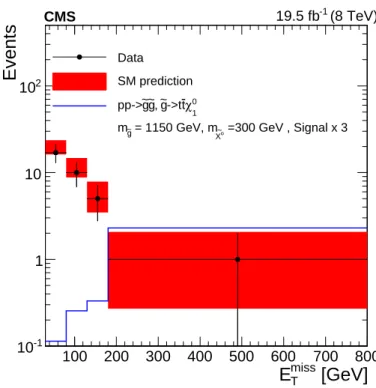
The predicted and observed Emiss
T distributions for the signal region are shown in Fig. 4 and
listed in Table 2. No excess of events is observed with respect to the SM prediction. For the interpretation of results (Section 5), all four ETmissbins are used. Besides their use in the combi-nation, we present in Appendix A the interpretation of the T1tttt and T5tttt scenarios based on the results of the opposite-side dilepton analysis alone.
Table 2: Predicted SM background and observed data yields as a function of ETmiss for the opposite-sign dilepton analysis. The uncertainties in the total background predictions include both the statistical and the systematic components.
Emiss
T requirement Background prediction Observed data yields
30<EmissT <80 GeV 19.9±3.7 17 80 <Emiss T <130 GeV 11.8±3.0 10 130<Emiss T <180 GeV 5.7±2.2 5 EmissT >180 GeV 1.2±1.1 1
8 5 Combination of analyses
[GeV]
miss TE
100 200 300 400 500 600 700 800Events
-1 10 1 10 2 10 Data SM prediction 0 1 χ t ->t g ~ , g ~ g ~ pp-> =300 GeV , Signal x 3 o X~ = 1150 GeV, m g ~ m (8 TeV) -1 19.5 fb CMS Figure 4: EmissT distribution in the signal region (black points) compared to the SM background
prediction with its statistical and systematic uncertainties (red band). The expected signal for the T1tttt model with a gluino mass of 1150 GeV and an LSP mass of 300 GeV, multiplied by a factor of 3 for better visibility, is indicated by the blue curve.
5
Combination of analyses
The results from the five analyses are combined to provide more stringent conclusions. The combined results are interpreted in the context of the SUSY scenarios illustrated in Fig. 1. The 95% confidence level (CL) upper limits (UL) on the cross sections are calculated using the LHC-style CLS method [48–50]. Because of their large branching fractions, the fully hadronic and
single-lepton analyses are most sensitive in the largest part of the phase space. However, the analyses based on higher lepton multiplicities become important for the more compressed mass spectra and for models with fewer b jets.
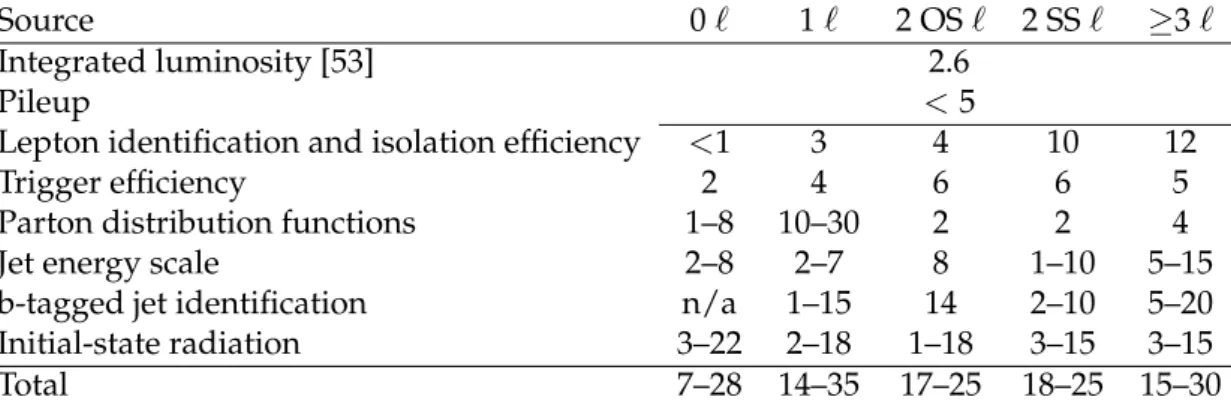
Systematic uncertainties in the signal selection efficiency are evaluated using the same tech-niques for all analyses. They are evaluated separately for the different signal models, search regions, and for each hypothesis for the SUSY particle masses. The systematic uncertainties in the signal modeling are taken to be 100% correlated among the mass hypotheses. As an exam-ple, a summary of systematic uncertainties for the T1tttt model is given in Table 3. The total systematic uncertainty varies between 7 and 35% depending on the decay modes considered, the search regions, and the mass points. An important source of systematic uncertainty for the analyses that require multiple leptons arises from the lepton identification and isolation effi-ciencies, which are evaluated using Z → `+`− events. The uncertainty in the energy scale of jets gives rise to a 1–15% systematic uncertainty that increases with more stringent kinematic requirements. For compressed spectra, the modeling of initial-state radiation (ISR) [18] is an important source of uncertainty. The PDF4LHC recommendations [51, 52] are used to evaluate the uncertainty associated with the parton distribution functions (PDFs). For most of the anal-yses the background evaluation methods differ, and so the systematic uncertainties are treated as uncorrelated. The overlap between most control regions is studied and found to be negligi-ble. The only exception occurs for the same-sign dilepton and multilepton analyses, which use
5.1 Gluino-mediated top squark production with virtual top squarks 9
the same methods to predict the background from non-prompt leptons and rare SM processes. For this case, the systematic uncertainties are taken to be fully correlated.
Table 3: Relative (%) systematic uncertainties in the signal efficiency of the T1tttt model for the fully hadronic (0`), single-lepton (1`), opposite-sign dilepton (2 OS`), same-sign dilepton (2 SS `), and multilepton (≥3`) analyses. The given ranges reflect the variation across the different search regions and for different values of the SUSY particle masses.
Source 0` 1` 2 OS` 2 SS` ≥3`
Integrated luminosity [53] 2.6
Pileup <5
Lepton identification and isolation efficiency <1 3 4 10 12
Trigger efficiency 2 4 6 6 5
Parton distribution functions 1–8 10–30 2 2 4
Jet energy scale 2–8 2–7 8 1–10 5–15
b-tagged jet identification n/a 1–15 14 2–10 5–20
Initial-state radiation 3–22 2–18 1–18 3–15 3–15
Total 7–28 14–35 17–25 18–25 15–30
5.1 Gluino-mediated top squark production with virtual top squarks
The results are first interpreted in the context ofegeg production witheg→ttχe
0
1through a virtual
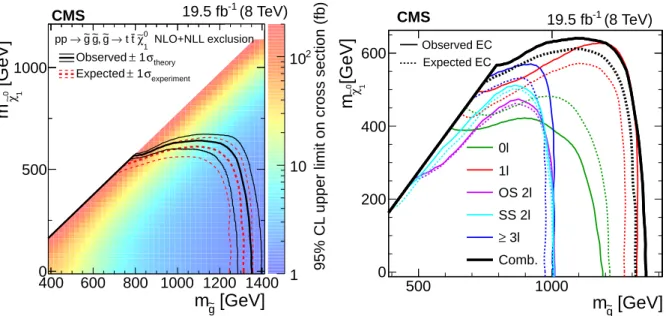
et, the process referred to as T1tttt. The signature contains four top quarks and has significant jet activity (Fig. 1 left). The fully hadronic and single-lepton analyses are therefore expected to be especially sensitive, because of their larger signal efficiencies. Figure 5 (left) shows the 95% CL upper limits on the product of the cross section and branching fraction in the (m
e
χ01,meg) plane.
The exclusion curves are evaluated by comparing the cross section upper limits with the next-to-leading-order (NLO) plus next-to-leading-logarithm (NLL) theoretical production cross sec-tions [54–58]. The thick red dashed line indicates the 95% CL expected limit, which is defined as the median of the upper limit distribution obtained using pseudo-experiments and a likeli-hood model. The±1 standard deviation experimental systematic uncertainties σexperiment are
shown by the thin red line around the expected limit. The observed limit is given by the thick solid black line, where the uncertainty band (thin black lines) indicates the±1 standard devi-ation uncertainty σtheory in the theoretical cross section. The theoretical uncertainty is mainly
due to uncertainties in the renormalization and factorization scales, and in the knowledge of the PDFs. To quote the gluino mass exclusion, we conservatively consider the observed up-per limit minus σtheory. It is seen that gluinos below 1280 GeV are excluded for m
e
χ01 ≈ 0 GeV. Assuming a gluino mass of 1000 GeV, an LSP with a mass below 600 GeV is excluded.
The exclusion curves for each individual analysis are shown in Fig. 5 (right). As expected, for low LSP masses, the single-lepton and fully hadronic analyses provide the most stringent re-sults. For m
e
χ01 ≈ 0 GeV, the combination is seen to extend the gluino mass exclusion by about 35 GeV compared to the single-lepton analysis, which provides the most stringent correspond-ing individual result. Large values of m
e
χ01 lead to more compressed mass spectra, softer decay products, and therefore smaller ETmiss. As a result, the fully hadronic and single-lepton analyses become less sensitive, since they require high-pT jets and large EmissT . The dilepton and
multi-lepton analyses depend less on the pTspectrum of the final-state particles, and their sensitivity
decreases less for smaller mass splittings. Thus the analyses requiring two or more leptons contribute most to the overall sensitivity when the difference m
e g−mχe
0
10 5 Combination of analyses
meg≈1000 GeV, the exclusion limit on mχe01 is extended by about 60 GeV because of the addition of the multilepton channels.
[GeV] g ~ m 400 600 800 1000 1200 1400 [GeV] 1 0 χ∼ m 0 500 1000 1 10 2 10 CMS 19.5 fb-1 (8 TeV) NLO+NLL exclusion 1 0 χ∼ t t → g ~ , g ~ g ~ → pp theory σ 1 ± Observed experiment σ 1 ± Expected 9 5 % C L u p p e r lim it o n c ro s s s e c ti o n ( fb ) [GeV] g ~ m 500 1000 [GeV] m 0 200 400 600 0l 1l OS 2l SS 2l 3l ≥ Comb. Observed EC Expected EC CMS 19.5 fb-1 (8 TeV) 1 0 χ∼
Figure 5: (left) The 95% CL cross section upper limits for gluino-mediated squark produc-tion with virtual top squarks, based on an NLO+NLL reference cross secproduc-tion for gluino pair production. The solid and dashed lines indicate, respectively, the observed and expected ex-clusion contours for the combination of the five analyses. The thin contours indicate the ±1 standard deviation regions. (right) Exclusion contours (EC) for the individual searches, plus the combination.
5.2 Gluino-mediated top squark production with on-shell top squarks
If the top squarks are light enough, the gluino can decay through an intermediate on-shell top squark. In this model, referred to as T5tttt, the values of m
e
χ01, met, and meg function as
independent parameters. Results are presented for a fixed mass m
e
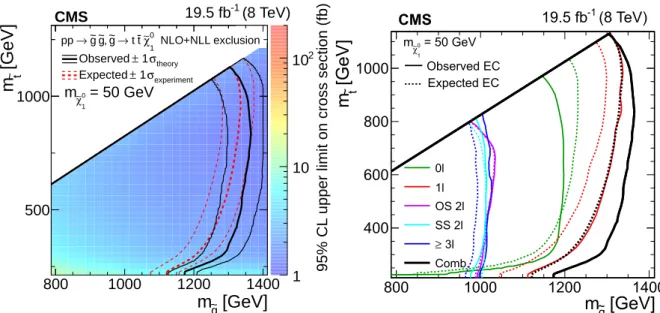
χ01 =50 GeV and scanned over the masses of the on-shell top squark and gluino. The 95% CL upper limits on the product of the cross section and the branching fraction in the metversus megplane are shown in Fig. 6, left.
In the context of the T5tttt model, gluinos with masses below around 1300 GeV are excluded for top squark masses around 700 GeV. Figure 6, right, shows the results for the individual studies. The contribution from the fully hadronic analysis remains important even for relatively small top squark masses met ≈200 GeV because of the high HT search regions: signal events in
this case contain smaller ETmiss but larger HT. However, for met < 150 GeV, the fully hadronic
analysis loses sensitivity. The single-lepton analysis provides the most stringent individual results, but loses sensitivity as met decreases. The sensitivity of the dilepton and multilepton searches depends less strongly on met, but their sensitivity even in the compressed region is rather small, although they contribute to the combination at very small met. The combination improves the exclusion reach in the gluino mass by about 50 GeV for small m
et.
5.3 Bottom squark pair production
We also consider bottom squark pair production with the bottom squarks decaying as eb1 →
tχe − 1 andχe − 1 → W−χe 0
1, known as T6ttWW (Fig. 1 right). The single-lepton and opposite-sign
dilepton analyses have very little sensitivity to such a model because of the stringent Nbjetsand
11 [GeV] g ~ m 800 1000 1200 1400 [GeV] t ~ m 500 1000 1 10 2 10 CMS 19.5 fb-1 (8 TeV) NLO+NLL exclusion 1 0 χ∼ t t → g ~ , g ~ g ~ → pp = 50 GeV 0 1 χ∼ m theory σ 1 ± Observed experiment σ 1 ± Expected 9 5 % C L u p p e r lim it o n c ro s s s e c ti o n ( fb ) [GeV] g~ m 800 1000 1200 1400 [GeV] t~ m 400 600 800 1000 0l 1l OS 2l SS 2l 3l ≥ Comb. = 50 GeV 0 1 χ∼ m Observed EC Expected EC CMS 19.5 fb-1 (8 TeV)
Figure 6: (left) The 95% CL cross section upper limits for gluino-mediated squark production with on-shell top squarks, assuming an LSP mass of m
e
χ01 =50 GeV, based on an NLO+NLL reference cross section for gluino pair production. The solid and dashed lines indicate, respec-tively, the observed and expected exclusion contours for the combination of the five analyses. The thin contours indicate the±1 standard deviation regions. (right) Exclusion contours (EC) for the individual searches, plus the combination.
does not impose a requirement on Nbjets, contributes some sensitivity. The main sensitivity
comes from the same-sign and multilepton searches with either Nbjets=1 or 2.
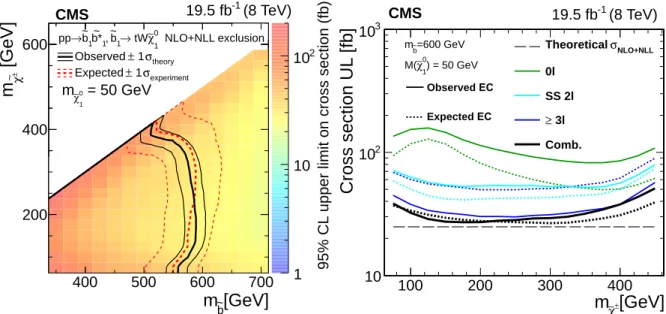
For the T6ttWW model, the LSP mass is set to 50 GeV. The resulting 95% CL upper limits on the product of the cross section and branching fraction in the m
e
χ± versus mebplane are shown in
Fig. 7, left. In the context of this model, bottom squark masses up to 570 GeV are excluded for LSP masses around 150-300 GeV. Figure 7, right, shows the exclusion limits for the individual analyses assuming a fixed bottom squark mass of 600 GeV. The same-sign dilepton analysis provides the best sensitivity for chargino masses below 400 GeV, and the combination with the multilepton analysis leads to a 15% improvement in the cross section upper limit and even up to 35% improvement in the expected cross section upper limit, which represents an improvement in the expected sbottom mass exclusion limits of around 50 GeV. For larger chargino masses, the fully hadronic analysis is more sensitive because jets from W boson decays become more energetic.
6
Summary
Five searches for supersymmetry with non-overlapping event samples are combined to obtain more stringent exclusion limits on models in which b jets and four W bosons are produced. The results are based on data corresponding to an integrated luminosity of 19.5 fb−1of pp col-lisions, collected with the CMS detector at√s =8 TeV in 2012. Because of their large branching fractions, the single-lepton and fully hadronic analyses have the largest sensitivity for most of the range of the supersymmetric mass spectra, whereas the analyses with higher lepton mul-tiplicities have higher sensitivity for models with more compressed mass spectra. The com-plementarity of the searches is exploited to provide comprehensive coverage across a wide region of parameter space. The combined searches yield 95% confidence level exclusions of
12 6 Summary [GeV] b ~ m 400 500 600 700 [GeV]± χ ∼ m 200 400 600 1 10 2 10 CMS 19.5 fb-1 (8 TeV) NLO+NLL exclusion 0 1 χ∼ tW → 1 b ~ , 1 b*~ 1 b ~ → pp = 50 GeV 0 1 χ∼ m theory σ 1 ± Observed experiment σ 1 ± Expected 9 5 % C L u p p e r lim it o n c ro s s s e c ti o n ( fb ) [GeV] ± χ∼ m 100 200 300 400 C ro ss s ec ti on U L [f b] 10 2 10 3 10 NLO+NLL σ Theoretical 0l SS 2l 3l ≥ Comb. ) = 50 GeV 0 1 χ∼ M( =600 GeV b ~ m Observed EC Expected EC CMS 19.5 fb-1 (8 TeV)
Figure 7: (left) The 95% CL cross section upper limits for bottom-squark pair production, as-suming an LSP mass of m
e
χ01 =50 GeV, based on an NLO+NLL reference cross section. The solid and dashed lines indicate, respectively, the observed and expected exclusion contours for the combination of the fully hadronic, same-sign dilepton, and multilepton analyses. The thin contours indicate the ±1 standard deviation regions. (right) Exclusion contours (EC) for the individual searches, plus the combination, assuming a bottom squark mass of 600 GeV.
up to 1280 and 570 GeV for the gluino and bottom-squark masses in the context of gluino and bottom-squark pair production, respectively. The increase in sensitivity that arises from the combination of the five analyses corresponds to an increase of about 50 GeV in the SUSY mass reach compared to the individual analyses.
Acknowledgments
We congratulate our colleagues in the CERN accelerator departments for the excellent perfor-mance of the LHC and thank the technical and administrative staffs at CERN and at other CMS institutes for their contributions to the success of the CMS effort. In addition, we gratefully acknowledge the computing centers and personnel of the Worldwide LHC Computing Grid for delivering so effectively the computing infrastructure essential to our analyses. Finally, we acknowledge the enduring support for the construction and operation of the LHC and the CMS detector provided by the following funding agencies: BMWFW and FWF (Austria); FNRS and FWO (Belgium); CNPq, CAPES, FAPERJ, and FAPESP (Brazil); MES (Bulgaria); CERN; CAS, MoST, and NSFC (China); COLCIENCIAS (Colombia); MSES and CSF (Croatia); RPF (Cyprus); MoER, ERC IUT and ERDF (Estonia); Academy of Finland, MEC, and HIP (Finland); CEA and CNRS/IN2P3 (France); BMBF, DFG, and HGF (Germany); GSRT (Greece); OTKA and NIH (Hungary); DAE and DST (India); IPM (Iran); SFI (Ireland); INFN (Italy); MSIP and NRF (Re-public of Korea); LAS (Lithuania); MOE and UM (Malaysia); CINVESTAV, CONACYT, SEP, and UASLP-FAI (Mexico); MBIE (New Zealand); PAEC (Pakistan); MSHE and NSC (Poland); FCT (Portugal); JINR (Dubna); MON, RosAtom, RAS and RFBR (Russia); MESTD (Serbia); SEIDI and CPAN (Spain); Swiss Funding Agencies (Switzerland); MST (Taipei); ThEPCenter, IPST, STAR and NSTDA (Thailand); TUBITAK and TAEK (Turkey); NASU and SFFR (Ukraine); STFC (United Kingdom); DOE and NSF (USA).
References 13
Individuals have received support from the Marie-Curie programme and the European Re-search Council and EPLANET (European Union); the Leventis Foundation; the A. P. Sloan Foundation; the Alexander von Humboldt Foundation; the Belgian Federal Science Policy Of-fice; the Fonds pour la Formation `a la Recherche dans l’Industrie et dans l’Agriculture (FRIA-Belgium); the Agentschap voor Innovatie door Wetenschap en Technologie (IWT-(FRIA-Belgium); the Ministry of Education, Youth and Sports (MEYS) of the Czech Republic; the Council of Sci-ence and Industrial Research, India; the HOMING PLUS programme of Foundation for Polish Science, cofinanced from European Union, Regional Development Fund; the Compagnia di San Paolo (Torino); the Consorzio per la Fisica (Trieste); MIUR project 20108T4XTM (Italy); the Thalis and Aristeia programmes cofinanced by EU-ESF and the Greek NSRF; and the National Priorities Research Program by Qatar National Research Fund.
References
[1] ATLAS Collaboration, “Observation of a new particle in the search for the Standard Model Higgs boson with the ATLAS detector at the LHC”, Phys. Lett. B 716 (2012) 1, doi:10.1016/j.physletb.2012.08.020, arXiv:1207.7214.
[2] CMS Collaboration, “Observation of a new boson at a mass of 125 GeV with the CMS experiment at the LHC”, Phys. Lett. B 716 (2012) 30,
doi:10.1016/j.physletb.2012.08.021, arXiv:1207.7235.
[3] R. Barbieri and G. F. Giudice, “Upper bounds on supersymmetric particle masses”, Nucl. Phys. B 306 (1988) 63, doi:10.1016/0550-3213(88)90171-X.
[4] A. Romanino and A. Strumia, “Are heavy scalars natural in minimal supergravity?”, Phys. Lett. B 487 (2000) 165, doi:10.1016/S0370-2693(00)00806-6,
arXiv:hep-ph/9912301.
[5] J. L. Feng, K. T. Matchev, and T. Moroi, “Multi-TeV Scalars are Natural in Minimal
Supergravity”, Phys. Rev. Lett. 84 (2000) 2322, doi:10.1103/PhysRevLett.84.2322, arXiv:hep-ph/9908309.
[6] R. Kitano and Y. Nomura, “A solution to the supersymmetric fine-tuning problem within the MSSM”, Phys. Lett. B 631 (2005) 58, doi:10.1016/j.physletb.2005.10.003,
arXiv:hep-ph/0509039.
[7] G. F. Giudice and R. Rattazzi, “Living dangerously with low-energy supersymmetry”, Nucl. Phys. B 757 (2006) 19, doi:10.1016/j.nuclphysb.2006.07.031,
arXiv:hep-ph/0606105.
[8] R. Barbieri and D. Pappadopulo, “S-particles at their naturalness limits”, JHEP 10 (2009) 061, doi:10.1088/1126-6708/2009/10/061, arXiv:0906.4546.
[9] D. Horton and G. G. Ross, “Naturalness and focus points with non-universal gaugino masses”, Nucl. Phys. B 830 (2010) 221, doi:10.1016/j.nuclphysb.2009.12.031, arXiv:0908.0857.
[10] G. R. Farrar and P. Fayet, “Phenomenology of the production, decay, and detection of new hadronic states associated with supersymmetry”, Phys. Lett. B 76 (1978) 575, doi:10.1016/0370-2693(78)90858-4.
14 References
[11] ATLAS Collaboration, “Search for new phenomena in final states with large jet
multiplicities and missing transverse momentum at√s=8 TeV proton-proton collisions using the ATLAS experiment”, JHEP 10 (2013) 130,
doi:10.1007/JHEP10(2013)130, arXiv:1308.1841.
[12] ATLAS Collaboration, “Search for direct third-generation squark pair production in final states with missing transverse momentum and two j
¯ets in √
s=8 TeV pp collisions with the ATLAS detector”, JHEP 10 (2013) 189, doi:10.1007/JHEP10(2013)189,
arXiv:1308.2631.
[13] ATLAS Collaboration, “Search for direct production of charginos and neutralinos in events with three leptons and missing transverse momentum in√s=8 TeV pp collisions with the ATLAS detector”, JHEP 04 (2014) 169, doi:10.1007/JHEP04(2014)169,
arXiv:1402.7029.
[14] ATLAS Collaboration, “Search for direct top-squark pair production in final states with two leptons in pp collisions at√s=8 TeV with the ATLAS detector”, JHEP 06 (2014) 124, doi:10.1007/JHEP06(2014)124, arXiv:1403.4853.
[15] ATLAS Collaboration, “Search for direct production of charginos, neutralinos and sleptons in final states with two leptons and missing transverse momentum in pp collisions at√s=8 TeV with the ATLAS detector”, JHEP 05 (2014) 071,
doi:10.1007/JHEP05(2014)071, arXiv:1403.5294.
[16] ATLAS Collaboration, “Search for supersymmetry in events with four or more leptons in√ s =8 TeV pp collisions with the ATLAS detector”, (2014). arXiv:1405.5086.
Submitted to Phys. Rev. D.
[17] CMS Collaboration, “Search for gluino mediated bottom- and top-squark production in multijet final states in pp collisions at 8 TeV”, Phys. Lett. B 725 (2013) 243,
doi:10.1016/j.physletb.2013.06.058, arXiv:1305.2390.
[18] CMS Collaboration, “Search for top-squark pair production in the single-lepton final state in pp collisions at√s =8 TeV”, Eur. Phys. J. C 73 (2013) 2677,
doi:10.1140/epjc/s10052-013-2677-2, arXiv:1308.1586.
[19] CMS Collaboration, “Search for new physics in the multijet and missing transverse momentum final state in proton-proton collisions at√s=8 TeV”, JHEP 06 (2014) 055,
doi:10.1007/JHEP06(2014)055, arXiv:1402.4770.
[20] CMS Collaboration, “Search for supersymmetry in pp collisions at√s = 8 TeV in events with a single lepton, large jet multiplicity, and multiple b jets”, Phys. Lett. B 733 (2013) 328, doi:10.1016/j.physletb.2014.04.023, arXiv:1311.4937.
[21] CMS Collaboration, “Search for new physics in events with same-sign dileptons and jets in pp collisions at√s = 8 TeV”, JHEP 01 (2014) 163,
doi:10.1007/JHEP01(2014)163, arXiv:1311.6736.
[22] CMS Collaboration, “Search for top-squark pairs decaying into Higgs or Z bosons in pp collisions at√s = 8 TeV”, Phys. Lett. B 736 (2014) 371,
doi:10.1016/j.physletb.2014.07.053, arXiv:1405.3886.
[23] N. Sakai, “Naturalness in supersymmetric GUTS”, Z. Phys. C 11 (1981) 153,
References 15
[24] S. Dimopoulos and G. F. Giudice, “Naturalness constraints in supersymmetric theories with nonuniversal soft terms”, Phys. Lett. B 357 (1995) 573,
doi:10.1016/0370-2693(95)00961-J, arXiv:hep-ph/9507282.
[25] M. Papucci, J. T. Ruderman, and A. Weiler, “Natural SUSY endures”, JHEP 09 (2012) 035,
doi:10.1007/JHEP09(2012)035, arXiv:1110.6926.
[26] C. Brust, A. Katz, S. Lawrence, and R. Sundrum, “SUSY, the Third Generation and the LHC”, JHEP 03 (2012) 103, doi:10.1007/JHEP03(2012)103, arXiv:1110.6670. [27] J. Alwall, P. Schuster, and N. Toro, “Simplified models for a first characterization of new
physics at the LHC”, Phys. Rev. D 79 (2009) 075020,
doi:10.1103/PhysRevD.79.075020, arXiv:0810.3921.
[28] D. Alves et al., “Simplified models for LHC new physics searches”, J. Phys. G 39 (2012) 105005, doi:10.1088/0954-3899/39/10/105005, arXiv:1105.2838.
[29] CMS Collaboration, “The CMS experiment at the CERN LHC”, JINST 3 (2008) S08004, doi:10.1088/1748-0221/3/08/S08004.
[30] CMS Collaboration, “Particle Flow Event Reconstruction in CMS and Performance for Jets, Taus and MET”, CMS Physics Analysis Summary CMS-PAS-PFT-09-001, 2009. [31] CMS Collaboration, “Commissioning of the Particle-flow Event Reconstruction with the
first LHC collisions recorded in the CMS detector”, CMS Physics Analysis Summary CMS-PAS-PFT-10-001, 2010.
[32] CMS Collaboration, “Electron reconstruction and identification at√s = 7 TeV”, CMS Physics Analysis Summary CMS-PAS-EGM-10-004, 2010.
[33] CMS Collaboration, “Energy calibration and resolution of the CMS electromagnetic calorimeter in pp collisions at√s=7 TeV”, JINST 8 (2013) P09009,
doi:10.1088/1748-0221/8/09/P09009, arXiv:1306.2016.
[34] CMS Collaboration, “Performance of CMS muon reconstruction in pp collision events at√ s =7 TeV”, J. Instrum. 7 (2012) P10002, doi:10.1088/1748-0221/7/10/P10002. [35] M. Cacciari, G. P. Salam, and G. Soyez, “The anti-ktjet clustering algorithm”, JHEP 04
(2008) 063, doi:10.1088/1126-6708/2008/04/063, arXiv:0802.1189. [36] CMS Collaboration, “Determination of Jet Energy Calibration and Transverse
Momentum Resolution in CMS”, JINST 6 (2011) P11002,
doi:10.1088/1748-0221/6/11/P11002, arXiv:1107.4277.
[37] CMS Collaboration, “Missing transverse energy performance of the CMS detector”, JINST 6 (2011) P09001, doi:10.1088/1748-0221/6/09/P09001,
arXiv::1106.5048.
[38] M. Cacciari and G. P. Salam, “Pileup subtraction using jet areas”, Phys. Lett. B 659 (2007) 119, doi:10.1016/j.physletb.2007.09.077, arXiv:0707.1378.
[39] M. Cacciari, G. P. Salam, and G. Soyez, “The Catchment Area of Jets”, JHEP 04 (2007) 005, doi:10.1088/1126-6708/2008/04/005, arXiv:0802.1188.
[40] CMS Collaboration, “Identification of b-quark jets with the CMS experiment”, JINST 8 (2013) P04013, doi:10.1088/1748-0221/8/04/P04013, arXiv:1211.4462.
16 References
[41] J. Alwall et al., “MadGraph/MadEvent v4: the new web generation”, JHEP 09 (2007) 028, doi:10.1088/1126-6708/2007/09/028, arXiv:arXiv:0706.2334. [42] S. Frixione and B. R. Webber, “Matching NLO QCD computations and parton shower
simulations”, JHEP 06 (2002) 029, doi:10.1088/1126-6708/2002/06/029,
arXiv:hep-ph/0204244.
[43] S. Frixione, P. Nason, and B. R. Webber, “Matching NLO QCD and parton showers in heavy flavor production”, JHEP 08 (2003) 007,
doi:10.1088/1126-6708/2003/08/007, arXiv:hep-ph/0305252.
[44] T. Sj ¨ostrand, S. Mrenna, and P. Skands, “PYTHIA 6.4 physics and manual”, JHEP 05 (2006) 026, doi:10.1088/1126-6708/2006/05/026, arXiv:hep-ph/0603175. [45] GEANT4 Collaboration, “GEANT4—a simulation toolkit”, Nucl. Instrum. Meth. A 506
(2003) 250, doi:10.1016/S0168-9002(03)01368-8.
[46] CMS Collaboration, “The fast simulation of the CMS detector at LHC”, J. Phys. Conf. Ser.
331(2011) 032049, doi:10.1088/1742-6596/331/3/032049.
[47] R. Rahmat, R. Kroeger, and A. Giammanco, “The fast simulation of the CMS experiment”, J. Phys. Conf. Ser. 396 (2012) 062016, doi:10.1088/1742-6596/396/6/062016. [48] A. L. Read, “Presentation of search results: the CLstechnique”, J. Phys. G 28 (2002) 2693,
doi:10.1088/0954-3899/28/10/313.
[49] T. Junk, “Confidence level computation for combining searches with small statistics”, Nucl. Instrum. Meth. A 434 (1999) 435, doi:10.1016/S0168-9002(99)00498-2, arXiv:hep-ex/9902006.
[50] ATLAS and CMS Collaborations, LHC Higgs Combination Group, “Procedure for the LHC Higgs boson search combination in Summer 2011”, Technical Report
ATL-PHYS-PUB 2011-11, CMS NOTE 2011/005, 2011.
[51] S. Alekhin et al., “The PDF4LHC Working Group Interim Report”, (2011).
arXiv:1101.0536.
[52] M. Botje et al., “The PDF4LHC Working Group Interim Recommandations”, (2011). arXiv:1101.0538.
[53] CMS Collaboration, “CMS luminosity based on pixel cluster counting — Summer 2013 update”, CMS Physics Analysis Summary CMS-PAS-LUM-13-001, 2013.
[54] M. Kr¨amer et al., “Supersymmetry production cross sections in pp collisions at√s = 7 TeV”, (2012). arXiv:1206.2892.
[55] W. Beenakker, R. H ¨opker, M. Spira, and P. M. Zerwas, “Squark and gluino production at hadron colliders”, Nucl. Phys. B 492 (1997) 51,
doi:10.1016/S0550-3213(97)80027-2, arXiv:hep-ph/9610490. [56] A. Kulesza and L. Motyka, “Threshold Resummation for Squark-Antisquark and
Gluino-Pair Production at the LHC”, Phys. Rev. Lett. 102 (2009) 111802, doi:10.1103/PhysRevLett.102.111802, arXiv:0807.2405.
17
[57] A. Kulesza and L. Motyka, “Soft gluon resummation for the production of gluino-gluino and squark-antisquark pairs at the LHC”, Phys. Rev. D 80 (2009) 095004,
doi:10.1103/PhysRevD.80.095004, arXiv:0905.4749.
[58] W. Beenakker et al., “Soft-gluon resummation for squark and gluino hadroproduction”, JHEP 12 (2009) 041, doi:10.1088/1126-6708/2009/12/041, arXiv:0909.4418.
A
Additional plots for the opposite-sign dilepton search
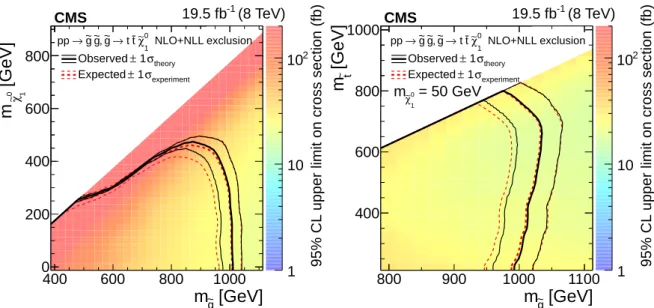
This appendix presents additional results for the opposite-sign dilepton search. The results of this analysis alone for the T1tttt (Fig. 1 left) and T5tttt (Fig. 1 middle) models are shown, respectively, in Figs. 8, left and right. In the context of the T1tttt model, gluinos with masses below around 980 GeV are excluded for LSP masses below 400 GeV. In the T5tttt model, gluinos with masses below 1000 GeV are probed for top squark masses around 650 GeV.
[GeV] g ~ m 400 600 800 1000 [GeV] 0 χ∼ 1 m 0 200 400 600 800 1 10 2 10 CMS 19.5 fb-1 (8 TeV) NLO+NLL exclusion 1 0 χ∼ t t → g ~ , g ~ g ~ → pp theory σ 1 ± Observed experiment σ 1 ± Expected 9 5 % C L u p p e r lim it o n c ro s s s e c ti o n ( fb ) [GeV] g ~ m 800 900 1000 1100 [GeV] t ~ m 400 600 800 1000 1 10 2 10 CMS 19.5 fb-1 (8 TeV) NLO+NLL exclusion 1 0 χ∼ t t → g ~ , g ~ g ~ → pp = 50 GeV 0 1 χ∼ m theory σ 1 ± Observed experiment σ 1 ± Expected 9 5 % C L u p p e r lim it o n c ro s s s e c ti o n ( fb )
Figure 8: (left) The 95% CL cross section upper limits for gluino-mediated squark production with virtual top squarks, based on an NLO+NLL reference cross section for gluino pair pro-duction, derived from the opposite-sign dilepton analysis. The solid and dashed lines indicate, respectively, the observed and expected exclusion contours. The thin contours indicate the ±1 standard deviation regions. (right) The corresponding results for gluino-mediated squark production with on-shell top squarks.
19
B
The CMS Collaboration
Yerevan Physics Institute, Yerevan, Armenia
V. Khachatryan, A.M. Sirunyan, A. Tumasyan
Institut f ¨ur Hochenergiephysik der OeAW, Wien, Austria
W. Adam, T. Bergauer, M. Dragicevic, J. Er ¨o, M. Friedl, R. Fr ¨uhwirth1, V.M. Ghete, C. Hartl, N. H ¨ormann, J. Hrubec, M. Jeitler1, W. Kiesenhofer, V. Kn ¨unz, M. Krammer1, I. Kr¨atschmer, D. Liko, I. Mikulec, D. Rabady2, B. Rahbaran, H. Rohringer, R. Sch ¨ofbeck, J. Strauss,
W. Treberer-Treberspurg, W. Waltenberger, C.-E. Wulz1
National Centre for Particle and High Energy Physics, Minsk, Belarus
V. Mossolov, N. Shumeiko, J. Suarez Gonzalez
Universiteit Antwerpen, Antwerpen, Belgium
S. Alderweireldt, S. Bansal, T. Cornelis, E.A. De Wolf, X. Janssen, A. Knutsson, J. Lauwers, S. Luyckx, S. Ochesanu, R. Rougny, M. Van De Klundert, H. Van Haevermaet, P. Van Mechelen, N. Van Remortel, A. Van Spilbeeck
Vrije Universiteit Brussel, Brussel, Belgium
F. Blekman, S. Blyweert, J. D’Hondt, N. Daci, N. Heracleous, J. Keaveney, S. Lowette, M. Maes, A. Olbrechts, Q. Python, D. Strom, S. Tavernier, W. Van Doninck, P. Van Mulders, G.P. Van Onsem, I. Villella
Universit´e Libre de Bruxelles, Bruxelles, Belgium
C. Caillol, B. Clerbaux, G. De Lentdecker, D. Dobur, L. Favart, A.P.R. Gay, A. Grebenyuk, A. L´eonard, A. Mohammadi, L. Perni`e2, A. Randle-conde, T. Reis, T. Seva, L. Thomas, C. Vander Velde, P. Vanlaer, J. Wang, F. Zenoni
Ghent University, Ghent, Belgium
V. Adler, K. Beernaert, L. Benucci, A. Cimmino, S. Costantini, S. Crucy, S. Dildick, A. Fagot, G. Garcia, J. Mccartin, A.A. Ocampo Rios, D. Poyraz, D. Ryckbosch, S. Salva Diblen, M. Sigamani, N. Strobbe, F. Thyssen, M. Tytgat, E. Yazgan, N. Zaganidis
Universit´e Catholique de Louvain, Louvain-la-Neuve, Belgium
S. Basegmez, C. Beluffi3, G. Bruno, R. Castello, A. Caudron, L. Ceard, G.G. Da Silveira, C. Delaere, T. du Pree, D. Favart, L. Forthomme, A. Giammanco4, J. Hollar, A. Jafari, P. Jez, M. Komm, V. Lemaitre, C. Nuttens, L. Perrini, A. Pin, K. Piotrzkowski, A. Popov5, L. Quertenmont, M. Selvaggi, M. Vidal Marono, J.M. Vizan Garcia
Universit´e de Mons, Mons, Belgium
N. Beliy, T. Caebergs, E. Daubie, G.H. Hammad
Centro Brasileiro de Pesquisas Fisicas, Rio de Janeiro, Brazil
W.L. Ald´a J ´unior, G.A. Alves, L. Brito, M. Correa Martins Junior, T. Dos Reis Martins, J. Molina, C. Mora Herrera, M.E. Pol, P. Rebello Teles
Universidade do Estado do Rio de Janeiro, Rio de Janeiro, Brazil
W. Carvalho, J. Chinellato6, A. Cust ´odio, E.M. Da Costa, D. De Jesus Damiao, C. De Oliveira Martins, S. Fonseca De Souza, H. Malbouisson, D. Matos Figueiredo, L. Mundim, H. Nogima, W.L. Prado Da Silva, J. Santaolalla, A. Santoro, A. Sznajder, E.J. Tonelli Manganote6, A. Vilela Pereira
20 B The CMS Collaboration
Universidade Estadual Paulistaa, Universidade Federal do ABCb, S˜ao Paulo, Brazil
C.A. Bernardesb, S. Dograa, T.R. Fernandez Perez Tomeia, E.M. Gregoresb, P.G. Mercadanteb, S.F. Novaesa, Sandra S. Padulaa
Institute for Nuclear Research and Nuclear Energy, Sofia, Bulgaria
A. Aleksandrov, V. Genchev2, R. Hadjiiska, P. Iaydjiev, A. Marinov, S. Piperov, M. Rodozov, S. Stoykova, G. Sultanov, M. Vutova
University of Sofia, Sofia, Bulgaria
A. Dimitrov, I. Glushkov, L. Litov, B. Pavlov, P. Petkov
Institute of High Energy Physics, Beijing, China
J.G. Bian, G.M. Chen, H.S. Chen, M. Chen, T. Cheng, R. Du, C.H. Jiang, R. Plestina7, F. Romeo, J. Tao, Z. Wang
State Key Laboratory of Nuclear Physics and Technology, Peking University, Beijing, China
C. Asawatangtrakuldee, Y. Ban, S. Liu, Y. Mao, S.J. Qian, D. Wang, Z. Xu, L. Zhang, W. Zou
Universidad de Los Andes, Bogota, Colombia
C. Avila, A. Cabrera, L.F. Chaparro Sierra, C. Florez, J.P. Gomez, B. Gomez Moreno, J.C. Sanabria
University of Split, Faculty of Electrical Engineering, Mechanical Engineering and Naval Architecture, Split, Croatia
N. Godinovic, D. Lelas, D. Polic, I. Puljak
University of Split, Faculty of Science, Split, Croatia
Z. Antunovic, M. Kovac
Institute Rudjer Boskovic, Zagreb, Croatia
V. Brigljevic, K. Kadija, J. Luetic, D. Mekterovic, L. Sudic
University of Cyprus, Nicosia, Cyprus
A. Attikis, G. Mavromanolakis, J. Mousa, C. Nicolaou, F. Ptochos, P.A. Razis, H. Rykaczewski
Charles University, Prague, Czech Republic
M. Bodlak, M. Finger, M. Finger Jr.8
Academy of Scientific Research and Technology of the Arab Republic of Egypt, Egyptian Network of High Energy Physics, Cairo, Egypt
Y. Assran9, A. Ellithi Kamel10, M.A. Mahmoud11, A. Radi12,13
National Institute of Chemical Physics and Biophysics, Tallinn, Estonia
M. Kadastik, M. Murumaa, M. Raidal, A. Tiko
Department of Physics, University of Helsinki, Helsinki, Finland
P. Eerola, M. Voutilainen
Helsinki Institute of Physics, Helsinki, Finland
J. H¨ark ¨onen, V. Karim¨aki, R. Kinnunen, M.J. Kortelainen, T. Lamp´en, K. Lassila-Perini, S. Lehti, T. Lind´en, P. Luukka, T. M¨aenp¨a¨a, T. Peltola, E. Tuominen, J. Tuominiemi, E. Tuovinen, L. Wendland
Lappeenranta University of Technology, Lappeenranta, Finland
21
DSM/IRFU, CEA/Saclay, Gif-sur-Yvette, France
M. Besancon, F. Couderc, M. Dejardin, D. Denegri, B. Fabbro, J.L. Faure, C. Favaro, F. Ferri, S. Ganjour, A. Givernaud, P. Gras, G. Hamel de Monchenault, P. Jarry, E. Locci, J. Malcles, J. Rander, A. Rosowsky, M. Titov
Laboratoire Leprince-Ringuet, Ecole Polytechnique, IN2P3-CNRS, Palaiseau, France
S. Baffioni, F. Beaudette, P. Busson, E. Chapon, C. Charlot, T. Dahms, M. Dalchenko, L. Dobrzynski, N. Filipovic, A. Florent, R. Granier de Cassagnac, L. Mastrolorenzo, P. Min´e, I.N. Naranjo, M. Nguyen, C. Ochando, G. Ortona, P. Paganini, S. Regnard, R. Salerno, J.B. Sauvan, Y. Sirois, C. Veelken, Y. Yilmaz, A. Zabi
Institut Pluridisciplinaire Hubert Curien, Universit´e de Strasbourg, Universit´e de Haute Alsace Mulhouse, CNRS/IN2P3, Strasbourg, France
J.-L. Agram14, J. Andrea, A. Aubin, D. Bloch, J.-M. Brom, E.C. Chabert, C. Collard, E. Conte14, J.-C. Fontaine14, D. Gel´e, U. Goerlach, C. Goetzmann, A.-C. Le Bihan, K. Skovpen, P. Van Hove
Centre de Calcul de l’Institut National de Physique Nucleaire et de Physique des Particules, CNRS/IN2P3, Villeurbanne, France
S. Gadrat
Universit´e de Lyon, Universit´e Claude Bernard Lyon 1, CNRS-IN2P3, Institut de Physique Nucl´eaire de Lyon, Villeurbanne, France
S. Beauceron, N. Beaupere, C. Bernet7, G. Boudoul2, E. Bouvier, S. Brochet, C.A. Carrillo Montoya, J. Chasserat, R. Chierici, D. Contardo2, B. Courbon, P. Depasse, H. El Mamouni, J. Fan, J. Fay, S. Gascon, M. Gouzevitch, B. Ille, T. Kurca, M. Lethuillier, L. Mirabito, A.L. Pequegnot, S. Perries, J.D. Ruiz Alvarez, D. Sabes, L. Sgandurra, V. Sordini, M. Vander Donckt, P. Verdier, S. Viret, H. Xiao
Institute of High Energy Physics and Informatization, Tbilisi State University, Tbilisi, Georgia
Z. Tsamalaidze8
RWTH Aachen University, I. Physikalisches Institut, Aachen, Germany
C. Autermann, S. Beranek, M. Bontenackels, M. Edelhoff, L. Feld, A. Heister, K. Klein, M. Lipinski, A. Ostapchuk, M. Preuten, F. Raupach, J. Sammet, S. Schael, J.F. Schulte, H. Weber, B. Wittmer, V. Zhukov5
RWTH Aachen University, III. Physikalisches Institut A, Aachen, Germany
M. Ata, M. Brodski, E. Dietz-Laursonn, D. Duchardt, M. Erdmann, R. Fischer, A. G ¨uth, T. Hebbeker, C. Heidemann, K. Hoepfner, D. Klingebiel, S. Knutzen, P. Kreuzer, M. Merschmeyer, A. Meyer, P. Millet, M. Olschewski, K. Padeken, P. Papacz, H. Reithler, S.A. Schmitz, L. Sonnenschein, D. Teyssier, S. Th ¨uer, M. Weber
RWTH Aachen University, III. Physikalisches Institut B, Aachen, Germany
V. Cherepanov, Y. Erdogan, G. Fl ¨ugge, H. Geenen, M. Geisler, W. Haj Ahmad, F. Hoehle, B. Kargoll, T. Kress, Y. Kuessel, A. K ¨unsken, J. Lingemann2, A. Nowack, I.M. Nugent, O. Pooth, A. Stahl
Deutsches Elektronen-Synchrotron, Hamburg, Germany
M. Aldaya Martin, I. Asin, N. Bartosik, J. Behr, U. Behrens, A.J. Bell, A. Bethani, K. Borras, A. Burgmeier, A. Cakir, L. Calligaris, A. Campbell, S. Choudhury, F. Costanza, C. Diez Pardos, G. Dolinska, S. Dooling, T. Dorland, G. Eckerlin, D. Eckstein, T. Eichhorn, G. Flucke, J. Garay Garcia, A. Geiser, A. Gizhko, P. Gunnellini, J. Hauk, M. Hempel15, H. Jung, A. Kalogeropoulos, O. Karacheban15, M. Kasemann, P. Katsas, J. Kieseler, C. Kleinwort, I. Korol,
22 B The CMS Collaboration
D. Kr ¨ucker, W. Lange, J. Leonard, K. Lipka, A. Lobanov, W. Lohmann15, B. Lutz, R. Mankel, I. Marfin15, I.-A. Melzer-Pellmann, A.B. Meyer, G. Mittag, J. Mnich, A. Mussgiller, S. Naumann-Emme, A. Nayak, E. Ntomari, H. Perrey, D. Pitzl, R. Placakyte, A. Raspereza, P.M. Ribeiro Cipriano, B. Roland, E. Ron, M. ¨O. Sahin, J. Salfeld-Nebgen, P. Saxena, T. Schoerner-Sadenius, M. Schr ¨oder, C. Seitz, S. Spannagel, A.D.R. Vargas Trevino, R. Walsh, C. Wissing
University of Hamburg, Hamburg, Germany
V. Blobel, M. Centis Vignali, A.R. Draeger, J. Erfle, E. Garutti, K. Goebel, M. G ¨orner, J. Haller, M. Hoffmann, R.S. H ¨oing, A. Junkes, H. Kirschenmann, R. Klanner, R. Kogler, T. Lapsien, T. Lenz, I. Marchesini, D. Marconi, J. Ott, T. Peiffer, A. Perieanu, N. Pietsch, J. Poehlsen, T. Poehlsen, D. Rathjens, C. Sander, H. Schettler, P. Schleper, E. Schlieckau, A. Schmidt, M. Seidel, V. Sola, H. Stadie, G. Steinbr ¨uck, D. Troendle, E. Usai, L. Vanelderen, A. Vanhoefer
Institut f ¨ur Experimentelle Kernphysik, Karlsruhe, Germany
C. Barth, C. Baus, J. Berger, C. B ¨oser, E. Butz, T. Chwalek, W. De Boer, A. Descroix, A. Dierlamm, M. Feindt, F. Frensch, M. Giffels, A. Gilbert, F. Hartmann2, T. Hauth, U. Husemann, I. Katkov5, A. Kornmayer2, P. Lobelle Pardo, M.U. Mozer, T. M ¨uller, Th. M ¨uller, A. N ¨urnberg, G. Quast, K. Rabbertz, S. R ¨ocker, H.J. Simonis, F.M. Stober, R. Ulrich, J. Wagner-Kuhr, S. Wayand, T. Weiler, R. Wolf
Institute of Nuclear and Particle Physics (INPP), NCSR Demokritos, Aghia Paraskevi, Greece
G. Anagnostou, G. Daskalakis, T. Geralis, V.A. Giakoumopoulou, A. Kyriakis, D. Loukas, A. Markou, C. Markou, A. Psallidas, I. Topsis-Giotis
University of Athens, Athens, Greece
A. Agapitos, S. Kesisoglou, A. Panagiotou, N. Saoulidou, E. Stiliaris
University of Io´annina, Io´annina, Greece
X. Aslanoglou, I. Evangelou, G. Flouris, C. Foudas, P. Kokkas, N. Manthos, I. Papadopoulos, E. Paradas, J. Strologas
Wigner Research Centre for Physics, Budapest, Hungary
G. Bencze, C. Hajdu, P. Hidas, D. Horvath16, F. Sikler, V. Veszpremi, G. Vesztergombi17, A.J. Zsigmond
Institute of Nuclear Research ATOMKI, Debrecen, Hungary
N. Beni, S. Czellar, J. Karancsi18, J. Molnar, J. Palinkas, Z. Szillasi
University of Debrecen, Debrecen, Hungary
A. Makovec, P. Raics, Z.L. Trocsanyi, B. Ujvari
National Institute of Science Education and Research, Bhubaneswar, India
S.K. Swain
Panjab University, Chandigarh, India
S.B. Beri, V. Bhatnagar, R. Gupta, U.Bhawandeep, A.K. Kalsi, M. Kaur, R. Kumar, M. Mittal, N. Nishu, J.B. Singh
University of Delhi, Delhi, India
Ashok Kumar, Arun Kumar, S. Ahuja, A. Bhardwaj, B.C. Choudhary, A. Kumar, S. Malhotra, M. Naimuddin, K. Ranjan, V. Sharma
23
Saha Institute of Nuclear Physics, Kolkata, India
S. Banerjee, S. Bhattacharya, K. Chatterjee, S. Dutta, B. Gomber, Sa. Jain, Sh. Jain, R. Khurana, A. Modak, S. Mukherjee, D. Roy, S. Sarkar, M. Sharan
Bhabha Atomic Research Centre, Mumbai, India
A. Abdulsalam, D. Dutta, V. Kumar, A.K. Mohanty2, L.M. Pant, P. Shukla, A. Topkar
Tata Institute of Fundamental Research, Mumbai, India
T. Aziz, S. Banerjee, S. Bhowmik19, R.M. Chatterjee, R.K. Dewanjee, S. Dugad, S. Ganguly, S. Ghosh, M. Guchait, A. Gurtu20, G. Kole, S. Kumar, M. Maity19, G. Majumder, K. Mazumdar, G.B. Mohanty, B. Parida, K. Sudhakar, N. Wickramage21
Indian Institute of Science Education and Research (IISER), Pune, India
S. Sharma
Institute for Research in Fundamental Sciences (IPM), Tehran, Iran
H. Bakhshiansohi, H. Behnamian, S.M. Etesami22, A. Fahim23, R. Goldouzian, M. Khakzad, M. Mohammadi Najafabadi, M. Naseri, S. Paktinat Mehdiabadi, F. Rezaei Hosseinabadi, B. Safarzadeh24, M. Zeinali
University College Dublin, Dublin, Ireland
M. Felcini, M. Grunewald
INFN Sezione di Baria, Universit`a di Barib, Politecnico di Baric, Bari, Italy
M. Abbresciaa,b, C. Calabriaa,b, S.S. Chhibraa,b, A. Colaleoa, D. Creanzaa,c, L. Cristellaa,b, N. De Filippisa,c, M. De Palmaa,b, L. Fiorea, G. Iasellia,c, G. Maggia,c, M. Maggia, S. Mya,c, S. Nuzzoa,b, A. Pompilia,b, G. Pugliesea,c, R. Radognaa,b,2, G. Selvaggia,b, A. Sharmaa, L. Silvestrisa,2,
R. Vendittia,b, P. Verwilligena
INFN Sezione di Bolognaa, Universit`a di Bolognab, Bologna, Italy
G. Abbiendia, A.C. Benvenutia, D. Bonacorsia,b, S. Braibant-Giacomellia,b, L. Brigliadoria,b, R. Campaninia,b, P. Capiluppia,b, A. Castroa,b, F.R. Cavalloa, G. Codispotia,b, M. Cuffiania,b, G.M. Dallavallea, F. Fabbria, A. Fanfania,b, D. Fasanellaa,b, P. Giacomellia, C. Grandia, L. Guiduccia,b, S. Marcellinia, G. Masettia, A. Montanaria, F.L. Navarriaa,b, A. Perrottaa, A.M. Rossia,b, T. Rovellia,b, G.P. Sirolia,b, N. Tosia,b, R. Travaglinia,b
INFN Sezione di Cataniaa, Universit`a di Cataniab, CSFNSMc, Catania, Italy
S. Albergoa,b, G. Cappelloa, M. Chiorbolia,b, S. Costaa,b, F. Giordanoa,c,2, R. Potenzaa,b, A. Tricomia,b, C. Tuvea,b
INFN Sezione di Firenzea, Universit`a di Firenzeb, Firenze, Italy
G. Barbaglia, V. Ciullia,b, C. Civininia, R. D’Alessandroa,b, E. Focardia,b, E. Galloa, S. Gonzia,b, V. Goria,b, P. Lenzia,b, M. Meschinia, S. Paolettia, G. Sguazzonia, A. Tropianoa,b
INFN Laboratori Nazionali di Frascati, Frascati, Italy
L. Benussi, S. Bianco, F. Fabbri, D. Piccolo
INFN Sezione di Genovaa, Universit`a di Genovab, Genova, Italy
R. Ferrettia,b, F. Ferroa, M. Lo Veterea,b, E. Robuttia, S. Tosia,b
INFN Sezione di Milano-Bicoccaa, Universit`a di Milano-Bicoccab, Milano, Italy
M.E. Dinardoa,b, S. Fiorendia,b, S. Gennaia,2, R. Gerosaa,b,2, A. Ghezzia,b, P. Govonia,b, M.T. Lucchinia,b,2, S. Malvezzia, R.A. Manzonia,b, A. Martellia,b, B. Marzocchia,b,2, D. Menascea, L. Moronia, M. Paganonia,b, D. Pedrinia, S. Ragazzia,b, N. Redaellia, T. Tabarelli de Fatisa,b