Nucleons from the Run 3 Data of the LUX Experiment
D.S. Akerib,1, 2, 3 H.M. Ara´ujo,4 X. Bai,5 A.J. Bailey,4, ∗ J. Balajthy,6 P. Beltrame,7 E.P. Bernard,8
A. Bernstein,9 T.P. Biesiadzinski,1, 2, 3 E.M. Boulton,8 A. Bradley,1 R. Bramante,1, 2, 3 S.B. Cahn,8 M.C. Carmona-Benitez,10C. Chan,11 J.J. Chapman,11A.A. Chiller,12C. Chiller,12 A. Currie,4 J.E. Cutter,13
T.J.R. Davison,7 L. de Viveiros,14 A. Dobi,15 J.E.Y. Dobson,16 E. Druszkiewicz,17 B.N. Edwards,8 C.H. Faham,15 S. Fiorucci,15 R.J. Gaitskell,11V.M. Gehman,15 C. Ghag,16 K.R. Gibson,1 M.G.D. Gilchriese,15
C.R. Hall,6 M. Hanhardt,5, 18 S.J. Haselschwardt,10 S.A. Hertel,19, 8, 15D.P. Hogan,19 M. Horn,19, 8, 15
D.Q. Huang,11 C.M. Ignarra,2, 3 M. Ihm,19, 15 R.G. Jacobsen,19, 15 W. Ji,1, 2, 3K. Kazkaz,9 D. Khaitan,17 R. Knoche,6 N.A. Larsen,8 C. Lee,1, 2, 3B.G. Lenardo,13, 9 K.T. Lesko,15 A. Lindote,14 M.I. Lopes,14
D.C. Malling,11 A. Manalaysay,13 R.L. Mannino,20 M.F. Marzioni,7 D.N. McKinsey,19, 8, 15 D.-M. Mei,12 J. Mock,21M. Moongweluwan,17 J.A. Morad,13 A.St.J. Murphy,7 C. Nehrkorn,10 H.N. Nelson,10 F. Neves,14
K. O’Sullivan,15, 19, 8K.C. Oliver-Mallory,19, 15 R.A. Ott,13K.J. Palladino,22, 2, 3 M. Pangilinan,11 E.K. Pease,19, 8, 15
P. Phelps,1 L. Reichhart,16 C. Rhyne,11S. Shaw,16T.A. Shutt,1, 2, 3 C. Silva,14 V.N. Solovov,14P. Sorensen,15
S. Stephenson,13 T.J. Sumner,4 M. Szydagis,21 D.J. Taylor,18 W. Taylor,11 B.P. Tennyson,8 P.A. Terman,20
D.R. Tiedt,5 W.H. To,1, 2, 3 M. Tripathi,13 L. Tvrznikova,19, 8, 15 S. Uvarov,13 J.R. Verbus,11 R.C. Webb,20 J.T. White,20 T.J. Whitis,1, 2, 3M.S. Witherell,10 F.L.H. Wolfs,17 K. Yazdani,4 S.K. Young,21and C. Zhang12
(LUX Collaboration) 1
Case Western Reserve University, Department of Physics, 10900 Euclid Ave, Cleveland, OH 44106, USA
2
SLAC National Accelerator Laboratory, 2575 Sand Hill Road, Menlo Park, CA 94205, USA
3Kavli Institute for Particle Astrophysics and Cosmology,
Stanford University, 452 Lomita Mall, Stanford, CA 94309, USA
4
Imperial College London, High Energy Physics, Blackett Laboratory, London SW7 2BZ, United Kingdom
5South Dakota School of Mines and Technology, 501 East St Joseph St., Rapid City, SD 57701, USA 6
University of Maryland, Department of Physics, College Park, MD 20742, USA
7
SUPA, School of Physics and Astronomy, University of Edinburgh, Edinburgh EH9 3FD, United Kingdom
8Yale University, Department of Physics, 217 Prospect St., New Haven, CT 06511, USA 9
Lawrence Livermore National Laboratory, 7000 East Ave., Livermore, CA 94551, USA
10
University of California Santa Barbara, Department of Physics, Santa Barbara, CA 93106, USA
11Brown University, Department of Physics, 182 Hope St., Providence, RI 02912, USA 12University of South Dakota, Department of Physics, 414E Clark St., Vermillion, SD 57069, USA 13
University of California Davis, Department of Physics, One Shields Ave., Davis, CA 95616, USA
14
LIP-Coimbra, Department of Physics, University of Coimbra, Rua Larga, 3004-516 Coimbra, Portugal
15Lawrence Berkeley National Laboratory, 1 Cyclotron Rd., Berkeley, CA 94720, USA 16
Department of Physics and Astronomy, University College London, Gower Street, London WC1E 6BT, United Kingdom
17University of Rochester, Department of Physics and Astronomy, Rochester, NY 14627, USA 18
South Dakota Science and Technology Authority, Sanford Underground Research Facility, Lead, SD 57754, USA
19University of California Berkeley, Department of Physics, Berkeley, CA 94720, USA 20
Texas A & M University, Department of Physics, College Station, TX 77843, USA
21
University at Albany, State University of New York,
Department of Physics, 1400 Washington Ave., Albany, NY 12222, USA
22University of Wisconsin-Madison, Department of Physics,
1150 University Ave., Madison, WI 53706, USA (Dated: May 17, 2016)
We present experimental constraints on the spin-dependent WIMP-nucleon elastic cross sections from LUX data acquired in 2013. LUX is a dual-phase xenon time projection chamber operating at the Sanford Underground Research Facility (Lead, South Dakota), which is designed to observe the recoil signature of galactic WIMPs scattering from xenon nuclei. A profile likelihood ratio analysis of 1.4×10⁴kg·days of fiducial exposure allows 90% CL upper limits to be set on the WIMP-neutron
(WIMP-proton) cross section of σn = 9.4×10−41cm2 (σp = 2.9× 10−39 cm2) at 33 GeV/c2. The
spin-dependent WIMP-neutron limit is the most sensitive constraint to date.
∗Corresponding author: [email protected]
The Weakly Interacting Massive Particle (WIMP) is one of the leading candidates for explaining the observed abundance of dark matter in the Universe [1]. Astronom-ical evidence for the existence of dark matter ranges from galactic to cosmological scales [2–4]. However, its exact composition remains unknown. WIMPs arise in many extensions of the standard model of particle physics and are expected to have a small coupling to ordinary matter [5]. The Large Underground Xenon (LUX) experiment is designed to detect the low-energy scattering of galactic WIMPs with atomic nuclei.
LUX is a dual-phase xenon time projection chamber (TPC) with 250 kg active mass, currently operating at the Sanford Underground Research Facility (SURF) in Lead, South Dakota [6]. A WIMP interaction in the de-tector gives a low energy nuclear recoil (<∼ 100 keV), pro-ducing prompt scintillation light (S1) and ionization elec-trons. An applied electric field (180 V/cm between the cathode and gate electrodes) drifts the electrons upwards into the gaseous phase of the detector, where they pro-duce electroluminescence (S2). Photons are detected by two arrays of photomultiplier tubes (PMTs). The differ-ence in arrival time between the S1 and S2 signals gives the depth of the interaction, and the (x, y) position is found from the localization of the S2 in the top PMT ar-ray. The ability to reconstruct positions of interactions in three dimensions allows fiducialization of the active volume, avoiding higher background regions near the de-tector walls and enabling rejection of multiple scatters. Electronic recoils (ER) are distinguished from nuclear re-coil (NR) interactions by the ratio of the charge (S2) and scintillation (S1) signals.
LUX published world-leading limits on the spin-independent (SI) WIMP-nucleon scattering cross section from an exposure of 1.1×10⁴ kg·days in 2013 [7], for
WIMP masses above 5.7 GeV. After collecting these data, a low energy NR calibration [8] was performed with a Deuterium-Deuterium (DD) neutron generator. This allows the charge and light response to be evalu-ated down to 1.1 keV, below the 3 keV recoil energy cut-off imposed in the original analysis. In addition, high statistics ER calibration data were acquired with a tri-tium source dissolved in the active liquid xenon [9], im-proving the characterization of the detector response to low energy ER interactions. A further 10 live days of WIMP search data were added taking the exposure up to 95 live days (1.4×10⁴ kg·days). Other improvements were made to the background model, vertex reconstruc-tion, and event selection. These improvements motivated a reanalysis of the 2013 data, enhancing the sensitivity of the LUX experiment [10]. The SI result is compati-ble with the background-only hypothesis and sets a 90% confidence upper limit on the WIMP-nucleon cross sec-tion of 5.6×10−46 cm2 at a WIMP mass of 33 GeV/c2.
Now we use the reanalyzed data to also set limits on the
spin-dependent (SD) WIMP-proton and WIMP-neutron scattering cross sections.
The case for an axial-vector (spin-dependent) inter-action is well motivated and occurs in various theories beyond the standard model of particle physics, including supersymmetry [11], universal extra dimensions [12], and little Higgs theories [13, 14]. For the nonrelativistic veloc-ities of galactic WIMPs, the scattering is mostly coherent across the whole nucleus. For isospin-conserving interac-tions, this leads to an enhancement of the scalar (spin-independent) interaction proportional to A2. For the SD
case there is cancellation between the spins of nucleon pairs so the A2 enhancement is not present. Therefore,
nuclei with even numbers of protons and neutrons have almost zero nuclear spin, giving a negligible contribution to the SD interaction. However, models exist where the SI interaction is suppressed [15], making it essential to search for the SD interaction, and moreover, xenon is sensitive to this interaction because it contains isotopes with nonzero spin.
SI and SD are not the only possible interactions. In a general, nonrelativistic effective field theory treatment there are several possible operators [16]. In particular, there are two ways in which WIMPs can couple to spin, with the projection of the spin either parallel or perpen-dicular to the momentum transfer. The standard SD response is a linear combination of these, only includ-ing operators which are nonvanishinclud-ing at zero momentum transfer. Constraints on the complete set of operators will be presented in a future publication.
For direct detection experiments the principal mea-sured quantity is the standard WIMP-nucleus cross sec-tion σ0. The WIMP-nucleus differential cross section for
momentum transfer q for the SD interaction can be writ-ten in terms of σ0 [17]: dσ dq2 = 8G2F (2J + 1)v2SA(q) = σ0 4µ2 Nv2 SA(q) SA(0) , (1)
where GFis the Fermi constant, µN is the WIMP-nucleus
reduced mass, J is the total nucleus spin, v is the WIMP velocity relative to the target and SA is the spin
struc-ture function. SA is analogous to the form factor in the
SI case; it describes the spin distribution within the nu-cleus. All momentum dependence is contained in the SA(q) term. In order to compare direct detection
ex-periments with different target nuclei the WIMP-nucleon cross section is required. For q = 0, SA reduces to:
SA(0) = (2J + 1)(J + 1) 4πJ |(a0+ a 0 1)hSpi + (a0− a01)hSni|2, (2) where hSp,ni are the proton or neutron spin expectation
values averaged over the nucleus and a0,1are the isoscalar
couplings to protons and neutrons by a0 = ap+ an and
a1 = ap− an. Then, a01 = a1(1 + δa1(0)) includes the
effects of two-body currents in the δ term,1 which repre-sent couplings between a WIMP and two nucleons [18]. In this zero-momentum transfer limit we can separate the two cases of “proton-only” (a0 = a1 = 1) or
“neutron-only” (a0 = −a1= 1) couplings and write:
σp,n= 3µ2p,n(2J + 1) 4πµ2 N σ0 SA(0) . (3)
SA(q) can be obtained from detailed nuclear shell
model calculations. The result depends on which nuclear states are included and the allowed configurations of nu-cleons within those states. There are also differences in the nuclear interactions accounted for. The calculation used here is from Klos et al. [17]. It includes the largest number of states and allowed configurations compared to previous theoretical treatments in the literature. The or-der of the experimentally measured nuclear energy levels in xenon is reproduced well. In addition, the Klos et al. result uses a chiral effective field theory treatment of the nuclear interactions including two-body currents. These structure functions are an update of those in Ref. [19]. Within the recoil energy range of interest, changes to the neutron-only structure function are small: at most 5% for129Xe, and a maximum 20% increase for 131Xe. For
proton-only the structure function is smaller than pre-viously: as the recoil energy increases the difference in
129Xe rises to 30% and in 131Xe to 50%. We also
com-pare to the structure function calculation of Ressell and Dean with the Bonn A nucleon-nucleon potential [20], which has been extensively used in previous SD results. This includes the same states as Ref. [17], but has more truncations in the allowed configurations of nucleons and only includes interactions with one nucleon.
There are two naturally occurring xenon isotopes with an odd number of neutrons, 129Xe and 131Xe (abun-dances 29.5% and 23.7%, respectively). Therefore, the “neutron-only” sensitivity is much higher than “proton-only”, as the majority of the nuclear spin is carried by the unpaired neutron. When only WIMP interactions with one nucleon are considered, the choice of ap,nabove
corresponds to WIMPs either coupling to only protons or neutrons. However, once two-body currents are included an interaction between a WIMP, a proton, and the un-paired neutron can occur even in the “proton-only” case. Therefore, this gives a significant enhancement to the structure function for “proton-only” coupling, while only slightly reducing the “neutron-only”.
Single scatter events (one S1 followed by one S2) within the fiducial volume (radius < 20 cm, 38–205 µs drift time,
1 Most previous analyses have not included 2-body currents, which
simplifies this equation.
or 48.6–8.5 cm above bottom PMT faces in z) are selected for the analysis. A total of 591 events are observed in the region of interest (cf. Fig. 2 in Ref. [10]) during an exposure of 1.4×10⁴ kg·days. The background rate
orig-inating from NR events is negligible [10] but ER events produce a significant background. The ER backgrounds include external gamma-rays from detector materials,
127Xe x-rays, and contaminants in the xenon (85Kr, Rn)
[21]. The tritium dataset allows Monte Carlo simula-tions [22] to be tuned to ER calibration data, which is then used to generate PDFs (in S1 vs. S2) for these ER backgrounds. Another important background comes from radon daughter decays on the PTFE walls of the TPC, with the tail of the distribution in reconstructed radius extending into the fiducial volume [23]. In these “wall events” some electrons are lost, resulting in a re-duced S2 signal, so that many events lie below the signal band in S2/S1. Part of this background is ERs, which can mimic NRs due to their reduced S2 signal. There are also NR wall events from the alpha decay of210Po, which
produces a recoiling daughter206Pb nucleus. The PDF
model for the wall events is generated from sidebands in the data.
For SD scattering the signal spectrum (per unit cross section) is suppressed relative to the SI case. The shape of the recoil spectrum produced by a SD neutron-only interaction is very similar to that from a SI one. The SD proton interaction produces a somewhat harder recoil spectrum at all WIMP masses, with the effect growing for heavier WIMPs; at 20 TeV the SD proton-only has 28% of recoils between 25 and 50 keV, compared to 20% for SI. The signal PDF for a given WIMP mass is evaluated by fitting the yield of single scatters from the DD-neutron calibration in S2 and S1 [8]. Systematic uncertainties from the DD neutron calibration are included in this fit. Contributions from the different isotopes are accounted for by adding their differential event rates. Confidence intervals are set with a profile likelihood ratio (PLR) in four variables: S1, S2, radius, and height. All of these variables are useful for discriminating signal from back-ground. Further detail on the analysis can be found in Refs. [10, 24], including the application of a power con-straint at the median sensitivity so as not to benefit from background fluctuations. The observed events are con-sistent with the expectation from background only.
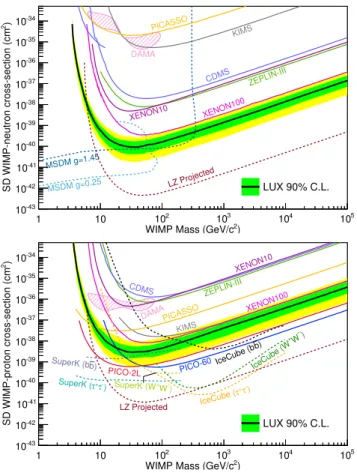
The upper limits on the SD WIMP-nucleon cross sections from the PLR analysis are shown in Fig. 1. The minimum excluded cross section at 90% CL for WIMP-neutron (WIMP-proton) elastic scattering is σn= 9.4×10−41cm2(σp= 2.9×10−39cm2), for a WIMP
mass of 33 GeV/c2. For the neutron-only coupling the
excluded cross section is lower than from previous direct searches. The proton-only limit is less constraining by a factor of ∼30. Using alternative structure functions from Ref. [20], the neutron-only upper limit is improved by a factor∼0.5 and the proton-only degraded by ∼2.5.
) 2 WIMP Mass (GeV/c
1 10 102 3 10 104 5 10 ) 2 SD WIMP-neutron cross-section (cm -43 10 -42 10 -41 10 -40 10 -39 10 -38 10 -37 10 -36 10 -35 10 -34 10 DAMA ZEPLIN-III CDMS KIMS MSDM g=0.25 MSDM g=1.45 PICASSO XENON100 XENON10 LZ Projected LUX 90% C.L. ) 2 WIMP Mass (GeV/c
1 10 2 10 3 10 4 10 5 10 ) 2 SD WIMP-proton cross-section (cm -43 10 -42 10 -41 10 -40 10 -39 10 -38 10 -37 10 -36 10 -35 10 -34 10 DAMA ZEPLIN-III CDMS KIMS PICASSO ) b SuperK (b ) -W + SuperK (W ) -τ + τ SuperK ( PICO-2L PICO-60 XENON100 XENON10 LZ Projected ) b IceCube (b ) -W + IceCube (W ) -τ + τ IceCube ( LUX 90% C.L.
FIG. 1. LUX upper limits on the WIMP-neutron (top) and -proton (bottom) elastic SD cross sections at 90% C.L. The observed limit is shown in black with the ±1σ (±2σ) band from simulated background-only trials in green (yellow). Also shown are the 90% C.L. from: CDMS [25], KIMS [26, 27], PI-CASSO [28], PICO-2L [29], PICO-60 [30], XENON10 [31], XENON100 [32], and ZEPLIN-III [33, 34]. The DAMA al-lowed region at 3σ as interpreted in [35] without ion chan-neling is the shaded areas. Three indirect limits from Ice-Cube [36] and SuperK [37] are shown. Collider limits from CMS mono-jet searches are included, assuming the MSDM model with two coupling scenarios [38]. The projected sen-sitivity for the LZ experiment is shown for an exposure of 5.6×10⁵ kg·days [39].
The results presented here improve on the limits set in Ref. [40] owing mostly to the lower energy threshold and the better background rejection afforded by the PLR-based statistical analysis. PICO [29, 30] is more sensi-tive to proton-only coupling, due to the unpaired pro-ton of the fluorine nuclei in the C3F8 target. However,
the inclusion of two-body currents in the xenon struc-ture functions yields significant proton-only sensitivity and the proton-only limit from this result is competitive. The DAMA allowed region [35] is excluded even in the proton-only case by this result.
Collider searches for dark matter particles can be in-terpreted in the same parameter space as direct searches for particular conditions [38]. In Fig. 1 we include limits
from CMS mono-jet searches [41], assuming the Minimal Simplified Dark Matter (MSDM) model for the particu-lar case where the couplings of the mediator to the quarks and the dark matter particle are equal (g = gq = gDM).
The cross section is dependent on these couplings, so we compare to the smallest and largest values used in Ref. [38]. For low WIMP masses the collider limits are stronger for both couplings, but these searches are not sensitive to heavier WIMPs. It is important to note this interpretation of collider searches is model-dependent. Therefore, dark matter signals would ideally be observed in collider, indirect, and direct searches in order to fully investigate the interactions of WIMPs.
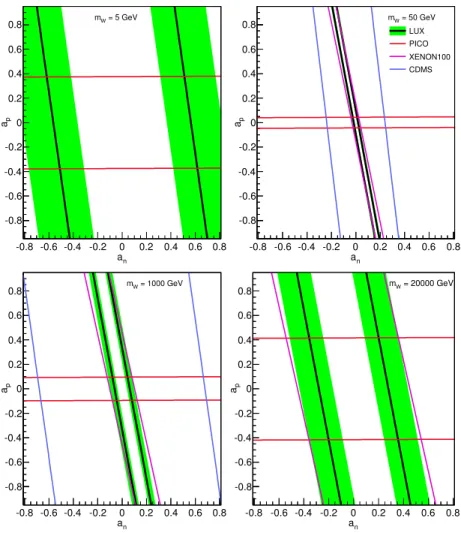
With limits set on σp,n the allowed region in ap− an
space can be found following the procedure detailed in [42]: X A ap q σA p ± an pσA n 2 > π 24G2 Fµ2p , (4) where σA
p,n are the limits on the proton or neutron-only
cross sections, for the isotope with mass number A. The excluded region is shown in Fig. 2. Typically only the most sensitive channel of the two cross sections is shown. In this case the limits in the ap− an plane can be found
following the method detailed in Ref. [43], which is a good approximation if ap an or vice-versa.
This result improves the constraint on an over
pre-vious experiments. The lines are parts of elongated el-lipses and the orientation depends on the sensitivity to both ap and an. The angle of the ellipse for LUX and
XENON100 is not the same due to differences in the spin structure functions used and the energy scale in the anal-ysis (which affects the signal spectrum). XENON100 also had slightly different abundances of129Xe and131Xe, due
to the addition of isotopically modified xenon. This plot also emphasizes the complementarity between the differ-ent detector materials.
In conclusion, we have set the most stringent limits on the SD WIMP-neutron cross section for all WIMP masses down to 3.5 GeV/c2 from the 2013 LUX data, and the
proton-only limit is also competitive. We also improve the constraints on the possible values of the couplings ap and an, complementary to experiments that are more
sensitive to the proton than the neutron coupling. The sensitivity to both proton and neutron-only coupling will be improved greatly with future large-scale experiments with xenon targets such as LZ [39].
This work was partially supported by the U.S. Department of Energy (DOE) under award num-bers DE-FG02-08ER41549, DE-FG02-91ER40688, DE-FG02-95ER40917, DE-FG02-91ER40674, DE-NA0000979, DE-FG02-11ER41738, DE-SC0006605, AC02-05CH11231, AC52-07NA27344, and DE-FG01-91ER40618; the U.S. National Science Foundation
n a -0.8 -0.6 -0.4 -0.2 0 0.2 0.4 0.6 0.8 p a -0.8 -0.6 -0.4 -0.2 0 0.2 0.4 0.6 0.8 mW = 5 GeV n a -0.8 -0.6 -0.4 -0.2 0 0.2 0.4 0.6 0.8 p a -0.8 -0.6 -0.4 -0.2 0 0.2 0.4 0.6 0.8 mW = 50 GeV LUX PICO XENON100 CDMS n a -0.8 -0.6 -0.4 -0.2 0 0.2 0.4 0.6 0.8 p a -0.8 -0.6 -0.4 -0.2 0 0.2 0.4 0.6 0.8 mW = 1000 GeV n a -0.8 -0.6 -0.4 -0.2 0 0.2 0.4 0.6 0.8 p a -0.8 -0.6 -0.4 -0.2 0 0.2 0.4 0.6 0.8 mW = 20000 GeV
FIG. 2. Constraints on the effective WIMP couplings to protons and neutrons, ap and an, at 90% CL for various WIMP
masses (5, 50, 1000, 20000 GeV). Also shown are CDMS [44], PICO-2L (for 5 GeV) [29], PICO-60 (for other masses) [30] and XENON100 [32], where the constraints have been inferred from the limits on σp,nusing the method in Ref. [43].
under award numbers PHYS-0750671, PHY-0801536, PHY-1004661, PHY-1102470, PHY-1003660, PHY-1312561, PHY-1347449, PHY-1505868; the Research Corporation grant RA0350; the Center for Ultra-low Background Experiments in the Dakotas (CUBED); and the South Dakota School of Mines and Technology (SDSMT). LIP-Coimbra acknowledges funding from Funda¸c˜ao para a Ciˆencia e a Tecnologia (FCT) through the project grant PTDC/FIS-NUC/1525/2014. Imperial College and Brown University thank the UK Royal So-ciety for travel funds under the International Exchange Scheme (IE120804). The UK groups acknowledge institutional support from Imperial College London, University College London and Edinburgh University, and from the Science & Technology Facilities Council for PhD studentships ST/K502042/1 (AB), ST/K502406/1 (SS) and ST/M503538/1 (KY). The University of Edinburgh is a charitable body, registered in Scotland, with registration number SC005336.
This research was conducted using computational re-sources and services at the Center for Computation and Visualization, Brown University.
We gratefully acknowledge the logistical and technical support and the access to laboratory infrastructure pro-vided to us by the Sanford Underground Research Fa-cility (SURF) and its personnel at Lead, South Dakota. SURF was developed by the South Dakota Science and Technology Authority, with an important philanthropic donation from T. Denny Sanford, and is operated by the Lawrence Berkeley National Laboratory for the Depart-ment of Energy, Office of High Energy Physics.
[1] J. L. Feng, Annu. Rev. Astron. Astrophys. 48, 495 (2010).
[2] J. I. Read, J. Phys. G: Nuc. Phys. 41, 063101 (2014). [3] D. Harvey, R. Massey, T. Kitching, A. Taylor, and
[4] Planck Collaboration, arXiv:1502.01589 (2015). [5] A. K. Drukier, K. Freese, and D. N. Spergel, Phys. Rev.
D 33, 3495 (1986).
[6] D. S. Akerib et al., Nucl. Instrum. Meth. A704, 111 (2013).
[7] D. S. Akerib et al., Phys. Rev. Lett. 112, 091303 (2014). [8] D. S. Akerib et al., “Low energy (0.7-74 keV) nuclear re-coil calibration of the LUX dark matter experiment using D-D neutron scattering kinematics” (in preparation). [9] D. S. Akerib et al. (LUX Collaboration), Phys. Rev. D
93, 072009 (2016).
[10] D. Akerib, H. Ara´ujo, X. Bai, and A. Bailey, Phys. Rev. Lett. 116, 161302 (2016).
[11] G. Jungman, M. Kamionkowski, and K. Griest, Phys. Rep. 267, 195 (1996).
[12] D. Hooper and S. Profumo, Phys. Rep. 453, 29 (2007). [13] A. Birkedal-Hansen and J. G. Wacker, Phys. Rev. D 69,
065022 (2004).
[14] J. Hubisz and P. Meade, Phys. Rev. D 71, 035016 (2005). [15] V. A. Bednyakov, H. V. Klapdor-Kleingrothaus, and
S. G. Kovalenko, Phys. Rev. D 50, 7128 (1994).
[16] A. L. Fitzpatrick, W. Haxton, E. Katz, N. Lubbers, and Y. Xu, J. Cosmol. Astropart. Phys. 02, 004 (2013). [17] P. Klos, J. Men´endez, D. Gazit, and A. Schwenk, Phys.
Rev. D 88, 083516 (2013).
[18] E. Epelbaum, H.-W. Hammer, and U.-G. Meißner, Rev. Mod. Phys. 81, 1773 (2009).
[19] J. Men´endez, D. Gazit, and A. Schwenk, Phys. Rev. D 86, 103511 (2012).
[20] M. T. Ressell and D. J. Dean, Phys. Rev. C 56, 535 (1997).
[21] D. S. Akerib et al., Astropart. Phys. 62, 33 (2015). [22] D. S. Akerib et al., Nucl. Instrum. Meth. A 675, 63
(2012).
[23] C. Lee, Mitigation of backgrounds for the Large Un-derground Xenon dark matter experiment, Ph.D. thesis, Case Western Reserve University (2015).
[24] D. S. Akerib et al., “Calibration, event reconstruction, data analysis and limits calculation for the LUX dark matter experiment ” (in preparation).
[25] Z. Ahmed et al., Phys. Rev. Lett. 106, 131302 (2011). [26] H. Lee et al., Phys. Rev. Lett. 99, 091301 (2007). [27] S. C. Kim et al., Phys. Rev. Lett. 108, 181301 (2012). [28] S. Archambault et al., Phys. Lett. B 711, 153 (2012). [29] C. Amole et al., Phys. Rev. D 93, 061101 (2016). [30] C. Amole et al., Phys. Rev. D 93, 052014 (2016). [31] J. Angle et al., Phys. Rev. Lett. 101, 091301 (2008). [32] E. Aprile et al., Phys. Rev. Lett. 111, 021301 (2013). [33] D. Y. Akimov et al., Phys. Lett. B 709, 14 (2012). [34] V. Lebedenko et al., Phys. Rev. Lett. 103, 151302 (2009). [35] C. Savage, G. Gelmini, P. Gondolo, and K. Freese, J.
Cosmol. Astropart. Phys. 04, 010 (2009). [36] M. Aartsen et al., arXiv:1601.00653 (2016). [37] K. Choi et al., Phys. Rev. Lett. 114, 141301 (2015). [38] S. A. Malik et al., Phys. Dark Universe 9–10, 51 (2015). [39] LZ Collaboration, Conceptual Design Report,
arXiv:1509.02910 (2015).
[40] C. Savage, A. Scaffidi, M. White, and A. G. Williams, Phys. Rev. D 92, 103519 (2015).
[41] CMS Collaboration, Eur. Phys. J. C 75, 235 (2015). [42] D. Tovey, R. Gaitskell, and P. Gondolo, Phys. Lett. B
488, 17 (2000).
[43] F. Giuliani and T. A. Girard, Phys. Rev. D 71, 123503 (2005).