Alves Martins, M. & Silva, C. (2009). Two spelling programmes that promote understanding of the alphabetic principle in preschool children. Journal of Writing Research, 1 (3), 225-240.
Contact and copyright: Earli | M. Alves Martins & C. Silva, Higher Institute of Applied Psychology, Lisbon - Portugal | [email protected]
understanding of the alphabetic
principle in preschool children
Margarida Alves Martins & Cristina Silva
Higher Institute of Applied Psychology, Lisbon | Portugal
Abstract:Our aim in this study was to test two programmes designed to lead preschool children to use conventional letters to spell the initial consonants of words. These programmes differed in terms of the characteristics of the vowels that followed those consonants. The participants were 45 five-year-old Portuguese children whose spelling was pre-syllabic - they used strings of random letters in their spelling, making no attempt to match the oral to the written language. They were divided into two experimental and a control group. Their age, level of intelligence, and phonological awareness were controlled. Their spelling was assessed in a pre- and a post-test. In-between, children from the experimental groups participated in two programmes where they had to think about the relationships between the initial consonant and the corresponding phoneme in different words: In Experimental Group 1, the initial consonants were followed by an open vowel, and in Experimental Group 2, these same consonants were followed by a closed vowel. The control group classified geometric shapes. Experimental Group 1 achieved better results than Experimental Group 2 following open vowels, being more able to generalize the phonological procedures to sounds that were not taught during the programmes. Both experimental groups used conventional letters to represent several phonemes in the post-test whereas the control group continued to produce pre-syllabic spellings.
1.
Introduction
Chomsky (1970) and Read (1971) were the first authors to use the concept of invented spelling while observing young children attempts to write down words. They were also the first to notice that there is some logic in children’s early spelling and that such logic changed over time according to children’s literacy experiences. In general they believed that invented spelling reflects a developmental progression of increasing sophistication as children become more adept at representing in print the sounds identified in spoken words. In Read’s own words: “some non-standard spellings represent a more advanced conception of the task or the language than others” (Read, 1986, p.47).
Also Ferreiro and Teberosky (1979) and Ferreiro (1988), from a constructivist point of view, analysed the nature of the spelling of children who had not yet received any formal teaching in reading and writing. Their perspective emphasises the role of children as active learners and the role of cognitive conflicts for the evolution of invented spelling. One of the main mechanisms for evolution are children’s discoveries (and cognitive conflicts caused by those discoveries) during their attempts to write or analyze conventional written forms. The results of their research led to the conclusion that children’s knowledge about written language evolves from an initial level where spelling is not yet determined by linguistic criteria to alphabetic spelling.
At the initial levels, children do not make any attempt to adjust oral and written language to one another. They focus on graphic dimensions, such as the minimum number of letters needed for writing to be read, or on varying letters in order to distinguish between the ways in which different words are written (pre-syllabic spellings). At these levels in their attempts at writing, children often spell words according to the size of the reference items—for example, by using more letters for words that refer to large items.
Later on, children begin to relate oral to written language. They begin with the search for equivalencies between letter elements and syllabic segments in words (syllabic hypothesis - syllabic spellings). Via this type of relationship children begin to solve the problem of the correspondence between the whole of the word and its constituent parts. This conceptual level culminates in an understanding of the alphabetic nature of written language (alphabetic spellings), preceded by an intermediate phase involving syllabic–alphabetic spellings, in which some of the phonemes in each word are not yet represented.
Various studies conducted in a number of different languages including English (Sulzby, 1985), French (Besse, 1996), Greek (Tantaros, 2007), Hebrew (Tolchinsky & Teberosky, 1998), Italian (Pontecorvo & Orsolini, 1996) and Portuguese (Alves Martins, 1993) have shown that there are a number of similarities between the languages in question on this journey to an understanding of the alphabetic principle, although the
syllabic spellings seem to be more frequent in languages such as Spanish, Italian and Portuguese.
In what concerns the syllabic spellings in Portuguese, Cardoso-Martins and Batista (2005) and Cardoso Martins, Correa, Lemos and Napoleão (2006) suggested that young children’s syllabic spellings result from their incipient understanding that letters represent sounds and from their attempt to represent the sounds they can detect in the pronunciation of words. Because very often there is only one vowel per syllable in Portuguese, the spelling of young speakers of this language will sometimes be syllabic. So from the point of view of these authors, children seem to rely almost exclusively on letter names in their early attempts to connect speech to print.
The scientific interest in invented spelling has increased because children’s early spelling can be seen as a window of their concepts and skills about literacy and about the written code (Ouellete & Sénéchal, 2008). Preschool children’s spelling activities act as a factor in children’s understanding of the alphabetic principle inasmuch as they induce metalinguistic thinking practices that have consequences on the ability to analyse the oral segments of words and to discover the relations between those segments and the corresponding letters (using the repertoire of letters’ names and sounds that children have acquired very often in informal contexts of learning). In this sense children seem to find it easier to develop alphabetic analytical procedures in writing activities rather than in reading ones, given that writing “may prompt children to use more systematic methods of deriving the spelling from sounds” (Bowman & Treiman, 2002, p. 31). This point of view is also consistent with that of Olson (1996) who argues that the model of language provided by a written code “is both what is acquired in the process of learning to read and write and what is employed in thinking about language; writing is in principle metalinguistic.” (p. 100). From this perspective writing provides preschool children with a model in terms of which phonological segments are represented or brought to into consciousness.
Silva and Alves Martins (2002, 2003) and Alves Martins and Silva (2006a, 2006b) confirmed this viewpoint in a number of experimental studies in which they compared the effect of programmes designed to lead preschool children to evolve in terms of the quality of their invented spellings. After spelling a few words, the children were confronted with spellings by a child at a level immediately above their own (e.g. pre-syllabic spellings / pre-syllabic spellings). They were asked to analyse the word in the oral form, to think about the two spellings, to choose one, and to justify their choice. In other words, they were induced to engage in metalinguistic reflection at the level of speech, writing, and the relationships between the two. The main cognitive activities involved were (a) predicting the number and type of letters to be written, (b) comparing the child’s own spelling with spellings one level higher, (c) evaluating which one was better, and (d) justifying their choice. These investigations were conducted according to some constructivist principles because the experimental intervention with children was mainly sustained by children’s discoveries.
Inasmuch as there is a fair consensus in the literature that invented spellings are important to the evolution of children’s knowledge about the written code, it would be useful to conduct a more systemic analysis of the way in which the phonological structure of the words that are to be written and/or the linguistic variables associated with the structure of the words may make the transition from pre-syllabic spellings to phonemic spellings easier.
For example, some words have phonological structures that are more favourable to the mobilisation of letters because they contain syllables which coincide with the name of a letter. So when children are asked to write words whose first syllable coincides with the name of a letter with which they are familiar (e.g. “pêra” [perα] “pêssego” [pesegu] (peach), they mobilise the letter “p” more often than when they are asked to spell “pano” [pαnu] (cloth) or “parede” [pαredə] (wall), in which the initial phonetic sequences do not match the name of the letter “p” [pe]. In this way, when children know the names of the letters, they can find it easier to detect them in the pronunciation of that type of word, which in turn facilitates the understanding of the sound-notation function that letters perform in the alphabetic code (Alves Martins & Silva, 2001; Mann 1993; Quintero, 1994; Treiman & Cassar, 1997).
In the case of Portuguese the effect is more accentuated for vowels than for consonants – the opposite to the case in English (Pollo, Kessler, & Treiman, 2005). On the other hand, Cardoso-Martins and Batista (2005) have shown that Brazilian Portuguese- speaking preschoolers more often use a phonetically plausible letter in their spelling when the sound corresponds to a letter name at the beginning of the word than at the end.
The articulatory properties of the phonemes in the words that are to be written may also influence the quality of children’s spelling, inasmuch as some phonemes are likely to be easier to isolate in the flow of speech than others. For example, phonemes that only differ from one another in voicing are easier to confuse than ones that only differ in the place of articulation (Treiman, Broderick, Tincoff & Rodriguez, 1998). On the other hand, according to Liberman et. al (1974) children find it easier to become aware of vowels than consonants, and to identify fricative consonants than occlusive ones. Treiman (1998) and Byrne and Fielding-Barnsley’s (1991, 1993) work shows that it is easier to train children in relation to the phonetic identity of fricatives than to that of occlusives, because it is easier to produce these sounds in isolation.
It is not only the articulatory properties of consonants that can have some influence on the phonetization procedures, but also the characteristics of the vowels that are the nucleus in a syllable. Vowels, which are more sonorous than consonants, are the core element in syllables, so their properties may make it easier or harder to abstract and graphically notate the consonants. The European Portuguese language contains 11 distinct vowel sounds. The spelling of those vowels, when compared to English, is fairly conservative. The five letters (a, e, i, o, u) represent in fact nine vowels [a], [α], [ɛ], [e], [ə], [i], [ɔ], [o], [u]. There is a great difference in pronunciation between closed and open vowels. A closed vowel is pronounced with the tongue as high in the mouth as
possible, as in the first syllable of the words “banho” [bαɲu] (bath) or “povo” [povu] (people). In contrast, an open vowel places the tongue low in the mouth, as in the first syllable of the words “mapa” [mapα] (map) or “dócil” [dɔsil], (docile).
Besides the greater sonority of the open vowels, in Portuguese their pronunciation matches the letter names that represent those vowels. This fact may induce more easily the notation of the vowel to the detriment of the consonants in the syllables that contain those vowels. So in Portuguese the nature of the vowels (open vs. closed) often combines with the greater ease created by the fact that the names of the letter that represent the open vowels coincide with their sound. A study by Cardoso Martins, Resende and Rodrigues (2002) reveals that in a list of 56 frequent words that were present in Brazilian preschool-level children’s books, the pronunciation of 51 contained at least one vowel letter name. In a similar list of 56 high-frequency English words, only 17 contained a letter name. So the nature of Portuguese written language may make it easier to mobilise vowels than consonants in children’s invented spellings. This is particularly the case in words that include syllables with open vowels, the pronunciation of which coincides with the letter name.
Analysis of the letters used to represent the vowels in written language have primarily addressed the mistakes that children make in the initial phases of the learning process, and have pointed to the importance of the development of context sensitivity to the consonants in the spelling of vowels (Treiman & Kessler, 2006). However, we are not aware of any studies in which the openness/closure of vowels may affect the perception and consequent graphic notation of the consonant that corresponds to the onset of the respective syllable – particularly within the context of children’s use of written language prior to formal education.
We thus stated the following research questions:
Will two spelling programmes (working on grapho-phonetic correspondences of initial consonants followed by an open-versus-closed vowel) result in equivalent use of conventional letters to represent the initial consonants in the post-test?
Will children from both groups generalise the phonological procedures to grapho-phoneeme correspondences that were not worked on during the programmes?
2.
Method
2.1 Participants
The participants were 45 five-year-old Portuguese children from three classes at a kindergarten in Lisbon, Portugal, where they had not been given any initiation into reading or writing. In those kindergaten classes there were no regular classroom activities/instruction relating to phonological awareness or invented spelling, as it happens in many kindergartens in Portugal. The teaching of reading and writing normally begins in the first year of elementary school. The only regular activities related
to reading and writing were story reading, teaching letter names, activities where children had to write their own names (eg. to identify their drawings, paintings, etc.) .
None of the children knew how to read – a fact that was verified by means of individual reading tests.
Only children who were familiar with the five vowel letters and at least with the consonants B, D, F, P, T and V were selected. These consonants were selected as they have regular correspondences with the phonemes they represent: three occlusive ones and three fricative ones. Their spelling was assessed by means of an initial interview where children were asked to write a set of words and to justify their spellings.
Forty five children were selected based on the interview whose writing was pre-syllabic. They were randomly divided into three groups: two Experimental Groups and a Control Group, each having 15 children. Experimental Group 1 and Experimental Group 2 engaged in spelling programmes in which they had to think about the relationships between the initial consonant and the corresponding phoneme in different words. (Exp. G1: initial consonant followed by an open vowel; Exp. G2: initial consonant followed by a closed vowel). The Control Group classified geometric shapes in accordance with criteria such as identical shape, size, or colour.
The children’s age, intelligence, number of letters known and phonological awareness was controlled. We carried out ANOVAs to compare their age, level of intelligence, number of letters known, and results in two phonological awareness tests. The results were: F =(2,42) = 0.12, p = .885 for the age; F=(2,42) = 0.84, p = .438 for the level of intelligence; F=(2,42) = 0.23, p = .795 for the number of letters known;
F=(2,42) = 0.64, p = .533 for the initial syllable classification test; and F=(2,42) =0 .23, p = .794 for the initial phoneme classification test. There were no statistically
significant differences among the three groups. Table 1 shows the means and standard deviations for the three groups’ results in relation to these variables.
Table 1. Means and standard deviations for age, intelligence, and letters known, and for the results in the initial syllable and initial phoneme classification tests, for the 3 groups
Age Intelligence Letters I.S.C. I.Ph.C.
M SD M SD M SD M SD M SD
G.1 66.80 4.44 21.40 3.27 8.73 5.37 8.47 2.10 5.27 1.53 G.2 66.20 3.49 19.80 4.18 8.87 5.84 7.47 3.02 4.87 1.96 C.G 66.20 3.51 19.93 3.73 7.67 4.62 7.73 2.31 5.20 1.61
G.1= spelling programme using open vowels G.2 = spelling programme using closed vowels C.G = Control group
I.S.C. = Initial syllable classification I.Ph.C. = Initial phoneme classification
2.2 Instruments and Procedures
2.2.1 Assessment of spelling in the pre- and post-tests.
In order to assess the initial level of children’s spelling, we asked them to spell a set of words to the best of their abilities.They were asked to spell 36 disyllabic words beginning with B, D, F, P, T and V. In half of the words the initial consonant was followed by an open vowel and in half of them by a closed one. The consonants P, T and F were worked on during the programmes, while B, D and V were not. The words that were used during the pre- and post-test are presented in Appendix A. None of these words were used during the programmes.
In classifying the children’s responses we used a grid that was constructed from those drawn up by Ferreiro (1988) and Alves Martins (1993). Only children whose spelling was pre-syllabic in the pre-test were selected. This category was used for spelling in which the children made no attempt to match the oral to the written language. Words were spelled in accordance with grapho-perceptive criteria. When they spelled, children sought to respond to factors such as the need for a minimum number of letters for each word and for a different combination of letters to distinguish between different words. While they were spelling children did not verbalise at all, and they did not use any conventional letters to represent the initial sound of the words.
In the post-test, children were evaluated using the dictation of the same set of words. We analysed whether the children correctly represented the first consonant in the different words. In order to be able to compare the number of words which each of the two groups spelled phonically, we allocated 1 point for each word in which the first letter was spelled correctly. We subsequently analysed whether the children correctly represented the other letters in the words.
2.2.2 Assessment of phonological awareness.
In order to assess the children’s phonological awareness they were given an initial syllable classification test and an initial phoneme classification test, which were both taken from Silva’s (2002) battery of phonological tests. We sought to take both the size of the units (syllables and phonemes) and the phonological properties of the initial phonemes in the words into account. Each test was made up of 14 items, preceded by two training items. In these tests the children were given four words in figurative form, two of which began with the same syllable or the same phoneme, and they were asked to identify the words. The children had to categorise two target words out of four, using a syllabic or phonemic criterion.1 point was given for each correct answer.
2.2.3 Assessment of letters known.
In order to assess how many and which letters the children knew, they were given a set of cards with the letters of the alphabet in capitals (excluding K, W and Y, which are
not formally part of the Portuguese alphabet), and were asked to name them. The possible score in this test ranged from 0 to 23.
2.2.4 Assessment of intelligence.
The level of the children’s intelligence was assessed using the coloured version of Raven’s Progressive Matrices (Raven, Raven & Court, 1998), because it is not very dependent on verbal aspects.
2.2.5 Spelling programmes.
The spelling programmes lasted for 5 sessions of around 15 minutes each, and were designed to lead the children to use conventional letters to represent the initial consonant in each word. The words used in the programmes were always different from those in the pre- and post tests. Experimental Group 1 spelled words in which the initial consonant (P, T, F) was followed by an open vowel; Experimental Group 2 spelled words in which the initial consonant (P, T, F) was followed by a closed vowel.
In each session each child was asked to spell a word as best he/she could, and was then shown the same word spelled by a child from another class, who had used the correct initial consonant to represent the first syllable in the word. He/she was asked to think about his/her spelling and that of the other child, and to try to think which was the better way to write the word and why. The child’s attention was drawn to the first letter in the word. Twelve words were used in each session. The first session involved three words whose initial syllable matched the name of the letters “P”, “T” and “F” respectively. The initial letter in the other nine words was followed by the open vowels
“a”, “e” or “o”. For example, in the first session of the programme followed by
Experimental Group 1, the children were asked to write the words Pera [perα] (Pear),
Feno [fenu] (Hay), Telha [teλ α] (Tile), in which the first syllable matches the name of
the letter “P” [pe], “F” [fe] and “T” [te] respectively, and then the words Pato [patu] (Duck), Pede [pɛdə] (Ask), Poro [pɔru] (Pore), Fada [fadα] (Fairy), Ferro [fɛRu] (Iron),
Foca [fɔka] (Seal), Taco [taku] (Bat), Terra [tɛRα] (Earth) and Toca [tɔkα] (Den). In
Experimental Group 2, after the three initial words, the initial syllable of which matched the name of the letters “P”, “F” and “T”, we asked the children to write nine words where these consonants were followed by the closed vowels “a”, “e” or “o”:
Panar [pαnar] (To fry in batter or breadcrumbs), Pedir [pədir] (To ask), Poço [posu] (A
well), Fadou [fαdo] (Destined), Feliz [fəliʃ] (Happy), Folha [foλα] (Leaf), Taxar [tαʃar] ( T o t a x ) , Tecer [təser] ( To weave), and Torre [toRə] (Tower).
The following example of the interaction between the researcher and a child named Joana is a good illustration of the dynamic that occurred during the spelling programme sessions:
R.: Joana, try to write the word Feno [fenu].
J. writes ‘JAMAO’.
R.: A child named Ana from another school wrote Feno in a different way. Shall I show you?
J.: Yes.
R. shows ‘FU’. What is the first letter that Ana wrote? J.: She wrote ‘F’ [fe].
R.: Do you think that Feno begins with F? Try to say the word slowly. J.: Fe [fe] - No[nu].
R.: How does the word begin? J.: F [fe], with F.
2.3 The control group programme
We organised a set of exercises with the Control Group using material of the logical blocks type. The children were asked to classify geometric shapes in accordance with criteria such as identical shape, size, or colour.
The three programmes involved five sessions that lasted approximately fifteen-minutes each and were individually conducted by the same researcher with the children over the course of a fortnight.
3.
Results
In the post-test none of the children in the Control Group used conventional letters to represent the initial phoneme in the words. Figure 1 shows an example of this type of spelling.
Passa
Povo
Pega
Pano
Figure 1.Example of pre-syllabic spelling produced by a child of the control group.
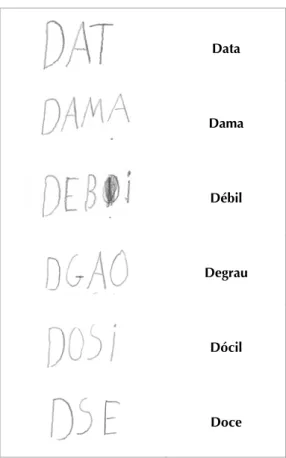
All the children in both experimental groups used conventional letters to represent the initial sound in some or all of the words (from 8 to 36 words). Some of the spellings were syllabic (Figure 2), and some were even syllabic-alphabetic and alphabetic (Figure 3).
Passa
Povo
Pega
Pano
Figure 2.Example of syllabic spelling by a child of experimental group 2.
Data Dama Débil Degrau Dócil Doce
Figure 3.Example of syllabic-alphabetic and alphabetic (in the word dama) spelling by a child of experimental group 1.
The means and standard deviations for the number of words in which the children in the two experimental groups used a correct letter to represent the initial phonemes of the 36 words in the post-test were M = 29.00, SD = 7.28 for Experimental Group 1 and
M = 22.80, SD = 8.80 for Experimental Group 2.
In order to assess the impact of the context in which the initial phoneme occurs (open versus closed vowel) on the evolution of the phonological processes involved in the children’s spelling, we carried out a t-test using the group as the independent variable and the number of words whose initial phoneme was spelled correctly in the post-test situation as the dependent one. The results show that there are statistically significant differences between the two groups: t (28) = 2.10, p < 0.05, Cohen’s d = 0.77. Experimental Group 1 obtained better results than Experimental Group 2.
Table 2 presents the means and standard deviations for the number of words in which the children in the two experimental groups spelled the initial phonemes in the post-test correctly, by taught and untaught consonants.
Table 2. Means and standard deviations for the number of words in which the children in the two experimental groups spelled the initial phonemes in the post-tes correctly, by taught and untaught consonants
PTF BDV
M SD M SD
G.1 16.2 2.27 12.80 5.21
G.2 14.47 3.64 8.33 5.61
G.1= spelling programme using open vowels G.2 = spelling programme using closed vowels PTF = letters taught in the programme BDV= letters not taught in the programme
In order to assess the differences between the two experimental groups as regards the spelling of phonemes in taught and untaught consonants, we carried out t-tests using the group as the independent variable and the number of words whose initial phoneme was spelled correctly in the post-test in each condition as the dependant one.
The results show that there are no statistically significant differences in relation to the consonants that were worked on during the programmes (PTF: t (28) = 1.56, p = 0.129), but that such differences occurred in relation to the consonants that were not worked on during the programmes (BDV: t (28) = 2.26, p < 0.05, Cohen’s d = 0.83).
Experimental Group 1, which worked on the grapho-phonetic correspondences between initial consonants followed by open vowels, obtained better results in the post-test in terms of the generalisation of the phonological procedures.
Table 3 presents the means and standard deviations for the number of words in which the children in the two experimental groups spelled the other letters correctly: vowel in the first syllable, last vowel, and consonant in the second syllable.
Table 3. Means and standard deviations for the number of words in which the children in the two experimental groups phonetized the first vowel, the second consonant and the last vowel in the post-test
First vowel Second consonant Second vowel
M SD M SD M SD
G.1 8.13 8.03 12.53 9.54 23.67 7.94
G.2 11.40 7.21 13.93 10.09 19.60 9.34
G.1= spelling programme using open vowels G.2 = spelling programme using closed vowels
In order to assess the differences between the two experimental groups in terms of spelling the first vowel, the last vowel and the second consonant correctly, we carried out t-tests using the group as the independent variable and the number of words in which the first or last vowel or the 2nd
consonant was spelled correctly in the post-test as the dependent variable. The results show that there are no statistically significant differences as regards spelling either vowel or the second consonant (1st
vowel: t (28) = -1.17, p = 0.251; last vowel: t (28) = 1.28, p = 0.209; 2nd
consonant: t (28) = - 0.39, p = 0.699) correctly.
4.
Discussion
The results indicate the efficacy of these intervention programmes, which led to an evolution in the way in which the children in the experimental groups conceived written language and mobilised phonological procedures. Asking children in the two experimental groups to think about their spelling and compare it with a more evolved phonological spelling enabled them to initiate metalinguistic thinking processes at the level of segments of speech and print, and of the relationships between them, which in turn modelled a conceptual understanding that the code is a system for spelling down sounds. Children in both experimental groups, whose spelling was pre-syllabic at the time of the pre-test, started phonetizing their spelling in the post-test, and some of them evolved to the point where their representations of words were syllabic-alphabetic and alphabetic.
These results confirm the view taken by various authors (Adams, 1998; Alves Martins & Silva, 2006 a, b; Ouzoulias, 2001; Treiman, 1998) that invented spelling activity promotes the understanding of the alphabetic principle and facilitates the beginning of correct spelling of sounds. This hypothesis is strengthened by the fact that there was a generalisation of the phonological procedures in both groups, (albeit to a greater extent in Experimental Group 1), which suggests that this type of programme leads children to acquire the notion that the phonemes they identify in words should be represented by letters which contain the applicable sound, and that they simultaneously acquire phonemic identification skills, that is, the ability to perceive phonemes as stable identities within different words which they then apply when they analyse new words.
However, the level of the understanding that these children presented appears to have been mediated by the nature of the vowels which followed the first consonant of the words used in the programmes. Children from Experimental Group 1, where the words used in the spelling programmes had an initial consonant followed by an open vowel, performed better in terms of the graphic representation of the initial consonants which had not been taught during the programmes than did their counterparts in Experimental Group 2, where the words used in the spelling programmes had an initial consonant followed by a closed vowel. Thus, they are gaining phonotactic knowledge of how a single phoneme’s spelling may be affected by the nature of the phoneme that follows.
The experimental condition applicable to Group 1 led children from this group to think about the relationships between speech and spelling under linguistically more complex conditions, and this circumstance appears to be related to a better performance. In fact, the pronunciation of open vowels coincides with the letter names, which is likely to make it easier to notate the vowels in the syllables in question, to the detriment of the consonants. Where these difficulties are concerned, we should also mention that in Portuguese the facilitating effect of letter names in invented spellings seems to be more accentuated for open vowels than for consonants. An example of this effect, besides coinciding with the respective letter name, these open vowels are present in many common words (Cardoso- Martins, Resende & Rodrigues, 2002). So it is likely that the complexity associated with the words used in Experimental Group 1’s intervention programme explains the fact that in the post-test, the children in that Group proved more consistent than their counterparts in Experimental Group 2 in terms of their abstraction of the initial consonants in words and the graphic notation thereof, particularly in the case of consonants that had not been included in the programme.
It is interesting to note that apart from Experimental Group 1’s more frequent notation of the initial consonant of words, there were no differences between the two groups in terms of the frequency with which they graphically represented the vowel in initial syllables. One might have expected the children in Experimental Group 2 to perform better in notating such vowels because they were spelling fewer untaught initial consonants (B, D, V) than Experimental Group 1, and these might have resorted to the notation of the vowel in the first syllable in words beginning with those three consonants. However, while in many cases the children in Experimental Group 2 were able to notate the vowel in the first syllable rather than the consonant, some of the children in Experimental Group 1 were not only able to notate the initial consonant, but also the vowel in the initial syllable. Thus in some cases this tendency reflects Group 1 children’s evolution towards a conception of the written code that based on an identification of all the phonemes in the initial syllable and their graphic representation using appropriate letters. Other studies (Alves Martins & Silva, 2006 a, b) have found that this intervention paradigm possesses potentials to enable some children to evolve towards almost alphabetic spelling.
When it came to the second syllable, the children in both groups essentially represented the vowel and not the consonant. There may be two reasons for this
finding: Either the children were not familiar with some of the consonants in the second syllables (the study design did not include the control of the consonants used in the second syllables), or phonemes in final positions are harder to notice (Treiman, Berch & Weatherson, 1993). This effect is likely to be more accentuated in the graphic notation of consonants than in that of vowels, because generally speaking the core vowel is more sonorous than the consonant that corresponds to the onset. The absence of significant differences in relation to the vowels indicates the existence in both groups of a generalisation effect of the taught consonants on the vowels.
These results demonstrate the need for a deeper analysis of the nature of the mechanisms that lead children to evolve via invented spellings towards phonological procedures and alphabetic conceptions of written language. In this context it would be useful to undertake more studies to gain a more in-depth understanding of the role that the linguistic components of words play as mediators that enhance evolution of spelling knowledge.
References
Adams, M. (1998). Beginning to read: Thinking and learning about print. (10th Ed.) Cambridge: MIT Press.
Alves Martins, M. (1993). Évolution des conceptualisations d'un groupe d'enfants d'âge pré-scolaire sur l'écriture portugaise. Études de Linguistique Appliquée, 91, 60-69.
Alves Martins, M., & Silva, C. (2001). Letter names, phonological awareness and the phonetization of writing. European Journal of Psychology of Education, 16, 605-617.
Alves Martins, M., & Silva, C. (2006a). The impact of invented spelling on phonemic awareness. Learning and Instruction, 16, 41-56.
Alves Martins, M., & Silva, C. (2006b). Phonological abilities and writing among Portuguese preschool children. European Journal of Psychology of Education, 21, 163-182.
Besse, J - M. (1996). An approach to writing in kindergarten. In C. Pontecorvo, M. Orsolini, B. Burge, & L. Resnick (Eds.), Children’s early text construction (pp. 127-144). New Jersey: Lawrence Erlbaum.
Bowman, M., & Treiman, R. (2002). Relating print and speech: The effects of letter names and word position on reading and spelling performance. Journal of Experimental Child Psychology, 82, 305-340.
Byrne, B., & Fielding-Barnsley, R. (1991). Evaluation of a program to teach phonemic awareness to young children. Journal of Educational Psychology, 83, 451-455.
Byrne, B., & Fielding-Barnsley, R. (1993). Evaluation of a program to teach phonemic awareness to young children: An 1 year follow-up. Journal of Educational Psychology, 85, 104-111. Cardoso-Martins, C., Resende, S. M., & Rodrigues, L. A. (2002). Letter name knowledge and the
ability to learn to read by processing letter-phoneme relations in words: Evidence form Brazilian Portuguese-speaking children. Reading and Writing, 15, 409-432.
Cardoso-Martins, C., & Batista, A. (2005). O conhecimento do nome das letras e o desenvolvimento da escrita : Evidência de crianças falantes do português. Psicologia, Reflexão e Critica, 18, 330-336.
Cardoso-Martins, C., Correa, M., Lemos, L., & Napoleão, R. (2006). Is there a syllabic stage in spelling development? Evidence from Portuguese-speaking children. Journal of Educational Psychology, 98, 628-641.
Chomsky, C. (1970). Reading, writing and phonology. Harvard Educational Review, 40, 287-309. Ferreiro, E. (1988). L´écriture avant la lettre. In H. Sinclair (Ed.), La production des notations chez le jeune enfant (pp.17-70). Paris: Presses Universitaires de France.
Ferreiro, E., & Teberosky, A. (1979). Los sistemas de escritura en el desarrollo del niño. Madrid: Siglo veintiuno editores.
Liberman, I. Y., Shankweiler, D., Fischer, F. W., & Carter, B. (1974). Reading and the awareness of linguistic segments. Journal of Experimental Child Psychology, 18, 201- 212.
Mann, V. (1993). Phoneme awareness and future reading ability. Journal of Learning Disabilities, 26, 259-269.
Olson, D. R. (1996). Towards a psychology of literacy: on the relations between speech and writing. Cognition, 60, 83-104
Ouellete, G., & Senechal, M. (2008). A window into early literacy: Exploring the cognitive and linguistic underpinnings of invented spelling. Scientific Studies of Reading, 12, 195-219. Ouzoulias, A. (2001). L´émergence de la conscience phonémique: apprentissage sensoriel ou
développement conceptuel. In G. Chauveau (Eds.), Comprendre l´enfant lecteur (pp. 101-127). Paris: Retz.
Pollo, T. C., Kessler, B., & Treiman, R. (2005). Vowels, syllables and letters names: Differences of young children´s spelling in English and Portuguese. Journal of Experimental Child Psychology, 92, 161-181.
Pontecorvo C., & Orsolini, M. (1996). Writing and written language in children’s development. In C. Pontecorvo, M. Orsolini, B. Burge & L. Resnick (Eds.), Children’s early text construction (pp. 3-23). Hillsdale, N.J.: Lawrence Erlbaum Associates Publishers.
Quintero, G. (1994). El uso y función de las letras en el período pre-alfabético. Lectura y Vida, 15, 28-38.
Raven, J., Raven, J. C., & Court, J. H. (1998). Manual for Raven’s progressive matrices and vocabulary scale. Section I. General overview. Oxford: Oxford Psychologists Press.
Read, C. (1971). Pre-school children's knowledge of English phonology, Harvard Educational Review, 41, 1-34.
Read, C. (1986). Children's creative spelling. London: Routledge and Kegan Paul. Silva, C. (2002). Bateria de provas fonológicas. Lisboa: ISPA.
Silva, C., & Alves Martins, M. (2002). Phonological skills and writing of pre-syllabic children. Reading Research Quarterly, 37, 466-483.
Silva, C., & Alves Martins, M. (2003). Relations between children's invented spelling and the development of phonological awareness. Educational Psychology, 23, 3-16.
Sulzby, E. (1985). Kindergarteners as writers and readers. In M. Farr (Ed.) Advances in writing research, Volume one: Children’s early writing development (pp. 127-200). Norwood, New Jersey: Ablex Publishing Corporation.
Tantaros, S. (2007). Invented spelling in the Greek context. L1 – Educational Studies in Language and Literature, 7(3), 31-62.
Tolschinsky, L. L., & Teberosky, A. (1998). The development of word segmentation and writing in two scripts. Cognitive Development, 13, 1-24.
Treiman, R. (1998). Why spelling? The benefits of incorporating spelling into beginning reading instruction. In J. L. Metsala & L.C. Ehri ( Eds.), Word recognition in beginning literacy (pp. 289-313). London: Lawrence Erlbaum Associates Publishers.
Treiman, R., Berch, D., & Weatherson, S. (1993). Children’s use of phoneme-grapheme correspondence in spelling: Roles of position and stress. Journal of Educational Psychology, 85, 466-477.
Treiman, R., Broderik, V., Tincoff, R., & Rodriguez, K. (1998). Children’s phonological awareness: Confusions between phonemes that differ only in voicing. Journal of Experimental Child Psychology, 68 (3), 2-41.
Treiman, R., & Cassar, M. (1997). L´acquisition de l´orthographe en anglais. In L. Rieben, M. Fayol & C. Perfetti (Eds.), Des orthographes et leur acquisition (pp. 79-99 ). Paris: Delachaux et Niestlé.
Treiman, R., & Kessler, B. (2006). Spelling as statistical learning: Using consonantal context to spell vowels. Journal of Educational Psychology, 3, 642-652.
Appendix A
Barra [baRα], Banho [bαɲu], Bege [Bejə], Belém [bəlein], Bode [bɔdə], Boda, [bodα] Data [datα], Dama [dama], Débil [debil], Degrau [də graw], Dócil [dɔsil], Doce [dosə] Face [fasə], Fama [fama], Feto [Fɛtu], Ferrou [FəRo], Fome [Fɔmə], Fogo [fogu] Passa [pasα], Pano [panu ], Pega [pɛgα], Petiz [pətiʃ], Pote [pɔtə], Povo [povu]
Taça [tasα], Tapou [tapo], Teca [tɛkα], Temor [təmor], Topo [tɔpu], Touro [toru] Vale [valə], Vapor [vapor], Vera [vɛrə], Vetou [vəto], Vota [vɔtα], Vouga [voga]