○ ○ ○ ○ ○ ○ ○ ○ ○ ○ ○ ○ ○ABST RAC T○ ○ ○ ○ ○ ○ ○ ○ ○ ○ ○ ○ ○ ○ ○ ○ IN TRO D U CTIO N○ ○ ○ ○ ○ ○ ○ ○ ○ ○
Today, the importance of breastfeeding is widely recognized.1-6 However, early weaning remains a chal-lenge in developing countries.7-11 This can be attrib-uted to the process of urbanization and industrializa-tion,12 although the reasons are complex and varied.
In urban areas the extended family, i.e. grandpar-ents, uncles and cousins, has been replaced by the nuclear family. As a result, there has been a break in the knowledge transmission chain from the older to the younger women in a family. When we observe the breastfeeding process in more traditional societies, we may be deceived by the apparent simplicity of the proc-ess. It is an error to conclude that all women are pre-pared for lactation. In fact, the art of breastfeeding is not innate, but one that has been taught from one generation to the next since time immemorial.13 A girl that lacks the company of family women other than her mother has few opportunities to watch and learn mother-to-child care techniques. When she becomes a mother herself and returns home after delivery, there are usually no close relatives she can count on, thereby finding herself isolated and unprepared. The nuclear family structure is one of the main reasons for the de-cline in breastfeeding in urban areas.14
However, breastfeeding is only part of the neces-sary newborn care techniques. These include childcare procedures that create the context needed for normal growth and development. Once the obstacles to the transmission of knowledge are identified, alternatives like breastfeeding promotion programs are needed; especially those aimed at pregnant women.15
Therefore, a broad survey on the knowledge of newborn healthcare among pregnant women was devised, aimed both at general health care topics and breastfeeding. Its results may prove useful in establishing new promotional and educational pro-grams in relation to breastfeeding.
○ ○ ○ ○ ○ ○ ○ ○ ○ ○ ○ ○ ○ ○M ETH O D S○ ○ ○ ○ ○ ○
Setting
The “Centro de Saúde-Escola Prof. Samuel Barnsley Pessoa” (Prof. Samuel Barnsley Pessoa Health School Center) is a primary health care fa-cility located in a poor area of São Paulo that has been created as a joint effort between the Univer-sity of São Paulo and the São Paulo State Health Office. It serves a population of 50,000 adults and children, and offers a prenatal care program. The Pediatrics and Preventive Medicine Departments of the University of São Paulo School of Medi-cine develop academic and welfare programs there.
Participants
The sample consisted of 65 pregnant women enrolled for six consecutive months in the prenatal care program of the Prof. Samuel Barnsley Pessoa Health School Center. The population consists mainly of low-income migrants, living in shanties or slum tenement houses. The overall literacy rate is low. Most of the family providers do manual labor as construction workers or performing menial tasks.
The study sample was made up from all the preg-nant woman enrolled during six consecutive months in the pre-natal care program, a total of 67 subjects. At the end of the program there were 65, as two subjects were excluded due to intended abortion.
The research plan was presented to each preg-nant woman at the first prenatal consultation and her collaboration was requested. She was informed that a refusal would not prejudice her clinical care. All the women agreed to participate and were indi-vidually interviewed by trained healthcare officers. The following topics were included in the ques-tionnaire: a) Current prenatal information; b) Pre-natal history and parturition; c) Basic knowledge of newborn healthcare; d) Basic breastfeeding practice.
O
ri
gi
n
a
l
A
rt
ic
le
• Hugo Issler
• M árcia Borges Sanches Rodrigues de Sá
• Dulce M aria Senna
Knowledge of newborn healthcare
among pregnant women: basis for
promotional and educational
programs on breastfeeding
Professor Samuel Barnsley Pessoa Health School Center, Faculty of Medicine,
Universidade de São Paulo, São Paulo, Brazil
CO N TEX T: Pro mo tio nal and educatio nal pro g rams re-lating to breastfeeding are impo rtant fo r reversing the dec line in this pra c tic e. Mo st pro g ra ms a re c entered exc lusively o n b rea stfeeding , a ltho ug h g eneral kno wledg e abo ut newbo rn healthcare may be impo rtant, especially amo ng preg nant wo men.
O BJECTIV E: To study preg na nt wo men’s kno wledg e abo ut g eneral healthcare o f newbo rns, including breastfeeding aspects.
TYPE O F STUDY: Cro ss-sectio nal.
SETTIN G: Pro f. Samuel Barnsley Pesso a Health Scho o l Center, Faculty o f Medicine, Universidade de São Paulo , Braz il.
PARTICIPAN TS: All preg nant wo men who were reg is-tered in the prenatal care pro g ram during six co n-secutive mo nths.
M AIN M EASUREM EN TS: Aspects o f the current g esta-tio n, previo us g estaesta-tio ns and childbirths, kno wledg e o f the g eneral aspects o f newbo rn healthcare and o f breastfeeding practices.
RESULTS: The results sho w that o nly a little o ver half o f the preg nant wo men had received any info rmatio n o n newbo rn healthcare. Misinfo rmatio n was clearly present reg arding pro per care o f the umbilical stump and the nature o f jaundice, and wo rst reg arding ho w to treat o ral thrush and jaundice, and abo ut vaccinatio n. In relatio n to breastfeeding, even tho ugh almo st all the preg nant wo men declared their inten-tio n to breastfeed, less than half had a co ncrete respo nse reg arding ho w lo ng to do it fo r. The lo w rates o btained in the to pics dealing with the dura-tio n, nursing intervals and the attitude to be taken to wards hypo g alactia sho w unfamiliarity with the breastfeeding technique. The “ weak milk” belief, the misinfo rmatio n abo ut co ntraceptive metho ds during breastfeeding and the co st o f artificial fo rmulas also have a neg ative impact o n this practice.
CO N CLUSIO N S: Preg nant wo men’s kno wledg e o f new-bo rn healthcare is lo w, as much in the aspects o f g e ne ra l c a re a s in re la tio n to the p ra c tic e o f breastfeeding . These finding s must be taken into c o nside ra tio n in e duc a tive pro g ra ms pro mo ting breastfeeding .
KEY W O RDS: Breast-feeding . Pro mo tio nal pro g rams. Educatio nal pro g rams.
São Paulo M edical Journal - Revista Paulista de M edicina
8
○ ○ ○ ○ ○ ○ ○ ○ ○ ○ ○ ○ ○ ○ ○RESU LTS○ ○ ○ ○ ○
Current gestational data
Of 65 subjects, 36 (55.4%) were at up to 14 weeks of pregnancy, 19 (29.2%) from 14 to 28 weeks, 4 (6.1%) over 28 weeks and in 6 cases (9.2%) the gesta-tional age could not be determined; 21 (32.3%) were primigravidae. Of the 44 subjects with a previous preg-nancy, 5 (11.4%) had had a previous abortion and 2 (4.6%) a stillbirth. None had produced twins.
Knowledge sources
The surveyed topics relating to the knowledge source are shown in Table 1. Analysis of Table 1 shows that only 38 (58.5%) of the subjects acknowledged having previous information. Of those 38, 12 (18.5%) acknowledged having had formal instruction from school, lectures or the healthcare center. The remain-der was from informal sources, such as family or friends. With regard to previous experience, 44 (67.7%) had helped baby-sitting a child, 29 (44.6%) watched their own mothers breastfeeding their siblings, and 51 (78.5%) acknowledged be-ing breast-fed as an infant.
The 43 subjects who had had at least one live child were asked about the kind of information given upon discharge from the maternity hospital. Only 25 (58.1%) acknowledged having been informed of how to take care of a child, and 17 (39.5%) how to breastfeed.
General newborn healthcare
Less than half of the subjects knew how to take proper care of the umbilical stump, deal with oral thrush care, or had knowledge of the nature of jaun-dice. Only 7 (10.7%) answered correctly how to treat jaundice, and 19 (29.3%) when to start vacci-nation. None of the subjects knew what the first 3 vaccines their child should receive were (BCG, Sabin and DPT, on the state of São Paulo schedule). Fi-nally, 47 subjects (72.3%) acknowledged the need for in-house support from family or friends upon arrival home from the maternity hospital (Table 2). Breastfeeding practice
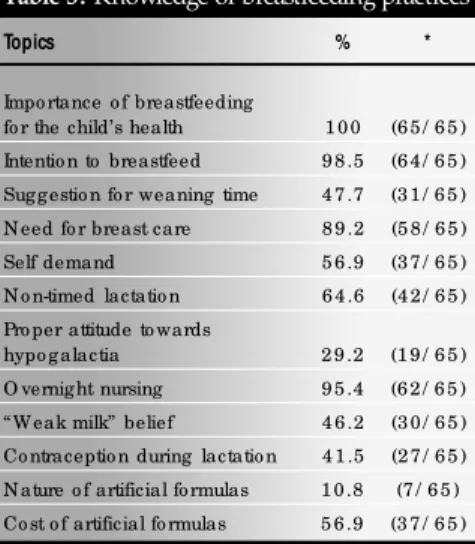
Regarding knowledge of breastfeeding practice, all the subjects recognized the importance of breastfeeding for the child’s health (Table 3). In spite of their assertion, 64 (98.5%) intended to breast-feed, but only 31 (47.7%) were able to give a time frame for weaning.
Even when lacking knowledge of proper tech-niques, 58 subjects (89.2%) stated the need for breast care. Regarding the timing of nursing, 37 (56.9%) wanted to nurse on demand, 42 (64.6%) preferred non-timed lactation and 62 (95.4%) ac-knowledged the need for overnight nursing.
When questioned about hypogalactia, only 19 (29.2%) stated that the mother should increase the feeding frequency, not completing with a bot-tle. Thirty subjects (46.2%) recounted the belief about “weak milk”. On the topic of contracep-tion, 27 (41.5%) had proper knowledge on how to avoid a new pregnancy during lactation.
Regarding the human milk substitutes, only 7 subjects (10.8%) knew that artificial formulas were made from cow or soybean milk. And 37 (56.9%) acknowledged the impact of the cost of the artificial formulas on the household income.
○ ○ ○ ○ ○ ○ ○ ○ ○ ○ ○ ○ ○D ISCU SSIO N○ ○ ○ ○ ○ ○ ○
It is a matter for concern that 58.5% of the women
surveyed had limited breastfeeding knowledge. The subjects with previous childbearing experience were poorly informed about the basic topics in newborn healthcare and breastfeeding upon discharge from the maternity hospital. This pattern of deficiency and its need for correction have not only been described in women of reproductive age,16-19 but also among ob-stetricians and pediatricians,20 who are at present of great importance in the knowledge transmission chain. Among the women surveyed, their sources of knowledge were mostly informal, from fam-ily or friends. Misinformation was clearly present, for example regarding proper care of the umbili-cal stump and the nature of the jaundice among newborns. It was worst in how to treat oral thrush and jaundice. The complete lack of awareness regarding vaccination was astonishing, consid-ering the public advertisement it is given.
Recognition of the need for family support is par-allel to the knowledge deficiency seen above. Ideally, when returning home from hospital women would have full family support, with help from their mothers and older women. However, the nuclear family struc-ture in urban areas does not offer these favorable con-ditions, and therefore, institutional help is crucial.
As for the practice of breastfeeding, although its benefits are widely recognized and almost all sub-jects declared their intention to breast-feed, their knowledge was precarious. The low scores obtained in the topics concerning the timing of nursing and the attitude towards hypogalactia provide evidence of the women’s lack of technique, and this will lead to difficulties in sustaining breast-feeding.
The other aspects raised may also lead to early weaning. The belief of the “weak milk” myth, the ig-norance about contraceptive methods during lacta-tion and about the cost of artificial formulas may be due to lack of explanation. On the other hand, the misinformation about the nature of artificial formulas may be related to an idea of modernity and sophistica-tion. This idea may explain how readily mothers substitute human milk with artificial formula.
Reviewing the published literature on pro-grams promoting breastfeeding among pregnant women, there is evidence of an increase in du-ration21-23 and of an increased incidence of breastfeeding,24,25 but other authors describe the inefficiency of these programs.26,27
In view of the contradictory theories, one hy-pothesis can be made. As a number of authors state,28-30 a decision in favor of breast-feeding mostly occurs before pregnancy, and is consolidated dur-ing the first trimester of pregnancy. Therefore, it is made before contact with health professionals, and thus a change of attitude would be rare and unex-pected. Another reason could be the lack of quality and administrative support for these programs.31
The quality of knowledge and support has a cru-cial role in the success of breastfeeding promotion.15 It is worth mentioning that the focus of most of these Table 3. Knowledge of breastfeeding practices
Topics % *
Impo rtance o f breastfeeding
fo r the child’s health 1 0 0 (6 5 / 6 5 )
Intentio n to breastfeed 9 8 .5 (6 4 / 6 5 )
Sug g estio n fo r weaning time 4 7 .7 (3 1 / 6 5 )
N eed fo r breast care 8 9 .2 (5 8 / 6 5 )
Self demand 5 6 .9 (3 7 / 6 5 )
N o n-timed lactatio n 6 4 .6 (4 2 / 6 5 )
Pro per attitude to wards
hypo g alactia 2 9 .2 (1 9 / 6 5 )
O vernig ht nursing 9 5 .4 (6 2 / 6 5 )
“ W eak milk” belief 4 6 .2 (3 0 / 6 5 )
Co ntraceptio n during lactatio n 4 1 .5 (2 7 / 6 5 )
N ature o f artificial fo rmulas 1 0 .8 (7 / 6 5 )
Co st o f artificial fo rmulas 5 6 .9 (3 7 / 6 5 )
* number of subjects with a correct or affirmative response and the respective total. Table 2. General knowledge
of newborn healthcare
Topics % *
Umbilical stump care 4 6 .2 (3 0 / 6 5 )
Info rmatio n abo ut the
nature o f jaundice 4 9 .2 (3 2 / 6 5 )
Treatment o f jaundice 1 0 .7 (7 / 6 5 )
O ral thrush care 1 5 .4 (1 0 / 6 5 )
W hen to start vaccinatio n 2 9 .3 (1 9 / 6 5 )
First vaccines z ero (z ero / 6 5 )
N eed fo r in-ho use suppo rt 7 3 .2 (4 7 / 6 5 )
* number of subjects with a correct or affirmative response and the respective total. Table 1. Knowledge Sources on Newborn
Healthcare and lactation
Topics % *
Previo us kno wledg e 5 8 .5 (3 8 / 6 5 )
Fo rmal kno wledg e 1 8 .5 (1 2 / 6 5 )
Experience prio r to ado lescence 6 7 .7 (4 4 / 6 5 )
W atching her o wn
mo ther breastfeeding 4 4 .6 (2 9 / 6 5 )
Kno wing she was breastfed 7 8 .5 (5 1 / 6 5 )
G eneral info rmatio n o n newbo rn healthcare given upo n discharge
fro m the maternity ho spital 5 8 .1 (2 5 / 4 3 )
Instructio n fo r breastfeeding g iven upo n discharg e fro m the
maternity ho spital 3 9 .5 (1 7 / 4 3 )
* number o f subjects with an affirmative respo nse and the respective to tal.
São Paulo M edical Journal - Revista Paulista de M edicina
9
programs is solely on breastfeeding, without discus-sion of other topics. Valdés et al.32 point to this fact and emphasize the need for inclusion of other infant health aspects in the breastfeeding programs.
From the information above, the need for breastfeeding promotion is clear, and though they may not influence the decision, higher quality programs will increase acceptance and the chance of better results. These survey re-sults are consistent, since there is a relationship
between newborn healthcare in general and the practice of breastfeeding, to ensure the care needed for the newborn’s survival. Therefore, the acknowledgement of other healthcare top-ics can enhance promotional and educational programs that relate to breastfeeding.
○ ○ ○ ○ ○ ○ ○ ○ ○ ○ ○ CO N CLU SIO N S○ ○ ○ ○ ○ ○ ○ ○ ○
Knowledge of basic newborn healthcare
CONT EXTO: Os programas de incentivo ao aleitamento materno são importantes para reverter o declínio desta prática. Muitos desses programas têm se fixado em discutir exclusivamente aspectos do aleitamento materno, quando conhecimentos gerais sobre cuidados de saúde para recém-nascidos podem ser demanda importante, especialmente entre gestantes.
OBJETIVO: Estudar conhecimentos de gestantes sobre cuidados gerais de saúde de recém-nascidos, incluindo aspectos referentes ao aleitamento materno.
TIPO DE ESTUDO: Inquérito transversal.
LOCAL: Centro de Saúde-Escola “Prof. Samuel Barnsley Pessoa” da Faculdade de Medicina, Universidade de São Paulo.
AMOSTRA: Todas as gestantes inscritas no programa de cuidados pré-natais durante seis meses seguidos.
VARIÁVEIS AVALIADAS: Aspectos da gestação atual, eventuais gestações e partos anteriores, conhecimentos sobre aspectos gerais da saúde de recém-nascidos e sobre a prática do aleitamento materno.
RESULTADOS: Os resultados mostram que apenas pouco mais da metade das gestantes recebeu alguma informação sobre cuidados de saúde para
recém-○ ○ ○ ○ ○ ○ ○ ○ ○ ○ ○ ○ ○ ○ ○ ○ ○ ○ ○ ○ ○ ○ ○ ○ ○ ○ ○ ○ ○ ○ ○ ○ ○ ○ ○ ○ ○R ESU M O○ ○ ○ ○ ○ ○
nascidos. É clara a desinformação quanto ao tratamento adequado do coto umbilical, à noção do que seja a icterícia neonatal e, ainda mais grave, em relação ao tratamento da monilíase, da icterícia e vacinação. Em relação ao aleitamento materno, embora quase todas as gestantes declaram intenção de amamentar, menos da metade tinha proposta concreta quanto a duração da amamentação. Os baixos índices obtidos nos tópicos que tratam da duração, intervalos de mamada e sobre a atitude a ser tomada na hipogalactia mostram desconhecimento da técnica de aleitamento. A crença do leite fraco, a desinformação de métodos contraceptivos durante a amamentação, do custo da alimentação artificial formam um contexto também negativo para esta prática.
CONCLUSÕES: Os conhecimentos das gestantes entrevistadas sobre cuidados de saúde para recém-nascidos são precários, tanto no aspecto de cuidados gerais, como também em relação à prática do aleitamento materno. Estes achados devem ser levados em consideração nos programas educativos de incentivo ao aleitamento materno.
PALAVRAS-CHAVE: Aleitamento materno. Promoção do aleitamento materno. Programas educativos.
ACKN OW LEDGM EN TS: To Do cto rs Miriam R. Lima and Mauro Taniguchi, and psycho lo gist Helo iza M. H. Ro go ne fo r helping with the questio nnaire. To the field team o f the Pro f. Samuel B. Pesso a o f the Health Scho o l Center fo r applying the questio n-naire. To Dr. André Nebel de Mello , MD fo r the English versio n.
Hugo Issler, M D, PhD. Assistant Pro fesso r, Department o f Pediatrics, Faculdade de Medicina, Universidade de São Paulo , São Paulo , Braz il.
M á rcia Borges Sa nches Rodrigues de Sá .N urse, Co o r-dinato r o f the N urse Staff, Divisio n o f Child Health Care, Pro f. Samuel B. Pesso a o f the Health Scho o l Center, Depart-me nt o f Pre ve ntive Me d ic ine , Fa c uld a d e d e Me d ic ina , Universidade de São Paulo , São Paulo , Braz il.
Dulce M a ria Senna , M D. Attending Physician, Divisio n o f Adult Health Care, Pro f. Samuel B. Pesso a o f the Health Scho o l Center, Faculdade de Medicina, Universidade de São Paulo , São Paulo , Braz il.
Sources of funding: N o t declared
Conflict interest: N o t declared
La st received: 2 7 June 2 0 0 0
Accepted: 1 4 Aug ust 2 0 0 0
○ ○ ○Pu b l i sh i n g i n f o r m a t i o n○ ○ ○ ○ ○ ○ ○ ○ ○ ○ ○ ○ ○ ○ ○ ○ ○
1. Organización Panamericana de la Salud. El valor incomparable de la leche materna. Washington DC: OPAS Publ cient; 1972:250.
2. Jelliffe DB, Jelliffe EFP. Human milk in the modern world, 2nd Ed. Oxford: Oxford University Press; 1979.
3. Ebrahim GJ. Breastfeeding: the biological option. 3rd Ed. London: ELBS
& Macmillan; 1980.
4. Feachem RG, Koblinsky MA. Interventions for the control of diarrheal diseases among young children: promotion of breast-feeding. Bulletin of the World Health Organization 1984;62:271-91.
5. Victora CG, Vaughan JP, Lombardi C, et al. Evidence for production by breastfeeding against infant deaths from infectious diseases in Brazil. Lancet 1987;2:319-22.
6. Vanderslice J, Popkin B, Briscue J. Drinking-water quality, sanitation and breastfeeding: their interactive effects on infant health. Bull World Health Organization 1994;72:589-601.
7. Mathai J. The Brazilian National Breast-feeding Program. Assign Child 1983;6:225-47.
8. Marin BV. Promocion de la lactancia materna mediante una acción aducativa dirigida a mujeres embarazadas. Bol Of Sanit Panam 1988;104:14-22. 9. Issler H, Leone C, Quintal VS. Duração do aleitamento materno em uma
área urbana de São Paulo, Brazil. Bol Of Sanit Panam 1989;106: 513-23. 10. Williamson NE. Breastfeeding trends and the breast-feeding promotion program in the Philippines. Int J Gynecol Obstet 1990;31(suppl 1):35-41. 11. Rea MF, Berquó ES. Impact of the Brazilian national breast-feeding pro-gram on mothers in greater São Paulo. Bulletin of the World Health Or-ganization 1990;68:365-71.
12. Jelliffe DB. Evolución de la alimentación infantil. In: La nutrición infantil
○ ○ ○ ○ ○ ○ ○ ○ ○ ○ ○ ○ ○ ○ ○ ○ ○ ○ ○ ○ ○ ○ ○ ○ ○ ○ ○ ○ ○ ○ ○ ○ ○ ○ ○ ○ ○ ○ ○ ○ ○ ○ ○ ○ ○ ○ ○ ○ ○ ○ ○ ○ ○ ○ ○ ○ ○ ○ R EFER EN C ES○ ○ ○ ○ ○ ○ ○ ○
en las zonas tropicales y subtropicales. Geneva, Switzerland: WHO. Ser Monogr 29; 1970:13-32.
13. Greiner T. Breast-feeding in decline: perspective on the causes. In: Jelliffe DB, et al. Lactation, fertility and the working woman; Proceedings of the joint IPPF/IUNS Conference, Bellagio, Italy, 1977. London, England: International Planned Parenthood Federation; 1979:61-9. 14. Helsing E. Lactation education: the learning of the “obvious”. In:
Breastfeeding and the mother. Amsterdam: Elsevier, Ciba Foundation Symposium, 45 - new series; 1976:215-30.
15. Garcia RR, Schaefer LA. Nuevos conceptos de la lactancia, su promoción y la educación de los professionales de la salud. Bol Of Sanit Panam 1991;111:1-15.
16. Maehr JC, Lizarraga JL, Wingard DL, Felice ME. A comparative study of adolescent and adult mothers who intend to breastfeed. J Adoles Health 1993;14:453-7.
17. Freda MC, Andersen HF, Damus K, Merkatz IR. What pregnant women want to know: a comparison of client and provider perceptions. J Obstet Gynecol Neonatal Nurs 1993;22:237-44.
18. Losch M, Dungy CI, Russell D, Dusdiker, LB. Impact of attitudes on maternal decisions regarding infant feeding. J Pediatr 1995;126:507-14. 19. Sciacca JP, Dube DA, Phipp BL, Ratliff MI. A breast-feeding education
and promotion program: effects on knowledge, attitudes and support for breastfeeding. J Community Health 1995;20:473-90.
20. Freed GL, Clark SJ, Sorenson J, Lohr JA, Cefalo R, Curtis P. National assessment of physicians’ breastfeeding knowledge, attitudes, training and experience. JAMA 1995;273:472-6.
21. Vega-Franco L, Gordilho LV, Meijerink J. Educación prenatal para la lactancia
al seno. Bol Med Hosp Infant Mex 1985;42:470-5.
22. Burkhalter BR, Marin PS. A demonstration of the increased exclusive breastfeeding in Chile. Int J Gynecol Obstet 1991;34:353-9. 23. Kistin N, Benton D, Rao S, Sullivan M. Breastfeeding rates among black
urban low-income women: effect of prenatal education. Pediatrica 1990;86:741-6.
24. Schwartz JB, Popkin BN, Tognetti J, Zohoory N. Does WIC participation improve breastfeeding practices? Am J Public Health 1985;85:729-31. 25. Young, SA, Kaufman M. Promoting breastfeeding at a migrant health center.
Am J Public Health 1988;78:523-6.
26. Hill PD. Effects of education on breastfeeding success. Matern Child Nurs J 1987;16:145-56.
27. Villa TCS, Pelá NTR. Aleitamento materno e suplementação alimentar. Bol Of Sanit Panam 1989;106:108-16.
28. Salber EJ, Stitt PG, Babbott JG. Patterns of breastfeeding 1. Factors affect-ing the frequency of breastfeedaffect-ing in the newborn period. N Engl J Med 1958;259:707-13.
29. Sarett H, Bain K, O’Leary J. Decisions on breastfeeding or formula feeding and trends in infant feeding practices. Am J Dis Child 1983;137:719-25. 30. Howard FM, Howard CR, Weitzman M. The physician as advertiser: the
unintentional discouragement of breastfeeding. Obstet Gynecol 1993;81:1048-51.
31. Stokamer CL. Breastfeeding promotion efforts: why some do not work. Int J Gynecol Obstet 1990;31(suppl 1):61-5.
32. Valdés V, Pérez A, Labbok M, Pugin E, Zambrano I, Catalan S. The impact of a hospital and clinic-based breast-feeding promotion program in a middle class urban environment. J Trop Pediatr 1993;39:142-51.
Address for correspondence:
Hug o Issler
Instituto da Criança do Ho spital das Clínicas Av. Dr. Enéas de Carvalho Ag uiar, 6 4 7 São Paulo / SP – Brasil – CEP 0 5 4 0 3 -9 0 0 E-mail: hug o i@ icr.hcnet.usp.br
CO PYRIG HT© 2 0 0 1 , Asso ciação Paulista de Medicina
practices among pregnant women is low. Its source is mostly informal, denoting the lack of efficiency of the educational programs.
Knowledge of breastfeeding practices is in-adequate, leading to difficulties in relation to lactation success.
Knowledge of newborn healthcare among pregnant women should be considered during the creation of breastfeeding promotion and educational programs.