Measuring spirituality and religiosity in clinical research:
a systematic review of instruments available in the
Portuguese language
Aferindo espiritualidade e religiosidade na pesquisa clínica: uma revisão sistemática
dos instrumentos disponíveis para a língua portuguesa
Giancarlo Lucchetti
I, Alessandra Lamas Granero Lucchetti
II, Homero Vallada
IIIUniversidade Federal de Juiz de Fora (UFJF), Juiz de Fora, Minas Gerais, Hospital João Evangelista and Faculdade de Medicina da
Universidade de São Paulo (FMUSP), São Paulo, Brazil
ABSTRACT
CONTEXT AND OBJECTIVES: Despite numerous spirituality and/or religiosity (S/R) measurement tools for use in research worldwide, there is little information on S/R instruments in the Portuguese language. The aim of the present study was to map out the S/R scales available for research in the Portuguese language. DESIGN AND SETTING: Systematic review of studies found in databases.
METHODS: A systematic review was conducted in three phases. Phases 1 and 2: articles in Portuguese, Spanish and English, published up to November 2011, dealing with the Portuguese translation and/or validation of S/R measurement tools for clinical research, were selected from six databases. Phase 3: the instruments were grouped according to authorship, cross-cultural adaptation, internal consistency, con-current and discriminative validity and test-retest procedures.
RESULTS: Twenty instruments were found. Forty-ive percent of these evaluated religiosity, 40% spiri-tuality, 10% religious/spiritual coping and 5% S/R. Among these, 90% had been produced in (n = 3) or translated to (n = 15) Brazilian Portuguese and two (10%) solely to European Portuguese. Nevertheless, the majority of the instruments had not undergone depth psychometric analysis. Only 40% of the in-struments presented concurrent validity, 45% discriminative validity and 15% a test-retest procedure. The characteristics of each instrument were analyzed separately, yielding advantages, disadvantages and psy-chometric properties.
CONCLUSION: Currently, 20 instruments for measuring S/R are available in the Portuguese language. Most have been translated (n = 15) or developed (n = 3) in Brazil and present good internal consistency. Nevertheless, few instruments have been assessed regarding all their psychometric qualities.
RESUMO
CONTEXTO E OBJETIVOS: Apesar do grande número de escalas sobre espiritualidade e religiosidade (E/R) para uso em pesquisas internacionais, ainda existem poucas informações sobre essas escalas na língua portuguesa. Objetiva-se mapear as escalas disponíveis para pesquisa clínica em língua portuguesa. TIPO DE ESTUDO E LOCAL: Revisão sistemática de estudos encontrados em bases de dados. MÉTODOS: Conduziu-se uma revisão sistemática em três fases. Fases 1 e 2: artigos em português, es-panhol e inglês, publicados até novembro de 2011, com a tradução ou validação para o português de instrumentos para aferir E/R na pesquisa clínica, foram selecionados de seis bancos de dados. Fase 3: os instrumentos foram agrupados de acordo com autoria, adaptação transcultural, consistência interna, vali-dade concorrente/discriminativa e procedimentos de teste-reteste.
RESULTADOS: Vinte instrumentos foram encontrados. Destes, 45% avaliavam religiosidade, 40% espiri-tualidade, 10% coping(enfrentamento) religioso/espiritual e 5% espiritualidade e religiosidade. Destes, 90% foram traduzidos (n = 15) ou criados (n = 3) para a língua portuguesa no Brasil e 2 (10%) somente para o português de Portugal. Entretanto, a maioria dos instrumentos não possuía análises psicométricas. Apenas 40% dos instrumentos apresentavam validação concorrente, 45% validação discriminativa e 15% teste-reteste. A característica de cada instrumento foi analisada de forma individualizada com vantagens, desvantagens e propriedades psicométricas.
CONCLUSÃO: No momento, existem 20 instrumentos para aferição de E/R disponíveis para a língua por-tuguesa. A maioria é traduzida (n = 15) ou desenvolvida (n = 3) no Brasil apresentando boa consistência interna. Entretanto, poucas escalas foram avaliadas quanto a todas as suas qualidades psicométricas.
IMD, PhD. Specialist in Geriatrics. Adjunct
Professor, Department of Medicine,
Universidade Federal de Juiz de Fora (UFJF), Juiz de Fora, Minas Gerais, Research Collaborator of João Evangelista Hospital and São Paulo Medical Spiritist Association, São Paulo, Brazil.
IIMD. Specialist in Geriatrics. Member of the
Research Department of São Paulo Medical Spiritist Association, João Evangelista Hospital and MBA Student at Fundação Getúlio Vargas, São Paulo, Brazil.
IIIMD, PhD. Specialist in Psychiatry. Associate
Professor, Department of Psychiatry, Faculdade de Medicina da Universidade de São Paulo (FMUSP), São Paulo, Brazil.
KEY WORDS:
Religion and medicine. Spirituality.
Psychometrics. Review [publication type]. Medical history taking.
PALAVRAS-CHAVE:
INTRODUCTION
here is growing interest in the ield of spirituality/religiosity (S/R) and its relationship to health. Studies have shown that indi-viduals with higher levels of S/R have lower prevalence of depres-sion and anxiety, better quality of life, lower prevalence of
cardio-logical problems and lower mortality.1-3
Nevertheless, empirical S/R evidence has been subject to criti-cism for several reasons, such as failure to control for confounding variables, failure to control for multiple comparisons, conlicting indings and an excessive number of instruments and approaches
for measuring S/R.4 In fact, measuring spirituality in clinical
prac-tice and research has posed a particular challenge because of the complexity of the elements and deinitions involved. Since there
is no widely accepted approach for measuring spirituality,5 a wide
range of S/R research instruments has emerged.
Recently, two reviews were conducted evaluating the
religios-ity6 and spirituality7 instruments/tools available worldwide. hese
reviews found that the tools measured an array of diferent dimen-sions, including organizational religiosity, non-organizational reli-giousness, religious/spiritual coping, intrinsic relireli-giousness, beliefs and values, religious ailiation, religious struggle, spiritual wellbe-ing, general spirituality and spiritual needs, among others.
Despite the large number of diferent measurement ments in use worldwide, there is little information on S/R instru-ments in the Portuguese language. In order to consolidate this ield of research, it is important to have efective and validated instruments available for use. herefore, an analysis on the instruments available in the Portuguese language and their psy-chometric properties may foster discussions on this issue and encourage further studies.
OBJECTIVES
he aim of the present study was to map out the S/R measure-ment scales available in the Portuguese language.
METHODS
A systematic review was conducted to gather information about the scales/tools designed to measure S/R that had previously been translated into Portuguese. his paper uses the term sys-tematic review to denote the entire process of retrieval, selection, appraisal, summarizing and reporting of evidence.
Search strategies
he data abstraction entailed three phases, as described below. Phase 1 (primary literature search): two researchers (GL, ALGL) independently screened the list of references (full arti-cles were retrieved for further analysis whenever necessary) to exclude studies that did not address the issue at hand. Any dis-agreements between the reviewers were discussed with a third reviewer (HV) and resolved by reaching a consensus.
Articles in Portuguese, Spanish and/or English dealing with the Portuguese translation and/or validation of S/R tools for sci-entiic research, published up to November 2011, were selected.
Articles dealing with translation or validation of S/R scales in languages other than Portuguese, as well as review articles only citing the scales, were excluded. All articles not fulilling the inclusion criteria and which met the exclusion criteria were omit-ted from the inal analysis.
The following databases were evaluated: PubMed (http://www.pubmed.gov.br); Excerpta Medica (EMBASE) (www. embase.com); Cochrane Library (http://www.thecochranelibrary. com/); Latin American and Caribbean Health Sciences Literature (Literatura Latino-Americana e do Caribe em Ciências da Saúde, Lilacs) (http://www.bireme.br); and Scientiic Electronic Library Online (SciELO), which is a database involving Portuguese and Spanish language-speaking countries (http://www.scielo.br).
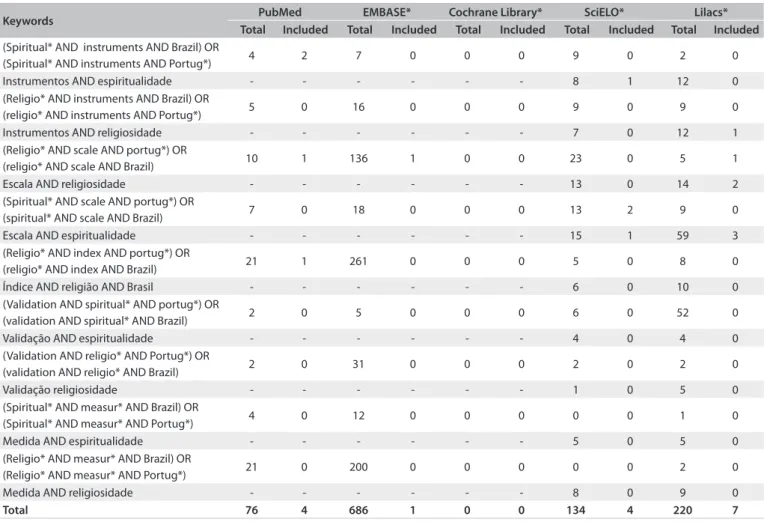
he keywords used (Table 1) were as follows:
• in English: (a) (Spiritual* AND instruments AND Brazil) OR (Spiritual* AND instruments AND Portug*); (b) (Religio* AND instruments AND Brazil) OR (religio* AND instru -ments AND Portug*); (c) (Religio* AND scale AND por -tug*) OR (religio* AND scale AND Brazil); (d) (Spiritual* AND scale AND portug*) OR (spiritual* AND scale AND Brazil); (e) (Religio* AND index AND portug*) OR (reli -gio* AND index AND Brazil); (f) (validation AND spiritual* AND portug*) OR (validation AND spiritual* AND Brazil); (g) (Validation AND religio* AND Portug*) OR (validation AND religio* AND Brazil).
• in Portuguese: (a) Instrumentos AND espiritualidade; (b) Instrumentos AND religiosidade; (c) Escala AND religio-sidade; (d) Escala AND espiritualidade; (e) Índice AND religião AND Brasil; (f) Validação AND espiritualidade; (g) Validação AND religiosidade.
Phase 2 (manual literature search): A manual search of the literature was conducted as an additional phase of the search process, with the aim of identifying studies that were missed in the primary search. Since there seems to be no standard prac-tice with regard to conducting manual literature searches, and in order to increase the search sensitivity, the names of speciic scales were used as keywords. hese scales were chosen based on
those reported by a previous review (conducted by Koenig et al.6
to investigate the most common S/R scales used for research) that was not found in Phase 1.
was included only in this phase because, according to recent studies, “Google Scholar, as for the Web in general, can help in the retrieval of even the most obscure information but its use is marred by inadequate, less often updated, citation
information”8.
he keywords used were as follows:
• (he Santa Clara Strength of Religious Faith Questionnaire) AND (Portug* OR Brazil)
• (Systems of Belief Inventory) AND (Portug* OR Brazil) • (FACIT sp 12) AND (Portug* OR Brazil)
• (Inspirit-R) AND (Portug* OR Brazil)
• (Daily Spiritual Experiences) AND (Portug* OR Brazil) • Fetzer/NIA Multidimensional Measurement of Religiousness/
Spirituality AND (Portug* OR Brazil).
Phase 3 (critical review of instruments): the articles were evaluated taking the following factors into consideration: • Article characteristics: authors, year of publication and pub
-lishing journal.
• Instrument validation process:
• translation process: consisting of (a) forward translation,
i.e. translation of the original language (also called the source language) version of the instrument into another language (oten called the target language); and (b) back translation, i.e. translation of the new language version back into the original language;
• cross-cultural adaptation: if an instrument was
previ-ously validated, this does not necessarily mean that it is valid for use in another time period, culture or context. herefore, it is necessary to adapt instruments used in other cultural settings. As an example, a questionnaire that asks about physical activity and uses cross-coun-try skiing as an example may not be relevant in settings where there is no snow;
• internal consistency: this is the extent to which tests or
procedures assess the same characteristic, skill or quality. It is a measure of the precision among observers or mea-suring instruments used in a study;
• concurrent/convergent validity: this is a measure of the
degree to which a given test correlates with a previously validated measurement;
• discriminative/discriminant validity: this examines the
extent to which a measurement correlates with measures of attributes that difer from the attribute that this mea-surement is designed to assess;
• test-retest procedure: this is the variation in
measure-ment when taken by a single person or instrumeasure-ment on the same item and under the same conditions;
• Setting evaluated: sample characteristics and number of participants.
RESULTS
Data abstraction
Phase 1 (primary literature search): use of the keywords led to retrieval of 76 articles from PubMed (4 included), 686 from EMBASE (1 included), none from the Cochrane Library (none included) and 134 from SciELO (4 included) and 220 from Lilacs (7 included), giving a total of 16 instruments in this phase (Table 1 and Figure 1).
Phase 2 (manual literature search): using scale names as key-words, six scales were examined and four of these were included
in the study (Table 2).
Phase 3 (critical review of instruments): in this phase, all 20 instruments found were evaluated in terms of authors, year of publication, publishing journal, translation process, cross-cul-tural adaptation, internal consistency, concurrent validity,
dis-criminative validity and test-retest procedure (Tables 3 and 4).9-25
In order to facilitate the interpretation of the results, the instruments were evaluated together and the characteristics were assessed separately, identifying advantages, disadvantages and psychometric properties.
Evaluation of general instruments
In this review, 20 instruments available for measuring S/R in the Portuguese language were assessed. Most of these tools (90%) had previously been developed (n = 3), translated and/or vali-dated for Brazilian culture and published in scientiic journals (60%) or as MSc/PhD theses (25%) within Brazilian universities. he majority of the articles providing validation in Portuguese were published in 2011, while the irst was published in 2002 (Portugal). his inding reveals that the ield of S/R research is new in Portuguese-speaking countries and has been increasing over the last decade. Forty-ive percent of the instruments evalu -ate religiosity (organizational, non-organizational and/or intrin-sic), 40% evaluate spirituality, 10% evaluate religious/spiritual coping and 5% evaluate both spirituality and religiosity.
he subjects evaluated by these instruments were drawn from a wide range of settings and included university students, inpatients and oncological patients. Nevertheless, other sub-jects such as epileptic, diabetic, breast cancer and rehabilitation patients were also included in these studies. he mean number of participants recruited for each study was 241.5 (standard devia-tion, SD = 36.7), with sample sizes ranging from 44 to 616.
However, the majority of the studies had not been subjected to an associated in-depth psychometric analysis. Only 40% of the instruments presented conirmed concurrent validity and 45% dis-criminative validity, while 15% had test-retest procedures available.
EVALUATION OF SPECIFIC INSTRUMENTS
he instruments below are listed according to year of publica-tion of their Portuguese versions. References for the original authors of each instrument are also included ater citing the Portuguese version:
a) Francis Scale of Attitude Towards Christianity:9-26 a 24-item
Likert-type instrument concerned with afective responses toward God, Jesus, the bible, prayer and church. Each item is assessed on a ive-point scale from “agree strongly” to “dis-agree strongly”. Church attendance was assessed on a ive-point scale from “never” to “nearly every week” and per-sonal praying was assessed on a ive-point scale from “never” to “daily”. Advantages: complex measurement of afective response towards Christianity. Disadvantages: not suitable for other religious backgrounds (Christianity-focused); it is
extensive but does not have a test-retest procedure or adapta-tion to Brazilian culture.
b) Strayhorn Religious Scale:11-27 a nine-item religiousness
scale without reference to exclusive denominational prac-tices. It evaluates common church practices (attendance, monetary giving and service) and assesses beliefs and prac-tices relating to having a personal relationship with God
(awareness of a religious purpose).28 Advantages: simple,
fast and easy to apply. Disadvantages: the Portuguese ver-sion has no test-retest procedure and has not been validated for internal consistency or concurrent and discriminative ability. he scale evaluates religiosity as opposed to spiri-tuality, and does not separate organizational, non-organi-zational and intrinsic religiosity. he original scale has 12 questions, which is diferent from the Portuguese translated version with 9 questions. During the cross-cultural adap-tation, the authors created a modiied version associating the Strayhorn, Weidman and Larson Religious scale with the Moschella scale, containing 25 items, which they named the Gonçalves, Ferraz and Giglio scale.11
Keywords PubMed EMBASE* Cochrane Library* SciELO* Lilacs*
Total Included Total Included Total Included Total Included Total Included (Spiritual* AND instruments AND Brazil) OR
(Spiritual* AND instruments AND Portug*) 4 2 7 0 0 0 9 0 2 0
Instrumentos AND espiritualidade - - - 8 1 12 0
(Religio* AND instruments AND Brazil) OR
(religio* AND instruments AND Portug*) 5 0 16 0 0 0 9 0 9 0
Instrumentos AND religiosidade - - - 7 0 12 1
(Religio* AND scale AND portug*) OR
(religio* AND scale AND Brazil) 10 1 136 1 0 0 23 0 5 1
Escala AND religiosidade - - - 13 0 14 2
(Spiritual* AND scale AND portug*) OR
(spiritual* AND scale AND Brazil) 7 0 18 0 0 0 13 2 9 0
Escala AND espiritualidade - - - 15 1 59 3
(Religio* AND index AND portug*) OR
(religio* AND index AND Brazil) 21 1 261 0 0 0 5 0 8 0
Índice AND religião AND Brasil - - - 6 0 10 0
(Validation AND spiritual* AND portug*) OR
(validation AND spiritual* AND Brazil) 2 0 5 0 0 0 6 0 52 0
Validação AND espiritualidade - - - 4 0 4 0
(Validation AND religio* AND Portug*) OR
(validation AND religio* AND Brazil) 2 0 31 0 0 0 2 0 2 0
Validação religiosidade - - - 1 0 5 0
(Spiritual* AND measur* AND Brazil) OR
(Spiritual* AND measur* AND Portug*) 4 0 12 0 0 0 0 0 1 0
Medida AND espiritualidade - - - 5 0 5 0
(Religio* AND measur* AND Brazil) OR
(Religio* AND measur* AND Portug*) 21 0 200 0 0 0 0 0 2 0
Medida AND religiosidade - - - 8 0 9 0
Total 76 4 686 1 0 0 134 4 220 7
Table 1. Data abstraction (phase 1 – primary literature search)
PubMed: 76 articles
Embase: 686 articles
Records identified through database searching (n = 1116) Cochrane: 0 articles
SciELO: 134 articles
Lilacs: 220 articles
Records excluded (n = 1055) through exclusion criteria
Records remaining after phase 1 (n = 16)
P
H
A
S
E
1
Records excluded (n = 45) because of repetition of instruments
Additional records identified through Phase 2 (n = 4)
P
H
A
S
E
2
P
H
A
S
E
3
Instruments included in the final analysis (n = 20)
Figure 1. PRISMA (The Preferred Reporting Items for Systematic Reviews and Meta-Analyses) low diagram.
Scale Databases
(The Santa Clara Strength of Religious Faith Questionnaire) AND (Portuguese OR Brazil) Found
(Systems of Belief Inventory) AND (Portuguese OR Brazil) Not found
(FACIT sp 12) AND (Portuguese OR Brazil) Found
(Inspirit-R) AND (Portuguese OR Brazil) Found
(Daily Spiritual Experiences AND (Portuguese OR Brazil) Found
Fetzer/NIA Multidimensional Measurement of Religiousness/Spirituality AND (Portuguese OR Brazil) Not found
Name of scale Authors* Journal Sample type N Francis Scale of Attitude Towards Christianity (Portugal) Ferreira and Neto9 Psychol Rep. University students 323 Strayhorn, Weidman and Larson Religious Scale (Brazil) Gonçalves11 PhD thesis Breast cancer population 130 Moschella Religious Scale (Brazil) Gonçalves11 PhD thesis Breast cancer population 130 Private and Social Religious Practice Scale (Brazil) Drucker15 Master Degree dissertation Depressive older patients 44 Intrinsic Religious Motivation Scale (Brazil) Drucker15 Master Degree dissertation Depressive older patients 44 Spiritual/Religious Coping Scale (Brazil) Panzini and Bandeira20 Psicol Estud. Mixed sample 616 Pinto and Pais-Ribeiro’s Spirituality Scale (Portugal) Pinto and Pais-Ribeiro22 Arq Med. Oncologic patients 426 Brief Santa Clara Strength of Religious Faith (Portugal) Amado25 PhD thesis Elderly outpatients 194
FACIT-Sp 12 (Brazil) Guedes12 PhD thesis Diabetes outpatients 54
Spiritual Well-Being Scale (Brazil) Marques et al.13 Aval Psicol. University students 506 Spirituality Self Rating Scale (Brazil) Gonçalves and Pillon14 Rev Psiq Clín (São Paulo) Male substance/drug users 138 Aquino’s Religiousness/Spirituality Attitude Scale (Brazil) Aquino et al.16 Psicol Cienc Prof. High educated population 299 Duke Religion Index (Brazil) Lucchetti et al.17 J Relig Health. Low income population 383 Pinto and Pais-Ribeiro’s spirituality scale (Brazil) Chaves et al.23 Rev Enferm UFPE Online. Hemodialysis patients 52 WHOQOL-SRPB (Brazil) Panzini et al.19 Rev Saúde Pública. Hospital staf and patients 404 Self-reported Religiosity (Brazil) Lucchetti et al.,18 J Rehabil Med. Rehabilitation patients 110 WHOQOL-100 - SRPB questions (Brazil) Panzini et al.19 Rev Saúde Pública. Hospital staf and patients 404 Brief Spiritual/Religious Coping Scale (Brazil) Panzini et al.19 Rev Saúde Pública. Hospital staf and patients 404
Inspirit-R (Brazil) Veronez et al.21 Arq Neuropsiquiatr. Epilepsy outpatients 50
Daily Spiritual Experience Scale (Brazil) Oliveira24 PhD thesis Clinical/surgical inpatients 179
Intrinsic Religiousness Inventory (Brazil) Taunay et al.10 Rev Bras Psiquiatr. (a)Psychiatric and (b) University students
(a) 102 (b) 323 Table 3. Characteristics of articles on spirituality/religiosity (S/R) instruments available for Portuguese language (by year of publication)
*Only authors who validated their instruments in Portuguese are listed in the table. For original articles and authors, see Discussion.
Table 4. Psychometric properties of spirituality/religiosity (S/R) instruments available for Portuguese language
Name of scale Number of
items
Translation process
Cross-cultural adaptation
Internal consistency
Concurrent validity
Discriminative validity
Test-retest procedure
Francis Scale of Attitude Towards Christianity(P) 24 Yes Yes 0.96 No No No
Strayhorn, Weidman and Larson Religious Scale (B) 9 Yes Yes No No No No
Moschella Religious Scale (B) 34 Yes Yes No No No No
Private and Social Religious Practice Scale (B) 10 Yes Yes N/A No No No
Intrinsic Religious Motivation Scale (B) 12 Yes Yes No No No No
Spiritual/Religious Coping Scale (B) 87 Yes Yes 0.97 Yes Yes No
Pinto and Pais-Ribeiro’s Spirituality Scale (P) 5 N/A N/A 0.74 Yes Yes No
Brief Santa Clara Strength of Religious Faith (P) 5 Yes Yes 0.93 Yes No No
FACIT-Sp 12 (B) 12 Yes Yes No No No No
Spiritual Well-Being Scale (B) 20 Yes Yes 0.92 No No No
Spirituality Self-Rating Scale (B) 6 Yes Yes 0.83 No Yes No
Aquino’s Religiousness/Spirituality Attitude (B) 15 N/A N/A 0.87 Yes Yes No
Duke Religion Index (B)* 5 Yes Yes 0.75 Yes* Yes Yes*
Pinto and Pais-Ribeiro’s Spirituality Scale (B) 5 N/A Yes 0.64 No No No
WHOQOL-SRPB (B) 32 Yes Yes 0.96 Yes Yes Yes
Self-reported Religiosity (B) 1 Yes Yes N/A No No No
WHOQOL-100 - SRPB questions (B) 4 Yes Yes 0.84 Yes Yes Yes
Brief Spiritual/Religious Coping Scale (B) 49 Yes Yes 0.93 Yes Yes No
Inspirit-R (B) 7 Yes Yes No No No No
Daily Spiritual Experience Scale (B) 16 Yes Yes 0.91 No No No
Intrinsic Religiousness Inventory (B) 10 N/A N/A 0.96 Yes Yes Yes
c) Moschella Religious Scale:11,29 a 34-item scale that evaluates
religious involvement (self-reported religiosity and religious attendance), religious struggle and religious coping, among others. Advantages: this is a broad instrument covering some important issues such as religious coping and religious strug-gle. Disadvantages: the scale was tailored for use among can-cer patients and has some items that are related to diseased individuals. he Portuguese version has no test-retest pro-cedure and has not been validated for internal consistency or concurrent and discriminative ability. he scale evaluates religiosity, but not spirituality, and does not separate orga-nizational, non-organizational and intrinsic religiosity. here are some questions such as “Do you believe in elves, fair-ies and wizards?” or “Have you ever sought help from some psychic or fortune teller?” that seem to be out of context. As already stated, during the cross-cultural adaptation, the authors created a modiied version associating the Strayhorn, Weidman and Larson Religious scale with the Moschella scale, containing 25 items, which they named the Gonçalves, Ferraz and Giglio scale.11
d) Private and Social Religious Practice Scale:15,30,31 a 10-item
instrument that assesses the frequency of prayer, religious attendance (i.e. attending a church or temple, and religious meetings), reading religious literature, watching religious programs on television, religiosity in the last decade and
friends in religion, among others.18 Advantages: simple, fast
and easy to apply, and has several qualitative items such as: “Why do you pray?” and “Why has your religiosity increased in the last 10 years?” Disadvantages: does not measure intrin-sic religiosity, but only “private and social religious practice”; there is no associated published paper validating it; and some items are confusing (religious attendance: every day, once a week, once in a while, never; in this case, if the person attends twice a week, none of the options it).
e) Intrinsic Religious Motivation Scale (adapted):15,32 a 12-item
scale in a Likert-like format evaluating two diferent aspects of religiosity: intrinsic and extrinsic. he score ranges from 12 to 60, and higher scores indicate more extrinsic religiosity. Advantages: brief and seeks to separate intrinsic and extrinsic religiosity using the same questionnaire. Disadvantages: no published papers validating the scale are available; and it only separates extrinsic-intrinsic religiosity and does not measure how religious the person is. he scale is complex for less- educated individuals. he Portuguese version was adapted from the original by adding two extra questions (original psychometric qualities should not be used in this version).
f) Spiritual/Religious Coping Scale (SRCOPE):20,33 an 87-item
with subscales that are intended to provide researchers with a tool for measuring the myriad manifestations of religious coping and to help practitioners better integrate religious and
spiritual dimensions into treatments.33 Each of the subscales
consists of items to which participants respond on a ive-point Likert scale ranging from one, “not at all”, to ive, “a great deal”. Advantages: it provides a complex and detailed analysis of spiritual and religious coping (including negative coping) with good psychometric qualities. Disadvantages: a very extensive instrument that is diicult to use in epi-demiological studies and low-income populations and is time-consuming.
g) Pinto and Pais-Ribeiro’s spirituality scale:22,23 an instrument
consisting of ive items centered on two dimensions: one associated with belief and the other associated with hope/ optimism. he responses are of Likert type, given on a scale
of four alternatives, from “do not agree” to “strongly agree”.34
Advantages: simple and easy-to-use instrument, quickly applied, created originally in Portuguese. Disadvantages: three out of the ive facets included in the instrument, i.e. hope, change in life and value, have been associated with reli-gious involvement, but are not themselves relireli-gious/spiritual
facets. he Brazilian version23 has neither a test-retest
proce-dure nor concurrent and discriminative validation.
h) Brief Santa Clara Strength of Religious Faith:25,35 a ive-item
questionnaire designed to measure strength of religious faith on a four-point scale, without taking the respondent’s
reli-gious background into consideration.35 Advantages: easy to
administer and score and straightforward to follow; widely used worldwide. Disadvantages: he Portuguese version lacks a test-retest procedure and discriminative validation; there is no version adapted to Brazilian culture.
i) FACIT-Sp 12:12,36 this consists of 12 items and three
sub-domains of spiritual wellbeing, thus facilitating in-depth exploration of the components constituting spiritual
well-being (peace, meaning and faith).37 All of the FACIT-Sp
questionnaires were designed for self-administration and use a ive-point Likert-type scale to measure patient-reported HRQOL (0 = not at all, to 4 = very much). Advantages: has been used in numerous published papers worldwide. Disadvantages: the Portuguese version lacks a test-retest pro-cedure, internal consistency analysis and concurrent and dis-criminative validation. Some of the facets included in the instrument, e.g. “I have a reason for living”, “I feel peace-ful” and “My life has been productive” have been associated with religious involvement, but do not in themselves denote religiousness/spirituality.
j) Spiritual Well-Being Scale:13,38 a 20-item self-administered
of the items from each subscale were worded with posi-tive meanings and half with negaposi-tive meanings. In Brazil, the scale was translated and adapted for use among univer-sity students and yielded an internal consistency of 0.92. No test-retest, concurrent or discriminative validity anal-yses have been performed. Advantages: much research has used this scale worldwide and it is a brief instrument. Disadvantages: each question on the RWB subscale includes the word “God,” although reviews claim that it is nonsectar-ian. he Portuguese version has no test-retest procedure, or concurrent and discriminative validations.
k) Spirituality Self-Rating Scale:14,39 this relects individuals’
orientation towards spirituality, i.e. whether they consider questions concerning the spiritual/religious dimension to be important, and how they apply this in their lives. he scale consists of six statements, which have Likert-type responses
ranging from totally agree to totally disagree.34 Advantages:
simple, fast and easy to apply. he instrument does not include secularism or quality-of-life measurements, but only spiritual issues. Disadvantages: the Portuguese version cur-rently has no test-retest or concurrent validity.
l) Aquino’s Religiousness/Spirituality Attitude Scale:16,40 a
15-item instrument that evaluates religious attitude (“I feel attached to a higher being”, “I attend the celebrations of my religion/spirituality” and “I seek to know the doctrines or religious precepts”). he participants respond using a ive-point Likert scale ranging from 1 = never to 5 = always. Advantages: created originally in Portuguese; complex yet not extensive. Disadvantages: does not have any test-retest procedure available; evaluates religiosity more than spiritual-ity; and does not separate organizational, non-organizational and intrinsic religiousness.
m) Duke Religion Index:17,41 a ive-item measure of religious
involvement, which yields three subscales: (I) organizational religious behavior (one item); (II) non-organizational reli-gious behavior (one item); and (III) intrinsic relireli-gious moti-vation (three items). he response options are on a ive or six-point Likert scale. Advantages: Simple and easy (vali-dated in a low-income population), fast to apply, cov-ers three religious dimensions, is widely used worldwide
and has good psychometric qualities. Recently, a study42
showed good concurrent analysis and test-retest reliabil-ity (Intraclass Correlation Coeicient > 0.90) relating to this index. Since this study was accepted for publication ater November 2011, it was not included in our system-atic searches but we decided to report its indings here. Disadvantages: does not evaluate spirituality.
n) WHOQOL-SRPB:19,43 this contains 32 questions covering
eight facets of spirituality, religion and personal beliefs relat-ing to health and quality of life, with inal scores rangrelat-ing
from four to 20. Advantages: extensively studied and vali-dated in Brazil with good psychometric qualities; widely used worldwide. Disadvantages: complex and extensive; some of the facets included in the instrument, e.g. meaning of life, awe, wholeness & integration and hope & optimism, have been associated with religious involvement, but they do not
in themselves denote religiosity/spirituality.44 Moreover, the
instrument was primarily designed to evaluate quality of life
and not spiritual beliefs.45
o) Self-reported religiosity:18 also known as subjective
reli-giosity,46 and is assessed by asking respondents to rate the
importance of religion to them with possible answers: “very important”, “somewhat important”, “little important” and “not at all important”. Advantages: simple and easy to measure, particularly for less educated individuals and in epidemiological studies. It is devised to measure intrinsic religiosity. Disadvantages: diicult to measure a multiple complex issue such as religiosity. Since it is not a scale, only
a translation and cross-cultural adaptation are available.18
p) WHOQOL-100 - SRPB questions:19,47 the WHOQOL-100
instrument contains four questions (domain VI) evalu-ating spirituality, religiousness and personal beliefs. he response options are on a ive-point Likert scale from “not at all” to “an extreme amount”. Advantages: brief instrument, easy to complete and ofering good psychometric qualities. Disadvantages: some of the facets included in the instru-ment, e.g. meaning of life and optimism, have been associ-ated with religious involvement, but do not in themselves
denote religiosity/spirituality,44 and the instrument was
pri-marily designed to evaluate quality of life and not spiritual
beliefs.45 It is less complex than the WHOQOL-SRPB.
q) Brief Spiritual/Religious Coping Scale:19,48 a reduced form of
the SRCOPE. his scale includes 49 items divided into two dimensions (positive SRCOPE, 34 items, seven factors; and negative SRCOPE, 15 items, four factors), four general indi-ces and 11 factorials from the means of the items, with results from 1 to 5 for SRCOPE use. Advantages: shorter but com-plex and detailed analysis of spiritual and religious coping with good psychometric qualities. Disadvantages: remains a very extensive instrument that is diicult to use in epidemio-logical studies and low-income population; time-consuming. A good alternative to SRCOPE.
r) Inspirit-R21,49 - he Index of Core Spiritual Experience: this
weight, the patient gives a rating from 1 to 4. Advantages: helps quantify some perceived aspects of spirituality and is a brief instrument. Disadvantages: the Portuguese version lacks a test-retest procedure, internal consistency analysis and concurrent/discriminative validations.
s) Daily Spiritual Experience Scale (DSES):24,50 a 16-item
self-reporting measurement designed to assess ordinary experiences that might have a connection with the transcendent in daily life. It includes constructs such as awe, gratitude, mercy, sense of connection with the transcendent and compassionate love. he scale also includes measurements of awareness of
discern-ment/inspiration and a sense of deep inner peace.51 Advantages:
the DSES is better accepted by non-religious researchers and respondents than many scales, partly due to the substantial
sec-tion of non-explicitly religious quessec-tions.51 he scale is a brief
and quick-to-apply measure that is widely used worldwide. Disadvantages: some of the facets included in the instrument, e.g. “I feel deeper inner peace or harmony” and “I feel a selless caring for others”, have been associated with religious/spiritual involvement, but they do not in themselves denote religious-ness/spirituality. he Portuguese version has no test-retest pro-cedure or concurrent and discriminative validations.
t) Intrinsic Religiosity Inventory:10 A 10-item Likert-type
scale on which each statement is followed by ive possible responses from 1 = never to 5 = always, which evaluates intrinsic religiosity (“People ind their master motive in religion. Other needs, strong as they may be, are regarded
as of less ultimate signiicance”).52 Advantages: simple and
easy instrument that is fast to apply and was created orig-inally in Portuguese. Has good psychometric qualities. Disadvantages: does not evaluate spirituality or organiza-tional and non-organizaorganiza-tional religiosity.
DISCUSSION
Surprisingly, there are 20 S/R instruments for health research in Brazil and Portugal. Before this analysis, a lower number of instru-ments was expected due to the few Brazilian and Portuguese stud-ies in this area over the last few decades. Analysis in greater detail revealed that most of the instruments were translated or cre-ated ater 2005, which coincides with the beginning of
spiritual-ity courses in Brazilian medical schools,53 as well as an increased
number of studies on this issue. his dramatic increase in numbers relects the potential of Portuguese-speaking countries in this ield.
According to the present analysis, most instruments in Portuguese had been translated or developed but not fully validated,
and ofered good psychometric qualities. According to Polit et al.,54
“the reliability of an instrument is a property not of the instrument but of the instrument when administered to a certain sample under certain conditions”. herefore, in the future, all instruments should be validated for a wide variety of diferent samples and in relation to
all psychometric properties, and should have concurrent and dis-criminative validity as well as a test-retest procedure.
his study has some limitations that should be highlighted. Firstly, only the instruments published in PubMed, Embase, Cochrane Library, Google Scholar, SciELO and Lilacs were eval-uated. Although these represent the largest and most appropri-ate databases for review, other measurements published in jour-nals not covered by these databases may exist. In addition, any other instruments published in books or presented in congresses were not included in the inal analysis. Secondly, as pointed out by
Monod et al.,7 the criteria used to include instruments in this type
of review are subject to criticism, since spirituality remains a broad, complex and multidimensional concept that lacks deinitional con-sensus. he exclusion of instruments designed to assess dimen-sions only loosely related to spirituality seems logical (i.e., hope or peace), but not considering instruments measuring broad concepts such as purpose or meaning in life remains a matter of debate.
CONCLUSIONS
Currently, 20 instruments for measuring spirituality and/or reli-giosity are available in the Portuguese language. Most of these instruments have been translated/adapted or developed in Brazil and ofer good internal consistency. Nevertheless, few instru-ments have been fully assessed in relation to psychometrical qualities, or have a test-retest procedure or conirmed concur-rent and divergent validity. Further validation studies are needed in order to fully assess these Portuguese-language instruments on a range of diferent samples.
REFERENCES
1. Koenig HG. Research on religion, spirituality, and mental health: a
review. Can J Psychiatry. 2009;54(5):283-91.
2. Lucchetti G, Lucchetti AL, Koenig HG. Impact of spirituality/religiosity
on mortality: comparison with other health interventions. Explore
(NY). 2011;7(4):234-8.
3. Koenig HG, McCullough ME, Larson DB. Handbook of religion and
health. New York: Oxford University Press; 2001.
4. Sloan RP, Bagiella E, Powell T. Religion, spirituality, and medicine.
Lancet. 1999;353(9153):664-7.
5. Koenig HG, George LK, Titus P. Religion, spirituality, and health
in medically ill hospitalized older patients. J Am Geriatr Soc.
2004;52(4):554-62.
6. Hall DE, Meador KG, Koenig HG. Measuring religiousness in health
research: review and critique. J Relig Health. 2008;47(2):134-63.
7. Monod S, Brennan M, Rochat E, et al. Instruments measuring
spirituality in clinical research: a systematic review. J Gen Intern Med.
2011;26(11):1345-57.
8. Falagas ME, Pitsouni EI, Malietzis GA, Pappas G. Comparison of
PubMed, Scopus, Web of Science, and Google Scholar: strengths and
9. Ferreira AV, Neto F. Psychometric properties of the Francis Scale of
Attitude Towards Christianity among Portuguese university students.
Psychol Rep. 2002;91(3 Pt 1):995-8.
10. Taunay TC, Cristino ED, Machado MO, et al. Desenvolvimento
e validação do Inventário de Religiosidade Intrínseca (IRI)
[Development and validation of the Intrinsic Religiousness Inventory
(IRI)]. Rev Bras Psiquiatr. 2012;34(1):76-81.
11. Gonçalves M. A religiosidade como fator de proteção contra
transtornos depressivos em pacientes acometidas com patologia
oncológica da mama [Religiosity as a protection factor against
depressive disorders in patients with mamma oncologic
pathology]. [Thesis]. Campinas: Faculdade de Ciências Médicas da
Universidade Estadual de Campinas; 2000. Available from: http://
www.bibliotecadigital.unicamp.br/document/?code=000199287.
Accessed in 2012 (Oct 18).
12. Guedes CHFF. Suporte telefônico como uma intervenção para
promover o incentivo à prática de caminhada em pacientes
diabéticos tipo 2: inluência do peril de personalidade nesta resposta
[Phone call as an intervention for improving walking practice in
type 2 diabetes: inluence of personality proile in this response].
[Thesis]. São Paulo: Faculdade de Medicina da Universidade de
São Paulo; 2009. Available from: http://www.teses.usp.br/teses/
disponiveis/5/5159/tde-29042009-103639/pt-br.php. Accessed in
2012 (Oct 18).
13. Marques LF, Sarriera JC, Dell’Aglio DD. Adaptação e validação da
Escala de Bem-estar Espiritual (EBE) [Adaptation and validation of
Spiritual Well-Being Scale (SWS)]. Aval Psicol. 2009;8(2):179-86.
14. Gonçalves AMS, Pillon SC. Adaptação transcultural e avaliação da
consistência interna da versão em português da Spirituality Self
Rating Scale (SSRS) [Transcultural adaptation and evaluation of the
internal consistency of the Portuguese version of the Spirituality Self
Rating Scale (SSRS)]. Rev Psiquiatr Clín (São Paulo). 2009;36(1):10-5.
15. Drucker C. Religiosidade, crenças e atitudes em idosos deprimidos:
em um serviço de saúde mental de São Paulo, Brasil. [Dissertation].
Campinas: Faculdade de Eduação da Universidade Estadual de
Campinas; 2005. Available from: http://www.amebrasil.org.br/html/
ClaudiaDrucker-TESECOMPLETA.pdf. Accessed in 2012 (Oct 18).
16. Aquino TAA, Correia APM, Marques ALC, et al. Atitude religiosa
e sentido da vida: um estudo correlacional [Religious attitude
and the meaning of life: a correlational study]. Psicol Cienc Prof.
2009;29(2):228-43.
17. Lucchetti G, Granero Lucchetti AL, Peres MF, et al. Validation of the
Duke Religion Index: DUREL (Portuguese Version). J Relig Health.
2012;51(2):579-86.
18. Lucchetti G, Lucchetti AG, Badan-Neto AM, et al. Religiousness afects
mental health, pain and quality of life in older people in an outpatient
rehabilitation setting. J Rehabil Med. 2011;43(4):316-22.
19. Panzini RG, Maganha C, Rocha NS, Bandeira DR, Fleck MP. Validação
brasileira do Instrumento de Qualidade de Vida/espiritualidade,
religião e crenças pessoais [Brazilian validation of the Quality of Life
instrument/spirituality, religion and personal beliefs]. Rev Saúde
Pública. 2011;45(1):153-65.
20. Panzini RG, Bandeira DR. Escala de coping religioso-espiritual (Escala
CRE): elaboração e validação de construto [Spiritual/religious coping
scale (SRCOPE Scale): elaboration and construct validation]. Psicol
Estud. 2005;10(3):507-16.
21. Veronez IS, Bicalho MAH, Claudino LS, Walz R, Lin K. Adaptação
transcultural do instrumento INSPIRIT-R no Brasil e aspectos de sua
aplicação em pacientes com epilepsia [Cross-cultural translation of
the INSPIRIT-R for Brazil and its applicability among epilepsy patients].
Arq Neuropsiquiatr. 2011;69(2b):310-5.
22. Pinto C, Pais-Ribeiro JL. Construção de uma escala de avaliação da
espiritualidade em contextos de saúde. Arq Med. 2007;21(2):47-53.
23. Chaves ECL, Carvalho EC, Dantas RAS, et al. Validação da escala de
espiritualidade de Pinto e Pais-Ribeiro em pacientes com insuiciência
renal crônica em hemodiálise [Validation of Pinto and Pais-Ribeiro’s
spirituality scale in patients with chronic renal insuiciency in
hemodialysis]. Rev Enferm UFPE Online. 2010;4(2):715-21. Available
from: http://www.ufpe.br/revistaenfermagem/index.php/revista/
article/view/890/pdf_8. Accessed in 2012 (Oct 18).
24. Oliveira AML. Análise psicométrica da “Daily Spiritual experience
scale” pelo método Rasch [Psychometric analysis of the Daily Spiritual
Experience Scale by Rasch Method]. [Thesis]. São Paulo: Escola de
Enfermagem da Universidade de São Paulo; 2011. Available from:
http://www.teses.usp.br/teses/disponiveis/7/7139/tde-01062011-134231/fr.php. Accessed in 2012 (Oct 18).
25. Amado NMBS. Sucesso no envelhecimento e histórias de vida em idosos
sócio-culturalmente muito e pouco diferenciados. [Thesis]. Lisboa:
Instituto Superior sw Psicologia Aplicada da Universidade Nova de Lisboa;
2008. Available from: http://repositorio.ispa.pt/bitstream/10400.12/39/1/
TES%20AMAD1%20-%2018362.pdf. Accessed in 2012 (Oct 18).
26. Francis LJ. Attitude and longitude: a study in measurement. Character
Potential: A Record of rresearch. 1978;8(3):119-29. Available from: http://
psycnet.apa.org/psycinfo/1979-10095-001. Accessed in 2012 (Oct 18).
27. Strayhorn JM, Weidman CS, Larson D. A measure of religiousness, and its
relation to parent and child mental health variables. Journal of Community
Psychology. 1990;18(1):34-43. Available from: http://onlinelibrary.
wiley.com/doi/10.1002/1520-6629(199001)18:1%3C34::AID-JCOP2290180105%3E3.0.CO;2-M/abstract. Accessed in 2012 (Oct 18).
28. Creel DB. Assessing the inluence of religion on health behavior.
Louisiana: Louisiana State University; 2007.
29. Moschella VD, Pressman KR, Pressman P, Weissman DE. The problem
of theodicy and religious response to cancer. Journal of Religion and
Health. 1997;36(1):17-20. Available from: http://www.jstor.org/discov
er/10.2307/27511087?uid=3737664&uid=2129&uid=2&uid=70&uid
=4&sid=21100723742361. Accessed in 2012 (Oct 18).
30. Ainlay SC, Smith DR. Aging and religious participation. J Gerontol.
1984;39(3):357-63.
31. Allport GW, Ross JM. Personal religious orientation and prejudice. J
32. Hoge R. A validated intrinsic religious motivation scale. Journal for
the Scientiic Study of Religion. 1972;11(4):369-76. Available from:
http://www.jstor.org/discover/10.2307/1384677?uid=3737664&uid
=2129&uid=2&uid=70&uid=4&sid=21100723742361. Accessed in
2012 (Oct 18).
33. Pargament KI, Koenig HG, Perez LM. The many methods of religious
coping: development and initial validation of the RCOPE. J Clin
Psychol. 2000;56(4):519-43.
34. Chaves ECL, Carvalho EC, Beijo LA, Goyatá SLT, Pillon SC. Eicácia
de diferentes instrumentos para a atribuição do diagnóstico de
enfermagem sofrimento espiritual [Eicacy of diferent instruments
for the identiication of the nursing diagnosis spiritual distress]. Rev
Latinoam Enferm. 2011;19(4):902-10.
35. Plante TG, Vallaeys CL, Sherman AC, Wallston KA. The development
of a brief version of the Santa Clara Strength of Religious Faith
Questionnaire. Pastoral Psychology. 2002;50(5):359-68. Available
from:
http://www.scu.edu/cas/psychology/faculty/upload/Plante-SCSRF-brief.pdf. Accessed in 2012 (Oct 18).
36. Peterman AH, Fitchett G, Brady MJ, Hernandez L, Cella D. Measuring
spiritual well-being in people with cancer: the functional assessment
of chronic illness therapy--Spiritual Well-being Scale (FACIT-Sp). Ann
Behav Med. 2002;24(1):49-58.
37. Bredle JM, Salsman JM, Debb SM, Arnold BJ, Cella D. Spiritual
well-being as a component of health-related quality of life: the functional
assessment of chronic illness therapy--spiritual well-being scale
(FACIT-Sp). Religions. 2011;2(1):77-94. Available from: http://www.
mdpi.com/2077-1444/2/1/77/. Accessed in 2012 (Oct 18).
38. Paloutzian RF, Ellison CW. Loneliness, spiritual well-being and the quality
of life. In: Peplau LA, Perlman D, editors. Loneliness: a sourcebook of
current theory, research and therapy. Nova York: Wiley; 1982. p. 224-37.
39. Galanter M, Dermatis H, Bunt G, et al. Assessment of spirituality
and its relevance to addiction treatment. J Subst Abuse Treat.
2007;33(3):257-64.
40. Aquino TAA. Atitude religiosa e crenças dos alunos de psicologia.
Revista da Unipê. 2005;9(1):56-63.
41. Koenig H, Parkerson GR Jr, Meador KG. Religion index for psychiatric
research. Am J Psychiatry. 1997;154(6):885-6.
42. Taunay TCDE, Gondim FAA, Macêdo DS, et al. Validação da versão
brasileira da escala de religiosidade de Duke (DUREL) [Validity of the
Brazilian version of the Duke Religious Index (DUREL)]. Rev Psiquiatr
Clín. 2012;39(4):130-5.
43. World Health Organization. Division of Mental Health and Prevention
of substance abuse. WHOQOL and spirituality, religiousness and
personal beliefs (SRPB). Geneva: World Health Organization; 1998
(Report on WHO consultation).
44. Moreira-Almeida A, Koenig HG. Retaining the meaning of the words
religiousness and spirituality: a commentary on the WHOQOL SRPB
group’s “a cross-cultural study of spirituality, religion, and personal
beliefs as components of quality of life” (62: 6, 2005, 1486-1497). Soc
Sci Med. 2006;63(4):843-5.
45. Fleck MP, Skevington S. Explicando o signiicado do WHOQOL-SRPB
[Explaining the meaning of the WHOQOL-SRPB]. Rev Psiquiatr Clín.
2007;34 suppl 1:146-9.
46. Koenig HG, Ford SM, George LK, Blazer DG. Religion and anxiety
disorder: An examination and comparison of associations in young,
middle-aged, and elderly adults. Journal of Anxiety Disorders.
1993;7(4):321-42. Available from: http://www.sciencedirect.com/
science/article/pii/088761859390028J. Accessed in 2012 (Oct 18).
47. Power M, Harper A, Bullinger M. The World Health Organization
WHOQOL-100: tests of the universality of Quality of Life in 15 diferent
cultural groups worldwide. Health Psychol. 1999;18(5):495-505.
48. Pargament KI, Smith BW, Koenig HG, Perez L. Patterns of positive
and negative religious coping with major life stressors. Journal for
the Scientific Study of Religion. 1998;37(4):710-24. Available from:
http://www.jstor.org/discover/10.2307/1388152?uid=3737664&u
id=2129&uid=2&uid=70&uid=4&sid=21101165351323. Accessed
in 2012 (Oct 18).
49. Kass JD, Friedman R, Leserman J, Zuttermeister PC, Benson H.
Health outcomes and a new index of spiritual experience. Journal
for the Scientific Study of Religion. 1991;30(2):203-11. Available
from: http://www.jstor.org/discover/10.2307/1387214?uid=373
7664&uid=2129&uid=2&uid=70&uid=4&sid=21101165351323.
Accessed in 2012 (Oct 18).
50. Underwood LG, Teresi JA. The daily spiritual experience scale:
development, theoretical description, reliability, exploratory factor
analysis, and preliminary construct validity using health-related data.
Ann Behav Med. 2002;24(1):22-33.
51. Underwood LG. The daily spiritual experience scale: overview and
results. Religions. 2011;2(1):29-50. Available from: http://www.mdpi.
com/2077-1444/2/1/29. Accessed in 2012 (Oct 18).
52. Allport GW, Ross JM. Personal religious orientation and prejudice. J
Pers Soc Psychol. 1967;5(4):432-43.
53. Lucchetti G, Granero A. Integration of spirituality courses in Brazilian
medical schools. Med Educ. 2010;44(5):527.
54. Polit D, Beck C. Nursing research: principles and methods. 7th ed.
Philadelphia: Lippincott Williams and Wilkins; 2004.
Sources of funding: None
Conlict of interest: None
Date of irst submission: April 4, 2012
Last received: August 2, 2012
Accepted: December 12, 2012
Address for correspondence:
Giancarlo Lucchetti
Avenida Juriti 367 — apto 131
Vila Uberabinha — São Paulo (SP) — Brasil
CEP 04520-000