AR
TIGO
AR
TICLE
1 Programa de Doutorado em Epidemiologia, Departamento de Medicina Social, Universidade Federal de Pelotas. Av. Duque de Caxias 250, Fragata. 96001-970 Pelotas RS Brasil. [email protected]
Moderate hyperopia prevalence and associated factors
among elementary school students
Prevalência de hipermetropia e fatores associados
em escolares do ensino fundamental
Resumo A hipermetropia é o estado refrativo mais comum na infância. Este estudo objetiva investigar a prevalência de hipermetropia mode-rada e fatores associados entre escolares, tendo em vista haver poucos estudos sobre o assunto. Méto-dos: Estudo transversal com 1.032 crianças do 1º ao 8º anos de duas escolas públicas da zona urba-na de uma cidade do sul do Brasil, no período de abril a dezembro de 2012. Ambos os olhos foram cicloplegiados e o erro refrativo foi medido através de autorrefração. Foi aplicado questionário socio-econômico e cultural. A análise multivariada foi realizada utilizando a regressão de Poisson. Resul-tados: A prevalência de hipermetropia moderada foi de 13,4% IC95% (11,2% – 15,4%) e 85% deles não usam óculos. Idade ficou inversamente asso-ciada com hipermetropia moderada enquanto sexo feminino OR=1,39 IC95% (1,02 – 1,90) e cor de pele branca OR=1,66 IC95% (1,04 – 2,66) foram fatores de risco para o desfecho. Conclusão: Este estudo avança na estimativa de prevalência de hipermetropia leve e moderada por faixa etária e por idade específica, enfatizando o grave proble-ma da falta de correção no sul do Brasil. O estudo destaca a importância de detalhar e caracterizar a quantidade de tempo gasto em atividades de longe e de perto e ao ar livre.
Palavras chave Hipermetropia, Prevalência, Criança, Adolescente, Estudante
Abstract Hyperopia is the most common refrac-tive condition in childhood. There are few studies on moderate hyperopia and associated factors. This study aims to investigate the prevalence of moderate hyperopia and associated factors among school children. A cross-sectional study compris-ing 1,032 students attendcompris-ing 1st to 8th grades at two public schools was conducted in a Southern Brazilian urban area in 2012. Cycloplegia was used to examine both eyes and refractive error was measured through auto-refraction. A socio-economic and cultural questionnaire was admin-istered. Multivariable analysis was performed through Poisson regression. Moderate hyperopia prevalence was 13.4% (95% CI, 11.2-15.4) and 85% of these did not wear glasses. Age was in-versely associated with moderate hyperopia, while female gender RP = 1.39 (95%CI, 1.02 – 1.90) and white skin RP = 1.66 (95%CI, 1.04 – 2.66) were risk factors for this outcome. This study makes progress in estimating mild and moderate hyperopia prevalence both by age range and spe-cific age. It emphasizes how the lack of this condi-tion being corrected in southern Brazil is a serious problem. It highlights the importance of detailing and characterizing the amount of time spent on close-range, long-range and outdoor activities.
Key words Hyperopia, Prevalence, Children, Ad-olescent, Student
C
astag
no VD
Introduction
Hyperopia is the most common refractive
con-dition in childhood1. Despite its association with
accommodative esotropia and amblyopia, there is no consensus among eye care professionals on the cut-off point or the age at which correction
should be prescribed2. The main concerns about
treatment relate to how important hyperopia re-ally is in the emmetropization process and the lack of evidence that correcting hyperopia in children can positively impact on school
per-formance2,3. Moreover, more complete
examina-tions such as those that evaluate the binocular
and accommodative functions are neglected3,4. As
a result there is lack of information about these disorders and their association with moderate hyperopia.
There is great variability in moderate hyper-opia prevalence among children and adolescents in these studies, even among those using similar methodology, such as the studies that followed the Refractive Error Study in Children (RESC)
proto-col5. In the literature, moderate hyperopia
preva-lence ranged from 2.8%6 to 28.9%7 among
7-year-old-children, 1.4%8 to 12.4%7 among 10-year-olds
and 0.5%9 to 10.3%7 among those aged 15. In the
5-15 age group, moderate hyperopia prevalence
ranged from 2.1%10 to 19.3%11,12. There is no clear
explanation for this age-specific variability. Al-though there are a significant number of studies on hyperopia prevalence, only a few have assessed
factors associated with moderate hyperopia1.
According to the literature, hyperopia is
inversely correlated to age7-9,11-21 and is more
common among White children1,22-24, whilst its
association with gender6-10,12-16,18-23,25-32, parental
education1,6,9,25,27,33,34 and family income16,27,28 is
inconclusive. With regard to environmental fac-tors, a direct association has been found between spending more time engaged in outdoor activi-ties and hyperopia in children, although
litera-ture on this aspect is very scarce1,35,36.
This study aims to investigate the prevalence of moderate hyperopia and associated factors among elementary school students.
Methods
A cross-sectional study was conducted
involv-ing all students attendinvolv-ing the 1stto 8th grades at
two public schools in the urban area of Pelotas, a medium-sized city in Rio Grande do Sul State (Southern Brazil) from April to December 2012.
According to the 2010 census, Pelotas has ap-proximately 328,300 inhabitants, some 41,000 of
whom are aged 0-1437.
The study population (n = 1032) enabled moderate hyperopia prevalence to be estimated
(≥ +2.00 D), with a 95% significance level and
an acceptable error of 2.2 percentage points, plus 10% to account for possible losses. Statistical power of 80% was obtained to detect prevalence ratios of 2.0 or higher with a 95% confidence lev-el for this association, which showed an ‘exposed/ unexposed’ relationship of 2:1 and moderate hy-peropia prevalence of 12% among the unexposed. The study population was based on the lists of students provided by the schools. As the lists showed inconsistencies, visits and telephone con-tacts were made to identify students whose names were on the lists provided by the schools but were actually attending other schools. These students were excluded from the study. All students older than 16 present inappropriate grade for age, thus, to avoid selection bias they were also excluded.
The eye examinations and eye drop instilla-tion were performed by two technicians super-vised by an ophthalmologist in adapted rooms in the two schools. The socio-economic/demo-graphic questionnaire was administered at the schools or at the students’ homes by a trained interviewer to the person responsible for each student.Refractive measures were expressed in spherical equivalent (SE ), calculated as the alge-braic sum of the spherical measure plus half the
cylindrical power5. SE for moderate hyperopia
was: hyperopia SE ≥ +2.00D (one or both eyes
with no myopia, characterized as SE ≤ 0.50 D)1,5.
Hyperopia of ≥ + 1.25 was also considered.
Ac-cording to Rosner38, when this point is reached
the use of correction should be started in order to avoid problems with school performance .
A 5 minute interval was left between the first and the second drop of cyclopentolate 1%, being instilled. Direct photomotor reflex and pupil size were observed after a further 20 minute interval. A third drop was instilled into both eyes if pupils
were photoreactive or their diameter was ≤ 6mm.
Signs of pupillary dilation were checked once more after a further 15 minutes.
aúd
e C
ole
tiv
a,
20(5):1449-1458,
2015
Other variables related to visual function were also collected during the study period. A third technician specialized in refraction and or-thoptics therefore measured accommodative am-plitude using the push-up technique performed in open space on 10% of the sample for the
pur-poses of quality control. The Bland & Altman39
method was uses to assess agreement between the examiners’ measurements and those of the tech-nician responsible for quality control.
The demographic variables studied were: gender (male or female), age (in years) and skin color as observed by the interviewer (white, black, brown, yellow and indigenous). Age range was categorized as 6-8, 9-12 and 13-16 years, and skin color as white, black and other. Heredity was dichotomized whereby hyperopia was considered to have been inherited when both students’ par-ents wore glasses and had started to wear them before they were 40 years old. Economic status was classified according to the criteria of the Brazilian Association of Research Companies
(ABEP)40. As information on the education of the
head of household was not available in the study, maternal education was used instead.
Students’ main activities when not at school were dichotomized (yes/no): watching TV, play-ing computer or video games, readplay-ing, playplay-ing outside and sports.
With regard to the appropriateness of age compared to school grade, 8 years of age or less was considered to be appropriate for the first grade, 9 years or less was considered to be appro-priate for the second grade and so on successively for each grade. Age ranges outside those defined for each grade were considered to be inappropri-ate for the respective grade.
Analyses were performed using Stata (version 11.0). Crude analysis assessed associations using the chi-square test for heterogeneity. Adjusted analysis was performed using Poisson regression with robust variance and backward selection. The study’s conceptual model guided the hierarchical analysis (Figure 1). Thus, demographic variables and heredity were the distal determinants eval-uated; socioeconomic level was the intermediate determinant; and proximal determinants were the main activities engaged in by children and adolescents out of school and which were charac-terized as far (watching TV), near (reading, play-ing computer or video games), outdoor (playplay-ing outside) and sports activities (Figure 1). In order to control for confounding, variables showing a
≤ 0.20 p value were kept in the model and ≤ 0.05
p values were considered statistically significant.
The study was approved by the Ethics Com-mittee of the Federal University of Pelotas (UF-Pel) School of Medicine and approved by the boards of both elementary schools. Study sub-jects and their parents had their right to refuse to take part and information confidentiality was guaranteed. Those who agreed to participate in the study underwent cycloplegic examinations and answered questionnaires only after parents and/or guardians had signed the informed con-sent form. Correction was prescribed for those cases needing it and those requiring ophthalmo-logic follow-up were treated at the UFPel School of Medicine Ophthalmology Clinic. The study was conducted in compliance with the ethical
principles of the Declaration of Helsinki41, and
National Health Council42.
Results
Of a total of 1,128 students from both schools, 1,032 underwent the cycloplegia examination followed by auto-refraction (8.5% losses and re-fusals). After excluding 12 individuals older than 16 years, the study was comprised of 1,020 stu-dents aged 6 to 16 years old.
Average age was 10.6 years (SD = ± 2.7) and 55% of the students were boys. Regarding hered-ity, at least one of the parents of 28.1% of the stu-dents began wearing glasses before 40 years of age and 6% had both parents in this condition. Most of the studied students (58.5%) belonged to
eco-Figure 1. Conceptual framework that guided the
hierarchical analysis.
Demographic variables:
age, gender and skin color Heredity
Socioeconomic variables: economic status
Activities out of school: TV, reading,
computer, video-game, playing outside, sports
MODERATE HYPEROPIA (≥ +2.00)
DIST
AL
INTERMEDIA
TE
PR
O
XIMAL
OUT
C
astag
no VD
nomic level ‘C’, 79% were White and only 15.5% of the students practiced sports. When asked about the main activities the students engaged in out of school, 19% reported outdoor activities, 36% watching TV, 31% playing video or comput-er games, and 2% reading. Half the children and adolescents studied were older than the expected age for their grade owing to having fallen behind in their academic performance (Table 1).
Moderate hyperopia prevalence was 13.4%
(95% CI, 11.2%-15.4%), while hyperopia ≥
+1.25D prevalence was 34.0% (95% CI, 31.1%-36.9%). In the 6-7 and 12-13 age groups, mod-erate hyperopia prevalence was 21.7% (95% CI, 15.2%-28.1%) and 8.8% (95% CI, 5.2%-12.5%), respectively (Table 2). Taking the students stud-ied as a whole, hyperopic spherical equivalent
was most common in all specific ages. 85% of students diagnosed as being moderately hyper-opic did not wear glasses (Table 1).
Around 20% of children aged 6-7 years and 14% aged 9, 10 and 11 years had moderate hyper-opia. Moderate hyperopia prevalence was around 9% among children and adolescents aged 12 or
older (Table 2). The prevalence of hyperopia ≥
+1.25D by specific age was more homogeneous. Prevalence was around 40% in those aged 6-11, decreasing to 28% at the age of 13 years and reaching 15% at 14 years (Table 2).
Examination of the crude analysis revealed no statistically significant association between moderate hyperopia and heredity, economic lev-el, playing outside, playing sports, watching TV and playing computer or video games. Playing
Variables
Gender (n = 1,020) Male
Female Age (n = 1.020)
13-16 9-12 6-8
Skin color (n = 1,020) Non-white White
Heredity – wearing glasses (n = 988)**
Neither parents wear glasses / one does not wear glasses and the other started wearing them after 40 years old / both started wearing after 40 years old
One of the parents wearing glasses before 40 years old Both parents wearing glasses before 40 years old Economic status (ABEP)Ω(n = 984)***
A+B C D+E
Plays outside£ (yes) Play sports£ (yes) Watches TV£ (yes)
Plays computer or video games£ (yes) Reads£ (yes)
Grade versus age appropriateness€
(n = 1.008) (appropriate) Moderate hyperopic (n = 137) NOT wearing glasses
N
564 456
290 453 277
215 805
650
278 60
351 574 59 190 155 358 309 20 508 117
%
55.3 44.7
28.4 44.4 27.2
21.0 79.0
65.8
28.1 6.1
35.7 58.3 6.0 19.0 15.5 35.8 30.9 2.0 50.4 85.4
Table 1. Description of the sample according to the following variables: demographic characteristics, heredity,
economic status, children’s activities, playing sports, wearing glasses, length of time children have being having eye care appointments, and appropriateness of school grade versus age. Pelotas-RS, Brazil, 2013.
** 32 parents/guardians had no knowledge of or could not recall using eye correction for themselves or for their spouse (when only one of the parents answered the questionnaire) or had no knowledge of or could not recall the child’s parents using of correction (when another relative/guardian answered the questionnaire). Ω Brazilian Association of Research Companies. *** 36 parents/ guardians had no knowledge of or refused to provide information on the education of the child’s mother. N = £
999. €
aúd
e C
ole
tiv
a,
20(5):1449-1458,
2015
outside (p = 0.106) and watching TV (p = 0.087) were kept in the model in order to control for confounding (Table 3).
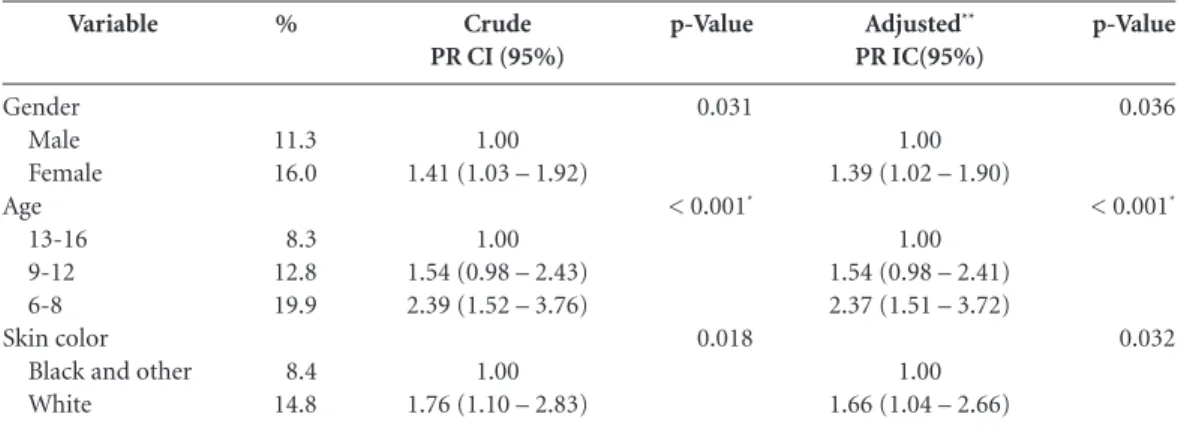
Examination of the association between moderate hyperopia and independent variables showed, after adjustment for confounding fac-tors, that girls were 39% more hyperopic than boys RP = 1.41(95% CI, 1.02-1.90) and White were 66% more hyperopic than Black RP = 1.66(95% CI, 1.04-2.66). Age had an inverse as-sociation with hyperopia (p<0.001). Those aged 6-8 were twice as likely to be hyperopic than those aged 13-16 RP = 2.37(95% CI, 1.51-3.72) (Table 4). Socioeconomic status, heredity and the variables relating to the students’ main activities out of school were not significantly associated with the outcome (p > 0.05).
The mean difference between the readings obtained by examiners and the gold standard with regard to the measurement of accom-modative amplitude for quality control using the Bland-Altman method was 1.0D (95% CI, 0.57D-1.45D) and the agreement between the examiners’ measurements and the gold standard regarding accommodative insufficiency when us-ing the kappa statistic was 1.0.
Age (N)
6 (69) 7 (92) 8 (116) 9 (112) 10 (113) 11 (114) 12 (114) 13 (123) 14 (102) 15* 16*
≥ + 2.00D
Prevalence % (95% CI)
23.1 (12.9 – 33.4) 20.6 (12.2 – 29.0) 17.2 (10.2 – 24.2) 13.3 (6.9 – 19.7) 14.1 (7.6 – 20.0) 14.9 (8.2 – 21.5) 8.7 (3.4 – 14.0) 8.9 (3.8 – 14.0) 5.8 (1.2 – 10.5)
-≥ + 1.25
Prevalence % (95% CI)
43.4 (31.4 – 55.4) 48.9 (38.5 – 59.3) 46.5 (37.3 – 55.7) 34.8 (25.8 – 43.7) 38.9 (29.8 – 48.0) 40.3 (31.2 – 49.4) 28.0 (19.6 – 36.4) 22.7 (15.2 – 30.2) 14.7 (7.7 – 21.6)
-Table 2. Age-specific hyperopia prevalence.
N Sample size, D diopters, CI confidence interval. * Specific ages with insufficient N.
Variables
Heredity – wearing glasses (n = 988)*
Neither parents wear glasses / one does not wear glasses and the other started wearing them after 40 years old / both started wearing after 40 years old
One of the parents wearing glasses before 40 years old Both parents wearing glasses before 40 years old Economic status (ABEP)Ω (n = 984)**
A+B C D+E Plays outside €
No Yes Play sports €
No Yes Watches TV €
No Yes
Computer or video games €
Yes No
%
14.6
12.5 10.0
13.1 14.5 11.9
14.6 10.0
13.7 13.5
12.3 16.2
11.5 14.6
Crude PR CI (95%)
1.00
0.86 (0.60 – 1.23) 0.68 (0.31 – 1.49)
1.00 1.10 (0.78 – 1.54) 0.90 (0.42 – 1.90)
1.00 0.68 (0.43 – 1.08)
1.00 0.98 (0.63 – 1.51)
1.00 1.31 (0.96 – 1.79)
1.00 1.25 (0.87 – 1.75)
Table 3. Moderate hyperopia (≥ + 2.00D D): prevalence and crude analysis of associated factors. Pelotas, RS,
Brazil, 2013. (n = 1020).
p-Value
0.234
0.822
0.106
0.948
0.087
0.209
PR prevalence ratio; CI confidence interval. * 32 parents/guardians had no knowledge of or could not recall using eye correction for themselves or for their spouse (when only one of the parents answered the questionnaire) or had no knowledge of or could not recall the child’s parents using of correction (when another relative/guardian answered the questionnaire). Ω Brazilian Association
of Research Companies. **36 parents/guardians had no knowledge of or refused to provide information on the education of the child’s mother. €
C
astag
no VD
Discussion
Almost one fifth of the school population was
diagnosed as having moderate hyperopia (≥
+2.00D SE) and more than three-quarters of these did not use correction and half the chil-dren and adolescents were older than expected for the school grade they were attending. Age was inversely associated with moderate hyperopia, while female sex and white skin color were di-rectly associated. Heredity, economic level, play-ing outside, playplay-ing sports, watchplay-ing TV, playplay-ing computer or video games and reading were not associated with moderate hyperopia.
This study was conducted in two schools in the same neighborhood, with strong representa-tion of lower-middle income families and there-fore not representative of different economic levels. On the other hand, the study evaluated refractive error in students objectively through auto-refraction. The low percentage of losses and refusals reinforces the validity of the findings. Al-though there is an overestimation of the amount of refractive errors using an auto-refractor in comparison with retinoscopy, the difference be-tween the two test methods is not significant in
the determination of refractive errors5. The
in-stillation of cycloplegic drops followed the pro-tocol used in the major population-based studies on refractive errors, and cycloplegia precision control was performed by observing direct pho-tomotor reflection and pupil size in each eye
be-fore auto-refraction5. The cut-off point for
mod-erate hyperopia (SE ≥ +2.00D) also followed the
RESC protocol, thus enabling consistency with other studies to be evaluated.
There is little evidence to support the defini-tion of the ideal cut-off point for starting hypero-pia correction. Some authors do not recommend the prescription of correction for young children because it decreases the stimulus (hyperopic de-focus) which regulates the growth of the eye and the interactions between the ocular components during the emmetropization period. Other au-thors emphasize that the emmetropization peri-od occurs very quickly, centering on the first year of life, and that the role of hyperopic defocus is not clear as the main agent in stimulating
em-metropization during childhood2. Also, there is
controversy about the need to take into account the binocular and accommodative functions in defining hyperopia correction. However, Rosner showed that hyperopic children with refractive errors greater than +1.25D without correction
had worse school performance4,38,43 suggesting
that the lack of correction in children with mod-erate hyperopia, as found in this study, is a seri-ous problem.
The prevalence of moderate hyperopia among children and adolescents aged 6-16 years was higher than that observed in most other
studies using the same age range4,17-23. Prevalence
was similar to the 16.6% (95% CI, 13.6%-19.7%) found in Iran, lower than the 19% found in Chile
and in another study conducted in Iran11,12. With
regard to other age ranges, the 26% (95% CI, 20%-33%) prevalence of moderate hyperopia
found in Northern Ireland20 and the 12.3% (95%
CI, 8.8%-15.7%) found in England34 in children
aged 6-7 is within the estimated prevalence confi-dence interval in this study. Among children and adolescents aged 12-13, the prevalence of
moder-Variable
Gender Male Female Age
13-16 9-12 6-8 Skin color
Black and other White
%
11.3 16.0
8.3 12.8 19.9
8.4 14.8
Crude PR CI (95%)
1.00 1.41 (1.03 – 1.92)
1.00 1.54 (0.98 – 2.43) 2.39 (1.52 – 3.76)
1.00 1.76 (1.10 – 2.83)
Table 4. Adjusted analysis of factors associated with moderate hyperopia (≥ +2,00D). Pelotas, Brazil 2013. (n =
1,020).
p-Value
0.031
< 0.001*
0.018
Adjusted**
PR IC(95%)
1.00 1.39 (1.02 – 1.90)
1.00 1.54 (0.98 – 2.41) 2.37 (1.51 – 3.72)
1.00 1.66 (1.04 – 2.66)
p-Value
0.036
< 0.001*
0.032
aúd
e C
ole
tiv
a,
20(5):1449-1458,
2015
ate hyperopia was also similar to the 5.4% (95%
CI, 2.8-8.0) found in England34.
Regarding moderate hyperopia prevalence by specific age, in a study conducted in Australia Ip et al. found 13.2% (95% CI, 11.1-15.2) in chil-dren aged 6 years and 5.0% (95% CI, 4.1%-5.8%)
in those aged 121. These findings are consistent
with our study. Moderate hyperopia prevalence in the 7-11 specific age group was similar to that found in the population-based study conducted by Fotouhi in Dezful, Iran, with 5,544 students
and a 96.8% response rate7.
In agreement with most studies in the liter-ature, age was inversely associated with
moder-ate hyperopia7,9,11-13,15,17,18,21,27,44. The process of
emmetropization and eye growth stimulated by hyperopic defocus is minimal after 3 years of age, which mitigates the variability of hyperopic
er-ror2. Nevertheless, there is evidence that the axial
length of the eye continues to increase until the age of 12 to 14 years, suggesting a decrease in the
hyperopic spherical equivalent as age increases45.
In this study girls were more hyperopic than boys. This finding is consistent with the risk of between 20% and 50% reported by some arti-cles10,11,13. However, most studies showed no
sig-nificant association between gender and moder-ate hyperopia among children and adolescents
aged 5-176-9,12,15,18,20-22,26,29-31. With regard to
ocu-lar components, on average girls’ eyes have lower
axial length when compared to boys19,22,45-48, thus
increasing their chance of being hyperopic. Dif-ferences in the association between gender and far and near activities in different cultures may affect the association between gender and
hyper-opia36. Furthermore, although genders are well
represented in the literature, they may have selec-tion bias, whether because of the greater difficul-ty girls face in accessing schools in some cultures, or because of their being more willing to partici-pate in health studies.
White students showed higher moderate hyperopia prevalence than non-white students. This result agrees with a study conducted in
England with children aged 6-7 years34 and
Kleinstein et al.’s study in the United States with children and adolescents aged 5-17 years, using a hyperopia cut-off point greater than or equal
to +1.25D23. With regard to ocular components,
White children and adolescents can be expected to present higher moderate hyperopia prevalence than Black ones because the axial length of their eyes is less than that of Black children and
adoles-cents49. Moreover, differences in economic status,
cultural aspects and far and near activities also
impact the association between skin color and moderate hyperopia.
Population-based studies have observed high hyperopia prevalence rates among members of
the same family (familial aggregation)35,50 as well
as increased correlation between high hyperopia and monozygotic twins when compared to dizy-gotic twins, suggesting a strong genetic
compo-nent3,51. In this study, the fact that parents wore
glasses before the 40 years of age was not associ-ated with moderate hyperopia in their children, although a limitation was that parents’ refractive error type was not defined precisely.
There was no association between outdoor activities (sports and playing outside) and mod-erate hyperopia. Literature shows that children and adolescents who spend more hours per week engaged in outdoor activities (including sports) are more hyperopic than those who spend less
time doing these activities1,35,36. Outdoor
activ-ities do not require much accommodation and
therefore stimulate axial length less49,52. The
greater intensity of the light in outside environ-ments causes reflexive miosis, thus increasing
focus depth and image sharpness36. Light also
stimulates dopamine release, thus inhibiting
oc-ular growth36,50.
There is no consensus on classifying ‘watching TV’ in terms of distance. Some studies consider it to be intermediate, others have classified it as
near1,53, while the present study considered it to be
far, based on the hypothesis that watching TV may be a risk factor for moderate hyperopia. In keep-ing with the literature, no association was found between watching TV and moderate hyperopia.
No association was found between near ac-tivities (reading and playing computer and vid-eo games) and moderate hyperopia. According to the literature, children who spend more hours per week engaging in near activities such as doing homework, studying, reading for pleasure, play-ing a musical instrument and usplay-ing the computer are less hyperopic when compared to those who spend fewer hours per week performing these
ac-tivities35,53. The study conducted by Rose in
Aus-tralia showed a modifying effect of ethnicity, since Caucasian children tended to be less hyperopic the more they increased the time spent doing near activities, whilst this association was not observed
among children of Asian origin36. Near activities
place greater demands on the accommodative and
binocular processes to keep images sharp2.
One study has shown that the time devoted to console games is a risk factor for hyperopia
C
astag
no VD
between playing computer or video games and moderate hyperopia. The association examined included activities involving different degrees of visual effort, whereby using a computer was con-sidered to be a much nearer activity than playing video games.
This study has made progress in estimating the prevalence of mild and moderate hyperopia both by age range and specific age, emphasizing the se-rious problem of the lack of this condition being corrected in Southern Brazil. It also indicates the inverse association between age and hyperopia, as well as the positive association between hyperopia and female gender and white skin color. Future studies should further examine genetic factors
related to moderate hyperopia, with improved evaluation of parental refractive errors. The eval-uation of far, near and outdoor activities is still scarce in the literature and there is no consensus on their classification. It is important for far, near and outdoor activities to be detailed, as well as to characterize the time devoted to each activity and accurately separate activities requiring dif-ferent degrees of visual effort. There is significant variability in moderate hyperopia prevalence be-tween the different studies. Researchers need to reflect on whether the causal chain that is being examined comprises this variability or if there are other aspects that should be evaluated, such as nutritional factors, for example.
Collaborations
VD Castagno prepared the project, carried out the work field, analyzed the data and wrote the article. AG Fassa developed the project, held the field work, analyzed the data and wrote the ar-ticle. MAP Vilela contributed to interpretation data and the review of the article writing. RD Meucci developed the project, carried out the work field, analyzed the data and wrote the arti-cle. DPM Resende contributed to the interpreta-tion of data the review of the article writing.
Acknowledgements
aúd
e C
ole
tiv
a,
20(5):1449-1458,
2015
Yekta A, Fotouhi A, Hashemi H, Dehghani C, Ostad-imoghaddam H, Heravian J, Derakhshan A, Yekta R, Behnia M, Khabazkhoob M. Prevalence of refractive errors among schoolchildren in Shiraz, Iran. Clin
Ex-periment Ophthalmol 2010; 38(3):242-248.
Zadnik K, Manny RE, Yu JA, Mitchell GL, Cotter SA, Quiralte JC, Shipp M, Friedman NE, Kleinstein R, Walker TW, Jones LA, Moeschberger ML, Mutti DO; Collaborative Longitudinal Evaluation of Ethnicity and Refractive Error (CLEERE) Study Group. Ocular com-ponent data in schoolchildren as a function of age and gender. Optom Vis Sci 2003; 80(3):226-236.
O’Donoghue L, McClelland JF, Logan NS, Rudnicka AR, Owen CG, Saunders KJ. Refractive error and visual impairment in school children in Northern Ireland. Br
J Ophthalmol 2010; 94(9):1155-1159.
Rezvan F, Khabazkhoob M, Fotouhi A, Hashemi H, Os-tadimoghaddam H, Heravian J, Azizi E, Khorasani AA, Yekta AA. Prevalence of refractive errors among school children in Northeastern Iran. Ophthalmic Physiol Opt 2012; 32(1):25-30.
Ip JM, Huynh SC, Robaei D, Kifley A, Rose KA, Morgan IG, Wang JJ, Mitchell P. Ethnic differences in refrac-tion and ocular biometry in a popularefrac-tion-based sam-ple of 11-15-year-old Australian children. Eye 2008; 22(5):649-656.
Kleinstein RN, Jones LA, Hullett S, Kwon S, Lee RJ, Friedman NE, Manny RE, Mutti DO, Yu JA, Zadnik K; Collaborative Longitudinal Evaluation of Ethnicity and Refractive Error Study Group. Refractive error and eth-nicity in children. Arch Ophthalmol 2003; 121(8):1141-1147.
Giordano L, Friedman DS, Repka MX, Katz J, Ibironke J, Hawes P, Tielsch JM. Prevalence of refractive error among preschool children in an urban population: the Baltimore Pediatric Eye Disease Study. Ophthalmology 2009; 116(4):739-746.
Murthy GV, Gupta SK, Ellwein LB, Munoz SR, Pokharel GP, Sanga L, Bachani D. Refractive error in children in an urban population in New Delhi. Invest Ophthalmol Vis Sci 2002; 43(3):623-631.
Gronlund MA, Andersson S, Aring E, Hard AL, Hell-strom A. Ophthalmological findings in a sample of Swedish children aged 4-15 years. Acta Ophthalmol
Scand 2006; 84(2):169-176.
Dandona R, Dandona L, Srinivas M, Sahare P, Narsaiah S, Munoz SR, Pokharel GP, Ellwein LB. Refractive error in children in a rural population in India. Invest
Oph-thalmol Vis Sci 2002; 43(3):615-622.
Dandona R, Dandona L, Naduvilath TJ, Srinivas M, McCarty CA, Rao GN. Refractive errors in an urban population in Southern India: the Andhra Pradesh Eye Disease Study. Invest Ophthalmol Vis Sci 1999; 40(12):2810-2818.
Casson RJ, Kahawita S, Kong A, Muecke J, Sisaleum-sak S, Visonnavong V. Exceptionally Low Prevalence of Refractive Error and Visual Impairment in Schoolchil-dren from Lao People’s Democratic Republic.
Ophthal-mology 2012; 119(10):2021-2027.
18.
19.
20.
21.
22.
23.
24.
25.
26.
27.
28.
29. References
Ip JM, Robaei D, Kifley A, Wang JJ, Rose KA, Mitchell P. Prevalence of hyperopia and associations with eye findings in 6- and 12-year-olds. Ophthalmology 2008; 115(4):678-685.
Mutti DO. To emmetropize or not to emmetropize? The question for hyperopic development. Optom Vis Sci 2007; 84(2):97-102.
Tarczy-Hornoch K. The epidemiology of early child-hood hyperopia. Optom Vis Sci 2007; 84(2):115-123. Rosner J. The still neglected hyperope. Optom Vis Sci 2004; 81(4):223-224.
Negrel AD, Maul E, Pokharel GP, Zhao J, Ellwein LB. Refractive Error Study in Children: sampling and mea-surement methods for a multi-country survey. Am J
Ophthalmol 2000; 129(4):421-426.
Naidoo KS, Raghunandan A, Mashige KP, Govender P, Holden BA, Pokharel GP, Ellwein LB. Refractive error and visual impairment in African children in South Af-rica. Invest Ophthalmol Vis Sci 2003; 44(9):3764-3770. Fotouhi A, Hashemi H, Khabazkhoob M, Moham-mad K. The prevalence of refractive errors among schoolchildren in Dezful, Iran. Br J Ophthalmol 2007; 91(3):287-292.
Goh PP, Abqariyah Y, Pokharel GP, Ellwein LB. Refrac-tive error and visual impairment in school-age children in Gombak District, Malaysia. Ophthalmology 2005; 112(4):678-685.
He M, Zeng J, Liu Y, Xu J, Pokharel GP, Ellwein LB. Refractive error and visual impairment in urban chil-dren in southern china. Invest Ophthalmol Vis Sci 2004; 45(3):793-799.
Pokharel GP, Negrel AD, Munoz SR, Ellwein LB. Re-fractive Error Study in Children: results from Mechi Zone, Nepal. Am J Ophthalmol 2000; 129(4):436-444. Maul E, Barroso S, Munoz SR, Sperduto RD, Ellwein LB. Refractive Error Study in Children: results from La Florida, Chile. Am J Ophthalmol 2000; 129(4):445-454. Ostadimoghaddam H, Fotouhi A, Hashemi H, Yekta A, Heravian J, Rezvan F, Khabazkhoob M. Prevalence of the refractive errors by age and gender: the Mashhad eye study of Iran. Clin Experiment Ophthalmol 2011; 39(8):743-751.
Zhao J, Pan X, Sui R, Munoz SR, Sperduto RD, Ell-wein LB. Refractive Error Study in Children: results from Shunyi District, China. Am J Ophthalmol 2000; 129(4):427-435.
Hashemi H, Fotouhi A, Mohammad K. The age- and gender-specific prevalences of refractive errors in Teh-ran: the Tehran Eye Study. Ophthalmic Epidemiol 2004; 11(3):213-225.
Pi LH, Chen L, Liu Q, Ke N, Fang J, Zhang S, Xiao J, Ye WJ, Xiong Y, Shi H, Yin ZQ. Refractive status and prevalence of refractive errors in suburban school-age children. Int J Med Sci 2010; 7(6):342-353.
Dandona R, Dandona L, Srinivas M, Giridhar P, Mc-Carty CA, Rao GN. Population-based assessment of re-fractive error in India: the Andhra Pradesh eye disease study. Clin Experiment Ophthalmol 2002; 30(2):84-93. Laatikainen L, Erkkila H. Refractive errors and other ocular findings in school children. Acta Ophthalmol
(Copenh) 1980; 58(1):129-136.
1.
2.
3. 4. 5.
6.
7.
8.
9.
10.
11.
12.
13.
14.
15.
16.
C
astag
no VD
Uzma N, Kumar BS, Khaja Mohinuddin Salar BM, Zaf-ar MA, Reddy VD. A compZaf-arative clinical survey of the prevalence of refractive errors and eye diseases in ur-ban and rural school children. Can J Ophthalmol 2009; 44(3):328-333.
Gao Z, Meng N, Muecke J, Chan WO, Piseth H, Kong A, Jnguyenphamhh T, Dehghan Y, Selva D, Casson R, Ang K. Refractive error in school children in an urban and rural setting in Cambodia. Ophthalmic Epidemiol 2012; 19(1):16-22.
Niroula DR, Saha CG. Study on the refractive errors of school going children of Pokhara city in Nepal.
Kath-mandu Univ Med J (KUMJ) 2009; 7(25):67-72.
Saw SM, Goh PP, Cheng A, Shankar A, Tan DT, Ellwein LB. Ethnicity-specific prevalences of refractive errors vary in Asian children in neighbouring Malaysia and Singapore. Br J Ophthalmol 2006; 90(10):1230-1235. Logan NS, Shah P, Rudnicka AR, Gilmartin B, Owen CG. Childhood ethnic differences in ametropia and oc-ular biometry: the Aston Eye Study. Ophthalmic Physiol Opt 2011; 31(5):550-558.
Ip JM, Saw SM, Rose KA, Morgan IG, Kifley A, Wang JJ, Mitchell P. Role of near work in myopia: findings in a sample of Australian school children. Invest
Ophthal-mol Vis Sci 2008; 49(7):2903-2910.
Rose KA, Morgan IG, Ip J, Kifley A, Huynh S, Smith W, Mitchell P. Outdoor activity reduces the prevalence of myopia in children. Ophthalmology 2008; 115(8):1279-1285.
Instituto Brasileiro de Geografia e Estatística (IBGE). Censo nacional de 2010 [internet]. [cited 2012 Oct 12]. Available from: http//censo2010.ibge.gov.br/apps/ atlas/
Rosner J. The relationship between moderate hyper-opia and academic achievement: how much plus is enough? J Am Optom Assoc 1997; 68(10):648-650. Bland JM, Altman DG. Statistical methods for assessing agreement between two methods of clinical measure-ment. Lancet 1986; 1(8476):307-310.
Associação Brasileira de Empresas de Pesquisa (ABEP).
Critério de Classificação Econômica Brasil. São Paulo:
ABEP; 2012.
World Medical Association (WMA). World Medical
As-sociation Declaration of Helsinki. Tóquio: WMA; 2004.
Brasil. Ministério da Saúde (MS). Conselho Nacional de Saúde. Resolução nº466, de 12 de dezembro de 2012. Diário Oficial da União 2013; 13 jun.
Rosner J. Relation between tonic accommodation and visual perceptual skills development in 6- to 12-year-old children. Optom Vis Sci 1989; 66(8):526-529. Hashemi H, Iribarren R, Morgan IG, Khabazkhoob M, Mohammad K, Fotouhi A. Increased hyperopia with ageing based on cycloplegic refractions in adults: the Tehran Eye Study. Br J Ophthalmol 2010; 94(1):20-23.
Larsen JS. The sagittal growth of the eye. IV. Ultrasonic measurement of the axial length of the eye from birth to puberty. Acta Ophthalmol (Copenh) 1971; 49(6):873-886.
Ojaimi E, Rose KA, Morgan IG, Smith W, Martin FJ, Kifley A, Robaei D, Mitchell P. Distribution of ocu-lar biometric parameters and refraction in a popula-tion-based study of Australian children. Invest
Oph-thalmol Vis Sci 2005; 46(8):2748-2754.
Lin LL, Shih YF, Tsai CB, Chen CJ, Lee LA, Hung PT, Hou PK. Epidemiologic study of ocular refraction among schoolchildren in Taiwan in 1995. Optom Vis Sci 1999; 76(5):275-281.
Twelker JD, Mitchell GL, Messer DH, Bhakta R, Jones LA, Mutti DO, Cotter SA, Klenstein RN, Manny RE, Zadnik K; CLEERE Study Group. Children’s Ocular Components and Age, Gender, and Ethnicity. Optom Vis Sci 2009; 86(8):918-935.
Trivedi RH, Wilson ME. Biometry data from caucasian and african-american cataractous pediatric eyes. Invest
Ophthalmol Vis Sci 2007; 48(10):4671-4678.
McCarthy CS, Megaw P, Devadas M, Morgan IG. Do-paminergic agents affect the ability of brief periods of normal vision to prevent form-deprivation myopia.
Exp Eye Res 2007; 84(1):100-107.
Teikari J, Koskenvuo M, Kaprio J, O’Donnell J. Study of gene-environment effects on development of hyper-opia: a study of 191 adult twin pairs from the Finnish Twin Cohort Study. Acta geneticae medicae et gemello-logiae 1990; 39(1):133-136.
Wallman J, Winawer J. Homeostasis of eye growth and the question of myopia. Neuron 2004; 43(4):447-468. Mutti DO, Mitchell GL, Moeschberger ML, Jones LA, Zadnik K. Parental myopia, near work, school achieve-ment, and children’s refractive error. Invest Ophthalmol
Vis Sci 2002; 43(12):3633-3640.
Article submitted 03/22/2014 Approved 11/14/2014
Final version submitted 11/16/2014 30.
31.
32.
33.
34.
35.
36.
37.
38.
39.
40.
41. 42.
43.
44.
45.
46.
47.
48.
49.
50.
51.